The dialing wheel returned beneath Merritt’s finger as she completed the final digit.
When the courthouse answered, she asked about property records filed in 1968 involving her grandfather’s name and the Torren block on Rasmuson Street.
The clerk explained where the older recorded documents could be examined.
There was no promise that anything useful existed.
Only an index, old microfilm, and whatever Alvar might have paid four dollars to preserve.
The next morning, Merritt drove to Sable Forks with his ledger beside her on the truck seat.
The courthouse records room occupied the basement.
Cold concrete stairs led to metal cabinets, thick index volumes, and a microfilm reader whose lamp projected a pale rectangle onto the desk.
She started with her grandfather’s surname.
Extrand.
She followed the references through documents that had nothing to do with her workshop.
Mortgages.
Deeds.
Discharges.
The afternoon was passing when she reached a reference to Book 62, page 293.
She turned the microfilm crank.
A two-page document came into view.
The location matched.
Torren block.
Rasmuson Street.
Bay 3.
The document was dated June 1968.
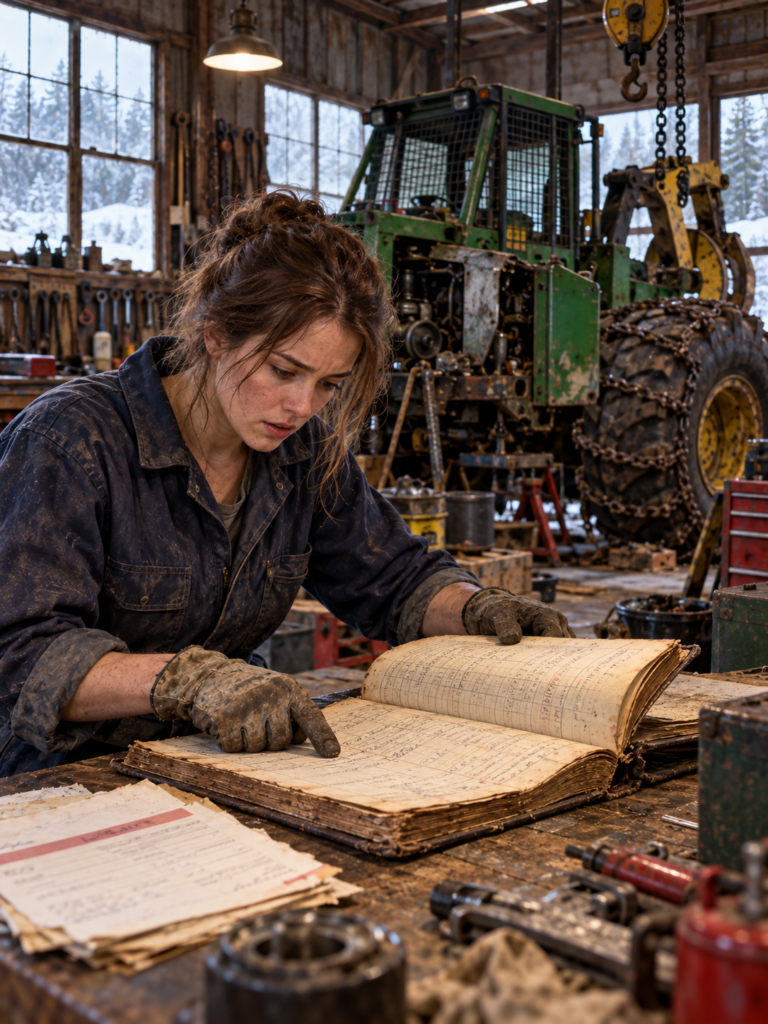
Merritt leaned toward the screen.
It was a lease.
That much was unsurprising. She had always known her grandfather rented the workshop.
What she had never seen was its complete term.
Ninety-nine years.
She moved her finger beneath the line to make certain she had not misread it.
The monthly rent was $65.
There were the signatures of the original building owner and Alvar Extrand.
There was the notarial acknowledgment.
And there was the county recording information.
Merritt checked the date again.
1968.
Ninety-nine years.
The written term extended to 2067.
For several seconds, she heard only the reader’s mechanical hum.
Then she started reading again.
Because finding a long lease did not, by itself, answer every legal question. Its enforceability, and the rights available after her grandfather’s death, still mattered.
But the document established something the eviction notice had ignored.
Her grandfather had not merely rented a workspace through an informal monthly arrangement.
He had entered into a long-term lease and placed it in the public records.
Decades before Truhella bought the property.
Merritt thought about the conversation at his yard.
The comfortable handshake.
The offer of two brighter bays.
The rent she could not afford.
Truhella had treated the old rental arrangement as something he could clear away.
But the document in front of her suggested that the property had come with an existing obligation.
She copied the reference carefully.
Then she read both pages again, concentrating on the actual terms rather than the possibility of victory.
Her grandfather had made that payment when she was not yet alive.
He had kept the paper where a future owner could have found it.
And he had recorded the expense in the same book where he wrote down bearing numbers, replacement parts, and repair costs.
Merritt requested certified copies.
At the counter, she paid the copying fees and placed one copy inside an envelope addressed to Truhella Timber Company.
She did not compose an angry letter.
She did not threaten him.
She simply sent the recorded document.
The other copy went back to Bay 3.
There, she hung it near the maintenance card she used when servicing the John Deere.
Cass noticed it when he arrived.
“What’s that?”
“Something Grandpa filed in 1968.”
Cass looked between the document and the eviction notice still taped to the outer door.
“Does that mean we’re staying?”
Merritt considered the question.
“It means he should have read the records before he bought the building.”
Nine days later, a Truhella employee walked up Rasmuson Street, carefully removed the eviction notice from Bay 3, and carried it away.
There was no meeting.
No apology.
No confrontation.
The demand simply disappeared.
Merritt watched the man leave, then turned back into the workshop.
The machines were still there.
The old tool chest was still against the wall.
For the first time in weeks, she could plan a service schedule without calculating how many days remained before the shop had to be emptied.
But as she reached for her notebook, she noticed the shelf of glass jars above the parts washer.
Each held a little used oil.
Each carried a date and an hour-meter reading.
She had saved them for years without knowing whether she would ever need them.
The recorded lease had protected the space where her machines stood.
It had not protected her business from what a determined competitor might challenge next.
Merritt pulled down the newest notebook, opened it on the bench, and began checking the service history of every working machine.
The newest notebook opened beneath Merritt’s hands, its pages crowded with dates, machine hours, measured clearances, and parts numbers.
Cass stood beside her while she checked the entries.
The John Deere 648 had accumulated thousands of working hours since its rebuild.
The Clark Ranger had been repaired and returned to dependable use.
Both machines had earned their place in the shop, and their records documented why.
“Something wrong?” Cass asked.
“Not that I can find.”
He watched her turn another page.
“Then what are you looking for?”
Merritt considered the question.
She had just discovered that a forgotten entry in her grandfather’s ledger had mattered more than months of worrying about the workshop.
She did not want to overlook another piece of evidence simply because it appeared ordinary.
“I want to know what we can prove,” she said.
That had been Alvar’s rule, although he had expressed it less directly.
He never accepted a repair as successful merely because the machine started.
He measured.
He recorded.
He checked again after it worked.
Merritt had learned that a working machine could conceal a developing failure, just as a document could conceal an important date.
Now she had to run a growing timber operation without letting those details escape her.
The reopening of the Halgrren mill had changed the business across the county.
During the years when the mill was closed, equipment sat unused in barns and yards. Contractors sold machines to reduce their debts. Some dismantled good equipment for parts because there was too little work to justify repairing it.
Merritt had studied those years in her grandfather’s records.
She had noticed that when mills reopened, cutting demand often returned faster than usable equipment could.
She could not know exactly when Halgrren would restart.
But she had prepared for the possibility.
She had maintained the John Deere instead of selling it.
She had purchased the used Clark Ranger at a farm sale and rebuilt it for comparatively little money.
And she had trained Cass to understand the machines rather than merely operate their controls.
Cass was nineteen when she hired him.
He had come into Bay 3 and recognized the old John Deere as the wreck from the bankrupt logger’s auction.
After inspecting the rebuild, he asked about the hydraulic pump’s most recent service measurements.
That question had mattered to Merritt.
She was accustomed to men asking who would run her equipment, whether she had a father managing the shop, or whether the work was too much for her.
Cass wanted to know what the machinery was doing internally.
She hired him.
He carried a small pocket notebook, and whenever she explained a problem, he wrote down the important details.
That habit reminded her of herself at fourteen, standing beside Alvar while he inspected machines that other people had given up on.
When the mill reopened in September 1996, the rates paid for moving timber rose quickly.
Garrick Lundine, a timber broker, offered Merritt three parcels that needed to be completed within the same seasonal window.
She operated the John Deere on the most difficult ground.
Cass handled another parcel with the Clark.
Orville Penhal, an experienced independent contractor, took the third under a subcontracting arrangement.
They moved 1,940 tons.
At eighteen dollars per ton, gross revenue reached $34,920.
After wages, fuel, subcontracting, and other operating costs, Merritt’s net for those eight weeks was $14,310.
For a woman whose first purchase had been mocked as worthless iron, that was substantial progress.
But it also made her visible.
Truhella Timber Company was no longer dealing with a girl trying to repair one abandoned machine.
It was competing with a small, efficient contractor who had very little equipment debt.
The eviction notice had been the first serious threat to that progress.
The recorded lease neutralized it.
But Merritt soon learned that preserving her building was not the same as preserving her opportunity to work.
In 1998, she kept accepting contracts and expanding with caution.
She did not purchase machinery simply because she could afford the asking price.
Every prospective machine had to justify itself against expected production, likely repair costs, and the risk of downtime.
She continued salvaging equipment that others considered unsuitable for commercial use.
Her fleet eventually grew to four working skidders.
Every major component had an inspection history.
Every machine had a service schedule.
And every operator was expected to write down not only the work performed but also what had been found.
In 1999, Merritt brought another young worker into the shop.
Anakah arrived with a notebook of her own.
When Merritt asked how she would diagnose a hydraulic system losing pressure, Anakah did not immediately name an expensive replacement part.
She described checking the hoses, filter, and pressure readings, then comparing the measurements against earlier recorded values.
Merritt asked to see her notebook.
The pages contained observations detailed enough to show that Anakah understood the difference between a suspicious symptom and an established mechanical fault.
She was hired.
That summer, an opportunity appeared that could establish Merritt’s business on an entirely different scale.
Harnen County offered a three-year selective logging contract covering approximately 4,800 acres in the Tamarack Sink area north of Kelso Grade.
The work required four machines in the field and careful handling of remaining timber stands.
It was the sort of contract Merritt had been preparing to take.
She knew parts of the terrain from trips she had made years earlier with her grandfather.
She also knew the dangers of poorly planned skid roads, steep ground, and seasonal thaw.
Then she read the bidding requirements.
There were financial conditions she had not seen in comparable earlier county offers.
A $250,000 performance bond.
Audited financial statements covering three fiscal years.
She checked old bid documents to make certain her memory was correct.
Those requirements had not appeared in the same form before.
She asked the county forester, Doc Stater, about the changes.
He could not tell her who had requested them.
Merritt went back to her numbers.
There was no evidence that the contract itself was beyond her capabilities.
She had four machines.
She had trained operators.
She had records of production, maintenance, and expenses.
She submitted a bid.
When the county opened the figures in September, hers was the lowest responsible price on the tabulation by a significant margin.
For a short time, she believed the careful years had finally brought her to the opportunity she had been working toward.
Then Truhella Timber Company filed a formal protest.
This time, Truhella did not challenge her lease.
He challenged her machines.
Attached to the protest was a professional equipment appraisal.
It described a four-machine fleet with fatigued frames, worn hydraulic systems, and components allegedly approaching the end of their useful service lives.
The appraiser, Ivor Mley, concluded that the equipment as presented for inspection posed a serious risk of failure during a multiyear contract.
Merritt read the appraisal standing at the same bench where she had rebuilt her first skidder.
She checked the descriptions against her service books.
The appraisal was not simply insulting.
If accepted, it could damage her ability to win the county’s largest contract.
She had enough equipment to perform the work.
But the county needed reasonable confidence that her fleet would remain reliable.
Now there was a written professional opinion saying otherwise.
For the first time in years, she seriously considered reducing the business.
She could sell some machines, keep a small operation with Cass, and avoid the pressure of competing for county contracts.
Cass found the protest on her bench.
After reading it, he suggested submitting the work under his name.
He offered because he thought it might remove one obstacle.
Merritt understood his intention.
But she refused.
If she had to disguise ownership behind a man’s name to be accepted, the business would no longer stand for the work she had built.
She would answer the appraisal with evidence.
First, she examined what it actually said.
The document criticized wear, deterioration, and likely failure.
It did not establish that every machine in her fleet was presently failing.
It relied heavily on the condition of the equipment the appraiser had inspected.
Merritt knew something about the difference between a machine’s outward age and its internal condition.
But her own testimony would not necessarily persuade a county committee.
She needed independent measurements.
That was when she looked toward the shelves above the parts washer.
The jars.
She had been saving used engine and hydraulic oil at regular service intervals since 1995.
Every jar carried the machine identification, date, and hour-meter reading.
The records had seemed almost excessive when she began collecting them.
Now their purpose became clear.
She selected fourteen samples representing different stages in the John Deere’s working life.
For every jar, she found the corresponding maintenance entry and made a copy.
Then she packed the samples and sent them to a laboratory in Green Bay specializing in oil analysis.
She requested measurements of wear metals.
Iron.
Copper.
Chromium.
And other elements that could indicate deterioration or contamination.
The results returned in a plain envelope.
Merritt spread the pages on the bench.
She placed a straightedge beneath the column measuring iron content.
If substantial internal wear had been accelerating over the years, the measurements could reveal a developing pattern, although oil analysis alone could not certify the entire machine’s condition.
She compared the earlier samples with the later ones.
The iron values fluctuated modestly.
They did not show a sustained upward progression.
The copper and chromium readings were similarly steady.
Silicon remained low.
Together with the detailed inspection and service logs, the results contradicted the idea that the John Deere was merely being operated until an inevitable near-term collapse.
For the first time since receiving the protest, Merritt felt she had something stronger than an argument.
But another detail in the appraisal still bothered her.
Some descriptions did not resemble her working equipment.
One machine was said to have a broken front axle.
Another fault involved a seized hydraulic motor.
She remembered exactly where she had seen those conditions before.
Behind Bay 3.
On a 1979 Timberjack 225 she had bought at a farm sale for $420.
She had purchased it as a source of usable parts.
Its axle was broken.
Its hydraulic motor was seized.
It had never been part of her operating fleet.
The Timberjack had remained in the rear yard, painted the same color as her other equipment to protect the exposed steel.
Merritt laid the appraisal beside her machine inventory.
Then she checked the serial numbers.
The possibility that emerged was more damaging to the protest than any speech she could have made.
The appraiser might have inspected a nonworking parts machine and treated it as one of her active skidders.
But suspicion was not enough.
She needed to establish precisely which machines had been examined.
The county hearing was scheduled for October 21, 1999.
Merritt assembled her service histories, oil-analysis results, serial-number records, and the appraisal itself.
On the night before the hearing, she placed the documents into a cardboard folder.
Then she opened the appraiser’s report to the page describing the broken axle and ran her finger down the machine identification line.
A machine that had never moved under its own power might have been used to discredit an entire working fleet.
And the official who had written that conclusion would be sitting in front of her the next morning.
The next morning, Ivor Mley sat at the front of the county meeting room with his appraisal open before him.
Merritt sat on the opposite side, her cardboard folder resting on the chair beside her.
The October 21 hearing drew more attention than an ordinary timber-contract protest.
Contractors attended.
County representatives occupied the front tables.
Ledard Truhella sat with his son Doran.
The central question appeared straightforward.
Could Merritt Krogstad’s equipment reliably perform the work required under the three-year Tamarack Sink contract?
Mley began by explaining how he evaluated machinery.
He described the effect of repeated stress on metal frames, the risks of worn hydraulic systems, and the difficulty of predicting major mechanical failures in aging equipment.
He was experienced.
He spoke carefully.
Merritt listened.
Nothing in his explanation was inherently unreasonable.
A badly maintained skidder could lose a contract weeks or months before its operator expected trouble.
She knew that better than most people in the room.
She had purchased her first machine in exactly that condition.
Mley described the equipment he had inspected.
He mentioned a broken axle.
A hydraulic motor that would not turn.
Deteriorated components.
Structural fatigue.
Merritt wrote the descriptions on her legal pad.
Then she waited.
When the committee gave her an opportunity to present her response, she opened the folder.
She did not begin by accusing Truhella of anything.
She first explained how her machines were maintained.
Every fifty operating hours, routine inspection and lubrication.
More extensive service at specified intervals.
Hydraulic checks.
Component inspections.
Written records.
She produced entries showing actual measurements rather than simple check marks.
Then she presented the independent oil-analysis results.
The samples covered years of operation of the original John Deere 648.
They were identified by machine and hour-meter reading and corresponded to dates already recorded in the shop notebooks.
The laboratory report showed no sustained rise in the wear-metal readings that would ordinarily support a claim of progressive internal deterioration.
She did not claim that oil samples made failure impossible.
A hose could rupture.
A frame could crack.
An unexpected bearing failure could still stop a machine.
But the results provided meaningful evidence that the engine and hydraulic systems were not deteriorating in the manner suggested by the broad assessment of her fleet.
The committee examined the pages.
Then Merritt brought out the machine identification records.
She asked Mley to confirm the equipment listed in his report.
He read the serial numbers.
She read hers.
They did not match.
The room became quiet.
Merritt explained that the machine with the broken front axle was a Timberjack 225 sitting in the rear yard of her shop.
It had been purchased as a parts machine.
It was not one of the four working skidders proposed for the county contract.
Mley reviewed his notes.
Then he acknowledged the problem.
He had been provided an address and equipment schedule.
At the yard, he had inspected what he was shown.
Where identification plates were difficult to read because of paint, he had relied on numbers from the supplied schedule rather than verifying every plate directly.
As a result, at least one machine he had evaluated was not a member of Merritt’s working fleet.
That admission mattered.
It did not establish that Mley had deliberately falsified his report.
It did not establish that Truhella had instructed him to make that error.
But it did establish that the professional appraisal being used to challenge Merritt’s capability was materially flawed.
The committee could no longer treat it as a reliable assessment of the four working machines she intended to use.
Merritt did not demand an apology.
She did not attempt to humiliate the appraiser.
The documents had answered the question more effectively than anger would have.
When the committee voted, the protest failed.
Her bid stood.
The contract was hers.
For the next three years, Merritt’s crews worked the Tamarack Sink ground.
The work was difficult.
There were seasonal restrictions, long hauling distances, and stretches of terrain where a poorly planned route could damage the remaining stand.
Four machines worked the unit during the productive months.
Cass ran whichever equipment the schedule required.
Anakah eventually operated the original John Deere.
Penhal handled suitable subcontracted work along the far side.
Through the autumn of 2002, the operation moved approximately 18,000 tons.
Gross revenue across the contract was about $349,200.
Net income after the substantial operating expenses was approximately $114,630.
There were repairs, of course.
There always were.
But the machines did not collapse in the manner the appraisal had predicted.
The original John Deere finished that period with approximately 8,900 hours on the replacement meter Merritt had installed in January 1994.
Its maintenance history was recorded in detail.
Scheduled inspections.
Replacement hoses.
Seals.
Pump work.
Engine work.
Tires.
Small parts.
The machine that nobody had wanted at the 1993 auction had become the foundation of an established logging business.
Yet that was not quite the end of the story.
Because Merritt’s success did not come from a single surprising repair.
It came from a practice that had begun years before the machine entered her life.
A man writing down what he found.
A girl learning to read what he wrote.
And a series of apparently insignificant records that eventually became indispensable.
The $4 entry in Alvar’s ledger had led her to the recorded lease.
The recorded lease had helped defend her right to remain in Bay 3.
The maintenance logs had supported her insurance history and later demonstrated the care given to her machinery.
The jars of oil had provided independent evidence when an equipment appraisal threatened her largest contract.
Even the broken Timberjack, which had no value as a working skidder, became important because Merritt could identify precisely what it was and what it was not.
There had never been a secret treasure hidden in the workshop.
No sealed chest of money.
No miraculous machine that fixed itself.
The value had been distributed across ordinary documents, measurements, and objects that other people considered unimportant.
Truhella’s company eventually suffered its own problems.
The unsuccessful protest became part of a public record.
Its inaccuracies could be examined by others.
In 2002, the surety company that provided bonds for Truhella Timber Company declined to renew its arrangement.
The company did not publicly establish every reason for that decision.
What mattered commercially was that the loss of bonding capacity restricted Truhella’s ability to compete for public contracts.
Merritt did not celebrate at the shop.
She still had work to finish.
Still had operators to pay.
Still had equipment that needed inspection before morning.
There were contracts to price and invoices to collect.
And the next mechanical failure never cared who had won the last argument.
Over time, the business changed.
Cass eventually left in 2004.
He was twenty-seven then, after eight years operating Merritt’s machinery.
He had acquired an old skidder of his own and rebuilt it for less than $2,000.
When he departed, he took three personal notebooks filled with what he had learned.
Merritt did not try to keep him.
Years earlier, Alvar had taught her by allowing her to work beside him.
Now Cass was carrying that knowledge into his own business.
The following summer, he telephoned to ask about a hydraulic valve that was behaving strangely under pressure.
Merritt talked him through a diagnostic sequence.
She did not simply tell him which part to replace.
She asked him what the pressure readings showed.
What the last service entry said.
Whether the problem appeared cold, warm, or under load.
By then, she recognized the importance of making someone reason through a problem instead of merely handing them an answer.
Anakah remained.
Her early pocket notebook developed into a far more comprehensive system.
As the fleet expanded, she created indexes connecting machine serial numbers, components, dates, and maintenance records.
A mechanic could retrieve the history of a particular pump or drivetrain component without searching through years of unrelated entries.
By 2008, Anakah was managing the day-to-day operation.
She scheduled crews, ordered replacement parts, and coordinated maintenance.
The business had five machines, four operators, and a bookkeeper.
Annual gross revenue reached approximately $212,000.
Net income was about $68,420.
The original John Deere remained part of the fleet.
Its history stretched from a muddy auction yard to thousands of hours of productive work.
The machine had long since stopped being a curiosity.
It was simply equipment that had earned its keep.
The workshop on Rasmuson Street remained the center of the operation.
The same floor drain still carried water away from cleaned equipment.
The chain hoist still hung above the work area.
Alvar’s red steel box still held the hydraulic gauges he had assembled.
The old tool chest stood where Merritt remembered it.
There were more notebooks now.
Some had been placed in a fireproof box after Anakah suggested that the records were becoming too valuable to leave unprotected.
The shelves of oil samples had grown as well.
By the autumn of 2008, they held 272 jars.
To a stranger entering the shop, the collection might have looked like a peculiar habit.
Small containers of dark used oil.
Strips of aging tape.
Dates and hour readings.
Nothing decorative.
Nothing impressive.
But Merritt knew how much those jars had once mattered.
She also understood something else about her grandfather’s records.
Alvar had not left her a completed business.
He had not purchased machines for her.
He had not guaranteed that timber prices would recover or that landowners would hire her.
The old ledger had given her information, not certainty.
When she bought the John Deere, there was no promise that its engine could be rebuilt within her budget.
When she discovered the frame crack, there was no promise that the repair would succeed.
When the first landowner stopped her work, she had to solve the insurance problem herself.
When the mill reopened, she still had to win contracts, hire people, and manage production.
And when Truhella challenged her workshop and her machinery, the old documents did not defend themselves.
Merritt had to find them.
Read them.
Verify them.
Use them.
That was perhaps the most important distinction in the whole story.
Her grandfather had preserved knowledge.
She had learned what to do with it.
One autumn, the original John Deere returned to ground Merritt remembered particularly well.
Orin Scogland’s property on Otterlide Road.
It was the same twelve-acre area where she had worked her first significant contract in the winter of 1994.
Back then, she had been twenty, working alone, checking every skid trail because she could barely afford one dissatisfied customer.
The job had nearly collapsed after Truhella Timber Company sent the warning about her lack of insurance.
She had eventually completed it for a reduced rate.
Now, years later, the operation had returned for another cutting cycle.
Anakah ran the old 648.
Orin was in his late seventies.
The forest had changed.
Some trees had grown into new value.
Others showed the ordinary effects of time and previous harvesting.
Merritt understood the importance of that return.
Good logging was not merely the amount of timber removed.
It was also what remained standing when the machinery left.
A contractor could produce a profitable season and leave damage that would outlast the equipment.
Her grandfather’s notes had taught her to think beyond the immediate repair.
Her own years of logging had taught her to think beyond the immediate load.
The second visit to Scogland’s ground was not a triumphant reenactment.
No crowd gathered.
Nobody repeated the jokes from the auction.
The John Deere simply went to work.
And the man who had first hired her had lived long enough to see the same machine return.
Merritt kept that fact in mind when she later examined the shop records.
The notebook entries from 1994 were still there.
So were the entries from the first rebuild.
The old machine had a history that could be followed almost continuously from the moment she set its replacement meter to zero.
A machine could be maintained.
A business could be expanded.
A contract could be won.
But the years themselves could not be recovered.
Alvar had died before she bought the John Deere.
He never saw the damaged skidder arrive at his workshop.
Never stood beside her while she repaired the eleven-inch frame crack using his 1971 instructions.
Never watched the machine move its first load of timber.
He never saw the mill reopen or the business grow beyond one operator.
And he never knew that a four-dollar recording fee, entered into a ledger decades earlier, would become the clue his granddaughter needed when someone tried to take away the shop.
He could not have known those particular events were coming.
That was what made the old records so meaningful.
They had not been written to predict Merritt’s future.
They had been written because Alvar believed work should leave an honest account of itself.
One evening, Merritt returned to the bench after the day’s machinery had been shut down.
The workshop was quieter than it had been in the early years.
There were other people now who could perform inspections, order parts, and answer questions that once came only to her.
Anakah’s maintenance system was more advanced than the notebooks Merritt had used in 1993.
But the older books remained on the shelf.
Merritt took down the first ledger.
Its binding had softened with years of handling.
She opened it near the beginning.
June 1968.
The familiar expenses appeared.
Rent.
Power.
Supplies.
And the four-dollar recording fee.
She looked at it for a long time.
Then she turned forward through the years.
There were entries describing machines long since scrapped.
Jobs performed at mills that no longer operated.
Repair measurements written for equipment whose owners were dead or retired.
A few notes about mistakes Alvar had made and the procedures he changed afterward.
He had never pretended to be incapable of error.
He had recorded his errors so that someone else would not have to repeat them.
Merritt closed the ledger.
Nearby sat one of the later notebooks, written partly in Anakah’s hand.
Another generation of repairs.
Another set of observations.
Different machines.
The same underlying discipline.
She placed the old ledger back on the shelf instead of locking it away.
The book was no longer merely something left by a grandfather who had died.
It was a working reference.
A record of what had already been paid for in time, labor, and mistakes.
The next morning, Anakah would arrive with the service schedule.
One of the machines would need hydraulic work.
Another had a tire that had been losing a little pressure between inspections.
There would be calls from landowners and questions from operators.
The ordinary problems of a business that continued to exist.
Merritt switched off the bench light.
Before leaving, she looked once toward the original John Deere 648.
In 1993, sixty people had seen it in a muddy yard and decided it was not worth their money.
She had seen the same machine and believed some of its problems might be repaired.
She had been right about enough of them to begin.
But the machine’s real value had never existed in the purchase price alone.
It existed in the years of labor that followed, the contracts it completed, the people who learned to operate it, and the records that made its condition understandable.
She had once feared that other people’s opinions would decide whether she was allowed to work.
By 2008, her name stood on a business whose results could be examined in its own records.
And the workshop remained in use.
The old lease had been recorded long before she was born.
Its stated term ran until 2067.
Alvar’s tools were still there.
His gauges were still there.
The ledger was still there.
But the woman who once walked through an auction yard carrying a flashlight was no longer merely keeping her grandfather’s shop open.
She had built something that could continue when she was not standing at the bench.
That was her final answer to the people who had laughed at the broken skidder.
Not a speech.
Not an argument.
Not a victory announced across a crowded room.
Just the machine still working, the workshop still open, and another generation writing down what it learned.
Merritt pulled the door closed behind her.
Inside, the old ledger rested beside the newer service books.
And by morning, there would be another date to enter.