
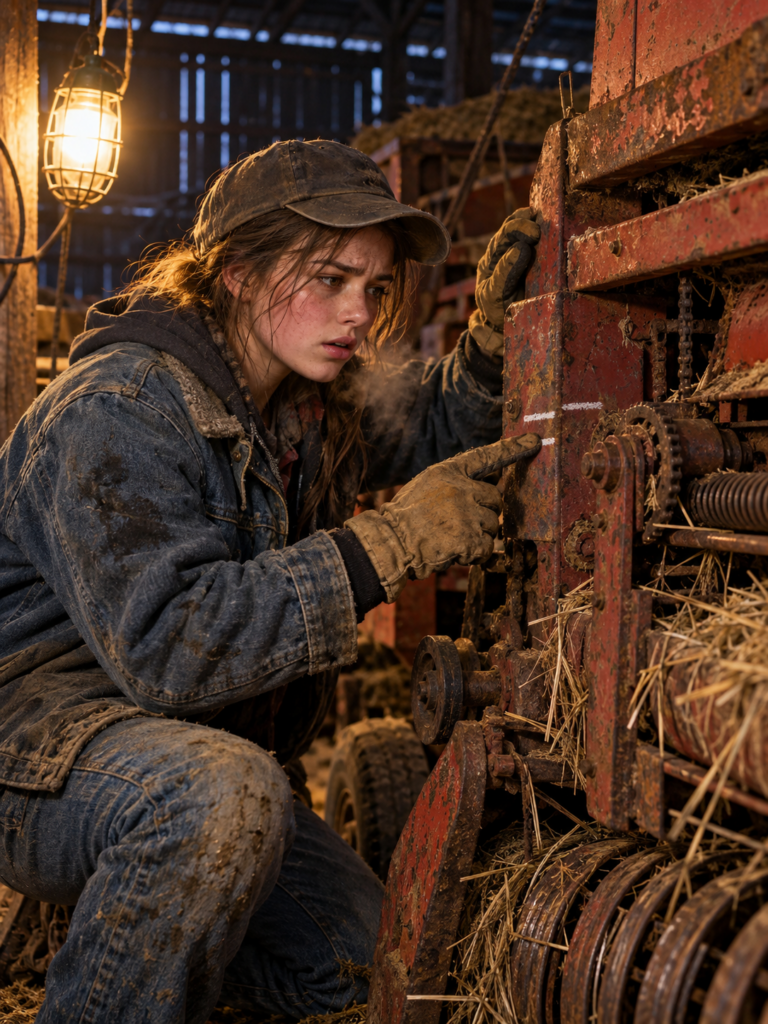
The light caught a thin, irregular line in the steel beneath the accumulated grease.
Callie leaned closer.
At first, it looked like a scratch.
She wiped the surface with a rag.
The mark did not disappear.
It ran through part of the frame brace, almost concealed by grime and the surrounding metal.
A crack.
Small enough to escape a casual inspection.
Possibly small enough to remain nearly closed when the machine was standing still.
Callie felt her heartbeat quicken, but she did not reach for the welder.
She remembered what her father had told her.
Understanding had to come before repairing.
She examined the brace, its mounting points, and the surrounding frame.
The crack was real.
That much she could establish.
But a crack alone did not prove it had caused Roy Shackleton’s intermittent knotting failures.
The chalk lines offered the second piece of evidence.
When the machine operated under a heavier load, the needle no longer traveled through precisely the same position relative to the knotter.
The difference was extremely small.
But hay balers depend on precisely coordinated movement.
Twine has to reach the bill hook at the correct moment and in the correct position.
If the supporting frame deflects, the components can each be mechanically sound and still fail to meet correctly.
That would explain something that had confused three experienced mechanics.
The machine could perform perfectly during a light test.
It could also fail repeatedly while compressing heavier hay in the field.
Callie sat back on her heels.
She remembered her father’s test in 1990.
He had run Roy’s baler with light hay from their own barn.
Two afternoons without a missed knot.
He had concluded that the machine itself was sound.
In one sense, he had been correct.
The knotter had been functioning properly under the conditions he tested.
What he had not established was how the entire frame behaved under the heavier conditions that caused the complaint.
Callie looked again at the white lines.
The evidence was pointing toward a structural problem, not a failed knotter.
But she still needed to understand how the crack had affected the frame.
The next inspection was slower.
She cleaned the surrounding metal, examined where the brace transferred load, and compared the crack with the direction of the observed deflection.
The pieces began fitting together.
Under pressure, the damaged brace could no longer maintain the same geometry.
Its slight movement altered the needle’s relationship to the knotter.
Sometimes the shift was too small to matter.
Sometimes it was enough to prevent the twine from being caught.
That was why the failures seemed unpredictable.
They depended on changing loads inside the bale chamber.
And that was why the earlier repairs had failed.
Replacing knotter components could not restore rigidity to a cracked frame brace.
Callie stood beside the machine and considered the implications.
Her father had not been careless.
The dealership mechanic had not necessarily installed anything incorrectly.
Roy had not imagined what he experienced in his fields.
Each man had been investigating a real symptom.
None had identified the underlying cause.
She thought about the money needed to protect the north forty acres.
She thought about the parts she had already invested in the other three balers.
And she thought about something else.
If her diagnosis was wrong, welding the brace would not magically solve the problem.
The repaired machine would have to prove itself under load, for long enough to show that the original failure had disappeared.
Callie placed the shield on the workbench, opened her notebook, and sketched the brace, the crack, and the two different needle positions.
She recorded what she had observed and separated it from what she still needed to confirm.
Then she reached for the tools needed to prepare the damaged steel.
For the first time since taking Roy’s abandoned machine home, she knew exactly which part she intended to repair.
What she did not yet know was whether that repair would produce a baler somebody would trust enough to buy.
Callie carried the cutting tools to the workbench and laid them beside her notebook.
The damaged brace was not going to be repaired by another adjustment to the knotter.
It needed structural reinforcement.
She prepared the cracked area and cut a reinforcing gusset from a piece of quarter-inch steel recovered from the scrap pile behind the barn.
The shop’s torch was out of oxygen, so she worked the plate into shape with a hacksaw and finished its edges with a grinder.
It was slow work.
The kind of work she had done beside her father for years, except that this time the decision was hers.
The metal had to fit.
The repair had to hold.
And the geometry that had shifted under load had to remain stable afterward.
She welded the prepared area and reinforcement.
Her welding experience was limited compared with Dale’s, and the finished bead did not have the smooth appearance of an experienced professional’s work.
But appearance was not her measure.
She inspected the repair, completed the remaining service work, and prepared the machine for another test.
Her recorded cost came to $47, including a drive belt, shear bolts, a used bill hook, twine, and welding supplies.
In February 1993, Dale agreed to help test the baler.
He operated the tractor while Callie observed from a safe distance.
The engine labored against the equipment.
Hay entered the pickup.
The chamber filled.
The knotter completed its cycle.
One finished bale emerged.
Then another.
Callie counted each one.
Ten.
Twenty.
Thirty.
She watched the mechanism with an intensity that made the cold almost irrelevant.
Forty.
Fifty.
Sixty.
Not a single missed knot.
When Dale shut the tractor down, Callie waited for the mechanism to stop before approaching.
Her father climbed down and walked toward the repaired brace.
He inspected the gusset.
Then he looked at the row of completed bales.
“So that was moving,” he said quietly.
“Yes.”
“And the knotter wasn’t the problem.”
“No.”
For a long moment, Dale said nothing.
Then he walked to the final bale, gripped its twine, and lifted it.
The knot held.
He set the bale down carefully.
There was no celebration.
No speech about what his daughter had accomplished.
But Callie knew what that small test meant.
Her father finally understood why a machine he had declared sound had continued failing in the field.
And she had found the answer.
The repairs were successful.
The financial problem was not yet solved.
***
By March, the deadline hanging over the Renard farm was approaching.
The family’s April expenses were not going to disappear.
The bank still expected its money.
And Callie’s repaired balers meant very little unless somebody purchased them.
She knew about the spring equipment consignment auction at the county fairgrounds.
Farmers brought their used equipment there. Buyers inspected machines, listened to auctioneers, and decided what they were prepared to risk their money on.
It seemed like the most direct path to a buyer.
Callie drove to the fairgrounds and approached the intake desk.
Merl Dutton was responsible for deciding which machines could enter the sale.
He had spent years handling agricultural equipment and knew that buyers cared about more than a machine’s apparent condition.
They wanted a history.
They wanted reassurance that someone dependable stood behind the work.
When Callie described her repaired baler, including the cracked brace and welded reinforcement, Dutton listened.
Then he asked about her experience.
She was sixteen.
She had no established business.
No long list of customers.
No recognized reputation as a machinery rebuilder.
Dutton declined to accept the machine.
His refusal was not shouted across the room.
He simply explained that people buying old equipment needed reasons to believe it would work.
Callie gave him the details again.
He remained unconvinced.
Finally, she asked him to come and inspect the machine before making a final judgment.
He told her he had too much work to do.
She left.
Two men nearby exchanged amused looks as she walked away.
What troubled her was not the laughter.
It was that nobody had actually examined the baler.
They were judging the credibility of the person offering it, not the condition of the machine.
She understood why a buyer might hesitate.
She also knew that hesitation could not pay the bank.
The following Saturday, she returned.
This time she did not arrive with an explanation.
She arrived with equipment.
She positioned the flatbed near the fairgrounds parking area, unloaded the repaired baler, and arranged a working demonstration with her father’s tractor.
She had brought loose hay from the family barn.
Instead of asking Dutton to accept her mechanical judgment, she intended to show the machine operating.
The demonstration continued for approximately forty-five minutes.
Finished bales accumulated behind it.
The noise drew farmers from the building.
One of them was Hollis Granger, a cattleman familiar with the cost of unreliable hay equipment.
He examined the baler.
He checked the pickup.
He inspected the knots.
He asked Callie who owned the machine.
“I do.”
Granger looked at her more carefully.
“How much are you asking?”
“Fourteen hundred.”
He offered eleven hundred.
Callie did not accept immediately.
She explained the repair, the operating test, and what he had just witnessed.
Granger studied another finished bale.
The negotiation continued.
They agreed on $1,200, with Callie handling the loading.
They shook hands in the gravel.
The baler had cost her $47 in recorded parts and materials, not counting her time and the other resources involved.
Now it had a buyer.
And Callie had enough money to address the immediate $1,150 problem threatening the family’s acreage.
Merl Dutton did not witness the transaction.
He remained in his office.
Callie did not return to tell him he had been wrong.
She secured the sale and drove home.
***
That afternoon, she laid $1,200 on the kitchen table.
Dale sat across from her.
The bills were arranged neatly.
He examined them without counting them aloud.
“From the baler?” he asked.
Callie nodded.
Dale looked down again.
The family history behind the north forty acres was present in the room, although nobody needed to recite it.
Emmett Renard had purchased that ground through years of careful sacrifice.
Dale had spent his working life maintaining it.
Now his daughter had brought home money earned by understanding machinery in a way he himself had taught her.
He touched the edges of the bills.
“Your grandfather used hog money to buy that first ground,” he said.
A little later, he rose from the table and went out toward the machine shed.
Callie did not follow.
The combine’s final drive was repaired.
Spring inputs were purchased.
The north forty acres were not listed for sale that year.
But that was only the immediate answer.
The operating debt still existed.
The farm was not suddenly prosperous.
What Callie had demonstrated was something more useful than a single profitable repair.
There were farmers all over the region with equipment they had stopped believing was worth fixing.
There were also farmers who desperately needed affordable machines that would operate reliably.
The gap between those two groups represented an opportunity.
Callie began acquiring more neglected equipment.
Some owners let her take it away without payment.
Others wanted a modest sum.
By the summer of 1993, she had eleven additional machines.
Her work was expanding much faster than the family’s shed could accommodate.
Parts filled shelves.
Machines stood beneath tarps.
A disassembled rake occupied space near the old hog pen.
Her mother, Marian, was increasingly unhappy about the clutter.
Dale eventually told Callie that she needed a proper place to work.
She found one two miles up County Road 9.
Clyde Ellison, an elderly retired farmer, had unused gravel ground behind a pole barn.
He agreed to rent it for $75 per month.
Callie built a simple lean-to from salvaged lumber and roofing materials.
She purchased a used stick welder.
In October 1993, nearly a year after hauling away the four abandoned balers, she moved her growing operation onto the rented lot.
She was seventeen.
She hired Lyall Jessup, another seventeen-year-old from a farming family, to help.
And then another experienced mechanic arrived.
Vernon Krebs had spent three decades working at a John Deere dealership.
Retirement had removed him from the shop, but not from the habit of studying machines.
He came to investigate something he had heard about Callie’s business.
A customer had suffered a failure shortly after buying one of her rebuilt machines.
Callie had collected it, investigated the cause, repaired it without charging the customer, and compensated him $200 for lost cutting time.
That incident mattered to Vernon.
He knew how unusual such accountability could be.
When he visited the lot, he inspected the machines and her method of organizing parts.
Components were grouped by their function and mechanical characteristics instead of simply by brand.
Every repaired machine carried information about the work performed.
Vernon examined a rebuilt knotter and asked who had set its timing.
Callie told him she had.
He proposed working with her a few mornings each week.
She agreed.
The operation was becoming a real shop.
But the customer failure Vernon had heard about was more consequential than its immediate financial cost suggested.
***
Earlier that summer, Callie had rebuilt a baler with a damaged pickup-drive bearing.
The damage appeared straightforward.
She removed the failed bearing, installed a replacement, checked the assembly, and returned the machine to service.
She sold it to a farmer.
Nine days into its first cutting season, it failed in the field.
The call came that evening.
Callie collected the machine and brought it back.
This time she investigated beyond the failed bearing.
The pickup-drive shaft was bent.
Only slightly.
Approximately one-sixteenth of an inch out of true.
But that was enough to produce repeated side loading on the bearing.
The previous bearing had not failed merely because it was old.
It had been forced to operate under a condition it could not survive indefinitely.
Replacing it had treated the visible damage without eliminating the cause.
Callie recognized the mistake immediately.
It was the same reasoning problem that had trapped the mechanics working on Roy Shackleton’s baler.
They had inspected the knotter.
She had inspected the bearing.
The damaged component had occupied all their attention.
The actual cause had remained elsewhere.
She rebuilt the pickup drive properly, corrected the shaft problem, and replaced the necessary components.
She charged the customer nothing.
The episode cost her approximately $600 in direct and related losses.
But it cost more than money.
That night, she sat alone in the workshop, thinking about how easily she had abandoned her own best practice.
She had known better.
She had been tired.
Busy.
Eager to finish.
She had accepted an obvious explanation without proving it.
In frustration, she threw a wrench against the sheet-metal wall.
It left a dent.
By morning, she had retrieved the wrench and returned it to the bench.
Dale found her in the shop.
She told him the bearing had failed because she had not checked the shaft.
He listened.
Then he reminded her that knowing why something failed mattered more than simply replacing what was damaged.
The conversation settled something in Callie’s mind.
She could not build a dependable business on occasional moments of exceptional insight.
She needed a method that made careful investigation routine.
Every machine would have to pass repeated tests under realistic loads.
Every repair would need documentation.
The underlying failure would have to be identified, not merely the component showing damage.
And somebody would have to sign for the work.
Marian helped design the forms.
Her experience organizing patient records at the medical clinic gave her a practical understanding of why good information had to be complete and readable by others.
The repair cards recorded each machine’s original complaint, diagnosed cause, replaced parts, labor, tests, and responsible mechanic.
It was a simple system.
But it changed the business.
The proof would arrive when a dealer offered Callie a contract large enough to transform her finances almost overnight.
Twenty machines.
A proposed $1,200 per machine.
Twenty-four thousand dollars in potential work.
Callie studied the numbers.
Then she studied the hours.
To satisfy the testing and repair standards she had just established, her small shop could complete only about fifteen machines a season.
She declined the larger commitment.
Lyall was disappointed.
The money could have helped them both.
Yet Callie refused to make promises her shop could not reliably keep.
And that decision placed the future of her business on a very different path from the operation that accepted the contract.
The dealer took his twenty-machine contract to a reconditioning shop in Williamson County.
For a while, that business earned more money than Callie’s operation.
Its equipment moved quickly through the workshop and back into the market.
Callie’s shop continued at its slower pace.
Every machine was inspected, repaired, documented, and tested.
She had no guarantee her approach would prove more profitable.
She only knew what happened when a machine left her workshop before the original failure had been understood.
The memory of that bent pickup shaft was sufficient to keep her from repeating the mistake.
Within a few years, the difference between the two businesses became difficult to ignore.
Some of the equipment reconditioned elsewhere began returning to service shops with fresh failures.
Bearings wore prematurely.
Hydraulic problems returned.
A mower conditioner suffered a dangerous cutter-bar fastening failure.
Nobody was injured in that incident, but the potential consequences were serious.
The shop that had accepted the twenty-machine contract eventually closed its equipment reconditioning operation.
Callie did not celebrate.
She understood too well how quickly a repair business could lose a customer’s confidence.
Instead, she continued building the record that every skeptical buyer had wanted her to possess when she was sixteen.
***
In the spring of 1994, Callie returned to the fairgrounds.
Merl Dutton was still managing the auction intake.
He recognized her.
This time she placed a typed list on his desk.
Six machines.
Their makes and models.
Their original failures.
The causes identified during repair.
The parts replaced.
And references from farmers who had already purchased her equipment.
Dutton examined the sheet.
He read it again.
The girl he had refused to accept a year earlier was now offering something that addressed his original objection.
Not promises.
A service history.
He agreed to visit her workshop.
When he arrived, he inspected the machines carefully.
He read the repair cards and tested the equipment.
He agreed to accept four of the six for the auction.
The remaining two were too old for the market he expected at the fairgrounds.
Callie sold those privately.
She had no reason to challenge his decision.
He had inspected the equipment this time.
That mattered.
Later that year, nine of her machines entered a consignment auction.
The bidding was stronger than expected.
The crowd began paying attention as consecutive lots sold above their estimates.
One machine in particular drew intense competition.
A John Deere 24T baler had arrived at Callie’s workshop badly damaged.
Its flywheel housing was cracked, and its driveline required extensive repair.
She had devoted approximately sixty hours to restoring it.
Before sending it to the fairgrounds, the baler passed the load testing required by her shop.
Its bidding began at $900.
The price climbed.
Then climbed again.
The hammer finally fell at $2,800.
Across the nine machines, sales totaled approximately $31,000.
The machinery was no longer being treated as worthless old iron.
Buyers were paying for the work, reliability, and documented repair history associated with Callie’s operation.
After the auction, Dutton approached her.
He admitted he had misjudged demand for properly rebuilt equipment.
The distinction was important.
He had believed the used hay-equipment market was weak.
What he had failed to recognize was that buyers still wanted older equipment when they believed it could be trusted.
Callie accepted the acknowledgment without making a spectacle of it.
She remembered the first Saturday when she had demonstrated a functioning baler outside his office.
He had remained at his desk.
The machine had been operating correctly whether he witnessed it or not.
Now he had seen what he previously dismissed.
***
The business expanded through repeat customers rather than dramatic advertising.
Hollis Granger returned.
Other farmers came because someone they knew had purchased a machine that survived an entire cutting season without trouble.
By the late 1990s, Callie’s rented lot had become a more permanent operation.
There were employees, better equipment, organized work areas, and a proper shop building.
Marian took responsibility for much of the bookkeeping and customer follow-up.
She contacted buyers after their purchases.
If something was not working properly, the shop wanted to know.
Problems were addressed rather than concealed.
This was not simply good customer service.
It was how the repair system improved.
Each failure added information.
Each cause identified made a future diagnosis more reliable.
By 1998, Callie had purchased Clyde Ellison’s property outright.
The gravel yard where she had begun under a salvaged roof belonged to her.
But the original Renard farm still carried financial obligations.
The north forty acres remained part of the family’s ongoing struggle to keep the entire operation solvent.
Callie had prevented an immediate sale in 1993.
She had not yet freed the family from the bank note.
That would take several more years.
***
The summer of 2000 brought severe heat and difficult agricultural conditions to southern Illinois.
Hay yields suffered.
Farmers pushed existing equipment hard because there was little room for delay.
A breakdown could mean losing the narrow window in which hay could be harvested at acceptable quality.
Equipment reliability became especially valuable.
Some reconditioned machines from other shops failed during the season.
Callie’s rebuilt equipment held up.
The years of careful diagnosis, structural inspections, load tests, and written accountability were producing measurable results.
Her customers depended on those machines.
And their dependable performance was helping sustain her business.
The year was not an easy one for the county.
But Callie’s shop produced approximately $58,000 in revenue, with a reported net margin of 44 percent.
That autumn, she made the payment her family had needed for so long.
She settled the outstanding operating note.
The balance was cleared.
The accumulated financial pressure tied to the farm finally lifted.
The north forty acres—Emmett Renard’s first piece of ground—remained in the family.
No auction.
No sale.
No strangers measuring the ridge and creek for a new fence line.
Callie had not discovered a hidden fortune inside a rusty machine.
She had found a way to earn a living from the mechanical knowledge her father had spent decades using only to keep his own farm operating.
That difference changed the family’s future.
It also changed how Dale understood his daughter’s work.
He had taught her how to repair machines.
She had shown him how that knowledge could become an independent business.
***
Another kind of inheritance was taking shape inside the shop.
Vernon Krebs, the retired dealership mechanic who had joined Callie in 1993, began writing down the lessons from his decades of work.
Callie’s notebooks concentrated on measurements, parts, and repair procedures.
Vernon’s writing examined broader principles.
Why one design failed differently from another.
Why manufacturers sometimes deliberately included components intended to fail before more expensive assemblies were damaged.
How a mechanic could understand the engineering decisions behind a machine instead of treating every breakdown as an isolated accident.
In 1998, he assembled those ideas into approximately 140 typed pages.
Callie kept the spiral-bound volume behind the counter.
It became a reference the shop consulted regularly.
When a difficult machine arrived, Vernon encouraged the mechanics to think beyond the obvious damaged part.
What had the designers intended?
Where was the load supposed to travel?
What component would be expected to fail first?
And what did the observed failure reveal about the stresses the machine had experienced?
These were not abstract questions.
They were variations on the same problem Callie had solved with two chalk lines in 1993.
A sound knotter had been mounted on a frame that changed shape under load.
Understanding the entire system mattered.
Vernon’s health gradually declined.
By January 2002, he could no longer depend on his hands to perform the work he loved.
He came into the shop, put his tools away, and told Callie that his working days were finished.
She had known his strength was failing.
But hearing him acknowledge it was still painful.
Vernon died in March 2003.
Callie closed the workshop so the employees could attend his funeral.
At the reception, Vernon’s daughter told her something he had said at home.
Of all the mechanics he had helped train, Callie had been the student he most admired.
Not because she never made mistakes.
Not because every repair came easily.
Because she wanted to know the reason behind a failure before claiming to have solved it.
Callie listened without interrupting.
She thought about the man who had walked into her gravel lot years earlier, inspected her work, and offered his experience without demanding control.
She thought about how much of his knowledge now existed in the shop’s daily procedures.
His spiral-bound notebook returned to its place behind the counter.
It remained there.
Not as a monument.
As a working reference.
***
In October 2007, a muddy pickup turned into Callie’s yard on County Road 9.
A flatbed followed behind it.
Four damaged agricultural machines were secured to the trailer.
A hay rake.
A small square baler.
A mower conditioner.
And an old corn planter.
The driver climbed down.
Her name was Norah Bowen.
She was fifteen years old.
Callie watched her approach the workshop.
The girl’s jacket was oversized, her boots showed considerable wear, and grease had settled into the creases of her hands.
Norah explained that she had brought the equipment because she believed some of it could be repaired.
Callie listened.
She asked what each machine had been doing before it failed.
Norah described the symptoms.
She explained which parts appeared usable.
When she did not know the cause of a problem, she said so.
That impressed Callie more than any confident guess could have.
The girl understood that a symptom was not the same thing as a diagnosis.
Callie agreed to take the machines under terms Norah accepted.
Then she offered her something unexpected.
She invited Norah to remain and watch the first machine being dismantled.
It was an invitation Callie herself had rarely received at that age.
Back in 1992, people had assumed she was collecting equipment for her father.
They had spoken to her as though she were carrying out someone else’s instructions.
Now she stood in her own workshop and could make a different choice.
Norah accepted.
She returned the following Saturday.
And the next.
By spring, she was a regular presence around the benches.
After several months, Callie hired her.
The girl learned the shop’s methods.
She studied Vernon’s notebook.
She helped inspect equipment.
She understood why every machine carried a repair card.
But two years later, she noticed something Callie had overlooked.
And for the first time, Callie found herself on the other side of an argument she knew very well.
***
By then, the workshop had accumulated approximately 1,600 repair records.
Marian’s original forms were stored in four filing cabinets.
They contained years of valuable information.
Each card described one machine and one repair history.
But the records were arranged according to when the work had been performed.
That made individual jobs easy to document.
It did not make recurring failures easy to identify across hundreds of machines.
Norah wanted to enter the information into a computer database.
The records could then be searched by model, component, failure type, and operating conditions.
Callie resisted.
She had built the paper-card system after a painful mistake.
It had helped create the reputation on which the business depended.
She saw no reason to replace something that worked.
Norah disagreed.
She pointed out that a mechanic might repair the same recurring problem dozens of times without noticing how frequently it appeared across the records.
One repair card could be accurate.
All the cards could be accurate.
Yet the shop could still be missing a pattern hidden in the larger collection.
Callie rejected the proposal.
Then rejected it again.
For several days, the disagreement remained unresolved.
One Thursday, Callie opened a filing cabinet while searching for a particular New Holland repair record.
As she worked through the cards, she noticed repeated entries involving the same type of pickup-bearing failure.
She examined more.
The same problem appeared again.
And again.
Approximately thirty similar repairs were represented across years of records.
Each had been handled as an individual job.
Each had been documented correctly.
But the repeated pattern had not been recognized as a pattern.
Callie closed the drawer.
She remembered the baler she had repaired as a teenager.
The knotter was sound.
The timing was correct.
Each component appeared fine.
The defect could only be understood when the frame was examined under the conditions in which it worked.
Now she had been examining her own repair system one card at a time.
She had assumed that because every individual record was correct, the system required no improvement.
Norah had been telling her to examine how the records worked together.
Callie crossed the shop and placed the card on Norah’s workbench.
She admitted that Norah had identified a real limitation.
Then she asked her to demonstrate how the proposed database could address it.
Norah began the project.
She purchased a secondhand computer for $130 and worked through the records.
It took fourteen months to enter, organize, and verify the information.
She checked the digital entries against the original paper cards.
She built categories that allowed mechanics to compare recurring problems across models and years.
The paper records stayed in the cabinets.
But the shop now had a new way to use them.
A farmer could describe a symptom over the telephone.
The database could identify similar failures in the shop’s history.
Vernon’s notebook could help explain the mechanical principles involved.
And the mechanics could use both sources of information to decide what needed to be inspected.
The database did not automatically prove a diagnosis.
It helped direct the investigation.
Callie recognized the achievement.
Norah had not rejected the shop’s tradition.
She had extended it.
***
One spring afternoon, Dale Renard visited his daughter’s workshop.
He walked past the machinery, the organized tools, the filing cabinets, and Norah’s computer.
He examined a rebuilt knotter sitting on a bench.
For years, he had watched his daughter develop the knowledge he had taught her into something larger than he had imagined.
Now that knowledge belonged to a working business.
Employees relied on it.
Customers trusted it.
And the family land that once stood under threat had been protected.
When Callie found him in the shop, Dale told her she had succeeded at something he had never quite managed.
He had kept equipment operating for much of his life.
She had built a living from the same skill.
He asked what the business needed next.
Callie explained that larger equipment was arriving and additional yard space would be useful.
She wanted room to expand.
Dale listened.
This time, he did not offer to solve the problem for her.
He left the decision in her hands.
It was an acknowledgment she understood immediately.
The workshop was hers to direct.
***
At a later spring consignment auction, Callie’s equipment brought close to $60,000 across fourteen lots.
Merl Dutton, long since retired from his intake position, was there.
After the bidding ended, he approached her beside the empty ring.
He admitted that he still remembered the first time she had brought a repaired baler to the fairgrounds.
She had been running it outside.
Farmers had gone to watch.
He had stayed inside.
He told her he regretted not examining the machine for himself.
Callie listened.
There was no reason to humiliate him.
His original judgment had been based partly on the seller he expected to see.
The years afterward had given him different evidence.
He acknowledged it.
That was enough.
Later, back at the workshop, another visitor arrived.
An elderly farmer brought a problem with a mower whose blades would not stay in alignment.
He had adjusted them repeatedly.
The problem kept returning.
Years earlier, this same man had stood beside a truck watching sixteen-year-old Callie haul abandoned equipment away.
He had called out to remind her that the machines were broken.
Now he stood at the counter of the business she had built.
A younger mechanic came forward.
Norah Bowen.
She asked what happened immediately before the mower began losing alignment.
She asked whether the problem worsened under heavier cutting conditions.
She asked what adjustments had already been attempted.
The man answered.
Norah recorded the information and entered it into the shop’s system.
Then she returned to the baler she had been examining.
A trouble light illuminated the frame.
A chalk mark showed the position she was studying.
The old farmer watched as she traced the line carefully.
He asked what was wrong with the baler.
Norah explained that the knotter itself appeared sound, but movement in the supporting frame under load had to be investigated.
The man stayed for a while.
He watched her work.
He listened.
When he left, he had received a serious assessment of his mower problem from the person qualified to give it.
The shop no longer needed a man standing behind a young woman to make her work credible.
***
The four abandoned balers Callie collected in 1992 were eventually sold and passed through working farms.
Their original owners had considered them nearly worthless.
But their condition had not been the same as their value.
A seized flywheel could sometimes be repaired.
Serviceable parts could be recovered and reused when they were properly matched.
An apparently hopeless machine might have a failure that became understandable with careful inspection.
And a knotter that seemed to fail randomly might not be defective at all.
Callie’s most important discovery had never been merely the crack concealed beneath old grease.
It was what the crack demonstrated.
A machine could appear sound when measured in pieces and still fail when its structure was subjected to real working conditions.
A repair could be technically correct and still leave the underlying cause untouched.
A written record could be accurate and still conceal a pattern unless someone considered the evidence as a whole.
And a person could be capable long before others were willing to recognize that ability.
The north forty acres remained in the Renard family.
The operating note was paid.
The repair shop grew from a borrowed trailer and a cold machine shed into a business capable of supporting employees and preserving decades of knowledge.
Dale’s mechanical understanding lived in Callie’s methods.
Vernon’s principles survived in his working notebook.
Marian’s recordkeeping continued through the repair cards.
Norah’s database gave the accumulated experience a new purpose.
The trouble light still illuminated machines that needed careful investigation.
The chalk still marked where the metal was supposed to move—and where it was not.
And when another broken baler arrived at the shop, no one needed to decide whether it was worthless before examining it.
They could begin with a better question.
What had actually caused it to stop working?
