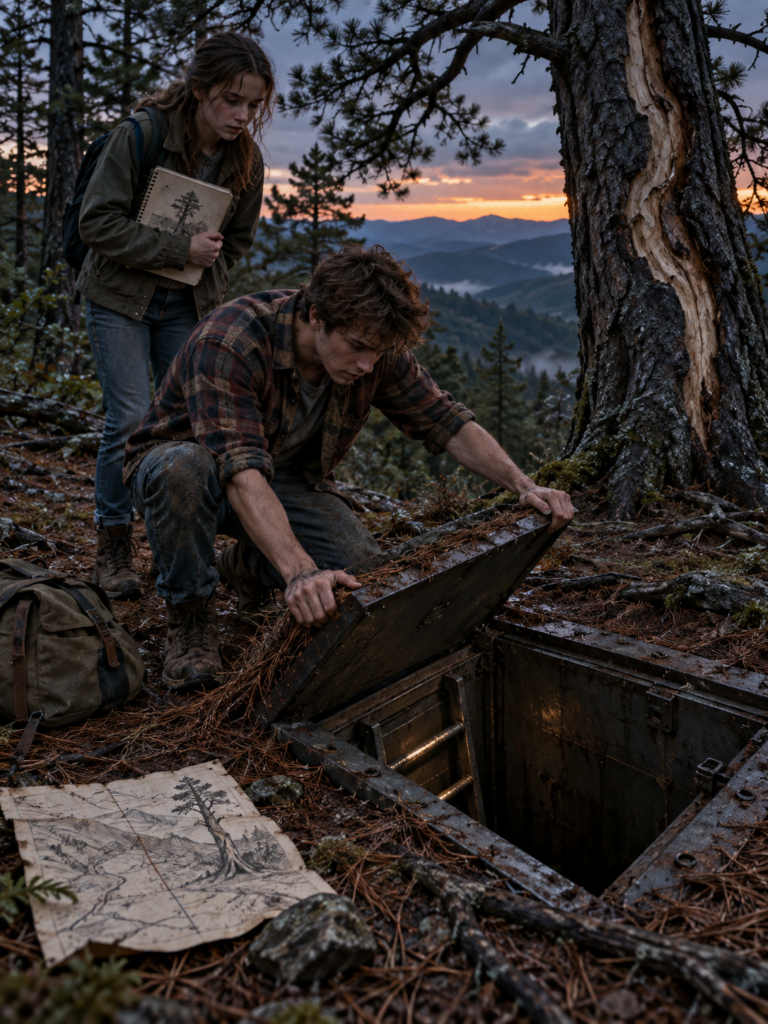
Callum lifted the first document from the steel box.
It was several pages long, fastened together and slightly yellowed.
At the top was a formal property heading.
He began reading.
Then he stopped.
The paper described ten acres of land in Rockbridge County, Virginia.
The boundaries included the ridge, the creek, and the distinctive landmarks from Desmond’s map.
But the owner wasn’t listed simply as Desmond Ror.
The land had been placed in a trust.
And the named beneficiary was Callum James Ror.
Callum read his own name twice.
The trust identified his eighteenth birthday as the point when he would receive full control of the property.
Yesterday.
His grandfather had arranged this years before dying.
Ren stood beside him.
“What does that mean?”
Callum struggled to answer.
“It means Grandpa put the land in my name.”
“All of it?”
He looked around the concrete room.
“That’s what this says.”
But the papers raised more questions than they answered.
Why establish a trust instead of leaving an ordinary inheritance?
Why conceal the land from the rest of the family?
And why keep the documents inside a room buried beneath a forest?
The next item in the box was a sealed envelope with a small card attached.
The card instructed Callum to save it until he’d examined everything else.
He set it aside.
Then he found an unsealed letter.
His grandfather’s handwriting covered the pages.
Callum recognized the careful, slightly angular script from old birthday cards.
He sat at the desk and began reading.
Desmond explained that he’d known Callum’s father was struggling with serious debts.
He had tried repeatedly to help.
But some of the people owed money were individuals he didn’t trust.
He feared those financial problems might eventually threaten Callum and Ren.
So Desmond had protected the ridge property by placing it in a trust for Callum rather than leaving it among assets that might become entangled in the family’s financial difficulties.
The underground room was part of the same plan.
It was stocked to provide an emergency place to stay.
Not permanently.
Only until Callum could establish something better.
Callum set the letter down.
His grandfather had known about the problems at home long before Callum understood them.
He hadn’t been able to prevent everything that followed.
But he’d quietly prepared somewhere for his grandchildren to begin again.
Ren examined the two cots.
“Did he know we’d end up here?”
Callum looked at the letter.
“He knew we might need help.”
There was an important difference.
Desmond hadn’t predicted every event.
He’d anticipated a danger and prepared for it.
Callum opened the remaining pages.
The letter referred to a lawyer in Roanoke named Wendell Crump, who held the trust’s original legal documentation.
His contact information was in the sealed envelope.
The cassette tapes contained additional explanations about the shelter and the family history.
Desmond wanted Callum to listen before making important decisions.
Callum examined the tape labels.
They covered different dates.
Some appeared to document construction work.
Others had been recorded closer to Desmond’s death.
Ren picked up the silver locket.
“Why send this with the map?”
Callum took it gently.
The same tree appeared on the locket and iron key.
Their grandfather had selected the objects deliberately.
The map showed where to go.
The locket carried a memory of the family.
The key clearly belonged to something they hadn’t yet opened.
And the trust established a possible future.
Callum looked around again.
They had food.
Water.
Temporary shelter.
And potentially land they could legally call their own.
But Ren was still fifteen.
The facility would be looking for her.
Owning property didn’t automatically make Callum her guardian.
The discovery had answered where Desmond wanted him to go.
It hadn’t solved how he could keep his sister with him.
Callum unfolded the letter again.
He read the instructions concerning the attorney.
Tomorrow, he would make that call.
He would also have to contact their caseworker.
He didn’t want to.
He was afraid that telling the authorities where Ren was might lead to another separation.
But hiding indefinitely would mean building their new life around the same fear they’d carried from the shelter.
Then he noticed one final line near the end of Desmond’s letter.
It referred to the recordings as more than instructions.
His grandfather had preserved an account of the family, including matters Callum didn’t yet know.
Callum reached for the cassette recorder.
He selected the first tape.
Ren sat beside him on the nearest cot.
He checked the batteries and placed the cassette inside.
Then, with the deed lying open on the desk and the mysterious iron key still hanging against his chest, he pressed the play button.
The cassette clicked into motion.
For a moment there was only a soft mechanical hiss.
Then Callum heard his grandfather’s voice.
He hadn’t heard Desmond speak in eight years.
The sound was so familiar that Callum gripped the edge of the desk.
Desmond’s voice was lower and rougher than he remembered, but the deliberate pauses were unmistakable.
He addressed Callum directly.
He explained that the room beneath the ridge was an emergency foundation.
Its purpose was to help him survive a difficult beginning, then build something aboveground.
Desmond had never intended his grandson to spend his life hiding.
The first tape described the shelter’s systems.
How the water filtration worked.
Where the ventilation shafts emerged.
How to maintain the hand-cranked generator.
Which supplies needed inspection before use.
Callum listened carefully.
These weren’t vague assurances that everything would be fine.
They were instructions from a craftsman who understood that a useful gift must actually work.
When the tape finished, Callum rewound part of it.
He listened again to the section explaining the ventilation.
The room was impressive, but it had been closed for years.
He needed to understand its systems before trusting them.
Ren watched his expression.
“Does it still sound like him?”
Callum nodded.
“Exactly like him.”
She held out her hand for the recorder.
He passed it to her.
They listened to the beginning again.
This time, Ren closed her eyes.
Neither spoke until the tape ended.
That night, the siblings slept on the narrow cots beneath the ridge.
For the first time since leaving the institution, they weren’t surrounded by strangers.
But Callum still woke repeatedly.
Every time he did, he checked that Ren was there.
The following morning, he climbed the ladder into the cold mountain air.
The clearing was quiet.
Beyond the trees, sunlight was beginning to illuminate the valley.
He walked toward the creek and examined the surrounding ground.
His grandfather hadn’t built a permanent cabin here.
There was only the concealed shelter.
But the clearing had space.
The ground looked suitable for investigation and planning.
A house could someday stand there.
Callum returned underground and found the sealed envelope.
Inside were the attorney’s contact details and additional instructions concerning Desmond’s arrangements.
He called Wendell Crump.
The attorney answered with unusual composure when Callum identified himself.
He knew the name.
He knew the trust.
And he had been expecting contact from Desmond’s grandson once Callum reached adulthood.
Crump confirmed that the documents belonged to a legal arrangement established years earlier.
The deed and trust paperwork would need proper review, and Callum would have to complete several practical steps.
But the property had been intended for him.
He wasn’t trespassing on a stranger’s land.
The ridge had been set aside for his future.
Callum asked about Ren.
He explained her age and the circumstances under which they’d left the facility.
Crump became more cautious.
Ownership of ten acres, he said, did not itself establish legal guardianship.
A separate family-court process would be necessary.
There would be documentation, assessments, and questions about their living conditions.
Callum understood.
He didn’t like it.
But he understood.
After speaking with Crump, he called Cornelia Ashford, their caseworker.
She answered immediately.
Her first words were questions.
Where were they?
Was Ren safe?
Did Callum understand how serious the situation had become?
He answered carefully.
He explained that they were in Virginia, that Desmond had established a trust, and that an attorney could verify the property.
He admitted taking Ren without authorization.
He asked Cornelia to help him pursue legal guardianship.
There was a long silence.
Then she began asking practical questions.
Could she contact the lawyer?
Did the property offer appropriate living conditions?
Was Callum willing to cooperate with the necessary reviews?
He said yes.
Cornelia did not promise an outcome.
But she agreed to make calls and help move the matter into the proper process.
When the conversation ended, Callum felt physically exhausted.
He’d feared making that call more than he’d feared entering the underground chamber.
Yet he’d done it.
For the first time, he was trying to protect Ren through something more lasting than simply refusing to let her go.
Over the following weeks, their lives became a mixture of difficult work and unfamiliar possibility.
Callum began preparing the site for a cabin.
He used information from the tapes and remembered lessons from Desmond’s workshop.
He studied drainage, foundations, and the careful selection of building materials.
He borrowed tools from Amos Whitfield.
He made mistakes and corrected them.
He photographed the work as it progressed.
Ren began a garden on the sunnier slope of the clearing.
She planted vegetables and herbs using seeds among the stored supplies.
She spent mornings tending the soil and afternoons drawing the changing landscape.
Her sketchbook gradually filled with something different from the pictures she’d made at the institution.
Instead of temporary bedrooms and institutional hallways, she drew the same ridge again and again.
The creek.
The twisted pine.
The growing frame of the cabin.
The first green shoots of the garden.
Callum noticed she was beginning to look less frightened.
Then he met Wendell Crump in person.
The lawyer’s office in Roanoke was small and orderly.
Crump reviewed the original deed, trust papers, and the steps Callum needed to establish his residence.
He also helped connect Callum with counsel for the guardianship proceedings.
Cornelia supplied documents and advocated for a safe and stable arrangement.
The process was neither immediate nor guaranteed.
But it was moving.
Meanwhile, Callum continued listening to Desmond’s recordings.
Some tapes described construction.
Others explained why the property had been assembled so carefully.
Desmond had purchased the land in separate transactions over many years.
He wanted it separated from the financial problems surrounding Callum’s father.
He had also been concerned about another member of the family.
Harlon Voss.
Harlon was related through Callum’s father’s side and had long shown an interest in Desmond’s property.
Desmond’s recordings described a man who tended to regard family assets as things he should eventually control.
The grandfather believed Harlon might challenge any arrangement excluding him.
Callum didn’t know whether Harlon was aware of the trust.
But the recordings made one point unmistakable.
Desmond had anticipated a possible dispute.
He had arranged professional legal assistance long before Callum found the land.
Still, a recording of someone’s expectations wasn’t proof of another person’s future behavior.
Callum kept listening.
Then Amos Whitfield called.
A man had been asking questions in Grover’s Mill about the Ror property.
He drove a silver SUV.
He said he was family.
He wanted to know who now owned the land.
The name was Harlon Voss.
Callum felt his stomach tighten.
The story Desmond had recorded was beginning to resemble the situation developing around him.
He contacted Crump.
The attorney advised him to keep every relevant document organized and respond through proper channels if a claim was filed.
Callum returned to work.
A few days later, a county official visited the ridge to inspect the property information.
Callum showed him the available documents and explained the construction.
The visit ended without confrontation.
But that evening, Cornelia called.
Harlon and his wife, Darlene, had retained an attorney named Prescott Hail.
They intended to challenge the trust.
Their argument centered on Desmond’s mental capacity when he created it.
They pointed to a medical record from 2009, documenting a period when Desmond had received inpatient treatment for major depression.
Callum sat silently as Cornelia explained.
The trust had been executed later.
The medical record alone did not establish Desmond’s condition at the moment he signed the documents.
But the challenge still required a legal response.
If Harlon succeeded, the ownership arrangements could be overturned.
Callum could lose the ridge.
And that might also undermine his efforts to show he could offer Ren a stable home.
After ending the call, he sat beside the unfinished cabin.
The posts stood upright against the evening sky.
He had spent weeks digging and measuring and building.
For the first time in his life, he had something tangible to lose.
His grandfather had told him that strong structures depended on sound foundations.
Now somebody was questioning the legal foundation beneath everything he’d begun.
Callum went underground.
He looked at the tapes.
The recordings were dated.
They covered years surrounding the establishment of the trust.
He selected one made after the trust was signed.
Desmond’s voice filled the small room, discussing construction measurements, material strength, and structural decisions with considerable precision.
Callum listened.
The tape demonstrated that his grandfather could reason through technical problems at the time of the recording.
It wasn’t a medical evaluation.
It couldn’t, by itself, settle the legal question.
But it was evidence worth bringing to Crump.
Callum called the lawyer.
Crump immediately recognized the potential importance of the tapes.
Their dates, authenticity, and contents would need to be examined.
Callum began organizing them.
He made notes.
He recorded the subjects of each cassette.
He identified passages concerning the trust, its purpose, and Desmond’s decisions.
The more he listened, the clearer the design became.
The recordings were not merely sentimental messages.
Desmond had deliberately preserved explanations of what he was doing and why.
On one cassette, he discussed the 2009 treatment history.
He acknowledged that he had been unwell.
He also recognized that someone might later try to use that history to challenge his competence.
He explained why he’d established the trust and whom he intended it to protect.
Callum listened twice.
Then he wrote down the tape number and date.
He understood the difference between loving his grandfather and proving a legal case.
His memories of Desmond couldn’t settle the dispute.
But signed documents, professional testimony, and authentic contemporary recordings could provide evidence the court would evaluate.
He brought the tapes to Crump.
Together, they organized the material for the proceedings.
The legal dispute continued as the cabin rose.
Ren documented the construction in sketches.
Her drawings recorded the clearing before work began, the foundation, the timber frame, the porch, and the changing landscape.
What had once been a private way to cope with constant moves became a detailed visual record of the home they were building.
Callum found the drawings unexpectedly valuable.
They showed not simply that a cabin existed, but how it had come into existence through sustained effort.
Meanwhile, another discovery helped him address the financial difficulties of starting a household.
The sealed instructions from Desmond directed him to a flat stone near the twisted pine.
Beneath it, buried in a protected container, was a reserve of cash his grandfather had stored for practical needs.
Callum did not treat it as money to spend casually.
He discussed its provenance with Crump and used a small amount through documented arrangements to support the work and establish banking.
The money gave him breathing room.
It did not remove the legal uncertainty.
And it did not make guardianship automatic.
Months of paperwork and preparation remained.
Then, shortly before a continued hearing, Prescott Hail contacted Callum.
The opposing attorney had discovered information about Harlon’s financial dealings.
He explained that Harlon had entered an agreement with Consolidated Timber Group.
The agreement concerned timber rights on the ridge, contingent upon Harlon gaining the necessary ownership.
In exchange, he’d received a substantial advance.
One hundred eighty thousand dollars.
The problem was that Harlon did not own the land.
His expected inheritance depended on invalidating Desmond’s trust.
And Hail now believed the trust challenge was unlikely to succeed.
Callum was stunned.
Harlon had not simply come to Grover’s Mill hoping to recover family property.
He had already made a financial arrangement involving land he had yet to establish any right to control.
Hail said the advance had been spent.
If the trust remained valid, Harlon faced demands for repayment and possible contractual penalties.
The potential liability was enormous.
Callum asked why Hail was telling him.
The attorney explained that he’d discovered material facts withheld by his client and intended to withdraw from the representation.
He would provide a documented statement addressing the timber agreement.
Callum took the information directly to Crump.
The discovery clarified Harlon’s motive.
Desmond’s tapes had described a relative who viewed inherited property as money waiting to be collected.
Now there was independent evidence that Harlon had attempted to profit from the ridge before establishing ownership.
But Callum’s situation remained precarious.
He was still eighteen.
He was still responsible for an unfinished cabin.
His sister’s future was still subject to legal review.
And the property dispute had not been decided.
The night before the continued hearing, he sat by the stove with the documents arranged before him.
The original deed.
The trust records.
The dated audio material.
The construction photographs.
Ren’s sketchbook.
And the new statement concerning the timber agreement.
He worked through the evidence one final time.
Then he reached for another of Desmond’s recordings.
It contained the grandfather’s thoughts about the cabin he’d hoped Callum would build someday.
Desmond described a porch facing the morning light, windows positioned toward the valley, and a stove that would keep the house warm in winter.
Callum listened.
Then he slowly looked around the cabin.
He had built much of it that way.
Not by following that particular tape.
He hadn’t heard it until recently.
He had simply made choices that seemed right for the place, using the practical principles his grandfather had taught him as a boy.
For the first time, he understood that the inheritance was not limited to the land or shelter.
Desmond had passed along a way of thinking.
A habit of making careful decisions.
A belief that good work should outlast the person who performed it.
Callum set down the recorder.
Tomorrow, the court would decide whether he could keep the land.
And the answer would determine whether the house rising above the underground shelter could become the permanent home he and Ren had been trying to build.
Callum arrived at the courthouse carrying his grandfather’s records in an old canvas bag.
The building stood in Lexington, its plain corridors smelling of paper, polished floors, and stale coffee.
Wendell Crump met him outside the courtroom.
The attorney reviewed their materials one final time.
He reminded Callum that the court would evaluate the trust through evidence, not through sympathy for his circumstances.
Desmond’s wishes mattered.
But those wishes had to be established through reliable documents and testimony.
Callum nodded.
He understood.
He was no longer the boy who’d stepped out of state care expecting nobody to help him.
Over the preceding months, he’d learned to ask questions, collect records, and work through procedures he once would have considered impossible.
Still, his hands felt cold.
Inside, Harlon Voss sat with his wife, Darlene.
Harlon looked older than Callum remembered.
The confidence he’d displayed while asking questions about the ridge had diminished.
Prescott Hail was no longer representing him.
A replacement attorney sat beside him, studying papers.
The hearing began.
The judge reviewed the filings.
The evidence concerning Desmond’s treatment history had already been submitted.
So had the trust documents and dated recordings.
Crump explained the sequence.
Desmond had received treatment in 2009.
Later, in early 2010, he executed the trust.
Professional records documented the legal arrangements.
The recordings made afterward showed him discussing the trust’s purpose and carrying out demanding technical work.
Crump did not claim those recordings erased Desmond’s medical history.
They didn’t.
Nor did they establish that he had never struggled emotionally.
Instead, they were relevant to the narrower legal question.
Had Desmond understood the nature and consequences of the trust when it was executed?
His own recorded explanations, supported by the legal documentation, addressed that question.
The court listened to selected material.
Callum heard his grandfather’s voice through the courtroom speakers.
The same voice that had instructed him beside a workbench when he was ten.
The same voice that had guided him through the underground shelter.
Now it was describing legal intentions formed years before Callum knew the trust existed.
Desmond had been specific.
He knew what property was involved.
He knew who would benefit.
He understood why he wanted the land kept separate from other family financial affairs.
His reasoning was organized and consistent.
Callum watched the judge taking notes.
Across the room, Harlon sat without moving.
The replacement attorney raised procedural objections and reviewed the arguments concerning the trust.
But the evidence supporting incapacity at the time of execution was limited.
The 2009 medical record documented a period of treatment.
It did not establish that Desmond lacked capacity months later.
Crump continued through the record.
He presented the documents confirming the property’s transfer.
He described the trust’s administration through his office.
He explained the significance of the recordings and their chronology.
Then he submitted supplementary materials showing what Callum had done since finding the ridge.
The photographs.
The construction records.
Ren’s sketchbook.
The drawings weren’t proof of the trust’s original validity.
But they showed how the beneficiary had used the property and what had been built there.
The judge examined several pages.
There was the clearing before construction.
The foundation.
The timber framing.
The finished sections of the cabin.
And drawings of the garden Ren had cultivated beside it.
She studied them carefully.
Then she addressed Callum.
“You’re eighteen?”
“Yes, Your Honor.”
“And you built this residence after finding the property?”
“Yes.”
“With assistance?”
“Some. I did much of the work myself.”
She looked at another drawing.
Callum waited.
He had rehearsed answers to questions about the documents.
He’d prepared for challenges to the recordings.
But the silence before the decision was something he couldn’t prepare for.
Finally, the judge delivered her ruling.
The motion to invalidate the Ror Ridge Trust was denied.
The evidence presented did not establish that Desmond lacked the necessary capacity when the trust was executed.
The court accepted the trust as valid under the proceedings before it.
Callum remained the beneficiary with the rights specified in the trust documents.
For several seconds, Callum barely moved.
He heard the words.
He understood them.
But the meaning arrived slowly.
The ridge was still his.
The cabin was still his.
The home he’d begun building was no longer threatened by Harlon’s claim in this proceeding.
Crump placed a hand briefly against his arm.
Callum looked toward him.
The older attorney nodded.
It was over.
At least this particular dispute was over.
The judge also addressed the timber agreement.
The materials concerning Harlon’s arrangement with Consolidated Timber Group had been entered into the record.
The court referred the circumstances for further review.
There was no sudden arrest.
No dramatic confession.
No instant determination of every financial consequence.
Those matters would have to proceed separately.
But Harlon could no longer rely on this trust challenge to establish ownership of the ridge.
The courtroom began to empty.
Callum gathered the papers.
He placed Ren’s sketchbook carefully inside his bag.
Then he looked across the room.
Harlon remained seated.
Darlene had risen and was collecting her belongings.
For the first time, Callum found himself wondering what it felt like to have expected an inheritance for years, made financial plans around it, and then discover it had never been yours to claim.
He didn’t feel pity exactly.
He didn’t feel triumph, either.
Harlon had tried to take the foundation Desmond built for two children who had already lost nearly everything.
The court had rejected that effort.
That was enough.
Callum left without approaching him.
Outside, the autumn air was cool.
He stood on the courthouse steps and called Ren.
She answered immediately.
“Well?”
He tried to speak.
For a moment, nothing came.
Then he managed three words.
“We still have it.”
There was silence.
“Callum?”
“The judge upheld the trust.”
He heard Ren breathe out.
A long, shaky breath.
Then she began asking questions all at once.
Was he sure?
Had the judge finished?
Could Harlon come back?
Did it mean they could stay?
Callum answered as carefully as he could.
The ruling protected the trust against the challenge just decided.
There could always be legal steps beyond one hearing.
But their lawyer was confident about the result.
For now, the property remained theirs to build on.
When he returned to the ridge, Ren met him near the cabin.
She didn’t ask to see the paperwork first.
She ran toward him and hugged him so tightly that his bag slipped from his shoulder.
They stood together in the clearing.
Above them, the completed roof caught the afternoon sunlight.
Beside the cabin, the vegetable garden was turning toward autumn.
Behind them, the twisted pine stood where it had stood when they first discovered the hatch.
Callum looked down at his sister.
“We did it.”
Ren pulled back.
“Not all of it.”
He smiled faintly.
“No.”
There was still the guardianship hearing.
He hadn’t forgotten.
The trust decision settled ownership of the land, not whether he had the legal authority and practical ability to care for a fifteen-year-old.
That required separate consideration.
Over the following days, Callum continued gathering the required documents.
Cornelia Ashford remained involved.
The family law attorney reviewed their circumstances.
The completed cabin, the documented property ownership, the support available through local contacts, and Ren’s welfare all mattered.
The decision wouldn’t depend on Callum’s determination alone.
For years, he’d believed that loving Ren fiercely enough might be the only protection he could offer.
Now he understood that love had to become something practical.
A safe house.
Reliable food.
Legal responsibility.
A plan for her education and everyday needs.
People willing to help when he couldn’t manage everything alone.
He had worked toward those things because he wanted his sister to have stability, not merely because a hearing required them.
And Ren had worked alongside him.
The garden was hers.
The drawings were hers.
Her growing confidence was hers.
Callum wasn’t rescuing a helpless child.
He was trying to keep a family together while his sister built a life of her own.
One evening, several days after the trust ruling, Amos Whitfield drove up the access road with tools in the back of his pickup.
He’d come to help finish a section of porch railing.
Callum worked beside him, shaping and fitting the boards.
The older man examined one joint.
“Your grandfather would have liked that.”
Callum looked at the timber.
“It’s not as good as his.”
Amos shrugged.
“Not yet.”
They worked until the light faded.
When the railing was finished, Amos tested it with both hands.
It held.
Callum stepped back and looked at the cabin.
He thought about Desmond building the underground room without knowing precisely what his grandson would face.
The old man had provided tools, supplies, land, and records.
But he couldn’t complete Callum’s future for him.
That was the part Callum had been given responsibility for.
The following week, the guardianship hearing took place.
Cornelia’s documentation and the family’s legal representatives supported the application.
The judge reviewed the evidence of a stable residence and the arrangements for Ren’s care.
Ren’s circumstances and wishes were considered.
The proceedings were far less adversarial than the property dispute.
At the end, the judge signed the guardianship order.
Callum was legally authorized to care for his sister.
When he drove home from Lexington, the papers rested on the passenger seat.
He kept glancing at them even though he knew exactly what they said.
At the cabin, Ren was sitting near the south window with her sketchbook.
She looked up when he entered.
He placed the order on the table.
“It’s official.”
She read the paper.
Then she sat completely still.
Callum waited.
He’d expected questions.
Maybe relief.
Maybe one of the jokes she used when she wanted to avoid showing emotion.
Instead, she began crying.
He moved toward her.
She stood and wrapped her arms around him.
For a long time, neither said anything.
Then Callum began crying, too.
He thought about the facility.
The departure papers.
The transfer scheduled for the morning after his birthday.
The shelter where they’d slept with their bags between two cots.
The bus station.
The mountain road.
The hatch.
Everything that had happened since.
For months, he’d fought the fear that someone would eventually tell him he wasn’t old enough, capable enough, or established enough to keep Ren safe.
Now there was a legal order recognizing the home they’d made.
He held his sister until she pulled back.
“Are you okay?” she asked.
He laughed through tears.
“Getting there.”
That evening, they cooked dinner in their own kitchen.
The stove warmed the room.
Outside, the temperature dropped quickly.
Ren sat beside the window drawing the ridge in the last light.
Callum placed the guardianship order with the other important documents.
He didn’t hide it underground.
He put it somewhere accessible.
There was no reason to conceal their life anymore.
Later, after Ren had gone to sleep, he returned to the hatch.
He climbed down into Desmond’s shelter.
The shelves remained neat.
The desk stood exactly where he’d first seen it.
The recorder and remaining tapes waited beside the steel document box.
The room no longer felt like the extraordinary discovery of a desperate boy.
It was part of their property.
An emergency shelter.
A record of Desmond’s work.
The foundation beneath a house that now existed.
Callum sat down and selected one of the final cassettes.
He pressed play.
Desmond’s voice emerged, rougher than on the earlier recordings.
He spoke about Callum’s father.
Not to excuse everything that had happened.
Not to pretend the debts and family collapse had caused no harm.
But to explain that weakness and cruelty were not identical things, even when the damage left behind could be severe.
Desmond regretted failing to help his son.
He wanted Callum to know those failures did not belong to him.
Callum listened.
He’d spent years carrying anger toward a father whose choices had helped dismantle their family.
The tape didn’t erase that anger.
It didn’t give him a neat answer about forgiveness.
But it separated his father’s story from his own.
For the first time, he could imagine a future that wasn’t organized entirely around avoiding the mistakes of the past.
He played the last tape.
Desmond spoke about building things that lasted.
About using good materials.
About making decisions slowly enough to understand their consequences.
About leaving people something they could use rather than merely something they could admire.
Then the tape ended.
Callum sat in the quiet.
He’d been given an inheritance far more complicated than he understood when he opened the box at the shelter.
Ten acres of land.
An underground room.
A practical supply of tools and equipment.
An attorney prepared to explain the trust.
Records that helped defend it.
And the remembered voice of the one adult who had once made him feel capable of building something worthwhile.
But there was one more piece of the story.
Among Desmond’s remaining papers, Callum found a folded drawing.
It showed a small cabin situated above the ridge shelter.
A porch faced the valley.
Windows caught the morning sun.
The proportions were practical and familiar.
Callum stared at it.
It looked astonishingly like the cabin he had built.
Not identical in every detail.
But close enough that he recognized the shared logic of the design.
He laid the drawing beside Ren’s sketches.
Desmond had imagined a structure that suited the land.
Years later, Callum had studied the same clearing and reached many of the same conclusions.
He hadn’t followed a hidden architectural plan.
He’d used the lessons Desmond taught him.
The same attention to drainage, timber, light, and lasting construction.
He ran his finger along the penciled porch line.
For a moment, he remembered being a child in the workshop.
Desmond standing behind him.
A block plane resting on the bench.
The old man telling him to study the wood before making a cut.
Callum finally understood what those lessons had given him.
Not merely the ability to repair things.
The habit of paying attention long enough to recognize what mattered.
He folded the drawing and placed it with the documents.
Then he carried the cassette recorder up the ladder.
The sky was beginning to lighten.
He crossed the clearing and stepped onto the east-facing porch.
The first sunlight appeared above the ridge.
It moved across the trees, reached the cabin windows, and gradually warmed the wooden railing beneath his hand.
Callum stood there for a long time.
He remembered his eighteenth birthday.
The office clock.
The envelope containing $127.
The cardboard box that arrived almost as an afterthought.
At the time, he’d believed the box was the last small thing his grandfather had left him.
Now he knew it was the beginning of a careful plan that had taken Desmond years to complete.
His grandfather hadn’t left a secret fortune for Callum to spend.
He’d left land intended to remain secure, practical shelter, and the means to build a life through work.
The physical inheritance was significant.
But Callum knew he would have lost much of its meaning if he’d spent the rest of his life hiding underground.
Desmond had never wanted that.
The shelter existed so his grandson could eventually come out of it.
And he had.
The days settled into a steady routine.
Callum worked on the cabin.
Ren tended the garden and drew.
Amos and other neighbors visited when help was needed.
The coming winter required preparation.
Firewood had to be cut and stacked.
The water system needed attention.
Insulation and heating had to be checked.
There was plenty of work.
But it was ordinary work.
Work associated with staying in one place.
Ren’s drawings began attracting attention beyond Grover’s Mill.
She quietly entered a regional art competition and won second place.
When the letter arrived, she placed it on the dinner table and tried to appear uninterested.
Callum read it.
Then he looked at her.
“Second?”
She shrugged.
“There were a lot of entries.”
He grinned.
“Second place.”
She looked down, trying unsuccessfully to hide her smile.
Callum framed the letter and hung it beside the south window.
Near it, he placed a family photograph he’d kept safe through years of moving.
The room now held something he hadn’t experienced since childhood.
Evidence that the people living there had a history worth remembering.
In late November, Cornelia Ashford wrote to them.
She was preparing to retire after decades in family services.
Her letter asked about the cabin.
Was it warm enough?
Had the garden survived the changing weather?
Was Ren still drawing?
Callum sat at the table to answer.
He considered everything that had happened since the afternoon Cornelia handed him his departure papers.
He had initially been angry with everyone connected to the system.
Some of that anger remained.
Ren’s transfer had frightened them.
Their years in care had left marks neither could simply dismiss.
But Cornelia had helped them navigate the legal process once he explained where they were and what he wanted to do.
She had not been able to make the circumstances easy.
She had been willing to help make them workable.
Callum told her the garden had done better than expected.
He told her the cabin was warm.
He told her Ren was drawing every day and had won an art award.
Then he added that they were living together and planning for the following spring.
He signed the letter and walked it down toward the county road.
The air was cold enough that his breath appeared white against the trees.
When he reached the mailbox, he stopped.
There had been a time when he carried every important thing in one canvas duffel.
He’d kept documents folded in pockets because he never knew when somebody would tell him to move.
Now he had an address.
A home.
A legal responsibility he had fought to earn.
And a sister who could leave her sketchbook on the kitchen table without worrying that she’d have to pack it before morning.
He placed the letter in the mailbox.
Then he turned toward the ridge.
From the road, the cabin was partially hidden by trees.
But he could see the top of the roof and the small thread of smoke rising from the chimney.
He began walking home.
A few weeks earlier, he had passed the same twisted pine where he first discovered the hatch.
He’d stopped to examine the lightning scar.
The tree had been damaged long before he was born.
Its trunk had grown into an uneven spiral.
Yet it had survived.
It wasn’t a symbol Desmond had invented.
It was simply a real landmark, distinctive enough to guide someone through the forest.
But Callum had begun thinking differently about it.
The scar hadn’t disappeared.
The pine hadn’t returned to the shape it might have had without the lightning.
It had kept growing.
That was something he understood.
He and Ren had lost years they couldn’t recover.
Their parents’ troubles were part of their history.
So were the institutions, the transfers, and the fear of separation.
Nothing on the ridge erased those experiences.
The trust ruling did not erase them.
The guardianship order did not erase them.
But those things had allowed the siblings to build something beyond them.
When Callum reached the cabin, Ren was at the table sketching the view outside the south window.
She looked up.
“Was the mailbox still there?”
He smiled.
“Still there.”
She returned to her drawing.
A moment later, she asked whether he planned to work on the porch after lunch.
He said yes.
She told him she’d help after finishing the sketch.
No ceremony.
No dramatic declaration.
Just two people discussing the ordinary work of maintaining their home.
Callum hung his jacket beside the door.
The fire was burning steadily.
The floor beneath his boots was solid.
Outside, the mountain wind moved through the trees.
Inside, Ren’s pencil made a soft scratching sound across the paper.
He went to the window and looked toward the clearing.
Beneath the ground stood Desmond’s remarkable room.
Its shelves, equipment, and recordings remained carefully preserved.
Above it stood the cabin Callum had built.
And inside that cabin, life was continuing.
The difference mattered.
Desmond had left him a foundation.
But the foundation had never been intended as the finished story.
Callum looked back at his sister.
She was concentrating on her drawing, occasionally pausing to compare the page with the view outside.
He thought about the boy who had left the facility carrying $127 and a box.
That boy had believed his only choices were to keep running or eventually surrender the person he loved most.
He hadn’t known that a dead grandfather had been preparing another possibility.
He hadn’t known that a map, an iron key, and a stack of old recordings would bring him back to the same mountains where he first learned to work with his hands.
Most of all, he hadn’t known he was capable of building the kind of home he had always wanted someone else to give him.
Ren set down her pencil.
“Come see this.”
Callum crossed the room.
She had drawn the cabin from the clearing, with the old twisted pine standing to one side.
Through the window she’d sketched two small figures.
A brother and sister.
Both inside.
Callum studied the drawing for a moment.
Then he smiled.
“That one’s worth keeping.”
Ren nodded.
“I know.”
He remained beside her while she added the final lines.
Outside, the light shifted slowly across the Blue Ridge Mountains.
And for the first time in years, neither of them had anywhere else they were required to go.