Part 1
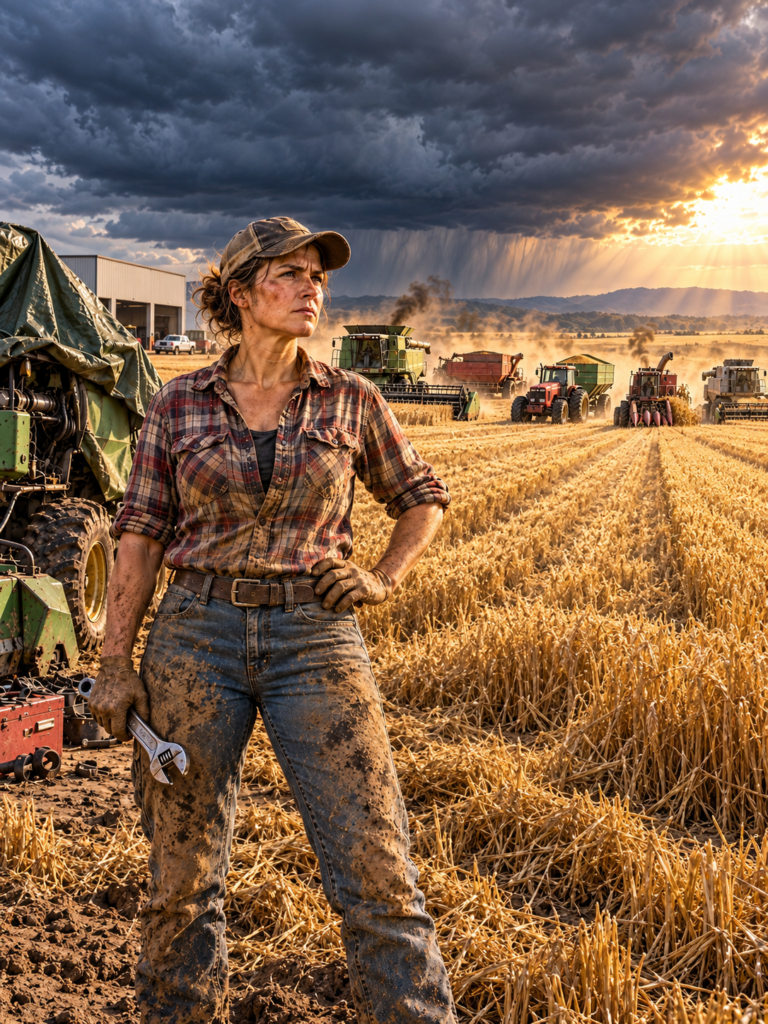
The first time Laura Bennett realized the dealership might let her lose everything, she was standing in the middle of a wheat field with a dead combine behind her and a storm warning glowing on her phone.
She was fifty-eight years old, with aching knees, calloused hands, and thirty-six harvest seasons behind her. She had buried her father, survived two droughts, raised a daughter, and watched neighbors sell farms their families had owned for generations.
But she had never been so frightened of losing her own.
The combine stood silent beneath the afternoon sun. Its cutting header rested against the ground, half buried in golden wheat. The engine had stopped without warning, and the display in the cab flashed a collection of error codes Laura had never seen before.
She climbed down, brushed dust from her jeans, and stared at the machine.
“Come on, old girl,” she whispered.
The combine had cost more than the house Laura and her husband, Mark, lived in. They had purchased it used six years earlier, financing it with an operating loan and the proceeds from selling a small parcel of timber.
It had been worth every dollar.
Until that morning.
A dealership technician arrived two days later. He connected his computer, replaced a sensor, and told Laura everything should be fine.
The machine ran for eleven minutes.
Then it died again.
This time, the technician spent three hours beneath the cab before climbing out with a troubled expression.
“Main control module,” he said.
Laura folded her arms.
“Can you replace it?”
“That’s the problem. They discontinued this particular controller.”
“Then find a used one.”
“We’ll try.”
“How long?”
He looked away.
“Four to six weeks, maybe longer.”
Laura stared at him.
“My wheat will be ready in ten days.”
“I understand, ma’am.”
“No,” she said quietly. “I don’t think you do.”
Behind her stretched the land her grandfather had first broken with a two-bottom plow nearly ninety years earlier.
One thousand two hundred acres of wheat, corn, soybeans, and sunflowers, spread across the rolling countryside of central Kansas.
Every acre represented something.
Mortgage payments. Fuel bills. Seed invoices. Fertilizer purchased on credit. Property taxes. Insurance premiums.
And forty years of her father’s life.
Her grandfather, Samuel Whitaker, had purchased the original hundred acres during the Depression. He had farmed with horses until he could afford a used tractor.
Her father, Thomas, expanded the operation slowly, refusing to purchase ground unless he believed the family could keep it through a bad year.
When Thomas developed heart disease, Laura came home from college to help.
She never left.
Over the following decades, she and Mark purchased neighboring parcels whenever circumstances allowed. Sometimes they borrowed money. Sometimes they worked two jobs. Sometimes they lived without things other families considered ordinary.
They never took expensive vacations.
Their house still had the kitchen cabinets her mother installed in 1978.
Mark drove a truck with nearly three hundred thousand miles on its odometer.
They had made their choices deliberately.
Land was their future.
And now that future depended upon an electronic component no one could find.
Three weeks passed.
The combine sat beneath a blue tarp in the dealership’s service yard, forty miles from the farm.
Every few days, Laura called.
Every conversation sounded almost identical.
“The technician is busy.”
“The part hasn’t arrived.”
“We’ve contacted the manufacturer.”
“These things take time.”
On the twenty-first day, Laura drove to the dealership herself.
The glass-fronted building stood beside the highway, surrounded by enormous green combines and shining tractors that cost more than some houses.
Inside, the showroom smelled of fresh rubber and coffee.
A salesman in polished boots greeted her.
“Looking to upgrade?”
“I’m looking for my combine.”
His smile faded.
“Oh. Mrs. Bennett.”
He disappeared into an office.
A few minutes later, service manager Dennis Crowley emerged carrying a clipboard.
Dennis was in his early fifties, with a carefully trimmed mustache and the weary expression of a man accustomed to delivering bad news.
“Laura. I was planning to call.”
“When?”
He hesitated.
“We still don’t have a delivery confirmation.”
“You told me that last week.”
“I know.”
“And the week before.”
He lowered the clipboard.
“Look, I understand you’re frustrated.”
“Frustrated?”
Laura’s voice rose enough that two salesmen glanced toward her.
“Dennis, I have twelve hundred acres waiting to be harvested. I’ve paid this dealership for parts, service, and equipment for seventeen years. My husband and I owe the bank money against crops that are standing in fields right now. And you keep telling me to be patient.”
Dennis rubbed his forehead.
“We’ve done everything we can.”
“Have you contacted salvage yards?”
“Yes.”
“Independent technicians?”
“We’ve explored the options.”
“Could we install a compatible controller?”
“Not safely.”
“Then give me a loaner.”
“We don’t have one.”
“Rent me something.”
“Nothing available.”
Laura took a slow breath.
“Then tell me what you expect me to do.”
Dennis looked through the showroom windows toward the equipment outside.
“We could offer you a substantial trade allowance toward a newer machine.”
For a moment, Laura said nothing.
Then she laughed once, without humor.
“You’re suggesting I borrow another three hundred thousand dollars?”
“I can have someone work up the numbers.”
“You haven’t fixed the machine I already own.”
“Laura—”
“Do you know what my father used to say?”
Dennis remained silent.
“He said there’s a difference between selling a farmer equipment and standing behind the farmer who bought it.”
She turned toward the door.
Dennis called after her.
“There is another possibility.”
She stopped.
“We could purchase your machine for parts. Take it off your hands.”
Laura slowly faced him.
“You want to buy my combine for scrap?”
“I’m only trying to give you options.”
She looked at him for several seconds.
Then she said, “You haven’t given me one option that gets my wheat out of the field.”
She walked out before he could answer.
Outside, she sat in her old Ford pickup for nearly ten minutes.
She wanted to cry.
Instead, she gripped the steering wheel until her knuckles turned white.
Her father had died in that same farmhouse seven years earlier.
On his last evening, he had asked her to open the bedroom window so he could smell the cut hay.
He had reached for her hand.
“Promise me something, sweetheart.”
“Anything, Dad.”
“Don’t ever let somebody convince you that you’re too small to fight for what we’ve built.”
She had promised.
Now she wondered whether promises could survive the realities of machinery, money, and weather.
When Laura returned home, Mark stood beside the kitchen table.
Their daughter, Elise, was there too.
Elise was twenty-nine and worked as a bookkeeper in the next county. During harvest, she came home whenever she could to drive grain trucks and help with paperwork.
The kitchen smelled of coffee and rain blowing through the screen door.
Mark had spread bank statements across the table.
“How bad?” Laura asked.
He didn’t answer immediately.
That frightened her more than any number could have.
Finally, he pointed toward the papers.
“If we can’t show the bank a workable harvest plan by Friday, they’re not extending the operating line.”
Laura pulled out a chair.
“And if they don’t extend it?”
“We won’t have enough cash to pay the fall bills.”
Elise looked down.
Mark continued.
“We could sell the north eighty.”
“No.”
“Laura—”
“No.”
“It’s the least productive parcel.”
“It’s where Dad taught me to drive a tractor.”
Mark sat across from her.
“I know.”
“And the creek pasture belonged to Grandpa.”
“I know that too.”
Laura pressed both palms against the table.
“I didn’t work forty years to sell pieces of this farm because a dealership can’t find one stupid box of electronics.”
Nobody spoke.
Rain tapped against the windows.
Finally, Elise asked, “What about hiring a custom harvesting crew?”
“Booked,” Mark said. “Every one of them. The earliest anybody can promise is two weeks.”
“The storm?”
“Could be here before then.”
Laura stood and walked to the kitchen window.
Beyond the yard stood the old storage barn, its roof patched with different shades of tin.
Behind it, lined up beside a row of cottonwood trees, were six machines.
Six tired, rusty, mismatched pieces of farm equipment.
The neighbors called them Laura’s junkyard.
A small combine from the 1970s.
An aging self-propelled harvester.
A pull-behind wheat harvester.
An old corn picker.
A grain cart.
And a heavy tractor with faded red paint.
Laura had purchased them over the previous two years at estate sales, retirement auctions, and farm liquidations.
She had never spent much on any one of them.
Some had been nearly given away.
Others cost less than a single repair bill on her modern combine.
Mark followed her gaze.
“No,” he said.
Laura didn’t turn around.
“I haven’t said anything.”
“You don’t have to.”
Elise moved beside her mother.
“Those old machines?”
Laura nodded.
Mark shook his head.
“Half of them won’t start. The red tractor has a bad clutch. That little combine hasn’t run since we brought it home.”
Laura watched the rain strike the rusted equipment.
“Grandpa ran equipment older than that.”
“Grandpa also farmed a hundred acres.”
“And he understood every bolt on every machine he owned.”
Mark sighed.
“We’ve got twelve hundred acres, Laura.”
She turned to face him.
“I know exactly how much land we’ve got.”
“You really think six broken machines can replace one modern combine?”
Laura looked at the bank papers.
Then at the family photographs above the kitchen table.
Finally, she looked toward the barn.
“No,” she answered.
“But maybe six machines don’t have to replace one machine.”
Mark frowned.
“What do you mean?”
Her eyes returned to the darkening yard.
“Maybe they just have to do six different jobs.”
Part 2
By sunrise, Laura had made three phone calls.
The first went to a salvage yard in Nebraska.
The second went to a parts dealer in Oklahoma.
The third went to Walter Price.
Walter was seventy-three years old, a retired mechanic who had repaired tractors before diagnostic computers became standard equipment.
He had known Laura’s grandfather.
He had worked beside her father.
And when Laura was seventeen, he had taught her how to rebuild a carburetor after she ruined one trying to impress a boy.
Walter answered on the fourth ring.
“Price residence.”
“Walter, it’s Laura Bennett.”
“Well, if it isn’t Tommy Whitaker’s little girl.”
“I’m fifty-eight, Walter.”
“You’re still Tommy’s little girl to me.”
Despite everything, she smiled.
“I need a favor.”
“That’s usually how our conversations start.”
“I’ve got six old machines behind the barn.”
“I know. Half the county knows.”
“Think you could come look at them?”
Walter paused.
“Laura, I’ve already told you that collection belongs in a museum.”
“I don’t need a museum. I need a harvest.”
There was silence.
Then Walter asked, “How soon?”
“Ten days.”
He let out a low whistle.
“Lord have mercy.”
“Walter?”
“I’ll be there after breakfast.”
He arrived in an old Chevrolet pickup with a toolbox strapped into the bed, a faded baseball cap, and a thermos that looked older than Elise.
For two hours, he crawled beneath machines, opened engine covers, inspected belts, checked bearings, and tapped suspicious metal with a wrench.
Laura followed him carrying a notebook.
Mark stood nearby, arms folded.
Elise photographed serial numbers with her phone.
At last, Walter sat on an overturned bucket beside the storage barn.
“Well,” he said, “I’ve seen worse.”
Mark raised an eyebrow.
“Really?”
“No. But I was trying to sound encouraging.”
Elise laughed.
It was the first laughter anyone had heard on the farm in days.
Walter pointed toward the red tractor.
“Clutch needs rebuilding. Engine sounds decent, though.”
He gestured toward the little combine.
“New belts. At least one wheel bearing. Tires are questionable.”
“The self-propelled one?” Laura asked.
“Hydraulic valve is sticking. Engine might survive if we’re gentle.”
“And the pull-behind?”
“Blades, reel adjustment, and a drive belt.”
“The grain cart?”
“Hose is rotten. Gearbox needs attention.”
“The corn picker?”
“Chains. Maybe sprockets.”
Mark rubbed his jaw.
“That’s a lot of work.”
Walter nodded.
“It surely is.”
“Can it be done?”
The old mechanic looked at Laura.
“What happened to your big combine?”
She explained.
Walter listened without interrupting.
When she finished, he spat into the dirt.
“Whole machine stopped because of one electronic box?”
“That’s about the size of it.”
“And nobody can find another?”
“Not before harvest.”
Walter shook his head.
“Your granddad would have thrown a wrench through the dealership window.”
Laura smiled faintly.
“He probably would.”
Walter stood.
“Well, I can’t promise you twelve hundred acres.”
“What can you promise?”
He pulled on his cap.
“I can promise that if there’s still a way to make these things run, we’ll find it.”
They started that afternoon.
The old storage barn became a workshop.
Elise cleared a section of floor and organized parts into labeled cardboard boxes.
Mark hauled scrap iron from behind the shed.
Walter dismantled the heavy tractor’s clutch while Laura removed the worn belts from the small combine.
They worked until dark.
The following morning, Laura drove sixty miles to purchase bearings from an agricultural supply store.
Mark attended an estate auction and came home with a box of clutch plates that might fit the red tractor.
Elise called every used-equipment dealer within two hundred miles.
Walter spent six hours rebuilding a hydraulic valve.
By Wednesday evening, their kitchen table was covered with receipts.
Laura studied the growing total.
Parts, fuel, bearings, belts, hoses, tires, transport.
Everything cost money they did not have.
Mark sat opposite her, rubbing grease from his hands.
“We’re into this for more than we planned.”
“I know.”
“We could stop now.”
Laura looked up.
“Do you want to?”
“No.”
“Then why say it?”
“Because somebody needs to remind us this could fail.”
Laura leaned back.
She understood his fear.
Mark had married into this farm thirty-four years earlier.
He had given up a promising position at a machinery company to work beside her father.
He had never complained about the long hours.
Not when their daughter was born during planting season.
Not when drought destroyed half their soybean crop.
Not when Laura’s mother spent her final winter in the upstairs bedroom and somebody needed to sit awake with her every night.
But Mark had become quieter over the years.
The farm had taken more from his body than either of them liked to admit.
His shoulders hurt constantly.
His hearing had suffered from decades around engines.
And now he was being asked to gamble what remained of their savings on six questionable machines.
Laura reached across the table and took his hand.
“I know you’re scared.”
Mark looked away.
“Of course I’m scared.”
“So am I.”
He gave a tired laugh.
“You don’t act like it.”
“That’s because I’m trying not to frighten everybody else.”
He looked at her then.
For a moment, she saw the young man who had asked her to dance at the county fair.
“I don’t care if we lose the equipment,” he said quietly. “I care if we lose you trying to save it.”
Laura squeezed his hand.
“We’ll do this carefully.”
“You promise?”
“I promise.”
The next day, a neighbor named Glenn Mercer pulled into the yard.
Glenn farmed nearly three thousand acres north of town.
He drove a new pickup and had purchased a modern combine the previous year.
He climbed out and surveyed the old machinery.
“Good heavens, Laura. You starting a scrap business?”
Walter, kneeling beside the red tractor, didn’t look up.
“Depends. You looking to donate your personality?”
Elise covered her mouth.
Glenn chuckled, apparently deciding to ignore the remark.
“Heard about your combine. That’s rough.”
“It is,” Laura said.
“You ought to have bought new.”
“With what money?”
“Financing’s available.”
“So is bankruptcy.”
Glenn shrugged.
“Just saying. Those old dinosaurs aren’t going to harvest twelve hundred acres.”
Laura wiped her hands on a rag.
“They don’t have to be pretty.”
“Pretty isn’t the issue. Capacity is.”
“Then I guess we’ll find out.”
Glenn looked at the equipment again.
“Well, good luck.”
He drove away shaking his head.
Laura watched the dust settle behind his truck.
Her father had taught her that neighboring farmers were often generous in a crisis.
But he had also warned her that some men measured intelligence by the size of the equipment a person owned.
She returned to work.
On the sixth day, the red tractor finally started.
Its engine coughed, rattled, and sent a cloud of black exhaust over the yard.
Walter adjusted the throttle.
The machine settled into a deep, uneven rumble.
Mark climbed into the seat.
He eased the clutch forward.
The tractor moved.
Only fifteen feet.
But it moved.
Elise cheered.
Laura closed her eyes for a moment.
She had not realized how much hope could fit into fifteen feet.
Two days later, the small combine moved across the pasture behind the barn.
Its cutting head shuddered.
The steering felt loose.
A bearing grew warm after twenty minutes.
Walter shut it down, made adjustments, and sent Laura back out.
This time it ran for an hour.
On the ninth day, five of the six machines were operational.
The corn picker was still missing a chain, but Walter believed it could be repaired before they needed it.
That evening, the family gathered in the barn while rain clouds gathered along the western horizon.
Walter spread a county map over the workbench.
Laura marked the fields by crop, acreage, and distance from the grain bins.
The small combine would start in the narrow wheat fields.
The heavy tractor would pull the old wheat harvester through ground that was accessible from the roads.
The self-propelled harvester would begin in the soybeans that were ready.
The grain cart would move between fields, supported by trucks.
The corn picker would remain in reserve until the corn dried enough to harvest.
They would rotate machines according to field conditions.
Nothing would move without inspection.
Every evening would end with lubrication, fuel checks, and repairs.
Elise would coordinate schedules, grain transport, and the location of spare parts.
Mark studied the map.
“This is going to be slow.”
Laura nodded.
“Painfully slow.”
Walter tapped the paper.
“But slow grain in the bin beats fast grain rotting in the field.”
Laura looked at the three people who had placed their faith in her idea.
Outside, the wind carried the dry smell of wheat.
She remembered her grandfather’s hands guiding hers around the steering wheel of an old tractor.
She remembered her father sitting alone at the same kitchen table after a hailstorm ruined a summer’s work.
She remembered all the times the family had survived because somebody refused to surrender.
“Tomorrow morning,” Laura said, “we start bringing it home.”
Part 3
The first combine entered the wheat at 5:42 the following morning.
Laura sat high above the crop in a cab that rattled with every movement.
The seat was cracked.
The fan barely worked.
Dust drifted through the seals around the door.
But when she engaged the cutting head, the blades turned.
Golden stalks bent toward the reel.
The machine swallowed its first row.
And grain began filling the tank.
Laura watched through the dusty glass.
For the first time in weeks, the fear inside her loosened.
Not completely.
Just enough to breathe.
She lifted the radio.
“Elise, you copy?”
“Loud and clear, Mom.”
“We’re harvesting.”
A moment passed.
Then her daughter’s voice returned.
“Grandpa would be smiling right now.”
Laura’s eyes filled unexpectedly.
She blinked hard and kept driving.
Across the county road, Mark operated the old self-propelled harvester through a field of soybeans.
Walter drove the heavy tractor, pulling the narrow wheat harvester through a smaller field bordered by trees.
Elise moved between them in the grain truck, recording loads and checking fuel.
The operation was noisy, imperfect, and awkward.
Nothing moved as quickly as Laura wanted.
The old machines required frequent adjustments.
The narrow headers demanded careful passes.
The grain cart had to be positioned precisely because loading was slower than with newer equipment.
But the crops were moving.
At noon, Elise brought sandwiches to the edge of the field.
Laura climbed down, her face covered in dust.
“How much?”
Elise checked her notebook.
“Twenty-nine acres from your machine so far. Twenty-two from Walter’s. Thirty-four from Dad’s.”
Laura added the numbers in her head.
“Eighty-five.”
Elise nodded.
“Eighty-five acres.”
Laura stared across the fields.
Their modern combine, working under favorable conditions, could have covered far more.
Still, eighty-five acres were no longer exposed to the weather.
Eighty-five acres represented debts they might be able to pay.
She took a bite of her sandwich.
It tasted better than any meal she had eaten in three weeks.
The second day was harder.
Temperatures climbed above ninety degrees.
The little combine began overheating shortly before noon.
Laura shut it down immediately and found the radiator packed with dust and chaff.
She spent forty minutes cleaning the cooling system.
In another field, Mark discovered hydraulic oil dripping from a hose.
Walter repaired it beneath a shade tree while Mark fetched the correct seal.
By sunset, Laura’s back hurt so badly she could barely straighten.
At the house, she lowered herself into the kitchen chair with a groan.
Elise placed a plate of chicken and potatoes in front of her.
“Eat.”
“I’m not hungry.”
“Then pretend.”
Laura managed a smile.
Mark entered carrying the day’s figures.
“We’re behind the schedule.”
“How far?”
“Depends on the weather.”
“That’s not an answer.”
“It’s the only honest one I’ve got.”
Laura pushed her plate away.
She could hear thunder beyond the western hills.
That night, she barely slept.
At two in the morning, she went downstairs and found Walter sitting at the kitchen table.
He had stayed in the spare room because driving home after sixteen hours of work was no longer safe.
A lamp burned beside his coffee mug.
He was studying the maintenance notes.
“Couldn’t sleep?” Laura asked.
“Old men don’t sleep much.”
“That’s not true.”
“All right. Worried old men don’t sleep much.”
Laura sat opposite him.
“Walter, tell me something.”
“All right.”
“Are we fools?”
He removed his glasses.
“For trying to harvest?”
“For believing we can make this work.”
Walter leaned back.
“Your grandfather once planted corn three times in the same spring.”
Laura nodded.
“I’ve heard.”
“The first planting drowned. The second got eaten by cutworms. Everybody told him to leave the field alone.”
“What happened?”
“He planted again.”
“And?”
“Had a decent crop.”
Laura smiled faintly.
Walter looked at her over the rim of his mug.
“That isn’t why I’m telling you.”
“Then why?”
“Because the third planting wasn’t brave just because it succeeded. It was brave because he knew it might not.”
Laura was quiet.
Walter continued.
“We might lose some acres. Machinery might fail. Weather might beat us. But there’s nothing foolish about using what you’ve got instead of sitting still waiting for somebody else to save you.”
Laura looked toward the dark window.
“What if it’s not enough?”
“Then we’ll know we gave the land everything we could.”
The fourth morning brought good progress.
By sunset, they had harvested approximately three hundred fifty acres.
Then the forecast changed.
A strong storm system that meteorologists had expected late the following week was moving faster than anticipated.
Heavy rain and damaging wind could reach the county in six days.
Elise stood in the barn with her phone.
“The weather service says this could be a serious one.”
Laura studied the radar.
The approaching front stretched across several states.
Mark folded his arms.
“We need more hours.”
Walter shook his head.
“We need more useful hours. Tired people tear up machinery.”
Laura thought for a moment.
“We’ll start earlier. We’ll stop when visibility gets bad or anybody’s too exhausted. And we’ll rotate breaks.”
She turned to Elise.
“Can you find another driver?”
Elise nodded.
“I’ll call Daniel.”
Daniel was her husband, a school bus mechanic who had helped on the farm for years.
He arrived the following afternoon with a toolbox and enough sandwiches to feed everyone.
Two neighbors began stopping by to help with fuel and transport.
A nearby farmer loaned them a second grain truck.
The harvest slowly became more than one family’s struggle.
It became an effort the community could see.
Yet every acre brought new problems.
On the fifth day, the red tractor lost power climbing a gradual slope.
Walter immediately disengaged the harvester and shut down the engine.
The clutch smelled burned.
When he opened the housing, he found warped plates.
Mark stared at the damage.
“We just rebuilt that.”
Walter nodded.
“Old parts don’t always forgive a heavy load.”
“Can we fix it?”
“Only if the spare plates match.”
The spare parts were at the main workshop.
Elise drove through the night to retrieve them.
Walter and Mark worked under portable lights, carefully replacing the damaged components.
Laura watched from the edge of the field, feeling the hours drain away.
Every stalled machine represented acres still standing.
Every hour mattered.
At dawn, the tractor started.
By afternoon, it was cutting wheat again.
On the sixth day, the old self-propelled harvester lost oil pressure.
Walter discovered a cracked oil line and replaced it with a reinforced hose.
Later, the small combine’s grain elevator chain broke.
Laura climbed into the machine’s service compartment and stared at the damaged links.
They had no exact replacement.
The nearest parts supplier was a hundred miles away.
She could feel panic pressing against her chest.
Then she thought of the corn picker.
It had a chain of similar pitch and suitable length, though it would need adjustment.
Walter confirmed that it could be adapted safely.
They removed the spare chain, fitted it to the combine, checked tension and alignment, and tested the elevator without grain.
It worked.
Laura sat on the machine’s step, holding the broken chain in her lap.
Walter stood beside her.
“Funny thing about old equipment,” he said.
“What’s that?”
“Sometimes the best parts department is your own barn.”
She smiled.
But she was exhausted.
Her hands had blisters.
Her shoulders burned.
Her clothes smelled permanently of diesel fuel and wheat dust.
On the seventh evening, Elise brought the updated acreage map into the kitchen.
Seven hundred twenty acres were complete.
Four hundred eighty remained.
The storm had accelerated again.
Laura stared at the figures.
Mark sat beside her.
“We’ve done more than anybody expected.”
“It’s not enough.”
“We’ve saved most of the crop.”
“Most won’t pay all the bills.”
“Laura.”
She looked at him.
His face was lined with fatigue.
His right hand shook slightly when he lifted his coffee.
She realized with sudden guilt that everyone had been working at the edge of their strength because she had refused to give up.
“Maybe we should stop,” she whispered.
Mark frowned.
“What?”
“Maybe I should call the bank. Sell the north eighty. Let the rest go.”
Elise looked at her mother in disbelief.
“No.”
Laura pressed her palms against her eyes.
“I’m tired.”
Nobody spoke.
Then Mark reached for her hand.
“I know you are.”
“What if somebody gets hurt?”
“Then we stop. No crop is worth a life.”
Laura lowered her hands.
Mark continued.
“But don’t make a decision about the future of this farm because you’re exhausted tonight.”
Elise moved closer.
“Mom, we’ve already brought in seven hundred twenty acres.”
“And four hundred eighty are still out there.”
“Then we’ll make a plan for those four hundred eighty.”
Laura looked at her daughter.
For years, she had wondered whether Elise understood what the farm meant.
Elise had built a career away from it.
She had never expressed interest in taking over.
Laura had assumed the family land might someday become an inheritance her daughter would sell.
But now Elise stood in the kitchen, covered in dirt, carrying a map of fields she knew by name.
The north eighty.
The creek bottom.
Grandpa’s hill.
The south wheat.
Elise placed her hand over her mother’s.
“You taught me something when I was little,” she said.
Laura shook her head.
“What?”
“That this place isn’t just dirt.”
Laura felt her throat tighten.
Elise smiled.
“It’s where our people kept showing up for one another.”
That night, for the first time since the combine broke, Laura slept without waking.
Part 4
On the eighth morning, Dennis Crowley’s dealership truck pulled into the farmyard.
Laura was inspecting the little combine when she saw him.
Dennis climbed out wearing clean boots and a dealership jacket.
Beside him stood a younger technician carrying a diagnostic case.
“We came to look at your combine,” Dennis said.
Laura glanced toward the tarp-covered machine in the yard.
“You mean the one that’s been sitting here for weeks?”
Dennis cleared his throat.
“The controller still hasn’t arrived. We wanted to inspect the wiring harness and verify the replacement specifications before the part comes.”
Laura said nothing.
The younger technician looked toward the fields.
Three old harvesting machines were working beneath the pale morning sun.
A grain truck moved slowly along the road.
The heavy tractor’s exhaust drifted over a line of trees.
“What are those?” he asked.
Laura followed his gaze.
“My harvest.”
The technician stared.
“You’re actually running those machines?”
“Every day.”
He smiled with genuine surprise.
“I haven’t seen one of those pull-behind harvesters working in years.”
Walter appeared from behind the equipment shed.
“That’s because most people forgot how to keep them running.”
The young man introduced himself as Nathan.
He spent several minutes asking Walter about the hydraulic repairs.
Walter explained how he had rebuilt the valve using a spring of matching dimensions and appropriate load characteristics.
Nathan listened closely.
“That’s clever.”
Walter shrugged.
“That’s maintenance.”
Dennis remained near his truck.
He looked uncomfortable.
Finally, he approached Laura.
“I didn’t realize you had all this equipment.”
“You didn’t ask what alternatives we were considering.”
“Laura, I really am sorry about the delay.”
She wiped grease from her hands.
“Sorry doesn’t move wheat into a bin.”
“I understand.”
She looked toward the old machines.
“You know what bothers me most?”
Dennis waited.
“When we bought that combine, your salesman told us your service department would keep us running. He said your parts network was the best in the region.”
“We’ve had supply problems.”
“I know. Everybody has.”
“Then you understand why this happened.”
“No. I understand why the part hasn’t arrived. I don’t understand why nobody helped us develop another plan.”
Dennis looked down.
Laura continued.
“You could have referred us to independent mechanics. You could have given us the part number sooner. You could have helped us search salvage yards. Instead, every conversation ended with somebody trying to sell me another combine.”
The manager swallowed.
“That’s fair.”
Laura was surprised by the admission.
Dennis looked toward the workshop.
“My father farmed too, you know.”
“I didn’t know that.”
“Lost his place in the eighties. Interest rates, two bad harvests, machinery debt.”
Laura studied him.
“Then you ought to understand what this means.”
Dennis nodded slowly.
“I should.”
For a moment, neither spoke.
Then he said, “If there’s anything we can do—”
“Get that controller. And when it arrives, fix the machine properly.”
“We will.”
Laura picked up her wrench.
“And next time a farmer calls you scared, don’t treat that like a sales opportunity.”
Dennis did not argue.
After the dealership truck departed, Walter stood beside Laura.
“You were easier on him than I would’ve been.”
She gave a tired smile.
“Maybe.”
“Why?”
“Because I need him to remember this conversation when the next farmer calls.”
By the end of the ninth day, the harvested total had climbed to nine hundred sixty acres.
The weather forecast showed rain within forty-eight hours.
Two hundred forty acres remained.
The family had made remarkable progress, but the most difficult fields were still ahead.
The southern wheat field had suffered wind damage.
A low soybean field held moisture after earlier rainfall.
The remaining corn was ready in some areas but uneven elsewhere.
Laura spread the map across the barn workbench.
“We take the south wheat first.”
Mark nodded.
“Then the soybeans?”
“The accessible ground, yes. We won’t drive into standing water.”
Walter studied the corn fields.
“We can get the picker running again if we replace the chain we borrowed.”
Elise checked the parts inventory.
“Daniel found another compatible chain at the salvage yard. He’s bringing it this afternoon.”
Laura looked up.
“That man deserves a medal.”
“He says he’d settle for a hot supper.”
They worked into the evening repairing and preparing equipment.
Before dawn, Laura gathered everyone near the barn.
“Six hours of rest,” she told them. “Nobody argues.”
Walter opened his mouth.
“That includes you,” she added.
He closed it.
The following day began under a gray sky.
The little combine entered the southern wheat field.
Mark followed with the self-propelled harvester.
Walter maneuvered the narrow pull-behind machine along the edges where the larger equipment could not turn efficiently.
The grain cart moved between safe loading points.
Two trucks waited along the field entrance.
Elise tracked progress on her paper map.
As each strip was completed, she marked it with a red pencil.
By noon, the southern wheat was nearly finished.
By late afternoon, the total acreage harvested had passed eleven hundred.
Laura stopped at the edge of the field and climbed down.
Elise approached carrying the map.
“One hundred acres left.”
Laura stared at her.
“Say that again.”
“One hundred acres.”
Mark came over and looked at the page.
Walter stood nearby.
Nobody cheered.
They were too tired.
And everyone knew the weather had not finished with them.
Wind bent the remaining crops toward the east.
The sky darkened steadily.
That evening, the first rain began.
It fell softly at first, pattering against the barn roof while the family examined the forecast.
Elise watched the radar.
“There’s more behind it.”
Laura nodded.
“How much?”
“Enough.”
They had approximately sixty acres of corn and forty acres of soybeans remaining, though some of the crop boundaries made the work awkward.
The ground was already softening.
Laura knew the danger.
Harvesting wet crops could damage equipment, compact soil, and produce grain with excessive moisture that would require careful handling.
Working in lightning was worse.
She looked at Walter.
“We do not go out in an electrical storm.”
Walter nodded.
“Agreed.”
“We wait for a safe window. Then we take what we can.”
Mark studied the radar.
“What if there isn’t a window?”
Laura stared at the map.
“Then we protect what we’ve already harvested and accept the rest.”
The words hurt.
But she meant them.
Her father had taught her to value land.
He had never taught her to gamble with people’s lives to save it.
At ten that night, lightning flashed beyond the creek.
The rain grew heavy.
Laura stood at the kitchen window, watching water pour from the gutters.
Mark came beside her.
“You should sleep.”
“I can’t.”
He put an arm around her shoulders.
For a while, they listened to the storm.
Then he said, “You know, when I married you, your father warned me about you.”
Laura turned.
“What did he say?”
“He said you were the most stubborn woman in three counties.”
She laughed softly.
“He wasn’t wrong.”
“He also said you’d never ask someone to do work you weren’t willing to do yourself.”
Her smile faded.
Mark kissed her forehead.
“I think he’d be proud.”
Laura closed her eyes.
She wanted her father there.
Not because he could fix anything.
He couldn’t.
He had lost crops and equipment like every farmer before him.
She wanted him because he would know how to stand beside her in that kitchen and make the fear feel smaller.
At three in the morning, the storm weakened.
The lightning moved east.
Rain slowed to a fine mist.
Laura stepped outside beneath the porch light.
The air smelled of soaked earth.
She could hear water dripping from the cottonwood leaves.
Across the yard, the old machines stood ready.
And she made her decision.
Part 5
By morning, the worst of the storm had passed, although more rain remained in the forecast.
Laura gathered the family beside the equipment shed.
Walter examined the soil with the heel of his boot.
“High corn ground might carry the tractor,” he said. “The low soybeans are going to be trouble.”
Laura nodded.
“Then we inspect every field before putting machinery into it.”
They drove the farm roads together.
The first soybean field was too wet.
Laura refused to risk it.
The second had better drainage, though the ground remained soft.
The corn stood on higher ground.
There, the soil was firm enough for a cautious pass.
They began with the corn picker.
The old machine rattled and shook as Mark eased the tractor forward.
Its gathering chains caught the stalks, and the snapping rolls drew them between the rows.
Ears of corn moved through the picker and into the trailing wagon.
Elise stood at the field entrance, watching.
She had never seen that machine work before.
For years, it had been nothing but rusting metal behind the barn.
Now it was bringing home a crop her family desperately needed.
Laura followed in the grain truck.
They moved slowly.
Every few rows, Walter checked the chains and bearings.
Whenever the picker clogged, they shut down the equipment completely before clearing the blockage.
There was no room for shortcuts.
By noon, twenty acres of corn were complete.
The rain remained light.
At one o’clock, the sun briefly appeared through a break in the clouds.
Laura looked up at it as though it were an old friend.
“Come on,” she whispered. “Give us one more day.”
They continued.
Meanwhile, Walter inspected the soybean field again.
The old self-propelled harvester had narrower tires than the modern equipment, and its weight distribution made it a possible option for the better-drained sections.
He tested the field entrance carefully.
The ground held.
Laura made the decision to begin.
Mark drove the harvester while Daniel managed the grain truck.
The machine moved slowly through the damp soybeans.
The moisture content was higher than they wanted.
Elise arranged space in the grain handling system so the harvested crop could be dried and monitored.
Nothing about the work was easy.
But it was possible.
By late afternoon, only a few sections remained.
The corn picker developed a chain problem.
Walter shut it down and replaced the damaged link.
The grain cart sprang a hydraulic leak.
Daniel fitted a new hose.
The small combine, brought out to collect a final dry patch of wheat missed during an earlier pass, needed another belt adjustment.
Every delay felt unbearable.
Yet every repair brought them closer.
As evening approached, the clouds broke again.
The wind settled.
Laura stood beside the grain truck with Elise, studying the map.
“How much?”
Elise checked her figures twice.
“Just under thirty acres.”
Laura looked across the fields.
Thirty acres.
After starting with twelve hundred.
Elise saw the expression on her face.
“We can finish.”
Laura shook her head.
“We might finish.”
Her daughter smiled.
“Then let’s find out.”
They worked until the light began to fade.
The remaining soybeans were harvested first.
Some grain required additional drying.
A few wet spots were left untouched until the soil could support the equipment.
The next day provided a short stretch of drier weather.
Laura used the opportunity to complete those sections carefully.
At last, the soybean harvest was finished.
Only the final corn rows remained.
The family returned to the southern field.
Walter drove the heavy tractor.
Mark walked beside the machinery during setup, checking connections before the tractor moved.
Laura managed the wagon exchange.
Elise stood at the field entrance with the map.
A cool wind swept across the rows.
The corn picker advanced.
One row.
Then another.
The machine sounded terrible.
Its chains rattled.
The tractor’s engine labored.
But the wagon continued filling.
Near the end, Laura climbed into the tractor after Walter complained of stiffness in his right leg.
“You take a break,” she told him.
Walter frowned.
“I’m not finished.”
“You’ve worked harder than anybody. Sit down.”
He looked at her for a long moment.
Then he smiled.
“You sound just like your father.”
Laura swallowed.
“Somebody has to.”
She took the wheel.
The old tractor shuddered beneath her.
Through the windshield, she could see the final rows.
She moved forward steadily.
The corn picker pulled in the stalks.
Ears dropped into the wagon.
At the end of the last row, Laura disengaged the power takeoff, brought the tractor to a safe stop, and shut down the engine.
Silence spread across the field.
For several seconds, she remained in the seat.
Then she climbed down.
Elise was running toward her.
“Mom!”
Laura turned.
Her daughter held the paper map in both hands.
Every field was marked.
Every acre accounted for.
One thousand two hundred acres.
Harvested.
Elise threw her arms around her mother.
“We did it!”
Laura hugged her tightly.
Behind them, Mark removed his cap.
Walter lowered himself onto the tractor step.
Daniel stood beside the full grain wagon, smiling.
Laura tried to speak.
Nothing came.
Then the tears arrived.
Not a few quiet tears.
She sobbed against her daughter’s shoulder, releasing weeks of fear and exhaustion.
Elise held her.
“It’s okay, Mom.”
Laura shook her head.
“I thought we’d lose it.”
“I know.”
“I thought I was going to lose Grandpa’s farm.”
Elise hugged her harder.
“But you didn’t.”
Laura looked at the surrounding land.
The fields were stripped and muddy.
The roads were rutted.
Some wheat had suffered wind damage.
Some soybeans would require extra drying.
The corn yields were lower than expected.
The harvest was far from perfect.
But it was home.
And it was still theirs.
That evening, Laura walked through the equipment yard.
The six old machines stood in a crooked line.
Their paint was faded.
Their tires were patched.
Their engines leaked small amounts of oil that would need attention.
The grain cart wore a fresh hydraulic hose.
The corn picker had a replacement chain.
The red tractor carried mud halfway up its wheels.
They were ugly machines.
They were slow machines.
And Laura thought they were the most beautiful things she had ever seen.
Mark joined her.
“We’ll need to figure out what we’re doing with all of them.”
Laura looked at him.
“What do you mean?”
“Storage. Maintenance. Parts.”
She smiled.
“We’re keeping them.”
“Every one?”
“Every one.”
Mark laughed.
“I figured you’d say that.”
A week later, Laura met with the bank.
She carried the harvest records, grain receipts, updated operating projections, and a revised equipment plan.
The loan officer studied the documents.
Finally, he looked up.
“You harvested all twelve hundred acres?”
Laura nodded.
“With six used machines?”
“And some people who knew how to fix them.”
The loan officer leaned back.
“I’ve been doing agricultural lending for twenty-five years.”
Laura waited.
“I don’t believe I’ve ever seen a backup plan quite like this.”
“Neither had I,” Laura said.
“But it worked.”
She looked at the paperwork.
“It did.”
The bank extended the operating line after reviewing the harvest proceeds and revised cash-flow forecast.
Laura left the building without having to sell the north eighty.
That afternoon, she drove there alone.
She parked beside the creek, walked to the old fence, and rested her hands on the top rail.
The land rolled away beneath a pale autumn sky.
Somewhere beneath the grass lay the old foundation of her grandfather’s first equipment shed.
Laura could still remember standing there as a little girl while her father repaired a tractor.
She heard his voice almost as clearly as if he were beside her.
“Everything breaks eventually, sweetheart. That’s why you learn how to mend things.”
She smiled through her tears.
“I remembered, Dad.”
Several weeks after the harvest, Dennis Crowley returned to the farm.
This time, he came without a salesman.
The replacement controller had finally arrived.
The dealership repaired the modern combine and tested it under load.
Dennis personally supervised the final inspection.
When the work was finished, he approached Laura near the barn.
“Your machine is ready.”
“Good.”
He glanced toward the six older machines, now cleaned and parked under cover.
“I owe you an apology.”
Laura remained quiet.
Dennis continued.
“We handled your situation badly. We kept treating it as a parts problem instead of a farm emergency.”
“That’s exactly what it was.”
“I know.”
He hesitated.
“We’re starting a program to help farmers source used parts and evaluate repair alternatives for older equipment. Nathan’s going to coordinate with independent shops.”
Laura studied him.
“That sounds useful.”
“It was your experience that got us thinking.”
She nodded.
“Then make sure it helps somebody.”
Dennis offered his hand.
Laura shook it.
She hadn’t forgotten the three weeks of unanswered questions.
She hadn’t forgotten how close the farm came to disaster.
But she believed people deserved the opportunity to do better.
As Dennis prepared to leave, he glanced toward the pull-behind harvester.
“Would you ever consider selling one of those?”
Laura looked at the machine.
“No.”
He smiled.
“Didn’t think so.”
Over the winter, Laura and Mark reorganized the storage barn.
Each machine received a designated parking space.
Elise created maintenance records, parts inventories, and field-specific backup plans.
Walter helped document the repairs so younger mechanics could understand them.
The family also made a difficult decision.
They would reduce their dependence on the dealership, but they would not abandon modern equipment.
The repaired combine remained their primary harvesting machine.
The older equipment would be maintained as backup capacity and used when conditions suited its limitations.
Laura understood the difference between nostalgia and practicality.
Old machinery could be valuable.
It could also be inefficient, dangerous, and expensive when poorly maintained.
The lesson wasn’t that older machines were always better.
The lesson was that depending upon a single machine, a single supplier, and a single replacement part had nearly destroyed everything her family built.
In the spring, Walter suggested something unexpected.
“You ought to show some young farmers how this stuff works.”
Laura laughed.
“Who’d want to spend Saturday looking at old tractors?”
Walter raised an eyebrow.
“You’d be surprised.”
He was right.
The first maintenance workshop drew eleven people.
By the following year, nearly forty farmers, mechanics, and agricultural students came to the Bennett farm.
They learned how to inspect bearings, identify hydraulic failures, adjust belts, maintain mechanical fuel systems, and build equipment contingency plans.
Walter taught much of the instruction.
Laura provided the field examples.
Elise organized the materials.
Mark kept coffee brewing and hamburgers on the grill.
Glenn Mercer, the neighbor who once laughed at Laura’s machinery, attended the second workshop.
He approached her during a break.
“Laura, I’ve been meaning to tell you something.”
She looked at him.
“What’s that?”
“I was wrong about those old machines.”
She smiled.
“Most people were.”
Glenn nodded.
“When my big combine went down last fall, I remembered what you did. Bought myself an old backup machine over winter.”
“Good.”
“Doesn’t look like much.”
“Does it run?”
“Sure does.”
Laura grinned.
“Then it’s worth something.”
Glenn held out his hand.
“I’m glad you saved the farm.”
Laura shook it.
“So am I.”
Years passed.
The Bennett farm continued producing crops.
Some seasons were good.
Others were difficult.
Equipment still broke.
Rain still arrived at the wrong time.
Markets still changed without asking permission.
But the farm never again depended upon a single combine to determine its fate.
Elise gradually became more involved in the operation.
She retained her bookkeeping work while learning the financial and mechanical details of the family business.
Eventually, she told Laura that she and Daniel wanted to raise their children on the farm.
Laura cried when she heard.
One autumn afternoon, several years after the famous harvest, Laura stood beside the pull-behind harvester with her granddaughter, June.
June was eight, with freckles, brown eyes, and the same stubborn expression Laura’s father had worn.
The old machine sat beneath the barn roof.
Its faded paint had been cleaned.
Its belts were protected.
A small wooden sign hung beside it.
It read:
“The machine that taught us never to give up.”
June touched the harvester’s dented metal housing.
“Grandma, why don’t you sell this thing and buy a prettier one?”
Laura smiled.
“Because prettier isn’t always better.”
“But it’s so old.”
“So am I.”
June giggled.
Laura crouched carefully beside her.
“Do you know what this machine did?”
“Helped with the harvest?”
“It helped save our farm.”
June’s eyes widened.
“Really?”
Laura nodded.
“When our big combine broke, we couldn’t get it fixed. We had crops standing in the fields, and a storm was coming. Everybody thought these old machines were useless.”
“What did you think?”
Laura considered the question.
“I thought they were worth trying.”
“Even though they were broken?”
“Especially because they were broken.”
June frowned.
“I don’t understand.”
Laura took her granddaughter’s small hand.
“Because, sweetheart, when you learn how to fix something, you also learn not to be afraid every time something goes wrong.”
June looked at the machine again.
“Can you teach me?”
Laura felt a warmth spread through her chest.
She thought of her grandfather.
Her father.
The promises made beside hospital beds and kitchen tables.
The long nights when she had feared there would be nothing left to pass down.
Then she smiled.
“Of course I can.”
She opened the toolbox.
And together, they began.
Outside, the Kansas wind moved across twelve hundred acres of family land.
The farmhouse stood beneath the cottonwoods.
The creek still ran through the north pasture.
The old barn still leaned slightly to the east.
And inside that barn, six machines remained ready.
Not because they were perfect.
Not because they were fast.
Not because they could compete with every advantage of modern agricultural technology.
But because, during one terrible harvest season, they had given a frightened family something more valuable than speed.
They had given them a choice.
Laura Bennett had begun that season believing she needed one perfect machine to save her farm.
She finished it understanding something her grandfather had known all along.
A farm survives through people willing to repair what is broken, neighbors willing to lend a hand, and families willing to stand together when the easy answers disappear.
And sometimes, when the newest machine sits helpless beneath a tarp, the equipment everyone laughed at becomes the reason an old family farm lives to see another harvest.