Part 1
“Twenty-five dollars? Son, you just paid good money for a pile of junk!”
The laughter rolled across the auction yard like thunder.
A dozen farmers stood beneath the hot Kansas sun, their boots planted in the dust, their arms folded over expensive work shirts. Some shook their heads. Others grinned openly.
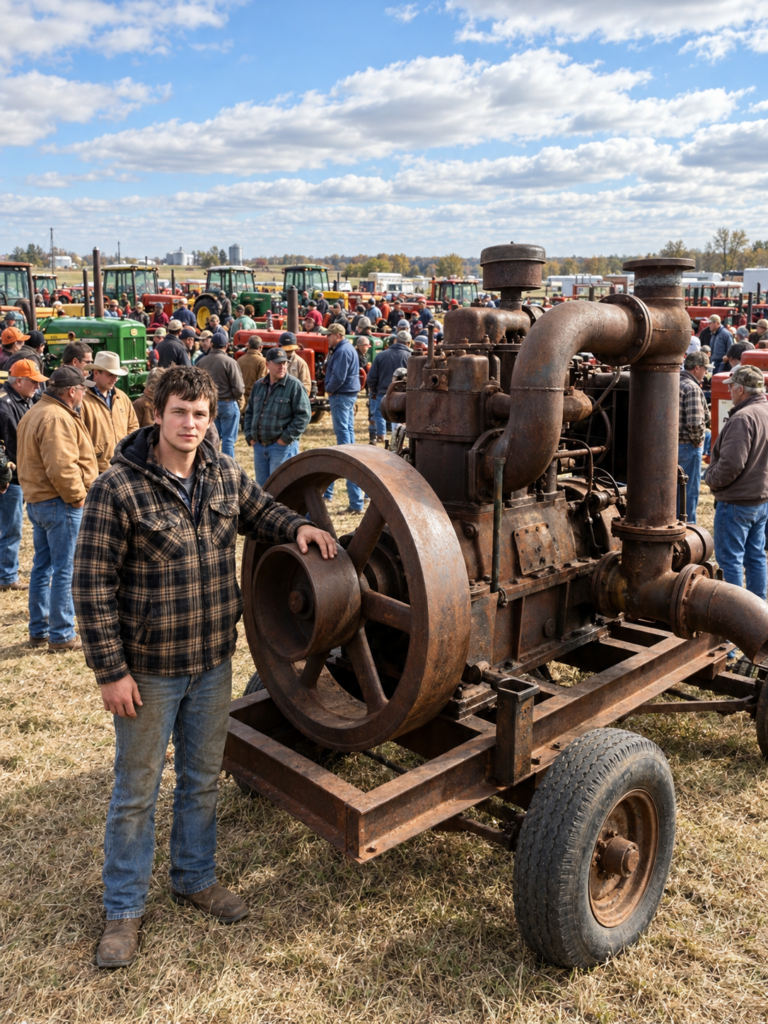
And standing beside the enormous, rust-covered irrigation pump was twenty-seven-year-old Eli Carter, holding a yellow auction ticket in one hand and the last twenty-three dollars from his checking account in the other.
He didn’t laugh.
He didn’t argue.
He simply looked at the machine everyone else had rejected and said quietly, “I guess we’ll see.”
What nobody standing in that yard knew was that this battered piece of forgotten equipment would eventually lead Eli back to another auction.
Only next time, he wouldn’t be bidding twenty-five dollars.
He would be bidding against some of the wealthiest farmers in the county.
And when the auctioneer finally brought down his gavel, the same men who had mocked Eli would be staring at him in stunned silence.
But that day was still three long years away.
And first, Eli would have to survive the hardest season of his life.
The auction was being held outside the small farming town of Bell Creek, Kansas, where the horizon stretched so far that a man could watch a thunderstorm coming for an hour before the first drop of rain touched his boots.
It was late August, and the heat had settled over the countryside like a heavy blanket.
Cornfields stood yellow at the edges. The gravel roads were dusty. Along the highway, old farmhouses sat behind windbreaks of cottonwood trees, their paint faded by generations of summer sun and winter storms.
Bell Creek was the sort of town where everyone knew who owned which fields, whose son had come home from college, and which families had been farming the same land since their grandparents were young.
Money was rarely discussed openly.
But everybody knew who had it.
At the top of that list was Richard Whitcomb.
At fifty-nine, Richard controlled nearly six thousand acres through several family farming operations. He owned new tractors, a grain-hauling business, and a white farmhouse that sat on a hill overlooking the county road.
His father had built the original farming operation, and Richard had expanded it through aggressive land purchases.
He was respected for his business sense.
He was also feared for his temper.
Standing beside him that morning was Dale Mercer, another prosperous farmer who had been Richard’s friend since high school.
Dale was the sort of man who never missed an opportunity to remind someone how successful he was.
His pickup was always new.
His belt buckle was always polished.
And whenever he spoke about struggling farmers, he had a favorite phrase.
“Some people just weren’t born to own land.”
Eli Carter had heard him say it more than once.
Eli lived six miles outside Bell Creek, in a narrow white house at the end of a rutted driveway.
The house had belonged to his father.
Behind it stood a small metal workshop with a crooked sliding door, two hydraulic jacks, an aging air compressor, and enough secondhand tools to fill three mismatched cabinets.
A hand-painted sign beside the road read:
CARTER EQUIPMENT REPAIR.
The letters had been painted by Eli’s father, Thomas Carter, nearly eighteen years earlier.
Thomas had been a mechanic his entire adult life.
He could rebuild a tractor transmission, repair a combine header, and identify an engine problem just by listening to it idle.
He was also the kind of man who believed his word was worth more than any contract.
That belief had earned him loyal friends.
It had not earned him much money.
When Thomas died of a heart attack four years earlier, he left Eli the house, the workshop, an old Ford pickup, and a stack of unpaid bills.
Eli had been twenty-three.
He had just begun working full-time at a machinery dealership in Wichita.
After the funeral, he came home intending to settle his father’s affairs and sell the property.
But on his third evening back, he found a coffee can sitting beneath the workshop bench.
Inside were faded invoices, handwritten repair notes, and a photograph of Thomas standing beside a young Eli, both smiling in front of an old tractor.
On the back of the photograph, his father had written:
Someday, this place is yours. Make it something good.
Eli sat on the concrete floor until the sunlight disappeared.
Then he called his supervisor in Wichita and resigned.
For the next four years, he tried to keep Carter Equipment Repair alive.
Some months were good.
Others were brutal.
A broken combine during harvest season could bring enough work to pay the mortgage and utilities.
But farmers were often struggling themselves, and many asked for extra time to settle their invoices.
Eli rarely said no.
By the summer of the auction, three customers owed him almost $9,000 combined.
His truck needed new tires.
The workshop roof leaked.
The bank had sent two letters reminding him that his business loan payment was overdue.
And his mother, sixty-four-year-old Ruth Carter, had begun quietly leaving bags of groceries on his porch.
Eli knew what she was doing.
He pretended not to notice.
Ruth lived in a modest house near the First Methodist Church in Bell Creek. She worked part-time at the public library and had never fully adjusted to life without Thomas.
She worried about Eli constantly.
Not because she doubted his abilities.
But because she had watched his father work himself nearly to death trying to keep the same workshop operating.
One evening, she had told him, “Your daddy loved fixing things. But sometimes he loved fixing everyone else’s problems more than he loved taking care of himself.”
Eli remembered those words as he drove toward the auction that Saturday morning.
He hadn’t gone there to buy a giant irrigation pump.
He had gone looking for a used hydraulic cylinder and a set of heavy-duty wrenches.
The auction belonged to an agricultural equipment dealer that had closed after the owner’s retirement.
Most of the valuable machinery had already been sold.
Only scattered tools, rusted implements, and a few pieces of industrial equipment remained.
Eli wandered between the rows, making notes in a small pocket notebook.
Then he saw the pump.
It sat beyond the main equipment line, half-hidden behind a broken fertilizer spreader.
The engine was enormous.
Its heavy steel frame was orange with rust. The exhaust stack leaned slightly sideways. Thick discharge pipes extended from a pump housing large enough for a grown man to sit inside.
A faded manufacturer’s plate identified it as an older industrial diesel pumping unit.
Eli crouched beside the machine.
He examined the bolts, the coupling, the pump casing, and the exposed sections of the drive assembly.
The exterior looked terrible.
But something caught his attention.
The pump housing had no visible structural cracks.
The large mounting brackets remained solid.
And beneath the rust, several important components appeared better preserved than he expected.
He brushed away dirt from the identification plate and wrote down the model information.
“Thinking about starting your own water company?”
Eli turned.
Dale Mercer stood behind him, smiling.
Richard Whitcomb was beside him.
“Just looking,” Eli said.
Dale pointed toward the machine.
“You’d need a miracle to make that thing useful.”
“Maybe.”
Richard stepped closer and examined the engine.
“That equipment has been sitting outside for years. By the time you transport it and rebuild it, you could buy something that actually works.”
Eli nodded.
“You might be right.”
Richard seemed irritated by the calm answer.
“I’m trying to save you some money, Carter.”
“I appreciate it.”
Dale chuckled.
“Well, if you buy it, at least the scrap dealer might give you enough to pay for dinner.”
They walked away laughing.
Eli looked back at the pump.
He knew there was a serious possibility the machine was worthless.
The engine could have internal corrosion. The rotating assembly might be damaged. Replacement components might be unavailable or prohibitively expensive.
He had no way to know without taking it apart.
Still, he kept looking.
Near the rear of the frame, he discovered an old service tag wired to a bracket.
Most of the writing had faded.
But one line remained legible.
Removed from service — pressure loss.
Eli studied those words.
Pressure loss did not necessarily mean catastrophic engine failure.
It could mean worn pump components, damaged seals, internal leakage, or any number of problems.
It could also mean that somebody had spent too much time and money trying to repair the machine and finally given up.
He understood the risk.
But for the first time that morning, he felt a flicker of possibility.
The auctioneer’s voice rose above the crowd.
“Gentlemen, we’ve got one final piece of equipment before we close!”
People turned toward the enormous pump.
The auctioneer wiped his forehead.
“Industrial diesel irrigation unit. Sold as-is, where-is. No warranties. Buyer responsible for removal.”
Someone whistled.
Another man laughed.
“Better include a crane!”
The auctioneer opened at five hundred dollars.
Nobody moved.
He dropped to two hundred.
Silence.
“One hundred dollars?”
Dale Mercer called, “I’ll give you five if you take it to the landfill!”
The crowd laughed.
The auctioneer shook his head.
“Come on, gentlemen. There’s a lot of steel sitting there.”
No hands went up.
“Fifty dollars?”
A long pause followed.
Then the auctioneer sighed.
“Twenty-five. Can I get twenty-five dollars?”
Eli raised his hand.
For a moment, the yard seemed to go completely still.
The auctioneer pointed.
“Twenty-five dollars. Do I hear thirty?”
Nobody bid.
“Going once.”
Dale stared at Eli.
“Son, are you serious?”
“Going twice.”
Richard folded his arms.
“Let him have it.”
“Sold! Twenty-five dollars!”
The gavel struck.
And the laughter began.
Eli walked toward the clerk’s table with his purchase ticket.
His face felt hot.
Not because he was ashamed.
Because he was suddenly wondering whether he had just made the worst financial decision of his young life.
As he passed Richard Whitcomb, the older farmer spoke loudly enough for everyone to hear.
“Your father would’ve known better than to throw money at that thing.”
Eli stopped.
The words struck harder than any laughter.
For several seconds, he looked at Richard.
Then he said, “My father taught me to figure out what’s wrong before I decide something can’t be fixed.”
Richard’s smile disappeared.
Eli turned and walked away.
He had no idea how he was going to move the enormous machine.
He didn’t know whether the engine would ever run.
And he certainly didn’t know how much repairing it might cost.
But he knew one thing.
He wasn’t going to let Richard Whitcomb have the final word about his father.
Part 2
By Monday morning, Eli understood why nobody else had wanted the pump.
Buying it had cost twenty-five dollars.
Moving it nearly emptied his savings.
The first hauling contractor he called refused the job.
The second quoted a price Eli couldn’t afford.
The third, a heavy-equipment operator named Walter Briggs, agreed to inspect the machine before giving an estimate.
Walter was seventy-one years old, with thick white eyebrows, broad shoulders, and hands scarred by fifty years of working around machinery.
He had known Eli’s father.
He had also known Eli since the boy was small enough to ride on Thomas Carter’s shoulders.
When Walter arrived at the auction yard, he walked around the pump twice.
Then he looked at Eli.
“Tell me you didn’t buy this.”
Eli handed him the receipt.
Walter read the amount.
“Twenty-five dollars.”
“Yes, sir.”
Walter stared at the machine.
“That’s about twenty-five dollars more than I’d have paid.”
Eli managed a weak smile.
“That’s what everybody keeps telling me.”
Walter bent down and examined the lifting points.
“How much does it weigh?”
“Based on the model information, somewhere around nine thousand pounds, depending on the configuration.”
Walter gave a low whistle.
“And you figured you’d just toss it in the back of that little Ford?”
“No, sir.”
“Good. Because I’d hate to explain that to your mother.”
They both laughed.
Then Walter grew serious.
“I’ll help you. But we’re going to move it properly. Suitable rigging, the right trailer, and enough lifting capacity. No shortcuts.”
Eli nodded.
The transport cost $1,180 after equipment rental, loading, hauling, and unloading.
It was money Eli could barely afford.
He paid Walter part of it immediately and arranged to pay the balance within thirty days.
When the truck finally carried the enormous pump down the gravel road toward Carter Equipment Repair, Eli drove behind it in his old pickup.
Every mile, he questioned himself.
He had purchased a machine that might be impossible to repair.
He had borrowed against next month’s income to transport it.
And he had done so partly because two wealthy farmers had laughed at him.
That last thought troubled him most.
His father had always warned him against pride.
Never let another man’s mouth make decisions for your wallet.
Eli could almost hear Thomas saying it.
By the time the machine reached the workshop, Eli wondered whether he had forgotten that lesson.
His mother arrived shortly after the truck left.
She parked her blue sedan beside the house and stood looking at the machine.
For a long moment, she said nothing.
Then she turned toward Eli.
“Honey, what on earth is that?”
“An irrigation pump.”
“I can see it’s a pump.”
He waited.
Ruth walked around the enormous rusted frame.
“Is it supposed to look like this?”
“Not exactly.”
“Does it work?”
“Not yet.”
She looked at him.
“Not yet?”
Eli rubbed his forehead.
“I think I can repair it.”
Ruth glanced at the workshop, where rainwater stains marked the wall beneath the leaking roof.
“Eli, you told me last week you couldn’t afford to replace the shingles over your bedroom.”
“I know.”
“And now you’ve brought home something that looks like it belongs at the bottom of a river.”
He lowered his eyes.
For a moment, neither spoke.
Then Ruth sighed.
“Your father once dragged home a tractor that had been sitting in a creek for three years.”
Eli looked up.
“He did?”
“Oh, yes. Your grandmother nearly lost her mind.”
“What happened?”
“He fixed it.”
Eli smiled.
Ruth shook her head.
“That’s not the part you need to hear.”
Her voice softened.
“He spent six months repairing it. We had almost no money. Your father worked every evening until his hands cracked. And when he finally sold it, he barely made enough to cover the parts.”
The smile faded from Eli’s face.
Ruth stepped closer.
“Your daddy could fix almost anything. But he never learned that some things cost more to save than they’re worth.”
She touched his arm.
“Promise me you’ll know when to stop.”
Eli looked toward the machine.
“I promise.”
It was an easy promise to make.
Keeping it would be much harder.
For the next ten days, the workshop filled with the sounds of metal tools striking steel.
Eli began with inspection and documentation.
He photographed the machine from every angle, recorded identification numbers, and searched for technical manuals.
He drained contaminated fuel from the tank.
He inspected the lubrication system.
He removed accessible covers and checked for obvious signs of internal damage.
The engine would not turn freely.
That worried him.
He resisted the temptation to force it.
Instead, he worked slowly, identifying possible causes and determining which components could be inspected safely.
Several fasteners had seized from corrosion.
A fuel line was badly deteriorated.
The electrical connections were brittle.
The pump casing itself appeared serviceable, but internal wear remained a concern.
Every discovery brought another expense.
A replacement fitting.
A gasket set.
Fuel-system components.
Specialized lifting assistance for the heavier assemblies.
Eli kept a running tally on a legal pad.
The number climbed with frightening speed.
At night, he sat at his kitchen table with unpaid bills spread around an old coffee mug.
Sometimes he worked until midnight, then woke before dawn to repair a customer’s tractor.
The giant pump occupied nearly half his workshop.
Whenever he passed it, he felt the weight of his decision.
And when September brought the first cold rain, his roof began leaking directly above the tool cabinet.
He placed a bucket beneath the drip and went back to work.
One Thursday evening, his longtime friend Caleb Foster stopped by.
Caleb operated a small cattle farm thirty miles west of Bell Creek.
He was broad-shouldered, slow-spoken, and had a habit of saying difficult things without trying to make them sound pleasant.
He found Eli sitting on a wooden stool beside the pump.
“You look terrible,” Caleb said.
“Thanks.”
“You sleeping?”
“Some.”
Caleb studied the scattered parts.
“How bad is it?”
“Worse than I hoped.”
“Can you fix it?”
“I don’t know.”
Caleb sat on an overturned bucket.
“Then why are you still working on it?”
Eli didn’t answer immediately.
Outside, rain tapped against the metal roof.
Finally, he said, “Because everybody said I couldn’t.”
Caleb leaned forward.
“That’s a poor reason to spend money you don’t have.”
Eli looked away.
“I know.”
“Your father taught me something once,” Caleb continued. “I brought him an old feed grinder. Wanted him to rebuild the whole thing. He told me he’d do it, but it’d be cheaper to buy a better one.”
“That sounds like Dad.”
“He said a good mechanic doesn’t just know how to fix something. He knows whether it ought to be fixed.”
Eli stared at the machine.
Those words stayed with him long after Caleb left.
The following morning, he made a decision.
He would complete one more careful assessment.
If the engine’s internal condition proved too poor or the necessary components cost more than the machine could reasonably justify, he would stop.
He wrote a maximum repair budget in his notebook.
Then he returned to work.
Two days later, his telephone rang.
The caller was a farmer named Samuel Bennett.
Samuel was sixty-eight and lived with his wife, Helen, on a two-hundred-acre property south of Bell Creek.
His grandfather had purchased the land in 1939.
Samuel had spent nearly his entire life working it.
But the farm was struggling.
The previous two summers had been dry, and the irrigation system serving his vegetable acreage was becoming increasingly unreliable.
A replacement pumping unit would require an investment he couldn’t easily make.
Someone at the grain elevator had recommended Eli.
“I hear you’re good with older equipment,” Samuel said.
“I work on it pretty regularly.”
“I’ve got a pumping system giving me trouble. Pressure keeps dropping. Dealer says I ought to replace everything.”
“Have they inspected the pump itself?”
“Not thoroughly. Mostly told me what a new one would cost.”
Eli looked across the workshop toward the enormous machine.
“I can come out and take a look,” he said. “But I won’t promise it’ll be worth repairing until I know what’s wrong.”
Samuel was quiet for a moment.
Then he said, “That’s the first sensible thing anybody’s told me about it.”
They agreed on a time.
The next morning, Eli drove to Bennett Farm.
Samuel’s property lay at the end of a narrow gravel road bordered by mature hedge trees.
The farmhouse was painted pale yellow.
A red barn stood behind it, its roof patched with mismatched tin.
Near the irrigation pond, Eli found a pumping installation that had clearly seen decades of service.
Samuel stood beside him as he worked.
“My father bought this place with money he’d saved working on the railroad,” Samuel said.
Eli nodded while inspecting the system.
“Back then, everybody said the land wasn’t worth much. Too dry. Too far from town.”
“What did your father say?”
Samuel smiled.
“He said dirt doesn’t have to impress anybody. It just has to grow something.”
Eli glanced toward the fields.
Rows of late-season vegetables stretched toward the tree line.
Several sections looked stressed from inadequate watering.
Samuel followed his gaze.
“If I lose another crop, I’m going to have to make some decisions I don’t care to make.”
Eli understood.
He had heard similar words from his own father.
After several hours of inspection, he identified problems in the existing system but also saw that a more reliable pumping arrangement might be useful if the farm’s water supply and distribution requirements supported it.
He explained the situation carefully.
“I’ve got an older industrial pump at my shop,” Eli said. “I’m evaluating whether it can be restored. It may not be suitable for your setup, but I can check the specifications against what you need.”
Samuel raised an eyebrow.
“Older how?”
Eli hesitated.
“Pretty old.”
“How much did you pay for it?”
“Twenty-five dollars.”
Samuel stared at him.
Then, unexpectedly, the old farmer laughed.
Not cruelly.
He laughed the way men sometimes do when life hands them something too strange to believe.
“Well,” Samuel said, “I’ve heard of expensive mistakes. Never heard of one quite that cheap.”
Eli grinned.
“Transport cost a little more.”
“I bet it did.”
Samuel put a hand on his shoulder.
“Find out whether it’ll work. That’s all I’m asking.”
For the first time since the auction, Eli felt something other than embarrassment when he thought about the pump.
He had a real problem to solve.
And a real farmer who might benefit from the solution.
That evening, he returned to his workshop and worked until the kitchen clock read 1:17 in the morning.
When he finally turned off the lights, the enormous machine stood in the darkness beside him.
For the first time, it looked less like a mistake.
And more like a possibility.
Part 3
The first time the old diesel engine started, Eli nearly cried.
It happened on a cold October afternoon.
After weeks of careful inspection, component replacement, lubrication work, and assistance from an experienced diesel specialist, the engine was ready for a controlled startup attempt.
Eli stood beside the machine with Walter Briggs.
They had taken the necessary precautions, verified the essential systems, and positioned themselves clear of moving equipment.
Walter looked at him.
“Ready?”
Eli swallowed.
“As I’ll ever be.”
The starter engaged.
For several seconds, the engine struggled.
Then came a deep mechanical cough.
Another.
And suddenly the massive diesel rumbled to life.
The sound filled the workshop.
A low, uneven roar vibrated through the concrete floor.
Eli stared at the engine.
Walter’s face broke into a wide grin.
“Well, I’ll be damned.”
Eli laughed.
It was the first genuine laugh he’d managed in weeks.
But the celebration lasted only a few moments.
The engine began running unevenly.
The readings weren’t right.
Eli shut it down.
Silence returned.
Walter looked at him.
“Still got problems.”
Eli nodded.
“Yes, sir.”
“Disappointed?”
“A little.”
Walter slapped his shoulder.
“Good. Means you’re paying attention.”
The fact that the engine had started was encouraging.
But Eli knew it proved very little about whether the complete pumping unit could operate safely and reliably under load.
He still needed to assess the pump’s performance.
And that required more work.
Over the next several weeks, he repaired additional components, arranged for expert inspection where necessary, and planned a controlled test using suitable equipment.
His expenses continued to rise.
Then came another setback.
During testing, the pump struggled to maintain pressure.
Eli watched the gauges with a sinking feeling.
He stopped the test and examined the results.
The problem appeared to involve internal wear and inadequate sealing.
More parts.
More labor.
More money.
That night, he sat alone in the workshop.
The old yellow auction tag still hung from the machine’s frame.
$25.
He stared at it for a long time.
Then he walked outside.
A cold wind swept across the fields behind his house.
The stars were bright.
His father’s old pickup sat beneath the cottonwood tree, the paint on its hood faded to a dull red.
Eli leaned against the truck.
He remembered being fourteen, standing beside Thomas while they struggled to remove a stubborn transmission housing.
He had gotten frustrated and thrown a wrench across the workshop.
Thomas had picked it up without saying anything.
Then he had handed it back.
“Son, anger doesn’t loosen bolts.”
Eli smiled sadly at the memory.
His father had taught him patience.
But patience couldn’t manufacture money.
The next morning, Eli called Samuel Bennett.
He explained the situation.
He told him that the auction pump might become useful, but that he couldn’t promise a successful restoration and wouldn’t recommend installing it without proving that its capacity, condition, and operating characteristics suited the farm.
Samuel listened quietly.
Then he said, “I appreciate you telling me straight.”
Eli continued, “I can also repair parts of your existing system. That might be the more economical option.”
Samuel was silent for a moment.
“You know something, Eli?”
“What?”
“Your father was the last mechanic I trusted to tell me when not to spend money.”
Eli gripped the telephone.
Samuel’s voice softened.
“Seems he raised another one.”
After the call ended, Eli sat staring at the receiver.
It was a small compliment.
But it meant more than any auction-yard laughter ever could.
By November, Eli had completed enough repairs to arrange another controlled operating test.
This time, the machine performed considerably better.
The pressure remained stable within the conditions being tested.
The engine operated more consistently.
The pumping unit still had limitations, and Eli documented them carefully.
It was not a miracle machine.
It was old, inefficient by modern standards, and unsuitable for many applications.
But it could perform useful work when matched to an appropriate job.
Eli had proven that the equipment was not entirely worthless.
More importantly, he had learned exactly why.
Samuel ultimately chose to repair his existing installation rather than replace it with Eli’s restored unit.
That decision might have disappointed another mechanic.
For Eli, it became the foundation of something larger.
He had charged Samuel fairly for the inspection and repairs.
Samuel paid promptly.
Then he told his neighbor.
The neighbor called about a damaged agricultural pump.
That farmer recommended Eli to his brother-in-law.
Within three months, Eli had inspected or repaired irrigation equipment for eleven customers.
Not every job was profitable.
One repair required a replacement shaft that took weeks to locate.
Another customer disputed the labor charge because the job had taken longer than expected.
On a third job, Eli found that the equipment was so badly deteriorated that replacing it was unquestionably the better decision.
He advised the owner not to repair it.
The farmer was surprised.
“You’re telling me not to give you work?”
Eli shrugged.
“I’m telling you what I’d do if it were my money.”
The farmer stared at him for a moment.
Then he shook Eli’s hand.
Two weeks later, that same man referred three customers.
Word began spreading.
Carter Equipment Repair didn’t have the newest building.
It didn’t have polished floors or a fleet of service vehicles.
But it had a young mechanic who showed up when he said he would, explained problems clearly, and refused to charge people for work they didn’t need.
The enormous auction pump stood near the workshop entrance.
Eli sometimes used it for controlled demonstrations and technical evaluations, and later arranged its use for suitable temporary pumping work after the necessary checks.
Customers frequently asked about it.
He told them the truth.
The purchase had been cheap.
The restoration had not.
And it had taken considerable effort to make the machine useful.
Some laughed at the story.
Others seemed impressed.
But what mattered most was that they remembered him.
The following spring brought heavy rains.
Several low-lying fields flooded.
Irrigation work slowed, but drainage equipment became a priority.
Eli began receiving requests from farmers who needed older pumps evaluated and repaired.
He hired a part-time assistant named Jonah Price.
Jonah was thirty-two, a former dealership technician who had recently moved back to Bell Creek to care for his widowed mother.
He was quiet, precise, and far more organized than Eli.
On his first day, Jonah looked at the workshop’s paperwork.
“You keep your invoices in three different boxes?”
“Four,” Eli admitted.
Jonah stared at him.
“We’re fixing that first.”
Over the next several months, the two men reorganized the business.
They established clear inspection fees.
They required written approval before major repairs.
They documented parts costs and labor.
They stopped accepting work that couldn’t be completed safely or economically with the equipment and skills available.
And most importantly, Eli began insisting on reasonable payment terms.
At first, he felt guilty.
Some customers had known his father for decades.
A few reminded him that Thomas had always been flexible.
Eli remembered his mother’s warning.
His father had helped everyone.
But sometimes he had left his own family struggling.
One afternoon, Richard Whitcomb drove into the yard.
His new black pickup pulled beside the workshop.
Eli was standing near a workbench when Richard entered.
“I hear you’re doing pump work now,” Richard said.
“Yes, sir.”
“I’ve got an older backup unit that needs looking at.”
Eli nodded.
“I can schedule an inspection.”
Richard glanced around the workshop.
His eyes settled on the huge rusted pump.
“That thing still here?”
“Yes.”
“Never thought you’d get it running.”
“It took some work.”
Richard gave a short laugh.
“Well, I suppose even a blind squirrel finds a nut sometimes.”
Eli said nothing.
Richard explained the problem with his backup pump.
Eli listened, took notes, and described the inspection process and fee.
Richard frowned.
“You’re going to charge me just to look at it?”
“Yes, sir. The fee covers testing and diagnosis.”
“Your father never charged me for that.”
Eli looked at him steadily.
“My father also spent a lot of evenings working for free.”
Richard’s face tightened.
“That’s how you keep customers.”
Eli nodded toward the yard.
“Sometimes. But it’s not how you keep a shop open.”
For several seconds, the older man stared at him.
Then he turned toward the door.
“I’ll call somebody else.”
“That’s your choice.”
Richard left without another word.
Jonah, who had been working behind a cabinet, stepped into view.
“Was that Richard Whitcomb?”
Eli nodded.
Jonah looked toward the driveway.
“Think you just lost a big customer?”
Eli picked up a wrench.
“Maybe.”
“Regret it?”
Eli thought about his father.
Then he shook his head.
“No.”
That evening, Ruth came over for supper.
She found Eli in the kitchen cooking potatoes and pork chops in his father’s old cast-iron skillet.
For years, the skillet had sat untouched in the cupboard.
Ruth noticed immediately.
“You’re using your daddy’s pan.”
Eli smiled.
“Figured it was time.”
They ate at the small wooden table beneath the kitchen window.
After supper, Eli handed her an envelope.
Inside was a check for $1,000.
Ruth looked at it.
“What’s this?”
“The money you’ve been helping me with.”
Her eyes filled.
“Eli, I didn’t give you that money expecting it back.”
“I know.”
“Then keep it. You’ll need it for the business.”
He shook his head.
“Mom, you’ve spent your whole life worrying whether this place was going to survive.”
He glanced toward the workshop.
“For the first time, I think it might.”
Ruth covered her mouth.
For a long moment, she couldn’t speak.
Then she reached across the table and took his hand.
“Your father would be proud of you.”
Eli looked down.
“I hope so.”
“Oh, honey,” she whispered. “I know so.”
The next two years were not easy.
There were slow winters.
There were unexpected equipment failures.
There were employees who didn’t work out and customers who disappeared before paying.
There was one particularly painful month when Eli had to replace a costly diagnostic tool just as three major invoices came due.
He learned that running a successful repair business required far more than mechanical ability.
It required discipline.
He worked with a local accountant.
He established a cash reserve.
He purchased insurance appropriate to the work.
He invested in better tools and training.
He hired another experienced mechanic.
And when the shop finally produced consistent profits, he resisted the temptation to buy a new truck.
Instead, he repaired the old Ford’s suspension and replaced its worn tires.
Jonah teased him.
“You know you can afford something that starts on the first try now.”
Eli grinned.
“This one usually starts on the second.”
But underneath the humor, Eli had begun thinking about something he’d never dared say aloud.
Land.
Not just the acre surrounding his workshop.
Real farmland.
A place where he could build a larger service facility, demonstrate repaired equipment, and eventually establish a small agricultural operation of his own.
He wanted to own something lasting.
Something that couldn’t disappear because a customer refused to pay.
Something his father would have understood.
One evening, he spread a county map across the kitchen table.
He circled several properties.
Some were too expensive.
Others lacked adequate access.
A few were unsuitable for the business he hoped to build.
Then he heard about a farm scheduled for auction.
Three adjoining parcels.
A total of approximately one hundred and sixty acres.
An aging barn.
Open fields.
Existing utility access and agricultural infrastructure.
The property had belonged to the Halvorsen family for more than sixty years.
After the death of the last surviving owner, the heirs had decided to sell.
Eli drove past the property that Sunday.
He stopped beside the road and looked across the fields.
The barn leaned slightly to the east.
The fencing needed attention.
Tall grass grew along the neglected driveway.
It wasn’t beautiful.
Not in the polished way that expensive farms could be beautiful.
But Eli saw possibilities.
He imagined a larger workshop beyond the barn.
A gravel equipment yard.
Fields leased to a neighboring farmer while he developed his own operation.
Room for expansion.
Room to work.
Room to breathe.
He remained beside the road until the sun began sinking behind the cottonwoods.
Then he took out his notebook.
And began doing the math.
Part 4
“Two hundred and thirty-eight thousand dollars?”
Ruth Carter stared at the figure written across her son’s kitchen table.
Eli nodded.
“That’s the highest number I’m willing to pay.”
His mother took off her reading glasses.
“Honey, that’s more money than your father and I ever had at one time in our lives.”
“I know.”
“And you’re thinking about spending it on that old Halvorsen place?”
“If the inspection and financing work out.”
Ruth looked down at the paperwork.
There were maps, repair estimates, soil information, tax records, notes from discussions with local officials, and a financing proposal.
For once, her son wasn’t acting on instinct.
He had done the research.
Still, the number frightened her.
“Eli, I watched your father borrow money to keep this business alive. Some nights he couldn’t sleep because he didn’t know how we’d make the payments.”
Eli sat across from her.
“I remember.”
“Then why would you put yourself through that again?”
He took a deep breath.
“Because I’m not trying to save a failing business anymore, Mom.”
He touched the paperwork.
“I’m trying to build something that can last.”
Ruth studied his face.
The boy who had once followed his father around the workshop with a toy wrench was gone.
In his place sat a man with callused hands, tired eyes, and a quiet confidence she had not seen before.
He explained the plan.
The repair business had become financially stable.
He had accumulated savings.
His accountant had reviewed the numbers.
The bank had evaluated his business records and assets.
The proposed financing was structured around what the business could reasonably support.
He had also included a reserve for repairs, taxes, insurance, and unexpected costs.
The property would not make him rich overnight.
In fact, buying it would probably make life harder for several years.
But he believed the workshop’s growing demand justified a larger site, and the land offered additional long-term possibilities.
“I’ve got a limit,” he said. “If the bidding goes above it, I walk away.”
Ruth looked at him carefully.
“Promise?”
Eli smiled.
“Promise.”
She reached across the table and squeezed his hand.
“Then I hope you get it.”
He looked surprised.
“You do?”
“Yes.”
She smiled faintly.
“Your father spent half his life dreaming about owning enough land to park every broken tractor in Kansas.”
Eli laughed.
“He would’ve filled it in six months.”
“Three,” she corrected.
Then she became serious.
“But I want you to remember something.”
“What?”
“You don’t need to buy a farm to prove anything to the people who laughed at you.”
Eli looked down at the paperwork.
For a moment, he thought about Richard Whitcomb and Dale Mercer.
About the auction yard.
About the laughter.
About Richard’s cruel remark concerning his father.
Then he shook his head.
“I’m not buying it for them.”
Ruth nodded.
“Good.”
Eli looked toward the dark workshop outside.
“I’m buying it because I finally know what I want to build.”
The week before the auction, Eli walked the property with a qualified inspector and reviewed the available disclosures and sale conditions.
The place had problems.
Plenty of them.
The barn needed structural attention.
Several fences were beyond practical repair.
The access road required grading.
The utilities needed further evaluation before expansion.
And the fields would require careful management to produce dependable income.
But the problems were understandable.
Unlike the giant pump three years earlier, Eli wasn’t relying on a hunch.
He had estimates.
He had professional advice.
He had a plan.
Most importantly, he knew what he could afford to lose.
On the Thursday before the auction, he drove into town to meet his banker.
Margaret Ellis had worked at Bell Creek Community Bank for twenty-six years.
She had known Thomas Carter.
She had also been the person who called Eli four years earlier to explain that his father’s business account was overdrawn.
Now, sitting across from her, Eli presented records showing steady revenue growth and several years of improving profitability.
Margaret reviewed the final documents.
“You’ve come a long way,” she said.
Eli smiled.
“Some days it doesn’t feel like it.”
She turned another page.
“That’s because you remember the difficult years better than the good ones.”
He laughed softly.
Margaret laid the paperwork down.
“The bank is prepared to proceed under the terms we’ve discussed, subject to the required conditions.”
Eli nodded.
“Thank you.”
She looked at him over her glasses.
“Do you remember what your father said the first time he brought you in here?”
Eli shook his head.
“You were about nine. He needed a small loan to replace some shop equipment.”
“What did he say?”
“He said, ‘Margaret, this boy’s going to run a bigger operation than I ever did.’”
Eli looked at her.
The office became very quiet.
Margaret smiled.
“He was very sure of it.”
Eli swallowed.
“He never told me that.”
“Parents don’t always tell their children everything they hope for them.”
She pushed the paperwork toward him.
“Now go make a sensible decision.”
The auction took place on a Saturday morning in early November.
A cold wind moved across Bell Creek.
The sky was pale gray.
Farm trucks lined the gravel parking area outside the county fairgrounds.
Inside the auction building, folding chairs faced a raised platform.
The property maps were displayed on large boards beside the auctioneer’s table.
Eli arrived wearing clean jeans, brown work boots, and his father’s old denim jacket.
The jacket was faded around the elbows.
One pocket had been repaired by Ruth years earlier.
Eli had owned newer jackets.
But this one felt right.
He registered, received bidder number 47, and found a seat near the middle of the room.
He opened his notebook.
On the first page, he had written:
Maximum bid: $238,000.
Below it was a second line.
Walk away if necessary.
He read those words twice.
Then someone spoke behind him.
“Well, I’ll be.”
Eli turned.
Dale Mercer stood in the aisle.
Richard Whitcomb was beside him.
Dale looked at the bidder card resting on Eli’s knee.
“You buying land now, Carter?”
“Thinking about it.”
Richard glanced at the maps.
“That’s a pretty big purchase for a repair shop.”
Eli nodded.
“It is.”
Dale laughed.
“Maybe he found another twenty-five-dollar machine and sold it for a million.”
Several men nearby chuckled.
Eli closed his notebook.
“Good morning, Dale.”
Dale’s smile faltered slightly.
Richard studied him.
“You understand the sale conditions, don’t you? This isn’t an old piece of equipment you can haul home and tinker with.”
“Yes, sir.”
Richard waited.
Eli said nothing more.
Finally, the older farmer shrugged.
“Suit yourself.”
They moved toward the front.
Eli watched them go.
Three years earlier, the same laughter would have burned inside him.
It would have made him desperate to prove them wrong.
Now he felt something different.
He felt nervous about the money.
He felt anxious about the responsibilities.
But he wasn’t ashamed.
And he wasn’t angry.
He knew how much work had gone into reaching that chair.
The long nights.
The unpaid invoices.
The repairs that failed.
The customers who trusted him.
The jobs that barely made a profit.
The tools he bought instead of a new truck.
The money he saved when it would have been easier to spend.
Richard and Dale knew none of that.
Their opinions no longer mattered.
At precisely ten o’clock, the auctioneer stepped onto the platform.
“Ladies and gentlemen, welcome. Today we’re offering the Halvorsen agricultural property according to the published terms and conditions.”
He reviewed the sale information.
He identified the parcels.
He explained the bidding increments and closing requirements.
Eli listened carefully.
He checked his notes one final time.
The auctioneer lifted his gavel.
“We’ll open at one hundred and eighty thousand dollars.”
Richard Whitcomb raised his card.
“One hundred eighty thousand.”
Dale looked toward him and smiled.
Another farmer offered $185,000.
Richard bid $190,000.
The price climbed to $195,000.
Eli remained still.
His heart was beating hard enough that he could feel it beneath his jacket.
He had rehearsed this moment.
He knew the numbers.
Yet raising his hand felt entirely different from writing them on paper.
The auctioneer scanned the room.
“Do I hear two hundred thousand?”
Eli raised bidder number 47.
“Two hundred thousand.”
The room changed.
Not dramatically.
Nobody gasped.
Nobody shouted.
But several heads turned.
Dale Mercer leaned back in his chair.
Richard Whitcomb looked over his shoulder.
The auctioneer pointed toward Eli.
“Two hundred thousand dollars. Thank you, sir.”
Another bidder offered $205,000.
Eli answered with $210,000.
Richard raised his card.
“Two fifteen.”
Eli glanced at his notebook.
Then raised his own.
“Two twenty.”
The auctioneer repeated the amount.
The bidding continued.
Two hundred twenty-five thousand.
Two hundred thirty thousand.
Eli felt sweat forming beneath his shirt despite the cool air.
He looked toward the front row.
Richard Whitcomb was leaning toward Dale Mercer.
They exchanged a few quiet words.
Then Richard lifted his card.
“Two hundred thirty-five thousand.”
The auctioneer called the bid.
“Two hundred thirty-five thousand dollars. Looking for an advance.”
Eli looked down.
His maximum was only three thousand dollars away.
He could not afford to get carried away.
He remembered his promise to Ruth.
He remembered the bank’s conditions.
He remembered the repair estimates.
And he remembered the instruction he had written to himself.
Walk away if necessary.
The auctioneer continued.
“Do I have another bid?”
For a moment, Eli considered stopping.
Two hundred thirty-five thousand was already a substantial price.
He could walk away and still have everything he had built.
His shop.
His employees.
His customers.
His savings.
His dignity.
He didn’t need this land to prove that he had succeeded.
And that realization made his next decision easier.
He wasn’t bidding out of anger.
He wasn’t bidding to humiliate Richard Whitcomb.
He was bidding because the property still made financial sense within his carefully prepared limit.
Eli lifted his card.
“Two hundred thirty-eight thousand.”
The auctioneer pointed toward him.
“Two hundred thirty-eight thousand dollars!”
Richard turned sharply.
Dale stared.
A long silence followed.
The auctioneer looked toward Richard.
“Do I hear two hundred forty thousand?”
Richard didn’t move.
He leaned toward Dale again.
Then he shook his head.
The auctioneer scanned the room.
“Two hundred thirty-eight thousand. Going once.”
Eli held his card loosely in his hand.
“Going twice.”
The wind rattled a window near the rear of the building.
“Third and final call.”
The gavel struck.
“Sold! Two hundred thirty-eight thousand dollars, subject to the published sale terms!”
For a moment, Eli simply sat there.
He looked at the number written in his notebook.
Then at his bidder card.
Then toward the auctioneer.
He had won.
The Halvorsen property was his to purchase under the required conditions.
Across the room, Richard Whitcomb sat motionless.
Dale Mercer wasn’t smiling anymore.
But Eli barely noticed them.
He was thinking about a small metal workshop six miles outside town.
A leaking roof.
An old coffee can.
A photograph of his father.
And a yellow auction ticket that still hung from a rusted machine.
Twenty-five dollars.
Three years.
More work than he could count.
And now, two hundred thirty-eight thousand dollars.
He lowered his head for a moment.
Not to hide from anyone.
But because his eyes had filled with tears.
Part 5
Outside the auction building, the wind had grown stronger.
Dry leaves skittered across the parking lot.
Eli stood beside his old Ford pickup, looking at the sale paperwork in his hands.
The excitement of winning had begun to fade.
In its place came a quieter realization.
He had just made the largest financial commitment of his life.
There would be closing requirements.
There would be legal documents.
There would be repairs.
Taxes.
Insurance.
Loan payments.
Equipment.
Responsibilities he hadn’t yet imagined.
He wasn’t suddenly wealthy.
In some ways, he had just made himself less financially comfortable than he’d been that morning.
But for the first time, he was moving toward a future he had chosen deliberately.
“Carter.”
Eli turned.
Richard Whitcomb was approaching across the gravel.
Dale Mercer remained near his truck.
Richard stopped a few feet away.
For a moment, he seemed uncertain what to say.
Finally, he looked toward the paperwork.
“Didn’t know your business was doing that well.”
Eli nodded.
“It’s been steady.”
Richard glanced toward the road.
“I figured that pump you bought was going to finish you.”
Eli smiled faintly.
“There were days I thought so, too.”
Richard studied him.
“You really got that old thing working?”
“Yes, sir. After a lot of repairs and testing.”
“What’d you make on it?”
Eli considered the question.
He could have exaggerated.
He could have told Richard what he wanted to hear.
He could have turned the conversation into a victory speech.
Instead, he answered simply.
“Not much directly.”
Richard frowned.
“What do you mean?”
“The restoration cost a lot more than the purchase. It wasn’t some magical bargain.”
“Then how’d it get you here?”
Eli looked toward the distant fields.
“It gave me a reason to learn more about irrigation equipment. I met farmers who needed help. I did the work. Some jobs went well. Some didn’t.”
He paused.
“Eventually, people started trusting me.”
Richard remained silent.
Eli continued.
“I saved what I earned. Took care of my employees. Learned how to run the business better.”
He glanced at the paperwork.
“That machine didn’t buy this land.”
Richard looked at him.
Eli said, “The work did.”
For several seconds, neither man spoke.
Then Richard looked away.
“I suppose I underestimated you.”
Eli nodded.
“Yes, sir. You did.”
There was no anger in his voice.
That seemed to make the words heavier.
Richard shifted his weight.
“Your father was a good mechanic.”
Eli felt his chest tighten.
“I know.”
“He helped me out more than once.”
Eli remembered the day Richard had walked into his shop and complained about paying an inspection fee.
Richard seemed to remember it too.
He looked uncomfortable.
“I wasn’t always fair to him.”
Eli didn’t respond.
Richard drew a slow breath.
“I guess I wasn’t very fair to you, either.”
The wind moved between them.
Eli looked at the older man.
There were a dozen things he could have said.
He could have reminded Richard about the auction.
About the laughter.
About the insult to his father’s memory.
He could have made Richard feel small.
But Eli thought about the people who had helped him.
His mother.
Walter.
Caleb.
Jonah.
Samuel Bennett.
He thought about how close he had come to giving up.
And he realized that the moment he’d once imagined—standing before Richard Whitcomb as a successful man—no longer mattered as much as he’d expected.
He held out his hand.
“Take care, Richard.”
The older farmer hesitated.
Then he shook it.
“You too, Eli.”
Richard walked away.
Eli watched him climb into his pickup.
Then he turned toward his own truck.
For the first time in years, the memory of that twenty-five-dollar auction no longer made him angry.
It simply made him grateful that he hadn’t quit.
The property purchase was completed after the required financing, legal review, and closing procedures.
On a clear December morning, Eli drove through the old Halvorsen gate carrying a thermos of coffee and a ring of keys.
Frost covered the grass.
The fields lay quiet beneath the pale winter sky.
The old barn stood at the far end of the driveway, its weathered boards silver in the morning light.
Eli parked beside it and turned off the engine.
For a while, he remained behind the wheel.
He listened to the cooling engine tick.
He watched his breath cloud the air.
Then he climbed out.
The ground crunched beneath his boots.
He walked slowly toward the barn.
One of the doors hung slightly crooked.
A swallow’s nest sat beneath the roofline.
Inside, sunlight entered through narrow gaps in the wooden siding.
Dust floated in the beams.
The building smelled of old hay, dry earth, and decades of work.
Eli stood in the middle of the barn and imagined what it might become.
A storage area.
A restored workspace.
A place where machinery could be protected from the weather.
A place where another young mechanic might someday learn a trade.
He looked toward the empty stalls.
Then he said softly, “Well, Dad. What do you think?”
Only the wind answered.
But somehow, that was enough.
The first year of ownership was harder than Eli expected.
The barn repairs cost more than the original estimates.
A section of fencing collapsed during a spring storm.
The access road became nearly impassable after several days of heavy rain.
And a major customer postponed an equipment order, forcing Eli to delay improvements he had hoped to complete before summer.
He made adjustments.
He postponed nonessential purchases.
He kept the original workshop operating while gradually developing the new site.
He leased much of the farmland to a neighboring producer under a written agreement, rather than trying to farm all the acreage himself before he had the equipment, time, and experience to do it properly.
He studied soil management.
He sought advice about land stewardship.
He learned how much he didn’t know.
Sometimes, after spending an entire day managing business obligations and property repairs, he came home too tired to eat.
But the tiredness felt different now.
He was building something.
Not chasing approval.
Not trying to silence laughter.
Something real.
One Saturday in late May, Samuel Bennett drove up the new gravel driveway.
He found Eli outside the barn, replacing damaged boards.
Samuel climbed out slowly.
“Well, would you look at this.”
Eli set down his hammer.
“Morning, Sam.”
Samuel turned in a slow circle.
“You bought yourself quite a place.”
“Bought myself quite a lot of work.”
Samuel laughed.
“Same thing, most of the time.”
They walked toward the fields.
The wheat growing on the leased acreage moved gently in the breeze.
Samuel stopped beside the fence.
“You know why I recommended you to all those people?”
Eli looked at him.
“Because you liked my prices?”
Samuel snorted.
“No. Your prices were fair, but there were cheaper mechanics.”
“Then why?”
Samuel rested both hands on the fence rail.
“Because when I called you about my irrigation system, you didn’t try to sell me that old pump just because you needed to recover your money.”
Eli remembered the conversation.
Samuel continued.
“You told me what would work. You told me what wouldn’t. You told me the truth, even when it didn’t put money in your pocket.”
He turned toward Eli.
“Farmers remember that.”
Eli looked across the fields.
“I just did what Dad would’ve done.”
Samuel shook his head.
“Your father would’ve been proud. But don’t give him all the credit, son.”
Eli smiled.
Samuel put a hand on his shoulder.
“You made your own choices.”
Those words stayed with Eli long after the old farmer drove away.
By the following autumn, Carter Equipment Repair had expanded into a larger operation.
The original workshop remained open for smaller repairs.
The new property provided room for storage, equipment inspection, and carefully planned expansion.
Eli had six employees.
He wasn’t running a giant corporation.
He wasn’t buying expensive houses or driving luxury trucks.
He still wore the same faded denim jacket.
He still repaired his own pickup whenever possible.
And he still had days when he lay awake worrying about payroll, customer demands, or the coming winter.
But the business was healthy.
The land was being maintained.
And the people who worked for him earned reliable wages.
One afternoon, Jonah approached him with a proposal.
“We’re getting more applications from young mechanics than we can hire,” Jonah said.
Eli looked up from a service report.
“That’s good, isn’t it?”
“Sure. But most of them don’t have enough experience.”
Eli nodded.
Jonah hesitated.
“I was thinking we could take on an apprentice.”
Eli leaned back.
“An apprentice?”
“Somebody from the technical program at the community college. Let them learn here. Pay them to help with the basic work. Give them proper supervision.”
Eli was quiet.
He thought about being fifteen years old, standing beside his father with grease on his hands.
Thomas explaining how a machine worked.
Thomas showing him how to diagnose a problem instead of guessing.
Thomas teaching him not to be embarrassed by what he didn’t know.
Eli looked at Jonah.
“Let’s do it.”
Their first apprentice was a nineteen-year-old named Ben Wallace.
Ben’s father had been injured in a farming accident several years earlier, and his family had struggled financially ever since.
The boy arrived on his first morning wearing boots with split stitching and carrying a toolbox that looked older than he was.
Eli noticed immediately.
He also noticed how carefully Ben listened.
During the first week, Ben made several mistakes.
He misplaced a tool.
He misunderstood an instruction.
He spent an hour trying to solve a problem that an experienced mechanic identified in minutes.
Each time, he looked embarrassed.
One afternoon, after a particularly frustrating job, Ben stood beside the workbench staring at the floor.
“I’m sorry, Mr. Carter.”
Eli looked up.
“For what?”
“I keep messing things up.”
Eli wiped his hands on a rag.
“Did you follow the safety instructions?”
“Yes, sir.”
“Did you ask when you weren’t sure?”
“Most of the time.”
“Then you’re learning.”
Ben looked doubtful.
Eli nodded toward the large rusted pump standing in the equipment shed.
“See that old machine?”
Ben turned.
“The giant one?”
“That’s it.”
“What’s wrong with it?”
“Nothing that we haven’t already identified. It still has its limitations, but it can do useful work.”
Ben studied the weathered steel.
“Looks like it belongs in a junkyard.”
Eli smiled.
“A lot of people thought so.”
“How much did you pay for it?”
“Twenty-five dollars.”
Ben stared.
“Seriously?”
“Seriously.”
“Did it make you rich?”
Eli laughed.
“No.”
Ben looked confused.
“Then why’d you keep it?”
Eli considered his answer.
“Because it taught me something.”
“What?”
“That the price of something and its value aren’t always the same.”
Ben glanced toward the machine.
Eli continued.
“But it also taught me that effort alone doesn’t make every bad investment worthwhile. You’ve got to understand what you’re working with. You’ve got to be willing to learn. And sometimes you’ve got to admit when something isn’t worth saving.”
Ben nodded slowly.
Eli placed the rag on the workbench.
“That’s true about machinery. And it’s true about business.”
He paused.
“But people are different.”
Ben looked at him.
Eli said, “A person who’s willing to learn deserves a fair chance.”
The young man stood a little straighter.
“Yes, sir.”
Eli handed him a wrench.
“Now come on. We’ve got work to do.”
That November, Ruth Carter turned sixty-eight.
Eli invited her to the farm for Sunday dinner.
He told her to arrive at noon.
She pulled into the driveway at eleven-forty-five, as she always did.
But instead of finding Eli alone, she discovered a dozen people waiting outside the restored barn.
Walter Briggs.
Caleb Foster.
Samuel and Helen Bennett.
Jonah and his family.
Several employees.
And a handful of neighbors who had helped with the property improvements.
Ruth climbed out of her car.
“What in the world is going on?”
Eli walked toward her.
“Happy birthday, Mom.”
She smiled.
“Oh, Eli. You didn’t have to do all this.”
“I know.”
He took her arm.
“But there’s something I want to show you.”
He led her toward the front of the barn.
A new wooden sign had been mounted beside the entrance.
It was covered with a canvas cloth.
Eli stopped beneath it.
“You remember when Dad painted the sign for the old workshop?”
Ruth nodded.
“Of course.”
“He always wanted to make that little place bigger.”
Her eyes softened.
“I know.”
Eli swallowed.
“Well, I figured it was time we gave this place a proper name.”
He reached up and pulled away the cloth.
Ruth stared at the sign.
Beautiful dark letters had been carved into the wood.
THOMAS CARTER AGRICULTURAL WORKSHOP
Beneath the name was a smaller inscription.
Built on honest work. Dedicated to those who never stopped believing.
Ruth lifted both hands to her mouth.
For several seconds, she couldn’t speak.
Then tears rolled down her cheeks.
“Oh, Eli.”
He stepped closer.
“I know Dad never got to see this.”
Ruth shook her head.
“He saw it.”
Eli looked at her.
She touched the carved wooden sign.
“He saw it every time he watched you following him around that old shop.”
Her voice trembled.
“He saw it when you fixed your first lawn mower. When you rebuilt your first tractor engine. When you came home after the funeral and said you weren’t ready to let the business go.”
She turned toward him.
“He knew what kind of man you were becoming long before you did.”
Eli’s eyes filled.
“I miss him, Mom.”
“I know, sweetheart.”
He hugged her.
And for a moment, standing beneath the sign bearing his father’s name, Eli felt like the young boy who had once believed his dad could fix anything in the world.
Around them, the others waited quietly.
Nobody hurried them.
Nobody spoke.
The November wind moved across the fields.
And the old barn, which had stood empty for years, was filled again with warmth and voices.
Later that afternoon, after the guests had eaten and the dishes were cleared, Eli walked alone toward the equipment shed.
The giant diesel pump stood near the back wall.
Its frame had been cleaned and stabilized to prevent further deterioration.
The major working components were maintained.
The yellow auction tag remained attached to a protected section of the frame.
The paper had faded.
But the handwriting was still legible.
$25.
Eli rested his palm against the cold steel.
He remembered the day he first saw it.
The weeds.
The rust.
The laughter.
Richard Whitcomb’s voice.
Your father would’ve known better.
For years, that remark had haunted him.
It had made him work harder.
Sometimes too hard.
Sometimes for the wrong reasons.
But now, standing in the quiet shed, Eli understood something he hadn’t understood at twenty-seven.
His father hadn’t taught him that every broken machine could be saved.
He hadn’t taught him that persistence guaranteed success.
He hadn’t taught him that an honest man would always become wealthy.
Life was far too complicated for any of those promises.
What Thomas had taught him was simpler.
Do the work carefully.
Tell the truth.
Respect people.
Learn from your mistakes.
Keep your word.
And never confuse another person’s opinion with your own worth.
The pump hadn’t transformed Eli’s life by itself.
It hadn’t secretly contained a fortune.
It hadn’t magically turned twenty-five dollars into two hundred thirty-eight thousand.
It had nearly bankrupted him before it ever started.
But it had forced him to become a better mechanic.
A more careful businessman.
A man who understood that opportunity was only the beginning.
Everything after that required work.
Behind him, the shed door creaked.
Ruth stepped inside.
“Thought I’d find you out here.”
Eli smiled.
“Just checking on the old girl.”
She looked at the pump.
“Hard to believe that’s the thing that started all this.”
Eli shook his head.
“It didn’t start everything.”
“No?”
He looked toward the open door, where the late afternoon sunlight stretched across the farmland.
“Dad started it.”
Ruth’s eyes filled again.
Eli continued.
“And you kept me going when I almost quit.”
She took his arm.
“Well, I suppose we all played our part.”
They stood together for a moment.
Then Ruth looked toward the old yellow tag.
“Twenty-five dollars,” she said softly.
Eli laughed.
“Twenty-five dollars.”
She shook her head.
“And nearly gave your poor mother a heart attack.”
“I remember.”
“Still might.”
He put an arm around her shoulders.
“Come on, Mom. I’ll make you another cup of coffee.”
They walked out of the shed together.
Across the property, the restored barn stood beneath the autumn sky.
Beyond it stretched the fields Eli had purchased for $238,000.
Fields he would have to work to maintain.
Land that demanded patience, money, and responsibility.
Land that offered no guarantees.
But it was his.
Not because someone handed it to him.
Not because he inherited a fortune.
Not because he found a miraculous treasure hidden inside a rusted machine.
It was his because he had taken a small opportunity, accepted its risks, learned from his failures, and spent years building something that other people could trust.
And somewhere in the quiet Kansas countryside, where the evening sun settled over the fields and the wind whispered through the cottonwoods, the little Carter workshop had become what Thomas Carter had always dreamed it might be.
A place where honest work mattered.
A place where a person’s word still meant something.
A place where young people could learn and older people were respected.
A place built not on pride, but on purpose.
That evening, Eli returned to the house after locking the equipment shed.
He stopped beside his father’s old pickup and looked across the fields one last time.
He could almost picture Thomas standing beside him, hands deep in his pockets, studying the property with the same practical expression he’d worn for years.
Eli imagined his father asking the question he always asked after they finished a difficult repair.
Well, son. Think it’ll hold?
Eli smiled into the fading light.
“I think so, Dad.”
Then he went inside, where his mother was waiting and the coffee was still warm.
And for the first time in a very long while, Eli Carter felt that he had finally come home.
The End.
Bạn có thích tính cách này không?