The envelope opened with a faint tearing sound.
Ren stopped, afraid of damaging the fragile paper.
Inside was a handmade birthday card.
A pressed wildflower had been attached to its front.
She unfolded it.
It was for her fifth birthday.
The handwriting was careful, slightly formal, and unmistakably personal.
Evelyn had written that she didn’t know where Ren was living or whether Jessica had ever spoken about her.
But she knew her great-granddaughter was somewhere in the world, turning five.
And she wanted that little girl to know she was loved.
Ren read the words again.
When she was five, she’d lived at St. Benedict’s.
She remembered the dining hall, the narrow bed, the other children.
She remembered waiting for a family that never arrived.
Somewhere in Montana, Evelyn Callaway had been making her a birthday card.
Ren opened the second envelope.
Then the third.
The cards continued through the years.
Some included stories about the farm.
There were descriptions of spring planting, an aging orchard, stubborn winter weather, and a cat named Hope.
Evelyn wrote about Ida Marsh, the woman who ran the local feed-and-supply store.
She wrote about the house and the memories it held.
Occasionally she mentioned Jessica.
Always with longing.
Ren noticed something important.
The letters to Jessica were returned by the postal service.
They had traveled to various addresses and come back unopened.
But the birthday cards had never been mailed.
Evelyn had written them without knowing where to send them.
The difference mattered.
Jessica hadn’t necessarily rejected those letters.
Evelyn had tried to reach her.
And Ren had never been forgotten.
By the time she reached the card for her eleventh birthday, her eyes were blurred with tears.
Evelyn described a bedroom she’d kept prepared for her great-granddaughter.
There was a quilt made during the winter Ren was born.
A room waiting for a child who might never arrive.
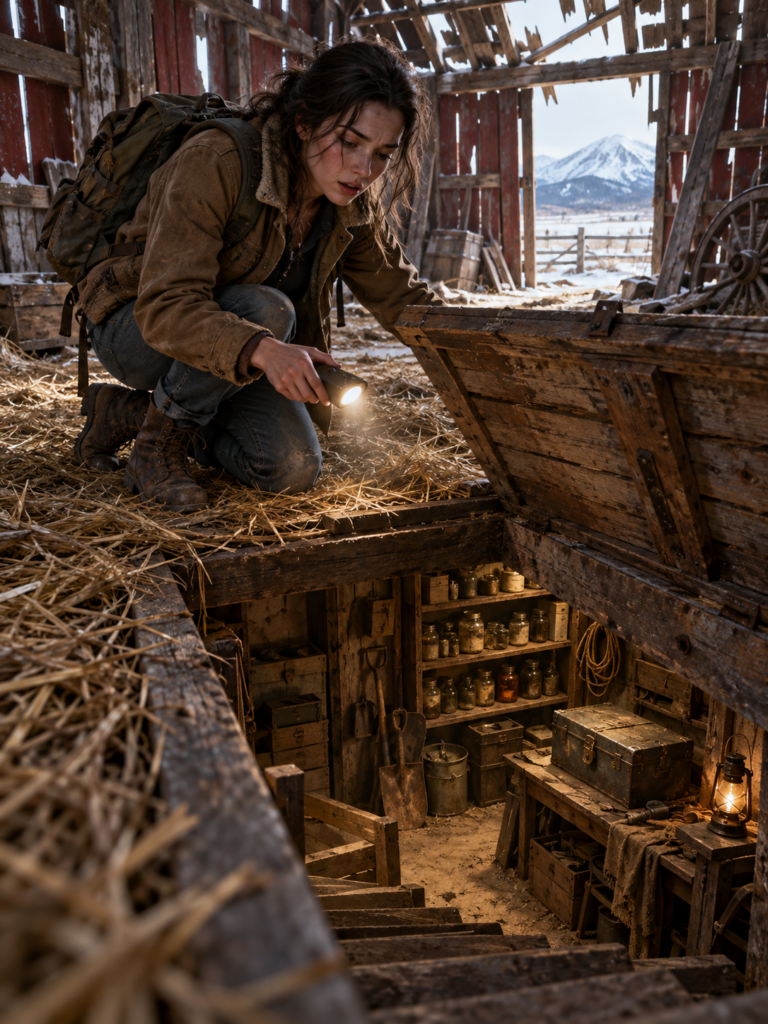
Ren looked toward the underground staircase.
Above her stood a ruined farmhouse.
She had seen a small bedroom with a broken bed and an old quilt.
At the time, she’d assumed it was simply another abandoned room.
Now she understood it differently.
Evelyn hadn’t been preserving an empty bedroom because she couldn’t bear to throw things away.
She had been keeping it ready.
Ren opened the final envelope.
The handwriting was less steady.
Evelyn had written it shortly before her death, when Ren was seventeen.
She explained that the farm, the hidden money, and the remaining family possessions were intended for Ren if she ever found her way there.
She apologized for being unable to give her great-granddaughter a childhood surrounded by family.
Then she asked her to come home.
Ren held the card against her chest.
For years, she’d believed nobody had been waiting for her.
That belief had helped her survive.
If nobody expected her, nobody could disappoint her.
But now there were thirteen cards proving that an elderly woman in Montana had thought of her year after year.
Ren turned to the forty-seven returned letters.
She opened one carefully.
Evelyn asked Jessica why she’d left so suddenly.
She begged her to explain what had happened.
In another, written much later, Evelyn said she no longer needed an explanation.
She only wanted to know Jessica was safe.
Ren reached for her mother’s photograph.
Jessica was seventeen in the picture.
Standing outside this farmhouse.
Smiling.
Then, sometime afterward, she had left Harlo.
Ren’s own childhood records offered no explanation for the separation.
And Evelyn’s letters showed that even her closest family hadn’t understood.
There was no evidence here of a deliberate rejection.
Only repeated attempts to find someone who had disappeared from their lives.
Ren thought of the letter Jessica had kept among her belongings until her death.
It meant her mother had known Evelyn wanted her home.
Why hadn’t she returned?
What had happened in Harlo that made staying away seem necessary?
The answer wasn’t in the birthday cards.
It wasn’t in the returned envelopes.
Not yet.
Ren wiped her eyes and examined the remaining contents of the strongbox.
Eleven hundred dollars.
A homestead claim dated 1923.
And the leather journal Evelyn had kept through years of running the farm.
Ren opened the journal, turning carefully past notes on weather, crops, and household repairs.
If Evelyn had left any explanation for Jessica’s departure, this was the next place to look.
She laid the journal across her knees and began reading.
Ren read until her phone screen dimmed.
The journal wasn’t a confession or a hidden family history.
It was something quieter.
A record of how Evelyn Callaway had kept eighty acres of Montana land working through droughts, difficult winters, failed crops, and years when money had been scarce.
The pages explained how to judge approaching weather from the western clouds.
How to repair a fence without wasting useful lumber.
How to inspect stored food and recognize spoilage.
How to maintain a wood stove.
How to tell which trees were still alive after a harsh winter.
Ren had hoped for an explanation of Jessica’s departure.
What she found instead was evidence of a woman who had kept living, working, and preparing a home for someone who might never come back.
There were references to Jessica.
Sometimes Evelyn mentioned another returned letter.
Sometimes she wrote only that no news had come.
Nothing explained why her granddaughter left.
Ren closed the journal.
The underground room had answered one question.
She was not a stranger to the Callaway family.
She had been loved, remembered, and expected.
But the mystery of her mother’s departure remained.
Ren gathered the cards, letters, journal, and family documents.
She climbed the wooden stairs and closed the hatch.
When she emerged into the barn, the morning wind was moving through the damaged roof.
She looked toward the farmhouse.
It seemed just as broken as the day before.
But now she knew somebody had maintained it with her in mind.
And for the first time, leaving felt like abandoning something that belonged to more than herself.
Ren began working.
She cleared debris where it was safe.
She separated usable lumber from rotten boards.
She found the least damaged room and started trying to make it habitable.
At night she slept in the old pickup truck.
During the day she worked until her hands ached.
She was painfully aware that eleven hundred dollars wouldn’t settle a $6,200 tax debt.
But she had time to try.
On the fourth morning, a pickup stopped near the farmhouse.
An older woman climbed out wearing a canvas work coat.
She introduced herself as Ida Marsh.
Ida had run the feed-and-supply store in Harlo for decades.
She’d also been Evelyn’s closest friend.
When Ren told her about the cards, Ida’s expression softened.
“Evelyn talked about you,” she said.
Ren stared.
“She did?”
“Whenever she had reason to think there was news. And sometimes when she didn’t.”
Ida remembered Jessica too.
She remembered Evelyn waiting for letters that never arrived, refusing to sell the farm, and insisting that somewhere her family might still return.
Then Ida went back to her truck.
Ren assumed the visit was over.
Instead, Ida lowered the tailgate.
Inside were roofing materials, rope, tarps, and boxes of supplies.
Some packaging was damaged.
The materials themselves were still usable.
Ida said she couldn’t sell them in that condition.
Ren could have them.
It was the first help anyone had offered her without demanding an explanation.
Two days later, a young man appeared while Ren struggled to cover the damaged roof.
His name was Garrett Hollis.
He worked with Ida and had studied construction before returning to Harlo.
He didn’t offer a speech.
He helped secure the loose sheeting, showed Ren how to fasten it properly, and climbed down.
When she asked why he’d helped, he told her Evelyn had once stayed with his family during a difficult night.
He hadn’t forgotten.
Garrett began coming regularly.
He taught Ren how to identify rotted structural members, measure accurately, and make repairs without wasting money.
Ren learned by watching and doing.
Soon the house had a patched roof.
Then a safer floor.
Then a working stove.
Loretta Winn, who owned the diner in town, hired Ren to wash dishes and clean after the evening rush.
The work wasn’t glamorous.
But the pay helped.
And people began recognizing her as Evelyn’s great-granddaughter rather than the foolish girl who’d spent seven dollars at an auction.
Not everyone welcomed her.
One morning, Warren G arrived in an expensive truck.
He offered her $3,000 for the farm.
Ren refused.
Warren pointed out the cost of repairs and the unpaid taxes.
Then he mentioned that he’d tried to buy the place from Evelyn many times.
She had never agreed.
Now, he suggested, Ren would eventually discover that sentiment couldn’t pay bills.
She told him the farm wasn’t for sale.
Warren left.
But the visit troubled her.
He knew the property’s condition.
He knew the debt.
And he seemed certain she’d be forced to leave.
Ren continued working.
By summer, she had a modest vegetable garden.
She’d restored cold water service to part of the house.
She was learning how to preserve vegetables, maintain tools, and read the weather.
The farmhouse was still far from comfortable.
But it was beginning to function.
Then a woman named Dileia Voss arrived in Harlo with two children.
Dileia was a widowed bookkeeper traveling toward work in Billings.
Her car had broken down.
Loretta knew Ren had a spare room.
What began as a temporary arrangement became a way for both women to manage.
Dileia contributed bookkeeping skills and money from occasional work.
Her son Owen helped with chores.
Her younger daughter June followed Ren around the yard, asking questions about everything.
For the first time, the farmhouse contained conversations at breakfast, children’s voices in the hallway, and people sharing responsibilities.
Ren discovered she liked coming home to those sounds.
Then autumn brought trouble.
Garrett was helping her reinforce a damaged beam in the barn when part of the old structure gave way.
He saw the movement before Ren did.
He shoved her out of the danger area.
The falling timber struck him before he could get completely clear.
He survived with a dislocated shoulder and cracked ribs.
But he needed time to recover.
Ida was furious and frightened.
She blamed herself for sending Garrett to help.
She asked Ren to keep her distance while he healed.
Ren understood Ida’s fear.
But Garrett’s absence left the farm harder to manage.
Shortly afterward, Loretta lost her diner.
Warren had acquired the building through a property company and imposed a rent increase Loretta couldn’t afford.
The diner closed.
Ren lost her job.
Her earnings were gone.
Her best helper was injured.
And the outstanding tax debt still threatened the farm.
Warren returned with another offer.
Five thousand dollars.
Ren refused again.
He warned her that the county would eventually reclaim the property.
She watched his truck disappear and wondered how long determination could compensate for a shortage of cash.
Winter arrived hard.
Ren studied Evelyn’s journal almost every night.
She learned how to manage the stove, conserve supplies, and prepare for storms.
Dileia kept careful records of every dollar entering and leaving the household.
Owen stacked firewood.
June fed the chickens.
The family they were becoming was held together by work as much as affection.
But the numbers remained frightening.
They were still short of what the county required.
On Christmas Eve, a severe storm closed the roads.
Snow swept across the farm.
The temperature fell dangerously below zero.
Ren was sitting in the kitchen when she noticed headlights moving unsteadily along the road.
A car had become stuck in a snow-filled drainage ditch.
She put on her heaviest clothing and went outside.
Inside the stranded vehicle was a frightened mother with two children.
The younger girl was dangerously cold.
Ren helped them into the farmhouse.
She knew from Evelyn’s journal that serious cold exposure required careful handling and medical attention.
She sheltered the family, kept them insulated, avoided applying direct intense heat, and tried to obtain emergency assistance despite the storm.
The child gradually became more responsive.
When conditions allowed, the family could receive further help.
The mother told Ren that she’d taken an unfamiliar road after the highway closed.
She’d been terrified they wouldn’t survive the night.
Ren looked toward Evelyn’s journal on the kitchen table.
The woman who had written those pages had been dead nearly a year.
Yet her practical knowledge had helped Ren recognize the danger and respond.
The storm passed.
Ren returned to the numbers.
They still weren’t enough.
But after news of her help during the storm spread through Harlo, some of the distance between her and the town began to disappear.
People who had barely spoken to her offered work, supplies, and small amounts of assistance.
Dileia found additional bookkeeping jobs.
Ren took every reasonable opportunity she could manage.
Then Ida came back.
She brought food.
And an envelope.
Evelyn had left it with her years before, asking that it be given to someone from the family who returned to the property.
Ida admitted she should have delivered it sooner.
She hadn’t known whether Ren intended to stay.
Inside was a check for three hundred dollars.
Ren recognized Evelyn’s handwriting.
It wasn’t enough by itself.
But together with what Ren and Dileia had accumulated, it closed the remaining gap.
In January, Ren walked into the county clerk’s office and paid the $6,200 tax debt.
The clerk stamped her receipt.
Paid in full.
Ren held the paper for a long moment.
She had come to Harlo with almost nothing.
Now she had paid what the county required to keep the farm.
But Warren was not finished.
In April, after Garrett had recovered enough to return, he arrived with an older man named Rupert Ashb.
Rupert was a retired attorney.
He had spent forty years practicing law and had little interest in returning to court.
But Garrett had shown him a notice delivered to Ren.
Warren claimed ownership of a narrow strip of land crossing the road used to reach the farm.
He intended to restrict access.
Ren had paid the taxes.
She had repaired the house.
She had refused to sell.
Now Warren was threatening the road that connected the property to the outside world.
Rupert examined the notice.
He asked how long the road had existed.
Ren showed him the original homestead document she’d discovered beneath the barn.
The access route had been part of the property’s history for generations.
Rupert studied the records.
He noticed that Warren had acquired the disputed strip in 1998.
Twenty-six years earlier.
Yet he’d never developed it or restricted its use.
Not until Ren refused his offers.
Rupert agreed to investigate.
Weeks later, he asked Ren to visit his cabin.
When she arrived, two folders lay on the table.
Rupert opened the first.
The disputed land had once been transferred by a Callaway family member named Thomas.
But Thomas’s medical records showed that by the time of the 1998 sale, he had significant cognitive impairment.
His physician had advised against allowing him to make major financial decisions without supervision.
The validity of the transfer was therefore open to serious challenge.
Then Rupert opened the second folder.
It contained an old complaint filed with the county sheriff.
The complaint alleged that Warren had obtained the land through an improper transaction involving Thomas.
It had been dismissed after only forty-eight hours.
And the person who filed it was seventeen years old.
Ren leaned toward the paper.
She recognized the name.
Jessica Callaway.
Her mother.
Jessica had tried to challenge Warren before leaving Harlo.
And Rupert had found a second record.
A bus departure, one week after the complaint was dismissed.
A seventeen-year-old passenger traveling west without a return ticket.
Ren stared at the date.
Her mother’s departure had followed an attempt to expose what she believed was an unjust land transaction.
The records didn’t prove every reason Jessica had left.
But they showed that her sudden disappearance had a history nobody had explained to Ren.
Rupert slid the documents closer.
“There’s something else you should understand about the man who dismissed your mother’s complaint,” he said.
Ren looked up.
And Rupert told her how the former sheriff was connected to Warren G.
“The sheriff was his first cousin,” Rupert said.
Ren looked again at the old complaint.
Jessica Callaway had been seventeen when she filed it.
She alleged that Warren had obtained the property strip through an improper transaction involving a man whose ability to understand the sale was seriously impaired.
The complaint had been dismissed within forty-eight hours.
No substantial investigation appeared in the records Rupert had recovered.
The county sheriff at the time was related to the man Jessica had accused.
Ren felt the meaning settle slowly.
For years, she’d imagined her mother leaving Montana because she’d wanted a different life.
Evelyn’s letters had made that explanation feel incomplete.
Now there was another possibility.
Jessica had confronted someone powerful.
Her complaint had gone nowhere.
Then she’d left town.
Rupert was careful about what the documents established.
They showed the filing.
They showed the dismissal.
They showed the family relationship.
They showed Jessica leaving Harlo shortly afterward.
But they didn’t contain a recorded threat.
They didn’t prove what anyone had said to Jessica privately.
And they couldn’t tell Ren exactly what her mother had feared.
“She thought staying would put someone in danger,” Ren said.
Rupert considered that.
“It’s a reasonable interpretation. But we need to keep it separate from what we can prove.”
Ren looked down at the papers.
Jessica had preserved a letter from Evelyn throughout the years she lived away.
She’d also kept the silver ring and the photograph of the farmhouse.
Those objects mattered differently now.
Ren had once assumed her mother kept them merely as reminders of a childhood she’d outgrown.
But perhaps Jessica had never stopped wanting to return.
Perhaps she had believed the situation in Harlo remained dangerous.
Perhaps she couldn’t bear to explain everything to Evelyn.
Ren would never know every private calculation Jessica had made.
Her mother was gone.
But the documents challenged the story Ren had carried since childhood.
Jessica hadn’t simply vanished without leaving evidence of what had happened beforehand.
She had attempted to intervene.
And the attempt had been dismissed in circumstances that deserved examination.
Rupert closed the folder.
He wanted to challenge Warren’s claimed control of the access strip and bring the older complaint before the court.
Ren asked what he needed.
“Your permission to use the records. And your patience.”
She gave him both.
The weeks that followed were difficult.
Warren had money, lawyers, and years of local influence.
Rupert had documentary evidence, experience, and a client who refused to surrender the property.
He prepared the case carefully.
The original homestead claim from 1923 was central.
So was a county filing from 1931 documenting a right of way for access to the Callaway farm.
That filing predated Warren’s acquisition of the disputed strip by decades.
The records concerning Thomas’s medical condition raised further questions about whether the later transfer could be enforced.
And Jessica’s complaint showed that the transaction had been challenged almost immediately.
When the hearing began, Ren sat in the Harlo courthouse facing Warren and his legal team.
She was nervous.
She had spent much of her life avoiding situations where other people possessed authority over her.
Now she was asking a court to examine decisions that had affected her family for more than twenty years.
Rupert presented the documents one by one.
He didn’t begin with accusations about Warren’s character.
He began with dates.
The original homestead.
The recorded access right.
The disputed transfer.
The medical evidence.
Then the complaint filed by Jessica.
The judge, Elaine Croft, examined the material.
Warren’s attorneys raised objections and offered competing interpretations.
Rupert addressed them without theatrics.
When he introduced Jessica’s complaint, Ren felt her chest tighten.
For the first time, her mother’s attempt to challenge Warren was being discussed publicly rather than sitting forgotten in an archive.
Rupert explained the circumstances of the dismissal.
He identified the sheriff’s relationship to Warren.
Then he introduced the bus record showing Jessica’s departure shortly afterward.
He made clear that the court could not determine everything that happened privately.
But the documented sequence mattered.
Jessica had raised concerns.
Those concerns had not received a meaningful investigation.
She had left Harlo.
And the disputed land had remained under Warren’s control until he attempted to use it against the next Callaway who came home.
Ren looked across the aisle.
Warren’s face remained controlled.
But he no longer appeared entirely comfortable.
For years, his argument had depended on one simple assertion.
He owned the access strip.
Therefore, he could decide whether Ren could use it.
Rupert had shown that the situation was not simple at all.
The earlier recorded right of way complicated that claim.
The medical evidence challenged the validity of the transfer.
And Jessica’s complaint raised questions about how the matter had originally been handled.
At the close of the hearing, Rupert requested that Warren’s restriction be rejected and that the old complaint be referred for further review.
The court considered the evidence.
Ultimately, Warren’s attempt to block access to the Callaway property failed.
The documentary history supported Ren’s continued use of the road.
The questions surrounding the original transfer also warranted attention beyond Warren’s unsupported assertion of absolute control.
The materials concerning Jessica’s complaint were referred for review.
That did not automatically prove every allegation against Warren.
Nor did it establish exactly why Jessica had fled.
But it meant her concerns were no longer buried without examination.
Ren left the courthouse carrying two things.
The documents showing the farm’s access was protected.
And a fuller understanding of the circumstances surrounding her mother’s departure.
For the first time, she felt that Jessica’s story belonged to the family again.
Not as a rumor.
Not as an accusation invented after the fact.
As a sequence of actions supported by records.
Jessica had identified a problem.
She had challenged it.
Her complaint had been dismissed.
She had left town shortly afterward.
The rest remained uncertain.
Ren could live with that uncertainty better than she could live with the old assumption that her mother had simply abandoned everyone.
Back at the farm, Dileia listened while Ren explained what Rupert had found.
Owen was outside working on the fence.
June was talking to the chickens.
Garrett was repairing a section of the barn that remained unsafe after the previous collapse.
The ordinary sounds of the household continued around them.
Ren laid Jessica’s documents beside Evelyn’s birthday cards.
Two generations of women had been separated by circumstances neither had fully explained to the other.
Evelyn had believed Jessica had chosen to stay away.
Jessica had kept Evelyn’s letter throughout her life.
Ren had grown up unaware that anyone in Montana was waiting for her.
And now the records suggested that fear, unequal power, and a failed complaint had contributed to the separation.
“I wish Evelyn had known,” Ren said.
Dileia nodded.
Ren touched the returned letters.
Forty-seven attempts to reach Jessica.
None delivered.
“I wish Jessica had known how long she waited.”
There was no way to repair that lost time.
Evelyn was dead.
Jessica was dead.
Ren couldn’t arrange the conversation they should have had.
But she could stop carrying the old misunderstanding forward.
She could preserve the letters.
She could tell the story accurately.
And she could make sure the farm remained a place where another person wouldn’t have to endure the same kind of isolation.
The work continued.
The farmhouse became safer and more comfortable.
Repairs that had once seemed impossible were completed gradually through careful planning and shared labor.
Ren learned to separate urgent work from improvements that could wait.
The barn remained the greatest challenge.
Its old structure had suffered too much damage to be trusted without substantial rebuilding.
Garrett inspected it carefully.
This time, neither of them approached the work with the confidence they’d had before his accident.
They had learned how quickly an old building could fail.
The reconstruction required proper supports and a safer plan.
The underground storage room remained an important part of the property.
Ren protected its contents.
The old tools and homestead documents were evidence of how the farm had been built and maintained.
The birthday cards and returned letters were too precious to leave exposed to damp or rodents.
She moved them into safer storage inside the house.
But she kept the journal close.
Evelyn’s practical observations still guided her.
Ren consulted it when preparing for frost, planting vegetables, and preserving food.
Sometimes she read passages merely to hear the voice of the woman she hadn’t met.
A woman who knew this land intimately.
A woman who recorded details because she understood that someone might someday need them.
Over time, the farm developed a rhythm.
Dileia continued using her bookkeeping skills to earn money and manage household expenses.
Owen helped maintain fences and firewood.
June took responsibility for feeding the chickens and checking her sunflowers.
Ren worked the land, handled repairs, and accepted help when she needed it.
Garrett became a steady presence again.
His shoulder healed gradually, although he remained more cautious about heavy work.
Ida visited regularly.
The older woman had lost her closest friend when Evelyn died.
In Ren, she found a connection to the person she missed.
Their relationship was not always easy.
Ida could be sharp.
Ren could be stubborn.
But their arguments increasingly resembled those of people who trusted one another enough to disagree.
Loretta’s diner did not return to its former place in town.
That loss remained one of the costs of Warren’s actions.
Ren remembered the diner because Loretta had given her work when she most needed it.
She remembered the booth where Evelyn had sat every Sunday.
A person could win one dispute and still be unable to undo every harm connected to it.
The Callaway farm’s survival didn’t erase what had happened to Loretta.
Or Jessica.
Or Evelyn.
But it did change what could happen next.
The following spring, the fields grew green again.
The apple trees along the fence began to blossom.
Some had been too damaged to survive.
Others produced new growth.
Ren inspected them one morning, checking the buds on the lower branches.
Garrett approached carrying a length of carefully sanded wood.
He had spent time working on it in the barn.
When Ren asked what it was, he turned it toward her.
A carved sign.
Callaway Farm.
Established 1923.
Below the lettering was a small farmhouse with a light burning in one window.
Ren ran her hand across the carved surface.
Edmund Callaway had established the property generations earlier.
Evelyn had maintained it for decades.
Jessica had stood before the farmhouse as a teenager, in the photograph Ren had carried across the country.
And Ren had come home by purchasing the place at auction for seven dollars.
Seven dollars hadn’t made her secure.
She’d nearly lost the farm repeatedly.
The tax debt had been real.
The repairs had been costly.
Garrett had been injured.
Warren had tried to buy the property, then restrict access to it.
Ren had survived because of work, help, evidence, and decisions she made even when frightened.
She had never been rescued by a hidden fortune.
The strongbox contained eleven hundred dollars, important but insufficient.
The real value of the underground room had been the documents and letters preserved there.
The original homestead claim helped establish the property’s history.
Evelyn’s journal helped Ren learn how to live on the farm.
The returned letters changed how she understood Jessica.
The birthday cards proved that someone had thought of her year after year.
The most important discovery wasn’t money beneath the barn.
It was the history of a family that had been interrupted without losing its capacity to love.
Ren looked at Garrett.
“It’s for the gate?”
He nodded.
They carried it together to the entrance of the farm.
The road stretched toward Harlo.
Beyond town lay the highway, the bus stations, and all the places Ren had once passed through without belonging.
She remembered sleeping in a laundromat’s exhaust warmth.
The endless search for temporary work.
The nights when she had calculated how many dollars remained before she would have nowhere to stay.
Now she stood on property her family had held for generations.
She knew its history.
She knew its problems.
She knew the people who depended on her and the people she depended on.
She had a place to return to each evening.
Garrett helped her fasten the sign securely.
Ren stepped back.
The carved farmhouse seemed modest compared with the real building.
But the illuminated window caught her eye.
Evelyn had kept a room prepared for Ren.
She had made a quilt.
She had written thirteen birthday cards.
She had saved money and supplies.
And she had kept hoping someone would return.
Ren thought about Dileia and her children.
They had arrived at the farm needing temporary shelter.
Now they were part of the household.
The spare room that Evelyn had prepared for a child she never met had become a room used by people who needed somewhere safe to stay.
The farm had already begun doing for others what Evelyn had wanted to do for Ren.
That realization stayed with her.
Later, while Garrett returned to the barn, Ren went inside.
She opened the metal box where she’d carefully stored the birthday cards.
The first one contained the pressed flower.
The last bore Evelyn’s unsteady handwriting.
Ren sat at the kitchen table and read them again.
At five, she’d believed nobody knew her birthday.
At eleven, she’d assumed no one outside the children’s home remembered her name.
At seventeen, she’d been working wherever she could and wondering how much longer she could survive without a permanent home.
During those years, Evelyn had been writing.
Every card had been a small act of faith unsupported by any guarantee of reunion.
Ren realized that the cards weren’t valuable because they erased her loneliness.
They couldn’t.
They were valuable because they proved the loneliness had never represented the whole truth.
She had been missed.
She had been hoped for.
She had belonged to a family long before she understood what the name meant.
Ren placed the cards back in the box.
Beside them she set the old Polaroid.
Jessica stood in front of the farmhouse, shading her eyes from the Montana sunlight.
Ren studied her mother’s expression.
For years, she’d imagined Jessica’s smile as evidence of an easy life Ren had never shared.
Now she knew Jessica had been seventeen when she challenged Warren’s disputed land transaction.
The photograph could not tell her what Jessica would do afterward.
It couldn’t reveal private threats or explain every decision.
But it showed a young woman who had once stood on this land with confidence.
Someone who knew the farm.
Someone who later kept a letter from home despite leaving.
Ren decided she would not remember Jessica merely as the mother who had been absent.
She would remember her as a person whose story deserved to be understood fairly.
The farmhouse had a history before Ren arrived.
And that history included people who had made difficult decisions, sometimes correctly and sometimes without knowing how much their choices would cost.
Evelyn couldn’t protect Jessica from everything.
Jessica couldn’t give Ren the childhood she deserved.
Ren couldn’t change either fact.
But she could decide what to preserve and what to do differently.
That evening, she lit the lamp in the front window.
It had become a familiar habit.
The house could be seen from the road on clear nights.
The light remained visible to anyone traveling toward the farm.
Dileia came into the kitchen carrying two cups of coffee.
She noticed the open box of letters.
“Thinking about Evelyn?”
“About all of them,” Ren said.
Dileia sat down.
Outside, June was still arguing with a chicken that refused to return to its coop.
Owen was stacking the last of the firewood.
Garrett’s truck stood near the rebuilt barn.
Ren looked through the window.
She had once believed having a family meant being born into a household where everyone stayed.
She knew better now.
Family could also be built through ordinary, repeated acts.
Someone arriving with damaged roofing supplies.
Someone holding a ladder.
Someone sharing a kitchen.
Someone checking the numbers when they were frightening.
Someone offering a room to a stranger whose car had broken down.
The people on the farm had found one another through need.
They remained because they had begun to care.
Ren picked up Evelyn’s journal.
Near the back were the last entries about the property.
Evelyn had written about preserving the farm for whoever eventually came home.
There was no guarantee she would live to see that day.
But she had kept preparing.
Ren understood the choice now.
Waiting hadn’t meant Evelyn had stopped living.
She’d continued working, maintaining the house, tending the orchard, recording what she learned.
She’d prepared for a future she might never witness.
The underground room had been part of that preparation.
It was built to protect supplies during uncertain times.
Evelyn had turned it into a place to preserve letters, money, records, and memories.
It wasn’t a mysterious treasure vault.
It was a practical room given emotional purpose by the woman who maintained it.
Ren closed the journal.
She would keep the underground room.
She would protect the family documents.
And she would keep the farm open to the people who needed it.
The following morning, Garrett finished adjusting the new gate hardware.
Ren joined him.
Together, they checked that the sign hung level.
The weathered road beyond it looked ordinary.
There was no parade.
No cheering crowd.
No dramatic announcement that the Callaway family had returned.
There was only a repaired gate, a carved sign, and a young woman standing on land she no longer intended to leave.
For a moment, Ren remembered her first arrival.
She had walked for almost two hours from town, carrying a backpack and wondering whether she’d wasted the last money she had.
The house had been nearly unlivable.
The barn had been dangerous.
And she had thought the seven-dollar purchase might be the worst decision she’d ever made.
Now she knew it had led her to something she couldn’t have discovered elsewhere.
A great-grandmother who had written cards for her.
A mother whose departure was more complicated than she’d been told.
An original homestead record that helped establish the family’s history.
And a group of people who had become her home.
Ren put her palm against the gatepost.
The wood was solid.
Beyond it, the fields moved in the spring wind.
She turned toward the farmhouse.
The front window reflected the morning sky.
That evening, she would light the lamp again.
She would keep doing it as long as she lived there.
Not because she expected Jessica or Evelyn to appear on the road.
They were gone.
But because other people might someday need to find their way somewhere.
Someone might arrive hungry.
Someone might need shelter.
Someone might believe nobody in the world was waiting for them.
Ren knew that feeling.
She also knew how much one open door could change.
She walked back toward the farmhouse, where Dileia was making breakfast and June’s voice carried through an open window.
The sign behind her moved gently in the wind.
Callaway Farm.
Established 1923.
The property had survived for generations because people kept repairing, working, and holding on.
Now it was Ren’s turn.
And the light in the window would remain on.