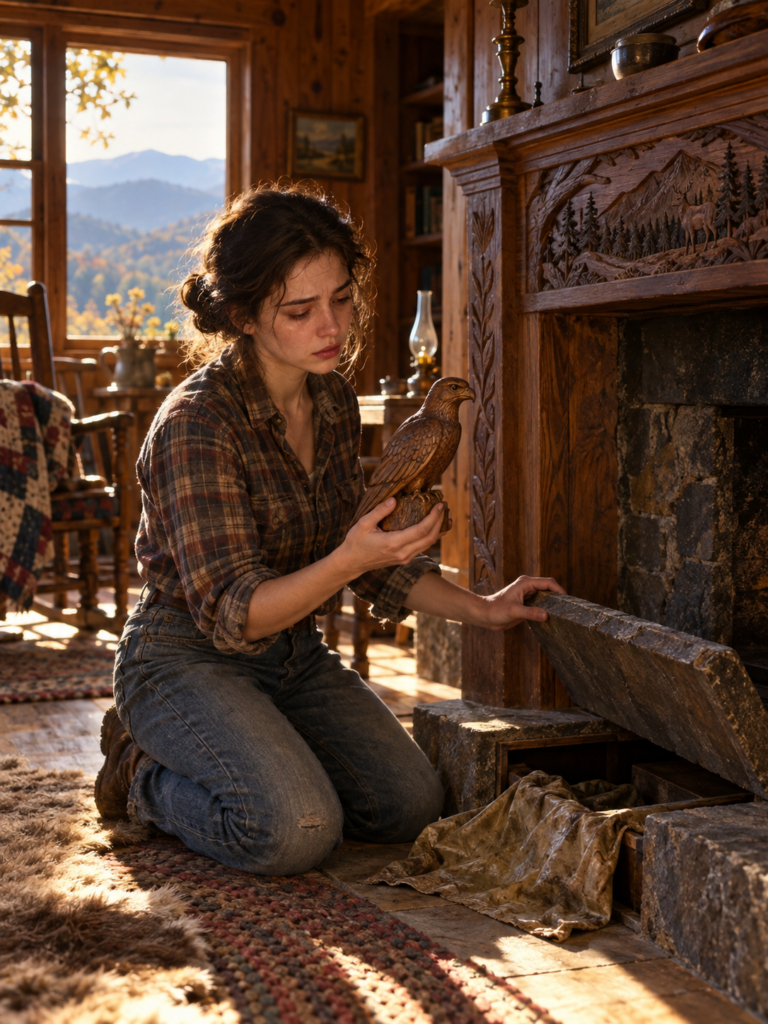
The second stone slid quietly sideways, exposing another compartment.
Sylvie leaned closer with the flashlight.
Two parcels rested inside.
Both were wrapped in oilcloth and tied with leather cord, just like the first.
She removed them carefully and carried them to the table.
The first contained a wooden fox.
It sat upright, its ears alert, its tail curled around its feet.
The carving was so precise that the animal seemed to be listening to something just beyond the room.
The second parcel held a deer bending its head toward a stream.
Even the water had been carved into the base, its flowing movement suggested by overlapping curves in the wood.
Sylvie turned both pieces over.
The same initials appeared beneath them.
E.H.
The fox was dated 1971.
The deer, 1978.
Three extraordinary carvings.
Three different years.
All hidden inside the fireplace of a cabin the Harmon family considered worthless.
Sylvie arranged them beside one another.
The hawk’s feathers.
The fox’s watchful face.
The delicate curve of the deer’s neck.
These weren’t casual experiments.
Whoever made them had spent enormous amounts of time on their smallest details.
But their value was still an open question.
Sylvie couldn’t simply assume fine craftsmanship meant a fortune.
She knew too little about woodworking or the art market to make that judgment.
What she did know was that Edmund had taken deliberate steps to conceal his work.
The hidden stone mechanisms were almost as impressive as the carvings themselves.
Neither compartment looked hastily constructed.
The sliding stones fitted tightly into the fireplace.
They would have remained invisible unless someone pressed exactly the right place.
Sylvie thought about the cabin’s handmade walls.
Dozens of panels.
Intricate joints.
Wood grain aligned so carefully that ordinary seams were difficult to distinguish.
Suddenly, the fireplace wasn’t the only part of the cabin she wanted to examine.
She lifted the flashlight toward the north wall.
Could the same craftsman have hidden things behind the paneling?
The possibility seemed reasonable.
But opening perfectly preserved woodwork without understanding its construction could cause damage.
Sylvie wasn’t willing to risk destroying the very thing she’d discovered.
She carefully rewrapped the carvings.
Then she remembered Holt Tanner.
Earlier that morning, she’d driven down to Millhaven, the small town beneath the ridge, to purchase cleaning supplies.
Holt owned the hardware store.
When she’d mentioned Edmund Harmon’s cabin, he’d recognized the name immediately.
He remembered Edmund as a quiet man who visited town for supplies and regularly repaired things for neighbors without charging them.
Holt had spoken about him with genuine affection.
Not at all the way Lorraine or Garrett spoke about their grandfather.
And Holt wasn’t the only local person who remembered him.
Sylvie had also met Vera Caldwell, a woman who lived farther along the mountain road.
Vera had known Edmund for many years.
She’d offered coffee, conversation, and the kind of uncomplicated neighborliness Sylvie hadn’t experienced since Colt died.
Vera might know who could examine the carvings.
Sylvie spent much of that night awake.
Outside, wind moved through the trees.
Inside, the cabin remained remarkably solid and quiet.
She looked up at the ceiling, studying its carefully joined boards.
She thought of Edmund spending decades alone here, making beautiful objects and hiding them.
The family had inherited his history without understanding it.
And Sylvie, who had been given the cabin almost as an insult, had discovered something they’d never bothered to seek.
At dawn, she drove down the mountain and contacted Vera.
She explained what she’d found.
There was a pause before Vera answered.
Then she asked Sylvie to describe the carvings again.
Sylvie told her about the hawk, fox, and deer, the signatures, and the sliding stone compartments.
When she finished, Vera became unusually quiet.
Finally, she gave Sylvie the name of a woodworker.
Ray Briggs.
He had decades of experience and knew fine craftsmanship.
Vera believed he would understand what Sylvie had found.
Sylvie wrote down his number.
She called him and arranged for him to visit.
Then she returned to the cabin and stood before the matched wooden walls.
The three carvings remained safely wrapped on the table.
The concealed stones were back in place.
But her understanding of the room had altered completely.
The cabin wasn’t just exceptionally well built.
Its builder had designed parts of it to remain undiscovered.
And when Ray Briggs arrived to examine the first three carvings, Sylvie would finally learn whether Edmund’s hidden work was merely unusual—or important enough to change the way everyone saw the Harmon family.
Ray Briggs arrived two days later in an aging pickup fitted with racks for lumber and tools.
Before he even entered the cabin, he stopped at the front door.
He studied the carved vines running across its heavy wooden surface.
Then he crouched to examine the lower panels.
Sylvie watched his expression change.
“What is it?” she asked.
Ray didn’t answer immediately.
He traced one joint with his fingertip.
“Who made this?”
“Edmund Harmon.”
Ray stood slowly.
“I knew the name. I didn’t know he built an entire room like this.”
Inside, Ray examined the walls, the mantel, and the wooden bed.
He tested a corner post with both hands.
It didn’t move.
He leaned close to the panels and inspected their joints.
After several minutes, he stepped back.
“I’ve worked with wood for thirty years,” he said. “Some of this is beyond anything I’ve ever made.”
Sylvie looked around the room.
She’d known the workmanship was remarkable.
Hearing a professional confirm it made the cabin seem unfamiliar again.
Ray told her he’d once seen an Edmund Harmon rocking chair sold through an Asheville auction house.
The chair had brought approximately sixty-two thousand dollars.
Sylvie stared at him.
“One chair?”
“One chair.”
He gestured toward the fireplace.
“Now show me what you found.”
Sylvie knelt and pressed the hidden stone.
It moved along its concealed track.
Ray crouched beside her, watching the mechanism.
She unwrapped the hawk and placed it in his hands.
For a long time, he said nothing.
He moved toward the window and rotated the carving in natural light.
He examined the feather details, the grain direction, and the tiny marks left by the tools.
Then he turned the figure over and inspected Edmund’s initials.
“Where are the others?”
Sylvie opened the second compartment.
Ray studied the fox and deer with the same attention.
When he finally spoke, his voice was quieter.
“These deserve a proper appraisal.”
Sylvie looked at the three small figures.
“How much could they be worth?”
“I wouldn’t put a number on them without having someone qualified examine them.”
He glanced at the walls.
“But I can tell you something else.”
“What?”
“I don’t think these are the only hidden pieces.”
They spent the next two hours inspecting the cabin.
Ray began by checking the wooden panels closest to the windows.
He explained how a fixed joint differed from one designed to move.
The distinction wasn’t always visible.
Sometimes it could only be felt by applying gentle pressure along a particular edge.
Behind one north-wall panel, they discovered another compartment.
Inside were seven individually wrapped wooden components.
Ray carefully laid them out on the porch.
They belonged to a child’s rocking chair.
Each joint was shaped to fit its corresponding piece.
As he assembled it, Sylvie watched the carved apple blossoms on the headboard align across the separate sections.
When the final component was fitted, the little chair stood perfectly balanced.
There was no need for glue.
The original pieces held together through the precision of Edmund’s joinery.
A small wooden instruction plaque accompanied them.
Its date was 1969.
Sylvie ran her hand over the finished chair.
Edmund had made this years before some of the figures in the fireplace.
He had been preserving his work for decades.
The next compartment revealed a folding writing desk.
Its surface contained elaborate inlaid patterns of walnut and pale maple.
The individual pieces fitted together with seams almost too fine to see.
Another compartment contained additional animal carvings.
A bear.
A pair of rabbits.
A trout leaping from carved water.
The trout was dated 1998.
The dates established that Edmund’s work had continued across many years.
But the next discovery was different.
Behind a low panel near the bed was a fitted rack holding woodworking tools.
Chisels.
Gauges.
Carving knives.
A small block plane.
Everything arranged in its own place.
Ray lifted one of the tools.
The edge was clean and carefully maintained.
“He kept the tools with the finished pieces,” Ray observed.
Sylvie examined the handles.
The wood had darkened where Edmund’s fingers had held them through years of use.
For the first time, she imagined not only the objects he’d made, but the person actually making them.
Alone in this room.
Sharpening a blade.
Selecting timber.
Working a curve until the grain carried the shape he wanted.
The cabin had been filled with evidence of his patience from the moment she entered.
Now she could see how much of that patience had been intentionally concealed.
They arranged the discoveries on the porch.
Ray studied the collection.
The carved figures, the rocking chair, the folding desk, and the preserved tools represented only part of what Edmund had created.
There were also the door, mantel, paneling, shelves, and bedframe.
All of it seemed to belong to one deliberate design.
“This isn’t ordinary furniture stored in a cabin,” Ray said.
He looked through the open doorway.
“The cabin itself is part of the work.”
Sylvie sat beside him.
She remembered Garrett laughing at the three-dollar appraisal.
Lorraine sliding the key across the conference table.
The absolute certainty that there was nothing here worth wanting.
She wondered what Edmund had thought of his family.
Colt had admired him.
That much she knew.
But why had his grandfather hidden work that could have earned him recognition or money?
Ray recommended Leonard Voss, an appraiser familiar with fine woodworking and Edmund’s name.
He offered to advance the cost of the appraisal.
Sylvie hesitated.
She didn’t want another debt.
But Ray made clear that he believed the collection deserved professional evaluation.
After he left, Sylvie walked through the cabin alone.
The newly discovered compartments were closed again.
Even knowing where they were, she struggled to distinguish them from the surrounding panels.
Edmund had designed them beautifully.
Then she remembered something.
Earlier, while moving the table to sweep beneath it, she’d noticed a straight seam near the base of the wall.
At the time, she’d assumed it was part of the paneling.
Now she wasn’t sure.
Sylvie moved the table away.
She crouched and pressed along the seam.
A wooden panel shifted.
She applied gentle pressure to one side.
The panel swung inward on concealed hinges.
Inside was a shallow cedar-lined cavity.
And within it stood a cherrywood drawer.
The drawer had no handle.
Its face was perfectly smooth.
She tried pulling it by its edges.
Nothing.
She pressed around the frame.
Still nothing.
Every earlier compartment had responded to pressure.
This one didn’t.
Sylvie sat back.
Why would Edmund make this hiding place different?
She examined the narrow underside of the drawer.
Her thumb caught on tiny indentations.
They were not cracks.
They were carvings.
She lowered her flashlight to the floor and angled its beam upward.
Six words had been cut into the wood.
“For the one they give it to.”
Sylvie read the sentence several times.
She thought of Lorraine giving her the cabin.
Of Garrett’s laughter.
Of the key resting on the polished conference table while everyone else received something they considered valuable.
Was Edmund describing a person in that exact position?
The words seemed too deliberate to dismiss.
But they didn’t explain how the drawer opened.
Sylvie examined the drawer’s edge more closely.
There was a small opening, barely visible beside the frame.
It looked like a keyhole.
She reached into her jacket pocket.
The brass cabin key still carried its faded paper tag.
She studied the key’s unusual shape.
Its final section was narrower than the rest of the shaft.
She’d noticed that the first day, but hadn’t given it any thought.
Now she brought the narrow tip toward the small opening.
It fitted.
Sylvie turned the key.
A soft click came from inside the wood.
The drawer released.
She pulled.
It slid forward smoothly.
Inside were four leather-bound journals and an unsealed envelope.
Sylvie carried the first journal to the table.
She opened it carefully.
The earliest entry was dated March 1962.
Edmund had written about digging foundations on the mountain, describing the rocky soil, the construction work, and the hawks that circled the ridge.
Sylvie kept reading.
The early journals documented how he built the cabin.
He wrote about selecting oak, fitting joints, working with difficult grain, and making furniture.
The writing wasn’t elaborate.
It was practical, direct, and exact.
But as Sylvie moved into the later decades, the tone changed.
Edmund began describing family disagreements.
In 1984, his sons had visited after a long absence and asked him to sign papers.
He later regretted signing them.
By 1986, he had learned that land and property he’d developed in the valley had been transferred into a family trust from which he was excluded.
His journal stated that the arrangements were legally effective.
He had investigated.
He understood what had happened.
And he could not simply undo it.
Sylvie stared at the page.
This wasn’t what she had expected.
She had imagined Edmund hiding valuable artwork because he wanted privacy.
Now she saw that the story was tied to the loss of property he’d built with his own hands.
His family had taken control of earlier work.
He’d retreated to the mountain.
And he’d spent decades making something they had no idea existed.
But the journals became even more revealing.
An entry from the 1990s described the construction of the hidden compartments.
Edmund explained his method of matching the grain across movable panels so the openings would remain invisible.
He recorded the work of building the concealed fireplace mechanisms.
The secrecy was not accidental.
It was part of the design.
And in a later journal, he finally explained why.
His sons, he believed, had already taken what they wanted from him.
The mountain cabin would be different.
He was making an inheritance for someone outside their circle of favored relatives.
Someone his family might eventually dismiss.
Someone they would hand the remote cabin to because they considered it unimportant.
He couldn’t know who that person would be.
But he knew his family well enough to believe that day would come.
Sylvie stopped reading.
Her chest tightened.
The cabin had not been forgotten by its maker.
He had prepared it.
Every hidden compartment.
Every preserved carving.
Even the unusual cabin key.
He’d anticipated that the family would one day give the property away.
And he’d built the drawer so whoever received the key could eventually find the truth.
Sylvie opened the final journal.
A late entry explained that fourteen finished works were concealed within the cabin’s walls.
Edmund believed their combined value exceeded what his family had taken from him.
He also knew that his failing hands would eventually prevent him from continuing.
The hidden collection was the culmination of decades of work.
Sylvie looked at the unsealed envelope.
She lifted it from the drawer.
Inside was a folded letter.
The handwriting matched the journals, but the letters were larger and less steady.
It was dated February 2009.
She carried the page closer to the lamp.
The letter was addressed to whoever eventually received the cabin.
And as Sylvie began reading, she discovered exactly what Edmund Harmon had intended for that person.
Sylvie read the letter slowly.
Edmund Harmon had written it near the end of his life, when his hands were no longer steady enough for the fine carving he’d spent decades perfecting.
He explained that his family had stripped him of property he’d built and land he’d worked.
He believed they had done so through arrangements he could no longer challenge.
They’d left him the mountain cabin because they considered it insignificant.
But he had never considered it insignificant.
It was the place where he could still build something nobody else controlled.
Piece by piece, he had filled its walls with his finest work.
He’d hidden furniture, carvings, and the tools used to make them.
He’d documented everything in journals.
Then he’d built one final drawer to protect the records.
He did not know who would inherit the cabin.
He couldn’t know.
He simply believed that someone, someday, would receive it from his family as though it had no value.
That was the person he intended to benefit.
Someone disregarded.
Someone given the smallest possible share.
Someone who might need the cabin and its contents more than the people who dismissed them.
Sylvie lowered the letter.
She’d arrived with a duffel bag, a sleeping bag, and barely enough money to support herself.
Lorraine had given her the cabin with the air of someone being generous.
Garrett had laughed.
They had expected Sylvie to disappear into the mountains with a property worth nothing.
Edmund had anticipated precisely that kind of dismissal.
And instead of destroying what remained to him, he’d spent years making sure it could benefit the next person treated that way.
Sylvie pressed the letter flat against Edmund’s table.
There was something extraordinary about it.
He hadn’t known her.
He hadn’t known Colt would marry her.
He hadn’t known how Colt would die or how the family would distribute his estate.
He had prepared for a pattern of behavior, not a particular individual.
And somehow that pattern had brought Sylvie to his front door.
She looked around the cabin.
Every carefully chosen board had been part of his answer.
Not just to his family.
To the idea that someone’s value could be determined by what other people were willing to give them.
For months, Sylvie had felt that losing Colt meant losing the last person who fully considered her family.
Now she was sitting in a room built by his grandfather, reading a letter meant to help someone in her circumstances.
It was not the same as having Colt back.
Nothing could provide that.
But it meant the family she had married into had held more than the coldness she’d experienced at its dinner table.
Edmund had existed.
And Colt had known him.
Sylvie carefully returned the letter to its envelope.
She gathered the journals.
Then she drove to Vera Caldwell’s house.
Vera opened the door and immediately noticed something different about her.
“What happened?”
Sylvie placed the journals on Vera’s kitchen table.
“I found out why he hid everything.”
Vera read Edmund’s final letter.
She didn’t interrupt.
When she finished, she rested her fingertips on the paper and remained quiet.
She had known Edmund for years.
She remembered bringing groceries to the cabin and finding him absorbed in his woodworking.
She remembered his reluctance to talk about his sons.
She knew he’d endured bitter family disagreements.
But even she hadn’t known the full purpose of the hidden collection.
“He told me once that he was still finishing the cabin,” Vera said.
Sylvie nodded.
“He was building compartments behind the walls.”
Vera looked down at the letter.
“All those years.”
They talked about Edmund’s family.
About the valley property.
About his retreat into the mountains.
Vera confirmed that he’d become increasingly distant from his sons after the property dispute.
She did not claim to know every detail.
The journals offered Edmund’s account, and they established why he believed the arrangements had wronged him.
They were not a complete legal history of the trust.
But they explained his decision to preserve the mountain cabin separately from the rest of the family holdings.
Then Sylvie mentioned Colt.
“He told me this place was special to him,” she said. “But I never knew how much time he’d spent here.”
Vera looked at her.
“He used to come up every summer.”
Sylvie stopped.
“Colt?”
Vera nodded.
She explained that Colt had visited his grandfather as a boy.
He’d worked out ways to reach the mountain from Raleigh, sometimes taking a bus and walking the remaining distance.
He and Edmund spent hours together on the porch.
They didn’t always do much.
Sometimes they watched the hawks.
Sometimes they talked about wood.
Sometimes they simply sat quietly.
The visits eventually stopped after Colt’s father learned about them.
Sylvie remembered Colt’s face when he’d described the cabin.
The affection in his voice.
The sadness she hadn’t understood.
“He never told me that part,” she said.
“Maybe it was difficult for him to talk about,” Vera answered.
Sylvie thought about her husband’s family.
Colt had belonged to them all his life.
He knew their expectations.
He knew what happened when someone refused to follow the path they considered proper.
Perhaps his love for Edmund was a part of himself he’d learned to keep private.
Vera offered one more memory.
Colt had once carved something into the underside of the porch railing.
She remembered seeing him working there during one of his final summer visits.
When Sylvie returned to the cabin, she took her flashlight onto the porch.
She crouched beside the lower rail near the corner post.
The marks were small.
Two letters.
C and E.
Colt and Edmund.
Sylvie touched the uneven cuts.
Unlike Edmund’s carvings, they weren’t especially precise.
The lines wandered slightly.
The depth varied.
They looked like exactly what they were: the work of a boy using a knife to mark something important.
Sylvie sat on the porch.
For the first time since Colt’s death, she could imagine him in a place she’d never visited with him.
A teenage boy sitting beside his grandfather.
Two people quietly making room for one another in a family that had never understood either of them.
She rested her hand near the initials.
Then she cried.
Not because she’d discovered money.
Not because the cabin might be valuable.
Because Colt had loved this place.
And now she understood why.
The next morning, Sylvie contacted Leonard Voss.
Ray had given her his name.
Voss was an appraiser familiar with fine woodworking and the small market for Edmund Harmon’s authenticated pieces.
When she described the cabin, he asked several careful questions.
How many finished works had been found?
Were they signed?
Were there dated records?
Had the pieces been moved or altered?
Sylvie explained that she had found fourteen works, along with four journals documenting Edmund’s craftsmanship over several decades.
Voss arranged to visit.
Three days later, he arrived carrying professional equipment and a notebook.
Ray joined them.
Vera came as well.
Sylvie opened the cabin door.
Voss walked slowly through the room, examining the construction.
He studied the door.
The mantel.
The matching wall grain.
The furniture and hidden compartments.
He spent a long time looking at Edmund’s carved animals.
Then he examined the journals.
The dated entries corresponded to the workmanship and signatures on the pieces.
They provided unusually detailed information about their creation.
That mattered.
The carvings were not merely unsigned objects someone believed might be valuable.
They were preserved in the maker’s own cabin, connected to his tools, and supported by records in his handwriting.
Voss explained that establishing provenance was essential.
A beautifully carved animal might be worth a modest amount if nobody knew its origin.
A documented piece by a recognized craftsman could be valued very differently.
The journals connected the work to Edmund across decades.
When Voss finally finished his preliminary examination, Sylvie stood beside the table.
“Can you tell me what it’s worth?”
Voss considered his notes.
He made clear that his estimate would require further comparison with documented sales.
Then he gave her his initial assessment.
The fourteen standalone works, taken together, had an estimated conservative value of approximately $840,000.
Sylvie said nothing.
She’d spent the past few days wondering whether the carvings might bring enough money to pay rent and rebuild her life.
Now she was trying to comprehend a number larger than anything she’d ever possessed.
But Voss continued.
The cabin itself also had substantial value.
Its walls, furniture, mantel, and architectural details were not ordinary construction materials.
They formed an integrated handcrafted work.
The structure was unique enough that direct comparisons were difficult.
His preliminary estimate placed the cabin’s artistic and architectural value in the hundreds of thousands of dollars.
Combined with the standalone pieces, he estimated the collection could be worth between $1.6 million and $1.8 million before the completed appraisal.
Sylvie gripped the back of Edmund’s chair.
Ray remained still beside the fireplace.
Vera looked toward the carved mantel.
The room seemed to contain the same silence it had held on Sylvie’s first evening there.
Nothing had physically changed.
The walls were the same.
The woodwork was the same.
The little hawk rested on the table just as it had before.
Only its understood value had changed.
Sylvie asked Voss one more question.
The other assets distributed through Colt’s estate had included the family residence, savings, a vehicle, and personal property.
How would their approximate value compare?
Voss cautiously estimated that the estate she’d described might fall around three to four hundred thousand dollars.
Sylvie looked at the key lying beside Edmund’s journals.
Lorraine had handed her the one thing the family believed was worthless.
It might now be worth several times everything they’d kept.
And there was something almost painfully fitting about that.
Edmund had not hidden his best work from the world because it lacked value.
He had hidden it because his family was unlikely to look.
The discovery was possible precisely because nobody had considered the cabin worth visiting.
When Voss left, he advised Sylvie not to rush into selling anything.
Museums, collectors, and foundations could be interested.
Some might pay large sums for individual objects.
But separating the pieces could destroy the historical meaning of the collection.
The cabin was not simply a container.
It was part of the work.
Sylvie understood that better than anyone.
Every hidden panel had been built with a purpose.
Every object belonged to the larger design.
The drawer, the key, and the journals completed the story.
She couldn’t imagine scattering those things into private collections where nobody could understand how they fitted together.
But she still needed money.
Her savings were nearly gone.
Her old job was three hours away.
The cabin required repairs.
And she couldn’t live on the value of things she refused to sell.
She began considering her choices.
Then news of the discovery reached the Harmon family.
At first, Sylvie received inquiries through their attorneys.
Questions about the appraisal.
Questions about which objects had belonged to Edmund.
Questions about whether the pieces were part of the cabin’s transferred property.
Sylvie responded with the information she had.
The objects had been concealed inside the cabin before she received it.
Edmund’s journals documented his intention.
The property transfer had been completed.
She also gave the attorneys the appraiser’s contact details.
The inquiries eventually stopped.
But Lorraine Harmon came herself.
Her black SUV appeared at the clearing one morning.
Sylvie watched her mother-in-law step out.
Lorraine stood staring at the cabin.
It was the first time she’d made the drive to see the property she had so casually given away.
She crossed the clearing and stopped before the carved door.
For a long moment, she studied it.
Then she looked at Sylvie.
“We need to talk.”
Sylvie stepped aside.
Lorraine entered.
Her eyes moved immediately toward the mantel.
She seemed unable to reconcile the neglected cabin she’d imagined with the extraordinary craftsmanship surrounding her.
She asked about the appraisal.
About the hidden pieces.
About the journals.
Sylvie answered what she could without exaggeration.
Lorraine examined the room.
Then she turned toward her.
“Nobody told us any of this.”
Sylvie studied her.
“Did anyone ever come here to look?”
Lorraine didn’t answer immediately.
The question required little explanation.
The family had owned the cabin for years.
They’d discussed its supposed worthlessness.
They’d laughed at its appraisal.
But they’d never bothered to investigate.
Lorraine’s gaze returned to the carvings.
“Edmund never made it easy,” she said.
Sylvie didn’t argue.
She knew from the journals that Edmund could be stubborn, private, and deeply resentful of what had happened to him.
His account didn’t establish that he’d been faultless in every family disagreement.
But it did establish that he had built an extraordinary body of work and deliberately preserved it.
Sylvie explained what the journals said about his intentions.
Lorraine listened.
She looked unsettled by the idea that Edmund had planned for the cabin to pass to someone the family considered unimportant.
He hadn’t named Sylvie.
He’d described a circumstance.
And Lorraine’s decision had fulfilled it.
After a long conversation, the visit ended without the reconciliation Sylvie once might have hoped for.
Lorraine had come to understand the newly discovered value.
Sylvie no longer needed her to approve of it.
As Lorraine prepared to leave, she paused beside the door.
“You could sell this place,” she said.
“I know.”
“You’d never have to worry about money again.”
Sylvie looked around the cabin.
“That’s one way to use what he left.”
Lorraine waited.
“But it isn’t what I’m planning.”
After Lorraine drove away, Sylvie sat on the porch steps.
The encounter had been difficult.
Yet she hadn’t felt small.
She hadn’t needed to explain why she deserved the cabin.
She hadn’t begged anyone to recognize Colt’s marriage or her place in his life.
The key she’d been given was enough.
The family had made its decision.
And now Sylvie could make hers.
The formal appraisal arrived later.
The final valuation was $2.1 million.
Sylvie read the figure twice.
She placed the report beside the journals and considered what that number meant.
It meant she possessed something extraordinarily valuable.
It meant Edmund’s craftsmanship had received professional recognition.
It meant the family had misjudged the cabin completely.
But it didn’t mean she suddenly had $2.1 million in cash.
The collection’s value existed in the market for rare craftsmanship.
Selling it would require finding buyers and potentially separating the work.
Sylvie thought about the tiny rocking chair.
The hawk.
The folding desk.
The carved walnut mantel.
The tool rack.
The hidden drawer.
And the letter to the person the family would dismiss.
If she sold the individual carvings, she might secure financial freedom.
But the collection would lose the very connection that made its discovery so meaningful.
So she refused the offers that followed.
Museums expressed interest.
Private collectors made inquiries.
A collector from Virginia offered an astonishing amount for the hawk alone.
Sylvie turned him down.
She had made her decision.
The cabin would remain together.
And she would let people see it.
The idea began modestly.
Holt Tanner placed a notice in his hardware store.
Vera spoke to people in Millhaven.
Ray told fellow woodworkers about the discovery.
On the first Saturday Sylvie opened the cabin, several cars arrived along the mountain road.
Visitors stepped into the clearing and stopped before the carved door.
Sylvie recognized their expressions.
She’d looked exactly the same when she first arrived.
She guided them through the cabin.
She explained the grain-matched panels.
She demonstrated the hidden fireplace compartments.
She showed the carving tools and the objects Edmund had preserved.
She shared selected passages from his journals, allowing visitors to understand the time, skill, and deliberate choices behind the work.
Vera sat in the small rocking chair Edmund had made decades earlier.
She spoke about the man she’d known.
Quiet.
Patient.
Frequently difficult to persuade.
Always willing to repair something for a neighbor.
Visitors listened.
Some came because of the reported value.
Others came for the craftsmanship.
But many left talking about the story of the key.
A family had handed away what it believed was worthless.
And the man who made it had anticipated that dismissal.
He’d hidden his work for someone who might understand what it meant to be overlooked.
Over the following weeks, more visitors arrived.
A schoolteacher brought a class of students from Millhaven.
They sat on the cabin floor while Sylvie explained the wooden hawk and how Edmund had shaped its feathers.
One boy raised his hand.
“Could you teach us how to do that?”
Sylvie looked at Ray.
Then back at the boy.
“I’m still learning myself,” she admitted.
He shrugged.
“Could we learn together?”
She smiled.
“Yes.”
Before long, Ray had built a sturdy workbench on the porch.
Sylvie acquired beginner woodworking tools.
On Saturday mornings, children came up the mountain to practice carving simple pieces of wood.
Their lines were rough.
Their cuts were uneven.
Sometimes they removed too much material and had to begin again.
Sylvie’s own work was hardly perfect.
But Edmund’s journals provided practical instruction.
He had recorded what he’d learned about grain, patience, blade angles, and the importance of examining a piece before cutting.
Ray helped when the work required experience Sylvie didn’t yet have.
Together, they created something that gave Edmund’s craftsmanship a future beyond its market value.
The cabin was becoming not merely a place where visitors admired old objects.
It was a place where new hands learned to make things.
As the months passed, Sylvie gradually found a life in Millhaven.
She established local connections.
She learned how to maintain the property.
She continued protecting the carvings and records.
And she began to feel less like a visitor in a place that belonged to someone else.
Still, some evenings were difficult.
She missed Colt.
She missed his laughter.
She missed the sound of his guitar.
Sometimes she stood on the porch and looked toward the ridge, remembering his description of the hawks.
The cabin could not bring him back.
But it had given her another connection to him.
One that had been there all along, waiting for her to understand.
She often sat beside the small initials he had carved into the porch railing.
C and E.
The marks were clumsy compared with Edmund’s masterful joinery.
Sylvie loved them for that.
They were not made for an auction.
They weren’t hidden because they might someday be worth money.
They were the work of a boy who loved his grandfather and wanted to leave a small sign of that love behind.
One evening, after the last visitors had driven away, Sylvie returned inside.
The sun was dropping beyond the ridge.
Its final light moved across the cabin’s wooden walls, bringing out the warm colors Edmund had chosen decades earlier.
The hawk stood on the table.
The journals rested nearby.
The brass key lay beside them.
Sylvie picked it up.
She remembered the conference room in Raleigh.
Lorraine’s handbag.
Garrett’s laughter.
The lawyer announcing a three-dollar appraisal.
She remembered taking the key because there was nothing else left for her.
At the time, she’d believed the cabin represented how little Colt’s family thought she deserved.
Now she understood that the same key had been designed to open something much greater than the front door.
Edmund had made a place for a person he would never meet.
Colt had loved that place without knowing the full secret hidden in its walls.
And Sylvie had discovered both men’s stories through the one inheritance everyone else had rejected.
She walked to the fireplace.
The concealed stones were closed.
The grain-matched panels appeared ordinary to anyone unfamiliar with their mechanisms.
She could still remember the first day she pressed that small section of masonry and felt it move.
She’d thought she was uncovering a forgotten object.
In truth, she’d begun uncovering decades of decisions.
A craftsman’s disappointment with his sons.
His determination to protect what remained.
His patience in creating an inheritance for someone outside the family he no longer trusted.
And Colt’s quiet loyalty to a grandfather other relatives preferred to ignore.
Sylvie returned the key to her pocket.
Then she opened the front door.
The mountain air was cool.
Far above the ridge, a hawk circled in the fading light.
She watched it until it turned toward the trees.
Behind her stood a cabin whose full value had once been listed at three dollars.
Its documented collection was now appraised at $2.1 million.
But she had chosen not to divide it for sale.
The artwork remained where Edmund intended it to be found.
The journals remained with the work they described.
Children now came to learn the skills he’d spent his life perfecting.
And the widow who’d arrived with $214 and nowhere secure to live had made a home in the place his family had overlooked.
Sylvie looked down at the porch railing.
The small initials remained visible beneath its lower edge.
She gently touched them before going back inside.
For years, the Harmon family had measured the mountain cabin by what they believed it could sell for.
Edmund had measured it by what he could build there.
Colt had remembered it because of the peace he’d found beside his grandfather.
And Sylvie would preserve it because all those meanings deserved to remain together.
She closed the door against the evening chill.
Inside, the handmade walls caught the warm light of the lamp.
The room was quiet.
Not empty.
Not abandoned.
Simply waiting for the next morning, when the road would fill with visitors again, and someone new would run a hand across Edmund Harmon’s carved wooden door.
And for the first time in a long while, Sylvie no longer wondered where she belonged.