
Part 1
“Eighty-five dollars.”
Lyle Pruitt threw back his head and laughed loudly enough for nearly everyone in the auction yard to hear.
“Well, folks, there you have it! The Lindgren girl just bought herself eighty-five dollars’ worth of firewood. Somebody ought to tell her the ocean’s six hundred miles that way!”
He pointed toward the distant horizon, and laughter rolled through the crowd.
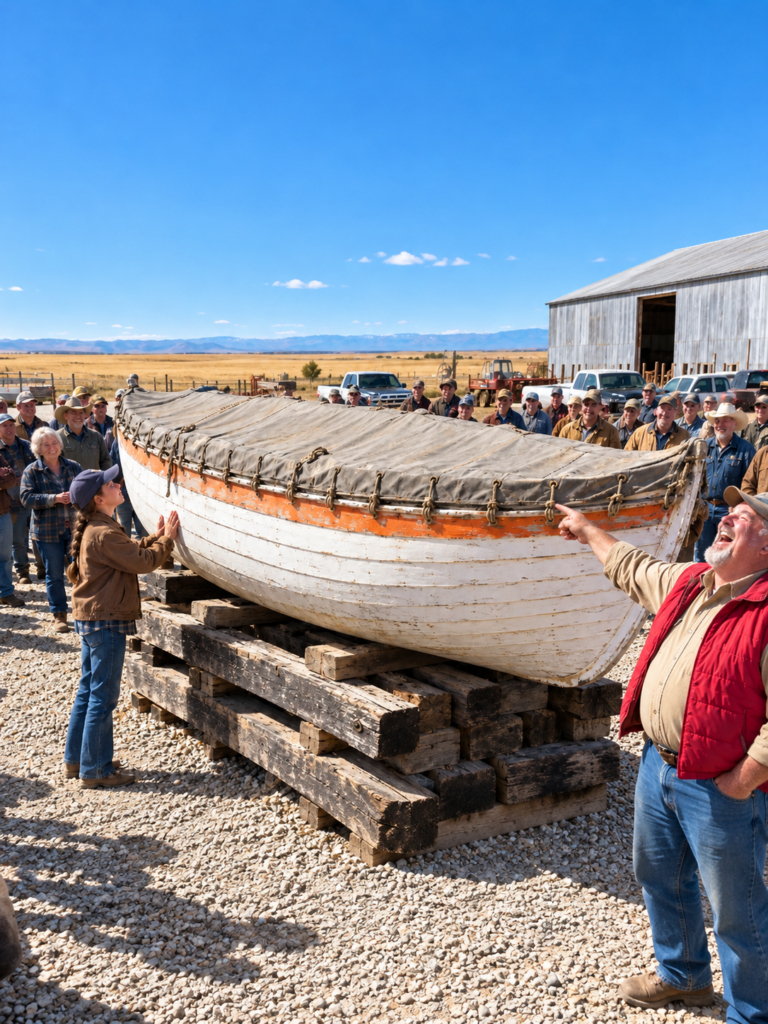
Nearly two hundred people had gathered that afternoon outside Oscar Brandvold’s old machine shed in Dunmore, Montana. They were farmers, machinery dealers, neighbors, and bargain hunters, most wearing dusty boots, seed caps, and faded work jackets.
Now they had something better than an auction to talk about.
A twelve-year-old girl had just spent eighty-five dollars on a twenty-six-foot wooden boat sitting in the middle of wheat country.
Nell Lindgren heard every word.
She stood beside the long white hull, her small hands resting against the weathered planks. Her brown chore jacket hung loosely over her shoulders, and the brim of her faded navy cap shadowed her eyes.
She had saved that money for three years.
Lyle was laughing at all of it.
“Come on, little admiral,” he called. “Pull that canvas off. Let’s see what treasure you bought.”
Nell looked at him.
“No.”
The word was quiet, but the people nearest her heard it.
Lyle’s eyebrows rose.
“No?”
“No, sir.”
For a moment, the laughter faded.
Lyle Pruitt owned the largest salvage and scrap business in town. He was president of the Dunmore Commerce Club and the sort of man who could make an ordinary conversation sound like an announcement over a loudspeaker.
He was accustomed to people laughing when he wanted them to laugh.
He was not accustomed to a twelve-year-old girl telling him no.
“Well, now,” he said, smiling again. “What’s the matter? Afraid of what you’ll find?”
Nell kept her hands on the boat.
She was afraid of something.
But it wasn’t what might be underneath the canvas.
She was afraid somebody would destroy something important before she understood what it was.
And there was something about that boat that made her certain it had a story worth protecting.
A few minutes earlier, nobody in the yard had wanted it.
The boat had been the last lot of Oscar Brandvold’s estate auction.
Oscar had died that spring at ninety-one, after spending nearly his entire life farming the same section of Montana wheat country. His nephew in Spokane wanted the property cleared and the remaining equipment sold.
By late afternoon, the tractors were gone, the smaller implements had found buyers, and nearly everything in the machine shed had been claimed.
Everything except the boat.
It rested behind the building on a crib of old railroad ties, its keel suspended above the hard ground.
Twenty-six feet from end to end, the vessel looked strange and almost misplaced beneath Montana’s enormous sky.
Its hull was painted white, although age had dulled the finish to the color of old bone. A faded orange stripe ran along its upper planking. Both ends rose in the same strong, narrow curve.
The boat was taller from keel to rail than a grown man.
But its most unusual feature was the cover.
Heavy gray canvas stretched tightly across the entire opening, secured by a continuous pattern of carefully tied knots. Someone had treated the material with tar, creating a dark protective skin that had hardened through the years.
There were no loose corners to lift.
No gaps through which to peek.
Even the small hatches in the hull were fastened shut with brass screws that had turned green.
Nobody at the auction could remember seeing the boat uncovered.
Nobody could explain why Oscar Brandvold, a wheat farmer living hundreds of miles from any ocean, had kept it all his life.
Most people assumed it was junk.
Dell Arnason, the auctioneer, consulted his clipboard with an expression suggesting he wished the boat had already been hauled away.
“Lot two hundred six,” he announced into his microphone. “One wooden boat. Sold as is, where is. Contents unknown. Buyer responsible for hauling.”
He glanced around.
“Who’ll give me a hundred dollars?”
Nothing.
“Fifty?”
A man toward the rear of the crowd shook his head.
“What am I supposed to do with it, Dell? Plant the thing?”
The laughter started again.
Dell tried twenty-five dollars.
That was when Nell raised her hand.
She had been standing near the front, studying the boat since the auction moved behind the machine shed.
At first she had hardly heard the bidding.
She was looking at the knots.
Each one was tied almost exactly like the one before it. The lacing followed the curve of the hull with a precision she had never seen on an ordinary farm tarp.
Whoever had closed that boat had cared about doing the job properly.
“Young lady,” Dell said, noticing her hand. “You bidding?”
“Five dollars.”
Several people turned.
Lyle Pruitt, standing with his thumbs tucked into the armholes of his bright red quilted vest, grinned.
“Ten.”
Nell swallowed.
“Fifteen.”
“Twenty,” Lyle called. “And I’ll burn the thing at next year’s Fourth of July bonfire. Biggest fire this town’s ever seen.”
The men beside him laughed.
“Twenty-five,” Nell said.
And so it continued.
Five dollars at a time.
Lyle lifted his hand lazily, enjoying the attention, while Nell kept her eyes on Dell and tried not to think about how much money remained in her coffee can at home.
At sixty dollars, Lyle leaned forward.
“Honey, does your mother know you’re spending her grocery money on a canoe?”
Nell felt the heat rise into her face.
It wasn’t grocery money.
She had walked the Austrender family’s dogs through the summer heat. She had collected eggs for Mrs. Kowalczyk, hauled little wagons of rhubarb down to the end of the lane, and saved nearly every dollar she earned.
For three years, she had kept her savings in a coffee can on the top shelf of her closet.
A strip of masking tape on the lid carried one word, written in pencil.
Boat.
She had put that label there when she was nine years old.
She had never imagined the boat she eventually bought would be waiting in a wheat field.
“Seventy-five,” Lyle announced.
Nell looked toward the long white hull.
“Eighty-five.”
Lyle spread his arms as though surrendering to a warship.
“Sold to the navy!”
The crowd roared.
He waved at Dell.
“That’s enough for me.”
Dell glanced around, gave the other bidders a final opportunity, and tapped his clipboard.
“Sold. Eighty-five dollars to the young lady in the blue cap.”
For Nell, the sound of that makeshift gavel was both wonderful and terrifying.
The boat belonged to her.
Now she had to explain it to her mother.
Carrie Lindgren had been at the far end of the auction yard paying for two rolls of fence wire.
When she learned what her daughter had bought, she came walking toward the machine shed so quickly that Nell knew she had heard more than the price.
“Nell.”
Her mother stopped beside her, looked up at the enormous hull, and blinked.
“Nell, honey. What did you just do?”
“I bought the boat.”
“I heard that. I think half of Montana heard that.”
Carrie stared at the thing again.
“Where are we supposed to put a boat?”
“The old calving shed.”
Carrie turned toward her.
“The calving shed?”
“It’s thirty-two feet long. The boat is twenty-six. It’ll fit.”
“You measured the shed?”
“Not exactly. I know how big it is.”
Carrie closed her eyes briefly.
She worked keeping books at the agricultural co-op, handling accounts for wheat farmers across miles of surrounding countryside. She spent her days balancing figures and making certain money went where it was supposed to go.
Eighty-five dollars was not an amount she could dismiss.
But when she looked at her daughter, she also knew those dollars had come from months of work.
Before Carrie could decide what to say, Lyle approached.
He stood close enough that Carrie instinctively shifted half a step in front of Nell.
“Now, Carrie, I’m just having a little fun,” he said. “But somebody ought to look under that tarp before your girl goes hauling this thing home.”
He glanced toward the canvas.
“Could be a family of mice in there. Might be a dead raccoon. Could be anything.”
He pulled a folding knife from his belt, opened it, then offered it to Nell by the handle.
“Here you go. Cut one of those strings. Let’s see the treasure.”
The people nearby watched.
Nell studied the blade.
Then she shook her head.
“I’m not cutting it.”
“Why on earth not?”
“Because somebody tied it that way on purpose.”
Lyle looked amused.
Nell pointed toward the lacing.
“Look at the knots. Every one is the same. Somebody spent a long time doing that.”
“So?”
“So you don’t cut something open just because everybody wants to laugh at what’s inside.”
The smile faded slightly from his face.
“It’s an old rowboat, kiddo.”
“Then it won’t hurt to wait.”
Lyle stared at her before finally folding the knife.
He made another joke for the crowd, something about young people losing their minds, and walked away shaking his head.
But Nell did not change her mind.
The canvas stayed closed.
Her grandmother, Ingrid Lindgren, had been watching from a hay bale beneath the shade of the machine shed. At seventy-four, Ingrid could be difficult to impress and even harder to intimidate.
When Nell walked over, Ingrid studied the boat for a moment.
Then she studied her granddaughter.
“You didn’t let him cut the rope.”
“No, Grandma.”
“Good.”
That was all she said.
And somehow, Nell felt better.
The practical problems started almost immediately.
A twenty-six-foot lifeboat couldn’t be hauled home in the bed of a pickup, and none of the Lindgrens owned a trailer capable of carrying it.
Walt Kowalczyk, whose wife Dorothy had been buying eggs from Nell for years, owned a gooseneck hay trailer and a powerful winch.
When Carrie explained the situation, Walt agreed to help.
On Tuesday morning, he backed his trailer toward the old railroad ties behind Oscar Brandvold’s shed.
Moving the boat was harder than anyone expected.
Four men worked with hydraulic jacks, a come-along, blocking timbers, and the winch. They had to raise the hull slowly, shifting its weight without twisting the planking or letting the keel strike the trailer.
Nell wanted desperately to help.
But Ingrid kept her beside the fence.
“Good work doesn’t mean everybody puts their hands on the thing,” she told her. “Sometimes good work means standing clear.”
For most of the morning, Nell watched the men move a few inches at a time.
Each small creak made her shoulders tighten.
She knew wood could split.
She knew the boat was old.
What she didn’t know was whether something protected for decades could survive one careless movement.
Finally, the hull settled onto the trailer.
Walt checked the supports and gave it an approving nod.
“Well, little captain. Looks like she’s ready.”
They drove through Dunmore at fifteen miles an hour, a red warning flag fluttering at the stern.
Nell rode with her grandmother and watched the boat ahead of them.
People came out of stores to stare.
A truck honked.
Outside the Senex gas station, Lyle Pruitt raised his coffee cup toward the passing trailer.
“Ahoy!” he shouted. “Watch out for icebergs!”
The men around him laughed.
By noon, someone had posted a photograph on the Dunmore community board.
The caption read:
Our first navy.
Beneath it, Lyle had added another comment about the eighty-five-dollar boat and the matches he had offered to sell its new owner.
Carrie read the comments that evening, her expression growing tighter with every line.
Then she placed the phone facedown on the kitchen table.
She didn’t mention them to Nell.
But Nell had already seen enough laughter to understand.
The calving shed stood behind the Lindgren farmhouse, at the end of their gravel lane.
It was an old, low building with gray wooden walls, broad doors, and narrow gaps between the weathered boards.
No calves had been raised there since Nell’s grandfather died.
Now it had a new occupant.
Walt and the other men set the lifeboat onto a carefully leveled foundation of timbers.
Ingrid insisted they check the cribbing twice.
When the work was finished, the long hull nearly filled the building from one end to the other.
Morning sunlight entered through cracks in the walls, laying thin, bright stripes across the tar-darkened canvas.
Walt wiped his hands on his jeans.
“Well, Nell. You got your boat home.”
“Thank you, Mr. Kowalczyk.”
He looked at the laced cover.
“Going to tell me what’s inside?”
Nell smiled faintly.
“I don’t know what’s inside.”
“That’s the point, huh?”
“Yes, sir.”
Walt laughed.
But his laughter was warm, without the cruelty that had followed her through the auction yard.
After supper that night, Nell and Ingrid carried a flashlight and a notebook out to the calving shed.
They closed the doors against the cool evening wind.
For the first time, Nell could examine her purchase without an audience.
Ingrid stood beside the hull for a long moment before speaking.
“I think I know what this might be.”
Nell turned.
“What?”
“A lifeboat.”
Her grandmother had grown up in Astoria, Oregon, at the mouth of the Columbia River.
Her father had served as a surfman at the Coast Guard station at Point Adams, where the river met the Pacific Ocean across a dangerous stretch of shifting water.
Ingrid had spent her childhood listening to stories of storms, rescue crews, and boats built strong enough to survive waves that could smash ordinary vessels to pieces.
She eventually married a Montana wheat farmer she had met at a dance in Portland and followed him nine hundred miles inland.
She loved her family and the life they built together.
But even after fifty years, she still missed the sound of the ocean surf.
On the hallway wall of the Lindgren farmhouse hung a photograph of six men in oilskins rowing a white boat into a towering wave.
Nell had looked at that photograph for as long as she could remember.
It was Ingrid who had taught her how to tie a bowline before she could properly tie her shoes.
And now her grandmother reached toward the sealed boat with an expression Nell had rarely seen.
“My father used to say you could recognize a proper lifeboat in the dark just by laying your hand against it,” Ingrid said.
She traced the air above the curve of the hull without touching the canvas.
“They were built differently. Heavy. Double-ended. Made to meet the surf with either end. And they carried air tanks so they could stay afloat even if they filled with water.”
Nell looked from one sharply rising end of the vessel to the other.
“Do you really think that’s what this is?”
“I think it could be.”
Ingrid smiled without much certainty.
“But I’m an old woman who misses the coast. That makes me a poor judge when I want something to be true.”
They began examining the boat carefully.
At the bow and stern, Nell found brass lifting fittings unlike anything she had seen on a farm boat.
Her grandmother explained how such hooks could attach to lifting gear used to lower a lifeboat from a larger ship.
Nell drew the fittings in her notebook.
They moved toward the keel.
Near the bow, a band of bronze carried faint stamped letters almost worn smooth by time.
Nell angled the flashlight.
A C.
An O.
What might have been an S.
And farther along, after a stretch of worn metal, one word remained clear enough to read.
Portland.
“Somebody made it there,” Nell whispered.
“Maybe,” Ingrid answered. “Or registered it there. Write exactly what you can see. Don’t guess at the missing letters.”
Nell wrote them down.
Then she discovered the stitching.
At the stern, beneath a flake of old tar where the final knot held the canvas together, someone had sewn a row of words using thick white thread.
The stitches were still intact.
Nell held her flashlight closer.
She read them slowly.
“It did its work. Let it rest.”
Ingrid stepped beside her.
She read the words once.
Then again.
For several seconds, neither spoke.
Outside, the wind moved through the grass around the shed.
“Do you think Mr. Brandvold sewed that?” Nell asked.
“Somebody did.”
“Why would they say it did its work?”
“I don’t know, honey.”
Ingrid’s hand remained near the lettering.
“But whoever wrote that cared a great deal about this boat.”
Nell imagined the unknown person sitting with heavy thread and a needle, painstakingly closing the canvas, tying knot after knot until nothing beneath it could be reached.
There was nothing careless about the work.
Nothing temporary.
Whoever had sealed the boat had meant it to stay sealed.
Nell closed her notebook.
“I’m not opening it, Grandma.”
Ingrid nodded.
“Not yet.”
“Not until somebody comes who knows what they’re looking at.”
“Then that’s how we’ll do it.”
Nell switched off the flashlight.
They stood for a moment beside the pale hull in the darkness.
And for the first time since the auction, Nell stopped wondering whether she had wasted eighty-five dollars.
The following Saturday, she rode her bicycle three miles into Dunmore.
The public library occupied a single room above the old Farmers State Bank, and its librarian, Mrs. B. Halloran, had spent thirty years helping townspeople find answers to questions that sometimes seemed impossible.
Nell arrived carrying her notebook.
She opened it on the counter and showed Mrs. Halloran the sketches of the hooks, the letters on the bronze band, and the exact wording stitched into the canvas.
Mrs. Halloran listened carefully.
Then she put on her reading glasses.
“Let’s see what we can find.”
For four hours, they searched records, historical material, old newspaper articles, and information about boatbuilders in the Pacific Northwest.
Eventually, they found a company called the Columbia Steel Boat and Launch Works.
It had operated in Portland, building lifeboats for passenger steamers traveling between Portland and San Francisco.
Its boats had carried bronze makers’ plates.
The company had closed before the Second World War.
Nell looked at the letters she had copied from the keel.
They were incomplete.
But they were enough to make her wonder.
Mrs. Halloran continued searching.
Then she discovered a newspaper article from the winter of 1934.
She leaned toward the screen, read the headline, and slowly removed her glasses.
“Nell,” she said. “You need to look at this.”
Nell stepped beside her.
The headline said:
STEAMER LOST ON THE BAR — 31 SAVED BY SHIP’S BOAT
For a moment, Nell could hear only the quiet hum of the library computer.
Thirty-one people.
A ship lost in dangerous water.
A lifeboat.
She looked down at the notebook she had carried into town.
She still didn’t know if her boat had anything to do with that old newspaper story.
But something inside her had shifted.
The sealed canvas no longer seemed like a cover hiding an unwanted piece of farm junk.
It seemed like a door somebody had closed very carefully on the past.
Mrs. Halloran printed the article.
Nell folded the paper and placed it inside her jacket.
That afternoon, she rode home against the Montana wind with the printout pressed close to her chest.
At the kitchen table, Carrie was sorting household papers while Ingrid sat nearby.
Nell placed the article between them.
She didn’t say a word.
Her mother read the headline first.
Then Ingrid leaned forward.
As her grandmother read the date and the account of the rescue, her hands became very still.
Nell waited.
Finally, Carrie looked up.
“You think this has something to do with the boat?”
“I don’t know.”
“Then what do we do?”
Nell glanced at Ingrid.
Her grandmother was still looking at the newspaper.
“We find somebody who does.”
And in the old calving shed behind their house, the long white boat remained exactly as they had found it.
Not one knot had been untied.
Not one screw had been removed.
Whatever truth lay beneath that gray canvas was still waiting.
Part 2
By Thursday, Lyle Pruitt had decided the whole business had gone on long enough.
His white salvage truck came rumbling down the Lindgrens’ gravel lane shortly after Carrie arrived home from the co-op.
She heard the engine before she saw him.
Through the kitchen window, she watched Lyle park beside the calving shed, climb out, and look toward the big wooden doors.
He carried a manila envelope beneath one arm.
Carrie stepped onto the porch before he could walk any farther.
“Afternoon, Carrie.”
“What can I do for you, Lyle?”
“Well, I come in peace.”
He smiled and held up the envelope.
“The Commerce Club’s planning the Fourth of July bonfire for next summer. I told the fellows I knew where we could find the finest pile of dry wood in the county.”
Carrie stared at him.
“The boat.”
“Exactly. Two hundred dollars, cash. I’ll haul it myself.”
He shook the envelope slightly.
“That’s more than double what your girl paid. Pretty good return for a week’s worth of owning a boat, wouldn’t you say?”
Nell had been inside the kitchen when she heard his voice.
She came onto the porch behind her mother, with Ingrid following more slowly.
“It’s not just firewood,” Nell said.
Lyle turned.
“Well, there’s the admiral.”
“The planks aren’t all the same kind of wood. Some of them are white oak. Maybe Port-Orford cedar, too. I’d have to examine the inside to know.”
Lyle chuckled.
“Then let’s go examine it.”
He motioned toward his truck.
“Got a pry bar right there.”
“No, thank you.”
“Two hundred dollars, Nell.”
“It’s not for sale.”
Lyle looked at Carrie, expecting her to take over.
She didn’t.
“Three hundred,” he said.
Nell stood straight.
“It’s still not for sale, Mr. Pruitt.”
His expression changed.
For the first time, he seemed less interested in joking than in winning.
“You know what people are saying about this, Carrie?”
Carrie folded her arms.
“I imagine you’ve been helping them say it.”
Lyle ignored that.
“They’re saying you let a twelve-year-old spend grocery money on some old rowboat, and now you’re too proud to admit it was a mistake.”
Nell felt the familiar heat climb into her cheeks.
She hated hearing that story repeated.
Her family had worked hard for everything they owned. She knew what groceries cost and how carefully her mother watched household expenses.
She would never have taken grocery money without asking.
Carrie’s voice remained calm.
“It wasn’t grocery money, Lyle.”
He glanced toward her.
“That eighty-five dollars belonged to Nell. She earned it herself. Every cent.”
“Well, I’m only trying to help.”
“She’s already told you no twice.”
Carrie moved down one porch step.
“That should be enough.”
Lyle looked from Carrie to Ingrid, who stood in the doorway holding a dish towel, and finally back to Nell.
For a moment he said nothing.
Then he tucked the envelope beneath his arm.
“Suit yourselves. When that thing rots, you know where to find me.”
He started toward the truck.
“I’ll still take it for the fire.”
After he drove away, Nell remained on the porch watching the dust settle.
She had expected her mother to be upset.
Instead, Carrie put an arm around her shoulders.
“You’re sure about keeping it?”
“Yes, Mom.”
“Then you keep it.”
Nell looked toward the shed.
“What if I’m wrong about it?”
Carrie considered the question.
“Then you’ll have an old boat you bought with your own money.”
She looked down at her daughter.
“That doesn’t give anybody the right to make fun of you.”
That evening, Nell spread her notebook across the kitchen table.
Beside it she placed the newspaper printout from Mrs. Halloran, her drawings of the bronze markings, and the notes she and Ingrid had made while examining the boat.
The family had no way to establish that the vessel had been involved in the 1934 rescue.
They did not even know its name.
The makers’ mark was worn. The newspaper described a ship’s boat but did not identify the sealed vessel in their shed.
Ingrid understood the difference between a promising clue and proof.
“Don’t write that you’ve found the rescue boat,” she advised.
“I wasn’t going to.”
“Tell them what you have. Let them decide what it means.”
They had found the Astoria Maritime Heritage Center while searching for people who studied old lifeboats.
Nell decided to write to its curator of small craft.
She used plain paper and her careful school handwriting.
She introduced herself as Nell Lindgren, twelve years old, from Dunmore, Montana.
She explained that she had purchased a twenty-six-foot wooden boat for eighty-five dollars at an estate auction.
She described its white hull, faded orange stripe, lifting fittings, and bronze markings.
She mentioned the Columbia Steel Boat and Launch Works in Portland.
Then she wrote about the cover.
The canvas was still tightly laced, she explained. It had been treated with tar, and under the tar someone had stitched a message asking that the boat be allowed to rest.
She had not cut or loosened the cover.
She promised not to disturb it until someone qualified could examine it.
The letter did not demand an appraisal.
It did not ask what the boat might be worth.
At its heart, it asked one question.
Could somebody who understood old lifeboats come and tell her what she had bought?
Nell enclosed nine photographs: the full hull resting on its timbers, the bronze band near the keel, the hooks at either end, the unusual knots, and the stitched message beneath the tar.
Some photographs overlapped in what they showed, but she wanted the curator to see every detail.
Ingrid read the letter over her shoulder.
When she finished, she rested her hand briefly on Nell’s back.
“Your great-grandfather would have liked you.”
Nell looked up.
“Do you think so?”
“He spent his life trusting boats that other people had built and cared for. He knew what good work looked like.”
She looked down at the letter.
“And he knew it mattered.”
The envelope went into the mail on Monday.
Then nothing happened.
A day passed.
Then another.
The first week ended without an answer.
Nell went to school, helped with chores, collected eggs, and checked the mail whenever she could.
The boat stood quietly in the shed, gathering a fine layer of dust along the outer canvas.
Every so often, Nell walked around it with her notebook.
She resisted the urge to touch the knots.
Meanwhile, Lyle kept telling the story of the little admiral and her landlocked navy.
At the salvage yard, he repeated his jokes to customers. At the gas station, people asked whether Nell planned to sail the boat down Main Street.
Someone left a toy sailboat on the Lindgrens’ mailbox.
One Saturday at the farmers market, a stranger stopped at Nell’s rhubarb stand.
“Well, aren’t you the girl with the pirate ship?”
Nell looked up from arranging the stalks.
“Yes, sir. I bought a boat.”
“Find any buried treasure yet?”
“Not yet.”
He laughed, bought some rhubarb, and walked away.
Nell finished selling every bundle she had brought.
But on the ride home, the question stayed with her.
She wasn’t looking for treasure.
She wasn’t even sure what she wanted the boat to be.
She only knew that the work somebody had put into preserving it deserved more than a joke about matches.
On a Wednesday evening in October, the kitchen telephone rang.
Carrie answered.
A woman’s voice asked politely whether she might speak to Miss Nell Lindgren.
Carrie raised both eyebrows.
“Nell? Telephone for you.”
Nell took the receiver.
“Hello?”
“Is this Nell Lindgren?”
“Yes, ma’am.”
“My name is Margaret Toliver. I’m the curator of small craft at the Astoria Maritime Heritage Center.”
Nell’s grip tightened on the receiver.
Margaret’s voice was low and steady.
“I have your letter here, Nell. And your photographs. I’ve been looking at them with considerable interest.”
Nell stood very still.
“Thank you for reading it.”
“You’re welcome. Now, I need to ask you something important. Please answer as accurately as you can.”
“Yes, ma’am.”
“Has anyone opened that canvas?”
“No, ma’am.”
“Not even one corner?”
“No.”
“Has anyone untied a knot or loosened any part of the covering?”
“Nobody’s touched it.”
There was a pause.
Nell could hear faint movement on the other end of the line.
Then Margaret spoke again.
“Good. That’s very good.”
Nell looked toward her mother.
Carrie was watching her carefully, trying to understand the conversation.
Margaret continued.
“A vessel that’s been protected under sealed canvas in a dry building can preserve details we rarely get to study. The covering itself may be important evidence, and opening it without proper care could damage what it’s been protecting.”
“I thought somebody wanted it kept closed.”
“That may be exactly what happened.”
Nell’s heart beat faster.
“Do you know what kind of boat it is?”
“I have some ideas. But I don’t want to tell you something I can’t prove.”
Margaret paused again.
“I’d like to come to Montana with a colleague from the Oregon State Historic Preservation Office. We want to examine it properly.”
Nell turned toward Carrie.
Her mother had already heard enough to understand that something extraordinary was happening.
“Mom,” Nell whispered. “She wants to come see the boat.”
Carrie’s eyes widened.
Then she nodded.
“Tell her yes.”
Nell spoke into the receiver.
“Yes, ma’am. You can come.”
“Wonderful. We can be there a week from Saturday at ten in the morning. I’d prefer daylight for an examination like this.”
“All right.”
There was something else Nell wanted to ask.
She had thought about it since the auction.
“Miss Toliver?”
“Yes?”
“When you open it, could there be people watching?”
“What sort of people?”
“Not a crowd. Just some people from town.”
Margaret did not answer immediately.
Nell hurried on.
“People who were at the auction. And people who helped me find out about it.”
“You’d like witnesses.”
“Yes, ma’am.”
“Why?”
Nell glanced toward the window.
Beyond it, the calving shed stood dark against the evening sky.
“Because they’ve all been talking about the boat. I’d like them to see what it really is.”
Margaret considered that.
“I think that’s reasonable. Choose your people carefully, and we’ll make sure the examination stays controlled.”
After the call ended, Nell put the receiver back on its cradle.
Carrie stared at her.
“A museum curator is coming here?”
“And a man from the state historic preservation office.”
Ingrid, who had been standing near the kitchen doorway, sat down suddenly.
For a moment she pressed the dish towel against her mouth.
“From Oregon?” she asked.
“Yes, Grandma.”
Ingrid looked toward the shed.
Nell recognized that expression now.
It was the look her grandmother had worn when she first saw the lifeboat.
The look of someone who had lived far from the ocean for fifty years and had unexpectedly heard its name spoken in her own kitchen.
The following days became a careful exercise in preparation.
Nell made a list of the people she wanted present.
First was Dell Arnason, the auctioneer who had sold her the boat after struggling to get even twenty-five dollars.
Then Mrs. Halloran, who had helped her identify the Portland boatbuilder and discover the newspaper article.
She invited Walt and Dorothy Kowalczyk because Walt had hauled the boat safely from Oscar Brandvold’s property.
She chose Ben Stockdale, who published the Dunmore Courier from the back of the hardware store and had written the only fair newspaper account of the auction.
And then there was Lyle.
Nell sat at the kitchen table with a blank card in front of her.
Carrie saw the name she had begun writing.
“You don’t have to invite him, honey.”
“I know.”
“He’s made this pretty miserable for you.”
Nell looked down at the card.
“He’s the one who said it was firewood.”
“Yes, he is.”
“I want him to see what it is.”
Carrie watched her daughter for a long moment.
“All right.”
Nell completed the invitation in her best handwriting.
It gave the date and time of the examination, explained that a curator from Oregon would be present, and asked Mr. Pruitt to attend.
She signed it simply.
Nell Lindgren.
With Ingrid accompanying her, Nell rode to Pruitt Salvage and Scrap and delivered it herself.
Lyle read the card in front of two employees.
His familiar grin appeared.
“Well, I’ll be. A grand opening for the admiral’s boat.”
He looked at his workers.
“Guess I’d better bring marshmallows.”
The men laughed.
Nell said nothing.
But she noticed that when Lyle finished reading, he slipped the card into his shirt pocket.
He didn’t throw it away.
Saturday arrived cold and bright.
Frost silvered the harvested fields, and the sky above the Lindgren farm was a clear, hard blue.
Carrie swept the calving shed floor twice.
Walt brought eight folding chairs from the basement of the Lutheran church and arranged them along the wall.
Ingrid made a large pot of coffee in the kitchen percolator, then found herself unable to drink a single cup.
Nell dressed in the same brown chore jacket and faded navy cap she had worn to the auction.
She had considered wearing something nicer.
But the boat had not changed.
She decided she wouldn’t either.
At a quarter to ten, a dusty gray van with Oregon plates turned into the lane.
Margaret Toliver climbed out carrying a canvas field bag.
She was a small woman with short silver hair and the quiet confidence of someone accustomed to handling things too old and fragile to be rushed.
Beside her stood Raymond Teague, a tall, reserved man from the Oregon State Historic Preservation Office, with a camera around his neck.
Margaret introduced herself to Carrie, Ingrid, and the other guests.
Then she approached Nell.
“So you’re the young lady who wrote that letter.”
“Yes, ma’am.”
Margaret held out her hand.
Nell shook it.
“Thank you for coming.”
“Thank you for leaving the boat alone.”
At five minutes to ten, Lyle’s white truck came up the driveway.
He stepped out in his red vest.
This time he wasn’t carrying an envelope or a knife.
He entered the shed, nodded to the others, and stood near the wide doors with his arms folded.
He had brought no marshmallows.
Margaret began by examining the boat without touching it.
She walked around the full twenty-six feet, stopping to study the bow, stern, and shape of the hull.
She crouched beside the bronze band, tilted her magnifying glass into the light, and spent several minutes studying the worn lettering.
Raymond photographed the fittings, planking, and weathered seams.
At the stern, Margaret knelt beside the white stitching.
Nell watched her read the words.
It did its work. Let it rest.
Margaret remained there longer than Nell expected.
Then she stood and looked at everyone assembled.
“Before we open anything, I want you to understand something.”
She indicated the covered boat.
“This canvas has protected the interior for a very long time. The lacing and tar have helped keep weather, dirt, and repeated handling away from the wood and fittings underneath.”
She looked toward Nell.
“Opening something old can be irreversible. Once the protection is disturbed, conditions change. Sometimes that destroys information we’ll never recover.”
Nobody interrupted.
“Most people would have cut this covering the day they found it.”
Margaret let her gaze travel around the shed.
“Nell didn’t.”
At the back, Lyle shifted his weight.
Margaret continued.
“Whatever we discover today, it’s still here for us to study because she had the patience not to open it.”
Nell looked down.
She had never heard an adult speak about her decision quite that way.
At the auction, it had seemed stubborn.
At home, it had seemed necessary.
Now someone who understood the boat was telling her that waiting had mattered.
Margaret took out a pair of white cotton gloves.
She knelt at the stern and began working on the first knot.
The old lacing was stiff but sound.
She eased it loose carefully, testing each section before moving to the next.
Raymond collected the freed line and coiled it neatly on the floor.
The process took nearly an hour.
Nobody complained.
Nobody left.
Nell watched the same knots that had fascinated her at the auction slowly come undone, each one released without being cut.
At one point, Margaret asked her to help hold a section of the heavy canvas.
Raymond handed her a second pair of gloves.
Nell put them on and took hold of the edge.
“Just keep it steady,” Margaret said.
“I will.”
She held the canvas without pulling.
They continued toward the bow.
At last, the final knot came free.
Margaret and Raymond exchanged a glance.
Then they lifted the gray covering together.
The heavy canvas folded back along the hull.
Nell leaned forward.
Beneath it lay rows of carefully preserved wooden seats, smooth with old oil and protected from the weather for decades.
Eight long ash oars rested in their racks.
Each had a leather collar where it would meet an oarlock.
Beneath the seats ran copper air tanks, green with age but still intact.
A coil of manila rope lay in the bow, arranged with the same care as the knots outside.
Nothing looked abandoned.
Nothing looked like firewood.
It looked as though someone had put every piece of equipment in its proper place, covered the boat, and closed the door on an entire moment in history.
Margaret moved toward the stern.
There, on a white board inside the hull, faded black letters spelled out a name.
HALCYON
And directly beneath it:
BOAT NO. 2
Nell stared at the lettering.
For the first time, the boat she had bought in a wheat field had a name.
And Margaret Toliver, who had spent more than two decades studying historic small craft, lowered herself slowly onto her heels.
She raised one gloved hand toward her mouth.
Whatever she had suspected from Nell’s photographs, the name painted inside the stern had changed what she knew.
But the most important evidence was still waiting just below it.
Part 3
Just below the painted name, screwed to the stern seat, was a small brass plate.
The metal had darkened almost to brown with age.
Raymond Teague leaned forward, adjusted his glasses, and brought his camera closer.
Margaret raised a hand.
“Before you touch anything, let’s get a clear photograph.”
Raymond nodded.
He took several pictures, changing his angle to avoid the glare from the daylight streaming through the shed doors.
Then he read the inscription aloud.
“Thirty-one souls brought across the Columbia Bar, February ninth, nineteen thirty-four.”
His voice slowed.
“Given by the survivors to Sigrid Brandvold and her son Oscar in thanks.”
Nobody spoke.
Ingrid made a small sound and sank into one of the folding chairs.
Nell looked toward her grandmother, then back at the brass plate.
Oscar Brandvold.
The old farmer whose estate had been sold.
The man who had kept this boat behind his machine shed for as long as anyone could remember.
Nell stared at the date.
1934.
She thought about the newspaper article Mrs. Halloran had found, the one she had carried home folded inside her jacket.
A steamer lost on the Columbia Bar.
Thirty-one people saved.
And here, fastened inside an old wooden boat, were words written by people who had survived that very disaster.
“Grandma,” Nell whispered, “Oscar was in this boat.”
Ingrid nodded without speaking.
“He was a baby.”
Margaret turned toward her.
“Yes,” she said quietly. “He was.”
Nell looked at the inscription again.
Sigrid Brandvold and her son Oscar.
A mother and her little boy.
People she had never met had been saved from the dangerous water off the Oregon coast, and afterward they had given the very boat that carried them to safety to the mother and child named on the plate.
Oscar had grown up.
He had moved through an entire lifetime in Montana, working his wheat farm, growing old, and eventually dying at ninety-one.
All those years, the boat had remained with him.
Protected under heavy canvas.
Its knots secured.
Its equipment left exactly where it belonged.
Nell imagined the baby mentioned on the brass plate becoming an old man, walking past the covered hull year after year.
To everyone else, it was an unwanted object.
To Oscar, it had been part of the reason he had lived long enough to own a farm at all.
Margaret stood and looked along the length of the lifeboat.
“I think we can now explain why Mr. Brandvold protected this so carefully.”
Her gaze moved to the folded canvas.
“He and his mother were among the people this boat saved. The survivors gave it to them in thanks. And it appears he kept it protected so it would never be treated as something ordinary.”
Nell remembered the words stitched into the stern.
It did its work. Let it rest.
She finally understood them.
The boat hadn’t been sealed because somebody wanted to hide treasure.
It had been sealed because it had already done something more important than anything its wood or metal could ever be worth.
It had brought people home alive.
Across the shed, Dell Arnason stared into the hull.
He had stood beside the boat at the auction, embarrassed to ask twenty-five dollars for it.
Now he looked at the eight oars and the carefully coiled rope as though he could hardly believe they had been there all along.
Mrs. Halloran pressed her fingers together.
The newspaper she’d discovered had supplied a clue.
But she had never imagined the answer would be waiting inside an old calving shed.
Ben Stockdale, the newspaper editor, held his notebook in both hands.
For once, he wasn’t writing.
Margaret turned toward him.
“Ben, I’d like you to record what I’m about to say.”
He immediately reached for his pen.
“This is the number two lifeboat of the steamer Halcyon, built by the Columbia Steel Boat and Launch Works in Portland.”
She rested her hand lightly on the stern rail.
“As far as our records establish, this is the only surviving boat from a documented steamer rescue on the Columbia Bar.”
Raymond continued photographing the vessel.
Margaret spoke slowly, carefully distinguishing what she could see from what the historical records established.
“It has never been restored. It hasn’t been altered. And it appears to have been kept out of the weather under its original protective covering.”
She gestured toward the seats and oars.
“Finding a vessel like this, with its equipment and historical markings still intact, is exceptionally rare.”
Nell’s attention moved across the interior.
She thought about Lyle’s folding knife at the auction.
If she’d taken it, she might have sliced straight through the old lacing.
She might have pulled the canvas off in front of a crowd that would have handled the oars, climbed into the seats, or dragged the boat out into the sunlight to satisfy their curiosity.
She had wanted to know what was inside as badly as anybody.
But she had waited.
Now the entire boat seemed to carry the evidence of why waiting mattered.
Margaret removed her gloves.
“I’ve spent twenty-two years looking for something like this.”
She looked at Nell.
“As a museum appraiser, I would value this boat at ninety-two thousand dollars.”
Nell blinked.
She knew she had heard the words correctly.
But they were so far beyond anything she had expected that they did not seem to belong in the same conversation as her eighty-five-dollar purchase.
“Ninety-two thousand?” Carrie repeated.
“Yes.”
Nell looked at her mother.
Carrie’s hands were clasped tightly in front of her.
She had spent years making certain the family’s expenses balanced against its income. She knew exactly what that sum of money could mean.
But even she seemed unable to find the next question.
Raymond cleared his throat.
“There’s something else.”
He looked from Carrie to Nell and Ingrid.
“The state of Oregon is prepared to pay that amount.”
Nell turned toward him.
Raymond glanced at the name painted on the stern.
“We’d like to bring the Halcyon’s lifeboat back to Oregon. The plan would be to restore what requires restoration and put it on the water again.”
He spoke with the seriousness of someone who understood that an offer did not give him ownership.
“But that would require you and your family to agree to sell it.”
Nell looked along the long white hull.
For weeks, the boat had occupied nearly every inch of their old shed.
Before that, it had spent decades hidden beneath the Montana sky.
And before that, it had known the cold water of the Columbia River.
Suddenly, she could imagine it returning to the place where its story began.
The thought made her feel proud.
And unexpectedly sad.
It was her boat.
She had saved for it.
She had protected it.
She had learned its secrets with the help of people who had treated her questions seriously.
Selling it meant letting it go.
Margaret seemed to understand that the decision was about more than money.
“There’s no need to make up your mind this very minute,” she told Carrie and Nell.
Nell nodded.
Her grandmother still sat beside the wall, looking toward the brass plate.
Then Ingrid spoke.
“That boat belongs near the water.”
Everyone turned toward her.
She looked at Nell.
“It spent enough time in a wheat field.”
Nell smiled a little.
She remembered the photograph in their hallway, her great-grandfather standing at the oars with the other surfmen, surrounded by rough gray water.
Perhaps a boat did not have to be owned forever to be loved properly.
Perhaps returning it to the river was another way of taking care of it.
At the back of the shed, someone shifted.
Lyle Pruitt had not moved from his place near the doors during the examination.
His red quilted vest stood out against the weathered boards.
He was staring at the lifeboat.
For nearly a month, he’d had a joke ready every time someone mentioned it.
He had called it firewood, offered matches, and tried to buy it for a bonfire.
He had told anyone who would listen that Nell had wasted her money.
Now the boat had a name.
A history.
Thirty-one lives connected to it.
And an offer from the state of Oregon that exceeded anything he had imagined.
Margaret finished speaking.
The others looked toward Lyle, waiting to see what he would say.
He lowered his eyes to his boots.
For once, he didn’t seem interested in having an audience.
Then he looked at Nell.
“Miss Lindgren.”
She turned.
His voice sounded different.
“I called that boat firewood in front of the whole county.”
He glanced toward the stern, where the brass plate remained attached to its seat.
“I was wrong.”
Nell said nothing.
Lyle swallowed.
“I’m sorry.”
The words seemed difficult for him, but he didn’t try to soften them with a joke.
Nell looked at the man who had laughed at her while two hundred people watched.
She remembered standing beside the hull, her hands flat against the planks, while he urged her to take his knife and cut through the canvas.
She remembered how angry her mother had been when the jokes continued online.
She remembered the embarrassment of strangers approaching her at the farmers market.
She could have reminded him of every one of those things.
Instead, she looked toward the boat.
“It’s twenty-six feet long, Mr. Pruitt.”
Lyle blinked.
“Yes, ma’am.”
“It’s going to need a pretty big trailer to get to Oregon.”
He looked at her for a moment.
Then something in his face loosened.
“I’ve got a lowboy.”
Nell waited.
“I’ll haul it,” he said. “No charge.”
He looked toward the long white hull.
“And I’ll drive it slower than anything ever went down that highway.”
Nell gave him a small nod.
“Thank you, Mr. Pruitt.”
He nodded back.
Nothing else needed saying.
In the days that followed, the Lindgrens considered the offer carefully.
The boat was valuable because of its history, its remarkable condition, and its surviving equipment. But its monetary value was only part of what the family had come to understand.
They knew they could not preserve it forever in a calving shed.
They also knew that selling it would mean losing something Nell had worked hard to find.
Carrie listened to her daughter.
Ingrid spoke about the Oregon coast, the surfmen who had spent their lives taking boats into dangerous water, and the meaning of returning a rescue vessel to the river it had once crossed.
Nell thought about Oscar Brandvold.
He had kept the boat safe throughout his life.
She could honor that care without keeping it locked away for the rest of hers.
The family accepted Oregon’s offer.
The old lifeboat would go home.
Lyle kept his promise.
When the time came to move it, he supplied his lowboy trailer and took responsibility for transporting the twenty-six-foot vessel westward.
There was no grand announcement from him.
No public joke.
He simply did the work he had promised to do.
The boat was handled carefully, its weight supported and its old wooden hull protected.
For the second time since the auction, the lifeboat left the Lindgrens’ calving shed.
This departure felt different.
The first time it had traveled through Dunmore, people had honked at it and laughed about the town’s first navy.
Now it was leaving Montana with its identity restored.
The white hull and faded orange stripe were no longer curiosities.
They belonged to the Halcyon’s number two lifeboat.
To a rescue on February 9, 1934.
To thirty-one people who had lived because a boat had carried them across dangerous water.
To a mother named Sigrid Brandvold and her infant son Oscar, whose family had protected it through the decades.
And to a twelve-year-old girl who had refused to let a stranger cut through its canvas.
By the following April, the lifeboat was ready to return to the water.
The restoration had been undertaken with care for the vessel’s history.
The wooden surfaces had been freshly oiled.
The copper tanks beneath the seats had been polished.
The boat retained the strong double-ended shape that had once allowed it to meet the heavy surf.
Its eight long oars were ready to be used again.
On the day of the relaunch, people gathered along the Astoria waterfront near the mouth of the Columbia River.
The harbor carried the smell of salt water, wet wood, and diesel from the nearby vessels.
Gulls moved overhead.
Across the water lay the broad opening where the Columbia met the Pacific, the place that had shaped so many stories in Ingrid Lindgren’s childhood.
Eight surfmen from the Point Adams station, dressed in white oilskins, prepared to row the restored boat.
Nell stood near the end of the dock in her brown chore jacket and faded navy cap.
The same clothes she had worn to the auction.
She watched the men take their places.
One by one, they settled at the oars.
The long ash blades extended over the sides.
Then the Halcyon’s number two lifeboat was launched into the Columbia River.
It settled onto the water as though it had never been away.
The surfmen lowered their oars.
The blades entered the river.
The boat moved forward.
For a moment, Nell could see the vessel as it had been meant to be seen.
Not sealed beneath a tarred canvas.
Not supported by railroad ties.
Not hidden in a dusty shed.
But afloat.
Its hull riding the water.
Its oars moving together.
Its history alive in the simple act of being rowed.
People along the waterfront watched as the crew guided the lifeboat across the harbor.
Lyle stood among them wearing his bright red vest.
He held his cap in both hands.
There was no joking now.
He watched the boat that he had once offered to burn, and he remained quiet.
Nearby, Carrie stood with her arm linked through Ingrid’s.
The older woman was crying.
She made no effort to wipe the tears away.
For fifty years, Ingrid had lived in Montana.
She had loved her husband and the home they had made in wheat country.
She had raised her family far from the water where she had grown up.
But somewhere inside her, the Oregon coast had always remained.
Her father had once stood on that same shoreline in oilskins, part of a world where men trusted one another and the boats beneath them with their lives.
Now, after all those years, she was watching another crew carry that tradition onto the river.
Carrie tightened her arm around her mother’s.
Ingrid smiled through her tears.
And Nell understood that the boat had brought something home besides itself.
It had returned a piece of her grandmother’s childhood.
A piece that had waited quietly on a Montana farm until someone was willing to listen.
The financial reward changed things for the Lindgren family, though not in the extravagant way people sometimes imagine when they hear about a discovery worth ninety-two thousand dollars.
Most of the proceeds went into a college account for Nell at the Farmers State Bank.
Some paid for a new roof on the old calving shed.
The same shed where the boat had rested beneath its sealed canvas now had solid protection from the rain.
And Nell, who had once kept her savings in a coffee can labeled Boat, would have opportunities that had seemed far beyond her family’s means.
But she did not spend her days thinking about the money.
She thought about the people.
Walt Kowalczyk, who had moved the boat without cracking a plank.
Mrs. Halloran, who had spent four hours searching for an answer to a child’s question.
Margaret Toliver and Raymond Teague, who had come from Oregon rather than dismissing Nell’s letter.
Her mother, who had defended her right to spend the money she earned.
And Ingrid, who had recognized the shape of a lifeboat and taught her granddaughter that knowing how to tie a knot also meant knowing when not to untie one.
Even Lyle had become part of the story in a way neither he nor Nell could have imagined.
He had begun by trying to turn her purchase into a public joke.
He ended by carrying the boat home.
Nell did not forget how he had treated her.
But she had given him the chance to do something better.
And he had taken it.
That summer, a small padded parcel arrived at the Lindgren farmhouse.
The return address was from Astoria.
Nell carried it to the kitchen table and opened it carefully.
Inside was a bronze oarlock.
It was old and darkened in places, with marks left by years of use.
A note from Margaret Toliver explained that it had belonged to the Halcyon’s number two lifeboat.
The fitting had been replaced during restoration.
Margaret wanted Nell to have the original.
Beneath the explanation, she had written one sentence.
It did its work. Now it can rest.
Nell held the oarlock in her palm.
The bronze felt heavy for its size.
She ran her thumb across its worn surface, thinking of the ash oars that had rested beside it, of the men who had pulled those oars across the Columbia Bar, and of the people they had carried safely away from danger.
Thirty-one lives.
One mother and her infant son.
A lifetime of care.
And a story that had almost disappeared beneath a joke about eighty-five dollars’ worth of firewood.
Nell took the oarlock to her bedroom.
On the top shelf of her closet was the place where her old coffee can had stood.
For three years, she had kept her money there beneath a lid marked Boat.
At nine, she had begun saving without knowing what kind of boat she would ever own.
At twelve, she had spent every dollar on a vessel nobody else wanted.
And because she had refused to cut a single knot, she had found something more valuable than she could have imagined.
She set the bronze oarlock carefully on the shelf.
The Halcyon was back where it belonged, moving across the waters of the Columbia River.
Oscar Brandvold’s secret was no longer hidden.
And Nell had a reminder she could keep for the rest of her life.
Not of ninety-two thousand dollars.
Not of the crowd that had laughed at her.
But of something her grandmother had understood long before Nell was born.
A thing does not become worthless simply because other people have forgotten what it was made to do.
Sometimes the most important stories are the ones nobody thought were worth opening.
And sometimes, to discover them, you must first have the patience to leave them untouched.
