
Part 1
Elsie Marlow had eight days to leave the only home she had ever known.
That was what the lawyer told her while sitting at her mother’s kitchen table, with his polished shoes resting beneath the chair where Augusta Marlow had spent so many evenings mending clothes by lamplight.
Elsie was twenty-one years old. She had eight dollars and fifteen cents to her name, fewer cattle than she needed to keep the ranch running, and two parents buried beneath the cottonwoods beyond the pasture.
Now a distant relative she barely knew was claiming that her family had never legally owned the land.
The lawyer had brought papers to prove it.
Elsie had nothing to prove him wrong.
Nothing except the last strange warning her mother had spoken before dying fourteen months earlier.
“If they ever tell you this land was never ours, don’t believe them.”
At the time, Elsie had thought those words came from fever and fear.
Now, looking across the table at a stranger who expected her to abandon everything her parents had built, she wondered whether Augusta had known exactly what was coming.
And whether her mother had left something behind that Elsie had never thought to look for.
The Marlow ranch sat in Pine Hollow Basin, Colorado, surrounded by broad stretches of grassland, scattered cottonwoods, and fences that seemed to wander toward the horizon.
It was never a prosperous place. The barn leaned slightly east, the farmhouse creaked in cold weather, and there was always something that needed fixing.
But Elsie had loved every inch of it.
She could remember being small enough to fall asleep beside her father in the little wooden buckboard he had built with his own hands. Amos Marlow would wrap his coat around her shoulders when the evenings turned chilly, and she would wake to the gentle jostling of the wheels as they approached home.
Her father had died in a winter accident when she was still a child.
For years afterward, that buckboard remained one of the few things Elsie could touch and know his hands had once touched it too.
Augusta kept the ranch going after Amos died.
She did the work of two people without making much of it. She rose before daylight, handled accounts at the kitchen table, helped with repairs when necessary, and still found time to teach her daughter to read from the Bible and whatever newspapers reached Pine Hollow.
Elsie had never thought of her mother as a particularly fearless woman.
Augusta worried about money. She disliked thunderstorms. She checked the locks at night and sometimes looked down the long road toward town with an expression Elsie could not understand.
But when work needed doing, Augusta did it.
That was the kind of strength Elsie had grown up believing in.
Then Augusta became ill.
At first, she insisted it was nothing serious. She rested between chores, took whatever medicine the doctor prescribed, and promised Elsie that she would feel stronger once spring arrived.
Spring came.
Augusta did not improve.
The medical bills grew faster than anything the ranch could produce.
Elsie sold seventeen cattle to pay the doctor and purchase medicine. She remembered standing beside the corral while the animals were driven away, calculating what the money might buy and how many weeks it might give her mother.
When that money ran out, she sold her bay mare.
The mare had carried her across Pine Hollow since she was old enough to ride alone. Elsie knew every nervous habit and gentle movement of the animal, but she handed over the reins without arguing.
A horse could be replaced, she told herself.
Her mother could not.
Finally, there was nothing left to sell except things that felt like pieces of the family itself.
That was when Elsie sold Amos’s buckboard.
She watched another family lead it down the road, the familiar wooden wheels rattling over stones, and kept her face composed until they disappeared beyond the ridge.
Only then did she go behind the barn and cry.
She could not bear to imagine what her father would have said.
Yet she knew what he would have done. He would have sold it himself if it meant Augusta might live.
The money bought more medicine.
It did not buy another spring.
On Augusta’s last evening, snow drifted softly against the farmhouse windows.
Elsie sat beside the bed, listening to her mother’s breathing and the occasional crackle from the stove downstairs.
Augusta had become so thin that the blankets seemed almost too heavy for her. The hands that had once hauled water, kneaded bread, and repaired torn work shirts lay quietly above the covers.
Suddenly, she reached toward the little table beside her bed.
“Elsie.”
“I’m here, Ma.”
“Take this.”
Augusta opened her palm.
Inside lay an old silver thimble.
Elsie recognized it immediately. Her mother had used it for as long as she could remember, pressing needles through thick fabric while sunlight crossed the kitchen floor.
“Ma, you still need that.”
Augusta shook her head.
“Listen carefully.”
Something in her voice made Elsie lean closer.
“If they ever tell you this land was never ours, don’t believe them.”
Elsie stared at her.
“Who’s going to tell me that?”
Augusta’s fingers closed around hers.
“Promise me you’ll remember.”
“Of course I will.”
“And don’t let them frighten you.”
Elsie wanted to ask who her mother meant. But Augusta was exhausted, and her breathing had grown shallow.
So Elsie kissed her forehead, tucked the blankets around her shoulders, and promised to remember.
By morning, Augusta Marlow was gone.
Elsie buried her beneath the cottonwoods beside Amos.
Afterward, she kept the silver thimble in her dress pocket.
It became a small, familiar weight she touched whenever she missed her mother too badly to think clearly.
For fourteen months, she lived quietly.
She repaired fences, managed what livestock remained, carried water, and made careful lists of expenses. Sometimes she set out two cups before remembering she was alone.
She left her father’s work coat hanging beside the stove.
She could not bring herself to move Augusta’s chipped blue cup from the kitchen shelf.
Life had become a collection of tasks, and Elsie survived by completing each one.
Then, one cold morning, a black automobile appeared beyond the Marlow gate.
Elsie heard the engine before she saw it.
Visitors were uncommon, especially visitors driving expensive automobiles along the rough road to Pine Hollow.
She stepped onto the porch, wiping her hands on her apron.
A neatly dressed man climbed out, carrying a leather briefcase. Mud clung to the edges of his polished shoes.
“Miss Elsie Marlow?”
“Yes.”
“My name is Alden Pierce. I’m an attorney from Denver.”
Elsie looked from the man to his automobile.
“Has something happened?”
“I’d prefer to speak with you inside.”
She hesitated, then stepped aside.
Mr. Pierce did not remove his hat until she invited him into the kitchen.
Later, Elsie would remember that detail. She would remember how carefully he examined the room, how he placed his briefcase on the table, and how he seemed unwilling to look directly at the things that made the house a home.
“Miss Marlow,” he began, “I’m here on behalf of Mr. Lucian Reddick.”
Elsie frowned.
The name was faintly familiar.
Her mother had mentioned Lucian only a few times. He was some distant relation on Augusta’s side of the family, but Elsie had never met him.
“What does he want?”
Mr. Pierce opened his briefcase.
“Pine Hollow Ranch.”
For a moment, Elsie thought she had heard him incorrectly.
“What about it?”
“He is asserting a legal claim to the property.”
Elsie gave a short, bewildered laugh.
“This is our ranch.”
The lawyer removed several documents.
“According to the county records, the original ownership was never properly transferred into your mother’s name. There are also questions concerning your parents’ marriage documentation and the chain of title.”
Elsie stared at the papers.
She knew how to calculate feed costs, recognize sick cattle, and repair a broken fence gate.
She did not understand why a man’s signature on a document should matter more than twenty years of living on the same land.
“My father bought this place.”
“That may be what your family understood.”
“He built the barn.”
Mr. Pierce lowered his eyes.
“My mother paid the property taxes every year.”
“I understand.”
“No, I don’t believe you do.”
Her voice trembled, but she continued.
“I was born upstairs in this house. My parents worked this land. They spent their lives here.”
She pointed toward the kitchen window.
“And they’re buried right over there.”
Beyond the pasture stood two wooden crosses beneath the cottonwoods.
Mr. Pierce followed her gaze.
For the first time, his carefully composed expression faltered.
“I am sorry, Miss Marlow.”
“Then tell me why somebody thinks he can take it.”
The lawyer explained that Lucian Reddick possessed an older family claim that appeared stronger than anything recorded under Augusta’s name.
Unless Elsie could produce documentation establishing lawful ownership and inheritance, possession of the ranch would transfer to Lucian.
Elsie heard the words but struggled to make sense of them.
Her mother had paid taxes on land she supposedly did not own.
Her father had purchased property the county now seemed unable to prove was his.
And someone who had never repaired a single fence on Pine Hollow Ranch was preparing to take it.
“How long do I have?”
Mr. Pierce hesitated.
“Eight days.”
Elsie looked at him.
“Eight days?”
“That is the period allowed under the notice.”
“And where am I supposed to go?”
The lawyer said nothing.
“Suppose I refuse to leave?”
“The sheriff may be required to remove you.”
Outside, a gust of wind rattled the window.
Elsie could hear the soft ticking of the kitchen clock.
She looked at the papers again.
“Did Mr. Reddick know my mother?”
Something shifted in Mr. Pierce’s face.
It lasted barely a second.
“He knew of her.”
“That’s not what I asked.”
“I’m afraid I can’t tell you more than that.”
Elsie watched him gather his papers.
There was no open cruelty in his manner. He seemed almost uncomfortable with what he had come to deliver.
But his discomfort would not save her home.
Before leaving, he placed a final document on the table.
Lucian Reddick’s signature appeared at the bottom.
Elsie stood in the doorway until the black automobile disappeared beyond the ridge.
Then she returned to the kitchen.
Eight days.
She took her money from the little tin where she kept it and counted carefully.
Eight dollars and fifteen cents.
She counted again, though she knew the amount would not change.
There was no money for a lawyer. No family member she could ask to intervene. No obvious place where she might find the documents Mr. Pierce demanded.
Her mother’s blue cup remained on the shelf.
Her father’s coat still hung beside the stove.
And suddenly those familiar things felt terribly fragile.
Elsie sat at the table and began to cry.
Not because she feared being poor.
She had already been poor for most of her life.
She cried because her parents had worked until their hands were rough and their backs ached, believing that the home they built would shelter their daughter after they were gone.
Now she could not even promise them she would be allowed to visit their graves.
She cried until her throat hurt.
Then she wiped her face, reached into her pocket, and took out Augusta’s silver thimble.
She placed it beside Lucian Reddick’s signature.
“If they ever tell you this land was never ours, don’t believe them.”
Elsie whispered the words aloud.
Her mother’s warning was too exact to be dismissed as fever.
Augusta had known someone might challenge the ranch.
But how?
And why had she never explained?
Elsie spent the evening searching the farmhouse.
She opened drawers, examined old bills, searched through the family Bible, and pulled dusty envelopes from a wooden box where Augusta had stored household papers.
She found receipts for seed, livestock, and repairs.
She found tax notices.
She found old letters from people whose names she barely recognized.
Nothing resembled the conclusive proof Mr. Pierce said she needed.
At one point she came across a scrap of fabric with her mother’s unfinished stitching still attached.
Elsie sat holding it for several minutes.
Then she folded it carefully and returned to her search.
By the time the lamp burned low, she knew the answer was not going to appear simply because she wanted it badly enough.
She would have to go to town.
She would have to ask questions she had never imagined needing to ask.
Before sunrise, Elsie packed bread, a blanket, and every relevant paper she could find into an old canvas bag.
She checked the farmhouse windows, closed the door, and turned the key.
Then she started walking toward the county records office.
With her mare and the buckboard gone, she had no transportation of her own.
The road stretched nearly seven miles across open country before reaching the edge of Pine Hollow.
Elsie had walked it many times.
That morning, however, every familiar landmark seemed to remind her how much she stood to lose.
She passed the pasture where her father had first taught her to ride.
She crossed the place where Augusta used to stop and gather wildflowers.
At the top of a low ridge, she turned to look back at the farmhouse.
It appeared small against the enormous Colorado sky.
For one painful moment, she imagined a stranger living inside it.
She tightened the strap of her canvas bag and kept walking.
By noon, the air had changed.
Elsie noticed the silence first.
The meadowlarks had stopped singing.
The wind, which had been moving steadily through the dry grass all morning, disappeared so suddenly that the country seemed to be holding its breath.
She glanced west.
Clouds had gathered above the distant hills, their undersides turning a strange, sickly green.
Elsie stopped.
Her father had taught her to recognize dangerous weather.
“Never wait to see what a storm decides to do,” Amos used to say. “Find low ground and get under something solid.”
She looked along the road.
There was no nearby house.
No barn.
Nothing that offered reliable shelter.
She considered turning back, but the distance to the ranch was already too great.
Then she heard a deep rumble.
At first, she thought it was thunder.
But it continued, growing louder and heavier, like a freight train moving across the land.
Her stomach tightened.
She knew that sound.
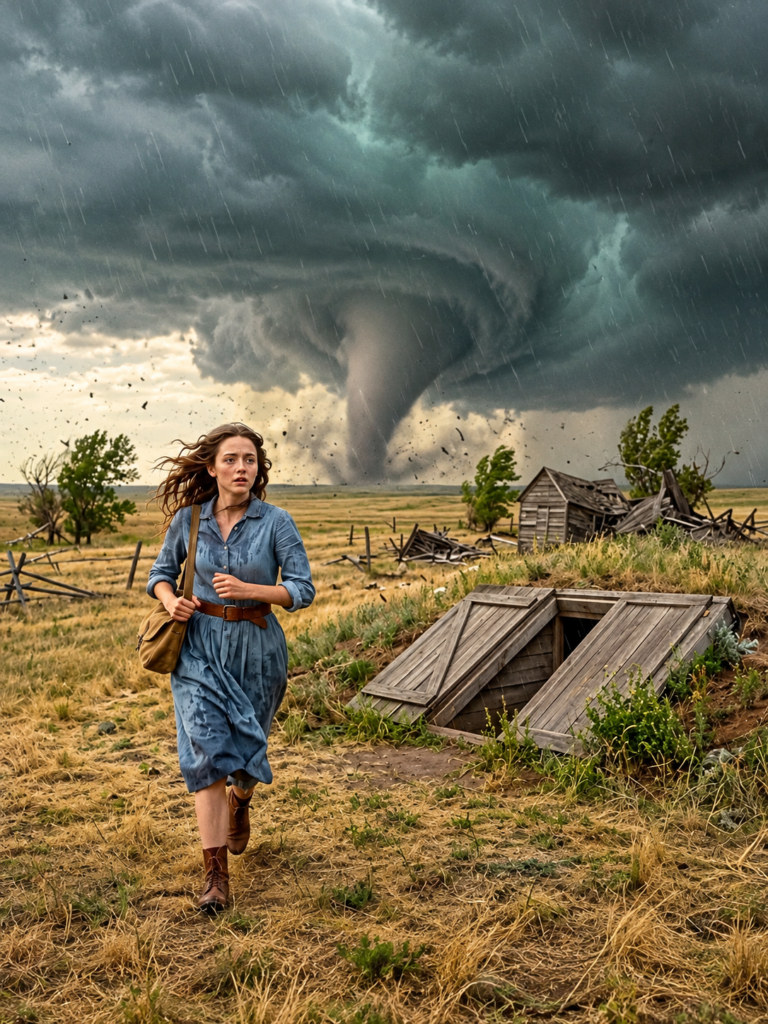
A tornado.
Elsie looked frantically around the basin.
Then she remembered Zebulon Tate’s old property.
Zebulon had died six years earlier, and his ranch had stood abandoned ever since.
The farmhouse was nearly collapsed, but the old man had built a storm cellar into the side of a hill.
Elsie could picture it.
Two heavy doors, partly sheltered by the rising ground.
If they were still there, she might survive.
She left the road and ran.
Rain struck before she reached the property.
Within seconds, her clothing was soaked. The wind caught her skirt and nearly pulled her off her feet.
Elsie clutched her canvas bag against her side.
She could barely see through the sheets of rain.
Behind her, the roaring grew louder.
She stumbled across the remains of Zebulon’s yard, searching for the cellar doors beneath weeds and dead branches.
At last she spotted a rusted hinge.
She dropped to her knees and dragged the weeds aside.
There.
One door was partly buried in mud.
Elsie pulled with both hands.
For a terrible moment it refused to move.
Then the wood shifted.
She squeezed through the opening, dropped into the darkness, and hauled the door shut above her.
The tornado struck seconds later.
The sound was unlike anything she had ever heard.
The entire cellar shuddered.
Dirt sifted from the ceiling.
Something massive slammed against the doors with such force that Elsie cried out.
She crouched against the stone wall, covering her head.
In the darkness, she could feel her heart pounding against her ribs.
She reached into her pocket and closed her fist around the silver thimble.
“Please,” she whispered.
She did not know whether she was speaking to God or to her parents.
Another violent impact shook the cellar.
Elsie pressed herself lower.
Her hand slid across the packed-earth floor.
And touched something unexpected.
Wood.
She moved her fingers across the surface.
Three narrow boards lay near the back wall.
They were smoother and cleaner than the surrounding floor, and one rested at an awkward angle.
Elsie frowned.
She remembered Zebulon Tate as a particular man who disliked crooked gates, misplaced tools, and careless workmanship.
He would never have left three boards lying that way without a reason.
The wind shrieked overhead.
Elsie knew she should remain where she was.
Instead, she leaned closer.
A flash of lightning entered through a crack near the doors.
In that brief illumination, she saw the edge of something beneath the boards.
She hooked her fingers beneath the crooked one.
It lifted easily.
Underneath was an iron ring.
Elsie stared at it.
She pulled away the other boards, exposing the outline of a concealed hatch.
The ring was cold and rough against her fingers.
She braced her feet and pulled.
A section of flooring rose with a long wooden groan.
Beneath it, narrow steps descended into darkness.
Elsie remained motionless.
An underground room.
Hidden beneath an abandoned storm cellar.
She looked toward the closed doors above.
The tornado still raged across Pine Hollow.
Every sensible instinct told her to leave the opening alone.
Then she remembered her mother’s warning.
She remembered the lawyer’s strange expression when she asked about Lucian Reddick.
And she remembered that Zebulon Tate had been dead for six years.
Who had hidden something beneath his cellar?
Elsie felt along the shelf beside her until she found an old box of matches.
She struck one.
A small flame trembled in her fingers.
Holding it carefully, she descended the narrow steps.
At the bottom lay a little room lined with cedar boards.
The air was still and surprisingly dry.
Against one wall stood a wooden chest.
Nearby was a tin money box.
Several bundles of papers rested on a shelf, each wrapped carefully in oilcloth.
Elsie looked around.
This was not a forgotten storage pit.
Someone had gone to considerable trouble to protect everything inside it.
She knelt beside the chest and lifted the lid.
The first bundle contained old receipts for land.
The second held letters.
She removed another folded document and saw a familiar name.
Amos Marlow.
Her father.
The match trembled.
Elsie unfolded the document, trying to read in the unsteady light.
Before she could make sense of it, an envelope slipped from between the pages and landed in her lap.
She picked it up.
Two words were written across the front in faded ink.
For Elsie.
Her hands began to shake.
She knew that handwriting.
She had seen those same careful letters on grocery lists, birthday cards, and little notes left beside her breakfast.
“Ma?”
The word escaped before she could stop it.
Augusta Marlow had been here.
In this hidden room.
Beneath Zebulon Tate’s abandoned storm cellar.
Elsie opened the envelope and found a folded letter dated nearly three years earlier, long before her mother’s final illness.
She held the match closer and began to read.
The first sentence made her forget the storm completely.
Elsie, if you’re reading this, then they finally came for the land.
Not he.
They.
Elsie looked around at the bundles of documents, the chest, and the money box.
Her mother had not hidden these things because she feared they might be lost.
She had hidden them because she feared somebody might find them.
And whatever Augusta had been trying to protect was important enough to bury beneath the earth.
Part 2
Elsie sat on the cedar floor with her mother’s letter open across her knees.
For a long while, she could not read past the first sentence.
If you’re reading this, then they finally came for the land.
Augusta had written those words nearly three years earlier.
She had known that someone might try to take Pine Hollow Ranch long before Elsie sat across from Alden Pierce in the farmhouse kitchen.
Outside, the wind battered the cellar doors, but the worst of the tornado seemed to be moving away.
Elsie struck another match.
The flame illuminated her mother’s handwriting, and for a moment, she could almost hear Augusta speaking.
The letter explained that certain things had been kept from Elsie because she was too young to carry them.
Augusta had not wanted her daughter growing up suspicious of every stranger who asked about the ranch.
She had not wanted ordinary days filled with fear over something that might never happen.
But years earlier, troubling questions had begun circulating about the Marlow property.
Men had asked about boundary lines.
Records that should have been available at the courthouse had disappeared.
Someone had even raised doubts about whether Augusta’s marriage to Amos had been properly registered.
Elsie stopped reading.
That was exactly what Mr. Pierce had said.
Not merely that a deed was missing, but that questions surrounding the marriage might affect her inheritance.
She searched the letter for more.
Augusta described how she had begun making copies of whatever records she could locate.
She had worked quietly, checking names, dates, and property descriptions.
Whenever she discovered something important, she preserved it.
She trusted very few people with her concerns.
Elsie looked at the documents scattered around her.
The hidden room was no longer simply a strange discovery.
It was the result of years of careful work.
Augusta had assembled a defense against a danger Elsie had never known existed.
She reached for the folded document bearing her father’s name.
Amos Marlow.
There was his signature near the bottom.
Beside it was Augusta’s.
The document described acreage along Pine Hollow Creek, with boundaries Elsie recognized from the ranch.
She had crossed those fields hundreds of times. She knew the creek’s bends, the cottonwoods, the uneven stretch of pasture where water collected after heavy rain.
Seeing those places described in formal language felt strange.
To Elsie, they were memories.
On paper, they were evidence.
Another document carried a county seal.
Another listed property taxes her mother had paid over the years.
Elsie arranged them carefully beside her.
Then she opened a yellowed envelope.
Inside was a marriage certificate.
She read the names once, then again.
Amos Marlow.
Augusta Marlow.
Lawfully married.
Elsie pressed her fingers against the paper.
Mr. Pierce had claimed there were questions about the marriage records.
But here was a certificate bearing both her parents’ names.
She remembered standing in the kitchen as the lawyer explained why she could not prove her inheritance.
She remembered how foolish and helpless she had felt.
Now she wanted to ask him why no one had mentioned this document.
Why no one had looked for it.
And why someone seemed so eager to declare that her parents’ marriage and property rights could not be established.
But anger would not explain where the missing county records had gone.
Neither would tears.
Elsie forced herself to keep reading.
The letter warned her that an official stamp did not necessarily mean a document told the entire truth.
Augusta instructed her to compare dates, signatures, witness names, and parcel numbers.
A paper might appear convincing by itself and tell a different story when placed beside another.
Then Elsie reached a sentence that made her stop.
If the claim comes through Lucian Reddick, understand that Lucian is only the hand you can see.
She reread it slowly.
Only the hand you can see.
Did Augusta believe someone else was involved?
Had Lucian been asking questions on another person’s behalf?
Elsie searched the letter for an explanation, but Augusta did not provide one.
The uncertainty bothered her.
She had gone underground believing she needed to defend the ranch against one distant relative.
Her mother seemed to have feared something larger.
Yet there was no proof in front of her identifying anyone beyond the names Augusta had written.
She could not afford to mistake suspicion for evidence.
Not when every piece of paper might determine whether she kept her home.
Elsie folded the letter carefully and examined the tin money box.
Inside were forty-three dollars, two keys, and a little notebook wrapped in cloth.
She stared at the money.
Forty-three dollars.
For someone who had been counting eight dollars and fifteen cents that morning, the amount seemed extraordinary.
She wondered how long Augusta had saved it.
How many small purchases her mother had gone without in order to leave something behind.
The keys were unfamiliar, and there was nothing immediately revealing what they opened.
Elsie set them aside without trying to invent an answer.
Then she opened the notebook.
Its pages were filled with Augusta’s handwriting.
Names.
Dates.
Trips into town.
References to courthouse files.
Notes about conversations.
A church register.
A property transfer number.
Some entries were only a few words long. Others described where Augusta had gone and which records she had tried to examine.
Elsie recognized her mother’s ordinary habits in the writing.
Augusta had always kept accounts in the same careful manner, recording every sack of feed and every payment made toward the doctor’s bills.
But these pages were different.
She had been watching people and tracking information.
One name appeared repeatedly.
Lucian Reddick.
Beside one entry, Augusta had written:
Asked again about Amos’s deed. Pretended it was family curiosity. It was not.
Elsie stared at the words.
Lucian had asked about her father’s deed while Augusta was still alive.
He had known enough about the property to ask specific questions.
Had he already been planning his claim?
She remembered how calmly Mr. Pierce had said Lucian’s papers appeared stronger than hers.
Perhaps Lucian had expected no one to challenge him.
Perhaps he had believed Augusta’s death would leave Elsie without any way to defend herself.
A hot surge of anger passed through her.
She thought about seventeen cattle sold to pay for medicine, the loss of her mare, and her father’s buckboard disappearing down the road.
While Elsie had been fighting to keep her mother alive, Augusta had been fighting another battle almost entirely alone.
And Elsie had never known.
For months after the funeral, she had remembered her mother as a woman made helpless by illness.
She remembered carrying soup upstairs, changing bedsheets, helping Augusta sit upright when coughing left her exhausted.
She remembered the painful embarrassment on her mother’s face whenever she needed assistance.
Elsie had believed that sickness had taken away nearly everything Augusta had once been.
Now, surrounded by evidence of her mother’s patient determination, she understood how little she had seen.
Augusta had been weak in body.
She had not been defeated.
“Why didn’t you tell me?” Elsie whispered.
The question echoed faintly through the hidden room.
No answer came.
She thought of all the evenings they had spent together, and all the opportunities Augusta had possessed to explain.
Then she remembered the letter.
Her mother had wanted to spare her a burden she was not yet ready to carry.
Elsie did not know whether she agreed with that decision.
She wished she had known sooner.
She wished she could ask Augusta a hundred questions.
But wishing would not change the eight-day notice lying on the farmhouse kitchen table.
She returned to the letter.
Near the end, Augusta’s words became more personal.
If you have found this room, my darling girl, I am probably no longer there to stand beside you.
Elsie swallowed.
Her mother apologized for that absence.
She urged Elsie not to let grief convince her that she was entirely alone.
She told her to ask questions, read carefully, and trust slowly.
Then came the instruction Elsie would carry with her long after the papers had been put away.
And when you become frightened, do the next necessary thing. Then do the one after that.
Elsie covered her face.
For fourteen months, she had been living with the belief that her mother’s final gift was a warning.
Now she held something larger.
It was a way to move forward when fear made the future impossible to imagine.
Augusta had not told her to win every battle.
She had not promised that justice would come easily.
She had simply told her to keep doing what was necessary.
Elsie wiped her eyes and looked around the room.
The next necessary thing was obvious.
She needed to protect these documents.
She wrapped the receipts, marriage certificate, land records, and letters in their oilcloth coverings.
She placed the notebook and her mother’s letter where she could reach them easily.
She gathered the forty-three dollars and the two keys.
Then, carrying the evidence beneath her coat and in her canvas bag, she climbed the narrow stairs.
The tornado had passed.
When Elsie pushed open the storm cellar doors, damp evening air struck her face.
Pine Hollow Basin looked wounded.
Branches littered the fields.
Fence posts leaned at odd angles.
Far away, a section of barn roof had been torn loose and dropped into a pasture.
Elsie stood for a moment in the wet grass.
The storm had frightened her more than almost anything she could remember.
Yet without it, she would have continued walking along the road.
She would not have entered Zebulon Tate’s property.
She would never have discovered the concealed boards or the room beneath them.
Perhaps her mother had hoped she would eventually find the hiding place.
Perhaps there was something she had once meant to explain and never had the chance.
Elsie could not know.
But the evidence was in her hands now.
And for the first time since the lawyer arrived, she was no longer thinking about where she would go when the eight days ended.
She was thinking about how to stay.
She continued toward town and reached the courthouse shortly before dusk.
The doors were locked.
Elsie stared at them in disbelief.
She had come so far, survived the tornado, and found the documents she needed.
Now she was standing outside a building she could not enter.
She looked toward the clock.
Another day had passed.
Seven days remained.
“Miss?”
Elsie turned.
An elderly man was sweeping rainwater from the steps of the building next door.
He wore spectacles and moved with the slow, deliberate care of someone accustomed to long hours of patient work.
“Are you waiting for the records office?”
“Yes, sir.”
“It closed some time ago.”
“I can see that.”
Her answer came out more sharply than she intended.
The man glanced at her wet clothing and the bag clutched against her side.
“Something urgent?”
Elsie almost told him no.
She was tired, hungry, and suspicious of strangers after her encounter with Mr. Pierce.
Then she remembered her mother’s letter.
Ask questions.
“My name is Elsie Marlow. I’m trying to find records for my family’s ranch.”
The man’s expression grew attentive.
“Harland Webb,” he said, offering his hand. “Harlan, to everyone around here. I worked in that records office for thirty-two years before I retired.”
Elsie looked toward the courthouse.
“You know the old property records?”
“I know where a good many of them are supposed to be.”
She hesitated, then reached into her bag.
“Would you look at something?”
Harlan leaned his broom against the wall.
Elsie unfolded the land record bearing Amos’s name.
The old man adjusted his spectacles.
He studied the paper beneath the doorway light.
Then he went back to the beginning and read it again.
“Where did you get this?”
“It belonged to my parents.”
“That isn’t what I asked.”
Elsie hesitated.
“My mother hid it.”
Harlan looked up.
For a moment, neither spoke.
Then he returned the document with great care.
“Come here tomorrow morning when the doors open.”
Elsie felt hope rise and immediately tried to control it.
“Can it help me?”
“It might.”
“Might?”
“It’s worth looking into properly. I won’t promise more until we’ve checked the books.”
He asked where she intended to spend the night.
Elsie realized she had no good answer.
She had planned to return home after visiting the courthouse, but darkness had arrived, and her exhausted legs could barely carry her another mile.
Later, the pastor’s wife found her sitting beneath the courthouse awning and arranged for her to sleep in the church’s back room.
Elsie accepted a place to rest with more gratitude than she could express.
She spread her blanket, set her canvas bag beside her, and checked the documents before lying down.
The room smelled faintly of old wood and clean linen.
For the first time in fourteen months, she was sleeping somewhere that was not her mother’s house.
That thought hurt more than she expected.
She turned onto her side and held the silver thimble.
Tomorrow, she would return to the courthouse.
Tomorrow, she would find out whether her mother’s years of work could save Pine Hollow.
At eight o’clock the next morning, Harlan was waiting outside the records office.
He led Elsie inside, past shelves holding thick ledgers and cabinets filled with aging documents.
The room smelled of dust, paper, and furniture polish.
“This may take some time,” he warned.
“I have time until they take it away from me.”
Harlan looked at her.
“Then we’d better use it carefully.”
They began with the oldest land records.
For three hours, Elsie turned pages while Harlan checked names and reference numbers.
Some handwriting was almost impossible to read.
Some entries were incomplete.
Others referred to documents that should have been filed elsewhere.
Elsie grew increasingly discouraged.
She had imagined that bringing her mother’s papers into the courthouse would make the truth immediately obvious.
Instead, it felt as though they were sorting through an enormous puzzle with missing pieces.
Then Harlan stopped turning pages.
“There.”
He pushed a heavy ledger toward her.
Elsie leaned close.
More than twenty years earlier, the county had recorded a transfer involving the Pine Hollow acreage.
The purchaser’s name was Amos Marlow.
Her father’s name.
She read it silently, hardly daring to believe what she was seeing.
“There he is,” she whispered.
“Yes.”
“Then we’ve found it.”
“We’ve found the entry.”
Harlan pointed to a reference number beside the name.
“That number should lead us to the original deed.”
He checked another record.
Then another.
His expression darkened.
“The corresponding document isn’t here.”
Elsie felt her brief relief disappear.
“Missing?”
“That’s what it looks like.”
“Then it proves nothing.”
Harlan shook his head.
“No. It proves something was recorded here. The deed may be gone, but this entry didn’t simply appear out of nowhere.”
He tapped the page.
“Records don’t usually invent themselves.”
Elsie remembered the notebook.
She pulled it from her bag and began scanning the pages.
There, near the middle, was the same reference number.
She showed it to Harlan.
He studied the entry.
Then he examined several of Augusta’s other notes.
“Your mother knew exactly what she was looking for,” he said.
Together, they compared the notebook with the county records.
One date matched.
Then another.
A property description lined up with the acreage recorded in Amos’s name.
A tax entry corresponded with a receipt Augusta had preserved.
Individually, the papers seemed incomplete.
Together, they began telling a consistent story.
Elsie grew more confident as she learned what to compare.
She stopped asking whether a document looked important and began asking how it connected to the next one.
For the first time, she understood why Augusta had instructed her to check every name, number, and signature.
Her mother had not left a single magical piece of paper.
She had left a trail.
By late morning, Harlan turned his attention to the marriage records.
The registry contained an entry confirming Amos and Augusta’s marriage.
But Harlan wanted independent corroboration.
One of Augusta’s notes mentioned a small church six miles outside town.
They followed that lead.
An aging minister received them and listened patiently while Harlan explained what they needed.
The minister went to an old cabinet and brought out a register.
He carefully turned the pages until he found the appropriate date.
There were Amos’s and Augusta’s names.
There were two witnesses.
Elsie leaned over the book.
She remembered the way Mr. Pierce had spoken about uncertainty surrounding her parents’ marriage.
There had been nothing uncertain about the ceremony itself.
Here was another record confirming it.
“My mother told the truth,” she said quietly.
Harlan looked at her.
“I believe she did.”
For a few precious minutes, Elsie allowed herself to feel hopeful.
Her parents had been legally married.
Amos’s purchase had been entered into the county ledger.
Augusta had paid taxes on Pine Hollow Ranch for years.
The facts were beginning to line up.
Surely that had to be enough.
But Harlan seemed troubled.
“Don’t celebrate yet.”
Elsie turned.
“Why not?”
“Because Mr. Reddick has presented a claim of his own, and your father’s original deed is still missing.”
“But we know he bought the land.”
“We have good evidence that he did. Now we need to make that evidence strong enough to survive a challenge.”
“How?”
Harlan opened the property ledger again.
He showed her the original transfer entry.
Two witnesses had signed when Amos purchased the acreage.
One was already dead.
The second name was difficult to read.
Harlan carried the ledger toward the window, where the daylight was stronger.
Elsie leaned beside him.
They examined the faded handwriting.
She traced the letters with one finger.
Suddenly, she stopped.
“Wait.”
“What is it?”
“I’ve seen that name.”
“Where?”
“In my mother’s papers.”
She opened her bag and searched through the bundles.
There were letters tied with twine, folded notes, and old envelopes with faded addresses.
Then she found one wrapped with blue thread.
She read the name written on the front.
It matched the surviving witness listed in the ledger.
Elias Mercer.
Harlan looked up sharply.
“May I?”
Elsie handed him the envelope.
Inside was a letter written years earlier.
Elias described being present when Amos Marlow purchased the Pine Hollow property.
He remembered the payment.
He remembered the signatures.
He remembered Augusta standing with her husband when the transfer was completed.
For several moments, Harlan read without speaking.
Then he turned the letter over.
There was an address at the bottom.
“Red Creek,” he said.
Elsie leaned forward.
“Is that far?”
“About eighteen miles north of here.”
“Do you think he’s still there?”
“I don’t know. But if he is, he may be able to confirm all of this.”
Elsie stared at the letter.
A living witness.
Someone who had stood beside her parents when Amos signed the purchase papers.
Someone who could tell a court that the transfer had really happened.
“Would that be enough?”
“It could make a very important difference.”
Elsie looked at the address again.
Eighteen miles.
She had no horse.
No buckboard.
No wagon.
And her money had already been stretched beyond anything she thought possible.
Harlan watched her face.
“How much time do you have left?”
“Six days.”
“And how do you intend to get eighteen miles north?”
Elsie folded the letter carefully.
“I’ll walk.”
Harlan stared at her for a long moment.
Then the corners of his mouth lifted.
“No,” he said. “You won’t.”
He reached into his coat pocket and brought out a ring of keys.
“My truck may be older than you are, Miss Marlow, but it still knows the road north.”
He placed a key in her hand.
Elsie looked down at it.
For fourteen months, she had believed she was completely alone.
She had imagined that surviving without her mother meant never needing anyone again.
But here stood an elderly man who had known her for barely a day, offering her the use of something valuable because he believed her family’s story deserved to be heard.
Elsie tried to speak.
Nothing came.
Harlan smiled gently.
“Sometimes, young lady, the sensible thing is to let somebody help.”
She closed her hand around the key.
And she thought again of Augusta’s words.
Do the next necessary thing.
Maybe some of those necessary things were not meant to be done alone.
Part 3
Harlan Webb’s truck coughed twice before the engine finally started.
It was old, noisy, and pulled stubbornly to the right, but Elsie had never been more grateful for a vehicle.
She kept Augusta’s notebook beside her on the seat as she drove north.
The road narrowed beyond Pine Hollow, passing through fields of sagebrush and dry grass. The tornado had left signs of damage across the basin, but the country gradually returned to its familiar quiet.
Eighteen miles.
Somewhere at the end of that road might be the man who could confirm her father’s ownership.
Elsie tried not to imagine what would happen if Elias Mercer had died or moved away.
When those thoughts came, she repeated her mother’s instruction.
Do the next necessary thing.
For now, that meant reaching Red Creek.
The address led to a weather-beaten farmhouse surrounded by open fields.
Elsie climbed out of the truck, straightened her dress, and approached the door.
She knocked.
After a moment, she heard slow footsteps inside.
An elderly man opened the door.
He had deeply lined features and the cautious expression of someone surprised to receive an unexpected visitor.
“Mr. Elias Mercer?”
“That’s right.”
“My name is Elsie Marlow.”
The name alone brought no immediate recognition.
Then she added, “Amos Marlow was my father.”
The man’s expression changed.
“Amos Marlow?”
“Yes, sir.”
“I haven’t heard that name in twenty years.”
Elsie removed the letter from her bag.
“I believe you wrote this.”
Elias accepted it and read slowly.
His hands trembled slightly as he turned the page.
When he finished, he looked at Elsie with an expression she could not quite interpret.
“Come inside, child.”
The farmhouse was modest, with worn furniture and the quiet stillness of a place occupied by an elderly man.
Elias offered Elsie a chair.
Then he sat opposite her, holding the letter in both hands.
“I remember your father,” he said.
Elsie leaned forward.
“He bought Pine Hollow Ranch, didn’t he?”
Elias nodded.
“He did.”
“Do you remember signing the transfer papers?”
“I stood right there when he signed them.”
Elsie held her breath.
“He paid for that ranch honestly,” Elias continued. “I remember your mother being there too.”
For the first time since Mr. Pierce appeared at her farmhouse, Elsie heard someone speak about her father’s ownership without hesitation.
No qualifications.
No missing documents.
No suggestions that Amos might merely have believed the land belonged to him.
Elias had been present.
He remembered.
Elsie felt tears gathering in her eyes.
“Mr. Mercer, there’s a man trying to take the ranch away from me.”
Elias listened while she explained the missing deed, Lucian Reddick’s claim, and the eight-day notice.
She showed him the land records and Augusta’s notes.
The old man examined them carefully.
When she finished, he shook his head.
“Your father was an honest man.”
“Then would you tell that to a judge?”
Elias looked toward the window.
His hands rested uneasily on his knees.
Elsie’s hope faltered.
“I’m eighty-four years old,” he said. “I don’t travel well anymore.”
She looked at the floor.
For a moment, all she could think about was the long drive back to Pine Hollow with another disappointment.
She had found a witness who knew the truth.
But knowing the truth and being able to prove it were not the same thing.
Then she felt the silver thimble in her pocket.
Ask questions.
Elsie raised her head.
“Mr. Mercer, what would you be willing to do?”
He looked at her.
“What do you mean?”
“If you can’t travel to court, could you give a statement here? Could somebody come to you?”
Elias considered the question.
“I suppose I could do that.”
It was such a simple answer that Elsie almost laughed with relief.
She had been so focused on getting him into a courtroom that she had nearly overlooked another possibility.
With Harlan’s help, a local notary was arranged to visit the farmhouse that afternoon.
Elias gave a sworn statement.
He described the day Amos purchased the land, the payment he witnessed, and the signatures on the transfer papers.
He identified the people who had been present.
He confirmed that Augusta stood beside her husband when the property was transferred.
Elsie watched carefully as the statement was completed.
The old man’s memory was not an original deed.
But it supported the records Augusta had preserved, and it gave Elsie something she had not possessed when the lawyer first appeared.
Independent testimony.
Before she left, Elias called her back.
“There’s something else you should know.”
Elsie turned.
“Your mother came here once.”
She stopped.
“Ma?”
“Years ago. She wanted me to write down everything I remembered about the transfer.”
Elsie looked at the letter in her hands.
Augusta had made this journey before her.
She had sat with Elias and asked many of the same questions.
“Why didn’t she tell me?”
The old man gave her a sad smile.
“Maybe she was trying to let you be young.”
Elsie could not answer.
She thought about the years she had spent worrying about ordinary things: weather, livestock, chores, and whether the ranch would survive another difficult season.
While Elsie was growing up, her mother had been quietly gathering evidence against a threat that might one day destroy their home.
Augusta had not been keeping secrets to punish her.
She had been trying to give her daughter a childhood untouched by that fear.
On the drive back to Pine Hollow, Elsie looked at the notebook beside her.
She wished she could tell her mother that she understood.
Not completely.
Perhaps she never would.
But enough.
The following morning, Elsie entered the courthouse with her canvas bag held tightly against her side.
Inside were the land records, marriage documentation, tax receipts, Augusta’s notebook, and Elias Mercer’s sworn statement.
Mr. Pierce was already there.
So was Lucian Reddick.
It was the first time Elsie had seen the man who claimed her home.
Lucian was silver-haired, well dressed, and surprisingly calm.
He studied her as though she were an inconvenience that should already have been dealt with.
“I understand you’ve found some family papers,” he said.
Elsie met his eyes.
“I found the truth.”
Lucian smiled faintly.
“Those aren’t always the same thing.”
Once, that remark would have intimidated her.
Now she recognized it as an attempt to make her doubt herself.
She said nothing more.
The proceedings were difficult.
Lucian’s attorney questioned the reliability of old letters and the memories of elderly witnesses.
He emphasized that Amos’s original deed remained missing from the county file.
Elsie listened as documents she had carried through a tornado were reduced to technical questions and competing interpretations.
Fear rose in her chest.
She knew how much depended on what happened.
If the county rejected her evidence, the eight-day deadline might still cost her the ranch.
But this time she did not sit helplessly.
She opened Augusta’s notebook.
One date corresponded with a recorded tax payment.
Another matched the church marriage register.
The property description matched the ledger.
Elias’s sworn statement supported the original transfer entry.
Each piece reinforced another.
Elsie explained what she and Harlan had found.
She did not pretend to understand every legal argument.
She simply showed how the evidence fit together.
At last, the county clerk agreed that there was sufficient evidence to suspend Lucian’s claim while the records underwent formal review.
Elsie felt her knees weaken.
She had not won the ranch.
Not yet.
But she would not be forced out under the original deadline.
For the first time, Lucian Reddick stopped smiling.
Outside the courthouse, Elsie sat on the steps.
Her hands shook so badly that she had to press them together.
Harlan came outside and sat beside her.
“You did well.”
Elsie shook her head.
“My mother did this.”
“Some of it,” Harlan answered.
She looked at him.
“Your mother collected those papers. But she didn’t drive eighteen miles. She didn’t ask Elias the right question. And she didn’t stand in there while people tried to make her doubt what she knew.”
Elsie looked down at her hands.
They were rough from work.
They were the same hands that had washed Augusta’s sheets, repaired fences, buried her mother, and counted eight dollars and fifteen cents at the kitchen table.
All her life, Elsie had believed that strong people were those who did not feel afraid.
Now she understood something different.
Courage was often doing what needed to be done while fear remained.
Her mother had shown her that.
And Harlan had helped her see it in herself.
Three weeks later, Elsie returned to the courthouse for the final review.
This time, she did not come alone.
Harlan sat behind her.
Elias’s sworn statement rested among the other evidence.
Along the back wall stood neighbors from Pine Hollow, people who remembered Augusta helping sick families, bringing food to those in need, and staying awake through winter nights when someone required assistance.
They had come because the Marlow family mattered to them.
Elsie had spent fourteen months believing there was nobody left to stand beside her.
Looking around the room, she finally understood how mistaken she had been.
Lucian Reddick sat across from her.
He did not meet her eyes.
The review had established that Amos’s property transfer had been recorded.
Although the original deed remained missing, the ledger entry, tax records, marriage certificate, witness testimony, and preserved copies formed a consistent chain.
Lucian’s claim depended upon that chain being broken.
It was not.
The judge spoke for several minutes.
Elsie heard the explanation only in fragments.
Then came the words she had been waiting to hear.
The Marlow claim was valid.
Pine Hollow Ranch legally belonged to Elsie.
For a moment, she did not move.
Harlan gently touched her shoulder.
“Elsie.”
She looked at him.
A smile spread slowly across his face.
Only then did she understand.
The ranch was hers.
She could go home.
Lucian rose, collected his papers, and left without speaking to her.
Elsie watched him walk away.
She had imagined that seeing him defeated might bring a fierce satisfaction.
Instead, she felt exhausted.
And strangely peaceful.
She did not need to celebrate Lucian’s failure.
She needed only to know that Amos and Augusta’s ownership had finally been recognized.
Outside, people embraced her and offered congratulations.
Elsie thanked them, but her thoughts had already turned toward the western road.
Toward the farmhouse.
Toward the two graves beneath the cottonwoods.
That evening, she walked through the pasture alone.
The tornado had broken several branches from the old trees, and weeds had grown around the wooden crosses.
Elsie knelt beside her father’s grave.
“I kept it, Pa.”
Her voice broke.
She remembered the buckboard, the warm coat around her shoulders, and the sound of his laughter on the road home.
Then she moved to Augusta’s grave.
For a long time, Elsie said nothing.
She took the silver thimble from her pocket and held it in her palm.
“You knew,” she whispered. “You knew I’d need you.”
The wind moved gently through the grass.
Elsie looked toward the farmhouse.
Then she smiled through her tears.
“No. You knew I’d have to learn how to do it without you.”
Augusta had not left behind a miracle.
She had left documents.
A notebook.
A letter.
Names and questions.
And enough guidance for her daughter to follow the truth one step at a time.
Elsie stood and looked across the ranch.
The barn still leaned east.
Fences needed repairing.
Bills waited on the kitchen table.
There were too few cattle in the pasture, and winter would come again.
Winning the ranch had not made her rich.
It had not restored her parents or returned the horse and buckboard she had sold.
Life was still difficult.
But the life ahead belonged to her.
Not simply because a judge had ruled in her favor.
Because Amos had built something worth preserving.
Augusta had protected it.
And Elsie had found the courage to defend it.
The following spring, she planted two young cottonwoods beside the old trees.
One for Amos.
One for Augusta.
She watered them carefully and watched their leaves emerge.
Years later, when people asked how she had saved Pine Hollow Ranch, Elsie never began with the courthouse.
She began with the storm.
She told them how a tornado drove her into an abandoned cellar, where three crooked boards concealed a room beneath the earth.
And how, in that room, she discovered something worth far more than the money in the tin box.
She discovered that the people we love can leave us strength long after they are gone.
Sometimes through the work they completed when nobody was watching.
Sometimes through the lessons they patiently taught us.
And sometimes through a few carefully chosen words that become clearer only when life demands more courage than we think we possess.
Elsie kept the silver thimble for the rest of her life.
Whenever the future seemed too uncertain, she remembered the letter written in her mother’s familiar handwriting.
Do the next necessary thing.
Then do the one after that.
