
Part 1
“Old man, you’re wasting everybody’s time. That tractor isn’t worth more than scrap, and you know it.”
The words carried across the auction yard, loud enough to stop conversations and turn heads.
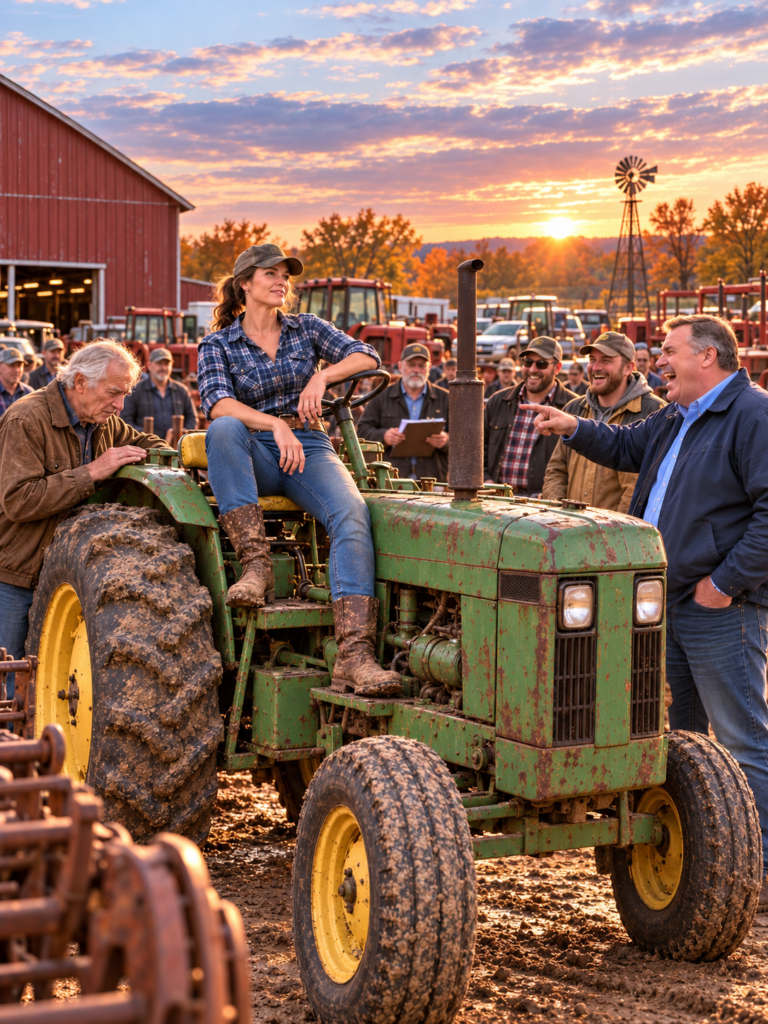
Walter Grady stood beside his faded green John Deere, one trembling hand resting on its hood. He was seventy-six years old, with shoulders bent from a lifetime of hard work and a face weathered by decades of Missouri winters. His canvas coat was patched at the elbows. His boots were clean but worn thin at the heels.
He had owned that tractor for nearly forty years.
And now, because his hands could no longer do the work they once had, he was about to watch a stranger take it away.
The man insulting him was Rick Colton, a well-known equipment dealer who bought struggling farmers’ machinery for pennies on the dollar and resold it at a profit.
Rick glanced at Walter’s shaking fingers and smirked.
“Look at him. He probably can’t even hold a wrench anymore. What good is a tractor to a man who can’t fix one?”
Several men in the crowd looked away.
Nobody challenged him.
Then a woman’s voice came from behind the gathering.
“Maybe you ought to let the man sell his tractor without insulting him.”
Rick turned.
A woman in her early forties stood near the auction fence, wearing a faded blue flannel shirt, a muddy brown jacket, and boots that looked as though they had traveled across every farm road in the county.
She carried no expensive handbag. Her dark hair was pulled into a loose ponytail, and there was dirt beneath one thumbnail.
Rick looked her up and down.
“Well, sweetheart, if you’re so concerned, why don’t you buy it?”
The woman stepped forward.
“Maybe I will.”
Rick laughed.
“Lady, you probably couldn’t afford the diesel to drive it home.”
She didn’t smile.
She didn’t argue.
Instead, she looked toward the auctioneer.
“What’s the opening bid?”
“Eight hundred dollars,” Gary announced.
“I’ll give you eleven hundred.”
The crowd went quiet.
Rick stared at her.
“Eleven hundred? For that old thing?”
“Yes.”
“You’re throwing your money away.”
“Then it’s a good thing it’s my money.”
A few people chuckled.
Rick’s expression hardened. He was accustomed to winning these little battles, especially against people who appeared to have less money than he did.
But there was something peculiar about this woman.
She wasn’t nervous.
She wasn’t trying to impress anyone.
She looked at him with the calm confidence of someone who had already made a decision and didn’t need his approval.
Rick shook his head.
“Fine. Keep the junk.”
He walked away.
Gary called for another bid.
None came.
“Sold! Eleven hundred dollars!”
The auctioneer’s gavel struck the wooden podium.
Walter didn’t celebrate.
He simply looked at the woman who had bought his tractor.
His gray-green eyes were tired, and there was something behind them that she recognized immediately.
Not gratitude.
Not relief.
Loss.
“You didn’t have to do that,” he said quietly.
“I know.”
“That’s more than most people would have paid.”
“I wasn’t buying it for most people.”
Walter studied her face.
“Do I know you?”
The woman hesitated.
“Not anymore.”
It was a strange answer.
Before Walter could ask what she meant, she reached into her coat and took out a folded payment envelope.
“My name is Victoria,” she said. “Victoria Hale.”
Walter repeated the name softly, as though searching through a drawer of memories.
“Hale.”
He frowned.
“That’s a name I haven’t heard in a while.”
Victoria looked at him.
“I know.”
And then, instead of explaining, she asked him a question.
“Mr. Grady, do you remember a woman named Margaret Hale?”
Walter’s hand stopped trembling for a moment.
He looked at Victoria again.
This time, really looked.
At her eyes.
At the shape of her face.
At something familiar that time had nearly erased.
“Margaret?” he whispered.
Victoria nodded.
“She was my mother.”
For the first time that morning, Walter Grady looked genuinely frightened.
Not because he had done something wrong.
But because a memory he had buried almost thirty years earlier had suddenly returned, standing before him in muddy boots.
And he had no idea that the little girl he once helped was now one of the wealthiest women in the agricultural equipment industry.
Thirty years earlier, Margaret Hale had been a widow trying to keep eighty-six acres of Missouri farmland from being repossessed.
Her husband, Daniel, had died in a grain-bin accident the previous November.
He had left behind a mortgage, overdue equipment payments, and a daughter who was only eleven years old.
What he had not left behind was enough money.
Margaret tried everything.
She took cleaning jobs in town. She sold eggs. She repaired neighbors’ clothes. She worked evenings at a diner, coming home with swollen feet and hands that smelled of dish soap.
Victoria remembered those nights more clearly than she remembered most of her childhood.
Her mother would come home after midnight, remove her shoes at the kitchen door, and sit at the old wooden table beneath a yellow lamp.
Sometimes she counted money.
Sometimes she counted bills.
And sometimes she simply sat there, staring at the wall until morning came.
The farm had belonged to Daniel’s family for three generations.
His father had planted the first orchard.
His grandfather had built the barn.
And Daniel had promised Margaret that their daughter would grow up with enough land beneath her feet to know she always had somewhere to belong.
But promises didn’t make mortgage payments.
By the spring after Daniel’s death, the bank had sent its final notice.
Margaret needed to bring in the harvest.
Without the harvest, she would lose the farm.
And without the farm, she had nowhere to take Victoria.
Then their old tractor broke down.
It happened on a Wednesday morning.
Victoria remembered the sound.
A harsh metallic knocking, followed by a coughing engine and sudden silence.
Margaret tried starting it three times.
Nothing.
She climbed down, stood beside the tractor, and pressed both hands against her face.
Victoria had never seen her mother cry in public.
But that morning, in the middle of a half-planted field, Margaret sank onto the tractor’s rear tire and wept.
“I don’t know what to do anymore,” she whispered.
Victoria stood a few feet away, holding a rusty toolbox.
She wanted to help.
She wanted to say something that would make everything better.
But she was eleven.
She couldn’t repair an engine.
She couldn’t negotiate with a bank.
She couldn’t bring her father back.
All she could do was stand beside her mother and feel the terrifying helplessness of being too young to save someone she loved.
The next afternoon, Margaret drove their broken tractor to Grady Agricultural Service on a borrowed trailer.
Walter Grady was forty-six then.
He had strong hands, thick dark hair beginning to gray at the temples, and a reputation for being the best agricultural mechanic in Miller County.
His repair shop sat beside a narrow gravel road, surrounded by old engines, spare tires, and equipment that farmers had abandoned because they could no longer afford repairs.
Margaret walked into the shop carrying a folder of bills.
Walter looked up from an engine block.
“Afternoon, ma’am. What can I do for you?”
She explained the problem.
He listened without interrupting.
Then he followed her outside, climbed onto the tractor, and tried the ignition.
He heard the knocking immediately.
He shut it down.
“Fuel delivery problem,” he said. “Could be the pump timing. Maybe a line, too. I’ll have to open it up.”
“How much?”
“Can’t tell until I look.”
Margaret swallowed.
“Can you give me some idea?”
Walter studied her.
She was wearing a faded floral dress and a coat that was too heavy for the weather. Victoria stood beside her, holding a paper sack containing two peanut-butter sandwiches.
Walter noticed the girl’s shoes.
One had been repaired with black electrical tape.
He had seen enough struggling farmers to recognize desperation without needing anyone to explain it.
“Why don’t you come inside?” he said. “Coffee’s still hot.”
Margaret shook her head.
“Sir, I need to know the price. I don’t want to waste your time.”
Walter leaned against the tractor.
“What’s your name?”
“Margaret Hale.”
He nodded slowly.
“Daniel Hale’s wife?”
Her face changed.
“You knew Daniel?”
“Fixed his baler a few times. Good man.”
Margaret lowered her eyes.
“He was.”
Walter looked toward Victoria.
“And who’s this?”
“My daughter.”
Victoria stepped forward.
“I’m Victoria.”
Walter smiled.
“Nice to meet you, Victoria.”
Then he turned back to Margaret.
“Leave the tractor here. I’ll see what I can do.”
Margaret stared at him.
“I don’t have enough to pay for a major repair.”
“We’ll figure that out later.”
But Margaret was proud.
She had already accepted help from neighbors, church friends, and relatives who had quietly begun treating her as though she were a burden.
She couldn’t bear another obligation.
“I don’t want charity,” she said.
Walter’s expression softened.
“Good. Because I wasn’t offering charity.”
“What were you offering?”
“A chance to get your tractor running.”
He took the key.
And that was how a man with grease on his hands and no fortune of his own changed the direction of two lives.
Part 2
Walter spent the next three days working on Margaret Hale’s tractor.
Victoria remembered sitting on an overturned bucket in the corner of his shop, watching him take apart machinery she didn’t understand.
The place smelled of engine oil, welding smoke, coffee, and sawdust.
A radio played country music from a shelf above the workbench.
Outside, spring rain drummed against the tin roof.
Walter worked steadily, occasionally stopping to explain what he was doing.
“See this line?” he asked, holding up a length of metal tubing.
Victoria nodded.
“Fuel’s got to reach the engine at the right pressure and the right time. Doesn’t matter how strong the engine is if what feeds it can’t do its job.”
“Is that why it stopped?”
“Part of it.”
He showed her the worn fittings.
Explained the timing adjustment.
Let her hold a flashlight while he examined the injection system.
By the third afternoon, Victoria had started asking questions faster than Walter could answer them.
“Why does this part have six bolts?”
“Why can’t you put the fuel line somewhere else?”
“Why does the engine sound different when it’s cold?”
Walter never told her to stop talking.
He never laughed at her questions.
Instead, he answered each one carefully.
And when she didn’t understand, he explained it another way.
“You’re a curious little thing,” he said eventually.
Victoria grinned.
“My daddy used to say I was trouble.”
“Your daddy sounds like he knew what he was talking about.”
She laughed.
It was the first time she had laughed freely since Daniel’s funeral.
Walter noticed.
But he didn’t say anything.
On the third evening, he finished the repair.
Margaret arrived just before sunset.
She stood outside the shop as Walter started the tractor.
The engine turned over.
Caught.
And settled into a smooth, steady rumble.
Margaret covered her mouth.
Victoria jumped up and down.
“It works, Mama! It works!”
Walter let the tractor idle for several minutes, listening carefully.
Then he climbed down.
“She’ll run,” he said. “Might need some attention after harvest, but she’ll get you through.”
Margaret stepped toward him.
“How much do I owe you?”
Walter wiped his hands on a rag.
“Come inside.”
At his desk, he took out a work-order form and began writing.
Margaret stood beside him, clutching her purse.
Victoria watched from the doorway.
Walter listed every repair.
Fuel-line replacement.
Manifold cleaning.
Timing adjustment.
Hydraulic service.
Filters.
Bearing inspection.
Then he drew a line beneath the charges.
In the total box, he wrote one number.
$0.
Margaret stared.
“That can’t be right.”
Walter slid the paper toward her.
“Looks right to me.”
“Mr. Grady—”
“Walter.”
“Walter, I can’t accept this.”
He leaned back in his chair.
“Why not?”
“Because you worked three days.”
“Yes, ma’am.”
“And you bought parts.”
“I did.”
“Then I owe you something.”
Walter looked at Victoria, who was tracing a finger along the edge of the workbench.
Then he looked back at Margaret.
“Your husband fixed the fence behind my shop one winter when my hired man broke his leg. Wouldn’t take a dime.”
Margaret blinked.
“Daniel never told me.”
“Didn’t surprise me. He wasn’t the kind who kept score.”
Walter paused.
“Neither am I.”
Margaret’s eyes filled.
“I don’t know what to say.”
“Say you’ll get that harvest in.”
She shook her head.
“You don’t understand. If I can’t make this year’s payment—”
“I understand enough.”
Walter picked up his pen again.
Below the total, he wrote a short sentence.
Pay me back by helping someone else someday.
Then he handed Margaret the paper.
“That’s the bill.”
Margaret looked down at the words.
Her shoulders began to shake.
Victoria had seen her mother cry from grief.
From exhaustion.
From fear.
But this was different.
This was what happened when someone who had been holding herself together for too long discovered she didn’t have to do it entirely alone.
Margaret reached across the desk and took Walter’s hand.
“Thank you.”
He nodded.
“Bring that harvest home.”
She did.
The tractor ran through the entire season.
Margaret made the payment that autumn.
Not easily.
She sold almost everything she could spare and worked until her hands cracked from cold and soap.
But the bank didn’t take the farm.
The following spring, she gave Victoria the work order.
It had become yellowed and creased from being folded and unfolded.
“Keep this,” Margaret told her.
“Why?”
“Because someday somebody will need your help, and I want you to remember what it feels like to be the one who needs it.”
Victoria studied the paper.
“Are we going to pay Mr. Grady back?”
Her mother smiled sadly.
“He doesn’t want us to pay him back.”
“Then why keep it?”
Margaret folded Victoria’s fingers around the document.
“Because some debts aren’t meant to be repaid to the person who gave you something. They’re meant to change what kind of person you become.”
Victoria didn’t completely understand.
Not then.
But she kept the paper.
Through school.
Through college.
Through the years when she started working in agricultural equipment sales.
Through her first failed business.
Through nights when she slept in a truck because she couldn’t afford a hotel.
Through her first profitable year.
And eventually, through the founding of Hale Agricultural Systems.
She kept that yellowed work order in a clear plastic sleeve inside her jacket.
Thirty years after Walter wrote it, Victoria had built a company with regional equipment dealerships, agricultural training centers, and hundreds of employees.
Her company helped farmers keep old machinery running instead of forcing them into debt buying equipment they couldn’t afford.
It wasn’t the biggest business in America.
But it had made Victoria wealthy beyond anything her mother could have imagined.
And it had begun with the simple belief that a person shouldn’t lose everything because one machine broke down.
Yet wealth had taught Victoria something uncomfortable.
People changed when they knew who she was.
Dealers offered her better prices.
Salesmen became suddenly polite.
Struggling farmers apologized for wasting her time.
Even mechanics who would normally have argued with a customer about a repair became careful with their words.
She disliked it.
So whenever she visited rural auctions, she dressed like the farmer’s daughter she had once been.
A faded shirt.
An old jacket.
Muddy boots.
No expensive jewelry.
No company logo.
She wanted to hear what people said when they thought nobody important was listening.
And that was why she had been standing in the Miller County auction yard on that cold October morning.
But seeing Walter there had shaken her more than she expected.
He had aged.
His once-powerful hands trembled.
His shoulders had narrowed.
And the man who had once seemed capable of fixing anything now stood beside his last tractor, preparing to say goodbye to the final working piece of a life he no longer knew how to live.
What Victoria didn’t yet know was how much he had lost.
Or how close he had come to believing there was nothing left of him worth saving.
Walter’s troubles had begun two years earlier.
At first, the trembling was mild.
He would reach for a socket wrench and notice his fingers weren’t quite steady.
He blamed age.
Then fatigue.
Then too much coffee.
But the tremor grew worse.
Small screws became difficult.
Delicate adjustments took longer.
Once, while repairing an injector assembly, he dropped a tiny steel component three times before finally sitting down in frustration.
His employee, a young mechanic named Ben Willis, retrieved the part.
“Want me to finish that, Walter?”
Walter snapped at him.
“I’ve been fixing these things since before you were born.”
Ben stepped back.
“Didn’t mean anything by it.”
Walter knew that.
He apologized later.
But the damage had already been done.
Not to Ben.
To Walter’s confidence.
Within months, a doctor confirmed that the tremor was a neurological condition.
Medication helped somewhat.
But not enough.
Walter could still diagnose engine problems by sound.
He could identify a faulty bearing from the faintest vibration.
He could hear a misfiring cylinder before a diagnostic scanner registered the issue.
But he could no longer trust his hands with every repair.
For a mechanic who had spent more than four decades measuring his worth through what he could fix, it felt like losing the language he had spoken all his life.
His wife, Ruth, tried to comfort him.
“You’ve got more knowledge in your head than most men have in their whole shop,” she told him one evening.
Walter stared at his trembling hand.
“Knowledge doesn’t tighten bolts.”
“No,” Ruth said. “But it teaches somebody else which bolts need tightening.”
He shook his head.
“I’m not a schoolteacher.”
“You’ve trained half the mechanics in this county.”
“That’s different.”
“How?”
He had no answer.
Then Ruth became ill.
Her heart had troubled her for years, but the decline came faster than either of them expected.
Walter closed the shop for two weeks to care for her.
Then a month.
Then longer.
She died the following February.
They had been married for forty-eight years.
After the funeral, Walter went home to a house that still smelled faintly of Ruth’s lavender soap.
Her reading glasses lay beside the living room chair.
Her blue sweater hung behind the bedroom door.
The last grocery list she had written remained attached to the refrigerator with a magnet shaped like a rooster.
Walter couldn’t bring himself to throw any of it away.
For weeks, he woke at five in the morning, made two cups of coffee out of habit, and only remembered after pouring the second that nobody would drink it.
The shop became unbearable.
Every drawer held something Ruth had organized.
Every invoice reminded him of a conversation she’d had with a customer.
Every afternoon, he expected to see her come through the doorway carrying lunch.
Eventually, he locked the doors.
He sold the building.
Moved the equipment into an outbuilding behind his house.
And stopped answering most phone calls.
His tractor became the last thing he could care for without feeling useless.
He changed its oil.
Greased its fittings.
Checked the tires.
Started it every morning.
Sometimes he sat in the driver’s seat without moving, listening to the engine idle while memories passed through him.
He could remember Ruth riding beside him on a hay wagon.
He could remember his father showing him how to adjust a carburetor.
He could remember summers when his hands were steady and the future seemed as wide as the fields.
But eventually, even the tractor began to feel like an accusation.
A machine ready to work.
Owned by a man who no longer could.
That was why Walter brought it to auction.
Not because he desperately needed the money.
But because he had started believing the world had no more use for him.
Part 3
When Victoria returned to Walter after paying for the tractor, the crowd had almost disappeared.
A light wind moved across the gravel yard, carrying the smell of diesel and wet leaves.
Walter watched a flatbed trailer back toward the John Deere.
The driver climbed out and began fastening the loading chains.
Victoria stood beside Walter.
“You took good care of it,” she said.
He nodded.
“Changed the oil every hundred hours. Sometimes sooner.”
“I noticed.”
“Hydraulics are good. Tires haven’t seen much road.”
“I noticed that, too.”
Walter glanced at her.
“You know tractors.”
“A little.”
He gave a faint smile.
“More than a little, I’d say.”
She looked toward the machine.
“My mother taught me that you don’t throw away something useful just because it’s old.”
Walter’s face softened at the mention of Margaret.
“How is she?”
Victoria didn’t answer immediately.
He understood before she spoke.
“She passed away six years ago.”
Walter lowered his head.
“I’m sorry.”
“She lived a good life.”
“Did she keep the farm?”
“For a long time.”
Victoria smiled.
“She brought in that harvest. And the one after it. She stayed three more years before she felt like she could breathe again.”
Walter looked down.
“I wondered sometimes.”
“She eventually sold the land, but only when she wanted to. Not when the bank told her she had to.”
“Good.”
It was a small word.
But Victoria heard the sincerity in it.
“She never forgot you,” Victoria continued.
Walter shifted his weight.
“Didn’t do anything special.”
“Yes, you did.”
“Just fixed a tractor.”
“You kept a family from losing its home.”
Walter looked uncomfortable.
“That was a long time ago.”
Victoria reached into the inside pocket of her jacket.
“I know.”
She took out the plastic sleeve.
Inside lay a yellowed work-order form.
The corners were worn.
The ink had faded to brown.
But the words were still legible.
She handed it to him.
Walter took it carefully.
He read the printed heading.
Grady Agricultural Service.
Then the itemized repairs.
Then the total.
$0.
His thumb moved across the plastic.
At the bottom, he recognized his own handwriting.
Pay me back by helping someone else someday.
Walter stared.
For several seconds, the only sound between them was the steady metallic clicking of the trailer winch.
“You kept this?” he whispered.
“For thirty years.”
“Why?”
“Because it changed my life.”
Walter looked up.
Victoria’s eyes had filled with tears.
“My mother used to tell me that the world is full of people who know the price of everything and the value of nothing.”
Walter let out a faint breath.
“Sounds like Margaret.”
“She said you didn’t just repair a tractor. You gave her time when she had run out of options.”
He tried to hand the paper back.
Victoria didn’t take it.
“Do you remember what you told me while you were fixing the fuel line?”
He shook his head.
“I talked too much back then.”
She smiled.
“You told me the strongest engine in the world was useless if the things feeding it weren’t working.”
Walter frowned, trying to recall.
“And you said that when something stops running, you don’t always need a new machine. Sometimes you just need someone who understands what’s wrong.”
He nodded slowly.
“That sounds like something I’d say.”
“Well, I built my whole business around that idea.”
Walter looked confused.
“Your business?”
Victoria reached into another pocket and removed a plain white business card.
She held it out.
Walter read it.
Victoria Hale.
Founder and Chief Executive Officer.
Hale Agricultural Systems.
His lips moved silently over the words.
Then he looked up.
“That company with the training centers?”
“Yes.”
“The one opening the big facility outside Springfield?”
“Yes.”
He stared at her.
“I’ve read about them.”
Victoria nodded.
“Then you’ve read about me.”
Walter looked at the card again.
“You built that?”
“I did.”
He glanced toward her muddy boots and faded jacket.
“Dressed like that?”
She laughed softly.
“My mother never let me forget where I came from.”
Walter sat down on an overturned wooden crate near the fence.
He seemed suddenly tired.
Victoria sat beside him.
The auction yard was nearly empty now.
A few workers were collecting signs.
Somewhere beyond the fence, a crow called from the bare branches of an oak tree.
Walter stared at the business card.
“I don’t know what to say.”
“You don’t have to say anything.”
He shook his head.
“Thirty years.”
“Thirty years,” she agreed.
“And all that time, you kept my bill?”
“I kept a reminder of the kind of company I wanted to build.”
Walter’s eyes glistened.
He blinked hard and looked away.
“Your mother would have been proud.”
Victoria’s smile trembled.
“I hope so.”
“She would.”
For a while, neither spoke.
Then Victoria asked the question she had been carrying since first seeing him beside the tractor.
“Why did you really sell it?”
Walter gave the answer he had prepared.
“Don’t use it much anymore.”
“That’s not what I asked.”
“Someone else can get more work out of it.”
Victoria studied him.
“Mr. Grady, you spent forty years teaching people to diagnose problems honestly. I’m asking you to be honest with me.”
He looked down at his hands.
The right one trembled against his knee.
“I can’t do the work anymore.”
“You can’t do all the physical work.”
“Same difference.”
“No. It isn’t.”
Walter gave a tired laugh.
“Easy to say when you’re young.”
Victoria didn’t argue.
She waited.
Eventually, Walter spoke again.
“After Ruth died, I kept going out to the shop. I’d stand there looking at tools I couldn’t use the way I used to.”
His voice roughened.
“I’d see a wrench and remember my father handing it to me. I’d see a hydraulic press and remember the day Ruth helped me save enough money to buy it.”
He swallowed.
“And every day, I could do a little less.”
Victoria listened.
“I used to be the man people called when nothing else worked,” Walter continued. “Now I’m the man people are careful not to ask.”
He looked out toward the gravel road.
“That’s a hard thing to get used to.”
Victoria said nothing.
Walter pressed his trembling fingers together.
“Ruth used to tell me I should teach. Said I had a gift for explaining things.”
“She was right.”
He shook his head.
“Teaching’s for people with degrees.”
“Is it?”
He looked at her.
Victoria pointed toward the far side of the auction yard.
A young man wearing a green baseball cap stood beside a pickup truck, speaking to another mechanic.
“Do you know him?”
“Ben’s nephew. His name’s Caleb.”
“I watched him ask you about injection timing earlier.”
Walter nodded.
“Boy’s trying to learn older diesel systems.”
“And you explained something to him in three sentences that he said he’d been struggling with for months.”
“Just a simple adjustment.”
“It wasn’t simple to him.”
Walter looked toward Caleb.
Victoria continued.
“He walked away understanding something he couldn’t figure out from a manual. I saw his face change.”
“That doesn’t make me a teacher.”
“It makes you exactly the kind of teacher my company needs.”
Walter turned.
“What?”
Victoria met his eyes.
“I run an agricultural training program. Young mechanics. Farm technicians. People who know how to use diagnostic equipment but don’t always understand what’s happening inside the machines.”
Walter listened carefully.
“We have classrooms. Workshops. Engines. Equipment. Instructors with certifications.”
“Sounds like you’ve got everything.”
“Not everything.”
She leaned forward.
“We don’t have enough people with forty years of real experience. People who can listen to an engine and hear what’s wrong. People who know why a farmer keeps a machine running long after everybody else says it’s too old.”
Walter’s jaw tightened.
“These hands aren’t steady.”
“I saw that.”
“Then why would you want me?”
“Because I’m not hiring your hands.”
Walter stared.
“I’m hiring what you know.”
The words seemed to strike him harder than any insult Rick Colton had thrown that morning.
He looked down at his fingers.
For two years, he had watched them and seen proof that his usefulness was ending.
Now someone was telling him that the most valuable part of his life’s work had never lived in his hands at all.
And that possibility frightened him almost as much as hope.
Victoria didn’t press him for an answer.
Instead, she asked whether she could visit his old workshop.
Walter hesitated.
“It’s a mess.”
“I’ve seen worse.”
“Half the equipment’s covered in dust.”
“Dust doesn’t bother me.”
He glanced at her boots.
“No, I suppose it doesn’t.”
They agreed on Saturday morning.
Before leaving, Victoria offered her hand.
Walter took it.
His grip was firm despite the tremor.
“I still don’t understand why you’d go to all this trouble,” he admitted.
Victoria looked toward the place where his tractor had stood.
“Because thirty years ago, a man at a small repair shop decided my mother’s future was worth three days of his time.”
Walter lowered his eyes.
“And now,” she added, “I think it’s your turn to let somebody believe in your future.”
He couldn’t answer.
So he nodded.
Victoria walked back to her dark green pickup.
As she drove away, Walter stood alone in the empty auction yard.
The old tractor was gone.
The money was in his pocket.
But for the first time in years, he wasn’t thinking about what he had lost.
He was thinking about the workshop behind his house.
The tools.
The engines.
The manuals.
The things he still knew.
And the possibility that maybe he hadn’t finished his life’s work after all.
Part 4
Saturday arrived beneath a hard gray sky.
Walter was awake before sunrise.
He had barely slept.
For three days, he had walked around his property trying to decide whether Victoria Hale’s offer was real or simply an act of kindness from a grateful woman.
He knew what sympathy looked like.
He had received plenty of it since Ruth died.
Neighbors brought casseroles.
Church members called to check on him.
People spoke gently when they saw his shaking hands.
They meant well.
But kindness was not the same thing as purpose.
And Walter was afraid of mistaking one for the other.
At six-thirty, he made coffee.
Only one cup.
That still hurt.
He sat at the kitchen table, surrounded by the ordinary objects of a marriage that had ended without his permission.
Ruth’s blue-and-white dishes stood in the cabinet.
Her favorite rooster-shaped saltshaker remained beside the stove.
A faded photograph of their wedding hung above the table.
She was twenty-one in the picture.
He was twenty-eight.
She had looked at him as though she couldn’t imagine a better man.
Walter stared at her smiling face.
“What would you tell me?” he murmured.
Of course, he knew.
Ruth would have told him to stop feeling sorry for himself and put on a clean shirt.
He smiled despite himself.
Then the smile faded.
On the kitchen counter lay the unopened letter he had received from the county tax office.
The house wasn’t in immediate danger, but the costs of maintaining the property had become harder to manage.
His savings were dwindling.
He hadn’t told anybody.
He’d sold the tractor partly because he believed he no longer deserved it, but partly because he needed to keep paying bills.
It was a truth he hadn’t admitted to Victoria.
At eight-fifteen, headlights swept across the gravel driveway.
Victoria’s green pickup rolled to a stop beside the barn.
Walter watched from the window.
She climbed out wearing the same muddy boots and brown canvas jacket.
But this time, she wasn’t alone.
A younger woman got out of the passenger side carrying a laptop bag.
Walter stepped onto the porch.
“Morning.”
“Morning, Mr. Grady.”
Victoria gestured toward her companion.
“This is Elena Brooks. She directs our technician training program.”
Elena shook his hand.
“It’s an honor to meet you.”
Walter frowned.
“Don’t know about honor.”
Victoria smiled.
“She’s been looking forward to this.”
“Then she must be easily entertained.”
Elena laughed.
“I’ve spent three years trying to find somebody who understands old mechanical injection systems as well as modern electronically controlled engines. Victoria says you might be that person.”
Walter looked at Victoria.
“You told her all that?”
“I told her what I saw.”
He shook his head.
“Well, come on. I’ll show you the junk.”
They walked past the farmhouse and along a muddy path to the outbuilding.
It was larger than Victoria expected.
A long, weathered structure with a corrugated roof, double wooden doors, and windows clouded by years of dust.
Walter opened the doors.
The smell of old oil and metal drifted into the morning air.
Inside stood two lathes, a hydraulic press, several engine stands, a drill press, storage cabinets, and workbenches scarred by decades of use.
Every tool had a place.
Even the ones covered in dust were carefully arranged.
Elena stopped just inside the doorway.
“Oh, my goodness.”
Walter looked embarrassed.
“Told you it was a mess.”
“This isn’t a mess,” she said. “This is a teaching museum.”
He snorted.
“Most of it’s older than you.”
“That’s why I like it.”
Victoria walked toward a workbench.
Several dismantled fuel pumps lay on a shelf.
Beside them sat a collection of handwritten notebooks.
She opened one.
Inside were diagrams.
Measurements.
Repair observations.
Notes about recurring faults in older John Deere and International Harvester machinery.
Walter approached.
“Those aren’t anything special.”
Victoria turned a page.
“What’s this?”
“Notes from a combine repair in ’97.”
“And this?”
“Injector timing problem on a 4020.”
Elena leaned closer.
“You documented all of this?”
Walter shrugged.
“Had to remember what worked.”
Victoria exchanged a look with Elena.
There were dozens of notebooks.
Maybe hundreds of individual repair cases.
Knowledge accumulated through forty-three years of work.
Knowledge that might disappear when Walter died.
And suddenly, Victoria understood that the stakes were even greater than she had realized.
“This is exactly what we’re missing,” Elena whispered.
Walter didn’t hear her.
He had moved toward an old engine sitting on a stand.
“Now, this one,” he said, “this one’s interesting.”
He pointed toward the injection pump.
“Most young mechanics see rough idle and start replacing parts. But listen to what happens when the fuel temperature rises.”
He began explaining.
Elena took out her notebook.
Victoria listened.
Walter spoke for twenty minutes without looking at either of them.
His voice strengthened.
His shoulders straightened.
He moved around the engine with practiced familiarity, pointing out faults, demonstrating principles, and explaining why seemingly identical symptoms could have entirely different causes.
His hands still trembled.
But his mind didn’t.
When he finally stopped, Elena looked at Victoria.
“We need him.”
Walter frowned.
“Need me for what?”
Elena closed her notebook.
“To teach people how to think.”
He laughed uneasily.
“You can find plenty of folks for that.”
“Not like you.”
Victoria stepped forward.
“Mr. Grady, we’d like to offer you a position as senior technical instructor.”
Walter stared.
“You’re serious?”
“Completely.”
“What would I be doing?”
“Teaching three days a week. Helping design training modules. Reviewing difficult diagnostic cases. Working with younger instructors who can handle physical demonstrations.”
He glanced at the engine.
“I’d need somebody steady for the small stuff.”
“You’ll have them.”
“And I wouldn’t have to travel all over the state?”
“No. We’ll arrange transportation when necessary. Some teaching can happen here initially.”
He looked around the workshop.
“This old place?”
“Yes.”
Walter seemed almost offended by the idea.
“Roof leaks over the back bench.”
“Then we’ll repair the roof.”
“Wiring needs work.”
“We’ll have it inspected.”
“Heat’s not much good in January.”
“We can upgrade that, too.”
Walter’s voice rose.
“Now hold on. I don’t need somebody coming in here throwing money around because they feel sorry for me.”
Victoria didn’t flinch.
“Neither do I.”
He stared at her.
She continued calmly.
“I’m proposing a business arrangement. Your expertise has value. This workshop has value. These records have value. I’m willing to pay for access to all three.”
Walter folded his arms.
“And if I say no?”
“Then I’ll respect that.”
Silence settled between them.
Victoria looked toward the open doors.
“You gave my mother a choice when nobody else would. I’m giving you one now.”
Walter’s eyes moved to the notebooks.
Then the engines.
Then the worn concrete floor where he had spent so many lonely mornings.
“Ruth always said I should teach,” he murmured.
Victoria smiled.
“Sounds like she knew you pretty well.”
“She did.”
His voice broke on the second word.
He turned away quickly.
For a moment, Victoria wondered whether she had pushed too hard.
Then Walter reached for the back of a wooden chair and sat down.
“I don’t know if I can do it,” he admitted.
Elena pulled up another chair.
“Then we start small.”
He looked at her.
“One class,” she said. “Five students. One engine. No cameras. No speeches. Just you explaining something you know.”
Walter swallowed.
“And if I’m no good?”
“Then we learn what needs changing.”
He considered that.
For the first time, he smiled without sadness.
“That’s what you do when an engine doesn’t run right.”
Elena nodded.
“Exactly.”
The first class took place two weeks later.
Victoria had arranged for five young technicians to visit Walter’s workshop.
Caleb, the young man from the auction, was among them.
Walter had spent three days preparing.
He cleaned the benches.
Organized the manuals.
Set out components in labeled trays.
He even put on the clean blue work shirt Ruth had bought him for their last anniversary.
But on the morning of the class, his nerves nearly defeated him.
He stood beside the engine, staring at his shaking fingers.
Elena noticed.
“Everything all right?”
Walter nodded too quickly.
“Fine.”
“You don’t have to do anything with your hands today.”
“I know.”
“Just talk.”
He looked at her.
“That’s the problem.”
Elena smiled.
“Five mechanics. You’ve probably argued with more than that before breakfast.”
He chuckled.
Then the students came in.
For the first few minutes, Walter was stiff.
He stumbled over an introduction.
Forgot a student’s name.
Dropped a pointer.
His face reddened.
He looked toward the door.
Victoria stood there, quietly observing.
She didn’t interfere.
Then Caleb raised his hand.
“Mr. Grady?”
“Yes?”
“That timing problem you explained at the auction. Can you show us why the engine behaved that way?”
Walter looked at the disassembled injection pump.
Something changed.
He reached toward it, then stopped.
“Elena, would you mind picking up that rotor?”
She did.
“Now, look here,” Walter began.
Within five minutes, he had forgotten he was teaching.
Within fifteen, every student was leaning forward.
By the end of the hour, Caleb was asking questions that would once have taken him months to formulate.
Walter answered them one at a time.
Not with memorized instructions.
But with stories of real machines, real failures, and real lessons earned through years of grease, cold mornings, and stubborn problems.
When the session ended, nobody moved.
Finally, Caleb said, “Mr. Grady, nobody’s ever explained it like that before.”
Walter blinked.
“Was it helpful?”
Caleb laughed.
“Sir, it was incredible.”
The other students nodded.
Walter looked toward Victoria.
She was smiling.
But she didn’t congratulate him.
She simply asked, “Same time next week?”
Walter considered the question.
Then he nodded.
“Better make it two hours. We’ve got a lot to cover.”
Part 5
Six months later, the old outbuilding behind Walter Grady’s farmhouse looked different.
The roof no longer leaked.
New wiring ran along the walls.
The workbenches had been restored, but not replaced.
Victoria had insisted on keeping the old wooden surfaces, complete with the scratches, burns, and marks left by forty years of repairs.
On the wall near the entrance hung a simple sign.
Grady Agricultural Training Workshop
Below it were smaller words.
Experience is only lost when it is never shared.
Walter had objected to the sign.
He said it made the place sound too important.
Victoria ignored him.
By spring, twenty-four students had completed introductory training there.
Several found work at local dealerships.
Two started their own mobile repair businesses.
Caleb became one of the program’s assistant instructors.
Walter began teaching twice a week, sometimes three times when he felt strong enough.
His tremor hadn’t disappeared.
There were still bad days.
Sometimes his right hand shook so badly he needed someone else to turn pages in a manual.
Sometimes he grew tired halfway through a session and had to sit down.
But the students adjusted without making a fuss.
They didn’t see a helpless old man.
They saw the person who could explain in ten minutes what they had struggled to understand for weeks.
That changed Walter.
Not all at once.
There were still mornings when he missed Ruth so much he couldn’t bear the silence of the house.
There were still evenings when he sat at the kitchen table, looking at her empty chair.
But now, he had things to tell her.
“Caleb figured out that pump problem today,” he would say into the quiet room.
Or, “You were right about teaching.”
Sometimes he laughed at himself for talking to an empty chair.
But he kept doing it.
The house felt less empty when the day had given him something worth sharing.
Victoria visited whenever her schedule allowed.
She never arrived in a suit.
Always jeans.
Always boots.
Sometimes she brought coffee.
Sometimes she brought a new group of trainees.
Once she brought a framed photograph of Margaret standing beside the old Hale farmhouse.
Walter held it for a long time.
“That’s the place?”
“Yes.”
“Looks good.”
“She kept it beautiful.”
Victoria placed the photograph beside Ruth’s picture in Walter’s kitchen.
“Thought you might like to have it.”
He cleared his throat.
“Thank you.”
But there was one thing Victoria had kept from him.
One final plan.
And she had been working on it since the day of the auction.
On a warm Saturday in May, Victoria called Walter and asked him to come to the company’s new regional training facility outside Springfield.
He resisted.
“Too much driving.”
“We’ll send a car.”
“Got work to do.”
“Caleb can handle it.”
“What’s the occasion?”
“You’ll find out.”
Walter sighed.
“You’re getting bossier every year.”
Victoria laughed.
“My mother used to say the same thing.”
He agreed.
When he arrived, he found a gathering larger than he expected.
Dozens of mechanics stood beside farmers and their families.
Local business owners.
Students.
Former customers.
People Walter hadn’t seen in years.
He spotted Ben Willis near the front.
Then several farmers whose machines he had repaired decades earlier.
He recognized the son of a man who had once owned the largest dairy operation in the county.
“What is all this?” he whispered.
Victoria stood beside him.
“Something overdue.”
A large green tractor sat beneath a canvas cover near the front of the building.
Walter noticed its shape.
His stomach tightened.
He knew those wheels.
That stance.
The familiar curve of the hood.
But before he could ask, Victoria stepped to the microphone.
“Thank you all for coming.”
The crowd quieted.
She looked toward Walter.
“Thirty years ago, my mother was a widow with a broken tractor, a mountain of bills, and an eleven-year-old daughter who was terrified of losing her home.”
Walter lowered his head.
Victoria continued.
“She went to a repair shop in Miller County because she had nowhere else to go. The mechanic who owned that shop spent three days fixing her machine.”
She paused.
“When she asked what she owed, he handed her a bill for zero dollars.”
A murmur moved through the gathering.
Walter closed his eyes.
Victoria held up a copy of the work order.
“He wrote one sentence at the bottom. ‘Pay me back by helping someone else someday.’”
She looked at the people standing before her.
“I spent most of my adult life trying to live up to that sentence.”
Her voice grew steadier.
“I built a company because I wanted farmers to have options. I wanted machinery to stay useful longer. I wanted families to keep the land they’d worked their whole lives to hold.”
She turned toward Walter.
“But it took me thirty years to understand one more thing.”
Walter looked up.
“Sometimes the people who keep everything else running begin to believe they have no value when their own bodies slow down.”
Nobody moved.
Victoria stepped closer.
“This man taught me that a machine should never be discarded without understanding what it still has to offer.”
Her eyes filled.
“And now he’s teaching that same lesson to a new generation.”
Applause began.
Walter tried to shake his head.
But the applause grew louder.
Students stood.
Farmers removed their caps.
Men who had spent their lives hiding emotion looked toward the ground.
Victoria waited until the room quieted.
“Today, we’re establishing the Walter and Ruth Grady Agricultural Scholarship Fund.”
Walter stared at her.
“The fund will support young mechanics from rural families who cannot afford technical training. It will also help experienced older tradespeople become instructors when physical limitations prevent them from continuing full-time repair work.”
Walter’s mouth opened.
No words came.
Victoria smiled.
“And every year, the first scholarship will go to someone who has shown not just mechanical ability, but the willingness to help another person succeed.”
She turned fully toward him.
“Walter, your wife believed you were a teacher long before any of us knew it.”
His face crumpled.
Victoria continued gently.
“I think she would have liked to see this.”
Walter covered his eyes with one shaking hand.
For a moment, he couldn’t stand straight.
Ben Willis stepped forward and put a steadying hand on his shoulder.
Nobody hurried him.
Nobody tried to rescue him from his emotions.
They simply allowed an old man the dignity of feeling what the moment meant.
When Walter finally spoke, his voice was barely audible.
“Ruth would have loved those young people.”
Victoria nodded.
“I think so, too.”
Then she gestured toward the covered tractor.
“One more thing.”
Walter frowned.
Victoria walked to the canvas and pulled it away.
Beneath stood a freshly restored 1987 John Deere.
The same tractor he had sold at auction.
Its paint gleamed green beneath the sunlight.
The tires had been cleaned.
The mechanical systems serviced.
But the familiar scrape along the left fender remained, carefully preserved under protective clear coating.
Walter recognized it instantly.
“My tractor.”
Victoria smiled.
“Yes.”
He stepped forward.
Ran his trembling fingers across the hood.
“Why’d you leave the scratch?”
“Because that’s part of its history.”
His hand lingered over the mark.
“Ruth put that there,” he whispered.
Victoria’s expression softened.
“We were moving a hay wagon behind the barn. She was guiding me, and I clipped the fencepost.”
He laughed through his tears.
“She told me I drove like a blind mule.”
The crowd chuckled.
Walter’s voice broke.
“I was mad about that scratch for a week.”
He looked at Victoria.
“Now I’d give just about anything to hear her fuss at me over it again.”
Victoria took his hand.
“I know.”
Walter gazed at the tractor.
“You’re giving it back?”
Victoria shook her head gently.
“Not exactly.”
He looked confused.
“The tractor belongs to the training program. It will be used to teach students how to service and preserve older agricultural machinery.”
Walter nodded slowly.
“But,” she continued, “you’ll be the one who decides how it’s used in your classes. And whenever you want to sit behind that wheel, it’s yours to enjoy.”
Walter looked toward the tractor again.
For years, he’d believed selling it meant admitting that his working life was over.
Now the machine would keep doing the very thing he had always believed machines were meant to do.
Work.
Teach.
Serve a purpose.
And so would he.
Later that afternoon, after the ceremony had ended and most of the guests had gone home, Walter found Victoria sitting alone on a bench beside the training building.
She was holding the old work order.
He sat down beside her.
For a while, they watched the sun lower over the distant fields.
“Thirty years,” Walter said.
Victoria nodded.
“Thirty years.”
He looked at her.
“You didn’t owe me all this.”
“I know.”
“You could’ve just bought the tractor and gone home.”
“I could have.”
He was quiet.
Then he asked, “Why didn’t you?”
Victoria looked down at the faded paper.
“When I was eleven, I thought you saved us because you were rich.”
Walter laughed softly.
“Never been rich a day in my life.”
“I know that now.”
She looked toward him.
“But back then, I thought anybody who could afford to work three days without being paid must have more money than we did.”
Walter smiled sadly.
“My shop account was almost empty that spring.”
Victoria turned.
“What?”
He nodded.
“Business was slow. Parts were expensive. Ruth and I were worrying about bills ourselves.”
She stared at him.
“You never told my mother.”
“Didn’t see a reason to.”
“But you still fixed the tractor?”
“Your mother needed it.”
Victoria was silent.
For thirty years, she had believed Walter’s kindness came from having enough to spare.
Now she understood something deeper.
He had helped when helping had cost him something.
Walter looked out toward the fields.
“Ruth asked me that night why I wasn’t charging Margaret.”
“What did you tell her?”
“I told her that Daniel Hale once fixed my fence when I didn’t have the money to hire somebody. And Margaret had a little girl who needed a place to grow up.”
He smiled faintly.
“Ruth said, ‘Then you’d better fix that tractor right.’”
Victoria laughed through her tears.
Walter reached into his coat pocket.
He took out a small, folded piece of paper.
“I found something after you came to the workshop.”
He handed it to her.
It was another work order.
A carbon copy.
Faded almost beyond recognition.
The same repairs.
The same total.
$0.
And the same handwritten message.
Victoria stared at it.
“You kept a copy?”
“Kept copies of every repair job.”
“But why this one?”
Walter looked at her.
“Because after your mother left, Ruth told me that someday that little girl might remember what happened in our shop.”
Victoria’s eyes filled.
Walter smiled.
“Guess she was right.”
They sat together as the last sunlight settled across the grass.
Then Walter said something Victoria would remember for the rest of her life.
“You know, when I sold that tractor, I figured the useful part of my life was finished.”
Victoria looked at him.
“I know.”
“I thought a man was worth what his hands could do.”
He held them out.
They trembled visibly.
“But these hands have gotten me through seventy-six years. Built a business. Fixed thousands of machines. Held my wife when she died.”
His voice grew quiet.
“And they’re not much good with a tiny wrench anymore.”
Victoria reached over and held one of them.
Walter looked at her.
“But I reckon they did one more good thing.”
“What was that?”
“They wrote something on a repair bill that a little girl never forgot.”
Victoria couldn’t speak.
She simply squeezed his hand.
The years that followed weren’t easy.
Walter’s condition continued to progress.
There were days he couldn’t teach.
Days when fatigue made even simple tasks difficult.
Eventually, he moved most of his classes to shorter sessions, working alongside younger instructors who performed the repairs while he explained the principles.
But he never stopped contributing.
The scholarship fund grew.
The training program expanded.
Students traveled from neighboring counties to study the handwritten notebooks Walter had spent forty-three years compiling.
His repair notes became part of an organized training archive.
And on the wall outside the main classroom hung two photographs.
One showed Walter as a young mechanic standing beside the old Grady Agricultural Service sign.
The other showed him at seventy-six, sitting proudly on the restored John Deere, surrounded by students young enough to be his grandchildren.
Beneath the photographs was a copy of the work order that had changed two families.
No expensive certificate.
No grand statement.
Just a list of repairs.
A total of zero dollars.
And eleven words about helping someone else.
On the first anniversary of the scholarship fund, Caleb asked Walter a question after class.
“Mr. Grady, what’s the most important thing you’ve learned in all your years working on machines?”
Walter thought for a moment.
He looked around the workshop.
At the young faces.
At the engines.
At the tools his father had taught him to use.
Then he smiled.
“Don’t be too quick to decide something’s finished just because it doesn’t work the way it used to.”
Caleb nodded.
“Talking about tractors?”
Walter chuckled.
“Sometimes.”
He looked toward the window, where Victoria stood talking with a visiting farmer.
“Sometimes people.”
That evening, Victoria drove Walter home.
When they reached his farmhouse, he paused before getting out.
“Victoria?”
“Yes?”
“Your mother would be proud of you.”
She smiled.
“I hope so.”
Walter shook his head.
“No. I know so.”
He stepped down carefully.
Victoria waited until he reached the porch.
The kitchen light glowed through the window.
His house was still quiet.
Ruth was still gone.
His hands still trembled.
Those things hadn’t changed.
But the next morning, five students would arrive at nine o’clock, carrying notebooks and questions.
There would be coffee to make.
An engine to explain.
A lesson to teach.
And somewhere, perhaps years from now, one of those young mechanics would remember what an old man had told them about machinery, patience, and the worth of a human life.
Walter unlocked his front door.
Before stepping inside, he turned toward Victoria.
“You coming by next Saturday?”
“Wouldn’t miss it.”
“Good. Got something I want to show you.”
“What?”
“An old transmission I’ve been saving for twenty years.”
Victoria laughed.
“Of course you have.”
Walter smiled.
Then he went inside.
And for the first time in a very long while, he wasn’t entering an empty house as a man waiting for life to be over.
He was going home to rest.
Because tomorrow, there was still work worth doing.
The world had once looked at Walter Grady and seen an old mechanic whose hands were failing. A dealer had mocked him, strangers had dismissed him, and Walter himself had nearly believed their judgment.
But thirty years earlier, when a frightened widow walked into his repair shop, Walter had seen something everyone else overlooked.
He saw a person worth helping.
And he gave what he could.
Not because he was wealthy.
Not because he expected a reward.
But because he believed that one person’s difficult season should not determine the rest of their life.
Thirty years later, the little girl who witnessed that kindness returned with the same belief.
She didn’t erase Walter’s age.
She didn’t cure his trembling hands.
She didn’t bring Ruth back.
She simply reminded him that he was still worth something.
And perhaps that was the greatest gift of all.
Because a person’s value isn’t measured only by how much work their hands can still accomplish.
Sometimes it’s measured by the lives they helped hold together when everything else was falling apart.
And sometimes, the smallest kindness we offer becomes a seed that grows for decades, until one day it comes back to us in a form we never imagined.
Walter Grady had once saved a widow’s farm with a zero-dollar repair bill.
Thirty years later, that same bill helped an old farmer find his way back to life.
And the most beautiful part was that neither of them had ever really been keeping score.
