Part 1
“You’re seriously thinking about buying that horse, Mara?”
Graham Weatherby’s voice carried across the auction barn, cutting through the low rumble of conversation and the restless movement of livestock behind the holding gates.
Mara Winslow stood beside the rail, studying the enormous gray Percheron waiting near the entrance to the sale ring.
The horse was standing quietly, his head lowered, his dark mane hanging against a thick, muscular neck. At first glance, there was nothing particularly alarming about him. He was a little thin through the shoulders for a draft horse, perhaps, and his coat lacked the polished appearance of the animals Graham normally brought to public events.
But Mara wasn’t looking at his coat.
She was watching his feet.
“He’s standing well enough,” she said.
Graham gave a short, humorless laugh.
“Standing is about all he’s good for anymore. Can’t pull an empty wagon without acting like somebody’s trying to kill him. Fights the trailer, fights the harness, fights everybody who tries to work him.”
A few men along the rail exchanged knowing looks.
Graham had spent forty years around draft horses. He owned Weatherby Heritage Carriages, a business known throughout the surrounding counties for wedding transportation, seasonal carriage rides, and appearances at local festivals. His polished black carriages were familiar sights at public events.
When Graham declared a working horse finished, most people accepted his judgment.
Mara wasn’t most people.
“Has a veterinarian examined him?” she asked.
Graham folded his arms.
“I don’t need a veterinarian to tell me what forty years of experience already have.”
“That wasn’t what I asked.”
His expression hardened.
“He’s got a chronic problem in the front end. That’s all you need to know.”
Mara looked back at the gelding.
He was standing with his left front leg slightly forward, resting the weight of his enormous body on the other three. When a handler shifted the lead rope, the horse followed reluctantly, placing that foot down with an unmistakable hesitation.
There was pain in that movement.
Mara couldn’t prove it, and she certainly couldn’t explain where it came from. But she had watched enough horses over the years to recognize the difference between an animal that resisted work and one that was afraid of what the next step might bring.
“Then you won’t mind if I look at his feet.”
Graham made an impatient gesture.
“Look all you want. You’ll still be buying yourself a feed bill with four hooves attached.”
Mara moved closer.
The gelding turned his head when she approached. His large brown eyes followed her without alarm. She rested her hand against his neck, feeling the warmth beneath his coarse gray hair.
He didn’t pull away.
She bent slightly to study his front feet, careful not to crowd him. The left hoof carried a relatively new shoe, noticeably cleaner than the worn hoof wall above it.
She couldn’t see enough to make a judgment.
But something about the way he held that foot bothered her.
When she straightened, the auctioneer was calling for a bid.
“Two hundred,” Mara said.
Graham turned sharply.
For a moment, he appeared uncertain whether she’d spoken seriously.
Then he looked toward the auctioneer.
“Drop the reserve. Let her have him. Sold as is. No guarantees.”
The auctioneer didn’t hesitate.
“Sold! Two hundred dollars! Number fifty-eight!”
The gavel came down.
A couple of men laughed.
Graham stepped closer to Mara, smiling with the satisfaction of someone who believed he had just escaped an expensive problem.
“Enjoy your two-hundred-dollar mistake, Mrs. Winslow.”
Mara took the bill of sale from the clerk.
“You sold him without a single veterinary record,” she replied. “Don’t pretend you’ve told me everything about what I bought.”
Graham’s smile disappeared.
“I told you exactly what you bought. When that horse goes down in your barn this winter, don’t call me.”
“I won’t.”
She signed the paperwork, folded her copy, and walked away.
The horse was hers.
His name, according to the documents, was Slate.
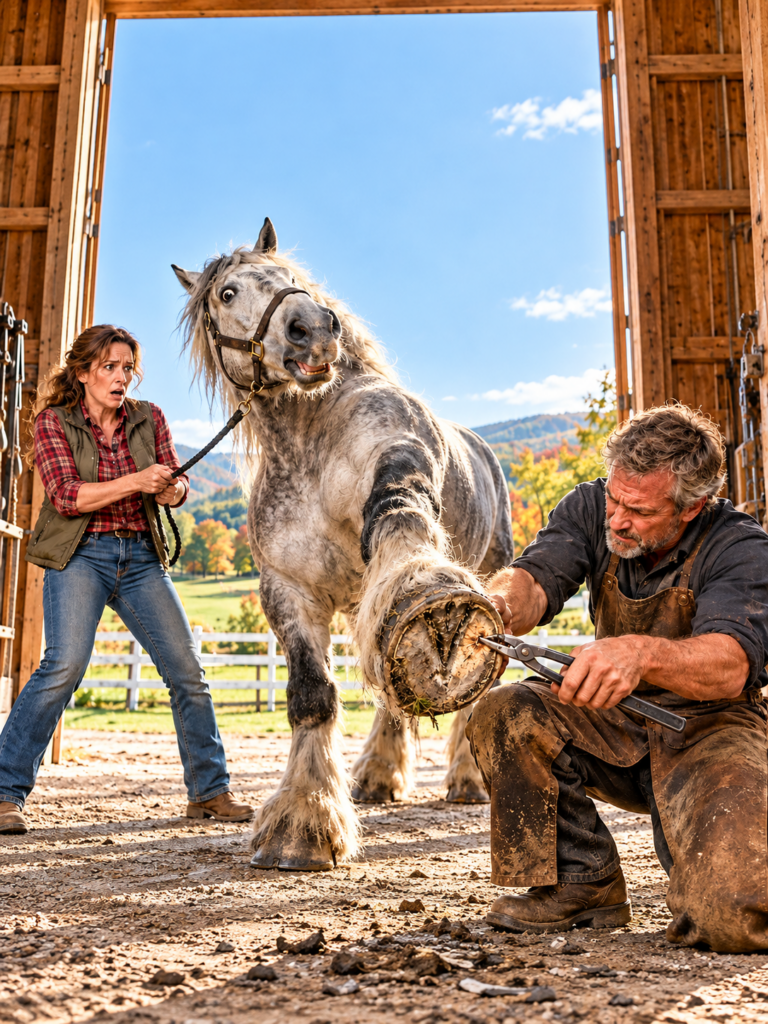
He was twelve years old, nearly nineteen hundred pounds, and the color of river stone after a long rain. Lighter gray markings spread across his shoulders and neck, while his legs looked as thick and solid as fence posts.
He should have been an impressive sight.
Instead, every step seemed to require a private decision.
When the handler led him toward the exit, Slate approached a section of steel plating set into the ground near the gate.
He stopped.
The handler tightened the rope.
Slate raised his left front hoof and held it suspended, refusing to place it on the metal.
“Come on, big fellow,” the handler muttered.
The horse stood rigid.
Mara stepped forward.
“Let me take him.”
She accepted the rope, loosened the pressure, and waited.
Slate lowered his foot onto the dirt beside the plate, but when she asked him to move toward the metal again, he stiffened.
Mara studied his face.
His ears were alert, his nostrils slightly widened. There was no attempt to kick, bite, or pull away.
He simply would not move forward.
She led him around the steel.
He followed.
It was a small detail, easily overlooked in the noise of an auction barn.
Mara carried it with her all the way to the trailer.
Loading Slate took forty minutes.
The old stock trailer had belonged to her husband, Daniel. He had bought it secondhand years earlier because it was large enough to accommodate their draft horses.
Mara backed it into position and lowered the aluminum ramp.
Slate walked to the bottom.
And stopped.
A yard worker watched her struggle for several minutes before approaching with a length of rope and a buggy whip.
“Want some help getting him moving?”
Mara glanced at what he was holding.
“No, thank you.”
“He’ll stand there all afternoon if you let him.”
“Then we’ll stand here a while.”
The worker shrugged and left.
Mara remained beside Slate, giving him time to investigate the ramp. Every few minutes she asked for a step, never enough to make him panic.
Eventually, he lifted one heavy hoof onto the aluminum.
Then another.
The left front came last.
When he finally entered the trailer, he placed that foot down as cautiously as a man testing ice over deep water.
Mara secured him, checked the partitions, and closed the ramp.
She stood for a moment with one hand against the trailer wall.
She had just spent two hundred dollars she couldn’t comfortably spare on an animal that might never earn back a cent.
And she had no idea what was wrong with him.
The drive home took her north through the Catoctin foothills.
Late-summer corn stood drying in the fields. Roadside produce stands displayed the first apples of the season. Beyond the narrow roads, low mountains rose in hazy blue layers.
Winslow Orchard occupied fourteen acres at the end of a gravel lane, its trees descending in two long rows toward a creek at the bottom of the property.
It wasn’t a large operation.
But it was hers.
Or, more accurately, it was what remained of the life she and Daniel had built together.
For eleven years, their barn had housed two draft horses.
Every autumn, Daniel had harnessed one of them to the family wagon and driven visitors through the orchard. Children perched on the wooden benches, pointing toward the trees. Parents bought apples and cider after the rides.
The wagon tours had never made them wealthy.
They had paid for repairs, extra equipment, and the little expenses that could make the difference between surviving another year and falling behind.
Then Daniel became ill.
The tours stopped first.
The last horse was sold the following spring.
And three years earlier, Daniel had died at fifty-two.
Mara was forty-four now.
She ran the orchard alone.
The apple harvest covered the mortgage when the weather cooperated. It left little for anything else.
That morning, before leaving for the auction, she had cleaned the largest box stall and laid down fresh bedding.
She had told herself she was merely preparing for the possibility of bringing a horse home.
Now, watching Slate slowly step off the trailer, she wondered whether some part of her had made the decision before she ever entered the sale barn.
She led him inside, filled his water bucket, and brought fresh hay.
Slate ate readily.
That encouraged her.
But when he tried to turn toward the water, he avoided pivoting on his left front foot. Instead, he made an awkward, wide movement, shifting his weight until he could reach the bucket without putting pressure on the leg.
Mara noticed.
She noticed everything now.
After settling him, she walked into the equipment shed.
Daniel’s wagon stood beneath a faded blue tarp.
She pulled back one corner.
Dust lay across the wooden boards. The driver’s seat was worn smooth where Daniel had sat through years of autumn afternoons, guiding horses along the orchard paths.
Mara touched the leather.
For a moment, she could almost hear the familiar sound of wheels moving over packed earth and Daniel calling back to children who wanted the horses to go faster.
Then she lowered the tarp again.
She had not bought Slate because she believed he could replace Daniel.
Nothing could do that.
But she had spent three years watching the life they had built grow smaller, one necessity at a time.
She wasn’t ready to surrender another piece of it without trying.
That evening, Mara sat at the kitchen table with her farm ledger open.
An estimate for repairing the equipment shed roof remained clipped inside the cover.
Winter hay occupied its own line.
So did feed, fuel, mortgage payments, and orchard supplies.
She added another entry.
Slate — $200.
Below it, she wrote Veterinary treatment.
Then she left the amount blank.
The empty space troubled her more than any number she might have written.
She picked up her phone and called Caleb Roark.
Caleb had worked as a farrier around Frederick County for thirty years. He knew heavy horses, difficult feet, and owners who sometimes expected an animal to work long after it should have been allowed to rest.
He could come Thursday morning.
That night, Mara lay awake listening to Slate through the open bedroom window.
The barn carried sound easily in the quiet.
Every few minutes came the scrape of a hoof, the dull shifting of weight, then another restless movement.
She had heard exhausted horses settle for the night.
Slate didn’t settle.
He seemed unable to find a position that didn’t hurt.
Thursday arrived cool and gray.
Caleb drove up the lane at seven, his truck carrying an assortment of worn tools and an old steel toolbox.
He stepped out, greeted Mara, and followed her into the barn.
Slate stood near the stall door.
The moment Caleb saw him, he stopped.
It lasted only a second.
But Mara noticed the change in his expression.
“You’ve seen him before,” she said.
Caleb didn’t answer immediately.
Instead, he placed his toolbox on the ground.
“Walk him for me. Somewhere level.”
Mara led Slate along the barn aisle and back.
Caleb watched without speaking.
“Again.”
She repeated the walk.
This time, Caleb crouched beside the left front leg and placed his palm against the hoof.
Then he pressed two fingers near the back of the fetlock.
“Foot’s hot,” he said. “And that digital pulse is stronger than it ought to be.”
He lifted the hoof carefully.
Mara stood beside him.
From this angle, she could see what had bothered her at the auction.
The shoe looked recently fitted, but the nails along the outer edge were unevenly positioned.
Caleb ran a thumb over one nail head.
His face tightened.
He reached into the toolbox and removed a pair of hoof testers.
The instrument resembled a large pair of steel pincers. He positioned it against the hoof, applied gentle pressure, released, and moved to another spot.
Slate tolerated the examination.
Until Caleb reached the outer edge of the sole.
He closed the testers near one particular nail.
Slate tore his foot away.
The hoof stand scraped violently across the concrete. The enormous horse threw his head up, backed against the wall, and strained against the rope.
Mara grabbed the lead and spoke softly.
“Easy, boy. You’re all right. Nobody’s going to make you do that again.”
Caleb stepped back.
For several seconds, the barn was filled with the sound of Slate’s breathing.
“Is it serious?” Mara asked.
Caleb looked down at the testers.
“I don’t know yet.”
“But you found something.”
“I found where it hurts. That’s not the same thing as knowing everything that’s wrong.”
He examined the rest of the hoof without pressing the sensitive spot again.
Then he looked at the new shoe.
“Who put this on?”
“I don’t know. I bought him Tuesday. Graham Weatherby brought him to the sale.”
Caleb carefully lowered Slate’s foot.
He had gone very still.
Mara watched him.
“You knew this horse when you walked in.”
Caleb wiped his hands against his jeans.
“I’ve done work out at Weatherby’s.”
“Then tell me what you know.”
“I don’t talk about a client’s horses based on guesses.”
“I’m not asking you to guess.”
He met her eyes.
“Not yet, Mara.”
She wanted to press him.
But she had a horse standing in front of her who needed help more urgently than she needed an explanation.
Caleb put the testers away.
“I want a veterinarian to look at this before I pull that shoe. If there’s something going on deeper inside the foot, we need to know what we’re dealing with.”
Mara thought about the ledger.
The roof estimate.
The thin margin between one season and the next.
“Could it be permanent?”
“Could be several things,” Caleb replied. “But that reaction was mighty specific.”
He closed the toolbox.
“Maybe you didn’t buy a ruined horse. Maybe you bought one that needs somebody to figure out why he’s hurting.”
After Caleb left, Mara called Dr. Laurel Finch.
Laurel arrived the following morning with a portable X-ray machine.
Caleb returned to assist.
The veterinarian spent time observing Slate before examining him. She checked the leg, watched him walk, and used the hoof testers on several areas of the sole.
At the same outer spot, Slate jerked his foot away.
Laurel released the pressure immediately.
“That’s a very localized pain response,” she said.
Mara watched her face.
“What does that mean?”
“It means the pain seems concentrated in one place. That’s not what I’d expect if the whole front end were chronically damaged the way you were told.”
She took radiographs from three angles.
Mara stood beside her as the images appeared on the tablet.
Laurel studied each one carefully.
“No fracture,” she said. “Nothing obvious in the coffin bone. That doesn’t rule out every possible problem, but it’s encouraging.”
Caleb began removing the shoe.
He worked slowly, extracting the nails one at a time.
When the nail nearest the painful area came free, he handed it to Laurel.
She turned it in her fingers.
Then she examined the hole it had left.
Mara could see the change in both their expressions.
“What is it?”
Laurel didn’t answer immediately.
She cleaned the area near the white line and carefully explored the affected portion of the sole.
A small amount of dark gray fluid suddenly escaped.
The unpleasant smell reached Mara a moment later.
Slate exhaled deeply.
His head lowered.
And for the first time since Mara had purchased him, he shifted his full weight onto his left front foot.
Laurel looked up.
“An abscess.”
Mara stared at her.
“That’s what’s been hurting him?”
“At least a major part of it. And fortunately, this one appears shallow.”
She indicated the nail and the surrounding hoof wall.
“This nail was placed too close to sensitive tissue. That can cause substantial pain and can contribute to an abscess like this.”
Mara looked at Slate.
The big gelding stood quietly, his weight distributed more evenly than she had seen since the auction.
“A nail did all that?”
“A horse this size puts tremendous force through his feet. If every step hurts, it doesn’t take long for ordinary movement to become something he wants to avoid.”
Mara remembered the auction gate.
The steel plate.
The trailer ramp.
Graham’s confident insistence that the horse was simply stubborn.
“Can you tell who put that shoe on him?”
“No,” Laurel said. “And I can’t tell you exactly how the problem started or whether anyone meant to cause it. I can only tell you what the examination shows.”
She traced a finger along the outer hoof wall.
“This part is also thinner than I’d like. He’ll need careful shoeing going forward.”
Caleb nodded.
He said nothing.
Mara watched him for a moment, wondering what he knew and why he was still holding it back.
“Will Slate walk normally again?” she asked.
Laurel gave her a measured look.
“There’s good reason to hope he will. But being comfortable enough to walk and being ready to work are different things.”
“So he isn’t crippled?”
“Right now, I haven’t found evidence to justify calling him that.”
Those words settled into Mara more deeply than she expected.
For the first time since handing over two hundred dollars, she allowed herself to imagine Slate walking through the orchard without pain.
Laurel treated the abscess, dressed the hoof, and explained the recovery plan.
Slate would need soaking, poultices, protective wrapping, a hoof boot, and rest.
There would be a follow-up examination in a week.
If the pain returned, Mara was to call immediately.
No pulling wagons.
No rushing his recovery.
By the time the veterinarian and farrier drove away, Slate was resting quietly in his stall.
Mara sat on an overturned bucket outside the door.
The old shoe lay on a rag beside her.
She turned it over.
One badly placed nail had caused suffering serious enough for an experienced horse dealer to dismiss the animal as worthless.
But removing that nail was not going to remove the financial consequences.
Laurel’s invoice arrived that evening.
Between the farm call, X-rays, treatment, and supplies, the total ran into four figures.
Most of Mara’s money for repairing the shed roof disappeared at once.
Then came bandages, poultice pads, extra hay, the protective boot, and Caleb’s bill.
Graham had been right about one thing.
The horse’s purchase price was the cheapest part of owning him.
That Saturday, Mara stopped at the feed store in Thurmont.
She was loading hay into the back of her truck when Graham emerged from the office carrying a receipt.
He recognized her immediately.
“Well, if it isn’t Mrs. Winslow.”
Mara continued stacking the bales.
“How’s that two-hundred-dollar horse treating you?”
“He’s being treated.”
Graham leaned against a post.
“So how much have you spent on him now?”
“More than two hundred.”
He smiled.
“Told you.”
Then he walked away.
Mara stood with one hand against a bale, watching him climb into his truck.
He hadn’t asked what was wrong with Slate.
He hadn’t asked whether the horse was comfortable.
He hadn’t even asked whether he was still alive.
She finished loading the hay and drove home.
Over the following days, Slate began to improve.
At the end of the first week, he could walk into his stall without the sharp hitch in his stride.
During the second week, Laurel permitted brief, controlled movement in the small pen behind the barn.
Mara followed her instructions carefully.
She allowed only a few minutes at a time.
Slate began to move more freely, though his left hoof remained protected.
One afternoon, a truck pulled into the yard with a delivery of hay.
The driver was Hollis Tate, a horse trader who also hauled feed for farms around the region.
Mara recognized him from the auction.
He had been the man who asked Graham about the missing veterinary records.
Hollis leaned against the paddock fence and watched Slate walk across the small enclosure.
“Doesn’t look much like a finished horse now,” he said.
“He’s recovering.”
“Looks good for what you paid.”
Mara made no answer.
Hollis considered the gelding for another moment.
“I’ll give you fifteen hundred dollars cash for him.”
She turned.
“Fifteen hundred?”
“There’s a logging outfit up in Pennsylvania looking for a big horse. If he’s coming sound, I could place him.”
The amount caught Mara off guard.
Fifteen hundred dollars would pay for the shed roof.
It would fill the hayloft for winter.
It would give her a little breathing room before the remaining orchard bills came due.
For several seconds, she could almost feel the relief of putting that money into the bank.
“When would they start working him?” she asked.
“Soon as he comes off the trailer, most likely.”
Mara looked toward Slate.
The protective boot was still secured around his left front hoof.
He had only recently begun to walk without pain.
“No,” she said.
Hollis raised his eyebrows.
“That’s a good profit on a two-hundred-dollar horse.”
“I know.”
“Offer won’t stay forever.”
“I understand.”
He studied her, then shrugged.
“Your horse.”
After he left, Mara stood beside the fence for a long time.
It would have been easy to call herself foolish.
The orchard needed repairs. Winter was approaching. She had no guarantee Slate would ever work again.
But she knew what would happen if she sent him away before he recovered.
He would be expected to earn his keep immediately, and the damage might start all over again.
She couldn’t do that.
Instead, she sold the old hay rake Daniel had stopped using years earlier.
She postponed the roof repair until spring.
And she stopped paying the neighbor’s boy for orchard jobs she could safely manage herself.
The work became harder.
The money remained tight.
But each morning, Slate looked a little more comfortable.
At his next examination, Laurel applied the hoof testers without producing more than a mild flick of his ear.
The veterinarian seemed pleased.
Then she gave Mara a warning.
“If you put him back to work too early because you need to recover what you’ve spent, you may end up paying for his treatment twice.”
Mara nodded.
“I understand.”
“I’m serious.”
“So am I.”
Several mornings later, Mara entered the barn carrying hay.
Slate was waiting at the stall door.
His ears were forward.
He stood squarely on all four legs, without the restless shifting that had filled her first nights with worry.
Mara stopped in the aisle.
She watched him for a moment before setting the hay down.
For the first time since the auction, she wasn’t thinking about whether he would ever pull a wagon.
She was simply glad to see him standing comfortably.
And that small victory made every difficult decision feel different.
She still didn’t know whether Slate had a future as a working horse.
But she knew he had deserved a chance to recover before anyone pronounced him finished.
What Mara didn’t yet realize was that Graham Weatherby had reasons of his own to regret selling her that horse.
And those reasons were about to become much harder for him to hide.
Part 2
By early September, three weeks after the abscess had been opened, Slate was moving well enough for Laurel to approve light groundwork.
It was not permission to return to ordinary labor.
His left front hoof still needed protection, and the thin outer wall would require careful attention for the foreseeable future.
Caleb arrived with a new shoe and spent far longer fitting it than Mara expected.
He measured, adjusted, and examined the hoof from different angles before setting each nail.
“There’s no sense getting in a hurry with a foot like this,” he told her.
Mara watched him work.
She was beginning to understand that the difference between careful treatment and careless treatment could be measured in fractions of an inch.
When Caleb finished, Slate stood quietly as Mara led him through the barn aisle.
He walked without the obvious limp that had once accompanied every step.
But Mara knew better than to assume the problem was completely behind them.
She began his training with the simplest commands.
Walk beside her.
Stop when asked.
Turn slowly.
Stand still while she handled the harness.
Slate remembered everything.
He moved with the quiet understanding of a horse that had once been thoroughly trained by someone who knew what they were doing.
He responded to her voice, waited at the end of the lead rope, and allowed her to place the old collar against his shoulders without resistance.
There was nothing wild or unpredictable about him.
When he understood what Mara wanted and felt comfortable enough to do it, he complied.
That discovery made Graham’s description of him seem increasingly strange.
A horse that fought everybody.
A horse too stubborn to work.
A horse that couldn’t be trusted near a trailer or harness.
Mara had seen fear in Slate.
She had seen pain.
She had not yet seen the dangerous behavior Graham had described so confidently.
Still, one obstacle remained.
The trailer.
And Mara needed him to load.
The Catoctin Harvest Festival was approaching in October. Among its attractions was a traditional farm transportation showcase, where local operators could demonstrate horses, wagons, and carriages.
A place in that showcase could mean renewed interest in orchard wagon rides.
Those rides had once helped keep Winslow Orchard financially stable.
Mara knew she couldn’t rebuild that part of the business overnight, but a successful appearance might bring enough customers to help with the winter expenses.
Applications closed in two weeks.
If she wanted even a chance, she had to begin preparing.
One afternoon, she backed Daniel’s old trailer against the level section of ground near the barn and lowered the ramp.
Slate followed her willingly until his front feet reached the bottom.
Then he stopped.
Mara gave a gentle signal.
Nothing.
She stepped backward, increasing the pressure slightly.
Slate raised his head.
His neck stiffened, and his feet planted themselves firmly in the dirt.
For an instant, irritation flashed through Mara.
He was no longer limping. Laurel had found no continuing evidence of serious damage. Surely he could take one more step.
She tightened her grip.
Then she remembered Graham’s voice at the auction.
He fights the trailer.
Mara looked at Slate again.
The big gray horse wasn’t trying to escape.
He was staring at the narrow strip of bare aluminum where the ramp met the ground.
She loosened the rope.
“I’m asking the wrong question, aren’t I?”
Slate lowered his head slightly.
Mara led him away in a wide circle.
When they returned, she paid attention to the exact moment his movement changed.
He approached the ramp readily.
He extended his front foot.
And just before touching the aluminum, he withdrew it.
Not because he couldn’t understand the command.
Because he didn’t trust the surface.
She called Laurel.
The veterinarian examined the hoof that evening and found no return of the abscess pain.
“Whatever he’s reacting to,” Laurel said, “I don’t see evidence that this foot is hurting him now.”
Mara looked toward the trailer.
“Then maybe he remembers when it did.”
Laurel considered that.
“It’s possible he’s learned to expect discomfort around certain surfaces. We can’t know exactly what’s going through his mind, but we can work with what he’s showing us.”
Mara changed the approach.
She moved the trailer against a small rise, reducing the ramp’s angle until it was almost level.
Then she covered the aluminum with thick rubber stall mats, including the exposed metal lip at the bottom.
Every evening, after finishing her orchard work, she brought Slate to the trailer.
Some days, he merely approached it.
Other days, he lowered his head to investigate the rubber.
Mara didn’t drag him forward or punish him for stopping.
She asked for whatever small movement he was comfortable making and ended the session before his anxiety became overwhelming.
There were evenings when she felt foolish standing in the fading light beside a horse that weighed almost a ton, waiting for him to place one foot on a rubber mat.
But she kept returning.
On the ninth evening, Slate walked forward and placed both front feet onto the covered ramp.
He stayed there.
Mara felt an almost irresistible urge to ask for another step.
She resisted.
Instead, she stroked his neck.
“That’s enough for today.”
She led him away.
For the first time, the trailer had become something other than a contest between them.
It was a small beginning.
But Mara had learned that small beginnings were often the only ones that lasted.
In mid-September, she submitted her festival application.
She did not exaggerate Slate’s condition.
The paperwork explained that he was recovering from a hoof injury, had not yet been cleared to carry passengers, and could participate only after veterinary approval and a satisfactory safety evaluation.
Two days later, the showcase coordinator, Denise Harper, called.
Denise explained that Mara’s application could be considered conditionally.
She would need updated veterinary documentation and proof that Slate could perform the required work safely.
Mara agreed.
For the first time in years, she began imagining Daniel’s wagon moving through the orchard again.
Five days later, Denise called back.
Mara was in the packing shed sorting the first Honeycrisp apples when her phone rang.
“Mrs. Winslow, I’m afraid your application has been placed on hold.”
Mara set an apple down.
“Why?”
“We’ve received an objection concerning the horse.”
“From whom?”
There was a brief pause.
“Graham Weatherby.”
Mara looked toward the barn through the open shed door.
Denise continued.
“He’s raised concerns about a chronic medical condition and a history of unsafe behavior.”
“Did he provide veterinary records?”
“Not with the letter.”
“Would you send me what you’re allowed to share?”
Denise agreed.
A few minutes later, Mara opened the email on her phone.
Graham’s letter was written on Weatherby Heritage Carriages letterhead.
It described Slate as a horse with a diagnosed chronic condition affecting his front end. It claimed he had demonstrated dangerous resistance around trailers and while working in harness.
It also questioned Mara’s judgment for purchasing an animal that other buyers had refused to take.
Mara read the document twice.
Then a third time.
The word that troubled her most was diagnosed.
Graham had never presented veterinary evidence of a chronic condition at the auction.
Now he was using the language of a medical diagnosis to argue that Slate should be excluded from a public event.
Mara opened the festival’s vendor information.
There, among the featured participants, was Weatherby Heritage Carriages.
Graham’s company was scheduled to provide carriage services.
Mara sat very still.
The objection might have been framed as a safety concern, but Graham also had a commercial interest in the event.
That didn’t automatically make every concern he raised false.
It did mean he wasn’t a disinterested observer.
She called Denise.
“If my veterinarian clears Slate, will you let him demonstrate what he can safely do?”
Denise answered carefully.
“We’ll need to evaluate him in person. I can’t approve an animal simply because his owner believes in him.”
“I wouldn’t ask you to.”
“We have to consider the safety of everyone involved.”
“I understand.”
After the call ended, Mara stared at the paperwork spread across the packing table.
She couldn’t answer Graham’s accusations with anger.
She needed records.
She needed evidence.
And she needed to know what had happened before the auction.
Her thoughts returned to Caleb standing in the barn aisle with the hoof testers in his hand.
The way his expression had changed when he saw Slate.
The way he’d refused to explain what he knew.
Mara picked up her truck keys.
Caleb’s workshop stood behind his house outside Thurmont.
Shelves lined the walls, crowded with horseshoes, rasps, nails, and tools collected over decades of work.
Several large binders sat above the workbench, their spines marked with dates.
Caleb was sorting equipment when Mara arrived.
She handed him her phone.
“Read this.”
He studied Graham’s letter without speaking.
When he finished, he returned the phone.
“You recognized Slate the first morning you came to my barn,” Mara said.
Caleb nodded.
“Yes.”
“Why didn’t you tell me?”
He looked toward the shelves.
“Because knowing a horse has been somewhere isn’t the same thing as knowing what happened to him. A farrier who starts making accusations about his clients without proof won’t be working long.”
“And now?”
Caleb pointed to the letter.
“Now somebody’s calling something a diagnosis when I never knew that horse to have one.”
Mara waited.
Caleb reached for a binder marked August.
He opened it and turned several pages.
Then he placed it on the workbench between them.
The entry was dated August second.
Weatherby Heritage Carriages.
Among the horses listed for attention was a gray Percheron gelding named Slate.
Caleb’s handwritten notes identified a thin area along the outside of the left front hoof wall.
They recommended caution during any reset and warned that if the horse became sore or lame, work should stop until a veterinarian could examine him.
Beneath the notes were two words.
Reset declined.
Mara looked up.
“You refused to shoe him?”
“That day, yes.”
“Why?”
“Graham wanted all six horses taken care of before a wedding job that weekend. I didn’t like the condition of Slate’s outer wall. Told him I wasn’t comfortable putting nails in it.”
“What did he say?”
Caleb took out his phone.
He found an old message and held it where she could read it.
Graham had written that he had found someone else to handle the work because the wedding couldn’t be canceled.
Mara stared at the screen.
“Do you know who did it?”
“No.”
“Can you tell whether that person put the nail in the wrong place?”
“No. I didn’t see the shoeing.”
Caleb spoke firmly.
“And I won’t accuse somebody of doing something I didn’t witness.”
Mara nodded slowly.
“But you warned Graham about that foot.”
“Yes.”
“And he decided to have the horse shod elsewhere.”
“That’s what the records show.”
Caleb rested both hands against the workbench.
“There’s something else. Graham’s shoeing area has steel flooring. Makes it easier to wash down.”
Mara looked at him.
“Steel?”
“Plate flooring. Horses stand on it regularly.”
She remembered Slate refusing to cross the metal at the auction gate.
The aluminum lip of the trailer ramp.
The way he’d held his painful foot above those surfaces.
An explanation began taking shape.
A horse with a developing abscess, expected to stand and move across hard metal flooring, might have learned that certain surfaces meant pain.
Even after the immediate cause was treated, the memory of that pain could remain.
She couldn’t prove every part of what had happened.
But the pattern was no longer invisible.
Caleb’s records established something important.
Before Graham sold Slate, he had received a warning that the horse’s hoof required caution and that lameness should lead to veterinary examination.
Yet at the auction, Graham had described the horse as chronically unsound without producing a single veterinary report.
Now he was repeating that claim in writing.
Mara felt anger rise through her.
Not because Graham had sold her a horse for two hundred dollars.
He had been entitled to sell him.
Not because the horse had developed an abscess.
Complications could occur even when people tried to do things properly.
What angered her was the speed with which Slate had been dismissed.
The horse had been hurting.
Someone had identified a reason to be careful.
And instead of establishing what was wrong, Graham had decided the animal was finished.
Caleb closed the binder.
“I’ll write a statement,” he said.
Mara looked at him.
“About what?”
“What I examined. What I warned them about. Why I declined the reset. And what Graham sent back. Nothing I can’t support.”
He made a copy of the work ticket.
Mara held it carefully.
For the first time, she possessed something more substantial than her own judgment.
Something Graham couldn’t dismiss with a laugh at the feed store.
A few days later, Laurel returned to Winslow Orchard for another evaluation.
She watched Slate walk and trot on firm, level ground.
She had him turn in both directions.
She examined the hoof and applied the testers.
Slate showed no significant pain response.
Laurel completed a written report.
She was comfortable permitting light work, short drives, and flat routes, provided the workload remained carefully controlled.
No heavy pulling.
No prolonged strain.
The left front hoof would require inspection after every session.
Mara accepted the restrictions without argument.
She wasn’t trying to prove Slate could do everything Graham had once demanded of him.
She wanted to establish what he could do safely.
That evening, she uncovered Daniel’s wagon.
The tarp came away in a cloud of dust.
Mara stood looking at the familiar wooden body, the narrow wheels, and the old driver’s seat.
She had spent years walking past it without touching it.
Now she rolled up her sleeves and began inspecting it.
She greased the wheel bearings, examined the shafts, checked the brake, and looked closely at every area where wear or cracking might create a problem.
She spread the harness across the workbench.
Every buckle was inspected.
Every leather strap was examined for weakness.
The collar needed to fit without rubbing.
Nothing would be left to chance simply because the equipment had once belonged to Daniel.
When everything was ready, Mara brought Slate into the level field below the orchard.
She placed the harness on him.
He stood calmly.
She attached the wagon.
Again, he waited.
The first time Mara climbed into the driver’s seat, she sat without asking him to move.
The leather beneath her felt familiar and strange at the same time.
She remembered watching Daniel settle into that seat, gather the lines, and speak to the horses as though they were old friends.
For a moment, grief rose so unexpectedly that she had to look down.
Then Slate turned one ear toward her.
Mara gathered the lines gently.
“Walk on.”
Slate leaned into his collar.
The wagon moved.
Only a short distance.
A hundred yards across the field.
But Mara felt every rotation of the wheels.
The next day, they traveled two hundred yards.
Then a little farther.
Over the following ten days, they practiced short, level routes.
Slate stopped when asked, turned carefully, and waited while Mara climbed down.
At one section where the grass track met hard gravel, he hesitated.
Mara gave him room.
He examined the ground, lowered his head, and eventually walked forward.
No argument.
No punishment.
Just time.
After every practice session, Mara examined his left front hoof.
She checked for heat, tenderness, changes in movement, or anything suggesting the work was too much.
Then she wrote down what she observed.
By the end of September, she had assembled her documentation.
Laurel’s veterinary report.
Caleb’s signed statement.
The August work ticket.
The records of Slate’s recovery.
The wagon and harness inspection details.
A carefully planned route.
And one additional provision.
If any part of the proposed route appeared unsafe, she wanted permission to use a flatter alternative.
Denise reviewed everything.
Two days later, she called.
“The assessments will be held the first Saturday in October. Eight in the morning at the fairgrounds.”
Mara gripped the phone.
“So we’re allowed to attend?”
“For an assessment,” Denise emphasized. “Approval will depend on what I see, not on who tells the better story.”
“That’s fair.”
“And Mrs. Winslow?”
“Yes?”
“Mr. Weatherby will be there. His horses have their own vendor inspection.”
Mara glanced through the kitchen window toward Slate’s stall.
“I expected he might be.”
After the call, she walked out to the barn.
Slate was resting quietly.
She stood beside him and thought about the coming Saturday.
Seven weeks of veterinary appointments, careful recovery, expenses, paperwork, and evening training would come down to one public evaluation.
There would be people watching.
There would be unfamiliar surroundings.
And Graham Weatherby would have another opportunity to argue that Slate was dangerous and unfit for work.
Mara placed a hand against the gelding’s neck.
“If you’re not ready, we stop,” she told him.
She meant it.
She could sell apples from a folding table at the festival if she had to.
She could take the wagon home.
Losing an opportunity would hurt.
Hurting Slate to win an argument would be worse.
On the morning of the assessment, Mara loaded the equipment before sunrise.
The air had turned cold enough to make her breath visible beneath the yard light.
Slate approached the rubber-covered ramp.
He paused, studied it, and stepped forward.
This time, he entered the trailer without a struggle.
Mara secured him and closed the ramp.
Then she stood for a moment in the dark.
Graham had once laughed at her for buying a horse that supposedly couldn’t pull an empty wagon.
Now she was taking that same horse to the fairgrounds.
And for the first time, Graham would have to defend his judgment against something more than his own reputation.
Part 3
The fairgrounds lay in a shallow valley beyond town, surrounded by wooded hills just beginning to show the first colors of autumn.
The grass was wet with dew.
Trailers lined the far fence.
Volunteers moved between temporary stalls and equipment areas carrying clipboards and stacks of paperwork.
Near the main field stood three polished black carriages.
Gold lettering on their doors read Weatherby Heritage Carriages.
Mara recognized them immediately.
She parked her trailer in the designated area and lowered the ramp.
Slate stood at the top, looking out over the unfamiliar surroundings.
Horses called to one another.
Metal gates rattled.
Somewhere near the vendor tents, an engine started.
Mara loosened the lead rope.
“Take your time.”
Slate stepped down carefully.
When all four feet reached the ground, Mara placed a hand against his shoulder and waited until his breathing settled.
Caleb arrived a few minutes later.
Laurel was already near the examination area.
Both had come to observe and assist within their professional roles.
Mara was grateful for their presence, though she knew neither could make Slate perform safely if he wasn’t ready.
Across the field, Graham stood talking with Denise.
He turned when he saw the gray gelding.
For an instant, surprise crossed his face.
Then his mouth tightened.
He said something to Denise and looked back toward Mara.
She couldn’t hear the words.
She didn’t need to.
Denise approached carrying a clipboard.
“Good morning, Mrs. Winslow.”
“Morning.”
“Slate looks comfortable.”
“He’s been doing well.”
“We’ll start with health documentation and equipment inspection. Then handling on foot. After that, we’ll decide whether to proceed with the driving portion.”
Mara nodded.
Denise unfolded a route map.
They would begin with an inspection walk along the main lane between the barns.
The route appeared straightforward.
Until they reached a drainage grate set across the gravel.
It was approximately four feet wide.
The steel bars were dark with morning moisture.
Slate saw it before Mara reached it.
His head rose.
His ears fixed on the metal.
Then he stopped.
The change was immediate.
His neck stiffened, and he shifted his weight away from his left front foot.
Mara felt the tension travel through the lead rope.
She stopped beside him.
Graham had been following the inspection from a short distance.
He didn’t miss the moment.
“There,” he said loudly. “That’s exactly what I’m talking about.”
Several people turned.
Graham stepped closer to Denise.
“You see? He won’t even walk through a simple lane. Imagine putting him near a crowd.”
Mara kept her eyes on Slate.
The horse stood rigidly, staring at the grate.
He wasn’t pulling backward.
He wasn’t charging forward.
He wasn’t threatening anyone.
He simply refused to place a foot on the steel.
Mara loosened the rope.
“Easy, boy.”
Graham shook his head.
“That’s what he did when I had him. You can’t trust a horse that refuses to move.”
Mara looked toward Denise.
“He hasn’t done anything dangerous. He’s stopped because he doesn’t want to cross that surface.”
“And what are you going to do about it?” Graham demanded.
Mara ignored him.
She pointed toward the map in Denise’s hand.
“The alternative path I submitted avoids this grate. Would you allow us to use it?”
Denise checked her clipboard.
“The flat route around the far side?”
“Yes.”
“That’s an approved option.”
“Then I’d like to take it.”
Denise studied Slate for a moment.
“All right.”
Mara asked the gelding to turn.
He responded slowly, moving away from the grate without pulling against her.
As soon as they reached ordinary gravel, the tension began leaving his body.
His head lowered.
His stride became easier.
Mara didn’t look back at Graham.
She could feel his frustration without seeing it.
On the test field, Caleb helped inspect the harness and wagon one final time.
He checked the collar’s fit, the traces, the wheel nuts, and the places where the leather might rub.
Laurel observed Slate’s movement.
Denise examined the equipment and reviewed the safety procedures.
Nothing was hurried.
Mara worked Slate on the ground first.
He walked.
Stopped.
Turned.
Waited.
Then she attached the wagon and asked him to move a short distance while it was empty.
The wheels followed quietly.
Slate showed no sign of panic at the movement or sound behind him.
Denise watched carefully.
At last, she nodded.
“You can proceed with the controlled drive.”
Mara climbed into Daniel’s seat.
Caleb took the place beside her as the single experienced adult permitted aboard for the test.
There were no passengers.
No children.
No unnecessary weight.
Only a short, level route under observation.
Mara gathered the lines.
She could hear the faint jingle of harness fittings.
Slate stood waiting.
She looked across the field.
Graham was standing beside one of his carriages.
Denise held her clipboard.
Laurel waited near the route with her medical bag.
Mara turned her attention back to the horse.
“Walk on, Slate.”
The gelding stepped forward.
The wagon rolled.
There was no sudden burst of strength.
No dramatic acceleration.
Nothing that would have impressed a crowd looking for spectacle.
Slate simply walked.
His shoulders moved steadily beneath the collar. His feet found their rhythm on the firm ground.
Mara kept the lines soft.
At the first turn, she gave him enough room to bring the wagon around without strain.
He slowed naturally, shifted his path, and guided the wheels through the curve.
Mara could feel the familiar movement of the wagon beneath her.
For an instant, she remembered Daniel beside her years earlier, explaining how much easier driving became when the horse trusted the person holding the lines.
Then the moment passed.
She focused on Slate.
They continued along the field edge.
At the designated marker, Mara gave the command.
“Whoa.”
Slate stopped.
The wagon settled behind him.
He remained standing, quiet and attentive.
Mara looked toward Denise.
The coordinator wrote something on her clipboard.
She didn’t smile or offer encouragement.
She simply recorded what she had seen.
And that was exactly what Mara wanted.
When the test ended, Mara climbed down.
Laurel immediately examined Slate.
She watched him walk and trot, checked his left front hoof, and used the testers to look for any return of pain.
Slate tolerated the examination calmly.
Denise approached.
“Doctor, based on what you’ve examined and what you saw today, do you have any reason to believe this horse can’t perform light work within the restrictions you’ve provided?”
Laurel answered without hesitation.
“Not based on my examinations or today’s performance. But his workload must remain controlled, and that hoof needs ongoing monitoring.”
Denise nodded.
Mara stood beside Slate, holding the lead.
She knew the drive had gone well.
She also knew one successful morning didn’t mean the horse could return to unlimited work.
The old hoof injury remained something she would have to manage.
But the difference between a horse requiring sensible limitations and a horse being permanently worthless was enormous.
Graham said nothing.
Mara might have left matters there.
The required demonstration was complete.
Slate had worked safely.
Her documents supported his recovery.
But as she began unhitching the wagon, she looked toward the lane between the barns.
The steel grate remained where they had left it.
She turned to Denise.
“There’s one more thing I’d like to try.”
Denise raised an eyebrow.
“What is it?”
“I’d like to walk him back toward that grate. Just on the lead. No wagon.”
Graham turned.
“Why?”
Mara didn’t answer him.
She continued speaking to Denise.
“It’s not part of the test. If he refuses, we stop. I won’t force him.”
Denise considered the request.
Then she nodded.
“As long as you handle it safely.”
Mara led Slate toward the barn lane.
The closer they came, the more carefully the gelding watched the ground.
Several feet from the grate, she stopped.
She let the rope fall slack.
Slate stood beside her.
There was no pressure on his halter.
No whip.
No crowd urging him forward.
Mara waited.
The gelding stretched his neck.
His nostrils widened as he investigated the dark steel bars.
Then he lowered his nose until it almost touched the metal.
He blew out a long breath.
One front hoof lifted.
For an instant, Mara wondered whether he would turn away again.
Instead, Slate touched the grate.
The steel rang beneath his shoe.
He pulled the foot back slightly.
Mara remained still.
After another moment, he placed the hoof forward again.
Then he moved his other front foot.
The left one.
The hoof that had hurt so badly at the auction.
It settled onto the steel.
Slate paused.
He shifted his weight.
Nothing happened.
No sharp pain.
No sudden pressure from someone pulling on his head.
Mara breathed slowly.
The gelding took another step.
Then another.
He crossed the grate.
One enormous hoof at a time.
When he reached the other side, he stopped and turned his head slightly toward Mara.
She rested her palm against his neck.
“Good boy.”
There was no cheer from Mara.
No triumphant gesture toward Graham.
She didn’t need one.
She knew what that crossing meant.
Not that every fear had vanished.
Not that Slate would never hesitate again.
Only that a horse once unwilling to put his foot on steel had been given enough time to decide it was safe.
Mara bent and lifted the left front hoof.
It was clean.
Cool.
He held it without resistance.
She lowered it gently and led him back toward the trailer.
At the organizer’s tent, Denise had assembled the relevant records on a folding table.
Laurel’s veterinary reports.
Caleb’s signed statement.
The August work ticket.
Graham’s objection.
And Denise’s observations from the morning.
Graham stood on the opposite side of the table, his expression closed.
Denise turned to Caleb.
“Mr. Roark, would you confirm the information in your statement?”
Caleb nodded.
He explained the condition of Slate’s left front hoof wall when he examined it in August.
He confirmed that he had advised caution and recommended veterinary attention if the horse became sore.
He described declining to reset the shoe because he wasn’t comfortable placing nails in the thin wall.
Finally, he confirmed receiving Graham’s message that another farrier would handle the work.
Denise glanced toward Graham.
“Is there anything in those records you dispute?”
Graham shifted his weight.
“You don’t understand what it costs to keep a working string of horses going.”
Mara looked at him.
“I understand what it costs to look after one.”
He gave her a sharp glance.
“I had a business to run. Weddings booked. Customers expecting their transportation.”
“You had every right to make decisions about your business,” Mara said.
“Exactly.”
“And you had every right to sell Slate.”
Graham’s jaw tightened.
“Then I don’t see what you’re complaining about.”
Mara rested her hand on the table.
“You told people he had a chronic condition. You called him finished. Then you put it in writing that he’d been diagnosed.”
She glanced at the veterinary reports.
“But you haven’t produced a record supporting that diagnosis.”
Graham looked toward Caleb.
Then at Denise.
“I know horses.”
“I’m not saying you don’t,” Mara replied.
She spoke quietly.
“But knowing horses doesn’t make a medical examination unnecessary. Caleb warned you about that foot. Slate was hurting. Somebody should have checked why before deciding he couldn’t work anymore.”
Graham stared at the paperwork.
For once, he had no quick answer.
Mara didn’t accuse him of deliberately injuring the horse.
She couldn’t establish that.
She didn’t claim to know who had fitted the shoe or whether anyone had intentionally caused harm.
What she could establish was simpler.
The gelding had been sold without supporting veterinary records.
A specific source of pain had been identified and treated.
And the horse Graham described as dangerous and permanently unsound had just completed a controlled driving assessment without incident.
Denise closed the folder.
“Here’s my decision.”
Mara stood straighter.
“Mrs. Winslow and Slate will be approved for a limited place in the traditional transport showcase.”
For a moment, Mara didn’t move.
Denise continued.
“Short route. Flat ground. Controlled workload. All veterinary restrictions remain in effect. No expansion of his duties without appropriate clearance.”
Mara nodded.
“Understood.”
“As for the objection, the principal medical claims weren’t supported by the documentation provided. They won’t be grounds for excluding you.”
Across the table, Graham’s expression tightened.
But he offered no further argument.
His company would still participate.
His carriages remained part of the festival.
No one confiscated his business or publicly humiliated him with a dramatic announcement.
The consequences were quieter than that.
He had tried to use his reputation to prevent Mara and Slate from participating.
Now his assertions had been weighed against documented examinations and observed performance.
They had not been enough.
Mara gathered her papers.
She looked at Graham.
He avoided her eyes.
She didn’t ask for an apology.
An apology wouldn’t change what Slate had endured.
And she had no intention of allowing Graham’s opinion to determine what happened next.
She walked outside, where Caleb and Laurel waited near the trailer.
“Well?” Caleb asked.
Mara looked toward Slate.
“We’re in.”
Caleb smiled.
Laurel nodded approvingly.
“Within the limits.”
“Within the limits,” Mara repeated.
She meant every word.
The following Saturday, the Catoctin Harvest Festival opened beneath a bright October sky.
The air smelled of hot apple cider, kettle corn, and damp fallen leaves.
Pumpkins lined the walkways.
Children sat on hay bales, eating caramel apples while their parents wandered among the farm displays.
Near the traditional transport area, Daniel’s restored wagon stood hitched behind Slate.
Mara checked the harness again.
Then the hoof.
Then the wagon.
Caleb had inspected the shoe on schedule, and Laurel’s working restrictions remained unchanged.
Slate would pull only short distances on level ground, with sufficient rest between appearances.
There would be no attempt to impress visitors with heavy loads or long runs.
Mara climbed into the driver’s seat.
The leather felt familiar beneath her hands.
The announcer read from his card.
“Winslow Orchard, offering traditional wagon rides through the fall season.”
A few people applauded.
Slate moved forward at Mara’s quiet command.
The wagon rolled through the designated showcase route.
Along the fence, an older farmer leaned toward his wife.
“That’s the gray horse Weatherby sold at the auction back in August.”
His wife turned to look.
“The lame one?”
“Sure looks like him.”
Mara heard only fragments of their conversation as the wagon passed.
She kept her attention on Slate.
At the far end of the lot, Graham stood beside his polished carriages.
He watched the gray gelding move past.
He did not clap.
But he didn’t turn away.
For a brief moment, Mara met his eyes.
She gave him a small nod.
Then she looked ahead and continued driving.
There was nothing left to explain to him.
By the end of October, families had booked most of the remaining weekends for orchard rides.
Parents who remembered visiting Winslow Orchard years earlier brought their children back.
Others arrived after seeing Slate at the festival.
The rides were modest.
Short loops over level ground.
Controlled groups.
Plenty of rest.
Mara never asked the horse to pull beyond Laurel’s restrictions.
She inspected his left front foot after every outing and kept Caleb’s regular appointments.
The money from the rides, combined with the apple harvest, finally allowed her to repair the leaking equipment shed roof before the first hard frost.
It didn’t solve every problem.
The mortgage still had to be paid.
The orchard still demanded more hours than one person could comfortably give.
And Slate would always need attention to the thin wall of his left front hoof.
But the farm was moving forward again.
For the first time in years, the wagon was no longer hidden beneath a tarp.
Its wheels left fresh tracks through the orchard.
Children’s voices returned to the rows of apple trees.
And in the evenings, when Mara finished putting away the day’s equipment, she could look toward the barn and see the enormous gray gelding resting comfortably.
On the last Sunday of October, Mara completed the final scheduled ride of the season.
The afternoon sun hung low over the hills.
Only a few apples remained among the thinning leaves.
She brought Slate to a gentle stop near the barn and climbed down from the driver’s seat.
For the first time, she did it without thinking about Daniel’s absence.
The wagon had become part of her daily life again.
Not because the past had returned.
But because she had found a way to carry something of it into the future.
Inside the barn, she removed Slate’s harness and hung it neatly on the wall.
She brushed the dust from his shoulders.
Then she lifted each hoof in turn, checking for stones, tenderness, and signs of wear.
When she reached the left front, Slate raised it willingly.
Mara held it in her hands.
She cleaned carefully around the outer edge, near the same area where Caleb’s hoof testers had once caused such violent pain.
Two months earlier, Slate had been unable to stand comfortably on that foot.
Now he rested it in her hand without fear.
She finished cleaning, inspected the hoof, and gently set it down.
Slate shifted his weight forward.
Onto his left front foot.
And left it there.
Mara stood quietly beside him.
She remembered Graham’s face at the auction.
The laughter when she offered two hundred dollars.
The way he had spoken of Slate as though the animal were nothing more than an expense waiting to happen.
She remembered the feed store and his satisfaction at hearing how much the treatment had cost.
She remembered his letter to the festival, the confident claims, the attempt to turn his own opinion into a reason for excluding her.
And she remembered Caleb’s quiet warning.
Maybe you didn’t buy a ruined horse.
Mara rubbed Slate’s neck.
“You gave us a lot more than anybody expected, didn’t you?”
He turned his head toward her.
She smiled faintly.
The truth was that she hadn’t known what she was buying that day.
She hadn’t known whether Slate would recover.
She hadn’t known how much the veterinary treatment would cost or whether the orchard could survive another season with so little money.
She had simply seen a horse struggling to take a step and wondered what might be causing it.
That question had taken her through weeks of worry, hard decisions, and expenses she could barely manage.
It had also brought her back to a part of her life she thought was gone forever.
She didn’t need Graham to admit he had been wrong.
She didn’t need the whole town to know what had happened.
The answer was standing in front of her.
Nearly nineteen hundred pounds of gray horse, resting easily on all four feet.
Mara opened the stall door.
Slate walked inside and turned toward his hay.
She checked his water, straightened the bedding, and stepped back into the aisle.
Outside, the wagon stood in the orange light of the setting sun.
Beyond it, the last apples glowed among the branches.
Mara pulled the barn door almost closed.
Then she paused and looked back through the narrow opening.
Slate stood quietly, one hind leg relaxed, his ears moving toward the soft evening sounds.
Nobody was pulling on his halter.
Nobody was asking him to prove he could still work.
He had done enough.
And Mara finally understood something that had been hidden beneath all the arguments about money, experience, and reputation.
Graham Weatherby had looked at a horse that refused to move and decided the refusal was the problem.
Mara had looked at the same horse and wondered whether the problem was something nobody had bothered to understand.
That difference had cost her money.
It had demanded patience.
It had nearly closed the door on the festival before she could even arrive.
But it had also saved a good horse from being written off before anyone discovered why he was hurting.
Mara let the barn door settle gently into place.
Inside, Slate shifted his weight once more onto his left front foot.
He stood comfortably.
And for the first time since the day she bought him, there was truly nothing left for him to prove.