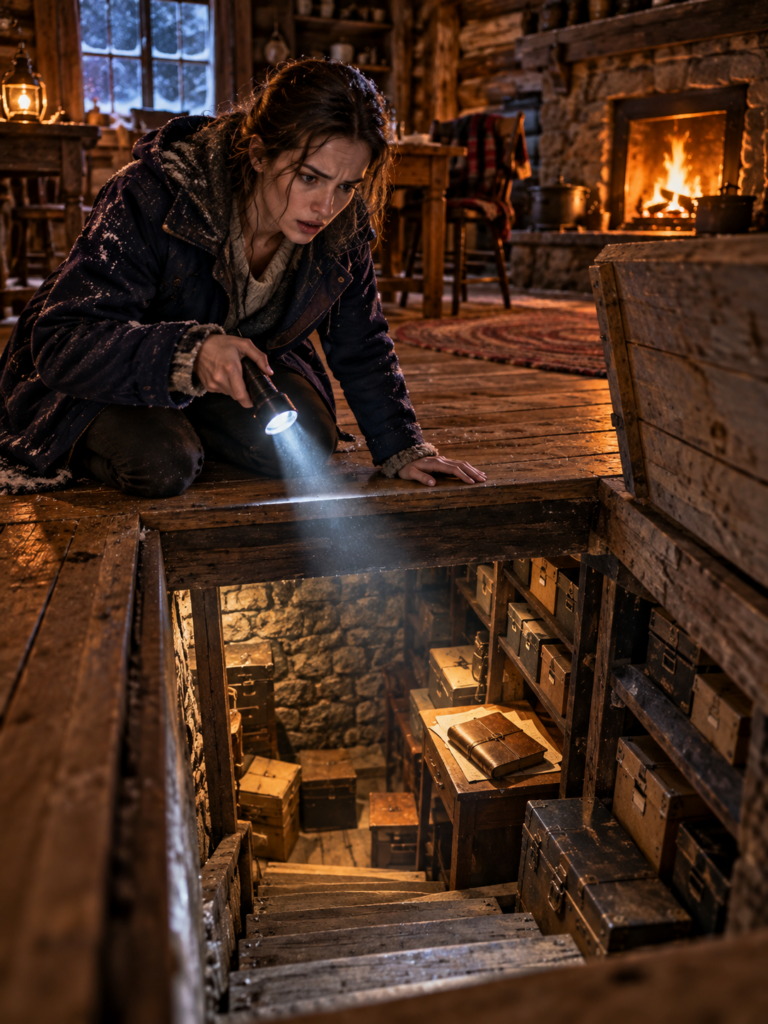
The lid came free with a faint scrape of cardboard against cardboard.
Inside were carefully stacked papers, a school newsletter, several photographs, and a journal.
Nora recognized the newsletter immediately.
It had come from Clover Hill Children’s Home.
She remembered the cheap paper, the photographs taken during school events, and the way children were encouraged to smile for pictures that made the institution look cheerful.
What she could not understand was how a copy had ended up in her father’s mountain cabin.
She lifted it from the box.
There she was, several years younger, standing with other children outside the school.
Harlan had preserved it.
Not in a family album.
Not on a refrigerator.
In an underground room that nobody had told her existed.
She opened the journal.
An entry described her school progress, including details she remembered discussing with a caseworker but never with Harlan.
Another mentioned a foster placement that had ended abruptly.
Another recorded his relief when she received a college acceptance letter.
The information was remarkably specific.
Nora tried to remember whether she had ever sent him any of those details.
She hadn’t.
Had someone at Clover Hill kept him informed?
Had he contacted the school?
The journals did not establish how every piece of information reached him.
They established something else.
He had been paying attention.
And he had been recording what he learned for years.
Nora felt an unexpected surge of anger.
Knowing was not the same as helping.
He had known about her failed placements. He had known about her financial struggles. He had known when she worked two jobs to remain in college.
Yet she had never received the kind of support that might have made those years easier.
She pushed the journal away.
For several minutes, she sat with her hands folded beneath the desk.
Then she looked again at the shelves.
The boxes began near the start of her life and continued almost to the date of Harlan’s death.
This was not a collection made during a sudden burst of remorse.
It was something he had maintained for decades.
She returned to the desk and opened a drawer.
Inside was a plain metal tin containing a small key.
A folded map and a pocketknife lay beside it.
Nora examined the key, wondering what it belonged to.
Then she noticed an oak cabinet positioned behind the door at the foot of the stairs.
She had passed it without seeing it because the open door concealed almost the entire cabinet.
She moved the door aside.
The key fit.
Inside the cabinet sat a handmade wooden box.
Her name was carved into its lid.
Nora carried it to the desk.
The clasp opened easily.
Dozens of envelopes filled the box, arranged in neat chronological rows.
Every one was addressed to her.
The earliest carried the address of Clover Hill Children’s Home.
Later envelopes were addressed to foster placements, her college dormitory, and finally her apartment in Roanoke.
Nora picked up the most recent.
It had been prepared for her birthday.
The stamp was attached.
The envelope was sealed.
But it had never entered the mail.
She checked another.
Then another.
All of them remained unopened.
Harlan had written to her repeatedly.
And instead of sending the letters, he had hidden them in a locked cabinet under a mountain cabin.
She opened the birthday letter.
Her father described trying repeatedly to find words that might explain the distance between them.
He admitted that every attempt felt inadequate.
Then came an apology.
It was simple, almost painfully so.
He was sorry for the years he had allowed to pass.
Nora read those lines several times.
Part of her wanted to believe that the letters proved something tender.
Another part wanted to demand why a man who could afford lawyers, accountants, and expensive properties couldn’t manage to mail a single envelope.
She set the letter aside and reached into the box again.
Beneath the final row of envelopes was a folder containing formal correspondence.
Nora opened it.
Attorney letters.
Requests for visitation.
Petitions concerning contact.
Responses from a law firm representing Harlan’s second wife, Vera.
Some requests had been denied.
Others had been withdrawn.
The papers suggested that Harlan had attempted to establish contact more often than Nora had known.
But they also suggested that people close to him had repeatedly opposed it.
Nora turned to the next document.
A notarized declaration concerning her welfare.
She scanned the language, which argued against further contact with her father.
Then she reached the signature.
Prescott Calloway.
Her half-brother.
The same man who had laughed when she inherited the cabin.
Nora held the paper beneath the lantern and read his name again.
This was not a rumor or a bitter recollection.
It was a signed document.
She placed the declaration beside Harlan’s unopened birthday letter.
Then she pulled the remaining legal correspondence toward her and began comparing the dates.
Nora arranged the documents in chronological order.
The earliest request concerned contact between Harlan and his young daughter.
Later papers recorded attempted mediation, objections, and withdrawn petitions.
The names changed across the correspondence.
The central argument did not.
Contact with Harlan, the opposing parties maintained, might destabilize Nora’s life.
Nora knew what instability looked like.
She had lived through placements that ended suddenly, changed schools without warning, and learned to carry everything important in one bag.
Reading those legal documents beneath the cabin, she found herself wondering whether any of the people invoking her stability had ever asked what it meant to her.
Prescott’s declaration troubled her most.
He had been a young law student when he signed it.
The language was formal, and the document did not prove that he personally directed every subsequent decision.
But it did prove his involvement from an early stage.
And the correspondence made clear that the effort to limit Harlan’s contact had not been a single misunderstanding.
Nora found another document near the back of the folder.
It was not a court filing.
It was a private note Harlan had written following a conversation with Prescott in 2019.
Prescott had again urged him to leave Nora’s life undisturbed.
By then she was an adult.
Harlan’s note recorded his growing suspicion that the advice had less to do with Nora’s welfare than with protecting the family’s existing arrangements.
Nora put down the paper.
Prescott had inherited most of Harlan’s wealth.
So had Reed.
For years, Nora had existed outside the household, outside its daily life, and outside any expectation that she would share equally in what the family controlled.
It was reasonable to question whether money had influenced Prescott.
But Nora refused to let suspicion become proof.
She had studied social work partly because she knew what happened when powerful adults constructed explanations about children without checking whether those explanations were true.
She would not repeat that mistake in reverse.
She would read what the documents established.
Then she would find someone capable of evaluating the rest.
For the next several days, she remained at the cabin.
She read journal after journal.
Harlan’s entries gave her glimpses of a person she had scarcely known.
He disliked unnecessary extravagance but had built considerable wealth. He loved old books, maintained the cabin himself, and had strong opinions about how firewood should be stacked.
He wrote about Catherine, Nora’s mother, with a tenderness that was almost harder to read than his apologies.
And he wrote about Nora.
Her graduation.
Her difficult foster placements.
Her decision to attend Roanoke College.
Her choice to study social work.
Some entries expressed pride.
Others were records of his helplessness, or what he described as helplessness.
Nora increasingly wondered how much of that helplessness had been imposed and how much he had accepted.
He had made attempts through attorneys.
He had also withdrawn them.
He had been discouraged.
He had also remained silent when Nora was old enough to receive a direct explanation.
The difference mattered.
By the fourth morning, she had finished much of the correspondence in the cabinet.
At the bottom of the wooden box, beneath the letters, she discovered one more envelope.
It was thicker than the others and bore no postal address.
On the front Harlan had written a short instruction.
She would recognize its meaning when she was ready.
Nora rested her fingertips on it.
For the first time since arriving, she chose not to open something.
There was already more truth in the room than she could comfortably carry upstairs.
She placed the envelope back in the box.
That morning, the cabin’s kitchen telephone rang.
Nora had hardly noticed the old landline mounted beside the shelves.
The caller was Amos Greer.
A man driving a dark sedan had passed through Cedar Ridge asking questions about the Calloway property.
He wanted to know whether someone was living there and whether it was for sale.
Amos had not spoken directly with him.
The description was too general to identify the visitor.
Still, the timing unsettled Nora.
She had inherited the cabin only days earlier.
Now someone was already asking about its availability.
She thanked Amos and returned downstairs.
In the final journals, Harlan described a heart condition diagnosed several years before his death.
He had begun spending more time at Cedar Ridge.
He reorganized his records, labeled his boxes, and built the cabinet.
One entry explained what he had come to believe about his inheritance.
He no longer regarded the cabin as ordinary real estate.
He wanted it to carry forward a purpose that had existed before him.
Nora remembered the photograph on the mantel.
The elderly woman.
The message about the fire.
She searched the journals for references to the woman and discovered her name.
Clara Calloway.
Clara had belonged to an earlier generation of the family, and the cabin had once been a place where people in difficulty could find shelter.
It had been more than a vacation property.
People had arrived needing temporary refuge, and Clara had made room for them.
The cabin’s importance lay in that history.
Harlan had worked to maintain the property, and his later writings showed that he wanted Nora to understand its original purpose.
Nora climbed upstairs and stood before the photograph.
For the first time, she saw more than two smiling relatives.
She saw a place that had served strangers long before she inherited it.
She also began to understand why Harlan might have chosen this particular property for her.
He knew she had grown up without a reliable home.
He knew she understood what it meant to ask for help and not receive it.
But knowing her history did not absolve him of his own failure to help.
That contradiction remained.
On the fifth morning, Nora heard a vehicle approaching through the trees.
A dark sedan appeared at the edge of the clearing.
Prescott stepped out.
Another man emerged from the passenger side carrying a leather portfolio.
Nora immediately recognized the practiced confidence with which Prescott surveyed the cabin.
He had not acknowledged her at the estate meeting.
Now he had driven into the mountains to speak to her personally.
She put on her coat and went outside.
“Good morning, Nora.”
His voice was polite.
He introduced the other man as his legal representative.
They had come, Prescott explained, because of a complication involving the property.
According to him, an unresolved mineral-rights claim created uncertainty about ownership and access.
He presented a court filing and said an assessment of the land would be required.
Nora read the document slowly.
It had been filed recently.
The language was technical, and she could not determine its full implications while standing in the snow.
Prescott suggested that she temporarily vacate the cabin while the issue was investigated.
He framed the request as assistance.
She thought about the declaration bearing his signature.
For years, he had presented separation from her father as something done for her benefit.
Now he was describing the removal of her from her own property in much the same way.
Nora looked at him.
“Why is this property suddenly so important?”
Prescott said the issue concerned title complications and possible liabilities.
“Then why weren’t those concerns raised during the estate proceedings?”
He answered that certain information had only recently required review.
She did not argue about mineral rights.
She lacked the knowledge to do so responsibly.
Instead, she told him that any further discussion would take place through an attorney representing her interests.
Prescott seemed displeased.
“You understand legal proceedings can become expensive.”
“I understand,” Nora said, “that you brought legal papers to a cabin I inherited without first asking to talk to me.”
He reminded her that the matter could not simply be ignored.
She agreed.
She would have the documents reviewed.
But she would not surrender possession because he told her to.
After a long silence, Prescott returned to his sedan.
Nora watched the car disappear between the hemlocks.
Then she went inside and called Amos.
He recommended Eleanor Vance, a property attorney in Staunton.
Nora contacted her that afternoon.
Eleanor listened to her description, then asked to examine the filing and property records before offering any conclusions.
Nora arranged an appointment.
Only after the call did she return to the underground room.
She looked again at the shelves.
The documents were no longer merely evidence of a damaged family.
They might also explain why Prescott wanted access to the land.
But no journal could settle a current ownership dispute.
She needed records that could be checked independently.
She began reviewing the property papers.
Among Harlan’s materials she found references to a conservation proposal.
The phrase Heritage Land Trust appeared in his later notes.
There was no complete explanation in the journal she was holding.
Only indications that he had begun a process involving the permanent protection of the land.
Nora placed the notes beside Prescott’s court papers.
One man had wanted the cabin preserved.
Another was asserting a claim connected to what might lie beneath the surrounding acreage.
The difference was striking.
Before she could examine the file further, someone knocked at the front door.
Nora closed the box she was reading and climbed the stairs.
On the porch stood a young woman carrying a shoulder bag.
Her coat was too light for the mountain cold.
She looked exhausted.
“Someone in town said this place sometimes helps people who have nowhere to stay,” she said.
Nora glanced toward the fireplace.
Then toward the photograph of Clara.
For a moment she remembered every doorway where she had stood waiting for an adult to decide whether she could come inside.
She stepped away from the entrance.
“Come in.”
The woman crossed the threshold, and Nora closed the door against the December wind.
For the first time, she understood the cabin was asking something of her that had nothing to do with inheritance.
Nora brought another piece of wood to the fireplace while the young woman warmed her hands.
Her name was Cara.
She did not offer a detailed explanation of what had brought her to Cedar Ridge, and Nora did not press her.
She gave Cara food, showed her one of the upstairs bedrooms, and told her she could rest.
There were questions Nora might eventually need to ask for practical reasons.
But they did not have to come before warmth.
That evening, as Cara slept upstairs, Nora sat in Harlan’s leather chair.
She thought about how strange the preceding week had been.
She had arrived believing she was inspecting an unwanted piece of property.
Now she was reading evidence that challenged her understanding of her childhood, defending land she barely knew, and opening her home to a stranger.
Three nights later, Cara left.
She folded her blankets neatly and placed a note on the kitchen table.
She thanked Nora for opening the door when she had run out of places to turn.
Nora read the note several times.
Then she carried it downstairs.
On an empty shelf beside Harlan’s carefully labeled archive, she prepared a new box.
It was the first box in the room that would contain something collected by her rather than her father.
She placed Cara’s note inside.
It seemed important that the archive not end with Harlan.
Over the following months, Nora continued working with Eleanor Vance.
The legal review required patience.
Prescott’s filing raised technical questions about property access and mineral rights, but Eleanor refused to accept his characterization without examining the underlying records.
They reviewed the chain of title.
They examined the relevant claims.
They compared the filings with the conservation papers Nora had found among Harlan’s belongings.
During one of her searches through the underground room, Nora located a larger envelope in the box marked 2019.
It contained documents concerning the Heritage Land Trust.
Harlan had applied to place the surrounding forty acres under permanent conservation restrictions.
The purpose was to protect the woodland from development and extraction.
His application had received preliminary approval.
But the final agreement remained unsigned.
A follow-up letter had been sent.
The paperwork showed no completed enrollment.
Nora carried the documents upstairs and called Eleanor.
“Does this mean he changed his mind?”
“Not necessarily,” Eleanor replied. “It means he didn’t complete the process. We need to establish what happened and what options remain.”
Nora studied the unsigned page.
For years, Harlan had been careful about his business affairs.
Why had he allowed such an important document to remain unfinished?
She remembered the way he had withdrawn earlier requests for contact with her.
The same pattern appeared to be repeating.
He had begun something important.
Then stopped.
Eleanor examined the conservation materials alongside the existing property records.
A separate discovery made Prescott’s sudden interest much clearer.
A geological survey had been commissioned in 2018 by a company called Ridgeline Resource Partners.
The survey identified commercially valuable rare-earth mineral deposits beneath part of the acreage.
The estimated extractable value ran into several million dollars.
That number changed Nora’s understanding of Prescott’s visit.
He had called the cabin an insignificant inheritance.
Yet a company with an interest in the minerals beneath the property had spent money investigating its resources years before Harlan died.
Eleanor traced the company’s ownership records.
Prescott’s name appeared among the principals.
Nora listened in silence as Eleanor explained what the records established.
Prescott was not merely a concerned relative responding to an unexpected title complication.
He had a financial connection to an entity interested in the mineral resources.
That did not, by itself, prove every statement he had made was false.
The title issues required proper legal analysis.
But it revealed a clear potential conflict of interest.
And it explained why his description of the cabin as worthless no longer seemed credible.
Nora thought back to the estate conference room.
Prescott had laughed when Gerald Whitfield announced her inheritance.
Perhaps he had assumed the land would be easy to acquire later.
She could not know exactly what he had been thinking.
She could now establish that he had a significant financial reason to want control over the property.
Eleanor also explained that the earlier conservation application might provide a path toward completing Harlan’s intended protection, subject to the required review and approvals.
Nora considered what that would mean.
The mineral resources might be worth millions.
Protecting the land would prevent their exploitation under the terms of the conservation arrangement.
She had spent her life worrying about money.
For her, even a fraction of that estimated value could have provided financial security she had never experienced.
She could stop worrying about rent.
She could repay debts.
She could afford the kind of ordinary stability that other people seemed to take for granted.
But accepting the financial value of the minerals would mean sacrificing something else.
The quiet mountain property.
Clara’s old refuge.
The cabin that Harlan had preserved.
And the possibility of continuing the place’s history.
Nora returned downstairs.
She opened the journals from Harlan’s final years.
He had written repeatedly about the land, about people who needed shelter, and about wanting the cabin to survive beyond his lifetime.
She could not say that his intentions resolved every legal question.
They did, however, give her a clear answer about what he had wanted.
He had wanted preservation.
Nora called Eleanor again.
“I want to finish the conservation process,” she said.
Eleanor warned her that it would require substantial documentation and review.
Nora understood.
She had spent much of her life learning to navigate complicated institutions.
For once, she would use that skill to protect something that mattered to her.
Over the following weeks, she worked with Eleanor through the required steps.
There were documents to obtain, questions about land use, reviews of the title history, and a site inspection.
A representative walked the property with her as winter gradually loosened its hold on Cedar Ridge.
Nora learned the boundaries of the forty acres.
She learned where the seasonal creek crossed the lower ground and where limestone appeared along the northern edge.
She began to know the property not as an acreage figure but as a real place.
The woods sheltered wildlife.
The clearing gathered snow in winter and opened to sunlight in spring.
The cabin occupied a small part of the land, yet its history gave meaning to everything surrounding it.
In late April, the conservation enrollment was completed.
The agreement permanently restricted the development and mineral extraction that Prescott’s company had been investigating.
The potential value of the minerals did not disappear.
It simply could no longer be pursued in the way Prescott had envisioned.
Nora did not feel triumphant.
She knew what having no money felt like.
She understood exactly what she had given up.
But she also understood that not everything valuable could be treated as something waiting to be sold.
Eleanor reviewed Prescott’s earlier legal filing in light of the ownership information they had uncovered.
She advised that Nora had grounds to challenge its presentation and pursue a formal response.
Nora authorized her to proceed.
She did not need to confront Prescott personally again.
The matter belonged in the hands of the people responsible for resolving it.
As spring advanced, Nora remained at the cabin.
She repaired damaged porch boards, addressed drafts around the windows, and worked on the upstairs rooms.
People from Cedar Ridge helped.
Amos brought practical advice and supplies.
Neighbors offered tools.
The property slowly became more comfortable.
Nora also learned more about Clara Calloway.
The elderly woman in the photograph had helped establish the cabin’s tradition of sheltering people who needed somewhere safe to stop.
Clara had not founded an institution or built a public monument.
She had maintained a place.
That work had been quiet and personal.
It required keeping the building usable, making space for visitors, and allowing people in difficulty to retain their dignity.
Harlan had inherited the property and continued to care for it.
He had also built the underground archive over many years.
People in Cedar Ridge remembered him bringing construction materials up the mountain.
They had known he was working beneath the cabin, though they had not known everything he intended to store there.
That detail relieved Nora of one of her lingering questions.
The room had not been built to conceal a crime or hide a fortune.
It had been constructed to preserve records that Harlan believed his daughter would someday need.
His secrecy had still caused pain.
But the room itself had a purpose she could finally understand.
One afternoon, Nora returned to the barn behind the cabin.
Among the old stored materials was a large wooden sign whose painted lettering had nearly vanished.
She cleaned it and carefully restored the remaining design.
The sign belonged to the cabin’s earlier history.
When she brought it inside and hung it above the mantel, Amos studied it for a long time.
“Harlan thought that was lost,” he said.
Nora turned toward him.
“He looked for it?”
“For years. He remembered it from when he was younger.”
She glanced at the original photograph, still standing beneath the sign.
Harlan had spent much of his life trying to preserve things he feared losing.
The land.
The cabin.
The records of Nora’s childhood.
And perhaps the possibility that one day she might understand him.
But preservation was not the same as repairing what had been damaged.
That part of the story remained unfinished.
Later that afternoon, after Eleanor confirmed that the major conservation work had been completed, Nora went downstairs.
The wooden box bearing her name sat on the desk.
For months, she had left the thick final envelope untouched.
She had discovered it while she was still trying to understand the legal documents.
At that time, she could barely tolerate another unanswered question.
Now she had lived through a winter at Cedar Ridge.
She had welcomed someone into the cabin.
She had defended the property.
She had found a purpose there that existed beyond Harlan’s intentions.
For the first time, she felt capable of reading the last explanation he had left behind without expecting it to decide who she was.
She removed the envelope.
It contained several handwritten pages.
The letter had been prepared shortly before Harlan’s death.
Nora began reading.
He wrote about her mother.
Catherine Reeves had grown up in Charlottesville and married him in the spring of 1998.
He described her as observant, thoughtful, and deeply attentive to ordinary people and ordinary things.
The affection in his words felt different from anything Nora had found in the earlier legal papers.
Those documents concerned custody, contact, and decisions.
This letter concerned a person.
A woman Nora had never had the chance to know.
Harlan explained that Catherine had died from complications surrounding Nora’s birth.
Her death had left him unable to manage his grief or the responsibilities of fatherhood.
He did not ask Nora to consider his grief a sufficient excuse.
Instead, he admitted that he had allowed his inability to cope to become abandonment.
He had left others to make decisions he should have confronted himself.
Two years later, he married Vera.
Vera convinced him that bringing an inconsistent father into Nora’s life would do more harm than good.
Prescott supported that position.
Harlan had accepted their reasoning, partly because it spared him the difficulty of making a decision on his own.
As Nora continued reading, she recognized the distinction he was trying to make.
He had been influenced.
He had also allowed himself to be influenced.
Prescott and Vera had acted in ways that benefited their side of the family, but Harlan could not truthfully claim that every year of distance had been forced upon him.
He had possessed choices.
He had been frightened of making them.
And Nora had lived with the consequences.
That was the hardest passage to read.
For days after discovering the underground room, she had wanted the documents to give her a clean explanation.
If her father had tried and been prevented, perhaps she could imagine that his absence was entirely someone else’s doing.
But the final letter would not allow that.
He had loved her.
He had made attempts to reach her.
He had also failed her.
All three things were true.
The letter returned to the afternoon when he had watched her laughing outside her school.
He had seen his daughter happy for a moment and realized how much of her life he had already missed.
After that, he made repeated journeys toward her world, often stopping at Cedar Ridge.
Sometimes he watched from a distance.
Sometimes he returned to the cabin and wrote.
He seemed to have believed that observing her life and preserving information about it was the closest he could come to being present.
In his final years, he recognized how inadequate that had been.
Nora stopped reading and closed her eyes.
She remembered a little girl sitting in a hallway at Clover Hill, hoping someone would come back.
That girl had not needed a private archive.
She had needed a father.
No amount of handwriting could restore those years.
Still, the letters changed what Nora knew.
She had always believed she had been unwanted.
Now she knew that her father’s absence had come from grief, weakness, misplaced trust, and decisions she had never been permitted to understand.
The difference would not give her back her childhood.
But it meant that the story she had told herself about being unworthy of love had never been the whole truth.
Near the end of the letter, Harlan explained why he had left her the cabin.
Clara had once made the building a place for people who needed shelter.
Catherine had understood the same principle: that people were not problems to be managed from a distance.
Harlan admitted that he had understood it imperfectly and far too late.
He hoped Nora might continue what those women had valued.
Not because suffering made her responsible for rescuing everyone.
Not because an inheritance could compensate for twenty-four years of absence.
But because the cabin could give her a choice he had so often failed to make.
She could decide whether to keep its doors open.
Nora reached the final page.
Her father offered no claim that his love had been enough.
He acknowledged that it had not.
He had left behind the land, the cabin, the journals, and the letters because he wanted her to know the truth and decide for herself what deserved to survive.
The last lines returned to the message on Clara’s photograph.
Keep the fire burning.
For the people who would need it after him.
Nora placed the letter on the desk.
She sat quietly in the underground room.
For years, she had imagined that discovering her father’s reasons might finally settle her feelings.
Instead, she found herself holding several emotions at once.
Anger at what he had allowed.
Grief for what they had never shared.
Compassion for the man revealed in his private writing.
And relief that the child she had been had not caused his absence.
She did not forgive everything.
She did not need to.
A complete explanation was not the same as an obligation to absolve the person who provided it.
She carefully folded the letter and placed it with the others.
Then she opened the newest archival box.
Inside was Cara’s thank-you note.
Nora held it for a moment.
It was a small piece of paper compared with the thick folders, formal filings, and notebooks her father had preserved.
But it documented something the older records could not.
Someone had needed help.
Someone had come to the cabin.
And the door had opened.
Nora understood that Harlan’s story was finished.
Hers was not.
She carried his final letter upstairs and placed it safely with the other papers she had chosen to keep close.
Evening was settling over Cedar Ridge.
The white winter clearing had become green, and the woods were full of the sounds of spring.
She added another log to the fireplace.
Above the mantel, the restored sign hung near the photograph of Harlan and Clara.
Nora looked at their faces.
She would never know her father as someone she could call when a day went badly.
She would never ask Catherine what she had been like as a young woman.
There were losses that the room beneath the floor could document but never repair.
Yet the records had given her something she hadn’t known she was entitled to seek.
A fuller account of her own life.
She was not the unwanted girl Prescott had treated as an inconvenience.
She was not simply the daughter Harlan had failed to raise.
She was a woman who had survived both abandonment and silence, who had built a life of her own, and who could now decide what family meant to her.
A knock sounded at the front door.
Amos stood outside carrying a small envelope.
Gerald Whitfield had found it among Harlan’s remaining private papers and sent it through Amos.
The letter was addressed to Nora.
She opened it beside the fireplace.
Harlan had written it in the final weeks of his life.
It was shorter than the others.
He explained that his sons would inherit the conspicuous possessions: the ranch, the lake property, the accounts.
Those things mattered to them.
The cabin mattered differently.
He had chosen Nora because he believed she would understand what it meant to stand outside a door with nowhere else to go.
He had wanted her to have a place that could remain open to people who needed it.
The last message echoed the photograph and the longer letter.
The fire was not to be kept alive for his memory.
It was to be kept alive for whoever came next.
Nora read the page again.
Then she looked at Amos.
“I spent my whole life thinking he left me out.”
Amos did not rush to contradict her.
“In a lot of ways,” he said, “he did.”
Nora nodded.
That was why she trusted him.
He had never tried to turn Harlan into a better father than the evidence supported.
“But he didn’t forget me,” she said.
“No,” Amos answered. “He didn’t.”
They stood beside the fireplace in comfortable silence.
Outside, the last daylight slipped behind the ridge.
Nora folded the letter and placed it with the first photograph she had found.
In the months that followed, word of the cabin spread quietly through Cedar Ridge.
People who needed temporary shelter sometimes arrived.
Nora helped where she could, drawing on both her social-work training and her own understanding of what it felt like to ask for assistance.
She learned that caring for a refuge required more than kindness.
It required planning, supplies, repairs, boundaries, and support from the surrounding community.
She did not try to do everything alone.
Amos remained a trusted friend.
Neighbors offered practical help.
The cabin’s two upstairs rooms continued to provide warmth and temporary rest.
Meanwhile, the underground archive remained carefully maintained.
Nora preserved Harlan’s journals and the records that had changed her understanding of their relationship.
She did not destroy the evidence of Prescott’s involvement.
She did not pretend those documents had never existed.
The legal dispute continued through appropriate channels, separate from the work of keeping the property useful.
The land remained protected.
And Nora kept adding to the newest box.
Not every visitor left a note.
Not every story ended neatly.
She had learned enough from her own life to understand that helping someone did not guarantee a happy ending.
But when she looked at the small collection of letters and messages left by people who had passed through, she knew the place was becoming what Clara had intended.
One evening, months after Nora first found the iron ring in the kitchen floor, she stood above the hatch again.
She lifted it and looked down the wooden stairs.
The room beneath the cabin had once frightened her because she believed it might overturn everything she knew.
In a sense, it had.
But it had not revealed a hidden fortune that solved her problems.
It had not erased her childhood.
And it had not transformed Harlan into a father who had always done the right thing.
It had revealed the record of a flawed man who loved his daughter, failed to reach her, and spent years preserving the truth he was too afraid to tell.
It had also revealed the choices of people who benefited from keeping her outside the family.
And it had given Nora the chance to make a different choice.
She lowered the hatch carefully.
Then she crossed the kitchen, checked the fire, and opened the front door for the evening air.
Beyond the porch stood forty acres of protected mountain woodland.
Behind her was a warm room with two chairs at the kitchen table and bedrooms ready when needed.
She thought of Clara.
She thought of Catherine.
She thought of Harlan, with all the love and disappointment that his name would probably always carry.
Then she looked back at the cabin.
For the first time in her life, Nora Calloway had a home she did not have to leave because someone else had decided she no longer belonged.
And she intended to make certain that its door could open for someone who needed it.
The fire continued burning.
This time, Nora was the one tending it.