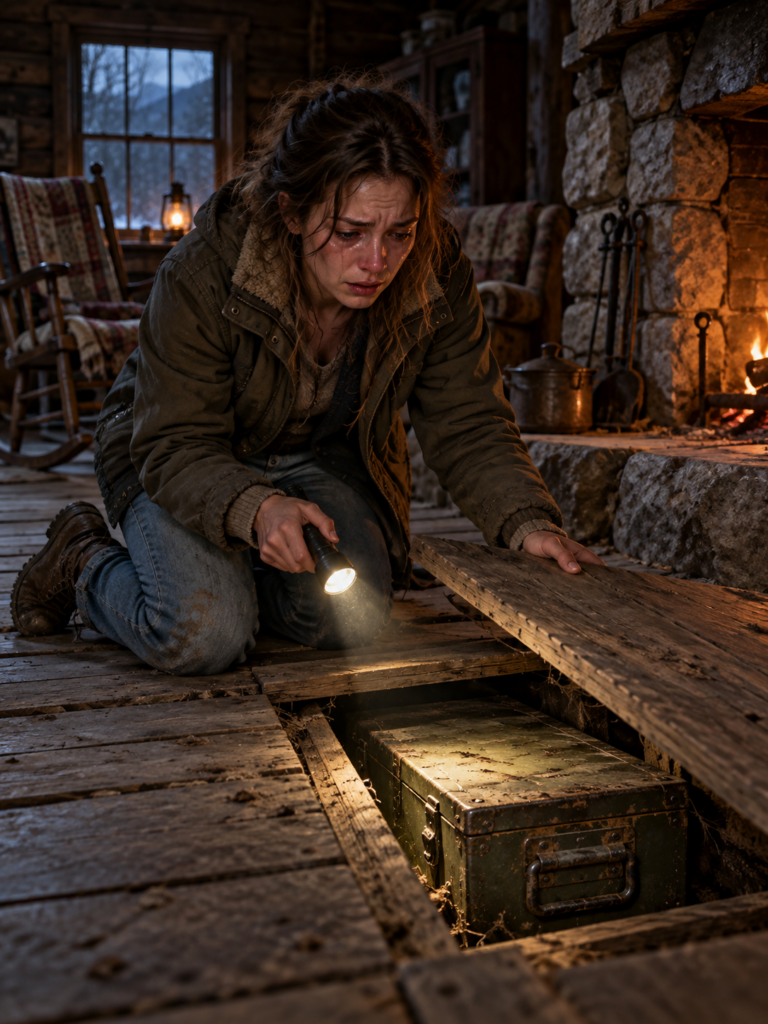
The lid rose with a long metallic groan.
Sadie leaned forward, directing the weakening flashlight beam into the opening.
The inside of the crate was lined with thick waxed paper, folded carefully around its contents.
On top lay a cream-colored envelope.
It was addressed to her.
Not to Betty.
Not to some unknown relative.
To Sadie.
She recognized the handwriting before she even touched it.
The narrow, slanted letters belonged to her grandmother.
For years, Betty had written birthday cards using that same careful script. Even when her hands grew stiff with age, she insisted on writing every message herself.
Sadie picked up the envelope.
It was heavier than an ordinary letter.
There was no postage or return address.
Whatever Betty wanted to say, she had never intended to send it through the mail.
Sadie turned the envelope over.
The flap remained closed.
She wanted to open it immediately.
Instead, her eyes returned to the strange lining beneath it.
The waxed paper was folded in layers.
Its edges had been pressed down neatly, as though protecting something from moisture.
She lifted one flap.
Then another.
And stopped.
Beneath the paper were bundles of cash.
Not a few folded bills or an emergency envelope.
Stacks.
Dozens of them.
Fifties and hundreds, arranged tightly together, held in place by aging rubber bands.
Sadie stared without moving.
Betty had lived in a cabin with no modern comforts.
She chopped her own wood, bought secondhand clothes, and saved glass jars because she hated throwing useful things away.
Why would a woman who lived so modestly hide this much money beneath her fireplace?
Sadie lifted one bundle.
The rubber band was brittle.
She carefully returned it to the box.
There was something else beside the cash.
Four small canvas pouches, each tied with a leather cord.
She reached for the nearest one.
The weight surprised her.
It was far too heavy for a pouch of ordinary jewelry.
She loosened the knot and tipped the opening into her palm.
A gold coin slid out.
Its surface caught the flashlight.
Sadie turned it over.
The familiar profile of Paul Kruger was stamped on one side.
An antelope appeared on the other.
She had once seen a similar coin in a jewelry dealer’s display.
A South African Krugerrand.
She tilted the pouch again.
More coins pressed toward the opening.
She stopped before they spilled out.
There were four pouches in the box.
All appeared tightly packed.
Sadie looked back at the cash, then down at the coin resting against her skin.
For the first time, she understood that Betty’s secrecy might have had nothing to do with eccentricity.
This was wealth.
Serious wealth.
Money that could have changed her grandmother’s life.
Yet Betty had chosen to keep living in the woods, cooking on a small stove and repairing her own clothes.
Sadie placed the coin back inside the pouch.
Her first instinct was to wonder whether the money had belonged to someone else.
But nothing in the box identified another owner.
And the envelope, clearly written for her, suggested Betty had deliberately arranged for Sadie to find it.
The question was why.
Sadie picked up the envelope again.
Four years.
For four years, this had been beneath her feet whenever she visited the cabin.
Betty had never mentioned it.
She had never even hinted at having significant savings.
Instead, she had told Sadie to keep the place, even if the rest of the family couldn’t understand why.
Had she been trying to protect something?
Had she known Logan would eventually hurt her?
Or had the money been hidden long before Sadie married him?
Sadie looked at the handwriting.
Her grandmother’s name was suddenly tangled with questions she had never thought to ask.
She inserted a finger beneath the envelope flap.
The paper tore softly.
Inside were three folded sheets.
She removed them and opened the first.
The initial lines were unmistakably personal.
Betty had written that if Sadie was reading the letter, she was gone, and life had finally given her granddaughter a reason to seek refuge in the cabin.
Sadie’s throat tightened.
She read further.
And there, in the same familiar handwriting, Betty began describing what had happened to Sadie’s grandfather after his business partners took away everything he had worked to build.
Sadie had heard fragments of that old family loss.
But she had never heard what Betty did afterward.
Now she lowered the flashlight closer to the page and continued reading.
The next paragraph described a woman Sadie had never truly known.
Betty hadn’t simply retreated to the mountains because she preferred solitude.
She had gone there after watching her husband lose his business, his financial security, and the future they had spent years building.
It happened in the 1970s.
According to the letter, his business partners had used contracts and legal maneuvering to strip him of his share of the company.
He had trusted them.
He had signed what they put in front of him.
And by the time he understood the consequences, the paperwork had already done its damage.
Sadie stopped reading.
She looked at the wooden floor beneath her knees.
Her grandmother had been writing about the past.
But the words described something frighteningly close to Sadie’s own marriage.
Logan’s patient explanations.
The property agreement.
The signatures.
The sudden discovery that legal ownership and moral fairness were not necessarily the same thing.
She returned to the letter.
Betty wrote that after her husband’s death, she gathered what remained.
There had been settlement money, life insurance proceeds, and whatever equity she could recover.
She didn’t trust financial institutions to protect what was left.
She had lost faith in men who spoke confidently about contracts while quietly arranging to benefit themselves.
So she turned her remaining assets into cash and gold.
Then she brought them to the cabin.
Sadie glanced toward the open metal crate.
The money suddenly had a history.
It was not an unexplained fortune appearing out of nowhere.
It represented the final remnants of a life Betty had once expected to share with her husband.
And she had concealed it beneath the one place she believed she could control.
Sadie continued reading.
Betty described how the family considered her decision to live off-grid unreasonable.
They saw a stubborn old woman refusing modern conveniences.
They did not see someone who had learned how quickly a comfortable life could disappear.
Then Sadie reached the passage that made her grip the paper harder.
Betty had been watching Logan.
Not secretly following him.
Not investigating his finances.
Simply watching him during ordinary family visits.
Listening as he interrupted Sadie.
Noticing how he dismissed her opinions.
Remembering the contempt in his voice when he spoke about the cabin.
Betty had not forgotten any of it.
Sadie read the passage twice.
She remembered one Thanksgiving dinner when Logan had laughed at the idea of Betty’s property being worth keeping.
“That place is practically falling apart,” he had said.
Sadie had defended it.
Logan had rolled his eyes.
Betty had remained quiet at the end of the table.
Sadie had mistaken that silence for disinterest.
Now she understood it differently.
Betty had been paying attention.
The letter explained that she had not wanted to interfere directly in Sadie’s marriage. She knew her granddaughter loved Logan, and she believed Sadie would have to recognize the truth for herself.
But she had also prepared for the possibility that Sadie might someday lose more than her marriage.
That was why the box existed.
And why the envelope carried Sadie’s name.
Betty had written an approximate inventory.
Four hundred thousand dollars in cash.
Another six hundred thousand dollars in gold at the valuation she had used.
Roughly a million dollars in stored wealth.
Sadie read those numbers several times.
Her checking account contained seventy-four dollars.
Yesterday, she had worried about having enough gasoline to reach the cabin.
Now she was sitting beside an amount of money she could barely comprehend.
But Betty’s next words made her uneasy.
Her grandmother had deliberately omitted the box from the paperwork transferring the cabin.
She believed anything documented could become the subject of legal conflict.
In Betty’s mind, the person who discovered and possessed the contents would control them.
She had wanted Sadie to have resources no husband could casually take away.
Sadie understood the intention.
She was less certain about the legal assumptions.
A hidden box did not automatically make questions of ownership, inheritance, or taxes disappear.
And gold coins did not become untraceable simply because someone kept them beneath a floor.
But none of those complications changed the fact that Betty had left something behind specifically for her.
Something Logan knew nothing about.
Sadie reached the final page.
Betty urged her to stop letting a powerful man define what she deserved.
Her grandmother’s language was fierce.
She told Sadie to protect the cabin, stand up for herself, and make anyone who exploited her face the consequences.
The signature at the bottom was familiar.
Love,
Betty.
Sadie slowly lowered the letter.
For several minutes, she sat without moving.
The cabin was still freezing.
Her clothes still smelled of rain and stale car upholstery.
She was still exhausted.
But she no longer felt trapped in the same way.
Logan had believed that taking the house would leave her without options.
He knew her bank balance.
He knew her legal expenses.
He knew she had little income from her art.
And he had counted on all of those things.
What he didn’t know was that Betty had spent years protecting something he considered worthless.
Sadie looked around the cabin.
The old fireplace.
The mismatched chairs.
The rocking chair with its worn wooden arms.
Logan had dismissed every part of this place.
Now its floor concealed more wealth than he could have imagined.
She folded the letter and slipped it into her jacket.
Then she carefully examined the contents of the crate.
The cash appeared to consist largely of older bills in denominations of fifty and one hundred dollars.
She couldn’t verify the total by flashlight.
And she had no way to determine the gold’s current value.
Still, the quantity was extraordinary.
She removed one bundle of fifty-dollar bills.
She would need food, heating supplies, and basic repairs if she intended to stay here.
Then she closed the metal lid.
The broken padlock lay beside the hearth.
She returned the crate to its recess, lowered the plank into place, and moved Betty’s rocking chair over the spot.
It was a temporary precaution.
She would have to consider how to secure and document the contents properly.
But tonight, she needed warmth more than answers.
Sadie retrieved the sleeping bag from her car.
She laid it on Betty’s old bed, wrapped herself inside, and listened to the wind move through the trees.
Sleep came in short, uncomfortable stretches.
Each time she opened her eyes, she looked toward the rocking chair.
The box was still there.
And so was the letter in her jacket pocket.
By morning, frost had gathered around the window edges.
Sadie woke shivering.
She climbed out of bed, pulled on her boots, and drove toward Pine Ridge, the nearest town.
The hardware and feed store stood along a quiet main street lined with weathered brick buildings.
Inside, she bought a portable heater, fuel, a generator, extension cords, and a sturdy new door lock.
The total came to $842.
She counted out seventeen fifty-dollar bills.
The young cashier paused over the older currency.
“Don’t see many of these anymore,” he said.
Sadie kept her expression neutral.
“They’ve been put away a long time.”
He completed the sale and returned her change.
At the grocery store, she purchased water, canned food, coffee, blankets, and other essentials.
By noon, she was back at the cabin.
She installed the new lock and brought the heating equipment inside.
She positioned the generator outdoors where exhaust could disperse safely and set up the heater according to its ventilation requirements.
Then she carried the groceries into the kitchenette.
For the first time since she arrived, the cabin began to feel less like a temporary hiding place.
She made coffee.
She cleaned enough of the table to work.
And she charged her phone.
As soon as a weak cellular signal appeared, notifications began arriving.
Three calls from her mother.
Two from Jessica, her closest friend.
And one voicemail from Logan.
Sadie played his message.
His voice was controlled, almost pleasant.
He explained that he had gathered the remaining belongings she had left in the bathroom and garage.
Then he mentioned the documents.
His lawyer had prepared the final papers for the LLC dissolution.
He needed her signature.
He wanted everything concluded quickly.
Sadie listened without interrupting.
When the recording ended, she played the last section again.
Logan was eager to finalize the transfer.
Too eager.
She remembered the agreement he had persuaded her to sign and the way he had handled every piece of paperwork.
She remembered that he worked for a private wealth management firm.
And she remembered the financial arrangements he discussed casually when they were married.
Delaware companies.
Deferred compensation.
Consulting fees.
Offshore accounts.
Sadie had never understood every detail.
But she knew enough to recognize that some of what Logan described at home was different from the clean professional image he presented to clients.
During their marriage, she had helped organize his files and tax paperwork.
She had seen company names and account references.
She had heard explanations she hadn’t questioned at the time.
None of that necessarily proved fraud.
She understood that now.
But it gave her a reason to ask someone qualified to examine the transactions.
And the LLC agreement itself deserved independent scrutiny.
Sadie set her coffee down.
Betty’s letter had given her more than money.
It had given her the means to seek professional help without asking Logan for anything.
She went to the fireplace.
Moved the rocking chair.
Lifted the floorboard.
And opened the crate once more.
This time she removed twenty gold coins.
She placed them into a canvas pouch and carried them to the dining table.
Then she searched her phone for attorneys experienced in complex asset recovery, financial fraud, and property disputes.
After reviewing several firms, she found the offices of Calvin Hughes.
A former federal prosecutor.
A lawyer whose practice focused on difficult financial litigation.
His listed retainer was fifty thousand dollars.
Two days ago, that would have been impossible.
Now it was a problem she could at least attempt to solve.
Sadie called the office.
A receptionist answered.
When Sadie requested an urgent consultation, the woman explained that Mr. Hughes was not routinely accepting new clients without referrals.
Sadie described the disputed home transfer and the financial irregularities she wanted reviewed.
Then she explained that she had access to gold assets she intended to liquidate legitimately to cover legal fees.
The receptionist placed her on hold.
Sadie waited beside the table.
Betty’s letter lay open.
The gold coins rested in the canvas pouch.
Then a man’s voice came onto the line.
“This is Calvin Hughes.”
Sadie straightened.
“Mr. Hughes, my husband used an LLC agreement to take our house. I think there’s more in his financial records that needs examining.”
Hughes asked a few precise questions.
Sadie answered them.
He did not promise that she had a winning case.
He did not claim that every suspicious arrangement was illegal.
But he said the circumstances warranted a closer look.
He could meet with her.
They would need documentation, a clear account of the transaction, and a verified source for any funds used to retain his firm.
Sadie glanced at the letter.
“I can bring what I have.”
“Good,” Hughes said. “Start with the papers you actually signed.”
Sadie felt her expression change.
For days, she had been replaying the moment she gave Logan the house keys.
Now she was thinking about a different moment.
The afternoon she signed the agreement that gave him control.
She had trusted his explanation.
This time, she intended to read every page.
She reached for a notebook and began writing down everything she could remember.
Sadie’s pen moved across the notebook until she had filled several pages.
Dates.
Conversations.
Company names.
The afternoon Logan proposed refinancing.
The documents he placed in front of her.
The explanation he gave about taxes.
The emails she later discovered.
And the morning he told her that she had no choice but to leave.
She wrote down what she knew directly and marked everything else as something that needed verification.
It was a distinction she had rarely made during her marriage.
Logan spoke with such certainty that she had become accustomed to treating his confidence as proof.
Now she could see how much she had accepted simply because he said it.
Several days later, Sadie walked into Calvin Hughes’s downtown office wearing a clean black blazer, worn boots, and a canvas bag containing Betty’s letter and the gold she had brought to fund her representation.
The reception area was immaculate.
Floor-to-ceiling windows overlooked the city.
Sadie felt conspicuously out of place.
But she had not come to impress anyone.
She had come to understand what had happened to her home.
Calvin Hughes was in his late fifties, broad-shouldered, with closely cropped facial hair and an expression that suggested he preferred facts to introductions.
He showed her into a conference room.
“Tell me what happened,” he said.
Sadie placed her notebook on the table.
Then she began.
She described the marriage.
The house.
The LLC.
The signatures.
The discovery of Logan’s relationship with another woman.
And the speed with which she had been pushed out.
Calvin listened without interrupting.
When she finished, he asked for the documents.
Sadie explained which copies she possessed and which records Logan still controlled.
He wrote that down.
Then he asked about the financial arrangements she had mentioned on the phone.
Sadie described the Delaware company and the offshore accounts Logan had discussed in their home.
She recalled the consulting fees, the deferred compensation arrangements, and some account names she had seen while helping organize his paperwork.
Calvin made careful notes.
“Do you have records establishing what those transactions actually were?”
“Not all of them.”
“Then we don’t assume the worst. We verify.”
Sadie nodded.
She had spent days imagining Logan’s downfall.
But Calvin was interested in what could be documented.
He explained that the home transaction might be challenged if the evidence supported claims of misrepresentation, coercion, or other legal defects.
The existence of a controlling-interest clause was not, by itself, proof of fraud.
Neither was Sadie’s failure to understand the paperwork.
They would need to examine what she had been told, what she signed, and how the ownership structure had been used.
That process might be expensive.
It might also be difficult.
Sadie listened to every word.
For once, she did not want anyone to simplify the truth for her.
When Calvin asked about payment, she placed the pouch on the table.
Twenty Krugerrands.
He examined one coin and then returned it.
“We’ll need to verify their authenticity, value, and lawful source before arranging payment.”
Sadie handed him a copy of Betty’s letter.
She explained the cabin inheritance and the hidden crate.
Calvin read the relevant passages.
His expression grew thoughtful.
“Your grandmother had strong opinions about financial institutions.”
“She had reasons.”
“She may have. But we’ll need to establish the estate and tax implications before treating these assets as yours to spend freely.”
Sadie looked at him.
For a moment, she felt the old disappointment of discovering another complication.
Then she thought about Betty.
Her grandmother had hidden the money because she distrusted complicated systems.
Yet avoiding documentation entirely could create different problems for Sadie.
“I want to do it correctly,” she said.
Calvin nodded.
“Then we begin there.”
They discussed the necessary steps.
Sadie agreed to retain the firm once the payment and ownership questions were appropriately addressed.
She signed the engagement documents after reading them carefully.
Every page.
Every paragraph.
When she reached something she didn’t understand, she stopped and asked.
Calvin answered.
Only then did she write her name.
The gesture seemed ordinary.
But to Sadie, it felt like reclaiming something she had surrendered years earlier.
Her own judgment.
Before she left, Calvin told her not to negotiate directly with Logan.
Future legal communications would go through counsel.
Sadie agreed.
Then she returned to the mountains.
The cabin greeted her with the familiar smell of old wood and the faint warmth of the heater.
She placed her bag on the dining table and looked around.
The roof still needed attention.
The porch remained crooked.
Dust collected in corners she had not yet cleaned.
Nothing about the place was luxurious.
But the door opened with her key.
No one had told her to leave.
No one stood in the kitchen waiting for her to surrender the property.
For the first time in several days, Sadie made dinner without checking her phone.
She ate canned soup at Betty’s old table and watched the sky darken beyond the windows.
Then she took out her grandmother’s letter.
She reread the passage about her grandfather.
It struck her differently now.
Betty’s husband had trusted men who understood contracts better than he did.
When the business collapsed, he lost the security he thought he had earned.
Betty had witnessed the damage and spent the rest of her life refusing to depend on anyone else’s promises.
But in trying to protect Sadie, she had also passed down some of her fear.
The hidden money was a remarkable act of preparation.
It was also the product of a wound that had never completely healed.
Sadie traced one finger over the old handwriting.
Betty had known something important about Logan.
Not the details of his financial affairs.
Not the specific contract.
She had recognized the way he treated his wife.
The way he dismissed Sadie’s judgment.
The way he assumed she would eventually surrender whatever he wanted.
Sadie remembered the Thanksgiving dinner again.
Logan laughing about the cabin.
Betty quietly watching him from across the table.
She wished she could return to that afternoon.
She wished she could ask her grandmother what she had been thinking.
But Betty had left her answer in the floor.
The following days brought legal work.
Calvin’s office examined the LLC arrangements and began preparing challenges to the transfer.
Sadie supplied records she was entitled to access, together with her recollections of the financial discussions she had witnessed.
Her attorney sought the remaining relevant documents through formal procedures.
The facts became more complicated than Sadie had initially understood.
The controlling-interest provision did not simply settle every question about the marital home.
Its creation, disclosures, and use were subject to examination.
And the financial arrangements involving Logan’s business interests warranted closer scrutiny.
As Calvin assembled the case, Sadie learned something about the man she had married.
Logan’s professional confidence depended heavily on other people accepting his version of events.
He knew how to make complicated transactions sound routine.
He knew how to move a conversation away from questions he did not want to answer.
And he had grown accustomed to Sadie accepting that behavior.
Now someone was reading the documents with an entirely different purpose.
Sadie could not predict what every investigation would establish.
But she understood that Logan’s certainty had never been the same thing as legal immunity.
When Calvin filed the initial challenge and sought emergency protections concerning the property, Logan received the papers at the house.
He had expected Sadie to be desperate for a small settlement.
Instead, he found the name Calvin Hughes attached to a substantial legal filing.
The documents questioned the disputed property transaction and sought to preserve the home while the issues were examined.
They also identified financial matters requiring further review.
Logan recognized some of the account references.
For the first time, he understood that Sadie had remembered far more than he realized.
He called his lawyer.
Then he called again.
His attorney advised him to preserve the relevant records and stop treating the dispute as a formality.
Logan was furious.
He could not understand where Sadie had found the resources to hire someone like Hughes.
He tried calling her.
She didn’t answer.
He sent a message asking to discuss the house privately.
Sadie forwarded it to Calvin.
No reply went directly to Logan.
That silence unsettled him more than any argument would have.
He had always been able to draw her into explaining herself.
This time, the conversation was no longer his to control.
The legal case moved forward.
Calvin’s filings brought new scrutiny to the home transaction, while the concerns about Logan’s financial practices reached people whose job was to investigate such matters.
Those allegations required examination rather than automatic acceptance.
But the existence of a serious, documented dispute was itself enough to disrupt Logan’s comfortable assumptions.
His firm began reviewing the questions surrounding the use of company credentials and the transactions identified in the filings.
Logan was placed on suspension while the review proceeded.
Restrictions affected accounts involved in the dispute.
He could no longer behave as though the house was his to dispose of without challenge.
The property became the subject of active legal proceedings.
And the professional reputation he had depended upon was suddenly vulnerable.
Sadie learned about the developments through Calvin.
She was standing outside the cabin when his message arrived.
The afternoon light lay across a stack of split logs.
She had spent the morning clearing brush near the porch and carrying firewood under the overhang.
Her arms ached.
There was dirt beneath her fingernails.
She read the update twice.
The court had granted interim protection concerning the disputed property.
Logan had been suspended pending review.
Relevant accounts were subject to restrictions.
Nothing was fully resolved.
There would be more filings, more records, and difficult questions ahead.
But Logan had lost the ability to conclude everything on his own terms.
Sadie put the phone down.
She thought she might feel triumphant.
Instead, she felt quiet.
For days, she had imagined him facing the same helplessness she experienced on the morning he forced her out.
She had pictured him alone in the marble kitchen, discovering that his professional status could not protect him from every consequence.
Now that part of that possibility had become real, she found herself looking at the trees.
Wind moved through the pines.
Somewhere beyond the clearing, a bird called.
It was a sound Betty had taught her to recognize years earlier.
Sadie took a long breath.
Then she picked up the splitting maul.
A thick log rested on the chopping stump.
She raised the tool and brought it down.
The wood split cleanly into two pieces.
She set another round on the stump.
Then another.
By the time she finished, the light had begun fading toward evening.
Inside the cabin, she washed her hands and made coffee.
The rocking chair still stood beside the fireplace.
Beneath it remained the box that had changed everything.
Sadie pulled out Betty’s letter once more.
She had been carrying it everywhere.
The paper had begun to soften along its folds.
She read the final instructions again.
Her grandmother wanted her to fight.
To protect herself.
To refuse to let Logan walk away untouched.
Sadie understood the anger behind those words.
Betty had watched one man lose his livelihood through betrayal and another man treat her granddaughter with contempt.
She had wanted to make sure Sadie would never be helpless in the same way.
But Sadie was beginning to realize something Betty might not have intended.
She did not want the rest of her life to revolve around Logan’s punishment.
She wanted her own life back.
Not necessarily the same house.
Not the marriage.
And certainly not the woman who had quietly allowed someone else to handle every important decision.
She wanted the freedom to choose.
The legal proceedings could continue.
Calvin could pursue the remedies the evidence justified.
If Logan had committed wrongdoing, he should face the consequences.
But Sadie did not need to make destroying him her life’s purpose.
She looked at the letter again.
There was one sentence she kept returning to.
Betty had written that Sadie was the only person who saw a home in the cabin instead of a decaying structure.
At first, those words seemed like an explanation for why she was receiving the hidden wealth.
Now they meant something larger.
Betty had not simply left Sadie money.
She had left her a place where her worth was not measured by what she earned, how impressively she lived, or whether a successful man approved of her choices.
The cabin was proof that Sadie had once known what mattered to her.
Before Logan’s career.
Before the marble kitchen.
Before six years of gradually shrinking her own wishes to fit around his.
She had loved making things.
She had loved working with wood.
She had loved the quiet of these mountains.
She had loved painting.
And she had loved the grandmother who taught her to trust her hands.
Sadie folded the letter and placed it on the table.
She walked to the bed and pulled back the faded quilt.
The room was no longer bitterly cold.
The heater had made the cabin livable.
The pantry contained food.
The door had a reliable lock.
Outside, there was enough firewood for the coming nights.
She had begun rebuilding her life with practical, ordinary decisions.
None of them required Logan’s permission.
Over the following weeks, Sadie continued working with Calvin and the appropriate professionals to establish the ownership and tax treatment of Betty’s hidden assets.
She learned that her grandmother’s wish to keep the box off paper did not eliminate legal obligations.
Records had to be examined.
Values had to be established.
Questions about the estate needed proper answers.
Sadie chose to handle those issues openly rather than recreate the secrecy Betty had relied upon.
It was one way she intended to make a different life.
She could appreciate why Betty had hidden the money without believing every fear her grandmother carried had to become her own.
The case against Logan also continued.
The protective court orders and professional review had already altered the balance between them.
The decisive final legal outcome remained dependent on the evidence and the proceedings.
But one fact was no longer in doubt.
Sadie was not going to sign away her remaining rights merely because Logan told her the paperwork was inevitable.
That part of their story was finished.
One afternoon, she took a chair onto the porch and sat beneath the roof overhang.
The sky was bright.
The woods smelled of wet leaves and cold earth.
She opened her sketchbook for the first time since leaving the suburban house.
At first, she simply looked at the blank page.
Then she began drawing the crooked iron gate.
The path.
The pine trees.
The cabin with its sagging porch and heavy stone chimney.
She drew slowly, making corrections, following the lines until the building began to emerge beneath her pencil.
It wasn’t a beautiful house in the way Logan understood beauty.
There were no gleaming countertops.
No enormous windows overlooking a landscaped street.
No impressive driveway.
But it was hers.
Sadie stopped drawing and looked toward the fireplace visible through the open doorway.
She remembered the night she arrived.
The cold floorboards.
The exhaustion.
The feeling that her entire life had been reduced to a few boxes in the back of an aging Subaru.
She remembered placing her palm on the floor.
The small, unexpected movement of the plank.
The metal box beneath it.
And the envelope bearing her name.
She had believed she was finding somewhere to hide.
Instead, she had found evidence of a sacrifice made decades earlier and a grandmother’s determination that her granddaughter should have choices.
The money mattered.
Without it, Sadie might never have been able to challenge Logan effectively or make the cabin habitable.
But the deeper discovery was not the gold.
It was realizing that Betty had understood her long before Sadie understood herself.
Sadie closed the sketchbook.
She went inside and lifted the old rocking chair away from the hearth.
For a moment, she considered leaving it over the loose floorboard forever.
Keeping the secret exactly as Betty had.
Then she moved it back to its familiar place beside the fireplace.
She had already begun arranging proper security and documentation for the contents of the box.
She would not rely on a loose plank and an old chair to protect her future.
The hiding place had served its purpose.
Now the cabin could become something other than a shelter for buried fear.
Sadie sat in Betty’s rocking chair.
The wood creaked beneath her.
She pictured her grandmother there, hands around a cup of coffee, watching the fire.
For years, Sadie had thought Betty lived alone in the mountains because she had turned her back on the world.
Now she knew the truth was more complicated.
Betty had suffered a profound loss.
She had withdrawn because she was afraid of losing what remained.
And somewhere within that hard, guarded life, she had made a plan to protect the granddaughter she loved.
Her secrecy had been shaped by fear.
But her final act had been shaped by love.
Sadie stayed in the rocking chair as afternoon light crossed the floor.
There would be difficult days ahead.
Lawyers.
Documents.
Repairs.
Decisions about money she had never expected to possess.
And eventually, the difficult work of deciding what kind of future she wanted.
But she had a place to begin.
She thought of Logan standing beside the kitchen island, calmly telling her to leave the keys.
Then she looked toward the cabin door.
The heavy brass key Betty had given her hung from its familiar braided leather cord.
Sadie reached for it.
The metal felt cool and solid in her hand.
Four years earlier, she had kept it without fully understanding why.
On the worst day of her life, it had led her back to the only home no one could make her surrender with a cruel remark and a stack of documents.
She returned the key to its place.
Then she picked up her sketchbook again.
Outside, the wind stirred the pine branches.
Inside, the fire crackled.
And Sadie began drawing a new picture of the cabin.
Not as it had been when she arrived.
Not as Logan would have seen it.
But as she intended to make it.
A repaired porch.
A cleared path.
Sunlight falling through clean windows.
A place where she could paint, work, and live on her own terms.
Beneath her feet lay the remnants of a fortune Betty had once buried to keep the world from taking everything.
But Sadie no longer had to live beneath the weight of that fear.
She had something better than the certainty that Logan would suffer.
She had the chance to build a life in which his choices no longer determined her own.
And when the evening shadows lengthened across the wooden floor, Sadie remained in the rocking chair, sketching quietly beside the fire.
For the first time in years, she wasn’t waiting for anyone to tell her what came next.