Greta’s hand remained on the account book as Mrs. Ordway pulled the coal tin closer to herself.
“Last winter?” the older woman repeated.
The conversations around the table began to fade.
Greta could feel Ezra watching her, but he offered no words. She had asked him not to speak for her, and he was keeping that promise.
“Yes,” she answered. “Last winter.”
Mrs. Ordway closed the account book beneath Greta’s fingers.
“I’m afraid this is neither the time nor the place.”
Greta withdrew her hand.
“Then perhaps you will tell me when there is a time.”
The question hung between them.
Nearby, Reverend Teague had stopped speaking with two farmers. Elias stood beside the food table, his face pale with concern.
Greta knew what the women were thinking.
They remembered the relief she had accepted during her first winter in Dakota Territory.
They remembered the flour and coal delivered after the early freeze.
And they remembered her complaint about the quantities recorded on a paper she could not read well enough to challenge.
What they did not remember was how she had counted every item herself.
Mrs. Ordway straightened.
“These matters were settled months ago.”
“Not for me.”
Greta’s words were quiet, but there was nothing uncertain in them.
“I was given one blanket. The paper said two.”
Mrs. Ordway glanced around.
“That isn’t my understanding.”
“It is what happened.”
“Greta, you signed the receipt.”
“I made my mark where the deacon showed me.”
The older woman’s expression hardened.
“And naturally we must keep proper records.”
Greta felt the familiar heat of embarrassment rise beneath her collar.
There it was again.
Her difficulty with written English had become proof against her.
Ezra moved slightly on the bench.
She turned and met his eyes.
He stopped.
She was grateful for that small obedience more than she would have been for another speech.
“I know the difference between one blanket and two,” she said.
Mrs. Ordway opened her mouth, then shut it.
Greta continued.
“I know how much coal came. I know what the flour weighed. I kept those figures because I had to know what would last until spring.”
The older woman looked down at the account book.
“Then bring your own records to the committee another day.”
“I will.”
The answer came quickly enough to surprise them both.
Greta lifted her dish and stepped back from the table.
Elias hurried toward her.
“Aunt Greta?”
“We are not leaving,” she told him. “We brought food for the Hollis family. We will stay and help serve it.”
She carried the dish to the other end of the table.
The other women made room, some awkwardly, others without comment.
Ezra remained where he was.
He understood that following her now would turn her decision into another public demonstration of his kindness.
So he picked up the abandoned stack of wood and finished his work.
Only later, when the supper was ending and Elias had gone to collect their empty dish, did Ezra approach Greta near the church gate.
“You have records?” he asked.
She nodded.
“A small book.”
“Of the relief supplies?”
“Of everything.”
He waited.
She looked toward the mercantile farther down the street.
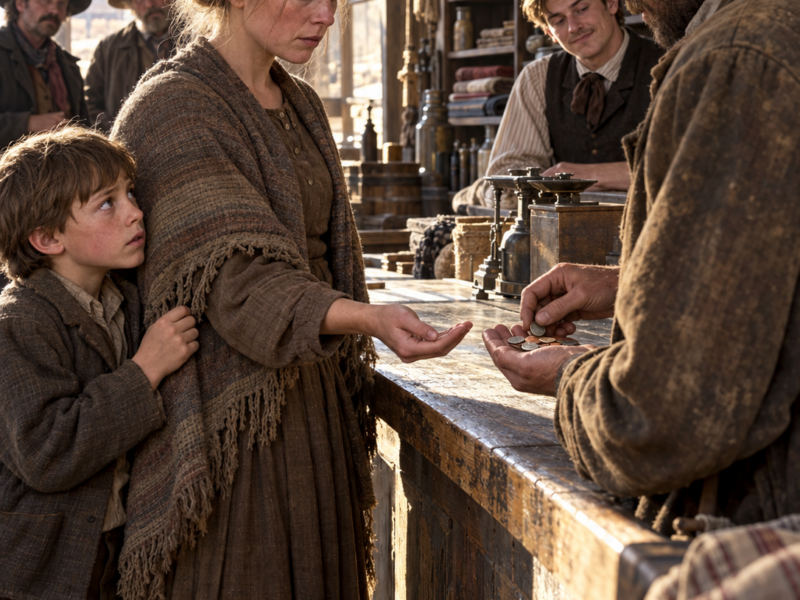
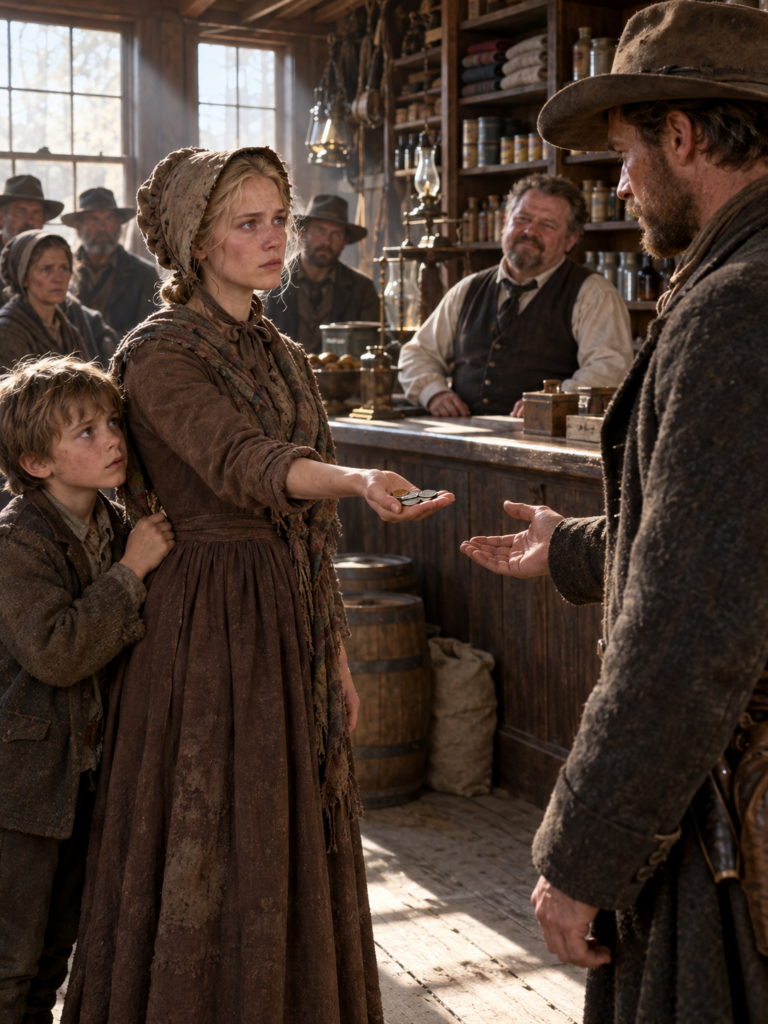
“Mr. Colton, do you remember the day you counted my coins?”
“I do.”
“You proved I had fifty-eight cents.”
“That’s right.”
“But it was not the first time that store had counted badly.”
Ezra studied her face.
“What do you mean?”
Greta held his gaze.
“I have been paying more than the marked prices since autumn. Not every penny is large enough for a man to notice. But I notice.”
“How often?”
“Fourteen times that I have written down.”
Ezra’s expression changed.
“Fourteen?”
She nodded.
“I have the dates. The goods. The prices. The money they took.”
“Then why didn’t you tell Dunore?”
“I tried telling people about one missing blanket. They showed me a paper and called me mistaken.”
Her fingers closed around the handle of the empty basket.
“I will not make the same mistake twice. This time I want proof even they cannot dismiss.”
Ezra glanced toward the road.
“I could go speak to him.”
“No.”
She spoke so firmly that he looked back at once.
“That is precisely what I do not want.”
He waited for her to finish.
“I want him to listen to me. Not because a respected rancher has spoken first.”
Ezra slowly nodded.
“Then what would you have me do?”
Greta considered him.
“Come to my cabin tomorrow. I will show you the figures. You may tell me whether they make sense.”
“And after that?”
She looked toward Elias, who was returning with their basket.
“After that, I intend to find out whether I am the only one.”
She started through the church gate, and Ezra stepped aside to let her pass.
Ezra stepped aside, but Greta paused just beyond the gate.
“Tomorrow afternoon,” she said. “After Elias finishes his lessons.”
“I’ll be there.”
“And bring your spectacles if you need them.”
Ezra raised an eyebrow.
“I don’t wear spectacles.”
“Then there is no excuse for misreading my numbers.”
He watched her walk away, her nephew keeping pace beside her.
For the first time that afternoon, Ezra smiled.
The following day, he arrived at the cabin with blue shutters carrying nothing but the shirt Greta had finished mending.
He had almost brought a sack of flour, then thought better of it.
Greta had been clear about what she wanted.
She wanted someone to examine her figures.
Not someone to arrive with gifts and a plan to solve her life.
Inside, Elias was bent over a primer at the kitchen table.
Greta had cleared the other end and placed a little ledger beside the lamp.
Its cover was worn, its spine beginning to loosen.
She set two cups of coffee on the table.
“May I?” Ezra asked, gesturing toward the book.
She pushed it toward him.
The pages contained columns of figures, dates, and small marks.
Some entries had crooked letters.
Others used symbols instead of words.
But the numbers were arranged with remarkable care.
“What does this mark mean?” Ezra asked.
“Flour.”
“And this one?”
“Thread.”
He turned another page.
“That’s clever.”
“It is necessary.”
There was no self-pity in her answer.
She sat opposite him and folded her hands.
“Read the figures. Do not tell me they are correct because you wish to be kind.”
Ezra looked up.
“I wouldn’t.”
“You did once.”
He remembered the mercantile.
“I counted them because I thought someone ought to.”
“And because you thought I needed a man to make them understand.”
Ezra accepted the rebuke.
“Yes,” he said. “I reckon there was some of that in it.”
Greta seemed surprised by his answer.
Then she pointed toward the first column.
“Begin there.”
He spent the next hour working through her records.
Every entry was dated.
Each purchase had been recorded after Greta returned home.
She had kept the marked price beside the amount actually paid.
A difference of two cents here.
Three cents there.
Sometimes a little more.
Never a difference in her favor.
Fourteen discrepancies since the autumn harvest.
Ezra checked the addition twice.
Then he closed the book.
“Your figures hold.”
Greta let out a breath she had been keeping inside her chest.
“I knew that.”
“I know.”
“But you checked.”
“That was what you asked me to do.”
For a moment, the kitchen was silent except for Elias turning a page.
Then Greta told Ezra about the winter receipt.
She described the relief supplies delivered when her sewing brought too little money and the cold came before she was prepared.
She explained how the deacon had pointed to the place where she should make her mark.
The paper, she had been told, listed what she received.
Only afterward had she discovered that its quantities were wrong.
“I challenged it,” she said. “And they showed me my own mark.”
Ezra’s jaw tightened.
“Did they ever explain the difference?”
“No.”
“Do you believe someone took the second blanket?”
“I don’t know.”
Her answer was immediate.
“I know only that the paper was wrong and they would not hear me. I will not accuse someone of stealing what I cannot prove was stolen.”
Ezra leaned back.
The restraint in that answer told him more about her than any of the mercantile’s laughter had.
“What happened to your sister?” he asked gently, after a while.
Greta glanced at Elias.
The boy kept reading, though both adults knew he could hear them.
“She died before we came here,” Greta said. “Elias was left to me.”
She watched the boy with an expression both tender and determined.
“I promised he would have schooling. A proper home. Someone who would not leave him wondering whether he belonged.”
Ezra nodded.
“And that’s why you came west?”
“Work was promised. Sewing. People needing clothes mended and household linens repaired. I believed I could make enough.”
“Did you?”
“Some weeks.”
She gave a small, weary smile.
“Some weeks I learned how far soup can stretch.”
Ezra did not offer pity.
Instead, he asked the question she had been waiting to hear.
“What do you want to do with the ledger?”
“Take it to Mr. Dunore.”
“And you want me there?”
“Outside. Where he can see you. But you will not speak unless I ask.”
Ezra considered the arrangement.
“That’s a hard position for a talkative man.”
Greta gave him a look.
“You are not a talkative man.”
“Then it should suit me.”
Three days later, Greta walked into Elmer Dunore’s mercantile with Elias beside her and her ledger held against her chest.
Ezra waited on the porch.
Dunore listened while Greta explained the fourteen discrepancies.
At first, his expression was patient.
Then it became dismissive.
“Prices change, Miss Lindqvist. Perhaps you’ve confused one week’s prices with another.”
“I wrote them the day I paid.”
“Silas has worked here for years.”
“Then he has had years to learn his figures.”
Dunore frowned.
Greta opened her ledger and showed him the columns.
“Fourteen times. Always more money taken. Never less.”
“Well, I will speak to him.”
“Will you check the accounts?”
“I said I would speak to him.”
Greta understood.
He wanted the complaint to end.
She closed the ledger.
“Then I thank you for your time.”
She walked outside without raising her voice.
Ezra straightened as she came down the steps.
“Well?”
“He heard me.”
“Did he listen?”
“No.”
They walked toward her cabin.
Ezra had never found silence quite so uncomfortable.
At last he said, “I could have made him look at those pages.”
“I know.”
“You could have asked.”
“I know that too.”
She stopped beside the road.
“But I am tired of being believed only after a man repeats my words.”
Ezra looked down at the ledger in her hands.
“You’re right.”
Greta studied him.
“You say that often.”
“Perhaps I’ve been wrong often.”
That earned him a brief smile.
A few days later, Ezra returned to the mercantile for nails.
He did not mention Greta.
He stood near the tool bins, examining files and hinges, when old Henry Voss came to the counter.
Henry was the blacksmith’s father, a white-haired man with a voice loud enough to carry across a pasture.
Silas counted his change.
Henry looked at the coins.
“That’s not right, boy.”
Silas checked.
Then he checked again.
His ears reddened.
“You’re right, Mr. Voss. My mistake.”
He corrected it immediately.
Henry grumbled, pocketed his money, and left.
Ezra remained still.
What troubled him was not merely that Silas had made another mistake.
It was how quickly he’d corrected it when Henry complained.
There had been no laughter.
No demand that Henry prove he understood numbers.
No suggestion that the old man was confused.
Ezra began to understand the difference Greta had tried to explain.
Silas was careless.
But some people could demand that his carelessness be corrected, while others were made ashamed for noticing it.
That evening, Ezra told Greta what he’d witnessed.
She listened closely.
“Then he does not count only my money badly.”
“No.”
“That matters.”
“It does.”
“It means we should not call him a thief without proof.”
Ezra nodded.
“But it also means,” she continued, “that people like me may have paid for his mistakes for a long time.”
She looked at her ledger.
“Perhaps it is time we asked them.”
The second thread came from Elias.
He had been visiting the Halverson household, where an elderly woman let him help shell peas and rewarded him with stories of earlier settlement days.
That afternoon, the Halverson daughter-in-law, newly arrived from Norway, mentioned that she never seemed to receive the change she expected at the mercantile.
Elias stopped shelling peas.
“How much did you pay?”
She told him.
He worked the figures aloud.
Two cents were missing.
He asked what she had bought.
Flour.
His heart began to race.
When he reached home, he rushed through the kitchen doorway.
“Aunt Greta! She says the flour costs more when she reaches the counter!”
Greta laid down her sewing.
“Who says?”
“Mrs. Halverson’s daughter-in-law.”
She listened as Elias described the figures.
When he finished, Greta sat for a long moment.
Then she reached for her ledger.
The following day, she visited the Halverson home.
She took her own book, a pencil, and a small slate.
She asked the young woman to show her what she remembered.
Together, they reconstructed the purchase.
The figures matched Elias’s account.
Greta asked permission to copy them.
Then she visited the Brandt household beyond the rail spur.
Otto Brandt was reluctant to discuss his family’s accounts.
He disliked admitting that anyone might have taken advantage of him.
His wife finally brought out their records.
When Greta compared them with her own, she found discrepancies of the same kind.
At the Novak home, Anesca Novak struggled to explain the transactions in English.
Greta sat with her for an entire afternoon.
They used gestures, coins, the slate, and whatever words they shared.
There were misunderstandings.
They erased figures.
They began again.
But eventually the numbers held together.
When Anesca realized what they had found, her eyes filled.
“I thought I was foolish.”
Greta placed her hand beside the other woman’s on the table.
“So did I.”
Anesca looked down.
“Not foolish?”
“No.”
Greta tapped the slate.
“Careful.”
The word meant more than either woman could easily say.
By the end of the week, Greta had gathered records from four other immigrant households.
Some were detailed.
Some were incomplete.
But together they showed the same troubling pattern.
Discrepancies at the mercantile were repeatedly left unresolved when customers lacked the English, confidence, or standing to challenge them.
Greta spread the books across her porch while Ezra sat beside her.
Elias stood nearby, trying not to look as proud as he felt.
Ezra studied the pages.
“Five households.”
“Five.”
“And you mean to take this back to Dunore?”
“No.”
She closed the first ledger.
“I already gave him the chance to listen privately.”
“Then what?”
“The Grange meeting.”
Ezra looked up.
“Thursday?”
“Yes.”
“Half the settlement will be there.”
“That is the idea.”
He regarded her for a long moment.
“You know what they’ll say.”
“I know what they have said already.”
“This could make things difficult for you.”
Greta smiled without amusement.
“More difficult than being laughed at for counting correctly?”
Ezra had no answer.
She placed her palm on the ledgers.
“When I complained alone, people said I was confused. When Mrs. Halverson’s daughter-in-law complained, she thought the fault must be hers. Anesca thought the same.”
Her voice trembled slightly.
“Do you understand what that means?”
Ezra nodded.
“It means you’ve all been carrying the same shame separately.”
“Yes.”
Greta looked toward Elias.
“And if nobody says anything, he will grow up watching it happen.”
Ezra rose from the porch bench.
“Then we’ll go Thursday.”
Greta shook her head.
“I will go Thursday.”
He stopped.
She stepped toward him.
“I want you there. I want you to stand beside me. But I do not want you at the front of that room explaining my accounts.”
Ezra met her eyes.
“I can manage that.”
“You must promise.”
“I promise.”
Greta looked relieved.
Then she picked up the five ledgers, wrapped them carefully in a piece of cloth, and tied the bundle.
On Thursday evening, the Grange Hall was crowded before the meeting began.
Farmers stood along the walls.
Women settled on benches, some with tired children sleeping against their shoulders.
Reverend Teague sat near the front.
Elmer Dunore occupied a chair beside the table where the meeting records lay.
Ezra stood against the wall.
Elias took a place in the first row.
Greta remained near the doorway until her name was called.
Then she walked to the front carrying the ledgers.
Every step seemed to echo.
She laid the books on the table.
“My name is Greta Lindqvist,” she began.
Her accent was clear.
Her hands were steady.
“I came here because I believe an honest person should be able to earn a living by honest work.”
She looked across the room.
“I have tried to do that.”
A woman shifted in her seat.
Greta continued.
“For seven months, I have kept the account of what I bought at the mercantile. I have found mistakes. Always mistakes that cost me money.”
Elmer Dunore frowned.
“Miss Lindqvist, we have already discussed—”
“Yes, sir.”
Her voice remained respectful.
“We discussed it. But we did not check it.”
A murmur moved through the room.
She placed her hand on the other ledgers.
“These belong to four other households. I asked their permission to bring them.”
Mrs. Ordway rose from the second row.
“Surely you understand that figures written by people unfamiliar with our language are not necessarily reliable.”
Greta looked at her.
“I understand that every figure should be checked.”
Mrs. Ordway opened her mouth again.
Ezra spoke from the wall.
“Let her finish.”
Three words.
Nothing more.
Greta turned toward him.
He fell silent.
Then she faced Dunore.
“I am not asking you to believe my writing.”
She pointed to the book lying before him.
“I am asking you to open your own accounts, Mr. Dunore.”
The storekeeper hesitated.
Greta took a slow breath.
“Read the first purchase from October ninth. Let everyone here add the numbers with us.”
Dunore looked toward Reverend Teague.
The reverend nodded.
And at last, with the entire hall watching, Elmer Dunore opened the mercantile ledger.
Elmer Dunore opened the mercantile ledger, then ran one finger slowly down the page.
The room was so quiet that Greta could hear someone shifting his boots against the floorboards.
Dunore cleared his throat.
“October ninth.”
He adjusted the book beneath the lamp.
“Flour, forty cents. Bacon, thirty-five. Coffee, twenty-five.”
Greta nodded.
“And the total?”
Dunore hesitated.
“One dollar and twenty cents.”
She did not smile.
She did not turn toward Ezra.
Instead, she looked around the room.
“Would someone please add those three prices aloud?”
Old Henry Voss, sitting near the back, spoke first.
“Forty and thirty-five makes seventy-five.”
Elias raised his hand almost before Henry finished.
“And twenty-five more makes one dollar.”
Several people nodded.
A woman began counting on her fingers.
Another whispered the sum to her husband.
Greta turned back to Dunore.
“One dollar.”
Dunore stared at the figures.
Then he added them again.
This time, much more slowly.
“One dollar,” he admitted.
Greta let the words remain in the air.
“Your book says one dollar and twenty cents.”
No one moved.
“There is the difference,” she said. “Not hidden. Not complicated. A mistake anyone can see if someone takes the trouble to check.”
Dunore’s face darkened.
He turned the page, then returned to the first entry.
“I don’t understand how this wasn’t caught.”
“Neither do I,” Greta answered.
But there was no triumph in her voice.
Only weariness.
Reverend Teague rose and approached the table.
“May I?”
Dunore moved aside.
The reverend examined the prices and added them on a scrap of paper.
“She’s correct,” he said. “Exactly correct.”
Greta felt Elias looking at her.
She wanted to turn and smile at him.
But she was not finished.
“Another household has records,” she said.
The Halverson daughter-in-law rose from her bench and brought forward her book.
Her English was uncertain, so Greta gave her time.
Together they pointed out the purchases and the money paid.
Again, the figures did not agree.
Dunore examined the corresponding store records.
He found an incorrectly copied price, one that had been carried forward in later calculations without proper checking.
He ran his hand over his face.
“I’ve been trusting these figures without looking closely enough.”
The admission was small.
But it was the first honest thing he had said about the matter in months.
Otto Brandt stood.
His heavy German accent filled the hall.
“My wife’s accounts showed me something was wrong. I told her she must have copied them badly.”
He looked toward Greta.
“I was wrong.”
His wife sat beside him with her hands folded tightly.
Anesca Novak could not comfortably address the meeting in English.
But she stood long enough to nod when Greta mentioned her household’s figures.
No one laughed.
Greta looked across the faces.
Some were ashamed.
Some were defensive.
Some appeared to be reconsidering conversations they had forgotten almost as soon as they happened.
She realized that she had once imagined this moment very differently.
For months she had dreamed of standing before the people who doubted her and watching them feel the humiliation they had given her.
But now that the opportunity was here, she did not want their humiliation.
She wanted their attention.
She wanted change.
“I do not know that Silas meant to cheat anyone,” she said.
Dunore looked up.
“Miss Lindqvist—”
“I am not calling him a thief.”
She placed her hand on the ledgers.
“I am saying that mistakes were made. I am saying those mistakes cost money. And I am saying that when people like me noticed, we were made to feel foolish for speaking.”
Her voice strengthened.
“If a man can argue loudly, he gets his change corrected. If a woman cannot find her English words quickly enough, sometimes she goes home with less money and more shame.”
Henry Voss bowed his head.
Greta continued.
“I want the accounts checked. I want the money returned where it is owed. And I want the same care given to every customer, whether they speak English easily or not.”
She stepped back.
That was all.
For the first time since entering the hall, she looked toward Ezra.
He stood where he had promised to stand.
Against the wall.
Silent.
His face showed a pride he made no attempt to hide.
But he did not come forward.
He understood the moment belonged to her.
Reverend Teague closed his Bible on the table.
“Some Sundays ago,” he said, “I reminded this congregation of the command not to oppress the stranger.”
He looked around the room.
“I wonder how many of us heard those words and imagined they were meant for someone else.”
Mrs. Ordway lowered her eyes.
The reverend turned toward Dunore.
“Elmer, I believe the next words should come from you.”
The storekeeper remained seated for several seconds.
Then he rose.
“I trusted my nephew’s work,” he began. “I should have checked it.”
His throat worked.
“I dismissed complaints that deserved investigation.”
He looked toward Greta.
“And I was wrong to do that.”
He turned to the room.
“Every account will be examined. Any money taken in error will be returned. Older overcharges will be repaid with interest, and any household that wants its purchases checked will have that right.”
A low murmur passed among the benches.
Dunore continued.
“Silas will work under my supervision until I am satisfied the mistakes have stopped.”
He paused.
“And from now on, the figures will be checked before a customer leaves the counter.”
Greta watched him carefully.
Promises were easy to make in a crowded hall.
The work of keeping them would come afterward.
Silas, who had been standing near the doorway, looked as though he wished the floor would swallow him.
Dunore called him forward.
The young clerk walked reluctantly toward the table.
He stopped several feet from Greta.
“I was careless,” he said.
His voice was low.
“I didn’t mean to take anybody’s money.”
Greta said nothing.
Silas swallowed.
“I thought if people didn’t understand me, there wasn’t much harm in telling them to count again. I didn’t think about how it sounded.”
He looked at her for the first time.
“I’m sorry, Miss Lindqvist.”
Greta studied him.
“You must think about it now.”
He nodded.
“And check the figures.”
“Yes, ma’am.”
She did not forgive him with a grand speech.
There was no need.
An apology could begin something.
It could not replace the work of making things right.
Near the rear of the hall, Henry Voss stood again.
“Boy made mistakes with me too,” he said loudly. “I just hollered until he fixed them.”
A few people gave uncomfortable little laughs.
Henry did not smile.
“Seems I never thought much about the folks who couldn’t holler.”
He sat down.
For Greta, those words mattered nearly as much as the calculations.
Someone had finally understood that the difficulty was not only in the numbers.
It was in whose voice the town chose to hear.
Then Mr. Ordway rose.
“What about the church relief accounts?”
His wife stiffened.
He looked toward Reverend Teague.
“If we’re talking about proper counting, ought we not check those too?”
Another silence settled over the hall.
Greta felt the old anxiety stir in her chest.
The winter paper.
The missing blanket.
The mark she had made without understanding the words above it.
Mrs. Ordway spoke carefully.
“Our relief money has always been handled responsibly.”
“I’m sure you’ve worked hard at it,” the reverend replied. “But that isn’t quite the same as checking.”
Greta watched the exchange.
A few months earlier, she would have stood there certain the conversation would turn against her.
Now she understood she had a choice.
She could demand the winter account be examined.
Or she could let the committee correct its practices going forward while preserving the unanswered question.
She took a breath.
“I would like my receipt checked,” she said.
Mrs. Ordway looked toward her.
“I still have my own figures.”
Reverend Teague nodded.
“Then bring them.”
Greta felt something loosen inside her.
For once, she had not needed to fight just to make the request.
***
The following week, the relief committee met in the church’s back room.
A small fire burned in the stove.
The coal money tin stood on the table.
Greta arrived with her ledger tucked beneath her arm.
Mrs. Ordway was already seated.
Mrs. Fenwick, who kept the written names and accounts, sat beside her.
For a moment, neither Greta nor Mrs. Ordway spoke.
Then the older woman gestured toward the empty chair.
“Please sit down.”
Greta sat.
Mrs. Ordway folded her hands.
“I have kept these accounts for eleven years.”
Greta waited.
“I was proud of the work. Perhaps too proud.”
She looked toward the coal tin.
“I thought because the money had never gone missing, it meant everything was being done correctly.”
Her voice softened.
“And when you questioned the winter receipt, I believed the paper before I believed you.”
Greta looked at the table.
Mrs. Ordway continued.
“I should have asked someone to check what was actually delivered.”
“Yes,” Greta said.
The older woman nodded.
“I know.”
There was no attempt to excuse it.
No claim that the insult had been harmless.
That made the conversation easier to bear.
Mrs. Fenwick opened the winter record.
They examined it together.
The receipt listed two blankets, as Greta had said.
But the surviving account did not establish clearly whether the second blanket had been delivered, misplaced, or recorded incorrectly.
There was no honest way to settle that uncertainty from the paper alone.
Mrs. Ordway looked troubled.
“I cannot tell you what happened to it.”
Greta nodded.
“Neither can I.”
“But I can tell you that we should never have treated your question as proof you were dishonest.”
For a moment, Greta could not speak.
She had spent months wishing someone would say precisely that.
At last she answered.
“That is what I needed you to understand.”
Mrs. Ordway turned the account book toward her.
“Then I’d like to ask you something else.”
Greta waited.
“Would you take charge of checking the quantities and money for the relief committee?”
Greta stared at her.
“The counting?”
“Yes.”
Mrs. Fenwick smiled gently.
“I will continue the written names and reports. You would check the totals, payments, and supplies.”
Mrs. Ordway added, “We need the work done correctly. And you have shown that you can do it.”
Greta looked down at the book.
The same table where she had not been trusted near the coal tin was now being offered to her as a place of responsibility.
She felt no sudden desire to embrace Mrs. Ordway.
The hurt had been real.
Some of it remained.
But a woman could accept a fair offer without pretending the past had never happened.
“What if I disagree with a written entry?” Greta asked.
“Then we check it.”
“And if I find a mistake?”
“We correct it.”
“Even if it is yours?”
Mrs. Ordway met her eyes.
“Especially then.”
Greta considered that.
Then she reached for the pencil.
“I will do it.”
There was no ceremony.
No applause.
Only three women at a wooden table, beginning work that should always have been shared with greater care.
But Greta would remember the sound of that pencil moving across the page for the rest of her life.
***
Outside the church room, Ezra waited with Elias.
The boy was sitting on the steps, swinging his feet.
When Greta appeared, he sprang up.
“Did they let you count?”
She looked down at him.
“Yes.”
“All the money?”
“The money and the supplies.”
Elias grinned.
“I told them you could.”
Greta bent and straightened his collar.
“You did.”
Ezra approached slowly.
“How was it?”
She held up the ledger.
“They have asked me to keep the figures.”
Ezra smiled.
“Sounds to me like they chose wisely.”
They walked home together in the evening light.
Elias went a little ahead, talking about his lessons and whether the garden would be ready for planting.
Greta listened with half an ear.
Her thoughts were elsewhere.
After a while, she looked toward Ezra.
“You never said anything about me needing to learn to count.”
He glanced at her.
“Why would I?”
“Most people in this town have told me what I must learn.”
Ezra considered his answer.
“You knew the numbers before I ever met you.”
Greta looked away.
The prairie stretched gold beneath the setting sun.
“That is the first time someone has said it quite that way.”
They walked in silence for several minutes.
Then Ezra spoke.
“I owe you an apology.”
She looked at him in surprise.
“For what?”
“For that first day in the store.”
“You helped me.”
“I did.”
“And the numbers were right.”
“They were.”
He shifted his hat in his hands.
“But I made myself the center of a moment that should have belonged to you.”
Greta slowed.
Ezra continued.
“I thought standing up for you meant doing the talking. Took me longer than it should have to understand you needed people to hear your own voice.”
She watched his face.
He was not trying to flatter her.
He was admitting something difficult.
And he had already changed his behavior.
At the mercantile, he’d spoken before she could stop him.
At the Grange, he’d remained at the wall.
When she stood before the town, he’d let her finish.
Greta smiled faintly.
“You learned.”
“Still learning.”
“That is good.”
He looked down the road.
“Can’t promise I’ll never make another mistake.”
“I would not believe you if you did.”
He laughed.
The sound startled them both.
They reached her gate as the last light caught the blue shutters.
Elias hurried inside to put away his books.
Greta remained beside the fence.
Ezra turned his hat over once.
“There’s something else I’ve been wanting to say.”
Greta waited.
He looked toward the small garden, the porch, and the smoke rising from the chimney he’d repaired weeks earlier.
“I enjoy coming here.”
“I know.”
“I enjoy your company.”
She looked at him.
“I know that also.”
Ezra rubbed a hand over his jaw.
“You’re making this difficult.”
“No. I am making you speak plainly.”
He smiled.
“Fair enough.”
He met her eyes.
“I would like to keep courting you, Greta. Slowly, if that’s what you’d prefer.”
She looked toward the cabin.
Inside, Elias was humming while he put his books away.
She thought of the first day at the mercantile.
Of how wary she had been.
Of how little trust she had left to offer.
And of how Ezra had learned not to take more than she freely gave.
“I have Elias,” she said.
“I know.”
“I have work here.”
“I know that too.”
“And I will not give up the place I am making for us merely because a man has begun to care for me.”
Ezra answered without hesitation.
“I wouldn’t ask you to.”
She studied him.
“You would have to be patient.”
“I’ve been learning that too.”
Greta looked down, smiling now.
The smile was no longer guarded.
“Then you may come Sunday.”
Ezra’s face softened.
“For supper?”
“For coffee. We shall see about supper.”
He touched the brim of his hat.
“Sunday it is.”
As he walked away, Greta stood at the gate a little longer than necessary.
She was not a woman waiting for someone to save her.
She had earned her own living, protected her nephew, confronted the town, and claimed a place at the table.
Now, for the first time in many months, she could imagine letting another person become part of her life without surrendering any of those things.
***
The summer brought changes to Larksburg Crossing.
They were not sudden.
Real change seldom arrived in a single grand moment.
Dunore kept his promise.
He examined the mercantile accounts with Silas and arranged repayments to households that had been overcharged.
Some sums were small.
Others were enough to matter greatly to families counting every purchase.
Silas continued working under supervision.
He made mistakes now and then.
But he stopped laughing when customers questioned a total.
More importantly, he began checking the figures before anyone had to ask.
Greta noticed that.
She did not praise him for doing what should have been done from the beginning.
But she recognized the improvement.
At the relief committee, Mrs. Fenwick and Greta developed a steady way of working.
Mrs. Fenwick handled the written reports.
Greta checked the quantities, prices, and payments.
They reviewed each other’s entries before closing the book.
At first, Mrs. Ordway watched them with visible discomfort.
Then, gradually, she began asking Greta’s opinion before making purchases.
One afternoon, Greta corrected a coal calculation that would have left the committee short before the next delivery.
Mrs. Ordway examined the figures.
Then she nodded.
“Good thing you caught that.”
Greta looked up.
“Yes.”
It was an ordinary exchange.
That was what made it precious.
No one seemed surprised that she was right.
Outside those meetings, Greta continued sewing.
Her earnings became steadier as more households trusted her work.
Elias helped plant the garden and continued practicing his English lessons.
Sometimes he sat beside his aunt while she worked through a difficult passage from his primer.
She never pretended the words were easy.
He never pretended he knew everything.
They learned together.
Ezra came on Sundays when ranch work allowed.
Sometimes he brought coffee.
Sometimes he brought a shirt that genuinely needed mending.
Sometimes he came with nothing at all.
He learned to ask before repairing anything.
Greta learned that accepting help did not always mean surrendering control.
She visited the ranch and saw the work that occupied so much of Ezra’s days: livestock needing care, fences requiring repair, crops and supplies to manage, and ordinary responsibilities that could not be postponed simply because a man wished to spend an afternoon elsewhere.
Ezra respected the same truth about her sewing and committee duties.
They did not always agree.
When they disagreed, they talked.
Sometimes badly at first.
Then more carefully.
Their affection grew through those ordinary conversations, through shared coffee, and through the small discovery that each could remain entirely themselves in the other’s company.
One Saturday, they rode into town together with Elias seated in the wagon between them.
The boy was excited about a new book Ezra had promised to help him find.
Outside the mercantile, Greta noticed the Novak family standing near the steps.
Anesca held several unfamiliar coins in her palm.
Her husband was trying to calculate a purchase.
Both looked uncertain.
Greta placed a hand on Ezra’s arm.
“Stop here, please.”
He pulled the wagon to the rail.
She climbed down.
“Anesca?”
The woman looked up.
Greta approached with a smile.
“Would you like some help?”
Anesca hesitated.
Then she opened her palm.
Greta examined the coins.
She began naming them one by one, showing how they added together.
She spoke slowly, giving Anesca time to repeat each amount.
When they reached the total, she rearranged the coins and asked Anesca to try again.
This time, the younger woman counted them correctly without assistance.
Her face brightened.
Greta smiled.
“There. You knew more than you thought.”
From the wagon, Elias watched proudly.
Ezra remained seated, the reins loose in his hands.
There had been a time when he would have climbed down immediately to offer his help.
Now he understood that the most useful thing he could do was allow Greta to give hers.
Anesca thanked her.
Greta shook her head gently.
“Next time, you will know. And one day you can show someone else.”
She returned to the wagon.
Ezra offered his hand to steady her as she climbed up.
She took it.
Not because she could not manage without him.
Because she wanted to.
As they drove away, Elias leaned forward.
“Aunt Greta?”
“Yes?”
“Do you remember when they laughed at you in this store?”
She looked toward the mercantile.
“I remember.”
“They don’t laugh now.”
Greta watched the dusty road ahead.
“No,” she said softly. “They don’t.”
Elias considered that for a moment.
“Is it because Mr. Colton made them stop?”
Greta glanced at Ezra.
Then she shook her head.
“Mr. Colton helped me when I needed a friend.”
Ezra kept his eyes on the road.
“But the town had to learn to listen,” she continued. “And we had to keep telling the truth until they did.”
Elias nodded thoughtfully.
“Even when it was hard?”
“Especially then.”
The wagon rolled past the church beneath the cottonwoods.
The relief table had been put away for the season, but Greta knew she would sit there again.
Next time, no one would need to invite her to touch the ledger.
Her place was hers because she had proved what she could do.
And because, at last, the people around her had learned to recognize it.
Ezra glanced toward her.
“Coffee Sunday?”
Greta pretended to consider.
“Perhaps.”
“Perhaps?”
“If you bring the book you promised Elias.”
“I’ve got it right here.”
“And if you remember not to leave your hat on my kitchen table.”
He laughed.
“That’s asking a great deal.”
Greta’s smile widened.
“Then you must decide whether I am worth the trouble.”
Ezra looked at her for a moment.
There was no uncertainty in his answer.
“You are.”
She reached across the narrow space between them and rested her hand beside his on the wagon seat.
Neither made a grand promise.
They did not need to decide every year of their future that afternoon.
Greta had her home.
Elias had his schooling.
Ezra had his ranch.
And between those places, something patient and honest was taking root.
The kind of love that did not demand a person become smaller to make room for it.
As the wagon moved into the warm Dakota afternoon, Greta felt the coins in her pocket shift against one another.
She no longer carried them as proof that she must be ready to defend herself at every counter.
She carried them because they were hers.
Because she knew their value.
Because she had always known.
And beside her rode a man who had learned that loving her did not mean speaking louder than she could.
It meant hearing her.
That was enough for a beginning.
And this time, the beginning belonged to Greta.