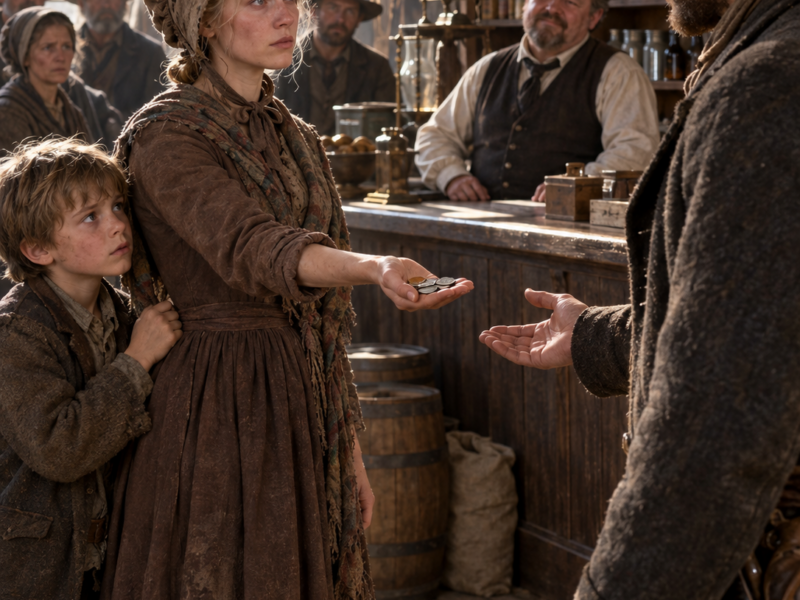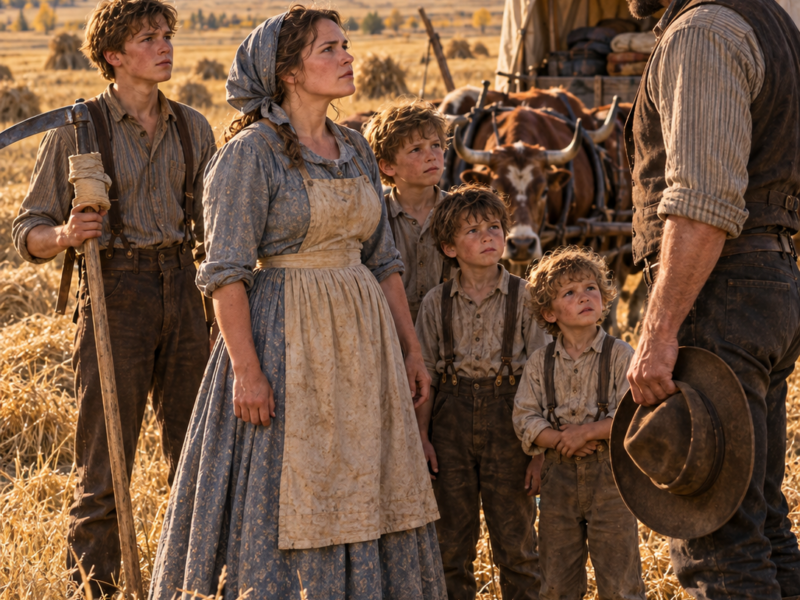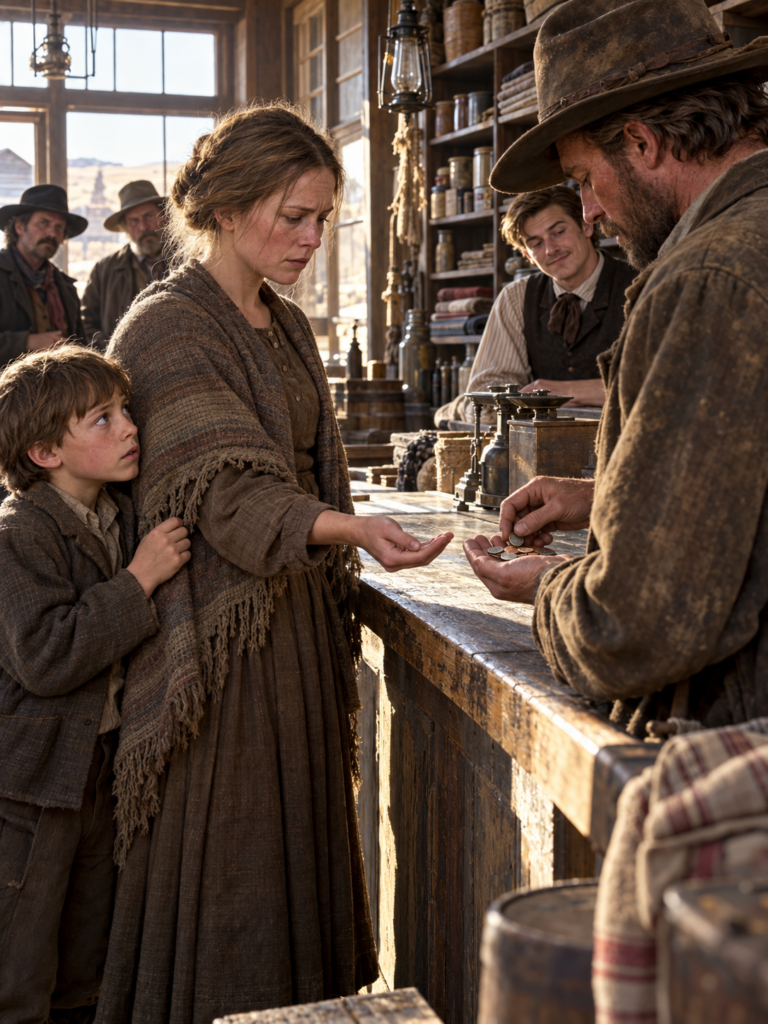
The ledger opened between them, its worn pages fluttering in the sharp spring wind.
Greta caught the corner beneath her thumb before a sheet could fold backward.
“Look,” she said.
Ezra stepped closer, careful not to crowd her.
Inside were columns of dates, prices, and small marks. Some words were missing altogether, replaced by symbols Greta had made herself.
He recognized flour, kerosene, needles, and coffee from the figures beside them.
“These are your purchases?”
“Every one since last autumn.”
Elias edged nearer.
“Aunt Greta counts everything.”
“I can see that.”
Greta turned back several pages.
“October. Two cents more than the marked price. November. Again. December. Again.”
Ezra followed her finger.
Fourteen entries carried the same kind of discrepancy.
Every difference favored the store.
Not one favored Greta.
“Have you shown Mr. Dunore?”
She closed her eyes briefly.
“No.”
“Why?”
“Because today you saw what happens when I say fifty-eight cents.”
Ezra had no answer.
A gust tugged at the ledger again. Greta steadied it against the basket and turned another page.
“Last winter, the church brought coal and blankets. I was grateful. Elias was cold. We had little put aside.”
Her words became slower.
“They brought a paper for me to mark. It said what we received.”
“You couldn’t read it?”
“Not well enough.”
She looked at him sharply.
“I know the numbers. The long English words are harder.”
“There’s no shame in that.”
“Others think there is.”
She told him how a church deacon had pointed to a place on the relief paper, assuring her it recorded two blankets.
She had received one.
When she questioned the amount, he showed her own mark as proof that the account must be correct.
“Afterward, people believed I complained about help freely given.”
Ezra looked toward the mercantile door.
“Did anyone check?”
“No one thought to.”
Elias drew closer to his aunt.
“We only had one blanket,” he whispered.
Greta squeezed his shoulder.
“I know.”
Ezra understood a little more now.
The ledger was not merely a record of pennies.
It was the only witness she trusted to speak clearly in a language that still sometimes betrayed her.
“Maybe the clerk’s careless,” he said.
“Maybe.”
“Could be other folks have lost money too.”
“That is what troubles me.”
She turned the ledger toward herself.
“I can tell you what I paid. I cannot yet tell you why.”
Ezra considered the fourteen entries.
“Will you let me help?”
Greta studied him.
“Help how?”
“I can read the longer words. You can check the figures.”
“And when someone asks who found the mistakes?”
“I’ll tell them.”
“What?”
“That you did.”
For the first time, her expression softened.
Only a little.
“Then you understand more than you did inside.”
“Reckon I’m learning.”
A wagon rattled past, making Elias step nearer the wall.
Greta closed the book and tucked it beneath the cloth.
“I have sewing to finish,” she said. “And Elias must practice his reading.”
“Then I won’t keep you.”
He tipped his hat.
She had already taken two steps when she turned back.
“Mr. Colton?”
“Ma’am?”
“The figures are not all I have kept.”
He waited.
“Sometimes I write down who was there. Who laughed. Who watched. Who said nothing.”
Her voice was quiet.
“I do not want Elias growing up believing that being silent makes a thing right.”
Ezra felt that more sharply than he expected.
“I don’t want that either.”
Greta nodded toward the road.
“Then when I ask for help, stand beside me. Do not stand in front of me.”
“You have my word.”
She started down the boardwalk, Elias holding her free hand.
Ezra remained by the hitching rail.
But before Greta reached the corner, she stopped, opened her ledger once more, and carefully added a new mark beside that day’s purchase.
Fifty-eight cents paid.
Fifty-seven cents owed.
One penny returned.
Then she turned to a fresh page and began writing the name of the man who had witnessed it.
Greta finished writing Ezra Colton’s name, closed the ledger, and tucked it away before the wind could catch another page.
Elias looked up at her.
“Does that mean Mr. Colton will help us?”
“It means,” she said, “he listened.”
The distinction mattered to her.
She had come to Dakota Territory believing that work, careful saving, and keeping one’s promises would be enough to build a respectable life.
Then her sister died, leaving Elias in her care.
Greta took over the little cabin with its blue shutters and bare garden patch. She earned what she could by sewing, mending, and occasional household work.
She knew how to stretch flour.
She knew how to mend a worn shirt so that it lasted another season.
She knew precisely how many pennies remained after paying for lamp oil.
But English handwriting defeated her often enough that strangers confused difficulty with foolishness.
That mistake had cost her far more than money.
Three days after the mercantile encounter, Ezra arrived at the cabin carrying a length of stove pipe.
Greta opened the door with a sewing needle still pinned into her cuff.
“What is that?”
“Something your chimney could use.”
“I did not ask for charity.”
“Didn’t come offering any.”
He showed her the pipe.
“Your chimney draws poorly. I can fit this piece. I’ve a shirt needs mending at the shoulder.”
She considered the exchange.
“How badly torn?”
“Bad enough I ought not wear it to church.”
“Then you have made a fair bargain.”
“That’s what I hoped.”
She opened the door wider.
“Come in.”
It was not an invitation into her life.
Not yet.
But it was the first time she had invited him across her threshold.
Ezra worked on the stove pipe while Elias watched with interest.
Greta finished one seam and began another.
When the chimney drew properly, smoke rose cleanly instead of curling back into the room.
Ezra wiped his hands.
“That ought to help.”
Greta examined the work.
“And your shirt?”
He handed it over.
She studied the torn shoulder.
“You worked hard to ruin this.”
“Can’t deny it.”
“Then perhaps I should charge more.”
He smiled.
“Perhaps you should.”
Elias laughed.
It was a small sound, but Greta noticed how freely it came.
Over the next several weeks, Ezra returned when he had useful work to do or a genuine errand nearby.
He split wood.
Greta mended his shirts.
Sometimes they shared coffee.
Sometimes Elias read aloud from his primer while Ezra repaired a loose hinge or sharpened a tool.
Ezra never treated the boy as an inconvenience.
And he never asked Greta to explain her gratitude.
That, more than anything, allowed her to become comfortable with his presence.
One afternoon, Elias stumbled over a long word.
Greta helped him sound it out, then admitted she had been uncertain of the last letters herself.
Ezra looked up from a repaired harness strap.
“Want me to read it?”
Greta hesitated.
Then she handed him the book.
“Once. Slowly.”
He did.
She repeated the word.
Elias tried again.
All three got it right.
Greta laughed at herself, then stopped when she realized neither of them was laughing at her.
Ezra returned the primer.
“Reckon that’s how most learning gets done.”
“With patience?”
“And by not pretending we knew yesterday what we only learned today.”
The words stayed with her.
But learning in her kitchen was easier than being believed in town.
On the second Sunday in May, Reverend Teague spoke about the duty owed to strangers.
He reminded the congregation that no person should be mistreated simply because they had come from somewhere else.
Several people lowered their eyes.
Greta sat in the rear pew beside Elias.
Ezra sat nearer the aisle.
Neither looked toward the other during the sermon.
Later that month, the church held a supper to help the Hollis family, whose pantry needed filling after a difficult spring.
Tables stood beneath cottonwood trees.
Women arranged food while others counted money for coal and household supplies.
Greta brought a dish and offered to help with the figures.
Mrs. Ordway, who had supervised the relief accounts for years, glanced at her.
“We have the money table handled, dear.”
“I can count.”
“I’m sure you can. But after last winter’s confusion, perhaps you’d be more comfortable serving food.”
Greta remained still.
The insult had been dressed in kindness.
That made it harder to answer.
Ezra approached from the woodpile carrying an armful of split logs.
He heard enough to understand.
His first impulse was to challenge Mrs. Ordway before everyone.
Then Greta looked at him.
The warning in her eyes was unmistakable.
He set the wood down.
Instead of making a speech, he took a seat on the bench near the accounts.
Greta leaned toward him.
“People will talk.”
“Likely.”
“They may decide you are foolish for sitting with me.”
Ezra turned his hat in his hands.
“They’ve thought worse of me after a poor cattle trade.”
“This is not the same.”
“No,” he admitted. “It isn’t.”
She looked surprised.
He continued.
“I don’t lose much if somebody dislikes my opinion. You lose work when folks decide you’re troublesome.”
Greta studied him.
“You understand that?”
“I’m beginning to.”
She looked toward the table, where Mrs. Ordway kept counting.
“Then stay. But let me speak for myself.”
Ezra remained seated.
“I can manage that.”
He kept his promise.
After supper, Mrs. Dunore stopped Greta near the church steps.
She had been among those laughing at the mercantile.
“I do hope you know we never meant any harm,” she said. “Your way of counting simply sounded unusual.”
Greta held Elias’s hand.
“It is not unusual where I come from.”
Mrs. Dunore’s smile faltered.
“Well, of course.”
“And it was correct.”
The older woman looked away.
Greta did not demand an apology.
But neither did she pretend the matter was settled.
Walking home, Ezra said, “You handled that better than I would have.”
“That is because you can afford to speak sharply.”
He considered it.
“And you can’t?”
“I can. But afterward people call me ungrateful.”
They walked in silence.
Then Greta told him the full story of the relief paper.
She described the early winter, the empty woodpile, and the supplies brought by the church.
She explained how the record listed two blankets, although only one reached her cabin.
She had marked the paper because she trusted the man who showed her where to put her name.
When she questioned the difference, the signed record was used against her.
“They thought I did not remember what I received,” she said.
“Did you?”
“One blanket. I remember it very well.”
Ezra listened.
“And now they don’t trust you with the money box?”
“No.”
“Because you questioned their record?”
“Because my mark was on it.”
She looked toward the distant cabin.
“A written word can become a wall when someone else decides what it means.”
He had no clever answer.
For once, he did not search for one.
Two weeks later, Ezra noticed the ledger on Greta’s kitchen shelf.
“May I see it?”
She lifted it down herself.
Pages of figures filled the little book.
At first glance, the columns looked ordinary.
Then she showed him the repeated overcharges.
Fourteen purchases.
Fourteen discrepancies.
Each favoring the mercantile.
Ezra traced one column carefully.
“These are all from the same store?”
“Yes.”
“Did you compare them with the prices posted when you bought the goods?”
“Every time.”
He looked at her.
“You’ve been checking this for months.”
“Since October.”
“Why didn’t you tell anyone?”
She smiled without amusement.
“Because I wanted enough proof that they could not laugh it away.”
Ezra closed the ledger.
“Then we ought to ask Mr. Dunore to check his accounts.”
“We?”
Greta raised an eyebrow.
Ezra corrected himself.
“You ought to. I’ll come if you want a witness.”
She considered him for a long moment.
“That is better.”
On Tuesday, Greta went to Dunore’s mercantile with Elias.
Ezra remained outside, as she requested.
Mr. Dunore listened while she explained the repeated mistakes.
He folded his arms.
“Silas has worked here three years. We’ve never had complaints of this sort.”
“Then perhaps no one has counted as I have.”
“Prices change, Miss Lindqvist.”
“Not fourteen times in the same direction.”
Dunore’s expression hardened.
“I’ll speak with him.”
“And compare the records?”
“I said I’ll speak with him.”
Greta understood the dismissal.
She closed her ledger.
“Then I have done what I came to do.”
Outside, Ezra saw the disappointment she was trying to conceal.
“Well?”
“He heard the words.”
“Didn’t believe them?”
“He did not even count.”
Ezra looked through the store window.
“That’s a poor way to settle a question about numbers.”
Greta turned toward home.
“It is a very good way to avoid settling it.”
A few days later, Ezra witnessed Silas make a similar mistake with Henry Voss, an older man respected throughout town.
Henry protested immediately.
Silas checked his figures and corrected the error.
Ezra learned something important.
Silas did not always make mistakes against immigrants.
But customers with standing could demand correction without being mocked.
Greta and others like her could not.
Carelessness had become more costly for people least able to challenge it.
Meanwhile, Elias made another discovery.
At the Halverson home, a Norwegian woman complained that flour cost more at the mercantile than she expected.
Elias counted the amount with her.
Again, two cents were missing.
He ran home.
“Aunt Greta! It happened to her too!”
Greta set aside her sewing.
“Show me.”
By the week’s end, she had visited several immigrant households, including the Brandts and the Novaks.
She compared their accounts, patiently working through unfamiliar words and different languages.
Four other families had records suggesting similar discrepancies.
The amounts varied.
The pattern did not.
One Saturday evening, she spread the ledgers before Ezra.
“It was never only me.”
He examined the columns.
“No.”
“One woman can be dismissed.”
Greta rested her hand on the books.
“Five households will be harder.”
Ezra watched her face.
“What are you planning?”
“The Grange meets Thursday.”
He looked up.
“You’re taking this before the town?”
“Yes.”
“That won’t be easy.”
“I know.”
“Some folks will be angry.”
“They already are when I ask a question.”
She gathered the ledgers into a neat stack.
“I have spent too long trying not to trouble people who are comfortable letting me be troubled.”
Ezra said nothing.
Greta met his eyes.
“I want you there.”
“I’ll be there.”
“But I want you beside me, Ezra. Not speaking instead of me.”
He nodded.
“Beside you.”
She placed her hand over the five ledgers.
“Then Thursday, I intend to make them count.”
Greta held her hand against the ledgers until their loose pages stopped moving.
Thursday was only five days away.
And for the first time since coming to Larksburg Crossing, she had decided that the town would hear her account whether it welcomed her words or not.
The days before the meeting passed slowly.
She checked every figure.
Elias practiced reading names and dates from the household records.
Ezra offered to help arrange the papers, but Greta had already decided the order in which they would be presented.
He did not interfere.
When he asked what she needed, she handed him a list.
“These households must know when to arrive.”
Ezra read the names.
“All of them?”
“All who agreed.”
He folded the paper.
“I’ll see they receive word.”
She nodded.
“Thank you.”
He lingered at the doorway.
“Greta?”
“Yes?”
“If the meeting goes badly, it won’t change what I think of your figures.”
She looked up.
“I know.”
“Or of you.”
Her hands stilled.
That was different.
She had come to trust him as a neighbor and a friend.
But those last words suggested something neither had yet spoken plainly.
For a moment, she allowed herself to consider what life might look like if there were someone beside her who did not require her to become smaller in order to be accepted.
Then she returned to the ledgers.
“Good night, Ezra.”
He touched his hat.
“Good night.”
The Grange Hall was crowded on Thursday evening.
Farmers still wore their work clothes.
Women settled along the benches.
Children whispered until their parents quieted them.
Elmer Dunore occupied a chair near the front.
Silas stood beside the wall, looking uncomfortable.
Reverend Teague sat at the main table.
Mrs. Ordway was there too.
Greta entered carrying the five ledgers.
Elias walked beside her.
Ezra came behind them but did not take the books from her hands.
He remembered his promise.
When the meeting reached the question of mercantile accounts, Greta stood.
Her voice was unsteady on the first sentence.
Then she looked at Elias.
He sat upright, watching her with complete faith.
She began again.
“I have kept my household figures since coming here. What I earn. What I spend. What things cost.”
Nobody interrupted.
“For seven months, the figures at the mercantile have sometimes been wrong.”
A few people shifted.
“Always in the store’s favor.”
Dunore stiffened.
Greta continued.
“I asked other families to compare their accounts. Four have brought their books.”
She laid them on the table.
“These are different hands. Different homes. Different purchases. The same kind of mistakes.”
Mrs. Ordway raised her voice.
“A person’s own ledger is hardly proof if the person keeping it has trouble reading.”
The words struck exactly where Greta expected.
But this time she did not lower her eyes.
“I agree that a record should be checked.”
The answer surprised Mrs. Ordway.
Greta turned toward Dunore.
“So let us check yours.”
The hall became quiet.
Dunore hesitated.
“My accounts are not generally discussed at public meetings.”
“They need not all be,” Greta answered. “Only the entries being questioned.”
Reverend Teague leaned forward.
“That seems reasonable.”
Dunore looked around.
He could see that refusing to examine his own figures would settle nothing.
Reluctantly, he opened the mercantile ledger.
Greta pointed to an entry.
“October ninth.”
Dunore read.
“Flour, forty cents. Bacon, thirty-five. Coffee, twenty-five.”
“And the total?”
“One dollar and twenty cents.”
Greta waited.
“Please add them.”
Dunore frowned.
“Forty and thirty-five makes seventy-five.”
He paused.
“Plus twenty-five…”
The silence grew.
“One dollar.”
Greta nodded.
“Yes.”
Dunore checked again.
The answer remained the same.
One dollar.
Not a dollar and twenty.
Reverend Teague took a pencil and repeated the calculation.
“She’s correct.”
Several people leaned forward.
Greta did not smile.
She had spent months imagining what it would feel like to hear those words from someone the town trusted.
Now that the moment had arrived, she felt mostly tired.
“That is one entry,” she said. “There are others.”
A second account showed a similar problem.
Then another household’s figures were compared.
The discrepancies did not prove a deliberate scheme.
They proved something almost as troubling: errors had been allowed to continue because certain customers were not taken seriously when they objected.
Otto Brandt stood from the rear bench.
“I doubted her myself,” he admitted.
His German accent was thick.
“I thought perhaps she had misunderstood the prices. My wife brought our book. She was right to question them.”
He sat down, looking ashamed.
Aneska Novak nodded quietly beside her husband.
Her English was still limited, but she understood the figures.
Silas looked at his boots.
Greta turned toward the room.
“I did not come here to call anyone a thief.”
Her voice was stronger now.
“I came because every customer should be allowed to question a price without being laughed at.”
She looked toward Mrs. Ordway.
“And someone who reads slowly can still count correctly.”
A few people lowered their heads.
Greta continued.
“I needed help with words when I first came here. I still do sometimes. That does not mean my memory is false. It does not mean my work is worth less.”
She drew one of the ledgers toward her.
“I am asking for the figures to be checked and the overcharges returned. Not only to me. To everyone.”
The room stayed silent.
Reverend Teague rose.
He reminded them of the sermon he had preached weeks earlier.
A stranger was not a lesser person.
A neighbor’s dignity did not depend on how quickly that neighbor learned English.
Then he looked at Dunore.
“Elmer, the accounts are yours. The responsibility is yours too.”
Dunore’s face had reddened.
For a long while, he said nothing.
Finally he stood.
“I’ll review the records myself.”
Greta watched him carefully.
“All the disputed accounts?”
“All of them. And any others customers wish checked.”
“And the money?”
“Returned where an overcharge is found.”
He cleared his throat.
“With something extra for the older mistakes.”
Ezra looked toward Greta.
She remained composed.
Dunore continued.
“Silas will work under my supervision until I am satisfied the accounts are being kept properly.”
Silas finally lifted his head.
“I was careless,” he said.
His voice was quiet.
“I should have checked when customers questioned me.”
He looked directly at Greta.
“I’m sorry, Miss Lindqvist.”
She nodded once.
She did not immediately offer forgiveness.
An apology mattered.
What happened afterward would matter more.
Then Henry Voss stood near the rear of the room.
“Boy’s made mistakes with me too,” he said. “Difference is, I hollered until he corrected them.”
A murmur moved through the benches.
Henry looked at Greta.
“Not everybody could afford to holler.”
It was a rough admission from a proud old man.
But it was an honest one.
And Greta understood that the town was beginning to see something larger than an error on a page.
The problem had never been merely arithmetic.
It was whose arithmetic deserved checking.
When the meeting ended, several households came forward to speak with Greta.
Some asked how she had organized her accounts.
Others wanted help checking their own.
One woman quietly admitted she had stopped questioning change at the mercantile because she disliked the embarrassment.
Greta listened to each of them.
Ezra waited near the hall doorway.
He did not interrupt.
Elias found him there.
“She did it,” the boy whispered.
Ezra looked toward Greta, who was explaining a column of figures to an older woman.
“She surely did.”
“You didn’t have to speak for her.”
“No.”
Elias considered that.
“She likes that.”
Ezra smiled slightly.
“I believe she does.”
Outside, the evening air was cool.
Greta emerged carrying the ledgers, her shoulders weary but no longer bent by dread.
Ezra reached for the door so she could pass.
“How do you feel?”
She considered.
“Not the way I expected.”
“What way did you expect?”
“Happy. Triumphant, perhaps.”
“And?”
“Tired.”
He nodded.
“That was a good deal of work.”
She looked at him.
“I think I will be happy tomorrow.”
“Then tomorrow will be worth waiting for.”
She laughed softly.
Elias walked a few paces ahead, swinging his arms.
Greta watched him.
“He heard everything.”
“Yes.”
“He heard them admit the mistake.”
“Yes.”
She pressed the ledgers against her coat.
“That matters more than the money.”
Ezra understood.
The boy had witnessed his aunt being humiliated.
Now he had witnessed her being believed.
The two memories would remain together.
The following week, the relief committee met in the church’s back room.
Greta had not expected an invitation.
But one arrived.
She carried her ledger along with her, uncertain whether the women meant to apologize, question her further, or simply ask for advice.
Mrs. Ordway sat at the table beside the familiar tin box used to hold coal money.
Mrs. Fenwick had a larger ledger open before her.
For several minutes, the meeting remained formal.
Then Mrs. Ordway put down her pencil.
“Miss Lindqvist, I’ve been thinking about what happened last winter.”
Greta waited.
“I was proud of our accounts. Proud that we kept the money in order.”
Mrs. Ordway folded her hands.
“And when you questioned that paper, I believed the paper rather than asking whether it was correct.”
Greta’s expression did not change.
“You did.”
“I should have checked.”
“Yes.”
Mrs. Ordway accepted the answer.
“I cannot put that right by pretending it was a small matter.”
She turned the ledger toward Greta.
“But I can change how this table works.”
Greta looked down.
“I would like you to oversee the figures. The money received, the quantities purchased, and what is distributed.”
Mrs. Fenwick nodded.
“I’ll keep the names and written descriptions as before.”
Greta looked from one woman to the other.
“You know I still find some of the long English words difficult.”
Mrs. Ordway nodded.
“Then we shall have two people checking different parts of the same record.”
She paused.
“We need accurate figures, Greta. You’ve proved you can provide them.”
For a long moment, Greta did not move.
Months earlier, she had been treated as unreliable because she questioned a written record.
Now the women responsible for those records were asking her to take charge of the counting.
It would have been easy to accept out of gratitude.
But Greta understood the work involved.
“Will I have the right to question an entry?”
“Of course.”
“Even if I did not write it?”
“Especially then.”
“And if I find a difference, we will check before anyone is blamed?”
Mrs. Ordway looked at her.
“Yes.”
Only then did Greta reach for the pencil.
“I will do it.”
There was no ceremony.
No great speech.
The women simply moved their chairs so that all three could see the ledger.
Then they began checking the coal accounts.
Outside the door, Ezra waited with Elias.
He had offered to walk them home afterward.
He heard the chairs scrape against the floorboards.
He heard Greta ask for another column to be added.
Then he heard Mrs. Fenwick say, “That is a sensible way to arrange it.”
Elias grinned.
“She’s telling them how to do it.”
Ezra smiled.
“Sounds that way.”
When Greta came outside, she looked almost astonished.
Not because she had been trusted.
But because, for once, she had been trusted for something she actually knew.
They walked home in the evening light.
Elias hurried ahead to examine a bird’s nest near the fence.
Greta and Ezra followed at a slower pace.
“You were quiet today,” she said.
“Didn’t see anything needed saying.”
“You have learned.”
“Had a patient teacher.”
She smiled.
“Not always patient.”
“Patient enough.”
They continued down the road.
After a while, Ezra said, “I’d like to ask you something.”
Greta glanced at him.
“Then ask.”
“May I keep coming by?”
She nearly laughed.
“You already do.”
“I mean without finding a damaged shirt or a broken chimney to excuse it.”
Her steps slowed.
Ezra stopped too, leaving room between them.
“I enjoy your company, Greta. And Elias’s.”
She looked toward the boy, who was kneeling beside the fence.
“I know you do.”
“But I don’t want you thinking I expect anything because I helped at the store.”
“I have never thought that.”
“Good.”
He turned his hat in his hands.
“Then I’d like to visit because I want to see you.”
Greta studied him.
There was no demand in his face.
No impatience.
Only the uncertainty of a man willing to hear an answer he might not like.
She thought of the first day at the mercantile.
She had been furious that he made himself the center of a moment that ought to have proved her right.
Yet he had listened when she told him so.
He had changed.
Not perfectly.
Not all at once.
But enough that she could see the difference.
“You may visit,” she said.
Ezra’s smile appeared slowly.
“And I may sometimes say I am busy.”
“Of course.”
“And you will not be offended.”
“I’ll try not to be.”
“Good.”
They resumed walking.
At her gate, Greta turned toward him.
“Ezra?”
“Yes?”
“I am glad you came into that store.”
He looked surprised.
“Even though I counted loudly?”
“Even then.”
She smiled.
“But I am gladder that you learned when to be quiet.”
He laughed softly.
“That may be the kindest thing you’ve said to me.”
“Do not grow too proud.”
“I’ll do my best.”
The summer moved forward.
The garden beside Greta’s cabin grew green.
Her sewing work continued.
The relief committee’s records became clearer, with quantities checked against the amounts actually delivered.
Mrs. Fenwick helped Greta practice the written words that still troubled her.
Greta taught Mrs. Fenwick quicker ways to compare columns and find mistakes.
Both women learned.
At the mercantile, Silas began checking totals twice before accepting payment.
Dunore examined the accounts regularly.
Families whose purchases had been entered incorrectly received their money back.
Trust did not return overnight.
But the work of repairing it had begun.
One Saturday, Greta saw the Novak family outside the mercantile, puzzling over a handful of American coins.
Aneska looked embarrassed.
Greta recognized the expression.
She had worn it herself.
She approached slowly.
“Would you like help?”
Aneska looked relieved.
“Please.”
Greta placed the coins on the edge of a wooden crate and explained their values.
She counted patiently.
When Aneska repeated the sum correctly, Greta smiled.
“Good. Now you can check me.”
Aneska laughed.
“Why?”
“Because everyone should be checked sometimes.”
Across the street, Ezra watched from his wagon.
He did not come over.
He did not interrupt.
Greta had no need of a man explaining her arithmetic to another woman.
She had the knowledge.
She had the confidence.
And now she had the chance to pass both along.
Later, as they rode slowly toward her cabin with Elias seated beside her, Ezra asked, “Did Mrs. Novak understand?”
“Yes.”
“Good.”
Greta studied him.
“You did not offer to help.”
“Didn’t look like you needed it.”
She smiled.
“No. I did not.”
The wagon rolled onward beneath the summer sky.
There would still be difficult days.
Some people would remain slow to change.
There would be more accounts to check, more sewing to finish, more English words to learn, and more work than any three people could complete easily.
Greta understood all of that.
But she was no longer afraid that a room full of doubtful faces could decide the truth of her own abilities.
Nor did she need Ezra to rescue her from every unkind word.
What had begun as one man’s intervention at a counter had become something neither of them could have built alone.
A friendship.
A patient affection.
And the possibility of a future chosen freely, one ordinary day at a time.
When the wagon reached the little cabin with blue shutters, Elias jumped down and carried the basket inside.
Ezra helped Greta descend, then released her hand.
She stood at the gate, looking toward her garden.
“Will you come Sunday?” she asked.
“If you’d like.”
“I would.”
He nodded.
“Then I’ll be here.”
She started toward the door, then turned back.
“Ezra?”
“Yes?”
“Bring no shirts to mend.”
He grinned.
“Not a one.”
“And no broken tools.”
“Wouldn’t dream of it.”
She rested her hand on the gate.
“Just come for supper.”
For a moment, the rancher who had faced an entire mercantile without hesitation seemed unable to find a single word.
Finally he smiled.
“I’d be pleased to.”
Greta went inside.
Ezra remained long enough to hear Elias laughing through the open window.
Then he rode home.
And on the kitchen shelf of the little blue-shuttered cabin, the narrow ledger remained where Greta could reach it.
Its figures were still carefully kept.
Its pages still bore the marks of purchases, wages, blankets, coal, and every hard-earned penny.
But the last entry she made that evening was different.
Beside the date, in slow and careful English, she wrote a single word she had been practicing.
Believed.
She looked at it for a long moment.
Then she closed the book.
For once, she did not need to count anything else.