Part 1
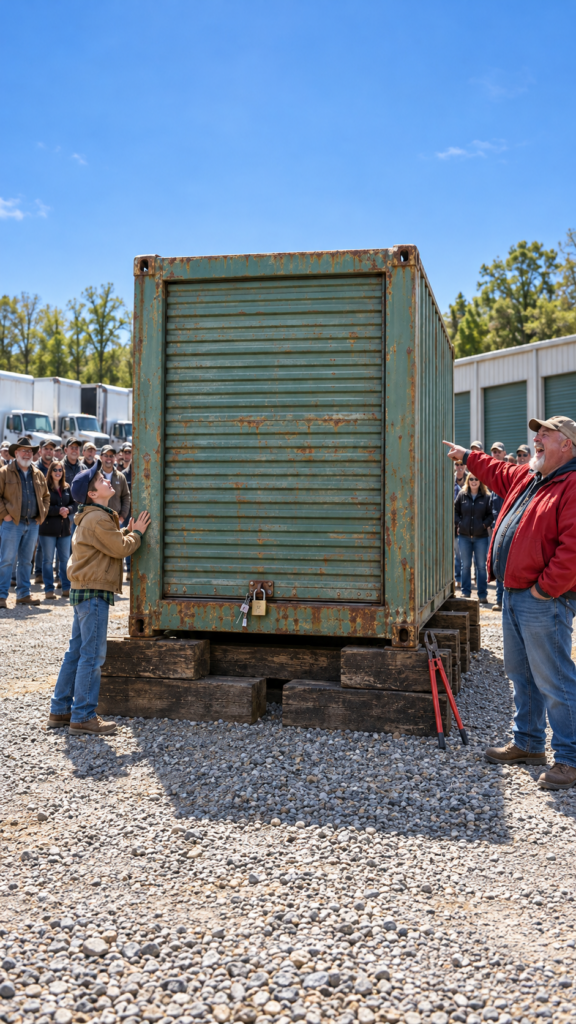
Dwayne Kettering lifted the bolt cutters above his head like a man holding a trophy, making certain everybody in the gravel yard could see them.
“Forty dollars!” he shouted, his voice carrying over the parked trucks and rows of weather-beaten storage units. “This kid just spent forty dollars on a locked steel box full of some dead man’s lawn chairs, and now he’s too scared to look inside!”
Laughter spread through the crowd.
Owen Pruitt stood against the faded green storage unit, his small hands resting flat on the cold, rust-streaked door. At twelve years old, he was younger than nearly everyone at the auction, and certainly the only person there who had just spent almost every dollar he owned.
Nearly sixty people had watched him make the purchase.
Now many of them were waiting to see him regret it.
Dwayne swung the cutters down and offered them to Owen, handles first.
“Come on, son. Cut that lock. Let’s see what your forty dollars bought.”
Owen looked at the heavy tool, then at the old brass padlock hanging from the door. Two small gray wire seals were twisted through the hasp beside it.
He knew what the crowd wanted.
They wanted him to open the unit right there, discover a pile of worthless junk, and give them one final laugh before everybody went home.
But Owen had seen something nobody else seemed to have noticed.
A name.
And because of that name, he was prepared to stand in front of sixty laughing strangers and refuse to open something he had just purchased with his own hard-earned money.
“No, sir,” he said.
Dwayne lowered the cutters slightly.
“What was that?”
Owen swallowed. His voice shook, but he made himself repeat it.
“No, sir. I’m not opening it here.”
For a moment, Dwayne stared at him.
Then he laughed so hard he bent at the waist.
“He’s scared of the raccoons!”
Another wave of laughter rolled across the gravel.
Owen kept his hands against the door.
He could feel his face burning beneath the brim of his old navy ball cap. He wished the people would go away. He wished Dwayne would stop talking.
But he did not wish he had kept his forty dollars.
Not yet.
He had a reason for what he was doing, even if he couldn’t prove it.
And that reason had started long before the auction.
Walt Pruitt, Owen’s grandfather, had worked for Kessler Brothers Moving and Storage for forty years.
He had driven the company’s crane truck along county roads, through small towns, into crowded college neighborhoods, and across the driveways of families preparing to leave their homes.
He had delivered green steel storage units to people who needed somewhere to put the contents of their lives.
Some were filled with furniture while houses were renovated. Others held the belongings of elderly parents moving into retirement communities. Some were shipped to military bases or hauled south to Florida when families decided they were finished with northern winters.
Walt had always understood that a storage unit could hold more than furniture.
Sometimes it held everything a person wasn’t ready to lose.
Now he was seventy-six years old, retired, and watching the company that had employed him for most of his adult life close its doors.
Kessler Brothers had been in business for seventy years. The last surviving brother involved in the company had retired to Arizona, and the property was being cleared.
Everything was going.
The trucks. The forklifts. The office desks. The spare equipment.
And nine abandoned storage units whose renters had stopped paying.
Under the state’s lien-sale rules, the contents could be auctioned to the highest bidder. Each unit would be sold sealed. Buyers had to rely on whatever clues were visible from the outside.
There was no inspection.
No opening a door just to see what might be hiding behind it.
Once the auctioneer’s gavel fell, the purchase belonged to the buyer.
That was the gamble.
Walt had asked Owen to come along because he couldn’t bear the thought of watching the final auction alone.
For Owen, it was supposed to be nothing more than a Saturday spent with his grandfather.
He wore his tan canvas chore jacket and his faded navy cap. In one pocket, carefully folded, were forty-three dollars.
He knew the amount because he had counted it the night before.
Every dollar had come from mowing lawns along Sycamore Street over the summer.
Some afternoons had been so hot that sweat soaked the back of his shirt before he finished the first yard. Sometimes a mower refused to start, or the grass had grown so tall that he had to make the same pass twice.
He did the work anyway.
He had been saving for a used bicycle.
The one he wanted wasn’t fancy. It didn’t have to be. He only wanted something reliable enough to ride around Crane Lake without asking his mother for a ride.
Forty-three dollars wasn’t much, but to Owen, it represented weeks of work.
He had not planned to spend a cent of it at Kessler Brothers.
At least, not until they reached the final storage unit.
The early sales were entertaining enough.
A reseller from a neighboring county paid two hundred ten dollars for a unit full of kitchen chairs. A young couple bought another for ninety dollars and found a boat motor and a rowing machine.
Each time a lock was cut, the crowd gathered to inspect the discovery.
And each time, Dwayne Kettering managed to find something funny to say.
Dwayne owned Kettering’s Resale Barn, a large metal building along the state highway where old furniture, appliances, tools, and whatever else he could purchase cheaply were offered for considerably more.
He attended storage auctions throughout three counties.
He knew how to bid, how to judge a unit by its size, and how to turn somebody else’s disappointment into a bargain for himself.
He was a broad man in his fifties, with a ruddy face, a gray goatee, and a bright red jacket that made him easy to spot wherever he went.
People laughed when he spoke.
Sometimes because he was funny.
Sometimes because he was Dwayne Kettering, and laughing was easier than becoming the next target of one of his jokes.
Owen had been watching that happen all morning.
Then the auctioneer, Ray Voss, approached the last unit.
It stood apart from the others near the chain-link fence, resting on a crib of old railroad timbers.
Sixteen feet long, taller than any person in the yard, the steel container looked like something forgotten behind the business and left there to weather quietly.
Its original green paint had faded to a dull, murky shade.
Long orange tracks of rust ran down its roll-up door.
A heavy brass padlock secured the hasp, and beside the lock were two little gray wire seals.
Owen noticed those seals immediately.
They were small enough that most people would have walked past them.
But his grandfather had once explained that Kessler Brothers used seals like those to show whether a storage unit had been opened after it was packed.
Beside the door, an old inventory card remained stapled beneath a brittle yellowed plastic sleeve.
Dwayne reached it first.
He leaned forward and read the handwriting aloud.
“Fourteen pieces. Carved. Stand upright. Fragile. Keep dry.”
He straightened and grinned.
“Well, there you go. Fourteen pieces of carved junk. Probably a bunch of wooden ducks and somebody’s old coat rack.”
The crowd chuckled.
Dwayne glanced at the signature and date.
“Signed A. Vail. Nineteen sixty-nine.”
Owen’s attention sharpened.
Vail.
He had heard that name before.
Beside him, Walt suddenly stopped shifting his weight and stood perfectly still.
Owen looked up at his grandfather.
Walt was staring at the inventory card, his weathered face unusually serious.
Ray Voss started the bidding at two hundred dollars.
Nobody raised a hand.
He dropped to one hundred fifty.
Still nothing.
“One hundred dollars,” Ray called. “Come on, folks. The steel box alone ought to interest somebody.”
Dwayne shook his head.
“That thing’s been sitting there since Nixon was in office. It’ll cost more to move than it’s worth.”
People laughed again.
Ray sighed.
“Fifty dollars. Anybody give me fifty?”
Owen barely heard him.
He was watching his grandfather.
“Grandpa,” he whispered.
Walt looked down.
“Is that Vail the carousel man from your stories?”
Something moved across Walt’s face.
Not surprise exactly.
More like the look of a man hearing a voice from a room he thought had been empty for years.
He didn’t answer.
But his eyes returned to the storage unit.
Owen felt his heart beginning to beat faster.
Ray called for forty-five dollars.
Nothing.
“Forty? Anybody give me forty dollars?”
Owen raised his hand.
He did it so quickly that he almost surprised himself.
At first, nobody noticed.
Then Ray spotted the small hand above the crowd.
“Forty dollars from the young man in the back.”
Dwayne turned around.
He looked at Owen, then at Walt.
“You’re kidding me.”
Owen’s arm remained raised.
“That’s his lunch money, Ray! Somebody call his mother before he spends it all!”
People began turning to stare.
Owen lowered his hand, but he did not retreat.
He could feel the folded bills in his pocket.
Forty-three dollars.
He was about to spend forty.
He would have three dollars left.
No bicycle.
No more summer savings.
Only a possibility that might turn out to be completely wrong.
Walt placed one broad, calloused hand on his shoulder.
He didn’t tell Owen to stop.
He didn’t tell him to bid higher.
He simply left his hand there.
“Forty dollars, going once,” Ray announced.
The yard grew quieter.
“Going twice.”
Ray glanced at Walt, who gave the slightest nod.
“Sold to the young man for forty dollars.”
The gavel struck the folding table.
Owen had never spent so much money in his life.
He walked to the clerk’s table and unfolded his bills. He placed them down one at a time, smoothing each note against the tabletop.
Someone laughed at the care he took.
But Owen had worked for that money. It mattered to him that he handed it over properly.
When the clerk finished with the payment, he returned to the green storage unit.
He rested both palms against the steel.
There was something strange about knowing that an object so enormous could suddenly belong to him.
He couldn’t have lifted it.
Couldn’t have moved it.
Couldn’t even have opened the lock without tools.
Yet the auctioneer had called it his.
That was when Dwayne appeared with the bolt cutters.
And when Owen refused to open the door, Dwayne found an entirely new reason to mock him.
“What are you planning to do with it, son? Pray over it?”
Owen remained quiet.
“You know you’ve only got forty-eight hours to get this thing off the property, right? That’s the auction rule.”
Owen glanced toward his grandfather.
Dwayne noticed.
“Oh, that’s a problem, isn’t it? You got a truck? A crane hidden in your pocket?”
“I’ve got one,” a voice said behind him.
Walt Pruitt stepped forward.
His white crew cut caught the sunlight. Brown suspenders ran over his gray work shirt, and his expression was calm.
People in the crowd knew him.
Many had known him for decades.
“He’s got me,” Walt said.
Dwayne gave a short laugh.
“Walt, you can’t seriously think—”
“Put the cutters away, Dwayne. The boy bought the unit fairly. He’ll open it when he’s ready.”
There was nothing threatening about the words.
Walt didn’t raise his voice.
He simply stood beside his grandson, one hand resting on Owen’s shoulder.
Dwayne looked between them.
Then he shrugged.
“Suit yourselves. When it turns out to be full of mouse nests, bring it to my barn. I’ll give the kid five dollars for the steel.”
That earned one final round of laughter.
The crowd slowly drifted away.
Owen stayed beside the unit until most of the yard had emptied.
He looked at the old card again.
A. Vail.
Fourteen pieces.
Carved.
Stand upright.
His grandfather stood with him.
Neither spoke for a long time.
Finally, Walt rubbed a hand across the back of his neck.
“Forty dollars,” he murmured.
Owen looked down.
“Are you mad?”
Walt studied the steel door.
“No,” he answered. “But I sure hope we’re remembering the same story.”
Getting the storage unit home took almost all of Sunday.
Walt called Bud Lindgren, an old coworker who had spent twenty years driving for Kessler Brothers. Bud’s son now operated a towing business on the county road, and Bud arranged to bring over one of the company’s large rollback trucks.
When Bud saw the unit standing on its railroad timbers, he gave a low whistle.
“That’s an old one.”
Walt nodded.
“Older than most of the equipment still in the yard.”
Bud walked around it, examining the heavy steel skids.
“They don’t make them this thick anymore. What’s inside?”
“Don’t know.”
Bud glanced toward Owen, who waited near his grandfather’s pickup.
“So the boy really won’t open it?”
Walt shook his head.
News of Saturday’s auction had already traveled around Crane Lake.
Bud looked at Owen again.
Whatever he saw in the boy’s expression made him stop smiling.
“All right, then,” he said. “Let’s get her home.”
The work had to be done carefully.
Bud tilted the rollback’s bed and connected its heavy winch cable to the storage unit’s steel skids.
The cable tightened.
The unit shifted slowly, wood creaking beneath its weight.
Owen stood back where his grandfather had instructed him to stay, watching every movement.
For a frightening moment, as the front edge lifted, the enormous container seemed unwilling to leave the timbers that had supported it for so many years.
Then it began moving steadily up the sloping bed.
A few townspeople had stopped to watch.
Dwayne Kettering appeared in his truck, a cup of gas station coffee in his hand.
“Hope the towing bill’s cheaper than the box!” he called.
He drove away laughing.
Walt watched him go, then turned back to Bud.
“Easy now. Keep her level.”
They transported the unit to the Pruitt farmhouse, where Walt had cleared space inside his old machine shed.
Owen and his mother, Dana, lived there with Walt.
They had moved in after Owen’s father left, and the house had become the center of their small family.
It wasn’t a place where money came easily.
Dana worked at the county hospital laundry, covering night shifts and weekends. Walt took care of what he could around the property, and Owen had learned early that earning something usually meant giving up time and comfort.
The machine shed stood behind the farmhouse.
Its concrete floor was large enough to accommodate the green unit, although bringing it inside took patience and careful maneuvering.
Bud eased the container down onto fresh timbers.
Walt checked that it was level.
Only when the truck pulled away did Owen fully understand what he had brought home.
Sixteen feet of old steel stood beneath the shed lights.
The brass padlock remained intact.
The two gray wire seals had not been disturbed.
Whatever had been placed inside in 1969 was still waiting.
At six that evening, Dana returned from her shift.
She walked into the machine shed wearing her navy hospital scrubs.
Then she stopped.
Her eyes traveled from the far end of the enormous green container to the rusty door and finally to the brass lock.
For several seconds, she didn’t speak.
“Owen.”
He stood beside his grandfather.
“Yes, ma’am?”
“What did you do?”
He told her.
He explained the auction, the abandoned units, the inventory card, and the forty-dollar bid.
He told her about Dwayne’s jokes and why he had refused the bolt cutters.
Dana listened without interrupting.
But when Owen mentioned the money, her expression changed.
“That was your bicycle money.”
“Yes, ma’am.”
“All of it?”
“Almost. I’ve got three dollars left.”
She closed her eyes briefly.
“And you don’t know what’s inside?”
“Not exactly.”
Dana stared at him.
“Then why won’t you open it?”
Owen turned toward Walt.
His grandfather had been quiet ever since the unit arrived.
Now Walt pulled a folding chair away from the workbench, lowered himself into it, and rubbed both hands over his face.
“Because I think I know what’s in there,” he said. “And so does Owen.”
That night, they gathered at the kitchen table.
Walt told the story Owen had heard many times growing up.
But this time, he told the part he had always kept to himself.
Long before Owen was born, before the old amusement park disappeared from the shoreline, Crane Lake had been home to a place called Lakeside Pleasure Park.
There had been a dance pavilion, a wooden roller coaster, a pier where steamboats docked, and a grand carousel beneath a round roof covered in a thousand electric bulbs.
The carousel had been the pride of the park.
Its horses were not cheap molded decorations.
They had been carved by hand in Philadelphia before the First World War, with elaborate saddles, real gold leaf, glass jewels, and tails made from actual horsehair.
“Every child in the county wanted to ride those horses,” Walt said. “I rode them. Your great-grandmother rode them. People used to dress up just to spend an afternoon there.”
Owen leaned forward.
“And Mr. Vail?”
Walt nodded.
“Ambrose Vail ran that carousel.”
He paused, looking down at his hands.
“The park closed in the fall of 1969. A developer bought the property. They tore down the roller coaster for lumber. Sold the carousel frame and motor for scrap.”
“What happened to the horses?” Dana asked.
“That’s the mystery. Everybody had a different story. Some said a collector took them to California. Others said they were destroyed. But nobody ever saw them again.”
Walt looked toward the dark kitchen window.
“I was nineteen that year. Had just started working for Kessler Brothers. One night in October, old Mr. Kessler sent Bud and me out to the park with an empty storage unit.”
Owen’s fingers tightened around the edge of the table.
“We set it down behind the carousel house after dark,” Walt continued. “Mr. Vail was there with three other men. They wouldn’t let us near the building.”
“Why not?” Dana asked.
“I don’t know. We waited in the truck for almost two hours. All we could see was those men coming out carrying big shapes wrapped in moving quilts.”
Walt gestured with his hands, indicating their height.
“Tall things. Heavy, too. They loaded everything themselves.”
“And then?” Owen whispered.
“Mr. Vail locked the storage unit. Paid Mr. Kessler cash for a year’s rent.”
Walt’s voice grew softer.
“He looked straight at me and said, ‘Keep her dry, son. That’s all I ask.’”
Owen glanced toward the shed beyond the house.
Walt continued.
“Mr. Vail came back every October and paid for another year. Did that for decades. Even when he got old enough to need a cane.”
“Until when?” Dana asked.
“Until last winter. He died at ninety-six. No family left. Nobody kept paying the rent.”
The grandfather looked at Owen.
“So the company sold the unit.”
Nobody spoke for a moment.
Then Owen repeated the words from the inventory card.
“Fourteen pieces. Carved. Stand upright.”
Dana looked at him.
Owen met her eyes.
“Horses stand upright, Mom.”
Her gaze moved toward the back door.
“Then open it. If you think the carousel horses are in there, why wouldn’t you just look?”
“Because Mr. Vail packed them carefully.”
Owen spoke slowly, searching for the right words.
“If those really are the horses, they’ve been sealed away for more than fifty years. I read at the library that old paint and wood can get damaged when conditions change too fast.”
He looked at Walt.
“What if opening the door outside ruins them? What if the gold starts coming off?”
Dana’s expression softened.
Owen wasn’t finished.
“And there’s something else.”
“What?”
“Everybody at the auction thinks I was stupid.”
“Owen—”
“Mr. Kettering’s going to say I’m lying if I open it myself and tell people they’re valuable.”
Dana watched him.
“So what do you want to do?”
Owen took a breath.
“I want somebody who knows about old carousel horses to open it. A real expert. Somebody people will believe.”
His grandfather began to smile.
“And?” Walt asked.
Owen hesitated.
Then he straightened.
“I want Mr. Kettering there when they do.”
For the first time since the auction, Walt laughed.
Not at Owen.
With him.
He looked at Dana.
“The boy’s right,” he said. “We leave it sealed.”
Outside, the old machine shed stood quiet behind the farmhouse.
Inside it, the green steel door remained closed.
And Owen Pruitt had just made a decision that would turn the longest week of his young life into something nobody in Crane Lake would ever forget.
Part 2
By Monday morning, nearly everybody in Crane Lake had heard about the twelve-year-old boy who had spent forty dollars on a locked storage unit and refused to open it.
Most people hadn’t been at the auction.
That didn’t seem to matter.
The story grew every time it was repeated.
At the feed store, Dwayne Kettering told anyone who would listen that Owen had bought a container full of junk because he didn’t understand how auctions worked.
At the diner, he described the boy standing against the rusty door as though he were protecting a treasure chest.
By Tuesday, Dwayne was telling people Owen had nearly cried when he saw the bolt cutters.
By Wednesday, the supposed contents had changed from old lawn chairs to a whole family of rats.
Everybody seemed to find the story amusing.
Everybody except Owen.
At school, the jokes followed him down the hallways.
Dwayne’s nephew, Tyler, sat two rows behind him in seventh grade.
Tyler had apparently decided that repeating his uncle’s jokes was an easy way to become the center of attention.
“Hey, Storage Boy,” he called when Owen entered the classroom.
Several students laughed.
Owen kept walking.
At lunch, Tyler told the story again, adding details that hadn’t happened.
He described Owen begging his grandfather to take the storage unit back. He claimed the auctioneer had tried to talk Owen out of paying for it.
None of it was true.
But Owen had no way to make the other students care about that.
The nickname spread through the cafeteria.
Storage Boy.
Storage Boy.
Storage Boy.
By the end of the day, Owen had heard it so many times that he barely reacted when someone said it.
The next morning, he found a drawing taped to his locker.
It showed an enormous cardboard box with a tiny figure standing inside.
Underneath, someone had written:
OWEN’S MANSION.
A few students stood nearby, watching to see what he would do.
Owen took the paper down.
He folded it carefully, once and then again, and slipped it into his backpack.
He didn’t argue.
He didn’t cry.
He didn’t even look to see who was laughing.
What hurt most wasn’t the drawing.
It was the fact that everybody seemed certain he had made a foolish decision before anyone had actually looked inside the unit.
On the bus ride home, he sat near the window and watched the houses pass.
He thought about the used bicycle he could have bought.
He thought about all the hot afternoons spent pushing a mower across other people’s yards.
And, for the first time since Saturday, he allowed himself to consider the possibility that he might have been wrong.
Maybe the storage unit was full of old furniture.
Maybe the fourteen carved pieces were coat racks or wooden decorations, just as Dwayne had said.
Maybe his grandfather had remembered the wrong man.
For a few minutes, the uncertainty felt heavier than the ridicule.
Then Owen remembered something Walt had told him at the kitchen table.
The men had carried tall objects out of the carousel house.
Ambrose Vail had insisted that the storage unit remain dry.
And he had paid for it, year after year, until his death.
There was a reason someone would protect a locked container for more than half a century.
Owen still didn’t know what that reason was.
But he knew he couldn’t find out by letting Dwayne Kettering make the decision for him.
After school, instead of going straight home, Owen rode the bus into town.
He walked along Main Street to the old bank building, where the Crane Lake County Historical Society occupied two rooms upstairs.
He had passed the building many times.
Until that afternoon, he had never needed anything inside it.
The historical society was run by Adeline Frick, a retired schoolteacher who was eighty-one years old.
She had bright white hair, glasses that slipped down her nose, and a cardigan with pencils tucked into its pockets.
When Owen appeared in the doorway, she looked up from her desk.
“Well,” she said, studying him. “You’re Walt Pruitt’s grandson.”
“Yes, ma’am.”
“The boy with the storage unit.”
Owen nodded.
He was beginning to wonder whether there was anyone left in the county who hadn’t heard.
Mrs. Frick set aside her papers.
“What can I help you with, Owen?”
“I need to know about the old Lakeside Carousel.”
Her expression changed immediately.
“What about it?”
“I think I might know where some of it went.”
For several seconds, she simply looked at him.
Then she stood.
“Come with me.”
She crossed the room to a gray filing cabinet and opened one of the lower drawers.
After searching through several folders, she pulled out a thick collection of photographs, newspaper clippings, and handwritten records.
She placed it on a long oak table.
“Sit down,” she said.
Owen obeyed.
Mrs. Frick opened the folder.
And for the first time in his life, Owen saw the carousel his grandfather had been describing.
There were postcards showing Lakeside Pleasure Park on summer afternoons.
In one picture, women in long dresses stood beside the pavilion while children gathered along the entrance to the carousel.
In another, the round carousel house shone with rows of glowing electric bulbs.
The horses were magnificent.
Some had sweeping manes and decorated saddles. Others wore carved armor or flowers. There were figures designed for small children, and unusual animals that made the whole carousel look like something from a storybook.
Owen studied every photograph.
He had heard about those horses since he was little, but photographs made them real in a way his grandfather’s stories hadn’t.
At last, Mrs. Frick found a black-and-white photograph dated 1952.
It showed a younger Ambrose Vail wearing a white shirt and bow tie.
He stood beside an extraordinary wooden horse.
The animal was rearing, its front hooves lifted high.
An eagle spread its carved wings across the horse’s armored chest, and the flowing mane had been finished with gold.
“That was the lead horse,” Mrs. Frick said.
Owen leaned closer.
Even without the original colors, he could see the workmanship.
The expression in the horse’s eyes.
The carefully carved lines of its armor.
The way its mane appeared to move.
He imagined it standing in the front of the carousel while children reached up to touch it.
“Was Mr. Vail proud of it?” Owen asked.
Mrs. Frick smiled faintly.
“Very.”
He studied the photograph for another long moment.
Then he asked the question that had brought him there.
“Mrs. Frick, do you know anybody who understands old carousel horses? I mean somebody who really knows what they’re looking at?”
She tilted her head.
“Why?”
Owen told her about the auction.
He described the old inventory card, the gray wire seals, the date, and his grandfather’s memory of delivering a storage unit to the closed amusement park.
He explained that the container was now in Walt’s machine shed, still locked.
Mrs. Frick listened carefully.
When he finished, she looked down at the photograph of Ambrose Vail.
“Are you telling me that nobody has opened it?”
“No, ma’am.”
“Not even to take a look?”
“No.”
“Why not?”
“Because if Grandpa’s right, the horses have been in there since 1969. I’m afraid opening it wrong could damage them.”
Mrs. Frick took off her glasses.
She looked at Owen with an expression he hadn’t seen from an adult all week.
She was taking him seriously.
“I think,” she said slowly, “we ought to make a telephone call.”
She knew someone at a museum in Columbus.
That friend knew a professional conservator named Helen Marchetti, a woman who had spent thirty years restoring historic carousel figures for museums and amusement parks.
Mrs. Frick made the call herself.
Owen stood beside the table while she explained what he had found.
At first, her voice was calm and professional.
Then she mentioned Ambrose Vail.
The fourteen carved pieces.
The untouched wire seals.
The storage date.
Mrs. Frick listened to the person on the line, nodded, and asked to speak with Helen directly.
When Helen Marchetti finally came on the telephone, Mrs. Frick repeated the story from the beginning.
Owen watched her expression grow more serious.
Then she held out the receiver.
“She wants to talk to you.”
Owen took it with both hands.
“Hello?”
“Is this Owen Pruitt?”
“Yes, ma’am.”
“Owen, I need you to listen carefully. Has anyone cut the lock on that unit?”
“No, ma’am.”
“Has the door been raised at all?”
“No.”
“And the two wire seals are still in place?”
“Yes, ma’am.”
There was a pause.
“Good. I don’t want you to open it. I don’t want anyone else opening it either. Keep the shed closed, and if the weather turns wet, make sure the doors stay shut.”
Owen felt his shoulders loosen.
For the first time, an expert was telling him that he had been right to wait.
“I can do that.”
“I’d like to come see it on Saturday. I’ll bring an appraiser from an auction house in Cincinnati. His name is Gordon Pell.”
Owen could hardly believe what he was hearing.
“A real appraiser?”
“Yes. But understand something, Owen. We don’t know what’s inside yet. It could be nothing. We’re going to find out properly.”
“Yes, ma’am.”
“And whatever we find, you’ve done a sensible thing by leaving those seals alone.”
When Owen hung up, Mrs. Frick was watching him.
“Well?” she asked.
“She’s coming Saturday.”
Mrs. Frick smiled.
“Then I suppose we have something to prepare for.”
Owen looked down at the old photograph.
He knew what he wanted next.
“Mrs. Frick?”
“Yes?”
“Would you come too?”
“Of course.”
He hesitated.
“And would you help me invite a few people?”
That evening, Owen sat at the farmhouse kitchen table with several plain white cards Dana had purchased from the drugstore.
He wrote every invitation in his neatest handwriting.
One went to Ray Voss, the auctioneer.
Another went to Bud Lindgren, who had helped transport the unit.
One went to Mrs. Ortega, their neighbor.
He invited Mr. Haskins, his science teacher, and Mrs. Frick.
He wanted people who had witnessed what happened at the auction, people who knew his family, and people who could recognize that something important might be unfolding.
He wasn’t trying to gather an enormous crowd.
He wanted witnesses.
The last invitation was the hardest to write.
He started it three times.
On the first card, his handwriting was crooked.
On the second, he pressed so hard with his pencil that the words looked angry.
He threw both away.
Then he began again.
Mr. Kettering,
You are invited to the opening of the storage unit I bought at the Kessler auction. It will be Saturday at 10:00 in my grandfather’s machine shed.
There will be a real expert there.
I hope you will come.
Sincerely,
Owen Pruitt.
He read the invitation twice before setting it aside.
Walt watched him from the other end of the table.
“You sure you want that man there?”
“Yes, sir.”
“Even after the way he’s treated you?”
Owen nodded.
“He said all those things in front of everybody. I want him to hear what the expert says in front of everybody too.”
Walt studied his grandson.
“Just remember something. If there’s nothing in that box, you haven’t done anything wrong by asking.”
Owen looked down at the white card.
“I know.”
But he didn’t really feel that way.
Not yet.
Because he knew that if the unit turned out to be worthless, Dwayne would have a new story to tell.
And the whole town would hear it.
Owen delivered the invitation to Kettering’s Resale Barn himself.
Walt drove him out along the state highway and parked his pickup outside.
Inside, the barn was crowded with dusty dressers, mismatched lamps, old tools, and crates of records.
Dwayne stood behind the counter speaking with three customers.
He looked up when Owen approached.
“Well, well. Storage Boy himself.”
Owen handed him the card.
“Good afternoon, Mr. Kettering. This is for you.”
Dwayne unfolded it.
He read the entire invitation aloud.
When he reached the words real expert, he laughed.
“A real expert!”
He slapped the counter.
“Well, wouldn’t miss that for the world!”
His customers grinned.
Dwayne looked at Owen.
“I’ll bring my own raccoon trap.”
Owen felt the familiar heat rising in his face.
But he didn’t look away.
“Thank you, sir.”
Then he turned and walked out.
Walt was waiting behind the wheel of the pickup.
He watched Owen climb inside and close the passenger door.
“How’d it go?”
“He said he’ll come.”
Walt started the engine.
“Figured he might.”
For the next couple of days, Owen did his best to behave normally.
He went to school.
He did his homework.
He helped around the farmhouse.
But every time he passed the machine shed, he found himself looking toward its closed doors.
Inside, the storage unit remained untouched.
His future seemed to be waiting behind that brass padlock.
Not because he had any idea how much the contents might be worth.
He didn’t.
For all he knew, a collection of old carousel horses could be beautiful and historically important without having any great financial value.
What mattered to him was whether the story his grandfather had carried for so many years was true.
And whether the name Ambrose Vail had meant what he thought it meant.
On Thursday evening, Dwayne Kettering’s red truck turned into the Pruitt driveway.
Owen saw it from the house.
Walt went out to meet him on the porch.
Dwayne climbed from the truck smiling, speaking in the easy, friendly tone of a man who wanted something.
“Walt, I’ve been thinking about the boy.”
Walt folded his arms.
“Have you?”
“Sure have. Listen, I feel kind of bad about all that teasing at the auction. He’s a good kid. Didn’t mean any harm.”
Walt said nothing.
Dwayne glanced toward the machine shed.
“Thing is, Saturday could turn embarrassing for him. Got all those folks coming. Some expert from out of town. No sense putting the boy through that if the box turns out to be worthless.”
Walt waited.
“So here’s what I’ll do,” Dwayne continued. “I’ll buy it from him. Sight unseen. Three hundred dollars.”
From behind the screen door, Owen felt his stomach tighten.
Three hundred dollars.
That was seven and a half times what he had paid.
Dwayne spread his hands.
“Pretty good deal, I’d say. He makes a nice profit, gets his bicycle money back, and nobody has to go through this whole circus.”
Walt looked at him for a long moment.
“That’s a generous offer for a storage unit full of mouse nests.”
Dwayne’s smile flickered.
“Well, I’m just trying to be neighborly.”
Walt turned toward the house.
“Owen! Come on out here a minute.”
Owen opened the door and stepped onto the porch.
“Mr. Kettering wants to buy your storage unit for three hundred dollars.”
Dwayne smiled at him.
“What do you say, son? That’s a lot of money for a twelve-year-old.”
Owen looked past him toward the shed.
He thought about his summer savings.
Three hundred dollars would buy the used bicycle several times over.
It would be more money than he’d ever held in his hands.
For one brief moment, the offer tempted him.
Not because he believed Dwayne was doing him a favor.
But because accepting would mean he could stop worrying.
He wouldn’t have to face Saturday.
Wouldn’t have to stand in front of people while the lock was cut.
Wouldn’t have to discover, in front of everyone, whether his forty dollars had bought a treasure or a mistake.
Then he remembered the photograph from 1952.
The eagle horse.
Ambrose Vail standing proudly beside it.
And he thought about a man who had paid storage rent every October for decades just to keep fourteen carved objects safe.
Owen looked at Dwayne.
“No, thank you, sir.”
Dwayne blinked.
“You sure?”
“Yes, sir. I’ll see you Saturday.”
For a moment, the older man seemed to be searching for something else to say.
Then he nodded, turned, and walked back to his truck.
He drove away without another joke.
Walt stood watching the red taillights disappear down the county road.
“He read that inventory card too,” he said quietly.
Owen looked up.
“What do you mean?”
Walt kept his eyes on the road.
“I mean he’s been thinking about that box all week.”
Owen turned toward the machine shed.
Until that moment, he’d believed Dwayne wanted nothing more than to embarrass him.
Now he wasn’t certain.
The man who had laughed the loudest at his forty-dollar purchase had just offered him three hundred dollars for the right to own it.
And he had done so without seeing a single thing inside.
Saturday morning arrived cold and bright.
Frost lay over the fields, and the morning sunlight made the gravel sparkle.
Walt and Owen had already swept the machine shed twice.
They borrowed twenty folding chairs from the Methodist Church and arranged them in two rows facing the storage unit.
Dana prepared two large pots of coffee and a plate of cinnamon rolls.
The gathering looked almost like a small community meeting.
Except that the center of attention was a rusted steel container that nobody had opened in fifty-seven years.
Owen stood beside it before the guests arrived.
He ran his fingers near the brittle inventory card, careful not to disturb it.
Then he looked at the padlock.
He had spent the entire week wanting this moment.
Now that it was here, he found himself afraid.
At nine-thirty, the first visitors arrived.
Mrs. Frick carried her thick historical folder.
Ray Voss brought his familiar white straw hat.
Bud Lindgren came with his wife.
Mrs. Ortega arrived from next door, followed by Mr. Haskins, who had brought his camera.
More people followed.
By ten o’clock, nearly twenty chairs were occupied and several visitors stood along the walls.
Dana moved among them with coffee.
Walt greeted the guests.
Owen sat in the front row, unable to keep his hands still.
At ten minutes past ten, a white van came up the gravel drive.
Helen Marchetti stepped out.
She was a small woman in her sixties with short silver hair and reading glasses hanging from a chain around her neck.
With her was Gordon Pell, a tall man wearing a tweed blazer and carrying a clipboard. Helen also had assistance from a younger museum worker for the careful examination ahead.
Gordon shook Walt’s hand.
Then he turned to Owen.
“Mr. Pruitt?”
Owen stared at him for a second.
Nobody had ever called him that.
“Yes, sir?”
Gordon offered his hand.
Owen shook it.
It was a small gesture, but it mattered.
The man had come from Cincinnati to examine something Owen owned, and he was treating the boy like a person whose decisions deserved respect.
Dwayne arrived last.
He came through the shed door in his bright red jacket, carrying a cup of coffee.
“Didn’t start without me, I hope,” he announced. “Wouldn’t want to miss the raccoons.”
A few people chuckled.
Most remained quiet.
Owen sat between his mother and grandfather.
Helen Marchetti approached the storage unit.
She didn’t make a joke.
Didn’t speculate about the contents.
She simply began to work.
Slowly, she walked around the entire container, examining the seams, the steel skids, the door, and the old brass padlock.
She photographed the two gray wire seals from several angles.
She checked the conditions near the door vent with a small humidity meter.
Then she stepped back.
For a moment, she studied the unit without speaking.
Owen watched her face.
He couldn’t tell whether she had seen something promising or troubling.
Finally, Helen turned toward the assembled witnesses.
“The seals are intact,” she said. “This unit has remained sealed since October of 1969. There’s no indication that anyone has been inside.”
She looked directly at Owen.
“I want everyone to understand that before we begin.”
The room grew quiet.
Then she asked him a question.
“It’s your storage unit, Owen. Would you like to open the door?”
He stood.
His knees felt unsteady.
He looked at his grandfather, who rose beside him.
Across the shed, Dwayne shifted his coffee cup from one hand to the other.
Helen gave her assistant a small nod.
The young man picked up a pair of long bolt cutters.
Owen watched the jaws close around the old brass lock.
For fifty-seven years, that lock had held the door shut.
Now, for the first time since Ambrose Vail sealed it, someone was about to break it.
The handles came together.
The lock snapped.
And Owen reached for the door handle beside his grandfather.
Part 3
The roll-up door resisted at first.
Owen gripped the handle with both hands while his grandfather took hold beside him.
For a moment, nothing happened.
Then the old mechanism groaned.
The door rattled upward, slowly rising from the concrete floor.
One foot.
Two feet.
Then high enough for the people standing behind them to see inside.
Nobody laughed.
The first thing that reached Owen was the smell.
Not the damp, sour odor of rotting furniture.
Not the smell of mice or abandoned junk.
It was cedar.
Cedar, old wool, and something faintly sweet that reminded him of varnish.
Inside the storage unit stood fourteen tall shapes.
They were arranged neatly in two rows, each carefully wrapped in quilted moving blankets and secured with rope.
A heavy canvas tarp covered the front of the arrangement.
Nothing appeared to have been thrown inside carelessly.
Every object had been positioned deliberately.
Owen could see that someone had taken extraordinary trouble to protect them.
Helen Marchetti leaned forward, examining what was visible.
She turned toward Owen.
“Go ahead,” she said softly. “Pull the tarp back. Gently.”
Owen reached up.
His fingers closed around one corner of the heavy canvas.
For an instant, he hesitated.
He thought about the long summer afternoons mowing lawns.
About Dwayne laughing at the auction.
About the drawing taped to his school locker.
About his grandfather, nineteen years old, sitting in a truck outside a closed amusement park while four men carried mysterious objects into a storage unit.
Then he pulled.
The canvas slid downward.
One of the front moving blankets had loosened slightly with age.
Through the gap, something appeared.
A wooden horse’s head.
Owen stopped breathing for a moment.
The horse had an eye made of glass, amber and black, so lifelike that the shed lights seemed to awaken it.
Its mane flowed backward in deeply carved waves.
And every wave was covered in gold leaf.
Not dull paint pretending to be gold.
Real gold, still catching the light after more than a century.
A red glass jewel gleamed from its bridle.
Owen took one small step backward.
Behind him, somebody whispered.
But no one laughed.
Helen moved forward with her white cotton gloves.
Together with her assistant and Walt, she began carefully removing the blankets.
One by one, the figures emerged.
First came a black horse with a flowing silver mane.
Then a dappled gray, decorated with carved roses along its saddle.
A small palomino jumper stood nearby, its proportions suggesting it had been made especially for younger children.
There was a lion carrying a carved cherub on its back.
A magnificent chariot decorated with swans.
And other elaborately carved figures, each revealing its own extraordinary craftsmanship.
The people who had come expecting a pile of worthless junk stood staring into the container.
Some moved closer.
Others remained where they were, seemingly afraid to interrupt.
Owen barely noticed them.
He had eyes only for the figures.
Then Helen and her assistant reached the back row.
There, standing taller than the others, was an armored horse.
Its front legs rose high in a dramatic rear.
A carved eagle spread its wings across the animal’s breast.
The mane swept backward, covered in gold.
Owen knew that horse.
He had seen it in black and white in the historical society’s folder.
But the photograph had not prepared him for the real thing.
“Mrs. Frick,” he whispered.
She was already opening her folder.
Her hands shook as she searched through the photographs.
At last, she found the picture from 1952.
Ambrose Vail.
White shirt.
Bow tie.
The great eagle horse standing beside him.
Mrs. Frick held up the photograph.
The horse in the picture and the horse before them were unmistakably the same.
She looked at Walt.
“Oh, Walt.”
The old man nodded slowly.
His eyes shone.
“I remember,” he said.
He had spent decades wondering what happened to the horses from the Lakeside Carousel.
Now he was standing in front of them.
The very objects he had unknowingly helped preserve when he was nineteen years old had returned to him because his grandson remembered a name.
Helen examined the figures for nearly an hour.
She studied the carving techniques and tool marks.
She inspected joints, original paint layers, and decorative details.
She looked beneath the lead horse and found a carver’s number cut into the wood.
Gordon Pell took notes on his clipboard.
Mrs. Frick compared the figures with the historical photographs.
Owen waited nearby, hardly daring to speak.
Every few minutes, Helen discovered another small detail.
A surviving glass jewel.
An area where the original paint remained protected beneath a later coat.
A section of gold leaf that had escaped damage.
The more she examined, the more serious her expression became.
Finally, she removed her gloves.
She stood beside Owen and turned toward the gathered witnesses.
“These are the fourteen figures from the Lakeside Pleasure Park Carousel,” she announced.
Owen looked up at her.
Helen continued.
“They were carved in Philadelphia around 1912, by one of the finest carousel workshops of that period. Very little of that shop’s work survives today as a complete, matching collection.”
She gestured toward the figures.
“These retain their original park paint beneath a single later coat. They have original gold leaf, original glass jewels, and remarkably well-preserved carved surfaces.”
She paused.
“I have been restoring carousel figures for thirty years. I can tell you that these are among the best-preserved examples I’ve ever examined.”
A quiet murmur moved through the shed.
Helen turned back toward the open storage unit.
“Whoever packed these knew exactly what he was doing. The cedar shavings, the wool blankets, the individual supports keeping the figures upright. Every part of the storage arrangement was intended to protect them.”
Walt looked down.
“Ambrose Vail,” he murmured.
Helen nodded.
Then she faced Owen.
“And there’s something else everyone here should understand.”
Owen’s stomach tightened.
“If you had opened this unit outside in September, exposing these figures suddenly to sunlight and damp air after fifty-seven years in a sealed environment, you could have caused serious damage. The paint might have cracked. The gold leaf could have lifted away from the wood.”
She let those words settle.
“Keeping that door closed until the proper people could examine it was the right decision.”
Owen stared at her.
For an entire week, adults had laughed at him for refusing to cut a lock.
Children had mocked him at school.
A man who made his living purchasing abandoned property had treated him as though he was too foolish to recognize his own mistake.
Now a professional conservator was standing in front of the same people and explaining that his refusal had protected something irreplaceable.
Helen smiled.
“You made a difficult decision, Owen. And you made the correct one.”
Dana reached for her son’s hand.
Owen took it.
He couldn’t think of anything to say.
Then Gordon Pell stepped forward.
He had been writing steadily throughout Helen’s examination.
Now he set down his pen and looked around the room.
“I’ve finished my preliminary appraisal,” he said.
The murmur stopped.
Owen felt his mother’s fingers tighten around his.
Gordon looked toward the fourteen figures.
“When objects like these appear individually, their value can be substantial. But what we have here is considerably more important.”
He indicated the collection.
“We have a historically documented matched set, identifiable through archival photographs, with exceptional preservation and a clear history connecting the figures to their original amusement park.”
He glanced at Helen.
“The condition is extraordinary.”
Owen looked toward his grandfather.
Walt was standing so still that he seemed hardly to breathe.
Gordon continued.
“For insurance purposes, I’m placing a conservative appraisal on the complete set. I believe a properly conducted public auction could exceed that figure.”
He looked down at his clipboard one final time.
“My appraisal for the fourteen Lakeside Carousel figures, as a matched collection, is four hundred sixty-three thousand dollars.”
$463,000.
Owen heard the number.
But for several seconds, he could not make sense of it.
Four hundred sixty-three thousand dollars.
He had paid forty.
Forty dollars that he had earned mowing lawns.
His mother sat with one hand pressed against her mouth.
Walt slowly lowered himself into a folding chair.
From the workbench came the faint ticking of the coffee pot as it cooled.
Nobody seemed eager to break the quiet.
Owen looked at Gordon.
“Sir?”
“Yes, Owen?”
“Did you say four hundred sixty-three thousand?”
“I did.”
“For all fourteen?”
“As a matched set, yes. That is an appraisal, not a guaranteed sale price, but it’s a conservative figure based on what we’ve examined.”
Owen looked back at the horses.
He had never seen four hundred sixty-three thousand dollars.
He could hardly imagine what such an amount meant.
But he understood one thing.
His mother would not have to worry about money in quite the same way if even part of that value could be realized.
He thought about the bills she kept carefully arranged at the kitchen table.
The nights she worked at the hospital.
The weekends when other families went places together while she stayed on shift.
He thought about his grandfather’s aging machine shed and the repairs that always seemed to be postponed.
Then he thought about the horses themselves.
They had been hidden for more than half a century.
And now they were standing in the light again.
Across the room, someone turned toward the back wall.
Then another person did.
Soon nearly everybody was looking in the same direction.
Dwayne Kettering stood beside the workbench in his bright red jacket.
His coffee cup remained in his hand.
The broad smile he had worn at the auction was gone.
His face had turned pale.
He looked at the horses, then at the appraiser, then at Owen.
For perhaps the first time anyone in Crane Lake could remember, Dwayne Kettering appeared to have no joke ready.
He opened his mouth.
Closed it.
Then cleared his throat.
“Well,” he said, in a strangely subdued voice, “I was thinking about bidding on that one myself.”
Ray Voss stood slowly.
The auctioneer removed his white straw hat and turned it in his hands.
“Dwayne,” he said, “I believe you told the whole yard it was full of lawn chairs.”
A few people chuckled.
Then the laughter grew.
This time, it wasn’t Owen being laughed at.
Dwayne looked around the room.
He seemed to recognize what was happening.
He had spent the week turning a boy’s decision into entertainment.
He had repeated the story throughout town, exaggerating it each time.
And now, standing in front of fourteen historic carousel figures worth nearly half a million dollars by appraisal, he couldn’t explain away what everyone had witnessed.
He set his coffee cup carefully on the workbench.
Without another word, he walked out to his red truck.
Owen watched him leave.
He had imagined this moment many times.
He had imagined Dwayne’s embarrassment and the satisfaction of proving him wrong.
But now that it was happening, Owen found that he didn’t want to shout after him.
Didn’t want to call him names.
Didn’t want to make the room laugh any harder.
There were fourteen beautiful wooden figures standing in front of him.
That seemed more important.
Walt came to stand beside his grandson.
“You did it, son.”
Owen looked up.
“We did it, Grandpa.”
Walt shook his head.
“I helped bring the box home. You were the one who remembered.”
Owen turned toward the lead horse.
“And Mr. Vail saved them.”
Walt followed his gaze.
“Yes,” he said. “He surely did.”
Within a week, offers began arriving.
A museum in Pennsylvania expressed interest.
Two private collectors wanted to discuss purchasing figures.
An auction house in New York made inquiries about selling the collection.
What had once been a forgotten green storage unit became the subject of conversations far beyond Crane Lake.
At the farmhouse kitchen table, Owen listened while his mother and grandfather helped him understand the possibilities.
There were figures valuable enough to sell.
There were people willing to pay for them.
But there was also a history that couldn’t be measured entirely in dollars.
Fourteen carousel figures had survived because Ambrose Vail refused to let them disappear when the amusement park closed.
He had paid for their protection every year.
He had kept them hidden and dry even after everyone else had forgotten them.
Owen thought about the man in the old photograph, standing proudly beside the eagle horse.
He couldn’t help wondering whether Ambrose had believed someone might someday bring the carousel back.
After considering the offers, Owen made his decision.
He sold two figures—the little palomino jumper and the dappled gray—to the museum in Columbus.
The museum would display them with Ambrose Vail’s name, preserving the connection between the horses and the man who had protected them for so long.
The money from that sale changed life at the Pruitt farmhouse.
Dana’s outstanding bills were paid.
Walt’s machine shed received a new roof.
And a college fund was established for Owen.
The boy who had spent his bicycle money on an old steel box now had opportunities his family had scarcely dared to imagine.
But he did not sell the remaining twelve horses to private collectors.
Instead, he offered them on loan to the town.
There was one condition.
They had to return to a working carousel by Crane Lake, where children could ride them again.
It was not the most profitable decision he could have made.
But when Owen looked at those figures, he did not see twelve expensive antiques waiting to be separated and displayed behind glass.
He saw the park his grandfather had described.
The summer evenings.
The music.
The thousand electric bulbs surrounding the carousel roof.
He imagined children laughing as the horses rose and fell, parents waiting beside the platform, and the lake shining beyond the trees.
He wanted those horses to be part of ordinary people’s lives again.
The way they had been before 1969.
It took two years.
There was planning, fundraising, construction, and the careful work of preparing the historic figures for their return.
A new carousel house rose on the north shore of Crane Lake.
Its round roof was decorated with a thousand light bulbs, just like the one Walt remembered from his childhood.
The eagle horse was placed in the lead position.
The other surviving figures stood proudly around the carousel, each one preserved through decades of darkness and brought back into the world.
On a warm Saturday in June, the new carousel house finally opened.
Families arrived from across the county.
Children stood in line, pointing toward the horses and arguing cheerfully over which one they wanted to ride.
Older residents lingered near the entrance.
Some remembered the original Lakeside Pleasure Park.
Others had only heard about it from their parents and grandparents.
Now they could see part of it living again.
Beside the ticket booth was a small brass plaque.
It honored Ambrose Vail, who had kept the figures safe for more than fifty years.
And it honored Owen Pruitt, who had paid forty dollars for a storage unit and refused to open it until the truth could be witnessed and properly understood.
Walt stood beside Owen, looking toward the carousel.
For a while, he said nothing.
Then he pointed at the eagle horse.
“There’s the old fellow.”
Owen smiled.
“Looks just like your stories.”
Walt shook his head.
“Better.”
When the carousel opened for its first ride, Owen climbed onto the eagle horse.
He was older now, but he still remembered exactly how it had felt to stand alone in front of that storage unit while a crowd laughed at him.
He placed his hands on the polished support and looked over at his grandfather.
Walt had chosen the lion with the carved cherub on its back.
He looked slightly awkward climbing aboard, but once he was seated, he grinned like a boy.
The carousel music began.
The platform moved.
Slowly, the figures started their circular journey beneath the glowing lights.
Owen looked toward the shoreline.
He thought about his mother’s long nights at the hospital.
His grandfather’s stories.
The old brass padlock.
The inventory card signed in 1969.
And the man named Ambrose Vail, who had quietly protected fourteen wooden figures for the rest of his life.
Owen understood now that the most valuable thing inside the storage unit had never been the promise of money.
The money had helped his family.
It had paid bills, repaired a roof, and given him a future with more possibilities.
But the real treasure was something the town had lost and never expected to see again.
A piece of its childhood.
A connection between generations.
A reminder that something forgotten was not necessarily worthless.
As the carousel circled, Owen caught sight of his mother smiling near the platform.
He raised one hand to her.
Then he noticed someone standing farther back in the line.
A broad man in a bright red jacket.
Dwayne Kettering.
He was holding a ticket like everyone else.
He wasn’t making jokes.
He wasn’t drawing attention to himself.
He was simply waiting quietly for his turn to ride.
Owen looked at him for a moment.
Then the carousel carried him around again, and the eagle horse rose beneath the thousand glowing lights.
The boy who had once been mocked for refusing to open a forty-dollar storage unit had brought the lost horses of Crane Lake home.
And this time, the whole town understood why he had waited.