Part 1
The first thing Ethan Miller heard was laughter.
It came from Ray Dawson, the owner of Miller’s Auto and Farm Salvage, as the seventeen-year-old counted eighty dollars onto the counter inside the old repair shop.
Ray looked at the money, then through the open doorway toward the mountain of rusting machinery parts behind the building.
“You’re really going to do it?”
Ethan finished counting the bills and pushed them across the counter.
“Eighty dollars. That’s what you said.”
Ray shook his head, still smiling.
“Kid, I know what I said. I’m just having a hard time believing somebody actually took me up on it.”
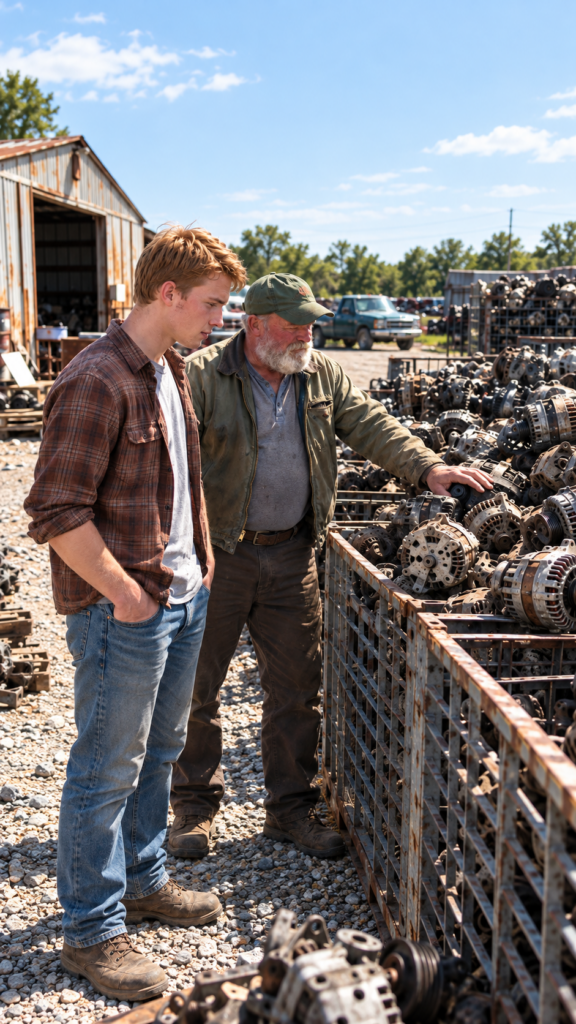
Outside, nearly eight hundred broken alternators sat in a sprawling heap of dirty aluminum, corroded steel, and decades of accumulated grease. Some had come from farm tractors. Others had been pulled from cars and trucks that were no longer worth repairing.
There were cracked housings, bent mounting brackets, seized bearings, rusty pulleys, and electrical terminals so badly corroded that their original shape was difficult to recognize.
A few looked almost complete.
Most looked hopeless.
And Ethan had just agreed to buy every last one for ten cents apiece.
Carl, one of the mechanics who worked at the salvage yard, had been listening from a nearby workbench. He wiped his hands on an oily rag and stepped toward the doorway.
“You’re taking the whole pile?”
Ethan nodded.
Carl stared at him.
“I wouldn’t haul that stuff home if Ray offered to give it to me.”
Ray laughed again.
Ethan didn’t argue.
He stood beside the doorway and looked over the heap one more time. The afternoon light caught the edges of dusty aluminum casings. Broken pulleys protruded from beneath other units. Small pieces of copper wiring showed through damaged openings.
To Carl, it was junk.
To Ray, it was something taking up valuable space.
But Ethan saw more than a pile of broken machines.
A housing could be useful even if the electrical components inside had failed. A pulley could fit another alternator. A mounting bracket might be exactly what somebody needed to keep an older tractor operating.
Some units might be rebuilt. Others could be stripped for parts. Even the ones beyond repair still contained recyclable metal.
Ethan wasn’t foolish enough to believe all eight hundred would work.
He simply didn’t believe all eight hundred were worthless.
“You sure you know what you’re getting into?” Ray asked.
Ethan looked back at him.
“I think I’ve got a pretty good idea.”
Carl snorted.
“That’s what worries me.”
The men laughed again.
Ethan smiled politely, but his eyes had already returned to the pile.
He was thinking about how to get everything home, where he would put it, and how much time it would take to discover what he had bought.
What he wasn’t thinking about was how strange the purchase looked to everybody else.
He had grown used to that part.
Three years earlier, when Ethan was fourteen, his father had given him an old red toolbox.
It wasn’t much to look at.
The paint had worn away around the corners. One drawer stuck whenever somebody tried to close it, and the tools inside appeared to have been collected from several different sets.
There were mismatched wrenches, scratched sockets, and screwdrivers whose handles had seen better days.
Ethan loved it.
His father worked as a maintenance mechanic at a small agricultural equipment shop outside their rural Midwestern town. He spent his working days around machines that had to keep operating even when their owners couldn’t afford expensive replacements.
He understood what a broken machine could mean to a farmer.
Sometimes it meant an inconvenient afternoon.
Sometimes it meant an entire day of work lost.
And sometimes a piece of equipment that looked ready for the scrapyard needed nothing more than one properly identified replacement part.
Ethan had watched his father work for years.
He liked the careful process of taking something apart, identifying a problem, and putting it back together. He liked understanding why one component failed while the others continued to function.
Most of all, he liked the moment when a machine that somebody had given up on began working again.
One day, while they were looking over a damaged piece of equipment, his father had told him something Ethan never forgot.
“Don’t decide something’s worthless until you understand what’s wrong with it.”
At fourteen, Ethan had accepted the advice as a lesson about engines and tools.
By seventeen, he had begun to understand that it applied to money, too.
He started visiting local repair shops and asking about old electrical components that were going to be thrown away.
Some mechanics were happy to get rid of the clutter.
Others were suspicious of a teenager who seemed unusually interested in broken starter motors and used electrical parts.
Ethan bought small quantities whenever he could afford them.
He took them home, cleaned off the dirt, inspected what remained, and separated the useful pieces from the damaged ones.
Some parts could be tested and resold. Others were valuable only because someone needed a particular housing, connection, or bracket.
There wasn’t much money in it at first.
One batch brought him twenty dollars.
Another made fifty.
Sometimes he spent hours cleaning and sorting something only to discover that almost none of it could be sold.
But occasionally, the results surprised him.
He once made nearly two hundred dollars from a box of discarded starter motors.
That sale stayed with him.
He hadn’t made the money because the motors were beautiful or because he’d discovered anything extraordinary.
He made it because he had been willing to examine something other people no longer wanted.
Somebody had a problem.
Somebody else had the part needed to solve it.
Ethan was beginning to understand how to connect the two.
That was what brought him to Miller’s Auto and Farm Salvage one Saturday morning.
Ray Dawson had operated the business for nearly thirty years. Behind the repair shop stretched an outdoor storage area filled with machinery and parts in various stages of decay.
Ethan had visited places like it before.
He knew that a salvage yard was not an organized catalog. Parts arrived from different machines, different owners, and different years. Some were labeled. Many weren’t.
Finding anything useful required patience.
He had driven his father’s old pickup that morning, hoping to discover a few inexpensive components.
Then he noticed the alternators.
They were stacked behind the shop, some in plastic crates, others scattered in a heap. Oil stains darkened several housings. Rust had settled around exposed bolts and pulleys.
There were far more than he had ever considered buying at once.
Ethan stopped walking.
Ray noticed him studying the pile.
“Looking for something in particular?”
Ethan pointed.
“Those alternators.”
Ray followed his gaze.
“What about them?”
“How much would you want for all of them?”
Ray turned toward him.
“All of them?”
“Yeah.”
Ray looked back at the heap as though trying to understand what part of the question he had misunderstood.
“You know most of those have been sitting back there forever.”
“I figured.”
“Some are broken. Some are missing parts. I wouldn’t even bother testing a lot of them.”
Ethan nodded.
“That’s kind of why I’m interested.”
Ray folded his arms.
The boy didn’t seem confused. He wasn’t asking whether the alternators were new, and he certainly wasn’t expecting them to be in working condition.
He appeared to know exactly how bad the pile looked.
“You want to take the whole mess off my hands?”
“If we can agree on a price.”
Ray scratched his beard.
For a moment, he seemed to be considering whether to quote a price high enough to discourage the idea.
Then he glanced toward the cluttered storage area.
“Eighty bucks,” he said. “You give me eighty dollars, and you can take every single one.”
Ethan didn’t hesitate.
“Deal.”
Ray blinked.
“I’m serious.”
“So am I.”
That was when Carl overheard them.
By the time Ethan had handed over the money, both men were thoroughly convinced that the teenager had bought himself an enormous amount of unnecessary work.
Carl wandered over to the pile, lifted one of the units, and turned it in his hands.
“Ethan, you’re seventeen years old. You know what you’re buying here?”
“Alternators.”
Carl gave him a flat look.
“Eight hundred problems.”
Ethan examined the damaged unit.
“Maybe.”
“Maybe?”
“I’m hoping at least some of them turn out to be opportunities.”
Carl burst out laughing.
Ray shook his head.
“Well,” he said, “I guess you’re going to learn something.”
Ethan knew that was possible.
He might have underestimated the amount of damaged material. He might find fewer working components than he’d hoped. He might spend far more time than the purchase deserved.
But he had already done enough small deals to understand one important fact.
At ten cents per alternator, he didn’t need every unit to be valuable.
He only needed to find enough value in the pile to justify the eighty dollars.
Loading everything into the pickup took almost two hours.
The alternators were heavier and more awkward than the pile had made them appear. Some were packed tightly together, while others had damaged brackets sticking out at odd angles.
By the time Ethan finished, grease covered his hands and dark streaks marked his clothes.
He looked down at the crowded truck bed and felt the first real weight of his decision.
Eight hundred.
He had counted that number while doing the math.
Seeing what eight hundred looked like in a pickup was another matter entirely.
Carl watched him prepare to leave.
“Still think you’re getting rich off that stuff?”
Ethan glanced back.
“I’ll let you know when I finish sorting it.”
Carl laughed.
“Hope you’ve got a lot of free time.”
Ethan climbed into the truck and drove home.
When he pulled into the driveway, his mother came outside.
She approached the pickup, looked into the bed, and stopped.
For several seconds, she said nothing.
Then she turned toward him.
“Ethan.”
“Yeah?”
“What did you buy?”
“Alternators.”
“I can see that. How many?”
He hesitated.
“About eight hundred.”
Her expression changed.
“Eight hundred?”
“Yeah.”
She looked at the truck again, as though a second inspection might reveal that he was exaggerating.
“Why would you buy eight hundred broken alternators?”
“They were cheap.”
“How cheap?”
“Eighty dollars for everything.”
She folded her arms.
“Please tell me you’re joking.”
Ethan smiled.
“I know it looks bad.”
“Bad? Ethan, the truck is full of broken machinery.”
“There’s usable stuff in there.”
“You haven’t even looked through all of it.”
“That’s what I’m going to do.”
His mother sighed, then laughed despite herself.
“Your father’s going to love this.”
When his father finally came outside, he took one look at the pickup and stopped beside the tailgate.
He glanced at Ethan.
“How much did all this cost?”
“Eighty dollars.”
His father looked into the bed again.
“For all of it?”
“All of it.”
He reached in, lifted one alternator, and studied the casing. He rotated the pulley, examined the mounting points, and looked through the ventilation openings.
Ethan waited.
He knew his father would recognize the damage immediately.
He also knew that if there was a serious flaw in his idea, his father wouldn’t hide it simply to make him feel better.
After a moment, the older man put the alternator down.
“Well,” he said, “at ten cents apiece, you don’t have to save many of them to make your money back.”
Ethan felt himself relax.
His father wasn’t promising a profit.
He hadn’t claimed the pile was full of valuable parts.
He had simply looked at the same purchase the way Ethan had looked at it.
As a question that could be answered by careful work.
The next morning, Ethan began turning the family garage into a sorting area.
He set up three worktables.
One was for complete alternators that appeared worth inspecting or testing. The second held damaged units that might be rebuilt or used as cores. The third was reserved for loose parts and components that could be salvaged.
Anything clearly beyond recovery would be set aside for scrap.
He wanted each piece to go somewhere for a reason.
The work was discouraging almost immediately.
Every time he cleaned a unit enough to see its condition, another fault seemed to appear.
A cracked mounting ear.
A pulley that refused to turn.
A terminal broken off flush with its connection.
Bearings that ground unpleasantly when he rotated the shaft.
Some housings contained electrical components too badly damaged to justify rebuilding.
Others looked promising until he examined the mounting brackets and discovered damage that would make them difficult to use.
By midday, the garage smelled of old grease and cleaning supplies.
Dirty rags lay beside the work area. Parts waited in separate groups, and the number of alternators still untouched seemed hardly smaller than it had that morning.
Ethan was concentrating on a particularly stubborn unit when his friend Noah arrived.
Noah stood in the garage doorway and stared.
“Man, what happened in here?”
Ethan didn’t look up.
“Bought some alternators.”
“I heard.”
Noah stepped inside.
“I thought somebody was exaggerating.”
“Nope.”
“You really got eight hundred?”
“Pretty close.”
Noah surveyed the tables and the piles stacked nearby.
“How many have you found that are any good?”
Ethan set down his tool.
“Seven.”
Noah stared at him.
“Seven?”
“Seven that look promising.”
“Out of eight hundred?”
“I haven’t gone through all eight hundred.”
Noah laughed and shook his head.
“You realize you might spend your entire summer cleaning junk?”
Ethan went back to work.
“Maybe.”
Noah picked up an alternator from the damaged pile.
“This thing looks like it’s been sitting outside since before we were born.”
“It might have been.”
“And you think somebody’s going to buy it?”
“Not necessarily that one.”
Noah put it down.
“You know everybody’s going to make fun of you.”
Ethan smiled without looking away from the part in his hands.
“They already are.”
Noah laughed.
“Fair enough.”
After his friend left, the garage became quiet again.
Ethan returned to the workbench.
He could have stopped that afternoon.
Nobody had forced him to buy the pile. His father hadn’t demanded that he finish. The eighty dollars was already gone, and accepting a loss would have been easier than continuing to take apart one filthy component after another.
But every time he found a usable bracket or a clean internal assembly, he was reminded why he’d started.
He wasn’t trying to prove that every broken thing deserved to be saved.
He wanted to learn which things were worth saving.
The days passed.
He cleaned housings, inspected bearings, checked shafts, and separated copper and aluminum. He saved usable pulleys and organized mounting brackets according to their shapes and possible applications.
Little by little, the mountains began to change.
The scrap pile grew.
So did the piles of usable parts.
After one week, Ethan had identified forty-three alternators that appeared worth testing.
After two weeks, the number had increased to seventy-nine.
Not seventy-nine guaranteed sales.
Not seventy-nine fully repaired machines.
Seventy-nine possibilities that had survived the first round of inspection.
Some would fail when tested. Others would need replacement components. A few might turn out to be more trouble than they were worth.
But there were enough promising units to make the work feel different.
The pile was no longer simply getting smaller.
It was becoming something he could understand.
He began paying closer attention to the differences between applications. An alternator that looked ordinary to someone unfamiliar with farm equipment might have a mounting arrangement that made it difficult to replace.
A piece of machinery didn’t have to be rare or expensive to become important.
It only had to be difficult to repair without the right part.
Then, one day, a local tractor mechanic named Mike came to the garage looking for an alternator for an older farm tractor.
A new replacement would cost more than two hundred dollars.
Mike had heard through Ethan’s father that the boy might have something useful.
Ethan listened as the mechanic described what he needed.
Then he turned toward the shelves.
For the first time since buying the eight hundred broken alternators, a customer had come looking for something the pile might actually provide.
And Ethan thought he knew where to find it.
Part 2
Mike followed Ethan toward the shelves, his work boots making dull sounds against the garage floor.
He was the kind of mechanic who had spent enough years around agricultural equipment to recognize how much trouble a missing part could cause. An older tractor might be mechanically sound in most respects, but if its charging system failed, the owner still had to find a way to repair it.
And finding a replacement wasn’t always as simple as ordering something new.
Ethan studied the alternators he had separated from the larger pile.
“Tell me about the mounting again,” he said.
Mike described the arrangement.
Ethan checked several units before taking one down from the shelf.
“This might be what you’re looking for.”
Mike took it from him and examined the mounting points.
The configuration appeared right.
He rotated the pulley.
“Does it work?”
Ethan hesitated only long enough to choose his words.
“I haven’t tested this one yet.”
Mike raised an eyebrow.
“You’re trying to sell me an alternator you don’t know works?”
“No,” Ethan replied. “I’m saying I think this one will fit, and I want to find out whether I can make it work.”
Mike studied the teenager for a moment.
Then he smiled.
“That’s a better answer.”
Ethan understood the distinction.
He could have polished the housing and described the unit as rebuilt. He could have hoped the customer wouldn’t ask too many questions.
But if Mike installed it on a tractor and discovered that the electrical output was wrong, Ethan would have accomplished nothing except creating trouble for someone who had trusted him.
The whole point was to solve a problem.
Not pass one along.
Ethan took the alternator to his testing equipment and prepared it for inspection.
He checked its mechanical condition first. The pulley rotated smoothly. There was no alarming noise from the bearings.
Then he tested the electrical output.
Mike watched closely.
As the test progressed, the voltage rose into the appropriate range.
Ethan checked the result carefully rather than stopping the instant he saw a promising reading.
The alternator was charging correctly.
For a moment, neither of them spoke.
Mike looked at the unit.
Then at Ethan.
“Well, I’ll be.”
Ethan tried not to smile too broadly.
“Looks like it’s a good one.”
Mike nodded.
“How much do you want for it?”
Ethan considered the question.
He knew what a new replacement would cost. He also knew that Mike had taken a chance by coming to a teenager’s garage instead of ordering a professionally rebuilt unit elsewhere.
“Seventy-five dollars.”
Mike thought about it.
“If it works the way you say it does, seventy-five sounds fair.”
They shook hands.
After Mike left, Ethan stood beside the workbench and looked at the money.
Seventy-five dollars.
The original alternator had cost him roughly ten cents as part of the bulk purchase.
Of course, he knew that didn’t mean he had made seventy-four dollars and ninety cents in pure profit. There was the time spent sorting, the cleaning materials, the testing equipment, and all the work required to identify a usable unit.
But the sale was important for a reason that went beyond the amount.
A real customer had arrived with a real problem.
Ethan had found a part, verified its condition, and provided a less expensive solution.
Until that day, the pile had represented a possibility.
Now it had produced a result.
He returned to the remaining alternators with renewed concentration.
There was no dramatic transformation. The garage was still crowded, the scrap still dirty, and hundreds of units still needed attention.
But Ethan began looking at his inventory differently.
He was no longer asking only whether a particular alternator could be repaired.
He was asking what kind of machine might need it.
That meant learning mounting arrangements, electrical connections, identification tags, and part numbers.
It meant understanding that two alternators could look similar and still be wrong for the same application.
It meant recognizing that a working component had limited value if he couldn’t identify the customer who needed it.
He started making more careful distinctions between complete units, rebuildable cores, and individual parts.
The more he learned, the less random the work became.
And as word spread among local mechanics, Ethan began to realize that his father’s reputation for careful mechanical work had opened a door for him.
But his own work would determine whether that door stayed open.
About a month after the original purchase, the phone rang.
The caller introduced himself as Walter, an older mechanic who operated a small repair shop specializing in older agricultural equipment.
“I hear you’ve been buying alternator cores,” Walter said.
“Yeah. I’ve got quite a few.”
“That so?”
“More than I expected, actually.”
Walter chuckled.
“I know that feeling.”
He explained that he was looking for several units suitable for rebuilding.
Not one or two.
Twelve.
Ethan listened, suddenly aware of how different this request was from Mike’s.
A single successful sale could have been luck.
Twelve possible replacements meant he needed to know his inventory.
“You got anything useful?” Walter asked.
“I think I have some worth looking at.”
“Mind if I come by?”
“Not at all.”
When Walter arrived, he didn’t waste much time admiring the worktables.
He began examining the alternators.
He picked them up, checked their housings, studied mounting points, and looked for identifying marks.
Ethan watched how carefully the older mechanic handled each unit.
Walter wasn’t impressed by clean paint or shiny aluminum.
He was interested in whether the part was the right one.
Every so often, he asked Ethan where a particular alternator had come from, whether it had been tested, or what condition its internal components appeared to be in.
Ethan answered as accurately as he could.
Sometimes that meant saying he didn’t know.
Walter didn’t seem bothered by the uncertainty.
He seemed more interested in whether Ethan could recognize it.
After examining several shelves, Walter picked up a dusty alternator with a faded identification tag.
He turned it over, brought the tag closer, and stopped.
“Now, this one’s interesting.”
Ethan moved beside him.
“What about it?”
“I’ve been looking for this style for months.”
Ethan studied the casing.
There was nothing especially impressive about it. The housing was worn, and the tag had faded badly with age.
“Seriously?”
Walter nodded.
“It belongs to an older tractor application. Not the kind of machine most people want to spend a fortune restoring.”
He ran his thumb across the tag.
“But the people who still own those tractors need to keep them running.”
Ethan looked at the alternator again.
He had already learned that damaged electrical components could have value.
Walter was showing him something more specific.
The older a piece of agricultural equipment became, the harder certain replacement parts could be to find.
A farmer might have a tractor that still performed useful work. The engine might run, the transmission might function, and the owner might have no reason to replace the machine.
But one failed alternator could leave that tractor waiting for a part that wasn’t readily available through ordinary suppliers.
A discontinued application didn’t necessarily mean there was no demand.
It sometimes meant the demand was difficult to satisfy.
Walter continued examining the shelves.
By the time he finished, he selected four alternators he believed were worth buying.
Ethan watched him place the units together.
Walter took out his money.
“Four hundred and twenty dollars.”
Ethan looked up.
“For all four?”
Walter nodded.
“That’s what they’re worth to me.”
Ethan counted the money carefully.
Four hundred and twenty dollars.
More than five times what he had paid for the entire pile.
And he still had hundreds of alternators left to process.
Walter noticed his expression.
“Don’t get too excited,” he said.
Ethan laughed.
“I’m trying not to.”
“Those other ones still need to prove themselves.”
Ethan glanced toward the shelves.
Walter continued in the practical tone of a man who had learned his lessons through work rather than luck.
“You’ve done the sorting. That’s good. But a clean housing doesn’t mean a working alternator.”
“I know.”
“And knowing what fits is just as important as knowing what runs.”
Ethan nodded.
Walter looked around the garage.
“You keep testing things properly, and you keep telling people exactly what you’ve got, they’ll remember.”
After Walter left, Ethan set the money aside and went back to work.
The older mechanic had given him something almost as useful as the sale itself.
A clearer understanding of why some parts mattered.
Ethan had originally looked at the pile as a collection of materials.
Copper.
Aluminum.
Steel.
Usable components.
Now he was beginning to see it as a collection of possible answers to problems he hadn’t encountered yet.
Somewhere, somebody might be searching for a mounting bracket that looked unremarkable on his shelf.
Somewhere, an old tractor could be sitting idle because a replacement part had become difficult to obtain.
The challenge was not simply discovering what an alternator was worth as metal.
It was learning what it was worth to the person who needed that exact unit.
That lesson became personal when Harold came to the garage.
Harold was an older farmer with a tractor that had belonged to his father.
The machine had been sitting unused for years.
His father had worked with it for nearly forty years before passing away a few years earlier. Now Harold wanted to get the tractor operating again so he could use it on a small piece of land his father had left behind.
He arrived carrying the alternator that had been removed from the old machine.
Ethan met him near the workbench.
Harold placed the unit down carefully.
“This came off my dad’s tractor.”
Ethan examined it.
The alternator showed its age. It needed cleaning and a thorough inspection before he could determine what might be saved.
“You think you can rebuild it?” Harold asked.
Ethan turned the unit over.
“I can try.”
Harold nodded.
For a moment, his attention remained on the alternator.
“My dad used that tractor for almost forty years.”
Ethan looked up.
Harold continued, more quietly.
“He’s been gone a few years now.”
The older man paused.
“I’ve got a little piece of land he left me. I’d like to get the tractor running again and use it there.”
Ethan listened without interrupting.
“I’m not trying to turn it into something valuable,” Harold said. “I just want it working again.”
Ethan understood what he meant.
The tractor wasn’t valuable only because of what another buyer might pay for it.
It had belonged to Harold’s father.
It had been part of the work he did, part of the land he cared for, and part of a life Harold could no longer return to.
Getting it running wouldn’t bring his father back.
But it would allow Harold to use something his father had spent much of his life using.
Ethan looked down at the alternator.
“I’ll see what I can do.”
He didn’t ask Harold for money up front.
He took the unit apart and began inspecting the components.
The work occupied two evenings.
He removed years of accumulated grime, cleaned the housing, inspected worn pieces, and replaced components that could no longer perform their intended jobs.
He checked the electrical connections and looked for problems that might not be visible from outside.
Nothing about the repair was particularly glamorous.
There were dirty hands, stubborn parts, and long stretches of careful work.
When the alternator was ready for its first test, Ethan set it up on the machine.
He started the test.
And watched the result.
Something was wrong.
The alternator wasn’t charging as it should.
Ethan shut down the equipment and stared at the unit.
He had already spent hours on it.
He could have called Harold and explained that the repair wasn’t successful. He had never promised the alternator could be saved.
But he wasn’t ready to give up without understanding why it had failed.
He went back through the work.
He checked the connections again, examined the wiring, and retraced the electrical path.
Eventually, he found the problem.
It was in the wiring.
He corrected it, checked his work, and returned the alternator to the test machine.
This time, when he started the test, the needle began to climb.
Ethan watched carefully.
The output rose into the proper range.
He continued observing the result, making sure the charging system behaved as it should.
It worked.
For a few moments, Ethan simply stood there, listening to the steady sound of the equipment.
The first failed test had not meant the alternator was beyond saving.
It meant he hadn’t found every problem yet.
That difference mattered.
A few days later, Harold brought the old tractor to the shop.
The machine had the worn appearance of equipment that had once been used regularly and then left standing for years.
Ethan recognized the alternator he had worked on now back where it belonged.
Harold climbed onto the tractor.
There was a brief moment of preparation.
Then the engine turned over and started.
The old tractor shook as its engine settled into motion.
A little smoke drifted from the exhaust.
The sound filled the space around them, familiar to anyone who had grown up around farm machinery.
Ethan stood watching.
Harold remained in the driver’s position for a moment, listening.
Then the tractor moved.
After years of sitting still, the machine that had once belonged to Harold’s father was working again.
It wasn’t a new tractor.
It hadn’t suddenly become a valuable collector’s machine.
It was the same old piece of equipment Harold remembered.
But it could move under its own power again.
When Harold finally climbed down, he walked toward Ethan.
He shook the teenager’s hand.
For a moment, neither said much.
Harold looked back at the tractor.
His expression softened.
“Dad would’ve liked this.”
Ethan felt the weight of those few words.
He could have talked about the electrical problem, the wiring correction, or the time he’d spent rebuilding the alternator.
But none of those details seemed important just then.
He smiled.
Harold kept looking at the machine.
Ethan understood that the older man was seeing more than a repaired tractor.
And for the first time, the teenager fully recognized that the small business growing inside his garage involved more than buying cheaply and selling for a higher price.
A part that meant little to one person could mean a great deal to another.
Sometimes that meaning was practical.
A farmer needed a machine operating before work could continue.
Sometimes it was financial.
A used replacement could keep an older tractor running without forcing its owner to spend hundreds of dollars.
And sometimes it was something that couldn’t be written on a price tag.
A son wanted to drive his father’s tractor again.
Ethan couldn’t repair the years that had passed.
He couldn’t replace the man Harold had lost.
But he had repaired one small piece of machinery that allowed a connection to remain useful and real.
That evening, when he returned to his garage, the remaining alternators looked different to him.
They were still greasy and rusted.
Some were still useless.
But he no longer measured their potential value only in dollars.
He thought about Mike trying to keep an older tractor working.
He thought about Walter searching for parts that were disappearing from ordinary supply.
And he thought about Harold, standing beside a tractor his father had used for almost forty years.
The work had begun with eighty dollars and a pile of unwanted metal.
Now it was becoming something Ethan hadn’t expected.
A way to help people preserve things they still needed.
Or simply weren’t ready to lose.
And there were still hundreds of alternators waiting to be examined.
Somewhere in that remaining pile was a unit Ethan had not yet recognized.
One that would teach him just how valuable an overlooked part could become when the right person had spent nearly a year searching for it.
Part 3
Three months after Ethan bought the eight hundred alternators, the garage looked nothing like it had on the morning he unloaded the pickup.
The worktables were no longer buried beneath random heaps of greasy metal.
Usable parts had begun finding their way into organized groups. Alternators that appeared suitable for rebuilding were separated from units that had passed testing. Damaged components waited to be stripped, and pieces with no practical remaining use were gathered for scrap.
Ethan had learned to recognize certain housings almost immediately.
He could look at a mounting arrangement and begin narrowing down the kind of equipment it might fit.
He had learned that identification tags deserved attention even when they were faded or covered in dirt.
And he had stopped assuming that a part was common simply because several similar pieces sat nearby.
Still, there were limits to what he knew.
He was seventeen.
He had learned a great deal from his father, from local mechanics, from repair manuals, and from the mistakes he’d made at his own workbench.
But there were still old agricultural applications he had never encountered.
And one of them was waiting near the bottom of the remaining pile.
That afternoon, Ethan was working through a group of badly damaged alternators.
Most were disappointing.
One had a broken housing. Another was missing components that would make rebuilding it impractical. Several had suffered enough corrosion that only individual pieces or scrap metal could be recovered.
Then Ethan pulled out an especially dirty unit that had been buried beneath the others.
Its housing was covered in grime.
The pulley was rusty.
The identification label was so badly faded that he could barely make out anything written on it.
He turned the alternator over.
At first glance, there was no reason to spend much time on it.
It looked like one more piece of worn-out machinery that had spent too many years exposed to dirt and weather.
Ethan carried it toward the scrap area.
Then he stopped.
He turned the unit around again.
Something about the mounting bracket caught his attention.
He couldn’t immediately identify what was unusual about it. The shape simply reminded him of something he had seen while studying older equipment applications.
He looked more closely.
The arrangement wasn’t quite like the common units he had been sorting.
Ethan returned to the workbench.
He cleared away enough grime to expose the identification tag.
The lettering was faint.
He cleaned it carefully, trying not to damage what remained.
Slowly, part of a number emerged.
Ethan leaned closer.
There it was.
A part number.
He took out his old repair manuals and began searching.
He checked the reference once.
Then again.
As he compared the numbers and mounting details, he realized what he was holding.
The alternator belonged to a discontinued agricultural application.
It wasn’t simply another common unit with a broken pulley.
It was a particular design used on equipment for which replacement parts had become difficult to locate.
Ethan remembered hearing that a local restoration shop had been searching for an alternator matching this application.
He went back through the identification information to make sure he hadn’t misunderstood it.
The number matched.
The mounting arrangement matched.
He looked down at the dirty alternator on his bench.
Only minutes earlier, he had almost thrown it into the scrap pile.
Now he was wondering whether he had found something a customer had been unable to locate for months.
He picked up the phone.
When the restoration shop owner answered, Ethan explained why he was calling.
“I heard you were looking for an alternator for an older agricultural application.”
The man sounded interested.
“Which one?”
Ethan gave him the identification information.
There was a pause.
“Where’d you find that?”
“I’ve been sorting through some old alternators.”
“You actually have one?”
“I think so.”
The man laughed, but it wasn’t the dismissive laughter Ethan remembered from the salvage yard.
It was the sound of someone who had spent a long time searching for something and could hardly believe it might finally have appeared.
“We’ve been trying to find one of those for almost a year.”
Ethan looked at the unit.
“I haven’t finished testing it.”
“Does the housing match?”
“As far as I can tell. The identification number matches, too.”
“Does it work?”
“I don’t know yet.”
The owner didn’t seem surprised.
“Test it. See what you’ve got.”
After the call, Ethan returned to the workbench.
He was excited, but experience had taught him not to confuse a valuable part number with a usable alternator.
The unit still had to survive inspection.
He checked the pulley and bearings.
The bearings were rough.
The regulator also needed attention.
Those problems would require work, and the alternator could not simply be cleaned and shipped to the shop as a functioning replacement.
But the main housing was usable.
So were important internal components.
The damage was not the kind that made the entire unit worthless.
Ethan began the rebuilding process.
He worked carefully because the circumstances were different from the first inexpensive units he had repaired.
With a common alternator, a serious problem might mean setting it aside and selecting another similar core.
Here, the value depended heavily on the particular unit he had found.
Replacing it with something that looked close would not necessarily solve the restoration shop’s problem.
He needed to preserve the correct application while repairing what had failed.
As he worked, Ethan thought about the way he had almost discarded the alternator.
If he had moved a little faster, if he had ignored the unusual mounting bracket, or if he hadn’t bothered cleaning the faded label, it would have joined the other unwanted pieces in the scrap pile.
Nothing about the alternator had announced its value.
There was no polished finish, no bright packaging, and no obvious sign that somebody had been searching for it.
Its importance was hidden in ordinary details.
A mounting bracket.
An identification number.
A discontinued application.
And the existence of a customer who needed exactly that part.
Once Ethan had completed the rebuilding work and verified the result, the restoration shop offered him three hundred and fifty dollars for the alternator.
He accepted.
The original cost of the unit, as part of his eight-hundred-piece purchase, had been approximately ten cents.
The rebuilding had taken additional time and materials, of course.
But the sale was remarkable.
A unit that had nearly ended up in the scrap pile had become one of the most valuable individual pieces Ethan recovered.
He had not discovered gold.
He had not uncovered a secret fortune or an extraordinary machine.
He had found an old alternator with the correct configuration for a specific discontinued application.
And because somebody needed it, that was enough.
Ethan thought back to the afternoon at Miller’s Auto and Farm Salvage.
Ray had laughed when he counted out the money.
Carl had called the purchase eight hundred problems.
Ethan himself had wondered whether the amount of work would be worth it.
Now, looking at the records of his sales, he could see how many different kinds of value had been hidden inside that pile.
But the work was far from finished.
Three months had passed since the original purchase.
It would take another three months before every alternator had been processed.
Some units became functioning replacements after cleaning, repair, and testing.
Others were sold as rebuildable cores to mechanics who had the tools and experience to put them back into service.
Some provided usable pulleys, brackets, housings, and electrical components.
Others contained recyclable copper and aluminum but little else that could justify further work.
And some were simply worn-out scrap.
Ethan learned to accept that.
At the beginning, he had sometimes felt reluctant to discard a part after spending time cleaning it.
But the more he worked, the more he understood that time had value, too.
Spending hours trying to rescue a hopeless alternator could prevent him from inspecting several units that actually had a reasonable chance of being useful.
His father’s advice had never meant that everything deserved to be saved.
It meant understanding the problem before making a decision.
Sometimes the correct decision was to repair.
Sometimes it was to salvage individual components.
And sometimes it was to stop.
By the end of six months, Ethan had processed all eight hundred alternators.
His garage had become a small but organized parts operation.
There were shelves holding tested units, areas for rebuildable cores, and containers of components separated according to their applications.
Near the door was a modest shipping table where he prepared parts for customers who weren’t able to collect them in person.
The arrangement wasn’t impressive because of expensive machinery or fancy equipment.
It was impressive because it worked.
Ethan knew what he had.
He knew which parts had been tested and which were being sold only as cores.
He understood that customers depended on accurate descriptions.
Most importantly, he had learned how to connect an overlooked component with the person who needed it.
When he added up his sales after six months, the total reached eight thousand nine hundred and forty dollars.
TOTAL SALES FROM THE ORIGINAL PURCHASE
Original purchase
$80
Total sales
$8,940
This was gross revenue, not net profit. Additional costs included replacement parts, cleaning supplies, shipping, tools, and testing equipment.
Ethan stared at the total for a while.
Eight thousand nine hundred and forty dollars.
He remembered how long it had taken to load the original purchase into the pickup.
He remembered standing in the garage after finding only seven promising units.
He remembered Noah laughing at the thought of spending an entire summer cleaning broken machinery.
And he remembered how relieved he’d felt when Mike paid seventy-five dollars for the first working alternator.
He also knew better than to pretend all eight thousand nine hundred and forty dollars belonged in his pocket.
There had been expenses.
Cleaning supplies, replacement components, shipping materials, tools, and testing equipment had all cost money.
Some repairs had taken more time than expected.
Some units had produced very little return.
After accounting for the expenses, the profit was considerably less than the total sales.
But it was still several thousand dollars.
From a pile of damaged alternators that most people had considered worthless.
For a seventeen-year-old working out of a family garage, that was more than enough to prove the idea had merit.
Yet the number wasn’t what pleased him most.
He was proud that the garage had become a place where mechanics could look for parts they couldn’t easily find elsewhere.
He liked that the shelves had a purpose.
He liked that people had begun asking him about older agricultural applications because they believed he might know where to look.
The business had started with cheap scrap.
It was beginning to depend on knowledge.
One afternoon, Carl stopped by the garage.
Ethan was working when he noticed the familiar mechanic standing near the doorway.
Carl looked around.
His gaze moved across the organized shelves, the labeled boxes, the separated cores, and the tested alternators waiting for customers.
He took a few steps inside.
“Well, look at this.”
Ethan smiled.
“Hey, Carl.”
Carl examined a row of alternators.
He picked one up, checked it, and set it back down.
Then he turned toward Ethan.
“So?”
Ethan raised an eyebrow.
“So what?”
Carl gestured around the garage.
“Still junk?”
Ethan laughed.
“You tell me.”
Carl looked at the shelves again.
For a moment, he seemed to be remembering the heap behind Ray Dawson’s repair shop.
The dirty casings.
The seized pulleys.
The broken brackets.
And the teenager who had counted out eighty dollars while everyone around him laughed.
Finally, Carl nodded.
“I’ll admit it.”
Ethan leaned against the workbench.
“Admit what?”
“You were right to buy them.”
Ethan smiled.
Coming from Carl, those words meant something.
The older mechanic had never been cruel to him. He had simply believed that the purchase was a mistake.
And from what the pile looked like that morning, Ethan could understand why.
He hadn’t been completely certain of the outcome himself.
“Well,” Ethan said, “I appreciate that.”
Carl pointed at him.
“Don’t let it go to your head.”
Ethan grinned.
“Too late.”
They both laughed.
But Carl wasn’t finished.
He glanced around the garage one more time.
“You know what your real business is?”
Ethan considered the question.
“Selling alternators?”
Carl shook his head.
“Not exactly.”
“Then what?”
Carl picked up another unit from the shelf.
“Knowing what people need before they know where to find it.”
Ethan looked at the alternator in Carl’s hands.
The remark stayed with him.
Because Carl was right.
The metal itself wasn’t the whole business.
There were thousands of broken alternators sitting in salvage yards, repair shops, and scrap piles.
Most would never be worth anyone’s time.
What made Ethan’s work different was his willingness to identify the useful ones, learn where they belonged, and find the customers who needed them.
Cleaning mattered.
Testing mattered.
Mechanical skill mattered.
But so did knowing the market.
Walter had understood that when he recognized a hard-to-find agricultural unit.
Mike had understood it when he came looking for an affordable replacement.
And Harold had shown Ethan that the value of a repair could reach far beyond the money exchanged.
The teenager who had once bought parts almost entirely because they were cheap was now learning to buy based on what he could verify.
After the success of the original eighty-dollar purchase, he never again bought another enormous pile blindly.
He inspected what he could before making deals.
He kept better records.
He studied identification numbers and learned how different components matched different machines.
He spoke with mechanics, not only about what they wanted to buy, but about which parts were becoming harder to find.
He listened when customers described the equipment they were trying to repair.
If someone needed an unusual alternator, Ethan didn’t assume a similar-looking unit would be good enough.
He checked.
If a component hadn’t been tested, he said so.
If a part was only suitable as a rebuildable core, he described it that way.
And if something was genuinely worthless, he stopped trying to turn it into something it wasn’t.
Those habits weren’t as exciting as turning ten cents into a three-hundred-and-fifty-dollar sale.
But they were what allowed the business to keep growing after the original pile was gone.
Ethan understood that he couldn’t rely on finding one overlooked treasure after another.
What he could rely on was a process.
Inspect carefully.
Learn the application.
Test what could be tested.
Describe the condition accurately.
And find the person who needed the part.
As the months passed, more people in the community began recognizing him as the young man who could sometimes locate components that other suppliers no longer carried.
It was a modest reputation, built through patient work and the trust of local customers.
But it was his.
And it had begun in the least impressive way imaginable.
With a pickup truck, eighty dollars, and eight hundred broken alternators.
Sometimes Ethan thought about the people who had helped him reach that point.
His father, who had taught him never to dismiss something before understanding it.
His mother, who had looked into the overloaded pickup and wondered what on earth he had brought home.
Noah, whose teasing had reminded him how ridiculous the project appeared from the outside.
Mike, who had insisted that a working part mattered more than a confident sales pitch.
Walter, who had shown him the value of older applications and warned him that every unit still had to prove itself.
Harold, who had stood beside his father’s old tractor and spoken a few quiet words Ethan would remember for years.
And Carl, who had finally recognized that the business wasn’t really about collecting scrap.
Each of them had helped Ethan understand something about what he was doing.
Some through advice.
Some through doubt.
And some simply by bringing him a problem worth solving.
The eight hundred alternators were eventually gone.
They had been repaired, sold, rebuilt, stripped for components, or sent on as scrap metal.
The original mountain behind the salvage yard no longer existed in Ethan’s garage.
But the work it had started remained.
There were still mechanics who needed parts.
Still farmers operating machines that had been built long before Ethan was born.
Still old tractors whose owners weren’t ready to replace them.
And still useful components waiting in places where nobody had bothered to look carefully.
Ethan had started with the belief that the difference between junk and value wasn’t always obvious.
Six months of dirty hands, failed tests, careful repairs, customer conversations, and unexpected discoveries had taught him how much effort it took to recognize that difference.
Being laughed at didn’t prove he was wrong.
But believing in an idea didn’t automatically make him right, either.
The only way to know was to do the work.
Years of experience were still ahead of him. There was plenty he didn’t know, and he was aware that future purchases might not turn out so well.
Yet he had already learned something that many people never considered.
The most useful thing in a pile of discarded machinery wasn’t always the part that looked the best.
Sometimes it was the part nobody recognized.
Sometimes it was the one with a faded identification tag.
And sometimes it was the small piece that allowed an old farmer to hear his father’s tractor running again.
Whenever someone asked Ethan how he had come up with the idea for his business, he didn’t tell them he’d discovered some secret formula for getting rich.
He didn’t talk about hidden treasures or extraordinary luck.
He simply thought back to that Saturday at Miller’s Auto and Farm Salvage.
He remembered Ray Dawson laughing behind the counter.
Carl shaking his head.
And eight hundred broken alternators piled behind the repair shop.
Then he would point toward the old salvage yard down the road.
“Everybody else saw eight hundred pieces of scrap,” he would say.
A small smile would cross his face.
“I saw eight hundred chances.”