Part 1
The morning Alton Ror lost his home, two strangers carried his living room furniture down the porch steps he had built with his own hands forty-five years earlier.
The rain fell steadily, soaking the grass and darkening the boards beneath their boots. One of the movers struggled with the old couch, dragging its wooden leg against the railing. Alton almost told him to be careful.
Then he remembered the couch no longer belonged to him.
He stood beside the front steps in a jacket too thin for November, turning a folding carpenter’s ruler between his trembling fingers. He had carried that ruler for forty years, through construction jobs, engine repairs, and countless small emergencies around the house.
He opened it, folded it, and opened it again.
There was nothing left to measure.
At seventy, Alton had imagined his remaining years would be quiet. He had paid off the mortgage decades ago. He had raised five children beneath that roof. The house was not grand, but every improvement had come from his labor.
Now strangers were loading it into a truck.
His wife, Dela, sat on the porch with their thirteen-year-old bluetick hound, Dutch. The dog’s muzzle had turned almost completely gray, and his bad hips made every movement difficult. He rested his head against her knee, watching the movers with suspicious eyes.
Dela kept one hand against his neck.
“It’s all right, old boy,” she murmured.
But Dutch continued watching the men.
A clean gray pickup stopped along the curb.
Their son Wade climbed out.
At forty-four, Wade looked like a man who had never worried about where he would sleep. His expensive wool coat was buttoned neatly, his shoes were polished, and he carried a leather folder beneath one arm.
He crossed the muddy yard carefully.
“Dad,” he said, “you shouldn’t be standing out here. You’ll get sick.”
Alton looked toward the empty doorway.
“Where would you suggest I stand?”
Wade sighed.
“We’ve been through this.”
He laid the folder on the porch railing.
“The place in Cordell has confirmed everything. Two beds, meals, medical staff, somebody checking on you every night. It’s a good facility.”
“We’re not going,” Alton said.
“Dad, you had two stents put in eighteen months ago. Mom can barely manage stairs anymore. You can’t keep pretending you’re healthy enough to live alone.”
Dela slowly opened the folder.
After thirty-one years as a home nurse, she knew more about care facilities than Wade imagined. She had spent much of her working life helping people remain comfortable, dignified, and independent despite failing bodies.
Her eyes stopped on a line near the bottom of the first page.
“No pets,” she said.
Wade rubbed his forehead.
“Mom, it’s a care facility.”
“It says no animals.”
“They have rules.”
Dela looked at Dutch.
The old dog had been with them through hospital visits, lonely winters, and the years when their children stopped coming home for Sunday dinners. When money became scarce, they had sometimes gone without medicine to pay for his.
Wade glanced at the hound.
“There’s a shelter on the west side. They could take him.”
“A shelter?”
“They’d keep him somewhere warm.”
“He’s thirteen, Wade.”
“Exactly. He’s old. His hips are bad. Honestly, finding him somewhere comfortable might be the kindest thing.”
Dela stood.
Her knees protested, and she steadied herself against the porch post. Dutch rose beside her, pressing his body against her leg.
“We don’t leave family in the cold,” she said.
Wade’s expression tightened.
“Mom, he’s a dog.”
“I know exactly what he is.”
She stepped closer.
“We spent three nights sleeping in our truck this fall because we had to choose between his medicine and ours. Do you know that?”
Wade looked away.
“Of course I didn’t know.”
“Because you never asked.”
For a moment, only the rain and the moving truck could be heard.
Then Dela placed the folder back on the railing.
“We’re not going somewhere that won’t take Dutch.”
Wade shook his head.
“You’re making an impossible situation worse.”
Alton stared at his son.
He wondered when Wade had learned to speak like that—always reasonable, always certain, as though anyone who disagreed simply failed to understand the facts.
Six years earlier, Wade had sat at their kitchen table with another folder.
He had spoken about lawsuits, medical expenses, estate planning, and protecting the house. The paperwork was complicated, but Wade had assured his father that signing it would safeguard everything he had worked for.
Alton could repair a truck engine from a box of discarded parts. He could frame a roof without looking at a drawing.
Legal documents were another matter.
He had trusted his son.
Now the home he thought he owned outright was being emptied by order of the bank.
He still did not understand how it had happened.
Dela broke the silence.
“We have the mountain.”
Wade turned.
“What mountain?”
“Grandmother Verly’s land. On Sorrel Mountain.”
Wade gave a short, disbelieving laugh.
“That worthless property?”
“It’s still in my name.”
She said the words carefully.
The land had come to her through her mother’s family after Wade had arranged the earlier paperwork. Whatever had happened to their house, the mountain parcel remained hers.
Wade knew it.
Alton saw the slight movement in his son’s face.
“There’s supposed to be a cabin up there,” Dela continued.
“That cabin’s probably been gone for fifty years.”
“Maybe.”
“There’s no proper road. It’s all rock and woods. You’ll freeze to death up there.”
Dela looked past him toward the moving truck.
“At least nobody will tell us to give away our dog.”
The mountain had always been a strange subject in her family.
Her grandmother Verly had lived to ninety-six, a stern, respectable woman who rarely spoke of her own youth.
Near the end of her life, she had made Dela promise to keep the land.
Don’t sell it. Don’t build on it. Don’t let anyone convince you to give it away.
And above all, stay off the mountain in winter.
When Dela asked why, Verly refused to answer.
She died two days later.
For decades, the deed remained in a shoebox, accompanied by an old hand-drawn map and a rusted cabin key.
Now those scraps of paper represented everything Alton and Dela had left.
Wade checked his watch.
“The beds are available until Friday. After that, I can’t promise anything.”
Alton folded his ruler.
“Then give them to somebody who wants them.”
“Dad—”
“At least on the mountain, we’ll decide how we live.”
Wade opened his mouth, but nothing came out.
For one brief moment, Alton thought he saw shame in his son’s eyes.
Then Wade looked at his watch again.
“I’ve got a call at one.”
He walked back to his truck.
Before leaving, he stopped beside the driver’s door.
“I did everything I could for you,” he said. “I hope you remember that.”
Alton watched him drive away.
The moving truck followed.
And when both vehicles disappeared around the corner, the elderly couple stood in the rain with two suitcases, an old dog, and a deed to a mountain nobody wanted.
Their own truck was a battered 1994 half-ton pickup with nearly 290,000 miles on its engine. Alton had kept it running through determination, spare parts, and repairs no sensible mechanic would have attempted.
It started on the third try.
Dutch climbed onto the bench seat between them.
Dela rested the shoebox on her lap.
Neither spoke as they drove north.
By the time they reached the foot of Sorrel Mountain, the rain had begun turning to snow.
The paved road became gravel, then narrowed into a winding track beneath bare oaks and tall pines.
Dela unfolded her grandmother’s map.
“There’s a turn coming up.”
Alton downshifted.
The truck struggled around the bend.
The road climbed more steeply. On the passenger side, the ground dropped away into a valley already disappearing beneath the gray afternoon.
Then the engine coughed.
Once.
Twice.
It lost power on the steepest stretch.
Alton pressed the accelerator, but the truck shuddered and stopped.
He tried the ignition.
The starter turned.
Nothing caught.
Outside, the snow thickened.
Alton sat for a moment, listening to the engine settle.
“Well,” he said quietly. “That isn’t good.”
He climbed out, opened the hood, and stood over the aging machinery.
The engine was hot. He suspected vapor lock, but he had neither the light nor the strength to work on it properly in a snowstorm.
They were miles from the highway.
According to Verly’s map, the cabin might be another mile uphill.
“Can we walk back?” Dela asked.
Alton looked down the winding road.
Six miles of icy switchbacks lay between them and the nearest help.
His chest had already begun tightening in the cold.
“Uphill’s shorter,” he said.
“And if the cabin isn’t there?”
“Then we’ll have to figure something else out.”
He tried to make the words sound reassuring.
Dela knew him too well.
They took the lantern, two blankets, a water jug, and the shoebox.
The suitcases stayed in the truck.
Dutch led them up the road, his stiff legs moving with an urgency Alton had not seen in months.
Snow gathered on their shoulders.
Every few minutes, Dela stopped to catch her breath.
Alton felt a familiar pressure deep beneath his breastbone, as though someone had placed a heavy hand against his heart.
He said nothing.
He simply counted his steps.
When his fingers began shaking, he reached for the ruler in his pocket.
Its familiar weight helped him keep moving.
After nearly a mile, the trees opened into a clearing.
They had found the cabin.
Or what remained of it.
A stone chimney stood alone beside a collapsed rectangle of timber. Snow covered the rotting beams, and the foundation stones were already sinking into the frozen ground.
There were no walls.
No roof.
No door.
Dela stopped beside the ruins.
“Oh, Alton.”
She lowered the lantern.
“I’m sorry.”
He put his arm around her.
“You didn’t do this.”
“I thought there’d be something here.”
“There was, once.”
“We can’t stay out here.”
He looked toward the ridge, where the mountain rose in a dark wall of limestone.
The lantern flame trembled.
They had perhaps an hour of oil remaining.
Alton did not know whether his heart could survive another hour in the wind.
Then Dutch began barking.
It was not his ordinary, weary bark.
The old hound had moved toward the far side of the clearing. He stood with both front paws against the limestone, his head lifted, sending a deep baying cry into the snow.
“Dutch!” Dela called.
He ignored her.
He scratched the rock, stepped backward, and barked again.
Alton raised the lantern.
At first he saw nothing except stone.
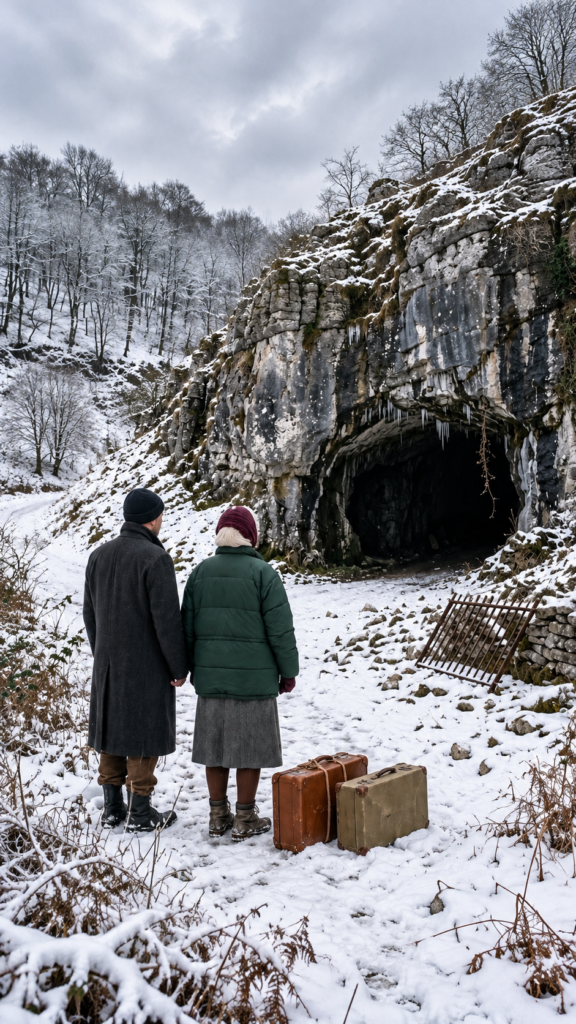
Then the flame revealed a narrow black opening.
A crack ran upward through the limestone, barely wide enough for a person to pass sideways.
Alton approached it.
He put his hand through the gap.
There was cold air inside, but no wind.
Still air.
Shelter.
“It’s a cave,” Dela whispered.
Alton looked at Dutch.
“Good boy.”
The dog squeezed through first.
Dela followed, turning sideways and scraping her coat against the rock.
Alton came last, carrying the lantern.
The passage continued for twenty feet before opening into a chamber large enough to hold a house.
Their footsteps echoed.
The floor was mostly dry.
Water had streaked the walls with pale minerals, and the roof rose beyond the lantern’s reach.
Outside, the wind screamed.
Inside, there was only silence and the sound of their breathing.
Dela leaned against the rock.
“We can stay here tonight.”
Alton nodded.
Then he moved deeper into the chamber.
He was searching for a dry place where they could spread the blankets when his outstretched hand touched something unexpected.
Not rough limestone.
Something flat.
Square.
He raised the lantern.
Before him stood a wall built from carefully cut stone blocks.
The courses were level. Mortar filled the joints. The wall reached from the cave floor into the darkness above.
Alton stared.
Nature had not made this.
Someone had carried those stones into the mountain and built a barrier across the back of the cave.
“Dela.”
She came beside him.
“What is it?”
He placed his palm against the cold masonry.
“Somebody sealed this off.”
“Why?”
He studied the stonework.
“I don’t know.”
Then he looked at the failing lantern.
“But whoever did it wanted whatever’s behind there to stay hidden.”
They did not attempt to open the wall that night.
Alton was exhausted, Dela could barely bend her knees, and the lantern had almost gone out.
They spread the blankets against the dry stone.
Dutch curled between their feet.
When Alton extinguished the flame, the darkness became absolute.
Dela could hear her husband’s breathing.
It was shallow and uneven.
After decades of nursing patients through difficult nights, she recognized the warning.
“Alton?”
“I’m here.”
“Talk to me.”
“About what?”
“Anything.”
He was quiet for a moment.
Then he began telling her about the summer of 1981, when he had built the porch steps on their house.
He remembered cutting the first wooden stringer wrong.
He remembered buying more lumber.
He remembered their oldest boy, only three years old then, solemnly handing him nails one at a time.
Dela listened to every word.
She knew the story already.
She wanted to keep hearing his voice.
They survived until morning, wrapped together beside the sealed wall, with Dutch pressed against their legs.
When daylight entered through the opening, Dela sat up stiffly.
Her knees had locked during the night.
Alton’s face looked gray, but he opened his eyes and reached for his ruler.
They were alive.
That was enough to begin with.
In daylight, they discovered the cave had once been occupied.
An iron ring was fixed near the entrance.
Soot darkened the ceiling above an old fire site.
Along one wall, dozens of initials and dates had been scratched into the limestone.
Some markings were strong and deliberate.
Others were faint, written low enough for a child to reach.
Dela ran her fingers across them.
“People stayed here.”
Alton examined the carved letters.
“A lot of people.”
She studied the different handwriting.
“Somebody wanted their names remembered.”
At the far end, Alton measured the sealed wall.
The stonework was unusually precise.
Whoever constructed it understood masonry. The blocks were carefully fitted, and the joints remained solid despite decades of damp and cold.
Above them, a long stone lintel bore a line of lettering, but dirt had collected in its grooves.
Dela rubbed at the inscription.
She could not make out the words.
“We’ll come back to that,” Alton said.
“Don’t you want to know?”
“More than you can imagine.”
He glanced at the empty lantern.
“But first we need food, oil, and a way to make a fire.”
They returned to the truck.
The snow had stopped, leaving the road white and dangerous.
Alton spent nearly two hours beneath the hood.
His hands shook as he worked.
Dela stood nearby, watching the road and occasionally reminding him to rest.
At last, the engine caught.
Blue smoke spilled from the exhaust.
Dela laughed and cried at the same time.
They drove downhill carefully.
At the base of the mountain stood a small general store, with feed sacks stacked along the porch and a hand-painted sign above the entrance.
A man about their age stood behind the counter.
He wore a flannel shirt and reading glasses pushed up onto his forehead.
He looked at their worn clothing, Alton’s gray complexion, and Dutch limping behind them.
“Cold morning to be out,” he said.
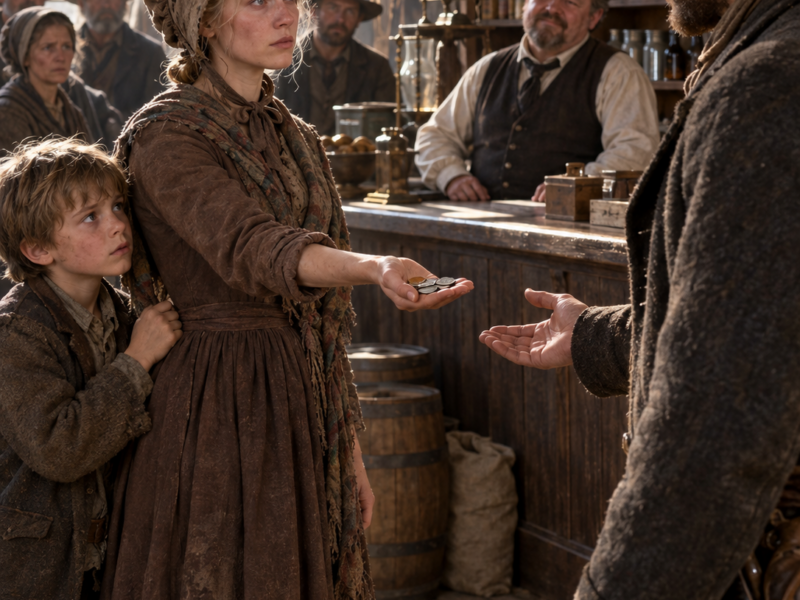
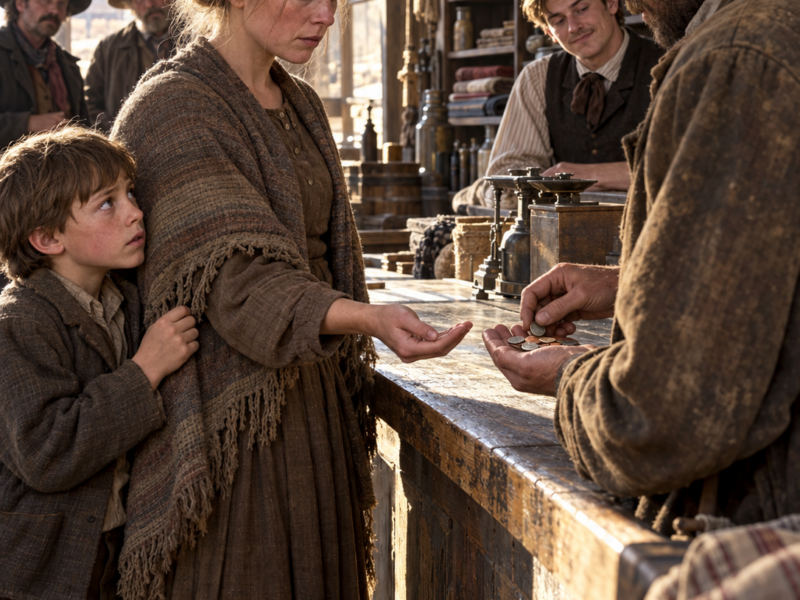
Dela placed eleven dollars on the counter.
“We need lamp oil, matches, and whatever food this will buy.”
The man looked at the money.
Then at them.
“You’re staying up on Sorrel Mountain, aren’t you?”
Alton nodded.
“Truck broke down up there yesterday. Somebody saw it. I figured whoever it belonged to had made it back home.”
“We don’t have a home to go back to,” Alton said.
The man did not respond immediately.
Instead, he came around the counter, took a basket, and began filling it.
Cornmeal.
Dried beans.
Coffee.
Bacon.
Salt.
Crackers.
Lamp oil.
Matches.
Candles.
A coil of rope.
He added several other things and carried the basket to the counter.
Then he pushed their eleven dollars back.
“We can’t take all this,” Dela said.
“Sure you can.”
“We don’t accept charity.”
“Good. Neither do I.”
He opened a spiral notebook and wrote down the supplies.
“It’s credit. Pay me when you can.”
He tore out the page and handed it to her.
“My name’s Booker Fra. I’ve owned this store thirty years. I figure I’ll be around long enough to collect.”
Alton looked at the basket.
“Why would you do this for strangers?”
Booker shrugged.
“Money can wait. People freezing to death can’t.”
Dela lowered her eyes.
She had spent a lifetime caring for other people.
Accepting help was much harder.
Booker changed the subject.
“Where exactly are you staying? The old cabin?”
“It collapsed,” Dela said. “We’re sleeping in the cave.”
Booker’s hand stopped on the notebook.
“The cave?”
“North side of the clearing, beneath the old chimney.”
He removed his glasses.
“My daddy used to tell stories about that place.”
“What stories?” Alton asked.
“About a woman who lived up there years before I was born. Said she took in people who had nowhere else to go. Runaways. Widows. Soldiers who came home from war and couldn’t settle back into life.”
He leaned against the counter.
“Supposedly, if you were desperate enough to find her, she’d feed you, give you somewhere warm to sleep, and never ask a question.”
Dela felt a strange uneasiness.
“What happened to her?”
“Nobody knows. One year she was there. The next year she was gone.”
Booker looked between them.
“How’d you end up on that property?”
“It belonged to my grandmother.”
“What’s her name?”
“Verly.”
Booker considered that.
“I can’t tell you whether she knew the woman in those stories. But something happened up there worth remembering.”
As they gathered their supplies, Booker added a flat pry bar to the basket.
Then he lowered his voice.
“One more thing. A water company came through last spring buying up land and spring rights along the ridge.”
Dela frowned.
“What would they want with our mountain?”
“Good water. That’s what they’re looking for. They’ve offered serious money for property people couldn’t give away ten years ago.”
He looked directly at Alton.
“If someone comes offering to buy that land, don’t sign anything until you’ve had somebody you trust look at it.”
Alton thought of Wade’s papers.
“We won’t.”
They returned to the mountain that afternoon, carrying enough supplies to make the cave livable for several days.
With a full lantern, the chamber looked different.
It was larger than they had realized.
The ceiling curved high overhead, and the soot marks seemed to spread across the rock like the memory of an enormous fire.
Dutch immediately hurried toward the sealed wall.
He lowered his nose to a corner near the floor.
Then he began scratching.
Alton knelt beside him.
“What have you found now?”
The dog whined.
Alton held his fingers against the joint surrounding a low stone.
A faint draft brushed his skin.
One block had loosened over time.
He reached for the pry bar.
The mortar crumbled under the steel.
With a slow grinding sound, the stone shifted.
Alton pulled it free.
Behind it was darkness.
And a narrow breath of dry air escaped through the opening.
Dela came closer.
“Let me help.”
She knelt and worked on the next stone, using steadier hands and more patience than her husband could manage.
They removed one block, then another.
The opening grew large enough for the lantern.
Dela lifted the light and looked through.
She stopped moving.
“Dela?”
She said nothing.
“What do you see?”
Her eyes filled with tears.
“Alton,” she whispered. “You need to look.”
Together they enlarged the opening until they could step through.
On the other side was a room.
Not a natural chamber.
A room someone had prepared for living.
Wooden shelves lined the walls. Glass jars sat in neat rows, their lids sealed beneath old wax. Dry firewood stood stacked beside a small iron stove, its pipe disappearing into a narrow fissure in the rock.
There were lanterns, oil containers, tools, burlap sacks, clay crocks, and a heavy wooden trunk reinforced with iron bands.
For a long time, neither of them spoke.
Then Alton slowly reached out and touched the stove.
He examined the pipe.
He touched the firewood.
Finally, he looked at his wife.
“Dela, somebody left an entire winter in here.”
She turned toward the shelves.
There was enough fuel, equipment, and shelter to keep people alive in weather that would otherwise kill them.
Whoever had closed the room had left it ready for another person to find.
But why?
Dela raised the lantern.
Above the shelves, words had been carved into a smooth slab of stone.
She brushed away the dust.
Alton stood beside her and read the inscription aloud.
“Take what you need.”
He paused.
“Then leave it fuller than you found it.”
The words seemed strangely simple for a place that had remained hidden for nearly eighty years.
Alton looked around again.
Someone had carried all of this into a mountain, built shelves, stacked fuel, filled jars, and sealed the entrance.
Not to protect treasure from thieves.
Perhaps to protect something from being lost.
And as Dela stood beneath the carved words, she began to suspect that her grandmother’s dying instructions had never been about keeping her away from Sorrel Mountain.
Perhaps they had been about keeping the mountain safe until someone needed it again.
Part 2
The stove became Alton’s first concern the following morning.
He had spent much of his life fixing things other people considered beyond saving, but he knew that an old stove connected to an unknown chimney could be dangerous.
He examined the firebox, cleared the pipe as well as he could, and studied the natural fissure where the smoke was meant to escape.
Someone had chosen the location carefully.
The rock formed a narrow passage rising through the mountain, and when he tested a small fire, the draft carried the smoke upward.
Alton watched it closely before adding more wood.
Soon the iron began to warm.
A faint ticking came from its sides.
Dela held her hands toward the heat.
She closed her eyes.
For weeks, warmth had meant sitting in their aging truck with the engine running until they could no longer afford the gasoline.
Now the heat surrounded her without a ticking clock attached to it.
“Does it really work?” she asked.
Alton gave the stove another thoughtful look.
“It draws better than some I’ve installed myself.”
She smiled.
“Don’t sound so surprised.”
“I’m not surprised. I’m impressed.”
That evening, Dela cooked dried beans with a little bacon and made cornmeal mush on the stove’s flat iron top.
They ate from their few dishes while Dutch lay in front of the fire, his stiff legs stretched toward the warmth.
For the first time since losing their home, Alton laughed.
The sound startled Dela.
She looked at him across the small room, the firelight catching his tired face, and realized how long it had been since she had heard him laugh without something painful behind it.
Over the next several days, the cave became less frightening.
Alton’s hands grew steadier.
The gray color began leaving his face.
Dela noticed it each morning when he woke.
She also noticed how often he touched the ruler in his pocket, as though reassuring himself that the world had not disappeared entirely.
They examined the shelves.
Some jars contained green beans and tomatoes. Others held blackberries and pickled vegetables. Dried apples had been stored in sacks, and sealed containers held cornmeal, salt, and other provisions.
The supplies were extraordinarily old. Dela inspected them carefully and relied mainly on the fresh food Booker had provided, but the abundance of everything left behind astonished her.
There were hand tools, sharpening stones, lamps, containers, and household objects selected with remarkable practical sense.
Nothing seemed expensive.
Everything seemed useful.
On the fourth morning, Alton ventured outside.
Below the cave, hidden beneath the snow, he discovered low stone walls running across the mountainside.
Terraces.
Someone had spent years cutting gardens into the slope, stacking stones by hand to keep the soil from washing away.
Farther along, clear water flowed from an opening in the rock.
It gathered in a basin before spilling downhill.
Even in the freezing weather, the spring continued running.
Alton knelt beside it.
He scooped water into his hands and tasted it.
Then he looked toward the cave.
Whoever had lived here had understood the mountain in a way he was only beginning to appreciate.
Shelter inside.
Food outside.
Water that did not stop when the world froze.
The land Wade had dismissed as worthless contained nearly everything required to support a life.
But the greatest discovery waited inside the iron-banded trunk.
On their third evening in the hidden room, Dela knelt beside it and lifted the lid.
The hinges groaned softly.
Inside were bundles wrapped in oilcloth.
She opened the first.
Books.
Not printed novels or religious texts, but handwritten journals, their pages yellowed and their ink faded brown.
There were letters tied with string, a small tin of buttons, a child’s carved wooden horse, and a thin gold wedding band.
The objects belonged to ordinary lives.
Lives someone had thought worth remembering.
Dela selected the oldest journal.
The first entries were dated in the 1940s.
A woman’s careful handwriting filled the pages.
On the opening page, Dela found a message addressed to whoever might someday discover the room.
If you’re reading this, you were cold and you were cast off, same as me.
Dela stopped.
She read the sentence again.
Alton moved closer.
“What does it say?”
She showed him.
He pulled a chair beside the stove.
“Well,” he said, “we’d better hear the rest.”
The writer’s name was Orpha.
She had come to the mountain as a young woman of nineteen, after becoming a mother outside marriage.
Her family had turned her away.
The town where she had grown up offered judgment rather than shelter, and the people who knew her best had given her nowhere to go.
Orpha wrote little about the child’s fate, as though the memory remained too painful to approach directly.
But she described her own journey into the mountains.
Cold.
Hunger.
A bundle of clothes.
And the desperate decision to climb when there was no place left for her below.
She had found the limestone opening almost by accident.
Her first winter was brutal.
She survived by gathering whatever food she could find, trapping small animals, and learning which places on the mountain provided shelter from the wind.
At times she believed she would die.
But spring came.
And when the weather warmed, she discovered she did not want to return to the people who had rejected her.
So she stayed.
She began building a life around the cave.
She learned the spring’s habits, cleared ground for vegetables, and carried stones to form the first terraces.
Then, during her second winter, a frightened girl appeared.
Fourteen years old.
Alone.
Nearly frozen.
The girl had followed a rumor about a woman who lived on the mountain and asked no questions.
Orpha possessed almost nothing.
She shared half of it.
The girl survived.
In spring she went back down the mountain, and the story of Orpha’s shelter began spreading quietly among people who had nowhere else to turn.
Dela read late into the night.
The journals told of young women rejected by their families, old men abandoned when they could no longer work, widows with children, and people whose troubles made them unwelcome in ordinary homes.
One former soldier arrived after a war.
He trembled so badly he could scarcely carry a cup.
He woke screaming, feared closed doors, and would not tell Orpha his last name.
She did not pressure him.
Instead, she gave him work.
He hauled water.
Split firewood.
Repaired walls.
Tended the garden.
He stayed until the following summer.
When he left, he still carried the damage of what he had endured, but he could sleep through the night and sometimes laugh.
Orpha wrote that she hoped God would go with him.
Dela held the journal open for a long time.
She thought of all the frightened people she had cared for during her nursing career.
Some had families gathered beside their beds.
Others had no visitors at all.
She understood why Orpha had stopped asking questions.
Sometimes a person needed help long before they could bear to explain why.
Another entry described a family whose house had burned.
They arrived with almost nothing and stayed through an entire season.
They worked the terraces, chopped wood, repaired tools, and helped preserve food before leaving.
They left behind more than they had used.
That was Orpha’s rule.
The words above the shelves were not decoration.
They were an agreement.
Whoever received shelter would help make it available to the next person.
Someone might leave jars of vegetables.
Another might repair a stove.
Someone with no money could gather firewood, mend clothes, or help tend the garden.
The cave did not belong to wealth or status.
It belonged to the people who kept it ready.
Now Dela understood the shelves.
The jars had not all been filled by one woman’s hands.
The stacked wood had not been cut by one person.
Generations of strangers had contributed to the room.
Some had arrived desperate and frightened.
Some had stayed a week.
Others had stayed through winters.
Each had been asked to leave something behind for the next person.
Dela closed the journal.
Tears ran down her cheeks.
Alton was holding the carved wooden horse.
“We raised five children,” he said quietly.
Dela looked at him.
“We did.”
“We gave them a roof. Food. Everything we could manage.”
He turned the little horse in his hands.
“And somehow we ended up with two suitcases and a dog.”
“Alton—”
“I’m not saying it because I regret raising them.”
He rested the toy on the trunk.
“I just wonder if we’ve spent our lives thinking family only means the people born to us.”
Dela looked around the small room.
Orpha had built a family from strangers.
Most of them had never shared her name.
Yet they had returned kindness with kindness, leaving enough behind for people they would never meet.
“Maybe family is whoever comes when you’re cold,” Dela said.
Alton nodded.
“And whoever stays.”
While they were discovering Orpha’s history, Wade was facing a much less generous truth.
The letter from the water company had reached his office.
It concerned the spring rights on Sorrel Mountain and included an offer that would once have seemed too small to interest him.
Now it looked like a lifeline.
His development business was failing.
A half-finished retail project had consumed his savings and borrowed money. The lenders were pressing him. His debts had begun reaching into every part of his life.
Six years earlier, he had used his parents’ paid-off home as collateral.
The money had gone into a project he believed would succeed.
When it failed, he had borrowed more.
He had told himself he would replace the money before his parents ever discovered what he had done.
But every attempt to repair the damage made it worse.
Now the house was gone.
And his parents were living somewhere on a mountain he had once called worthless.
Wade unfolded the water company’s offer again.
The property belonged to his mother.
Only his mother.
He could not touch it without her signature.
He thought of the cave, the cold, and the two elderly people who had refused his sensible arrangements.
Then he began preparing another folder.
This time, he would explain that selling the water rights could save everyone.
He did not intend to tell them how much of the money he needed for himself.
Meanwhile, Cass was trying to find her parents.
She was the youngest of Alton and Dela’s five children, living three states away.
A cousin had finally told her about the eviction.
By then, her parents had disappeared.
Cass called relatives.
She called her siblings.
Some refused to answer.
Others claimed they did not know where the couple had gone.
Eventually, someone mentioned Sorrel Mountain and a general store near its base.
Cass found Booker’s number.
At first he was cautious.
He had no intention of revealing where two vulnerable elderly people were staying to someone who might be trying to hurt them.
But Cass kept talking.
And as Booker listened, he began to believe her.
“Are they alive?” she finally asked.
He heard the fear in her voice.
“Yes,” he said. “They’re alive.”
Cass began crying.
“Can you tell me where they are?”
“Come to the store first. Bring warm clothes.”
She packed a bag and drove north.
For two days she rehearsed an apology.
Every version sounded inadequate.
Finally, she stopped trying to find the right words.
She would go.
She would listen.
And she would do whatever she could to begin repairing what had happened.
Back in the cave, Dela had developed a new feeling about her grandmother.
Anger.
Verly had known about the mountain.
She must have.
Why else would she insist that Dela keep the deed?
Why else would she warn her about winter and refuse to explain?
Dela sat beside the stove one evening with the journals spread around her.
“She could have told me,” she said.
Alton looked up.
“Who?”
“Grandmother.”
He waited.
“We slept in a truck. We lost our house. You nearly died on that road. And all this time there was a place up here with shelter and firewood and food.”
She pushed a journal aside.
“She knew, Alton. I’m certain she knew.”
“Maybe.”
“Why wouldn’t she tell me?”
He had no answer.
Instead, he reached into the trunk and found a thick black volume they had not yet examined.
“Maybe it’s in here.”
Dela opened it.
Unlike the journals, the pages were arranged in columns.
Names.
Dates.
Descriptions of what people brought.
And what they left behind.
It was a ledger.
Orpha had kept a record of everyone who stayed on the mountain.
Some entries contained only a name and a few words.
Others recorded small acts of kindness.
A girl who arrived in spring and left two jars of preserves.
A man who repaired the stove.
An older traveler who donated his tools.
A former soldier who cut an entire supply of firewood before leaving.
Page after page.
Dozens of names.
Then hundreds.
Dela followed the entries with her finger.
Near the bottom of an old page, she stopped.
The name was written in different handwriting.
Unsteady letters.
A girl’s signature.
Verly.
Dela stared at it.
She checked the date.
Then she read the name again.
“Alton.”
He came beside her.
“What’s wrong?”
She pointed.
“That’s my grandmother.”
He examined the entry.
“Are you certain?”
“I know that name. And the date… it would be the right time.”
She touched the faded ink.
All her life, Verly had seemed impossibly strong.
A woman who maintained a spotless home, attended church twice a week, and considered any display of weakness almost indecent.
Dela had never heard her speak about being hungry.
Or homeless.
Or frightened.
Yet here was her name, written in the shaky hand of a girl who had needed shelter.
“She came here,” Dela whispered.
Alton stood quietly beside her.
“She was one of them.”
The realization changed the shape of her grandmother’s life.
Verly had not merely known about Orpha.
She had been saved by her.
They searched the letters next.
Eventually, Alton found one written in Verly’s mature handwriting, dated approximately forty years after her entry in the ledger.
The letter thanked Orpha for the winter she had given her.
It spoke of a kindness Verly had never been able to acknowledge publicly.
It explained that she had purchased the parcel to protect the mountain from strangers who might destroy the shelter or close it to those who needed it.
She promised the land would remain safe.
Her final words were the hardest for Dela to read.
Verly admitted she lacked Orpha’s courage.
She could not tell her own family what had happened.
But she could keep the door.
Dela pressed the letter against her chest.
Her grandmother had spent decades protecting a secret from the very people she loved.
Not because the secret was shameful.
But because Verly had never stopped feeling ashamed of having needed help.
“She told me to stay away in winter,” Dela said slowly.
Alton nodded.
“Winter was when Orpha saved her.”
“She didn’t want me to find out.”
“Maybe she was afraid of what you’d think.”
Dela looked at the letter.
“Oh, Grandma.”
She remembered Verly’s stern face, the careful way she dressed, the pride with which she kept her small home.
For the first time, Dela saw the frightened girl beneath all those years of respectability.
The anger she had carried began to dissolve.
“She kept the mountain,” Dela whispered.
“She did.”
“And Orpha kept her alive.”
Alton looked at the inscription above the shelves.
“Looks like it’s our turn.”
Dela understood.
They would not sell the property.
They would not empty the cave and leave.
They would maintain the shelter so others could use it.
Whatever happened to their own lives, they would leave the mountain fuller than they found it.
Two days later, Dutch began barking near the cave entrance.
Alton looked outside.
Booker was coming through the clearing, followed by a woman carrying a bag.
Her coat was far too thin for the mountain.
Even from a distance, Dela recognized the way she walked.
“Cass?”
Her daughter looked up.
For a moment neither moved.
Then Cass dropped her bag and hurried across the snow.
She threw her arms around her mother.
“I’m sorry,” she sobbed. “Mom, I’m so sorry.”
Dela held her tightly.
“I didn’t know,” Cass continued. “I would have stopped it if I’d known. I swear I would.”
“I know, sweetheart.”
“I kept thinking you might be out here somewhere. That something had happened.”
Dela stepped back and looked at her daughter’s exhausted face.
“You came.”
Cass nodded.
“I should have come sooner.”
Dela touched her cheek.
“You’re here now.”
They brought Cass inside.
She stood in the warm room, staring at the shelves, the stove, and the stone walls.
It was not remotely what she had expected.
Booker remained near the entrance while Alton told the story.
When he described the paperwork Wade had prepared six years earlier, Cass became quiet.
“Dad,” she asked, “did you ever see the loan documents on the house?”
Alton shook his head.
“Wade handled everything.”
“But you owned that house outright.”
“For years.”
Cass looked toward her mother.
She had begun to suspect something deeply wrong.
But she had not come to accuse anyone that evening.
She had come to be with her parents.
“Can I stay?” she asked.
Dela smiled.
“Of course.”
“I don’t mean just tonight.”
Cass looked around the cave.
“I want to help. Whatever you’re planning to do here, I want to be part of it.”
Alton pulled another chair toward the stove.
“There’s room.”
Booker left before dark.
A storm was gathering in the west.
He warned them to stay inside until the road cleared.
They had fuel.
Food.
Water.
And a warm room beneath the mountain.
For once, they were ready.
The blizzard arrived after midnight.
Wind screamed across the cave entrance.
Snow swept through the clearing and piled against the limestone.
Inside, Alton and Dela sat near the stove while Cass listened to her mother read from Orpha’s journals.
Dutch slept with his head on his paws.
None of them knew Wade was climbing the mountain.
He had left town that afternoon carrying the water company’s offer and a folder of documents.
He believed he could persuade his mother to sell the spring rights.
He told himself he was bringing financial security to his parents.
He had repeated that explanation so often it almost sounded true.
Then the storm caught him halfway up the gravel road.
His pickup slid across an icy turn.
The front wheels dropped into a deep drift.
He tried to reverse.
The tires spun uselessly.
He tried his phone.
No signal.
Wade sat inside the truck with the heater running, waiting for the weather to improve.
But the storm grew worse.
Around three in the morning, the engine died when the fuel ran out.
The cold entered almost immediately.
He remained in the cab until his hands began going numb.
Then fear overcame judgment.
He climbed out.
Wearing an expensive wool coat and city shoes, he began struggling uphill toward the only shelter he knew might exist.
He had never felt so helpless.
The wind knocked him sideways.
Snow filled his shoes.
He lost the road, found it again, and stumbled into drifts that reached above his knees.
At some point, he fell.
Getting up became difficult.
He thought about his parents.
About the folders.
About the house.
And finally about the reason he had come.
He had driven into a blizzard to persuade two elderly people to surrender the last property they owned.
Not because he wanted to save them.
Because he wanted to save himself.
The knowledge settled over him with terrible clarity.
He kept crawling.
Inside the cave, Dutch suddenly raised his head.
A deep sound rolled out of his chest.
He rose stiffly and hurried toward the entrance.
Alton followed with the lantern.
“Dutch, what is it?”
The dog began barking.
Alton looked into the storm.
At first he saw only snow.
Then something moved beyond the lantern light.
A dark shape.
A person.
Someone was crawling toward the opening.
Alton took another step.
The figure raised its head.
And despite the snow covering the man’s face, Alton recognized his son.
“Wade?”
The figure collapsed.
For one brief moment, Alton stood motionless.
This was the son who had taken his house.
The son who had dismissed his dog as disposable.
The son who had insisted that abandoning independence was the responsible choice.
Now Wade lay helpless in the snow.
Alton could have turned away.
No one would have known.
But he remembered Dela standing on their old porch, saying they did not leave family in the cold.
He remembered Orpha’s journals.
He remembered the words above the shelves.
Then he shouted into the cave.
“Dela! Cass! Come help me!”
The two women hurried toward him.
“It’s Wade,” Alton said. “He’s freezing.”
Together they dragged him through the narrow passage.
Wade was barely conscious.
His clothing was soaked.
His fingers were stiff, and his whole body shook uncontrollably.
Dela immediately took charge.
She moved him beside the stove, replaced his wet clothing with dry coverings, and began warming him carefully while checking his breathing and circulation.
Cass fetched blankets.
Alton brought more wood.
For the next hour, there were no accusations.
No questions about property.
No demands for explanations.
There was only a family trying to keep one of its members alive.
Eventually Wade opened his eyes.
He stared at the fire.
Then the shelves.
Then his mother, kneeling beside him.
His sister sat nearby.
His father stood beside the stove.
Dutch had returned to his place on the floor.
Wade’s eyes moved upward to the carved words.
Take what you need. Then leave it fuller than you found it.
He remembered the documents in his coat.
Documents designed to take something away.
Tears gathered in his eyes.
“Mom,” he whispered.
Dela leaned closer.
“Yes?”
“There’s something I have to tell you.”
She studied his face.
“About what?”
“The house.”
He swallowed.
“About what I did.”
Dela held his gaze.
She could see that whatever he wanted to say was going to hurt.
But his hands were still cold, and he had only just survived the mountain.
“Not tonight,” she said gently.
“Mom—”
“Tonight, you get warm. Tomorrow, you can tell us everything.”
Wade closed his eyes.
For the first time in years, he did not argue.
But before morning, someone else in that room would be fighting for his life.
And the cost of saving Wade would fall on the one person who had already sacrificed more than he could afford.
Part 3
Alton’s chest began hurting shortly before dawn.
At first, he tried to ignore it.
He sat on the edge of the cot, one hand resting against his shirt, waiting for the familiar pressure to ease.
It had happened before.
A little heaviness.
A little trouble catching his breath.
Usually, if he rested long enough, it passed.
But this time the pain kept growing.
He had pushed himself too hard dragging Wade through the snow. His body had been cold, exhausted, and frightened, and his damaged heart was struggling under the strain.
Dela noticed immediately.
“Alton?”
He tried to answer.
Instead, he bent forward.
She crossed the room and caught his shoulders.
His face had turned pale gray.
Sweat covered his forehead despite the warmth of the stove.
His breathing was short and painful.
“Dela,” he managed.
“I’m here.”
She helped him onto the cot and called for Cass.
Then she turned toward Wade, who was still recovering beneath the blankets.
“I need your help. Now.”
Wade struggled to his feet.
Dela directed her children with the calm urgency she had developed over thirty-one years of nursing.
Cass kept the fire burning and gathered what little medical equipment they possessed.
Wade helped support his father in a position that made breathing easier.
Dela checked Alton’s pulse, loosened his clothing, and watched every change in his face.
There was no ambulance waiting outside.
No telephone signal.
No possibility of getting down the mountain until the storm passed.
She understood how serious his condition might be.
And she understood that she could not provide the treatment a hospital could.
But she could keep him warm, minimize his exertion, monitor him, and prevent panic from making a desperate situation worse.
Alton’s hand moved toward his shirt pocket.
He was searching for the folding ruler.
His fingers found nothing.
The small confusion on his face nearly broke Dela’s composure.
She took his hand.
“Look at me.”
His eyes struggled to focus.
“Alton Ror, you listen to me.”
He breathed unevenly.
“You are not leaving me up here.”
Tears filled her eyes, but her voice stayed firm.
“We’ve lost the house. We’ve lost nearly everything we spent our lives building. We finally found somewhere we belong.”
She leaned close.
“And I am not going to lose you now.”
Wade knelt beside the cot.
“Dad?”
Alton tried to turn toward him.
“Don’t move,” Dela said.
Wade took his father’s hand.
The hand was rough and familiar.
It had taught him how to hold a hammer, how to change a tire, and how to keep working when a job went wrong.
Now it felt frighteningly weak.
“Dad, I’m here.”
For hours they stayed beside him.
The storm continued outside.
Inside, Dela listened to his breathing and counted his pulse, watching for any sign that the danger was increasing.
Slowly, as the night approached morning, the crushing pressure began to ease.
Alton’s breathing grew steadier.
His color improved slightly.
Eventually, he fell asleep.
Dela remained beside him, holding his wrist.
Only when she was satisfied that he was resting did she allow herself to cry.
Wade sat across from her.
He looked at his father and understood something he had never allowed himself to consider.
Alton had risked his life to save the son who had taken his home.
And Dela had spent the night fighting to keep that same father alive.
The papers Wade had brought seemed obscene now.
He could not bear to touch them.
By morning, the storm had stopped.
The mountain lay beneath a deep blanket of snow.
Alton woke near noon.
His first movement was toward his pocket.
Cass found the folding ruler among his belongings and placed it in his hand.
His fingers closed around it.
“Still here,” he whispered.
Dela brushed the hair away from his forehead.
“Yes, you are.”
When the road finally became passable, Booker arrived with a doctor he knew.
They helped Alton down the mountain for an examination.
The doctor checked his heart, reviewed his condition, and arranged the medicines he needed.
He was concerned about what had happened during the storm and made it clear that Alton had come dangerously close to dying.
“Who looked after him?” he asked.
Alton nodded toward Dela.
“My wife. She was a nurse for thirty-one years.”
The doctor turned toward her with new respect.
“Then you know how fortunate he is.”
He gave Alton strict instructions about rest and further care.
When they explained their financial situation, the doctor declined to charge for the visit and offered to help if the prescription costs became a problem.
Afterward, they returned to Sorrel Mountain.
They had no desire to live anywhere else.
Alton rested beside the stove while his strength slowly returned.
And during those quiet days, Wade finally told his family the truth.
He began with the failed development.
The borrowed money.
The investors.
The mounting debts.
Then he described the afternoon six years earlier when he had brought papers to his parents’ kitchen table.
He admitted that he had used their paid-off house to secure financing.
He had explained the documents as protection, knowing his father did not understand their full consequences.
When his investment failed, he kept hoping another deal would restore the money.
Instead, the debt grew until the bank came for the property.
Alton listened without interrupting.
Dela sat beside him.
Cass stood near the stove.
“The house wasn’t lost because Mom and Dad couldn’t afford it?” Cass asked.
Wade shook his head.
“Not originally. It was my debt.”
“And you let everyone believe they had simply run out of money?”
“Yes.”
Cass looked away.
“What about the others? Did they know?”
“No.”
Wade’s voice cracked.
“They thought the care facility was the responsible solution. I let them believe it.”
He looked at his parents.
“I knew what I’d done. And instead of telling you, I tried to move you somewhere I wouldn’t have to face it.”
Dela’s expression remained still.
Wade lowered his head.
“And then I came up here with another set of papers.”
He explained the water company’s offer.
How he intended to persuade his mother to sell the spring rights.
How desperately he needed the money.
How he had convinced himself that taking their mountain was actually helping them.
“I was going to do it again,” he said.
Nobody spoke.
The stove made a small clicking sound as the iron cooled.
Wade wiped his face.
“I don’t know how to make this right.”
Alton studied his son for a long time.
Then he lifted one hand.
“Come here.”
Wade approached the cot.
“Closer.”
He knelt.
Alton looked at the grown man who had once been a little boy handing him nails on a summer afternoon.
“You took our house,” he said.
Wade nodded.
“Yes.”
“But that wasn’t the worst part.”
Wade’s eyes filled.
“The worst part was losing you years before we lost the house.”
Alton paused to catch his breath.
“You decided we were a burden. You stopped being our son when we needed you most.”
Wade lowered his face.
“I know.”
Alton rested a hand on his shoulder.
“But you’re still my boy.”
Wade began crying.
“And I’m too old to spend whatever time I have left hating you.”
He looked toward Dela and Cass.
“We’ve learned something up here. A person can lose a lot and still have enough to give.”
Wade pressed his forehead against the cot.
Alton kept his hand on the back of his son’s head.
Across the room, Dela watched.
Her forgiveness did not arrive all at once.
She could not forget the lost house, the sleepless nights, or the fear that had nearly consumed them on the mountain.
But after a while, she crossed the room and placed her hand on Wade’s shoulder.
He reached up and held it.
They remained like that for a long time.
No one pretended the damage had disappeared.
Wade still faced his debts.
He still had to accept the consequences of his decisions.
His parents did not possess the money to rescue his business, and they did not offer the mountain as payment for his mistakes.
But Wade had one skill that might finally be useful for something good.
He understood legal documents, property arrangements, and the complicated business of protecting land.
For three days, he studied Verly’s deed, Orpha’s ledger, and the old letters.
Booker helped obtain county property records.
Together they traced the parcel’s ownership.
The records confirmed that Verly had purchased it in the 1960s.
She had paid the taxes faithfully and arranged for the property to remain within her family.
She had protected the mountain for decades without ever explaining why.
Now Wade knew what needed to be done.
He proposed a trust designed to preserve the land and its purpose.
The documents would protect the spring from commercial exploitation and establish a lasting arrangement for maintaining the cave as a refuge.
He explained every provision to Dela.
This time, she read every word.
When she did not understand something, she made him explain it again.
Wade answered without impatience.
Finally, she signed.
Not because her son told her to.
Because she understood and agreed.
In spring, the water company called again.
Its representative offered more money.
Wade listened politely.
Then he stepped onto the new porch Alton had built.
“I’m afraid the property’s no longer available for that purpose,” he said.
The man made another offer.
Wade shook his head.
“The spring isn’t for sale.”
He listened.
“No. Not at any price.”
When he ended the call, he stood for a moment looking toward the mountain.
For the first time in years, he had used his knowledge to protect something rather than take it.
And the satisfaction was different from any business success he could remember.
Spring arrived slowly on Sorrel Mountain.
The snow retreated from Orpha’s terraces.
Water continued flowing through the stone basin.
Dela found seeds among the old supplies and began preparing the gardens. Some had been carefully preserved through generations, and to her delight, enough sprouted to bring green shoots back to the mountain.
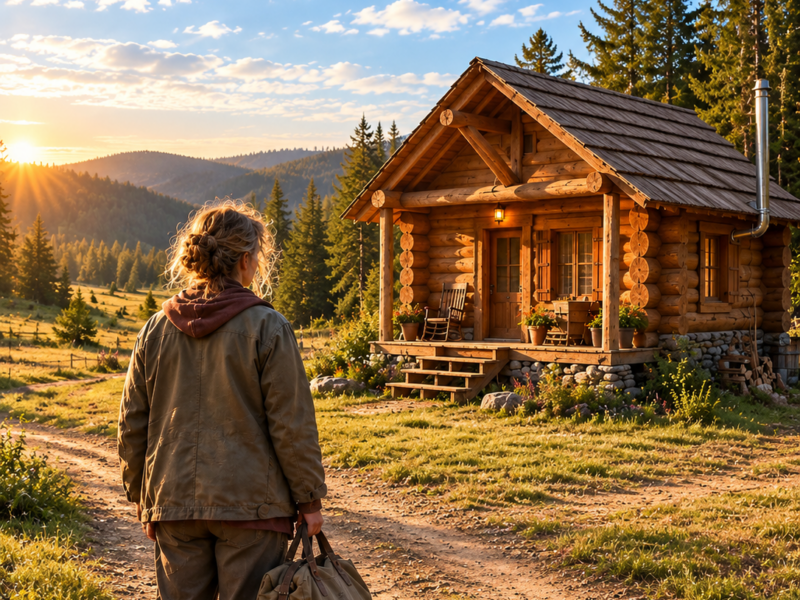
Alton repaired what remained of the old cabin near the trail.
He worked carefully, resting whenever his heart required it.
He measured every board twice.
Before summer, the building had a sturdy roof, a door, and a proper chimney.
Cass stayed through the spring.
Then she gave up her lease three states away.
She had found work worth doing beside her parents, and she did not intend to abandon it.
Booker continued visiting.
Sometimes he brought supplies.
Sometimes he brought a pie.
Sometimes he simply sat with Alton and talked until sunset.
By midsummer, a long wooden table stood beneath a brush arbor near the cabin.
On Sunday evenings, it filled with food and people.
Dela cooked.
Cass learned how to preserve vegetables and laughed whenever she burned her fingers.
Booker brought whatever he could spare.
Dutch wandered beneath the table, hoping somebody would drop something.
Not every member of the Ror family came.
Their other children remained absent.
Alton and Dela did not close the door against them, but they stopped putting their lives on hold waiting for them to return.
There were other people who needed the mountain.
Booker began telling carefully chosen strangers about the place.
A widower whose children had scattered.
A family passing through hard times.
A young man recently released from prison with nowhere willing to take him.
The young man stayed longer than most.
He arrived guarded and suspicious, expecting judgment from everyone he met.
Alton handed him a hammer.
“Know how to hang a door?”
The young man shook his head.
“Want to learn?”
Over the following weeks, they worked together.
The young man proved talented with engines.
He helped keep Alton’s old truck running, repaired the generator, and fixed the water pump when it failed.
When he eventually left to begin a new life, he had rebuilt a waterline and repaired the woodshed door.
He shook Alton’s hand at the cave entrance.
He struggled to find words.
Alton understood.
“You did good work,” he said.
After the young man departed, Dela opened Orpha’s black ledger.
She wrote his name, the date, and what he had contributed.
For the first time in many years, new entries filled its pages.
The chain had begun again.
One evening near the end of summer, Alton sat on the cabin steps with his folding ruler resting in his hands.
Dela joined him.
Below them, the valley stretched green beneath the fading light.
“Funny thing,” he said.
“What is?”
“Wade. The bank. Losing the house.”
Dela looked toward him.
“They thought sending us up here was the worst thing that could happen.”
He folded the ruler.
“Turned out it was the only thing that could have brought us to the place where we belonged.”
Dela took his hand.
Neither spoke for a while.
Their lives were not free of hardship.
Alton still had a damaged heart.
Dela’s knees still hurt.
They had lost a home filled with forty-five years of memories.
But they possessed something neither had expected to find at seventy.
A purpose.
A family larger than the one they had raised.
And a place where being unwanted by the world did not mean being without worth.
The following November, almost exactly one year after the eviction, the first hard snow began falling.
Dela was outside closing the woodshed when Dutch lifted his head.
The old hound was grayer now.
His movements were slower.
But his hearing remained sharp.
He gave a low bark toward the trail.
Dela turned.
A young woman was coming through the snow.
She was thin, wearing a coat too light for the weather.
Something was bundled tightly against her chest.
At first Dela thought it was clothing.
Then she saw a tiny face.
A baby.
The young woman stopped at the edge of the clearing.
Her expression held the same fear Dela remembered feeling when she and Alton had first climbed the mountain.
Fear that there would be no shelter.
Fear that the last person she asked for help might turn her away.
Dela took the lantern from its hook.
She lit it and walked down the path.
The young woman’s eyes filled with tears.
“Please,” she whispered.
Dela did not ask where she had come from.
She did not ask what had happened.
She did not ask why she had a baby in the middle of a snowstorm.
Instead, she reached out and placed a hand on the woman’s shoulder.
“Come inside, sweetheart.”
The young woman looked toward the warm light glowing through the opening in the limestone.
“Can we stay?”
Dela smiled.
“Of course you can.”
She wrapped an arm around the young mother and guided her toward the cave.
“We’ve got a fire. There’s food, and there’s room for both of you.”
The young woman began crying.
Dela held her gently.
Then she spoke the same words Orpha had left carved into the stone so many years before.
“Take what you need.”
She looked toward the baby.
“And when you’re able, leave it fuller than you found it.”
Together they entered the mountain.
Behind them, snow covered the trail.
Inside, the stove burned steadily.
The shelves were full.
Alton sat near the fire with his ruler tucked into his pocket.
Cass was preparing another bed.
Dutch settled himself beside the warmth, satisfied that another stranger had found the way home.
And above them, cut deep into the rock, the old words remained.
They had survived the years.
They had survived the silence.
They had survived the people who were ashamed to need help, and the people who were too proud to offer it.
Now they belonged to another generation.
For eighty years, the cave had waited for those who had nowhere else to go.
And as Dela closed the door against the November wind, she knew it would be waiting for the next person, too.
Not because the mountain was rich.
Not because anyone had discovered buried gold.
But because, long ago, a woman who had lost everything decided that no one else should have to face the cold alone.
And those who came after her had kept that promise.