Part 1
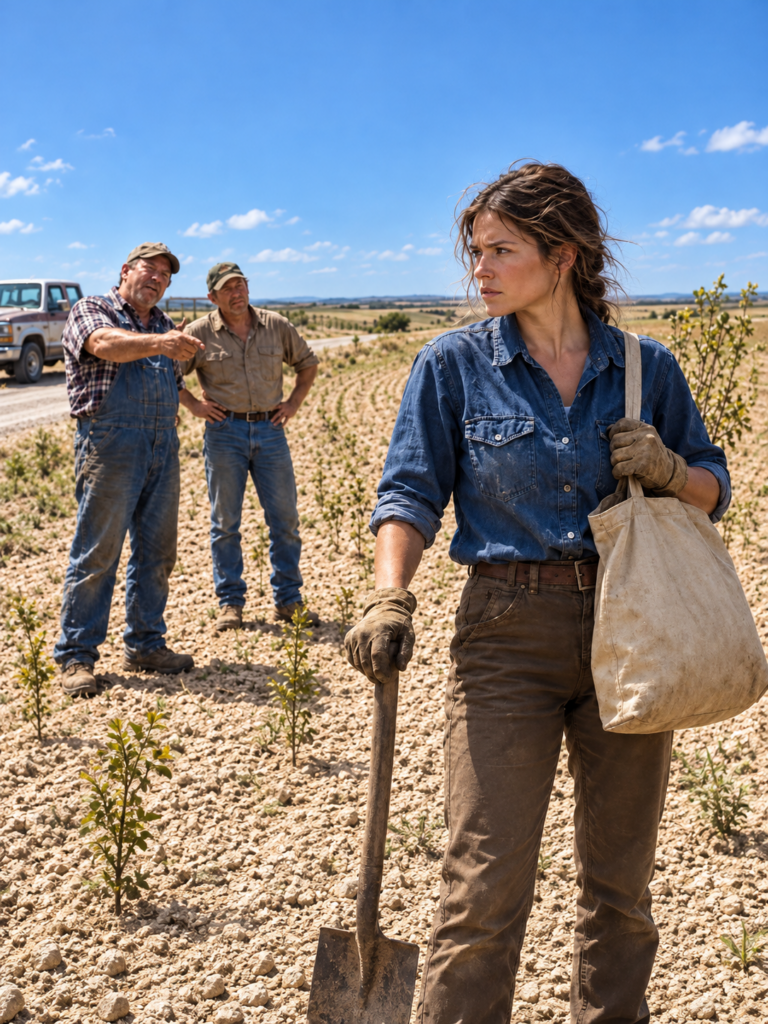
The first time Eleanor Voss heard her neighbors laughing at her, she was kneeling in the dirt with a handful of acorns.
It was October 1958, and a cold Nebraska wind was sweeping across ninety acres of ground that hadn’t produced a decent crop in more than a decade.
The earth was pale and cracked. White streaks of alkali covered the hard surface like old scars. Here and there, a stubborn Russian thistle rattled against a broken fence post.
Nothing else grew.
Eleanor was thirty-one years old, with two young children, an unhappy marriage, and a farm that seemed to be slipping farther into debt with every harvest.
Yet there she was, pushing acorns into the soil.
A pickup truck slowed along the county road.
Walter Kyper leaned his elbow out the driver’s window.
“Good Lord, Eleanor. What are you doing out there?”
“Planting trees, Walter.”
He looked across the empty field.
“Trees?”
“Bur oaks.”
Walter stared at the canvas sack beside her.
“You’re telling me you’re planting those things one nut at a time?”
“That’s right.”
Another farmer in the passenger seat chuckled.
Walter shook his head.
“Eleanor, that ground won’t even grow decent grass.”
“I know.”
“And you’re trying to grow a forest?”
“I’m trying to give the land a chance.”
The men laughed.
Walter wasn’t an especially cruel man. He had helped Eleanor’s father repair fences after a spring storm, and his wife had brought food when Eleanor’s mother fell ill.
But he was a practical farmer.
And to him, what Eleanor was doing made no sense.
“You’d be better off planting dollar bills,” he called. “At least somebody might find them someday.”
The truck rolled away.
Eleanor remained on her knees.
She pressed another acorn into the ground, covered it with two inches of soil, and moved to the next spot.
By sunset, her fingers were bleeding.
She had planted eighty-three acorns.
There were thousands more waiting in the sack.
And she had absolutely no guarantee that even one of them would grow.
Eleanor had been raised on that farm.
Her father, Henrik Voss, arrived in Nebraska from the Netherlands in 1911, carrying a wooden suitcase, a little money, and a belief that American soil could provide a future his family had never known.
He bought land west of a small farming community where the prairie seemed to stretch forever.
In those early years, the ground was generous.
Wheat rose thick and golden.
The family kept chickens, two milk cows, and a team of horses.
On summer evenings, Henrik sat on the farmhouse porch and spoke to Eleanor about the land.
“Remember this, little bird,” he would say. “The ground isn’t something we own forever. We borrow it from whoever comes after us.”
As a child, Eleanor didn’t understand.
She thought the farm would always look the same.
Then the drought came.
By 1935, the world outside her bedroom window had turned brown.
Eleanor was seven years old when the great dust storm swept across the plains that April.
She remembered her mother hanging wet bedsheets over the windows.
She remembered cattle coughing in the barn.
She remembered her father standing in the yard, his face wrapped in cloth, trying to find a fence he had built with his own hands.
The dust had swallowed it.
For hours, the sky remained black.
Afterward, dirt lay across the kitchen table, inside the cupboards, and beneath the beds.
Her mother cried quietly while sweeping the floor.
Her father went outside and stood looking at the ruined wheat.
Eleanor followed him.
“Daddy, will the grass come back?”
Henrik knelt beside her.
“I hope so, sweetheart.”
“When?”
He looked across the empty fields.
“I don’t know.”
It was the first time Eleanor had heard her father admit that he didn’t know how to save something.
She never forgot it.
Years later, when the government began encouraging farmers to plant shelterbelts, Henrik put rows of elm and ash trees along the northern boundary.
Neighbors questioned the expense.
Henrik planted them anyway.
By the time he died in 1954, those trees were tall enough to break the worst winter winds.
But the southeastern section of the farm remained damaged.
Everyone called it the Bald Quarter.
And it seemed beyond saving.
Henrik left Eleanor 320 acres, an aging farmhouse, machinery that needed constant repairs, and debts she barely understood.
Her husband, Arthur, had never liked farming.
He had married Eleanor because he loved her, or at least because he had believed he did.
But he disliked the uncertainty of harvests, the endless repairs, and the fact that every dollar earned seemed already promised to somebody else.
“We ought to sell,” he said one evening in 1956.
Eleanor was standing beside the kitchen stove, stirring beans in a battered enamel pot.
“Sell what?”
“The bad acreage. Maybe the whole place.”
“My father spent forty years building this farm.”
“And now we’re spending our lives trying to keep it alive.”
Their daughter, Marta, sat at the kitchen table doing arithmetic.
Seven-year-old Peter was asleep upstairs.
Eleanor lowered the spoon.
“Where would we go?”
“Denver. Omaha. Somewhere a man can earn a paycheck without praying for rain.”
“And Mother?”
Arthur looked toward the bedroom where Eleanor’s widowed mother slept.
“Your mother could come with us.”
Eleanor said nothing.
She knew Arthur wasn’t entirely wrong.
The farm was struggling.
The wheat prices were disappointing.
The machinery was old.
And the Bald Quarter was an enormous stretch of land that produced absolutely nothing.
But she also knew that selling the farm would mean abandoning the last physical connection to her father.
After supper, she stepped outside.
The elm trees along the northern fence rustled in the wind.
Henrik had planted them twenty years earlier.
They were still standing.
She looked toward the Bald Quarter.
Something occurred to her then.
Perhaps the land wasn’t finished.
Perhaps they had simply been asking it to grow the wrong things.
In the winter of 1956, Eleanor wrote a letter to the University of Nebraska.
She didn’t know which department to contact, so she addressed it to someone studying soils and native trees.
Her handwriting was careful.
She described the land, its white crust, its history of failed crops, and the native grasses that had disappeared during the Dust Bowl.
Then she asked a simple question.
Was there a tree that could survive where almost nothing else would grow?
Weeks passed.
She assumed the letter had been thrown away.
Then one February afternoon, a thick envelope arrived.
Inside was a response from Dr. Miriam Asher, a soil scientist.
Dr. Asher explained that some native trees survived drought by developing deep root systems before producing much visible growth.
One species particularly interested her.
Bur oak.
Unlike fast-growing cottonwoods, bur oak invested heavily in its roots.
Its seedlings often looked unimpressive for years.
But underground, they were reaching toward moisture that other plants couldn’t access.
The letter also discussed soil fungi and the complicated relationship between roots and living soil.
Eleanor read it three times.
That evening, Arthur found her sitting at the kitchen table with papers spread around her coffee cup.
“What’s all this?”
“Something that might help the southeast field.”
Arthur picked up the letter.
“Trees again?”
“These aren’t like the shelterbelt trees.”
He sighed.
“Eleanor.”
“Just listen.”
She explained what she had learned.
Arthur listened for a minute, then dropped the letter onto the table.
“How long before these things are worth anything?”
“Maybe twenty-five years. Maybe thirty.”
Arthur stared at her.
“Thirty years?”
“They could live for centuries.”
“Wonderful. Maybe they’ll make us rich when we’re buried.”
He walked away.
Eleanor sat alone beneath the weak kitchen light.
She looked at the letter.
Then she looked at the little photograph of her father hanging beside the cupboard.
Thirty years.
She would be sixty-one.
Her children would be grown.
She might never benefit from the trees at all.
But perhaps her children would.
And perhaps that was enough.
Part 2
By the autumn of 1958, Eleanor had collected nearly four thousand acorns.
She gathered them beneath mature bur oaks along country roads, on the grounds of old churches, and near a courthouse sixty miles east.
Some days she drove the family pickup before sunrise, carrying a thermos of coffee and two empty canvas sacks.
Other days she brought Marta and Peter.
“Why can’t we just buy little trees?” Peter asked.
“Because little trees cost money.”
“Acorns don’t?”
“Not if you ask permission and pick them up yourself.”
Marta held a particularly large acorn in her palm.
“Will this really become a tree?”
“If we’re lucky.”
“How big?”
Eleanor pointed toward a towering oak near the courthouse.
“Maybe that big.”
Peter stared up into the branches.
“That’ll take forever.”
Eleanor smiled.
“Most good things take longer than we want.”
She stored the acorns in damp sand during winter, following instructions from Dr. Asher.
When the planting season came, she carried them into the Bald Quarter.
She worked in the mornings before the sun grew hot and in the evenings after cooking supper.
Her knees ached.
Her hands blistered.
Sometimes the ground was so hard she had to loosen it with a steel rod.
The children helped on Saturdays.
Marta kept track of rows in a notebook.
Peter carried water.
Arthur seldom joined them.
By November, Eleanor had planted hundreds.
By spring, thousands.
Yet when summer arrived, most of the planting sites remained empty.
A few tiny green shoots appeared.
The first successful seedlings were barely taller than her thumb.
Others withered almost immediately.
Eleanor kept counting.
By the end of the first growing season, roughly six hundred acorns had germinated.
Hundreds of those seedlings were already struggling.
One evening, she sat at the kitchen table with her notebook open.
Arthur glanced over her shoulder.
“How many?”
“About six hundred came up.”
“Out of four thousand?”
“Yes.”
He gave a short, bitter laugh.
“Eleanor, that’s a disaster.”
“I expected losses.”
“You expected nearly everything to die?”
She closed the notebook.
“They aren’t all dead.”
Arthur pulled out a chair.
“Look at me.”
She did.
“We owe money on the tractor. The wheat isn’t bringing enough. The roof needs fixing. Your mother needs medicine. We have two children who are going to need school clothes.”
“I know every bill we owe.”
“Then why are you spending your days out there?”
“Because I can’t keep watching the ground blow away.”
“That dirt isn’t going to feed us.”
“Maybe it can someday.”
Arthur rubbed his forehead.
“Someday. That’s all I ever hear.”
Eleanor didn’t answer.
He rose and walked upstairs.
She remained at the table, staring at the figures.
Four thousand acorns.
Six hundred sprouts.
The numbers hurt.
But when she looked out the kitchen window, she could see the dark shapes of her father’s shelterbelt trees.
Those trees had started small too.
In June 1961, a violent hailstorm destroyed much of the wheat crop just before harvest.
The storm arrived with almost no warning.
Eleanor was in the barn when the first stones hammered the tin roof.
Within minutes, the yard turned white.
Branches snapped.
Windows cracked.
The chickens fled beneath the porch.
When the storm passed, the wheat lay flattened beneath a layer of shredded leaves and ice.
Arthur stood in the field, holding a ruined stalk.
He had worked that ground since March.
He stared at it without speaking.
Eleanor walked beside him.
“We’ll figure something out.”
He laughed without humor.
“With what money?”
“We still have some grain in storage.”
“Not enough.”
“I can take extra work.”
“You already work from daylight to dark.”
She reached for his hand.
Arthur stepped away.
“I can’t do this anymore.”
The words were quiet.
That frightened her more than shouting would have.
By the following spring, Arthur was spending longer stretches away from the house.
He drove into town for errands that should have taken an hour and returned after dark.
He argued about expenses.
He stopped asking about the children.
One April evening, Eleanor found his suitcase beside the bedroom door.
Arthur was folding shirts.
“Where are you going?”
“Denver.”
“For how long?”
He didn’t answer.
She looked at the suitcase.
Then at his face.
“Arthur?”
He sat on the edge of the bed.
“I’ve been offered work.”
“What kind of work?”
“Equipment sales.”
“And you’re taking it?”
“I have to.”
“What about us?”
Arthur stared at his hands.
“I’ll send money when I can.”
Eleanor felt something cold settle behind her ribs.
“You’re leaving us?”
“I’m not trying to hurt anybody.”
“That’s not what I asked.”
He looked toward the window.
“I can’t breathe here anymore.”
For a moment, she thought of begging him to stay.
She thought of the children sleeping downstairs, the unfinished fencing, the bills piled on the kitchen shelf.
Then she noticed that Arthur had already packed his wedding photograph.
Not theirs.
His parents’.
He had left their photograph on the dresser.
He was not planning to return.
“Tell Marta and Peter yourself,” Eleanor said.
Arthur winced.
“Eleanor, please.”
“They deserve to hear it from you.”
The following morning, Arthur drove away.
Marta stood on the porch with her arms wrapped around herself.
Peter ran after the pickup.
“Daddy!”
Arthur slowed briefly.
Then continued down the road.
Peter stopped at the gate.
Dust rose behind the truck.
Eleanor walked over and put her hand on her son’s shoulder.
“When’s he coming home?” Peter asked.
She couldn’t answer.
So she knelt beside him.
“I don’t know, sweetheart.”
It was the same answer her father had given her in 1935.
And it hurt just as much.
The next years nearly broke her.
Eleanor rose before dawn to feed the chickens, milk the cow, and prepare breakfast.
She worked the wheat ground, repaired fencing, and kept the old tractor running with borrowed parts.
She paid bills late.
She learned to stretch a pot of stew across three meals.
She patched Peter’s coat with fabric cut from Arthur’s old work shirts.
At night she sometimes sat alone at the kitchen table, counting coins.
Her mother helped with the children and laundry, but age had made her hands stiff.
Marta grew up too quickly.
At thirteen, she could operate the tractor.
At fourteen, she knew how to balance the farm ledger.
At fifteen, she was preparing supper while her mother worked in the fields.
Once, Eleanor found Marta asleep over her schoolbooks.
The girl still held a pencil.
Eleanor gently removed it from her fingers.
She looked at her daughter’s tired face and felt a terrible guilt.
Marta deserved dances and friends and ordinary teenage worries.
Instead, she knew the price of diesel fuel.
She knew when the bank payment was due.
And she knew how to tell whether her mother had been crying.
The Bald Quarter suffered too.
Grasshoppers stripped leaves from the little oaks in 1963.
Another outbreak came three years later.
A severe dry spell killed several more.
Eleanor hauled water in old milk cans during the worst summers.
She couldn’t reach every tree.
So she saved the ones she could.
She mulched the base of surviving seedlings.
She built crude wire protections around vulnerable trunks.
She marked each living oak in her notebook.
Walter Kyper occasionally stopped along the road.
“You still fooling with those trees?”
“They’re growing.”
He looked at the little saplings.
“Not much.”
“They’re putting down roots.”
Walter shook his head.
“You always were stubborn.”
Eleanor stood with a watering can in one hand.
“Somebody has to be.”
He drove away.
She went back to work.
Then, in August 1968, a prairie fire swept across part of the Bald Quarter.
Eleanor first saw the smoke while repairing a fence.
A dark line was moving across the horizon.
The wind was strong.
The grasses and thistles were bone-dry.
She ran for the pickup, drove to the farmhouse, and called the volunteer fire department.
Within minutes, men arrived with shovels, water tanks, and tractors.
They cut a rough firebreak along the field’s western edge.
Eleanor worked beside them, dragging hoses and carrying water until her arms shook.
The flames reached several rows of young oaks.
She could hear branches crackling.
She tried to run toward them.
Walter caught her arm.
“Don’t be a fool!”
“My trees!”
“You can’t save them!”
He held her back as a wave of heat swept over the field.
By sundown, the fire was contained.
Blackened earth stretched across the southern section.
Many of the little oaks stood bare and scorched.
Eleanor walked among them after the firefighters left.
She touched one burned trunk.
Its bark crumbled under her fingers.
For the first time in ten years, she wondered whether everyone had been right.
She went home and washed the soot from her hands.
Then she opened her notebook.
She tried to record the damage.
But the numbers blurred.
She laid down her pencil.
Alone in the kitchen, she cried.
Not loudly.
Not for long.
Just long enough to feel the weight of ten years of work that might have vanished in an afternoon.
The next morning, Marta found her mother standing among the burned trees.
“Are they all dead?”
Eleanor looked at the blackened branches.
“I don’t know.”
Marta bent down beside a small trunk.
Near its base, she noticed a tiny green bud.
“Mom?”
Eleanor knelt.
There, beneath the scorched bark, was living tissue.
The fire had damaged the tree.
But it hadn’t killed it.
Eleanor touched the bud with one finger.
And for the first time since the flames, she smiled.
Part 3
By 1970, about four hundred of Eleanor’s original oaks were firmly established.
Most were still less than eight feet tall.
From the road, they looked like a scattered collection of oversized shrubs.
The Bald Quarter was nowhere near a forest.
But Eleanor saw changes that others missed.
The soil beneath the trees no longer looked quite as pale.
Fallen leaves collected around the trunks.
After rain, water lingered longer in the shaded patches.
Small grasses began appearing near the trees.
Sometimes she found earthworms where she hadn’t seen them before.
She recorded everything.
Rainfall.
Tree height.
Trunk diameter.
Insect damage.
The first frost.
The last frost.
She didn’t have fancy instruments.
She had a measuring tape, a shovel, a notebook, and more patience than anyone in the county understood.
Her daughter Marta had become fascinated by the work.
One afternoon, seventeen-year-old Marta joined Eleanor beneath one of the larger oaks.
She carried a jar filled with soil.
“Look at this, Mom.”
Eleanor examined it.
The earth was darker than she remembered.
“Where did you get that?”
“Under the big tree near the south fence.”
Marta opened the jar.
“Smell it.”
Eleanor did.
It smelled earthy and damp.
Like the ground beneath the old shelterbelt.
Marta grinned.
“It’s changing.”
Eleanor looked across the field.
For years she had been so concerned with keeping the trees alive that she had nearly forgotten why she planted them.
She wasn’t trying to produce timber.
She was trying to bring the soil back.
And perhaps, slowly, it was happening.
In 1971, Marta received an opportunity to study forestry at Iowa State University.
The acceptance letter arrived in April.
Marta read it three times before showing her mother.
Eleanor was peeling potatoes at the kitchen sink.
“Mom?”
“What is it?”
“I got in.”
Eleanor turned.
Marta held out the letter.
For a moment, neither spoke.
Then Eleanor wiped her hands on a towel and embraced her daughter.
“Oh, honey.”
Marta laughed through tears.
“I didn’t think they’d take me.”
“Of course they did.”
But that evening, after the excitement faded, Marta sat quietly at the kitchen table.
“Mom, I don’t know if I should go.”
Eleanor looked up.
“Why wouldn’t you?”
“The farm.”
“What about it?”
“You need help.”
“I’ve always needed help.”
“That’s what I mean.”
Eleanor set down her coffee cup.
“Marta, listen to me.”
Her daughter looked at her.
“I didn’t spend all these years trying to keep this place alive so you could spend your whole life trapped here.”
“I’m not trapped.”
“I know you love this farm.”
“I do.”
“Then go learn things I never had the chance to learn. Come back if you want. Build your life somewhere else if that’s what makes you happy.”
Marta’s eyes filled.
“What about you?”
Eleanor smiled.
“I’ve still got Peter. And I’ve got four hundred very demanding trees.”
Marta laughed.
But later that night, Eleanor went into her daughter’s bedroom.
The girl had fallen asleep with college papers scattered across her bedspread.
Eleanor stood in the doorway.
She remembered Marta as a little girl with muddy knees, carrying acorns in a coffee tin.
Now she was leaving for college.
The years had passed while Eleanor was working.
She wondered how many moments she had missed.
Then she quietly turned off the lamp.
The 1970s brought more changes.
Eleanor’s mother died after a brief illness.
Peter finished school and found work repairing agricultural equipment.
He remained close enough to help with the farm during harvest.
Arthur sent occasional money, especially during the early years, but his letters grew shorter and less frequent.
Eventually, Eleanor stopped expecting them.
She never spoke badly about him in front of the children.
When Peter asked why his father had left, she told him the truth as simply as she could.
“Your father was unhappy, and he didn’t know how to stay.”
“Was it because of us?”
“No.”
“Was it because of the farm?”
Eleanor hesitated.
“The farm was part of it.”
Peter kicked at the dirt.
“I hate him.”
Eleanor put a hand on his shoulder.
“I understand why.”
“Don’t you?”
She looked toward the empty fields.
“Some days.”
“Then why don’t you say it?”
“Because being angry at him won’t fix the tractor.”
Peter stared at her.
Then, reluctantly, he laughed.
By the late 1970s, the oldest oaks had begun producing small acorn crops.
Birds gathered in their branches.
Squirrels appeared.
Rabbits sheltered beneath low limbs.
The ground grew thicker with leaves.
Eleanor noticed that some young oaks were appearing in places she hadn’t planted.
At first she assumed she’d forgotten the original rows.
Then she watched a blue jay carry an acorn away from one of the mature trees.
It flew toward an old fence post and disappeared into the grass.
She followed.
There, in a small patch of loose soil, she found evidence of a buried seed.
Eleanor smiled.
“You little thief.”
She returned to the farmhouse and opened her notebook.
For years, she had believed every surviving tree depended on her hands.
Now the birds were helping.
The land had begun participating in its own recovery.
Marta returned to Nebraska in 1979 with a forestry degree and a determination to document what her mother had accomplished.
She carried equipment, field guides, and years of training.
Eleanor met her at the front gate.
Marta stepped from the car and stared toward the Bald Quarter.
The little trees she remembered were no longer little.
Some stood more than twenty feet tall.
Branches spread wide enough to cast real shade.
The wind sounded different.
Instead of sweeping across an empty field, it whispered through leaves.
Marta slowly put down her suitcase.
“Mom.”
Eleanor smiled.
“They’ve been busy.”
Marta walked toward the grove.
She stopped beneath one of the oldest trees.
Its trunk was thick enough that she couldn’t encircle it with both arms.
She touched the bark.
“I remember planting this one.”
“So do I.”
Marta looked at her mother.
“You did it.”
Eleanor shook her head.
“Not yet.”
“Mom, look around.”
“I am.”
“These trees are alive. The soil’s changing. There are grasses everywhere.”
Eleanor picked up a fallen leaf.
“We’ve still got a long way to go.”
Marta looked across the growing woodland.
Then she smiled.
“Well, now you’ve got somebody who knows how to measure that.”
Over the next several years, mother and daughter worked together.
Marta collected soil samples beneath the oldest oaks and compared them with samples from the untouched edges of the field.
She measured water infiltration.
She mapped natural seedlings.
She recorded the return of grasses and wildlife.
The results surprised even her.
The soil beneath the trees contained dramatically more organic matter than the pale ground beyond their shade.
Rain soaked into the protected earth faster.
The expanding canopy reduced wind erosion.
Areas that had once supported only thistles were beginning to sustain native vegetation.
In 1981, Marta took her findings to an agricultural extension office.
A researcher examined the figures.
“These samples are from the same farm?”
“Yes.”
“And the trees were planted in 1958?”
“Most of the originals.”
He looked at the measurements again.
“Who designed the project?”
“My mother.”
“Is she a forester?”
“No.”
“A soil scientist?”
“No.”
“Then what is she?”
Marta smiled.
“A farmer.”
The researcher leaned back.
“Well, I’d like to meet her.”
That autumn, several visitors came to the farm.
They walked beneath the oaks, took photographs, and studied the soil.
Eleanor stood beside them in her faded work coat.
One man asked how she had known bur oaks would survive.
She explained Dr. Asher’s letters.
Another asked why she hadn’t planted faster-growing trees.
“Because I wasn’t trying to grow trees quickly,” Eleanor replied. “I was trying to grow trees that would stay.”
One of the researchers crouched to examine the ground.
He held up a handful of dark soil.
“This is impressive.”
Eleanor looked at it.
For a moment, she was seven years old again, standing beside her father after the dust storm.
She remembered his face.
His hopelessness.
His silence.
And she wished he could see this.
That evening, after everyone had left, Eleanor carried a chair to the edge of the grove.
She sat beneath the oldest oak until sunset.
For the first time, she allowed herself to believe she had been right.
But she didn’t yet know that the greatest test of her work was still ahead.
Part 4
In the early 1980s, the American farm economy began to collapse.
Land values fell.
Interest rates rose.
Grain prices weakened.
Families who had worked the same farms for generations watched their debts grow faster than their income.
At the local diner, conversations grew quieter.
Farmers stopped talking about new equipment.
They talked about refinancing.
They talked about selling livestock.
They talked about whose property would be auctioned next.
Eleanor watched the trouble spread across the county.
And then it reached her own farm.
The wheat harvests weren’t enough to cover everything.
Repairs consumed what little money remained.
Property taxes came due.
A mortgage she had refinanced twice since Arthur left became an impossible burden.
By early 1986, the bank was demanding a plan.
Eleanor sat across from a loan officer named Robert Harlan.
He was a middle-aged man who had known her family for years.
He kept his voice gentle.
“Mrs. Voss, I don’t enjoy having this conversation.”
“Neither do I.”
He turned a document toward her.
“The balance is substantial. The farm isn’t generating enough income to service it.”
“I’ve made payments for thirty years.”
“I know.”
“Never walked away from a single debt.”
“I know that too.”
“Then why are we talking about taking my home?”
Robert removed his glasses.
“Because the bank can’t keep extending the loan without sufficient security.”
Eleanor stared at the papers.
“What if I sell some equipment?”
“It won’t be enough.”
“The livestock?”
“Still not enough.”
She looked toward the window.
“What about selling part of the land?”
Robert hesitated.
“The market is very weak.”
“How weak?”
He told her.
Eleanor felt her stomach tighten.
The price was far less than she had expected.
“If we can’t work something out,” Robert said, “the bank may have to begin foreclosure.”
The word seemed to fill the room.
Foreclosure.
Eleanor had watched neighbors lose their farms.
She had attended auctions where tractors were sold for less than the cost of their repairs.
She had seen families standing beside their pickup trucks while strangers carried furniture out of houses their grandparents had built.
Now it might be her turn.
That night, Eleanor sat at the kitchen table with her mortgage papers.
The same table where Marta had done arithmetic.
Where Peter had built model airplanes.
Where Arthur had told her he wanted to leave.
The table was scarred with decades of ordinary family life.
She touched one deep scratch near the edge.
Peter had made it with a pocketknife when he was ten.
She remembered scolding him.
She remembered how frightened he had looked.
Now she would have given anything to hear him running down the stairs again.
The house was quiet.
Too quiet.
Eleanor looked at the numbers.
There was no way to make them work.
For the first time since Arthur left, she considered selling everything.
She could move into a small place in town.
Peter had offered to help.
Marta had told her she would always have a home with her.
But leaving meant losing the last place where the whole family had once lived together.
It meant walking away from her father’s work.
And from the trees.
She stood, put on her coat, and stepped into the night.
The wind was cold.
Stars shone over the fields.
Eleanor walked toward the Bald Quarter.
At the grove’s edge, she stopped beneath the oldest oak.
Its branches reached into the darkness.
She placed her hand against the trunk.
“I don’t know what to do,” she whispered.
No answer came.
Only the soft rustle of leaves.
She leaned her forehead against the bark.
“Thirty years,” she said. “I gave you thirty years.”
Her voice broke.
“Please don’t let it be for nothing.”
By spring, the bank had begun preparing a formal assessment of the property.
Eleanor received notice that an outside valuation firm would inspect the land.
She assumed it meant the end was approaching.
Marta came home immediately.
Peter took time away from work.
The three sat around the kitchen table.
Peter spread out the bank documents.
“We could sell the western acreage,” he suggested.
Marta shook her head.
“Not at these prices.”
“Then maybe the machinery.”
“Without the machinery, Mom can’t farm.”
Eleanor listened.
She was sixty years old now.
Her hair had turned gray.
Years of work had stiffened her knees and hands.
She had once believed she could solve almost anything by working harder.
But she was beginning to understand there were problems no amount of labor could fix.
“I don’t want either of you going into debt over this place,” she said.
Marta looked up.
“Mom—”
“I mean it.”
Peter frowned.
“We’re family.”
“And that’s exactly why I won’t let this ruin your lives.”
Marta studied the documents.
Then she looked toward the window.
“What about the oaks?”
Peter sighed.
“What about them?”
“The bank’s assessing the whole property.”
“Trees aren’t going to pay the mortgage.”
“Maybe not.”
Marta reached for her field notebook.
“But they have value.”
Eleanor shook her head.
“I didn’t plant those trees to cut them down.”
“I’m not saying we should.”
“Then what are you saying?”
Marta opened the notebook.
“I’m saying the bank may not understand what we have.”
The assessor arrived in April 1987.
His name was Samuel Reed.
He drove a muddy station wagon and carried a leather case filled with survey maps.
Eleanor met him at the porch.
He introduced himself politely and explained that he needed to inspect the full property.
They walked the wheat ground first.
He examined irrigation access, buildings, fences, and soil conditions.
He asked questions.
Eleanor answered.
Then he pointed southeast.
“What’s over there?”
“The Bald Quarter.”
“Pasture?”
“Used to be ruined ground.”
He looked toward the trees.
“That’s quite a stand of timber.”
Eleanor glanced at Marta.
Marta said nothing.
Samuel studied his map.
“How many acres?”
“About ninety.”
“Who planted it?”
“I did.”
He looked at Eleanor.
“When?”
“Started in 1958.”
He raised his eyebrows.
“Those are bur oaks?”
“Yes.”
“All of them?”
“Most of the original plantings. Some younger ones grew naturally.”
Samuel looked across the grove again.
“Would you mind showing me?”
They spent the next three hours among the trees.
Samuel measured trunks.
He examined the spacing.
He counted established oaks.
He studied the natural regeneration.
At one point, he stopped beneath a mature tree and looked upward.
“Remarkable.”
Eleanor folded her arms.
“What’s remarkable?”
“The quality of this stand.”
Marta stepped closer.
Samuel examined the trunk again.
“You have mature timber here. And more importantly, a naturally regenerating woodland on land that apparently couldn’t support crops.”
“That’s right,” Eleanor said.
“Has anyone ever valued the timber?”
“No.”
“Has anyone examined conservation enrollment possibilities?”
Marta nodded.
“I’ve been looking into that.”
Samuel wrote something in his notebook.
“I’d like copies of your research.”
Marta handed him a folder.
He studied the first pages.
Then looked at Eleanor.
“You planted these by hand?”
“Mostly.”
“How many?”
“About four thousand acorns to begin with.”
Samuel whistled softly.
“Four thousand.”
“Most didn’t survive.”
He looked around.
“Enough did.”
Several weeks passed without an answer.
Eleanor continued her chores.
She repaired fencing.
She planted vegetables.
She checked the wheat.
She tried not to think about the bank.
But every time a vehicle turned into the driveway, her stomach tightened.
One afternoon, Robert Harlan called.
“Mrs. Voss, we need to meet.”
“About the foreclosure?”
“About the assessment.”
His voice sounded different.
More cautious.
Almost uncertain.
Eleanor gripped the telephone.
“Is something wrong?”
There was a pause.
“Actually, Mrs. Voss, something rather unexpected has come up.”
The next morning, Eleanor drove to town with Marta.
The bank lobby was quiet.
Robert led them into his office.
Samuel Reed was already there.
A thick report lay on the desk.
Robert gestured for them to sit.
“Mrs. Voss, the original valuation of your property was based primarily on agricultural production.”
Eleanor nodded.
“That makes sense.”
“Unfortunately, it omitted a significant asset.”
Marta glanced at her mother.
Robert opened the report.
“The timber stand on your southeast acreage has considerable value.”
Eleanor frowned.
“I don’t understand.”
Samuel leaned forward.
“The oaks aren’t just a collection of trees. They’re an established hardwood resource, a functioning windbreak, and a significant conservation planting.”
He explained the assessment.
The timber had economic value.
The restored land had conservation potential.
The grove had improved the overall assessment of the property.
Robert turned another page.
“There’s also a federal conservation program that may provide annual payments for eligible land.”
Marta sat straighter.
“The Conservation Reserve Program?”
“Yes.”
Samuel nodded.
“The grove appears to be a strong candidate, subject to approval.”
Eleanor looked between the two men.
“What does that mean for the farm?”
Robert folded his hands.
“It means we may have a basis for restructuring your loan.”
She stared at him.
“Restructuring?”
“Instead of proceeding with foreclosure.”
For several seconds, Eleanor couldn’t speak.
Marta reached beneath the desk and took her hand.
Robert continued explaining the figures.
But Eleanor barely heard him.
All she could think about was a canvas sack filled with acorns.
And a pickup truck full of laughing men.
Part 5
The summer of 1987 brought the decision Eleanor had been afraid to hope for.
The Bald Quarter was accepted into an appropriate conservation arrangement.
The revised property valuation, together with the prospect of conservation income and a workable payment plan, gave the bank enough confidence to restructure the mortgage.
The foreclosure process stopped.
The farm was safe.
Not rich.
Not free of debt.
Not suddenly rescued from every hardship.
But safe.
Eleanor sat in Robert Harlan’s office holding the documents.
“Are you telling me I can go home?”
Robert smiled.
“Yes, Mrs. Voss.”
“And nobody’s going to put an auction sign by the road?”
“No.”
She looked down at the papers.
Her hands trembled.
Marta put an arm around her shoulders.
For thirty years, Eleanor had been told the Bald Quarter was worthless.
For thirty years, she had poured labor into land that produced no wheat, no cattle, and no immediate income.
And now that same land had become the reason she could keep her home.
She began to cry.
Robert looked away respectfully.
Samuel Reed quietly closed his folder.
Marta embraced her mother.
“You did it, Mom.”
Eleanor shook her head.
“No, honey.”
She wiped her eyes.
“We did.”
When they returned to the farm, Peter was waiting on the porch.
He stood as soon as the car stopped.
Marta stepped out first.
She gave him a small nod.
Peter looked at his mother.
“Well?”
Eleanor climbed out slowly.
Her knees were stiff.
She held the bank papers against her chest.
“We’re staying.”
Peter stared.
Then he crossed the yard in three strides and wrapped his arms around her.
For a moment, Eleanor felt him as he had been at seven years old, running toward her after his father drove away.
Only now he was a grown man.
Strong enough to lift her off her feet.
She laughed through tears.
“Put me down, Peter.”
He did.
Then kissed her forehead.
“You’re not getting rid of us that easily.”
That evening, the three ate supper around the old kitchen table.
Fried chicken.
Mashed potatoes.
Green beans from Eleanor’s garden.
Nothing fancy.
But it tasted better than any meal she could remember.
Afterward, Marta brought out a bottle of sparkling cider.
Peter raised his glass.
“To Mom.”
Eleanor shook her head.
“To the trees.”
Marta smiled.
“To Granddad.”
They grew quiet.
Then Eleanor raised her glass.
“To the people who planted things they knew they might never live to see.”
They drank.
Outside, the oak leaves rustled in the summer wind.
News traveled quickly in farming communities.
Within days, neighbors had heard that Eleanor Voss’s trees had helped save her farm.
Some came to see the grove.
Others asked questions at the grain elevator.
A few admitted they had laughed at her years earlier.
One afternoon, Walter Kyper appeared at her driveway.
He looked older than Eleanor remembered.
His shoulders were stooped.
His face was drawn.
He removed his cap as she approached.
“Afternoon, Eleanor.”
“Walter.”
He looked toward the southeast field.
“Heard about the bank.”
“It’s settled.”
“Good.”
He shifted his weight.
For a moment, neither spoke.
Then Walter said, “I suppose those trees turned out all right.”
Eleanor looked toward the grove.
“They did.”
Walter nodded.
“I remember telling you they wouldn’t.”
“I remember.”
He rubbed the brim of his cap.
“Well, I was wrong.”
Eleanor studied him.
She had imagined that moment more than once.
Imagined telling him how much his laughter had hurt.
How many nights she had questioned herself.
How many years she had spent working while others dismissed her.
But standing there, looking at Walter’s tired face, she felt no desire to humiliate him.
“Would you like to see them?” she asked.
He hesitated.
Then nodded.
“I would.”
They walked slowly through the grove.
Walter paused beneath the oldest trees.
He looked up at the branches.
Sunlight filtered through the leaves.
Small birds moved overhead.
The soil beneath his boots was dark and soft.
He bent down and picked up a handful.
“Hard to believe,” he murmured.
Eleanor smiled faintly.
“It took a while.”
Walter let the soil fall through his fingers.
Then he looked at her.
“They’re taking my place, Eleanor.”
She felt her smile disappear.
“What?”
“The bank. I couldn’t make the payments.”
Walter stared into the distance.
“They’ll auction the equipment next month.”
Eleanor didn’t know what to say.
Walter had farmed beside her family for decades.
He had worked hard.
He had endured droughts, storms, low prices, and years of uncertainty.
And now, near the end of his working life, he was losing everything.
“I never thought it’d happen,” he said.
Eleanor looked at the gray-haired man standing beside her.
This was the neighbor who had laughed at her.
The man who had said the land could never support oak trees.
Now his own farm was slipping away.
She could have reminded him.
She could have made him feel the full weight of his mistake.
Instead, she said, “I’m sorry, Walter.”
He nodded.
“So am I.”
They stood in silence.
Then Walter touched one of the thick trunks.
“You know, I thought you were wasting your life out here.”
Eleanor looked up through the leaves.
“I wondered that myself sometimes.”
He gave a weak smile.
“Guess you were seeing something I couldn’t.”
“Maybe.”
She paused.
“Or maybe I just couldn’t stand to believe the ground was finished.”
Walter looked at her.
Then extended his hand.
Eleanor took it.
There was no grand apology.
No audience.
No triumphant speech.
Just two aging farmers standing beneath trees that neither had expected to see so tall.
In the years that followed, the grove became a place of quiet local interest.
Students visited to examine the soil.
Agricultural researchers measured tree growth.
Neighbors came to see how native grasses were returning beneath the canopy.
Eleanor never became wealthy.
She still patched her work clothes.
She still drove an aging pickup.
She still saved jars and reused string.
But the fear of losing her home gradually faded.
The mortgage became manageable.
The farm continued operating.
And the trees kept growing.
Marta helped document the grove’s ecological changes.
Peter maintained the buildings and machinery.
The family began discussing how to preserve the woodland for future generations.
Eleanor insisted on one thing.
“No clear-cutting.”
Peter laughed.
“Mom, nobody’s talking about cutting them down.”
“Good.”
Marta smiled.
“You’re going to be protecting these trees when you’re a hundred.”
Eleanor looked toward the grove.
“They’ll be doing just fine without me by then.”
In 1992, Eleanor’s granddaughter visited during autumn.
The little girl was eight years old.
She followed Eleanor through the grove, carrying a small basket.
Leaves covered the ground.
Acorns lay scattered beneath the branches.
The girl picked one up.
“Grandma, did you really plant all these trees?”
“Not every one.”
“Mom says you planted thousands.”
“I planted quite a few.”
“How?”
“One at a time.”
The girl studied the acorn.
“Did you know they’d get this big?”
Eleanor looked up.
The branches stretched high overhead.
“No, sweetheart.”
“Then why did you plant them?”
Eleanor thought for a moment.
“Because the land needed help.”
The girl frowned.
“But you didn’t know it would work.”
“No.”
“That sounds scary.”
Eleanor smiled.
“It was.”
The child looked around.
“Are you glad you did it?”
Eleanor crouched beside her.
She took a handful of dark soil and placed it gently in her granddaughter’s palm.
“Very glad.”
“Why?”
“Because when I was little, this ground was almost dead. The wind carried it away. Nothing wanted to grow here.”
The girl looked down.
“But it’s good now.”
“Much better.”
“Because of the trees?”
“Partly because of the trees.”
The child examined the earth.
Then she looked up.
“Can I plant one too?”
Eleanor felt a warmth spread through her chest.
“Of course you can.”
They chose a sheltered spot near the edge of the grove.
Eleanor showed her how to loosen the soil.
The little girl placed the acorn into the small hole.
Then she covered it carefully.
“How long until it’s big?”
“Longer than you think.”
“Will you get to see it?”
Eleanor hesitated.
Then smiled.
“Probably not when it’s really big.”
Her granddaughter looked disappointed.
“Then why are we planting it?”
Eleanor rested a hand on her shoulder.
“Because somebody else will.”
By 1994, Eleanor’s health had begun to decline.
Her knees were painful.
Her hands, once strong enough to dig through hard prairie soil for hours, struggled with jar lids and buttons.
She no longer worked full days.
Peter insisted on handling the heavy chores.
Marta visited often.
But Eleanor still walked to the grove whenever she could.
One October morning, she asked Marta to take her there.
The air was cool.
The sky was clear.
Golden leaves drifted across the fields.
Marta brought the pickup close to the grove and helped her mother out.
Eleanor stood quietly.
The oldest oaks were approaching forty feet tall.
Their branches formed a broad canopy.
Beneath them, native grasses moved softly in the breeze.
Small birds called from the upper branches.
Eleanor walked slowly to the tree she believed had been among the first to survive.
She rested her palm against its trunk.
The bark was deeply furrowed.
Solid.
Alive.
Marta stood nearby.
“Are you tired, Mom?”
“A little.”
“We can go back.”
“Not yet.”
Eleanor looked down.
Then she slowly bent and pressed her fingers into the soil.
It was dark.
Cool.
Soft.
Her hand sank into it.
For a long moment, she stayed there.
Marta watched without speaking.
Finally, Eleanor said, “Your grandfather would have loved this.”
Marta knelt beside her.
“I know.”
“He used to say we were only borrowing the land.”
Marta nodded.
Eleanor lifted a handful of soil.
“I think maybe we’ve given some of it back.”
Her voice trembled.
Marta put an arm around her.
They sat together beneath the trees.
Neither hurried to leave.
Eleanor Voss died later that year.
She was sixty-seven.
Her funeral was held in the small church where her parents had worshiped.
Neighbors filled the pews.
Farmers she had known for decades stood beside former students, forestry researchers, and families whose children had visited the grove.
Walter Kyper attended.
He sat near the back, holding his cap in both hands.
After the service, Marta found him standing outside.
He looked toward the distant fields.
“Your mother was a remarkable woman.”
“Thank you, Walter.”
He swallowed.
“I wish I’d understood what she was doing.”
Marta looked at him.
“She understood why people doubted her.”
“That doesn’t make it right.”
“No,” Marta said gently. “But she never needed everybody to agree.”
Walter nodded.
Then he walked away.
Years later, the Bald Quarter no longer resembled the dead ground of Eleanor’s youth.
The surviving oaks had grown into a substantial woodland.
Their descendants spread into open spaces.
Birds and small mammals carried acorns beyond the original planting rows.
Each autumn, leaves fell in thick layers.
The soil beneath them continued to change.
The grove became a living record of what patience, ecological understanding, and stubborn determination could accomplish over time.
Marta preserved her mother’s notebooks.
Their pages contained thousands of small observations.
Rainfall totals.
Frost dates.
Seedling counts.
Tree measurements.
Notes about grasshoppers, fires, droughts, and unexpected new growth.
The handwriting changed with the years.
Early entries were neat and firm.
Later ones became slower and less steady.
But the same practical curiosity ran through them all.
In the oldest notebook, Marta found an entry from the first planting season.
It contained no dramatic declaration.
No prediction that the trees would someday save the farm.
Just a date, the weather, and the number of acorns planted.
Beneath it, Eleanor had written a short thought.
The ground may not be finished yet.
Marta read the words several times.
Then closed the notebook.
She thought of her mother at thirty-one, kneeling in hard soil while neighbors laughed.
She thought of Arthur driving away.
Of hailstorms, grasshoppers, fire, and unpaid bills.
Of years when there had been barely enough money to keep the lights on.
Of that terrible winter when the bank nearly took everything.
And of the day in 1987 when a lifetime of work, once dismissed as foolishness, became the very thing that kept their family’s home from being sold.
Eventually, the family placed a modest wooden sign near the entrance to the grove.
There was no grand monument.
No bronze statue.
No elaborate memorial.
Just a simple sign bearing Eleanor’s name and the year she began planting.
Below it were words inspired by something she often said to her children.
“planted in 1958 for people i will never meet.”
Visitors sometimes stopped to read it.
Some were farmers.
Some were students.
Some were families with children who wanted to walk beneath the great oaks.
And some were older people who understood exactly what Eleanor had endured.
They knew what it meant to work for decades without recognition.
To be dismissed as foolish.
To lose people they loved.
To keep going when money was scarce and hope was even scarcer.
They understood that Eleanor’s true achievement wasn’t merely growing trees.
She had refused to accept that something damaged was necessarily beyond repair.
She had believed that land could recover.
That time could reward patience.
That work done in obscurity could matter long after the worker was gone.
And that sometimes the most valuable thing a person leaves behind is something they never get to enjoy themselves.
The laughter that followed Eleanor across that barren field in 1958 disappeared long ago.
The men who mocked her are gone.
The old trucks have rusted.
The wheat prices that once determined whether her family could survive have become numbers in forgotten ledgers.
But the oaks remain.
Their roots hold the earth.
Their branches shelter wildlife.
Their fallen leaves enrich soil once considered worthless.
And each year, new acorns drop to the ground, promising trees that may stand for centuries.
Eleanor never lived to see the full forest they would become.
She never needed to.
Because on the morning she planted that first acorn, she made a choice that would eventually save her family.
She chose to believe in a future she could not yet see.
And nearly thirty years later, when the bank came close to taking everything she had, that future was waiting for her.
Not in a buried chest of gold.
Not in a forgotten inheritance.
Not in the mercy of wealthy strangers.
But in the quiet strength of trees she had planted with her own bleeding hands.
The same trees everyone had laughed at.
The same trees they said would never grow.
The same trees that, in the end, kept a widow’s family home standing.
And long after Eleanor Voss was laid to rest, the wind still moved through their branches, carrying a lesson her father had tried to teach her when she was a little girl:
The land doesn’t belong only to those who are alive today. It also belongs to those who haven’t been born yet.
And sometimes, the greatest harvest of an ordinary life is the one that grows after that life is over.