Owen’s fingers touched the ledger, then hesitated.
Britta paused with the bread in her other hand.
“Where did you find this?”
“In the smoke room.”
He opened the cover.
The name inside struck him harder than she expected.
“Moses.”
Across the table, Amos looked down at his supper.
“He left it when the place closed,” the foreman said.
Owen turned several pages.
His attention caught on an autumn entry listing riders from neighboring ranches.
“Clara used to read these after supper,” he murmured.
Britta carefully set down the bread.
“Your wife?”
He nodded.
“She liked knowing which outfits had come. Said a table wasn’t much good if it only fed the people who already belonged to the house.”
For the first time, Britta understood why he had refused her request.
This wasn’t merely an old kitchen.
It was a room filled with a life he had lost.
Owen shut the ledger and pushed it gently toward her.
“Keep it somewhere dry.”
Then he resumed eating.
Britta accepted the small permission for what it was.
She did not ask him to speak further.
When the last plates were empty, several cowboys lingered instead of hurrying back to the bunkhouse.
Teddy offered to carry water.
Cass brought wood.
Even Jubel stood awkwardly beside the wash tub.
“That stew,” he said.
“Yes?”
“Reckon a fellow could have it again?”
“Provided someone brings me another steer with worthwhile bones.”
He rubbed his mustache.
“Could arrange that.”
The following morning, Owen returned to the cookhouse.
Britta was kneading dough.
He remained outside until she noticed him.
“Miss Soulberg.”
“Mr. Toiver.”
“I’ve reconsidered.”
She continued working.
“About the floor?”
“The cooking.”
He offered thirty dollars a month, board and supplies, with a review at the end of September.
Britta folded the dough beneath her palms.
“Thirty-five.”
His eyebrows rose.
“That’s higher than I offered.”
“Yes.”
For a moment, his stern mouth nearly softened.
“You bargain like a horse trader.”
“I learned from people who counted every biscuit against a railroad company’s money.”
She also requested the use of the smoke room on Sundays for work of her own.
Owen asked what she intended to make there.
“Something I mean to sell under my father’s name.”
He studied her.
Then he agreed.
Thirty-five dollars.
And Sundays.
No promise that she would stay beyond the agreed term.
No claim upon her private work.
Britta washed her hands and offered him a handshake.
Owen took it.
His grip was warm and firm, but he released her as soon as she did.
From the ranch house window, Royce Sutter watched them.
His expression was less pleased than before.
Later that morning, Britta arrived at the storeroom to collect flour, coffee, and baking supplies.
Sutter opened his supply ledger.
“Sign carefully,” he told her. “The ranch accounts for every pound.”
“An excellent habit.”
She signed.
But while he measured the provisions, her eyes moved over the preceding entries.
August.
July.
June.
The same supplies appeared month after month.
Flour.
Sugar.
Coffee.
Dried fruit.
All charged to the cookhouse.
All recorded as having been drawn by Royce Sutter.
Britta turned another page.
The cookhouse had stood closed for nearly two years.
Yet the ranch had supposedly spent $38.40 every month supplying it.
She did not accuse him.
She merely asked for her flour and carried it downhill.
That afternoon, Teddy was splitting wood when she approached.
“How much flour do you usually bring from Cedar Bend?”
“One barrel. Sometimes two when the outfit’s busy.”
“Three?”
He shook his head.
“Wouldn’t have anywhere to put it.”
“And dried plums?”
Teddy laughed.
“Haven’t tasted those since I was little.”
Britta thanked him.
That evening, after the dishes were washed and the range banked, she opened her father’s order book.
On a clean page, she began adding figures.
Twenty-three months.
Thirty-eight dollars and forty cents each month.
Eight hundred eighty-three dollars and twenty cents.
Money charged to a kitchen that had not served a single meal.
She checked the multiplication.
Then checked it again.
There were several innocent possibilities, and she knew better than to accuse a man from figures alone.
But a question had taken hold of her.
Why would a bookkeeper keep buying food for a place nobody used?
And why had Owen Toiver, a rancher responsible for thousands of cattle and an enormous debt, failed to notice?
She closed her father’s book.
Then she opened Moses Abernathy’s old ledger beside it.
Her gaze returned to the strange figures in the margins.
72 SB.
41 SB.
106 SB.
These were not quantities of flour or meat.
And the letters appeared beside the names of neighboring outfits.
Britta ran one finger beneath the entries.
The ranch books seemed to record things that were never there.
Moses’s table book seemed to record things that had gone somewhere else.
She reached for a pencil and began copying the figures, determined to learn what those two letters meant before she spoke to Owen.
Britta copied the last figure, laid her pencil across the page, and studied the two books side by side.
One belonged to a kitchen that had vanished.
The other belonged to a kitchen that had supposedly continued buying supplies.
Neither made sense.
Yet she suspected they were telling different parts of the same story.
The following weeks gave her little time to investigate.
Nineteen hungry cowboys were determined to make up for two years of miserable cooking.
She baked before sunrise, prepared dinners that could sustain men riding long hours, and learned exactly which cuts of beef the ranch could afford to send to her range.
The men changed.
Teddy stopped looking quite so hollow beneath his hat.
Cass Whitlow put away his plans to leave.
Jubel Sykes, who had mocked her on arrival, began carrying wood without being asked.
Owen changed more slowly.
At first, he ate at the far end of the table and departed before the final dishes were cleared.
Then he began sitting among the cowboys.
Eventually he stayed long enough to ask about the meal.
Britta noticed that he never interrupted her when she worked.
If the range was crowded, he waited.
If something needed carrying, he asked where it belonged.
Those small courtesies mattered to a woman who had spent years being treated as hired hands rather than a skilled worker.
On the second Sunday, she used the smoke room for her own enterprise.
She rubbed briskets with salt, pepper, brown sugar, and crushed juniper gathered from the hills.
Then she tended a gentle chokecherry fire through the night.
By morning, the meat carried a deep, fragrant smoke.
The cowboys ate it with potatoes and gravy.
Teddy stopped halfway through his serving.
His mother, he explained, had once prepared Sunday dinners that filled their whole street with the smell of roasting meat.
He had almost forgotten them.
Nobody teased him.
Jubel silently pushed another slice onto the young man’s plate.
Britta watched and felt an unexpected ache in her throat.
A good kitchen fed more than hunger.
That afternoon, Owen announced that she would remain through the fall.
But when the others left, he returned alone.
“I can’t promise anything after November first,” he told her.
“Why that date?”
He explained the mortgage.
Eighteen thousand dollars owed to the Northwest Cattle Loan and Trust Company of St. Paul.
A contract requiring a November count of at least three thousand branded cattle.
A spring tally showing only twenty-five hundred sixty.
If the herd remained below the required number, the company could demand repayment and seize the cattle.
“Was the winter severe?” Britta asked.
“No.”
“Then where did the rest go?”
Owen looked away.
“Sutter believes there were losses.”
“Does Amos believe that?”
Owen did not answer.
Britta understood that grief had left him more than lonely.
It had made him willing to accept answers he did not examine.
Still, she needed evidence.
She found her next opportunity in the meat shed.
Pablo Reyes, a quiet vaquero from Sonora, showed her how to cut beef into long strips that would dry without crumbling.
She showed him how her father had preserved meat with smoke.
They combined their methods.
After several days of working together, Pablo trusted her enough to answer a question about the cattle.
He counted them every spring, independently of Sutter.
And his own small notebook showed twenty-nine hundred ninety head at the last spring count.
Four hundred thirty more than Sutter’s tally.
“Why didn’t you show Owen?” she asked.
“I did.”
Pablo’s expression remained composed.
“Sutter told him my figures were wrong. Said a Mexican hand could not keep a proper count.”
“And Owen believed him?”
“He believed the ranch book.”
Pablo held his little oilcloth notebook close.
He had a wife and two daughters in Miles City.
Losing his position would hurt them all.
Britta did not ask him to risk it.
“Keep your record,” she said. “If there’s a way to use it safely, I’ll tell you. The decision will remain yours.”
Pablo studied her for a moment.
Then he nodded.
That night, Owen came down to the smoke room and found her checking the fire.
They sat on separate overturned buckets while the smoke curled upward.
He asked about her Sunday work.
She told him about her father, the railroad counter, and her ambition to establish a provisioning business under the Soulberg name.
Smoked beef.
Dried meat for freight wagons.
Food for survey crews and cattle outfits.
“I don’t intend to spend my life depending on another man’s decision to hire me,” she said.
Owen listened.
Then he told her about Clara.
His wife had helped design the smoke room.
She had believed that the ranch ought to welcome its neighbors at roundup time.
Moses Abernathy cooked the meals. Clara welcomed the riders. Owen joined the cattle work with neighboring outfits.
After Clara died of pneumonia, Owen could not bear the old gatherings.
Sutter persuaded him to dismiss the cook and close the building.
Soon the ranch stopped sending riders to neighboring roundups.
Britta looked into the smoke.
“What happened to the cattle that wandered onto other ranges?”
“They stayed there until somebody came for them.”
“And nobody from here went?”
“Not for two years.”
The missing meaning in Moses’s ledger suddenly came clear.
Those little figures marked Sorbuk cattle recovered from other outfits.
For eight seasons, the numbers had been recorded beside the supper guests.
Without the gatherings, no one had maintained that exchange of help.
Britta said little until Owen left.
Then she reopened the table book.
The historical figures showed that hundreds of Sorbuk cattle could drift onto other ranges during a season.
Perhaps many of the supposedly missing animals had never been lost at all.
They were simply beyond the ranch’s present count.
On her next trip to Cedar Bend, Britta visited Winifred Cole, secretary of the Badlands Stock Growers Association.
Winifred maintained records sent by the neighboring outfits.
Seven ranges were holding reports of Sorbuk cattle.
Together they listed 523 head.
Beside each entry, the association had noted that the ranch sent no representative to collect them.
Winifred had written to Owen twice.
Both replies bore Sutter’s hand.
Both said the ranch could spare no men.
Britta copied the figures.
Then she asked Winifred to preserve the letters.
At the Cedar Bend Hotel, Ruth Hail confessed that she had deliberately arranged Britta’s original employment as a scrubwoman.
She knew Owen would never request another cook.
But she believed Britta might restore the cookhouse once she entered it.
Britta gave her a rueful look.
“You might have warned me.”
“Would it have changed your mind?”
“Probably not.”
Ruth smiled.
Britta returned to the ranch carrying written orders for smoked beef from freight customers.
By then she knew Sutter had withheld important information.
She did not yet know who else was involved.
The following Monday, Sutter entered the crowded cookhouse carrying a supply ledger.
He accused Britta, in front of Owen and every ranch hand, of taking more flour and sugar than she had signed for.
He also accused her of using ranch provisions to make goods for herself.
Britta answered calmly.
Her own signatures showed what she had drawn.
The beef samples were part of a separate arrangement she had discussed with Owen.
She had not sold them, and had offered to pay the ranch for the meat used.
But Sutter insisted that his written entries were sufficient proof.
Owen stared at the ledger.
Then he told Britta to surrender the storeroom key until matters could be investigated.
Nineteen men watched.
The humiliation was worse than anything Jubel had said on her first day.
She placed the key beside Sutter’s book and returned to her work.
But that evening she went to the ranch house.
Owen rose when she entered his office.
Britta remained standing.
“You let him question my honesty in front of your entire crew,” she said.
“I had to protect the ranch.”
“Then you should have examined the evidence. You didn’t ask me what happened.”
Owen looked toward the ledger.
She stepped closer.
“I won’t have you accepting another man’s suspicions as my guilt. If you want my answer, ask me yourself.”
She laid the signed freight orders on his desk.
“These are what I took to Cedar Bend. Read them. Then read the earlier supply accounts. All of them.”
She left before he could answer.
The next evening, Jubel placed a folded note beside her woodbox.
He had helped load the wagon.
He confirmed that the sacks contained dried beef.
The handwriting was clumsy, but its meaning was unmistakable.
The man who had insulted her publicly had quietly chosen to defend her.
Before dawn the following morning, Owen came to the cookhouse.
He carried the supply ledger.
His face was gray with exhaustion.
“I found twenty-three months of charges,” he said.
“Yes.”
“Eight hundred eighty-three dollars and twenty cents.”
“Yes.”
“I signed the accounts without examining them.”
Britta waited.
Owen took the key from his pocket and placed it on the table.
“I was wrong about you.”
“Yes, you were.”
He accepted that without protest.
Then he asked what she believed Sutter had done.
She told him about Pablo’s book, Winifred Cole’s records, and the letters he had never received.
Owen listened.
Every fact was another reminder of what he had allowed grief to take from him.
When she finished, his voice was rough.
“I abandoned more than the cookhouse.”
Britta did not contradict him.
“Then you can begin putting it right.”
He asked her what she needed.
“The mortgage. Every page.”
He brought it.
Then Teddy arrived running with a new letter.
The loan company announced that it would conduct the decisive count on November first and take possession immediately if the tally fell below three thousand head.
A buyer would be present to take the cattle.
Sixteen days remained.
Britta read the mortgage while cooking.
She continued reading after supper.
After midnight, she tried again.
On the fourth examination, deep in a paragraph about the duties of the borrower, she discovered an important provision.
The ranch owner could require an inspector from the stock growers association to witness the count.
And Sorbuk cattle located anywhere within the association’s district could be included if properly gathered or counted before the inspector.
It was not enough merely to suspect where the cattle had gone.
They would need to bring them in, or otherwise have them officially tallied according to the agreement.
Owen read the provision at sunrise.
“More than five hundred cattle,” he said. “Seven ranges. Less than two weeks.”
“We know where most of them are.”
“They won’t gather themselves.”
“Then ask your neighbors.”
Owen looked down.
He had stopped answering their letters.
He had stopped attending their roundups.
Why would they help him now?
Britta turned Moses’s old table book toward him.
She showed him the names of the outfits that once gathered around Clara’s table.
The history of exchanged cattle, shared meals, and neighboring work.
“Ask them to come back,” she said. “Not because they owe you anything. Because you owe them an explanation, and because this ranch can offer them something again.”
Owen sat silently.
Then he reached for writing paper.
Seven invitations went out in his own hand.
The cookhouse would hold its old roundup supper on October thirty-first.
Every neighboring outfit was welcome.
Every rider who could help bring the Sorbuk cattle home would be fed.
Owen also apologized for the unanswered letters.
Men carried the invitations over the river country.
Amos rode to the closest outfits.
Teddy took two others.
Pablo traveled farther downriver.
Jubel requested the roughest country.
Meanwhile Britta and Owen traveled to Cedar Bend.
Attorney Ansel Whitcomb examined the mortgage provision and confirmed that it appeared in the recorded instrument.
Formal notice was delivered to the loan company.
Winifred arranged for association inspector Lyall Branock to attend the November count.
But that evening Ruth’s son Percy, a clerk employed by the lending company, brought them an old letterpress copy book.
He had discovered troubling correspondence.
Letters from Lucius Varnum, the company’s local representative, suggested that closing the cookhouse and separating the Sorbuk from its neighbors had been deliberate.
The lender stood to benefit from a weakened ranch and a failed cattle count.
Suddenly, Sutter’s false charges and inaccurate tally looked less like isolated dishonesty.
They looked like pieces of a plan.
Owen stared at the copied letters.
Britta watched him struggle with the knowledge that his grief had given dishonest men the opening they needed.
He looked toward her.
“After the way I treated you, you could have taken Saturday’s wagon.”
“I still could.”
“I know.”
She held his gaze.
“That’s why you must never make the mistake of thinking my staying is something you’ve earned by needing me.”
He nodded slowly.
“I won’t.”
On their return to the ranch, Owen walked beside her through the cookhouse doorway.
Outside, men were unloading wood and setting large kettles in place.
Inside, preparations for the greatest supper the building had seen in years were beginning.
Owen looked at the long table.
“If the riders don’t come, I lose the ranch.”
Britta placed Moses’s ledger beside her father’s order book.
“Then we’ll prepare enough food to give them every reason to come.”
She looked at him.
“And when this is over, Mr. Toiver, you and I are going to discuss what my work here is actually worth.”
For the first time, he did not look away from the challenge.
“I believe we are,” he said.
Britta closed her father’s order book and moved it away from the flour dust.
The numbers inside were more important than ever.
But that evening, the ranch’s future depended on something no ledger could guarantee.
People.
Owen had written the invitations.
His riders had delivered them.
Now the neighbors would decide whether the Sorbuk Ranch still deserved a place among them.
For the next twelve days, the ranch worked harder than it had in years.
Britta planned meals for more than a hundred men.
Amos arranged slaughtering and meat deliveries.
Teddy hauled water and fuel.
Pablo helped prepare dried beef while organizing what information he could about the missing cattle.
The old cooking range could not feed such a gathering alone.
So large kettles were readied outside, and the stone oven was kept working almost without pause.
Britta assigned tasks with the calm authority of someone who had spent her youth feeding entire trainloads of travelers against the clock.
Nobody questioned whether she was capable.
They had already learned the answer.
Owen took instructions alongside everyone else.
If she needed boards moved, he moved them.
If she needed the outside kettles positioned differently, he listened.
Sometimes she caught him watching her from across the room.
Not the way Sutter watched people, calculating what he might gain from them.
Owen seemed to be discovering what the cookhouse looked like when another person’s purpose filled it.
One afternoon he approached while she was measuring flour.
“Would you like additional help?”
“From whom?”
“Anyone I can find.”
She considered the question.
“Moses Abernathy knows this range better than anyone alive. Have you asked him?”
Owen looked toward the smoke room.
“I hadn’t.”
“Perhaps it’s time.”
Owen sent word.
Moses arrived before the final supper preparations, older than Britta had imagined, with a steady gaze and a cook’s practiced hands.
He stood beneath the rafters for a long moment.
Then he examined the cleaned range.
“You’ve been using it properly,” he told her.
“I’ve been hoping so.”
He smiled.
“Any room that smells this good has found itself a cook.”
Britta showed him the old table book.
Moses touched its cover.
When he saw his own handwriting, he chuckled softly.
“Never did trust anybody else’s memory for a proper count.”
She told him how the records had helped trace the cattle.
Moses listened, astonished that his old habit of noting visiting outfits had become useful in so serious a matter.
Then he rolled up his sleeves.
“We’d best get supper ready.”
By October thirty-first, light snow lay across the broken hills.
The first riders arrived before noon.
A few came leading small groups of Sorbuk cattle.
Others brought more substantial numbers, accompanied by extra hands to keep the animals together.
Soon the holding pens began filling.
Britta counted what she could from the porch between trips to the stove.
She recognized the brands of neighboring outfits on horses and saddle blankets.
Box Elder.
Lazy Four.
Cross Keys.
Wagon Wheel.
The names from Moses’s ledger were becoming living people again.
Owen went out to meet them.
Some men shook his hand readily.
Others made him wait.
He did not blame them.
He apologized for the seasons of silence and acknowledged that the ranch had failed to send help when it was needed.
One older rancher examined him closely.
“Thought you’d forgotten you had neighbors.”
“I did,” Owen admitted. “And I was wrong.”
The answer was enough to begin with.
By late afternoon, riders and cattle continued arriving.
Not every stray could be recovered.
Some were too far away, and the rough country made the work slower than anyone wished.
But the neighboring outfits had brought back almost everything their association reports accounted for.
In total, 521 Sorbuk cattle were gathered from the surrounding ranges.
The pens echoed with lowing.
Horses crowded the rails.
Cowboys shouted over the noise.
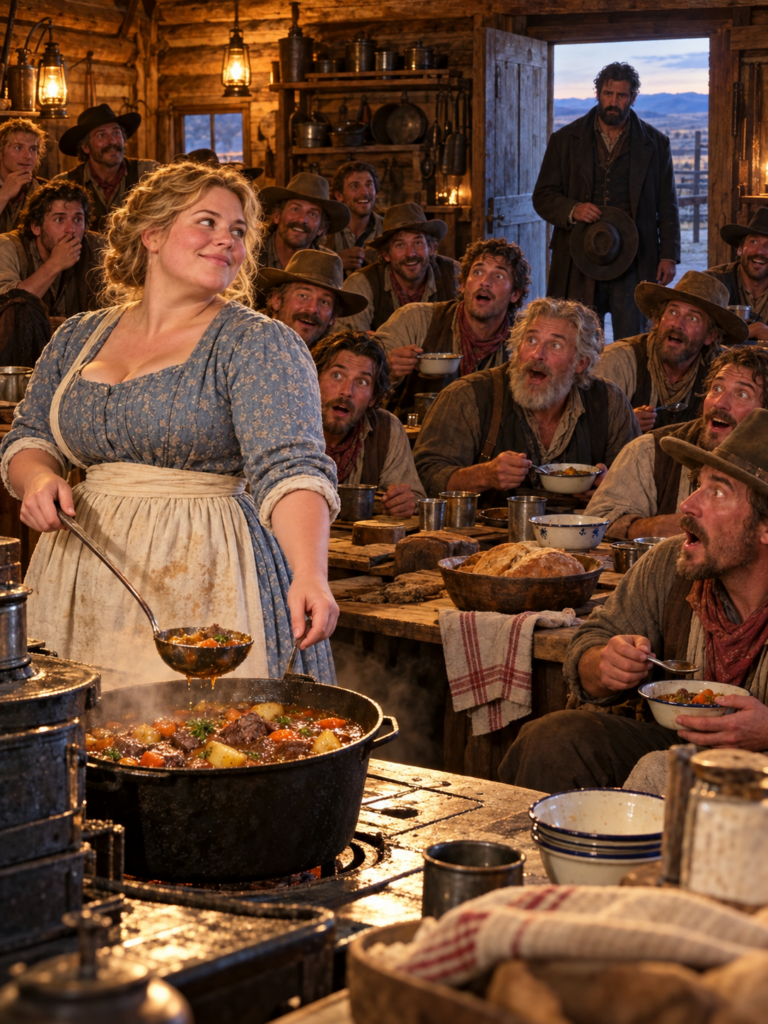
And inside the cookhouse, Britta lifted the first lid from a pot of beef stew.
Steam rolled toward the rafters.
Moses tasted the gravy.
He considered it carefully.
Then he handed her the spoon.
“Wouldn’t change a thing.”
Britta felt a warmth that had nothing to do with the stove.
The benches filled quickly.
Sixty places were not enough.
Additional men settled on crates and along the walls, while others waited near the door for their turn.
Ninety-six riders had come from seven outfits.
With the Sorbuk’s nineteen hands, there were 115 hungry cowboys to feed.
Ruth Hail poured coffee.
Winifred Cole helped serve.
Moses managed the range.
And Britta stood at the end of the long table.
She carried a ladle in one hand.
It was the place Clara Toiver had once occupied.
Owen noticed.
For a brief moment, grief crossed his face.
Then something gentler followed.
He picked up a stack of plates and carried them to the waiting men.
The supper stretched into the evening.
Beef stew darkened with rich gravy.
Smoked brisket.
Baked beans.
Fresh bread.
Plum pies cooling along the shelves.
Men who had not shared a table in two years spoke as if the silence between them had finally been broken.
Major Strand tasted the stew and looked toward Moses.
He praised the old cook’s familiar skill.
Moses shook his head and indicated Britta.
The credit belonged to her.
Across the room, Owen heard him.
He looked at Britta differently then.
Not because she had recreated his wife’s cooking.
Not because she had made the room resemble what it once was.
Because she had given the place a future that belonged to her own work.
Clara had built something good here.
Moses had helped sustain it.
Britta had restored it without pretending to become either of them.
Owen could finally see the difference.
Later that evening, Britta stepped onto the porch for a moment of cool air.
Owen followed, leaving the door open behind them.
“You did this,” he said.
She looked toward the filled corrals.
“Not alone.”
“No.”
He watched the horses moving beyond the fence.
“I spent two years believing that if I kept everything unchanged, I wouldn’t lose any more of Clara.”
Britta waited.
“Instead, I nearly lost all of it.”
“Grief doesn’t make a man dishonest,” she said. “But it doesn’t excuse him from paying attention, either.”
Owen gave a quiet nod.
“I know.”
Inside, someone laughed so loudly that several others joined him.
Owen looked through the doorway.
“I used to hate hearing that sound.”
“And now?”
“Now I think Clara would be angry with me for wasting two good years of it.”
Britta rested a hand against the porch rail.
“Then perhaps you can stop wasting them.”
He looked at her.
She did not look away.
Nothing more needed saying that night.
The next morning, Lucius Varnum arrived in a buggy accompanied by another company representative and a Chicago cattle buyer.
He stopped when he saw the crowded pens.
More than a hundred riders surrounded the corrals.
Inspector Lyall Branock waited at the gate with the association’s brand records.
Attorney Whitcomb carried the certified mortgage.
Varnum approached with the confidence of a man accustomed to finding matters arranged in his favor.
He demanded to know why so many outsiders were present.
Owen explained.
The association inspector would supervise the count under the mortgage’s written provision.
The proper notice had been delivered.
Every Sorbuk animal gathered within the district and presented according to the contract would be included.
Varnum objected.
Whitcomb showed him the recorded language.
The discussion was no longer a private disagreement between a rancher, his bookkeeper, and the lender.
There were witnesses.
There were records.
There was an inspector who owed his duty to the association.
And there were hundreds of cattle standing within sight of the men who had brought them home.
The count began.
One animal at a time passed through the gate.
Branock called the numbers.
Pablo checked his own observations against the tally.
Sutter sat opposite him, holding a new book.
For once, the bookkeeper had no opportunity to decide the figures in private.
Men watched every animal.
Every brand mattered.
The morning passed slowly.
Britta carried coffee to the working men and returned to the cookhouse to prepare their dinner.
She refused to stand at the rail waiting helplessly for an answer.
The kitchen still needed her.
Whatever the count revealed, her future would not be decided entirely by a company official.
At last, early in the afternoon, the inspector closed his tally book.
The home herd numbered 2,586.
The returned strays numbered 521.
The total was 3,107 head.
One hundred seven more than the mortgage required.
Owen stood motionless for a moment.
Then his shoulders dropped.
The company could not seize the cattle for a shortage that did not exist.
But the count was only part of what had to be settled.
The evidence gathered by Britta, Pablo, Winifred, and Percy raised serious questions about how the shortage had been manufactured.
The missing association letters.
The falsified supply accounts.
The conflicting spring tallies.
The correspondence between Varnum and Sutter.
Percy’s copy book became particularly important.
It contained letters suggesting that the cookhouse had been closed deliberately to weaken the connections between the Sorbuk and its neighbors.
The loan company had appeared prepared to take advantage of the resulting isolation.
When confronted with the evidence, Sutter attempted to put the blame on Varnum.
His composure disappeared.
A county attorney had attended the proceedings, and Sutter was taken back to Cedar Bend to answer questions about the accounts and correspondence.
Varnum returned toward the railroad without the cattle he had expected to acquire.
The Chicago buyer had nothing to purchase through the threatened seizure.
For the first time in years, Owen could look across the Sorbuk corrals without wondering how long they would remain his.
But the thing Britta remembered most was not the count.
It was Pablo’s face when the inspector closed the book.
His figures had been dismissed because of who he was.
Now an independent count had publicly vindicated his competence.
Owen went to him before he returned to the cookhouse.
“You were right to keep your own record,” he said. “I should have listened the first time.”
Pablo accepted the apology without pretending the earlier slight had been small.
Britta was glad of that.
A man’s change meant little unless it reached the people he had failed.
That evening, when the other riders had departed, Owen came to the cookhouse with a folded sheet of paper.
Britta was wiping the long table.
He waited until she finished the section in front of her.
“I’ve written an offer,” he said.
She dried her hands and read it.
Sixty dollars a month.
Board and supplies.
Employment for as long as she wished.
It was generous compared with her original three-day cleaning agreement.
For a moment, Owen seemed hopeful.
Then Britta folded the paper.
“No.”
He blinked.
“Is it the wage?”
“No.”
“Then what?”
She pulled out a chair.
“Sit down, Owen.”
He sat across from her.
“When my father died, the railroad company took away the eating house we’d spent years building. They could do it because the lease belonged to him, and they would not renew it in my name.”
Owen listened.
“I could feed hundreds of men. I could buy provisions, train workers, keep the books, and turn a profit. But none of that changed what was written on their paper.”
She laid his offer on the table.
“If I accept this, I’ll still be an employee. A better-paid employee, perhaps. But another man will still decide whether I have a kitchen tomorrow.”
Owen slowly nodded.
“What would you prefer?”
“A business.”
She opened her father’s order book.
She showed him the freight orders she had collected in Cedar Bend.
The notes about curing beef.
The possible demand from neighboring roundup wagons.
The supplies she would need, the work involved, and the income she believed she could earn.
The cookhouse could feed the Sorbuk hands and serve association roundups.
The smoke room could produce preserved beef for freight outfits, survey crews, and neighboring ranches.
She proposed buying meat from the Sorbuk at a fair agreed price.
The ranch would provide the existing premises and equipment.
The provisioning venture would bear the Soulberg name.
And its profits would be divided between them.
“How much of the profit?” Owen asked.
“Forty percent to me. Sixty to the ranch.”
He considered the figures.
Then he offered a smaller share.
Britta rejected it.
They bargained.
He reminded her that the ranch owned the buildings and supplied the cattle.
She reminded him that unused buildings earned nothing, that a smoke room without trade had no business value, and that the ranch’s neighbors had returned because someone had opened its table again.
Her recipes were hers.
Her commercial name would remain hers.
And if she ever wished to leave, the agreement must give her a fair means of doing so.
Owen studied her for a long time.
Then he smiled.
It was not the tired expression she had seen on her arrival.
It was the smile of a man beginning to enjoy being challenged.
“Forty percent,” he agreed.
“And my name over the door.”
“Agreed.”
“And the recipes remain mine.”
“Yes.”
She extended her hand.
He shook it.
Then she passed him the pencil.
“We ought to have it properly written.”
Owen laughed.
The sound surprised them both.
The following morning, they traveled to Cedar Bend.
Attorney Whitcomb prepared a written partnership agreement setting out the division of profits and the separate rights of each party.
The new business would be called Soulberg’s at the Sorbuk Table.
Britta retained ownership of her recipes and business name.
The ranch retained its cookhouse and smoke room.
Either partner could seek a fair buyout under the agreed terms.
Britta examined every page carefully.
She read the agreement four times.
When she was satisfied, she signed.
Owen signed beneath her.
Winifred Cole and Ruth Hail witnessed the document.
Moses Abernathy, who had agreed to work through the winter as a second cook, added his signature as another witness.
Britta folded her copy and placed it safely inside her coat.
It was the first time in years that a written agreement had given her something to build upon rather than taken something away.
On the drive home, the prairie lay quiet beneath the evening sky.
Owen handled the reins while Britta watched the river country pass.
Near the Box Elder crossing, he reached beneath the wagon seat and produced a long parcel.
“I bought something for your work,” he said. “I wanted to give it to you after the business was settled.”
Britta untied the string.
Inside a fitted walnut case lay six fine Sheffield steel kitchen knives.
She lifted one carefully.
The balance was excellent.
The handles were dark and smooth.
A purchase record inside the case showed that Owen had ordered them back in September, soon after her first supper at the Sorbuk.
Before the cattle investigation.
Before the partnership.
Before anyone knew whether she would remain beyond her three-day agreement.
Britta looked at him.
“You ordered these when you still intended to send me away?”
“I had seen the condition of your old knives.”
“And?”
“I thought your work deserved proper tools.”
He paused.
“I also hoped you’d find a reason to stay.”
She examined the steel for a moment.
“Why didn’t you say so?”
“I wasn’t ready to admit it.”
The horses slowed along the road.
Owen kept his attention on them.
“I don’t want you to feel that the business agreement has anything to do with what I might hope for between us.”
Britta waited.
“I admire what you’ve made of that kitchen,” he continued. “And the way you’ve treated my men. And the way you insisted I answer for what I’d done wrong.”
His voice grew quieter.
“I’ve come to care for you, Britta. But I know you’ve worked too hard for the freedom to make your own choices. I won’t ask you to give that up for me.”
She studied him.
There was affection in his face now, but no demand.
He was offering her something that remained hers to accept or refuse.
For a long moment, Britta thought about Ashby Junction.
Her father’s counter.
The day she lost it.
The years she had spent being employed by other people.
Then she thought about Owen sitting through the night reading accounts because she had told him to.
About his apology to Pablo.
About the hands carrying wood and washing plates.
About the strange comfort of hearing Owen laugh across the long kitchen table.
She closed the knife case.
“I have plans,” she said.
“I know.”
“Large ones.”
“I’d like to hear every one.”
“Some may take years.”
He looked at her.
“Then we ought to start before we’re too old to enjoy them.”
Britta laughed softly.
She rested the case between them and held out her hand.
Owen gathered the reins in his other hand before taking it.
They traveled the remaining miles together, their hands joined, while the cookhouse lights appeared across the darkening valley.
There was no hurried promise of marriage.
No bargain that confused gratitude with love.
Britta had secured her livelihood before she chose to open her heart.
And Owen had finally learned that caring for someone meant leaving room for that person’s freedom.
Over the winter, the cattle dispute continued through the territorial legal proceedings.
Sutter was ordered to repay the fraudulent cookhouse charges and received a sentence for falsifying accounts.
Varnum faced prosecution for his role in the scheme and lost his position with the loan company.
The lender’s directors allowed the Sorbuk mortgage to continue on its previous terms.
In April, Owen cleared the remaining debt through cattle sales.
The following spring, the ranch looked different.
Not grander.
More alive.
Smoke rose from both cookhouse chimneys.
Freight wagons stopped for meals.
The smoke room supplied cured beef to travelers and neighboring outfits.
Spring roundup brought eighty-four visiting riders from seven ranches to Britta’s table.
Moses worked beside her, their different skills making the kitchen stronger than either could have managed alone.
Pablo continued keeping an independent cattle count.
Percy Hail, having left the lending company, helped Owen maintain the ranch accounts.
The figures were checked openly.
The neighboring outfits exchanged riders again.
And along the cookhouse porch hung a new painted sign bearing the Soulberg name.
Britta stood beneath it one May morning, watching a freight wagon approach along the river road.
The driver stopped because he could smell the cooking before he saw the building.
He asked whether a traveler could buy dinner.
Britta smiled.
“Certainly. Come in.”
From inside, Owen called to ask how many places she needed set.
“One more,” she answered.
He brought another plate.
The driver entered the long room where, less than a year before, mice had nested in the range and nobody had believed it would serve another meal.
Now every bench seemed to have a purpose.
Britta carried her father’s old order book to the shelf beside Moses’s table ledger.
Two records of kitchens.
Two histories of feeding people.
And, for once, a future that no one could dismiss simply by ordering a woman onto the next wagon.
Owen came to stand beside her.
“Busy day ahead?”
“Very.”
“Need anything?”
She looked toward the approaching riders.
“More wood. And another kettle washed.”
He nodded and went to fetch both.
Britta watched him leave with a fond smile.
Then she turned back to her stove.
The woman who had been hired to scrub an abandoned cookhouse had become its rightful business partner.
The rancher who had shut his doors in grief had learned how to open them again.
Their future was not built from a dramatic rescue or a promise made in haste.
It was built from honest accounts, shared work, good meals, difficult apologies, and the freedom to choose one another every day.
And when the first guests sat down, Britta lifted her ladle and began serving supper.
Beyond the windows, the Little Missouri moved steadily through the badlands.
The old ranch table was full again.
This time, there was room for everyone.