
Part 1
“Please, ma’am. I’m not asking for money. Just something to eat. Then I’ll be on my way.”
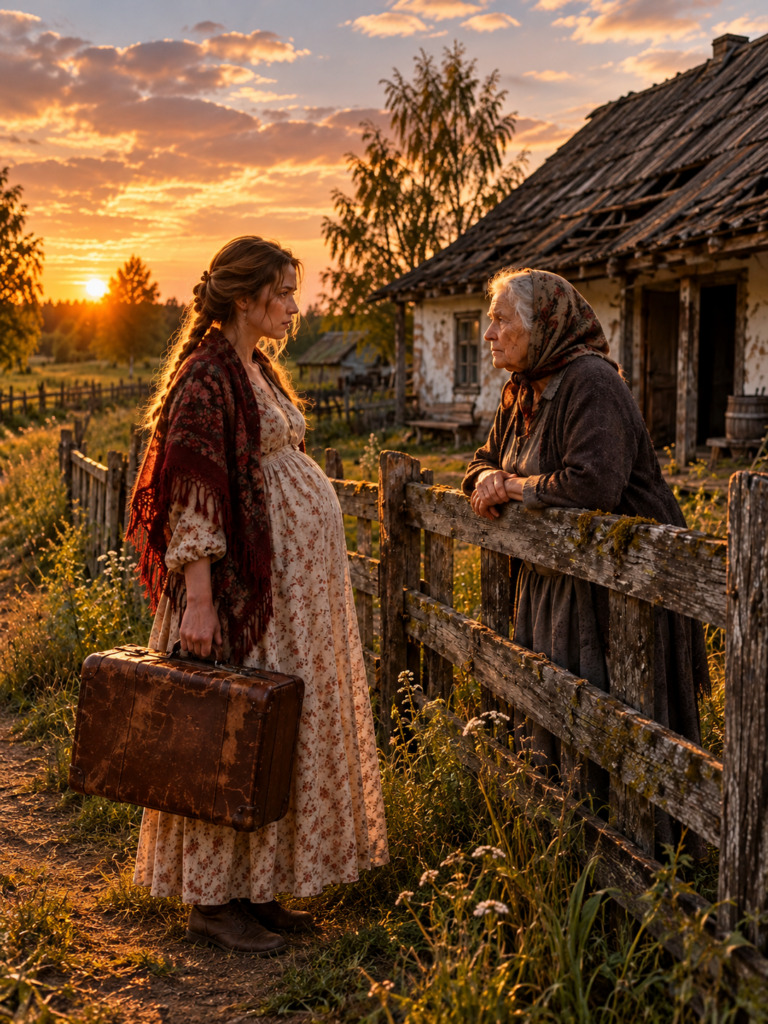
The young woman stood outside the iron gate with one hand resting on her swollen belly and the other gripping a battered brown suitcase.
Her shoes were worn nearly through. Dust covered the hem of her faded flowered dress. A caramel-colored knitted shawl hung loosely around her shoulders, despite the warm evening air.
She looked barely twenty-three.
And she was seven months pregnant.
Across the gate, sixty-four-year-old Rosalie Whitmore stared at her without speaking.
For seventeen years, Rosalie had lived alone on her Missouri farm. She had learned not to trust strangers, not to expect kindness from the world, and never to open her heart to anyone she might lose.
Yet something about the frightened young woman made her hesitate.
“What’s your name?” Rosalie finally asked.
“Maria.”
“Where’s your husband?”
Maria lowered her eyes.
“I don’t have one.”
Rosalie studied the girl’s face. There were dark circles beneath her eyes, and the hand holding the suitcase trembled from exhaustion.
“You got family nearby?”
Maria shook her head.
“Then where exactly are you going?”
“I don’t know, ma’am.”
The answer was so quiet that Rosalie almost didn’t hear it.
For a long moment, neither woman spoke.
Beyond them, the last orange light of September stretched across the pasture. The cattle had gathered near the watering trough, and somewhere behind the barn, an old rooster called as though confused by the fading daylight.
Rosalie looked toward the empty road.
The nearest town was twelve miles away.
Darkness would fall within an hour.
And that young woman looked as though another mile might finish her.
“Come inside,” Rosalie said.
Maria blinked.
“Ma’am?”
“I said come inside. Nobody leaves my property hungry.”
The girl’s eyes filled with tears.
“Thank you.”
“Save your thanks. Just follow me.”
Rosalie turned toward the farmhouse before the girl could see the emotion crossing her face.
She had no idea that by opening that gate, she had begun to unlock a secret she had kept buried for nearly forty years.
The Whitmore farm stood at the end of a long gravel road in southern Missouri, surrounded by rolling pastures, oak trees, and fields that had been worked by the same family for generations.
It was a prosperous place.
There were forty-two acres of good pasture, twenty dairy cows, a vegetable garden, an old red barn, and a white farmhouse with a deep front porch.
Rosalie had inherited part of the land from her father. The rest she and her late husband, Stephen, had purchased over decades of careful work.
They had never been wealthy in the way city people understood wealth.
But they had never gone hungry.
The pantry was stocked with vegetables, preserves, flour, and canned peaches. The cellar held potatoes and winter squash. There was always milk, eggs, and enough food to feed several families.
Yet every evening, Rosalie sat alone at a kitchen table built for eight.
Stephen had died seventeen years earlier after a long illness.
His passing had left her with no one to share the morning coffee, no one to complain about the weather, and no one to tell her that the fence needed repairing.
She continued working the land because she didn’t know what else to do.
She rose before sunrise, fed the chickens, checked the cattle, carried buckets from the barn, and kept the house immaculate.
But she had stopped inviting people over.
The neighbors respected her.
Some called her independent.
Others called her difficult.
A few said grief had made her hard.
They were all partly right.
What none of them understood was that Stephen hadn’t been the first person Rosalie had buried.
At the end of the upstairs hallway stood a small room with a faded white door.
It had remained locked for nearly four decades.
Rosalie carried the key in a tiny cloth pouch sewn inside her apron.
Every morning, she touched it while dressing.
Every night, she felt its weight as she hung her apron beside the kitchen door.
But she never used it.
There were memories behind that door that she could not bear to face.
Maria followed Rosalie into the kitchen.
The room smelled of warm bread, coffee, and the beef stew that had been simmering on the stove since afternoon.
“Sit,” Rosalie instructed, pulling out a chair.
Maria placed her suitcase beside the wall and lowered herself carefully.
Rosalie noticed the way she winced.
“How long have you been walking?”
“A few days.”
“A few days?”
“Sometimes people gave me rides.”
“And the rest?”
“I walked.”
Rosalie said nothing.
She ladled stew into a deep ceramic bowl, cut two thick slices of bread, and placed them before her visitor.
Maria stared at the food.
“Go ahead,” Rosalie said.
The girl took one careful spoonful.
Then another.
She tried to eat slowly, politely, but hunger soon defeated her manners.
Rosalie turned away and busied herself with the kettle, allowing the girl a little dignity.
When Maria finally finished, Rosalie quietly refilled her bowl.
“Thank you,” Maria whispered.
“You can tell me where you came from while you eat.”
Maria gripped the spoon.
“My father owns a farm near Springfield.”
“That so?”
“Yes, ma’am.”
“Then why aren’t you there?”
Maria looked down at her stomach.
For several seconds, she seemed unable to speak.
Finally, she said, “Because he doesn’t want me anymore.”
Rosalie stopped pouring tea.
Maria explained that her mother had died when she was nine. Her father, Peter, had raised her alone, but his love had always been tied to obedience.
He cared deeply about reputation.
About church appearances.
About what the neighbors said.
When Maria became pregnant, everything changed.
The baby’s father, a young man named Victor, had promised to marry her.
Instead, he disappeared.
And when Maria told her father, he called her a disgrace.
“He said I ruined everything,” Maria whispered.
Rosalie placed a cup of tea in front of her.
“What did he want you to do?”
Maria hesitated.
“He made arrangements with some people.”
“What kind of arrangements?”
“A married couple from another county. They have money. They can’t have children.”
Rosalie felt a cold uneasiness settle in her stomach.
Maria continued.
“My father said I could come home if I agreed to give them my baby after she was born.”
Rosalie’s fingers tightened around the teacup.
“He said they’d pay for everything. The doctor, the hospital, even give him money for the trouble.”
“And what did you say?”
“I said no.”
Maria lifted her chin for the first time.
“I told him this baby is mine. I may not have a husband or a house, but she’s mine.”
“And he threw you out?”
“He said if I wouldn’t agree, I wasn’t his daughter anymore.”
Rosalie stared at her.
There was something painfully familiar about the girl’s determination.
Not the circumstances.
Not the father.
But the fierce, frightened love in her voice.
It reminded Rosalie of a woman she had once been.
A woman who had counted the days until her own baby would arrive.
A woman who had stitched tiny clothes by lamplight.
A woman who had believed that love alone could protect a child.
Rosalie turned toward the window.
The fields were disappearing into darkness.
“You can’t go anywhere tonight,” she said.
Maria looked up.
“I don’t want to cause trouble.”
“There’s a spare room downstairs. You can sleep there.”
“Just for tonight?”
Rosalie hesitated.
“For tonight.”
Maria pressed a hand to her mouth.
No one had offered her a bed without demanding something in return since she had left home.
Rosalie took the empty bowl.
“Bathroom’s down the hall. There’s clean water in the pitcher. If you need something, knock on my door.”
“Mrs. Whitmore?”
Rosalie paused.
“Yes?”
“Why are you helping me?”
The older woman looked at the girl for a moment.
Then she gave a small shrug.
“Because somebody should.”
That night, Maria fell asleep beneath a handmade quilt.
And upstairs, Rosalie lay awake for hours.
She could hear the faint creaking of the old floorboards, the wind brushing the windows, and the occasional restless movement from the room below.
For the first time in seventeen years, there was another person sleeping beneath her roof.
Rosalie should have found it unsettling.
Instead, the house felt strangely less empty.
But before dawn, she rose and walked silently to the locked upstairs door.
She pressed her palm against the peeling paint.
Then she closed her eyes.
“Don’t do this again,” she whispered to herself.
“Don’t let yourself love someone you might lose.”
Part 2
Maria stayed one night.
Then another.
By the fourth morning, Rosalie had stopped asking when she planned to leave.
Neither woman acknowledged the change.
Rosalie continued her chores before sunrise, and Maria quietly began helping around the house.
She swept the porch, washed dishes, folded laundry, and mended a torn curtain that had been hanging in the kitchen for years.
She never took anything without permission.
She ate what was offered, thanked Rosalie for every meal, and tried to make herself as useful as possible.
One morning, Rosalie found her carrying a heavy bucket toward the barn.
“Put that down!”
Maria jumped.
“I was only bringing water to the chickens.”
“You’re seven months pregnant. You shouldn’t be hauling heavy buckets.”
“I want to help.”
“Then help by keeping yourself and that baby safe.”
Maria lowered the bucket.
“I’m sorry.”
Rosalie immediately regretted her sharp tone.
The girl looked like someone accustomed to being scolded for existing.
Rosalie cleared her throat.
“There’s bread dough on the counter,” she said more gently. “You could knead that.”
Maria looked surprised.
“I can do that.”
“Good. And don’t apologize every time someone speaks to you.”
It was the closest Rosalie had come to kindness in years.
Slowly, a routine developed.
Each morning, they shared coffee or tea at the kitchen table.
Rosalie read the agricultural bulletin while Maria listened to the radio.
In the afternoon, Maria worked on sewing projects beside the window while Rosalie attended to the garden.
They talked about ordinary things.
Rainfall.
The price of feed.
Whether the county road would be graded before winter.
Maria learned that Rosalie liked apple pie but rarely bothered baking one for herself.
Rosalie learned that Maria could sew beautifully and had once dreamed of opening a small dressmaking shop.
Some evenings, the girl would laugh at something on the radio.
The first time it happened, Rosalie nearly dropped her cup.
It had been so long since laughter filled that kitchen that she barely recognized the sound.
She found herself listening for it afterward.
And that frightened her.
Because with every passing day, Maria was becoming more than a stranger who needed temporary shelter.
She was becoming someone Rosalie worried about.
Someone whose empty chair she noticed.
Someone she found herself wanting to protect.
One evening, a thunderstorm swept across the valley.
Rain struck the farmhouse roof in heavy sheets.
Lightning flashed over the pasture, briefly illuminating the dark shapes of cattle huddled near the barn.
Rosalie was checking the windows when she discovered Maria sitting alone at the kitchen table.
The girl had both hands wrapped around a cold cup of tea.
“Can’t sleep?” Rosalie asked.
Maria shook her head.
“The thunder?”
“A little.”
Rosalie lit another lamp and sat across from her.
For several minutes, they listened to the rain.
Then Maria whispered, “Do you think someone can be a good mother even if she has nothing?”
Rosalie studied her face.
“What makes you ask that?”
Maria’s eyes filled.
“I’ve been thinking about what my father said.”
“What did he say?”
“That I’m selfish. That keeping my baby when I can’t give her a proper home is cruel.”
Rosalie leaned back.
“And you believe him?”
“Sometimes.”
Maria wiped her cheek.
“I don’t have savings. I don’t have a husband. I don’t even know where I’ll live when she’s born.”
Her voice broke.
“What if he’s right? What if loving her isn’t enough?”
Rosalie stared at the trembling young woman.
She thought about the expensive nursery upstairs.
The tiny dresses.
The hand-carved cradle.
All the beautiful things she and Stephen had prepared.
And how none of them had been enough to save their child.
“Money doesn’t make a mother,” Rosalie finally said.
Maria looked at her.
“Neither does a fine house.”
Rosalie’s voice grew unsteady.
“A mother is someone who stays when staying hurts. Someone who loves a child when loving is the hardest thing in the world.”
Maria was silent.
Rosalie lowered her eyes.
“I had a daughter once.”
The storm seemed to grow quieter.
Maria slowly straightened.
“You did?”
Rosalie nodded.
“She lived only three days.”
The words left her mouth with difficulty.
For almost forty years, she had spoken them to no one.
Maria didn’t interrupt.
Rosalie took a breath.
“She was born too early. The doctor did everything he could, but her lungs weren’t strong enough.”
A tear slid down her cheek.
“Stephen and I had waited eleven years for that baby. Eleven years of praying and hoping and trying not to be disappointed.”
She stared at her hands.
“We bought a cradle. Made blankets. Painted a little room upstairs.”
Maria’s gaze shifted toward the hallway.
Rosalie continued.
“When she finally came, I thought every sorrow we’d ever known had been worth it.”
Her voice cracked.
“Then three days later, I held her while she stopped breathing.”
Maria covered her mouth.
“I’m so sorry.”
Rosalie shook her head.
“She was so small. I remember wondering how something so little could leave such a terrible emptiness.”
The older woman’s shoulders began to tremble.
“We’d chosen a name.”
“What was it?”
“Rose.”
She smiled through tears.
“Stephen said it was a beautiful name for a little girl who’d bring life into our house.”
Maria reached across the table and gently covered Rosalie’s hand.
For a long time, they sat together.
The rain continued.
The wind rattled the windows.
But something in that kitchen had changed.
Two women who had spent so long being alone were finally allowing someone else to witness their grief.
And yet neither of them knew that trouble was already traveling down the county road toward the farm.
Three days later, Rosalie drove her old pickup into town to buy flour, lamp oil, and livestock feed.
At Miller’s General Store, the owner, Hank Miller, approached her while she examined a shelf of canned goods.
“Rosalie, you hear about the fellow asking questions around here?”
She glanced up.
“What fellow?”
“Stranger came through yesterday. Nice coat, polished boots. Didn’t look like a farmhand.”
“What did he want?”
“Looking for a pregnant girl.”
Rosalie felt her stomach tighten.
Hank continued.
“Said her father sent him. Offered two hundred dollars to anyone who could tell him where she was.”
Rosalie kept her expression still.
“What kind of father puts a reward on his daughter?”
Hank shrugged.
“Claims he’s worried sick.”
“Does he?”
“That’s what the man said.”
Rosalie set the canned goods into her basket.
“Did you tell him anything?”
“Nothing to tell.”
Hank paused.
“But if you see somebody fitting that description, I’d be careful. Fellow gave me a bad feeling.”
Rosalie paid for her supplies and drove home faster than usual.
For the first time since Maria arrived, she understood that the girl hadn’t simply been abandoned.
Someone was actively looking for her.
Someone with money.
Someone who might not accept no for an answer.
The stranger appeared the following afternoon.
Rosalie saw him from the kitchen window, riding up the gravel drive in a dark pickup truck.
He was in his forties, dressed in expensive-looking work clothes that had never seen much work.
He stopped outside the gate and stepped out with a polite smile.
Rosalie quietly told Maria to stay in the downstairs bedroom.
Then she went outside.
“Afternoon, ma’am,” the stranger called.
“Afternoon.”
“My name is Raymond Cole. I’m helping a gentleman locate his missing daughter.”
Rosalie folded her arms.
“That so?”
“A young woman. Early twenties. Dark hair. Expecting a baby.”
He smiled again.
“Her father is terribly concerned.”
“What’s your business with me?”
“We believe she may have passed through this area.”
Raymond looked past her toward the house.
“Perhaps someone offered her shelter.”
Rosalie didn’t move.
“People pass through all the time.”
“Of course.”
He reached into his coat and produced an envelope.
“Her father is prepared to compensate anyone who assists us.”
Rosalie glanced at the envelope.
Then at him.
“Put that away.”
Raymond’s smile weakened.
“Ma’am, I think you misunderstand.”
“No,” Rosalie replied. “I understand perfectly.”
He took a step toward the gate.
“Would you mind if I had a quick look around?”
Rosalie’s expression hardened.
“Yes.”
“I’m only trying to reunite a family.”
“You heard me.”
Raymond stared at her.
“It’s a rather large property. Surely you wouldn’t object to—”
“I’ve owned this land longer than you’ve been wearing those shiny boots.”
Her voice remained steady.
“You have no permission to enter my property. And you won’t get it.”
For a moment, his pleasant manner disappeared.
“You don’t want to interfere in a family matter, Mrs. Whitmore.”
Rosalie felt a chill.
He knew her name.
But she refused to show fear.
“Then stop bringing your family matter to my gate.”
Raymond studied her.
Finally, he returned to his truck.
“This isn’t finished.”
Rosalie stood motionless as he drove away.
Only when the dust settled did she notice her hands were shaking.
Inside, Maria was waiting beside the bedroom door.
“Was he looking for me?”
Rosalie nodded.
Maria began crying.
“My father sent him.”
“I know.”
“He won’t stop.”
Rosalie crossed the room.
For the first time, she placed a hand gently against Maria’s cheek.
“Listen to me.”
Maria looked up.
“As long as you are under this roof, nobody is taking you anywhere against your will.”
“But—”
“No buts.”
Rosalie’s voice was firm.
“This is my home. And you are safe here.”
Maria clutched her hand.
Neither woman spoke the word family.
But both were beginning to understand what it meant.
Part 3
Autumn settled over the Whitmore farm.
The mornings became colder, the grass lost its bright summer color, and fog drifted through the low fields before sunrise.
Rosalie began preparing for winter.
She checked the barn roof, repaired a section of broken fence, stacked firewood along the back porch, and made certain the water pipes were protected from freezing.
Maria watched her work with growing admiration.
The older woman moved slowly at times, especially when her knees ached, but she knew the farm with the familiarity of someone who had spent a lifetime listening to it.
She could tell from the sound of the pump when the pressure was dropping.
She knew which cow would kick during milking.
She could read approaching weather from the clouds above the southern ridge.
And she never wasted anything.
A broken bucket became a flowerpot.
Old shirts became cleaning cloths.
Scraps of wood were saved for repairs.
Maria began to understand that the farm’s prosperity wasn’t an accident.
It was the result of decades of patience, discipline, and sacrifice.
Behind the farmhouse lay an abandoned orchard.
Two cherry trees, three plum trees, and an old apple tree stood among waist-high weeds.
The branches were tangled with dead vines.
The soil was hard.
The fence leaned drunkenly toward the pasture.
One morning, Maria stood beside the kitchen window studying it.
“Mrs. Whitmore?”
“Hm?”
“Why don’t you use the orchard anymore?”
Rosalie glanced toward the trees.
“Nothing good grows there now.”
“Did something happen?”
“Stephen used to take care of it.”
Rosalie returned to her dishes.
“After he died, I didn’t have the heart.”
Maria nodded.
But she continued watching the orchard.
To her, the trees didn’t look dead.
They looked neglected.
And she knew what that felt like.
The following morning, she carried a small garden rake and a pair of gloves into the yard.
She began clearing weeds from beneath the nearest tree.
She worked carefully, taking frequent breaks, never lifting more than she could manage.
When Rosalie noticed her, she marched outside.
“What are you doing?”
“Clearing the orchard.”
“I can see that.”
Maria smiled nervously.
“I thought maybe we could bring it back.”
Rosalie shook her head.
“Those trees haven’t produced properly in years.”
“Maybe they just need some attention.”
“Maria, you don’t have to work for your meals.”
“I know.”
“Then why are you doing this?”
Maria looked at the twisted branches.
“Because I want to leave something better than I found it.”
Rosalie had no answer.
For a moment, she remembered Stephen standing beneath those same trees with a pruning saw, his hat tipped back, teasing her about how much apple pie she expected him to eat.
She looked away.
“Don’t overdo it,” she said.
Then she returned to the house.
Over the following two weeks, Maria worked in the orchard a little each morning.
She pulled weeds, cleared fallen branches, and watered the driest patches of soil.
Rosalie eventually joined her.
At first, she simply offered advice.
“That branch is still alive.”
“Don’t dig so close to the trunk.”
“Use the smaller shears. They’ll be easier on your hands.”
Then one afternoon, she appeared with a wheelbarrow and a pair of pruning gloves.
Maria smiled.
“Thought you said nothing would grow here.”
Rosalie snorted.
“I said the trees were neglected. Not that they were hopeless.”
Maria laughed.
And Rosalie, despite herself, smiled too.
They worked together beneath the pale autumn sun.
Sometimes they spoke.
Sometimes they enjoyed the silence.
But it was no longer the heavy, lonely silence Rosalie had known for years.
It was the peaceful quiet of two people who felt comfortable together.
One afternoon, Rosalie brought apple pie and two glasses of cold milk to the orchard.
They sat beneath the oldest tree.
Maria rested her hands on her belly.
“She moved.”
Rosalie glanced over.
“The baby?”
Maria nodded.
“Would you like to feel?”
Rosalie froze.
For nearly forty years, she had avoided touching a pregnant woman’s belly.
Not because she disliked children.
But because the memory of losing her own had never stopped hurting.
Maria seemed to understand.
“You don’t have to.”
Rosalie swallowed.
Then, very slowly, she reached out.
Maria guided her hand to the side of her stomach.
A small movement pressed against Rosalie’s palm.
She gasped.
Then it happened again.
A tiny, unmistakable kick.
Rosalie’s eyes filled with tears.
“Oh, sweetheart,” she whispered.
Maria watched her quietly.
For several moments, the older woman kept her hand where it was.
Then she withdrew it gently.
“Strong little thing,” Rosalie murmured.
Maria smiled.
“She has to be.”
The weeks passed.
Rosalie grew increasingly protective of Maria, insisting that she rest whenever she seemed tired.
But one morning, while Rosalie was inside preparing breakfast, Maria returned to the orchard.
A dead vine had become tangled around one of the lower cherry branches.
Maria reached to pull it free.
The ground was damp from overnight rain.
Her shoe slipped.
She fell hard onto her side.
A sharp cry broke through the quiet yard.
Rosalie dropped the dish she was holding.
By the time she reached the orchard, Maria was lying in the grass, clutching her belly.
“Maria!”
The girl was pale.
“It hurts.”
Rosalie dropped to her knees.
“Where?”
“My stomach.”
Fear struck so suddenly that Rosalie nearly couldn’t breathe.
She remembered another frightened night.
Another tiny life slipping beyond her reach.
But this time, she forced herself to act.
She helped Maria remain still and hurried inside to telephone for medical assistance.
The nearest hospital was miles away, and an ambulance would need time to reach the farm.
Rosalie returned with blankets and stayed beside Maria, keeping her warm and talking to her until help arrived.
“Look at me,” she said.
Maria was crying.
“I’m scared.”
“I know, honey.”
“What if something happens to her?”
Rosalie gripped her hand.
“We’re going to get you checked. And we’re going to do everything we can.”
At the hospital, doctors examined Maria and monitored the baby’s heartbeat.
There was no sign of serious injury, but Maria had developed contractions and needed observation.
Rosalie spent the entire afternoon beside her bed.
She refused to leave even when the nurses suggested she get something to eat.
By evening, the contractions had settled.
The doctor was cautiously reassured.
But Maria had developed a fever, and the medical staff decided to keep her overnight while they investigated the cause.
Rosalie sat in a plastic chair beside the bed.
Her back ached.
Her knees throbbed.
Her hands were cold.
But she didn’t move.
Sometime after midnight, Maria woke from an uneasy sleep.
The fever had left her exhausted and confused.
She reached blindly toward the chair.
“Please,” she whispered.
Rosalie leaned forward.
“I’m here.”
Maria’s fingers found her hand.
“Mom?”
Rosalie went still.
“Mom, don’t leave me.”
The word entered her heart like a key turning in a lock.
Mom.
For decades, she had imagined hearing that word.
She had imagined a little girl calling it from the porch.
A teenager saying it impatiently across the kitchen.
A grown daughter using it softly during a visit home.
But those imagined years had never come.
Now, in a quiet hospital room, a frightened young woman was calling for her.
Rosalie pressed Maria’s hand against her cheek.
“I’m here, baby.”
Tears streamed down her face.
“I’m right here.”
Maria drifted back to sleep.
Rosalie remained beside her.
And for the first time since her daughter’s death, the older woman allowed herself to imagine that perhaps her life was not finished.
Perhaps love could return in a different form.
Perhaps a heart could break and still have something left to give.
Maria remained in the hospital until the doctors were satisfied that she and the baby were stable.
Rosalie paid for the prescriptions, filled the refrigerator with fresh food, and prepared the downstairs bedroom so Maria wouldn’t need to climb stairs.
When Maria returned to the farm, she noticed a new rocking chair beside her bed.
It was old, but freshly polished.
“Where did this come from?” she asked.
Rosalie adjusted the quilt.
“Been in the attic.”
“It’s beautiful.”
“Stephen made it.”
Maria ran her hand over the smooth wooden arm.
Rosalie hesitated.
“He made it when we were expecting our little girl.”
Maria turned toward her.
“You kept it all these years?”
Rosalie nodded.
“I couldn’t bear to throw it away.”
Maria sat carefully.
The chair rocked with a soft, familiar creak.
Rosalie stood in the doorway, watching.
For the first time, seeing someone use a piece of her daughter’s furniture didn’t feel like losing the past.
It felt like allowing the past to become part of something new.
Then, one evening, a letter arrived.
It was addressed to Maria.
There was no return address.
Rosalie handed it to her without comment.
Maria opened it.
By the time she finished reading, her face had gone white.
“What is it?” Rosalie asked.
Maria looked up.
“My father.”
She held out the letter with trembling fingers.
“He says he’s coming for the baby.”
Part 4
Rosalie read the letter twice.
Peter had written that Maria’s return was still possible, but only if she agreed to the arrangement he had made.
The couple who wanted the baby, he claimed, were prepared to provide a comfortable life.
They had money.
A fine home.
Connections.
He described Maria’s refusal as stubbornness and warned that she was making a terrible mistake.
The final paragraph was the cruelest.
If she continued rejecting his offer, he wrote, she should expect no further assistance from him.
Maria folded her arms across her belly.
“He still thinks I’m going to give her away.”
Rosalie placed the letter on the table.
“Then he’ll be disappointed.”
Maria shook her head.
“You don’t understand. He doesn’t like being told no.”
“I’ve noticed.”
“He knows people. He has money. He’ll find a way to make trouble.”
Rosalie studied her.
For the first time, Maria seemed more frightened than she had been when she arrived at the gate.
Rosalie pulled out a chair.
“Sit down.”
Maria obeyed.
“I want you to tell me something,” Rosalie said.
“What?”
“Do you want to give up your daughter?”
“No.”
“Not because of your father. Not because of me. What do you want?”
Maria’s eyes filled.
“I want to raise her.”
“Then that’s where we start.”
The following morning, Rosalie called an attorney in town.
His name was Samuel Bennett.
He had handled the Whitmore family papers for more than twenty years and had known Stephen personally.
Samuel arrived that afternoon in a dusty sedan, carrying a leather briefcase and wearing an expression of concern.
Rosalie explained everything.
The pregnancy.
The father’s demands.
The stranger at the gate.
The letter.
Samuel listened carefully.
Then he turned to Maria.
“How old are you?”
“Twenty-three.”
“Have you signed anything agreeing to an adoption?”
“No.”
“Has anyone obtained a court order concerning you or your child?”
“No, sir.”
Samuel nodded.
“Then your father cannot simply decide to give your baby away. You’re an adult, and these decisions are yours.”
Maria released a breath she seemed to have been holding for months.
Samuel continued.
“However, I want you to keep every letter and document. If anyone threatens or harasses you, call me. We’ll deal with it properly.”
Rosalie folded her arms.
“What about the fellow who came here?”
“If he returns and refuses to leave, contact the sheriff.”
“Good,” Rosalie said.
Samuel looked around the kitchen.
“You planning to let Maria stay?”
Rosalie glanced at the young woman.
“As long as she needs.”
Samuel smiled faintly.
“Then I’d recommend putting a few things in writing.”
Rosalie’s expression changed.
She glanced toward the upstairs hallway.
“Actually,” she said slowly, “there’s something else I’d like to discuss.”
Maria looked up.
But Rosalie merely asked her to rest while she and Samuel reviewed the farm’s legal documents.
In the weeks that followed, the Whitmore household changed completely.
Rosalie repaired the old cradle.
She washed baby blankets that had been stored for decades and carefully inspected them before choosing which could still be used.
She bought a new mattress, diapers, and a small collection of baby clothes.
Maria protested.
“You’ve already done so much.”
Rosalie waved a hand.
“A baby needs things.”
“But it’s expensive.”
“So is feeding twenty cows. I manage.”
Maria laughed.
Rosalie looked pleased with herself.
One afternoon, while sorting linens, Maria discovered a small embroidered cloth at the bottom of an old trunk.
In one corner, stitched in faded pink thread, was a single name.
Rose.
Maria touched the letters.
“Did you make this?”
Rosalie’s smile faded.
“Yes.”
“For your daughter?”
Rosalie nodded.
Maria held the cloth carefully.
“It’s beautiful.”
“I made it while Stephen was building the cradle.”
She sat on the edge of the bed.
“We were so sure we’d bring her home.”
Maria knelt beside her chair.
“Do you ever wish you’d had another child?”
Rosalie looked toward the window.
“Every day for a long time.”
“Why didn’t you?”
“We tried. But it never happened.”
Her voice grew softer.
“After a while, we stopped talking about it. Stephen threw himself into the farm. I did the same.”
Maria placed the cloth in Rosalie’s hands.
“I’m sorry you had to go through that alone.”
Rosalie shook her head.
“I wasn’t alone then. Stephen was here.”
A tear formed in her eye.
“But after he died, I didn’t know who I was supposed to be anymore.”
Maria rested her head against Rosalie’s shoulder.
“You’re still someone who matters.”
Rosalie closed her eyes.
The words seemed to reach a place inside her that had gone untouched for years.
Late October brought cold rain and strong winds.
The nights grew longer.
The orchard stood nearly bare, its branches reaching toward a gray sky.
Maria’s due date approached.
Rosalie arranged for prenatal visits, checked the tires on her truck, and kept a hospital bag beside the front door.
She also began making frequent trips upstairs.
Maria sometimes heard footsteps in the hallway.
Once, she saw Rosalie standing outside the locked room with the small iron key in her hand.
But the older woman turned away before opening it.
Maria never asked.
She understood that grief had its own timetable.
The trouble returned on a Thursday afternoon.
Raymond Cole drove up to the farm, this time accompanied by another man.
Rosalie was repairing a porch step when she heard the vehicle.
She set down her hammer.
Maria stood in the kitchen doorway.
“Go inside,” Rosalie said quietly.
“I’m tired of hiding.”
Rosalie looked at her.
There was something different in Maria’s voice.
Fear remained, but it no longer ruled her.
Rosalie nodded.
“Then stand beside me.”
The two women walked together to the gate.
Raymond greeted them with a practiced smile.
“Maria. There you are.”
Maria said nothing.
“Your father’s been worried sick.”
“You know that isn’t true,” she answered.
Raymond’s smile tightened.
“You’re making this harder than it needs to be.”
Rosalie stepped forward.
“You’ve been told not to come here.”
“This concerns her family.”
Maria raised her chin.
“I am her family,” Rosalie said.
Raymond gave a short laugh.
“She’s been here a few weeks and now you’re family?”
Rosalie didn’t answer.
Maria did.
“She took me in when I had nowhere to go. She fed me when I was hungry. She sat beside me at the hospital.”
Her voice shook, but she continued.
“She has done more for me than my father has in years.”
Raymond looked irritated.
“The arrangement is still available. Those people can give your baby opportunities you can’t.”
“I don’t want their arrangement.”
“You don’t understand what you’re giving up.”
“I understand exactly what you’re asking me to give up.”
Raymond took a step closer.
Rosalie moved between them.
“That’s enough.”
The second man glanced uneasily toward the road.
Raymond lowered his voice.
“You’re making a mistake, Mrs. Whitmore. This girl will leave eventually, and you’ll be alone again.”
The words struck their target.
Rosalie felt them.
The fear of abandonment.
The possibility that Maria would eventually disappear.
The terrible thought of returning to the silence.
For one painful moment, she couldn’t speak.
Then she remembered the girl who had stood at her gate asking for a single meal.
She remembered the hands that trembled from hunger.
The shame in Maria’s voice.
The stubborn determination to protect her unborn child.
Rosalie straightened.
“Maybe she will leave someday,” she said.
Raymond smiled.
“But that’s her choice. I won’t help you force her into anything just because I’m afraid of being alone.”
She pointed toward the road.
“Now get off my property.”
Raymond hesitated.
Then he and his companion returned to their vehicle.
As the truck disappeared, Maria turned toward Rosalie.
“Did you mean that?”
“What?”
“That you wouldn’t stop me if I left?”
Rosalie looked at her.
“Of course.”
“But you want me here?”
The older woman’s eyes filled.
“More than I know how to say.”
Maria embraced her.
“Then I want to stay.”
Rosalie held her tightly.
For a moment, the cold wind and the empty fields disappeared.
There was only the embrace.
And a promise neither woman needed to put into words.
That night, Rosalie could not sleep.
She rose, put on her robe, and walked upstairs.
At the end of the hallway, she stopped before the locked door.
The little iron key felt cold against her palm.
She held it up.
Then lowered it again.
From downstairs came the faint sound of Maria humming a lullaby.
Rosalie closed her eyes.
For nearly forty years, she had believed opening that door would mean admitting her daughter was truly gone.
But now another thought had begun to form.
What if keeping it closed meant refusing the life that was still waiting for her?
She stood there for a long time.
Then she whispered, “Not yet, my sweet girl.”
And returned to bed.
Part 5
The baby decided to arrive on a cold November night.
A full moon hung above the Whitmore farm, silvering the pastures and turning the farmhouse windows pale.
Rosalie had just finished washing the supper dishes when she heard Maria call from the downstairs bedroom.
“Mrs. Whitmore?”
There was something different about her voice.
Rosalie hurried down the hallway.
Maria stood beside the bed, one hand pressed against her stomach.
“I think it’s time.”
Rosalie stared at her.
“Are you having contractions?”
Maria nodded.
“They’ve been coming for a while.”
“How far apart?”
“About five minutes.”
Rosalie drew a sharp breath.
Then she became remarkably calm.
“All right. Sit down, honey. We’re going to the hospital.”
She reached for the telephone and called ahead.
But before she could finish gathering their things, Maria cried out again.
The contractions had intensified rapidly.
Rosalie checked the clock.
Then looked toward the window.
Outside, freezing rain had begun falling across the gravel road.
The county dispatcher warned that slick conditions were slowing traffic.
Rosalie requested an ambulance and remained on the line for guidance.
The dispatcher explained that help was coming and instructed her on how to support Maria while they waited.
Rosalie pulled a chair beside the bed.
“Look at me,” she said.
Maria was trembling.
“I’m scared.”
“I know.”
“What if something goes wrong?”
Rosalie took her hand.
“Then we’ll face it together.”
Another contraction came.
Maria gripped Rosalie’s fingers.
“Don’t leave me.”
“I won’t.”
While they waited, Rosalie suddenly remembered something.
The nursery upstairs.
The room she had kept closed for nearly forty years.
She looked toward the ceiling.
The old memories surged through her.
Stephen smiling beside the cradle.
Tiny clothes folded in a drawer.
A pink blanket.
A beautiful baby girl who had lived only three days.
For decades, the room had been a monument to everything Rosalie had lost.
And for decades, she had believed that opening it would destroy her.
But now Maria was downstairs, frightened and hurting.
Another baby was preparing to enter the world.
And Rosalie realized something she had never understood before.
The love she had given her daughter had not died with her.
It had remained inside her, waiting for somewhere to go.
She stepped into the hallway and reached into her apron.
The key was there.
As always.
She climbed the stairs slowly.
At the end of the hall, she stopped before the faded white door.
Her hands trembled.
“Forgive me, sweetheart,” she whispered.
Then she inserted the key.
The lock resisted.
Rosalie turned it harder.
At last, something clicked.
The door swung inward.
Dust floated in the moonlight.
Against the far wall stood a small wooden cradle Stephen had carved himself.
Its curved rockers were still smooth.
A pale curtain hung beside the window.
There was a narrow dresser, a rocking chair, and a little shelf holding a stuffed rabbit whose ears had faded with age.
Everything remained almost exactly as it had been.
Rosalie stepped inside.
The scent of old wood and stored linens surrounded her.
She approached the cradle.
Her fingertips brushed its edge.
For a moment, she remembered Stephen standing in this room, proud of his handiwork.
“Strong enough for a dozen babies,” he had joked.
She remembered laughing.
She remembered the dream of a house full of children.
And she remembered returning home from the hospital with empty arms.
Rosalie began crying.
Not the restrained tears she had learned to hide.
But deep, shaking sobs that carried years of grief.
She sat in the rocking chair and covered her face.
“Oh, Rose,” she whispered. “I missed you so much.”
For a few minutes, she allowed herself to mourn.
Then she wiped her cheeks.
Downstairs, Maria called her name.
Rosalie rose.
She opened the curtains.
She opened the window briefly to let in fresh air.
And she looked around the room.
“This isn’t where love ended,” she said quietly.
“This is where it began.”
Then she closed the window and returned downstairs.
The ambulance arrived before dawn.
Rosalie rode with Maria to the hospital and remained beside her throughout the labor.
The hours were long.
Maria cried out in pain.
Rosalie held her hand.
A nurse brought warm blankets.
A doctor checked the baby’s progress.
At one point, Maria looked at Rosalie with tears streaming down her face.
“I can’t do this.”
Rosalie leaned close.
“Yes, you can.”
“I’m so tired.”
“I know, baby.”
“What if I’m not strong enough?”
Rosalie brushed damp hair from her forehead.
“Look at what you’ve already survived.”
Maria squeezed her eyes shut.
“You walked miles with nowhere to go. You stood up to your father when everyone told you to surrender. You kept your baby safe when nobody offered you a hand.”
Rosalie kissed her forehead.
“You are stronger than you know.”
Maria looked into her eyes.
Then she whispered, “Mom?”
Rosalie’s breath caught.
It was the same word Maria had spoken in the hospital weeks earlier.
But this time, she was fully awake.
And she meant it.
“Yes, sweetheart?”
“Will you stay?”
Rosalie smiled through her tears.
“Always.”
Just after sunrise, a baby’s cry filled the delivery room.
The doctor lifted a tiny, healthy newborn girl into view.
“Congratulations,” she said. “You have a daughter.”
Maria began sobbing.
Rosalie pressed both hands over her mouth.
The baby was placed against Maria’s chest.
She had a little round face, dark hair, and the loudest cry either woman had ever heard.
Maria stared at her in wonder.
“Hello, my beautiful girl,” she whispered.
Rosalie stood beside the bed, unable to stop crying.
For years, she had dreamed of holding a baby again.
She had imagined what it might feel like.
She had feared that the memory would be unbearable.
But standing beside Maria, she felt something entirely different.
Gratitude.
A sense of belonging she thought she’d lost forever.
Maria looked up.
“Mom?”
Rosalie moved closer.
“I know what I want to name her.”
Rosalie smiled.
“Do you?”
Maria nodded.
“Rose.”
The older woman froze.
Maria continued softly.
“After the little girl you loved. And after the woman who saved us.”
Rosalie stared at her.
“You don’t have to do that.”
“I want to.”
Tears spilled down Maria’s cheeks.
“You told me once that you had so much love left to give, but nobody to give it to.”
She looked down at her newborn daughter.
“Well, now you have us.”
Rosalie covered her face and wept.
Maria reached for her hand.
“Would you like to hold your granddaughter?”
The word nearly brought Rosalie to her knees.
Granddaughter.
She had never imagined hearing it.
Slowly, carefully, she accepted the baby into her arms.
Little Rose stirred against her chest.
Rosalie gazed down at the tiny face.
“Hello, sweetheart,” she whispered.
Her voice broke.
“I’ve been waiting a very long time to meet you.”
Three days later, Maria and baby Rose returned to the farmhouse.
The freezing rain had passed.
Sunlight shone across the fields, and the sky was a clear November blue.
Rosalie carried the baby’s bag while Maria stepped carefully onto the porch.
When they entered the house, Maria noticed that something had changed.
The upstairs hallway door stood open.
She looked at Rosalie.
“Mrs. Whitmore?”
The older woman smiled.
“Come upstairs. There’s something I want to show you.”
Maria climbed slowly, holding the sleeping baby close.
Rosalie led her to the room at the end of the hall.
The nursery.
But it no longer looked abandoned.
The curtains had been washed and rehung.
The dresser was polished.
Fresh bedding rested in the cradle.
The old stuffed rabbit sat on a shelf beside new baby clothes and a framed photograph of Stephen.
Maria looked around in astonishment.
“You opened it.”
Rosalie nodded.
“I thought it was time.”
Maria stepped toward the cradle.
“It’s beautiful.”
“Stephen made that with his own hands.”
Rosalie ran her fingers along the polished wood.
“He wanted our daughter to have the finest cradle in the county.”
Maria smiled through tears.
“I think Rose will love it.”
Rosalie turned toward her.
“So do I.”
For a while, they stood together, surrounded by the past and the future.
Then Rosalie reached into her pocket.
She withdrew a small ring of keys.
Maria looked confused.
“What are those?”
“The farmhouse. The barn. The storage shed. The front gate.”
Rosalie placed the keys in Maria’s palm.
“I’ve spent most of my life taking care of this farm. I always believed I’d leave it to a child of my own.”
Maria looked at her.
“Mrs. Whitmore—”
“Rosalie,” the older woman corrected gently. “Or Mom, if you still want to call me that.”
Maria’s eyes filled.
“Mom.”
Rosalie smiled.
She continued.
“I’ve spoken with Samuel Bennett. He’s preparing the papers to make certain this property goes to you and little Rose when I’m gone.”
Maria stared at her.
“No. I can’t accept that.”
“You’re not taking anything from me.”
“But this is your whole life.”
Rosalie looked around the room.
“No, sweetheart. This farm is where I spent my life.”
She gently touched the baby’s blanket.
“You two are the reason I want to keep living it.”
Maria began to cry.
Rosalie embraced her carefully, mindful of the baby between them.
“For years, I thought everything I worked for would be sold when I died. The fields, the barn, the house Stephen built.”
Her voice softened.
“Now I know somebody will love this place after I’m gone.”
Maria shook her head.
“We’re not going anywhere.”
Rosalie hugged her closer.
“I know.”
There were still difficulties.
Peter did not immediately abandon his attempts to interfere.
When he learned the baby had been born, he sent another letter demanding that Maria reconsider the arrangement.
This time, Maria answered through Samuel Bennett.
The letter was brief and firm.
She was an adult.
She was her daughter’s mother.
She had never consented to an adoption.
And she wanted no further contact unless her father was willing to respect her decisions.
Samuel also warned Raymond Cole that any further harassment would be documented and reported.
The wealthy couple who had been waiting for the baby withdrew when they learned that Maria had never agreed to surrender her daughter.
Without their cooperation, Peter’s plan collapsed.
He never visited the Whitmore farm.
Years later, Maria heard through an old neighbor that her father had grown ill and withdrawn from the community.
She felt sadness when she heard the news.
But she did not regret protecting her daughter.
Rosalie never encouraged revenge.
“Anger is a heavy thing to carry,” she told Maria. “You can put it down without pretending nobody hurt you.”
Maria remembered those words.
And she chose to build a life that would not be governed by the cruelty she had escaped.
Spring returned to the Whitmore farm.
The cherry trees blossomed.
The plum trees grew fresh leaves.
And the little orchard that had once seemed abandoned began producing fruit again.
Rosalie and Maria worked together, pruning branches, spreading compost, and tending the vegetable beds.
Little Rose spent her mornings in a stroller beneath the porch roof while the women worked nearby.
By the time she learned to walk, she had become the undisputed ruler of the farmhouse.
She followed the chickens.
She chased butterflies.
She squealed whenever the cows gathered near the fence.
And she called Rosalie “Grandma” long before she could pronounce many other words.
Every time, Rosalie smiled as though hearing it for the first time.
Maria gradually began taking sewing work from neighbors.
She repaired dresses, made curtains, and eventually purchased a used sewing machine with money she earned herself.
Rosalie helped her turn a small room beside the kitchen into a workspace.
When customers arrived, they often found little Rose playing on the floor while Maria measured fabric.
Rosalie would appear with coffee and homemade cookies, proud of the business growing beneath her roof.
The farmhouse became a place people visited again.
Neighbors came for supper.
Children played in the yard.
The kitchen table that had stood nearly empty for so many years was filled with conversation.
And the old nursery became a room of laughter, bedtime stories, and sleepy goodnight kisses.
Five years after Maria first arrived at the gate, Rosalie sat in her rocking chair on the front porch.
The evening sky glowed orange.
A warm breeze moved through the trees.
Little Rose, now a lively five-year-old, was running across the yard with a handful of wildflowers.
“Grandma!”
Rosalie looked up.
“What’s that, sweetheart?”
The girl held out a small bunch of yellow blossoms.
“These are for you.”
Rosalie accepted them with a smile.
“Why, they’re beautiful.”
Rose climbed into her lap.
“Mommy says flowers grow better when somebody loves them.”
Rosalie looked toward the orchard.
Maria stood beneath the cherry trees, gathering fruit into a basket.
Beyond her, the fields stretched toward the distant hills.
The old barn stood sturdy and freshly painted.
The farmhouse windows glowed with the warm light of home.
Rosalie kissed her granddaughter’s forehead.
“Your mommy is a very wise woman.”
Rose leaned against her.
“Grandma?”
“Yes, honey?”
“Were you lonely before we came?”
Rosalie’s smile faded slightly.
She looked toward the front gate.
She remembered the young woman who had stood there at sunset, dusty and frightened, asking for a single plate of food.
She remembered how close she’d come to sending her away.
How she’d feared opening her home.
How she’d feared loving someone again.
Then she looked down at the child in her arms.
“Yes, sweetheart,” she answered softly.
“I was very lonely.”
Rose wrapped her small arms around Rosalie’s neck.
“Well, you’re not lonely anymore.”
Rosalie closed her eyes.
“No,” she whispered.
“I’m not.”
From the orchard, Maria called that supper was ready.
Rose scrambled down and ran toward the house.
Rosalie remained seated for a moment.
She looked at the gate.
At the fields.
At the house where she had suffered her greatest sorrow and discovered an unexpected second chance.
For decades, she had believed that the daughter she lost had taken her entire future with her.
But life had given her something she could never have planned.
Not a replacement for the child who died.
Nothing could ever replace her.
Instead, it had given her a new daughter to love.
And a granddaughter to hold.
And a family built not by blood, but by compassion, loyalty, and the courage to open a door.
Rosalie rose slowly from her chair.
Inside, Maria was setting the table.
Little Rose was laughing.
The smell of fresh bread drifted through the doorway.
And for the first time in nearly forty years, Rosalie walked into her home without feeling the weight of an empty room.
The old key still hung inside her apron.
But the door it opened no longer needed to be locked.
Because sometimes the greatest blessings in life don’t arrive wrapped in beautiful packages.
Sometimes they come barefoot and exhausted, carrying an old suitcase, asking for just enough kindness to survive another night.
And sometimes, when we open the door to someone who has nowhere else to go, we discover that we were the ones waiting to be brought home.
