
Part 1
“Forty-five dollars for twenty-two tons of rust!”
Dwayne Kittredge laughed so hard that coffee spilled down the front of his red work jacket.
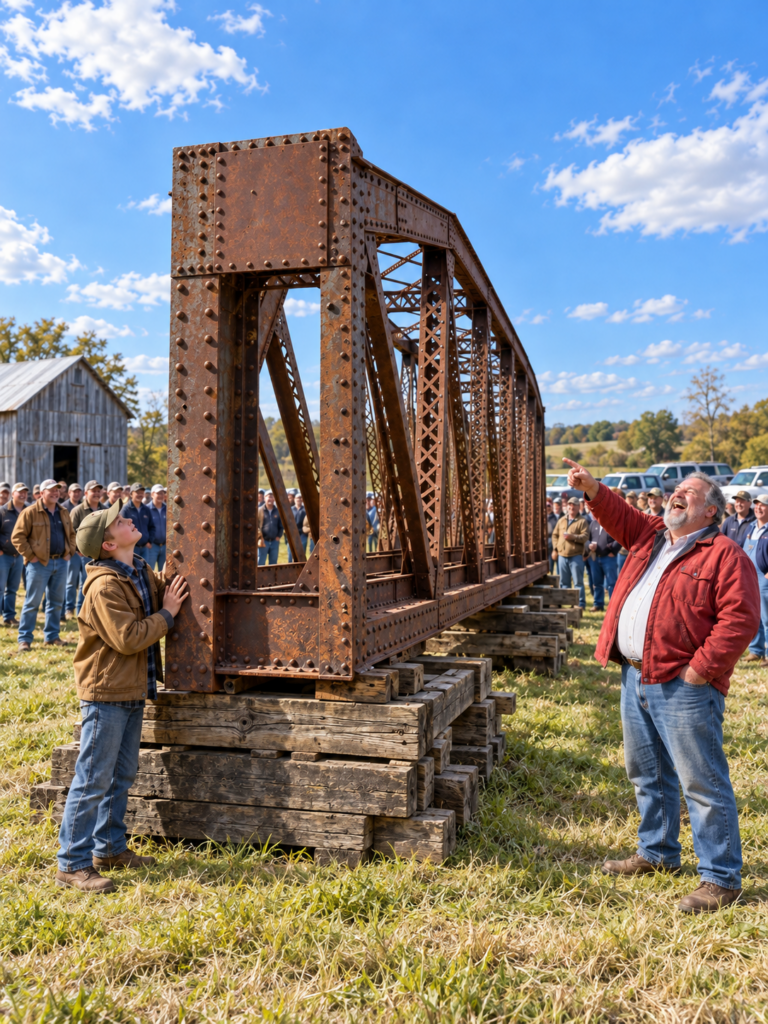
He stood beside his expensive pickup truck in the middle of a harvested hayfield, surrounded by farmers, equipment dealers, and neighbors who had gathered for the estate auction of the late Elmer Voss.
“Son, you can’t drive that thing, you can’t farm with it, and you sure can’t carry it home in your pockets!”
The crowd burst into laughter.
Some men slapped their knees. Others shook their heads. Even the auctioneer, a stout woman named Beverly Strand, struggled to hide a smile.
Standing alone beside an enormous rusted iron bridge was twelve-year-old Lyall Pennock.
His boots were worn through at the heels. His faded green cap had belonged to his father, who had died when Lyall was seven. His brown canvas jacket was two sizes too large.
And in his pocket were the last two dollars he owned.
He had just spent forty-five dollars buying a fifty-two-foot bridge weighing approximately twenty-two tons.
A bridge that nobody wanted.
A bridge that had been removed from Sallow Creek years earlier and left standing on timber supports at the edge of Elmer Voss’s pasture.
And a bridge that Dwayne Kittredge, the richest scrap dealer in Tamson County, had been planning to cut into pieces and sell by the ton.
Dwayne took another sip of coffee.
“You know what, boy? I’ll do you a favor.”
Lyall looked up.
“I’ve got a cutting torch right over there in my truck. I’ll cut that old patch off the top so you can see what kind of treasure you bought.”
He pointed toward a square iron plate riveted above the bridge’s northern entrance.
For nearly a century, nobody had touched it.
Lyall moved closer to the bridge.
“No, sir.”
Dwayne raised his eyebrows.
“What did you say?”
“I said nobody’s cutting anything.”
The laughter grew louder.
Dwayne spread his arms.
“Would you listen to that? He’s protecting the rust!”
But Lyall didn’t smile.
He placed one hand against the cold iron.
“My bridge stays exactly the way it is until somebody who understands its history comes to look at it.”
Dwayne stared at him.
Then he laughed again.
“History? Boy, that bridge was hauling cattle across a creek before your grandfather was born. The only history it’s got is that nobody wanted it anymore.”
Behind Lyall stood his grandfather, Hollis Pennock.
Hollis was seventy-three, thin as a fence rail, with a white mustache and hands roughened by decades of working on farms and driving a milk truck.
He wore a gray wool cap and an old coat with a missing button.
He had watched the entire auction without saying much.
Now Dwayne turned toward him.
“Hollis, you’re really going to let your grandson throw away his money like this?”
Hollis studied the bridge.
Then he looked at Lyall.
“Already did.”
Dwayne shook his head.
“Lord help us. You’ve both lost your minds.”
Hollis smiled faintly.
“Wouldn’t be the first time somebody thought that.”
The crowd began drifting toward the lunch stand.
But Dwayne remained.
He stepped close enough that only Lyall and Hollis could hear him.
“You’ve got thirty days to get this thing off the Voss property. You know that, don’t you?”
“Yes, sir.”
“And if you don’t?”
“It goes back to the estate.”
Dwayne nodded.
“Exactly. And when it does, I’ll be standing here with my cutting crew.”
He tapped the rusted iron.
“You just paid forty-five dollars to hold my place in line.”
Then he walked away, chuckling.
Lyall kept his hand on the bridge.
He waited until the man’s pickup disappeared down the gravel lane.
Only then did his shoulders sag.
“Grandpa?”
Hollis stepped beside him.
“Yes, son?”
“Did I make a mistake?”
The old man looked at the fifty-two feet of iron latticework stretching across the hayfield.
“Well,” he said slowly, “you’ve got twenty-nine days to figure out how to move twenty-two tons of iron.”
Lyall swallowed.
“That sounds bad.”
Hollis nodded.
“It certainly isn’t convenient.”
“Do you think I’m crazy?”
His grandfather looked down at him.
“Crazy is a separate question.”
For the first time that morning, Lyall smiled.
But when he looked back at the bridge, his smile faded.
Because what nobody in that crowd understood was that he hadn’t bought the bridge simply because it was cheap.
He had bought it because of a promise.
A promise made to a lonely old farmer three summers earlier.
And because somewhere beneath those two rusted iron plates was a name that had been hidden for almost a hundred years.
The Pennock home stood two miles south of Harlo, a small farming community surrounded by soybean fields, cattle pastures, and gravel roads.
It was a modest white farmhouse with a narrow front porch and a tin-roofed barn.
The property belonged to Hollis.
He had inherited it from his father and worked it for most of his adult life.
Once, it had supported a dairy herd of forty cows.
Now the barn was mostly empty.
The milking equipment had been sold years earlier.
The fencing needed repair.
The roof leaked near the western wall.
And the fields were rented to a neighboring farmer because Hollis’s knees no longer allowed him to do the work himself.
His daughter, Dina, lived with him.
She was thirty-eight and worked in the laboratory at Tamson County Hospital.
Her husband, Michael Pennock, had died in a highway accident five years earlier.
He had been driving home from a construction job when a tractor-trailer crossed the centerline during an ice storm.
Lyall remembered very little about the funeral.
He remembered the smell of wet coats inside the church.
He remembered his mother’s hand gripping his so tightly that his fingers hurt.
And he remembered his grandfather kneeling beside him afterward, saying, “Your daddy loved you more than anything in this world.”
Since then, Hollis had become the closest thing Lyall had to a father.
He taught him how to repair a bicycle.
How to sharpen a shovel.
How to read the weather by watching the clouds over the western ridge.
And how to stand by his word.
Every morning, Hollis rose before sunrise.
He made coffee in an old aluminum percolator and sat beside the kitchen window, watching the farm wake up.
Lyall often joined him.
Some mornings they spoke.
Other mornings they simply sat together.
It was a quiet life.
Not easy.
But steady.
Dina paid most of the household bills.
Hollis contributed his retirement income and whatever he earned from renting the fields.
They weren’t wealthy.
There were months when the refrigerator looked empty before payday.
The pickup needed new tires.
The kitchen floor had a soft spot beside the sink.
And Hollis sometimes pretended he wasn’t hungry so Lyall could have the last piece of chicken.
Lyall noticed things like that.
Children raised in households where money is scarce often learn to recognize sacrifices that adults think they have hidden.
He knew his mother worked overtime whenever possible.
He knew his grandfather wore the same winter coat year after year.
And he knew that forty-five dollars mattered.
That was why, when he handed nearly all his savings to the auction clerk, his stomach had twisted with fear.
He wasn’t a boy who wasted money.
He had spent three summers earning it.
And most of those summers had been spent working for Elmer Voss.
Elmer lived alone in a farmhouse along Sallow Creek.
He had been ninety-four when he died.
His wife had passed away seventeen years earlier.
His children had moved away long before that.
His closest remaining relative was a great-nephew named Grant, who lived in the city and visited only occasionally.
Elmer’s farm had become quiet.
The old cattle barn stood empty.
The windmill no longer turned.
And weeds grew through the gravel near the machine shed.
But Elmer still insisted on keeping his yard neat.
Every Saturday during the summer, Lyall rode his bicycle three miles to mow the lawn.
Elmer paid him ten dollars.
Then he gave him lemonade on the porch.
At first, Lyall stayed only because he felt it would be rude to leave immediately.
But the old farmer knew stories.
Stories about floods.
Hard winters.
Cattle drives.
The time lightning struck the barn.
The year corn sold for so little that his father burned some of it for heat.
And the old iron bridge.
That bridge had once crossed Sallow Creek at Puit’s Mill.
It had carried horses, wagons, cattle, early tractors, and generations of farm families.
According to Elmer, the county replaced it with a concrete crossing in 1931.
Rather than send the old bridge to the scrap yard, his father, August Voss, purchased it for one dollar.
Then August undertook the enormous task of moving it upstream.
He used greased logs, heavy chains, teams of horses, and a borrowed steam engine.
It took nearly a month.
But when he finished, the bridge connected the two sides of the Voss pasture.
For decades afterward, cattle crossed it every summer.
Lyall loved hearing that story.
One afternoon, he asked a question.
“Mr. Voss, why are those iron squares on top of the bridge?”
Elmer looked toward the creek.
“What squares?”
“The ones riveted above the entrances.”
The old man went quiet.
Then he leaned forward in his rocking chair.
“Come here, boy.”
Lyall moved closer.
“Every iron bridge built in those days had a name.”
“A name?”
“Who made it. When it was built. Sometimes who paid for it.”
“Like a license plate?”
Elmer smiled.
“Something like that.”
He looked toward the bridge.
“My father told me that men used to travel the back roads at night stealing those old cast-iron nameplates. Collectors would pay good money for them.”
Lyall listened.
“So Daddy covered ours.”
“With those patches?”
“That’s right. Riveted plain iron over both plates.”
“Why both?”
“One was the maker’s name. The other belonged to the county.”
Elmer lowered his voice.
“He told me a bridge without its name was just a pile of iron.”
Lyall looked toward the distant structure.
“Did anybody ever take the patches off?”
“Not that I know of.”
“What’s underneath?”
Elmer smiled.
“A piece of history, son.”
Then he reached out and touched Lyall’s shoulder.
“Promise me something.”
“What?”
“If anybody ever tries to cut those names off, don’t let them do it in the dark.”
Lyall frowned.
“Why would they?”
“Because men are sometimes careless with things they don’t understand.”
Elmer looked toward the creek.
“Someday, somebody might want that old bridge back.”
Lyall had been nine when he made the promise.
He had almost forgotten it.
Until Elmer died.
And the auction notice arrived.
That night after the sale, Dina sat at the kitchen table with the auction receipt in front of her.
“Forty-five dollars.”
Lyall stared at his hands.
“Yes, ma’am.”
“Your entire savings?”
“Almost.”
“How much do you have left?”
“Two dollars.”
Dina rubbed her forehead.
“Baby, where are you planning to put a twenty-two-ton bridge?”
Lyall glanced at Hollis.
His grandfather cleared his throat.
“North pasture’s mostly flat.”
Dina turned toward him.
“Daddy.”
“What?”
“You are not helping.”
Hollis took a sip of coffee.
“I haven’t said it was a good idea.”
“You drove him to the auction!”
“That’s true.”
“You let him bid!”
“Also true.”
“And now you’re suggesting we put a bridge in our pasture!”
Hollis considered that.
“Well, when you say it all together, it does sound a little unusual.”
Dina sighed.
Lyall lowered his head.
“I’m sorry, Mom.”
She looked at him.
Something in his voice softened her anger.
“Sweetheart, why did you do it?”
He hesitated.
“Because Mr. Voss told me something.”
He explained the story of the hidden nameplates.
The promise.
The bridge’s history.
The men who had laughed when he tried to protect it.
Dina listened quietly.
When he finished, she leaned back.
“Oh, honey.”
Lyall’s eyes filled.
“Everybody thinks I’m stupid.”
She reached across the table.
“Look at me.”
He raised his eyes.
“I don’t think you’re stupid.”
“But you’re mad.”
“I’m worried.”
“About the money?”
“About what happens if we can’t move that bridge.”
Lyall looked toward Hollis.
The old man had become very quiet.
Dina continued.
“You bought something enormous because you believed it mattered. I understand that.”
She squeezed his hand.
“But believing something matters doesn’t make the practical problems disappear.”
“I know.”
“We have thirty days.”
“I know.”
“And moving it could cost thousands.”
Lyall swallowed.
“I know.”
Dina brushed the hair away from his forehead.
“Then tomorrow we start figuring out what can actually be done.”
Hollis nodded.
“That’s a plan.”
Dina looked at him.
“And Daddy?”
“Yes?”
“No more buying bridges.”
Hollis raised both hands.
“Wasn’t planning on it.”
For the first time that evening, they all laughed.
But later, after Lyall had gone upstairs, Dina remained at the kitchen table.
The receipt lay beside her coffee mug.
Forty-five dollars.
A boy’s entire summer savings.
She picked it up.
Then she looked toward the darkened stairs.
“Daddy,” she said quietly, “what if we can’t help him?”
Hollis stared out the window.
“Then he’ll learn something hard.”
Dina closed her eyes.
“I think he’s learned enough hard things already.”
The older man nodded.
For a long time, neither spoke.
Then Hollis folded his hands.
“I made that boy a promise after Michael died.”
Dina looked at him.
“What promise?”
“That I wouldn’t teach him to be afraid of trying.”
His voice grew quiet.
“I’ve got to keep that one, even when trying looks foolish.”
Outside, wind moved through the bare branches beside the barn.
And somewhere three miles away, twenty-two tons of rusted iron waited in a hayfield.
Part 2
The first estimate came Monday morning.
Four thousand dollars.
That was what a heavy-hauling company in the county seat wanted to transport the bridge two miles.
And they couldn’t schedule the job for another six weeks.
Hollis thanked the dispatcher and hung up.
Lyall sat across from him at the kitchen table.
“How much?”
Hollis hesitated.
“More than we have.”
“How much more?”
“Quite a bit.”
Lyall looked down.
“What about a crane?”
Hollis shook his head.
“Even more expensive.”
“Could we use somebody’s tractor?”
“Not safely.”
“What about cutting it into sections and putting it back together?”
His grandfather looked at him.
“That would defeat the whole reason you bought it.”
Lyall nodded.
He opened his spiral notebook.
At the top of a fresh page, he wrote:
WAYS TO MOVE THE BRIDGE.
Underneath, he recorded the company’s name and the price.
Then he drew a line through it.
Over the next three days, Hollis made more calls.
A construction contractor.
A grain elevator.
Two trucking companies.
A crane operator in the next county.
A man who moved grain bins.
A farmer with a heavy equipment trailer.
By Wednesday afternoon, the notebook contained nine possibilities.
All crossed out.
Lyall sat on the porch steps staring at the list.
Twenty-six days remained.
Hollis came outside carrying two glasses of iced tea.
He handed one to Lyall.
“Running out of ideas?”
“Yes, sir.”
“Good.”
Lyall frowned.
“Good?”
“Means you’ve tried enough of the obvious ones.”
He lowered himself carefully into the porch chair.
“Now we start thinking about people instead of equipment.”
Lyall looked up.
“What do you mean?”
“Sometimes a man has what you need. Sometimes he knows somebody who does.”
Hollis stared across the road toward the fields.
Then his expression changed.
“Marcus Blythe.”
“Who’s that?”
“Runs a towing and rigging outfit south of town.”
“Can he move a bridge?”
“Don’t know.”
“Does he have a big truck?”
“Two of them.”
“Would he charge four thousand dollars?”
Hollis smiled.
“Let’s ask.”
Marcus Blythe arrived Thursday morning.
He was forty-six, broad across the shoulders, with a gray beard and hands marked by years of handling steel cable.
His company owned two heavy wreckers, a lowboy trailer, hydraulic jacks, and a collection of rigging equipment.
He knew Hollis well.
Twenty years earlier, during a January blizzard, Hollis had found Marcus’s father injured beside an overturned truck.
The old milk driver had pulled him out of a ditch, wrapped him in blankets, and driven him to the hospital.
Marcus’s father had survived.
Every Christmas afterward, Marcus sent Hollis a card.
Now he stood beside the bridge in Elmer Voss’s hayfield, staring up at its rusted latticework.
“You really bought this thing?”
Lyall nodded.
“Yes, sir.”
“For forty-five dollars?”
“Yes.”
Marcus walked along the bridge.
He examined the timber supports.
Measured the width.
Checked the lower members.
Then crouched beneath one end.
For several minutes, he said nothing.
Finally, he straightened.
“Twenty-two tons, give or take.”
Hollis nodded.
“That’s what the auction notice said.”
Marcus scratched his beard.
“It’s old riveted iron. But the main members look sound enough for a carefully planned lift.”
Lyall stepped forward.
“Can you move it?”
Marcus looked at him.
“Probably.”
Lyall’s heart jumped.
“How much?”
Marcus glanced toward Hollis.
The old man waited.
Finally, Marcus said, “Diesel.”
Lyall blinked.
“Diesel?”
“Enough to cover the fuel.”
Hollis shook his head.
“Marcus, that’s too generous.”
The younger man looked at him.
“Your old milk truck ever charge my father for that ride to the hospital?”
Hollis said nothing.
Marcus smiled.
“Then let’s call it even.”
Lyall stared at him.
“You’d really do that?”
Marcus nodded.
“But I want one thing.”
“What?”
“When somebody finally opens those iron patches, I want to be there.”
Lyall grinned.
“Yes, sir!”
Marcus pointed toward the bridge.
“And nobody touches this thing until we move it safely. Understand?”
“Yes, sir.”
“Good.”
For the first time since the auction, the bridge seemed possible.
But there was still one obstacle.
And it would prove more difficult than twenty-two tons of iron.
A load that size required an oversize transport permit.
Marcus submitted the application Friday morning.
He expected approval within a few business days.
Instead, Monday passed.
Then Tuesday.
Then Wednesday.
No permit.
When Marcus called the county office, the clerk sounded uncomfortable.
“The application has been sent for additional review.”
“Review by whom?”
“The road board.”
Marcus frowned.
“Why?”
“I don’t know, sir.”
He hung up and called Hollis.
By the following week, nothing had changed.
The deadline drew closer.
Nineteen days.
Seventeen.
Fifteen.
Every afternoon after school, Lyall rode his bicycle to the Voss property.
He walked around the bridge.
Checked the iron patches.
Counted the rivets.
Sometimes he rested his forehead against the cold metal and whispered, “Just a little longer.”
He knew it was foolish to talk to a bridge.
But his father’s death had taught him that sometimes people speak to things that cannot answer.
An empty chair.
An old photograph.
A coat hanging behind a door.
The bridge had belonged to Elmer.
It carried a promise.
And Lyall was afraid of failing him.
One Thursday afternoon, he noticed something strange.
A bright orange line had been sprayed on the timber supports beneath the northern end.
Another appeared near the center.
Lyall had seen similar markings at salvage yards.
He took photographs with his mother’s old phone.
Then he rode home.
Hollis studied the pictures.
“Somebody’s planning where to cut.”
Lyall’s stomach tightened.
“Dwayne?”
His grandfather didn’t answer immediately.
“Could be.”
“Can he do that?”
“Not while it’s yours and the removal deadline hasn’t passed.”
Lyall looked toward the road.
“What if he does anyway?”
Hollis folded his arms.
“Then we’ll have a different kind of problem.”
At the Harlo Feed and Seed, Dwayne Kittredge had turned the bridge into his favorite joke.
Every morning, he sat at the coffee counter with several local farmers.
He wore the same red jacket with KITTREDGE METAL RECOVERY stitched across the back.
When Hollis entered, Dwayne called out.
“Well, if it isn’t the grandfather of the county’s youngest bridge engineer!”
The men laughed.
Hollis continued toward the shelves.
“Morning, Dwayne.”
“Got that bridge moved yet?”
“Working on it.”
“Want me to bring the torch?”
“No, thanks.”
Dwayne grinned.
“Offer still stands.”
A week later, the offer changed.
“Tell the boy I’ll give him two hundred dollars for it.”
Hollis looked at him.
“That’s generous.”
“I’m feeling generous.”
“It’s not for sale.”
Dwayne chuckled.
Three days later, he offered three hundred.
Then five hundred.
Cash.
On the counter.
The coffee men stopped laughing quite so loudly.
One of them, a retired farmer named Earl Maddox, glanced at the bills.
“That’s a lot of money for scrap you said wasn’t worth hauling.”
Dwayne gave him a hard look.
“Scrap’s my business, Earl.”
“Sure is.”
“And I know what iron’s worth.”
Earl took a slow sip of coffee.
“Then maybe the boy knows something too.”
Dwayne’s smile vanished.
Hollis paid for his fence staples and walked out.
But as he reached the door, Dwayne called after him.
“Thirteen days, Hollis!”
The old man stopped.
“That’s all you’ve got!”
Hollis turned.
“Then I reckon we’d better use them wisely.”
That evening, Lyall found his mother sitting at the kitchen table with a stack of bills.
The refrigerator hummed.
Rain tapped against the windows.
Dina had just returned from a twelve-hour shift at the hospital.
She looked exhausted.
Lyall sat across from her.
“Mom?”
“Yes, baby?”
“Could we pay somebody to move the bridge?”
She looked at him.
“With what money?”
He stared at his hands.
“I don’t know.”
Dina sighed.
“I’m sorry. That sounded harsh.”
“It’s okay.”
She pushed the bills aside.
“Come here.”
He moved closer.
She wrapped an arm around him.
“Do you know why I’m worried?”
“Because of the bridge.”
“Because I don’t want you hurt.”
Lyall looked down.
“Everybody already thinks I’m stupid.”
“Everybody?”
“Most people.”
Dina shook her head.
“No, sweetheart. The loudest people aren’t always everybody.”
He leaned against her.
“Dad would’ve known what to do.”
Dina’s expression changed.
For a moment, she looked toward the framed photograph above the mantel.
Michael Pennock stood beside an old pickup, smiling with his arm around a much younger Dina.
“Yes,” she whispered. “He probably would’ve had some ridiculous plan.”
Lyall smiled faintly.
“He liked fixing things.”
“He did.”
“Even things nobody else wanted.”
Dina laughed softly.
“He brought home a broken riding mower once because the man at the dump said it couldn’t be repaired.”
“Did he fix it?”
“Of course.”
She brushed his hair back.
“Your father had more stubbornness than good sense sometimes.”
Lyall looked at her.
“Am I like him?”
Dina’s eyes filled.
“More every day.”
They sat quietly.
Then Lyall spoke.
“Mom, I don’t want to give up.”
She kissed his forehead.
“Then don’t.”
The next morning, Lyall rode his bicycle into Harlo.
He went straight to the county administration building.
The receptionist looked surprised when a twelve-year-old boy entered carrying a folder of photographs.
“Can I help you?”
“I need to speak to the county engineer.”
“Do you have an appointment?”
“No, ma’am.”
“What’s this about?”
“A bridge.”
She looked at him.
“A bridge?”
“Yes, ma’am. One I bought.”
The woman blinked.
Then she picked up the telephone.
Twenty minutes later, Lyall sat across from Patrice Lindgren.
Patrice was a tall woman in her fifties with tired eyes and reading glasses hanging from a cord around her neck.
She had spent sixteen years overseeing roads and bridges in Tamson County.
When Lyall explained the situation, she listened without interrupting.
Then she opened the permit application.
Read it once.
Then again.
Her expression tightened.
“Who told your hauling contractor this needed road board review?”
“The clerk did.”
Patrice looked toward the window.
“That’s unusual.”
Lyall swallowed.
“Does that mean we can’t move it?”
She shook her head.
“No.”
She examined the route plan.
The load dimensions.
The escort arrangements.
The proposed travel time.
Everything was in order.
Patrice leaned back.
“This should have been approved more than a week ago.”
Lyall felt his heart pounding.
“Can you approve it?”
She looked at him.
“That’s my job.”
She signed the form.
Stamped it.
Printed a copy.
Then handed it across the desk.
“There you are.”
Lyall stared at the paper.
“That’s it?”
“That’s it.”
He looked up.
“Thank you, ma’am.”
Patrice smiled.
“Go move your bridge.”
Lyall hurried out of the office.
He didn’t stop running until he reached his bicycle.
Then he pulled out his phone and called his grandfather.
“Grandpa!”
Hollis answered on the third ring.
“Everything all right?”
“We got it!”
“Got what?”
“The permit!”
There was silence.
Then Hollis laughed.
“Well, I’ll be.”
Lyall grinned so hard his cheeks hurt.
For the first time in nearly three weeks, he believed they might actually succeed.
Part 3
The bridge moved on a cold Saturday morning with nine days remaining before the removal deadline.
Marcus arrived before sunrise.
His winch truck rumbled down the gravel lane carrying chains, timber blocking, hydraulic jacks, and steel lifting equipment.
Behind him came the lowboy trailer.
Two of his nephews followed in a service truck.
Hollis and Lyall waited beside the bridge.
The grass was white with frost.
Their breath rose in pale clouds.
Marcus climbed from his truck and examined the supports one final time.
“Everybody listens to me today,” he said.
His nephews nodded.
Then he looked at Lyall.
“You too.”
“Yes, sir.”
“No crawling under anything. No touching chains. No standing near the load.”
“Yes, sir.”
“You’re watching.”
Lyall looked disappointed.
Marcus crouched slightly.
“Watching is important work. Especially when you’re learning.”
Hollis placed a hand on his grandson’s shoulder.
“You heard the man.”
The work began slowly.
The crew positioned hydraulic jacks beneath reinforced points.
They lifted one end of the bridge a fraction of an inch.
Inserted timber blocking.
Checked the load.
Then repeated the process.
The old structure groaned.
Its iron members creaked as weight shifted from the original supports.
Lyall held his breath.
Marcus moved carefully.
He understood what the bridge meant to the boy.
And he understood that one mistake could destroy it.
By midmorning, the lowboy had been positioned beneath the structure.
Heavy chains secured the bridge.
The winch tightened.
Twenty-two tons of nineteenth-century iron shifted onto the trailer.
For a moment, the entire load seemed to sway.
Lyall gripped his grandfather’s hand.
Then the bridge settled.
Marcus stepped back.
Wiped his forehead.
And smiled.
“She’s aboard.”
Lyall let out a breath.
Hollis squeezed his shoulder.
“First hard part’s done.”
They moved at walking speed.
The truck carried the bridge along Sallow Creek Road, orange flags marking its corners.
Hollis followed in his old green Ford pickup.
Lyall sat beside him.
He stared through the windshield at the enormous iron structure rolling ahead.
It looked impossible.
A bridge traveling down a county road.
Past mailboxes.
Barns.
Fields.
And farmhouses.
Halfway to Hollis’s property, a white pickup appeared from the opposite direction.
It slowed.
Then stopped.
Dwayne Kittredge leaned out the window.
His red jacket caught the sunlight.
He stared at the bridge.
Then at the permit displayed inside Marcus’s windshield.
For once, he seemed genuinely surprised.
But only for a moment.
“Well, look at that!” he shouted.
“The bridge to nowhere!”
He laughed and sounded his horn.
Marcus kept driving.
Hollis said nothing.
Lyall watched the white pickup disappear in the side mirror.
Then he turned toward his grandfather.
“He’s still laughing.”
Hollis nodded.
“Sure is.”
“Doesn’t it bother you?”
The old man kept his eyes on the road.
“Used to.”
“What changed?”
Hollis smiled.
“I got old enough to understand that some folks laugh because they don’t want anybody else to notice they’re worried.”
Lyall thought about that.
“Worried about what?”
“Being wrong.”
By noon, the bridge stood on new timber supports in Hollis’s north pasture.
The structure stretched across the open grass, with a row of cedar trees behind it.
Its rusted latticework cast long shadows.
The two iron patches remained attached above the entrances.
Every rivet was still in place.
Lyall walked around it slowly.
Then he stopped beneath the northern portal.
For the first time, he could stand beneath the bridge without worrying that somebody might come to cut it apart.
Marcus came over.
“Well?”
Lyall looked up.
“It’s perfect.”
Marcus laughed.
“Most people wouldn’t use that word.”
Lyall smiled.
“I know.”
Hollis approached carrying a coffee can.
Inside was money he had quietly set aside for emergencies.
He handed Marcus enough to cover the fuel and offered more.
Marcus waved away the extra.
“You’ve already paid me.”
Hollis frowned.
“What do you mean?”
Marcus looked at him.
“Twenty years ago, you stopped your milk truck in a snowstorm and saved my father’s life.”
Hollis lowered his eyes.
“Anybody would’ve done that.”
Marcus shook his head.
“Not everybody did.”
The two men shook hands.
Lyall watched them.
He had heard the story before.
But now he understood something he hadn’t understood as a child.
His grandfather had spent a lifetime helping people without expecting repayment.
And sometimes, years later, those small acts of decency came home.
That evening, the Pennocks ate supper together.
Dina had made roast chicken and potatoes.
Lyall could barely sit still.
“The bridge is in the pasture!”
“I know,” she said, laughing. “I’ve looked at it three times already.”
“It didn’t break!”
“I know.”
“And the patches are still there!”
“I saw.”
Hollis took a piece of bread.
“Boy’s going to talk about bridges until Christmas.”
Dina smiled.
“Probably longer.”
But after supper, when Lyall went upstairs, she turned toward her father.
“Daddy?”
“Yes?”
“How much did you pay Marcus?”
Hollis looked at his plate.
“Not much.”
“How much?”
“Enough.”
She sighed.
“Daddy.”
He looked up.
“I used some money I’d been saving.”
“For what?”
He hesitated.
“Truck repairs.”
Dina closed her eyes.
“You need that truck.”
“I know.”
“And the transmission’s been slipping.”
“I know that too.”
“Then why?”
Hollis looked toward the window.
The bridge stood dark against the stars.
“Because Michael would’ve helped that boy move it.”
Dina became very still.
Her father continued.
“And because every time Lyall looks at something broken, he sees a reason to fix it.”
He swallowed.
“That’s his daddy coming through.”
Dina wiped her eyes.
Hollis looked down.
“I miss him too, sweetheart.”
Neither spoke for a while.
Then Dina reached across the table and took her father’s hand.
With the bridge safely moved, Lyall began searching for its history.
He returned to Harlo Public Library.
The building was small, with wooden shelves, faded carpet, and a narrow basement archive.
The librarian, Agnes Torvik, was seventy years old.
She had short silver hair and wore knitted cardigans in every season.
When Lyall explained what he wanted, she listened carefully.
“You want to know who built the bridge?”
“Yes, ma’am.”
“And when?”
“Yes.”
“And whether the plates under those iron patches still have the original names?”
Lyall nodded.
Agnes smiled.
“Well, that’s a proper mystery.”
She took a set of keys from behind the counter.
“Come downstairs.”
The basement smelled of paper, dust, and old glue.
Heavy ledgers lined metal shelves.
Boxes of county documents were stacked against the walls.
Agnes explained that the county commissioners had preserved meeting minutes dating back to the 1850s.
Some had been copied onto microfilm.
Others still existed only as handwritten records.
They began with 1931.
The year Elmer’s father had purchased the bridge.
After several hours, Agnes found the entry.
The county had authorized the sale of the old iron span at Puit’s Mill to August Voss for one dollar.
The buyer was responsible for removing the structure within ninety days.
Lyall copied the wording into his notebook.
“That’s exactly what Mr. Voss told me.”
Agnes nodded.
“Then he remembered correctly.”
They searched backward.
1920.
1900.
1880.
The records grew older.
The handwriting became harder to read.
Some pages had water stains.
Others had torn corners.
On the third afternoon, Agnes opened a ledger from 1869.
She read several entries.
Then stopped.
Her fingers rested on the page.
“Lyall.”
He looked up.
“What?”
“Come here.”
He moved beside her.
The entry authorized construction of a wrought-iron lattice bridge over Sallow Creek at Puit’s Mill.
The contractor was listed as the Ashworth Iron Bridge Company of Elmira, New York.
The length was fifty-two feet.
The cost was four thousand one hundred dollars.
Lyall stared.
“Fifty-two feet.”
Agnes nodded.
“Exactly.”
“That’s my bridge.”
“It certainly appears to be.”
He looked at the date.
“1869.”
Agnes leaned back.
“Lyall, that means your bridge was already more than sixty years old when August Voss bought it.”
Lyall felt a strange chill.
“And now it’s over a hundred and fifty.”
“Yes.”
“Is that old for a bridge?”
Agnes looked at him.
“Very old.”
She returned to the ledger.
“And if this record is correct, it may have been the first iron bridge ever built in Tamson County.”
Lyall swallowed.
“Does that make it important?”
Agnes looked toward the shelves.
“Historically? Absolutely.”
“Worth money?”
She smiled gently.
“That I cannot tell you.”
Then she closed the ledger.
“But I know somebody who might.”
Dr. Ruth Halverson was a professor of historic engineering at the state university.
She specialized in nineteenth-century bridges.
Agnes explained that Ruth maintained a research database documenting surviving iron spans.
Some had been restored.
Others had been dismantled.
Many had disappeared entirely.
Lyall wrote her a letter.
He described the auction.
The bridge.
The hidden plates.
The county records.
And Elmer Voss’s story about his father protecting the maker’s name.
He included photographs.
He also copied the 1869 contract entry.
He did not mention Dwayne.
His mother had told him that a serious research letter was no place for complaints about a rude neighbor.
Agnes mailed it.
Then they waited.
Eight days later, the telephone rang during supper.
Dina answered.
She listened for a moment.
Then looked toward Lyall.
“It’s for you.”
“Who?”
“A professor.”
Lyall jumped from his chair.
He took the telephone.
“Hello?”
“May I speak with Lyall Pennock?”
“This is him.”
“Hello, Lyall. My name is Ruth Halverson.”
“Yes, ma’am.”
“I received your letter.”
Lyall gripped the receiver.
“Did you read it?”
Ruth laughed softly.
“Several times.”
She asked him to describe the bridge’s structure.
The lattice arrangement.
The upper chords.
The rivets.
The portal shape.
Lyall answered everything he could.
When he wasn’t sure, he said so.
Finally, Ruth asked whether he could send more detailed photographs.
“I can,” he said.
“Good. Because I have a file on that bridge.”
Lyall went still.
“You do?”
“Yes.”
“What does it say?”
There was a pause.
“It says the bridge was built in 1869, removed from service in 1931, and presumed scrapped.”
Lyall stared at the wall.
“But it wasn’t.”
“No,” Ruth said quietly. “Apparently it wasn’t.”
He swallowed.
“Is that good?”
“It could be very important.”
“How important?”
Ruth took a breath.
“According to our records, no complete Ashworth Iron Bridge Company structures are known to survive.”
Lyall looked toward the kitchen window.
His grandfather was watching him.
“Not one?”
“Not one.”
For several seconds, Lyall couldn’t speak.
Then Ruth continued.
“But we must verify what you have. The maker’s plate would be critical.”
Lyall nodded.
“It’s under the patch.”
“Maybe.”
“I think it is.”
“Then I need you to promise me something.”
“Yes, ma’am?”
“Don’t remove those patches.”
“I won’t.”
“Don’t let anybody use a cutting torch. Don’t let anyone pry at them.”
“I won’t.”
“If the plates are there, we need to document them carefully and remove the protective coverings using proper conservation methods.”
Lyall looked toward his grandfather.
“How long?”
“About six weeks before I can arrange a visit.”
Six weeks.
It felt like forever.
But the bridge was safe now.
He had already waited nearly a month.
“Yes, ma’am.”
“Can you do that?”
Lyall smiled.
“I’ve had practice.”
For the next six weeks, life in the Pennock household settled into an uneasy routine.
Lyall went to school.
Dina worked at the hospital.
Hollis repaired fences, fed the few remaining animals, and struggled with the aging transmission in his Ford pickup.
Every afternoon, Lyall walked to the north pasture.
He checked the bridge.
He photographed the iron patches.
He brushed weeds away from the supports.
Sometimes he sat beneath the latticework and imagined the thousands of people who had crossed it.
Farmers hauling corn.
Children riding in wagons.
Young couples traveling to church.
Soldiers returning home.
Families leaving for new lives.
He wondered whether his own great-grandparents might have crossed it.
He wondered whether Michael had ever driven over it before the county removed it.
He wondered how many people had passed beneath the hidden nameplates without knowing they were there.
The bridge became more than an object.
It became a connection to people who were gone.
To Elmer.
To August Voss.
To the men who built it.
And to his own father, who had always believed that old things deserved a second chance.
But somebody else was watching the bridge too.
One gray Tuesday afternoon, Lyall noticed fresh scratches around two rivets on the southern patch.
The marks were bright against the rust.
Someone had tried to loosen the metal.
He hurried home.
Hollis came back with him.
The old man examined the scratches without speaking.
Then he straightened.
“Somebody’s been here.”
Lyall felt sick.
“Do you think they were trying to steal the plate?”
“Maybe.”
“Could they come back?”
Hollis looked toward the road.
“Maybe.”
“What do we do?”
His grandfather rested a hand on his shoulder.
“We take pictures. We tell the sheriff. And we make sure nobody gets another chance.”
That evening, Hollis parked his Ford beside the bridge.
He brought a thermos of coffee, a blanket, and an old battery-powered radio.
He stayed until ten.
The next evening, he did the same.
And the next.
His knees ached.
The cold settled into his hands.
But every night, he sat there watching the bridge.
Lyall worried.
“Grandpa, you shouldn’t be out here.”
Hollis smiled.
“Used to deliver milk in weather worse than this.”
“But you’re tired.”
“I’m old, son. That’s not quite the same thing.”
Lyall sat beside him for a while.
The radio played softly.
Wind moved through the cedar trees.
Finally, Lyall asked, “Why are you doing all this for me?”
Hollis looked at him.
“Because you’re my grandson.”
“That’s not enough reason to sit in a cold truck every night.”
The old man was silent for a moment.
Then he said, “Your daddy would’ve done it.”
Lyall looked down.
“I miss him.”
Hollis swallowed.
“So do I.”
The boy leaned against his grandfather.
And the two sat together beneath the dark silhouette of the old bridge.
Neither spoke again for a long time.
Part 4
The invitations went out the following Monday.
Lyall wrote each one by hand.
He invited Beverly Strand, the auctioneer.
Grant Voss, who had inherited and sold Elmer’s estate.
Agnes Torvik, the librarian.
Marcus Blythe.
Patrice Lindgren, the county engineer.
Jodie Fenwick, a reporter for the Harlo Ledger.
And, of course, his mother and grandfather.
There was one final invitation.
Dwayne Kittredge.
Dina watched Lyall address the envelope.
“Are you certain you want him there?”
“Yes, Mom.”
“After everything he said?”
Lyall nodded.
“He told me he’d like to meet somebody who knows about bridges.”
Dina studied him.
“And?”
“Dr. Halverson is coming.”
His mother smiled despite herself.
“So you want to introduce them.”
“Yes, ma’am.”
She leaned back.
“Just remember something, sweetheart. You don’t have to humiliate somebody because they humiliated you.”
Lyall looked at her.
“I know.”
“Then why invite him?”
He thought about the question.
“Because he said the bridge was garbage.”
Dina waited.
“And I want him to see why Mr. Voss cared about it.”
Dwayne received the invitation at the feed-and-seed store.
He read it aloud to the coffee men.
“Saturday, ten o’clock. Hollis Pennock’s north pasture. Dr. Ruth Halverson will examine the old iron bridge.”
He laughed.
“Listen to this. A real professor!”
Earl Maddox looked up.
“She’s coming all the way from the university?”
“Apparently.”
“Must be something worth looking at.”
Dwayne waved the paper.
“Academics love old junk.”
Lyall stood quietly beside the counter.
Dwayne looked down at him.
“Witnesses, too? What is this, a moon landing?”
Lyall said nothing.
Dwayne smirked.
“Well, boy, I promised I’d meet your expert.”
He folded the invitation.
“I’ll be there.”
Lyall nodded.
“Thank you, sir.”
As he turned to leave, Dwayne called after him.
“Want me to bring my torch?”
Lyall stopped.
Then turned back.
“No, sir.”
The coffee men waited.
“Dr. Halverson is bringing somebody who knows how to remove the patches without damaging what’s underneath.”
For the first time, Dwayne’s grin faltered.
Only slightly.
But Lyall saw it.
He walked out without another word.
Saturday arrived bright, cold, and cloudless.
Frost covered the grass.
The cedar trees cast long shadows across the north pasture.
The bridge stood on its timber supports, silent and rust-red beneath the October sun.
Marcus arrived early to help arrange the area.
The Lutheran church had loaned folding chairs.
Beverly Strand brought doughnuts.
Agnes arrived carrying copies of the county records.
Jodie Fenwick came with a camera and notebook.
Grant Voss drove three hours from the city.
He stood near the back, looking uncomfortable.
Lyall wondered whether Grant regretted selling the bridge.
But the man approached him before the examination began.
“My great-uncle talked about that thing constantly.”
Lyall nodded.
“I know.”
“He told me it mattered. But I never understood why.”
Lyall looked toward the bridge.
“Maybe today we’ll find out.”
Grant sighed.
“I hope so.”
At quarter to ten, a dusty university vehicle turned into the driveway.
Dr. Ruth Halverson stepped out.
She was a small woman in her sixties, with short gray hair and a heavy canvas field coat.
With her came Neil Brea, a conservator from the state historical museum, and Calvin Oakes, a representative from the state transportation department.
Ruth walked directly toward the bridge.
She stopped beneath the northern portal.
Then placed one hand against the cold iron.
For a long moment, she said nothing.
Finally, she looked toward Lyall.
“You’re the young man who found this?”
“Yes, ma’am.”
She smiled.
“Well, let’s see what you’ve saved.”
The examination began with photographs.
Neil documented each rivet.
Each seam.
Each section of the protective iron patch.
Ruth compared the lattice construction to historical drawings.
Calvin examined the bridge’s main members and recorded measurements.
Lyall stood beside Hollis.
He wore safety glasses Marcus had given him.
His hands were clenched inside his jacket pockets.
At ten-thirty, Ruth turned toward the gathered crowd.
“Before we remove anything, I want everyone to understand why this structure matters.”
The audience grew quiet.
“This bridge appears to match the specifications of a span manufactured by the Ashworth Iron Bridge Company in 1869.”
She gestured toward the latticework.
“Very few examples of this early construction method survive.”
She looked toward Neil.
“If the original identification plates remain beneath these coverings, they may establish the bridge’s identity beyond reasonable doubt.”
Dwayne sat at the end of the second row.
His red jacket was unmistakable.
He crossed his arms.
Ruth continued.
“We will remove the protective patches carefully. The goal is to preserve both the underlying plates and the coverings themselves.”
Neil climbed an orchard ladder.
Marcus steadied it.
The first drill bit touched a rivet head.
A sharp metallic sound echoed across the pasture.
Lyall held his breath.
One rivet.
Then another.
Then another.
Fourteen in all.
The work was slow.
Neil frequently stopped to inspect the metal and adjust his tools.
Nobody complained.
Even Dwayne remained quiet.
At last, the final rivet head was removed.
Neil eased a flat bar beneath the edge of the patch.
Marcus reached up to support its weight.
The iron plate shifted.
For the first time in nearly a century, daylight touched the metal beneath.
Neil lowered the protective patch carefully.
And there, above the bridge entrance, was a cast-iron nameplate.
Its raised letters were still clearly visible.
ASHWORTH IRON BRIDGE COMPANY.
ELMIRA, NEW YORK.
1869.
For several seconds, nobody moved.
Then Ruth made a small sound.
Almost a laugh.
She climbed the ladder after Neil descended.
She ran her fingers carefully across the raised lettering.
Her eyes filled.
“I’ve seen this mark before,” she whispered.
Lyall stared up at her.
“In photographs.”
She turned toward the crowd.
“Two photographs. Both showing bridges that were dismantled before I was born.”
She looked at Lyall.
“This is extraordinary.”
He swallowed.
“Is it really an Ashworth?”
Ruth nodded.
“Yes, Lyall.”
She stepped down.
“And as far as our documented records show, this is the only surviving complete bridge built by that company.”
A murmur swept through the audience.
Agnes covered her mouth.
Beverly Strand stared at the nameplate.
Grant Voss lowered his head.
Hollis rested a hand on Lyall’s shoulder.
The boy looked up at his grandfather.
“Mr. Voss was right.”
Hollis smiled.
“Looks that way.”
Dwayne shifted in his chair.
Then spoke loudly.
“Well, do the other end too.”
Several people turned.
He gave a thin smile.
“Maybe there’s something even more interesting under that patch.”
Ruth nodded.
“We intend to.”
The second patch required another fourteen rivets to be carefully drilled.
Two showed fresh damage consistent with someone having attempted to pry or chisel them loose.
Neil photographed the marks.
Lyall noticed his grandfather glance briefly toward Dwayne.
But Hollis said nothing.
When the second patch came away, another iron plate emerged.
Smaller.
Older-looking.
Its lettering identified the county commissioners who had authorized construction.
At the bottom were three names.
Amos Pruitt.
Henry Dahl.
Josiah Kittredge.
For a moment, Ruth simply read the names aloud.
Then Beverly Strand turned toward Dwayne.
“Dwayne.”
He looked at her.
“That’s your family.”
Dwayne frowned.
“What?”
She pointed toward the plate.
“Josiah Kittredge.”
The color drained from his face.
His great-great-grandfather had served as a county commissioner in the nineteenth century.
His name had been preserved in iron for more than a century.
And Dwayne had spent weeks threatening to cut the bridge apart.
He stood slowly.
Walked closer.
Then stared up at the plate.
For the first time anyone in Harlo could remember, Dwayne Kittredge had nothing to say.
Calvin Oakes opened his folder.
Inside were documents related to a proposed recreational trail along Sallow Creek.
The state transportation department had been working with local authorities to develop a walking and cycling route connecting several historic sites.
One section required a bridge crossing near the old Puit’s Mill location.
For two years, planners had considered purchasing a historic iron span from another county.
Now Calvin looked at the structure standing in Hollis Pennock’s pasture.
Then at Ruth.
“Would it be possible to restore this bridge for pedestrian use?”
Ruth considered the question.
“Subject to a full engineering assessment, yes.”
Calvin nodded.
“That’s what I was hoping.”
He turned toward Lyall and Hollis.
“I’d like to speak with your family about the possibility of purchasing this bridge.”
Lyall blinked.
“Purchasing it?”
“Yes.”
“For the trail?”
“Exactly.”
Lyall looked toward the structure.
“But would it go back over the creek?”
Calvin smiled.
“As close as possible to its original location.”
Lyall’s heart began pounding.
The bridge had stood across Sallow Creek for generations.
Then had spent decades carrying cattle.
Now it might return to the place where it belonged.
He looked toward his grandfather.
Hollis nodded slowly.
But before anything could be decided, Neil Brea stepped forward.
He had been reviewing his notes.
And he was ready to explain just how extraordinary Lyall’s discovery had become.
Part 5
Neil Brea stood beneath the old iron bridge with his notebook open.
The October sunlight illuminated the maker’s plate above him.
He looked toward Ruth Halverson.
Then toward Calvin Oakes.
Finally, he faced Lyall Pennock.
“Young man, I’ve spent more than thirty years working with historic iron structures.”
Lyall stood beside his grandfather.
“Yes, sir.”
“I’ve examined railroad bridges, early highway trusses, industrial structures, and decorative ironwork dating back to the nineteenth century.”
He paused.
“Some were valuable because of their age. Others because of their construction. A few because they were the last surviving examples of their kind.”
He turned toward the bridge.
“What you have here combines all three.”
The crowd grew silent.
Neil continued.
“This is an intact, documented, 1869 wrought-iron lattice bridge. It appears to be the only complete surviving example from its manufacturer.”
He gestured toward the nameplates.
“Both original identification plates remain in place. Its history can be traced through county records, photographs, and the Voss family.”
He closed his notebook.
“For insurance and heritage valuation purposes, I would estimate its value at approximately one hundred and sixty-four thousand dollars.”
Nobody spoke.
Lyall looked up at his grandfather.
“One hundred and sixty-four thousand?”
Hollis nodded slowly.
“That’s what the man said.”
Lyall turned toward Neil.
“Dollars?”
A few people laughed softly.
Not cruelly.
Not the way they had at the auction.
Neil smiled.
“Yes, son. Dollars.”
Lyall looked toward the bridge.
The rusted iron.
The worn lattice.
The patches lying carefully on protective blankets.
Then he thought about the forty-five dollars he had counted onto the auction clerk’s table.
The last of his summer savings.
All those afternoons mowing Elmer Voss’s lawn.
All those hours sitting on the porch listening to stories.
He suddenly felt dizzy.
Dina stepped forward and put an arm around him.
“Are you all right?”
He nodded.
Then shook his head.
Then laughed nervously.
“I don’t know.”
His mother hugged him.
Across the pasture, Dwayne Kittredge remained motionless.
His face had turned pale.
The man who had offered to cut the bridge apart for scrap had been standing beside something worth more than many homes in Tamson County.
And beneath one of the plates was his own ancestor’s name.
Calvin Oakes stepped forward.
“Lyall, I’d like to make something clear.”
The boy looked up.
“The state has been searching for a historic bridge suitable for the Sallow Creek trail project.”
“Yes, sir.”
“We originally expected to purchase a structure from another county.”
Calvin glanced toward the maker’s plate.
“But bringing this bridge home would be a much better outcome.”
Lyall swallowed.
“Home?”
Calvin nodded.
“Back to Puit’s Mill. Back where it stood in 1869.”
He opened his folder.
“Subject to formal approval, engineering review, and the necessary legal arrangements, the state would like to acquire the bridge at its appraised value.”
The boy looked toward Hollis.
His grandfather’s eyes were wet.
“Grandpa?”
“Yes, son?”
“That’s a lot of money.”
Hollis let out a quiet laugh.
“It certainly is.”
“What do I do?”
The old man placed both hands on his shoulders.
“First, you listen carefully to the people who know about these things.”
Lyall nodded.
“Then you talk with your mother. And we make sure everything is handled properly.”
Calvin smiled.
“That’s exactly right.”
Ruth stepped closer.
“And whatever happens, Lyall, you should know something.”
He looked at her.
“You didn’t just find something valuable.”
She gestured toward the bridge.
“You saved something important that might otherwise have disappeared.”
Lyall looked up at the nameplate.
He thought about Elmer Voss.
About the old man’s rocking chair.
The glasses of lemonade.
The afternoon he’d pointed toward the bridge and explained why his father had covered the names.
Then Lyall spoke.
“If the state buys it, can I ask for something?”
Calvin nodded.
“Of course.”
“The iron patches have to go with it.”
Ruth smiled.
“I would insist on that myself.”
“And the nameplates have to stay.”
“They will.”
Lyall took a breath.
“And can you tell people about Mr. Voss?”
Calvin looked surprised.
“Elmer Voss?”
“Yes, sir.”
“Of course.”
“Because he told me why the plates were there. And his father protected them all those years.”
His voice grew unsteady.
“I don’t want everybody thinking I did it by myself.”
For a moment, nobody spoke.
Then Ruth placed a hand on his shoulder.
“We’ll make sure the whole story is told.”
Dwayne Kittredge waited until most people had begun gathering around the bridge.
Then he approached the second nameplate.
He stood beneath it, staring at the cast-iron letters.
JOSIAH KITTREDGE.
His great-great-grandfather.
A man whose portrait hung in the hallway of his family home.
A man Dwayne had always described as one of the county’s founders.
He had never known that Josiah helped authorize the first iron bridge across Sallow Creek.
Never known his name remained on the structure.
Never bothered to ask.
Beverly Strand approached quietly.
“Quite a thing, isn’t it?”
Dwayne nodded.
“Yeah.”
She looked at the plate.
“Your family helped build something that lasted more than a century.”
Dwayne swallowed.
“Looks that way.”
Beverly hesitated.
“Funny how things survive.”
Dwayne stared at the bridge.
“Yeah.”
He turned toward Lyall.
The boy was standing beside Marcus, asking questions about the lattice construction.
For a moment, Dwayne seemed uncertain.
Then he walked over.
“Lyall.”
The boy looked up.
“Yes, sir?”
Dwayne shifted his weight.
“I reckon I owe you something.”
Lyall waited.
Dwayne looked toward the bridge.
“I was wrong about that thing.”
The admission came awkwardly.
Like a man trying to speak a language he hadn’t practiced.
“I thought it was scrap.”
Lyall said nothing.
“And I gave you a hard time.”
“Yes, sir.”
Dwayne rubbed his jaw.
“I shouldn’t have.”
The boy looked at him.
Then toward the nameplate.
“Mr. Voss told me the bridge had a name.”
Dwayne nodded.
“I heard.”
“He said people used to steal those plates.”
“Apparently.”
Lyall hesitated.
“I’m glad your great-great-grandfather’s name is still there.”
Dwayne looked at him.
The boy’s expression held no mockery.
No triumph.
Just simple sincerity.
For some reason, that seemed to make the older man more uncomfortable than anger would have.
“Yeah,” Dwayne said quietly.
“Me too.”
He walked away.
Not forgiven for everything.
Not suddenly transformed into a different man.
But perhaps changed enough to understand that wealth and confidence were not the same as wisdom.
The sale took several months to complete.
The state required engineering inspections, legal documentation, transportation planning, and conservation assessments.
Because Lyall was a minor, his mother and grandfather worked with legal advisers to ensure his interests were protected.
The acquisition was ultimately approved at the appraised value of one hundred and sixty-four thousand dollars.
Most of the money was placed in a protected account for Lyall’s future.
Part of it was used, through arrangements approved for his benefit, to cover appropriate expenses connected with preserving and transporting the bridge.
The family also decided that some of the proceeds would support the institutions and people who had helped uncover its history.
The Harlo Public Library received funding to preserve and digitize its oldest county records.
Marcus Blythe received a payment for his work that made him laugh aloud.
And Hollis’s aging Ford finally got the transmission repair it desperately needed.
But the greatest change wasn’t financial.
It was the way people began looking at Lyall.
At school, the boy who had been mocked for buying a useless bridge was suddenly asked to speak about local history.
Teachers praised his research.
Neighbors congratulated him.
Even some of the men who had laughed at the auction stopped him in town to shake his hand.
Lyall appreciated the kindness.
But he remembered something his grandfather told him one evening.
“Don’t let praise change you any more than ridicule did.”
They were sitting on the porch.
The north pasture was empty again.
The bridge had been transported to a restoration facility.
Lyall looked toward the place where it had stood.
“Is that hard?”
Hollis smiled.
“Sometimes.”
“Why?”
“Because when people laugh at you, you want to prove them wrong. And when people praise you, you want to keep proving them right.”
Lyall thought about that.
“What should I do?”
“Just do what you believe is worth doing.”
The boy nodded.
Hollis looked across the fields.
“And try not to forget the people who helped you.”
Lyall leaned against him.
“I won’t.”
The following summer, the bridge returned to Sallow Creek.
Not to the Voss pasture.
Not to Hollis’s north field.
But to Puit’s Mill.
The place where county workers had first assembled it in 1869.
The restoration team had carefully cleaned and stabilized the iron.
Engineers reinforced several connections.
New stone abutments had been constructed.
The structure was painted a historically appropriate dark green.
Its original maker’s plate remained above the northern entrance.
The county commissioners’ plate remained above the southern entrance.
Both were protected from weather and vandalism.
The plain iron patches that had concealed them for nearly a century were preserved as part of the historical exhibit.
A new information sign stood beside the trail.
It explained the bridge’s construction.
Its sale in 1931.
Its decades on the Voss farm.
And the remarkable discovery made by a twelve-year-old boy.
The dedication ceremony drew hundreds of people.
Families came from neighboring counties.
Local historians attended.
The university sent representatives.
The governor’s office sent a letter of recognition.
And the Harlo Ledger published a special feature about the bridge’s return.
Lyall stood beside his mother and grandfather near the ribbon.
He wore a clean blue shirt and the same faded green cap he’d worn to the auction.
Dina had suggested buying him a new one.
He refused.
His father had worn that cap.
He wanted it with him.
Ruth Halverson stepped to the microphone.
“One hundred and fifty-five years ago, this bridge was built to connect two sides of a creek.”
She looked toward the structure.
“Over the generations, it carried farmers, families, livestock, wagons, and machinery. It helped people reach their neighbors, their schools, and their markets.”
The crowd listened quietly.
“Then the county replaced it. It became obsolete. Eventually, people forgot its name.”
She paused.
“But one family protected that name.”
Her eyes moved toward the descendants of August Voss.
“And years later, one young boy listened to an old man’s story and understood that forgetting something doesn’t mean it has no value.”
She smiled toward Lyall.
“Today, because of that boy, this bridge has come home.”
The crowd applauded.
Lyall looked down.
He wasn’t used to being applauded.
Not like this.
Ruth continued.
“This bridge is not simply a historic structure. It is a reminder that our communities are built by generations of people whose names we may no longer know.”
She gestured toward the iron plates.
“Today, some of those names are visible again.”
After the speeches, officials invited Lyall to help cut the ribbon.
His mother stood beside him.
Hollis rested a hand on his shoulder.
Marcus and Agnes waited nearby.
And at the back of the crowd, Dwayne Kittredge stood in his red jacket.
He had come alone.
He did not smile.
But he watched carefully.
When the ribbon fell, the crowd moved slowly onto the restored bridge.
Children ran ahead.
Parents took photographs.
Older residents stopped to read the historical signs.
Lyall waited until most of them had crossed.
Then he stepped onto the bridge with Hollis.
The iron deck felt solid beneath his shoes.
Below them, Sallow Creek moved quietly between its banks.
The water caught sunlight.
Cottonwood branches stirred overhead.
Birds called from the trees.
Hollis stopped at the center.
“Quite a view.”
Lyall nodded.
“Yeah.”
They stood together.
For a long moment, neither spoke.
Then Lyall looked up.
“Grandpa?”
“Yes, son?”
“Do you think Mr. Voss would’ve liked this?”
Hollis stared toward the creek.
The old farmer who had told the story was gone.
So was his father.
And the men who built the bridge.
But their work had survived.
“I think,” Hollis said slowly, “Elmer would be mighty pleased.”
Lyall smiled.
“Me too.”
Later that afternoon, Dwayne approached the southern entrance.
He stood beneath the county commissioners’ plate.
His ancestor’s name shone in the sunlight.
JOSIAH KITTREDGE.
He read it carefully.
Then again.
For years, he’d told people that the Kittredge family had helped build Tamson County.
Now he understood something he hadn’t understood before.
His great-great-grandfather hadn’t built his reputation by owning the most land or making the most money.
He had helped construct something useful.
Something that served ordinary people.
Something that outlasted him by generations.
Dwayne removed his cap.
For a long time, he stood there quietly.
When he finally turned away, he saw Lyall approaching.
The boy stopped beside him.
“Mr. Kittredge?”
Dwayne looked down.
“Yes?”
“I’m glad you came.”
The older man studied him.
Then looked back at the nameplate.
“Your grandpa raised you right.”
Lyall smiled.
“He’s still working on it.”
Dwayne gave a short laugh.
This time, there was no cruelty in it.
Just a little sadness.
And perhaps a little humility.
He held out his hand.
Lyall shook it.
Then they went their separate ways.
That evening, the Pennocks returned home.
Dina made fried chicken.
Hollis brewed coffee.
Lyall spread the photographs from the dedication across the kitchen table.
One showed the restored bridge.
Another showed Ruth speaking.
A third captured Hollis and Lyall standing together at the center of the span.
Dina picked up that photograph.
Her expression softened.
“Your father would’ve loved this.”
Lyall looked up.
“Do you think so?”
She nodded.
“He always said you were going to do something remarkable.”
Lyall stared at the picture.
“I wish he could’ve seen it.”
Dina pulled him close.
“So do I.”
Hollis looked toward the mantel.
Michael’s photograph stood beside a small vase of flowers.
The same photograph that had watched over the kitchen for five years.
The old man cleared his throat.
“Your daddy would’ve liked the bridge.”
Lyall smiled faintly.
“Because it was old?”
“Because you saved it.”
For a moment, the kitchen was quiet.
Then Lyall asked, “Grandpa, can I tell you something?”
“Of course.”
“When everybody laughed at the auction, I was scared.”
Hollis nodded.
“I know.”
“I thought maybe I was wrong.”
“Could’ve been.”
“I almost wished I hadn’t bought it.”
His grandfather waited.
“But then I remembered what Mr. Voss told me.”
“About the nameplates?”
Lyall nodded.
“He said a bridge without its name was just a pile of iron.”
Hollis smiled.
“That’s a good way of putting it.”
Lyall looked down at his hands.
“I guess I didn’t want them to forget his name either.”
Dina wiped her eyes.
Hollis reached across the table.
“You didn’t let them.”
Years afterward, people in Tamson County would still tell the story of the twelve-year-old boy who spent his last forty-five dollars on a bridge that everyone else considered worthless.
They would remember Dwayne Kittredge laughing beside his truck.
They would remember the enormous iron structure moving slowly down a county road.
They would remember the day a university professor removed the protective plates and discovered the only known surviving Ashworth bridge.
And they would remember the astonishing one-hundred-and-sixty-four-thousand-dollar valuation.
But Lyall remembered different things.
He remembered Elmer Voss sitting in his rocking chair, telling stories while the summer sun lowered over the fields.
He remembered his mother worrying about money at the kitchen table.
He remembered Marcus arriving before dawn with heavy equipment.
He remembered Agnes turning the fragile pages of an old county ledger.
He remembered his grandfather sitting alone in a cold pickup truck, guarding a bridge that most people thought was junk.
And he remembered the feeling of crossing Sallow Creek on a structure that had finally returned home.
The money would eventually help him attend college.
It would give him opportunities his parents had never been able to afford.
But it wasn’t the greatest thing the bridge gave him.
The greatest thing was understanding the value of keeping a promise.
Of honoring people who had come before.
Of recognizing history in ordinary places.
And of refusing to believe that something was worthless simply because the world had stopped paying attention to it.
Because the most important things in life are not always new.
They are not always beautiful.
And they are not always the things wealthy people are willing to pay for.
Sometimes they are rusted and forgotten.
Sometimes they are hidden beneath layers of iron.
Sometimes they are protected by an old farmer who knows that a name matters.
And sometimes they are discovered by a twelve-year-old boy with forty-five dollars, a stubborn heart, and a grandfather who believes in him.
The bridge had once connected two sides of a creek.
But more than a century later, it connected something else.
A boy to his father’s memory.
A grandfather to his grandson.
A forgotten family to its history.
And an entire community to the people whose labor had built the roads beneath their feet.
That was a legacy no scrap yard could measure.
And no amount of laughter could ever take away.


