
Part 1
“Fifty-five dollars!”
Rod Casper shouted the number so loudly that people standing beside the hay wagons turned to look.
“Did everybody hear that? The Brea boy just spent fifty-five dollars on a piece of junk somebody ought to have hauled to the scrapyard fifty years ago!”
Laughter swept through the farmyard.
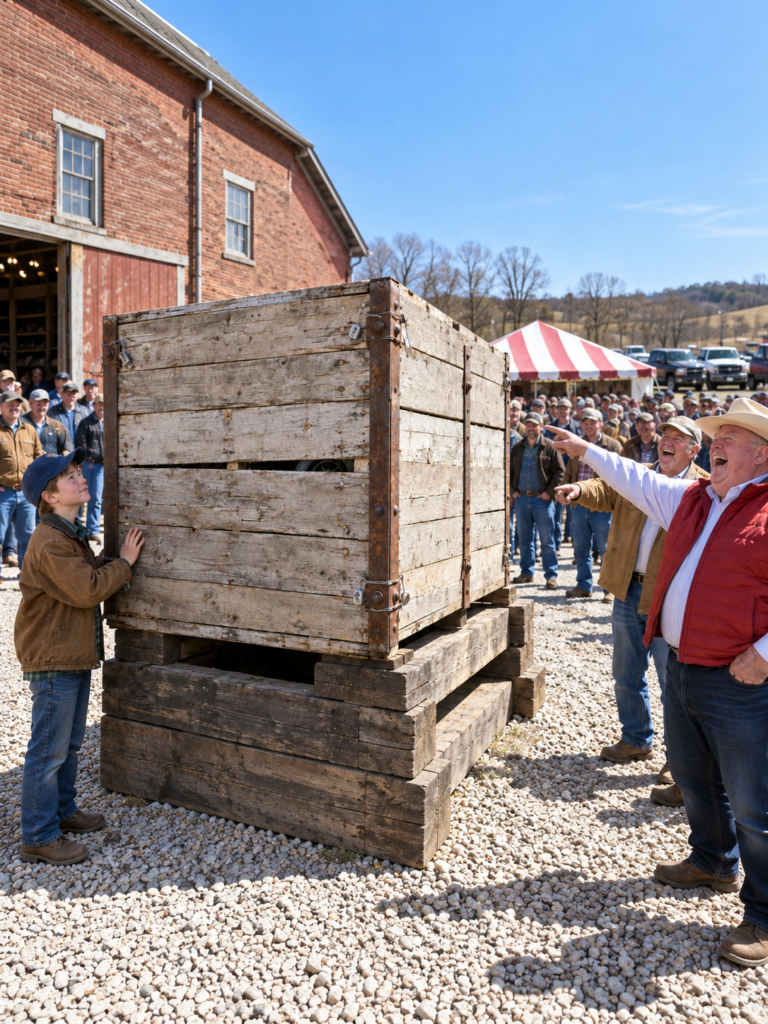
At the center of it stood Owen Brea, a skinny twelve-year-old boy wearing a faded green cap, scuffed work boots, and a brown canvas jacket that had once belonged to his father.
Beside him sat an enormous gray bell.
It was taller than Owen.
Its surface was covered with peeling paint, its mouth had been sealed with thick oak boards, and three rusted iron straps held everything together.
Nobody at the auction seemed to know where the bell had come from.
Nobody cared.
To them, it was a useless piece of metal that would cost more to move than it could ever be worth.
Rod Casper, owner of the largest salvage yard in that part of Minnesota, stood before the crowd with a paper cup of coffee.
He was a broad, loud man in his late fifties who wore the same bright red barn coat to every farm auction.
He smiled down at Owen.
“Well, son, you’ve gone and bought yourself a mighty expensive lawn ornament.”
More laughter followed.
Someone behind the crowd shouted, “Maybe he can ring it when dinner’s ready!”
Another man called, “Only if his mama can afford a crane!”
Owen felt his cheeks grow hot.
He had never been comfortable with crowds, and sixty people staring at him was more attention than he had received in his entire life.
But he didn’t move.
Instead, he rested one small hand against the bell’s cold painted surface.
Rod glanced around, enjoying himself.
Then he picked up a crowbar from a nearby wagon and tossed it into the dry stubble beside Owen’s boots.
“Go ahead, boy. Pull those boards off. Let’s see what kind of treasure you wasted your money on.”
The crowd quieted.
Owen looked down at the crowbar.
He could hear the wind rattling through the dried corn stalks beyond the farmyard.
He could see his mother standing near the auction trailer, holding a folded receipt in one hand.
Karen Brea looked frightened.
Not frightened of the bell.
Frightened of what her son had just done.
Because fifty-five dollars was almost every penny Owen owned.
It was the money he had earned mowing a cemetery through the hottest summer he could remember.
He had been saving for a bicycle.
Now it was gone.
Rod leaned closer.
“Well? Aren’t you going to open it?”
Owen slowly lifted his eyes.
“No, sir.”
Rod blinked.
“What?”
“I said no, sir.”
For one moment, the yard was silent.
Then Rod threw back his head and laughed.
“You hear that? The boy doesn’t even want to know what he bought!”
He turned toward the crowd.
“That’s what happens when you let children spend their own money!”
The laughter returned, louder than before.
Owen kept his hand against the bell.
He didn’t know exactly what it was.
He didn’t know where it had come from.
But he knew one thing the laughing men did not.
Beneath the cracked gray paint was a small patch of dark green metal.
And when Rod had slapped the bell earlier that morning, it had produced a deep, lingering hum unlike anything Owen had ever heard.
Something about that sound had awakened a memory.
A photograph.
An abandoned church.
And a story an elderly woman had once told him while he was cutting grass around the graves of people who had been dead for generations.
Owen looked at the boarded mouth of the bell.
Someone had gone to a great deal of trouble to seal it.
He didn’t believe they had done that for nothing.
What he couldn’t possibly know was that the bell had crossed the Atlantic Ocean more than a century earlier.
That it had once called an entire community to worship, weddings, and funerals.
That someone had deliberately hidden it from a scrap dealer.
And that, months later, a historian would travel hundreds of miles to examine it.
When the truth finally emerged, the same people who had laughed at Owen would stand speechless inside his family’s machinery shed.
And an offer of $124,000 from Norway would change his family’s life.
But first, the boy would have to endure months of ridicule.
He would have to uncover a secret that several generations of adults had failed to solve.
And he would have to decide whether the most valuable thing he had ever owned truly belonged to him.
Two hours earlier, Owen hadn’t even known the bell existed.
The auction was being held on the old Feld farm, eight miles north of Sunburg, Minnesota.
Arvid Feld had died that spring at eighty-eight.
He was the last member of his immediate family still living on the property, and his nieces in Seattle had decided to sell everything.
The old farmhouse stood beyond a row of cottonwoods, its white siding yellowed by decades of weather.
A windmill leaned beside the cattle yard.
The machinery shed smelled of old oil, mice, and dry grain.
Farm equipment sat in neat rows across the yard.
There were two tractors, a combine, an aging grain truck, several wagons, and enough rusted tools to fill a hardware store.
People had come from three counties.
Some hoped to buy equipment.
Some wanted bargains.
Others came because farm auctions were one of the few occasions when neighbors who hadn’t seen each other in years could stand around drinking coffee and talking.
Karen Brea had come for a chest freezer.
Their old freezer had failed the previous winter, forcing her to throw away nearly two hundred dollars’ worth of food.
She had been saving for a replacement ever since.
Owen had come because she promised he could spend some of his summer earnings if he found something useful.
For two months, he had been mowing the old Yelvik Cemetery outside town.
The job paid little.
The grass grew quickly.
And July afternoons could be miserable.
But Mrs. Thea Rudd, the ninety-one-year-old woman who had helped arrange the work, always paid him fairly.
Every other Friday, she gave him his wages from a coffee can and added a homemade cookie.
Owen had saved fifty-eight dollars.
He was hoping to find a used bicycle.
His old one had a bent wheel and a chain that slipped whenever he stood on the pedals.
A better bike would make the three-mile ride to the cemetery easier.
But while his mother waited near the auction office, Owen wandered behind the machinery shed.
There, beyond the polished tractors and the equipment people actually wanted, were the forgotten things.
Broken fence posts.
Old tractor tires.
A feeder with a rusted bottom.
Window frames.
A stack of damaged doors.
And at the far end of the row, resting on heavy railroad ties, stood the enormous painted bell.
Owen stopped.
For several seconds, he simply stared at it.
There was something familiar about its shape.
He walked closer.
The bell was broad at the mouth and narrowed toward the top, where a heavy crown had been formed into the metal.
Thick boards covered the opening.
The paint was badly weathered, curling away in places.
Owen touched one of the loose edges.
Beneath it, the metal wasn’t orange with rust.
It was greenish brown.
Like an old penny.
He remembered something Merl Dahl had shown him the previous winter.
Merl was a retired mechanic and welder who lived two farms away from the Brea family.
He had been repairing an antique pump when Owen stopped by his shop.
“See that green?” Merl had asked, turning a bronze bushing in his hands.
Owen nodded.
“Old iron rusts orange. Bronze develops a green patina. That’s one way you can tell them apart.”
Now, standing behind the Feld machinery shed, Owen looked at the strange green patch on the bell.
Bronze.
Could it be bronze?
He circled the object slowly.
Then he remembered the photograph.
It hung inside the tool shed at Yelvik Cemetery.
The photograph showed a small white wooden church standing alone against the prairie sky.
Its walls were simple.
Its windows were tall and narrow.
And above the entrance stood an open bell tower.
Owen had studied that photograph dozens of times while resting from mowing.
The church had been demolished long before he was born.
All that remained was the cemetery, a square stone foundation, and the memories of a few elderly residents.
But in the photograph, a bell hung inside the tower.
A large bell.
With a curved shoulder and a narrow crown.
Owen looked at the object before him again.
His heart began to beat faster.
That was when Rod Casper appeared.
“Well, look what we’ve got here.”
Rod approached carrying his coffee.
Two other men followed him.
“Somebody’s grandpa’s dinner bell.”
He slapped the side with his open hand.
The metal responded with a low, resonant hum.
Owen felt the vibration through his fingertips.
The sound didn’t stop immediately.
It lingered.
Softened.
Then seemed to disappear into the wind.
Rod laughed.
“Hear that buzzing? Means it’s cracked.”
One of the men nodded as though the explanation were obvious.
“Probably cast iron.”
“Exactly,” Rod said. “Big lump of painted cast iron. Worth whatever the scrapyard pays, minus the cost of moving it.”
He looked at Owen.
“Don’t waste your allowance on that thing, kid.”
Then he walked away.
But Owen remained beside the bell.
He had heard cracked metal before.
Merl had shown him damaged machine parts.
This sound was different.
Deep.
Round.
Almost musical.
When auctioneer Gary Linquist reached the junk row shortly before noon, most of the crowd followed him more out of curiosity than serious interest.
Gary sold old wire for eight dollars.
A damaged feeder went for three.
Then he stopped before the bell.
He tipped back his hat.
“Folks, I’ll admit I don’t know much about this one.”
A few people chuckled.
“Big painted bell. Boards across the mouth. Selling as is, where is. Buyer removes it by next Saturday at noon.”
He looked around.
“Who’ll give me twenty dollars?”
Nobody spoke.
“Ten?”
Silence.
Rod Casper raised his hand.
“Two dollars, Gary. I’ll take it for scrap.”
People laughed.
Gary pointed toward him.
“Two dollars. Do I hear five?”
From the edge of the crowd came a small voice.
“Five.”
Heads turned.
Owen stood with one hand raised.
Rod stared at him.
Then smiled.
“Well, now we’ve got ourselves a collector.”
He raised his hand.
“Six.”
“Ten,” Owen replied.
“Fifteen.”
“Twenty.”
The bidding continued.
Rod didn’t need the bell.
He didn’t even want it.
But the crowd was entertained, and Rod enjoyed being the center of attention.
Twenty-five.
Thirty-five.
Forty-five.
Every time Owen raised his bid, laughter swept through the yard.
Karen Brea pushed through the crowd.
“Owen?”
He looked at her.
There was worry in her eyes.
But she didn’t interrupt.
“Fifty!” Rod shouted, spreading his arms dramatically.
Owen swallowed.
He had fifty-eight dollars.
Eight dollars would remain if he bid fifty.
Three dollars if he bid fifty-five.
He thought about the bicycle.
The hot cemetery afternoons.
The money folded in his pocket.
Then he lifted his hand one final time.
“Fifty-five dollars.”
Rod held his gaze.
For a moment, something unreadable passed across the older man’s face.
Then he laughed and stepped back.
“Let the kid have it!”
Gary brought down the auction hammer.
“Sold! Fifty-five dollars!”
The crowd erupted.
Owen lowered his hand.
His legs felt weak.
He had just spent nearly everything he owned.
And he wasn’t even certain what he had bought.
Across the yard, his mother stood perfectly still.
Owen looked at her.
Then at the enormous bell.
For the first time that morning, he wondered whether he had made a terrible mistake.
Part 2
Karen Brea waited until the crowd had moved toward the next auction lot before approaching her son.
She held the freezer receipt in one hand.
Her face was pale.
“Owen.”
He looked down.
“Yes, Mom?”
“Please tell me you didn’t spend fifty-five dollars on that.”
He swallowed.
“I did.”
“All your summer money?”
“Almost.”
Karen closed her eyes.
For several seconds, she said nothing.
Owen knew what she was thinking.
She worked long hours as a nursing assistant at a care home in town.
His father, Daniel, had died four years earlier after a highway accident.
Since then, Karen had handled the mortgage, groceries, school expenses, and repairs around their small property alone.
There was never much money left at the end of the month.
Owen knew the price of almost everything in their house.
He knew his mother bought bread when it was discounted.
He knew she turned down the thermostat when she thought he was asleep.
And he knew how much fifty-five dollars mattered.
“I’m sorry,” he whispered.
Karen looked at him.
“I’m not angry because you bought something, Owen. It’s your money.”
She glanced toward the bell.
“I’m worried because that thing is enormous, and we have no way to move it.”
He looked at the railroad ties beneath it.
Gary had been clear.
The buyer had one week to remove it.
Otherwise, the estate could dispose of it.
“I know.”
Karen rubbed her forehead.
“What were you thinking?”
Owen took a breath.
Then he told her.
About the green metal beneath the paint.
About Merl’s lesson on bronze.
About the photograph hanging inside the cemetery shed.
And about the sound the bell had made when Rod struck it.
Karen listened.
She didn’t laugh.
She didn’t interrupt.
When he finished, she looked at the bell again.
“You think this came from the old church?”
“I don’t know.”
“But you think it might?”
Owen nodded.
She studied the boards covering its mouth.
“Then why is it painted?”
“Maybe somebody wanted to hide what it was.”
“That was a long time ago, honey.”
“I know.”
She considered him carefully.
“And if you’re wrong?”
Owen looked toward the men laughing beside Rod Casper’s pickup.
“Then I spent fifty-five dollars finding out.”
His mother sighed.
He added quietly, “But if I’m right, Mom, I don’t think we’re supposed to just tear it open.”
Karen turned toward him.
“What do you mean?”
“Somebody sealed it for a reason. Maybe they were protecting it.”
She looked at the rusted straps.
Then she put one arm around his shoulders.
“All right.”
Owen blinked.
“All right?”
“We’ll find out what it is.”
He felt a small rush of relief.
“But first,” Karen continued, “we need to figure out how to get it home.”
Before they could leave, Rod Casper returned.
His red coat stood out against the brown farmyard.
He approached with a smile that was almost friendly.
“Listen, son. I’m going to make you an offer.”
Owen said nothing.
“I’ll give you forty dollars for that bell.”
Karen frowned.
Rod shrugged.
“You lose fifteen dollars. Call it a lesson. I haul the thing away, and nobody has to worry about it.”
Owen looked at his mother.
Then back at Rod.
“No, thank you.”
Rod raised an eyebrow.
“Forty-five.”
“It’s not for sale.”
The man’s smile tightened.
“Boy, you don’t understand how the world works.”
Owen stood very still.
Rod pointed at the bell.
“You’ve bought a problem. I’m offering to take it off your hands.”
“I appreciate it, sir.”
“Then take the money.”
“No, sir.”
Rod stared at him.
For a moment, his expression turned cold.
Then he laughed.
“Fine. When you’re tired of looking at it, come find me. But the price goes down every week.”
He turned and walked away.
Karen watched him leave.
Then she looked at Owen.
“You were polite.”
Owen nodded.
His hands were shaking.
“Good,” she said. “You can be polite without letting somebody push you around.”
That evening, they drove to Merl Dahl’s workshop.
Merl was sixty-six, thin and gray-haired, with a limp from an accident involving a hay baler decades earlier.
He had known Owen’s father since high school.
Daniel Brea had spent countless Saturdays in Merl’s shop, learning how to weld, repair engines, and fix machinery that other people considered beyond saving.
After Daniel’s death, Merl had quietly continued helping the family.
He never asked for payment.
Karen usually repaid him with jars of homemade preserves or a pie.
Merl listened while Owen described the bell.
When the boy finished, he leaned back against his workbench.
“How big?”
“Taller than me.”
“That doesn’t narrow it down much.”
“Really big.”
Merl smiled faintly.
“And it’s sitting on railroad ties?”
“Yes.”
“Got lifting points?”
“I don’t know.”
“Any idea what it weighs?”
“No, sir.”
Merl looked at Karen.
“You let him spend fifty-five dollars on this?”
Karen raised an eyebrow.
“By the time I found out, the hammer had already fallen.”
Merl chuckled.
Then he turned back to Owen.
“Why didn’t you let Casper buy it?”
Owen hesitated.
“Because I think it might be important.”
Merl studied him.
“Important to who?”
“I’m not sure yet.”
Something in the old man’s expression softened.
He crossed his arms.
“Well, I suppose we’d better find out.”
On Thursday morning, Merl arrived at the Feld farm with his flatbed truck, a winch, steel ramps, heavy timbers, chains, and enough tools to repair half the county.
Owen and Karen followed in their pickup.
The wind was cold.
A thin layer of frost covered the grass.
Merl walked around the bell slowly.
He knelt beside the green patch on its shoulder.
For a long moment, he said nothing.
Then he muttered, “Well, I’ll be.”
Owen stepped closer.
“What?”
Merl glanced at him.
“I’m not telling you anything yet.”
“But—”
“Because I don’t know enough to tell you.”
He stood.
“And that means we’re going to be careful.”
Moving the bell took most of the afternoon.
Merl used the timbers supporting it rather than fastening chains directly around the unknown metal.
He positioned the flatbed carefully.
Checked the winch cable twice.
Then eased the massive object toward the ramps.
The wood creaked.
The truck suspension settled under the weight.
Owen stood behind the fence with his mother, watching every inch.
At one point, the bell shifted slightly.
Karen grabbed his shoulder.
Merl stopped the winch.
He adjusted the support timbers.
Checked the balance.
Then continued.
Slowly, the bell climbed onto the truck.
When it finally rested securely on the flatbed, Merl stepped back and wiped his forehead.
“That’s enough excitement for one day.”
Owen grinned.
“Thank you.”
Merl pointed a finger at him.
“Don’t thank me until it’s unloaded.”
As they were securing the load, a red pickup slowed along the gravel road.
Rod Casper rolled down his window.
“Well, look at that!”
He leaned on the horn.
“Taking your treasure home, are you?”
Merl didn’t answer.
Rod laughed.
“Hope you enjoy looking at it!”
Then he drove away.
Owen felt his face burn.
Merl tightened the final strap.
“Don’t pay him any mind.”
Owen looked toward the road.
“He makes everybody laugh.”
Merl glanced at him.
“That’s easy.”
“What is?”
“Making people laugh at somebody who can’t fight back.”
The old mechanic secured his tools.
“Knowing when to keep your mouth shut is harder.”
They brought the bell to the Brea family’s machinery shed before dark.
Merl prepared a stable platform of heavy timbers beneath the main beam.
He carefully lowered the bell into place.
When everything was secure, he stood beside Owen under the dim shop lights.
“I’ve got a wire brush in the truck.”
Owen looked up.
“What for?”
“Clean a little patch. See what kind of metal we’ve got.”
Owen shook his head immediately.
“No.”
Merl raised an eyebrow.
“No?”
“I don’t want to scratch it.”
“Even a little?”
“What if the paint is hiding something important?”
Merl stared at the boy.
Then he looked toward the sealed mouth of the bell.
Finally, he nodded.
“Fair enough.”
He put the brush away.
For the next month, the entire town of Sunburg seemed determined to remind Owen about his purchase.
Rod Casper told the story at the café.
He told it at the fuel station.
He told it at auctions.
He even painted a sign on a sheet of plywood outside his salvage yard.
WE BUY BELLS — $40.
ASK FOR OWEN.
People honked as they passed.
At school, several boys began calling Owen “Bell Boy.”
A few made ringing noises whenever he entered the cafeteria.
Others asked whether he planned to put the bell on the roof of his house.
Owen tried not to react.
But the jokes followed him everywhere.
One afternoon, he returned home with mud on his jacket.
Karen found him sitting on the back steps.
“What happened?”
“Nothing.”
She sat beside him.
“Owen.”
He stared at his boots.
“Some boys were messing around.”
“With you?”
He shrugged.
“They wanted to know if I was going to spend my next summer buying a church.”
Karen felt anger rise in her chest.
“Who said that?”
“Doesn’t matter.”
“It matters to me.”
Owen looked at her.
“I just want them to stop.”
His voice broke.
Karen put her arms around him.
He had tried so hard to appear brave.
But he was still twelve.
Still a boy who had lost his father.
Still a boy who had spent the money he’d worked all summer to earn on something everybody said was worthless.
And now he was afraid he had disappointed the only parent he had left.
Karen held him until he stopped trembling.
Then she asked quietly, “Do you wish you’d taken Mr. Casper’s offer?”
Owen thought about it.
“No.”
“Do you wish you hadn’t bought the bell?”
He hesitated.
Sometimes he did.
Especially at school.
Especially when people laughed.
But every evening, when he entered the machinery shed and saw the enormous gray shape resting beneath the lights, the feeling returned.
The same feeling he’d had at the auction.
That the bell was waiting for someone to understand it.
“No,” he whispered.
Karen kissed the top of his head.
“Then we keep looking.”
That night, Owen went out to the shed.
He sat on an overturned bucket beside the bell.
His father’s old toolbox stood against the wall.
Daniel had once used the shed to repair lawn mowers and small engines.
Most of his tools were still there.
Owen remembered sitting beside him as a little boy, handing him wrenches and asking questions.
His father had been patient.
Even when Owen asked the same thing three times.
Everything has a story, buddy. You just have to learn how to listen.
Owen looked at the bell.
He touched the cold metal.
“What happened to you?” he whispered.
The shed was silent.
He could have removed a piece of paint.
He could have pried loose one of the boards.
He could have satisfied his curiosity in less than an hour.
But something stopped him.
Someone had carefully sealed the bell.
Someone had painted it.
Someone had stored it on heavy timbers rather than leaving it directly on the ground.
Those actions seemed deliberate.
And Owen had begun to suspect that the mystery wasn’t simply what the bell was.
It was why somebody had wanted the world to forget it.
Part 3
The first person Owen visited was Thea Rudd.
She lived in a small care home on Main Street, in a room overlooking the water tower.
At ninety-one, Thea’s back was bent and her hands were marked with age, but her eyes remained sharp.
She had spent most of her life in the Sunburg area.
She remembered families who had moved away forty years earlier.
She remembered roads before they were paved.
And she remembered the old Yelvik Church.
Owen arrived on a Sunday afternoon carrying the cemetery photograph wrapped in a dish towel.
Thea was sitting beside her window knitting a blue scarf.
When she saw him, she smiled.
“Well, there’s my hardworking young man.”
“Hi, Mrs. Rudd.”
“Finished mowing already?”
“No, ma’am. I wanted to ask you something.”
He placed the photograph on her lap.
Thea unfolded the towel.
Her expression changed.
For a long time, she stared at the faded black-and-white image.
Then she touched the little church tower with one trembling finger.
“Oh, my.”
Owen sat forward.
“Do you remember it?”
Thea smiled sadly.
“Remember it? I was baptized there.”
She traced the outline of the building.
“Confirmed there, too. And married there in June of 1956.”
Her eyes brightened.
“My husband Henry said the bell rang so loudly on our wedding day he couldn’t hear half the pastor’s words.”
Owen looked at the photograph.
“The bell?”
Thea nodded.
“It was beautiful.”
“Where did it come from?”
“Norway.”
Owen blinked.
“Norway?”
Thea leaned back in her chair.
“When our people first settled here, most of them had come from a little coastal parish in western Norway. They named their church Yelvik after the place their families remembered.”
She paused.
“The original parish sent them an old bell. A very old bell.”
Owen’s heart began to race.
“Why?”
“Because the settlers couldn’t afford one. The people back home wanted them to have something that connected the two communities.”
She smiled.
“My grandmother said the bell arrived by ship, then railroad, then wagon. Took quite a journey.”
“Was it big?”
“Oh, yes.”
“How big?”
Thea held out her hands.
“Bigger than anything we could have paid for ourselves.”
Owen leaned forward.
“What happened to it?”
The old woman’s smile faded.
The room seemed quieter.
“The church closed in 1959.”
“Why?”
“Too few families left. Some moved to bigger towns. Some stopped attending. The building needed repairs nobody could afford.”
She looked toward the window.
“It was a sad time.”
“What happened to the bell?”
Thea pressed her lips together.
“That’s the strange part.”
Owen waited.
“The church district planned to sell the building and its contents. Bronze was valuable, so a scrap dealer came to inspect the bell.”
Owen felt a chill.
“Who?”
Thea turned toward him.
“Emil Casper.”
He froze.
“Casper?”
“Yes. Rod Casper’s father.”
For a moment, Owen couldn’t speak.
Thea continued.
“But when Emil arrived, the bell was gone.”
“Gone?”
“The tower was empty.”
“Who took it?”
“Nobody knew.”
She lowered her voice.
“Torvald Feld was the church sexton. He had the keys. He told everybody the bell had been sent to another congregation in Minnesota.”
Owen stared at her.
“Did anybody believe him?”
“Some did. Others wondered. But Torvald was a good man, and nobody wanted to accuse him of anything.”
She looked down at the photograph.
“He loved that old bell.”
Owen swallowed.
“Mrs. Rudd?”
“Yes, dear?”
“I think I found it.”
He told her everything.
The auction.
The enormous painted bell.
The oak boards.
The iron straps.
The greenish metal.
The strange, lingering hum.
And Rod Casper’s laughter.
Thea listened without moving.
When Owen finished, her hands began to tremble.
“Where is it now?”
“In our machinery shed.”
“Have you opened it?”
“No.”
“Have you scraped off the paint?”
“No, ma’am.”
Thea leaned forward and caught his hand.
“Good.”
Her grip was surprisingly strong.
“Owen, listen carefully.”
He looked into her eyes.
“Don’t let anybody damage it.”
“I won’t.”
“Not until somebody who understands old bells has examined it.”
“I promise.”
Tears gathered in her eyes.
Then she looked down at the photograph.
“You know, there was a story about that bell.”
“What story?”
Thea took a slow breath.
“My grandmother said the Norwegian pastor who sent it wrote a letter. He said the bell was being loaned to the people on the prairie.”
“Loaned?”
“Yes.”
“For how long?”
“For as long as there was a church there to ring it.”
Owen looked at the photograph.
“And after that?”
Thea’s voice became very soft.
“Then it was supposed to go home.”
On his bicycle ride home, Owen could barely concentrate on the road.
Norway.
An old church.
A missing bell.
A man named Torvald Feld.
A scrap dealer named Emil Casper.
And a promise made more than a century ago.
He had spent fifty-five dollars thinking he might have found an antique.
Now he was beginning to suspect he had found something much more complicated.
Something that might not truly belong to him.
That evening, he told his mother everything.
Karen listened at the kitchen table while stirring a pot of soup.
When he mentioned Rod Casper’s father, she stopped stirring.
“Emil Casper?”
Owen nodded.
“And Torvald Feld was the church sexton.”
Karen looked toward the window.
“The Feld family owned the farm where you bought the bell.”
“I know.”
They sat quietly.
Then Owen said, “Mom, what if Torvald hid it?”
“Why would he?”
“Because somebody wanted to melt it down.”
Karen considered the possibility.
“That would explain why it was sealed.”
“And painted.”
“Maybe.”
Owen looked at her.
“But if it’s really from Norway, maybe it belongs there.”
Karen sat across from him.
“Then we need to find out.”
The following morning, Owen visited the school library.
Mrs. Halverson, the librarian, had known him since kindergarten.
She was a cheerful woman in her fifties who wore reading glasses on a chain and believed that every question deserved a serious answer.
Owen explained what he had learned.
When he finished, she removed her glasses.
“Well,” she said, “that’s quite a mystery.”
“Can you help me find somebody who knows about old bells?”
Mrs. Halverson smiled.
“That’s what libraries are for.”
They began searching.
At first, the results were disappointing.
There were websites selling decorative bells.
Articles about famous church towers.
Auction listings for smaller bronze bells.
But eventually they found references to historical bell preservation.
Then museum collections.
Then specialists who studied church bells brought to America by immigrant communities.
By Friday afternoon, Mrs. Halverson had found a name.
Dr. Ingrid Moe.
A bell historian and certified appraiser who had spent decades studying historic European bells preserved in the American Midwest.
She worked with a museum collection in Minnesota.
Owen stared at her photograph on the computer screen.
“She looks important.”
Mrs. Halverson laughed softly.
“She probably knows more about bells than either of us.”
That evening, Owen wrote an email.
He described the auction.
The gray paint.
The boarded mouth.
The greenish metal.
The connection to the demolished Yelvik Church.
He attached photographs Karen had taken with her phone.
Then he asked whether the historian might be willing to tell him what he had found.
He checked the email three times for spelling mistakes.
Then he clicked Send.
The reply arrived the following morning.
Karen was making pancakes when Owen ran into the kitchen carrying her laptop.
“Mom!”
She nearly dropped the spatula.
“What happened?”
“She answered!”
Karen wiped her hands.
“Slow down.”
Owen placed the laptop on the table.
The email was short.
Dr. Moe thanked him for the photographs.
Then she gave very specific instructions.
Do not remove the paint.
Do not take off the boards.
Do not strike the bell with a hammer or another metal object.
Do not attempt to move it again without proper support.
And do not allow anyone to begin restoration before its origin had been documented.
At the bottom was one final paragraph.
Dr. Moe believed the object deserved an in-person examination.
She proposed visiting on the second Saturday of November.
And she suggested that Owen invite several witnesses.
Karen read the email twice.
Then she looked at her son.
“You did it.”
Owen shook his head.
“We don’t know what it is yet.”
“No,” she agreed.
“But you found somebody willing to take you seriously.”
That mattered more than Owen wanted to admit.
For weeks, people had laughed at him.
His classmates had mocked him.
Rod Casper had turned his purchase into a local joke.
Now a professional historian wanted to travel to his family’s farm.
For the first time since the auction, Owen felt as though the ground beneath his feet was steady.
He began preparing.
Merl agreed to be present.
Mrs. Halverson offered to record notes.
Gary Linquist, the auctioneer, said he would attend to confirm the sale and ownership history.
Pastor Ellen Strand offered to bring folding chairs.
Karen arranged transportation for Thea Rudd.
Then Owen made one final decision.
He wanted Rod Casper there, too.
His mother stared at him.
“Rod?”
“Yes.”
“After everything he’s done?”
Owen nodded.
“Especially after everything he’s done.”
Karen sat quietly for a moment.
“Why?”
Owen looked toward the machinery shed.
“Because if I’m wrong, he’ll know.”
“And if you’re right?”
The boy considered the question.
Then he answered.
“He should know that, too.”
Three days later, Owen rode his bicycle four miles along the highway to Casper Salvage.
Rod was cutting apart an old grain bin.
He stopped when he saw the boy approaching.
“Well, look who’s here!”
He raised his welding mask.
“Ready to sell me that bell?”
“No, sir.”
Rod grinned.
“Then what brings you out?”
Owen explained that a historian was coming to examine it.
He gave Rod the date and time.
Then he invited him to attend.
Rod stared.
“You want me there?”
“Yes, sir.”
“To watch some college lady tell you that you bought a boiler bell?”
Owen nodded.
“If that’s what it is.”
Rod laughed so hard he had to sit on an oil drum.
“Oh, kid.”
He wiped his eyes.
“I wouldn’t miss it for the world.”
Owen thanked him.
Then he rode home.
The November wind was cold against his face.
But he felt strangely calm.
He had done everything he could.
Now all he had to do was wait for the truth.
Part 4
The second Saturday of November arrived bright and bitterly cold.
Frost covered the fence posts.
The fields lay brown and empty beneath a pale blue sky.
Inside the Brea farmhouse, Karen woke before sunrise.
She brewed coffee.
Prepared a tray of sandwiches.
And checked the weather forecast twice, worried that ice might make the roads dangerous.
Owen was already awake.
He had barely slept.
He sat at the kitchen table wearing his father’s old canvas jacket, staring at the clock.
Karen placed a plate of toast before him.
“You need to eat.”
“I’m not hungry.”
“I know.”
She sat beside him.
“Eat anyway.”
He took a bite.
Then looked toward the window.
“What if she’s wrong?”
Karen considered him.
“About coming here?”
“About the bell.”
She reached across the table.
“Owen, listen to me.”
He looked up.
“You bought that bell because you noticed something the rest of us overlooked.”
He swallowed.
“You’ve been careful with it. You’ve asked questions. You’ve treated it with respect.”
She squeezed his hand.
“Whatever Dr. Moe tells us today, that doesn’t change.”
Owen looked down.
“I just don’t want everybody laughing again.”
Karen’s expression softened.
“Oh, honey.”
She moved her chair closer and wrapped her arms around him.
For a moment, he leaned against her like the little boy he had been before his father died.
Then he straightened.
“I’ll be okay.”
“I know you will.”
By eight o’clock, Merl arrived.
He opened the machinery shed doors and checked the timbers beneath the bell.
He had spent the previous evening inspecting the support platform.
Nothing had shifted.
Nothing had cracked.
The bell stood exactly where it had for weeks.
Massive.
Gray.
Silent.
Merl switched on the overhead lights.
Then he stood beside Owen.
“Nervous?”
“A little.”
Merl chuckled.
“Good.”
Owen looked confused.
“Good?”
“Means you understand this matters.”
At nine, Pastor Strand arrived carrying folding chairs.
Mrs. Halverson came with a notebook and two pens.
Gary Linquist wore a clean button-down shirt and brought a copy of the auction receipt.
Karen arrived with Thea Rudd shortly afterward.
The elderly woman wore a lavender cardigan beneath her winter coat.
She walked slowly with a wooden cane.
Owen hurried to help her.
“Careful, Mrs. Rudd.”
She smiled.
“I’ve been walking longer than you’ve been alive, young man.”
“I know.”
“But thank you.”
When she entered the shed and saw the bell, she stopped.
Her face changed.
Owen watched her eyes move over the curved shoulder, the narrow crown, and the boarded opening.
For a moment, Thea seemed unable to breathe.
She took one small step closer.
Then another.
“Oh,” she whispered.
Karen reached for her arm.
“Are you all right?”
Thea nodded.
Her eyes shone with tears.
“I think I know you,” she murmured toward the bell.
Nobody spoke.
Then she lowered herself into a chair.
At nine forty-five, Rod Casper arrived.
His red pickup rolled into the yard, followed by a smaller truck carrying two of his employees.
He climbed out holding a cup of coffee.
“Well, would you look at this.”
He glanced at the chairs.
“Got ourselves a whole audience.”
Owen approached.
“Thank you for coming, Mr. Casper.”
Rod grinned.
“Wouldn’t miss the show.”
He took a seat in the back row.
Stretched out his legs.
And waited.
At precisely ten o’clock, an old station wagon turned into the Brea driveway.
A small woman with short silver hair stepped out.
She wore wire-rimmed glasses, sturdy boots, and a dark green field jacket.
This was Dr. Ingrid Moe.
She greeted Karen.
Shook Owen’s hand.
Introduced herself to the others.
Even Rod received a polite handshake.
Then she turned toward the bell.
And stopped.
For nearly a minute, she said nothing.
Owen watched her expression.
It wasn’t excitement.
Not exactly.
It was concentration.
The kind of attention Merl gave an unfamiliar engine before deciding where to place his tools.
Dr. Moe walked slowly around the bell.
She inspected the shape of the crown.
The curve of the shoulder.
The thickness of the lip visible beneath the boards.
She examined the iron straps and their fasteners.
Then she crouched beside the small green patch where the paint had flaked away.
Owen held his breath.
Dr. Moe took out a magnifying lens.
She studied the exposed metal.
Then she stood.
“Has anyone removed any paint since the photographs were taken?”
“No, ma’am,” Owen answered.
“Any attempt to loosen the boards?”
“No.”
“Has anybody struck the bell?”
“Only with an open hand at the auction.”
Dr. Moe nodded.
“Good.”
She looked toward Merl.
“Did you transport it?”
“Yes, ma’am.”
“How did you support it?”
Merl explained the railroad ties, the winch, and the lifting arrangement.
The historian listened carefully.
Then she smiled.
“You were right not to wrap chains directly around the body.”
Merl shrugged.
“Didn’t know what we were hauling.”
“Exactly.”
Rod shifted in his chair.
“Isn’t this taking things a little seriously?”
Dr. Moe turned toward him.
“Possibly.”
He smiled.
“That’s what I’ve been saying.”
She continued calmly.
“But until we identify the object, treating it carelessly could destroy evidence we can’t replace.”
Rod stopped smiling.
The historian opened one of her cases.
Inside were measuring tools, lights, magnifying lenses, gloves, and documentation equipment.
She measured the bell’s height and circumference.
Photographed the paint.
Recorded the construction of the straps.
Then she examined a small area near the shoulder where the existing paint had already lifted.
She explained that the coating might conceal cast inscriptions and that any removal would have to be carefully controlled.
After discussing the process with Karen and Owen, she began a limited examination using conservation materials suitable for the old coating.
The room fell quiet.
Owen stood beside his mother.
Merl held a light.
Mrs. Halverson prepared her notebook.
Thea watched from the front row, her hands folded tightly in her lap.
Dr. Moe worked slowly.
A small amount of gray paint softened and lifted.
Beneath it lay darkened metal.
Then, as she followed the curve of the shoulder, a raised line appeared.
She adjusted the light.
Owen leaned forward.
Another line emerged.
Then part of a letter.
The historian stopped.
She took a photograph.
Studied the marks.
Then continued.
Nobody spoke.
The only sounds were the overhead lights and the occasional creak of the old building in the wind.
Minutes passed.
More raised forms appeared beneath the coating.
Letters.
Actual letters cast into the bell.
Dr. Moe stood still.
She leaned closer.
Then she looked toward Thea.
“Mrs. Rudd?”
The old woman straightened.
“Yes?”
“Did the people who founded your church come from western Norway?”
Thea nodded.
“Most of them.”
Dr. Moe looked back at the inscription.
“I thought so.”
Owen felt his heart pounding.
“What does it say?”
The historian didn’t answer immediately.
She took additional photographs.
Compared the visible lettering with notes she had brought.
Then she stepped away.
“I believe we’re looking at an eighteenth-century Norwegian church bell.”
A murmur passed through the room.
Rod sat forward.
“An eighteenth-century what?”
Dr. Moe faced the gathering.
“Bronze. Not cast iron.”
Owen’s mother grabbed his hand.
The historian continued.
“The surviving inscription indicates that this bell was cast in Bergen in 1761 for a church in the Yelvik area of western Norway.”
Thea covered her mouth.
Tears filled her eyes.
Dr. Moe read the translated inscription aloud.
“Cast in Bergen in the year of our Lord 1761, for the church at Yelvik. Ring for the living. Ring for the dead. And when your work is done, ring yourself home.”
The words seemed to hang in the cold shed.
Owen looked at Thea.
Her lips were trembling.
“That’s what my grandmother said,” she whispered.
Dr. Moe looked toward the boarded mouth.
“There may be more evidence inside.”
Merl stepped forward.
“What do you need?”
The historian explained how the bell would be supported while the protective boards were carefully removed.
Merl inspected the overhead beam and lifting equipment.
He prepared the hoist.
The work proceeded slowly.
One iron strap was loosened.
Then another.
Then the third.
The old fasteners resisted.
But Merl worked patiently, using the proper tools and stopping whenever the wood shifted unexpectedly.
Finally, the boards began to separate.
Owen stood beside his mother, watching.
The first oak plank came away.
Dust drifted into the light.
The second followed.
Then the final board was removed.
Inside the bell hung a heavy iron clapper.
It was wrapped in old oiled canvas.
Thick rope secured it so tightly that it could not move.
Dr. Moe crouched to examine the interior.
For a long moment, she said nothing.
Then she looked up.
“Whoever prepared this understood how to protect a bell during transportation and storage.”
She pointed toward the clapper.
“It was restrained so it couldn’t swing and damage the lip.”
She looked at the boards.
“The opening was sealed against moisture, animals, and debris.”
Then she glanced toward the gray paint.
“And the outer coating concealed the bronze.”
Owen whispered, “Somebody was hiding it.”
The historian nodded thoughtfully.
“Somebody certainly wanted it protected. Whether concealment was part of that purpose will take more research.”
Thea leaned forward.
“Torvald Feld.”
Everyone looked toward her.
She gripped her cane.
“He was the sexton. He had the keys.”
Her voice grew stronger.
“When they wanted to sell our church bell for scrap, Torvald told everybody it had already been sent away.”
She looked at the ancient bronze.
“But it hadn’t.”
Her eyes filled again.
“He kept it.”
Rod Casper sat motionless.
Thea slowly turned toward him.
“Your father came with his truck to collect that bell, Rodney.”
Rod’s face tightened.
“He was doing his job.”
“I know.”
Thea nodded.
“I never said otherwise.”
She looked toward the bell.
“But now we know why Torvald didn’t let him take it.”
Rod lowered his eyes.
For once, he had no joke.
Dr. Moe examined the clapper and discussed the precautions needed before the bell could be sounded.
After checking the accessible components, she determined that a gentle test could be performed under supervision.
A temporary rope was attached to control the clapper’s movement.
Then she turned toward Owen.
“Would you like to ring it?”
The boy stared at her.
“Me?”
“You’re the reason we’re standing here.”
He looked at his mother.
Karen was crying.
She nodded.
Owen stepped forward.
His fingers closed around the rope.
For a moment, he thought about the auction.
Rod’s laughter.
The crowbar lying in the stubble.
The classmates who called him Bell Boy.
The nights he had sat alone in this very shed, wondering whether he had made the biggest mistake of his young life.
Now he stood before something older than his country.
Something that had crossed an ocean.
Something that had survived generations of families, marriages, funerals, abandoned buildings, and changing times.
He looked toward Thea.
The old woman smiled through her tears.
“Go on, sweetheart.”
Owen pulled the rope.
The clapper moved.
Struck the bronze.
And the bell rang.
The sound was enormous.
Deep.
Warm.
Full.
It filled the machinery shed and rolled through the open doors across the frozen fields.
It seemed to gather strength as it traveled.
A second vibration followed the first.
Then a long, rich resonance lingered in the cold air.
Owen felt it through his hands.
Through his chest.
Through the floor beneath his boots.
Thea began to cry openly.
“Oh, Henry,” she whispered.
Her husband had been dead for nearly thirty years.
But for one brief moment, she was a young bride again, standing beneath the white church tower on a June morning in 1956.
She could almost see the congregation.
The flowers.
The pastor.
The sunlight through the windows.
And Henry waiting beside her, smiling while the bell rang overhead.
“That’s it,” she sobbed.
“That’s our bell.”
Nobody laughed.
Nobody spoke.
In the back row, Rod Casper stood holding his untouched coffee.
His mouth was slightly open.
The bell’s last vibration faded into silence.
And for the first time since Owen had spent his fifty-five dollars, the entire room understood what he had been protecting.
Part 5
Dr. Ingrid Moe spent another three hours examining the bell.
She documented its measurements.
Photographed the inscription.
Recorded the condition of the bronze, clapper, straps, and surviving protective materials.
She also interviewed Thea Rudd about the old church and the stories passed down through her family.
Gary Linquist provided the auction paperwork.
Karen gathered the photographs Owen had taken before the object was moved.
Merl described the original support timbers and how the bell had been transported.
By late afternoon, the Brea kitchen table was covered with documents.
The historian sat with a cup of coffee while Owen watched her organize her notes.
Finally, Karen asked the question nobody had dared to ask.
“What is something like this worth?”
Dr. Moe removed her glasses.
“That depends on what kind of value we’re discussing.”
Karen looked confused.
The historian continued.
“As an eighteenth-century European bronze church bell with a documented immigrant-community history, it has substantial historical importance.”
She glanced toward Owen.
“And its connection to the original Norwegian parish may make it even more significant.”
“But in dollars?” Karen asked quietly.
Dr. Moe considered the question.
“For preliminary insurance purposes, I would not be comfortable valuing it below one hundred and ten thousand dollars, subject to full documentation and condition review.”
Karen’s hand flew to her mouth.
Owen stared at the historian.
“One hundred and ten thousand?”
“At least as a preliminary insurance figure.”
He looked toward the shed.
He remembered counting out fifty-five dollars in crumpled bills at the auction clerk’s table.
He remembered wondering whether he could afford a candy bar with the three dollars he had left.
Now someone was telling him the bell might be worth more than his mother earned in several years.
The room seemed to tilt.
Karen sat down heavily.
Dr. Moe reached across the table.
“Mrs. Brea, insurance value is not the same thing as a guaranteed sale price.”
Karen nodded slowly.
“I understand.”
“And before anybody makes a decision, the provenance and any legal or historical claims should be reviewed.”
Owen looked up.
“Because it came from Norway?”
“Exactly.”
The historian smiled gently.
“You may have purchased it legally at auction, Owen. But its history includes a promise that deserves serious consideration.”
The boy thought of Thea’s words.
When the church on the prairie no longer needs it, it should come home.
He looked down at his hands.
Then he asked, “Can you find the church it came from?”
Dr. Moe nodded.
“I believe I can.”
“Would you write to them?”
“Of course.”
Owen looked toward his mother.
Karen’s eyes were wet.
Then he turned back to the historian.
“I think they should know where their bell is.”
That afternoon, Rod Casper left without saying goodbye.
He had been unusually quiet since the unveiling.
He walked to his red pickup.
Sat behind the steering wheel.
And stared through the windshield for a long time.
His employees waited beside their truck.
Finally, Rod started the engine and drove away.
When he reached Casper Salvage, he parked near the front gate.
The plywood sign was still there.
WE BUY BELLS — $40.
ASK FOR OWEN.
Rod stood before it.
He remembered his father’s stories about farm auctions.
About how much money could be made by recognizing value in something other people overlooked.
He had always admired Emil Casper’s sharp eye for bargains.
But somewhere along the way, Rod had begun confusing knowing the price of scrap with knowing the worth of everything.
He walked to the sign.
Pulled it away from the fence.
And carried it into the shed.
It never appeared again.
Three weeks later, Karen’s laptop sat open on the kitchen table.
On the screen were three people sitting in a small meeting room thousands of miles away.
One was the pastor of a Norwegian parish.
Another was the mayor of the surrounding community.
The third represented a heritage preservation fund in Oslo.
Dr. Moe joined the conversation remotely.
Owen sat beside his mother wearing his cleanest shirt.
He was nervous.
He had never spoken directly to anyone in another country.
The Norwegian pastor was an elderly man with silver hair and a gentle voice.
His English was careful but clear.
“Good evening, Owen.”
Owen smiled shyly.
“Good afternoon, sir.”
The pastor laughed softly.
“Yes. Of course. The time difference.”
He leaned toward the camera.
“First, I want to thank you.”
Owen looked confused.
“For what?”
“For taking care of something our community believed was lost.”
The pastor held up a photograph.
It showed a white church above a Norwegian fjord.
Mountains rose behind it.
Cold green water stretched toward the horizon.
“This is our parish church.”
Owen leaned closer.
“It’s beautiful.”
“Thank you.”
The pastor lowered the photograph.
“We have records showing that an old bell from our church was sent to the Norwegian settlers in America during the nineteenth century.”
He glanced at the other people in the room.
“We also have a letter from the pastor who arranged the transfer.”
Owen held his breath.
“What does it say?”
The pastor smiled.
“It says the bell was being entrusted to the congregation on the prairie, to serve them while their church stood.”
He paused.
“And when that service ended, it was hoped the bell would return home.”
Owen looked toward his mother.
Thea had remembered correctly.
The story had survived across generations.
The pastor continued.
“For many years, we believed the bell had disappeared after the American church closed.”
His voice softened.
“We did not know whether it had been sold, melted down, or destroyed.”
Then he looked directly into the camera.
“And now a twelve-year-old boy has found it.”
Owen felt his face grow warm.
“I just saw it at an auction.”
The pastor smiled.
“That is often how important things are found. Somebody notices what others pass by.”
The conversation continued.
They discussed the bell’s condition.
Its history.
The surviving documents.
And the steps necessary to establish a lawful transfer and arrange international transport.
Eventually, the woman from the heritage fund spoke.
“We would very much like to bring the bell home.”
Owen answered before anyone mentioned money.
“I’d like that.”
Karen turned toward him.
“Owen.”
He looked at her.
“What?”
She swallowed.
“Are you sure?”
He nodded.
“Mrs. Rudd said it was supposed to go back.”
The pastor’s eyes filled.
Then the heritage representative continued.
“The parish, the municipality, and our preservation fund have discussed a purchase arrangement.”
She looked toward Dr. Moe.
“Subject to the final documentation and transfer requirements, we are prepared to offer one hundred and twenty-four thousand dollars.”
Karen froze.
Owen blinked.
He looked at his mother.
Then back at the screen.
“How much?”
“One hundred and twenty-four thousand American dollars.”
The room fell silent.
Karen covered her face.
For years, she had worried about the mortgage.
The aging pickup.
The repairs to the house.
The expenses of raising her son on one income.
She had spent countless evenings calculating bills at the kitchen table after Owen had gone to bed.
And now, because he had noticed a green patch beneath some old paint, their financial future might change.
Tears spilled between her fingers.
Owen touched her arm.
“Mom?”
She pulled him close.
For a moment, she couldn’t speak.
Then she whispered, “Your dad would be so proud of you.”
That broke something inside him.
He had spent years imagining what his father might say if he were still alive.
He had imagined showing him the bell.
Asking him how to move it.
Listening while Daniel explained the metal and the old-fashioned ironwork.
He had imagined his father standing beside Merl during the examination.
Maybe laughing.
Maybe shaking his head in amazement.
Now, hearing his mother say those words, Owen felt how much he had missed him.
He buried his face against her shoulder and cried.
Across the ocean, the Norwegian representatives waited quietly.
They understood that the conversation was about more than money.
When Owen finally looked up, the pastor spoke gently.
“We hope this will help you continue your education someday.”
Owen wiped his face.
“Thank you.”
Then he added, “I just wanted it to go where it belongs.”
The months that followed were busy.
The bell’s ownership history and documentation were reviewed.
The preservation fund arranged the purchase.
Specialists prepared the bell for international shipment.
Merl helped coordinate its removal from the machinery shed.
Dr. Moe supervised the preservation precautions.
And Thea Rudd received regular updates from Owen.
By March, everything was ready.
On the morning the bell left Sunburg, the sky was pale and clear.
Frost glittered in the roadside grass.
Merl backed his flatbed toward the shed.
This time, professional rigging equipment and a carefully prepared support cradle accompanied the move.
Owen stood beside his mother while the bell was slowly loaded.
The same enormous gray object that had once sat forgotten behind the Feld machinery shed now rested inside a protective transport structure.
Some of the old coating had been documented and conserved.
The inscription was visible.
The clapper was secured.
Every step was recorded.
When the truck began moving, a small crowd had gathered along the road.
Neighbors.
Farmers.
Teachers.
People who had attended the auction.
People who had laughed.
And people who had quietly believed Owen might be right.
Gary Linquist stood beside his pickup.
Mrs. Halverson held a camera.
Pastor Strand offered a prayer for safe travel.
Thea Rudd watched from Karen’s passenger seat.
She was wrapped in a thick blanket.
Owen approached her window.
“Are you okay?”
Thea smiled.
“Better than okay.”
She looked toward the bell.
“I never thought I’d see it again.”
Owen glanced at the truck.
“Are you sad it’s leaving?”
Thea took his hand.
“A little.”
Then she smiled.
“But some things aren’t meant to stay where we find them.”
She squeezed his fingers.
“You understand that better than a lot of grown people.”
The truck rolled slowly onto the gravel road.
Owen watched until it disappeared beyond the cottonwoods.
Only then did he begin to cry.
It surprised him.
He had wanted the bell to return home.
He still did.
But for months, it had stood in the family shed.
He had visited it after school.
Talked to it when he was worried.
Sat beside it when classmates laughed.
It had become part of his life.
And now the space where it stood was empty.
Karen put an arm around him.
“Come on,” she said softly.
“Let’s go inside.”
That spring, Owen and Karen traveled to Norway.
The heritage fund and parish had invited them to attend the bell’s return.
For Owen, it was his first journey outside the United States.
He stared out the airplane window as the coastline appeared beneath the clouds.
Mountains.
Water.
Small villages.
Green hillsides dotted with houses.
Everything looked different from Minnesota.
Yet something about the farms and open land felt familiar.
When they arrived at the church, the pastor greeted them outside.
The old building stood above a cold green fjord.
Its bell tower rose against the mountains.
The bronze bell had been carefully installed after inspection and conservation.
The church was filled with local residents.
Some were descendants of families who had remained in Norway.
Others were historians, preservation workers, and community members who had followed the story of the bell’s return.
Owen stood near the entrance, overwhelmed.
He had never imagined that buying something at a farm auction could bring him to this place.
The pastor approached.
“Are you ready?”
Owen swallowed.
“Yes, sir.”
They walked toward the bell rope.
The congregation grew quiet.
The pastor explained that the bell had once served their ancestors.
Then it had crossed the ocean to serve another community.
Now, after more than a century away, it had returned.
He turned toward Owen.
“This young man made that possible.”
The boy looked down.
He didn’t know what to say.
The pastor placed a hand on his shoulder.
“You do not have to say anything.”
He guided Owen toward the rope.
“Just let the bell speak.”
Owen took hold of it.
For a moment, he remembered another rope.
Another building.
The Brea machinery shed in November.
The cold air.
The silent faces.
Thea Rudd waiting with tears in her eyes.
Then he pulled.
The bell rang.
Its deep bronze voice rolled through the church tower and out across the Norwegian fjord.
The sound echoed against the mountains.
It drifted over the water.
And lingered above the small village where the bell had first been cast for service centuries earlier.
Karen stood nearby, crying.
Owen pulled the rope again.
The second toll followed the first.
Then a third.
He thought of his father.
Of Merl.
Of Mrs. Halverson.
Of Thea Rudd.
Of the cemetery where he had spent so many summer afternoons pushing a lawn mower through the heat.
And of Torvald Feld.
The man who had apparently hidden the bell when others wanted to sell it for scrap.
Owen wished he could tell Torvald what had happened.
That the bell had survived.
That nobody had melted it down.
That a boy had found it.
And that, after decades of silence, its voice had finally returned home.
Back in Minnesota, Thea watched the ceremony on a tablet at the care home.
Several nurses gathered around her chair.
When the bell rang, she closed her eyes.
For a moment, she was a girl again.
Standing outside the old white Yelvik Church with her parents.
Hearing the bell call the congregation inside.
Then she was a bride.
Henry stood beside her.
His hand was warm around hers.
The bell rang above them.
And she remembered the life they had shared.
Tears ran down her cheeks.
One of the nurses touched her shoulder.
“Mrs. Rudd, are you all right?”
Thea opened her eyes.
She smiled.
“Oh, yes.”
She looked toward the tablet.
“It’s home.”
A month later, a wooden crate arrived at the Brea farm.
The return address was the Norwegian parish.
Inside was a small bronze bell.
It was new.
Beautifully made.
And accompanied by a letter of gratitude.
The parish had commissioned it as a gift to the community that had cared for the original bell for generations.
Their wish was that it be placed at the old cemetery where Yelvik Church had once stood.
Merl built a simple wooden frame beside the surviving stone foundation.
Pastor Strand organized a small dedication.
Thea Rudd attended.
So did Mrs. Halverson, Gary Linquist, Karen, and Owen.
Even Rod Casper appeared.
He stood near the back of the gathering.
Without his usual crowd.
Without his loud jokes.
After the ceremony, Rod approached Owen.
The boy looked up.
“Hello, Mr. Casper.”
Rod removed his cap.
For several seconds, he said nothing.
Then he cleared his throat.
“Owen, I owe you an apology.”
The boy stared.
Rod looked toward the small bronze bell.
“I made a fool of you at that auction.”
Owen said nothing.
“I thought I knew what that thing was worth.”
Rod gave a rueful smile.
“Turns out I didn’t know much of anything about it.”
Owen glanced toward his mother.
Karen stood quietly nearby.
Rod continued.
“Your father would’ve been proud, son.”
The words caught Owen by surprise.
“You knew my dad?”
Rod nodded.
“Sure did. Bought scrap from him more than once. He was a good man.”
Owen swallowed.
“Thank you.”
Rod shifted his cap between his hands.
Then he looked down.
“I shouldn’t have laughed.”
Owen thought about the months of teasing.
The sign.
The jokes.
The way Rod had tried to buy the bell from him after the auction.
He could have said something cruel.
He could have made the older man feel small.
Instead, he remembered his mother’s words.
You can be polite without letting somebody push you around.
“I’m glad you came today,” Owen said.
Rod looked up.
Then he nodded.
“Me too.”
He walked away.
There was no cheering.
No dramatic victory.
Only a man who had been wrong and a boy who didn’t need to humiliate him to prove it.
That summer, Owen returned to mowing Yelvik Cemetery.
He no longer needed the small wages as desperately as before.
The money from the bell had changed his family’s finances.
Karen had paid outstanding bills, made necessary repairs to the farmhouse, and set aside money for Owen’s education.
But Owen still wanted to work.
Every other Friday, he pushed the mower between the headstones.
He trimmed the grass along the fence.
He cleared weeds from the old stone foundation.
And when the work was finished, he walked to the little bronze bell Merl had installed.
He took the rope.
And rang it once.
The sound was smaller than the ancient Norwegian bell.
But it was clear.
Warm.
And beautiful.
Then he collected his wages and the cookie Thea still insisted he receive.
One afternoon, Karen came to pick him up.
She found him standing beside the bell, looking across the cemetery.
“You ready?”
“Almost.”
She waited.
Owen touched the wooden frame.
“Mom?”
“Yes?”
“Do you think Dad would’ve believed me?”
Karen looked at him.
“About the big bell?”
He nodded.
She smiled sadly.
“Your father would’ve wanted to see the green patch.”
Owen laughed.
“Then what?”
“He would’ve asked Merl to come over. And the two of them would’ve spent three hours arguing about what it was.”
Owen smiled.
“That sounds like Dad.”
Karen stepped closer.
“But you know something?”
“What?”
“He would’ve listened to you.”
Owen looked down.
She rested one hand on his shoulder.
“That’s what I wish you could remember most about him. He always believed you deserved to be heard.”
Owen nodded slowly.
Then he looked toward the little bell.
“I think he would’ve liked this.”
Karen followed his gaze.
“I know he would.”
They walked together toward the pickup.
Behind them, the cemetery stood quiet beneath the summer sun.
The cottonwoods moved gently in the breeze.
The stone foundation remained where the old church had stood.
And beside it hung a small bronze bell, a reminder of a much larger one that had traveled across an ocean, disappeared into a farm shed, and finally returned home.
Years later, people around Sunburg still told the story.
Some remembered the fifty-five-dollar bid.
Others remembered the enormous bell sitting in the Feld farmyard.
Some spoke about the $124,000 paid by the Norwegian parish and heritage fund.
And nearly everybody remembered Rod Casper laughing.
But Owen remembered something different.
He remembered a green patch beneath gray paint.
An unfamiliar sound that seemed too beautiful to come from scrap.
An old woman’s trembling hands holding a photograph.
A mechanic who knew when to be careful.
A librarian who helped him ask better questions.
And a mother who stood beside him even when she was afraid he had made a mistake.
The money mattered.
Of course it did.
It made life easier for Karen.
It gave Owen opportunities his parents had once worried they couldn’t afford.
But the greatest thing he received was something no amount of money could buy.
The knowledge that being laughed at did not mean he was wrong.
That age didn’t determine whether a person had something worthwhile to say.
And that sometimes the most valuable things in the world survive because one ordinary person refuses to treat them as worthless.
Rod Casper continued attending farm auctions.
He still bought machinery.
Still negotiated over scrap.
Still wore his familiar red coat.
But people noticed something had changed.
Whenever he found an unfamiliar object sitting at the end of a junk row, he no longer laughed immediately.
Instead, he looked more closely.
Sometimes he asked questions.
Sometimes he walked away.
And sometimes, when someone younger noticed something he had missed, he listened.
As for Owen, he never forgot the afternoon he stood among sixty laughing people with only three dollars left in his pocket and one hand resting against an enormous gray bell.
He had been frightened.
Embarrassed.
And uncertain.
Yet he had made one decision that changed everything.
He refused to destroy something merely to satisfy the curiosity of people who wanted to laugh at him.
Because deep inside, the twelve-year-old boy understood a truth that the adults around him had forgotten.
Not everything that looks abandoned has lost its purpose.
Not everything covered in rust or paint is worthless.
And not everyone who stands alone is wrong.
Sometimes a forgotten object carries the hopes of an entire community.
Sometimes a promise can survive longer than the people who made it.
And sometimes, all it takes to bring a lost piece of history home is one young boy who knows when not to pick up the crowbar.


