
Part 1
The first thing Royce Amler did was laugh.
Not a small laugh. Not the kind a man gives when something catches him by surprise. It was a loud, deliberate laugh, the kind meant to travel across a room and make sure everybody knew who was being humiliated.
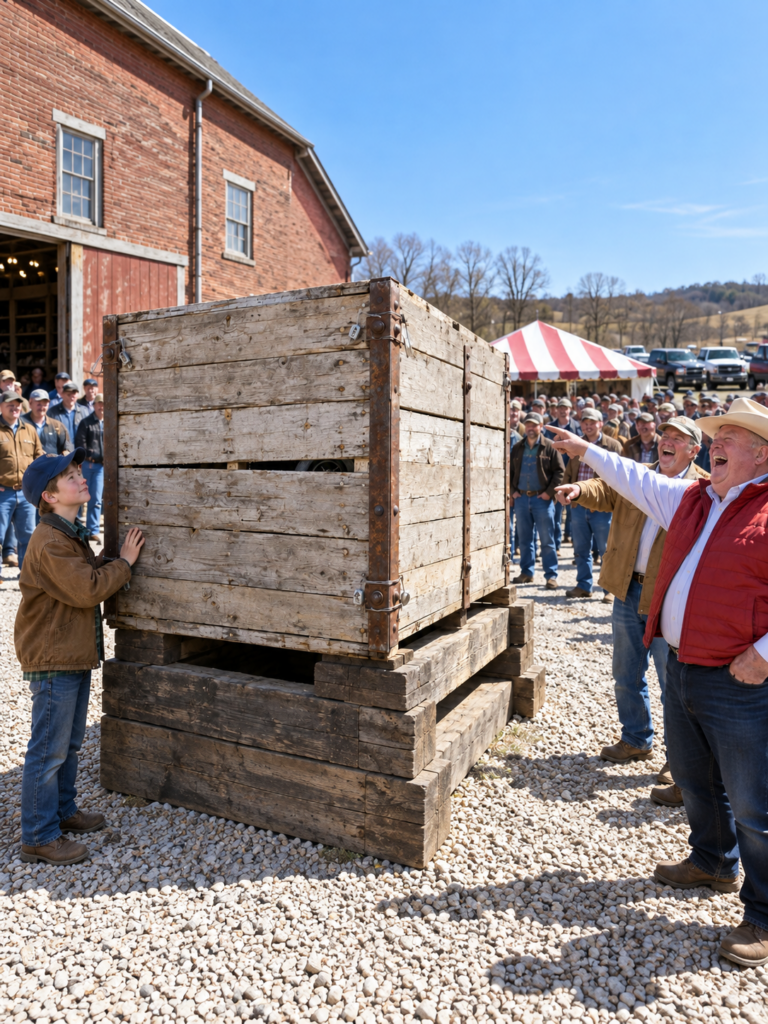
“Twenty-five dollars!” Royce shouted, slapping his palm against the wooden auction counter. “Ladies and gentlemen, the Pelfrey boy just spent twenty-five dollars on a pile of rotten lumber!”
Nearly sixty people stood inside the old Ness Feed and Implement barn that Saturday afternoon. Farmers in dusty boots, retired mechanics, widows looking for inexpensive tools, and men who had been attending farm auctions since before Owen Pelfrey was born.
Most of them laughed.
A few shook their heads.
And one twelve-year-old boy stood beside an enormous wooden crate, holding an auction receipt in his trembling hand.
His name was Owen Pelfrey.
He wore a faded brown canvas jacket that had belonged to his older cousin, jeans with a repaired knee, and boots his mother had purchased secondhand the previous winter.
The crate behind him was twelve feet long, six feet wide, and taller than the boy by nearly two feet. Its thick oak boards had been painted white so many times that the original shipping marks were almost invisible.
Nine rusted metal straps wrapped around it.
Small factory seals hung from twisted wires.
Nobody had opened it in more than a century.
And nobody in Ashby Mill, Iowa, believed there was anything worthwhile inside.
Royce Amler stepped closer.
He was sixty-one, broad-shouldered, wealthy, and accustomed to people moving aside when he entered a room. His family owned thousands of acres north of town, several grain storage facilities, and a controlling interest in the local farming cooperative.
He also owned the farmhouse where Owen lived with his parents.
Royce looked down at the boy with the pleasant expression of a man who enjoyed making someone else uncomfortable.
“Son,” he said, lowering his voice just enough to make his next words feel personal, “you really ought to have saved that money.”
Owen said nothing.
“Your mama’s going to need every penny she can get when she’s packing your things.”
A few people stopped laughing.
They knew what Royce meant.
Everybody in Ashby Mill knew.
In five weeks, the Pelfrey family’s rented farmhouse and the forty acres surrounding it would be sold at public auction.
And when the sale was finished, Owen’s family would have thirty days to leave.
Royce straightened and looked around the room.
“Unless, of course, that old box turns out to be full of gold!”
More laughter.
Owen folded the receipt carefully and slipped it into his jacket pocket.
Then he looked directly at Royce.
“I didn’t buy it because I thought it was full of gold, sir.”
Royce raised his eyebrows.
“Oh? Then what did you buy it for?”
Owen glanced at the crate.
“Because nobody else wanted to know what was inside.”
That answer produced another round of laughter.
But near the office door, a ninety-one-year-old man named Walter Ness stopped smiling.
He had been sitting quietly throughout the auction, his cane resting across his knees.
For seventy years, Walter had operated the feed business his grandfather had established in the late nineteenth century.
Now the business was closing, the equipment was being sold, and the building would soon belong to strangers.
Walter had watched nearly everything his family owned pass into other hands that afternoon.
But the wooden crate was different.
It had stood against the same brick wall for longer than anyone alive could remember.
His father had forbidden employees from opening it.
His grandfather had never explained why.
And now a boy with twenty-five dollars had bought it.
As Owen walked toward the door, Walter reached out and touched his sleeve.
“Son.”
Owen stopped.
Walter leaned closer.
“That crate was there before I was born.”
“I know, sir.”
“My daddy never let anybody touch it.”
Owen looked toward the wooden box.
“Did he ever tell you what was inside?”
Walter shook his head.
“No. But I remember something he told me once.”
The old man’s voice grew quiet.
“He said his father ordered something that was supposed to change the future of farming around here. And when it finally arrived, it broke his heart.”
Owen swallowed.
“What happened to it?”
Walter looked at the crate.
“I reckon you’re the one who’s going to find that out.”
Outside, a cold September wind rolled across the gravel parking lot.
Owen pulled his jacket tighter.
In his pocket was a receipt for twenty-five dollars.
At home, his mother had a kitchen drawer full of overdue bills.
And in five weeks, the only home he had ever really known might belong to a gravel company.
He had no idea whether his purchase was brilliant or foolish.
But he knew one thing.
He wasn’t going to open that crate.
Not yet.
The Pelfrey farmhouse stood along Plum Creek, eight miles south of Ashby Mill.
It was an old white two-story house with a sagging porch, a patched roof, and a red equipment shed built by Royce Amler’s grandfather.
The property had once been part of a much larger family farm.
Over the years, most of the surrounding land had been absorbed into Royce’s growing agricultural operation.
The forty-acre homestead was all that remained.
Owen’s family had rented it for six years.
His father, Curtis Pelfrey, drove a long-haul truck across the Midwest, sometimes staying away for two weeks at a time.
His mother, Rhonda, delivered mail along a ninety-four-mile rural route.
Neither earned much.
Together, they earned enough to pay the rent, keep their aging station wagon running, and make sure Owen never went to bed hungry.
But saving money was another matter.
Every time Rhonda managed to set aside fifty dollars, something broke.
A water pump.
A tire.
The washing machine.
A dental bill.
Life seemed to know exactly how much money they had and how quickly to take it back.
Their house wasn’t impressive.
The floors creaked.
The windows rattled in winter.
One kitchen cabinet door had been held shut with a hook for almost three years.
But Rhonda had made it a home.
She grew tomatoes behind the porch, hung curtains she had sewn herself, and kept family photographs on the mantel.
Curtis had built Owen a wooden desk beside his bedroom window.
Every spring, they planted sweet corn along the southern fence.
And every Christmas, no matter how tight money became, Rhonda decorated the cedar tree beside the driveway with colored lights.
Owen had never imagined living anywhere else.
Until the letter arrived.
It came on a Tuesday in August.
Rhonda opened it standing beside the kitchen sink.
The letter carried the letterhead of Amler Agricultural Holdings.
It stated that the forty-acre property would be sold on October 26.
Tenants would be required to vacate within thirty days of closing.
There was no personal explanation.
No offer to negotiate.
No acknowledgment of six years of rent paid promptly.
Only a notice.
Rhonda read it twice.
Then she folded it and placed it beside the breadbox.
That evening, she made meatloaf, mashed potatoes, and green beans.
She spoke normally.
She asked Owen about school.
She reminded him to finish his math homework.
She laughed when Curtis called and complained about the coffee at a truck stop in Nebraska.
But after Owen went upstairs, he heard her crying.
He stopped at the landing.
The kitchen light was still on.
His mother sat at the table with the letter in front of her, one hand pressed against her forehead.
“I don’t know where we’re going to go,” she whispered into the telephone.
Curtis was on the other end.
“We’ll figure something out,” he told her.
“With what money, Curtis?”
There was silence.
“I’ve been looking at rentals,” Rhonda continued. “Anything close enough that Owen can stay in the same school district. Everything costs twice what we’re paying now.”
“We’ll manage.”
“And what if we don’t?”
Her voice broke.
“What if we can’t?”
Owen backed quietly away from the stairs.
He had never heard his mother sound so frightened.
That night, he lay awake watching the moonlight move across his bedroom ceiling.
He thought about the garden.
The creek.
The red shed.
The tree where his father had hung a rope swing.
He thought about leaving his school, his friends, and the small bedroom where he had learned to read.
Then he remembered something his neighbor Lonnie Vick had told him at the county threshing reunion that summer.
“Sometimes,” Lonnie had said, “the things people overlook are worth more than the things everybody’s fighting over.”
At the time, Lonnie had been talking about an old tractor magneto.
But Owen couldn’t stop thinking about those words.
Lonnie Vick was seventy-four years old.
He lived alone in a small house half a mile down the road, surrounded by sheds filled with machinery parts.
His wife, Helen, had died eleven years earlier.
His children lived in different states.
And his closest regular visitor was a twelve-year-old boy who loved tractors.
Lonnie had spent forty-three years working as a machinist and repairing agricultural equipment.
He could identify antique engines by the sound of their exhaust.
He could sharpen a plow blade by hand.
And he had a habit of rescuing broken machines that other people considered worthless.
Owen had been visiting him since he was eight.
Their friendship began when Owen’s bicycle chain broke near Lonnie’s driveway.
Lonnie repaired it without asking for payment.
Then he showed the boy how to do it himself.
Four years later, Owen knew more about agricultural machinery than most grown men in Ashby Mill.
Every August, Lonnie took him to the county threshing reunion.
They spent three days wandering between steam engines, early gasoline tractors, and threshing machines that had not worked a field in generations.
Lonnie answered every question.
Even when Owen asked the same one twice.
One afternoon, standing beside a rusted tractor salvaged from a creek bottom, Lonnie had rested a hand on the iron wheel.
“Remember something, Owen. Used iron is everywhere. But untouched iron? Machinery that survived without ever working?”
He shook his head.
“That’s history you can put your hands on.”
A week before the auction, Owen visited the old Ness barn during its public inspection day.
Most buyers crowded around the grain cleaner, the antique scales, and a large wooden desk.
Owen wandered toward the back.
That was where he noticed the crate.
Its boards were warped with age.
One narrow gap had opened near the bottom.
Owen knelt and shined his flashlight through it.
Inside, he saw black iron.
A curved surface.
Heavy square cleats.
Something that looked very much like the wheel of an early tractor.
He leaned closer.
There was another smell.
Old grease.
Not the sour smell of abandoned machinery.
Clean, preserved grease.
The kind Lonnie kept in sealed tins.
Owen’s pulse quickened.
He moved the flashlight.
For one brief second, he caught the edge of a cast-iron hub with what appeared to be a raised letter.
Then the angle disappeared.
He stayed crouched there until the auction clerk told him the building was closing.
That night, Owen counted the money in the jar on his dresser.
Twenty-six dollars and forty-three cents.
Nearly all of it had come from mowing the Methodist church lawn throughout the summer.
He had been saving for a used bicycle.
Instead, he placed the money in an envelope.
For the first time since the eviction letter arrived, he felt something stronger than fear.
He had a plan.
Not a complete plan.
Not even a particularly sensible one.
But something he could do.
And when a child believes he has found a way to help his family, sometimes that belief is enough to make him brave.
Part 2
By Saturday morning, the entire town seemed to know that Owen Pelfrey had purchased the old crate.
And everybody wanted to see what would happen next.
The auctioneer had given him until noon to remove it from the Ness barn.
That presented a problem.
The crate weighed nearly three tons.
Owen owned a bicycle.
His mother drove a station wagon with 248,000 miles on it.
His father was hauling freight somewhere west of Wyoming.
Without Lonnie Vick, the purchase would have been impossible.
At eight-thirty, Lonnie arrived in his old blue flatbed truck.
A heavy winch was mounted behind the cab.
His toolbox sat on the passenger-side floor.
He wore a faded work coat and the same gray cap he had owned since Owen was born.
Rhonda met him at the driveway.
“Lonnie, I’m sorry he dragged you into this.”
Lonnie smiled.
“Your boy didn’t drag me anywhere.”
He looked toward Owen.
“He asked me a question, and I said I’d help him find the answer.”
Rhonda folded her arms.
“You don’t even know what’s in that thing.”
“No, ma’am.”
“And it’s enormous.”
“That it is.”
“And he’s spent practically every dollar he owns.”
Lonnie scratched his jaw.
“Well, Rhonda, I’ve spent considerably more than twenty-five dollars on considerably worse ideas.”
She tried not to smile.
“That’s not comforting.”
“It wasn’t meant to be.”
Owen came running from the porch.
“Are we going?”
Lonnie opened the truck door.
“Climb in, professor.”
The crowd had already gathered when they reached the feed barn.
Pickup trucks lined the gravel shoulder.
Several men stood drinking coffee near the loading door.
Royce Amler’s polished black pickup was parked across from the entrance.
His younger brother Dwight leaned against the tailgate.
When Lonnie pulled up, Royce raised his cup.
“Well, here comes the rescue operation.”
Owen ignored him.
Lonnie walked around the crate, checking the heavy oak skids underneath it.
He examined the floor.
The loading ramp.
The truck’s position.
Then he turned to Owen.
“First rule?”
“Stay clear of the cable.”
“Second rule?”
“Never stand where the load could fall.”
“Third?”
“If something starts going wrong, don’t try to save it.”
Lonnie nodded.
“Good. You might make a mechanic yet.”
The winch cable tightened.
For a moment, nothing happened.
The old boards creaked.
Dust drifted from the upper corners.
Then the crate moved.
Only an inch.
But it moved.
The crowd grew quiet.
Lonnie worked carefully, stopping several times to adjust wooden blocks beneath the skids.
Owen watched every movement.
His mother stood safely against the fence, one hand gripping her coat.
It took nearly forty minutes to pull the crate through the barn doorway.
Another half hour to secure it on the flatbed.
When Lonnie finally tightened the last chain, he stepped back and studied his work.
“That’ll travel.”
Royce walked over.
“Where exactly are you planning to put that thing?”
“Our shed,” Owen answered.
Royce chuckled.
“My shed, you mean.”
Owen went still.
Royce pointed toward the road.
“Remember, boy, you’re renting that property. You don’t own so much as a fence post.”
Rhonda stepped forward.
“Mr. Amler, that’s enough.”
Royce turned toward her with a practiced smile.
“I’m only being practical, Rhonda. Come November, your family won’t be there. I don’t want some enormous junk pile left behind.”
Lonnie climbed into his truck.
“The crate’s going to be taken care of.”
Royce looked up at him.
“That’s mighty charitable of you.”
Lonnie met his gaze.
“Some things are worth taking care of.”
Then he started the engine.
The truck rolled slowly out of the gravel lot, carrying the enormous whitewashed crate toward Plum Creek.
Owen sat beside him.
And for the first time that morning, he allowed himself to smile.
They placed the crate inside the red equipment shed.
It nearly filled the building.
Lonnie lowered it onto heavy railroad ties, checked that it rested evenly, and loosened the transport chains.
Rhonda brought him a cup of coffee.
“Thank you,” she said.
Lonnie accepted it.
“He’s a good boy.”
“I know.”
“He’s got a mind for machinery.”
“I know that too.”
Lonnie glanced toward the crate.
“He’s also got something weighing on him.”
Rhonda’s expression changed.
The older man spoke gently.
“Children hear more than we think they do.”
Rhonda lowered her eyes.
“I don’t want him worrying about the house.”
“He already is.”
She looked across the shed.
Owen was kneeling beside the wooden crate, studying its weathered surface.
He looked so small next to it.
“He’s twelve,” she whispered.
Lonnie nodded.
“That’s exactly why he’s trying so hard.”
Later that evening, Rhonda found Owen still sitting beside the crate.
The shed was cold.
A single overhead bulb cast a yellow circle across the concrete floor.
She carried two mugs of hot chocolate.
“Thought you might need this.”
Owen took one.
“Thanks, Mom.”
She sat on an overturned bucket.
For several minutes, they drank in silence.
Then Rhonda spoke.
“Can I ask you something?”
“Sure.”
“Why did you really buy it?”
Owen stared into his mug.
“Because I think there’s a tractor inside.”
“I know that part.”
He said nothing.
Rhonda waited.
Finally, Owen looked up.
“If it’s worth something, maybe we could buy a different house.”
Her heart tightened.
“Owen.”
“Not a big one. Just one near town. Maybe with a garage for Dad.”
She placed her mug down.
“Honey, that’s not something you need to fix.”
“I know.”
“You’re supposed to be worrying about homework and whether you’re going to make the baseball team.”
“I still do.”
“Owen.”
His eyes filled.
“I heard you crying.”
Rhonda closed her eyes.
For a moment, the only sound was the wind brushing against the shed walls.
Then she pulled her son against her.
He tried to hold himself together.
But once she wrapped her arms around him, his shoulders began shaking.
“I don’t want us to leave,” he whispered.
“I know, baby.”
“I don’t want Dad to have to drive more.”
“I know.”
“And I don’t want you to be sad.”
Rhonda held him tighter.
It was the kind of embrace a mother never forgets.
Because the boy in her arms was still young enough to need comforting, but already old enough to believe he should protect her.
She kissed his hair.
“You listen to me. Your father and I will find a way. We always have.”
Owen nodded against her shoulder.
“But maybe,” he said, “I can help.”
Rhonda looked toward the crate.
She had no faith in the enormous wooden box.
None at all.
But she believed in the boy sitting beside her.
And that night, she made a decision.
She would not make him feel foolish.
Whatever happened, she would let him try.
The following week was miserable.
By Monday morning, the story had spread through Ashby Mill.
Royce repeated it at the cooperative coffee counter.
At the gas station.
Outside the hardware store.
Everywhere he went, he described the purchase as the funniest thing he had seen in years.
At school, the jokes followed Owen from the cafeteria to the playground.
“Hey, Crate Boy!”
“Find any treasure yet?”
“My dad says you’re starting a lumberyard!”
Owen kept walking.
He had never been especially popular.
He wasn’t good at basketball.
He wore inexpensive clothes.
He spent his spare time repairing old lawnmowers with a seventy-four-year-old neighbor.
But until that week, most children had left him alone.
Now everybody seemed to have an opinion.
On Wednesday, a boy named Tyler Mercer approached him near the school buses.
“My dad says your family is getting kicked out.”
Owen tightened his grip on his backpack.
“We’re not getting kicked out.”
“Then why’s your house being sold?”
“Because the owner wants to sell it.”
Tyler smirked.
“Same thing.”
Owen looked away.
“Whatever.”
Tyler stepped closer.
“You really think that stupid box is gonna buy you a house?”
Owen didn’t answer.
“Because my dad says there’s probably nothing inside but rats.”
Owen pushed past him.
He reached the bus before the tears came.
He sat at the very back, turned toward the window, and pressed his forehead against the cold glass.
That afternoon, he went directly to Lonnie’s workshop.
The old man was repairing a carburetor.
He looked up when Owen entered.
“Rough day?”
Owen nodded.
Lonnie moved a stool beside the workbench.
“Sit.”
The boy sat.
For a while, neither spoke.
Then Owen asked, “What if I’m wrong?”
Lonnie set down his screwdriver.
“About the crate?”
Owen nodded.
“What if it’s nothing?”
“Then you’re out twenty-five dollars.”
“And everybody was right.”
Lonnie leaned against the bench.
“About what?”
“That I’m stupid.”
The older man’s face hardened.
“Now listen here.”
Owen stared at the floor.
“Being wrong about something doesn’t make a man stupid. It makes him wrong about something.”
He waited until Owen looked up.
“But laughing at somebody who’s trying? Making a child feel small because his family has less money?”
Lonnie shook his head.
“That tells you considerably more about the people doing the laughing.”
Owen wiped his nose.
“But what if there isn’t a tractor?”
“Then we’ll find that out.”
“And if there is?”
“Then we’ll find that out too.”
Lonnie opened a drawer and removed a small brass caliper.
“Now. You said you saw a wheel through the boards?”
“Yes.”
“Tell me exactly what it looked like.”
For the next hour, they talked about old iron wheels, early motor plows, and the peculiar shapes of machinery manufactured before 1920.
By the time Owen left, he felt steadier.
Not because Lonnie promised the crate contained something valuable.
But because the old man had treated his questions seriously.
Sometimes that is the only encouragement a frightened child needs.
The following evening, Owen and Lonnie returned to the shed with flashlights, notebooks, measuring tapes, and a camera.
They agreed on one rule.
Nothing would be opened.
No boards removed.
No straps loosened.
No seals broken.
If the crate truly contained an unused antique machine, its original condition might matter more than anything else.
Owen measured every side.
Twelve feet, two inches long.
Six feet, one inch wide.
Seven feet, four inches high.
He drew sketches.
Photographed every corner.
Recorded the location of every metal strap.
Lonnie examined the wire seals.
Each carried three faint letters.
KMP.
“Those aren’t local shipping tags,” Lonnie said.
Owen leaned closer.
“What are they?”
“Factory seals, most likely.”
“From the tractor company?”
“Could be.”
“Can we tell which company?”
Lonnie smiled.
“That’s what research is for.”
They studied the whitewashed boards.
Near the bottom of one side, Owen noticed a dark line beneath several layers of paint.
Lonnie handed him a flashlight.
“Hold it almost flat against the wood.”
“Like this?”
“Lower.”
Owen adjusted it.
The shallow shadows of old lettering appeared.
He gasped.
“Lonnie!”
The old man leaned forward.
A large letter K.
Two faint vertical lines.
Something resembling an M.
Farther along, another word.
Its final letters looked like Q-U-E.
And near the end of the crate, barely visible beneath the paint, were the words:
NESS FEED & IMPLEMENT.
ASHBY MILL.
Owen took photographs.
Then he wrote the letters in his notebook.
KMP.
A company name beginning with K.
A city ending in QUE.
Lonnie rubbed his chin.
“Dubuque.”
“What?”
“Dubuque, Iowa. It’s an old manufacturing town.”
Owen’s eyes widened.
“You think that’s where it came from?”
“I think we just found ourselves a place to start looking.”
The next afternoon, they went to the Ashby Mill Public Library.
And that was where everything began to change.
Part 3
The Ashby Mill Public Library occupied the second floor of a former bank building on Main Street.
It had one long reading room, a narrow staircase, shelves that smelled of old paper, and windows overlooking the town square.
For thirty-one years, the library had been managed by Dolores Venn.
She was sixty-eight, wore lavender sweaters almost year-round, and believed that no question was too strange to deserve a proper answer.
Owen had been borrowing books from her since he was four.
By the age of ten, he had read nearly every book the library owned about farm machinery.
Now he stood at her desk with a spiral notebook full of measurements.
“Mrs. Venn?”
She looked up from a stack of returned books.
“Well, Owen Pelfrey. I hear you bought something interesting.”
Owen’s cheeks warmed.
“You heard about that?”
“Half the county has heard about it.”
He lowered his head.
“Yeah.”
Dolores removed her glasses.
“Most of what I’ve heard is coming from people who haven’t bothered to learn a single thing about it.”
She held out her hand.
“Let’s see what you’ve got.”
Owen placed his notebook on the desk.
He showed her the photographs.
The dimensions.
The factory seals.
The faint lettering.
Dolores studied one image.
“KMP,” she murmured.
“That’s on all nine seals,” Owen said.
“And you believe the machine came from Dubuque?”
“Lonnie does.”
She looked at him.
“Did you know Dubuque had dozens of small manufacturing businesses around the turn of the century?”
Owen shook his head.
“Farm implements, gasoline engines, wagons, industrial equipment. Most of them disappeared before the Great Depression.”
She turned back to the photograph.
“And you say this crate was at Ness Feed and Implement?”
“Yes, ma’am.”
“Then Albert Ness probably ordered it.”
“Walter’s grandfather?”
“That’s right. Albert advertised everything his business sold.”
Dolores stood and walked toward a locked cabinet.
“Let’s see whether he advertised this.”
Inside the cabinet were boxes of microfilm containing old editions of the Ashby Mill Ledger.
The newspaper had been published every Thursday since 1892.
Dolores carried several reels to the reader.
For nearly two hours, they searched advertisements from 1917.
Nothing.
Then 1918.
Still nothing.
The library closed before they reached 1919.
Owen looked discouraged.
Dolores touched his shoulder.
“Come back tomorrow.”
“What if it’s not there?”
“Then we’ll look somewhere else.”
“You don’t think I’m wasting your time?”
She smiled.
“Owen, I’m a librarian. Finding things is my idea of a good afternoon.”
He returned the following day.
And the day after that.
On the third evening, Dolores stopped the film reader.
“Wait.”
Owen leaned forward.
A quarter-page advertisement filled the screen.
At the top was an illustration of a short, heavy tractor with tall iron wheels.
Beneath it were the words:
THE KESLER MOTORPLOW.
BUILT IN DUBUQUE, IOWA.
ARRIVING THIS SPRING AT NESS FEED & IMPLEMENT.
Owen stared.
“KMP,” he whispered.
Dolores nodded.
“Kesler Motorplow.”
They read the advertisement again.
It promised a compact gasoline-powered agricultural machine suitable for small family farms.
A machine capable of replacing teams of horses.
A machine designed to reduce labor.
The advertised price was substantial for its time.
But the manufacturer claimed the machine could transform farming.
Owen looked at the drawing.
The rear wheels had broad iron cleats.
Exactly like the curved iron he had glimpsed through the crate.
“That’s it,” he whispered.
Dolores looked at him.
“We have a strong possibility.”
“No. Look.”
He pulled out his notebook.
The wheel sketch he’d made matched the illustration.
Dolores studied them side by side.
Her expression changed.
“Well,” she said softly. “That’s certainly interesting.”
They continued searching.
Five weeks later, a short announcement appeared on page six of the Ledger.
The Kesler Motorplow Company had closed.
Its bank had called outstanding loans.
Factory assets had been seized.
Dealers were advised that replacement parts and future service could not be guaranteed.
Dolores read the paragraph aloud.
Owen sat back.
“That’s why it was never opened.”
“Maybe.”
“Albert Ness ordered it. Then the company went bankrupt before he could sell it.”
Dolores looked toward the illustration.
“A farmer wouldn’t pay good money for a machine he couldn’t repair.”
“So he put it in storage.”
“Or decided not to unpack it in the first place.”
Owen looked down at his hands.
One hundred years.
The machine had been waiting for more than one hundred years.
Then Dolores found something else.
In an old agricultural encyclopedia, the Kesler Motorplow Company appeared in a short list of vanished manufacturers.
The entry was only a few lines long.
Production was estimated to have been extremely limited.
No surviving complete machines were documented.
Owen read those words several times.
No surviving complete machines.
He thought about the sealed crate standing inside his family’s red shed.
His throat felt dry.
“Mrs. Venn?”
“Yes?”
“Does that mean it might be rare?”
Dolores considered her answer carefully.
“It means that if we are right, it could be historically important.”
“How important?”
“I don’t know.”
“Worth money?”
“Possibly.”
“How much?”
She smiled gently.
“That is a question for somebody who knows a great deal more about antique tractors than I do.”
Owen took another look at the advertisement.
Then he closed his notebook.
“I want to find that person.”
Two days later, Owen wrote a letter to the State Museum of Agriculture.
He worked at the kitchen table while his mother prepared dinner.
The letter was three handwritten pages long.
He described the crate.
The seals.
The photographs.
The advertisement.
The factory history.
He explained why he believed an untouched Kesler Motorplow might be inside.
He did not mention the schoolyard jokes.
He did not mention Royce Amler.
He did not mention that his family might lose their home.
And he did not mention that he was twelve years old.
He wanted the letter to be judged by the evidence.
Not by his age.
The following morning, Dolores typed his letter and emailed it to the museum.
At the bottom, she added a sentence of her own.
I have known this young man since he was four years old. He is careful, honest, and remarkably knowledgeable about early agricultural machinery. I believe his discovery deserves serious attention.
Then they waited.
During those days, the weather turned colder.
The cornfields north of Ashby Mill faded from green to brown.
Dust rose behind combines.
The creek dropped low enough that stones appeared along its banks.
And the land auction drew closer.
Every evening, Rhonda checked rental listings.
She kept a handwritten notebook with addresses, monthly payments, and telephone numbers.
Most houses were too expensive.
Several were too far from Owen’s school.
One had a leaking roof.
Another had no functioning heat.
Curtis called whenever he could.
He offered to take longer routes.
Rhonda told him not to.
He offered to sell his pickup.
She reminded him he needed it when he was home.
They argued once about money.
Not loudly.
Not cruelly.
But Owen heard enough through his bedroom floor to understand.
His parents were running out of options.
One Thursday evening, Curtis called from a truck stop near Rawlins, Wyoming.
Owen answered.
“Hey, Dad.”
“Hey, buddy. How’s my favorite mechanic?”
“Okay.”
“Your mama tells me you’re still working on that crate.”
“Yes, sir.”
“Any progress?”
Owen hesitated.
“I think I know what’s inside.”
“Well, don’t keep your old man guessing.”
“A Kesler Motorplow. From 1919.”
Curtis whistled.
“Never heard of one.”
“That’s because hardly anybody has.”
“Is that good?”
“I think so.”
Curtis laughed.
A warm laugh.
Nothing like Royce Amler’s.
“Well, son, you know more about tractors than I ever will.”
Owen gripped the telephone.
“Dad?”
“Yeah?”
“Are we gonna lose the house?”
There was a long silence.
In the background, Owen could hear truck engines idling.
Finally, Curtis spoke.
“I don’t know, Owen.”
The honesty hurt.
But Owen appreciated it.
“Your mother and I are working on something,” Curtis continued.
“I know.”
“And whatever happens, we’ll be together.”
Owen looked through the kitchen window toward the red shed.
“I really want to stay here.”
“I know you do.”
“I’ve lived here half my life.”
Curtis exhaled.
“So have we, in a way.”
Another pause.
Then his father said something Owen would remember for years.
“Son, a home is more than the ground under it. But that doesn’t mean the ground doesn’t matter.”
Owen swallowed.
“I know.”
“And I promise you, we won’t stop trying.”
After they hung up, Owen sat at the kitchen table for a long time.
Then he opened his notebook.
He added another page of questions for the museum.
Because waiting frightened him more than working.
The following Sunday, Royce Amler arrived at the property without calling.
His pickup rolled up the driveway shortly after two.
Dwight sat beside him.
Owen was in the shed photographing the crate.
He looked up when Royce entered.
“Well,” Royce said, looking around, “there’s the famous treasure chest.”
Owen put down his camera.
“Afternoon, Mr. Amler.”
Royce walked slowly along the crate.
He tapped one of the boards.
“Still haven’t opened it?”
“No, sir.”
“Afraid there’s nothing inside?”
“No.”
“Then why keep it sealed?”
“Because I want somebody who knows what they’re doing to examine it first.”
Royce chuckled.
“Somebody who knows what they’re doing.”
He glanced at Dwight.
“Listen to him. Sounds like a little businessman.”
Dwight smiled weakly.
Royce removed his wallet.
“Tell you what. I’ll give you fifty dollars for the whole thing.”
Owen stared at him.
“Fifty?”
“Double your money. Not bad for a week’s work.”
“No, thank you.”
Royce raised his eyebrows.
“A hundred, then.”
Owen shook his head.
“It’s not for sale.”
Royce’s smile thinned.
“Boy, you’re turning down easy money.”
“I know.”
“You ought to learn when somebody’s doing you a favor.”
Owen looked at the crate.
“I’m trying to learn what I bought.”
For a moment, Royce said nothing.
Then he slid his wallet back into his pocket.
“Fine.”
His voice had changed.
“Keep your box.”
He stepped closer.
“But let me remind you of something.”
Owen stood very still.
“This land belongs to me. The shed belongs to me. And on October twenty-sixth, all of it goes to auction.”
“Yes, sir.”
“If you leave that thing here after the sale, the new owner won’t be responsible for it.”
“I understand.”
Royce looked down at him.
“And I don’t intend to delay the sale because some child thinks he’s found a fortune in junk.”
Owen’s face reddened.
“I’m not asking you to delay anything.”
“Good.”
Royce turned toward the door.
Outside, a man wearing a Brasque Aggregate jacket was driving survey stakes along the fence near Plum Creek.
Royce watched him with satisfaction.
Then he glanced over his shoulder.
“Better start packing, Owen.”
The words stayed in the air after he left.
Owen stood beside the crate, his fists clenched.
He wanted to run after the man.
He wanted to shout.
He wanted to tell Royce that his family had cared for the property better than the owner ever had.
But he did none of those things.
Instead, he sat on the concrete floor.
For the first time since the auction, he wondered whether everyone might be right.
Maybe he had been foolish.
Maybe the crate contained broken machinery.
Maybe no museum would care.
Maybe there was nothing he could do.
He sat there until the light faded.
Then Lonnie came through the door.
The older man saw Owen’s expression and lowered himself onto a bucket.
“Royce stopped by?”
Owen nodded.
“Offered me a hundred dollars.”
“Did he now?”
“I told him no.”
Lonnie was quiet.
“Was that stupid?”
“No.”
“You don’t even know if it’s worth anything.”
“Neither does Royce.”
Owen looked up.
Lonnie pointed toward the factory seals.
“There’s a difference between knowing something has value and knowing exactly what that value is.”
Owen wiped his eyes.
“What if the museum never answers?”
“Then we’ll contact another one.”
“And if they don’t answer?”
“We’ll find an antique machinery society.”
“And if nobody cares?”
Lonnie leaned toward him.
“Then I’ll still be proud of you.”
Owen blinked.
“Why?”
“Because you asked a question when everybody else was laughing. And you did the work to find an answer.”
The old man stood slowly.
“Come on. Your mama’s got supper ready.”
They turned off the shed light and walked toward the house.
Two days later, the telephone rang.
And everything Owen believed about the crate began to change.
Part 4
Rhonda answered the telephone just after six on Tuesday evening.
Owen was eating spaghetti at the kitchen table.
She listened for a few moments, then turned toward him.
“Owen?”
He looked up.
“There’s a woman on the telephone asking for you.”
“Who?”
“She says she’s from the State Museum of Agriculture.”
Owen nearly dropped his fork.
He hurried to the telephone.
“Hello?”
“May I speak with Owen Pelfrey?”
“This is Owen.”
“Hello, Owen. My name is Dr. Margaret Lindquist. I’m the senior curator of agricultural technology at the State Museum.”
“Yes, ma’am.”
“I received your letter.”
Owen gripped the receiver.
“I was hoping you would.”
Margaret laughed softly.
“I’ve read it four times.”
He glanced at his mother.
“Four?”
“Your measurements are unusually detailed. And your photographs of the factory seals are particularly interesting.”
Owen swallowed.
“Do you think it’s a Kesler?”
There was a pause.
“I think you may have found something I’ve been looking for for twenty-two years.”
Owen stopped breathing for a moment.
Margaret continued.
“I have one original photograph of a Kesler Motorplow taken in 1918. I have several factory drawings. I’ve searched auction records, old agricultural warehouses, private collections, and historical society inventories across the Midwest.”
“Did you find one?”
“No.”
“Not even one?”
“Not a complete machine.”
Owen looked out the window toward the shed.
“And you think mine might be complete?”
“I think there’s a possibility.”
“How big a possibility?”
“Big enough that I’d like to drive to Ashby Mill and examine the crate personally.”
Owen’s knees weakened.
He sat down.
Margaret went on.
“I’d also like to bring an appraiser named Harlon Weeks. He specializes in early farm engines and tractors.”
“Yes, ma’am.”
“There’s one very important thing I need to ask.”
“Okay.”
“Have you opened the crate?”
“No, ma’am.”
“Not even one board?”
“No.”
“Have any of the factory seals been broken?”
“No, ma’am. All nine are still there.”
Margaret exhaled audibly.
“Good.”
“Is that important?”
“Potentially very important.”
Owen looked at the table.
His mother was watching him.
“Can I ask you something?” he said.
“Of course.”
“If it really is a Kesler, would opening it ruin anything?”
“No, not if it is documented and handled correctly. But we need to examine everything before disturbing the original packaging.”
Owen nodded.
Then an idea came to him.
“Could we open it somewhere people can watch?”
Margaret paused.
“What do you mean?”
“At the fairgrounds. In the exhibition building.”
“Why there?”
Owen looked through the kitchen window.
He could see the place where Royce’s truck had stopped on Sunday.
“Because a lot of people think I bought garbage.”
Margaret remained silent.
“And my mom’s been embarrassed. And kids at school keep making jokes.”
His voice became steadier.
“I don’t want to embarrass anybody back. I just want everyone to see what it is at the same time.”
Margaret considered that.
Then she said, “Owen, I think that’s an excellent idea.”
Once the plans were made, Ashby Mill began talking about the crate for an entirely different reason.
The State Museum was coming.
An expert appraiser was coming.
And the mysterious wooden box would finally be opened in front of witnesses.
Lonnie arranged to use the county fairgrounds exhibition hall.
The Methodist church loaned forty folding chairs.
Dolores Venn offered to display copies of the original 1919 newspaper advertisement.
Walter Ness agreed to attend despite his declining health.
Even the Ashby Mill Ledger sent its young editor, Paul Sabo, to photograph the event.
Owen helped his mother write invitations.
There was one he insisted on delivering himself.
Royce Amler.
Rhonda watched as Owen wrote the man’s name on an envelope.
“Are you sure about that?”
Owen nodded.
“He ought to be there.”
“After everything he’s said?”
“Especially after everything he’s said.”
Rhonda sat beside him.
“Sweetheart, you know you don’t have to prove anything to that man.”
Owen looked at her.
“I know.”
“Then why invite him?”
“Because he’s been telling everybody what’s inside my crate.”
He paused.
“I want him to hear the answer from somebody who actually knows.”
Rhonda studied her son.
Then she smiled.
“All right.”
Royce received the invitation at the cooperative office.
He read it aloud.
Then he laughed.
“Well, would you look at this!”
Several men sitting at the coffee counter turned.
“The Pelfrey boy is putting on a show at the fairgrounds!”
He held up the invitation.
“Got himself a museum lady and everything!”
One man asked whether the crate had finally been opened.
“Nope,” Royce replied. “Still sealed. Apparently we’re all supposed to gather around and watch them discover a hundred-year-old pile of feed sacks.”
He looked at the date.
“Saturday morning.”
Then he grinned.
“I wouldn’t miss it.”
Dwight sat beside him.
“You really think there’s nothing in there?”
Royce shrugged.
“Probably some obsolete machine nobody wanted.”
“But why bring in experts?”
“Because people love a mystery.”
Dwight looked down at his coffee.
“Maybe the boy found something.”
Royce’s expression tightened.
“Dwight, I’ve been buying and selling farm equipment longer than that boy’s been alive.”
“I know.”
“If something valuable had been sitting in the Ness barn for a hundred years, somebody would’ve found it.”
Dwight said nothing.
Royce folded the invitation.
“And even if there is an old tractor in there, it won’t be worth enough to change anything.”
He dropped the envelope onto the counter.
“Five weeks from now, that farm still gets sold.”
The night before the opening, Curtis Pelfrey drove home through the dark.
He had arranged for another driver to take his final delivery.
It cost him two days of work.
Money the family could scarcely afford to lose.
But he refused to miss Saturday.
He reached the farmhouse shortly before dawn.
Rhonda was asleep.
Owen had fallen asleep at the kitchen table with his notebook open.
Curtis stood in the doorway for a long moment, looking at his son.
The boy’s cheek rested against pages filled with sketches of antique tractor wheels.
Beside his elbow lay a photograph of the 1919 Kesler advertisement.
Curtis walked quietly across the kitchen and placed a hand on Owen’s shoulder.
The boy woke with a start.
“Dad?”
“Hey, buddy.”
Owen jumped up and wrapped his arms around him.
Curtis held him tight.
“I thought you weren’t coming until Sunday!”
“Changed my mind.”
“Did you drive all night?”
“Most of it.”
“Are you tired?”
“Pretty tired.”
“Are you gonna be there when they open it?”
Curtis looked down at him.
“Wouldn’t miss it for anything.”
Owen stepped back.
“What if there’s nothing inside?”
Curtis took off his jacket.
“Then we’ll all know.”
“What if everybody laughs?”
His father rested both hands on his shoulders.
“Then they laugh.”
Owen lowered his eyes.
“But I need you to understand something.”
Curtis waited until his son looked up.
“I am not coming because I think you’ve found a fortune.”
Owen swallowed.
“Okay.”
“I’m coming because you’ve spent weeks working harder on this than some grown men work on anything in their lives.”
He squeezed the boy’s shoulders.
“And I want to be there when you find out what all that work means.”
Owen nodded.
Then he hugged his father again.
Outside, the first pale light appeared over the cornfields.
By ten o’clock Saturday morning, more than forty people had gathered inside the county exhibition hall.
The crate stood in the center of the concrete floor.
Its whitewashed boards looked even older beneath the bright overhead lights.
Chairs faced it in three rows.
Walter Ness sat in the front with his cane.
Dolores sat beside him, holding the printed newspaper advertisement.
Lonnie stood near the crate, speaking quietly with a tall man in a tweed jacket.
That man was Harlon Weeks.
He had been appraising antique farm machinery for thirty-four years.
Beside him stood Dr. Margaret Lindquist, a woman in her fifties with silver-gray hair, wire-rimmed glasses, and a navy blazer.
They had spent nearly twenty minutes examining the crate.
Taking measurements.
Photographing joints.
Reading worn lettering.
Studying the nine factory seals.
Royce sat near the end of the second row.
He wore his familiar red quilted vest.
A bag of marshmallows rested in his lap.
When Owen entered with his parents, Royce stood.
“Last chance, son.”
Owen stopped.
Royce reached into his pocket and pulled out a folded bundle of bills.
“Five hundred dollars. Right here. Right now.”
Several people turned.
“Save yourself the disappointment.”
Owen looked at the money.
Five hundred dollars was more than he’d ever held at one time.
It would help with groceries.
Gasoline.
Maybe even a deposit on another rental.
But he thought about the letters.
The seals.
The photographs.
And the hours everyone had spent helping him.
“No, thank you.”
Royce tilted his head.
“You’re really going to turn down five hundred dollars for a box you bought for twenty-five?”
Owen answered quietly.
“Yes, sir.”
Royce gave a sharp laugh.
“Suit yourself.”
Owen walked past him.
His father placed a hand on his back.
And together, they took their seats.
At ten-thirty, Margaret stepped forward.
“Ladies and gentlemen, thank you for coming.”
The room quieted.
“We’re here to examine an object that may represent an extraordinary piece of American agricultural history.”
Royce leaned back in his chair.
Margaret continued.
“Before proceeding, Mr. Weeks and I have documented the shipping crate, its construction, its seals, and its surviving markings.”
She turned toward Harlon.
He crouched beside one of the gray metal tags.
“This seal,” he said, “carries the initials KMP.”
He held it carefully between two fingers.
“Kesler Motorplow Company.”
A murmur moved through the room.
Harlon looked toward Owen.
“All nine seals appear consistent with factory packaging from the period. None shows evidence of having been opened.”
He stood.
“That is remarkable in itself.”
Royce stopped smiling.
Margaret gestured toward the crate.
“We cannot authenticate the contents until the box is opened.”
She turned toward Owen.
“Young man, are you ready?”
Owen stood.
His mouth was dry.
He looked at his mother.
Rhonda gave him a small nod.
Then at Curtis.
His father nodded too.
Owen took a breath.
“Yes, ma’am.”
Harlon lifted a pair of side cutters.
He positioned them around the first twisted wire.
The little metallic snap echoed through the building.
Then another.
And another.
One by one, the nine factory seals were cut.
Margaret photographed each one before it was moved.
Lonnie and Harlon loosened the iron straps.
They worked slowly, protecting the old timber wherever possible.
Finally, Harlon reached for the first long oak plank.
He eased the nails free.
Lonnie lifted one end.
Together, they removed the board.
And beneath the century-old whitewash, something green appeared.
Not faded green.
Not rust-streaked green.
A deep, glossy factory green that looked as though it had been painted yesterday.
Someone in the front row gasped.
Harlon froze.
Margaret took one step forward.
Then she whispered, “Oh, my goodness.”
The second plank came away.
A great iron wheel emerged.
Its spokes were bright red.
Its heavy cleats were untouched.
The third plank revealed the curve of an engine hood.
Then a brass plate.
Then a steering mechanism.
Margaret covered her mouth.
Harlon stared.
Lonnie slowly removed his cap.
And Owen stood so still that his mother reached over and took his hand.
Because everyone in that room could now see what had been hidden for more than one hundred years.
But the most important discovery was still ahead.
And when Harlon Weeks saw the serial number, even he had to sit down.
Part 5
The final board came away just before noon.
In the center of the exhibition hall stood a complete Kesler Motorplow.
Its iron wheels rested on the original oak shipping skids.
Its green paint gleamed beneath the lights.
The red wheel spokes had never been scraped against a fieldstone.
The small pressed-steel seat was still wrapped in protective factory paper.
A set of tools lay inside a wooden compartment attached to the machine.
Beside the tools was an instruction manual wrapped in waxed paper.
The fuel tank was empty.
The grease fittings were clean.
And the engine showed no sign of ever having been started.
For a long time, nobody spoke.
Then Walter Ness rose slowly from his chair.
His cane trembled against the concrete.
“My grandfather ordered that,” he whispered.
Margaret turned toward him.
Walter approached the machine.
His eyes were wet.
“My daddy told me his father ordered something once that cost him more than he could afford.”
He reached out, stopping just before touching the green hood.
“Said it was going to change the way farmers worked.”
His voice broke.
“But then the company failed. Nobody wanted to buy it. And he couldn’t bring himself to open the crate.”
Walter looked at Owen.
“All those years.”
Tears ran down his cheeks.
“All those years it was sitting there.”
Owen moved beside him.
Walter laid a trembling hand on the boy’s shoulder.
“You found it, son.”
Owen swallowed.
“We found it.”
Walter shook his head.
“No. I walked past that box for ninety-one years.”
He smiled through his tears.
“You’re the one who stopped to look.”
Harlon Weeks crouched beside the engine.
He examined the castings.
The identification plate.
The untouched controls.
Then he carefully read the serial number.
Thirty-one.
He looked at Margaret.
She looked back at him.
Neither spoke.
Finally, Margaret turned toward the audience.
“Ladies and gentlemen, I need to explain what you’ve just witnessed.”
The room grew silent.
“The Kesler Motorplow Company operated for only a few years in Dubuque, Iowa. It was a small manufacturer attempting to provide affordable gasoline-powered machinery to family farmers.”
She gestured toward the tractor.
“Only thirty-eight machines were completed before the business collapsed in 1919.”
A murmur moved through the crowd.
“Over the years, historians and collectors have searched for surviving examples. None has ever been conclusively documented as complete.”
She placed her hand lightly on the hood.
“Until today.”
Owen’s mother gripped Curtis’s arm.
Margaret continued.
“This machine appears to have remained in its original shipping crate since March 1919. It retains its factory finish, tools, documentation, and packaging.”
She looked at Owen.
“And most remarkably, it has never been used.”
Harlon rose.
“I’ve spent thirty-four years evaluating antique agricultural equipment,” he said.
“I’ve seen rare steam engines, early tractors, one-of-a-kind prototypes, and machinery that collectors have spent fortunes restoring.”
He paused.
“But this is something different.”
He turned toward the tractor.
“This isn’t merely a rare machine. It’s a preserved historical object in exceptional original condition.”
Royce sat motionless.
Harlon continued.
“For insurance purposes, taking into account its uniqueness, condition, provenance, and historical importance, I would recommend a valuation of no less than three hundred and ten thousand dollars.”
For a heartbeat, the entire room seemed to stop breathing.
Then someone gasped.
A chair scraped against the floor.
Dolores pressed a hand to her chest.
Lonnie stared at the ceiling.
Rhonda whispered, “Curtis…”
Her husband was looking at Owen.
The boy seemed unable to move.
“Three hundred…” Owen began.
Harlon smiled.
“Three hundred and ten thousand dollars.”
Owen shook his head.
“But I only paid twenty-five.”
“I know.”
“Twenty-five dollars.”
“I know, son.”
Owen looked at the enormous machine.
Then at his parents.
His mother’s face crumpled.
She began crying.
Curtis put his arms around her.
And Owen stood there trying to understand how the wooden crate that had made an entire town laugh might now be worth more than his parents earned in several years.
Across the aisle, Royce Amler stared at the tractor.
The bag of marshmallows rested unopened in his lap.
Dwight leaned toward him.
“Royce…”
Royce did not respond.
After a long moment, he stood.
He picked up the bag.
And walked quietly toward the exit.
Nobody laughed.
Nobody stopped him.
Nobody even turned to watch.
That afternoon, Margaret met privately with the Pelfrey family.
The museum had already been working with a donor interested in acquiring historically significant farm machinery.
Margaret explained that the museum could make a formal purchase offer, subject to final documentation and arrangements.
Owen sat beside his parents.
His legs barely reached the floor.
“Would you keep it at the museum?” he asked.
“Yes,” Margaret said. “On permanent public display.”
“Where people can see it?”
“Where thousands of people can see it.”
Owen looked toward the machine.
“Would they know where it came from?”
“Absolutely.”
“Would Mr. Ness’s grandfather be mentioned?”
Margaret smiled.
“He certainly would.”
Owen hesitated.
“Can the crate go with it?”
“The crate?”
“All the boards. The straps. Even the cut seals.”
“Of course.”
“Because everybody thought the crate was garbage.”
Margaret nodded.
“I understand.”
“And there’s something else.”
“Yes?”
Owen looked at Lonnie.
“If you ever get it running, can I be there?”
Lonnie smiled.
Margaret considered the question.
“If our conservation team determines it can be operated safely, I’ll make sure you’re invited.”
Owen nodded.
Then he looked at his parents.
“Mom?”
Rhonda wiped her cheeks.
“Yes, sweetheart?”
“Do you think we could buy our house?”
The question hung in the room.
Curtis looked toward Margaret.
The curator understood immediately.
She gently closed her folder.
“Tell me about your home.”
The museum’s final offer was three hundred and ten thousand dollars.
The paperwork required legal review.
There were questions about ownership, provenance, and the appropriate way to hold the proceeds for a minor.
Curtis and Rhonda obtained legal advice and worked through those matters with the museum.
The money was placed under arrangements designed to protect Owen’s interests.
And the family prepared for the land auction.
The sale was scheduled for October 26.
Two days before the auction, the museum transaction was completed and the funds became available.
After reviewing the cost of purchasing and maintaining the property, the family agreed that buying the homestead was the right decision.
For the first time since the eviction notice arrived, Rhonda slept through the night.
But there was still one problem.
They had to win the auction.
And Royce Amler had no intention of making it easy.
The morning of October 26 was cold and bright.
The fields around Plum Creek had been harvested.
Cornstalks rattled in the breeze.
The old white farmhouse stood beneath a pale blue sky.
Marv Tuttle, the same auctioneer who had sold Owen the crate, stood on a hay wagon with a microphone.
More than a hundred people had gathered.
Some were potential buyers.
Others had come because the story of the Kesler Motorplow had traveled far beyond Ashby Mill.
The Brasque Aggregate representative stood near the front with a bidding folder.
The company wanted the gravel deposits beneath the property.
Royce stood beside the auctioneer wearing his red vest.
He had barely spoken to anyone that morning.
Owen arrived with his parents.
He wore the same brown jacket he’d worn to the feed barn auction.
In his hand was bidding card number forty-three.
Lonnie stood near the front.
Walter Ness sat in a folding chair beside Dolores.
Rhonda looked at the house.
The porch steps Curtis had repaired.
The upstairs window where Owen slept.
The garden she had planted every spring.
She took her husband’s hand.
“Whatever happens,” she whispered, “thank you for coming home.”
Curtis squeezed her fingers.
“Always.”
Marv tapped the microphone.
“Ladies and gentlemen, we’re offering forty acres, improvements, residence, outbuildings, and associated property interests, subject to the published terms.”
He paused.
“Opening bid, one hundred and fifty thousand dollars.”
The Brasque representative raised his card.
Owen looked at Curtis.
His father nodded.
Owen raised number forty-three.
“One hundred and fifty-five thousand.”
A murmur moved across the crowd.
The bidding continued.
One hundred and sixty.
One hundred and sixty-five.
One hundred and seventy.
Owen raised his card again.
The representative answered.
Each bid felt heavier than the last.
Rhonda kept looking from the house to the auctioneer.
At two hundred thousand dollars, Marv paused.
“Two hundred thousand. Do I hear two hundred and five?”
The gravel company bid again.
Owen raised his card.
The crowd went quiet.
Royce stood rigid beside the wagon.
The boy he’d laughed at was now bidding against a commercial land buyer.
For the very property Royce had threatened to take away from him.
The bidding climbed.
Two hundred and twenty.
Two hundred and twenty-five.
Two hundred and thirty.
The representative from Brasque studied his documents.
Then raised his card again.
“Two hundred and thirty-four thousand.”
Marv looked toward Owen.
Owen looked at his mother.
Rhonda nodded.
He lifted his card.
“Two hundred and thirty-six thousand.”
Silence.
The gravel company representative examined his folder.
He spoke quietly to another man.
Then shook his head.
Marv waited.
“Two hundred and thirty-six thousand. Any advance?”
Nobody moved.
“Going once.”
Owen gripped the bidding card.
“Going twice.”
Rhonda covered her mouth.
“Sold!”
The auctioneer’s voice rang across the yard.
“Forty acres and the farmhouse to bidder number forty-three for two hundred and thirty-six thousand dollars!”
For one second, Owen did not react.
Then his father lifted him off the ground.
Rhonda began crying.
Lonnie removed his cap.
Dolores clapped.
And Walter Ness smiled so broadly that his whole face seemed younger.
Owen wrapped his arms around his father’s neck.
“Dad?”
“Yeah, buddy?”
“Does that mean we get to stay?”
Curtis’s voice broke.
“Yes, son.”
“Forever?”
His father looked toward the farmhouse.
“As long as we take good care of it.”
Owen buried his face against his father’s shoulder.
The same house.
The same garden.
The same creek.
The same little bedroom.
Only now, nobody could send them away simply because they were tenants.
The sale was completed through the bank and the necessary paperwork.
Royce signed the documents on the hood of his pickup.
He seemed smaller than he had in the feed barn.
Not physically.
But something about his certainty had disappeared.
When he handed the pen back, he looked toward Owen.
For a moment, neither spoke.
Then Royce cleared his throat.
“Guess you knew what you were buying.”
Owen looked at him.
“No, sir.”
Royce frowned.
“What?”
“I didn’t know for sure.”
The man studied him.
“Then you got lucky.”
Owen considered that.
“Yes, sir. I did.”
He paused.
“But I also spent a long time trying to find out.”
Royce looked away.
There was no dramatic apology.
No sudden transformation.
Royce was still the same proud man who had mocked a child in front of his neighbors.
Perhaps he regretted it.
Perhaps he only regretted being wrong.
Owen would never know.
But he no longer needed the man’s approval.
Royce climbed into his pickup and drove away.
And Owen turned back toward his house.
That evening, Rhonda made meatloaf.
The same meal she had prepared when the eviction letter arrived.
Only this time, the kitchen felt different.
Curtis sat at the head of the table.
Lonnie had been invited for supper.
Owen sat in his usual chair beside the window.
A small brass key lay near his plate.
Curtis had placed it there after the paperwork was signed.
Owen picked it up.
“What’s this for?”
“Front door.”
“But we already have a key.”
Curtis smiled.
“That one belonged to the landlord.”
Owen looked at the brass key.
“And this one?”
“This one belongs to us.”
He turned it over in his hand.
Rhonda wiped her eyes.
Lonnie pretended to be very interested in his mashed potatoes.
Then Owen asked, “Mom, can we still put Christmas lights on the cedar tree?”
Rhonda laughed through her tears.
“Of course we can.”
“Even though the electricity bill might be higher?”
Curtis chuckled.
“Son, after everything that’s happened, I think we can manage a few strings of Christmas lights.”
Owen smiled.
Then he looked out toward the dark yard.
The red shed was empty now.
The crate had been taken to the museum.
But he didn’t miss it.
The crate had done what he needed it to do.
It had given his family the chance to stay home.
The following spring, the Kesler Motorplow went on display at the State Museum of Agriculture.
Its restored exhibition space included photographs of the Ness feed barn, newspaper advertisements from 1919, and carefully preserved sections of the original shipping crate.
Each board had been numbered.
The nine factory seals were displayed in a glass case.
A large information panel explained the history of the forgotten manufacturer.
And beside the tractor was a photograph of Owen Pelfrey standing next to the crate on the day it was opened.
The museum invited the Pelfrey family to a special event.
Margaret Lindquist had wonderful news.
After months of inspection, cleaning, and conservation work, the museum’s mechanics believed the engine could safely be started for a carefully controlled demonstration.
Lonnie had assisted with the preparation.
Walter Ness attended in a wheelchair.
Dolores came wearing her favorite lavender cardigan.
Curtis wore his cleanest work jacket.
Rhonda brought her camera.
And Owen stood beside the tractor, staring at the machine that had changed his family’s life.
Margaret approached him.
“Are you ready?”
Owen nodded.
“More than ready.”
Lonnie stepped toward the crank.
Rhonda looked at her son.
“You’re staying back here with us.”
Owen smiled.
“Yes, ma’am.”
The mechanic checked the controls.
Lonnie positioned himself carefully.
He turned the crank.
Nothing.
He reset his grip.
Turned it again.
A cough came from the engine.
The crowd leaned forward.
On the third attempt, the Kesler Motorplow came alive.
Its engine fired with a low, uneven rumble.
Then settled into a steady rhythm.
A thin cloud of blue exhaust rose toward the high windows.
The sound filled the exhibition hall.
People clapped.
Walter Ness began crying.
Dolores pressed both hands against her heart.
Curtis put his arm around Rhonda.
And Owen stood completely still.
He did not clap.
He did not shout.
He simply listened.
For more than a century, the machine had waited in darkness.
It had survived the collapse of the company that built it.
The deaths of the men who ordered it.
Two world wars.
The Great Depression.
Generations of farmers.
And decades of people walking past it without giving it a second glance.
Then a twelve-year-old boy had noticed a narrow crack between two old boards.
A boy who owned twenty-six dollars and forty-three cents.
A boy whose family faced eviction.
A boy who had been laughed at by nearly everyone in town.
Owen reached into his jacket pocket.
Inside was the original auction receipt.
Twenty-five dollars.
Lot number 206.
He had kept it folded in his wallet.
Now he smoothed it carefully between his fingers.
Lonnie came to stand beside him.
“Beautiful sound, isn’t it?”
Owen nodded.
“Yes, sir.”
The older man watched the engine for a moment.
“Remember what I told you? About untouched iron?”
Owen smiled.
“Yes.”
“Still think I was right?”
Owen looked at the old tractor.
Then at his parents.
Then at Walter Ness, smiling through his tears.
“More than you know.”
That Christmas, the white farmhouse beside Plum Creek glowed with lights.
Colored bulbs shone from the cedar tree.
A wreath hung on the front door.
Smoke rose from the chimney.
Curtis had repaired the loose porch railing.
Rhonda had planted daffodil bulbs along the walkway.
And Owen had started saving money again.
This time, he was saving for a bicycle.
One evening, while snow drifted quietly across the yard, Rhonda found her son sitting at the kitchen table.
He was studying an old machinery catalog.
Beside him lay a photograph from the museum.
It showed the Kesler Motorplow standing in all its restored dignity.
Rhonda sat beside him.
“Thinking about buying another mysterious wooden box?”
Owen laughed.
“No, Mom.”
“Good. I don’t think our shed could handle another one.”
He closed the catalog.
“Mom?”
“Yes?”
“Were you mad when I spent my money?”
She thought about the question.
“I was worried.”
“Because it was a lot?”
“Because it was almost everything you had.”
He nodded.
She reached across the table and took his hand.
“But I was never ashamed of you.”
Owen looked down.
“Even when everybody was laughing?”
“Especially then.”
He squeezed her hand.
Rhonda looked toward the family photographs on the mantel.
“You know what I remember most about all this?”
“The tractor?”
“No.”
“The auction?”
She shook her head.
“I remember you sitting in that cold shed, telling me you wanted to help us keep our home.”
Owen swallowed.
Rhonda continued.
“You didn’t know whether that box held something valuable. You didn’t know whether anybody would believe you.”
She smiled gently.
“But you cared enough to try.”
Owen leaned against her shoulder.
Outside, the wind moved through the bare branches of the cedar tree.
Inside, the house was warm.
Their house.
The one they’d nearly lost.
And the one they had finally made their own.
Years later, people around Ashby Mill would still tell the story of the boy who bought a twenty-five-dollar crate and discovered a tractor worth hundreds of thousands of dollars.
They would talk about Royce Amler.
The auction.
The museum.
The extraordinary machine that had remained untouched for more than one hundred years.
But Owen remembered something different.
He remembered his mother crying alone at the kitchen table.
He remembered his father’s tired voice coming through the telephone from a distant truck stop.
He remembered Lonnie saying that being wrong didn’t make a person foolish.
And he remembered an old man named Walter Ness telling him that a forgotten wooden crate had been waiting for somebody to discover its secret.
The money had saved the farm.
But the real treasure was never just the tractor.
It was the dignity his family regained.
The neighbors who stood beside them.
The history they helped preserve.
And the simple, extraordinary privilege of waking up every morning in a place they could finally call their own.
Because sometimes the world mistakes poverty for ignorance.
Sometimes it mistakes kindness for weakness.
And sometimes it laughs at the one person in the room who has the courage to look where everyone else has stopped looking.
But that doesn’t mean the laughter is right.
And it doesn’t mean the story is finished.
Sometimes, all it takes to change a family’s future is a little courage, a great deal of patience, and the willingness to believe that something forgotten may still be worth saving.


