
Part 1
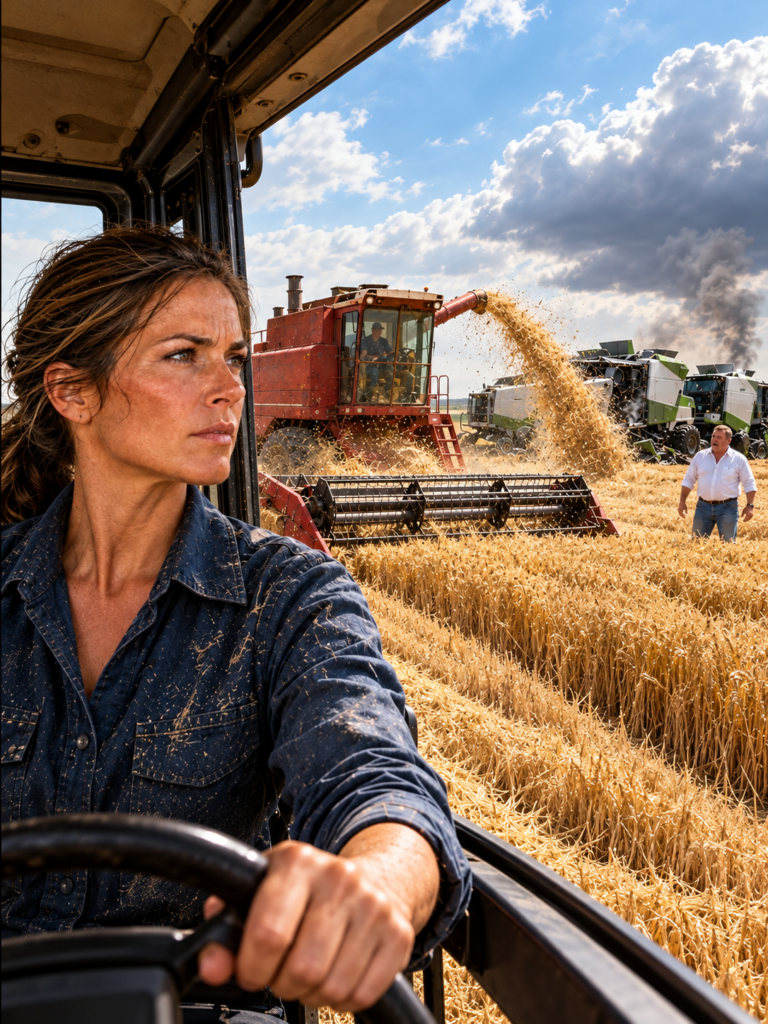
At six o’clock on an August morning in rural Kansas, Laurel Whitcomb drove a forty-six-year-old combine harvester into a field of golden wheat while three enormous, brand-new machines rolled past her property.
Each of those machines cost more than six hundred thousand dollars.
Hers had cost twelve hundred dollars to rent.
The old International Harvester rattled so violently that Laurel could feel its vibrations through the soles of her boots. Its paint had faded to the color of dried blood. The cab had no air conditioning, the seat was patched with canvas, and the engine sounded like a bucket of bolts being shaken inside a steel drum.
Across the narrow county road, Preston Harrington stood beside his polished black pickup, watching her struggle to get the old machine moving.
He smiled.
Then he laughed.
“You’re going to be harvesting until Christmas with that thing, Laurel!”
His nephew Blaine laughed beside him.
Laurel heard every word through the open window of her cab.
She didn’t answer.
She simply adjusted the throttle, lowered the header, and began cutting.
By noon, all three of Preston Harrington’s six-hundred-thousand-dollar combines would be standing motionless in the wheat.
By two o’clock, grain trucks would be backed up along the highway, and desperate farmers would be calling mechanics across three counties.
And before sunset, a stranger would arrive at Laurel’s field asking about a mysterious switch beneath the dashboard of her ancient machine.
But that morning, none of them understood what was about to happen.
Least of all Laurel.
All she knew was that she had 180 acres of wheat to harvest, a bank payment due in seven days, and a storm moving toward Kansas that could destroy everything her husband had left behind.
Three years earlier, Laurel had buried Caleb Whitcomb beneath a cottonwood tree in the little cemetery outside town.
He had been forty-three.
One April morning, he had walked into the machinery shed carrying a coffee mug and a list of repairs he planned to finish before planting.
By lunchtime, he was gone.
The doctor called it a sudden cardiac event.
Laurel called it the morning her world stopped making sense.
For seventeen years, Caleb had handled the machinery while Laurel managed the fields, the planting schedules, and the books. They had built their farm through long days, short nights, and a thousand decisions nobody outside agriculture ever noticed.
They had never been wealthy.
But they had been happy.
And the farm had been theirs.
After Caleb died, Laurel discovered how much of the work she had never needed to understand.
There were bearings she couldn’t identify, hydraulic lines she was afraid to disconnect, and electrical problems that seemed to require a language only her husband had spoken.
At first, neighbors helped.
They brought meals, repaired fences, and checked on her equipment.
Then the first harvest passed.
Then the second.
Eventually the casseroles stopped arriving, and people returned to their own problems.
Laurel didn’t resent them.
Farming was hard enough without carrying somebody else’s grief.
She learned to live with the silence.
Every morning, she drank coffee at the kitchen table where Caleb had once sat. His favorite blue mug remained on the shelf above the sink, a tiny chip on its handle exactly where he had left it.
Sometimes she still reached for two cups.
And sometimes, when she was exhausted, she caught herself listening for the sound of his boots coming through the mudroom.
Those were the moments she hated most.
Not because they made her cry.
Because for one brief second, before memory corrected her, she felt happy.
By the summer of 2026, Laurel was thirty-nine years old and had managed to keep the farm alive for three full seasons.
She had paid down nearly every outstanding equipment bill.
She had negotiated a new operating line with the bank.
And she had kept the 180 acres of wheat planted despite rising fertilizer prices, expensive diesel, and weather that never seemed willing to cooperate.
This year’s crop looked unusually promising.
The wheat stood thick and golden across the rolling Kansas ground.
When Laurel walked the north field in early July, the heavy heads bent in the breeze. She rubbed a few kernels between her palms and felt the hard, dry grain against her skin.
It was good wheat.
Maybe the best crop she and Caleb had ever raised.
She had knelt in the field that afternoon, surrounded by the whispering stalks, and allowed herself a rare moment of relief.
“We might actually make it, Cal,” she whispered.
The wind moved through the wheat.
For a moment, she imagined it was an answer.
Her calculations were simple.
A successful harvest would clear the bank note, pay for fall inputs, and leave enough to renew the lease on the neighboring quarter section.
One good harvest.
That was all she needed.
Then Russ Toiver called.
Russ operated a custom harvesting crew that had cut Laurel’s wheat for two years. He was reliable, reasonably priced, and one of the few contractors willing to work smaller farms.
Laurel answered the phone expecting a starting date.
Instead, Russ sounded uncomfortable.
“Laurel, I’ve got a problem.”
She stopped writing.
“What kind of problem?”
“A large operation south of the county line offered us a premium to move their acreage ahead of yours.”
“How far ahead?”
Russ cleared his throat.
“Ten days. Maybe twelve.”
Laurel looked through the kitchen window.
Beyond the yard, wheat stood beneath the afternoon sun.
“Russ, my wheat won’t wait twelve days.”
“I know.”
“There’s rain coming.”
“I know that, too.”
She closed her eyes.
“Then why are you telling me this?”
“Because I’ve got six men to pay and machines that cost more than my house. I can’t turn down that kind of money.”
He wasn’t cruel.
That almost made it worse.
When the call ended, Laurel sat motionless at the kitchen table.
Then she turned over a fertilizer invoice and began making calls.
She contacted two harvesting crews in Nebraska, one in Oklahoma, and a man near Salina who had once rented her a grain cart.
Every crew was booked.
Every machine was committed.
Every conversation ended with some version of the same sentence.
“Wish I could help you, Laurel.”
By Thursday evening, she had eighteen names written on the back of the invoice.
Seventeen were crossed out.
The last man hadn’t returned her call.
She made herself a sandwich, took two bites, and threw the rest away.
Then she walked out to Caleb’s machinery shed.
His old workbench was still against the west wall.
The coffee can full of miscellaneous bolts remained beneath it. A pair of leather gloves hung from a nail, stiff with age.
Laurel picked them up.
She could almost hear him.
There’s always another way, sweetheart. Might not be an easy one, but there’s usually another way.
For the first time since his funeral, she wasn’t sure she believed him.
The following morning, Preston Harrington arrived.
Preston owned Harrington Agricultural Holdings, one of the largest farming operations in the region.
His family controlled more than six thousand acres and harvested thousands more under contract.
His equipment was new.
His trucks were spotless.
His name appeared on signs, buildings, and donation plaques from the county fairgrounds to the local high school.
He had known Caleb.
They had never been friends.
Preston stepped out of his black pickup wearing pressed jeans, polished boots, and a pale blue shirt with the company logo embroidered above the pocket.
“Laurel.”
“Preston.”
He looked toward her fields.
“Fine crop you’ve got.”
“Thank you.”
“Heard Russ can’t get to you.”
She folded her arms.
“News travels fast.”
“In a farming county, it usually does.”
He leaned against his truck.
“I’ve been thinking. You don’t need this kind of uncertainty year after year.”
Laurel said nothing.
“I could lease your land for five years. Pay you above the local average. First payment upfront.”
He named a figure.
It was a generous figure.
Enough to satisfy the bank.
Enough to remove the fear that had followed her through three years of planting seasons.
“You’d still own the ground,” Preston continued. “You just wouldn’t have to fight it every day.”
Laurel looked beyond the machinery shed to the row of cottonwoods Caleb’s grandfather had planted.
Five years.
Five years of watching someone else’s machinery cross the ground her husband had loved.
Five years without crop records of her own.
Five years of watching her farming business slowly become a memory.
When those five years ended, she might still own the land.
But would anyone still consider her a farmer?
“You’re offering to rent the ground,” she said quietly.
“That’s right.”
“And then you’d farm it.”
“That’s how a lease works.”
“And what would I be?”
Preston frowned slightly.
“You’d be a landowner with a guaranteed income.”
Laurel swallowed.
“That’s not what I asked.”
He looked at her for a moment.
Then he straightened.
“I’m making you a sensible offer.”
“I know you are.”
“And?”
“I appreciate you coming, Preston. But no.”
He stared at her.
“No?”
“No.”
“Laurel, you’re thirty-nine years old, alone, with no harvesting equipment and a bank note coming due.”
“I’m aware of my situation.”
“Then you should be aware that pride doesn’t put wheat in a truck.”
The words landed harder than she expected.
For a moment, anger rose in her chest.
But she kept her voice steady.
“Neither does somebody else owning my decisions.”
Preston’s face hardened.
He opened the truck door.
“Well, I hope you find a miracle.”
He drove away, leaving tire marks across the dry gravel.
Laurel stood beside the porch until the dust settled.
Then she went inside and cried.
Not because she regretted refusing him.
Because a small, frightened part of her wondered whether he was right.
That evening, Wade Fletcher called.
Wade was a grain hauler in his late sixties who had known Caleb since high school.
His voice was rough, his language economical, and his trucks always looked about ten years older than they actually were.
“Heard you’re hunting a combine.”
Laurel rubbed her forehead.
“I’m hunting anything that cuts wheat.”
“There’s an old machine north of town.”
“How old?”
“Old enough to vote several times over.”
“Wade.”
“Belongs to Gideon Vale.”
Laurel sat up.
“Gideon still has a combine?”
“Hasn’t used it regularly in years. But he says it runs.”
“Why hasn’t anybody rented it?”
Wade hesitated.
“Because it looks like it ought to be in a museum.”
The next morning, Laurel drove to a weathered barn fifteen miles north of town.
Gideon Vale was waiting outside.
He was seventy-two, broad-shouldered despite his age, with thick gray eyebrows and hands permanently darkened by decades of grease.
He had repaired tractors, trucks, harvesters, and nearly everything else with an engine since before Laurel was born.
He didn’t smile when she arrived.
Instead, he pointed to the barn.
“Help me with the door.”
Together they pulled the heavy sliding door along a rusted track.
Dust drifted into the sunlight.
And there, beneath an old canvas tarp, sat the ugliest combine Laurel had ever seen.
Its red paint had faded.
The tires were cracked along the sidewalls.
There were visible welds on the feeder housing, a replacement panel near the engine compartment, and scratches deep enough to expose bare metal.
Laurel stared at it.
“You’ve got to be kidding.”
Gideon pulled away the tarp.
“1980 International Harvester 1460.”
“1980?”
“Built before you were born.”
“Does it actually run?”
Gideon gave her an offended look.
“I don’t keep dead machines in my barn.”
He climbed into the cab.
A moment later, the engine coughed.
Then it roared.
The entire machine began to shake.
Laurel stepped backward.
Gideon leaned out of the cab.
“Sounds good, doesn’t it?”
She looked at the vibrating bodywork.
“That’s one word for it.”
He shut it down and climbed out.
“Twelve hundred dollars for the season. You buy fuel, parts, and grease. You do the maintenance.”
Laurel blinked.
“That’s all?”
“That’s enough.”
“What’s the catch?”
Gideon stared at her.
“The catch is you listen when I tell you how to keep it alive.”
He took a small spiral notebook from a metal toolbox.
Inside were handwritten maintenance instructions, grease points, belt measurements, and sketches of components that Laurel barely recognized.
“Before you start, you check everything on this list.”
He turned a page.
“After you stop, you check it again.”
“Twice a day?”
“Every day.”
“That seems excessive.”
Gideon closed the notebook.
“Then rent somebody else’s machine.”
She looked at the combine.
Then at the wheat visible beyond the barn.
“I’ll do it.”
For the next two hours, Gideon walked her through the machine.
He showed her how to adjust the concave, check the sieves, monitor the fan speed, and recognize the sound of overloaded equipment.
He made her repeat instructions until he was satisfied.
Then, just as she was preparing to climb down from the cab, he pointed beneath the right side of the dashboard.
A small toggle switch sat inside a metal bracket.
It didn’t match anything else.
“One more thing.”
Laurel bent closer.
“What is that?”
“Monitoring hardware. Somebody installed it during a trial years ago.”
“What does it monitor?”
“Location. Operating data. That sort of thing.”
“Does it work?”
“Probably.”
“Should I turn it on?”
Gideon’s expression changed.
“No.”
She looked up.
“Why not?”
“Because this machine doesn’t need permission from somebody in an office to harvest wheat.”
He tapped the switch.
“Leave it off.”
Laurel nodded.
“All right.”
She didn’t understand why he sounded so serious.
But eleven days later, when machines worth nearly two million dollars stopped in the middle of the harvest, she would remember that conversation word for word.
And she would finally understand why the old mechanic had insisted on one very simple rule.
Never turn on that switch.
Part 2
The first person to laugh at Laurel’s new combine was Blaine Harrington.
He spotted the old machine being hauled through town on Wade Fletcher’s lowboy trailer.
Blaine was thirty-one, handsome in the polished way of a man who had never worried about the cost of replacing a tire, and accustomed to operating machinery worth more than most houses in the county.
He pulled out his phone.
By evening, a video of Laurel’s combine rattling down Main Street had circulated through half the farming community.
Someone added a caption joking that the machine had probably harvested wheat during the Carter administration.
Another man suggested Laurel should hitch a team of horses to it.
A third wondered whether the scrap dealer would pay more than she had spent renting it.
Laurel saw the video while sitting at her kitchen table.
She watched it once.
Then she turned her phone facedown.
The worst part wasn’t the laughter.
It was that she could understand it.
The machine looked terrible.
Its cab windows were scratched, the paint was uneven, and the metal steps had been repaired so many times they barely resembled the originals.
Even Laurel had difficulty imagining it surviving a full harvest.
That evening, she climbed into the cab and started the engine.
The old combine roared to life on the second attempt.
A cloud of gray exhaust rose into the quiet evening air.
She let it idle until the temperature gauge steadied.
Then she drove it slowly around the edge of a harvested alfalfa field.
The steering wandered slightly.
The brakes felt strange.
The cab smelled of warm vinyl, old dust, and decades of hard work.
But it moved.
It turned.
It responded.
When she stopped, Laurel sat for several minutes listening to the engine.
Then she placed one hand on the worn steering wheel.
“Come on, old girl,” she whispered. “Just give me one harvest.”
Back at the farmhouse, she found an old photograph tucked inside the notebook she had been using for farm expenses.
Caleb stood beside a tractor with a broken hood, grinning at the camera.
Laurel remembered taking that picture.
They had been married only three years.
The tractor had quit in the middle of planting, and she had been furious because rain was coming.
Caleb had worked beneath the hood for six hours.
When she asked whether they should call a mechanic, he laughed.
“Why pay somebody to tell me I’m already doing it wrong?”
He had eventually repaired the tractor with a replacement wire, a borrowed wrench, and more stubbornness than common sense.
Laurel smiled at the memory.
Then she cried again.
She was beginning to understand how much she missed his confidence.
Not his ability to fix everything.
Just the way he never seemed frightened of trying.
Over the next nine days, Laurel worked harder than she had in years.
She checked the machine every morning.
She crawled beneath it with a grease gun.
She tightened belts, inspected bearings, and cleaned the radiator screens.
She kept Gideon’s spiral notebook in a plastic bag inside the cab.
She also continued preparing the farm.
There were field entrances to clear, truck routes to organize, delivery appointments to confirm, and invoices to review.
At night, she sat at the kitchen table with a calculator.
Her bank payment was due August fifteenth.
The amount was large enough that missing it would threaten the operating line she needed for fall planting.
She had options, technically.
She could try to refinance.
She could sell equipment.
She could accept Preston Harrington’s lease offer.
But each option would cost her something.
Money.
Independence.
Or the future she and Caleb had spent seventeen years building.
On Thursday, she drove to the fuel station outside town.
Preston was filling a service truck.
He spotted her before she could leave.
“Wade says you got Gideon’s old machine running.”
Laurel kept her eyes on the pump.
“Seems that way.”
Preston chuckled.
“That combine’s worth less than a set of tires on one of mine.”
She tightened her grip on the nozzle.
“Maybe.”
“You really think you’re going to save the season with that thing?”
“I’m going to try.”
“There’s an easier way.”
“I know.”
He watched her for a moment.
“You still have my number.”
Laurel hung the nozzle back on the pump.
“Have a good afternoon, Preston.”
He shook his head as she walked away.
She waited until she was inside her pickup before letting herself breathe.
Every encounter left her feeling smaller than the last.
Not because Preston shouted or threatened her.
He didn’t.
He spoke as though the conclusion was already obvious, as though her decision to continue farming was a stubborn refusal to accept reality.
And sometimes, late at night, she feared that was exactly what it was.
The Harrington combines arrived the following Monday.
Laurel saw the trailers turning into the equipment yard across from her north field.
Three enormous machines, newly purchased that spring, each equipped with a wide header and advanced computerized controls.
They were beautiful machines.
Even Laurel had to admit it.
Their paint gleamed in the sunlight.
Their tires were nearly as tall as her pickup.
Their cabs looked more comfortable than her living room, with climate control, digital screens, automated steering, and sophisticated harvest-monitoring systems.
Blaine supervised unloading.
A handful of local men gathered to watch.
Laurel drove past on her way to town and saw Preston standing beside the machines, smiling.
He looked like a man who had invested in the future and expected the future to reward him.
And perhaps he had.
There was nothing inherently wrong with modern equipment.
Laurel knew that.
Modern combines could harvest faster, cleaner, and more efficiently than anything built when Gideon’s machine was new.
The problem was that she couldn’t afford one.
And the old machine was what she had.
Two days before harvest, Gideon called.
“Did you check the cleaning fan drive belt?”
“Yes.”
“Did you measure the tension?”
“I checked it.”
“That’s not what I asked.”
Laurel closed her eyes.
“Gideon, I’ve checked that belt three times.”
“Then a fourth won’t hurt.”
She almost snapped at him.
Instead, she promised to check again.
But that evening, exhausted after a long day repairing a fence, she decided it could wait until morning.
It was a small decision.
The kind people make when they’re tired.
The next morning, the belt was slipping.
One side had begun to glaze.
When Laurel touched the nearby housing, she felt heat where there shouldn’t have been any.
She immediately shut down the machine.
For several seconds, she simply stared.
If she had run it another hour, the damaged belt might have ruined an idler assembly.
A repair could have cost her most of a day.
Maybe longer.
She sat on the ladder with her face in her hands.
She hadn’t skipped the inspection because she didn’t know better.
She had skipped it because she was tired of needing help.
Tired of being the widow.
Tired of proving herself to people who had already decided she couldn’t do the work.
And in that moment, she recognized something uncomfortable.
Pride could destroy a machine just as easily as ignorance.
She drove to Gideon’s shop that afternoon.
He looked at the belt she brought him.
“You missed an inspection.”
It wasn’t a question.
“Yes.”
“Why?”
“I was tired.”
He nodded.
“That’s when machines usually get neglected.”
Laurel waited for him to lecture her.
Instead, he handed her a replacement belt.
“Put this on. Check the pulley alignment while you’re there.”
She took it.
“Gideon?”
He looked up.
“Thank you.”
“Don’t thank me. Keep it running.”
Then, as she turned to leave, he spoke again.
“Laurel.”
“Yes?”
“That switch under the dashboard.”
She stopped.
“What about it?”
“Still off?”
“Yes.”
“Keep it that way.”
She frowned.
“Why do you keep asking?”
Gideon looked toward the open shop doors.
Outside, the afternoon sun shone on tractors waiting for repairs.
“Because sometimes the things that make life easier are the same things that make it harder to recover when something goes wrong.”
Laurel didn’t know what to say.
He returned to his workbench.
“Go get ready for harvest.”
The night before harvest began, Laurel walked her fields one last time.
The wheat whispered against her jeans.
She paused where the land sloped toward a shallow draw.
Beyond it stood the cottonwood trees that Caleb’s grandfather had planted decades earlier.
She remembered Caleb bringing her there shortly after they married.
He had stood beneath the trees, his hand resting on the fence, and pointed across the fields.
“My granddad used to say land isn’t something a family owns forever.”
Laurel had laughed.
“That doesn’t sound like something a farmer would say.”
“He said we borrow it from the people who come after us.”
“And what if we don’t have children?”
Caleb had smiled.
“Then we borrow it from whoever comes after us anyway.”
She remembered the warmth of his hand closing around hers.
The promise of a future neither of them could see.
Now, standing alone in the fading light, she looked toward the farmhouse.
A single lamp glowed in the kitchen window.
The house seemed terribly small against the open land.
And for the first time in weeks, she allowed herself to say aloud what she feared most.
“I don’t know if I can do this.”
The wheat rustled.
A meadowlark called from the fence.
Nothing answered her.
She wiped her face with the sleeve of her shirt.
Then she turned toward the house.
At four thirty the next morning, her alarm rang.
She rose in the darkness, pulled on her boots, made coffee, and packed sandwiches into an old cooler.
By five, she was beside the combine with a flashlight clamped between her teeth.
She checked sixteen grease points.
Inspected the belts.
Checked the fuel and hydraulic levels.
Opened the access panels.
She repeated the instructions Gideon had taught her.
At six, she climbed into the cab.
Across the road, the Harrington machines were already rolling toward their fields.
Preston stood beside his truck.
He saw her start the engine.
And laughed.
Laurel lowered her header.
The first stalks of wheat disappeared beneath the cutting bar.
The old machine began its work.
And the most important harvest of her life had begun.
Part 3
For the first twenty minutes, Laurel drove too fast.
Fear made her impatient.
She had spent so long worrying about the harvest that, once the combine was finally moving, she wanted to cover as much ground as possible.
But the machine didn’t cooperate.
The engine struggled.
The feeder system began to overload.
When she stopped and checked the grain tank, she found cracked kernels mixed with too much chaff.
She stared at the wheat in her hand.
Then she remembered Gideon’s voice.
The machine will tell you what it needs. Your job is to listen.
She reduced her ground speed.
Adjusted the fan.
Changed the sieve setting.
Ran another hundred yards.
Stopped.
Checked again.
Better.
She repeated the process until the grain looked clean.
Then she settled into a pace the machine could handle.
It was painfully slow.
Across the road, the Harrington crew swept through a broad section of wheat with three massive combines moving in formation.
Their headers were nearly twice as wide as hers.
Their engines sounded smooth and powerful.
In the time Laurel completed one pass, they seemed to finish several.
She watched them for a moment.
Then she forced herself to look ahead.
She wasn’t competing with Preston Harrington.
She was competing with the weather.
By nine o’clock, the sun had turned the old combine cab into an oven.
Sweat soaked the back of her shirt.
Dust settled on her arms.
The engine noise seemed to vibrate inside her skull.
She drank water whenever she could.
Watched the header.
Checked the grain tank.
Listened to the bearings.
Gradually, she began to feel the machine rather than simply operate it.
When the wheat grew heavier near the draw, the engine note changed.
She reduced speed before the feeder could overload.
When the crop thinned across a rise, she eased forward.
The adjustments became smaller.
More natural.
For the first time since Caleb died, Laurel experienced something she had nearly forgotten.
The satisfaction of mastering a difficult piece of work.
She was still afraid.
Still exhausted.
Still uncertain whether the machine would survive.
But she was harvesting.
And no one could take that fact away from her.
At ten fifteen, she heard a strange sound.
A thin, high whine rose beneath the engine noise.
It appeared when she slowed at the end of a pass.
She listened carefully.
There it was again.
She shut the machine down.
Climbed out.
Walked to the rear.
The sound seemed to be coming from the straw chopper.
She touched the bearing housing with the back of her hand.
Then jerked her fingers away.
Hot.
Too hot.
She looked down the field.
Only another four minutes to finish the pass she had been planning.
She could keep going.
Just a little longer.
Then she remembered the glazed belt.
And the embarrassment of admitting to Gideon that she had skipped an inspection.
She reached for her phone.
He answered on the third ring.
“What is it?”
“Chopper bearing. Driver’s side. It’s running hot.”
“How hot?”
“Can’t keep my hand on the housing.”
“Shut it down.”
“Already did.”
“Good. Grease it, run the system unloaded for five minutes, and check again.”
Laurel followed every instruction.
When she called back, the bearing had cooled.
Gideon told her to monitor it closely.
“I’ve got a replacement,” he added. “I’ll bring it out.”
“You don’t need to drive all this way.”
“I know.”
He hung up.
Laurel stood beside the combine, looking at her phone.
For the first time, she understood that accepting help didn’t mean surrendering responsibility.
It meant making a better decision.
The repair check had cost her forty minutes.
But the machine was running again.
Just before eleven, Laurel looked across the road.
One of Harrington’s combines had stopped.
She noticed because it was sitting in the middle of standing wheat with its header lowered.
That was unusual.
Operators normally stopped at the end of a pass whenever possible.
She watched a man climb down from the cab and walk around the machine.
Then she returned to her own work.
Ten minutes later, a second combine stopped.
This one sat several hundred yards from the first.
Laurel frowned.
The third machine continued cutting.
For a while.
Then, at eleven twenty, it stopped too.
Three enormous combines.
Three silent engines.
Three headers sitting motionless in golden wheat.
Laurel stared.
A strange thought crossed her mind.
Maybe they got bad fuel.
It seemed possible.
The machines were part of the same operation and might have been serviced from the same truck.
She felt a small flicker of satisfaction.
Then immediately regretted it.
There were crops to harvest.
Farmers depending on equipment.
Men with families who would lose wages if work stopped.
She knew too well what that kind of uncertainty felt like.
So she turned back to her own header.
At noon, she stopped long enough to eat a sandwich while sitting on the combine ladder.
Across the road, four pickups had gathered around the Harrington machines.
A technician in a white shirt stood on one cab platform with a laptop balanced against the railing.
Another man was talking on a phone.
Blaine paced beside his machine.
Laurel took another bite of her sandwich.
Then looked down at her ancient combine.
It was covered in dust.
One side panel vibrated every time the engine idled.
The paint looked worse than ever beneath the bright afternoon sun.
But it was still working.
At one o’clock, a service truck arrived at the Harrington yard.
At two, another followed.
By midafternoon, the first grain trucks had begun lining up along the county highway.
Their drivers had been expecting loads from Harrington’s operation.
Instead, they waited.
And waited.
Laurel’s phone rang.
It was Wade.
“You still cutting?”
“Yes.”
“Don’t stop unless you have to.”
She glanced toward the road.
“What’s happening?”
“It’s not just Harrington.”
“What do you mean?”
“The Dilbeck outfit is down. Carnahan’s got two machines sitting outside Burton. Another crew near the county line can’t engage their headers.”
Laurel looked across the field.
“All at once?”
“Close enough.”
“Fuel?”
“Doesn’t look like it.”
“Electrical?”
“Everybody’s guessing.”
She could hear trucks rumbling behind Wade.
Then he lowered his voice.
“Laurel, whatever it is, it’s got a pattern.”
The line went quiet.
Laurel watched the three machines across the road.
For the first time, she felt something colder than satisfaction.
Concern.
A failure affecting several operations at once could become a disaster.
Not just for Harrington.
For the entire county.
Every delayed harvest meant more grain exposed to the weather.
More trucks sitting empty.
More contracts at risk.
And the storm was still coming.
By late afternoon, the local grain elevator was buzzing with rumors.
Some said the machines had received a bad software update.
Others blamed an equipment dealer.
A few men suggested the problem was deliberate sabotage.
Nobody knew enough to be certain.
At four, a retired farmer named Dell Oiler arrived at Laurel’s field.
Dell was sixty-eight and farmed sixty acres as a supplement to his retirement income.
He approached the combine while Laurel was unloading into Wade’s grain truck.
When she shut down the engine, he removed his cap.
“Laurel.”
“Dell.”
“Looks like you’re still going.”
“So far.”
He glanced toward the Harrington fields.
“Mine’s sitting ready.”
She knew what he was asking.
She also knew why he didn’t want to say it.
“How much wheat?”
“Sixty acres.”
Laurel looked at her own field.
She still had nearly ninety acres standing.
“I can’t do it, Dell.”
He nodded slowly.
“I figured.”
“I wish I could.”
“I know.”
She tried to explain.
“I’ve got my own crop to finish, and this machine isn’t fast. If I give you half a day, I could lose everything when the rain comes.”
“You don’t owe me an explanation.”
“I don’t want you thinking it’s about money.”
Dell put his cap back on.
“I know exactly what it’s about.”
He looked toward the horizon.
“Same thing I’m worried about.”
They stood quietly for a moment.
Then he climbed into his pickup and drove away.
Laurel watched until the dust disappeared.
Refusing him hurt more than she expected.
But she had to protect her own farm before she could save anyone else’s.
Twenty minutes later, an unfamiliar pickup pulled into the field entrance.
It had Nebraska plates and a service body covered in road dust.
A gray-haired man stepped out carrying a laptop bag.
He walked directly toward Laurel’s combine.
“Mrs. Whitcomb?”
“That’s me.”
“Elliot Granger. Independent equipment technician.”
He offered his hand.
She shook it cautiously.
“Can I help you?”
“Maybe you can help me.”
He looked up at the cab.
“That’s Gideon Vale’s old 1460, isn’t it?”
“Yes.”
“Did he tell you about the monitoring equipment under the dashboard?”
Laurel felt a sudden tightening in her chest.
“What monitoring equipment?”
“A little toggle switch on the right side. Mounted beneath the panel.”
She stared at him.
“Why?”
Elliot looked toward the three silent combines across the road.
“Because I think your old machine might tell us something about why those expensive ones aren’t moving.”
Laurel stepped between him and the ladder.
“Who sent you?”
“Nobody.”
“Then how do you know about that switch?”
Elliot studied her expression.
“I worked with Gideon for nine years. I know what he put into that machine.”
He opened his laptop bag.
“And I know what somebody else put into the Harrington machines.”
Laurel looked from the stranger to the old combine.
The engine ticked softly as it cooled.
Behind them, the afternoon wind moved through the wheat.
“You’re telling me there’s a connection?”
“Maybe.”
He glanced at the cab again.
“May I take a look?”
Laurel hesitated.
Gideon had been very clear.
Leave the switch off.
Finally, she moved aside.
“You can look.”
Then she added firmly.
“But you don’t touch anything until you tell me exactly what you’re doing.”
Elliot nodded.
“Fair enough.”
He climbed into the cab.
And what he found beneath the dashboard would change Laurel’s understanding of the entire harvest.
Part 4
Elliot Granger spent nearly fifteen minutes examining the wiring beneath the dashboard.
He used a flashlight to trace the cables leading away from the small toggle switch.
Then he removed a panel, inspected the monitoring module, and carefully replaced everything exactly as he had found it.
Laurel waited beside the ladder.
The sun was beginning to sink.
She could hear distant truck engines idling along the highway.
Finally, Elliot climbed down.
“Well?”
He wiped his hands on a rag.
“Gideon was right.”
“About what?”
“Your monitoring package doesn’t control the combine.”
Laurel frowned.
“I don’t understand.”
Elliot pointed toward the field.
“That little box can report where your machine is and how it’s operating. But if it loses power, your engine still runs. Your separator still engages. Your header still cuts wheat.”
He looked across the road.
“Those machines are different.”
“How?”
“The management package is integrated into their operating controls. It authenticates the operator and communicates with a central service platform.”
“And?”
“And something has gone wrong with that process.”
He pulled out his phone and showed her a service bulletin.
Several operations in the region had reported authentication failures.
A recent configuration update was being investigated.
The affected machines were entering restricted operating mode because their control systems could no longer verify the required credentials.
“Can they still drive?” Laurel asked.
“Slowly. Enough to get off a road or move to safety. But they can’t operate the harvesting systems normally.”
“Why not just reset them?”
“Because the fault requires a licensed diagnostic tool and authorized credentials.”
Laurel looked toward the silent combines.
“Who has those?”
“Not many people in this region.”
“How many?”
Elliot hesitated.
“Four authorized technicians were available in the wider service area when the problem started.”
She stared at him.
“Four?”
“For every affected machine?”
“That’s the problem.”
Laurel turned toward her old harvester.
“So mine works because it’s too old for all that?”
Elliot shook his head.
“Not exactly.”
He rested one hand against the faded red bodywork.
“Your machine works because nobody designed it to stop harvesting when a remote service system loses track of its permissions.”
“Then the old one is better?”
He almost smiled.
“No, ma’am. It’s slower. It burns more fuel per acre. It has fewer safety and monitoring features than a modern machine. And you’re spending half your life keeping it adjusted.”
Laurel looked disappointed.
“Then what’s the difference?”
Elliot tapped the machine lightly.
“This one still belongs to the person operating it in the way that matters today. You don’t have to ask a server in another state whether you’re allowed to cut your own wheat.”
She looked at the toggle switch through the open cab door.
“Could turning that on help the other machines?”
“No.”
“What if we removed the box?”
“Wouldn’t help them either. Your equipment is completely separate.”
He closed his bag.
“The strange thing is, Gideon warned people about this exact possibility years ago.”
Laurel looked sharply at him.
“He did?”
Elliot nodded.
“Ask him about the cooperative project.”
That evening, after shutting down the combine, Laurel drove to Gideon’s workshop.
The lights were still on.
He stood near a workbench, holding a coffee mug.
When she entered, he looked up without surprise.
“Something wrong with the machine?”
“No.”
“Then what is it?”
She walked closer.
“You knew those new combines could be stopped by a software problem.”
Gideon was silent.
“You knew, didn’t you?”
He set down the mug.
“I knew it was possible.”
“And you didn’t tell anybody?”
“I did.”
“Who?”
“Everybody willing to sit through the meeting.”
Laurel stared at him.
He pulled out a chair.
“Sit down.”
She remained standing.
Gideon shrugged.
“Suit yourself.”
He explained that three years earlier, a regional agricultural cooperative had proposed a shared equipment-management system.
The plan sounded reasonable.
Modern machinery produced enormous amounts of useful information.
Farmers could track fuel consumption, engine temperatures, maintenance intervals, operator assignments, and location data.
Centralized systems could help prevent expensive failures.
Gideon had not opposed those benefits.
In fact, he had supported several parts of the proposal.
“What bothered me,” he said, “was one clause in the service agreement.”
“What clause?”
“It gave the provider authority to restrict machine operation remotely for certain security and contractual reasons.”
Laurel folded her arms.
“Why would anybody agree to that?”
“Because there are legitimate reasons to protect expensive equipment. Theft prevention. Unauthorized operation. Contract compliance.”
He paused.
“But nobody had written down what would happen if the system made a mistake.”
Laurel remembered Elliot’s explanation.
“So you warned them.”
“I asked for three protections.”
He held up one finger.
“First, a local recovery procedure that a trained owner or operator could use if the central system failed.”
A second finger.
“Second, no nonessential configuration changes during harvest unless absolutely necessary.”
A third.
“And third, a backup pool of equipment that wasn’t enrolled in the same control system.”
Laurel shook her head.
“That seems sensible.”
“It costs money.”
“So does losing a harvest.”
Gideon nodded.
“That’s easier to see after it happens.”
He explained that the committee had considered the extra safeguards unnecessary.
The system was new.
The provider was reputable.
The probability of a widespread authentication problem was considered low.
One member of the committee had argued especially strongly for minimizing redundancy.
Preston Harrington.
Laurel stared at Gideon.
“Preston?”
“Yes.”
“Then this is his fault.”
Gideon shook his head.
“Not entirely.”
“How can you say that?”
“Because his argument made sense to a room full of people who had spent twenty years trying to lower operating costs.”
“He helped reject the safeguards.”
“He did.”
“And now his machines are stopped.”
“They are.”
Gideon met her eyes.
“But don’t confuse a bad decision with a man wanting a bad outcome.”
Laurel sat down.
For a while, neither spoke.
Then she asked, “Why didn’t you stay and fight?”
“I told them what I knew. They recorded it. They made their decision.”
He picked up the mug.
“I wasn’t putting my name on a system that could leave a farmer unable to operate his own machine in the middle of harvest.”
Laurel looked at his old tools hanging on the wall.
Wrenches.
Pliers.
Bearing pullers.
A torch.
Boxes of parts labeled in careful handwriting.
“So you kept that combine.”
“I already had it.”
“Because you knew this would happen?”
“No.”
He gave her a tired look.
“Because old machines break down, too. And sometimes the only thing standing between a farmer and disaster is having another machine that can still run.”
Laurel looked toward the open shop door.
Beyond it, the Kansas night stretched dark and quiet.
She had wanted a villain.
Someone to blame for the danger facing the county.
Someone she could point to and say, There. That’s the reason this happened.
But Gideon’s explanation was less satisfying.
The failure had not come from one evil man.
It had come from sensible decisions made without enough protection against an unlikely disaster.
And those decisions had worked.
Until suddenly they didn’t.
Laurel drove home close to ten.
She was exhausted.
Her hands ached from gripping the steering wheel all day.
Grain dust had settled in her hair.
When she entered the kitchen, the silence felt heavier than usual.
She made a cup of tea and sat at the table.
Caleb’s blue mug was still on the shelf.
For a long time, she stared at it.
Then she spoke softly.
“You would’ve understood this better than me.”
She could imagine his answer.
Maybe. But you’re the one still out there cutting wheat.
Her phone rang.
It was Nora Kesler, who managed the independent grain elevator on the east side of town.
Nora was a practical woman in her fifties who had never given Laurel special treatment simply because they were friends.
“Laurel, I need to talk to you about the weather.”
Laurel straightened.
“What happened?”
“The front moved faster.”
“How much faster?”
“You’re looking at heavy rain by late tomorrow afternoon.”
Laurel looked at the calendar.
She had been counting on nearly two more days.
“Are you sure?”
“As sure as a forecast can be.”
Nora paused.
“I’ve got eleven producers trying to book delivery slots, and I can’t fit all of them in before the weather.”
“What about my contract?”
“I’ll take every bushel you deliver within the window. But I can’t promise the premium on grain that comes in wet.”
Laurel closed her eyes.
“I understand.”
“I know you do.”
The line went quiet.
Then Nora said gently, “I wish I could do more.”
Laurel swallowed.
“So do I.”
After the call, she walked to the kitchen window.
Lightning flickered far to the southwest.
Her remaining wheat stood in darkness.
She had spent three years trying to save the farm.
Three years of working through grief.
Three years of making repairs she didn’t know how to make, paying bills she could barely afford, and enduring the quiet certainty of people who believed she would eventually give up.
Now everything came down to one more day.
She went to bed.
But she barely slept.
At four thirty the next morning, she was back in the field.
The combine started.
The engine rattled.
The header turned.
She worked until the sun rose, then kept working as the heat built inside the cab.
Hour after hour, the wheat disappeared beneath the cutting bar.
The old machine crept across the field.
Slow.
Loud.
Relentless.
By late morning, she had made better progress than expected.
By early afternoon, she was beginning to believe she might finish.
Then, at two o’clock, the straw chopper bearing failed.
The warning came as a sudden grinding noise that rose through the floor of the cab.
Laurel shut down the separator immediately.
The machine rolled to a stop.
She climbed down.
Hot metal smelled sharp in the air.
The bearing housing was scorching.
She didn’t need Gideon to tell her what had happened.
It was finished.
She looked across the remaining wheat.
Thirty-one acres still standing.
A storm approaching.
And the old combine was broken.
For a moment, Laurel simply stood there.
Then she sat on the bottom step.
Her hands began to shake.
She thought about the bank.
The farmhouse.
Caleb.
The years she had spent holding everything together.
She thought about Preston telling her there was an easier way.
And for one terrible moment, she wanted to call him.
Not because she believed he was right.
But because she was tired.
So tired that giving up seemed almost peaceful.
Then she remembered standing beside Caleb’s grave, promising that she would try to keep the farm alive.
She had never promised she would succeed.
Only that she would try.
Laurel wiped her face.
Pulled out her phone.
And called Gideon.
“Chopper bearing’s gone.”
He answered without hesitation.
“I’m coming.”
Thirty-five minutes later, his pickup rolled into the field.
Wade arrived twenty minutes after that, bringing a bearing puller, work light, and additional tools.
Neither man wasted time asking whether she was all right.
They could see the answer.
They simply went to work.
For more than two hours, the three of them fought the damaged bearing assembly beneath the afternoon sun.
The old parts resisted.
A retaining ring refused to release.
Laurel lay on her back beneath the machine, grease coating her elbows, wheat chaff sticking to her sweat-soaked neck.
At one point, she dropped a wrench.
It struck the dirt beside her head.
She swore.
Wade laughed.
“Now you sound like Caleb.”
Laurel froze.
For an instant, his name hurt so badly she could barely breathe.
Then she laughed, too.
A broken little laugh.
But real.
Gideon handed her the tool again.
“Try the ring from the other side.”
She did.
This time, it released.
By late afternoon, the replacement bearing was seated.
The shaft turned freely.
Gideon checked the alignment.
Then he stepped aside.
“Start it.”
Laurel climbed into the cab.
Turned the key.
The engine roared.
She engaged the system carefully.
Everything turned.
Nothing ground.
Nothing screamed.
Gideon raised one hand.
“Good.”
Laurel looked down at the two old men standing beside her machine.
Her eyes filled.
She couldn’t hear herself over the engine.
But she mouthed the words anyway.
“Thank you.”
Then she lowered the header and went back to work.
As the sun dropped toward the horizon, the wheat continued falling before her.
And somewhere beyond the western fields, dark clouds began gathering.
Part 5
The rain reached Kansas at five forty the following evening.
By then, Laurel Whitcomb had already finished harvesting every acre of her own wheat.
But the final twenty-four hours nearly broke her.
She worked through the long evening after repairing the bearing, stopping only when darkness and heavy dew made further cutting impractical.
When she finally returned home, she left her boots in the mudroom and sank into a kitchen chair.
Her hands were cramped.
Her shoulders ached.
Her eyes burned from dust and exhaustion.
She was too tired to eat.
But before going to bed, she opened Gideon’s notebook and checked off every maintenance item she had completed.
Then she wrote one sentence beneath the day’s entry.
Thirty-one acres left. Machine running.
She stared at the words for a long time.
They seemed impossibly small compared with what they meant.
At dawn, she was back in the cab.
The western sky was gray.
The wind carried the smell of approaching rain.
She worked without looking at the clock.
One row.
Then another.
Then another.
By midmorning, the last of her wheat was in the grain tank.
When the final stalks disappeared beneath the header, Laurel eased the machine to a stop.
For a moment, she couldn’t move.
She looked through the dusty windshield at the stubble stretching behind her.
One hundred and eighty acres.
Harvested.
She had done it.
The old combine had done it.
And Caleb’s farm was still standing.
She didn’t cheer.
She didn’t cry.
She simply rested both hands on the steering wheel and breathed.
Then she began unloading.
There was still work to do.
Wade had trucks to fill.
Nora had delivery slots to manage.
And somewhere nearby, other farmers were still racing the storm.
Laurel had barely finished her own work when she noticed Dell Oiler’s pickup waiting at the field entrance.
He stood beside it, holding his cap.
She shut down the engine.
“Morning, Dell.”
“Morning.”
He looked toward her empty field.
“Finished?”
“Just now.”
He smiled.
“Well, I’ll be.”
Laurel climbed down.
Dell cleared his throat.
“I brought a grain cart and a truck. Got a full tank of fuel, too.”
She looked toward the western horizon.
“How much wheat have you got standing?”
“All sixty acres.”
Her heart sank.
There was no way she could finish all of it.
Not with the storm coming.
Dell seemed to read her thoughts.
“I’m not asking for the whole thing.”
Laurel looked at him.
“Then what are you asking?”
“Whatever time you’ve got left.”
She turned toward the combine.
The old machine sat trembling at idle.
Its paint was covered in dust.
A fresh smear of grease marked the repaired bearing housing.
She could feel exhaustion settling into her bones.
But she could also see Dell’s face.
The careful hope he was trying not to show.
She remembered how it had felt to stand at her kitchen table with every harvesting crew’s name crossed out.
And she knew what she had to do.
“I can give you a few hours.”
Dell’s eyes widened.
“You sure?”
“No promises. This thing breaks, we stop. Rain comes, we stop. I can’t guarantee how much we’ll get.”
He nodded.
“I understand.”
“And you handle the trucking and fuel.”
“Done.”
She held out her hand.
“Then let’s go.”
They shook on it.
And for the first time in days, Laurel wasn’t harvesting merely to save her own future.
She was helping someone else save his.
By late morning, she was cutting Dell’s wheat.
The ground was uneven.
The rows were shorter.
But the old combine kept moving.
Wade coordinated grain hauling.
Nora rearranged delivery appointments so the loads could be received without unnecessary delays.
Nobody made a speech about generosity.
Nobody called it a miracle.
They simply did what farmers had always done when the weather turned against them.
They worked.
At eleven, Blaine Harrington arrived.
Laurel saw his pickup pull to the edge of Dell’s field.
He waited until she reached the end of a pass.
When she shut off the engine, he approached on foot.
He looked different.
His shirt was dirty.
Dark circles shadowed his eyes.
The confident smile he had worn while filming her old combine was gone.
“Laurel.”
“Blaine.”
He glanced toward the ancient machine.
“You’re still going.”
“So far.”
He looked down.
“We got one of our combines cleared last night.”
“That’s good.”
“Another one’s supposed to be released soon.”
Laurel waited.
Blaine shifted his weight.
“There’s a problem with the Pritchard place.”
She knew the property.
A narrow strip of wheat bordered by a waterway and an awkward point of land.
“What kind of problem?”
“Our big headers can’t get into the narrow sections without tearing up the ground. Especially if it gets wet.”
Laurel looked toward the sky.
“That won’t take long.”
“Exactly.”
He took a breath.
“I can put one of our working machines on Dell’s open acres and finish them fast. But somebody needs to cut the Pritchard strip.”
He looked at her combine.
“Your header would fit.”
Laurel said nothing.
Blaine continued quickly.
“We’ll provide fuel. Pay your operating time. Put it all in writing.”
She watched him.
This was the same young man who had taken a video of her old combine and made her the county’s joke.
Now he stood before her asking for help.
A sharp answer rose immediately to her lips.
She could have reminded him of the laughter.
The video.
The jokes.
She could have made him feel as small as he had made her feel.
For one brief moment, she wanted to.
But she looked past him toward the fields.
Wheat was still standing.
Rain was coming.
And the crop belonged to people who hadn’t laughed at her.
“Fuel both machines,” she said.
Blaine nodded.
“Agreed.”
“We settle the hours tonight.”
“All right.”
“On paper.”
He looked at her.
Then, unexpectedly, he smiled.
“Fair enough.”
Laurel climbed back into her cab.
Blaine returned to his pickup.
An hour later, one of Harrington’s enormous modern combines was working Dell’s open acreage while Laurel guided the old International Harvester through the narrow Pritchard strip.
The two machines could not have looked more different.
One was powerful, sophisticated, and capable of harvesting enormous quantities of grain.
The other was faded, slow, and held together by decades of maintenance.
But on that afternoon, both were necessary.
The big machine took the broad fields.
The small machine worked the corners.
And neither operator had time to think about pride.
At five twenty, the first drops struck Laurel’s windshield.
She watched them darken the dust.
Then looked ahead.
One last stretch.
A narrow section near the waterway.
She adjusted the header.
Reduced speed.
And kept moving.
The rain grew heavier.
The sky darkened.
Wade’s truck lights appeared near the field entrance.
Across the field, Harrington’s machine finished its final pass and shut down.
Laurel watched the last wheat disappear beneath her cutting bar.
Then she raised the header.
Turned toward the grain cart.
Unloaded the tank.
And finally shut off the engine.
The sudden silence was overwhelming.
Rain drummed against the cab roof.
Water streaked the dusty glass.
The old combine sat motionless in the gathering darkness.
Laurel placed her hands in her lap.
She had spent so many days listening to the engine that the silence felt almost unreal.
Outside, trucks pulled away with their loads.
Their headlights moved slowly along the county road.
She watched them disappear into the rain.
Then she lowered her head.
And cried.
Not loudly.
Not dramatically.
Just the quiet, exhausted tears of someone who had been frightened for a very long time and had finally been given permission to stop.
When Laurel climbed down, Preston Harrington was waiting near the gate.
His black pickup stood beneath the gray sky.
He had an umbrella inside.
He wasn’t using it.
Rain soaked his shoulders.
Laurel walked toward him.
Neither spoke at first.
They stood beneath the edge of the grain cart while rain hammered against the metal.
Finally, Preston broke the silence.
“I misjudged two things.”
Laurel looked at him.
“What things?”
He glanced toward the distant fields.
“The risk in that equipment-management agreement.”
Then he looked directly at her.
“And you.”
Laurel said nothing.
Preston continued.
“We’ve lost contract customers. There’ll be financial consequences.”
“I’m sorry to hear that.”
He gave a tired laugh.
“No, you’re not.”
Laurel considered lying.
Then decided against it.
“I’m sorry for the farmers who couldn’t get their wheat cut.”
Preston nodded slowly.
“Fair enough.”
The rain intensified.
He looked toward her old combine.
“I’d like Harrington to compensate you for the hours you worked on the Pritchard property. Current custom rate. Fuel and wear included.”
Laurel thought about it.
Only a week earlier, she might have refused out of pride.
But Gideon had taught her something important.
Fair payment wasn’t charity.
And accepting it didn’t make her weak.
“Send me your numbers,” she said.
Preston looked surprised.
“I’ll send you mine. We’ll put it in a contract.”
For the first time, he smiled without amusement.
“You’d rather have a contract than an apology?”
Laurel thought of Caleb’s old farm.
The bank note.
The years of uncertainty.
Then she answered.
“An apology doesn’t have terms.”
Preston looked at her for a long moment.
Finally, he nodded.
“No. It doesn’t.”
He didn’t become a different man that afternoon.
He didn’t suddenly turn kind or humble.
But he stopped speaking to Laurel as though she were a woman who needed saving from herself.
Instead, he asked about her yield.
She told him.
He raised his eyebrows.
“That’s better test weight than anything we’ve pulled off our east sections.”
Laurel smiled faintly.
“Good ground.”
“Good farming,” he corrected.
Those two words meant more than she expected.
Because Preston Harrington had finally recognized something the entire county had overlooked.
Laurel Whitcomb was not simply Caleb Whitcomb’s widow.
She was a farmer.
The rain continued for two days.
Across the region, standing wheat suffered significant damage.
Some fields lodged beneath the wind and water.
Others became too wet to harvest without substantial losses.
The equipment provider eventually released a statement acknowledging an authentication fault associated with a configuration update.
Additional technicians arrived.
The remaining affected machines were restored.
But for some producers, the help came too late.
The county talked about the failure for months.
Not because modern equipment was inherently unreliable.
Many farmers using newer machinery without the affected control package had finished their harvests without difficulty.
The problem was more specific.
Too many operations had depended on one system without an adequate backup plan.
When that system failed, expensive machinery became useless precisely when farmers needed it most.
Preston’s company began revising its equipment strategy.
By September, Blaine arrived at Gideon’s workshop carrying a thick folder.
Laurel happened to be there, learning how to remove a shaft assembly.
Blaine looked surprised to see her.
“You’re working here now?”
“Learning.”
Gideon didn’t look up from the workbench.
“She’s getting better.”
Laurel smiled.
“High praise.”
Blaine turned to Gideon.
“We’re putting together a contingency plan for next year.”
Gideon raised an eyebrow.
“Are you?”
“A separate group of machines outside the management system. Local recovery procedures. Independent technicians on contract.”
He placed the folder on the bench.
“Preston wants you to review it.”
Gideon stared at the papers.
Then at Blaine.
“Why?”
“Because you warned us.”
The workshop fell quiet.
Blaine looked toward Laurel.
“I saw the meeting records.”
Gideon folded his arms.
“And?”
“And we should’ve listened.”
There was no grand apology.
No dramatic confession.
Just a tired young man admitting that someone else’s experience had been worth more than he had understood.
Gideon opened the folder.
“Bring coffee next time.”
Blaine blinked.
“What?”
“If I’m going to read all this, bring coffee.”
Laurel laughed.
And this time, Blaine laughed with her.
The bank payment was cleared on August fourteenth.
Laurel sat across from the loan officer while he reviewed the documents and confirmed that her harvest proceeds had satisfied the note.
She watched him stamp the final page.
The sound seemed impossibly loud.
“You’re current, Mrs. Whitcomb.”
Laurel stared at the paper.
“Completely?”
“Completely.”
She had just over four hundred dollars remaining from the money allocated to the payment.
It wasn’t wealth.
It wasn’t freedom from every future worry.
Next spring would bring more bills.
More repairs.
More uncertain weather.
But her operating line remained available.
Her crop history was intact.
And she could renew the lease on the neighboring land.
She drove home slowly.
When she reached the farmhouse, she parked beneath the cottonwoods and walked inside.
The kitchen looked exactly as it always had.
The worn table.
The old refrigerator.
The photograph of Caleb hanging beside the pantry.
His chipped blue coffee mug on the shelf.
Laurel took it down.
Washed it.
Filled it with fresh coffee.
Then carried it outside to the porch.
She sat in Caleb’s old chair and looked across the harvested fields.
For the first time in three years, the farm didn’t feel like something she was desperately trying to keep from disappearing.
It felt like a place where she might still have a future.
Near the end of August, Gideon arrived to collect the combine.
Laurel had washed it.
Greased it.
Cleaned the cab.
And written a complete maintenance record in his spiral notebook.
He walked around the machine slowly, inspecting the repaired bearing and checking the belts.
Then he climbed into the cab.
A moment later, he climbed back down.
“You skipped an evening belt inspection.”
Laurel stared at him.
“That was weeks ago.”
“Still shows.”
She laughed.
“Nothing gets past you.”
“Not much.”
He closed the notebook.
“You took good care of her.”
Laurel looked at the old combine.
Despite the washing, the paint was still faded.
The tires were still cracked.
The bodywork still carried scars from decades of repairs.
But something about it looked different now.
Maybe it was simply that Laurel knew what it had survived.
“Would you sell it?” she asked.
Gideon shook his head.
“No.”
She smiled sadly.
“Didn’t think so.”
“You can rent it again next year.”
She looked up.
“Really?”
“Same price. Same conditions.”
Laurel swallowed.
“Thank you.”
He studied her for a moment.
Then he asked, “What are you going to do all winter?”
She looked toward his toolbox.
“Learn.”
“Learn what?”
“Everything Caleb used to know that I don’t.”
Gideon said nothing.
She continued.
“I don’t want to spend another harvest praying that nothing breaks.”
He nodded once.
“Then you’ll need to spend time in the shop.”
“How much time?”
“Tuesdays and Thursdays.”
Laurel smiled.
“All winter?”
“If you’re serious.”
“I am.”
Gideon pointed toward her hands.
“Bring your own gloves.”
Before he loaded the combine, Laurel climbed into the cab one final time.
She sat in the worn canvas seat.
Placed her hands on the steering wheel.
And looked around at the scratched glass, faded controls, and yellowed dashboard.
Then her eyes settled on the little toggle switch beneath the right side of the panel.
It was still off.
Exactly where Gideon had told her to leave it.
She thought about the thousands of dollars in equipment that had failed.
The farmers who had lost crops.
The expensive technology that had worked beautifully until one invisible system decided it could no longer authorize the people using it.
She also thought about her own mistakes.
The belt she had neglected.
The bearing she had nearly destroyed.
The help she had been too proud to accept.
And the men who had shown up anyway.
The lesson wasn’t that old equipment was always better.
It wasn’t that technology was dangerous.
And it certainly wasn’t that a person could survive alone if she simply worked hard enough.
Laurel knew better now.
What mattered was understanding the tools you depended on.
Knowing what might fail.
Knowing who could help.
And never giving away so much control over your life that one stranger’s mistake could take everything from you.
She reached beneath the dashboard.
Not to flip the switch.
Just to wipe the dust from around it.
Then she climbed down.
Gideon secured the combine to the trailer.
As he prepared to leave, he glanced back.
“See you Tuesday.”
Laurel nodded.
“Tuesday.”
She watched the old machine disappear along the gravel road.
When the dust settled, she turned toward the farmhouse.
The fields were quiet.
The wheat was gone.
The land rested beneath the late-summer sun.
And for the first time in a long while, Laurel didn’t feel like a woman standing alone against the world.
She felt like herself.
A widow.
A farmer.
A person who had made mistakes, swallowed her pride, accepted help, and kept going when the sensible thing seemed to be surrender.
That evening, she walked to the edge of the north field.
The cottonwoods rustled behind her.
She thought about Caleb.
About the seventeen years they had shared.
About the day he had promised there would usually be another way.
Then she smiled through her tears.
“You were right, sweetheart.”
The wind moved gently across the stubble.
And Laurel Whitcomb went home.
Not to an empty house filled only with memories.
But to a home she had fought for.
A home she still owned.
A home where tomorrow was no longer something she feared.
In the years that followed, people in the county would remember that harvest in different ways.
Some remembered three expensive combines sitting motionless in golden wheat.
Some remembered a storm that ruined fields across Kansas.
Others remembered the extraordinary failure of a technology system that was supposed to make farming easier.
But the people who knew Laurel remembered something else.
They remembered a woman who had been laughed at for renting the oldest combine in town.
A woman who had worked through heat, dust, grief, and fear.
A woman who had refused to let humiliation make her cruel.
And when her own harvest was finally safe, she turned around and helped her neighbors save theirs.
She never became wealthy from that season.
She never appeared on television.
She never received an award.
But she kept her ground.
She kept her livelihood.
And she regained something she had nearly lost during the lonely years after Caleb’s death.
Her belief that she was still capable of building a future.
Sometimes the strongest person in a community isn’t the one with the largest bank account, the newest equipment, or the loudest voice.
Sometimes it’s the woman driving the oldest machine in the county, one slow row at a time, refusing to surrender the land her family entrusted to her.
And sometimes the greatest victory isn’t watching the people who laughed at you fail.
It’s reaching the end of a long, difficult season, looking across the fields you managed to save, and knowing that despite everything you suffered, you are still standing.


