
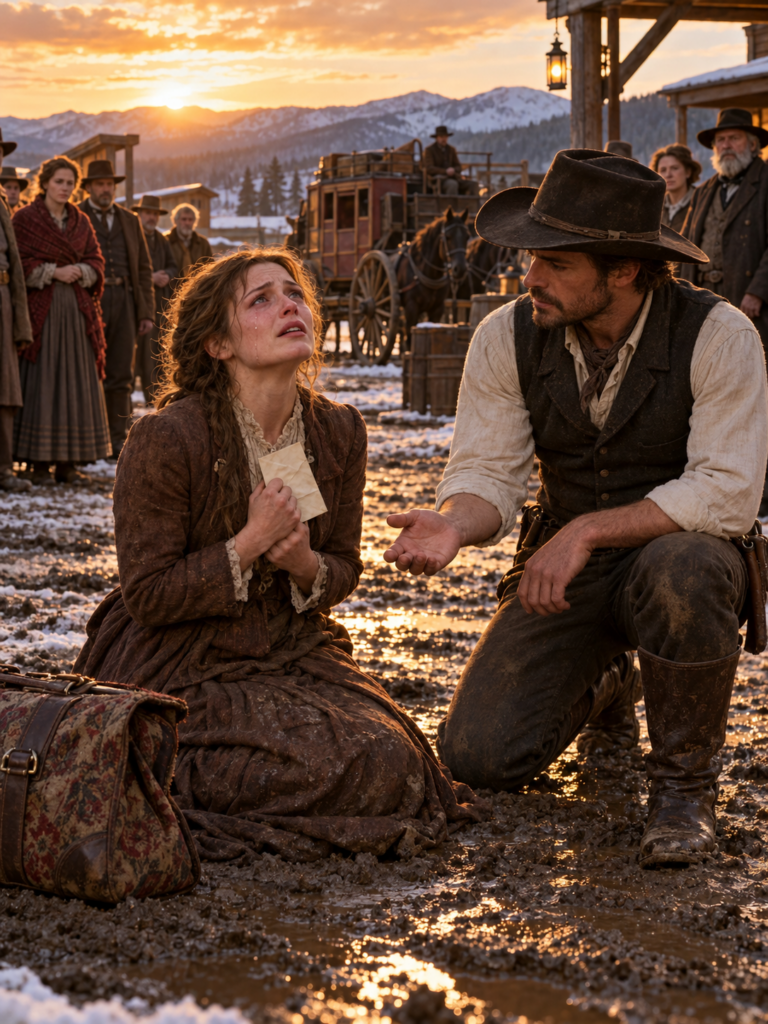
Clara’s fingers tightened until the fabric pulled against Ethan’s arm.
He looked at her hand, then at her frightened face.
“Is this man coming after you?”
“I don’t know.”
“Has he threatened you?”
“Not in words anyone would call a threat.”
She released his sleeve, ashamed of her own urgency.
Ethan did not move away.
“Then we ought to understand what danger there is before deciding what to do about it.”
“You speak as though it can be managed.”
“Some troubles can. Others can’t. But fear won’t tell us which.”
Clara lowered her eyes.
“He was a member of the school board.”
Ethan waited.
“I taught younger children in Lawrence. I loved the work. I was good at it.”
Her voice trembled on that last sentence.
“He came to see me at the school. Often. At first, I thought he was checking on his contribution to the building.”
“Then?”
“He began asking for things a respectable man had no right to ask of a teacher.”
Ethan’s expression hardened, but he kept his voice controlled.
“And you refused.”
“Yes.”
“What happened afterward?”
Clara glanced toward the open bedroom door.
“I lost my position.”
He said nothing.
“The board called it misconduct. Parents stopped speaking to me. My father believed what they said.”
She folded her arms against herself.
“I had taught those children for three years. Some could scarcely read when I first met them. I knew their families. I thought that would count for something.”
Her eyes filled.
“It counted for nothing.”
Ethan looked down the hallway toward the warm kitchen.
“Have you eaten since morning?”
Clara stared at him.
“Did you hear what I said?”
“Every word.”
“Then why are you asking about supper?”
“Because you have traveled four days, you’ve hurt your knees, and you haven’t had a proper meal. None of those things will help you think.”
She gave a small, astonished laugh that turned into a sob.
He did not reach for her.
“I can bring you food here,” he offered. “Or you can eat at the table.”
“The table,” she answered. “I don’t wish to hide.”
“All right.”
She followed him to the kitchen.
While he warmed beans and sliced bread, Clara sat beside the lamp and watched his practiced movements.
The house seemed strangely ready for another person.
Two plates. Two cups.
A second chair pulled away from the wall.
“Did you always mean to marry a stranger?” she asked.
“No.”
“Then why did you write?”
Ethan put the bread down.
“My parents and the rest of my family died of fever years ago. Afterward, I kept the ranch because it was what remained. I told myself work was enough.”
“Was it?”
“No.”
The plainness of his answer unsettled her more deeply than a confession dressed in beautiful language might have.
He set a plate before her.
“That’s part of why I rebuilt the house. I wanted somewhere another person might actually wish to live.”
Clara picked up her fork.
“And if that person arrives carrying disgrace?”
“Then I’d rather know whether the disgrace is deserved than trust the people spreading it.”
She looked at him.
“Preston Hail,” she said quietly.
Ethan paused.
“That’s his name?”
“Yes. He has money, influence, and friends in places I’ve never been. I don’t know how far his reach goes.”
Outside, a horse shifted in the barn.
The sound brought back the station yard, Mabel’s remarks, the people who already seemed to know something about her.
“Someone in town recognized the story,” Clara said. “How could they know so quickly?”
Ethan considered that.
“People trade gossip along with letters and goods. It may have reached here ahead of you.”
“And if Hail sends proof?”
“What sort of proof?”
“Official papers. He made certain the accusations were written down.”
Ethan drew out the other chair.
“Then we may have to look at those papers.”
“Would you believe them?”
“I’d read them. Then I’d ask who prepared them and why.”
Clara pressed her lips together.
No one in Lawrence had asked those questions.
For the first time, she understood that escaping Kansas was not the same as recovering her name.
She could live quietly here, perhaps even marry this considerate man.
But the accusations would remain.
And if she never challenged them, any person with an interest in hurting her could use them again.
She pushed her plate aside.
“Ethan, I want to stay tonight. But I won’t marry you simply because you’ve given me somewhere to sleep.”
“I wouldn’t ask you to.”
“And I won’t have you fighting my battles without speaking to me first.”
He inclined his head.
“Fair enough.”
She extended her hand across the table.
“Then let us begin by telling each other the truth.”
Ethan reached toward her offered hand.
Before his fingers touched hers, Clara made one more decision.
“Tomorrow,” she said, “I want to see the ranch accounts. If I am to consider a life here, I ought to know what kind of life we’re discussing.”
For the first time that evening, Ethan smiled.
“That,” he said, taking her hand, “I can arrange.”
Ethan’s hand closed gently around Clara’s.
It was not a lover’s grasp. Not yet.
It was the handshake of two people agreeing that whatever came next would be decided openly.
Clara held on for a moment, then withdrew her hand and returned to her supper.
Across the table, Ethan looked toward the ledger on the kitchen shelf.
He had imagined many conversations with the woman he meant to marry.
He had not imagined discussing supply accounts before courtship.
Yet somehow, the prospect pleased him.
The following morning, Clara slept later than she intended. When she finally entered the kitchen, the sun was already shining across the floorboards.
Ethan had gone to the barn.
She found cornmeal, salt pork, and coffee, prepared breakfast, and set out two plates.
When he returned, she stood beside the stove.
“I took the liberty of using your kitchen.”
He glanced at the meal.
“I see that.”
“If you’d rather I didn’t—”
“Miss Bennett, if I objected to breakfast, I’d be a fool.”
She smiled despite herself.
He sat down.
She joined him rather than waiting to serve.
Over coffee, they discussed the ranch: the cattle, the feed supplies, the fall repairs, the cost of keeping horses through winter.
Ethan brought out his accounts.
Clara began reading.
Within an hour, she noticed an irregularity.
The price charged for feed exceeded the amount shown on several delivery receipts.
At first, she assumed he had entered the figures incorrectly.
Then she found the same difference again.
And again.
“Ethan, who prepares your invoices?”
“Barker’s feed store. Why?”
She turned the ledger toward him.
“Because for months, somebody has been charging you for more than you’ve received.”
He leaned over the figures.
“How much?”
“Close to a tenth on several orders. I haven’t finished checking the earlier ones.”
Ethan stared.
“I’ve done business there for years.”
“Then perhaps you’ve trusted them for years.”
He looked at her, then laughed softly.
“That’s a fair distinction.”
She requested the remaining receipts.
By evening, she had arranged the discrepancies by date and amount.
Ethan watched her working beneath the lamp.
Her expression was different from the one she had worn at the station.
The frightened passenger had disappeared.
In her place sat a capable woman who understood exactly what she was doing.
He realized the difference mattered.
She was not becoming stronger because of him.
She was recovering the strength other people had tried to take from her.
The next day, Ethan carried her calculations into Red Hollow.
Barker protested, then examined the receipts and began to sweat.
By the end of the week, the overcharges had been corrected.
Word spread quickly.
Not everyone welcomed the news.
Mabel Puit continued whispering about the woman from Kansas.
But Ruth Alderson arrived at the ranch with her husband’s mill accounts. Then the Garretts came with their records. An elderly rancher named Cobb brought a ledger he had not trusted anyone to examine in years.
Clara helped each of them.
She did not pretend every mistake was dishonesty.
Some were careless additions. Others were confused entries.
But the work reminded her of something she had feared she had lost.
She still knew how to make herself useful through knowledge rather than obedience.
And people were beginning to come to her for that knowledge.
One afternoon, Ethan found her in the barn holding the bridle of a wounded bay mare.
The animal had injured its foreleg against a fence.
“She won’t stand quietly,” he warned.
“Let me try.”
Clara spoke softly to the mare, keeping her hand steady against the leather.
The horse settled.
Ethan cleaned and dressed the cut while Clara held her.
“You know horses,” he said afterward.
“My father kept them. I rode often when I was younger.”
Ethan nodded toward a dun gelding in the far stall.
“That one’s Solomon. Reliable fellow, provided you don’t expect him to hurry before breakfast.”
“May I ride him?”
“Of course.”
She looked surprised.
“You trust me?”
“You’ve just handled a frightened mare better than I did. I see no reason not to.”
That afternoon, Clara rode beyond the barn and into the clear autumn air.
She did not go far.
But when she returned, her cheeks were flushed and her eyes bright.
Ethan was repairing a porch board.
“How was Solomon?”
“Stubborn.”
“That’s his better quality.”
“He reminds me of somebody.”
Ethan glanced up.
“Can’t imagine who.”
For the first time, her laughter came without sorrow following it.
Their lives gradually acquired a rhythm.
Ethan tended the cattle and fences.
Clara kept the books, helped where she chose, and rode Solomon when the weather permitted.
They learned each other’s habits.
He discovered she preferred strong coffee and disliked having her work interrupted.
She discovered he sometimes spoke to his horses more freely than to people, and that he kept repairing things long after they were sturdy enough to serve.
At supper, they discussed figures, weather, neighbors, and memories.
Sometimes they disagreed.
Clara found that he listened even when he did not immediately agree.
That alone felt unfamiliar.
On the third evening after her arrival, they had settled one question.
She would remain at the ranch, and marriage would not be demanded as payment for shelter.
But after a week, another question was beginning to trouble them both.
What were they becoming to each other?
Ethan offered marriage as an honest possibility, along with the alternative of helping her establish herself elsewhere.
Clara asked for time.
He gave it.
Then a letter arrived from Kansas.
She recognized Preston Hail’s handwriting before she opened it.
The message was brief and courteous.
He had learned she was living in Montana Territory.
He possessed acquaintances there.
He trusted she understood that a reputation could travel farther than the person who carried it.
Clara placed the paper on the kitchen table.
Ethan read it at her request.
“He wants you frightened,” he said.
“He wants me reminded that he can still reach me.”
“How did he learn where you are?”
“I don’t know.”
But Clara remembered a wealthy cattleman who had watched her at the station.
William Crawford.
He owned the largest ranch in the area and had twice tried to purchase part of Ethan’s land.
Ethan had refused both offers.
Dale Hutchkins, Ethan’s closest neighbor, soon supplied troubling information.
Crawford had been asking questions about Clara’s background.
He had also renewed his interest in Ethan’s forty acres along the creek, land lying near a proposed northern road.
Clara studied the situation.
“A man wants your property,” she said. “He cannot persuade you to sell. Then a woman arrives who gives him something he can use to damage your standing.”
Ethan sat opposite her.
“You think he’s using Hail’s accusations?”
“I think we should find out.”
Dale learned that information about Clara had passed through business acquaintances connecting Kansas and Montana.
Crawford had received details about her dismissal.
And he was not keeping them to himself.
Clara felt the old shame return.
She had traveled hundreds of miles only to find the same weapon waiting for her.
One evening, Ethan spoke of marriage again.
“A proper wedding would settle some questions people are raising,” he said. “But I won’t pretend it can make Crawford harmless.”
Clara looked directly at him.
“And I won’t marry merely to strengthen your position against him.”
“I know.”
“Ask me when you want a wife, Ethan. Not when you need a defense.”
He accepted the correction.
“I do want a wife. I hoped that woman might be you. But I want you willing.”
Her hands grew still.
For a moment, neither spoke.
Then she said, “Ask me again after I’ve had time to know what my own answer means.”
He nodded.
Meanwhile, Crawford changed his approach.
One morning, while Ethan worked on a distant fence, three riders appeared near the barn.
Clara recognized the man in front.
William Crawford dismounted with a polished smile.
“Miss Bennett.”
She remained beside Solomon, a curry comb in her hand.
“Mr. Crawford.”
“I hear you’re helping our neighbors with their accounts.”
“When they ask.”
“An interesting occupation for a woman whose professional career ended under unfortunate circumstances.”
Clara held his gaze.
“Is there business you have with Mr. Walker?”
“Nothing urgent. I merely thought you should know that your former acquaintance, Mr. Hail, sends his regards.”
The curry comb grew heavy in her hand.
Crawford continued.
“It’s a lonely property out here. A woman might find herself needing friends.”
“I have friends.”
“Friends can change their minds.”
Clara took one measured breath.
Then another.
“Mr. Walker knows about Lawrence,” she said. “You needn’t trouble yourself with the telling.”
Crawford’s smile faded slightly.
“And if the documents say otherwise?”
“Then whoever reads them should ask who wrote them.”
For several seconds, he studied her.
Then he remounted and rode away with his two men.
Only after they vanished beyond the fence did Clara sit on a hay bale and allow her shaking hands to rest.
She told Ethan everything that evening.
He listened.
When she finished, he said, “Crawford won’t be coming here to frighten you again without hearing from me.”
“Ethan, don’t threaten him.”
“I intend to speak to him.”
“Then tell him exactly what happened. Nothing more.”
He agreed.
But before he left the table, Clara caught his attention.
“Ethan.”
“Yes?”
“You asked me to consider marriage.”
He waited.
“I’ve considered it.”
Her eyes filled, though her voice remained clear.
“I want to marry you. Not to silence Mabel. Not to frighten Crawford. Because I like the man you are when nobody’s watching.”
Ethan stood motionless.
Then he crossed the kitchen and took both her hands.
“Clara Bennett,” he said, “would you choose to become my wife?”
“Yes.”
Their wedding took place the following Saturday.
Reverend Aldis performed the ceremony.
Dale and his wife attended, along with Ruth Alderson, the Garretts, and Cobb.
Clara wore a blue dress she had almost left behind in Kansas.
Ethan wore the same good hat he had worn at the station.
He remembered her on her knees in the mud.
She remembered his open hand.
Neither mistook gratitude for love.
They were choosing something harder and better: a life in which each would have to keep choosing the other.
That evening, they returned to the ranch and prepared supper together.
Clara stirred the pot while Ethan cut bread.
For several minutes, they spoke of nothing important.
Then she set down the spoon.
“There’s something I want you to know.”
He looked at her.
“I am happy I married you.”
His face softened.
“So am I.”
“But I still intend to clear my name.”
“I would expect nothing less.”
She smiled.
Then a knock came at the door.
Dale Hutchkins stood on the porch, looking troubled.
“Ethan. Clara. There’s something going around town.”
Ethan stepped aside.
Dale entered carrying several copied pages.
“Crawford’s been sending out records from Lawrence. School-board complaints. Dismissal notices. He’s sent them to Reverend Aldis, several families, and word is he’s written to the land office.”
Clara took the pages.
The signatures were familiar.
The accusations were familiar.
Every page looked official.
Every accusation was false.
And this time, William Crawford intended those papers to help him take their land.
Clara laid the documents flat on the kitchen table.
“Ethan,” she said, “we are not going to hide from this.”
He looked at her.
“Then what do you intend?”
She drew the account ledger beside the papers.
“We are going to find everyone else Crawford has tried to ruin. And we are going to make them tell the truth together.”
Clara pulled a clean sheet of paper from the drawer and began writing names.
Ethan brought the lamp closer.
At the top, she wrote William Crawford.
Beneath it, she entered the Walker property, the forty acres of creek access, the proposed road, and the dates of Crawford’s earlier purchase offers.
Then she added the names of people whose difficulties had begun after they refused to sell land.
Ethan leaned over her shoulder.
“Cobb,” he said. “Crawford bought some of his north pasture.”
Clara wrote the name.
“The Garretts mentioned trouble with their credit,” she said. “They told me it began after a visitor offered to buy their claim.”
Another name went onto the page.
She examined the list.
“We need their accounts, not merely our suspicions. Dates. Letters. Documents. Anything that shows what happened.”
Dale rubbed his beard.
“Crawford has friends in important offices.”
“Then we must be careful which offices we trust,” Clara replied.
Ethan watched her arrange the papers into neat stacks.
He had seen this expression before: the concentration she brought to discovering irregularities in the ranch accounts.
Only now the figures represented people’s homes.
And their freedom to keep them.
The next morning, husband and wife separated to gather information.
Ethan rode to Cobb’s property.
Clara took Solomon north to visit James and Norah Garrett.
She was no longer the exhausted woman who had arrived unable to stand.
Her movements were confident, though she understood perfectly well that Crawford’s influence made the journey risky.
The Garretts received her cautiously.
They already knew about the Kansas documents.
Clara did not spend time defending herself.
“I’ve come to ask about Crawford,” she said.
James exchanged a glance with Norah.
“What about him?”
“Did your troubles begin after you refused to sell?”
Norah answered first.
“Yes.”
She described the sudden withdrawal of credit at the general store, questions from the county assessor, and the visitor who had mentioned an old family difficulty that had nothing to do with their Montana land.
Clara listened carefully.
“Would you be willing to tell the sheriff?”
James looked troubled.
“Crawford can make things hard for us.”
“He already has.”
That silenced him.
Clara softened her voice.
“I’m not asking you to risk your home for mine. I’m asking whether you’d help us protect both.”
Norah touched her husband’s arm.
“We should tell it,” she said.
James finally nodded.
“We will.”
Meanwhile, Cobb told Ethan how Crawford had used his son’s old debt to pressure him into surrendering eighty acres for far less than their value.
“Who handled the transfer?” Ethan asked.
“Henderson Doyle. At the county land office.”
Ethan remembered the name.
Doyle had been associated with Crawford for years.
When he returned home, he found Clara waiting beside the kitchen table.
They compared notes.
Different families.
Different weaknesses.
But the same sequence appeared again and again.
A landowner refused Crawford.
Private difficulties suddenly became public.
Credit tightened. Official questions appeared. Family reputations were threatened.
Eventually, property changed hands.
Clara drew lines connecting the events.
“He doesn’t need to steal land outright,” she said. “He makes keeping it so difficult that people accept his offer.”
Ethan studied the page.
“And Doyle?”
“May have helped him select the properties and complete the transfers. We need more than suspicion to prove it.”
She began preparing letters.
One went to the territorial authorities in Helena.
Another went to Marcus Webb, a lawyer in Lawrence whom Clara remembered from an earlier dispute.
The third went to Reverend Aldis.
She asked him to examine the motives behind Crawford’s distribution of the school records rather than treating the existence of those records as proof of misconduct.
Sheriff Baines listened when Ethan presented their findings.
He was an honest man, but Crawford’s influence troubled him.
“These are serious accusations,” he warned.
“I understand,” Ethan said.
“Then understand this as well. Suspicion won’t convict Crawford of anything.”
Clara leaned forward.
“That’s why we’re bringing you witnesses and records instead of asking you to take our word.”
Baines looked down at her organized papers.
Then he began reading.
The investigation moved slowly.
Letters had to travel between towns. Records had to be checked. People who had remained quiet for years had to decide whether they were willing to speak.
There were discouraging days.
One witness remembered events but possessed no documents.
Another feared losing business.
Crawford’s friends dismissed Clara as a vindictive woman whose own character had been questioned.
Yet every week brought another small piece of the pattern.
The ranch continued operating during the struggle.
Cattle needed tending. Fences needed repairing. Horses needed feed.
Clara never abandoned the ordinary work of their life.
Neither did Ethan ask her to set aside the investigation so that he could conduct it on her behalf.
At night, they sat together over the kitchen table.
Sometimes Clara became so frustrated with missing records that she pushed the papers away.
Ethan would bring coffee and sit beside her.
“Want to stop for tonight?”
“Not yet.”
“All right.”
He stayed.
Other evenings, Ethan returned from difficult conversations with men who were afraid to contradict Crawford.
Clara listened as he explained what he had learned.
Together, they decided what might be worth pursuing and what could not yet be proved.
Their marriage deepened through these ordinary acts of patience.
But the past still hurt.
One evening, Clara received a reply from Marcus Webb.
He had begun examining the proceedings that had cost her teaching position.
The dismissal had followed complaints made under Preston Hail’s influence.
Some witnesses had never been independently questioned.
Others had since become willing to reconsider their original statements.
Clara read the letter twice.
Ethan found her standing at the window.
“Good news?”
“Possibly.”
She handed him the page.
When he finished, she said, “I thought leaving Kansas meant I was giving up any chance to be heard.”
He returned the letter.
“You are being heard now.”
“Because people here helped me.”
“Because you kept asking questions. The rest of us finally learned to ask them with you.”
She looked toward the books beside the fireplace.
“I miss teaching.”
It was the first time she had admitted it without immediately speaking of the disgrace.
Ethan knew how much the admission cost her.
“Would you teach again?”
“If anyone would trust me.”
“I’d trust you with a classroom.”
She shook her head.
“You’re my husband.”
“True. But I’ve also watched you correct Barker’s accounts, straighten mine, and convince Cobb that eighty acres of lost pasture are worth fighting for.”
Clara laughed quietly.
“That’s hardly the same as teaching children.”
“No. But it tells me you’re good at explaining things other people find difficult.”
She remained thoughtful long after they went to bed.
The investigation soon uncovered another family whose land had attracted Crawford’s attention.
Agnes Whitmore had lost her claim under circumstances strikingly similar to Cobb’s experience.
Her original papers contained discrepancies when compared with the recorded transfer.
That discovery became important.
A territorial investigator named Samuel Vance began reviewing the transactions.
He examined statements, original deeds, altered entries, and the connection between Crawford and Doyle.
The families’ testimony strengthened the record.
So did Clara’s carefully dated account of events.
One afternoon, Vance asked her why she had thought to compare the land transfers.
“Because I had seen how official records could be used to disguise dishonesty,” she answered.
“From Kansas?”
“Yes.”
“And you believed the same thing had happened here?”
“I believed it was possible. I wanted the papers to tell me whether I was right.”
He studied her notes.
“They appear to have told you a great deal.”
Clara glanced at Ethan.
He did not speak for her.
He merely met her eyes.
That was enough.
In the weeks that followed, more documents emerged.
The disputed transfers followed a recognizable course.
Crawford had acquired strategically placed property through pressure and fraudulent alterations, while Doyle had used his office in ways that favored Crawford.
The proposed northern road explained why those parcels mattered.
It would pass through land Crawford had been trying to assemble, including the Walker creek property.
The same road that might increase the value of the land had given Crawford a reason to force other owners out before its plans became widely known.
For the first time, Clara understood the entire scheme.
Her reputation had never been Crawford’s true concern.
Her reputation was simply another tool he believed he could use.
That recognition did not lessen the suffering Preston Hail had caused her.
But it made the struggle in Montana clearer.
Crawford was not entitled to her silence.
Neither was Hail.
When Vance’s report reached Sheriff Baines, it documented fraudulent land-transfer alterations, coordinated intimidation, and improper dealings with Doyle.
Warrants followed.
Crawford faced proceedings concerning the transactions.
Doyle disappeared for a time, but his flight did not erase the records.
Several disputed transfers were frozen while the territorial authorities considered the evidence.
Clara stood beside Ethan in the sheriff’s office as Baines explained the findings.
Cobb was present.
So were the Garretts and Agnes Whitmore.
For a long moment, nobody spoke.
Then Agnes began crying.
Norah Garrett put an arm around her.
Cobb removed his hat and lowered his head.
These were not people celebrating revenge.
They were people discovering that the injuries they had endured could finally be named.
Clara looked at the official papers on Baines’s desk.
For more than a year, an official record had been the thing she feared most.
Now another record contained facts powerful men had wanted hidden.
Yet she understood that the work was not finished.
Crawford employed lawyers and challenged the proceedings.
The disputed transfers still required decisions.
The Kansas accusations remained part of Clara’s history until the original record could be formally reviewed.
She went home and continued working.
More letters traveled east.
Marcus Webb gathered evidence concerning Preston Hail’s conduct.
Gerald Foster, connected with the earlier school-board proceedings, supplied information relevant to the review.
The account of Clara’s dismissal began to unravel under scrutiny.
Meanwhile, Red Hollow’s opinion of Clara continued changing.
Ruth Alderson had never withdrawn her friendship.
The Garretts stood beside her publicly.
Cobb spoke of her work to anyone who asked.
Even Reverend Aldis began challenging the town’s willingness to confuse a signed accusation with established truth.
At church one Sunday, Clara encountered Mabel Puit near the side door.
Mabel held her handbag with both hands.
“Mrs. Walker, I spoke about you before I knew the circumstances.”
“Yes,” Clara answered.
“I was wrong.”
Clara regarded her quietly.
She remembered the station yard.
The frozen mud.
The voices that had made her feel unworthy to stand beside Ethan.
She could have walked away.
Instead, she said, “Next time you hear a story like mine, ask who gains something by spreading it.”
Mabel lowered her eyes.
“I will.”
Clara nodded.
She did not feel obliged to become Mabel’s friend.
But the conversation was finished.
And she had finished it standing straight.
***
The hearing in Helena brought Crawford’s affairs before a territorial judge.
Marcus Webb traveled from Kansas to assist with the documents concerning Clara’s dismissal.
Before proceedings began, he found her in the courthouse corridor.
“Mrs. Walker, there’s news from Lawrence.”
Clara felt her heart quicken.
“What news?”
“The review has found serious irregularities in the complaints against you. Your dismissal record has been amended to include those findings. Preston Hail has been asked to resign from the school board.”
Clara stared at him.
For a moment, the courthouse sounds faded.
She could see the classroom in Lawrence.
The desks arranged in careful rows.
Children bent over their reading books.
Her father refusing to hear her explanation.
The envelope of traveling money placed in her hands.
She had carried those memories across the country believing they would remain unanswered.
Now the record was no longer permitted to speak only with Hail’s voice.
“Does it say I did nothing wrong?” she asked.
“It does not erase the dismissal,” Webb answered carefully. “But it establishes that the original proceedings were tainted. The official account can no longer be treated as unquestioned fact.”
Clara drew a slow breath.
It was not a perfect correction.
It did not return the year she had lost.
But it meant the truth had found a place in the record.
“Thank you,” she said.
Webb shook his head.
“You did much of the difficult work yourself.”
Ethan stood a few steps away.
When Clara turned, he extended his hand.
She took it.
Then she looked toward the hearing room.
“Let’s finish this.”
During the proceedings, Crawford’s attorneys questioned the witnesses and challenged the interpretation of the records.
They argued that Clara’s past gave her a personal reason to attack their client.
But the investigation included documents that did not depend upon her reputation.
There were altered transfer papers.
Witness accounts.
Evidence concerning Doyle’s conduct.
And a survey of the proposed county road.
That survey revealed the central purpose behind Crawford’s acquisitions.
The disputed properties were positioned along the planned route.
The forty acres Ethan refused to sell occupied another important part of it.
For years, Crawford had been assembling land whose value would rise if the road were approved.
He had not merely wanted a larger ranch.
He had wanted control of a corridor before its worth became widely understood.
Clara watched his expression as the survey was examined.
He no longer looked like a man confidently arranging another family’s future.
He looked like a man who had lost control of his own calculations.
The ruling did not come that day.
The court required time to review the evidence.
Clara and Ethan returned to Red Hollow and resumed their work.
Eleven days later, word arrived.
Crawford had been found liable in the proceedings involving fraudulent land-transfer alterations and intimidation.
His attorneys appealed.
The disputed transfers remained frozen.
The affected families gained a path toward restitution.
Doyle was eventually apprehended.
The investigation into the use of confidential road information continued beyond the original land cases.
Justice did not arrive all at once.
Some families waited months for the restoration of what had been taken.
But Crawford could no longer operate as though nobody would question him.
Cobb eventually recovered much of the value of his lost pasture.
Agnes Whitmore regained her claim and began managing it herself.
The Garretts were able to plan their future without the same pressure to sell.
For Clara, their recoveries mattered as much as the judgment against Crawford.
The victory had never belonged to her alone.
It belonged to everyone who had finally spoken.
***
Winter settled over the Walker ranch.
Snow gathered along the fence posts.
The garden lay dormant beneath the cold ground.
Inside the house, the kitchen remained bright.
Clara continued helping neighbors with their accounts.
Ethan handled the cattle and the endless work of keeping a ranch through winter.
They shared duties without measuring affection in chores.
When Clara wanted quiet to write letters, Ethan respected it.
When he needed another hand in the barn, she helped if she could.
When either of them disagreed with a decision, they discussed it.
The home Ethan had rebuilt before her arrival was finally becoming the home he had imagined.
Not because it now contained a wife.
Because it contained two people with a voice in its future.
One evening, Clara laid aside a letter from Marcus Webb and took down one of the books from the shelf.
She turned several pages without reading them.
Ethan noticed.
“Something troubling you?”
“No. Something I haven’t decided how to begin.”
“Tell me.”
She looked up.
“I want Red Hollow to have a proper school.”
He smiled.
“I wondered when you might say that.”
Clara narrowed her eyes.
“Did you?”
“You’ve been speaking about the children’s education for weeks.”
“That doesn’t mean the town will agree.”
“Then you’ll have to persuade them.”
She looked at him for a moment.
“And you?”
“I’ll stand beside you. Though I suspect you’ll manage the persuading better.”
She began preparing her proposal.
It required careful estimates, a suitable building, supplies, a teacher’s schedule, and the support of local families.
She approached it with the same discipline she had used to untangle the land records.
At the town meeting, Clara spoke clearly.
She did not ask anyone to forget the accusations made against her.
She explained what the review had established and what she intended to provide.
Then she described the need for a school.
Several families supported her immediately.
Others needed convincing.
Clara answered their questions.
In time, the proposal succeeded.
When the first pupils arrived, she stood beside the classroom door and welcomed them.
A little boy asked whether she was truly the woman who had helped his father get money back from a dishonest account.
Clara smiled.
“Today I’m the woman who intends to teach you your letters.”
He considered that.
“Is that harder?”
“Sometimes,” she answered.
The child laughed and hurried to his seat.
Clara stood for a moment with her hand on the doorframe.
She remembered the classroom she had lost.
Then she walked inside and began teaching.
***
As the seasons passed, the Walkers’ marriage grew quieter and deeper.
There were arguments over ordinary things.
Ethan sometimes tried to take on too much work himself.
Clara occasionally worked past exhaustion because she still feared losing what she had rebuilt.
They learned to recognize those habits.
One evening, Ethan found her bent over a neighbor’s accounts long after supper.
“Those figures will still be there tomorrow.”
“They need these corrected.”
“And they will be. But I need you to eat something.”
Clara looked at him, then at the untouched plate he had left beside her.
“You’re becoming rather commanding.”
“Only where supper is concerned.”
She laughed.
He took the other chair and joined her.
Neither of them had forgotten the first evening when he had brought food to a woman who believed she must explain her entire past before deserving kindness.
They no longer spoke of those memories often.
They did not need to.
The proof of what they had built appeared in smaller things.
His coat beside hers.
Two cups washed and placed together.
Her books joining his on the shelf.
A horse that recognized her footsteps.
A kitchen table where neighboring families could arrive with problems and find someone willing to help them think.
Then, one spring morning, Clara discovered that their family would be growing.
She carried the knowledge privately for a little while, wanting to be certain before speaking.
When she finally found Ethan in the barn, he was checking Solomon’s stall.
“Ethan.”
He turned.
“I believe we’ll need another room before autumn is over.”
He looked puzzled.
Then understanding slowly transformed his face.
“Clara?”
She nodded.
For once, Ethan Walker had no immediate words.
He crossed the barn and gently held her face between his hands.
“Are you pleased?” he asked.
“Very.”
He rested his forehead against hers.
“So am I.”
She laughed when he immediately began talking about carpentry, repairs, and how much room the new addition might require.
The baby would not make their marriage meaningful.
That meaning was already there.
But they welcomed the prospect of another life within the home they had chosen together.
***
Three years after Clara’s arrival in Red Hollow, the Walker ranch looked much as it always had from the road.
The same barn stood beyond the house.
The same creek ran past the lower pasture.
The same porch faced the mountains.
But the house now had another room, painted pale to welcome the daylight.
A little girl named Mary slept there.
She had her father’s gray eyes and her mother’s determined expression.
She loved horses, though Ethan insisted she was still far too young to understand why Solomon disliked anyone pulling his mane.
Clara taught school four days each week.
On Fridays, neighbors came to the Walker kitchen with their account books.
Sometimes they brought news.
Cobb wrote when the remaining restitution questions concerning his land were finally resolved.
Agnes Whitmore sent word of improvements on her restored property.
Marcus Webb continued his work in Kansas, using what he had learned from Clara’s case when other women faced similar abuses of authority.
Not every wrong was corrected.
Not every cruel remark was forgotten.
But the structures that had allowed Crawford and Hail to act without challenge had been tested, exposed, and changed.
And Clara had played an essential part.
One November evening, the air turned cold over the ranch.
Ethan stepped onto the porch carrying two cups of coffee.
Clara was already sitting there.
Inside, Mary slept peacefully.
He handed Clara a cup and took the chair beside her.
For a while, they watched the mountains.
Then Ethan said, “Do you remember the day you came?”
Clara smiled.
“I remember nearly falling through the bottom of that stagecoach.”
“You fell hard enough.”
“I was certain you’d send me away.”
“I know.”
She examined the man beside her.
His hair had begun to show more gray. There were fine lines around his eyes that had not been there three years earlier.
But the steadiness she had recognized in him remained.
“I used to think about that afternoon constantly,” she said. “What would have happened if I hadn’t come? If I’d turned back? If you’d decided a woman with my past was too much trouble?”
Ethan rested his cup on the porch rail.
“I was frightened too.”
Clara looked at him.
“You?”
“Of course. I’d spent years alone. I had a house I knew how to repair and a ranch I knew how to run. I didn’t know whether I could make another person happy.”
“You never told me that.”
“I didn’t know how to say it then.”
She considered his answer.
“And now?”
“Now I know happiness isn’t something one person can build for another.”
He looked at the windows glowing behind them.
“We both had to make this place a home.”
Clara reached for his hand.
She thought of Preston Hail.
Of William Crawford.
Of the months spent gathering evidence, the people who had spoken, and the hard-won corrections made to records that once threatened to define her.
She thought of the schoolchildren she taught and the families who trusted her judgment.
She thought of little Mary asleep inside.
Then she remembered an exhausted woman kneeling in the mud, believing her life had become something shameful.
“I know what I would tell her now,” Clara whispered.
“Who?”
“The woman who got off that stagecoach.”
Ethan waited.
Clara looked across the yard toward the road leading back to Red Hollow.
“I’d tell her she was never what those men said she was. I’d tell her she would teach again. That she would help other people keep their homes. That she’d have a husband who listened when she spoke, and that she would never again have to mistake silence for agreement.”
She paused.
“And I’d tell her she would learn to trust herself.”
Ethan squeezed her hand.
“She did all that.”
“We did some of it together.”
“Yes,” he said. “We did.”
From inside came a soft sound.
Both parents turned automatically toward the door.
Mary settled again.
Clara smiled.
Ethan looked at her.
“Are you happy?”
It was a question he had asked in different ways throughout their marriage.
He never assumed the answer merely because she had stayed.
Clara thought about it.
“Yes,” she said. “Not because everything that happened was made right. Some things can never be given back.”
He nodded.
“But I can stand in my own classroom. I can look people in the eye. I can make choices about this ranch, this family, and my work. And when I come home, I know I belong here because I want to.”
Ethan lifted her hand to his lips.
“That’s what I hoped.”
She leaned her shoulder against his.
The porch boards creaked softly beneath them.
Beyond the fence, the last light disappeared from the Montana hills.
Years earlier, Ethan had rebuilt a house for a woman he had not yet met.
Clara had crossed the country searching for a place where the accusations against her might finally fall silent.
Neither had found exactly what they expected.
He had found someone who could challenge his judgment, share his burdens, and make a lonely house feel inhabited.
She had found more than protection.
She had found room to reclaim the work, dignity, and future that had always been hers.
And together, they had built something neither could have created alone.
When Clara rose to check on Mary, Ethan stood beside her.
At the doorway, she paused.
“Do you know what I remember most clearly about that day at the station?”
“The mud?”
She laughed.
“No.”
“That miserable stagecoach?”
“Not that either.”
He waited.
“You gave me your hand,” she said. “But you waited until I chose to take it.”
Ethan looked at her for a long moment.
Then he opened the door and stepped aside so she could enter first.
Clara crossed the threshold into the home they had made.
And this time, she did not enter as a frightened stranger hoping to be allowed to stay.
She entered as a woman who knew she was loved, knew she was free, and knew exactly where she wished to be.


