Part 1
The first thing Tobias Wedlock dragged up the mountain wasn’t lumber, bedding, or firewood.
It was fifty pounds of pinto beans and two dented cans of rendered pork fat, lashed to a rough pine sled with mule rope so stiff from the cold that it barely bent beneath his fingers.
His old dog, Bram, walked ahead through the thin snow, occasionally stopping to look over his shoulder.
The wind swept across the Idaho mountainside, lifting loose snow from the rocks and driving it into Tobias’s face. His boots slipped twice on the frozen trail. Every few yards, he had to stop, catch his breath, and tighten his grip on the rope.
Above him, the cave waited.
From the outside, it looked like little more than a dark crack in the mountain.
The people of Sorrow Hollow called it the Goat Hole.
Nobody wanted it. Nobody had wanted it for years.
And three hours earlier, Tobias had spent the last ten dollars he and his wife possessed to make it theirs.
The laughter had started before the ink dried.
It happened inside the town diner, where a failing iron stove rattled beside the counter and half a dozen men sat nursing weak coffee they could barely afford.
An old silver miner, ruined by a claim that had stopped producing long ago, had unfolded a property paper and pushed it across the table.
“Ten dollars,” the miner said. “That’s all I’m asking.”
Tobias studied the paper. The property amounted to a rocky patch of mountainside and the abandoned cave opening within it.
He counted out the money.
Rowan Pike, the town carpenter, leaned back in his chair and laughed.
“Only a fool buys himself a hole in the ground when winter’s coming.”
A few other men chuckled.
Someone asked whether Tobias planned to raise goats. Another wondered how long before the mountain buried him.
Tobias didn’t argue.
He signed the paper, folded it carefully, and slipped it into his coat.
Then he asked the miner one question.
“Does the draft run deep inside?”
The miner frowned.
“Draft?”
“The air. Does it move through the back of the cave?”
The old man shrugged.
“Wouldn’t know. Haven’t been in there for years.”
Tobias nodded and stood.
Rowan shook his head.
“Ten dollars gone, just like that.”
Tobias picked up his hat.
“Maybe.”
He walked out before anyone could ask what he meant.
Sorrow Hollow had once believed prosperity was just around the corner.
First it had been silver. Then timber. Then a railroad survey that promised tracks, jobs, and customers.
The railroad never came.
By that autumn, the town survived on unpaid accounts, borrowed supplies, and promises nobody trusted anymore.
Tobias and his wife, Mara, lived in a small cabin near the edge of the settlement, where there were no other buildings to break the northern wind.
Their cabin looked respectable enough from the road.
Inside, it was a different story.
Cold air crept beneath the door and through gaps in the walls. The floorboards lifted slightly in hard weather. Even with the stove burning, the corners of the room stayed cold enough to make their breath visible.
When Tobias returned home with the property paper, Mara was sitting beside the stove, mending a worn wool coat.
She read the document once.
Then again.
“Tobias.”
He took off his gloves.
“Yes?”
She looked up.
“We spent our last ten dollars on a cave?”
He didn’t answer immediately.
Instead, he pointed toward the front door.
A thin ribbon of powdered snow was slipping through the gap beneath it.
“The house breathes wrong,” he said.
Mara stared at him.
“Our house leaks. I know that.”
“It leaks faster than we can heat it.”
“Then we fix the walls.”
“With what money?”
She looked down at the paper again.
Tobias understood what she was thinking. He had been thinking about it himself for months.
The previous January, Mara had awakened to find frost along the inside seams of their blanket.
The stove had still been burning.
That was the part Tobias couldn’t forget.
He had crossed the room and pressed his hand against the cabin wall, feeling cold air move through the timber as though the house were nothing more than a wooden sieve.
They had burned nearly all their firewood that week.
They had nearly frozen anyway.
Since then, Tobias had become suspicious of buildings that looked solid but couldn’t hold warmth.
“The mountain’s different,” he told Mara.
“You don’t know that.”
“No.”
He folded the paper.
“That’s why I’m going up there.”
Mara returned to her sewing, but the needle moved more slowly.
Neither of them spoke for a long time.
That night, Tobias lay awake listening to the wind.
Bram slept near the door. Whenever a gust found a new opening in the cabin, the dog raised his head.
Tobias noticed.
The animal knew where the cold was coming from even when Tobias couldn’t see it.
Before dawn, he took an oil lantern, wrapped himself in his heaviest coat, and climbed the mountain with Bram.
The first passage of the cave narrowed almost immediately.
Tobias had to stoop to keep the lantern flame away from the damp ceiling.
Water dripped somewhere farther inside.
The sound echoed through the stone.
Bram sniffed the ground and continued forward.
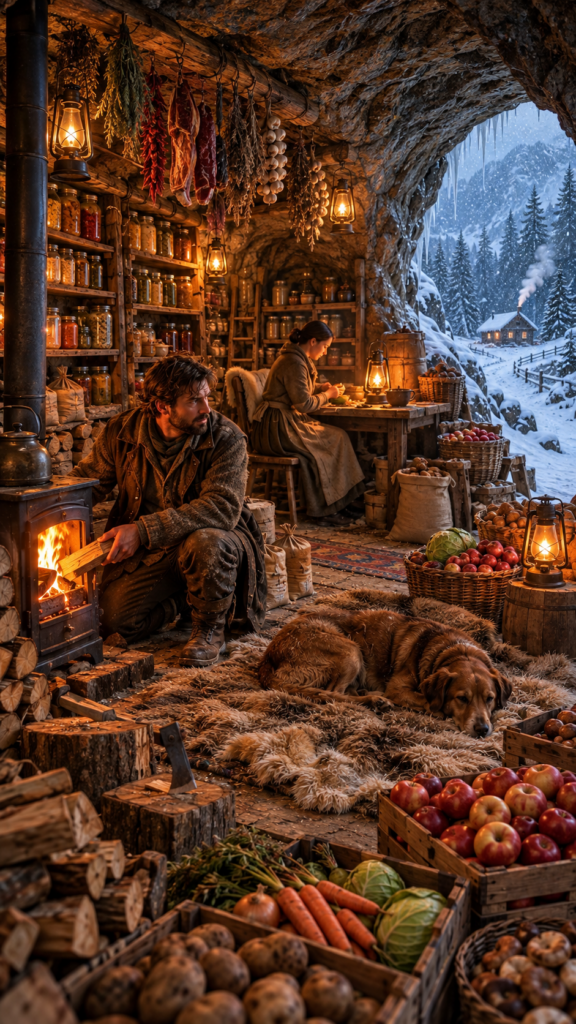
In the entrance chamber, everything smelled of wet dirt and cold minerals. Tobias could see old debris collected along the walls and the tracks of animals that had sheltered there.
Nothing about it suggested a comfortable home.
But farther inside, the air changed.
It was still cold.
Yet the cold felt different.
It didn’t strike his face in shifting gusts. It seemed to remain where it was, quiet and heavy, regardless of what the wind was doing outside.
Tobias crouched and put his palm against the stone floor.
The rock wasn’t warm.
But neither did it carry the sharp, punishing chill of the exposed boards in his cabin.
He held his hand there for several seconds.
Then he lifted the lantern.
Above an old blackened hearth, soot marks spread across the ceiling.
He stepped closer.
The stains continued toward a narrow crack in the stone overhead.
Someone had used a fire here before.
And somehow, the smoke had escaped.
Tobias studied the old hearth carefully, remembering the miner’s uncertain answer about the draft.
He found a long stone ledge beside the wall, smoothed by years of use. Nearby, a shallow drainage trench followed the floor toward a lower opening.
The cave had been lived in.
Not recently, perhaps.
But somebody had once understood how to survive here.
Bram moved across the chamber, circled twice beside the eastern wall, and settled down.
Tobias looked at him.
“Found your place already?”
The dog’s tail tapped the stone once.
Tobias crouched beside him.
There was no obvious reason that particular spot should feel different, but Bram had ignored the entrance and every other corner of the cave.
The old dog had chosen the place farthest from the wind.
Tobias stayed there for another hour, studying the stone, the airflow, and the old hearth.
When he finally stood, he knew he had not bought a comfortable home.
He had bought work.
An enormous amount of it.
But for the first time in months, he believed that work might actually keep them alive.
Over the next six days, he treated the cave less like a shelter than a stubborn piece of machinery.
He carried flat river stones uphill, one load after another, until his shoulders ached.
He arranged them around the old hearth, looking for a way to absorb warmth while the fire burned and release it slowly afterward.
From an abandoned freight shed, he salvaged rough planks and built a sleeping platform nearly a foot above the cave floor.
He widened the drainage trench with a pick.
He moved supplies away from damp sections of wall.
He hung strips of smoked venison in a colder part of the chamber and stacked sacks of pinto beans and barley on raised shelves.
Near the entrance, he built two separate wooden frames and stretched old canvas across them.
The layers formed a crude barrier, with a narrow space between them to slow the wind before it reached the main chamber.
At first, Mara watched his preparations with weary uncertainty.
Then, without announcing that she’d changed her mind, she began helping.
She repaired old feed sacks.
She hung blankets near the driest wall.
She counted the jars of lamp oil and arranged them where they wouldn’t be knocked over.
One evening, she sat beside the lantern dipping match heads into melted beeswax to protect them from dampness.
Tobias watched her work.
“You don’t have to do all that tonight.”
“I know.”
She dipped another match.
“But if we’re going to live in a hole, I’d rather have dry matches.”
He smiled faintly.
It was the closest either of them had come to joking about the purchase.
Then Tobias made his first serious mistake.
He built the fire too large.
For several minutes, the flames burned bright and hot. The stones around the hearth began to warm, and Tobias felt an almost childish satisfaction.
Then the smoke changed direction.
Instead of climbing toward the natural opening above the hearth, it rolled beneath the ceiling and began spreading through the chamber.
Mara coughed.
Bram jumped to his feet and barked frantically, pushing himself against her legs.
Tobias moved at once.
He smothered the flames with dirt and water, stamping out what remained.
The cave filled with a bitter smell.
They retreated toward the entrance until the smoke cleared.
Mara wiped her eyes.
“That could’ve killed us.”
“I know.”
“You said it could breathe.”
“I said I thought it could.”
She stared at the blackened hearth.
“And now?”
Tobias looked upward.
“Now I learn what I did wrong.”
That night, he didn’t build another large fire.
He sat beside the cold ashes with a single candle, watching how its flame moved as he changed openings and observed the air.
The mountain had its own habits. He couldn’t force it to behave like a cabin chimney.
He would have to work within its limits.
Mara eventually came over with a cup of cold coffee.
She placed it beside him and sat down.
They remained there in silence, watching the small flame.
By morning, Tobias had a better understanding of how carefully the hearth would need to be used.
But understanding the cave was only half the struggle.
Keeping it supplied was the other.
For two weeks, Tobias worked behind the local assessor’s office, splitting heavy timber with an iron maul from dawn until the light failed.
By evening, his palms were blistered and raw.
At home, he covered them with grease and rags, then counted the money he’d earned.
A few pennies for one necessity.
Another silver dime for something else.
Every small purchase meant another day of swinging the maul.
He bought beans, barley, salt, rope, lamp oil, and whatever dry firewood he could manage.
He hauled it all uphill.
Silas Vann, the owner of the general store, eventually began watching him.
Silas controlled more winter credit than anyone else in Sorrow Hollow.
Most families owed him money.
Many would have struggled to buy flour without his permission to add another line to his ledger.
He stood outside the store one afternoon while Tobias tightened a rope around a sack of barley.
“Planning a war, Wedlock?”
Tobias didn’t look up.
“Planning for the weather.”
Silas smiled.
“Weather comes every year.”
“Not always the same weather.”
Silas glanced at the sled.
“That’s an awful lot of supplies for a man who spent his last cash on a cave.”
Tobias checked the knot.
“Then I suppose I’d better keep working.”
He pulled the sled away.
Silas watched him leave.
Men like Silas had built their standing by becoming necessary to everyone else.
A man who could survive without relying on the store’s credit was something Silas didn’t quite know how to regard.
That evening, Tobias discovered an extra sack beside his sled near the cave entrance.
Salt.
Clean, dry salt, carefully protected from the snow.
There was no note.
Only fresh boot prints leading back toward town.
Tobias stood over the sack for a while, then carried it inside.
From an upstairs window near the general store, Clara Vann watched him.
She was Silas’s daughter.
She remained at the window until the wind erased the footprints.
Not everyone in town thought Tobias was a fool.
Elizabeth Cross, an elderly widow, stopped him outside the general store one afternoon.
“Is that cave dry?” she asked.
“Dry enough in the back.”
“What about the wind?”
“Hardly reaches the main chamber.”
She nodded slowly.
Then she told him about a winter thirty years earlier, when her family had survived eleven days beneath an overturned freight wagon buried in snow.
They hadn’t been comfortable.
They’d barely been able to move.
But the wind couldn’t reach them.
“People spend their lives trying to make bigger fires,” she said. “Sometimes what matters is keeping the heat you’ve already got.”
Before leaving, she pressed two jars of peach preserves and a small sack of dried mustard seeds into Mara’s hands.
Mara tried to refuse.
Elizabeth closed her fingers around the jars.
“You take them.”
That night, Mara set the preserves on a shelf inside the cave.
For the first time, she looked around the chamber without seeing only how much they had lost.
Two mornings later, Tobias found a neat pile of dry juniper wood outside the entrance.
Beside it lay an old rabbit trap repaired with new wire.
Bram sniffed the snow and followed the tracks uphill.
They belonged to Olden Rock, a former miner who lived alone beyond the ridge.
Olden was a spare, weathered man with stiff hands and a face that looked as though it had spent decades arguing with the weather.
When Tobias invited him inside, he surveyed the chamber quietly.
His expression changed when he saw the old hearth.
“I remember this place.”
Tobias turned.
“You’ve been here?”
“Long time ago.”
Olden walked toward the rear of the cave.
He raised his lantern and showed Tobias a cluster of narrow knife marks cut into the stone.
Dozens of them.
“One for every week of winter,” Olden said.
“You made these?”
“Most of them.”
Tobias looked at the marks.
“You lived through a whole winter in here?”
Olden rested his hand against the wall.
“Long enough to know what this place can do.”
He glanced back toward the warm chamber.
“The stone holds heat. Better than people think.”
Then he lowered the lantern slightly.
“But it holds loneliness, too.”
Tobias looked at the tally marks again.
He had been so occupied with surviving the coming cold that he hadn’t considered what months of isolation could do to a person.
Olden seemed to understand his thoughts.
“Keeping a body alive is one thing,” the miner said. “Keeping yourself human is another.”
Tobias remembered those words long after Olden left.
By late November, signs of an unusual winter began appearing across the valley.
Geese flew lower than normal.
The wind changed direction three times in a single afternoon.
Fine, dry snow drifted through the air even under a clear sky.
At night, Bram abandoned his usual place near the entrance and slept deeper beside the eastern wall.
Tobias noticed all of it.
He doubled his efforts.
More beans.
More dry juniper.
More stones around the hearth.
He built the fire small and kept it controlled, allowing the surrounding rock to absorb warmth slowly.
Then he let the flames die down and watched what happened.
For several nights, the results disappointed him.
The stones cooled too quickly in some places. Damp areas remained uncomfortable. The draft shifted when the outside wind changed.
He adjusted the arrangement, checked the old chimney opening again, and continued observing.
Then, one night, it worked.
Mara woke after midnight.
The fire had diminished to a faint bed of embers.
But the stone bench near her still held a gentle warmth.
She reached out beneath the blankets and touched it.
The heat wasn’t fierce.
It didn’t feel like standing beside a stove.
It was steady.
The kind of warmth that stayed.
She turned toward Tobias, asleep beside the embers.
For weeks, she had watched him exhaust himself trying to prepare a shelter nobody believed in.
Now she understood why.
The cave wasn’t becoming a warmer version of their cabin.
It was becoming something altogether different.
She drew the blanket over his shoulder and settled beside him.
For the first time since he’d bought the property, Mara slept without wondering whether the wind would wake her before morning.
The next day, Tobias returned to town.
Several men were gathered inside the diner, arguing over the rising price of flour and the latest delay in railroad supplies.
Rowan Pike sat beside the stove.
The Reverend Emas Pall occupied a nearby chair, warming his hands around a chipped mug.
Tobias entered with snow on his boots.
He didn’t take a seat.
“Double your firewood before Sunday,” he said.
The conversations stopped.
Rowan looked up.
“What’s that?”
“Your firewood. Get twice what you think you’ll need.”
Someone laughed.
Rowan leaned back.
“That advice coming from the man living underground?”
Tobias removed one glove.
“I’m serious.”
“You hiding from winter now, Wedlock?”
“No.”
Tobias glanced toward the frosted window.
“I’m hiding from the wind.”
A few men chuckled into their coffee.
Reverend Pall tried to ease the tension.
“Every winter makes men anxious, Tobias.”
Tobias studied the gray sky beyond the glass.
“Not like this one.”
Nobody answered.
He waited another moment, hoping someone would ask what he’d seen, or at least why he was worried.
No one did.
He put his glove back on and left.
Three nights later, the Blue Norther arrived.
It came without warning.
Not with a gentle snowfall or a gradual drop in temperature.
The first sign was pressure.
Inside the cave, Mara noticed the oil lamp flame tilting strangely, though she couldn’t feel a draft.
Bram woke suddenly.
His ears rose.
A low growl vibrated in his throat.
Then a roar struck the mountain.
It sounded like a freight train racing along the ridge, except there were no tracks above Sorrow Hollow.
The wind slammed against the stone.
Snow began moving sideways across the entrance.
Within minutes, the world outside disappeared.
Down in town, cabin doors rattled violently against their hinges.
A stable lost half its roof.
Loose shutters tore away.
Stove chimneys froze and clogged.
Lantern lights vanished one house at a time as families retreated into rooms that were growing colder despite their fires.
Visibility collapsed.
A man could step ten yards from his own porch and lose sight of home.
Inside the cave, Tobias stood near the entrance, listening.
The double canvas curtains snapped against their wooden frames.
Beyond them, the wind screamed through the rocks.
But in the main chamber, the small fire continued burning steadily.
The stone bench still held its warmth.
The sleeping platform remained dry.
There was no violent draft skimming the floor, no ice forming along the blankets.
Mara looked around, hardly believing what she was seeing.
Tobias felt no triumph.
Instead, a terrible realization settled over him.
If a storm could rage with such force that the mountain seemed to tremble, while the cave remained this calm, then the houses below were enduring something far worse than anyone had imagined.
He thought of the diner.
Of Rowan laughing.
Of the men who hadn’t listened.
Then he looked toward their supplies.
Beans, barley, venison, lamp oil, firewood.
Enough, he hoped, for two people to survive.
Bram lay down beside the warm stone, but Tobias remained standing.
He was beginning to understand that the hardest decision of the winter might have nothing to do with keeping the fire alive.
It might be deciding what to do when the people who had mocked him came looking for warmth.
Part 2
Tobias slept less than an hour that first night.
He sat beside the hearth with a lantern and counted everything they owned.
He checked the beans, the barley, the venison, the rendered fat, the lamp oil, the firewood, and the containers of water.
Then he counted them again.
The supplies had looked plentiful when he stacked them along the cave wall.
Now, with a storm raging outside, every sack seemed smaller.
Mara lay beneath the blankets watching him.
“If someone comes,” she said, “what will we do?”
Tobias kept his eyes on the supplies.
He knew what she was asking.
The question wasn’t whether they could help one person.
It was how many people they could help before they endangered themselves.
He thought of Rowan’s laughter in the diner.
He thought of Silas standing over his ledger, carefully measuring how much help other people could afford.
He thought of the days he had spent splitting wood with bleeding hands.
Then he looked at Mara.
“I don’t know yet.”
She nodded.
It wasn’t the answer she wanted, but it was an answer she believed.
Near dawn, Bram lifted his head.
A moment later, someone pushed through the canvas entrance.
Olden Rock stumbled inside, covered in snow from shoulders to boots.
His beard had frozen into stiff white clumps.
Tobias hurried toward him.
“What happened?”
Olden caught his breath.
“Church roof split. Whole section came down.”
Mara brought him toward the fire.
Olden shook snow from his coat, then looked around at the orderly shelves, the raised bed, and the warmth lingering in the stone.
“If this wind lasts three days,” he said, “people are going to start freezing inside their own houses.”
Tobias watched him.
“Did you come to tell me I should help them?”
Olden considered the question.
“No.”
Tobias frowned.
“Then why are you here?”
“Because your cave is warmer than my cabin.”
The old miner eased himself down against the wall.
He held his hands toward the fire for a while.
Then he added, “But you ought to think about it.”
Neither man spoke again immediately.
Outside, the wind continued roaring over the ridge.
Tobias looked toward the entrance.
He had spent weeks trying to keep warmth from escaping.
Now he was discovering that warmth carried a responsibility of its own.
By the second day, the storm had grown stronger.
Snow piled against the lower rocks, changing the shape of the entrance. Wind screamed through the narrow outer passage and strained the canvas.
Tobias inspected the barrier repeatedly.
He was returning to the hearth when Bram suddenly pushed past him.
The dog stood near the entrance, whining.
Tobias pulled aside enough canvas to look outside.
For a moment, he saw nothing but blowing snow.
Then a dark shape moved below the ridge.
Someone was trying to climb the slope.
The figure staggered.
And fell.
Tobias grabbed his coat.
Mara caught his arm.
“You can’t see where you’re going.”
“Bram can.”
He pulled on his gloves and stepped outside.
The cold hit him with such force that he struggled to breathe.
Snow scratched his cheeks like sand. Every step required effort, and the wind kept driving him sideways toward the edge of the path.
Bram reached the fallen figure first.
It was Elizabeth Cross.
She lay half-buried beside a cluster of rocks.
Her right glove had frozen into a rigid shell, and her face was pale beneath a coating of ice crystals.
Bram licked her cheek and whined.
“Elizabeth!”
Tobias dropped to his knees.
Her eyes moved, but she couldn’t answer.
He got an arm beneath her shoulders and struggled to lift her.
She was lighter than he’d expected.
That frightened him more than her silence.
Getting her uphill felt almost impossible.
The wind pushed against them. His boots slid across the packed snow. Once, he fell to one knee and nearly lost his grip.
Bram stayed beside them, barking whenever Tobias stopped moving.
By the time they reached the cave, Tobias’s arms shook so badly he could barely pull the curtain aside.
Mara and Olden hurried forward.
They helped Elizabeth out of her frozen outer clothes and wrapped her in dry blankets.
Mara warmed water while Tobias tended the small fire.
He resisted the urge to pile on more wood.
The cave needed steady heat, not a sudden smoky blaze.
They warmed Elizabeth gradually, keeping her sheltered while her trembling slowly eased.
At first, she seemed unaware of where she was.
Then her fingers moved toward the stone bench.
She touched it.
Her eyes filled with tears.
She looked from the hearth to the walls and finally toward Tobias.
“You built a winter stomach inside this mountain,” she whispered.
Tobias smiled tiredly.
“Something like that.”
Elizabeth settled back into the blankets.
For several minutes, she simply rested, her hand remaining against the warm stone.
That afternoon, Tobias counted the food again.
There were four people in the cave now.
He tried not to think about how long the storm might continue.
By the fourth day, the cave had become a place where survival required constant attention.
Tobias tended the hearth and watched the airflow.
Mara measured meals, repaired clothing, and kept the bedding as dry as possible.
Olden melted snow for water and carried it back from the safer sections near the entrance.
Elizabeth, feeling stronger, helped mend blankets and kept an experienced eye on the stone walls.
It was Elizabeth who noticed the next problem.
“Tobias,” she called. “Come look at this.”
He found her beside the sleeping platform.
A thin crust of ice had formed overnight in a colder section above the bed.
Now it was beginning to melt.
Cold drops struck the blankets.
Tobias touched the damp stone.
Too many people were breathing inside the chamber. Moisture was collecting where the warmer interior air met the colder rock.
Even their successful shelter had limits.
Bram had already abandoned his usual sleeping place.
The dog stood near the hearth, watching the damp corner with an uneasy expression.
Tobias looked up at the ceiling.
“A warm cave can sweat,” he murmured.
He spent much of that night correcting the problem.
He adjusted the ventilation without closing off the cave’s necessary airflow, moved the sleeping platform farther from the damp wall, and rearranged the surrounding heated stones.
Mara helped him drag the wooden frame across the uneven floor.
They worked quietly, tired enough that conversation seemed like another task neither could afford.
When the platform finally stood in a drier position, Mara straightened her back.
“At least the walls won’t blow away.”
Tobias glanced at her.
“No.”
“That’s something.”
He looked toward the entrance.
“It’s quite a lot.”
Late that afternoon, Bram began growling again.
This time, the dog heard the visitors before anyone else.
A series of hurried knocks came against the outer wooden post.
Tobias opened the canvas.
Eli Mercer stumbled inside carrying a little girl against his chest.
Two frozen quilts were wrapped around her.
“Please,” Eli said. “She’s freezing.”
Tobias moved aside at once.
Eli was a widowed cowboy from the lower end of Sorrow Hollow. His daughter, Nora, was so still that Mara reached for her immediately.
The girl’s lips had turned a frightening shade of pale blue.
Eli sank onto the floor.
“Our chimney clogged,” he explained. “Smoke started coming back into the cabin. I couldn’t keep the fire going. I tried covering the windows, but the cold kept coming through.”
His voice cracked.
“She stopped talking to me.”
Mara took Nora toward the warmest safe spot near the hearth.
Elizabeth helped remove the frozen quilts while Tobias brought dry blankets.
Eli sat beside his daughter, holding her hand and watching every small movement she made.
He barely noticed the cave at first.
Then, as Nora slowly began responding to Mara’s voice, he looked around.
He saw the raised shelves.
The wood stacked away from damp stone.
The water containers.
The carefully managed fire.
He saw how much preparation had gone into making a place that everyone in town had called worthless.
Eli rubbed a hand across his face.
“I should’ve spoken up for you.”
Tobias looked at him.
“When?”
“At the diner. When those men started laughing.”
Tobias didn’t answer.
Eli stared at the floor.
“Silas holds most of what I owe. Half my life feels written in that ledger of his. I figured it was better to keep my mouth shut.”
Tobias adjusted a warm stone near Nora’s bedding, keeping it protected from direct contact with her skin.
“You left that bundle of wood near my sled,” he said.
Eli looked up sharply.
For a moment, he seemed unable to speak.
“I didn’t think you knew.”
“Bram followed the tracks.”
Eli stared at the dog.
Bram had settled beside the little girl, his thick fur pressed gently against her blankets.
“Wasn’t much wood,” Eli murmured.
“It was enough to matter.”
Eli looked toward Nora again.
Several hours passed before the color began returning to her face.
She opened her eyes and asked for water.
Eli held the cup for her because his hands were still trembling.
That night, he sat beside her without sleeping.
Tobias left him alone.
There were things a father needed to feel without an audience.
On the fifth day, Rowan Pike arrived.
The carpenter came struggling through the entrance with Caleb in his arms.
The child had a fever and a deep, painful cough.
Snow covered Rowan’s shoulders, and his face was raw from the wind.
He stepped into the main chamber and stopped.
For a moment, he seemed to forget why he had come.
The air was warm.
Not hot, not suffocating, and not filled with smoke.
Just warm enough for a man to breathe without feeling the cold stab his chest.
The hearth burned low and steadily.
The surrounding stone held its heat.
And there, beside the fire, were people Rowan had feared might already be dead.
“Bring him here,” Mara said.
Rowan moved quickly.
She wrapped Caleb in dry blankets while Elizabeth helped clear a place near the hearth.
Bram settled beside the boy, pressing his body against the bedding.
Rowan stood watching.
He had spent his life building things.
He understood strong joints, straight framing, and good timber.
He had taken pride in houses that looked solid enough to withstand any weather.
Yet his own cabin had failed to keep out the cold.
And this cave, which he had dismissed as a hole fit only for goats, was sheltering people who might otherwise have died.
Tobias crossed the chamber carrying another piece of wood.
Rowan stopped him.
“I laughed at this place.”
Tobias nodded.
“Yes.”
Rowan waited.
Perhaps he expected a lecture.
Perhaps he wanted one.
Instead, Tobias crouched beside the fire and adjusted the wood.
Rowan looked down.
“I was wrong.”
Tobias glanced at Caleb.
“He’s here now.”
Nothing more needed saying.
That night, Rowan sat beside the sleeping boy and studied the cave.
He looked at the canvas entrance, the raised bedding, and the stones around the fire.
He thought about the gaps around his cabin door.
The way he had tried to compensate for them by feeding the stove larger and larger pieces of wood.
He had spent years believing a good carpenter could defeat any winter with enough timber.
Now he understood that good wood couldn’t overcome bad physics.
Near dawn, when everyone else appeared asleep, Rowan lowered his head into one of his broad hands.
He wept quietly.
No one mentioned it the next morning.
By the sixth night, more than ten people were sheltering in the cave.
The chamber had changed.
Its shelves were less orderly.
Wet clothing hung wherever there was safe space.
Blankets occupied nearly every dry corner.
The sound of breathing seemed to fill the stone room even when nobody spoke.
Tobias kept the fire low and watched the supplies diminish.
Mara served smaller meals.
She did it gradually, without announcing that the portions were shrinking.
She also served herself last.
Tobias noticed, but when he tried to give her more food, she shook her head.
“The children first.”
He wanted to argue.
He couldn’t.
Hunger was beginning to change the way people behaved.
Every spoon scraping a bowl sounded louder.
Every time someone opened a sack, several faces turned toward it.
Even friendly conversations became shorter.
That evening, Jonas Reed finally lost his temper.
Jonas was a broad-shouldered freight hauler from the northern road camps, a man accustomed to hard labor and large meals.
He stared into his tin cup at the measured serving of beans.
“That’s it?”
Tobias continued dividing the remaining food.
“Same as everyone else.”
Jonas lifted his cup.
“I’m bigger than half the people in here.”
Tobias passed another portion to Mara.
“I can see that.”
“I work harder. I need more.”
“We all need to eat.”
Jonas pushed himself to his feet.
Dust rose from the floor.
“You expect me to survive on this?”
Tobias set down the serving spoon.
“I expect every person in this cave to have a chance of surviving.”
Jonas took a step forward.
Rowan Pike moved between them.
The carpenter didn’t raise his voice.
“Sit down, Jonas.”
Jonas glared at him.
“This doesn’t concern you.”
“It concerns everyone who has to sleep beside you.”
Near the wall, Olden lifted his eyes from the fire.
“I once saw two brothers kill each other over dried beans in Wyoming,” he said.
His voice was quiet enough that people had to listen.
“Both thought they deserved more than the other.”
Jonas looked away.
Olden returned his attention to the fire.
“Neither got another meal.”
The words settled heavily over the chamber.
Then a small voice spoke from the back.
“Pa, stop.”
Jonas turned.
His son, Will Reed, stood near the wall holding his untouched bowl in both hands.
The boy was looking at him with unmistakable shame.
Jonas’s expression changed.
For a moment, Tobias saw something in the freight hauler’s face that anger had concealed.
Fear.
The same fear everyone else was carrying.
Jonas looked down at his cup.
Then he sat.
Nobody applauded.
Nobody offered a speech about fairness.
Mara resumed passing out the beans.
Tobias continued measuring the portions.
But that night, Will slept near Caleb and Bram instead of beside his father.
Jonas noticed.
He didn’t say anything.
Later that night, three slow knocks sounded from the entrance.
They weren’t frantic.
They were deliberate, spaced apart as though the person outside were struggling to conserve strength.
Tobias opened the canvas.
Clara Vann stood in the blowing snow.
A sack of flour rested on her shoulder.
Two glass jars were wrapped tightly against her coat.
Frost clung to her eyelashes, and one side of her face was almost numb.
Bram stepped aside to let her enter.
Tobias helped her with the sack.
Mara took the jars.
Inside were rendered pork fat and a homemade cough remedy prepared with pine resin and wild honey.
Clara had brought supplies they desperately needed.
But the expression on her face told Mara that the cost had been greater than money.
“What happened?” Mara asked.
Clara kept her eyes on the hearth.
“My father caught me taking food from the store.”
Nobody moved.
She swallowed.
“He told me if I walked out the door, I shouldn’t come back.”
Mara set the jars down carefully.
“He said that to you?”
Clara nodded.
“I thought he’d change his mind.”
She stared at the flames.
“He didn’t.”
Tobias looked at her.
“Come sit down.”
Clara remained standing.
There was more she needed to say.
“He’s got food,” she whispered.
Tobias frowned.
“What?”
“My father. There’s food underneath the store floor. Flour, salt pork, beans, oil. More than anybody knows.”
Rowan turned toward her.
“How much?”
“Enough to last for weeks.”
A long, uncomfortable quiet followed.
Everyone in the cave knew how many families depended on Silas Vann.
They knew what it meant to ask for credit and watch him decide whether their need justified another entry in his ledger.
But they had assumed his own supplies were limited.
Clara shook her head.
“He kept it back. He’ll give supplies to families still on his accounts, but he won’t release everything. He says he has to protect the business.”
Eli Mercer looked at the floor.
His daughter had nearly frozen in a cabin while food and supplies sat hidden a few streets away.
Rowan rubbed his palms together, then stopped when he realized he was doing it.
No one cursed Silas.
No one needed to.
The truth was ugly enough without adding words.
Clara stood motionless.
She had lost the only home she’d known because she couldn’t bear to watch others suffer while her father protected his stock.
Mara crossed the chamber and wrapped both arms around her.
For a moment, Clara remained stiff with surprise.
Then her shoulders began shaking.
She cried quietly against Mara’s coat.
Mara held her until she could breathe normally again.
“You can stay here,” Mara told her.
Clara looked toward Tobias.
He nodded.
“Find yourself a place near the fire.”
Outside, the storm continued.
Inside, the cave had become something Tobias never intended when he bought it.
A refuge not only for people threatened by the cold, but for people who had been left alone by those who should have cared for them.
By the seventh day, Tobias no longer needed to count the sacks to know they were running low.
The beans had settled into shallow folds at the bottoms of their bags.
The jars of fat were nearly scraped clean.
The woodpile had shrunk until he could estimate the remaining fuel with one tired glance.
He went through the numbers anyway.
Three days.
Possibly less.
The storm was still raging.
There was no safe way to reach town, no clear path to more firewood, and no certainty that the weather would improve.
Tobias sat beside the hearth, staring at the supplies.
Then he said what he’d been trying not to say.
“If this keeps up, we’re going to starve.”
Mara looked toward the sleeping people.
Caleb’s cough had eased.
Nora’s breathing sounded clearer.
Elizabeth rested beneath blankets she’d helped repair.
Olden slept against the wall.
Clara lay near the hearth, finally safe enough to close her eyes.
Bram occupied the space nearest the children, his old body positioned against the weakest remaining draft.
Mara sat beside Tobias.
“Do you regret letting them in?”
He didn’t answer immediately.
He looked across the chamber.
Every face represented another portion of food, another share of the heat, another day taken from whatever safety he had originally planned for himself and Mara.
But he also remembered carrying Elizabeth through the snow.
Eli’s trembling hands.
Rowan holding a feverish child.
Clara standing in the entrance with nowhere else to go.
Tobias rubbed his tired eyes.
Then he looked at his wife.
“Not tonight.”
Mara rested her hand over his.
He leaned against the warm stone, exhausted beyond anything he’d felt during the weeks of preparation.
For the first time since buying the cave, he was afraid that doing the right thing might cost them all their lives.
And outside, the wind showed no sign of stopping.
Part 3
The eighth day passed with little change.
The wind continued battering the mountain.
Tobias divided the remaining food into smaller portions. Olden helped him sort the firewood, setting aside pieces that had to remain dry for the following night.
Nobody complained about the meals.
Even Jonas Reed accepted his portion without a word.
The people inside the cave had begun to understand that survival depended on more than the strength of any one person.
Rowan carried water.
Elizabeth repaired torn blankets.
Eli helped maintain the sleeping area while Nora recovered.
Clara measured flour beside Mara, carefully preserving every handful.
Will and Caleb stayed near Bram, whose heavy coat offered a little extra comfort when the fire burned low.
They had become a strange household, brought together by cold, necessity, and choices none of them could take back.
Tobias watched them from beside the hearth.
He thought about the day he’d bought the cave.
He had wanted nothing more than a place where he and Mara could survive winter.
He hadn’t imagined becoming responsible for a room full of frightened neighbors.
Yet every person there was doing something to help the others.
There were still arguments.
There were still moments when hunger made someone impatient or exhaustion turned a harmless remark into an insult.
But no one had been abandoned.
And that mattered.
On the ninth morning, Tobias woke because something was missing.
For several seconds, he couldn’t identify it.
Then he sat upright.
The wind.
It was no longer roaring.
A faint, uneven moan came through the entrance, followed by long stretches of quiet.
He listened carefully.
The canvas barely moved.
Bram raised his head and gave a tired wag of his tail.
Mara opened her eyes.
“What is it?”
Tobias stood.
“I think it’s breaking.”
He crossed the chamber and pulled aside the inner curtain.
Beyond the outer canvas, the world had reappeared.
Snow still drifted across the rocks, but the blinding white violence had weakened.
He stepped outside.
The sky remained gray.
The mountain was buried beneath enormous banks of snow.
But he could see the valley.
For the first time in nine days, he could see Sorrow Hollow.
The town looked ruined.
Roofs had collapsed beneath heavy drifts.
Fences had vanished.
Chimneys stood above the snow like broken black fingers.
Several sheds were buried so completely that Tobias could no longer tell where they had stood.
He stared at the silent buildings.
Somewhere down there were families who hadn’t reached the cave.
He wondered how many had survived.
Behind him, the others began emerging.
They stood together near the entrance, blinking in the pale daylight.
Nobody seemed certain what to say.
Then Nora stepped into the snow.
Her foot sank deeper than she expected.
She lost her balance and toppled sideways into a drift.
For one terrible instant, Eli reached toward her in alarm.
But Nora began laughing.
It was a sudden, bright sound, full of surprise.
She rolled onto her back, still laughing, while Bram pushed his nose against her cheek.
The people around her stood motionless.
For nine days, they had listened to wind, coughing, scraping bowls, and the sounds of people trying not to die.
Now a child was laughing in the snow.
Eli knelt beside his daughter and helped her up.
Nora brushed snow from her sleeves.
“I’m all right, Papa.”
Eli held her against him.
“I know, sweetheart.”
But he didn’t let go immediately.
Rowan turned his face toward the mountain.
Tobias saw tears in his eyes.
He looked away to give the carpenter his privacy.
Mara slipped her hand into Tobias’s.
Neither spoke.
There was no reason to fill that moment with words.
They had survived.
The storm had finally exhausted itself before their supplies ran out.
But survival was only the beginning.
When the paths became passable, the people of Sorrow Hollow began digging their town out of the snow.
Some homes could be repaired.
Others had been damaged so badly that families had to leave them.
The church roof was broken.
Several chimneys would have to be rebuilt.
Stores and sheds needed their doors cleared before anyone could reach what remained inside.
Silas Vann’s general store was still standing.
Not untouched.
But standing.
Rowan was among the first to approach it.
As a carpenter, he immediately recognized what Silas had done.
Extra beams reinforced the roof from inside.
Thick clay had been packed into cracks along the exterior walls to slow the wind.
Channels had been cut through the snow around the building to relieve pressure against its sides.
Silas had known how dangerous the storm could become.
He had prepared carefully.
But only for himself.
Rowan pushed his way to the locked door and struck it with his fist.
“Silas!”
There was movement inside.
The door finally opened.
Silas stood in the narrow gap, looking older than he had before the storm.
“What do you want?”
Rowan looked past him.
“I want to see what you’ve got in there.”
Silas stiffened.
“This is my store.”
Eli Mercer stepped beside Rowan.
“Open it.”
Silas looked from one man to the other.
Then he saw Clara standing farther back near Tobias and Mara.
His expression hardened.
“Clara.”
She didn’t move toward him.
Silas stepped aside reluctantly.
The men entered.
Under the store’s floorboards, they found the hidden supplies Clara had described.
Barrels of flour.
Salt pork.
Beans.
Lamp oil.
Food enough to keep families going for weeks.
Rowan stood over the stores without speaking.
He thought of Caleb coughing through the storm.
He thought of the cold inside his cabin.
He thought of Tobias dividing the last of his beans among people who had nothing left.
Eli stared at the barrels.
His face tightened.
“You had all this?”
Silas lifted his chin.
“It’s inventory.”
Eli turned toward him.
“People were starving.”
“I had obligations,” Silas snapped. “Debts to collect. A business to keep alive.”
Rowan looked at the supplies again.
“And what good is a business if the people it serves are dead?”
Silas’s face reddened.
“You don’t understand what it takes to protect what’s yours.”
Eli moved a step closer.
“My daughter nearly died.”
Silas looked away.
Eli’s voice became quieter.
“You let people go hungry while you kept all this locked up.”
“I protected what belonged to me.”
No one answered immediately.
The words seemed to settle over the store more heavily than the snow had settled over its roof.
Outside, the ruined town waited.
Clara stood beside Mara.
Her father looked toward her, perhaps expecting her to defend him or come back inside.
She remained where she was.
Tobias finally stepped forward.
He looked at the barrels, then at Silas.
“You protected your inventory.”
Silas opened his mouth.
Tobias continued.
“Not your people.”
That was all.
He didn’t threaten Silas.
He didn’t demand revenge.
He didn’t pretend that taking away the storekeeper’s property would repair every broken cabin or restore the trust he’d destroyed.
He simply walked outside.
The others followed.
Silas remained standing among his supplies.
For years, he had controlled the town through what people owed him.
Now, everyone had seen what he was willing to protect when their lives depended on him.
No punishment Tobias could have invented would have made that knowledge any less devastating.
In the weeks that followed, Sorrow Hollow began rebuilding.
It was slow, difficult work.
Men cleared roads one frozen section at a time.
Broken chimneys were replaced.
Cabin walls were repaired and reinforced.
People who had once believed warmth depended entirely on making larger fires began looking carefully at where the wind entered their homes.
Rowan Pike was among the first to ask Tobias for help.
The two men stood inside a damaged cabin one morning, examining the gaps around its walls.
Rowan ran a rough hand along the timber.
“I would’ve just put more wood in the stove.”
Tobias nodded toward the cracks.
“And the wind would’ve carried the heat away.”
Rowan crouched to inspect the floor.
“Show me what you’d do.”
Tobias did.
He went from cabin to cabin, helping families reduce drafts, improve the placement of their stoves, raise sleeping platforms above freezing floors, and manage moisture and ventilation more carefully.
He didn’t make speeches.
He worked.
Rowan helped him.
So did Eli whenever he could.
Olden shared what he’d learned during his years in the mountains.
Elizabeth reminded people of the mistakes her family had survived decades earlier.
Mara organized supplies and helped families prepare bedding and food for the next cold season.
Clara remained part of that work, having chosen the people who had welcomed her over the comfort of a storehouse that had turned its back on them.
Little by little, the town changed.
Canvas wind barriers appeared behind cabin doors.
Families stored more dry firewood before the first snowfall.
People began thinking about heat as something to conserve rather than something to create endlessly.
The cave changed too.
At first, people simply referred to it as Tobias’s cave.
Then someone called it Wedlock Hollow.
The name spread.
Nobody voted on it.
Nobody put up a sign.
One day, it was simply what everyone called the place.
The shelter no longer belonged only to Tobias and Mara in the minds of the people who had survived there.
It had become part of the town.
Food was stored in the chamber throughout the year.
Emergency lamp oil remained on the shelves.
Dry firewood was stacked beneath protective canvas.
Each autumn, families carried additional beans, barley, blankets, and supplies up the mountain.
They checked the entrance and its wind barriers before the first hard frost.
The work became a shared habit.
Nobody laughed about the ten-dollar cave anymore.
One evening, as another cold season approached, Mara stood near the entrance watching neighbors carry supplies inside.
Children ran through the light snow, laughing as Bram lumbered after them.
The old dog no longer had much interest in chasing anything.
But every so often, he made an effort that sent the children squealing.
Mara watched them for a while.
Then she looked toward Tobias.
He was helping Rowan arrange another stack of firewood.
She remembered the day Tobias had returned home with the folded property paper.
She remembered the fear she’d felt looking at those ten dollars gone.
She remembered thinking that perhaps desperation had finally driven her husband into foolishness.
Now she watched the same townspeople who once mocked him preparing the cave for another winter.
They were building their future around a place none of them had wanted.
When Tobias finally came outside, Mara took his hand.
“Do you remember what I said when you bought this place?”
He looked at her.
“Every word.”
She smiled faintly.
“I thought you’d lost your mind.”
“I know.”
She glanced toward the children.
“I don’t think that anymore.”
Tobias squeezed her hand.
He didn’t tell her he’d been right all along.
He remembered the smoke that had nearly filled the chamber.
The nights spent testing the draft.
The dwindling food supplies.
The fear of hearing another knock when they barely had enough to survive themselves.
He knew how close they’d come to losing everything.
But he also knew that the cave had given them something neither of them had expected.
A place within the town that didn’t depend on credit, promises, or another person’s permission to survive.
A place where people had learned to keep one another alive.
Spring returned slowly to the mountains of Idaho.
Snow softened along the lower slopes.
Meltwater began dripping through the upper cracks in the cave, following channels that no longer froze solid every night.
The muddy roads reappeared.
The wind lost its sharp winter edge.
For the first time in months, the cave entrance remained open during daylight.
One quiet morning, Tobias carried a lantern into the deepest chamber.
He walked past the raised shelves and the sleeping platform, past the stone bench that had held so much precious warmth during the storm.
He stopped before the old knife marks on the wall.
The ones Olden had shown him during his first weeks in the cave.
A mark for each week of winter.
Tobias studied them for a long time.
Each narrow cut represented days spent beneath the mountain, waiting for the cold to pass.
Waiting for the wind to weaken.
Waiting to come out alive.
He took his knife from its sheath.
Then he scratched a single new mark into the stone.
The sound echoed softly.
Behind him, Olden Rock stepped out of the shadows.
The old miner looked at the fresh mark.
“Only one?”
Tobias turned toward the entrance.
Sunlight fell across the floor, reaching farther into the cave than it had during winter.
Outside, Mara was laughing.
Children were chasing Bram across patches of wet spring grass, their boots splashing through shallow meltwater.
The old dog trotted after them with his tail raised.
For once, he looked warm for reasons that had nothing to do with finding shelter.
Tobias rested his palm against the stone wall.
It held a faint warmth from the spring sunlight.
Not enough to save anyone from a blizzard.
But enough to remind him that winter wasn’t the whole world.
Olden waited.
Tobias looked again at the single mark he’d carved.
He thought of Mara, Elizabeth, Eli, Nora, Caleb, Rowan, Clara, Jonas, Will, and everyone else who had crowded into the cave while the storm tried to erase the town below.
He thought of the people who had carried supplies uphill afterward without being asked.
And finally, he smiled.
“I’m not counting the weeks until winter ends anymore,” he said.
Olden studied him for a moment.
Then he looked toward the sunlight.
He understood.
The old marks had been a record of endurance.
Tobias’s mark was something different.
It remembered a winter when one poor man bought a worthless cave for ten dollars, only to discover that its greatest value wasn’t the stone, the shelter, or even the warmth.
It was what happened when he chose to share them.
Beyond the mountain, the last snow continued melting beneath the Idaho sun.
Down in Sorrow Hollow, hammers rang against new timber, children played between repaired cabins, and families prepared for seasons they no longer had to face entirely alone.
And beneath the stone, the ten-dollar cave stood ready.
Not as a hiding place from the world.
But as a place the world could turn to when winter came again.