Part 1
The seven dollars lay inside a thin paper envelope on Thaddeus Cole’s desk, and Daisy knew, before her uncle finished speaking, that they were all he intended to give her.
She was eighteen years old. Outside the mercantile, a September wind carried dust along the street of Prairie Ridge. Inside the little office, the smell of ink, old paper, and polished wood seemed unusually strong.
“The store has been sold,” her uncle said.
Daisy stood with her hands clasped behind her back. Her uncle had not invited her to sit, and she had learned long ago not to take liberties in his office.
“Mr. Gable will take possession on the first of October. He has a family of his own, and there won’t be room for you.”
Thaddeus pushed the envelope toward her with two fingers.
“You’re eighteen now. Of legal age. It’s time you made your own way.”
Seven dollars. Six years of living under his roof, working where he told her, and asking for almost nothing had ended with seven dollars.
Daisy looked at the envelope, then at her uncle.
“Is that everything?”
“It is what remains after your parents’ final debts were settled, along with the expense of your board and keep.”
He said it in the same tone he used when calculating the cost of flour or marking an unpaid account.
There was no anger in his face. That might have been easier to bear. Instead, he seemed satisfied that an inconvenient responsibility had finally been removed from his books.
Daisy reached for the envelope.
Her fingers were steady, although something inside her had begun to tremble.
“All right,” she said.
Thaddeus gave a small nod and turned his attention back to the papers beneath his glass paperweight.
The conversation was over.
But for Daisy, the question had only begun.
Where was she supposed to go with seven dollars, a change of clothes, and no one left in the world who was obliged to care whether she lived or died?
Six years earlier, she would never have imagined herself standing in that office.
Her father, Thomas Cole, had owned the mercantile with her mother, Mary. It had never been a grand establishment, but the shelves had been well stocked, the accounts carefully kept, and the customers treated fairly.
Daisy remembered her father lifting heavy sacks of flour onto the counter and her mother measuring calico with practiced hands. She remembered the warm smell of coffee beans, the creak of the floorboards, and the way afternoon sunlight settled across the jars of peppermint candy.
Most clearly, she remembered being wanted.
Her parents had taught her to read from the catalogs that arrived by wagon twice a year. Her father taught her arithmetic on a little slate behind the counter, making games of adding prices and calculating change.
When she made a mistake, he would smile and tell her to try again.
Her mother had a quieter way of encouraging her. She would set a hand on Daisy’s shoulder and remain there until the girl worked out the answer for herself.
Neither of them had much money to spare, but there had always been affection in that little store.
Then the fever came.
Daisy was twelve when sickness swept through the valley. People spoke of it in frightened whispers at first, as though refusing to name it might keep it from crossing their thresholds.
It did not.
Her mother fell ill first. Her father followed within days.
By the end of the week, both were gone.
Daisy remembered their empty bedroom, the covered mirrors, and the dreadful stillness of a place that had once been filled with familiar voices.
Her father’s only brother, Thaddeus, took charge of the business and of Daisy.
He provided a bed, food, and work. He never struck her, and he seldom raised his voice. He simply made it clear that everything she received had a cost.
At twelve, Daisy did not understand the full meaning of being treated as an expense.
By eighteen, she understood it perfectly.
Yet there had been another man in Prairie Ridge, one who saw something in the orphaned girl that her uncle never did.
Silas Croft was the town’s blacksmith and wheelwright, a widower with broad shoulders and hands permanently roughened by years of working iron and wood.
He had been a friend of Thomas Cole.
After Daisy’s parents died, Silas noticed how often she stood outside his smithy, watching the work through the open doorway.
One afternoon, he looked up from a wagon wheel and found her studying the iron rim he had laid beside the forge.
“Want to know how that fits?” he asked.
Daisy nodded.
“Then come closer. You won’t learn much from the street.”
That was how it began.
Silas never offered her pity. He offered her tasks.
At first, she swept the floor, sorted nails, and carried scraps of wood to the proper bins. Then he began showing her how tools worked and why a careless cut could spoil a sound piece of timber.
He taught her to distinguish the straight grain of good cedar from wood likely to split unpredictably. He showed her how to use a froe to make shingles, an adze to shape beams, and a drawknife to smooth rough boards.
When she struggled, he seldom took the tool out of her hands.
“Look at what the wood’s telling you,” he would say. “Don’t just look at what you want it to do.”
He taught her how to temper steel and how to prepare clay, sand, and horsehair for sealing the gaps between cabin logs.
There were afternoons when her palms blistered and her shoulders ached so badly she could scarcely lift her arms.
Silas would inspect her work, point out what needed correcting, and let her begin again.
In his shop, mistakes were not evidence that she was useless. They were part of learning to do something properly.
She came to treasure that distinction.
Silas had a saying he repeated whenever a customer brought in a broken tool, a damaged wagon, or a piece of equipment that looked beyond saving.
“Most things aren’t useless, Daisy. They just haven’t found their purpose yet.”
When she turned sixteen, he gave her a whittling knife.
The blade was fine German steel. The handle was juniper, sanded and oiled until it felt smooth beneath her fingers.
He had shaped it himself.
Daisy turned the little knife over in her hands, hardly knowing what to say.
“That handle ought to fit you,” Silas told her. “If it doesn’t, we’ll make it right.”
“It fits,” she whispered.
He smiled.
“Then take care of it.”
No one had ever given her something so perfectly suited to her.
The knife was not valuable in the way Thaddeus understood value. It could not buy a horse or pay a month’s rent.
But it represented something Daisy had almost forgotten she possessed: a future shaped by her own hands.
A year later, Silas died peacefully in his sleep.
His smithy went quiet, and Daisy lost the one person who had never made her feel that she was occupying space meant for somebody else.
After that, she spent more of her time at the mercantile. She swept floors, sorted goods, helped with accounts when her uncle permitted it, and kept her few belongings in the little room at the back.
Thaddeus spoke occasionally of selling the store, but Daisy never imagined he would do so without making some provision for her.
She understood her mistake on that Tuesday morning in September.
Now, standing in the office where her parents had once discussed the future of their business, Daisy folded the envelope and put it into her pocket.
She could have asked her uncle for more money. She could have reminded him how many years she had worked without wages or how her parents had built the very business he was selling.
But Thaddeus had already decided what those years were worth.
She would not bargain with him for the privilege of remaining unwanted.
Daisy went to her room and packed a canvas sack.
There was a spare dress, a blanket, a small tin of matches, and her mother’s worn copy of Robinson Crusoe. She folded the clothes carefully so they would take up as little space as possible.
Last of all, she slipped Silas Croft’s knife into her pocket.
The familiar juniper handle pressed against her palm.
For a moment, she stood looking around the room.
The little bed. The bare boards. The window through which she had watched six winters turn to spring.
She had slept there since she was twelve, yet almost nothing in the room belonged to her.
She closed the door behind her and walked through the mercantile one final time.
Her uncle did not come out to say goodbye.
Outside, the wind caught her hair. Daisy adjusted the strap of her sack, turned south, and began walking.
She did not look back.
By evening, Prairie Ridge was a distant memory beneath a sky streaked with fading gold.
The first day had been easier than Daisy expected. Anger gave her energy, and the simple act of placing one foot ahead of the other kept her from thinking too long about what she had lost.
On the second day, the anger began to wear away.
Her feet blistered. The straps of her sack rubbed her shoulder raw. The road stretched across unfamiliar country, and she began to understand how little seven dollars meant when she had no place to sleep and no certainty about where she was going.
She rationed her food, stopped whenever she found shade, and counted the money in her pocket more often than she cared to admit.
The landscape changed as she traveled.
The green valleys of her childhood gave way to harder ground. Trees grew smaller and farther apart. Sagebrush replaced fields, and pale dust clung to her skirt and boots.
On the third day, she heard wagon wheels behind her.
A freight wagon approached at a slow, steady pace, loaded with barrels of vinegar and sacks of salt.
The driver was a tired-looking man named Henderson.
He pulled his horses to a halt beside her.
“Where are you headed, miss?”
“South,” Daisy answered.
Henderson glanced at the empty road ahead, then at her dusty boots.
“That’s a long way to walk.”
“I’ve noticed.”
He gave a short laugh.
“Climb in. I’m bound for Cottonwood Flats.”
Daisy hesitated only long enough to judge his manner. Then she thanked him and climbed into the wagon.
For the next three days, she rode among the cargo, jostled by deep ruts while the sun moved slowly across a vast, nearly empty sky.
Henderson did not ask many questions.
Daisy was grateful for that.
Sometimes they spoke about the road, the weather, or the settlements scattered along the route. More often, they traveled in silence.
She watched the distant hills and wondered whether any of them concealed a place where a person might begin again.
By the time the wagon reached Cottonwood Flats, she had six dollars and some change remaining.
The town hardly looked like a destination.
A dozen unpainted buildings stood along a single dusty street. There was a saloon, a general store, a livery stable, a land office, and a handful of modest houses.
The place seemed to have been built by people who expected to move on before the wood had time to weather.
Henderson helped Daisy down.
“This is where I turn off,” he told her.
“Thank you for the ride.”
“Good luck to you, miss.”
She watched the freight wagon disappear, its wheels raising a thin curtain of dust.
Then she looked at the unfamiliar buildings.
There was no one waiting for her. No job arranged. No room she could afford to rent indefinitely.
But there was a land office.
Daisy had noticed it while the wagon was coming into town.
She had spent enough years helping at the mercantile to understand that money disappeared quickly when everything had to be bought. Land, however, offered possibilities that a rented room never could.
It was an unreasonable thought. She knew that.
Still, she crossed the street and entered the building marked LAND AND TITLE.
Behind a desk sat an elderly man with spectacles balanced on his nose.
A tarnished brass plate identified him as Elias Vance.
He looked up from a thick ledger.
“Help you?”
“I’m looking for a place,” Daisy said. “Some land. A claim, perhaps. Something I can afford.”
Vance examined her worn dress, her dusty boots, and the canvas sack hanging from her shoulder.
“What can you afford?”
“Not very much.”
“Then I’m afraid you’ve come to the wrong office.”
He gestured toward the maps covering the wall.
“Anything worth having around here was claimed years ago. Unless you’ve a thousand dollars and a desire to run cattle on a proper ranch, there’s nothing I can offer.”
Daisy studied the maps.
Colored lines divided the country into properties, boundaries, and claims. Each one represented something she could scarcely imagine possessing.
She lowered her eyes.
“Nothing at all?”
Vance was already reaching for his ledger when he stopped.
He looked at her more carefully.
There was a stubbornness in the way she stood, he thought, though she made no effort to appear brave.
He tapped one finger against the desk.
“Well. There is one place.”
Daisy looked up.
“The old Hatcher property. North of town, close to Dry Creek.”
He pulled a ledger toward him and turned several pages.
“Forty acres. A small cabin, a corral, and a well. Though I wouldn’t promise you much from any of them.”
“Why is it empty?”
“Elias Hatcher lived there years ago. Went into the mountains and never came back. Nobody’s occupied the place for fifteen years.”
Vance shook his head.
“Rocky ground. Poor grazing. Too much trouble for anyone who can afford something better.”
Daisy listened without interrupting.
“Does it have water?”
“There was a well. Likely dry by now.”
“Could I see the property?”
Vance leaned back in his chair.
“Young lady, even if you saw it, I doubt you’d want it.”
“How much?”
He regarded her for several seconds.
“The county took it for back taxes. We can’t sell it outright, but the deed can be released to someone willing to assume the tax burden going forward.”
He paused.
“One dollar for the filing fee.”
Daisy thought she had misunderstood.
“One dollar?”
“That’s the filing fee. You’ll still be responsible for future taxes, and I won’t pretend the place is worth repairing. You’d be taking on forty acres that no one else wants.”
Daisy slipped her hand into her pocket.
Her fingers found the coins beside Silas’s knife.
She had no husband, no parents, no employer, and no one willing to lend her money. What she did have was the knowledge to repair a door, mend a roof, and judge whether old timber was truly ruined.
A neglected cabin was frightening.
But it was also something she understood.
She placed a silver dollar on the desk.
“I’ll take it.”
Vance stared at the coin.
For a moment, he seemed inclined to argue.
Instead, he adjusted his spectacles, opened the ledger, and began preparing the paperwork.
An hour later, Daisy walked out of the office with a deed to forty acres near Dry Creek.
She had committed herself to a ruined property and its future tax obligations.
There was no guarantee that the land could support her. No guarantee the cabin would remain standing through the winter. No guarantee the well contained a single drop of water.
Yet the paper in her hand said something no one had said to her since her parents died.
This place was hers.
The road north of Cottonwood Flats soon became little more than a pair of wagon ruts winding through sagebrush and rocky ground.
Daisy followed the rough directions Vance had drawn for her.
As the town disappeared behind the hills, doubt began to trouble her.
She had not seen the property before accepting the deed. A single dollar represented a substantial part of everything she possessed.
Perhaps she had mistaken desperation for courage.
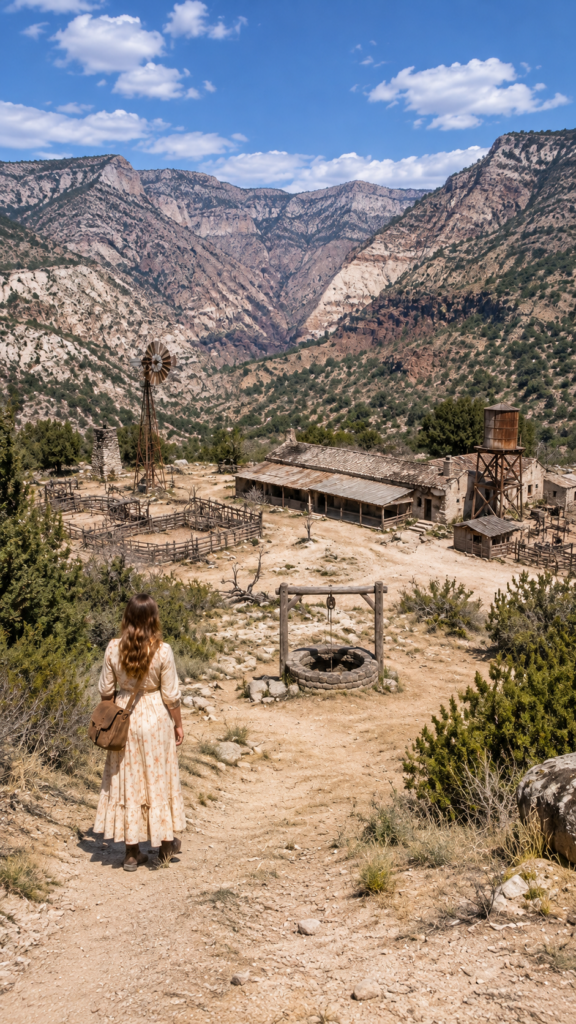
Then the land dipped into a shallow basin, and she saw the old Hatcher place.
The cabin stood alone beneath a wide sky.
Its logs had weathered gray, and the roof sagged in the middle. The corral beyond it was little more than broken rails and leaning posts. A window opening stared out from one wall, empty of glass.
The surrounding hills were dotted with juniper and sage, and the dry creek bed lay like a pale scar through the lower ground.
Daisy stopped walking.
There was no welcome here. No smoke from the chimney, no livestock in the corral, no sound except the wind.
She approached the cabin slowly.
The first thing that caught her attention was not the broken roof.
It was the well.
Ten yards from the cabin door stood a circle of carefully fitted stones, rising about two feet above the ground.
Daisy knelt beside it and examined the masonry.
Whoever had constructed it had taken considerable care. Each stone had been chosen and fitted so that the wall held together without mortar.
She ran her fingers along the edges.
Silas would have admired work like this.
A person who built a well with such patience, she thought, might have built other things to last.
She turned toward the cabin.
The structure was twelve feet square, with thick roof beams and a foundation of solid stone. The logs were dry and weathered, but they were not rotten.
Inside lay dust, leaves, and the remains of a hard life abandoned long ago.
A broken wood stove stood in one corner. The floor needed repair. The door was missing, and the roof had enough damaged shingles to admit rain through several places.
Daisy walked the room, testing the boards carefully.
Then she went outside and studied the ground.
Near the dry creek bed, the soil was darker than it was on the surrounding slopes. The corral posts would have to be reset, but some rails might still be useful.
There were materials here worth saving.
She could see that much.
By sunset, her fear had settled into something more practical.
The place was poor. It was damaged. It would require more labor than anything she had ever undertaken alone.
But the bones of the cabin were good.
She carried her canvas sack inside and set it near the doorway.
That small action felt strangely important.
For the first time in six years, she was placing her belongings in a room where nobody could simply order her to leave.
She spread her blanket and ate a little of the food she had remaining.
As darkness gathered around the cabin, she listened to the wind slipping through the empty window and the gaps in the roof.
She was cold, tired, and terribly alone.
Still, she could almost hear Silas speaking beside her.
Look at what you have. Then decide what needs doing first.
The answer was obvious.
Water.
Without water, she could not remain here long enough to repair anything.
The next morning, Daisy found an old bucket and a length of frayed rope inside the collapsed lean-to that had once served as a stable.
She inspected the rope, tied the best knot she could manage, and carried the bucket to the well.
The stone circle was cool beneath her hands.
She peered into the darkness.
Then she lowered the bucket.
The rope slipped through her fingers.
Down it went, scraping occasionally against the stone lining, until at last she heard a dull, hollow thud.
No splash.
Daisy waited, hoping she had misheard.
Then she drew the bucket back up.
It contained only dust and a few scraps of dry leaves.
She stood very still.
The land office clerk had warned her.
But seeing the empty bucket was different from hearing an old man’s opinion.
If the well was dry, the Hatcher place might not be a home at all.
It might be nothing more than forty acres of land where a girl could die of thirst.
Daisy lowered the bucket again, trying to judge the depth.
It struck something uneven.
When she hauled it back up, small stones and packed earth lay in the bottom.
She examined them carefully.
The bottom of the well was covered with debris.
She remembered Silas explaining how neglected wells could become choked with material that fell in over the years.
A dry bucket did not necessarily mean an empty well.
Daisy looked down into the darkness once more.
She could leave. Return to Cottonwood Flats. Admit that she had made a foolish decision and search for work before her remaining money disappeared.
Or she could find out what was beneath all that rubble.
She set her feet against the hard ground, tightened the rope around the bucket handle, and began clearing the well.
Part 2
By midday, Daisy’s shoulders burned.
The work was far more difficult than she had expected. Every bucket had to be lowered into the well, dragged across the uneven bottom, and hauled up by hand.
Some loads contained loose dirt and leaves. Others held stones that made the rope bite painfully into her palms.
She emptied the debris into a growing pile a short distance from the well, then returned to begin again.
The sun climbed higher. Heat settled over the basin, and the stone rim grew warm beneath her hands.
Daisy paused occasionally to drink from her canteen, but the water was running dangerously low.
She knew she could not continue like this indefinitely.
The sensible thing might have been to stop.
Yet every bucket brought up evidence of years of neglect, and she could not shake the feeling that she had not reached the true bottom.
She remembered Silas teaching her to clear debris from a damaged wagon wheel before deciding whether the wooden hub could be repaired.
“You have to find the sound part,” he had told her. “Can’t judge a thing properly while the damage is still in the way.”
That was what she was trying to do now.
Find the sound part.
Late in the afternoon, the bucket came up with a piece of dark, rotting wood.
Daisy turned it over in her hands.
It was thick enough to have been part of a cover, and one edge showed the marks of an old iron fitting.
She lowered the bucket again.
This time, as she dragged it across the bottom, she heard a sharp metallic sound.
She tried the same movement once more.
There it was again.
Metal striking stone.
When she brought the bucket up, an iron hinge lay among the dirt.
Daisy studied it.
The old well must once have had a wooden cover. Over the years, the cover had rotted and fallen inward, filling the shaft with broken timber, stones, and earth.
That explained some of the obstruction.
Encouraged, she resumed working, using the bucket to draw the remaining material away from the walls.
On one attempt, the rope tightened abruptly.
She pulled.
The bucket would not move.
Daisy frowned and gave the rope a cautious tug.
Something scraped against the masonry deep below.
She shifted her position and pulled from another angle.
A grating sound echoed up through the shaft.
Then came a heavy clatter.
A stone had come loose.
Daisy leaned over the rim and peered into the darkness.
She could see almost nothing, but the bucket was free again.
She lowered it carefully and felt for the place where the obstruction had been.
The movement was different now.
The bucket seemed to enter a small hollow beside the wall, as though the displaced stone had concealed a cavity.
She worked the rope slowly, afraid that a careless movement might dislodge more masonry.
When she finally lifted the bucket, she knew from its weight that she had caught something unusual.
It was heavier than a load of dry leaves, yet it did not scrape and shift like loose stones.
Daisy pulled steadily until the bucket reached the rim.
Inside lay a package wrapped in dark oilskin.
For several seconds, she simply stared.
The bundle was tightly bound with waxed cord. Its surface was coated with dust and fine grit, but the wrapping appeared remarkably well preserved.
Someone had put it there deliberately.
The realization made her look around the deserted basin.
The cabin was silent. The dry creek bed lay empty beneath the afternoon sun.
There was no one to ask.
Daisy lifted the package from the bucket and carried it to the cabin threshold.
She sat where the light was strongest, wiped the dirt from her fingers, and took Silas Croft’s knife from her pocket.
The blade slipped beneath the old cord.
She worked carefully, trying not to damage whatever lay inside.
The first layer of oilskin came away with a dry rustle.
Beneath it was a smaller canvas sack.
Beside the sack lay a folded paper, yellowed with age.
Daisy reached for the sack.
It was surprisingly heavy for its size.
She loosened its opening and poured a little of its contents into her palm.
Gold dust spilled across her skin.
Among it were several coins, silver and gold, worn but unmistakable.
Daisy stopped breathing for a moment.
Then she slowly closed her fingers.
She had never held so much wealth in her life.
Her father had handled coins every day at the mercantile, but they had belonged to the business, to customers, or to suppliers. She had never mistaken the money in the cash drawer for something she could spend herself.
The coins in her hand were different.
They were lying inside a package concealed beneath the stones of an abandoned well on land she now owned.
Yet even in her astonishment, Daisy knew there was a question she could not ignore.
Whose money was it?
She poured the dust and coins back into the little sack and drew the folded paper toward her.
The handwriting was careful, although the ink had faded.
At the top were four words.
To whoever finds this.
Daisy began to read.
The writer identified himself as Elias Hatcher.
He had built the cabin in the spring of 1874, when he came to the land with his wife, Sarah, and their daughter, Lily.
They had intended to make their home there.
Daisy looked up from the letter toward the well.
Hatcher explained that the well had been the first thing he constructed.
A man might endure some hardship without a proper roof, he wrote, but he could not survive without water.
Daisy glanced at the raw marks on her palms.
She understood his reasoning better than she had a day earlier.
She continued reading.
For two years, Elias and his family had been happy on the property.
Then fever came during the winter.
It took Sarah.
It took Lily.
Daisy’s eyes lingered over the names.
She thought of her own mother lying helpless beneath a blanket, then of the sudden, unbearable absence that had followed her father’s death.
The letter grew harder to read.
Elias wrote that he had buried his wife and daughter on the rise east of the cabin, where the morning sun would reach them.
Afterward, the silence of the property became unbearable.
He could no longer listen to it.
Daisy looked toward the eastern hill.
Somewhere among the stones and sagebrush were the graves of two people who had once called this place home.
The letter explained the money.
Elias had made a small gold strike in the mountains. The dust and coins were the result of his own labor, not the wealth of a man born to riches.
He had no family left to inherit it.
He intended to return to the high country, uncertain whether he would find peace there or ever come back.
Daisy read those lines twice.
There was no bitterness in them. No accusation.
Only exhaustion.
She imagined a man who had built a cabin and a well because he believed in the years ahead, then lost the two people for whom those years had mattered.
She looked around the small room.
She had seen only a ruin when she arrived.
Elias Hatcher had once seen a future.
Near the end of the letter, the handwriting remained surprisingly firm.
He hoped that whoever found his money would be someone in need.
More than that, he hoped the money would help bring life back to the property.
A home should not be silent, he had written.
He wanted it filled again with the ordinary sounds of work and living.
Daisy reached the signature.
Elias Hatcher. September 1877.
She lowered the paper into her lap.
For a long time, she remained seated without moving.
The sun shifted across the doorway. A faint breeze stirred the edge of her skirt.
She had come to this land because nobody else wanted it.
She had expected to find hardship, loneliness, and perhaps enough shelter to survive another day.
Instead, she had found a letter from a stranger who seemed to understand the very thing she had been unable to explain about herself.
Elias Hatcher had lost his family.
Daisy had lost hers.
He had abandoned the place because its silence reminded him of everyone who was gone.
She had come because she could no longer bear living where her presence was merely tolerated.
Their lives had never crossed, and yet his words spoke to the deepest part of her grief.
Daisy unfolded the letter again.
There was no promise of a fortune. No grand scheme. No demand that the finder perform some extraordinary act.
Only the hope that an empty home might one day be lived in again.
She looked at the sack of gold.
It would not make her rich. She understood enough about money to know that even an impressive handful of coins could disappear quickly when lumber, food, tools, and livestock had to be purchased.
But it was enough to help her begin.
The thought was almost too much to accept.
She had spent six years hearing, in one way or another, that she was an expense.
Now a man who had never met her had left behind the means to make a life of her own.
Daisy gathered the oilskin to wrap the letter again.
As she lifted one corner, something small slipped against her fingers.
She stopped.
Tucked deep into the wrapping was a wooden bird no larger than her thumb.
It had been carved from pale, smooth wood.
The shape was simple. The wings were uneven, and the small head leaned slightly to one side. Whoever made it had worked with more affection than skill.
Daisy held it closer to the light.
It was the sort of object a father might make for a child with an ordinary pocketknife on an ordinary evening.
Something that cost almost nothing but might be treasured for years.
She imagined little Lily Hatcher holding it in her hand.
The thought brought tears to Daisy’s eyes.
Gold could purchase lumber and food.
It could not buy back the girl for whom that bird had likely been carved.
Daisy closed her hand around the tiny figure.
In her other hand, she held Silas’s knife.
One object had been made for her by a man who taught her how to work with the world.
The other had been made by a grieving father whose hopes had once lived inside this abandoned cabin.
Both were small enough to fit in her pocket.
Both meant more than their materials could ever explain.
Daisy wiped her eyes with the back of her hand.
Then she refolded the letter, wrapped it carefully in the oilskin, and returned the gold to its pouch.
She did not know whether Elias Hatcher had ever returned from the mountains. Everything she had heard suggested that he had not.
But she knew what he had wanted.
And for the first time since leaving Prairie Ridge, Daisy felt that she knew what she wanted, too.
She would rebuild this place.
Not because she had suddenly become wealthy.
Not because owning land would prove her uncle wrong.
She would rebuild it because it was within her power to do so, and because there was something deeply right about answering one person’s abandoned hope with another person’s determination.
That evening, she sat beside the cabin and studied the darkening hills.
The hidden package had changed her prospects, but it had not removed the difficulties ahead.
The roof still leaked. The door still needed replacing. The land was still dry and rocky, and she remained a young woman alone in unfamiliar country.
She would have to make every purchase carefully.
She would have to work.
Daisy looked at the well.
Even before she knew what lay hidden in its wall, she had decided to clear it.
The gold had come to her because she kept working after the first empty bucket.
That seemed worth remembering.
The next morning, she secured the money in a pouch inside her clothing and set out for Cottonwood Flats.
The walk was long, but it felt different from her journey south.
Then, she had been traveling away from the only home she had known.
Now, for the first time, she was traveling back toward one.
Her first stop was the general store.
The smell of coffee, leather, and smoked bacon greeted her as she entered.
She purchased flour, beans, salt, a slab of bacon, coffee, and a small cast-iron skillet.
Each item represented something practical: meals she could prepare, strength she would need, and fewer journeys into town while the cabin remained unfinished.
She counted the cost carefully before paying.
It was tempting to buy more than she needed. After days of uncertainty, the ability to purchase a full sack of food felt almost extravagant.
But she had learned from her parents that money was only useful when it was handled wisely.
And the hidden gold, however generously left, was not endless.
After purchasing provisions, she went to the livery stable, where Caleb Finch operated a small lumber mill behind the main buildings.
Finch was a large, gruff man with a beard that seemed permanently filled with sawdust.
He looked up from his work when Daisy approached.
“What do you need?”
“Lumber.”
His eyes traveled from her dusty boots to the canvas sack at her shoulder.
“For what?”
“I’m repairing the old Hatcher place.”
Finch straightened.
“The Hatcher place?”
“Yes.”
“North of Dry Creek?”
“That’s the one.”
He studied her as though waiting for the rest of the explanation.
“Thought that property was abandoned.”
“It was. I have the deed now.”
Finch gave a low grunt.
“Well, you’ve taken on plenty of work.”
“I know.”
“What kind of lumber?”
“Cedar for shingles. Some sound planks for the floor. Enough for a proper door.”
He rubbed a hand through his beard.
“You know how to split cedar?”
“With a froe and mallet.”
“You know how to use them?”
“Yes.”
He sounded doubtful.
Daisy did not take offense.
She knew how she appeared: an eighteen-year-old girl in a worn dress, asking for materials to repair a deserted ranch cabin.
It was not the sort of request he probably heard every day.
“Silas Croft taught me,” she added. “He was a blacksmith and wheelwright in Prairie Ridge.”
Finch’s expression changed.
“Silas Croft?”
“Yes, sir.”
“I knew of him. Fine wheelwright.”
“He was.”
Finch considered her for another moment.
Then he stepped toward a stack of cedar logs.
“Well, if Croft taught you, I expect you know a straight grain when you see it.”
He showed her the available timber, pointing out pieces that would split cleanly and others likely to cause trouble.
Daisy examined the logs, running her fingers over the grain just as Silas had shown her.
Finch noticed.
He did not offer another doubtful remark.
Instead, he helped her select what she needed, including a bundle of used planks that were weathered but still sound.
The price was fair.
When the lumber and supplies had been arranged, Finch dropped a handful of old straight nails into her sack.
Daisy looked at him.
“I haven’t paid for those.”
“No charge.”
“Are you sure?”
“No sense having a sound door fall off its hinges for want of a few nails.”
His expression remained gruff, but Daisy recognized kindness when it was offered.
“Thank you, Mr. Finch.”
He nodded.
“Make good use of them.”
By the time she returned to the Hatcher place with her purchases and materials, Daisy had a plan.
The roof came first.
She could manage a cold night, and she could make do with a temporary door for a while longer.
But the damaged roof would let rain and winter weather reach everything beneath it.
A house could not remain sound if water was allowed to ruin the timber year after year.
Daisy began by examining the old shingles.
Some had rotted completely. Others were split or loose. She removed them carefully, sorting what could still be used from what had become little more than brittle scraps.
The work was slow.
Standing on a roof required different care from working at a bench. She had to watch her footing, keep her tools close, and avoid putting her weight on places she had not tested.
When she was tired, she climbed down.
When her hands began to shake, she rested.
She had no intention of proving her independence by being careless.
The fresh cedar was the best material she possessed.
She split the logs with her froe and mallet, choosing her lines carefully, working with the grain instead of against it.
The first few shingles came out uneven.
She adjusted her technique.
Soon, the rhythm returned.
The mallet struck. The froe followed the grain. A clean piece of cedar separated from the log.
Again.
And again.
The scent of newly split wood filled the air.
It reminded her so strongly of Silas’s workshop that, once, she stopped with the tool in her hand and listened as though expecting to hear his voice.
But the only sounds were the breeze and the scrape of cedar against cedar.
She returned to work.
There were days when the pile of finished shingles seemed too small to matter and the remaining roof looked impossibly large.
Yet each evening the pile grew.
And each morning Daisy climbed back to her work.
She laid the shingles in overlapping rows, fastening them securely, checking the edges so rain would run away from the timber rather than beneath it.
By the time the final section was finished, her arms ached, her hands were marked with small cuts, and the September heat had long since given way to cooler weather.
Daisy climbed down and stood a little way from the cabin.
The roof was straight and sound.
For the first time, the building no longer looked as though it were slowly surrendering to the elements.
She entered the cabin and looked up at the beams.
They were old, but they had held.
She thought of Elias Hatcher working on those same timbers years before, hoping to make a home for Sarah and Lily.
The cabin had survived him.
Now it would survive another winter.
Daisy set her tools aside and allowed herself a small smile.
One important part of the work was finished.
There was still much to do.
But she was no longer looking at a ruin and wondering whether anything could be saved.
She was looking at a home that had begun to return.
Part 3
Once the roof was secure, Daisy turned her attention to the inside of the cabin.
The floor had several damaged boards that needed replacing. She removed the worst of them, examined the supports beneath, and cut the sound planks from Caleb Finch to fit.
She worked slowly, measuring twice before making each cut.
The old cabin had settled unevenly over the years, so the replacement boards required careful shaping.
There were times when a plank refused to sit properly, and Daisy had to lift it again, study the uneven edge, and remove another thin shaving of wood.
It was frustrating work.
But she remembered Silas telling her that impatience could waste more wood than inexperience.
By the end of several days, the floor felt solid beneath her feet.
The door came next.
She assembled the boards, fitted the braces, and fastened the hinges so the finished door would swing freely without dragging across the threshold.
The first time she closed it, she stood inside the cabin with one hand resting on the latch.
The sound was ordinary.
Just a wooden door settling into place.
Yet Daisy felt an unexpected warmth spread through her chest.
At her uncle’s mercantile, doors had always belonged to someone else. They had been opened or closed according to rules she did not make.
This door belonged to her.
She could close it against the night and know that she had the right to remain inside.
For the empty window, Daisy stretched oiled canvas across the opening.
It was no substitute for proper glass, but it kept out the worst of the wind while allowing a soft, muted light to enter.
She repaired the old wood stove and made sure it could draw properly before building a fire.
When the first flames caught, the cabin filled with the faint crackling of burning wood.
Daisy stood beside the stove and held her cold hands toward the heat.
Outside, evening settled over the rocky hills.
Inside, there was food, shelter, and a place to sleep.
It was a modest beginning, but there was nothing uncertain about the warmth of that fire.
She cooked beans and bacon in her cast-iron skillet, ate slowly, and considered what she had accomplished.
The hidden gold had made the purchases possible. Without it, the work would have been painfully difficult, perhaps impossible before winter.
But money had not fitted the shingles or repaired the floor.
Money had not climbed onto the roof in the morning cold or worked until her fingers were stiff.
Silas had given her the skills.
Elias Hatcher had left her the means.
The labor still had to be hers.
Daisy kept the letter wrapped in oilskin among her few treasured possessions, away from the heat and damp.
Sometimes, before sleeping, she took it out and read a passage.
She was especially drawn to the part about Elias’s family.
He had written so simply of Sarah and Lily, yet every sentence seemed weighted with the life they had shared.
One clear afternoon, Daisy decided to find their graves.
She remembered the letter’s description of the eastern rise, where the sun would reach the burial place each morning.
She walked uphill through sagebrush and loose stones, scanning the ground.
At first, she saw nothing.
Then, near the top, she noticed two low mounds of carefully arranged rock.
They were almost hidden by years of weeds.
Daisy knelt beside them.
There were no flowers, no fresh marks, no sign that anyone had visited for a very long time.
She began clearing the weeds.
She worked gently, careful not to disturb the stones beneath them.
When the little graves were visible again, she sat back on her heels.
Sarah Hatcher.
Lily Hatcher.
She spoke their names aloud.
The wind moved through the sage.
Daisy thought of her own parents and the pain of knowing she would never hear their voices again.
For Elias Hatcher, the grief must have been unbearable.
He had built the cabin and well to keep his family safe. He had worked the land and imagined a life that would continue growing.
Then illness had taken everything that made the place meaningful to him.
Daisy understood why he had left.
She also understood why he had hidden the money and written the letter.
It had been a final attempt to give the home a future, even when he could no longer bear to live there himself.
She selected a smooth stone and took out Silas’s knife.
Carefully, she carved the names Sarah and Lily Hatcher into its surface.
The letters were not perfect, but they were clear.
When she finished, she placed the marker beside the graves and brushed the loose stone dust from her hands.
“I found your letter,” she said quietly.
She looked toward the cabin below.
“I’m taking care of the place.”
There was no answer, and she had expected none.
Still, something about saying the words aloud gave her peace.
She remained on the hill a little longer, watching sunlight move across the land.
Then she went home.
Weeks passed.
The cabin became cleaner and more comfortable. Firewood accumulated beside the door. The damaged corral waited for repairs, but there was already a kind of order about the property that had been missing when Daisy arrived.
One afternoon, she heard hoofbeats approaching.
She stepped outside and saw an older woman riding a mule along the track toward the cabin.
The visitor had a weathered face, practical clothing, and the easy posture of someone accustomed to long hours of outdoor work.
She stopped near the well.
“Afternoon,” the woman called.
“Afternoon.”
“I’m Agnes Miller. My place is a few miles east.”
Daisy approached.
“I’m Daisy Cole.”
Agnes looked past her toward the cabin.
“Saw smoke coming from your chimney. Haven’t seen that in fifteen years.”
Her eyes traveled over the repaired roof, the new door, and the neatly stacked lumber.
“Thought I’d better come see who’d moved in.”
“I took over the old Hatcher place.”
“So I see.”
Agnes lifted a small pail.
“Brought you some milk. A body can’t live on beans alone.”
Daisy stared at the offering.
She had grown so accustomed to counting every mouthful that the simple generosity caught her off guard.
“That’s very kind of you.”
“Well, are you going to stand there all afternoon, or shall we go inside?”
Daisy smiled and invited her in.
Agnes entered the cabin and looked around.
She examined the fitted floorboards, the repaired stove, and the fresh door.
Then she tilted her head toward the ceiling.
“That roof your work?”
“Yes, ma’am.”
“Did it alone?”
“Yes.”
Agnes gave an approving nod.
“You’ve done good work here.”
Daisy lowered her eyes, suddenly unsure what to say.
She had heard criticism for years, often delivered so calmly that she had almost stopped recognizing it as criticism.
Praise felt unfamiliar.
“Thank you,” she managed.
Agnes set the milk on the table.
“This place has been waiting for someone to care for it again.”
The words stayed with Daisy long after the older woman rode away.
It was the beginning of a friendship.
Agnes returned with eggs, bread, or news from the neighboring properties. Sometimes she stayed to share a meal, and sometimes she merely checked that Daisy had enough of what she needed.
Daisy disliked receiving kindness without offering something in return.
When she learned that part of Agnes’s fence needed repair, she offered to help.
The two women worked together, resetting posts and tightening wire beneath the open sky.
Agnes soon discovered that Daisy understood tools and timber as well as most people twice her age.
Daisy discovered that Agnes could work for hours without complaint and had little patience for unnecessary fuss.
They spoke when there was something worth saying.
Otherwise, they worked in comfortable silence.
Daisy had never known how much she missed that sort of companionship until it returned to her life.
News spread gradually through the country around Dry Creek.
The old Hatcher property was no longer abandoned.
People riding past slowed to look at the neat stacks of firewood and the fresh shingles on the cabin roof.
They saw the repaired door and the signs of steady work.
Some were curious. Others simply nodded and continued along the road.
In a country where nearly everyone understood the difficulty of maintaining a homestead, good work spoke for itself.
When Daisy went to Cottonwood Flats for supplies, Caleb Finch began setting aside useful pieces of straight-grained wood.
He called them cuttings.
They were often exactly the sort of pieces she needed for small repairs, and he charged her very little.
Daisy knew he was being generous.
Finch knew that she knew.
Neither saw any reason to make a speech about it.
Even Sheriff Brody began riding past the property about once a week.
He was a quiet man who seldom had much to say.
He would rein in his horse near the cabin and glance over the yard.
“Everything all right out here, Miss Cole?”
“Everything’s fine, Sheriff.”
“Good.”
Then he would touch the brim of his hat and ride away.
At first, Daisy wondered whether someone had asked him to check on her.
Eventually, she understood that his visits were simply a practical courtesy toward a young woman living alone on an isolated property.
His presence also made it clear that she was the recognized occupant of the Hatcher place.
No one in the area had challenged her deed, but Daisy appreciated the quiet reassurance.
Little by little, she ceased feeling like a stranger passing through.
She had become Daisy Cole of the old Hatcher ranch.
The name settled naturally into local conversation, and she found she liked hearing it.
With the cabin secure, she began repairing the corral.
Many rails had fallen, and several posts leaned so badly that they could no longer support the fence.
Daisy removed the worst of the damaged wood, dug new post holes, and reset what could be saved.
She worked carefully to make the enclosure strong enough for animals.
Agnes eventually sold her two goats.
Their arrival changed the sound of the property almost immediately.
They investigated everything, complained loudly when they wanted attention, and made it impossible for Daisy to pretend that she lived in complete silence.
Daisy found herself laughing at their stubbornness.
Before long, she acquired chickens as well.
Their scratching and clucking filled the yard with a cheerful kind of disorder.
Every morning brought another list of tasks.
Animals needed feeding. Water had to be carried. Wood needed cutting. The cabin required maintenance, and the ground around it had to be cleared.
There was no shortage of work.
But it was work directed toward something that belonged to her.
When the season allowed, Daisy began cultivating a small garden near the dry creek bed.
She remembered noticing the darker soil during her first inspection of the property.
Now she broke the ground with her tools and prepared rows for potatoes, onions, and hardy greens.
She knew that a garden in such country would require patience and close attention to water.
She remembered Silas teaching her to examine the ground rather than assume all soil was alike.
She worked the beds carefully, watching the changing weather and using what she had learned.
The well became the center of daily life.
Once cleared of the years of accumulated debris, it supplied cold, clear water.
Every time Daisy lowered the bucket and heard it meet the water below, she remembered that first terrible morning when it had struck a dry bottom.
She remembered the exhaustion of hauling dirt and stones, the old iron hinge, the loosened stone in the wall, and the oilskin package hidden behind it.
But she also thought of Elias Hatcher placing each stone with his own hands.
The well was more than the place where she had found gold.
It was the first thing he had built for the family he loved.
Years after his disappearance, it was still providing life.
That mattered more to Daisy than the coins themselves.
The months passed in a rhythm of work and weather.
There were difficult mornings when her back hurt and the chores seemed endless. There were cold evenings when the cabin felt lonely despite the fire, and there were times when she missed her parents so fiercely that she had to put down her tools.
The hidden money had not removed grief.
Neither had the land.
She still remembered the morning her uncle dismissed her from the mercantile, the neat envelope on his desk, and the way he had turned back to his paperwork before she left.
Sometimes she wondered whether he ever thought of her.
Perhaps he assumed she had found employment somewhere.
Perhaps he imagined her living in poverty, regretting the day she walked away.
Daisy did not know.
She no longer needed to know.
There were also good days.
Days when the goats grazed peacefully inside the repaired corral. Days when Agnes arrived carrying a loaf of bread. Days when Daisy returned from town with useful scraps of wood and a few words of encouragement from Caleb Finch.
There were evenings when she stood in the doorway of her cabin and looked over the work she had completed, hardly able to remember how hopeless the place had seemed when she first arrived.
By late spring, after more than a year of bringing the old property back to life, the changes were unmistakable.
The garden had taken hold.
Neat rows of vegetables grew in the darker soil near the creek bed.
The corral stood straight again, and the goats moved contentedly behind its rails.
Chickens scratched around the yard.
The cabin had a sound roof, a sturdy door, and a small porch Daisy had built with her own hands.
The house was not grand.
It was twelve feet square, patched and repaired with timber that had already weathered many years.
Its window was still covered with oiled canvas, and its furniture was simple.
But it was dry, warm, and safe.
And it was hers.
One evening, Daisy sat on the porch as the sun began to disappear behind the western hills.
The air smelled of damp earth and blooming sage.
A lantern glowed through the open doorway behind her, casting a warm yellow light across the floorboards.
She could hear the faint sounds of the animals settling for the night.
A year earlier, silence had seemed to swallow the property.
Now even the quiet was different.
It was the quiet of a place where the day’s work had been completed, where living things were resting, and where tomorrow would bring familiar responsibilities.
Daisy reached into her pocket and took out Silas Croft’s knife.
The juniper handle had become smoother with use. The blade still held its edge, and it had served her faithfully through more repairs than she could count.
She turned it over in her right hand.
Silas had seen a capable person in her long before she had learned to see one in herself.
He had taught her to work carefully, to examine a problem before surrendering to it, and to recognize value in things that appeared broken.
Without those lessons, Daisy doubted she would have recognized the possibilities hidden beneath the Hatcher cabin’s damaged roof.
Then she reached into her other pocket.
The little wooden bird rested in her left palm.
Its pale surface had been worn smooth by years of handling, and its uneven wings still bore the marks of an inexperienced carver.
Daisy wondered what Lily Hatcher had thought when her father gave it to her.
Perhaps she had laughed at its crooked shape.
Perhaps she had loved it precisely because her father had made it.
Daisy would never know.
But the tiny bird had traveled through years of abandonment and darkness to reach her hands.
She held it gently.
Two objects.
One carefully made by a skilled craftsman.
The other roughly shaped by a father who loved his daughter.
Both had survived the loss of the people who made them.
Both carried something that gold could never replace.
Daisy looked across the ranch.
Elias Hatcher had given her the money to begin again, but he had also given her a responsibility that no deed could fully describe.
He had wanted the property to become a home again.
Not a monument to grief.
Not a forgotten patch of ground.
A home filled with the sounds of ordinary living.
Daisy thought of the mornings when the chickens made enough noise to wake her before sunrise. She thought of the goats calling impatiently from the corral, Agnes’s mule approaching along the track, and the scrape of her own tools against wood.
She thought of the little garden, the stove, and the steady warmth that greeted her when she stepped inside after a cold evening.
The old ranch was alive again.
She had kept the promise expressed in Elias’s letter.
And in doing so, she had fulfilled a promise she had never quite dared to make to herself.
She had built a life in which she was not a burden.
She did not need permission to remain.
She did not have to calculate her worth according to the expense of feeding or sheltering her.
Her value was visible in the things she had repaired, the friendships she had formed, and the care she gave to the land.
Daisy thought once more of her uncle.
Thaddeus Cole had regarded her as an obligation to be settled, a final amount to be entered into a ledger.
He had placed seven dollars on his desk and considered the matter closed.
He could not have imagined the cabin, the garden, or the laughter that sometimes rose from Daisy’s porch when Agnes came visiting.
He could not have imagined a young woman who had been sent away with almost nothing learning to live without fear of being sent away again.
But Daisy understood something now that she had not understood on the day she left Prairie Ridge.
Thaddeus had never truly known what she was capable of.
He had looked at her quietness and mistaken it for weakness.
He had seen her willingness to work and assumed she would always work for someone else’s benefit.
He had mistaken her lack of money for a lack of value.
Silas Croft had known better.
And in a different way, Elias Hatcher had believed in the possibility that someone unknown might one day restore what he could no longer bear to keep.
Daisy closed her fingers around the bird and the knife.
She wished she could thank them both.
Silas, for teaching her to build.
Elias, for leaving behind a chance to do it.
The setting sun turned the hills purple, and the last light touched the stones of the old well.
Daisy watched the shadows lengthen across the yard.
In the morning, she would draw water for the animals, tend the garden, and perhaps repair a section of fencing near the creek.
There would be bread to make, wood to cut, and the endless small duties that came with maintaining a homestead.
Nothing about tomorrow promised to be extraordinary.
And that, she realized, was what made it precious.
She had once believed that safety meant having someone else willing to take her in.
Now she knew it could also mean standing in a home she had built through her own labor, surrounded by the quiet evidence of people who had helped her along the way.
The seven dollars had not been enough to guarantee her survival.
The single silver dollar she paid at the land office had not purchased an easy life.
And the gold hidden in the well had not magically repaired everything that had been broken.
But together with the skills she carried, the work she was willing to do, and the kindness she learned to accept, those small beginnings had become a future.
Daisy rose from the porch and stepped into the cabin.
She placed Silas’s knife and the little wooden bird safely beside Elias Hatcher’s letter.
Then she turned toward the doorway for one last look at the evening sky.
The old Hatcher ranch stood quiet beneath the approaching stars.
Its roof was sound. Its stove was warm. Its animals were sheltered, and its garden was growing.
There was no great fortune, no splendid mansion, and no crowd gathered to witness her success.
There was only a small, sturdy home and a young woman who had made it hers.
Daisy stepped inside and closed the door.
For the first time in many years, the sound did not mark the end of something she had lost.
It marked the beginning of another peaceful night in a place where she belonged.
And deep beneath the stones of the well, where a grieving father had once hidden his last hope, the cold, clear water continued to flow.