Part 1
On October 2, 1887, Odessa Brandt stepped down from a Union Pacific passenger train in Plum Bluff, Nebraska, carrying a modest leather trunk and the determination of a woman who had spent most of her life earning the right to make her own decisions.
Behind her, three railroad employees were struggling with a wooden shipping crate.
The crate was nearly as long as a coffin, stood almost as high as a kitchen table, and weighed enough to make the stationmaster question whether its contents had been fashioned from solid iron. Thick ropes held the pine boards together. Along one side, black lettering identified a sewing machine manufacturer in Chicago.
Two porters lifted the front while a young freight handler pushed from behind. The crate scraped across the platform, its weight making the old planks complain.
Odessa watched their progress with an expression of patient concern. She had traveled hundreds of miles with that crate, and she had no intention of allowing it to come to harm during the final few yards.
At the far end of the platform stood Halvor Ingram.
He was thirty-four years old, tall and broad through the shoulders, with a face weathered by Nebraska summers and a coat that had been patched so carefully at the elbows that the repairs had become part of its original appearance. He held his hat in both hands, turning its brim slowly between his fingers.
For three months, he had exchanged letters with the woman approaching him.
He had imagined her arrival more times than he cared to admit.
In those imaginings, there had always been a woman, a trunk, and perhaps a carpetbag. He had expected uncertainty. He had expected awkward conversation. He had even prepared himself for disappointment.
He had not prepared himself for a piece of freight large enough to require its own wagon.
Odessa stopped before him.
“Mr. Ingram?”
He nodded.
“I’m Odessa Brandt.”
Her handshake was firm, although her fingers were cold beneath her gloves.
Halvor looked past her toward the crate.
She followed his gaze.
“That belongs to me,” she said. “It’s a Singer treadle sewing machine, with the cabinet and the spare parts I need to keep it working.”
He said nothing.
“I thought it best to explain immediately.”
“That’s a considerable amount of equipment.”
“It is.”
“For sewing?”
“For making a living, Mr. Ingram.”
The distinction seemed important to her, though he was not yet certain why.
He glanced again at the crate, where the freight workers had finally managed to lower it onto a handcart.
“My house has two rooms,” he said. “The barn isn’t much better. I lost a third of my cattle last winter, and there’s barely enough space for what I already own.”
Odessa listened without interrupting.
“I advertised for a wife,” he continued, his voice growing uncomfortable. “Not a business to move onto the place.”
The stationmaster pretended to inspect a freight receipt. One of the porters turned away.
Odessa felt the insult, but years of difficult employers and impatient customers had taught her that wounded pride was a poor companion when important decisions needed to be made.
She straightened the cuffs of her gloves.
“Well, a sewing machine won’t require supper, and it won’t use your bed.”
Halvor looked at her.
“If you’ve decided this arrangement was a mistake,” she continued, “I’ll accept that. But the machine is mine, and wherever I go, it goes with me.”
He shifted his weight.
“I’m not saying—”
“Give me one day,” she said.
He stopped.
“One day to show you that I can be useful. If you still wish me gone afterward, I’ll take the eastbound train without troubling you further.”
There was no pleading in her voice.
That made the request harder to refuse.
Halvor had been alone too long to understand what courage was required for a woman to travel across the country and place her future in the hands of a man she knew only through letters. But he recognized determination when he saw it.
He looked at the crate once more.
“It’ll have to go in the barn.”
“As long as it’s dry.”
“It gets cold.”
“So does Milwaukee.”
Something shifted beneath his stern expression.
It might almost have been amusement.
He put his hat on and went to arrange the loading.
By the time the crate had been wrestled onto the hired freight wagon, the springs were sagging badly. Odessa climbed onto the seat beside him, her trunk secured behind them.
Before leaving Plum Bluff, they stood together before the local justice of the peace, with the stationmaster serving as witness, and made the promises they had traveled so far to exchange.
Then they turned the wagon north toward the Sandhills.
The town disappeared behind them. The prairie opened into long rolling grasslands, pale gold beneath an October sky. Wind moved over the hills in restless waves, and the road stretched ahead between fence posts and patches of dry weeds.
They rode for several miles without speaking.
Halvor occasionally glanced at the woman sitting beside him.
Odessa kept her hands folded over her lap and watched the land.
Neither knew what to make of the other yet.
And neither understood how much their lives had already begun to change.
Eight years earlier, Odessa had begun keeping a small ledger of her sewing work.
She had never intended it as a record of accomplishment. At first, she merely wanted to know how much cloth she used, what she earned, and which customers had paid their bills.
But over time, the entries had accumulated.
Coats for bank clerks. Coats for children. Coats for prosperous Milwaukee women who complained about the slightest uneven stitch while wearing garments that cost more than Odessa earned in a month.
One winter Sunday, sitting beside a boardinghouse window with the snow falling outside, she had added the figures.
Eleven hundred coats.
She checked the calculation twice.
Eleven hundred.
Then she looked down at the shawl wrapped around her own shoulders.
Its original cloth was almost lost beneath patches and repairs.
She had made enough warm clothing to fill a respectable store, yet she could not afford a decent winter coat for herself.
The thought stayed with her.
Odessa had been seven when her father died. He had worked as a tailor, and after his death, her mother survived by taking whatever finishing work the local clothing houses would provide.
The family had possessed little besides a few household things and the tools of the trade.
Odessa learned to thread a needle before she could read a full page without help.
By twelve, she was setting sleeves in a cutting room, earning four dollars a week and bringing three of those dollars home. She learned to measure by sight, conserve scraps, sharpen shears, and recognize the difference between cloth that looked substantial and cloth that would survive a hard season.
The work was exhausting.
There were long hours, sore fingertips, and winters when the draft through the workshop walls made her hands so stiff she could barely grip a needle.
But she became good at it.
Very good.
When her mother died of lung fever during Odessa’s nineteenth year, the girl found herself alone with a funeral bill and no one to help pay it.
She worked.
She paid what she could.
And when the debt was finally gone, she began saving toward the one possession she believed could change her life.
A Singer treadle machine.
It was not a luxury.
To Odessa, it represented the possibility of owning her own labor.
She had spent years stitching garments for employers who determined what her skill was worth. With a machine of her own, she could choose her customers, organize her work, and perhaps earn enough to build something that belonged to her.
The machine cost more than most working men earned in two months.
She purchased it on installments of five dollars a month.
For three years, she made those payments.
Some months, she ate less than she should have. She mended other women’s fine dresses by lamplight while wearing shoes she could no longer afford to replace. She went without small comforts that others barely noticed.
Then, one afternoon, the final payment was made.
Odessa left the company’s office holding a receipt that declared the machine entirely hers.
She carried that receipt home inside her coat, protected from the rain, and placed it in the little ledger beside the record of her eleven hundred coats.
For the first time, she owned the means by which she earned her living.
Yet ownership brought a different realization.
She could work from her boardinghouse room for another twenty years and still return each evening to a narrow bed in a house that belonged to someone else.
What she wanted was not wealth.
She wanted a home.
A place where her work mattered beyond the amount written on an invoice.
A place where the light in the window belonged to her.
Then she read an advertisement in a Chicago newspaper.
A Nebraska rancher sought a wife willing to share a difficult life. He offered no promises of comfort or prosperity. He asked for honesty, goodwill, and a willingness to work beside him.
The advertisement was unusually plain.
Odessa read it three times.
Then she took out a sheet of paper and answered.
Their correspondence continued through the summer.
Halvor’s letters were brief but thoughtful. He wrote about cattle, the weather, and the loneliness of the house since his mother had died. He did not pretend that the ranch was flourishing.
Odessa admired that.
She told him about Milwaukee, her work, and her desire for a home.
She did not mention the Singer.
Not because she meant to deceive him about her life, but because she feared he would misunderstand the machine before he had the opportunity to understand the woman who owned it.
When he asked her to come to Nebraska, she accepted.
And now, with the October wind blowing across the Sandhills, she was married to a man who had nearly rejected her over the most valuable possession she owned.
The Ingram ranch lay eleven miles north of Plum Bluff in a shallow hollow sheltered by low hills.
Its eleven hundred acres looked spacious beneath the open sky, but the buildings told a harsher story.
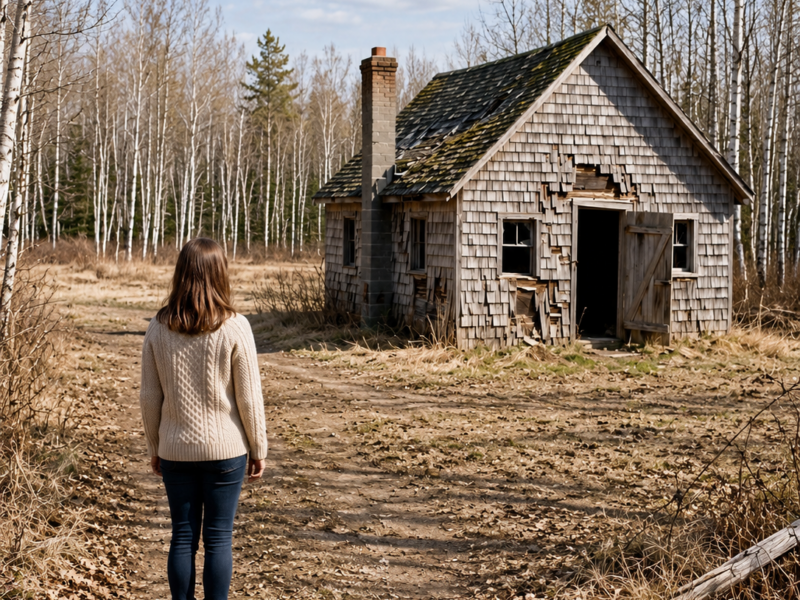
The house was a two-room sod dwelling, with a narrow wooden porch built years earlier by Halvor’s father. The barn leaned eastward, its weathered boards silver with age. Fences crossed the pastures in uneven lines, and the cattle that remained were scattered across the grass.
Halvor helped Odessa down from the wagon.
She surveyed the property without comment.
He noticed that she did not ask where the larger house stood.
“This is it,” he said.
“I see.”
“It was better once.”
“I believe you.”
There was something in the way she said it that made him look at her.
She was not measuring the place against the life she had left in Milwaukee. She was trying to understand what could be done with it.
Halvor carried her trunk inside.
He showed her the bed and told her she could have it. He would sleep on the bench beside the stove.
Odessa began to object, but he had already turned toward the door.
“I’ll find somewhere for the machine.”
Outside, he shifted hay from a stall and cleared a dry corner in the barn.
He worked until the light faded, carrying the smaller pieces of equipment beneath shelter and making certain the cabinet would be protected from rain.
He was not an unkind man.
He was a frightened one.
His father had left him the ranch when Halvor was twenty-three, along with a bank loan taken out to purchase breeding cattle.
For eleven years, Halvor had struggled to make the land profitable enough to clear that debt.
Some seasons, the grass was generous.
Others, the rain failed.
The previous winter had been devastating.
A dry autumn had been followed by a bitter freeze. The cold settled in November and held until March, turning the ranch into a place of exhausted animals, frozen water, and endless labor.
Halvor and his nineteen-year-old ranch hand, Colm Rooney, had spent those months hauling hay and breaking ice until their hands split from the work.
Colm was an orphan who had known little comfort before coming to the Ingram place, and he worked with the quiet loyalty of someone grateful to be wanted.
Together, the two men had done everything they could.
It had not been enough.
Sixty cattle died.
A third of the herd was gone.
That spring, the Plum Bluff Bank informed Halvor that the remaining four hundred and twelve dollars on his father’s note must be paid in full by March 1, 1888.
He had read the notice at the kitchen table.
Then he folded it into a small square and fed it to the stove.
Burning the paper did nothing to erase the debt.
He knew that.
But it was the only thing he could do with his hands at that moment.
His mother had once made him promise never to let the family home fall empty and cold. After her death, he had continued living there, doing the work of two men and speaking to almost no one except Colm.
Eventually, he had written the advertisement.
He told himself a wife would help keep the household and share the burdens of the ranch.
But during the weeks when Odessa’s letters arrived, he discovered something else.
He began looking forward to them.
He caught himself thinking about what she might say next.
For the first time in years, the house seemed to contain the possibility of laughter.
That possibility frightened him almost as much as the bank note.
Hope had become another thing he was afraid he could not afford.
And when Odessa arrived with her great wooden crate, all those fears had emerged in one foolish complaint about space.
That first night, he lay awake on the bench listening to the wind.
In the darkness, he thought about the woman sleeping only a few feet away.
He had promised to welcome her.
Instead, his first words had made her defend her right to bring her own property into the marriage.
Halvor stared toward the faint orange glow of the stove.
He had no idea how to repair what he had already damaged.
Odessa began with the things she understood.
She repaired a torn curtain, tightened the covering on a chair, and mended two shirts whose seams had worn thin.
She cleaned the corners of the kitchen and rearranged what little furniture the house contained, never making a change so large that Halvor might feel pushed out of his own home.
Within days, she had learned where the stove smoked, which window admitted the worst draft, and which floorboard creaked when someone crossed the room after dark.
Colm Rooney became her first unwilling customer.
One evening, as the young ranch hand ate supper, Odessa noticed the condition of his jacket.
It was made from thin canvas duck, once sturdy but now worn soft and frayed. The lining hung in strips, and one sleeve had a hole large enough to expose most of his forearm.
“Colm,” she said, “take that coat off.”
He looked up from his plate.
“Ma’am?”
“Your coat.”
“What’s wrong with it?”
“At present, almost everything.”
He glanced toward Halvor, uncertain whether he was being scolded.
Halvor continued eating.
Colm surrendered the jacket.
Odessa examined it beneath the lamp, pulling apart an old repair to see how much usable fabric remained.
“It’s kept me warm enough,” Colm offered.
“Then you have a generous definition of warm.”
That evening, she set the Singer in motion.
Halvor had already brought the machine into the kitchen after noticing how cold her fingers became while working in the barn.
Its iron treadle moved beneath her foot. The needle rose and fell. The little room filled with the steady sound of machinery doing the work it had been built to do.
Halvor sat by the stove, listening.
For eleven years, the evenings had been defined by silence, wind, and the occasional crack of burning wood.
Now there was a new rhythm.
Odessa worked carefully, reinforcing the weak seams, replacing the worst pieces of lining, and adding stitches where the old cloth threatened to split.
When she finished, she held the jacket up to the lamplight.
It was still an old coat.
But it could survive another winter.
The next morning, Colm pulled it on and moved his arms experimentally.
“Fits better than it did.”
“It ought to,” Odessa said. “I’ve taken enough loose thread out of it to knit another sleeve.”
He grinned.
Halvor watched from the doorway.
He began to understand that the machine had brought something into the house that the ranch had been missing for years.
Not merely work.
Care.
And unlike a sack of flour or a load of firewood, it was not something that diminished when shared.
On Saturdays, Odessa accompanied Halvor into Plum Bluff for supplies.
There she noticed a troubling pattern.
The ranch wives wore thin shawls against the early cold. Children hurried between buildings in patched jackets, their ears wrapped in scarves made from old stockings. Men who spent entire days outdoors wore coats so worn that the wind entered through the seams.
Everyone seemed to be waiting for winter clothing that had not arrived.
Ezra Pell, owner of the local mercantile, had ordered ninety coats and two hundred blankets from a wholesaler in Omaha.
But a washout at the Elkhorn River bridge had stranded the freight at Grand Island.
The railroad offered no reliable delivery date.
Pell had eleven winter coats remaining in stock.
All were men’s sizes.
All were too expensive for most of the families who needed them.
Then, on November 19, the first severe cold arrived.
The morning looked deceptively peaceful. There was no storm, no great noise of wind.
But the water in the Ingram trough froze solid to the bottom.
Odessa stood on the porch, watching Halvor and Colm break ice.
She knew winter clothing.
She knew the difference between a cold morning and dangerous weather.
And she understood that Plum Bluff was not prepared for what might be coming.
Several days later, Dagny Lindquist drove into the Ingram yard with her youngest child beside her.
Dagny was the wife of a sheep rancher in the neighboring valley, a strong, cheerful woman who rarely allowed difficulty to take the smile from her face.
That afternoon, however, she looked worried.
She brought a flour sack into the kitchen and removed a boy’s coat.
“This belonged to my eldest,” she explained. “He’s grown out of it, but there’s no money for another. I thought perhaps you could let it out somewhere.”
Odessa spread the garment across the table.
The sleeves were too short. The elbows had worn almost through. The wool was compressed and thin from years of use.
She turned it over and examined the lining.
Then she looked at Dagny.
“I could make it fit a little longer,” she said. “But the cloth won’t give you much warmth.”
Dagny sighed.
“I know.”
Odessa ran her hand across the worn fabric.
There was a better answer.
She could almost see it forming, though she had no materials with which to accomplish it.
“Give me a few days,” she said. “And see how much flannel the women in your valley can spare.”
Dagny studied her.
“What are you thinking?”
Odessa folded the coat.
“I’m thinking we ought to stop asking old coats to do work they’re no longer fit to do.”
The following Saturday, she went into the rear storeroom of Pell’s mercantile.
And there, beneath years of accumulated dust, she found what the entire district needed.
Two hundred and sixty gray army-surplus wool blankets.
They had been purchased cheaply at a government sale two years earlier. Pell had hoped the ranchers would buy them, but the blankets were heavy, coarse, and an unappealing shade of dark gray.
Most customers had passed them by.
Odessa unfolded one and held it against the light.
The weave was dense.
The wool was thick.
It would resist the wind, and with a proper lining, it could keep out far more cold than the garments she had seen hanging from the shoulders of the Plum Bluff children.
Her fingers traveled along the cloth, measuring without a ruler.
A hood.
Long sleeves.
A generous body reaching below the knee.
Double seams at the shoulders.
She could see the pattern as clearly as if she had already cut it.
Ezra Pell emerged from behind a shelf.
“Looking for something, Mrs. Ingram?”
“These blankets.”
He glanced at the pile.
“Nobody wants them.”
“I do.”
“How many?”
Odessa considered the rows stacked almost to the rafters.
“All of them.”
Pell stared at her.
“All two hundred and sixty?”
“If you’ll sell them for what you paid.”
“What on earth would you do with that much gray wool?”
Odessa folded the blanket and placed it carefully on top of the stack.
“Make winter coats.”
He looked from her to the blankets.
Then back again.
“Out of these?”
“There’s nothing wrong with the wool, Mr. Pell. The trouble is that everyone’s looking at a blanket when they ought to be looking at what the blanket could become.”
For a moment, the storekeeper had no answer.
Then he shrugged.
If she wanted to purchase stock that had been gathering dust for two years, he saw no reason to stand in her way.
By that evening, Odessa had the beginnings of an arrangement and a plan.
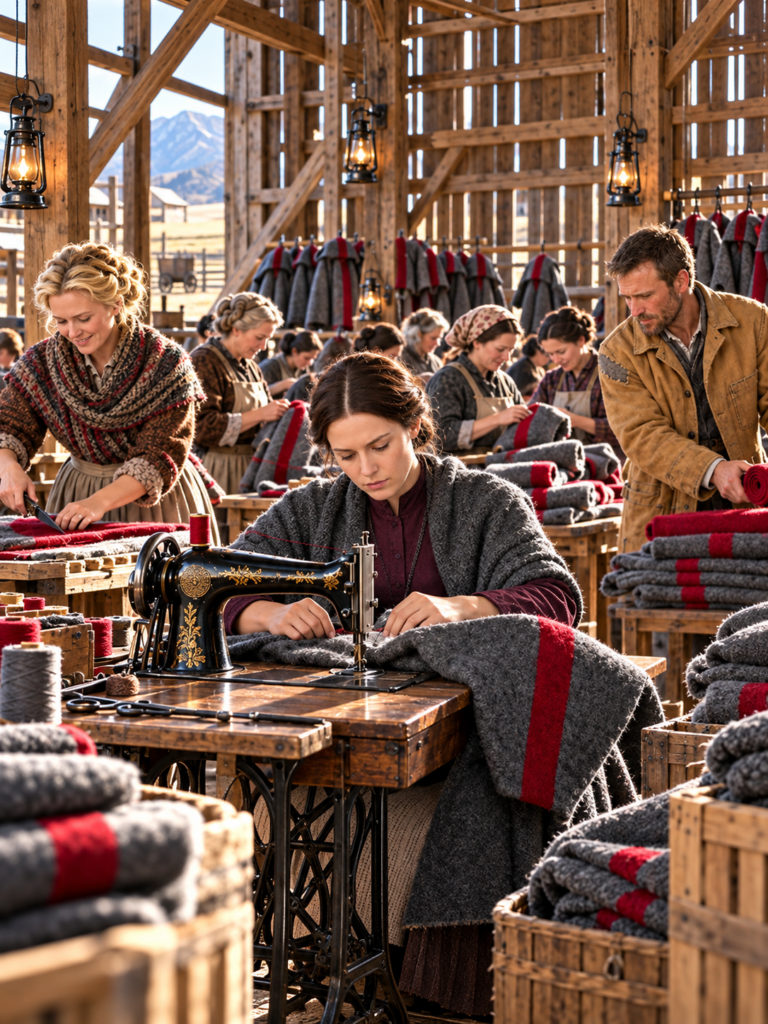
She would cut the blankets into long hooded coats, modeled on the practical winter garments used by northern traders. The women of the district could provide whatever lining material, thread, and labor they possessed.
It would not be fine clothing.
But it would be warm.
She explained the idea to Halvor after supper.
He sat motionless, his hands resting on the table.
When she finished, he looked down at his plate.
“No.”
Odessa waited.
“I didn’t bring a wife out here to sew for half the county.”
“I’m not proposing to leave the ranch.”
“That isn’t the point.”
“Then what is?”
Halvor’s jaw tightened.
“A man ought to be able to provide for his own household. I won’t have people saying I brought you here to work like a hired seamstress because I can’t manage my affairs.”
The words struck harder than he intended.
Odessa stood beside the table, the dish towel still in her hands.
She could have reminded him that she had provided for herself since childhood.
She could have told him what it had cost her to own the machine he had nearly refused.
Instead, she let a moment pass.
“Halvor, I spent years sewing coats for people who never learned my name.”
He raised his eyes.
“I know what it means to be hired for my hands. This isn’t that.”
He said nothing.
“I would be working in my own home, with my own machine, alongside women who need the same things we do.”
She put the towel down.
“I don’t want to be a stranger hired to serve your household. I want to share the work of it.”
Halvor looked toward the Singer, standing beneath its cloth cover near the wall.
Odessa’s voice softened.
“I’ve made eleven hundred coats for other people. Eleven hundred. And I never knew whether any one of them kept someone warm on a bitter night.”
She glanced at the window, where the cold had turned the glass white around its edges.
“I’d like to make a few for people I know.”
Halvor thought of Colm’s patched jacket.
He thought of the children in town and the women struggling against the cold.
Then he thought of his father’s debt.
Four hundred and twelve dollars.
March first.
He could not see how they would survive another winter of losses.
And here was his wife, asking to bring more work and more responsibility into a place he already feared was failing.
“I don’t know where you’d put everybody,” he said at last.
It was not agreement.
But it was no longer refusal.
Odessa recognized the difference.
She did not press him.
That night, Halvor lay awake listening to the wind against the sod walls.
Before dawn, he rose, dressed in the cold kitchen, and took a lantern out to the barn.
By the time Odessa came looking for him, he had cleared a portion of the loft.
The kitchen table stood beneath the rafters, with two chairs beside it. A blanket covered the drafty window. The floor had been swept, and a lantern hung from a beam above the workspace.
Odessa stopped at the top of the ladder.
Halvor stood beside the table, looking as though he had been caught doing something embarrassing.
“What is all this?” she asked.
He shifted the lantern slightly.
“You said you’d need somewhere to cut the cloth.”
She looked around.
The loft was plain, cold, and dusty around the edges.
But there was space.
Space for work.
Space for people.
Space for an idea that might turn into something neither of them could yet understand.
Odessa looked back at him.
“Yesterday you said there wasn’t room.”
Halvor rubbed a hand across his jaw.
“Found some.”
She laughed.
It was a full, sudden laugh, the first he had heard from her since she arrived.
He looked embarrassed for another moment.
Then, despite himself, he smiled.
And on that cold Nebraska morning, the old barn began becoming something it had never been before.
A place where people came not merely to work, but to help one another survive.
Part 2
The first six women arrived at the Ingram barn carrying more determination than equipment.
Dagny Lindquist came with her two sisters-in-law. Ottoline Fenwick, the schoolmistress, brought a basket of thread and a bundle of worn flannel. Two widows from the creek-bottom homesteads arrived with scissors, needles, and cloth saved from household garments that could no longer be repaired.
None of them had much money.
All of them knew how to make a little material go further than anyone had reason to expect.
Odessa spread the first gray blanket across the table and smoothed it flat.
The women gathered around her.
“We’re going to make something simple,” she explained. “Nothing fashionable. Long enough to cover the legs, loose enough for another layer underneath, and strong enough to last more than one winter.”
Dagny ran a hand across the heavy wool.
“Won’t these be awfully ugly?”
“Probably.”
That brought a laugh.
“But they’ll be warm,” Odessa added. “And warm is prettier than frostbite.”
She marked the cloth with tailor’s chalk.
The first pattern was deliberately generous. Children could grow into the coats. Adults could wear thick shirts beneath them. The hoods would be deep enough to shield ears and cheeks, and the shoulders would be reinforced to prevent tearing during heavy work.
Every scrap had a purpose.
Smaller pieces could become mittens, patches, or additional layers around the neck. Cloth too narrow for sleeves could still be useful in a hood.
Odessa had learned those habits during years when wasting material meant losing money she could not replace.
Now those same habits would help stretch the supply of wool across an entire district.
She divided the work.
Dagny and one of her sisters-in-law began cutting the largest panels. The other women basted seams, prepared linings, and turned hoods. Ottoline concentrated on the smaller sizes, measuring against a coat she had brought from the schoolhouse.
Odessa moved between them, checking the shapes and demonstrating the stitches that would carry the most strain.
When the first pieces were ready, she sat at the Singer.
The machine began its familiar rhythm.
Across the loft, the other women took up their needles.
For a time, there was little conversation.
Then Dagny told a story about one of her sons trying to persuade a stubborn sheep to follow him into a shed.
The widows laughed.
Ottoline described a pupil who had arrived at school with his mittens tied together by a length of string long enough to trip half the class.
Soon the barn was full of voices.
Women who had spent months isolated on distant homesteads discovered how much they had missed the company of others.
They talked about flour prices, troublesome stoves, sick livestock, and children who outgrew their boots before the family could afford replacements.
Occasionally the conversation turned serious.
Someone mentioned a neighbor whose firewood was running low.
Another woman knew of a family that had been stretching one sack of potatoes through too many meals.
Odessa listened.
She had come west hoping to belong somewhere.
Now, in the cold loft of a leaning barn, she began to understand what belonging might require.
It meant knowing who needed help before they had to ask for it.
The work spread through the Sandhills faster than Odessa expected.
A woman returned home wearing one of the unfinished sample coats and told her neighbors what she had seen. A rancher carried the news to another valley. Mothers who could not spare money offered old flannel, buttons, or a few hours of stitching.
By the third week of the project, thirty women were coming to the Ingram place.
On some mornings, the barnyard looked almost like the street outside a church after Sunday services.
Wagons stood along the fence. Horses waited beneath blankets. Children hurried between the vehicles while their mothers carried bundles up to the loft.
Halvor had never seen so many people arrive at his ranch willingly.
At first, he remained outside, busying himself with the ordinary chores of feeding cattle and repairing fences.
But there was no avoiding the operation for long.
The women needed more lamps.
They needed places to hang wet shawls.
They needed the table shifted whenever a larger blanket was laid out.
Without announcing any change of heart, Halvor began attending to those things.
He brought up another lantern.
He repaired a loose step on the ladder.
When the loft grew especially cold, he found more material to block the drafts.
Odessa noticed each small improvement.
She thanked him when there was an opportunity, but she was careful not to turn his kindness into a public event.
Halvor did not enjoy being praised in front of people.
He did, however, seem pleased whenever she discovered something he had quietly repaired.
Colm became accustomed to hearing the sewing machine running overhead when he came in from the pasture.
The boy was interested in the coats, although he pretended otherwise.
One afternoon, Odessa called him upstairs.
“Stand here, please.”
He obeyed.
She held a gray garment against his shoulders.
It was larger and heavier than the patched jacket she had repaired weeks earlier.
“Put your arms through.”
He looked uncertain.
“Whose is it?”
“Yours.”
His eyes moved toward her.
“Mine?”
“Unless you know another Colm Rooney of approximately your height.”
The women laughed.
He slipped into the coat.
It reached almost to his knees. The sleeves covered his wrists. The lining was soft against his neck, and the large hood pulled forward over his ears.
For a moment, he stood with his arms slightly raised, not knowing what to do with them.
Dagny stepped back.
“Well, look at that.”
Ottoline smiled.
“You could stand outside the schoolhouse all day in that.”
Colm turned slowly, examining the garment.
He touched one of the reinforced seams.
Then he looked at Odessa.
“I’ve never had a new coat before.”
The loft grew quiet.
He cleared his throat.
“Not one that was mine from the beginning, I mean.”
Odessa felt something tighten in her chest.
She had dressed wealthy strangers for years and had never seen a customer look at a garment quite that way.
“Then it’s long past time,” she said.
Colm gave a short, embarrassed laugh.
One of the widows began clapping.
The others joined her.
Soon the rafters were ringing with applause, and Colm stood in the middle of it, red-faced and smiling.
When he finally escaped down the ladder, he wore the coat outside despite having no particular reason to leave the barn.
Halvor saw him cross the yard.
“Where did you get that?”
“Mrs. Ingram made it.”
Halvor examined the garment.
He tested the weight of the wool between his fingers.
“Looks warm.”
“It is.”
“Better keep it clean.”
Colm grinned.
“Can’t promise that.”
Halvor almost smiled.
He watched the young man walk toward the cattle sheds, the gray hood resting against his shoulders.
Then he looked up toward the loft.
The Singer was running again.
Odessa developed the idea for the red stripe late one evening.
Most of the women had gone home. The lanterns had been turned low, and the barn settled into the familiar noises of animals shifting below.
Several completed coats hung from the rafters.
The gray wool looked practical and substantial in the lamplight.
But as Odessa studied them, a troubling thought took shape.
In heavy snow, a gray coat could disappear against the landscape.
She had already learned how deceptive the Sandhills could be.
A familiar slope looked different beneath frost. A low fence vanished when drifting snow accumulated along it. The distances that seemed so manageable under clear skies became treacherous when a winter wind began sweeping across the open country.
She imagined a person walking through a blizzard, bent against the wind, with the landscape reduced to swirling white.
What would another person be able to see?
Not a gray back.
Not a dark shadow.
There needed to be something brighter.
Odessa remembered a bolt of red flannel that Ezra Pell had donated.
She brought it from the shelf, unfolded it, and spread it across the cutting table.
Then she measured a strip five inches wide.
She cut it cleanly and laid it against the back of a gray hood, running from the crown down toward the collar.
The contrast was striking.
She pinned the flannel in place and stepped away.
A gray coat might blend into snow and shadow.
That broad red stripe would not disappear nearly so easily.
She sat at the Singer and began stitching.
The needle passed through the layers in a straight, firm line.
When she finished, she lifted the hood beneath the lantern.
It looked unusual.
But it could be seen.
Halvor climbed the ladder a few minutes later, carrying another lantern.
“I saw the light,” he said. “Thought you might still be working.”
Odessa held up the coat.
“What do you think?”
He examined it.
“Red?”
“Five inches wide.”
“That’s a lot of red.”
“It needs to be.”
He looked at her.
She turned the hood so he could see the stripe clearly.
“If someone gets lost in a snowstorm, what color would you want them wearing?”
Halvor considered the question.
He had been caught in enough bad weather to understand what she was asking.
“Something I could find,” he answered.
“Exactly.”
She moved the coat into the darker end of the loft and held it beside another finished garment.
Even in the dim light, the red stood out.
Halvor studied the difference.
“That might be useful.”
“I think so.”
He stayed where he was for a while.
Then he put down the lantern, sat on the floor beside the cutting table, and began rolling the unused red strips into neat bundles.
Odessa watched him.
“You don’t have to do that.”
“I know.”
He continued working.
The wind pressed against the barn. Somewhere below, a horse shifted its weight.
For the next several hours, they worked together without much conversation.
Odessa sewed.
Halvor prepared the strips and passed her thread when she needed it.
At one point, their fingers touched while he handed her a spool.
Neither moved away immediately.
It was a small moment, so ordinary that someone else might have missed it.
But for two people who had spent their lives protecting themselves against disappointment, it meant more than either could comfortably say.
Odessa looked down at the cloth beneath her hands.
She was tired.
Her shoulders ached, and the cold had worked its way into her feet.
Yet she realized she was happy.
Not because the work was easy.
Because she was no longer doing it alone.
By the middle of December, one hundred and forty coats had been completed.
They hung in orderly rows beneath the rafters, gray wool and red stripes stretching across the loft.
Ottoline Fenwick had made twenty-three smaller coats for the children at Plum Bluff School.
She knew which pupils came from households where the winter supplies were running short. She knew who walked the farthest and which children had begun arriving at school with hands so cold they could barely hold their pencils.
The little coats were made with those children in mind.
When Ezra Pell came to inspect the work, he was prepared to discuss the cost of wool, the shortage of thread, and the accounts that were steadily expanding at his store.
Instead, he stood beneath the row of children’s coats and said nothing.
He touched one hood, then another.
The red stripes had been stitched on carefully, each one broad enough to be seen from a distance.
“These all going to the school?” he asked.
“Every child who needs one,” Odessa replied.
Pell looked down the line again.
He had spent years selling the things people could afford to buy.
For the first time in a long while, he was looking at something made because people could not afford to buy it.
He cleared his throat.
“If you need more thread or lining, Mrs. Ingram, put it on the store account.”
Odessa turned toward him.
“We haven’t settled the blanket costs yet.”
“I know.”
“I don’t want to leave you carrying the expense.”
Pell waved a hand.
“Those blankets weren’t earning me anything sitting under dust. At least now they’re doing some good.”
He examined another small coat.
“We’ll keep a proper ledger. Work out what’s owed when things are easier.”
Odessa thanked him.
The storekeeper gave a gruff nod, pulled on his gloves, and left before anyone could make too much of his generosity.
Halvor stood near the loft entrance and watched him go.
For years, he had considered the Ingram ranch a burden he was responsible for carrying alone.
Now the barn was full of people working together, and even the town storekeeper was offering help.
He still worried about the bank note.
He still knew what a second disastrous winter might do to the herd.
But something inside him was changing.
He had always believed a man’s strength could be measured by how much hardship he endured without asking for assistance.
Odessa was showing him another kind of strength.
One that made room for other people.
Christmas passed beneath a sky the color of pewter.
Snow came and went, settling into hollows and along the fence lines. The mornings grew sharper. Ice formed in the water buckets almost as quickly as it was broken.
The sewing continued.
Coats left the loft on the shoulders of ranchers, children, widows, and young farmhands who had not owned warm winter clothing in years.
Some people paid a little cash.
Others brought eggs, meat, preserves, or bundles of cloth.
Several offered labor.
Odessa accepted what people could spare, but she did not allow the absence of money to keep anyone from receiving a coat.
She knew there would be time to reckon the accounts.
For now, the weather mattered more.
At the Ingram house, the days settled into a pattern.
Halvor and Colm tended the cattle.
Odessa worked with the women and kept the household running.
In the evenings, Halvor sometimes carried the heavy fabric bundles between the house and barn. Occasionally he sat beside the sewing machine, preparing the red strips while Odessa finished a coat.
Their conversations were still quiet.
But the silences had changed.
At first, they had been the silences of strangers trying not to offend each other.
Now they were the silences of people comfortable enough to share a room without filling every moment with words.
One evening, Halvor found Odessa counting completed garments in her ledger.
“How many now?”
“Enough to have used more thread than I thought existed in Nebraska.”
He pulled up a chair.
“You’re wearing yourself out.”
“I’ve worked harder for less useful reasons.”
“Still.”
She closed the ledger.
“You worry about everyone on this ranch, don’t you?”
“Somebody has to.”
“That includes you.”
He looked at her, uncertain how to answer.
Odessa reached over and straightened the fold of his cuff.
“You don’t always have to carry everything alone.”
Halvor stared at the small movement of her hands.
It was not the first time someone had offered him kindness.
But it had been a long time since he had believed he could accept it without someday being asked to pay for it.
He remained beside her until the lamp burned low.
Outside, the wind rose.
Neither knew that the hardest test of their new life was less than two weeks away.
On January 11, 1888, the afternoon light over the Sandhills turned strangely yellow.
There had been no great storm clouds building all morning.
Instead, the air became almost unnaturally still.
The animals noticed first.
Horses shifted in their stalls. Cattle gathered uneasily along the sheltered side of the pasture. Even the ordinary sounds of the ranch seemed subdued.
Halvor and Colm were working in the far pasture, moving the remaining cattle toward the protection of the low hills.
They had been watching the weather, but the sudden change gave them little time.
A gust struck from the west.
Then another.
By three o’clock, snow was flying sideways across the grass.
Within minutes, the distant fences disappeared.
Halvor shouted to Colm, directing him toward the sheltered ground.
The boy raised an arm in acknowledgment.
Then a thick wall of blowing snow swept between them.
Halvor could no longer see him.
“Colm!”
The wind tore the name from his mouth.
He tried again.
There was no answer.
The familiar landscape had vanished.
The storm swallowed the horizon, the cattle, the fence lines, and every visible sign of the direction home.
At the ranch house, Odessa stood on the porch watching daylight disappear into the moving white.
She had experienced bitter Milwaukee winters.
But this was different.
There was something frightening about the speed with which the entire world had been erased.
She lit the kitchen lamp.
Then another.
She placed every lamp she owned near a window, hoping that even the faintest glow might help guide someone toward the house.
The wind battered the walls.
Snow hissed across the porch boards.
She watched until she could no longer distinguish the barn from the darkness beyond it.
Halvor and Colm were still outside.
She returned to the kitchen.
The Singer stood near the stove.
Odessa sat down, placed her feet on the treadle, and began sewing.
The needle moved rapidly through the wool.
She had nothing else she could do.
No horse could safely cross that storm without direction.
No lantern would carry far enough to show her where the men had gone.
But she could keep the house warm.
She could keep the lamps burning.
And she could keep her hands occupied while she listened for footsteps that did not come.
The night deepened.
The storm continued.
And across the Sandhills, the people wearing Odessa’s gray coats began discovering what the red stripes on their hoods were truly worth.
Part 3
The blizzard held through the night and into the following morning.
Across Plum Bluff and the surrounding ranches, people remained close to their stoves, listening to the wind shake the walls.
Snow piled against doors and buried the lower fences. Paths disappeared beneath drifts. Men who had lived in the Sandhills all their lives found themselves unable to recognize familiar ground.
By the second morning, a desperate message reached the district by sled.
Twenty-three children were trapped inside the Plum Bluff schoolhouse with their teacher, Ottoline Fenwick.
The coal supply was nearly exhausted.
The children had blankets and the gray coats Odessa’s workers had made for them, but the building could not remain warm much longer without fuel.
A group of men organized a rescue.
They tied themselves together with rope, each man following the one ahead. Every man wore a long gray wool coat with a broad red stripe stitched down the back of its hood.
The wind struck hard enough to push them sideways.
Snow filled their eyes and covered their tracks almost as soon as they made them.
At times, the men could see no more than ten feet.
But even when the person ahead became little more than a shadow, that red stripe remained visible.
It gave them something to follow.
When the line broke apart in a violent gust, the flashes of red helped them locate one another before anyone wandered too far into the white.
Abner Voss, a rancher from the creek bottom, later said he had lost all sense of direction and might have walked straight toward the frozen Elkhorn if he had not seen a narrow patch of red moving ahead of him.
He followed it.
And found the others.
The men reached the schoolhouse and began the slow, dangerous work of bringing the children to safety.
Meanwhile, miles away, Halvor Ingram was still searching for Colm Rooney.
He had been fighting the storm since the two became separated in the pasture.
His beard was packed with ice. Snow had found its way inside his collar, and his hands were so numb he could scarcely close them.
He called whenever he had breath enough.
The wind returned nothing.
He knew what could happen to a man who stopped moving in such weather.
He also knew Colm was only nineteen, and that the boy had trusted him since coming to work at the ranch.
Halvor could not leave him.
He pushed onward through the drifts, searching one patch of ground after another.
Then, through the swirling snow, he saw something.
A small flash of red.
He stopped.
For a moment, it vanished.
Then the wind shifted, and he saw it again, perhaps twenty feet away.
Halvor forced his way toward it.
There, almost buried beneath a drift near the creek, lay Colm Rooney.
The red stripe on the boy’s hood was the only part of him plainly visible.
Halvor fell to his knees and began digging with his bare hands.
He cleared the snow from Colm’s face, checked that he was breathing, and pulled him free.
The boy was dangerously cold, but alive.
Halvor got him across his shoulders.
Then he began the long journey home.
A mile of open country lay between them and the ranch house.
Every step was a struggle.
But eventually, through the flying snow, Halvor caught sight of a faint yellow glow.
A window.
Odessa’s lamp.
He followed it toward the house.
When the kitchen door finally opened, Odessa rose so suddenly that her chair fell backward.
Halvor stood in the doorway with snow covering his coat and Colm hanging weakly across his shoulder.
For a moment, she could not speak.
Then she moved.
She helped Halvor carry the boy inside, pulled blankets close, and began getting warmth back into his frozen body.
Halvor sank beside them, exhausted.
Odessa put her arms around both men.
Her husband was alive.
The boy was alive.
And the coat she had sewn for Colm, with its ridiculous bright stripe, had helped bring them both home.
She held them until the shaking in her own hands began to ease.
The storm finally broke on the fourth morning.
Sunlight spread across a landscape transformed by snow.
The fences were buried. The hollows had filled. Fields and roads lay beneath one vast white covering.
But the people of Plum Bluff were alive.
All twenty-three schoolchildren had been brought home safely, traveling on sleds and wrapped in the gray wool coats made in the Ingram barn.
Every family in the district had survived the cold.
In the days that followed, stories traveled from ranch to ranch.
Men described following the red markings through the blizzard when they could barely see their own hands. Parents told how their children had stayed warm despite the schoolhouse running short of coal.
Halvor spoke little of his search.
But Colm told people how his employer had found him.
And every time someone asked what Halvor had seen in the snow, the answer was the same.
The red stripe on his hood.
The thing Odessa had added because she feared gray wool would vanish against a winter sky had become the difference between being lost and being found.
She had not expected any of this.
She had simply wanted to make practical coats for people who needed them.
But the district understood what had happened.
And they decided they would not let her kindness pass without acknowledgment.
On the first clear morning after the storm, forty wagons and sleds made their way toward the Ingram ranch.
Odessa was in the kitchen with flour on her sleeves when she heard the first horses outside.
She looked through the window.
Then she saw another wagon coming up the hollow.
And another.
Soon the yard was crowded.
Ezra Pell stood at the front of the visitors, holding his hat.
Dagny Lindquist was beside him, along with Ottoline Fenwick, Abner Voss, and families from across the district.
Children wore gray hooded coats marked with red.
Some of the adults had been among the women who had worked in the loft. Others were men Odessa barely knew.
One by one, they entered the kitchen.
They placed gifts on the table.
Eggs.
A ham.
Jars of preserves.
Warm knitted mittens.
A handkerchief containing eleven silver dollars.
One little child offered a drawing of a woman seated at a sewing machine, surrounded by yellow rays that made her look almost like the sun.
Odessa stared at the accumulating gifts.
“What’s all this?”
Pell stepped forward.
“We’ve been keeping a record at the store.”
She looked at him.
“Of the coats,” he explained. “Who received them. What each family could contribute.”
Odessa shook her head.
“I told you there was no hurry about payment.”
“There wasn’t. But people wanted to settle things properly.”
He unfolded a sheet of paper.
The contributions included cash, goods, labor, and credit for materials.
Together, they amounted to more than six hundred dollars.
Odessa looked at the figure in disbelief.
“Mr. Pell, I can’t possibly take all that.”
“You’re not being asked whether you’ll take it.”
“But the women did much of the work. And the blankets—”
“The women have had their say,” Dagny interrupted gently.
She stepped closer.
“Odessa, there are mothers standing in this room whose children might not have survived that storm without those coats.”
Odessa’s eyes filled.
Dagny laid a hand on her shoulder.
“You gave people more than sewing.”
Pell cleared his throat once more.
“There is another matter.”
He reached inside his coat and placed a bank receipt on the table.
Odessa looked down.
The paper came from the Plum Bluff Bank.
It acknowledged payment in full of the remaining debt on the Ingram ranch.
Four hundred and twelve dollars.
Paid.
The remaining balance of the community’s contributions had been placed in an account bearing both Odessa’s and Halvor’s names.
For several seconds, she could not understand what she was seeing.
Then she looked toward her husband.
Halvor stood against the kitchen wall.
His arms were folded, but his expression had changed.
The debt his father had left him, the debt he had carried for eleven years, was gone.
No more March deadline.
No more bank notice threatening everything he had worked to preserve.
The ranch was free of that burden.
Odessa covered her mouth.
She tried to thank the people gathered around her, but the words would not come.
Nobody demanded a speech.
One by one, the visitors said what they had come to say and returned to their wagons.
When the last sled disappeared down the hollow, the house seemed impossibly quiet.
Halvor crossed to the table and picked up the receipt.
He read it.
Then he read it again.
Without speaking, he set the paper down and walked outside.
Odessa watched him from the window.
He stopped beside the barn, the same building where he had reluctantly found room for her machine.
For a long time, he stood motionless.
Then his shoulders began to shake.
Odessa stayed where she was.
She understood that some feelings were too large for a man to put into words, especially a man who had spent years believing he must carry every burden alone.
That evening, after supper, Halvor asked Odessa to sit beside him near the stove.
The wind had finally fallen quiet.
Beyond the window, the snow rested beneath a clear sky, blue in the moonlight.
He sat with his hat in his hands, turning the brim between his fingers.
Odessa recognized the habit.
He had done the same thing on the station platform the day they met.
“I owe you an apology,” he said.
She waited.
“When you came off that train, I told you there wasn’t room for your machine.”
“I remember.”
“I’ve regretted saying it.”
He looked toward the stove.
“I had eleven hundred acres, a house, and a barn. It wasn’t space I was short of.”
Odessa watched him carefully.
“I was afraid,” he continued. “Afraid of the note. Afraid the cattle would die. Afraid I’d let my father down and break the promise I made my mother.”
His voice lowered.
“Somewhere along the way, I stopped believing anything good could happen here.”
He looked at her.
“That’s what I didn’t have room for. Hope.”
Odessa reached for his hand.
He let her take it.
“You remember what you did after I told you about the coats?” she asked.
He shook his head slightly.
“You got up before dawn and carried the kitchen table into the barn loft. Then you covered the window so we wouldn’t freeze.”
A faint smile moved across her face.
“You were arguing with yourself, Halvor. I could tell which side was going to win.”
He laughed softly.
She held his hand more tightly.
“I didn’t come west because I expected an easy life. Your advertisement promised a hard place and an honest man to share it with.”
Her eyes shone.
“I think I got exactly what I came for.”
For a long moment, neither spoke.
Then Halvor leaned toward her.
He kissed her gently, with the awkward tenderness of a man who had wanted to do so for months but had been afraid of asking for too much.
When he drew back, he looked almost embarrassed.
“I’ve been sleeping on that bench for three months,” he said.
“I know.”
“I’ll keep sleeping there if you want me to.”
Odessa smiled.
“I believe you’ve spent quite enough nights on that bench.”
Halvor looked at her.
She took his hand and drew him closer.
Outside, the snow lay silent across the Sandhills.
Inside, the little house was warm.
And for the first time since their marriage, neither of them felt like a guest in the other’s life.
When spring came, Halvor built Odessa a workroom.
He framed it against the south side of the house, with a broad window that admitted the morning light.
There was a long cutting table, shelves for bolts of cloth, and a corner measured carefully to accommodate the Singer cabinet.
He completed most of the work without allowing her to inspect it.
Then, one clear morning, he led her to the doorway and asked her to look.
Odessa stood silently.
Sunlight fell across the empty table.
The room smelled of fresh wood.
Everything had been arranged for her work.
Not squeezed into a corner.
Not tolerated in a barn.
Welcomed into the house.
She crossed to the place prepared for her machine and laid a hand against the new wood.
“No one’s ever built a room just for me,” she whispered.
Halvor stood behind her.
“Then it’s about time somebody did.”
The years that followed were kinder to the Ingram ranch.
With the bank note gone, Halvor could devote his efforts to rebuilding the herd. Colm stayed on, working beside him, and in time other dependable hands joined them.
The ranch became one of the steadier cattle operations in that part of Nebraska.
But Odessa’s work grew beyond the ranch.
In the spring of 1889, she opened a small sewing shop on Main Street in Plum Bluff, with a sign Halvor painted for her and a steady trade in coats and mending.
Over the following twenty years, she trained more than sixty girls from the district in the sewing trade.
She taught them to cut cloth, repair garments, keep accounts, judge good materials, and take pride in work that could support them.
Each young woman left with a practical skill and the confidence that came from knowing she could earn something of her own.
The county commissioners also made a change.
Beginning with the first winter after the great storm, the school budget included money to provide winter coats for children whose families could not afford them.
Odessa designed the pattern herself.
Long gray wool.
A deep hood.
Reinforced shoulders.
And the broad red stripe down the back.
The stripe became familiar throughout the Sandhills.
For a generation, children wore those coats to school, to church, and through the snow-covered streets of Plum Bluff.
The red marking came to mean more than warmth.
It meant that someone had thought about their safety.
Someone had taken the trouble to make sure they could be found.
Odessa and Halvor eventually had four children.
The little two-room sod house grew into a home of seven rooms, full of ordinary family noise.
And every winter, when the first hard frost arrived, the family climbed into the old barn loft to inspect the coats and prepare for the cold months ahead.
Above the hearth in the house stood a small brass plate commissioned by Ezra Pell in the spring of 1888.
Its inscription was simple.
THE TOWN OWES YOU EVERYTHING.
Beneath those words, in smaller letters, it read:
WE KNOW WE CANNOT REPAY IT.
Odessa never entirely accepted the sentiment.
She had never considered herself someone to whom an entire town owed a debt.
She had seen a need, discovered materials, and done the work she knew how to do.
But she kept the plate for sixty years.
When her grandchildren asked about it, she told them the story.
She told them about stepping off a train in Plum Bluff with a small trunk and an enormous wooden crate.
About the rancher who had looked at her sewing machine and said there was no room.
About the women who gathered in a cold barn loft and turned unwanted blankets into winter coats.
And about the terrible January blizzard when a few inches of red cloth had shown frightened men the way home.
Sometimes she would remind them that work was love made visible.
And she would tell them that kindness did not have to begin with grand promises or great wealth.
Sometimes it began with a person noticing what others needed and finding a way to help.
The Singer remained one of her most treasured possessions.
Yet as the years passed, Odessa came to understand that the machine had given her more than independence.
It had given her a way to become part of a community.
And it had helped a lonely man discover that opening his home to another person did not mean losing what he had struggled to protect.
It could mean finding the strength to keep it.
Halvor had believed his ranch was too small, his resources too limited, and his future too uncertain to make room for a sewing machine.
But on that October morning in 1887, he had made room anyway.
And before the winter was over, the woman who arrived with that heavy wooden crate had given the entire district something no bank, railroad, or merchant could have supplied in time.
A chance to survive together.
For all the years that followed, whenever a gray hood with a red stripe appeared against the winter snow, the people of Plum Bluff remembered Odessa Ingram.
And they remembered that the most valuable thing she brought to Nebraska was not the machine itself.
It was her willingness to use what she had for people who needed it.
A gift that began with one woman’s hands, filled a barn with neighbors, and helped keep an entire community warm.