
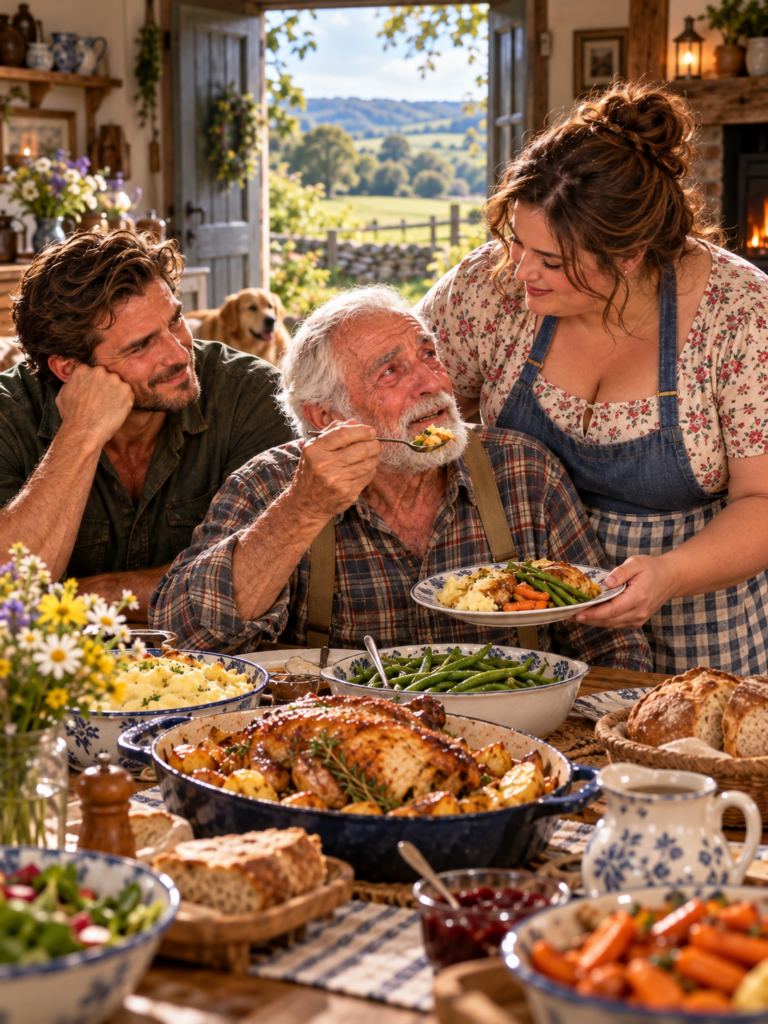
Part 1
The first time Nora Collins saw the old man, he was sitting on a porch overlooking three thousand acres of Kentucky farmland, holding a cup of coffee he had no intention of finishing.
Thomas Hale was eighty-two years old, one of the most respected cattlemen in Bourbon County, and the owner of a ranch worth more money than Nora could imagine.
But he was slowly starving himself.
For three years, since his wife had died, he had refused almost every proper meal placed in front of him.
Doctors had examined him. Specialists had prescribed nutritional drinks, supplements, and carefully planned diets. His son had hired four professional cooks, including one who had worked for a prominent Lexington family.
Nothing had worked.
Thomas would drink coffee with cream, nibble a few crackers, and occasionally swallow enough soup to keep everyone from calling an ambulance.
Beyond that, he wanted nothing.
His only son, Ethan Hale, had spent a small fortune trying to change his mind.
At forty-five, Ethan owned the kind of life people envied from a distance. He had inherited the responsibility for the family’s sprawling cattle operation, controlled valuable grazing land, and lived in a white farmhouse with six bedrooms, a wraparound porch, and a driveway lined with centuries-old oak trees.
What people couldn’t see was how empty the house had become.
Ethan had never married. His father barely spoke. The kitchen where his mother once cooked Sunday dinner remained locked.
And every evening, Ethan watched another untouched plate disappear into the trash.
One September night, he found his father sitting beneath the porch light, staring toward the pasture.
The chicken soup beside him had gone cold.
“Dad, you have to eat something.”
Thomas didn’t turn.
“I had my coffee.”
“Coffee isn’t dinner.”
“Wasn’t planning to argue about it.”
Ethan stood with both hands on his hips.
“You’ve lost another five pounds. Dr. Reynolds is talking about admitting you for observation.”
“Then he can talk to somebody else.”
“You’re not making this easy.”
“I never promised I would.”
Ethan picked up the untouched bowl.
For a moment, he wanted to throw it across the yard.
Instead, he carried it inside.
He had learned that anger accomplished nothing with his father. Concern accomplished even less.
As he reached the kitchen, a small voice came from the doorway.
“Mr. Ethan?”
Rosie Miller stood on the back step wearing purple sneakers and an oversized sweatshirt.
She was nine years old, the daughter of Ben and Leah Miller, who helped maintain the ranch and lived in a cottage near the equipment barns.
Rosie had grown up running between the two houses.
Before Ethan’s mother died, she had practically been a second grandmother to the girl.
Now Rosie looked at the full bowl in his hand.
“Is Grandpa Tom going to die because he won’t eat?”
Ethan had negotiated livestock contracts worth millions of dollars.
He had argued with bankers, lawyers, and men twice his age.
But he couldn’t answer a nine-year-old’s question.
He crouched beside her.
“We’re doing everything we can, sweetheart.”
Rosie glanced toward the porch.
“Grandma June used to make him eat.”
Ethan felt the familiar pressure behind his ribs.
“Yeah,” he said. “She did.”
The following morning, he placed another advertisement.
LIVE-IN COOK WANTED. PRIVATE KENTUCKY RANCH. EXPERIENCE WITH SENIOR MEAL PREPARATION PREFERRED. ROOM AND BOARD PROVIDED.
At the bottom, he added one sentence.
Patience required.
He didn’t really expect an answer.
Not one that would matter.
Forty miles away, in a rented basement apartment outside Lexington, Nora Collins sat on the edge of her bed with a wooden spoon across her knees.
It had belonged to her mother.
The handle was darkened from decades of use, and one side had worn smooth beneath the pressure of a thumb.
Nora was thirty-eight.
She had spent more than twenty years working in kitchens, starting as a teenage dishwasher in a roadside diner and eventually becoming the lead cook at a successful Lexington restaurant.
Six weeks earlier, she had believed her career was finally going somewhere.
The restaurant had won a regional food award for its signature chicken pot pie.
The recipe was hers.
Her mother had taught her how to make it in a tiny farmhouse kitchen, rolling pastry by hand and simmering chicken until the meat came away from the bone.
Nora had refined the recipe over the years, adding roasted garlic, fresh thyme, and a particular balance of stock and cream.
Customers drove across the county for it.
When a local food magazine announced the award, the restaurant owner, Patricia Grant, accepted the recognition.
Patricia gave interviews.
Patricia posed for photographs.
Patricia talked about her culinary vision.
Nora’s name appeared nowhere.
At first, Nora tried to convince herself it didn’t matter.
Then she saw a photograph of Patricia holding the award in front of a plate of Nora’s chicken pie.
The caption called it Patricia Grant’s celebrated family recipe.
Nora asked for proper credit.
She didn’t demand money or threaten to leave.
She simply requested that her name be included on the menu and in future interviews.
Patricia smiled across her desk.
“Of course, Nora. We’ll discuss it.”
Two weeks later, she called Nora into the same office.
This time, she closed the door.
“There have been discrepancies in the cash register,” Patricia said.
Nora frowned.
“What kind of discrepancies?”
“Missing money.”
“I don’t handle the register.”
“I’m aware of your responsibilities.”
“Then why are you telling me?”
Patricia folded her hands.
“Because I think it’s best that we end your employment today.”
For several seconds, Nora could only stare.
“You’re firing me?”
“I’m offering you an opportunity to leave quietly.”
“On what grounds?”
Patricia’s expression didn’t change.
“Let’s not make this unpleasant.”
Nora understood the threat.
If she argued about the recipe, Patricia would accuse her of stealing.
If she left quietly, perhaps the accusation would go no further.
She walked out through the restaurant’s rear entrance carrying her apron, a few personal belongings, and her mother’s spoon.
Three days later, she discovered Patricia had filed a police incident report alleging employee theft.
No charges were filed, but that distinction made little difference when prospective employers contacted her former workplace.
Restaurants that had initially sounded enthusiastic suddenly stopped returning her calls.
Nora knew the restaurant had security cameras.
She knew the cash records could be checked.
What she didn’t have was the money to hire a lawyer and force Patricia to answer for what she’d done.
Her savings dwindled.
Her rent came due.
For the first time in her adult life, Nora was afraid she might have to give up cooking altogether.
Then her neighbor, a retired schoolteacher named Mrs. Parker, knocked on her door.
“I saw something you might be interested in.”
She handed Nora her phone.
A ranch was looking for a cook.
An elderly man refused to eat.
Four previous employees hadn’t lasted.
Mrs. Parker studied her.
“Sounds like a difficult job.”
Nora read the advertisement twice.
Then she looked at the wooden spoon on her kitchen table.
Her mother used to say that cooking for someone wasn’t the same as feeding them.
One filled a stomach.
The other reminded a person that somebody cared whether they came home.
“Do you think they’d consider someone with a bad reference?” Nora asked.
Mrs. Parker shrugged.
“There’s only one way to find out.”
The bus dropped Nora outside a small convenience store on a two-lane highway.
A dark pickup truck waited beside the gas pumps.
The man leaning against it wore faded jeans, a white work shirt, and a brown felt cowboy hat.
He was tall, broad through the shoulders, with dark hair showing a little gray at his temples.
He looked as though he hadn’t slept properly in years.
“Nora Collins?”
“That’s me.”
“Ethan Hale.”
He offered his hand.
His grip was firm, brief, and businesslike.
“Thanks for coming all this way.”
“Thanks for answering my application.”
He took her small suitcase and placed it behind the truck seat.
Nora noticed the expensive watch on his wrist, the scuffed boots, and the fine layer of dust covering the vehicle’s dashboard.
This was clearly a wealthy man.
But nothing about him suggested he enjoyed being wealthy.
They drove in silence past white fencing, rolling pastures, and fields where cattle grazed beneath the late-afternoon sun.
Eventually, Ethan spoke.
“Before we get there, you should know my father can be difficult.”
“I’ve worked in restaurant kitchens for twenty years. I’ve met difficult.”
“This is different.”
“How?”
“He’ll refuse whatever you make. He might not even look at it.”
“Does he become aggressive?”
“No.”
“Does he insult people?”
Ethan shook his head.
“Mostly, he acts like you’re not there.”
Nora watched the countryside pass.
“That sounds lonely.”
Ethan glanced at her.
“For him or the cook?”
“Both.”
He said nothing after that.
The ranch house appeared at the end of a long gravel drive.
It stood among enormous oak trees, its white clapboard walls glowing in the evening light.
A broad porch wrapped around the front and one side of the house.
Beyond it lay barns, fenced paddocks, and a distant ridge of wooded hills.
Nora had worked in some expensive homes before, but this place felt different.
It had generations behind it.
She could see that in the worn porch steps, the weathered fence posts, and the old brass bell hanging near the back door.
Ethan stopped the truck.
“There are a few rules.”
Nora turned toward him.
“All right.”
“You’ll prepare meals for my father, me, and the ranch hands when they’re working the full day. You’ll have your own room in the guest cottage.”
“Understood.”
“The smaller kitchen in the back wing is yours to use.”
“And the main kitchen?”
Ethan’s face changed.
“It’s closed.”
“Being renovated?”
“No.”
“Then why—”
“Because it’s closed.”
His voice ended the conversation.
Nora looked at the house.
“All right, Mr. Hale.”
“It’s Ethan.”
“Then you can call me Nora.”
For the first time, his expression almost softened.
Almost.
An elderly man sat on the front porch in a wooden rocking chair.
His white hair was combed neatly back, and a blanket covered his legs despite the mild weather.
He watched the gravel driveway without any interest in the people standing on it.
Beside the porch steps, Rosie appeared with a golden retriever at her heels.
“Is she the new cook?”
Ethan sighed.
“Rosie, manners.”
The little girl grinned.
“I’m Rosie.”
“Nora.”
“Can you make cinnamon rolls?”
“I can.”
“Grandma June made them on Sundays.”
Ethan’s gaze moved sharply toward Rosie.
The girl’s smile disappeared.
“Sorry.”
Nora noticed.
Before she could ask anything, a silver SUV came up the driveway.
A man stepped out wearing polished shoes and a pale blue shirt with the sleeves rolled to his elbows.
He was handsome in a tidy, practiced way, with the relaxed confidence of someone accustomed to entering rooms where he expected to be welcomed.
“Ethan. You didn’t tell me the new cook was arriving today.”
“Grant.”
The newcomer turned toward Nora.
“Grant Hale. Ethan’s cousin. I handle most of the ranch’s financial administration.”
He offered an easy smile.
“I hope you’ve been warned about Uncle Tom.”
“A little.”
“He’s not quite himself these days. Memory problems. Confusion. You know how it goes at his age.”
Nora glanced toward the porch.
Thomas Hale was looking directly at Grant.
For the first time, his eyes appeared fully alert.
“I remember you perfectly well, boy,” he called.
Grant laughed.
“See? Still got some fire in him.”
But the laughter stopped a little too quickly.
Nora filed away the exchange.
Her first dinner was a failure.
She made a gentle chicken and vegetable soup with homemade stock, tender potatoes, and fresh parsley.
She served it with warm bread and softened butter.
Thomas looked at the tray.
“No, thank you.”
“Would you prefer something else, Mr. Hale?”
“No.”
“Maybe a little of the broth?”
He pushed the tray away.
“I’m not hungry.”
Nora didn’t argue.
She cleared the tray and returned to the back kitchen.
The following morning, she tried oatmeal with apples and cinnamon.
He refused that too.
At lunch, she offered mashed potatoes and slow-cooked beef.
Nothing.
By the third day, Nora was beginning to understand why the other cooks had left.
The problem wasn’t her food.
It was something that existed long before she arrived.
That afternoon, Rosie came into the back kitchen and sat on a stool.
Nora was trimming green beans.
“Can I help?”
“You can snap the ends.”
Rosie worked quietly for a few minutes.
Then Nora asked, “Who was Grandma June?”
The girl’s fingers stopped.
“Mr. Ethan’s mom.”
“I figured that much.”
“She was nice.”
“What was she like?”
Rosie thought about it.
“She made everybody sit together for dinner. Even when they were busy.”
Nora smiled.
“That sounds like a good rule.”
“She had a special kitchen. The big one.”
“The locked kitchen?”
Rosie nodded.
“She made pies and biscuits and everything. There was this huge table. Grandpa Tom always sat at one end, and Grandma June sat at the other.”
“What happened?”
“She died.”
Rosie looked down at the beans.
“After that, Grandpa Tom quit eating at the table. Mr. Ethan locked the kitchen.”
“Why?”
“I don’t know. They don’t talk about her.”
“Who doesn’t?”
“Mr. Ethan and Grandpa Tom.”
Nora watched the little girl’s face.
“Do you miss her?”
Rosie nodded fiercely.
“She always saved me the crispy edges of the cornbread.”
Nora put down her knife.
“Did she?”
“The corners were the best.”
That evening, Nora walked past the main hallway on her way to get a glass of water.
A thin strip of light came from beneath a closed door.
Thomas stood in front of it wearing a bathrobe and slippers.
An old brass key hung from a cord around his neck.
His fingers were wrapped around it.
He leaned toward the door and whispered something.
Nora couldn’t hear every word.
But she heard a name.
“June.”
Then he said, almost apologetically, “I know. I’m just not ready.”
Nora stepped away before he noticed her.
She returned to her room with an uncomfortable realization.
The old man wasn’t simply refusing food.
He was refusing a life he no longer recognized without his wife.
Two mornings later, Nora went into the vegetable garden behind the house.
The last sweet corn of the season was still growing along the fence.
She chose six ears.
Back in the small kitchen, she shucked them, washed them, and began grating the fresh kernels by hand.
It was slow work.
Milky corn juice ran down the grater into the bowl.
She added a little flour, an egg, buttermilk, salt, and a spoonful of melted butter.
Then she heated a cast-iron skillet and made small, golden corn cakes, crisp at the edges and tender in the center.
Her mother had made them exactly this way.
No packaged cornmeal mix.
No frozen kernels.
Just corn scraped fresh from the cob and cooked while it was still sweet.
As the first cakes browned, Nora saw movement through the window.
Thomas had lifted his head.
The scent had reached the porch.
She cooked two more.
Then she placed them on a small plate beside a mug of coffee.
She carried everything outside.
“Morning, Mr. Hale.”
Thomas barely acknowledged her.
Nora set the plate on the side table.
“I made too many. You’re welcome to these if you want them.”
She walked to the other end of the porch and sat with a bowl of beans to prepare.
She didn’t watch him.
For several minutes, the only sounds were birds in the oak trees and the gentle creak of the rocking chair.
Then the chair stopped.
Nora kept her eyes on the beans.
A fork scraped against the plate.
She heard a small movement.
Then another.
After a while, a voice spoke from behind her.
“Where’d you learn to make corn cakes like that?”
Nora looked up.
Thomas was holding the second one.
“My mother.”
He studied it.
“She use fresh corn?”
“Always. Said you lose half the flavor when you start cutting corners.”
Thomas stared at her.
A faint smile touched his face.
“June said something like that every summer.”
He took another bite.
At that moment, Rosie came around the corner carrying the dog’s water bowl.
She stopped so suddenly that water splashed over her shoes.
“Grandpa Tom?”
Thomas looked at her.
“What?”
“You’re eating.”
He glanced at the plate as though the evidence surprised him too.
“Looks that way.”
Rosie dropped the bowl.
“MR. ETHAN!”
She ran toward the barns.
A minute later, Ethan came hurrying across the yard.
He had been checking cattle in the north pasture and looked genuinely frightened.
“What happened?”
Rosie pointed.
“Look!”
Ethan stopped at the foot of the porch.
His father was finishing the second corn cake.
No argument.
No coaxing.
No untouched plate.
Just an elderly man eating breakfast.
Ethan stood completely still.
Thomas wiped his mouth with a napkin.
“Your cook knows what she’s doing.”
For a second, Ethan looked toward Nora.
He seemed about to say something.
Instead, he lowered his head and removed his hat.
When he raised his face again, his eyes were wet.
“That’s good, Dad.”
Thomas shrugged.
“They’re only corn cakes.”
But everyone on that porch knew they were much more than that.
And Nora, sitting with a bowl of green beans in her lap, couldn’t stop looking at the man who had spent three years trying to save his father.
She had seen anger in him.
Exhaustion.
Suspicion.
Now, for the first time, she saw something else.
Hope.
What she didn’t know was that somebody on the ranch had a very good reason to fear Thomas Hale getting better.
And that man had already begun making plans to get rid of her.
Part 2
The change in Thomas Hale happened slowly.
It began with two corn cakes.
The next morning, he asked for scrambled eggs.
By the end of the week, he was sitting at the little kitchen table eating chicken and dumplings while Rosie explained why her third-grade teacher had banned trading snacks during lunch.
He still ate small portions. Dr. Reynolds checked on him regularly, concerned about how much weight he’d lost and how carefully his nutrition needed to improve.
But the old man was eating.
More importantly, he was talking.
Nora discovered that Thomas had once driven cattle across three states with his father. He remembered winters when the pipes froze, summers when the rain didn’t come, and the year a tornado destroyed half the equipment barn.
He could recall the purchase price of a tractor bought thirty-seven years earlier.
He remembered which fence posts had been replaced in 1994.
And he remembered every detail of meeting his wife.
“June was selling pies at the Saturday market in town,” he told Nora one afternoon.
Rosie immediately climbed onto the stool beside him.
“Tell the story again.”
“You’ve heard it a hundred times.”
“Tell it a hundred and one.”
Thomas chuckled.
“It was 1966. I was twenty-three, didn’t have much money, and thought I was the handsomest cowboy in Bourbon County.”
Nora raised an eyebrow.
“Were you?”
“Not even close. But I didn’t know that.”
Rosie giggled.
“Go on.”
“June had this little booth outside the church. Sold chicken pies, apple turnovers, and cinnamon rolls. I bought a pie just to talk to her.”
“Then what?” Rosie demanded.
“I bought another.”
Nora laughed.
“You must have been hungry.”
“I was interested.”
“And did she notice?”
“On the third pie, she told me I could either ask her out or keep eating until I made myself sick.”
Rosie nearly fell off her stool laughing.
“Did you ask?”
“Sure did.”
“And she said yes?”
Thomas’s smile grew softer.
“She said if I wanted to take her to dinner, I’d better put on a clean shirt.”
He looked toward the window.
“Married her six months later.”
Nora continued chopping carrots.
“How long were you together?”
“Fifty-six years.”
His voice changed.
“For fifty-six years, there was somebody waiting for me at the dinner table.”
Nobody spoke for a while.
Then Thomas picked up his fork.
“You get used to a thing like that.”
Nora watched him finish his meal.
She was beginning to understand that June Hale hadn’t simply been the woman who cooked in this house.
She had been the reason everyone came to the table.
Ethan noticed the changes too.
At first, he watched Nora with something approaching suspicion.
One evening, after Thomas had finished a bowl of beef stew, Ethan found her washing dishes in the back kitchen.
“What are you doing differently?”
Nora glanced at him.
“With what?”
“My father.”
“Cooking, mostly.”
“Four people tried that before you.”
“Maybe they were good cooks.”
“They were.”
“Then maybe he wasn’t ready.”
Ethan crossed his arms.
“You’ve got an answer for everything?”
“No. If I did, I’d probably have a better-paying job.”
He looked at her for a long moment.
Then he leaned against the counter.
“I don’t understand it.”
“Understand what?”
“Three years. I begged him. I got angry. I drove him to specialists. I even threatened to bring in home health aides whether he wanted them or not.”
Nora dried her hands.
“What did he eat before your mother died?”
Ethan stared at her.
“Everything.”
“Where?”
“In the kitchen.”
“With whom?”
His expression tightened.
Nora let the question settle.
Finally, he said, “I wasn’t here when she died.”
She didn’t interrupt.
“I was in Oklahoma, negotiating a cattle sale. We were behind on a loan. I thought the deal would fix things.”
He studied a crack in the wooden counter.
“By the time I got home, she’d already passed.”
“I’m sorry.”
“My father hasn’t forgiven me.”
“Did he tell you that?”
“He didn’t have to.”
Nora moved a clean plate onto the drying rack.
“People can spend years misunderstanding each other when neither one knows how to ask the right question.”
Ethan gave a short, humorless laugh.
“You sound like my mother.”
“Was she annoying?”
“Frequently.”
Nora smiled.
For the first time, Ethan smiled back.
It lasted only a moment.
But afterward, he began finding reasons to come into the kitchen.
Sometimes he needed coffee.
Sometimes he wanted a glass of water.
Once, he came in to ask where she kept the extra dish towels, even though he’d lived in the house his entire life.
Nora noticed.
She pretended not to.
One Sunday, Thomas asked Nora to walk with him.
He took his cane and led her along a narrow path behind the pasture.
The afternoon was warm, with a breeze moving through the tall grass.
They stopped beside a wide oak tree growing near a small creek.
“This was June’s tree.”
Nora looked up into the branches.
“It’s beautiful.”
“She planted it when Ethan was born.”
Thomas settled carefully onto a low wooden bench beneath it.
“She said every child ought to grow up beside something that would outlive them.”
Nora sat at the other end.
For several minutes, they watched sunlight move across the water.
Then Thomas said, “You’ve never told me much about your family.”
“There isn’t much family left.”
“Your mother?”
“Died when I was twenty.”
“Father?”
“Left before I was old enough to remember him.”
“Brothers? Sisters?”
Nora shook her head.
“Just me.”
Thomas looked toward the tree.
“That’s a lonely way to live.”
“Sometimes.”
She rubbed her thumb along the edge of the bench.
“My mom cooked for people her whole life. Farm families. Truck drivers. Anybody who needed a hot meal. She could make dinner for ten with what most people kept in their cupboards.”
“Sounds like June.”
“She used to say people could taste whether you wanted them at your table.”
Thomas smiled.
“June would have liked her.”
Nora looked down at her hands.
“I haven’t cooked for people who were happy to see me in a long time.”
Thomas considered that.
Then he said, “Well, you do now.”
He pointed his cane toward the house.
“And I’m tired of you eating by yourself after the rest of us are finished. From now on, you sit at the table.”
Nora hesitated.
“Mr. Hale, I work here.”
“That doesn’t mean you can’t have dinner.”
He gave her a stern look.
“June would’ve scolded every last one of us for making you eat alone.”
Nora laughed softly.
“All right.”
Thomas looked pleased with himself.
Then he added, “My son ought to be grateful I hired such a pretty cook.”
Nora turned sharply.
“Your son hired me.”
“Well, that’s the first smart thing he’s done in years.”
“Mr. Hale.”
“Don’t worry. I’ll leave the courting to him.”
She shook her head, smiling despite herself.
As they walked back toward the house, Ethan appeared on horseback near the fence line.
He brought the horse to a stop.
For a moment, he simply stared at his father walking beneath the trees.
Thomas lifted his cane.
“Quit gawking, boy. I’m not dead.”
Ethan laughed.
It was the first full, unguarded laugh Nora had heard from him.
And when he looked at her, something passed between them that neither was ready to name.
Two mornings later, Nora entered the back kitchen and found the old range had been repaired.
The burner that had refused to light now worked perfectly.
The loose oven handle had been replaced.
Even the cabinet door that always stuck had been adjusted.
On the windowsill stood a small glass jar holding white asters.
Beside it lay Ethan’s felt hat.
Nora touched the brim.
She didn’t need to ask who had been there.
That afternoon, Ethan came by for coffee.
“Stove working all right?” he asked.
“Very well.”
“Good.”
“Did somebody fix it?”
“Probably.”
“Somebody leave flowers too?”
Ethan looked at the jar.
“Could be.”
Nora smiled.
“Well, whoever it was should know I appreciate it.”
He took his coffee.
“I’ll pass that along.”
After he left, Nora picked up the hat and placed it carefully in the cupboard.
She told herself she was only keeping it clean.
But that night, she lay awake thinking about his smile.
That frightened her more than she cared to admit.
She had lost one job because somebody decided her work was useful but her reputation was disposable.
She couldn’t afford to let herself depend on another wealthy family.
And she certainly couldn’t afford to fall in love with the man who signed her paychecks.
Grant Hale visited the following afternoon.
He arrived while Ethan was inspecting the south property with a livestock buyer.
Nora was preparing supper when Grant placed a folder on the counter.
“I need a small favor.”
She set down her knife.
“What kind?”
“My uncle’s medical situation.”
“What about it?”
“His attorney needs documentation. We’re trying to make sure the property is protected.”
Nora opened the folder.
The document was a written statement asserting that Thomas suffered from memory impairment and could no longer make sound financial decisions.
It referenced a possible petition for guardianship.
At the bottom was a place for Nora’s signature.
She read it carefully.
“Why would I sign this?”
“You’ve been observing him every day.”
“Yes. And this isn’t an accurate description of what I’ve observed.”
Grant leaned against the counter.
“He’s eighty-two, Nora.”
“He’s also perfectly capable of remembering what he ate for breakfast and what he paid for a cattle trailer in 1988.”
“Having a good day doesn’t mean somebody has full capacity.”
“Then his physician and attorney can evaluate him properly.”
Grant’s smile thinned.
“You don’t understand the financial complexity here.”
“You’re right. I don’t.”
She pushed the folder toward him.
“But I understand what my signature means.”
He didn’t take it immediately.
Instead, he studied her.
“Be careful, Nora.”
“About what?”
“People with questionable employment histories should be cautious about making enemies.”
The kitchen seemed suddenly colder.
Nora didn’t move.
Grant picked up the folder.
“I’d hate for Ethan to learn something unfortunate about your last job.”
He left before she could answer.
Nora remained at the counter, her fingers gripping the edge.
Somebody had been checking into her past.
And Grant had just made it clear that he intended to use what he found.
That evening, Thomas asked her to stay behind after dinner.
He waited until Rosie had gone home and Ethan’s truck had disappeared down the driveway.
Then he reached beneath his shirt.
The old brass key hung from its familiar cord.
He removed it and held it out.
Nora looked at him.
“Mr. Hale?”
“I want that kitchen opened.”
She stared at the key.
“Are you sure?”
“No.”
His answer was so immediate that she almost smiled.
“But I’m tired of being afraid of a room.”
He placed the key in her hand.
“Will you help me?”
The next morning, they stood together outside June Hale’s kitchen.
Thomas leaned on his cane.
Nora turned the key.
The lock stuck at first.
Then it clicked.
She pushed the door open.
Sunlight entered through two tall windows and fell across a room that looked as though its owner had stepped away only yesterday.
Copper pans hung above an enormous wooden table.
A six-burner range stood against the far wall.
Glass-fronted cabinets held dishes painted with tiny blue flowers.
There were twelve chairs around the table.
On a peg beside the window hung a faded floral apron.
Thomas stopped at the doorway.
For several seconds, he couldn’t step inside.
Nora waited.
Finally, he whispered, “She’d be furious.”
Nora looked at him.
“Why?”
He nodded toward the dust.
“Because I let her kitchen get like this.”
She smiled.
“Then we’d better clean it.”
For four days, Nora worked to bring the room back to life.
Thomas sat at the table, telling her which pan June used for cornbread and where she kept the good serving dishes.
Rosie helped polish silverware and wash the blue-flowered plates.
On the third afternoon, Nora discovered a heavy recipe notebook wrapped in a tea towel inside a kitchen drawer.
The cover was stained with flour.
Inside were decades of handwritten recipes.
Buttermilk biscuits.
Apple butter.
Sunday roast.
Corn cakes.
Chicken and dumplings.
The handwriting was neat, with occasional notes scribbled in the margins.
Ethan likes extra gravy.
Tom says this needs more pepper. Ignore him.
Rosie laughed at that one.
Then Nora reached the last section.
Several pages had been torn from the binding.
The remaining page contained only a heading.
Sunday Chicken Pie for My Ethan.
Nora ran her finger lightly over the damaged edge.
Thomas had gone very still.
“Mr. Hale?”
He looked away.
“Some things are best left alone.”
Nora closed the notebook.
She didn’t ask again.
On Sunday, the large kitchen filled with the scent of baking pastry.
Nora had worked from June’s notes and the family’s memories to reconstruct her Sunday chicken pie.
It had tender chicken, smoked country ham, sweet onions, celery, a little fresh thyme, and a golden crust.
She made mashed potatoes and green beans to go with it.
Thomas sat at the head of the table.
Rosie arranged wildflowers in an old ceramic pitcher.
Ethan came home early when a scheduled livestock delivery was delayed.
He entered through the back door, pulled off his boots, and stopped.
The kitchen door was open.
For one terrible second, Nora thought he might order her out.
“Ethan,” she began.
He didn’t answer.
His gaze traveled across the clean counters, the hanging copper pans, the familiar plates.
Then he saw his father sitting at the head of the table.
Rosie was beside him, laughing about something that had happened at school.
Thomas looked toward his son.
“Well? Are you going to stand there all day?”
Ethan remained in the doorway.
” Dad…”
“Sit down. Dinner’s getting cold.”
Ethan slowly pulled out a chair.
The same chair he’d used as a boy.
Nora served the pie.
He took one bite.
Then another.
He stared down at his plate.
“Mom used to put country ham in it.”
“Rosie told me.”
“And thyme.”
“Your father remembered that.”
Ethan looked at Thomas.
The old man kept eating.
For the first time in three years, father and son shared a proper Sunday dinner in June’s kitchen.
They didn’t discuss the past.
They didn’t apologize.
But Ethan asked for another helping.
And when Rosie accidentally knocked over her glass of iced tea, both men laughed before either remembered they had spent years barely speaking.
Later, Ethan stayed to help wash the dishes.
Nora handed him a towel.
“You don’t have to do that.”
“I know.”
He dried a copper pan slowly.
After a while, he said, “I was engaged once.”
Nora looked over.
“Really?”
“I was twenty-five. Her name was Rebecca. She wanted to move to Chicago.”
“And you didn’t?”
“I couldn’t imagine leaving the ranch.”
“What happened?”
“She left. I stayed.”
He smiled without much humor.
“Then came the loans, the cattle prices, my parents getting older. There was always something that needed doing.”
Nora rinsed a plate.
“You regret it?”
“Sometimes.”
He looked at her.
“But lately I’ve been wondering whether I was waiting for the wrong thing.”
Her hands stopped beneath the running water.
Neither spoke.
Then Nora turned off the faucet.
“Ethan, I should tell you something.”
He set down the towel.
“What?”
She wanted to explain the restaurant.
The accusation.
The police report.
Everything.
But fear rose before the words could come.
Instead, she said, “I didn’t leave my last job on good terms.”
Ethan nodded.
“You don’t have to tell me tonight.”
And somehow, that kindness made the truth even harder to say.
Over the following days, Nora began noticing something else.
Grant left grocery and feed invoices in a folder near the back office.
Because she ordered kitchen supplies, she sometimes had to check deliveries against the paperwork.
The numbers didn’t make sense.
One invoice listed fifteen cases of canned tomatoes.
Only six had arrived.
Another billed the ranch for feed sufficient for hundreds more cattle than the operation had in its current feeding program.
Prices appeared inflated.
Delivery quantities were inconsistent.
Nora had spent years managing food costs for restaurants.
She knew what wholesale supplies cost.
She also knew when somebody was manipulating inventory.
At first, she assumed the mistakes were administrative.
Then she compared another month.
And another.
The same patterns appeared.
She began keeping careful notes in the back of her own recipe book.
What the invoices said.
What had actually arrived.
What the suppliers normally charged.
Her notes alone weren’t proof of fraud, but they were enough to make her suspicious.
One night, she saw Grant’s SUV beside the main office.
Through the open window, she heard him speaking on the phone.
“Once we have the medical documentation, the buyers will be more comfortable.”
A pause.
“Ethan won’t agree while he thinks his father’s improving.”
Another pause.
“That’s why we need to move quickly.”
Nora stepped away before he noticed her.
Her heart was pounding.
Grant wasn’t merely trying to manage the ranch.
He was preparing to sell it.
And Thomas’s recovery was becoming an obstacle.
The following Sunday, Grant came for lunch.
The long table had been set with June’s blue-flowered dishes.
Thomas sat at the head.
Ethan was beside him.
Rosie had placed a napkin at Nora’s chair.
Grant arrived carrying a leather folder.
He was pleasant through most of the meal.
He complimented the pie.
Asked about the cattle.
Joked with Rosie.
Then, as Nora was bringing coffee to the table, he placed a sheet of paper beside Ethan’s plate.
“There’s something you need to know about your new cook.”
Ethan looked down.
It was a copy of the Lexington police incident report.
Nora recognized her name immediately.
Grant rested his elbows on the table.
“I checked her references. Apparently, she left her last restaurant under suspicion of theft.”
Rosie’s smile vanished.
Thomas looked sharply at his nephew.
Ethan read the report.
Then read it again.
Nora felt her stomach sink.
“That isn’t what happened.”
Grant sighed.
“Naturally, there are two sides.”
“Grant,” Ethan said quietly.
His cousin leaned back.
“I thought you deserved to know who you’ve brought into your father’s house.”
Nora looked at Ethan.
“There’s an explanation.”
He finally lifted his eyes.
“Why didn’t you tell me?”
She swallowed.
“I tried.”
“When?”
“The other night. I wanted to, but—”
“But you didn’t.”
The disappointment in his face was worse than anger.
Grant watched them without speaking.
Nora stood straighter.
“Yes, there was a report. No, I didn’t steal anything.”
“Then why did your employer file it?”
“Because I asked her to stop taking credit for my recipe.”
Ethan looked down at the paper.
“That’s a serious accusation, Nora.”
“So is calling someone a thief.”
Silence settled over the table.
Then Ethan folded the report.
“Maybe it’s best if you leave for now.”
Nora went cold.
“Ethan.”
“I’ll drive you to the bus station tomorrow morning.”
Rosie started crying.
“Mr. Ethan, no!”
Thomas struck his palm against the table.
“Boy, you’d better think carefully.”
But Ethan was already standing.
“I need time to sort this out.”
He left the room.
Grant took another sip of coffee.
Nora looked at him.
Now she understood why he’d chosen Sunday dinner.
Why he’d waited until everyone was seated.
Why he’d brought the report in person.
It wasn’t enough for him to make Ethan doubt her.
He wanted the entire family to witness her humiliation.
Nora removed her apron.
She folded it carefully.
Then she walked out of June Hale’s kitchen.
That night, Nora packed her suitcase.
Her clothes fit easily.
So did her few books.
She wrapped her mother’s wooden spoon in a towel and placed it on top.
In the cupboard, she found Ethan’s felt hat.
She held it for a moment.
Then she set it on the table.
She wasn’t taking something that belonged to him.
She sat on the bed and cried.
Not because she had lost another job.
Not entirely.
She cried because, against her better judgment, she had begun believing she could belong somewhere again.
Near eleven, someone knocked.
“Nora?”
It was Thomas.
He stood outside her door wearing slippers and carrying his cane.
“Come with me.”
“Mr. Hale, it’s late.”
“I know what time it is.”
He looked at the suitcase.
“And leave that where it is.”
Ethan was sitting on the porch when they found him.
Thomas pointed toward the house.
“Kitchen. Both of you.”
Ethan frowned.
“Dad—”
“Now.”
There was enough authority in his voice that neither argued.
They gathered around the long table beneath the warm kitchen lights.
Thomas reached into the pocket of his robe.
He withdrew several folded pages, yellowed with age.
Ethan stared at them.
“What are those?”
Thomas placed them on the table.
“The pages missing from your mother’s recipe book.”
Ethan didn’t move.
“I tore them out three years ago.”
Nora looked at the old man.
Thomas’s hand trembled against the wood.
“There’s something I should’ve told you a long time ago, son.”
He sat down.
“Your mother took sick on a Monday. Chest pains. Trouble breathing. She told me to call you.”
Ethan went pale.
“I remember the call.”
“I know.”
“You said she was feeling better.”
Thomas closed his eyes.
“She wasn’t.”
Ethan gripped the back of a chair.
“Dad?”
“You were in Oklahoma. You’d finally made that cattle sale. You sounded so relieved because you thought it would keep the bank from coming after the ranch.”
He drew a shaky breath.
“I told you there was no need to hurry home.”
Ethan stared at him.
“Why?”
“Because I thought we’d have more time.”
The old man’s eyes filled.
“By Tuesday night, she could barely hold a pen. She asked for her recipe book. Said she wanted to write down your favorite Sunday pie properly.”
He touched the pages.
“She wrote you a letter too.”
Nora remained very still.
“Wednesday morning, she died.”
Ethan pulled out the chair and sat.
Thomas continued.
“When you came home, you looked at me like you’d never forgive yourself for being away.”
His voice broke.
“And I let you believe it was your fault.”
“Dad…”
“I couldn’t tell you I’d been the one who said not to come. I couldn’t stand seeing how much it would hurt you.”
Thomas wiped his eyes.
“So I hid the letter. Tore it out of her book. Locked the kitchen.”
He stared at his hands.
“And every time I sat down to eat, I remembered that I was the one who’d kept you from saying goodbye.”
For a long moment, nobody moved.
Then Ethan asked, barely above a whisper, “What did she write?”
Thomas pushed the pages toward him.
Ethan tried to read them.
His hands were shaking too badly.
Finally, he looked at Nora.
“Would you?”
She took the pages.
The handwriting was faint, but she could make it out.
She began to read.
My dearest Ethan,
If you’re reading this, your father is probably making far more fuss than necessary. Don’t be angry with him. And please don’t be angry with yourself.
You have spent so many years trying to take care of this family. I hope someday you understand that you are allowed to have a life of your own.
Look after your dad. He’s stubborn, but underneath all that pride is a very soft heart.
Keep an eye on little Rosie. Family has never been only about blood in this house.
And whatever happens, promise me you won’t let our Sunday table stay empty.
Nora paused.
Her eyes blurred.
She read the final lines.
One day, someone wonderful may come into your life. When she does, don’t make her stand outside the door because you’re afraid of losing her.
Love isn’t something you protect by keeping it locked away.
With all my love,
Mom.
Ethan covered his face.
For three years, he had believed his mother died waiting for a son who couldn’t be bothered to come home.
Now he knew she had written him a final message of love.
And the man sitting across from him had spent those same years punishing himself for a terrible mistake.
Thomas stood with difficulty.
He walked around the table and placed a hand on Ethan’s shoulder.
“I’m sorry, son.”
Ethan turned.
Then he stood and wrapped his arms around his father.
Neither man tried to hide his tears.
Nora rose quietly.
She wanted to give them privacy.
But before she reached the door, Ethan spoke.
“Please stay.”
She turned.
He wiped his face.
“I owe you an apology.”
Nora said nothing.
“I should’ve asked for your side before making a decision.”
“Yes,” she said.
The simplicity of her answer made him look down.
“I was wrong.”
She returned to the table.
Then she told him everything.
The award.
The stolen credit.
Patricia’s threat.
The false allegation.
The restaurant employees who had witnessed what happened but had been too frightened to speak.
When she finished, Ethan listened for a long moment.
“I believe you.”
Nora looked at him.
“I appreciate that.”
“But I understand if you don’t trust me anymore.”
She didn’t rush to reassure him.
“I don’t know if I do.”
He accepted that.
Nora opened her recipe book and turned to the pages of handwritten figures.
“There’s something else you need to see.”
Ethan studied the invoices and notes.
His expression changed.
“Where did you get these numbers?”
“From the delivery records. And from the prices suppliers normally charge.”
Thomas adjusted his glasses.
“Grant has been handling those accounts.”
“I know,” Nora said.
Ethan turned another page.
“These quantities don’t match our feeding records.”
“And this isn’t just one mistake,” Nora replied. “It’s been happening for months.”
Ethan leaned back.
“I’ve been trusting him because he’s family.”
Thomas looked at his son.
“That’s what he’s counting on.”
They talked until well after midnight.
By morning, they had a plan.
Ethan would ask the agricultural cooperative’s accountant to help reconcile the invoices and obtain copies of the original supplier records.
Thomas would speak to his longtime attorney about Grant’s attempt to document him as incapacitated.
Nora would remain at the ranch if she chose to stay.
And on Saturday, they would go into town.
Because Grant had arranged a meeting with potential buyers at a hotel near the farmers’ market.
The same market where June Hale had once sold pies.
The same market where Thomas had met the love of his life.
And, after three years of standing empty, June’s old stall would finally open again.
Part 3
By sunrise on Saturday, the Hale ranch kitchen was alive with activity.
Nora stood at the long wooden table rolling pastry while Rosie brushed egg wash over the tops of small chicken pies.
Thomas supervised from his favorite chair.
“Your grandmother would have used a little more butter,” he told Rosie.
Rosie looked at Nora.
“Is that true?”
“Probably.”
“Then we need more butter.”
Nora laughed.
“We’ve already got plenty.”
Thomas shook his head.
“That’s what I used to tell June.”
Outside, Ethan loaded folding tables and boxes into his truck.
He had spent the previous two days with the cooperative’s accountant reviewing the ranch records.
They had found payments for supplies that were never delivered, inflated invoices, and transfers that required explanations Grant hadn’t provided.
More than forty-five thousand dollars appeared to have been diverted or improperly charged.
Ethan had made copies of everything.
He wasn’t going to accuse his cousin without evidence.
Not after what he’d done to Nora.
By eight o’clock, they reached the Saturday market in downtown Paris, Kentucky.
June Hale’s old stall stood near the end of the row, beneath a large tree.
For decades, she’d sold pies there every weekend.
After her death, Thomas had continued paying the small rental fee but had never allowed anyone to reopen it.
Now Nora pulled away the protective covering.
Rosie arranged the pies on wooden trays.
Thomas settled behind the counter with a cash box.
And Ethan hung a freshly painted sign above them.
JUNE HALE’S SUNDAY PIES
Beneath it, in smaller letters, Nora had added:
Made with love by the Hale family and Nora Collins.
When Thomas saw the sign, he removed his glasses.
He pretended they needed cleaning.
Nora didn’t mention the tears.
Within an hour, a line had formed.
An elderly woman took one bite of chicken pie and stopped.
She looked at Thomas.
“Tom Hale?”
He smiled.
“Morning, Margaret.”
The woman stared at the pie.
“That tastes like June’s.”
Thomas nodded.
“It should.”
Margaret put a hand over her mouth.
“Oh, Tom.”
Soon, the word was spreading through the market.
June Hale’s pies were back.
And Thomas Hale, whom many neighbors hadn’t seen in years, was sitting behind the counter telling stories and arguing cheerfully about the proper amount of black pepper.
For the first time in three years, he looked like himself.
Around eleven, a woman hurried toward the stall.
She wore a badge identifying her as a volunteer at a nearby senior living center.
“Are you the cook?”
Nora looked up.
“Yes.”
“Our kitchen manager has been taken to urgent care. We have forty residents expecting lunch, and the replacement isn’t available until tonight.”
She looked desperately at the trays.
“Would you be willing to help? Our staff can assist, and we’ve got food in the kitchen.”
Nora glanced at Ethan.
He nodded toward the pies.
“We can handle things here.”
Thomas waved her away.
“Go feed those people.”
For the next two hours, Nora worked alongside the center’s employees, preparing chicken and vegetable stew, mashed potatoes, tender carrots, and a soft dessert suitable for residents who needed easier-to-eat food.
She organized the staff, checked dietary instructions, and made sure every meal reached the right person.
By the time she returned to the market, she was exhausted.
But she was smiling.
The volunteer coordinator followed her back.
“I don’t know what we would have done without you.”
Nora shook her head.
“Your team did most of the work.”
“Maybe. But you brought order to the kitchen when we needed it.”
Several customers overheard.
Word spread quickly.
That was when Grant Hale arrived.
He came from the direction of the hotel accompanied by a man in a charcoal suit and a younger associate carrying a briefcase.
Grant stopped when he saw the crowd.
Then he noticed his uncle.
Thomas was laughing with a customer.
Grant’s expression hardened.
He walked directly toward the stall.
“Ethan.”
Ethan turned.
“Grant.”
“What exactly is going on?”
“We’re selling pies.”
“I can see that.”
Grant looked at Nora.
Then he raised his voice.
“Does everyone here know who this woman is?”
The customers nearest the stall stopped talking.
Nora felt the familiar cold sensation in her stomach.
Grant pointed toward her.
“This woman was accused of stealing from her last employer. Now she’s using my late aunt’s name to make money.”
“That’s enough,” Ethan said.
Grant ignored him.
“She’s been manipulating an elderly man who hasn’t been mentally well for years.”
Thomas slowly stood.
“Grant.”
His nephew continued.
“We have serious concerns about my uncle’s ability to make decisions. My family has been trying to protect him.”
“Grant,” Thomas repeated, louder this time.
The crowd turned toward the old man.
Thomas rested both hands on his cane.
“You’ve said plenty about my condition.”
Grant gave an uneasy smile.
“Uncle Tom, let’s discuss this privately.”
“No.”
The old man’s voice carried across the market.
“You told people I couldn’t remember things. Couldn’t manage my own affairs.”
“I’m only trying to help.”
“Then perhaps you can help me remember why we paid for cattle feed that never arrived.”
Grant’s smile disappeared.
Ethan stepped forward.
“We’ve reviewed the accounts with an independent accountant.”
He opened his folder.
“Duplicate invoices. Unsupported charges. Payments that don’t match supplier records.”
The suited man beside Grant turned toward him.
“What is this?”
Ethan faced him.
“You’re here about purchasing part of the ranch, aren’t you?”
The man hesitated.
“We were invited to discuss a potential transaction.”
“By someone who doesn’t have authority to sell it.”
Ethan held up the documents.
“My father hasn’t authorized any sale. Neither have I.”
Thomas looked directly at the buyer.
“And I don’t intend to.”
The man closed his portfolio.
“Then I believe our meeting is over.”
He and his associate walked away.
Grant stood alone beside the stall.
His face had gone pale.
“Ethan, you don’t understand—”
“I understand enough to have our attorney review every account you’ve handled.”
Grant opened his mouth.
Then closed it.
Thomas pointed toward Nora.
“And before you say another word about this woman, remember something. She helped me when I could barely find the will to get out of bed.”
The old man looked around at his neighbors.
“She’s welcome at my table.”
His voice caught briefly.
“And I’d trust her in my kitchen before I’d trust my own nephew with another dollar.”
Nora thought the confrontation was over.
Then a woman emerged from the edge of the crowd, carrying a baby.
“Nora?”
Nora turned.
“Paige?”
Paige Brooks had worked beside her at the Lexington restaurant for nearly three years.
She had been there when Nora developed the award-winning recipe.
She had witnessed the conversation that led to Nora’s dismissal.
And she had been one of the employees who stayed silent.
Nora had sent her a message earlier that week.
It had gone unanswered.
Paige approached the stall.
“I got your text.”
Nora swallowed.
“I wasn’t sure you’d come.”
“I wasn’t sure either.”
Paige shifted the baby in her arms.
Then she faced the people gathered around the stall.
“I worked with Nora Collins at Patricia Grant’s restaurant.”
Nora felt Ethan move beside her.
Paige continued.
“Nora didn’t steal anything. There were no missing cash receipts that I ever saw, and she didn’t even work the register.”
She looked at Nora.
“The pie that won the award was Nora’s recipe. Everybody in our kitchen knew it.”
A murmur passed through the crowd.
“Patricia threatened her after she asked for credit. I heard the conversation afterward. I knew what was happening.”
Paige’s eyes filled.
“And I didn’t say anything because I was scared of losing my job.”
She turned back to Nora.
“I’m sorry.”
Nora looked at the woman she’d once considered a friend.
For weeks, she had imagined this moment.
She’d imagined being angry.
Demanding explanations.
Asking why Paige had allowed her to lose everything.
But now, looking at the exhausted woman holding her little boy, Nora felt only relief.
“Thank you for coming.”
Paige began crying.
Nora walked around the counter and embraced her.
The baby protested loudly between them.
Several people laughed.
Then someone started clapping.
A moment later, others joined in.
Nora didn’t feel triumphant.
She felt as though she could finally breathe.
Ethan stepped beside her.
He didn’t make a speech.
He simply offered his hand.
This time, Nora took it.
Grant resigned from his position managing the ranch the following Monday.
The family’s attorney investigated the records and negotiated a formal restitution agreement for the funds the review could establish had been diverted, while reserving the family’s legal options over any further losses.
Grant had been heavily in debt after a failed investment.
Selling the ranch, he admitted, had seemed like the fastest way to escape his financial problems.
Before leaving, he visited Thomas one last time.
“You always trusted Ethan more than me.”
Thomas watched him from the porch.
“Ethan made mistakes too.”
“Not like mine.”
“No,” Thomas replied. “Not like yours.”
Grant lowered his eyes.
“I never felt like I belonged here.”
Thomas looked toward the kitchen window.
“You were always welcome inside, son. But you kept measuring what you could take from this place instead of what you could give to it.”
Grant had no answer.
He drove away that afternoon.
The ranch never put him back in charge.
In Lexington, Paige gave a formal statement supporting Nora’s account.
Patricia Grant’s allegations were investigated further, and the police closed the complaint without pursuing charges against Nora.
The food magazine published a correction acknowledging Nora as the creator of the award-winning recipe.
Other former employees began speaking about the restaurant’s management practices.
Within months, the business closed.
Nora didn’t celebrate.
When Rosie asked whether she was happy that Patricia had lost her restaurant, Nora thought carefully before answering.
“I’m happy people know the truth.”
“But she was mean to you.”
“She was.”
“Then why aren’t you happy?”
Nora brushed flour from the girl’s cheek.
“Because somebody else’s bad ending doesn’t have to be the best part of ours.”
Rosie considered that.
Then she returned to rolling pastry.
Autumn gave way to winter.
And winter eventually softened into spring.
At the ranch, Thomas continued improving under his doctor’s care.
He gained weight, took short walks, and began attending Sunday services again.
He and Ethan started talking.
Not just about feed prices and grazing schedules.
They talked about June.
About the years before the ranch became a burden.
About the mistakes each had made.
Sometimes they argued.
Sometimes they laughed.
Once, Nora saw them walking toward the creek with fishing rods.
They returned hours later without a single fish.
Thomas blamed Ethan’s terrible choice of bait.
Ethan blamed his father’s refusal to remain quiet.
Nora hadn’t heard the house filled with so much laughter since arriving.
Meanwhile, she made changes of her own.
She began operating a small catering business and selling pies at the Saturday market.
Her name appeared on every menu and every box.
Ethan helped her find suppliers, but the business was hers.
She kept her own books, made her own decisions, and paid her own expenses.
She had learned what it cost to surrender control of her future.
She wasn’t going to do it again.
And as the months passed, the relationship between her and Ethan changed.
They spent evenings talking on the porch.
He brought her coffee when she worked late.
She saved him dinner when a sick calf kept him out after dark.
He learned which songs she liked.
She learned that he hated crowded places but loved old country records.
Sometimes, while they washed dishes together, their hands brushed.
Neither moved away.
One evening, Ethan asked if he could take her to dinner.
“A real date?” Nora asked.
“A real date.”
“No ranch paperwork?”
“No paperwork.”
“No checking on cattle halfway through?”
“I’ll leave my phone with Dad.”
Nora laughed.
“Now that I’d like to see.”
He took her to a small restaurant in Lexington.
They ate, talked, and stayed until the staff began stacking chairs around them.
When he walked her to her door afterward, he didn’t assume anything.
He simply asked, “Can I kiss you?”
Nora smiled.
“Yes, Ethan.”
And when he did, there was no fear in it.
Only a tenderness that had taken them both a long time to trust.
One Sunday afternoon, Ethan asked Nora to walk with him to the oak beside the creek.
It was the tree June had planted forty-five years earlier, when Ethan was born.
The branches were full of green leaves.
The water moved quietly over the stones.
Ethan carried his old felt hat.
Nora noticed it immediately.
“Found your hat, did you?”
He smiled.
“You kept it for a long time.”
“I was making sure you could find it when you needed it.”
“You knew I left it there on purpose?”
“Of course.”
“How?”
“Because a man doesn’t repair a stove, leave flowers, and accidentally forget his favorite hat.”
Ethan laughed.
Then he grew serious.
“Nora, I’ve spent most of my life thinking the ranch needed everything I had.”
She listened.
“I thought if I worked hard enough, I could make sure nothing bad ever happened to my family again.”
He looked toward the tree.
“Then you came here with one suitcase and a wooden spoon, and you showed me how much I’d forgotten.”
Nora felt tears rising.
“Ethan…”
He took her hand.
“I’m not looking for someone to take care of my house.”
He paused.
“And I’m certainly not looking for someone to give up her own life to fit into mine.”
He drew a small ring box from his pocket.
“I want to build a life with you. One where we both get to be ourselves.”
Then he lowered himself onto one knee.
“Nora Collins, will you marry me?”
She covered her mouth.
For a moment, she couldn’t speak.
Then she laughed through her tears.
“Are you seriously proposing with your cowboy hat in one hand?”
“Apparently.”
“Thomas is never going to let you forget this.”
“I know.”
She knelt in front of him and took his face between her hands.
“Yes.”
Ethan let out a breath.
“Yes?”
“Yes, you stubborn man.”
He kissed her beneath the oak.
And for the first time in years, Nora felt that loving someone didn’t mean losing herself.
They married on a bright Saturday morning in a small country church.
Rosie carried the rings.
Her parents sat in the front pew beside Thomas.
Paige came from Lexington with her husband and little boy.
The ranch hands filled the back rows.
Neighbors stood outside because there wasn’t enough room for everyone.
Thomas wore a dark suit and insisted on walking Nora down the aisle.
She had protested at first.
“You don’t have to do that.”
“I know.”
He offered his arm.
“But June and I always hoped we’d have a daughter someday.”
Nora couldn’t answer.
She simply took his arm.
The following afternoon, the Hale kitchen hosted its first full family Sunday dinner in years.
Every one of the twelve chairs was occupied.
Extra chairs were pulled in from the porch.
There were chicken pies, roasted vegetables, cornbread, mashed potatoes, sweet tea, and apple cobbler.
Rosie ate so much pie that her mother threatened to send her home without dessert.
Thomas told the story of buying three pies just to ask June on a date.
Everybody laughed.
Even Ethan, who had heard it a thousand times.
After dinner, Thomas tapped his spoon against his glass.
“I want to say something.”
The conversation quieted.
He looked around the table.
“Three years ago, I thought this house had lost everything worth keeping.”
He paused.
“I spent a long time sitting on that porch feeling sorry for myself.”
Ethan reached for Nora’s hand.
Thomas smiled.
“Then my son hired a cook.”
A few people chuckled.
“Turns out we got a lot more than we paid for.”
He looked at Nora.
“You helped an old man remember that he still had a life to live.”
His voice softened.
“And you helped my boy remember he didn’t have to live it alone.”
He raised his glass.
“To Nora.”
Everyone joined him.
Nora wiped her eyes.
She had spent years working in kitchens where nobody knew her name.
Now a room full of people was celebrating it.
That evening, after the guests had gone, Thomas called Nora and Rosie into the kitchen.
June’s recipe book lay open on the table.
The missing pages had been carefully restored.
Thomas handed Nora a pen.
“June always wanted this book to stay in the family.”
Nora looked at the handwritten recipes.
“I wouldn’t want to change anything.”
“You’re not changing it.”
Thomas pointed to the final page.
“You’re adding to it.”
Beneath June’s last recipe, Nora wrote:
Sunday Chicken Pie.
June Hale and Nora Collins Hale.
For everyone who finds a place at our table.
Rosie immediately reached for the pen.
“My turn.”
In enormous, crooked letters, she added:
AND ROSIE TOO.
Thomas laughed so hard he had to sit down.
Later, Nora washed the last copper pan and hung it beside the stove.
The house was quiet.
Thomas had fallen asleep in his favorite chair.
Rosie was curled up on the bench waiting for her father to carry her home.
Through the open window came the smell of rain-soaked earth.
Nora removed her apron.
She looked at the faded floral one hanging on the peg.
June’s apron.
The one that had remained untouched for three years.
Nora placed her own beside it.
Above them hung Ethan’s brown felt hat.
Three ordinary things.
Two aprons.
One hat.
But to Nora, they represented everything the house had become.
A memory that had been honored.
A love that had been chosen.
And a family that had found its way back to the table.
Ethan appeared in the doorway.
“Ready for bed, Mrs. Hale?”
Nora smiled at the sound of it.
“Almost.”
He stepped beside her and looked toward the aprons.
“Mom would’ve liked that.”
“I hope so.”
“She would’ve loved you.”
Nora leaned against him.
For a while, they stood together listening to the evening rain.
Then Ethan reached toward the old brass key hanging on its nail.
“Think we should put this somewhere safe?”
Nora looked at the key that had once kept June’s kitchen locked away from the world.
She shook her head.
“Leave it there.”
“Why?”
“To remind us what doors are for.”
Ethan smiled and turned off the light.
They walked down the hallway together.
Behind them, the kitchen door remained open.
And it was never locked again.


