
Part 1
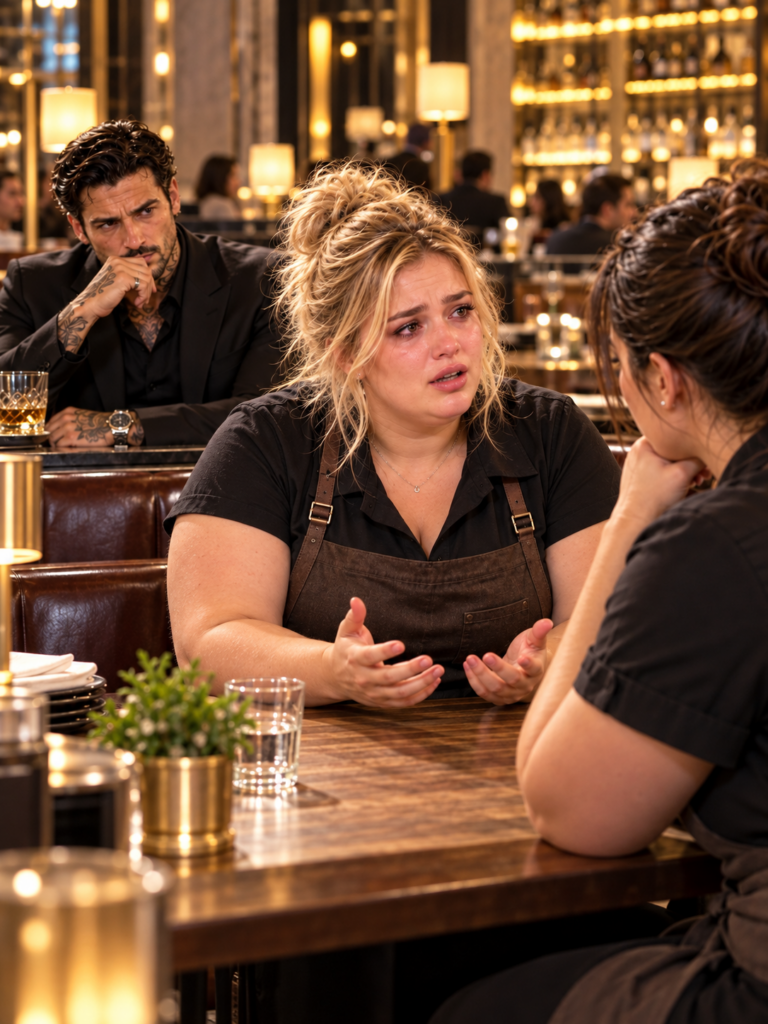
At one in the morning, Marin Doyle said something she had spent eight years trying not to say.
“I don’t want anyone to fix my life, Rosie. I just want one day when the world doesn’t take something from me.”
Her coworker stood on the other side of the bar, holding a pair of shoes in one hand and a glass of water in the other.
The last customers were gone. The chairs were upside down on the tables. Outside, a fine October rain blurred the streetlights along Atwells Avenue in Providence, Rhode Island.
Marin believed they were alone.
She was wrong.
In booth number nine, almost completely concealed by the darkened corner and frosted glass, Raphael Baron sat motionless with his phone in his coat pocket.
Thirty-four years old, he controlled one of the most powerful criminal organizations on the Rhode Island waterfront. He owned legitimate businesses, warehouses, trucking operations, and bakeries. He also controlled debts, territories, and agreements no respectable accountant would ever enter into a ledger.
Men twice his age lowered their voices when he entered a room.
And yet, for the first time in years, Raphael was listening to someone who wanted absolutely nothing from him.
That was why he stayed.
It was also why he would remember the decision with regret.
Eight hours earlier, Marin had arrived at Howerin’s Tap for another night shift.
The old bar smelled of beer, lemon cleaner, and damp wood. Its brass fixtures had been polished so often that the metal was wearing thin. Marin knew every unreliable stool, every temperamental appliance, and every corner where customers tended to leave forgotten belongings.
She had worked there six nights a week for nearly four years.
At twenty-eight, she could move through the place without looking where she put her feet.
She tied her apron and slipped a small brown leather notebook into its pocket.
The notebook had belonged to her father.
Its original pages contained his working notes from the docks. Marin used the empty pages at the back to record payments toward the debts that had swallowed her adult life.
Every dollar mattered. Every date mattered.
Sometimes she managed a payment of four hundred dollars. Sometimes sixty. There had been months when all she could do was write down the date and promise herself that next month would be better.
She had learned not to make promises about anything more ambitious.
Around seven, Gus Pavitus, the owner, hurried into his office with a telephone pressed to his ear.
Marin heard him say please before he shut the door.
She knew his business was struggling. She did not know that a debt of $140,000 had placed the bar on a list of seven properties being considered for collection by the Baron organization.
Nor did she know that the man responsible for that list intended to visit before the night was over.
Just before midnight, three black SUVs stopped outside.
One man stepped out.
Raphael Baron wore a dark overcoat and carried himself with the quiet assurance of someone who had never needed to demand attention.
He crossed the bar without hesitation and settled into booth nine.
Rosie approached him first. She returned looking troubled.
“What did he order?” Marin asked.
“Espresso.”
“At midnight?”
Rosie gave a noncommittal shrug.
Marin prepared the drink using a machine Gus had purchased secondhand decades earlier.
When she delivered the cup, she glanced at the stranger.
“Before you complain, that machine is old enough to have opinions about how coffee should be made.”
Raphael looked at her.
For a moment, the severe expression on his face nearly softened.
“I’ll keep that in mind.”
His voice was low, calm, and distinctly unhurried.
Then he asked to speak with the owner.
Gus emerged from his office, and their conversation lasted less than three minutes.
Marin couldn’t hear the words.
She saw the result.
When Gus returned behind the bar, his face was pale, and his hand trembled as he folded a towel.
Raphael had given him a deadline.
In three weeks, the debt would move toward enforcement. The bar would almost certainly be lost.
For Raphael, the visit should have ended there.
He had delivered his message. The numbers were clear. Nothing more needed discussing.
But instead of leaving immediately, he lingered over his espresso.
Eventually he paid and departed.
Twenty minutes later, however, he realized his phone was missing.
Raphael returned through the unlocked service entrance, retrieved the device from booth nine, and was interrupted by a call from Bruno Ta, his oldest and most trusted adviser.
He settled into the shadows to answer.
By the time the call ended, the bar had closed.
Marin and Rosie had begun talking.
Raphael should have announced himself.
He understood that remaining hidden would violate a privacy neither woman had agreed to surrender.
He hesitated.
Then Marin began speaking about her father.
Eight years earlier, Aean Doyle had been working at Pier Four when a heavy cargo load broke loose above him.
Approximately seven hundred kilograms of equipment had fallen.
He had died before his daughter could see him again.
The company called it an industrial accident.
Its representatives insisted that he had crossed a yellow safety line.
Marin had been twenty-one and too overwhelmed to challenge anything powerful men in expensive suits told her.
Soon afterward, her mother became seriously ill.
A woman with a reassuring voice had placed paperwork in front of Marin and told her where to sign.
By the time Marin understood what she had agreed to, a hospital debt of $61,000 carried her name.
Her mother never recovered.
Then, two years earlier, something terrible had happened to her younger brother, Micah.
He had been eighteen, working at a car wash near the harbor.
A vehicle struck him, leaving him with a serious spinal cord injury.
Now twenty, Micah lived at Bay View, where his care cost $4,200 a month.
Marin visited him twice a week.
She paid what she could, worked every available shift, and refused to imagine the financial consequences of failing.
“I still hear the phone from the night he was hurt,” she told Rosie.
Her voice was steady.
That steadiness disturbed Raphael more than tears would have.
He had heard grief used as persuasion. Men approached him with dying parents, endangered businesses, troubled children, and stories that ended in demands.
Marin was different in one crucial respect.
She wasn’t addressing him.
She didn’t know he was listening.
She wasn’t asking Rosie for money or promising to repay a favor. She was simply allowing another human being to witness what her life had become.
Rosie reached across the bar.
“You didn’t cause any of it.”
Marin stared at her own hands.
“I know. But knowing doesn’t change what I owe.”
For a moment, neither woman spoke.
Then Marin mentioned Block Island.
There had been a summer when her father was alive, her mother was laughing, and Micah was still a boy who could run ahead of everyone.
They had visited the lighthouse and spent a day on the beach.
Marin hadn’t returned since.
She spoke about it with the careful tenderness of someone touching an object already broken.
Raphael lowered his gaze.
Then she mentioned Pier Four again.
Something in him tightened.
That pier was part of the waterfront network his family had controlled for years.
He remembered decisions made during his father’s leadership, agreements signed by people who were still seated at his family’s table.
He had no reason yet to believe Marin’s father’s death involved them.
But he knew enough about the waterfront to understand that the official account of an industrial accident was not always the complete one.
When Rosie went to retrieve her coat, Raphael quietly left.
Before going, he placed five hundred dollars beneath his empty cup.
To him, it was a small amount.
To Marin, it was almost an entire week’s survival.
She found the cash moments later.
And she knew exactly who had left it.
Raphael had nearly reached the corner when he heard footsteps behind him.
“Sir.”
He turned.
Marin stood in the rain without a coat, her apron still tied around her waist. She held the folded bills toward him.
“You heard what I said.”
Raphael didn’t insult her by denying it.
“Yes.”
“Then you understand why I’m giving this back.”
He studied the money.
“You work hard. I thought—”
“You thought I needed it?”
“I know you do.”
“That doesn’t mean it’s yours to give.”
Her voice wasn’t angry. It was tired, but unmistakably firm.
Raphael had negotiated with violent men, skeptical bankers, federal investigators, and rivals who would celebrate his death.
None of them had ever made him feel quite so uncomfortable.
Marin stepped closer and extended the money again.
“I can’t repay five hundred dollars. And I don’t take things I can’t repay.”
For several seconds, Raphael looked at her.
Then he accepted the bills.
“Understood.”
She nodded, turned around, and hurried back toward the bar.
Raphael watched her disappear inside.
His driver, Pety MarQueti, opened the SUV door.
Raphael entered without speaking.
But by the time he reached his house on the East Side, the decision he’d made earlier that night had begun to unravel.
Bruno was waiting in the kitchen.
He was fifty-one, sharp-eyed, discreet, and accustomed to understanding Raphael’s moods without asking for explanations.
Raphael removed his coat.
“I need the complete file on an accident at Pier Four eight years ago.”
Bruno lifted his head.
“What accident?”
“A longshoreman named Aean Doyle. Cargo fell from a crane. I want the safety reports, insurance records, and internal correspondence.”
Bruno took out his pen.
“Anything else?”
“Find out what became of Wade Greer. He was here four years ago and disappeared from our usual channels. I want to know what he knows.”
Bruno noted both instructions.
Then he asked about Howerin’s Tap.
“Do we proceed on Pavitus?”
Raphael remembered Marin beneath the streetlight, water streaming down her face, insisting that five hundred dollars wasn’t his to give.
“Not yet.”
The next morning, Camila Richi presented the seven-property recovery schedule in the office above the family bakery.
At thirty-two, she managed the financial structure of the Barons’ operations with terrifying precision.
Her father, Salvatore Richi, had served the Baron family for decades.
Camila had also once shared a more intimate relationship with Raphael, long since reduced to a professional arrangement neither discussed.
She moved through the property list.
When she reached Howerin’s Tap, she explained the debt, missed payments, and failed refinancing attempts.
“It won’t recover,” she concluded.
Raphael stood beside the window.
“Hold enforcement.”
Camila looked up.
“On Howerin’s?”
“On all seven.”
The room became attentive.
Four notices were already prepared.
The land beneath the properties was substantially more valuable than the buildings.
Financially, postponement made little sense.
Camila closed her folder.
“May I know why?”
“No.”
She observed him for a moment.
Then she wrote a notation beside the fourth property.
Held. No explanation.
Raphael knew she would investigate.
He also knew he had just made the first business decision of his adult life that he couldn’t justify in numbers.
He returned to Howerin’s the following evening.
And the next.
And the next.
Always espresso. Always booth nine.
At first, Marin treated him as an ordinary customer.
He didn’t demand her attention, and she appreciated that.
But as the nights passed, their conversations grew longer.
Raphael told her he worked in the bakery business. It was true, although incomplete to a degree that would eventually matter enormously.
Marin told him about the nursing program she’d abandoned after three semesters when her family needed her.
She still owned the textbooks.
Sometimes, unable to sleep, she opened the pharmacology book and read several pages just to remember the woman she had intended to become.
“Would you finish the program?” he asked one night.
She polished a glass.
“With what time?”
“I asked whether you wanted to.”
“Yes,” she said after a pause. “More than I like admitting.”
Raphael told her about his grandmother Teresa, who believed modern coffee machines ruined everything they touched.
He described an occasion when she had poured an expensive espresso down a restaurant sink and apologized sincerely to the bewildered waiter.
Marin laughed.
Not politely.
She laughed so hard that she had to brace a hand against the counter.
Raphael watched, then looked away before she noticed.
That became the first of many small moments neither understood how to name.
Marin eventually noticed another habit.
After leaving, Raphael would stand beneath the awning of a closed bakery across the street.
His vehicles waited nearby.
He stayed until she extinguished the final light inside the bar.
The first time she saw him, she assumed it was coincidence.
The third time, she understood.
He was making sure she finished safely.
She never thanked him.
Instead, she began taking a little longer to turn off that last lamp.
One evening, when she admitted she hadn’t slept properly in years, Raphael answered with unexpected familiarity.
“Neither have I.”
Their eyes met.
For a few seconds, neither occupied the roles the world had assigned them.
He wasn’t a powerful man. She wasn’t a struggling waitress.
They were simply two exhausted people who recognized something in each other.
Rosie saw it happening.
And Rosie knew who Raphael Baron was.
She had grown up on Federal Hill, where the Baron name had been spoken carefully for generations.
She had seen what proximity to men like Raphael could do to a family.
Her former husband had become involved in criminal operations years earlier. A conviction had shattered their marriage, and she’d raised their daughters while working nights and double shifts.
She understood the dangers Marin couldn’t see.
But she also remembered four years of watching her younger coworker endure loss without complaint.
For the first time, Marin looked happy.
So Rosie waited.
One night became another.
Then twenty-two days had passed.
Meanwhile, something else changed.
The relentless collection calls that had followed Marin for years suddenly stopped.
She suspected Raphael.
She didn’t know what he’d done, and she wasn’t sure whether she wanted to know.
Her hospital debt remained.
So did Bay View’s monthly charges.
She was relieved that he hadn’t interfered with those, though the unexplained silence still troubled her.
On the first Sunday of the month, Marin sat at her kitchen table and recorded another payment in her father’s notebook.
Four hundred and ten dollars.
She studied the running total.
Then, for the first time in eight years, she opened the notebook from the front.
Her father’s writing filled the pages.
Shift times. Crane numbers. Equipment checks. Workers’ names. Notes scribbled in pencil with the hurried practicality of someone who had never expected his daughter to read them.
Marin turned page after page.
She could almost hear his voice.
Then she reached page sixty-one.
The entry was dated three days before his death.
At the bottom, beneath the ordinary details of a dockworker’s day, he had written a warning concerning the number-three crane cable at Pier Four.
It had been reported twice.
Beside the warning were two initials.
S.R.
Marin read them repeatedly.
She didn’t know what they meant.
But for the first time, she wondered whether her father’s death had been an accident at all.
She hid the notebook in a kitchen drawer.
The following evening, Rosie locked the bar door and told her the truth about the man in booth nine.
Marin listened without interrupting.
When Rosie finished, she asked a single question.
“Are you scared of him, or are you scared something will happen to me?”
Rosie’s eyes filled.
“Both. Mostly the second.”
She told Marin about her former husband, the conviction, and the years she’d spent protecting her daughters from a world she hadn’t understood until it entered her kitchen.
Marin reached across the bar and held her hand.
She didn’t promise to stop seeing Raphael.
But the following night, she sat opposite him in booth nine.
“Tell me exactly who you are.”
Raphael understood immediately.
He placed his cup down.
“My name is Raphael Baron. My grandfather built our first bakery here. My father ran the family after him. When my father was killed, I took his place.”
He explained the legitimate businesses.
Then he explained the part that couldn’t be written into contracts.
The waterfront. The lending. The influence. The power held through fear and obligation.
He described boundaries his organization maintained, including refusing to traffic women or involve children in its trade.
He didn’t pretend those boundaries made him innocent.
Marin listened carefully.
“Why didn’t you tell me before?”
Raphael took his time answering.
“Because you spoke to me as though I was an ordinary man. I liked being that man more than I should have.”
“That isn’t an answer that makes it better.”
“I know.”
“And the collection calls?”
“I stopped them.”
She looked toward the window.
Then she turned back.
“You don’t pay my hospital bill. You don’t pay for Micah’s care. You don’t reach into my finances without asking.”
Raphael’s first instinct was to object.
He could eliminate those debts without changing a single line in his personal accounts.
But Marin continued.
“Those payments are mine. Every entry in that notebook means I kept going. If you take that away, you’re not helping me. You’re deciding something about my life that belongs to me.”
Raphael looked at her hands.
“All right.”
“If you break that promise, I won’t argue. I simply won’t be here when you come back.”
He understood the difference between a threat and a boundary.
Marin was setting the latter.
“I won’t break it,” he said.
And he meant it.
What neither of them knew was that Bruno had spent nineteen days investigating Pier Four.
By the time he returned to Raphael’s kitchen, he had found an accident report that blamed employee positioning, two ignored safety warnings, and an internal memorandum refusing to spend $180,000 on a damaged crane cable.
He had also found a work order showing that the dock’s yellow safety lines had been repainted after Aean Doyle died.
The memorandum carried a signature.
Salvatore Richi.
Raphael stared at the name.
Salvatore was Camila’s father.
A man Raphael had known since childhood.
A man who had stood beside his own father’s coffin and wept.
Suddenly, the woman he was falling in love with and the family empire he had inherited were no longer separate worlds.
And somewhere inside the paperwork of Pier Four lay the truth that could destroy them both.
Part 2
For most of his life, Raphael Baron had believed there were only two kinds of mistakes.
The ones a man could correct, and the ones he had to make certain nobody discovered.
The file concerning Aean Doyle belonged to neither category.
It was evidence of a wrong committed long before Raphael inherited the family’s leadership. Yet the decision had protected businesses he now controlled, and the man who signed the authorization still occupied a respected position in his organization.
Raphael read the documents again.
An inspector had identified serious wear on the cable of the number-three gantry crane.
Replacement had been recommended within thirty days.
Five weeks later, another warning had been submitted.
No corrective action followed.
The internal memorandum was painfully short. The replacement would cost $180,000. The shipping season was behind schedule. The work would be reconsidered later.
Then Aean Doyle died.
And nine days afterward, someone authorized repainting the yellow safety markings around the pier.
The sequence made Raphael physically sick.
Marin had spent eight years believing her father was partly responsible for his own death.
The company had helped create that belief.
Salvatore Richi had helped make it possible.
“Did my father know?” Raphael asked.
Bruno remained standing across the kitchen table.
“I haven’t established that.”
“Then establish it.”
“And Camila?”
Raphael looked at the signature.
That was the more immediate problem.
Camila had controlled waterfront documentation for years. It was difficult to believe that a woman who knew every account balance and contract clause had somehow overlooked a fatal accident involving her own father.
Raphael instructed Bruno to keep investigating.
He wanted the crane operator, the original reporting chain, and every archived record that might have been moved or concealed.
He also wanted to know whether any evidence connected other tragedies on the waterfront.
Bruno warned him that pulling those records could expose an entire network of decisions.
Raphael already knew.
The danger was no longer abstract.
It had a name, a face, and a woman waiting for him at a bar each night.
Yet he found himself incapable of staying away from her.
He didn’t tell Marin about the signature.
Not while he had only fragments and suspicions.
He convinced himself he was waiting until he could give her the complete truth.
He failed to consider that withholding the fragments was itself a decision she might have wanted to make.
Meanwhile, Marin continued working, paying bills, and visiting Micah.
She saw that Raphael treated her brother with something rarer than exaggerated kindness.
He treated him as an adult.
He spoke directly to Micah, argued baseball with him, and waited patiently while the younger man communicated through expressions, gestures, and the limited movement of his hands.
Raphael never addressed Marin as though Micah were absent.
That mattered more to her than expensive gestures ever could.
One afternoon, Raphael asked whether she could exchange a Tuesday shift.
“For what?”
“A trip.”
“That’s not an answer.”
“To Block Island.”
Marin stopped drying a glass.
“Why?”
“You said you wanted to go back.”
“I also said I wanted to finish nursing school. Are you planning to enroll me?”
“No.”
“Good.”
“But I thought a day at the island might be possible.”
She studied him.
“Micah comes.”
“Of course.”
“And we’re not turning it into some elaborate luxury production.”
Raphael glanced toward the ancient espresso machine.
“Would sandwiches be acceptable?”
She almost smiled.
“Sandwiches would be fine.”
What he didn’t tell her was that the investigation had expanded.
While examining Pier Four’s archives, Bruno had found an eleven-page security file from two years earlier.
Its subject was Micah Doyle.
At eighteen, Micah had photographed the back of a box truck at the car wash where he worked on Allens Avenue.
The license plate was clearly visible.
He posted the photograph online with a careless joke.
Nine hours later, it disappeared from his account.
Six days afterward, Micah was struck by a vehicle reported stolen.
The driver was never identified.
The file contained internal circulation records showing that the photograph had been forwarded to several people associated with the waterfront.
Someone had replied that the problem would be handled elsewhere.
Then the file was quietly closed.
Raphael understood what the documents suggested.
Micah’s collision might not have been an accident.
It might have been an attack intended to silence an eighteen-year-old who had photographed the wrong truck.
Bruno showed him the injury report.
An incomplete spinal cord injury at the sixth cervical level.
Transfer to rehabilitation.
Long-term care at Bay View.
Raphael set the pages on the table.
For a long time, he said nothing.
Eight years earlier, a preventable equipment failure had killed Marin’s father.
Two years earlier, someone connected to that same waterfront might have ordered violence against her brother.
And for both tragedies, the burden had fallen on a young woman who had never received an honest explanation.
“You need to tell her,” Bruno said.
Raphael looked toward the kitchen window.
“If I give her the file now, she’ll go after whoever did it.”
“She deserves to choose what she does.”
“She has no protection against these people.”
“Then explain the danger.”
Raphael shook his head.
He knew Marin.
If she possessed evidence that Micah had been deliberately injured, she would not quietly place the documents in a drawer.
He imagined her approaching police officers with names that meant nothing without further proof. He imagined those names reaching men who had already demonstrated how far they were willing to go.
“I need the driver,” he said. “Something conclusive.”
Bruno studied him with open disappointment.
“Don’t confuse making her safe with making her choices for her.”
Raphael heard the warning.
Then he ignored it.
On the first Tuesday in June, Marin stood on the Point Judith ferry with the wind pushing her hair across her face.
Micah sat nearby in his wheelchair, staring through the glass toward the approaching island.
He hadn’t been there since childhood.
Marin hadn’t either.
Raphael brought them coffee and left her alone when he noticed her eyes shining.
At the beach, he retrieved a long wooden plank from the vehicle.
It was rough marine plywood, fitted with grip tape and cleats.
Marin noticed a blister on his thumb and sawdust caught in his jacket cuff.
“You made that?”
“It’s a ramp.”
“I can see what it is.”
“Then why are you asking?”
“Because you could have paid someone to bring a proper one.”
Raphael considered the plank.
“This one works.”
It did, although the process was slow.
He laid it over the soft sand, pushed Micah’s chair across, lifted the board, and placed it ahead again.
Over and over.
Thirty yards took eleven minutes.
Marin watched a man who could command dozens of employees move a piece of plywood across a beach without impatience.
He didn’t try to turn the work into a demonstration of virtue.
When Micah’s wheels finally reached the hard, wet sand, Raphael simply stepped aside.
Micah tilted his head toward the sunlight.
Then he laughed.
A brief, unguarded sound.
Marin turned toward the dunes before either man could see her crying.
They spent the day eating sandwiches, arguing about baseball, and remembering summers when her family had still been whole.
Raphael ventured into the ocean, immediately declared the water offensively cold, and retreated with his trousers soaked to the knees.
Micah found this enormously entertaining.
Later, using one hand and the support of his wheelchair armrest, he folded a paper napkin into a crane.
He offered it to Raphael.
Raphael accepted it with unusual care.
“Thank you, Micah.”
He slipped it into the inside pocket of his jacket.
Marin noticed.
And something that had resisted every compliment, every expensive offer, and every attempt at protection finally began to yield.
For one afternoon, she wasn’t calculating the next payment.
She wasn’t counting shifts.
She wasn’t thinking about a hospital letter or what would happen if Bay View raised its rates.
She was a sister watching her brother enjoy the ocean.
And she was a woman beginning to love a man who understood that the most valuable gifts weren’t always things money could purchase.
A few days later, Raphael introduced her to his grandmother.
Teresa Baron was eighty-two and possessed a talent for making powerful men behave like schoolchildren.
She didn’t greet Marin with questions about her intentions.
She handed her an apron.
They made bread together in a warm kitchen while Teresa asked about Marin’s parents and their lives.
Marin described her mother working as a school aide for nineteen years, sitting beside children who needed extra help and rarely receiving the recognition she deserved.
Teresa listened.
Then, while pressing dough beneath her palms, she asked whether Marin feared Raphael.
Marin answered carefully.
“I’m not afraid of him. I’m afraid of what being close to him could bring to Micah.”
Teresa studied her.
Then she guided Marin’s hands back into the dough.
“Good,” she said. “You understand what’s important.”
That evening, a storm swept across Providence.
Marin finished her shift shortly after two.
Raphael was waiting outside, without his usual vehicles.
He had sent the drivers away.
They began walking together, but the rain quickly became too heavy, forcing them beneath the overhang of a closed warehouse near the harbor.
Marin laughed as water dripped from her hair.
Raphael didn’t.
He was looking toward the cranes.
The dock beyond the fence was Pier Four.
Only a short distance away lay the place where her father had died.
He knew.
She didn’t.
Marin noticed his expression change.
“Where did you just go?”
Raphael turned toward her.
“Nowhere.”
“You’re a terrible liar when something matters.”
He looked at her damp face.
She raised a hand and touched his cheek.
It was a small, unplanned gesture.
Raphael became very still.
Then he leaned toward her.
Their kiss was quiet and unhurried, shaped less by desire than by the weeks of trust and longing neither had wanted to name.
When they separated, Marin rested her forehead against his jaw.
Raphael closed his eyes.
He wanted to tell her everything.
Instead, he told her about the dangers of loving a man with enemies.
He explained that photographs, addresses, and familiar routines could become weapons against the people close to him.
“I can arrange protection,” he said. “But I can’t make this life harmless.”
Marin listened.
“And if I decide I can’t do it?”
“I leave you alone.”
“Completely?”
“Completely. The bar stays untouched. No one interferes with you.”
She searched his face.
Then she answered.
“I’m not leaving.”
He let out a breath.
“But I have another condition.”
“Tell me.”
“You start getting out of that world.”
Raphael looked past her toward the dark waterfront.
He had inherited an organization his grandfather created and his father expanded. Leaving it wasn’t like resigning from a company.
There were obligations, dangerous loyalties, unfinished conflicts, and people who would interpret withdrawal as weakness.
But for the first time, he allowed himself to imagine it.
“All right,” he said quietly.
Marin didn’t know how much that promise would cost.
She also didn’t know how much truth he had already kept from her.
Camila Richi discovered the archived file request soon afterward.
Bruno’s name appeared on the requisition record.
She recognized the years, the terminal department, and what he had almost certainly uncovered.
For two years, she had carefully protected documents that could expose her father’s connection to the death at Pier Four.
Now Raphael was digging through exactly the part of the archive she had feared.
And Marin Doyle was becoming impossible to ignore.
Camila called Marin on a Thursday morning.
She introduced herself and asked for twenty minutes at a coffee shop on Wickenden Street.
When Marin hesitated, Camila mentioned Micah.
Marin went.
The meeting looked completely ordinary.
Two women seated by a window.
A folder on the table.
Tea cooling beside a neatly folded napkin.
Camila was courteous.
That made what followed worse.
She opened the folder and placed the security records before Marin.
She explained Micah’s photograph, the deleted social-media post, the stolen vehicle, and the six days separating the image from the collision.
Marin read the pages.
Once.
Then again.
“Are you saying someone hurt my brother deliberately?”
“I’m saying the evidence points toward an attack, not a random collision.”
Marin gripped the folder.
“Where did you get this?”
Camila paused.
“Raphael has known about it.”
Marin looked up.
“How long?”
“Long enough to decide you didn’t need to know.”
Camila described Bruno’s investigation and Raphael’s decision to keep the file from her.
She placed those facts beside the visit to Block Island and the night they had kissed beneath the warehouse roof.
She didn’t need to invent anything.
Marin remembered the handmade plank.
The napkin crane.
Micah laughing on the beach.
She remembered standing beside Raphael with rain running down her face and believing he was finally telling her the truth.
All the while, he had held back evidence about her brother.
“Why would you tell me this?” she asked.
Camila’s expression remained controlled.
“Partly because you should know. Partly because I don’t want to watch him destroy everything he’s built.”
“And the rest?”
Camila looked into her untouched tea.
“Because I used to love him.”
She let the admission stand.
Marin studied her.
“Do you still?”
Camila didn’t answer directly.
“Nothing about my feelings changes what those documents say.”
She slid the folder forward.
“Keep it.”
Marin left without finishing her coffee.
She didn’t cry.
Instead, she went home and began undoing the relationship one practical decision at a time.
She returned Raphael’s key through the doorman at his East Side residence.
She canceled the rehabilitation payment arrangement connected to a Boston practice.
She called Gus and asked for additional shifts.
Then she returned to the bar.
For three nights, booth number nine remained empty.
On the second evening, Raphael came in and sat at the far end of the counter.
Marin poured his coffee without speaking.
He didn’t offer an explanation.
He didn’t use the word protection.
He said her name once.
She kept washing glasses.
After twenty minutes, he paid the exact price of the coffee and left.
No extravagant tip.
No plea.
No attempt to turn an apology into another exercise of power.
Marin stood in the walk-in cooler afterward, pressing both palms over her eyes.
She had wanted him to defend himself so she could explain how completely he had betrayed her.
His silence left her with nothing to fight except the fact that she still loved him.
Bruno later confirmed that Camila had arranged the meeting.
Raphael listened.
He knew Camila had used the truth to wound Marin.
He also knew the wound existed because of his own choice.
For once, he had no argument that could make him innocent.
“Find the driver,” he told Bruno.
“And Marin?”
Raphael looked toward the window.
“She decides what happens with us. Not me.”
At Bay View, Marin sat beside Micah during her usual Thursday visit.
She told him there had been someone in her life.
Someone he knew.
Someone she had loved.
“It didn’t work,” she whispered. “But you don’t need to worry about me. It’s still us, Micah. It always will be.”
Her composure broke.
She began crying despite every effort to stop.
Micah watched her.
For two years, everyone had assumed his silence was another consequence of his injuries.
But a speech pathologist, Denise Woo, had recorded something different shortly after the collision.
His vocal structures were intact.
His comprehension was unimpaired.
There was no neurological reason he couldn’t speak.
Micah had chosen silence.
At eighteen, he had understood that repeating the license plate he’d photographed might place his sister in danger.
He knew she would investigate.
He knew she would refuse to abandon him.
So he had carried the six characters alone.
Seven hundred and thirty days of silence.
Now Marin was sitting beside him, trying to convince him she was strong enough to lose another person.
Micah moved his jaw.
A strained sound escaped his throat.
Marin stopped crying.
He tried again.
Then, slowly, deliberately, he spoke six characters.
Three letters.
Three numbers.
The license plate.
Marin stared at him.
He repeated them.
Then, in a voice she hadn’t heard since he was eighteen, he said her childhood nickname.
“Ren.”
Marin covered her mouth.
Her brother was speaking.
And the first thing he chose to give her was the secret he’d sacrificed two years of his life to protect.
Part 3
Marin left Bay View with the license plate written on the back of a visitor slip.
She drove home in a state somewhere between shock and determination.
For two years, she had believed Micah’s silence was something the accident had taken from him.
Now she understood that it was something he had chosen.
He had protected her in the only way he believed possible.
The realization hurt almost as much as the knowledge that someone had deliberately destroyed his life.
At two in the morning, she paid nineteen dollars for an online vehicle-record search.
The results led to a man in Cranston who had died of heart failure fourteen months earlier.
The truck associated with the registration had been reported stolen before Micah’s collision.
The leasing company in Pawtucket had since dissolved.
Every lead ended at another locked door.
By dawn, Marin understood what she had to do.
She picked up her phone.
Raphael answered on the second ring.
“Marin?”
“I’m not calling because I’ve forgiven you.”
“I understand.”
“Micah spoke yesterday.”
Raphael stood up.
“He spoke?”
“He gave me the license plate. I checked it. It leads to a dead man, a stolen vehicle, and a company that doesn’t exist anymore.”
Raphael listened while she explained.
Then he said, “I’ll find where it leads.”
Marin swallowed.
“I’m asking you to do that. But this time, whatever you discover, I hear it when you do.”
There was no hesitation.
“You have my word.”
“And Raphael?”
“Yes?”
“You don’t get to protect me by keeping me ignorant again.”
He closed his eyes.
“I know.”
After the call, Marin opened the kitchen drawer and took out her father’s notebook.
She turned to page sixty-one and looked at the initials beside his final warning.
S.R.
She had hidden the notebook because she was afraid of what it might prove.
Now she was ready to use it.
When she shared the page with Raphael, she made one thing clear.
“This doesn’t belong to your family. It belongs to my father. Whatever you do with it, that doesn’t change.”
Raphael agreed.
Bruno spent eleven days following the plate through registrations, dissolved companies, and concealed leasing arrangements.
The investigation ultimately led to Otto Kesler.
Fifty-seven years old, Kesler had spent four years attempting to gain control of sections of the Providence waterfront.
Two years earlier, a truck associated with his operations had appeared at Micah’s car wash.
Micah had photographed it without understanding its importance.
The security records, the deleted post, and the subsequent collision now formed a chain that could be investigated beyond speculation.
Bruno assembled the supporting documents.
Raphael had what he needed.
He arranged a meeting above the bakery on Atwells Avenue.
Nine men and one woman were present.
Among them were Kesler, Salvatore Richi, Bruno, and Camila.
Raphael did not arrive with threats.
He brought documents.
First came the photograph taken by Micah.
Then the license-plate records, leasing arrangements, and evidence surrounding the collision.
Kesler listened with carefully maintained indifference.
Raphael explained the investigation in chronological order, including the internal circulation of Micah’s photograph and the suspicious decision to close the file without further action.
Kesler denied responsibility.
Raphael moved on.
Eight years earlier, Pier Four had suffered a preventable equipment failure.
The inspection warnings had been ignored.
The subsequent accident investigation had blamed a dead worker.
And the safety markings had been altered afterward.
Raphael placed the memorandum concerning the $180,000 repair on the table.
Then he brought out Aean Doyle’s notebook.
He slid it toward Salvatore.
“Page sixty-one.”
Salvatore looked at the worn leather cover.
For a long time, he didn’t touch it.
Finally, he opened the notebook.
He studied the pencil writing, the equipment number, and the warning that had been reported twice.
Then his eyes reached the initials.
His initials.
For decades, Salvatore had believed the decisions he made on the waterfront would disappear into corporate paperwork and forgotten records.
But a dockworker had written down what he saw.
And his daughter had kept the evidence without knowing it.
Salvatore placed one hand over his face.
“The season was behind schedule,” he whispered.
Nobody answered.
“I thought the repair could wait.”
Raphael looked at the old man who had been part of his family since childhood.
“And Aean Doyle died waiting.”
Salvatore couldn’t meet his eyes.
Then Camila stood.
She opened her own folder and placed a complete internal circulation log beside the notebook.
It identified the recipients of Micah’s photograph and the chain of communication surrounding it.
She had concealed that evidence for two years.
Her hand remained on the folder for a moment.
“I kept thinking I could protect my father without becoming responsible for what he had done,” she said.
She looked toward the window.
“I was wrong.”
Her confession didn’t excuse the way she had used the earlier file to hurt Marin.
But it completed the evidence.
Kesler’s confident composure finally deserted him.
No one struck him.
No one ordered an execution or staged a display of revenge.
Instead, the assembled records left the building in the possession of a lawyer.
By noon, the process that would dismantle Kesler’s position had begun.
The legal consequences would take longer.
So would the accounting of Salvatore’s decisions.
Raphael understood that neither money nor loyalty could erase what had happened.
That evening, Bruno came to the East Side house carrying something he had hidden for five years.
It was a key.
In a safe-deposit box at a bank in Newport, Raphael’s father had left documents prepared with the United States Attorney’s Office during the final months of his life.
He had known powerful enemies were closing in.
Before he was killed, he had arranged a conditional path toward cooperation and withdrawal from the criminal organization.
But he had attached a requirement.
The arrangement could be used only if Raphael independently chose to leave.
Bruno had been instructed not to reveal it before then.
Raphael stared at the key.
His father, a man who had spent his life building and defending the organization, had quietly prepared an escape for his son.
Not an escape forced by defeat.
A choice.
For years, Raphael had mistaken inheritance for destiny.
Now he realized the difference.
He accepted the key.
The eighteen-month transition began the following Monday.
The bakeries, trucking company, and warehouses remained under legitimate management, their operations reviewed and separated from the criminal network.
The waterfront interests were dismantled in stages across six quarters.
Contracts were restructured. Financial relationships were ended. Some men departed. Others remained within the legitimate businesses.
There were complicated negotiations, difficult investigations, and consequences that could not be settled with a signature.
Raphael did not emerge untouched.
Nor did he pretend he should.
Three months into the process, he established a fund with an initial endowment of six million dollars.
It was intended for families of longshoremen killed on the harbor over the preceding twenty years.
The families would not have to beg, hire attorneys, or prove that their suffering deserved attention.
He named it the Aean Doyle Fund.
It wasn’t a payment toward Marin’s debts.
It was an acknowledgment of damage his inherited organization had helped cause.
And he knew Marin needed to hear about it from him, not from a newspaper or another intermediary.
When he eventually told her, she remained silent for a long time.
“Will it bring him back?” she asked.
“No.”
“Will it fix Micah?”
“No.”
“Then don’t ever tell yourself the money makes everything right.”
Raphael nodded.
“I won’t.”
She looked at him.
“That’s the difference I needed you to understand.”
Their relationship did not recover in a single conversation.
Marin still remembered the documents Camila had placed before her. She still knew what it felt like to discover that someone she trusted had decided which truths she was strong enough to bear.
Raphael couldn’t erase that memory.
He could only change what he did next.
He shared information instead of filtering it.
He accepted her decisions even when they worried him.
And when she said she needed time, he gave it to her.
Gradually, Marin began to believe in the man he was becoming.
Not because he had rescued her.
Because he had finally stopped confusing love with control.
That February, Marin walked into an office park in Warwick and made the final payment on her hospital debt.
She used money she had earned through years of night shifts.
She requested a printed receipt.
Then she sat in her car and looked at it until the numbers stopped blurring.
The balance was zero.
For eight years, she had imagined that moment.
She had expected triumph.
Instead, she felt an enormous, unfamiliar quiet.
At home, she removed the brown notebook from its drawer.
She separated the pages where she had recorded her debt payments from the pages containing her father’s working life.
She kept his notes.
The other pages she burned, one by one, in the small tiled hearth.
Four hundred and ten dollars.
Three hundred and eighty.
Sixty.
Every payment she had made while believing there was no other way forward.
She watched the paper curl into ash.
It wasn’t that those years no longer mattered.
It was that she no longer needed to carry the proof of surviving them everywhere she went.
She had her father’s pages professionally bound and placed them on a shelf.
Then she returned to school.
She completed the nursing program the following spring, finishing what she had abandoned eleven years earlier.
At thirty, she received her certificate.
For the first time in years, she began sleeping at night.
Micah continued working with rehabilitation specialists.
His speech returned gradually.
So did more strength and coordination.
Eleven months into a strengthening program, he sat at the kitchen table and folded a paper crane using both hands.
When it was finished, he placed it in front of Marin.
She stared at it.
Then she left the room because she was crying too hard to speak.
The crane stayed on her dresser.
Raphael still carried the one Micah had given him at Block Island.
By September, Raphael had made a decision about his future that no family obligation could reverse.
He took Marin back to the island.
They walked along the beach in the fading light, close to the place where he had once struggled across the sand with a homemade plank.
He didn’t hire musicians.
He didn’t arrange an elaborate spectacle.
He simply stopped beside her and took her hands.
“When we met,” he said, “you told me you couldn’t accept what you weren’t able to repay.”
Marin smiled faintly.
“I remember.”
“I’ve spent most of my life giving orders and calling them decisions. You taught me there’s a difference.”
She looked at him carefully.
“I didn’t change you, Raphael. You decided to change.”
“Yes,” he said. “Because you showed me that I could.”
He held her gaze.
“I’m not offering to own your future. I’m asking whether you’ll let me share it.”
Marin’s eyes filled.
Raphael, who had once commanded men with a glance, found the next words unexpectedly difficult.
“May I stay?”
She answered before he could say anything more.
“Yes.”
They married the following June in the small Federal Hill church where Teresa Baron had been married in 1963.
Micah accompanied his sister down the aisle in a power wheelchair he controlled himself.
He wore a gray suit and took the final turn with immense concentration and dignity.
Rosie Vasquez cried through two packets of tissues and needed a third from her daughter.
Teresa watched from the front pew, her expression composed until Raphael placed the ring on Marin’s finger.
Then the old woman pressed a handkerchief to her eyes.
The reception took place at Howerin’s Tap.
Gus Pavitus closed the bar to the public.
The tables were pushed together, and booth number nine became the head table.
Gus gave a toast in Greek.
Almost nobody understood it.
Everyone applauded.
Rosie leaned toward Marin and whispered, “Remember when I told you to be careful?”
Marin glanced toward Raphael.
He was helping Micah adjust his chair at the table, listening with complete seriousness to an argument about baseball.
“I remember.”
“You were careful?”
Marin smiled.
“In the ways that mattered.”
Two years later, on a September morning, their daughter was born.
They named her Josephine Baron.
Within an hour, everyone was calling her Josie.
Raphael held the baby with both hands.
Those hands had remained steady through interrogations, threats, funerals, and dangerous negotiations.
Now they trembled.
Marin noticed immediately.
“Are you frightened?” she asked softly.
Raphael looked down at the tiny face pressed against his chest.
“Yes.”
“Of what?”
He considered the question.
“Getting something this important wrong.”
Marin leaned against him.
“Then we’ll learn together.”
He kissed her forehead.
And for the first time, he didn’t feel responsible for controlling everything that might happen.
He felt responsible for being present.
Teresa introduced her great-granddaughter to breadmaking before Josie could walk.
She guided one tiny finger toward a bowl of flour and explained in Italian that machines could never understand the soul of good bread.
Josie responded by plunging her entire hand into the flour.
Then she patted Teresa’s cheek.
The old woman burst into laughter.
The following year, Marin opened a small coffee shop off Wickenden Street.
Eleven tables.
A reliable espresso machine.
A simple menu.
She named it Second Pour.
On the front door, beneath the name, she posted the hours.
Seven in the morning until six in the evening.
She chose those hours herself.
After years of seeing the world mostly through darkened windows, Marin wanted daylight.
She wanted mornings.
She wanted to eat dinner with her family and hear Josie laughing before bedtime.
And she wanted to build a business that belonged to her without surrendering herself to keep it alive.
There was one corner booth in Second Pour that never appeared on the reservation list.
Regular customers eventually learned not to ask why.
It wasn’t the largest table.
It wasn’t beside the best window.
But it reminded Marin of another booth in another place, where the truth had first reached a man who wasn’t supposed to hear it.
One evening, as the autumn light turned orange across the shop’s windows, Marin finished counting the register.
The last customer had gone.
Raphael stood near the entrance with Josie asleep against his shoulder.
He still wore a dark coat, but the expensive watch and polished shoes seemed less important than the paper crane he continued to keep in his inside pocket.
Marin switched off the coffee machine.
He walked over and extinguished the lamp above the counter.
Then he waited for her.
She looked around the quiet room.
Eleven tables.
A business of her own.
A daughter sleeping safely in her father’s arms.
A husband who had learned that protecting someone meant standing beside her, not making her decisions.
Marin untied her apron.
“Ready?” Raphael asked.
She smiled.
“Almost.”
She checked the door, collected her bag, and took his free hand.
Then they stepped out together into the fading daylight.
Raphael didn’t walk ahead.
He didn’t send a driver to take her somewhere she hadn’t chosen to go.
He stayed beside her, moving at her pace, while their daughter slept peacefully between them.
Years earlier, in a nearly empty bar, Marin had wished for a world that would stop taking things from her.
She hadn’t known that somewhere in the darkness, a man was listening.
She hadn’t known what they would lose, what they would uncover, or how much courage both of them would need to change their lives.
But she had never needed a powerful man to make her whole.
She had been whole already.
What Raphael finally learned was how to love her without asking her to become anything less.
And when the last light faded behind the windows of Second Pour, he was still there.
Waiting for his wife.
Ready to go home with her.


