
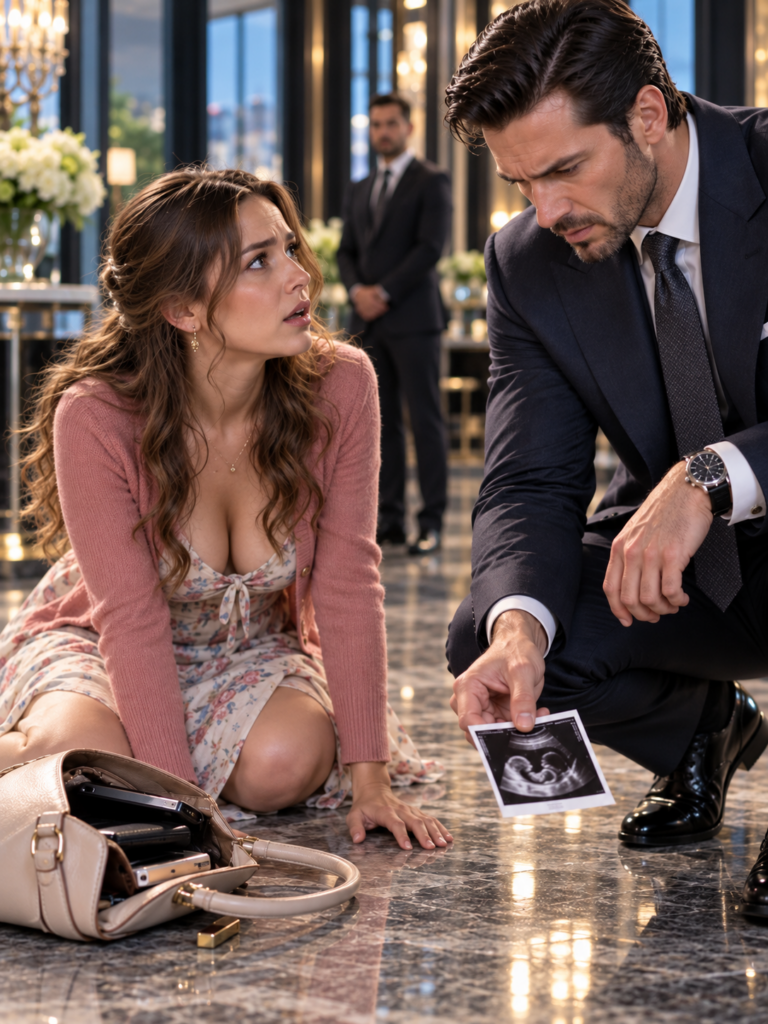
My purse burst open across the marble floor, spilling six dollars, a hospital badge, and the ultrasound of the baby whose father had abandoned us.
The entire restaurant fell silent when a man in a black suit knelt beside me and lifted the photograph with unexpectedly gentle hands.
Then he read my name—and looked at me as if he had been searching for me long before I walked through that door.

PART 1 — THE MAN WHO SILENCED THE ROOM
I never believed in fate until my purse slipped from my fingers at Bellucci’s.
Coins struck the polished marble with a series of bright, humiliating clicks. My keys skidded beneath a nearby table, followed by lip balm, an unpaid electric bill, a crushed granola bar, and the ultrasound photograph I had carried for three weeks.
After a sixteen-hour nursing shift, my hands had simply stopped cooperating.
“I’m sorry,” I murmured, dropping to my knees.
The restaurant smelled of garlic, white wine, and money. Men in tailored jackets turned from candlelit tables. Women wearing diamonds watched me gather the small evidence of my exhausted life.
Then the room went quiet.
A pair of black leather shoes stopped inches from my fingers.
I looked up.
The man standing over me was perhaps thirty-six, tall and powerfully built beneath a charcoal suit. His dark hair was combed away from a severe, striking face, and his eyes were such an intense blue that meeting them felt almost physical.
Two men waited behind him, their posture watchful.
Private security.
“Allow me,” he said.
His voice carried a restrained Italian accent.
Before I could object, he crouched and retrieved my metro card. The restaurant manager stood several feet away, pale and motionless, as though witnessing a king lower himself to the floor.
“I’ve got it,” I said.
The stranger ignored me.
His hand reached beneath a chair and returned holding my ultrasound.
He studied the grainy profile.
My name was printed in the corner.
EMMA REYNOLDS — TWELVE WEEKS
Something shifted in his face.
“Yours?”
I took the photograph from him. “Yes.”
“You’re alone.”
The accuracy stung.
“I’m managing.”
A flicker of respect entered his expression.
He stood and offered his hand.
“Luca Moretti.”
The name meant nothing to me, but the manager’s reaction said it should have.
“Emma.”
“I know.”
My fingers froze in his.
He glanced at my wrinkled blue scrubs beneath my coat.
“You work at Northshore Medical Center.”
“You read my badge.”
“Yes.”
“And you read my ultrasound.”
“Yes.”
“At least you’re honest.”
The corner of his mouth moved.
“Have you eaten?”
“I ordered something to go.”
His gaze settled on the small paper bag waiting at the host station.
“One container of plain pasta after sixteen hours.”
“That is none of your business.”
“No,” he agreed. “It isn’t.”
The answer surprised me.
He turned toward the manager. “Marco, add grilled chicken, vegetables, bread, and soup to Ms. Reynolds’s order.”
“That’s unnecessary,” I said.
Luca faced me again.
“You may refuse.”
The room appeared to wait for my answer.
I should have walked out. Instead, hunger tightened painfully beneath my ribs.
“Only if I pay for my original order.”
“Agreed.”
He did not argue, and that mattered.
Twenty minutes later, one of his security men drove me home because freezing rain had begun coating the sidewalks. The food arrived in two heavy bags.
Tucked between the containers was a cream card.
Proper meals. Shorter shifts. No obligation. —L.M.
A phone number appeared beneath the initials.
I told myself I would throw it away.
I placed it in my kitchen drawer instead.
The following morning, charge nurse Sandra stopped me before rounds.
“You’ve been reassigned.”
“To where?”
“The private wing. Room 801.”
“I’m not credentialed for private care.”
“You are now. Reduced patient load, eight-hour shifts, same pay.”
My stomach turned.
“Who authorized this?”
“A hospital-wide maternal-welfare grant was approved last night.” Sandra lowered her voice. “The donor requested you for one temporary assignment.”
“Which patient?”
She handed me a new badge.
“Antonio Moretti.”
Upstairs, an older man with silver hair and Luca’s blue eyes waited in a private suite.
When I entered, he smiled.
“So,” Antonio said, “you’re the nurse my son has spent ten years trying to find.”
I stopped beside the door.
“Your son met me last night.”
Antonio’s smile faded.
“No, Emma. Luca first saw your name in a letter written by his mother the week before she died.”
PART 2 — THE LETTER HIS MOTHER LEFT BEHIND
The monitor beside Antonio’s bed emitted a steady green pulse.
Beyond the private suite’s windows, Chicago lay beneath a gray January sky. Snow pressed against the glass in tiny wet stars, blurring the neighboring towers.
I remained near the door.
“What letter?”
Antonio’s hands rested on the white blanket. Age had softened his face, but not the intelligence in his eyes.
“You should ask Luca.”
“You brought me into this room. I’m asking you.”
His expression changed—surprise first, then approval.
“My wife’s name was Caterina,” he said. “She received treatment at Northshore for ovarian cancer. Twenty-three years ago.”
“I was eleven.”
“I know.”
“Then how could she have written about me?”
Antonio looked toward the window.
“About your mother.”
My mother, Diane Reynolds, had also been a nurse. She spent most of her career in oncology before dying from a cerebral aneurysm when I was twenty-four.
I had followed her into nursing because hospitals were the only places where grief ever made sense to me. People entered carrying fear, and someone still had to check medications, warm blankets, and answer questions no one wanted to ask.
“What did my mother do?” I said.
“She cared for Caterina during her final months.”
The room seemed to shift.
My mother rarely spoke about individual patients. She believed their suffering belonged to them, not to our dinner table.
Antonio reached toward the bedside drawer.
“May I?”
“This is your room.”
He removed a copy of a handwritten letter protected inside a clear sleeve.
The paper had yellowed. The handwriting leaned elegantly to the right.
“My Caterina wrote this for Luca,” he explained. “He was thirteen when she died. She asked me not to give it to him until he became the head of our family.”
“When was that?”
“Ten years ago.”
I did the calculation. Luca would have been in his mid-twenties.
“Why search for us?”
“Read.”
I took the page.
The letter began in Italian, followed by a translation. Near the bottom, Caterina described a nurse named Diane whose husband had died suddenly, leaving her with a young daughter.
Diane sits with me after her shift when Antonio cannot come. She brings photographs of Emma playing the piano at her school recital and tells me that frightened children need truth delivered gently, never silence dressed as protection.
My throat tightened.
If Luca becomes powerful one day, remind him that power is measured by what a person does for those who cannot repay him. Find Diane if our family ever has the chance. Return her kindness without making it a debt.
I stopped reading.
The sounds of the hospital continued outside the room—cart wheels, distant voices, the muted chime of an elevator.
“My mother never told me.”
“She may have considered it part of her work.”
“Why didn’t Luca contact us?”
“He found that Diane Reynolds had died. You had moved from Ohio, married briefly, changed addresses, and later restored your maiden name. The investigators lost the trail.”
“You hired investigators?”
“Luca did.”
A chill passed over me.
“That does not sound like gratitude. It sounds like surveillance.”
Antonio nodded slowly. “A fair criticism.”
“Did Luca know I worked here before Bellucci’s?”
“I don’t know.”
I folded the letter carefully.
“What exactly does your family do?”
“International food distribution, commercial shipping, hotels, and private security.”
“That answer sounds rehearsed.”
“It is accurate.”
“Is it complete?”
“No.”
I looked at him.
Antonio sighed.
“My father and grandfather built influence in ways I would not defend today. Luca has spent his adult life separating legitimate companies from that history.”
“Mafia.”
“Such words make complicated things sound simple.”
“Sometimes simple words are useful.”
Antonio smiled without amusement. “Yes. Historically, our family had organized-crime connections.”
“And now?”
“Now we have lawyers, auditors, enemies, and a reputation that travels faster than truth.”
The guard outside the room suddenly made sense.
The restaurant’s silence made sense.
My reassignment became more alarming.
“You had no right to interfere with my employment.”
“No,” Antonio said. “We did not.”
His agreement took some force from my anger.
“Then reverse it.”
“I will tell Luca.”
“No. I’ll tell him.”
My phone vibrated inside my pocket.
An unknown number had sent a message.
My father says you have questions. I owe you answers. Dinner tonight, if you choose. Public place. No car sent unless requested. —Luca
I showed Antonio.
He lifted his hands. “I did not prompt him.”
I believed him, though I wasn’t sure why.
I completed Antonio’s assessment professionally. His blood pressure was stable after a minor cardiac procedure, but his potassium remained low. He tried to distract me with family stories while I reviewed his medication.
I refused to be charmed.
Mostly.
Before leaving, I returned the letter.
“Keep the copy,” he said.
“No.”
“It concerns your mother.”
“Then send it through hospital administration with documentation. I don’t accept personal gifts from patients.”
Antonio regarded me for a long moment.
“My son was right.”
“About what?”
“You are very much Diane’s daughter.”
Outside his room, my phone vibrated again.
This time it was Jason.
The father of my baby had been silent for nine weeks.
We need to talk. I heard you’ve been telling people I abandoned you.
I stared at the message until the letters blurred.
Jason and I had dated for eleven months. He was charming when things were light, attentive when attention earned affection, and absent whenever responsibility entered the room.
When I showed him the positive pregnancy test, he sat on the edge of my bathtub and said, “You need to fix this.”
I told him the pregnancy was not broken.
He left before dawn.
Now he wanted to manage the story.
I blocked his number.
At lunch, Sandra found me in the staff room eating soup from a vending machine.
“Administration wants to meet with you,” she said.
“About the reassignment?”
“And the donation.”
The chief nursing officer, hospital counsel, and human-resources director sat around a small conference table. Their smiles carried the anxious polish of people aware that generosity had created a compliance problem.
The donation was real. Five million dollars had been designated for maternal-health staffing, lactation support, emergency childcare, and modified schedules for pregnant employees.
It did not name me.
A separate verbal request from Luca’s office had suggested I might be assigned to Antonio’s room.
“That request should never have influenced staffing,” hospital counsel said. “We are investigating how it did.”
“Will refusing the assignment affect my hours?”
“No.”
“The grant?”
“No. Its terms prohibit donor control over individual employment decisions.”
“Then return me to general medicine with the pregnancy accommodations available to any staff member.”
The chief nursing officer nodded.
For the first time since meeting Luca, I felt the ground beneath me become solid again.
The donation could help hundreds of women.
But kindness that depended on my obedience was not kindness.
At six thirty, I entered a small Italian café near the river.
I had selected the location.
Luca sat at a corner table in a navy suit without a tie. No guards stood beside him, though I noticed one man reading a newspaper near the door and another parked across the street.
“You came,” Luca said.
“I chose to.”
His gaze sharpened at the distinction.
A candle flickered between us. The restaurant smelled of espresso, tomato, and fresh bread. Outside, wind drove snow along the sidewalk.
“I owe you an apology,” he said.
“For which part?”
“The reassignment. Obtaining your number without permission. Allowing my interest to become interference.”
“That is a promising list.”
“I am not accustomed to wanting something I cannot arrange.”
“I am not something.”
“No.”
The answer came immediately.
“You are someone. I behaved otherwise.”
A server approached. I ordered sparkling water and soup. Luca ordered coffee.
When we were alone again, I placed Caterina’s letter between us.
“Did you know who I was at Bellucci’s?”
“Not when your purse fell.”
“When did you know?”
“When I saw your surname and hospital badge. I remembered the search file.”
“And the ultrasound?”
His expression softened.
“That was unexpected.”
“Why did you keep looking for my family?”
“At first because my mother asked. Later because Diane’s kindness became a story my father used whenever he thought I was becoming too much like the men before me.”
“You made a donation because of a twenty-three-year-old letter?”
“I had been considering the maternal program for months. Meeting you determined the timing, not the structure.”
“You then used it to change my assignment.”
“Yes.”
“You understand why that frightened me?”
“I do now.”
I searched his face.
Most powerful men I had encountered apologized by explaining why they were right. Luca did not.
“Why is everyone afraid of you?”
“My last name.”
“That is incomplete.”
“It is.”
He looked toward the window.
“My family once collected debts through threats and controlled contracts through pressure. When I assumed leadership, I ended the illegal operations I could identify, sold several companies, and cooperated with regulators.”
“And the ones you couldn’t identify?”
“I’m still finding them.”
“Have you hurt people?”
His blue eyes returned to mine.
“Yes.”
The direct answer dried my mouth.
“How?”
“Financially. Professionally. I have used fear. I have threatened exposure. I have made decisions that cost people careers.”
“Physically?”
“I have defended myself. I have never ordered an execution, if that is what you are asking.”
“It is.”
“I am not a harmless man, Emma. But neither am I the story whispered when I enter a room.”
The soup arrived.
Steam carried the scent of basil between us.
“Why are you interested in me?” I asked.
“Because you dropped six dollars and an ultrasound, then looked at me as though I were the one inconveniencing you.”
“You were.”
His mouth curved.
“Because you worked sixteen hours while pregnant and still refused charity that compromised your independence.”
“That sounds less like attraction and more like evaluation.”
“Both can be true.”
I took a slow breath.
“My child comes first.”
“Good.”
“I am not looking for a replacement father.”
“I did not offer.”
“I am not available to be rescued.”
“I understand.”
“Do you?”
His eyes held mine.
“No. But I am willing to learn.”
That was the answer that made me stay through dinner.
We spoke for two hours.
Luca told me his mother played piano badly but joyfully. I told him mine played one folk song whenever she was nervous. He described growing up inside guarded houses, where adults lowered their voices when children entered.
I described an apartment where my mother and I could hear every word through thin walls but never discussed the patients whose names she protected.
When we left, snow dusted the riverwalk.
Luca did not touch me until I slipped on ice.
Then his hand caught my elbow.
The gesture echoed Bellucci’s, but this time he released me immediately.
“May I see you again?” he asked.
“One condition.”
“Name it.”
“No interference in my employment, medical care, finances, housing, or transportation unless I ask.”
“Agreed.”
“And no investigators.”
His jaw tightened slightly.
“Agreed.”
“If you violate that, there is no second dinner.”
“I understand.”
At home, I found Jason waiting outside my apartment.
He leaned against the hallway wall wearing the leather jacket I had once bought him. The building smelled of radiator heat and someone’s burned dinner.
“You blocked me,” he said.
“Yes.”
His gaze dropped to my stomach.
“You’re showing.”
“That tends to happen.”
“Can I come in?”
“No.”
His expression hardened.
“I heard you’re seeing Moretti.”
“How?”
“People talk.”
“No one in my life knows.”
He looked away too slowly.
Unease moved through me.
“Have you been following me?”
“Don’t be dramatic.”
“Answer.”
“I saw the SUV bring you home.”
“When?”
“The night you met him.”
He had been watching before Luca entered my life.
I stepped back toward the stairwell.
“What do you want?”
“My parents heard about the baby.”
“You told me they wanted nothing to do with us.”
“They’ve reconsidered.”
“So have I.”
“You can’t cut me out.”
“You removed yourself.”
Jason’s face reddened.
“I’m the father.”
“Biologically, yes. Legally, responsibility comes with rights. We can address both through proper channels.”
“Meaning lawyers?”
“Meaning documentation.”
He laughed bitterly.
“You meet a rich man and suddenly you think you’re powerful.”
“No. I met a rich man and became more aware of how often men mistake access for permission.”
Jason stepped closer.
The stairwell door opened behind me.
My neighbor, Mrs. Alvarez, appeared carrying a laundry basket.
“Everything okay, Emma?”
“Yes,” I said. “Jason was leaving.”
Mrs. Alvarez remained in the doorway.
Jason looked from her to me.
“This isn’t over.”
“I know. Parenthood rarely is.”
He left.
Inside my apartment, I called a family-law attorney.
Not Luca.
The distinction mattered.
Over the following week, life settled into a rhythm that felt almost normal.
I returned to my regular hospital unit with an eight-hour accommodation approved through standard policy. The maternal-welfare grant funded two additional float nurses, reducing forced overtime across three departments.
Luca did not claim credit.
He sent no gifts.
He texted once each evening, asking whether I wanted to speak.
Sometimes I said no.
He accepted it.
On Friday, Antonio was discharged. Before leaving, he handed me a sealed envelope through Sandra so the exchange would be documented properly.
Inside was a certified copy of Caterina’s letter and a photograph.
My mother stood beside Caterina’s hospital bed, younger than I remembered her. A thin Italian woman smiled beneath a scarf, holding the hand of a solemn thirteen-year-old boy.
Luca.
He had his mother’s eyes.
On the back, Diane had written:
Two mothers, two stubborn children, and one terrible hospital piano.
That night, I texted him first.
Do you still own the piano?
His answer arrived instantly.
Yes. It has been silent for twenty-three years.
I visited his house the following Sunday.
The Moretti residence stood behind stone walls north of the city, but it felt less like a palace than a home built for too many absences. Dark wood lined the hallways. Family photographs occupied every surface.
Rosa, the housekeeper who had cared for Luca since childhood, greeted me with a warm embrace and a sharp glance at him.
“You let her stand outside in this cold?”
“She refused the car at the door.”
“Then you should have stood outside too.”
I liked her immediately.
Dinner was served in a sunroom overlooking snow-covered gardens. Antonio had joined us, looking healthier and annoyingly pleased.
“Do not perform romance at the table,” Luca warned him.
“I am recovering from surgery. I need entertainment.”
Rosa placed bread beside him. “You need less salt.”
After dinner, Luca led me to the music room.
The grand piano stood beneath tall windows, its black surface reflecting the lamps. Dust did not cover it; someone maintained the instrument despite its silence.
“My mother played here,” Luca said. “After she died, my father closed the room.”
“You reopened it.”
“Five years ago. I thought buying a new piano might bring music back.”
“Did it?”
“No.”
I sat at the bench.
“May I?”
He nodded.
I played the folk melody my mother loved.
The notes were simple, familiar, imperfect. They moved through the high room and settled into corners where grief had waited for decades.
When I finished, Luca stood beside the piano.
“My mother used to hum that song,” he said.
“Diane probably taught it to her.”
He sat beside me.
Our shoulders almost touched.
“Would you teach me?” he asked.
“To play?”
“To begin.”
I placed his right hand over the keys.
His fingers were strong but careful.
We played five notes.
Then again.
When he finally produced the first line of the melody, surprise softened his face.
“There,” I said. “Not hopeless.”
“I have an excellent teacher.”
The air changed.
His gaze dropped to my mouth, then returned to my eyes.
“May I kiss you?”
The question undid me more than confidence would have.
“Yes.”
His hand came gently to my cheek.
The kiss was warm, controlled, and brief enough to leave me leaning toward the space where he had been.
When he drew back, his breathing had changed.
“So much for control,” I whispered.
“You are becoming an expensive lesson.”
“I charge by the hour.”
He laughed—a low, unguarded sound that brought Antonio to the doorway.
“My work here is done,” the older man announced.
Luca threw a piano cloth at him.
For the first time in months, happiness did not feel borrowed.
Then Luca’s phone rang.
He checked the screen, and every trace of warmth disappeared.
He walked into the hallway, speaking rapid Italian.
When he returned, tension held his shoulders.
“I need to leave.”
“What happened?”
“A warehouse security alert.”
“What kind?”
“I don’t know yet.”
“Then say that. Don’t tell me it’s nothing.”
He paused.
“You’re right.”
The correction was small but immediate.
“I can have Dominic take you home.”
“I can call a cab.”
“Please use the driver. The roads are icing.”
I considered it.
“All right.”
Luca kissed my forehead before leaving.
Dominic drove me home in silence.
As we approached my building, I noticed an unfamiliar sedan parked across the street. Its headlights came on when our SUV slowed.
Then it pulled away.
“Did you see that?” I asked.
Dominic watched the sedan turn.
“Yes.”
“Was it one of yours?”
“No.”
He called someone through the dashboard.
At my apartment door, the lock showed fresh scratches.
Inside, nothing appeared missing.
My purse remained on the chair. The television stood untouched. Even the emergency cash inside a kitchen jar was there.
But the bedroom drawer containing my prenatal records had been opened.
The ultrasound was gone.
So was Caterina’s letter.
On my pillow lay a photograph of Jason speaking to a man outside Northshore Medical Center.
A message had been written across it in black ink:
MORETTI DOES NOT GET TO BUILD A NEW FAMILY.
Dominic read the words and reached for his phone.
I caught his wrist.
“Call the police first.”
His expression tightened.
“Mr. Moretti should know.”
“He will. After law enforcement.”
For one moment, we stood on opposite sides of two worlds.
Then Dominic dialed 911.
Detectives arrived within twenty minutes. They photographed the damaged lock, collected the picture, and requested the building’s security footage.
Luca arrived as they were finishing.
He crossed the apartment toward me, then stopped himself several feet away.
“Are you hurt?”
“No.”
“The baby?”
“Fine.”
His eyes moved to the message on the pillow.
Cold fury entered his face.
“Who knew you had the letter?”
“You, Antonio, Rosa, hospital staff involved in delivery, and whoever has been watching Jason.”
“Jason may have been used.”
“Or involved.”
Detective Maya Chen returned from the hallway.
“The building camera captured two men. One used a copied key, not forced entry.”
“I changed the lock after Jason moved out.”
“Who had the new key?”
“Only me and the landlord.”
Luca looked at Dominic.
“Find out—”
“No,” I said.
Both men turned.
“The police investigate. Your security may provide information through Detective Chen.”
Luca’s jaw tightened.
“These people entered your bedroom.”
“And that does not suspend the law.”
“If they return—”
“I will stay somewhere secure. I will cooperate. I will not let fear turn my life into a private war.”
Detective Chen studied him.
“Ms. Reynolds is correct.”
Luca’s eyes remained on mine.
Finally, he nodded.
“My guesthouse is separate from the main residence. She can control access.”
“I am not moving into your house.”
“A hotel?”
“Chosen by the police and my attorney.”
He exhaled slowly.
“All right.”
That night, I slept in a secure hotel under my own name with police patrols arranged through formal channels. Luca’s security remained outside only after I agreed.
At three in the morning, I woke to pain low in my abdomen.
Fear surged through me.
The pain came again.
I called the hospital.
Within minutes, Luca was in the hallway outside my room, fully dressed, his face pale. He did not enter until I opened the door.
At Northshore, doctors determined that stress and dehydration had caused uterine irritability, not premature labor. The baby’s heartbeat remained strong.
Luca sat beside my bed through dawn.
He did not touch me until I reached for him.
“I brought danger to you,” he said.
“Someone targeted your family before I arrived.”
“They targeted you because of me.”
“Possibly.”
“That is enough.”
His fingers tightened around mine.
“I should leave you alone.”
The statement hurt more than I expected.
“Is that what you want?”
“No.”
“Then don’t call abandonment protection.”
He looked at me.
“I cannot guarantee nothing will happen.”
“No one can.”
“My world is not safe.”
“Neither is mine. A man I trusted left when I became pregnant. Someone entered my apartment with a key. Hospitals lose patients despite everything we do.”
“That does not make my risk acceptable.”
“No. It makes honesty necessary.”
Morning light seeped through the blinds.
“If you want to be in my life,” I said, “you do not control me, investigate me, relocate me, or decide what truth I can handle. You tell me the risk, and I choose.”
His blue eyes shone with something he refused to release.
“And if your choice is to leave?”
“You let me.”
He bowed his head over our joined hands.
“I don’t know how.”
“Learn.”
The next afternoon, Detective Chen called.
The copied key had come from my landlord’s office. A temporary maintenance employee admitted photographing the master keys in exchange for cash.
The payment traced to a shell company connected to a former Moretti security executive named Calvin Ross.
Ross had been dismissed after Luca discovered he was selling protected shipping information.
Jason had met Ross twice.
Police brought him in.
At first, Jason denied everything. Then investigators showed him the photograph from my pillow and payment records covering three months of his rent.
He admitted giving Ross details about my schedule, pregnancy, and connection to Luca.
“He said he wanted leverage,” Jason told police. “He said no one would get hurt.”
The familiar excuse.
No one would get hurt.
Men said it whenever they preferred not to examine what their cooperation made possible.
Jason claimed he never entered my apartment and did not know Ross intended to threaten me. Prosecutors still charged him with conspiracy, stalking-related offenses, and providing access used in the break-in.
Ross disappeared before police reached his home.
Then Antonio received a message.
Return the ledger, or the nurse loses more than a photograph.
The stolen letter had not been the target.
A ledger had been concealed behind its backing.
Antonio had never known.
Caterina’s original letter, kept in a family archive, had been framed decades earlier. Someone had hidden a small encrypted storage card inside the frame.
The copy delivered to me should not have contained it.
But the archivist had accidentally scanned and shipped the wrong backing sleeve.
The card held financial records from the last years of Luca’s grandfather’s illegal operations—payments, names, political favors, and proof that Ross’s father had diverted millions.
It could expose criminals and several respected public figures.
It could also prove Luca’s legitimate companies had been built partly with money that should have been surrendered years earlier.
“Did you know?” I asked him in the hospital conference room.
“No.”
“Will you turn it over?”
Antonio spoke first. “Such records could destroy everything we rebuilt.”
Luca looked at his father.
Then at me.
“Yes.”
Antonio stood abruptly.
“Our employees will lose jobs. Innocent people will suffer.”
“Innocent people already suffered,” Luca said. “Caterina hid it because she wanted the truth preserved.”
“She hid it because she feared our enemies.”
“Both may be true.”
Antonio’s face seemed to age.
“You would dismantle your mother’s legacy?”
Luca’s voice softened.
“My mother’s legacy is not stolen money.”
The decision cost him.
That was why I believed it.
He delivered the card to federal investigators through counsel. The government opened a financial review of Moretti Holdings.
News broke within forty-eight hours.
Headlines described Luca as a suspected crime heir, cooperating executive, possible whistleblower, and hypocrite depending on the publication.
Several banks froze credit lines.
Two directors resigned.
A hotel partnership collapsed.
Luca’s name, once powerful because it inspired fear, became fragile beneath scrutiny.
He did not ask me to defend him publicly.
When reporters gathered outside Northshore, I entered through the employee garage and continued working.
My relationship was not a public-relations strategy.
Three days later, Ross appeared at the hospital.
He wore maintenance scrubs and used a forged badge.
A nurse recognized him from the police bulletin and triggered a silent alarm. Security locked the maternity corridor.
I was helping a patient walk when the announcement sounded.
“Code Silver. Eighth floor.”
The phrase froze every muscle in my body.
Staff moved patients into secured rooms. I guided the woman beside me into the nearest treatment area and locked the door.
Through the narrow window, I saw a man walking quickly toward the private wing.
Ross.
He carried no visible weapon, but one hand remained inside his jacket.
My patient began to cry.
“Is someone going to hurt us?”
“Not if we follow procedure.”
My voice sounded steadier than I felt.
I lowered the blinds, silenced my phone, and moved her away from the door.
Outside, footsteps passed.
Then stopped.
The handle turned once.
A man’s voice came through the door.
“Emma?”
I did not answer.
“Luca sent me.”
A lie designed for fear.
My hand pressed protectively over my stomach.
The patient squeezed my other hand.
An alarm sounded farther down the corridor. Ross moved away.
Hospital security and police contained him near a service stairwell. He surrendered after officers cornered him behind two locked fire doors.
No shots were fired.
No one was injured.
Inside his jacket, police found zip ties, a copied map of the hospital, and a phone containing instructions to take me as leverage for the ledger.
The plan failed because nurses followed procedure, security upgrades worked, and one employee paid attention to a face on a bulletin.
Not because a powerful man arrived to rescue me.
By the time Luca reached the hospital, Ross was already in custody.
He found me in a consultation room drinking water from a paper cup.
His hands shook.
I had never seen them shake.
He stopped in the doorway.
“May I?”
I nodded.
He crossed the room and knelt in front of me. His forehead rested against my hands.
For several seconds, neither of us spoke.
“I was not here,” he whispered.
“The hospital protected me.”
“I should have been here.”
“You cannot stand beside me every minute.”
His shoulders tightened.
“I nearly lost you.”
“No. You nearly learned you were never the only person capable of keeping me safe.”
He lifted his head.
Despite the fear, a faint smile touched his mouth.
“You correct me at terrible times.”
“You require frequent maintenance.”
He laughed once, but tears remained in his eyes.
Then he placed his palm lightly against my abdomen.
The baby kicked.
His face broke open with relief.
“Hello, little one,” he whispered.
Something inside me shifted.
Not because he promised to defeat every enemy.
Because when he arrived too late to play the hero, he did not resent the people who had already saved me.
He thanked them.
Every nurse.
Every security officer.
Every police officer.
The Moretti investigation lasted four months.
Federal auditors separated lawful assets from money traceable to older criminal operations. Luca forfeited several properties and paid substantial penalties. He sold the private-security company where Ross’s influence had survived.
Antonio stepped down.
For weeks, father and son barely spoke.
Then Antonio came to my apartment carrying Caterina’s original letter.
“This belongs in the family archive,” he said.
“Then why bring it?”
“Because I have misunderstood which family she meant.”
He placed it on my table.
I read the final paragraph, one Luca had never shown me.
If my son ever confuses protection with control, remind him that love cannot grow inside a locked room. Open the door, Luca. If the person stays, you will know it is because she chooses you.
Antonio watched my face.
“Caterina wrote that before she knew you existed,” he said. “Yet somehow it sounds intended for both of you.”
“Luca did not show me this part.”
“He never read it.”
I looked up.
“What?”
“I kept the final page.”
“Why?”
“Because it criticized me too.”
The admission carried years of shame.
“I taught Luca that control was how a man prevented loss. When Caterina died, I made the lesson permanent.”
“And now?”
“Now I have watched him surrender money, reputation, and power rather than conceal the truth.”
Antonio looked toward the small keyboard against my apartment wall.
“Perhaps the boy is finally becoming the man his mother hoped.”
That evening, I invited Luca over.
He arrived without security at my door, though a car remained discreetly at the corner.
I gave him the final page.
He read it twice.
Then he sat on my worn sofa, elbows on his knees, the paper trembling between his hands.
“My father hid this.”
“Yes.”
“He thought he was protecting me.”
“Yes.”
Luca laughed bitterly.
“The family tradition.”
I sat beside him.
“Traditions can end.”
He looked at me.
“I interfered in your employment.”
“You did.”
“I obtained your number without permission.”
“Yes.”
“I used resources to learn about you before asking.”
“Yes.”
“I believed providing safety entitled me to proximity.”
“Yes.”
His jaw tightened at every answer, but he continued.
“I am sorry.”
“I know.”
“Is that enough?”
“No.”
Pain crossed his face.
I touched his hand.
“But it is a beginning.”
He turned his palm upward beneath mine.
“What would enough look like?”
“Time. Consistency. Telling me the truth before I discover it. Asking instead of arranging.”
“And if I do all of that?”
“Then perhaps one day you ask a larger question.”
His eyes dropped briefly to my bare left hand.
“I have been carrying a ring for three weeks.”
“Of course you have.”
“I did not intend to ask tonight.”
“Good.”
“I may need a list of approved circumstances.”
“No restaurants where women drop purses.”
“Restrictive.”
“No hospital rooms.”
“Reasonable.”
“No situation involving immediate danger.”
“Agreed.”
“And no proposal based on protecting me.”
His gaze held mine.
“What should it be based on?”
“Wanting a life with me after the danger ends.”
He lifted my hand and kissed my knuckles.
“I can wait.”
He did.
My pregnancy advanced into its final trimester.
Luca attended childbirth classes only after asking whether I wanted him there. He sat among nervous couples in a plain navy sweater, taking notes with the concentration of a man preparing for litigation.
When the instructor demonstrated diapering on a plastic doll, he raised his hand.
“How tight should the tabs be?”
“Snug, not restrictive.”
“And how is that measured?”
The room laughed.
He did not.
At home, he practiced until the doll’s diaper looked professionally engineered.
Jason accepted a plea agreement. He received probation, a protective order, mandatory counseling, and financial obligations determined through family court. DNA testing confirmed paternity, but he initially declined visitation.
I did not celebrate.
My daughter would one day ask why her biological father disappeared. No legal order could make that answer painless.
Luca never spoke badly of Jason.
“He will define himself through what he does next,” he said.
“So will you.”
“I know.”
At thirty-six weeks, I began maternity leave.
The hospital maternal program funded by the Moretti donation expanded permanently under independent oversight. No donor could influence staffing. A plaque recognizing contributors was installed in the lobby.
At my request, Luca’s name was not larger than anyone else’s.
He pretended not to care.
Rosa told me he photographed it.
One Sunday afternoon, I visited his home for another piano lesson.
The music room no longer felt abandoned. Sheet music rested above the keys. A small lamp cast warm light over the bench, and a vase of winter branches stood near the window.
Luca played the folk melody alone.
He missed one note, corrected it, and continued.
When he finished, I applauded.
“Mockery is unattractive,” he said.
“That was sincere.”
“Worse.”
He moved aside so I could sit.
We played together, his lower notes supporting mine.
When the final chord faded, silence filled the room—not empty this time, but complete.
Luca reached into his jacket.
I raised one eyebrow.
“You violated the approved location list.”
“You prohibited restaurants, hospitals, and danger. You said nothing about piano benches.”
“I knew I forgot something.”
He opened a small velvet box.
The ring inside was not enormous. A sapphire rested in a simple platinum setting, blue as his eyes and deep as evening.
He did not kneel immediately.
First, he spoke.
“Emma, I cannot promise a life without fear. I cannot erase my family’s history, your disappointment in Jason, or the mistakes I made when I first entered your life.”
His voice grew rough.
“I can promise that your choices will remain yours. I can promise to tell you the truth even when I fear losing you. I can promise that your daughter will never be treated as a debt, obligation, or extension of my name.”
My eyes burned.
“I do not want to marry you so I can protect you,” he continued. “I want to marry you because the house is no longer silent when you are inside it. Because my father laughs when you correct him. Because Rosa has begun taking your side before arguments start.”
“She is an intelligent woman.”
“She is a traitor.”
From the hallway, Rosa called, “I heard that.”
I laughed through my tears.
Luca finally lowered himself to one knee.
“I want the tired nurse, the stubborn mother, the woman who calls police before private security, and the pianist who returned my mother’s song to this room.”
He looked at me without command, certainty, or expectation.
“Will you choose a life with me?”
I placed both hands over my daughter as she moved beneath my heart.
Then I looked at the open doorway.
No lock.
No guards preventing me from leaving.
No debt disguised as love.
“Yes,” I said. “I choose you.”
Luca closed his eyes briefly.
When he stood, I held up one finger.
“Conditions.”
“Of course.”
“We remain in counseling.”
“Yes.”
“I keep working after maternity leave if I want.”
“Yes.”
“My daughter decides what she calls you when she is old enough.”
“Yes.”
“And no private investigators unless there is a documented threat and I know.”
He hesitated for half a second.
“Agreed.”
I let him place the ring on my finger.
Then he kissed me.
The kiss was not a claim.
It was a question I answered.
We married six weeks after my daughter was born.
The ceremony took place in the music room.
My mother’s photograph stood beside Caterina’s on the piano. Antonio held the baby while Rosa cried openly and denied it whenever anyone looked.
Dominic served as Luca’s witness.
Detective Chen, invited at my insistence, attended in a dark green dress and advised Luca that marrying a nurse did not provide immunity from future questioning.
“I assumed as much,” he said.
My daughter slept through the vows.
We named her Sophia Diane Reynolds Moretti.
Sophia for the wisdom Luca’s mother had placed inside a letter.
Diane for the nurse who sat beside a frightened woman after her shift because no one should face death alone.
Reynolds because my daughter came from me before anyone else chose her.
Moretti because family, at its best, could be added without erasing what came first.
Six months later, spring sunlight filled the music room.
Sophia lay on a blanket kicking at the air while Luca attempted the folk song again. He had improved, though not enough to justify his confidence.
“That note is wrong,” I said from the doorway.
“It is interpretation.”
“It is F-sharp.”
“Art resists rigid categories.”
“Not that rigidly.”
He looked over his shoulder and smiled.
The expression still surprised me.
Chicago continued whispering about Luca Moretti. Some people called him a reformed heir. Others called him dangerous. Federal oversight remained in place, and several of his companies were smaller than before.
He slept better.
Antonio chaired a legitimate trade foundation and complained that retirement was discrimination against energetic older men.
The original letter hung behind archival glass beside the piano.
Its final line remained visible:
Open the door. If the person stays, you will know it is because she chooses you.
Our doorbell rang.
A courier stood outside holding a certified envelope from family court.
Jason had requested supervised visitation.
My stomach tightened.
Luca read my face but did not reach for the envelope.
“What do you want to do?” he asked.
The question mattered more than any promise that he could make Jason disappear.
“I’ll call my attorney.”
“I’ll stay with Sophia.”
“Thank you.”
He lifted our daughter from the blanket. She grasped his collar and stared solemnly at his face.
“Whatever happens,” Luca said, “we tell her the truth when she is ready.”
“Yes.”
No insult.
No claim that biology meant nothing.
No attempt to make the decision for me.
Just truth and time.
I called my attorney from the sunroom.
Jason’s request did not erase his abandonment. It also did not allow me to pretend he would never exist in Sophia’s life. We arranged a careful evaluation through the court.
The first supervised visit took place two months later.
Jason arrived nervous, sober, and carrying no gifts. He apologized to me without asking that I forgive him.
“I was afraid,” he said.
“So was I.”
“I ran.”
“Yes.”
“I want to do better.”
“That will be measured over years, not spoken in a room.”
He nodded.
Luca waited outside the building.
He did not enter, intimidate, or watch through the glass.
When I emerged carrying Sophia, he opened the car door and asked only, “How are you?”
“Tired.”
“Home?”
“Yes.”
That evening, rain fell softly over the garden.
I sat at the piano with Sophia asleep against my chest. Luca played beside me, carefully finding each note.
The house smelled of coffee, polished wood, and the tomato sauce Rosa had left simmering downstairs. Antonio argued with a baseball game in the den.
Nothing about the scene resembled the future I imagined when my purse opened across Bellucci’s marble floor.
Back then, I had six dollars, an ultrasound, and a man’s rejection shaping every fear I carried.
I thought safety meant finding someone powerful enough to prevent pain.
I was wrong.
Safety was being able to say no without losing love.
It was a hospital following procedure instead of waiting for a hero.
It was a powerful man surrendering control because the truth mattered more than his reputation.
It was allowing my daughter’s biological father one lawful chance to demonstrate change while refusing to confuse a request with entitlement.
It was a door that remained open.
Luca reached the difficult measure of the melody and hesitated.
I placed my fingers over his.
“Here,” I said.
Together, we played the final notes.
Sophia stirred against me but did not wake.
Rain traced silver lines down the windows. Beyond them, the city glowed beneath a soft evening haze—vast, imperfect, and beyond anyone’s complete control.
Luca looked at the wedding ring on my hand.
“Do you ever regret walking into that restaurant?”
“Sometimes I regret ordering the cheapest pasta.”
“A grave mistake.”
“And I regret allowing a stranger to send an entire week of food to my apartment.”
“Excellent food.”
“Excessive food.”
“You ate it.”
“I was pregnant.”
“You still are not answering.”
I smiled.
“No. I don’t regret meeting you.”
His expression softened.
“Even knowing everything?”
“Because I know everything.”
That was the difference.
Not the money.
Not the guards.
Not the old name that could silence a restaurant.
Truth had made the choice real.
I looked down at my daughter, then at the two photographs beside the piano—Diane in her nurse’s uniform, Caterina beneath her scarf, both women smiling despite the difficult room in which they met.
A kindness offered twenty-three years earlier had crossed death, distance, and silence to reach us.
But kindness alone had not built our family.
Boundaries had.
Consequences had.
Questions asked before doors opened.
The courage to reveal what power preferred to hide.
Luca played the melody once more.
This time, he made no mistake.
The last chord lingered in the warm room, and no one hurried to fill the silence.
Outside, rain washed the city windows clean.
Inside, the man everyone feared lowered his head and kissed our sleeping daughter with extraordinary gentleness.
Then he reached for my hand—not to lead, claim, or rescue me, but simply to ask me to stay.
And because the door was open, I did.

