
The curtain rose beneath Nathan’s fingers, exposing a narrow strip of moonlit road.
Nothing appeared at first.
Then a horse moved beyond the cottonwoods.
Another followed.
Nathan lowered the curtain.
Eleanor was already trying to climb from the bed.
“Don’t,” she whispered. “Don’t let them find me.”
He stepped away from the window, keeping the doorway clear.
“Those riders haven’t turned toward the house.”
“They will.”
“Perhaps. But you’ll do yourself more harm trying to run with those ribs.”
She gripped the bedframe. Her face tightened with pain.
Nathan waited until she looked at him.
“Miss Whitmore, I can help you better if I know what danger we’re facing. But I won’t demand your whole story tonight.”
The hoofbeats faded past the ranch road.
Eleanor remained upright, trembling.
“William Crawford employs men to find people who displease him.”
“Why would he be looking for you?”
“I worked in his household.”
“For how long?”
“Four years.”
Nathan pulled the chair back from the bed and sat where she could see his hands.
Eleanor lowered herself carefully against the pillows.
“People admire him,” she continued. “They think he’s generous. He knows how to make them think it.”
Nathan had heard the same praise.
Crawford’s name appeared whenever a church needed repairs or a school required supplies.
“Did he hurt you?”
Her eyes moved toward the bruises along her arm.
“His men did.”
Nathan’s jaw tightened.
He forced himself to remain still.
“What does he want?”
She hesitated.
“Something I took from his house.”
“Money?”
“No.”
“Then what?”
“Proof.”
Nathan waited.
Eleanor studied him with the wary attention of someone deciding whether a single mistake might cost her freedom.
“I found records concerning land that belonged to other families. Records that didn’t match what those families were told.”
“What kind of records?”
“Transfers. Agreements. Correspondence.”
Nathan’s thoughts turned to stories he had heard about ranchers suddenly losing their claims.
People who had spent years improving land only to discover that documents in distant offices said it belonged elsewhere.
“Crawford’s involved?”
“Yes.”
“Can you prove it?”
She looked toward the window.
“If I can reach the proper authorities.”
Nathan had more questions.
He asked none.
Instead, he stood and fetched another blanket.
“You can remain here until you’re fit enough to travel. We’ll discuss the rest when you’ve had some sleep.”
Eleanor watched him place the blanket across the foot of the bed.
“What do you expect in return?”
“Nothing.”
“People don’t do things for nothing.”
“Sometimes they do.”
She studied him for a long moment.
Then said, “I need to know that you’ll never hand me over without allowing me to speak for myself.”
Nathan met her gaze.
“Agreed.”
“And you won’t demand to know where I’ve hidden those papers.”
“Not until you’re ready to tell me.”
She nodded slowly.
He left her with the cup and lamp within reach.
By morning, Eleanor had managed to stand and make her way to the kitchen.
Nathan found her near the stove, holding her injured side.
“What are you doing?”
“Looking for breakfast.”
“You ought to rest.”
“I’m aware.”
“Then why are you standing?”
“Because I’ve spent too many years learning what happens when other people decide I’m useless.”
Nathan studied her.
Then he moved a chair beside the table.
“You aren’t required to work for your breakfast here.”
Her expression changed.
He continued, “But if you want something to occupy your hands, you can tell me how you prefer your eggs.”
A reluctant smile appeared.
“Cooked, preferably.”
He almost laughed.
They ate together.
Afterward, Eleanor told him the remaining part of the warning.
“Crawford will send men. They’ll claim I’m wanted for theft. They may bring papers bearing official seals.”
Nathan set down his cup.
“What do you want me to do if they come?”
“Ask who issued the warrant. Ask what authority they have. And don’t let them pretend their word is enough.”
He nodded.
That was when the horses sounded again.
Closer this time.
Several riders approached the gate.
Nathan looked through the kitchen window.
Four men.
One wore a deputy’s badge.
Eleanor went white.
“That’s Tom Sykes,” she whispered. “He works for Crawford.”
The leading rider stopped in the yard.
“Mr. Cole!” he called. “Official business!”
Nathan turned toward Eleanor.
He did not tell her to hide.
He asked, “What do you want done?”
She swallowed.
“Find out what authority he claims. Don’t tell him where I am.”
Nathan nodded.
Then he walked to the front door.
The deputy was already dismounting.
He unfolded a paper and started toward the porch.
Nathan stepped outside and pulled the door closed behind him.
The latch settled behind Nathan as Deputy Tom Sykes mounted the porch steps.
The man stopped two paces away.
Three riders waited in the yard.
“Morning, Cole.”
Nathan did not offer his hand.
“Deputy.”
Sykes unfolded the paper.
“We’re looking for Eleanor Whitmore. She’s accused of stealing valuable property from William Crawford.”
Nathan glanced at the document.
“Who’s made the complaint?”
“Crawford.”
“I’d gathered that.”
Sykes’s eyes narrowed.
“We have authorization to bring her in.”
“Then I’d like to see exactly what it authorizes.”
The deputy held the paper out reluctantly.
Nathan examined the seal and the written accusation.
He was no lawyer.
But he knew the difference between being shown a complaint and being ordered to surrender a person without question.
“Doesn’t say anything about searching my house,” he observed.
“Wouldn’t need to if you cooperated.”
“What happens if Miss Whitmore disputes the accusation?”
Sykes folded the paper sharply.
“That gets sorted out after she’s brought in.”
Nathan thought of Eleanor barely able to walk across the kitchen.
“Then I reckon you’ll need to speak with the proper court before searching here.”
One of the riders shifted toward his holster.
Sykes stopped him with a look.
“You’ve been living alone too long, Cole. Crawford can make life difficult for a man who interferes.”
Nathan felt the familiar anger rising.
He had spent three years avoiding arguments.
That did not mean he had forgotten how to recognize a threat.
“I’m asking you to follow the law, Deputy.”
Sykes considered him.
Then he stepped off the porch.
“We’ll return.”
Nathan watched the riders leave before going inside.
Eleanor stood against the kitchen wall.
Her hands were clasped tightly.
“They’ll return with something stronger,” she said.
“Probably.”
“Then you must understand what you’re risking.”
Nathan filled the coffee pot.
“I understand Crawford has considerable influence.”
“You don’t understand how he uses it.”
She sat carefully, supporting her injured ribs.
“Have you heard of the Alderton family?”
Nathan nodded.
They had lost their ranch despite years of improvements.
“The Bowmonts?”
“Yes.”
“And the Harmons?”
Nathan turned.
“Those losses weren’t accidents?”
Eleanor shook her head.
“I believe Crawford arranged them through false land records.”
She described her years in his household.
She had arrived at nineteen after her mother’s death, taking the only respectable employment available.
At first, Crawford had seemed generous.
He remembered servants’ names.
He paid wages regularly.
He presented himself as a man concerned with the welfare of everyone dependent upon him.
Eleanor had believed him.
Until she found a letter from a federal land agent named Robert Garrett.
The letter referred to altered property records.
Names of families.
Payments.
Instructions for transfers that those families had never willingly authorized.
“I copied what I could,” she said. “Then I began paying attention to the other papers that crossed his desk.”
Nathan remained quiet.
“For two years I gathered evidence whenever I could do so without attracting notice. I didn’t have access to everything. But I collected enough to show a pattern.”
“Seventeen properties?”
“Seventeen families whose claims appear in the records.”
“And Crawford found out?”
Her hand tightened around her cup.
“He learned I had spoken with a young lawyer interested in one of the displaced families. He suspected I knew more than I should.”
Nathan looked toward her injured face.
“He had his men punish me. After that, I escaped.”
“Where’s the evidence?”
“Hidden at Miller Creek.”
Nathan waited.
“Beneath the loose boards under the old watering trough. Six miles east of here.”
“You left it there before they caught up with you?”
“I knew his riders would search anyone carrying a parcel. I meant to draw them away and return for it.”
“Instead, you collapsed beside the river.”
She nodded.
Nathan looked at the calendar nailed beside the cupboard.
There was a long journey between his ranch and Helena.
A federal authority beyond Crawford’s local influence was their best hope.
“We’ll need to get those papers.”
“Not today,” Eleanor said before he could offer a reckless plan.
He turned.
“My ribs won’t permit a fast ride. And Crawford’s men are watching the roads.”
“Then we’ll plan it properly.”
She studied him.
“We?”
“If you’ll allow it.”
That answer seemed to trouble her more than an argument would have.
Finally, she said, “All right.”
***
Over the next several days, Eleanor recovered slowly.
A neighboring doctor’s examination confirmed that her ribs were injured and would require careful handling and time. The cuts began healing, though bruises remained.
Nathan did not pretend she was well simply because she could stand.
He cooked.
He fetched water.
He tended the horses.
When she offered to help with small household tasks, he accepted those she could manage without straining herself.
Sometimes she mended clothing.
Sometimes she sat beside the kitchen window reviewing names and dates from memory.
One afternoon, she found Margaret’s sewing basket.
She ran her fingers along the initials stitched into its lining.
“M.C.”
Nathan stopped at the doorway.
“My wife,” he said.
Eleanor looked up.
“I’m sorry. I should have asked before using it.”
He shook his head.
“She would have wanted good tools used.”
Eleanor placed the basket carefully on the table.
“Will you tell me about her?”
Nobody had asked Nathan that question in years.
People spoke of Margaret in the careful tones reserved for funerals.
They told him she was at peace.
They told him he must carry on.
Almost nobody asked who she had been.
“She came west young,” he said eventually. “She was cleverer than she let most people know. Could manage horses, gardens, and accounts better than I could.”
Eleanor smiled faintly.
“She sounds formidable.”
“She was.”
He sat opposite her.
“Seven years married. Then a fever took her in the spring of 1882.”
He stared toward the window.
“I couldn’t get the doctor here in time.”
Eleanor let the silence settle.
Then she said, “You loved her.”
“More than I knew how to say.”
“And you still do.”
Nathan looked at her.
“Yes.”
“Then you needn’t speak of her as though that’s something you must apologize for.”
The words reached a place in him he had kept shut for three years.
He said nothing.
But that evening, when Eleanor asked whether she might use the sewing basket again, he told her she could.
***
Tom Burch arrived on the fourth morning.
He was Nathan’s closest neighbor, a steady man who knew most of the valley’s history.
After listening to what Nathan could safely tell him, Tom warned that Crawford’s influence extended into local offices and courts.
“You need someone beyond his reach,” Tom said.
“Helena,” Nathan answered.
Tom nodded.
“Martha sent some clothing for your guest. She also says you should remember there are people willing to help.”
Nathan accepted the package.
He had refused the Burch family’s invitations for years.
Now their kindness struck him differently.
Inside the parcel was a plain work dress and a note.
Eleanor read the note twice.
Then carefully folded it.
“Your neighbors know about Crawford?”
“Enough to distrust him.”
“Do they know what helping me may cost?”
“Tom does.”
Her expression softened.
That afternoon, Nathan and Eleanor studied the route to Miller Creek.
The watering trough stood near an old crossing marked by a twisted cottonwood.
Nathan knew the trail.
Eleanor knew precisely where she had concealed the packet.
They agreed to retrieve it after dark, using the moonlight and traveling at a restrained pace.
Nathan would take Copper.
Eleanor would ride his gray horse, Dust.
“You’ll tell me if the pain becomes too much,” he said.
“I will.”
“And if we have to turn back—”
“We turn back,” she finished. “But I intend to reach that trough.”
He could not help smiling.
“I’d gathered that.”
***
The creek crossing lay quiet beneath a pale moon.
Nathan dismounted first.
Eleanor followed more slowly.
She guided him to the weathered trough.
Beneath it, an old board concealed a narrow hollow.
Eleanor knelt.
She moved the board aside.
Her fingers found oilskin.
For a moment, she did not move.
Then she lifted a tightly wrapped packet from the earth.
Nathan watched her hold it.
“Is that everything?”
“Everything I managed to save.”
She pressed it against her chest.
“Four years.”
He understood that she was not merely counting pages.
She was counting years spent afraid.
Days of silence.
The cost of remaining in Crawford’s household long enough to obtain proof.
Nathan extended his hand to help her rise.
She accepted it.
They turned toward the horses.
A stone shifted above the crossing.
Then a familiar voice sounded from the darkness.
“Miss Whitmore.”
Eleanor stopped.
William Crawford stepped from behind the rock, accompanied by two men.
He wore a fine coat, entirely unsuitable for scrambling through a creek crossing.
His face was composed.
His voice almost courteous.
“I hoped you’d return.”
Nathan stood beside Eleanor, not blocking her view.
Crawford looked at the packet.
“Those papers are mine.”
Eleanor straightened.
“They concern families you stole land from.”
“An accusation is not proof.”
“That’s why I’m taking them to Helena.”
Crawford’s smile narrowed.
“Mr. Cole, surely you’re sensible enough to understand that this quarrel has nothing to do with you.”
Nathan looked at Eleanor.
She held the packet firmly.
“It has something to do with people who’ve been wronged,” he answered.
Crawford stepped closer.
“I can make certain your ranch remains untouched. You need only allow my men to retrieve stolen documents.”
Nathan’s expression did not change.
“No.”
One of Crawford’s men moved toward Eleanor.
Nathan intercepted him.
The confrontation turned physical in seconds.
A blow struck Nathan’s jaw.
He staggered, recovered, and grappled with the man before he could reach Eleanor.
The second grabbed at her coat.
She drove an elbow backward, broke his grip, and moved toward Dust.
Crawford shouted an order.
But his men had not expected such resistance.
Nathan shoved his opponent away long enough to reach Copper.
“Mount!” he called.
Eleanor was already climbing into the saddle.
The packet remained beneath her coat.
They rode from the crossing while Crawford shouted behind them.
Not until they reached the familiar road toward the ranch did Nathan slow the horses.
Eleanor was breathing painfully.
Nathan’s jaw had begun swelling.
Neither was fit for another fight.
At the ranch, she laid the oilskin packet on the kitchen table.
Then she found a clean cloth for Nathan’s face.
“You were hurt.”
“So were you.”
“That doesn’t excuse you from having your jaw tended.”
He sat obediently.
She pressed the damp cloth gently against the swelling.
For a moment, their faces were close.
Nathan could see how exhausted she was.
And something else.
Not the helpless fear of the woman beside the river.
Determination.
She lowered the cloth.
“We must get to Helena.”
“Yes.”
“Before Crawford can prevent it.”
Nathan considered the distance, her injuries, and the men who would surely watch the main roads.
He knew the journey could not be made carelessly.
“We’ll provision both horses. Take the lesser-used trails wherever they’re practical.”
Eleanor touched the packet.
“And we’ll keep it with us.”
Nathan nodded.
“At first light.”
She looked at him.
“I won’t forget what you risked tonight.”
He shook his head.
“Don’t make this a debt between us.”
“Then what should I call it?”
Nathan took a slow breath.
“Two people doing what they believe is right.”
She held his gaze.
Outside, the horses shifted in their stalls.
And inside the kitchen, for the first time since Margaret’s death, Nathan found himself afraid not merely of losing something he had loved, but of losing a future he had only just begun to imagine.
***
They left before dawn.
The first hours were quiet and tense.
Nathan chose lesser-traveled ground, stopping regularly to water the horses and allow Eleanor to rest.
By afternoon, the summer heat pressed down heavily.
The oilskin packet remained secure beneath Eleanor’s coat.
She refused to surrender it to Nathan for safekeeping.
He never asked her to.
When they halted beside a small creek, she examined the papers once more.
Altered land entries.
Correspondence.
Names.
Payments.
The letter identifying Garrett’s involvement.
She wrapped them again carefully.
“If these reach the right person, Crawford won’t be able to dismiss me as a dishonest servant.”
Nathan offered her a water flask.
“Then we’ll see they reach the right person.”
She looked at him.
“You make that sound simple.”
“It isn’t.”
He glanced toward the trail.
“But it is the next thing we have to do.”
They resumed the journey.
Two hours later, riders emerged from a dry wash.
Crawford led them.
Three men spread across the road.
Nathan drew Copper to a halt.
Eleanor stopped beside him.
Crawford was no longer smiling.
“Give me the documents.”
Eleanor held his gaze.
“No.”
“You’ve made a foolish decision.”
“I’ve made it deliberately.”
Crawford’s attention shifted toward Nathan.
“You’re willing to throw away your home for this woman?”
Nathan looked at the men blocking the road.
Then at the rough ground beyond them.
He knew the country.
The riders did not.
He leaned slightly toward Eleanor.
“Follow me when I turn.”
She understood.
Crawford ordered his men forward.
Nathan wheeled Copper toward the open ground.
Eleanor moved with him.
They rode toward a series of gullies Nathan remembered from his cattle-working years.
The pursuit lasted only until the terrain began breaking into steep banks and narrow cuts.
Nathan led them into a sheltered draw.
The pursuing horses scattered along the higher trail.
He and Eleanor waited beneath the bank until the hoofbeats faded.
Only then did Eleanor admit how much the ride had hurt.
Nathan looked at her carefully.
“We need rest.”
“We need distance.”
“Both.”
He studied the country.
“There’s another route. Longer, but less likely to be watched.”
Eleanor nodded.
“Take it.”
They camped that night without a fire.
Above them, the stars spread across an immense Montana sky.
Nathan sat beside his bedroll, listening to the quiet.
Eleanor held the packet in her lap.
After a long time, she spoke.
“I thought I was going to die at that river.”
Nathan looked toward her.
“I know.”
“I kept trying to reach the water.”
He remembered her hand stretched through the mud.
“That’s what Copper noticed.”
Eleanor looked at him.
“If your horse hadn’t stopped…”
She could not finish.
Nathan lowered his eyes.
“She’s a good mare.”
Eleanor smiled faintly.
“So is her owner, when he remembers to be.”
He looked up.
For the first time in years, he laughed.
Not loudly.
Not for long.
But enough for Eleanor to recognize that something within him had begun to live again.
Before dawn, they broke camp.
And continued north toward Helena.
The eastern sky was only beginning to pale when Nathan tightened Copper’s saddle and checked the worn leather straps.
Eleanor stood beside Dust, holding the reins in one hand and the oilskin packet close beneath her coat.
She had slept badly.
Her injured ribs made every deep breath uncomfortable.
Nathan could see it in the way she moved.
“We can take another hour,” he offered.
She considered the suggestion.
Then shook her head.
“I’d rather rest somewhere Crawford can’t send men to take those papers.”
Nathan did not argue.
He helped secure her saddlebag, mounted Copper, and waited until she was ready.
Then they rode.
The morning passed in a succession of dusty trails, shallow crossings, and long stretches of country where another person might not appear for hours.
Nathan knew enough about horses not to spend their strength recklessly.
They walked the animals where the ground was rough.
Watered them whenever a reliable source was available.
And stopped when Eleanor could no longer disguise the pain in her side.
She disliked those stops.
But she had made a promise to tell Nathan when she needed them.
And he had made an equally important promise not to mistake her determination for an excuse to ignore her injuries.
By the second afternoon, they reached Garver.
The town was large enough to have a hotel, livery stable, and telegraph office.
Nathan wanted fresh provisions and proper rest for the horses.
Eleanor wanted to pass through without being recognized.
They entered quietly.
Nathan arranged feed and water for Copper and Dust while Eleanor remained near the hotel.
They had barely settled when Nathan noticed a man near the telegraph office watching them.
Not a familiar face.
But his interest was too deliberate.
Nathan told Eleanor.
She examined the street from their room.
“Crawford may have sent descriptions ahead.”
“Likely.”
“Then remaining here might be more dangerous than continuing.”
They discussed their choices rather than rushing to one.
A horse needed rest.
So did Eleanor.
But the possibility of another warrant being used to detain her was growing.
They decided to leave as soon as the horses had recovered enough for the next safe stage of travel.
Their caution proved justified.
Later that evening, a lawman arrived at the hotel asking about Eleanor Whitmore.
The accusation again concerned stolen property from Crawford’s household.
Nathan recognized the pattern.
Eleanor recognized it too.
They kept their papers secure and avoided a confrontation in the hotel.
When the opportunity came, they left through the service passage and collected the horses.
The road north was dark.
The horses were tired, so they traveled at a measured pace until they were safely clear of Garver.
Neither spoke for nearly an hour.
Then Eleanor said, “I used to believe the truth would be enough.”
Nathan considered the words.
“It ought to be.”
“But it hasn’t been.”
“Not yet.”
She glanced toward him.
He continued.
“That’s why we’re carrying it somewhere men like Crawford aren’t meant to decide the answer.”
Eleanor looked ahead.
She wanted to believe that.
She needed to believe it.
But her experience had taught her that officials could be bought and documents altered.
Trusting the law would require courage different from the courage of escaping.
And she understood that Nathan could not make the decision for her.
The evidence belonged in her hands.
The accusation would be hers to make.
He could accompany her.
He could testify to what he had seen.
He could refuse to abandon her.
But the work she had undertaken four years earlier could only reach its proper conclusion if she was allowed to finish it herself.
***
They reached Helena on the fourth afternoon.
The streets were crowded compared with the quiet valley Nathan called home.
Wagons rattled across the road.
Shopkeepers called to customers.
Horses waited outside brick buildings.
Eleanor sat straighter in the saddle despite her exhaustion.
“The courthouse?” she asked.
Nathan pointed ahead.
“Two blocks.”
They secured the horses and approached the building together.
At the entrance, Eleanor stopped.
Nathan noticed.
“What is it?”
She looked at the doors.
“For four years, I’ve imagined bringing these papers to someone who could do something.”
“And now?”
“Now I must find out whether anyone will listen.”
He considered her.
Then stepped aside.
“After you.”
She pushed open the courthouse door.
Inside, a clerk initially refused their request to see Judge Daniel Hart without an appointment.
Eleanor explained the seriousness of the evidence.
Seventeen disputed properties.
Correspondence involving a federal land agent named Robert Garrett.
Records suggesting a coordinated scheme of false transfers.
The clerk’s manner changed when she mentioned Garrett.
He disappeared upstairs.
A short while later, Judge Hart came down to speak with her.
He had already heard troubling reports concerning Garrett.
Eleanor told him she possessed documentary evidence.
Hart invited her to his chambers.
She began ascending the stairs.
Nathan followed several steps behind.
Then the front door burst open.
Three men entered.
One carried a paper accusing Eleanor of theft.
They demanded she be detained.
The clerk looked toward the judge.
Hart examined the situation and directed the men to stand down while the federal authorities reviewed the matter.
He ordered a marshal summoned.
The men hesitated.
Their accusation no longer carried the automatic authority it had in Crawford’s territory.
Eleanor remained on the staircase.
Nathan stood nearby, ready to assist, but did not speak over her.
Hart turned toward Eleanor.
“Miss Whitmore, bring your evidence upstairs.”
She continued climbing.
Nathan followed.
At the chamber door, Eleanor looked back at him.
“We reached it.”
“You brought us here,” he answered.
She shook her head.
“We did this together.”
He accepted the correction.
Inside the chambers, Nathan took a chair against the wall.
Eleanor placed the oilskin packet before Judge Hart.
And began the work she had risked her life to complete.
***
The judge examined every page carefully.
He asked how Eleanor had obtained the documents.
How she knew they were connected to Crawford.
Whether the originals could be located.
Which entries she had personally copied.
Which details came from direct observation.
Eleanor answered plainly.
She did not claim certainty where she lacked it.
She named the families whose land appeared in the altered records.
She described the letters between Crawford and Garrett.
She explained how she had copied documents while working in Crawford’s household, then hidden them before attempting to escape.
Hart took notes.
He asked further questions.
And when she finished, he sat for a long time studying the papers.
“This will require a formal investigation,” he said.
Eleanor’s shoulders tightened.
“But there is sufficient material here to justify taking the allegations seriously.”
She exhaled.
Nathan watched her fingers relax against the arms of the chair.
For years, every attempt to speak had carried the threat of punishment.
Now someone with lawful authority was listening.
Hart arranged for the documents to be preserved and examined.
He directed that testimony be taken.
And he began seeking records and witnesses beyond Crawford’s direct control.
Eleanor understood immediately that their arrival did not mean instant victory.
The law moved through sworn statements, corroboration, and evidence.
Crawford would have attorneys.
Garrett would have explanations.
Some witnesses would be frightened.
Others might refuse involvement altogether.
The investigation could be long.
But for the first time, Crawford was not the person deciding which questions could be asked.
That evening, Nathan and Eleanor returned to their lodging in Helena.
They ate a quiet supper.
Eleanor looked at him across the table.
“I thought I would feel different.”
“Different how?”
“Relieved. Certain. As though handing over the documents would take away everything that happened before.”
Nathan turned his cup slowly.
“Doesn’t work that way, I suppose.”
“No.”
She looked out at the street.
“I still remember every morning I woke in his house wondering whether he’d discovered what I was doing.”
Nathan listened.
She continued.
“I still remember the families who lost their homes.”
He nodded.
“Those memories won’t disappear because a judge believes you.”
“No.”
“But perhaps they needn’t be the only things in your life.”
Eleanor turned toward him.
He said nothing further.
He did not wish to offer promises he could not keep.
But she understood what he meant.
There might be a future beyond Crawford.
She simply had not yet learned how to imagine it.
***
Over the following days, the investigation widened.
Hart’s office began examining Garrett’s transactions.
Witnesses were contacted.
The displaced ranching families learned that someone had brought forward evidence supporting what they had long suspected.
James Alderton came to Helena.
When Eleanor met him, she remembered his household from her years in Crawford’s employment.
The family had lost land they had worked for years.
Alderton examined the records concerning his property.
For a long time, he said nothing.
Then he looked at Eleanor.
“My daughter was born on that ranch.”
Eleanor nodded.
“I remember.”
“She’s old enough now to ask why we left.”
His voice faltered.
“I’ve never known how to tell her that doing everything properly wasn’t enough.”
Eleanor reached across the desk.
Alderton took her hand.
“Now I can tell her we didn’t imagine what happened.”
Eleanor felt tears rise.
She did not hide them.
For four years, she had carried evidence that seemed too heavy for one woman to hold.
Now other people were stepping forward.
Not because she was rescuing them single-handedly.
But because she had given them a chance to be heard.
Nathan watched from across the room.
He understood that her victory could never be reduced to escaping Crawford.
It had always included the people he had harmed.
***
Crawford arrived in Helena with his attorney, Briggs.
His confidence remained considerable.
He argued that Eleanor had stolen private documents.
He claimed the records were being misunderstood.
His attorney attempted to challenge her credibility.
But the inquiry had progressed beyond her word alone.
Independent records were being examined.
Families were offering testimony.
Garrett’s involvement was under scrutiny.
Nathan watched Crawford’s composure begin to falter as the extent of the investigation became clear.
He could not simply order the proceedings to stop.
Nor could he erase the evidence already secured.
When federal marshals finally detained Crawford as the case developed, Nathan felt no great triumph.
He remembered the bruised woman beside the river.
And how close she had come to dying without anyone knowing why she had been hunted.
Crawford’s arrest did not undo that.
But it meant his power was no longer unquestioned.
The legal work continued.
Garrett was taken into custody and questioned concerning the altered land records.
The evidence eventually supported charges against both men.
The families still faced separate proceedings concerning their properties.
Justice would not return every lost season or erase years of hardship.
But the silence protecting Crawford’s conduct had been broken.
Eleanor had helped break it.
***
During their stay in Helena, Nathan and Eleanor began speaking about things neither had expected to discuss.
Not only the case.
Not only danger.
Ordinary things.
Nathan told her about his earliest years working cattle drives.
About the horses he had trained badly before learning to train them properly.
About the first winter on the ranch when Margaret had insisted on growing vegetables in soil everyone else considered worthless.
Eleanor listened with genuine interest.
“What was she like when she laughed?”
Nathan looked up.
He had never been asked that particular question.
“She laughed easily. Even when I didn’t deserve it.”
Eleanor smiled.
“That sounds like a useful quality.”
“It was.”
He looked down at his hands.
“I stopped talking about her after she died.”
“Why?”
“People became uncomfortable. They wanted me to move on. I couldn’t. So I stopped saying anything.”
Eleanor considered him.
“Perhaps remembering her and continuing to live aren’t opposites.”
Nathan lifted his eyes.
“You think so?”
“I do.”
She spoke carefully.
“She helped make you the person who saw me beside that river and stopped.”
Nathan stared at her.
For three years, he had treated grief as something that could only be preserved by keeping the rest of his life still.
Now he wondered whether he had misunderstood what remembrance required.
Margaret had loved the ranch.
She had loved the living things on it.
She had never asked Nathan to stop being alive if she died first.
That knowledge did not remove his grief.
But it made room beside it.
***
One morning, Nathan returned from visiting Hart’s office with a question he had spent the previous night considering.
Eleanor was seated near the lodging-house window, reviewing a copy of her testimony.
“May I ask you something?”
“Of course.”
“When this is over, where do you intend to go?”
She lowered the pages.
“I haven’t decided.”
“Would you consider returning to the ranch?”
Eleanor looked at him without answering.
Nathan continued.
“You could stay while you recover and decide what you want next. There’s room enough.”
She studied his face.
“Would that be fair to you?”
“It’s my offer.”
“That isn’t quite what I asked.”
Nathan sat opposite her.
“I’ve grown used to your company. I won’t pretend otherwise.”
Her expression softened.
“But you don’t owe me anything,” he added. “Not for finding you. Not for the journey. Not for helping bring Crawford’s conduct to light.”
“I know.”
“And if you’d rather make a life somewhere else, I’ll help you get started.”
Eleanor looked down at the papers.
For four years, every important choice had been shaped by escaping one man’s control.
Now she faced the unfamiliar task of choosing something because she wanted it.
Not because it was safe enough.
Not because it was the only alternative.
Because it might make her happy.
“I’d like to return,” she said finally.
Nathan nodded.
“Then we’ll go home when your business here allows.”
The word remained in the room between them.
Home.
Neither attempted to define it further.
***
Their return to the ranch was quieter than the journey to Helena.
There were no frantic attempts to outrun riders.
They stopped when the horses needed rest.
Eleanor’s ribs were improving, though she still had to move carefully.
She slept better.
Ate without having to force herself.
And began noticing things she had overlooked while traveling in fear.
The colors of the evening hills.
The smell of dry grass after the day’s heat.
The way Nathan spoke to Copper as though the mare understood every complaint.
On the final afternoon, Eleanor asked him something.
“When you found me, did you want to turn away?”
Nathan considered denying it.
Then decided against dishonesty.
“For a moment.”
She looked at him.
“I’d been alone a long time. I saw trouble. And I thought of everything I didn’t know how to handle anymore.”
“What made you stay?”
He remembered the riverbank.
“Your hand.”
“My hand?”
“You were reaching for the water. Even when you hardly had strength left.”
Eleanor looked ahead.
“I was thirsty.”
“I know that now.”
He paused.
“But what I saw was somebody who hadn’t surrendered.”
She watched him.
“That’s why you helped me?”
“That’s why I couldn’t leave.”
For a while, neither spoke.
Then Eleanor reached across the space between their horses.
Nathan offered his hand.
She took it.
They remained that way until the trail narrowed.
***
At the ranch, Martha and Tom Burch welcomed Eleanor with the kind of warmth she had almost forgotten existed.
Martha brought preserved fruit and insisted that Eleanor eat properly while continuing her recovery.
Tom helped Nathan catch up on work that had accumulated during the journey.
Eleanor learned the ordinary routines of the ranch.
She could manage a number of tasks, though Nathan insisted they divide work according to strength, ability, and what needed doing rather than old assumptions.
Her knowledge of household work proved useful.
So did her careful memory, recordkeeping, and understanding of how written agreements could protect people from exploitation.
Nathan offered her space to organize the ranch’s records.
She accepted.
But she was clear about one thing.
“I don’t want my place here to depend upon how much work I perform.”
Nathan looked at her.
“It doesn’t.”
“Then I want to help because I choose to.”
“That suits me.”
Their arrangement became a partnership gradually.
There were evenings when they sat on the porch without speaking.
Mornings when they argued mildly over how a task ought to be done.
Days when Eleanor felt the strain of her injuries and had to rest.
Days when Nathan found himself withdrawn by memories of Margaret.
Neither was expected to become a different person overnight.
When he visited Margaret’s grave, Eleanor did not insist on accompanying him.
When she needed to spend an afternoon alone, he did not question her.
They learned that respect could make closeness possible without making solitude forbidden.
***
One evening, Nathan walked up the hill to Margaret’s grave.
The air was warm.
The vegetable garden below the house was growing well.
He stood before the simple marker.
For years, he had spoken about fences, horses, and the weather.
Now he told Margaret about Eleanor.
About the river.
About Helena.
About a woman who had spent four years gathering evidence against a powerful man while everyone around her underestimated her.
He told Margaret that the woman was brave.
Stubborn.
And kinder than her guarded manner first suggested.
Then he spoke about himself.
How strange it felt to laugh again.
How he still missed his wife.
How he was afraid that caring for someone new might mean losing something precious from the years they had shared.
He stood quietly for a long time.
At last he understood what he had been unable to say.
Love did not become false because life continued.
He could honor Margaret without making his house a monument to absence.
And he could care for Eleanor without asking her to become the woman who had lived there before.
When he returned, Eleanor was sitting on the porch.
She looked up.
“How is the hill?”
“Peaceful.”
He sat beside her.
After a while, he said, “I told Margaret about you.”
Eleanor’s eyes grew bright.
“What did you say?”
“That somebody came into my life when I was certain I’d finished living it.”
She looked away briefly.
“And?”
“That I hope you’d like to remain.”
She turned toward him.
“Nathan…”
He waited.
“I don’t know what the rest of my life is going to look like.”
“Neither do I.”
“I still have things to learn about being safe. About trusting people.”
“I know.”
“And I can’t promise I’ll never be frightened again.”
“I’m not asking you to.”
She looked at their hands resting close together on the porch.
“Then I’d like to find out what kind of life we can build.”
Nathan offered his hand.
Eleanor took it.
There was no sudden kiss that solved everything.
No promise that fear would disappear.
Only two people choosing to remain long enough to discover what a shared future might become.
***
Three weeks later, Eleanor and Nathan traveled to Helena again.
The grand jury was preparing to examine the allegations against Crawford and Garrett.
This time, their journey carried no desperate urgency.
Eleanor had already given her formal testimony.
The original documents were in official custody.
The displaced families had been contacted.
The proceedings were moving forward.
For four days, the grand jury heard evidence.
James Alderton testified concerning his family’s property.
Others described similar losses.
The documents Eleanor had preserved were examined alongside official records.
Garrett’s cooperation strengthened the case.
At the conclusion, the grand jury returned indictments against Crawford on multiple counts relating to land fraud, conspiracy, bribery, and obstruction.
Garrett also faced charges.
The indictments were not the end of every legal proceeding.
Trials and questions about the affected properties still lay ahead.
But the scheme that had operated behind closed doors was now subject to public legal scrutiny.
When Eleanor emerged from the courthouse, Nathan was waiting in the hallway.
She stood before him.
For a moment, she seemed unable to speak.
Then she said, “They believed the evidence.”
“They did.”
“After everything he tried, those papers reached the right hands.”
Nathan nodded.
Eleanor looked at the people passing around them.
For years, she had lived as though William Crawford might appear behind any door.
Now she had stood before lawful authorities and spoken openly about his conduct.
He could no longer make her disappear by declaring her dishonest.
She looked at Nathan.
“Will you take me home?”
He smiled.
“Of course.”
And this time, Eleanor recognized what she was asking.
She was not begging for shelter.
She was returning to a life she had chosen.
***
On the final evening of their journey, they stopped on the low rise above Nathan’s valley.
Below them stood the small ranch house.
A thin line of smoke rose from the chimney.
The vegetable patch bordered the yard.
The corral gates were closed.
Everything looked ordinary.
Nothing had ever seemed so remarkable to Eleanor.
She rested one hand on Dust’s neck.
“When I first came here, I was afraid of every door.”
Nathan looked toward her.
“I remember.”
“I thought kindness meant somebody would eventually demand something in return.”
“And now?”
She considered the house below.
“Now I know I can accept help without surrendering myself.”
Nathan smiled faintly.
“I’ve learned something too.”
“What?”
“That keeping a house standing isn’t the same as making a home.”
She looked at him.
Then toward the hill where Margaret was buried.
“She’s still part of this place.”
“Always will be.”
“I’m glad.”
Nathan studied her.
“You needn’t compete with her memory.”
“I wouldn’t want to.”
They sat quietly for a while.
The valley changed color beneath the lowering sun.
Nathan thought about the years he had spent moving between the stable, the fields, the kitchen, and Margaret’s grave.
He had once believed there was nothing left worth reaching toward.
Then Copper had stopped at the river.
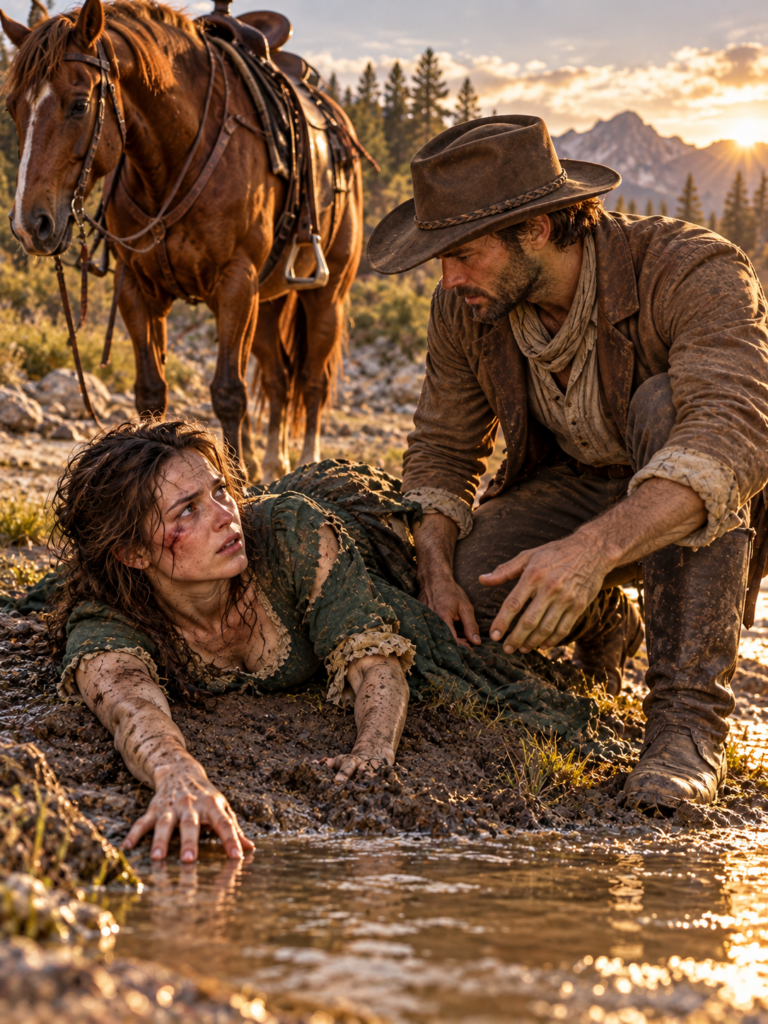
He had found a woman lying in the mud, her injured hand extended toward water she could barely reach.
At the time, he had thought he was simply saving a stranger’s life.
He understood now that Eleanor had not been waiting for a man to make her life meaningful.
She had already chosen to fight for it.
She had worked for years to expose the truth.
She had endured pain, escaped Crawford, preserved the evidence, and carried it all the way to Helena.
Nathan had helped her continue.
And in doing so, he had remembered how to continue himself.
Eleanor turned toward him.
“Do you ever think about that river?”
“Often.”
“Will you show me the place again someday?”
“When you want.”
She smiled.
“I think I’d like that.”
He reached toward her.
She took his hand willingly.
There was no hurry now.
No pursuit.
No need to prove anything before a judge or a powerful rancher.
Below them stood a house with room for two independent lives to become something shared.
The garden Margaret had planted would remain.
The sewing basket would still be used.
Copper would grow older and continue making decisions Nathan had learned to respect.
There would be work, disagreements, laughter, and ordinary days whose value neither person would ever again take for granted.
Eleanor had not forgotten what happened to her.
Nathan had not forgotten Margaret.
Neither needed to.
They turned their horses down the slope.
Halfway to the ranch, Eleanor looked over at him.
“There’s something else I ought to tell you.”
Nathan waited.
“I don’t know whether I’ll ever become the woman I was before Crawford.”
He considered that.
“Perhaps you don’t have to.”
She looked at him.
“Perhaps.”
He smiled.
“I’d rather know the woman you’re becoming.”
Her expression softened.
“And I’d like to know the man you’re becoming, Nathan Cole.”
Then she urged Dust forward.
Copper followed.
And together they rode toward the porch, the garden, and the two cups that would be waiting at supper.
Three years earlier, Nathan had believed his life ended at a grave.
Four years earlier, Eleanor had believed survival meant never allowing herself to trust another soul.
Neither belief had survived the summer.
Because on a lonely Montana riverbank, an old mare had refused to take one more step.
And a man who had forgotten how to live had finally stopped long enough to see a woman who refused to give up.
He had reached down to help her.
She had chosen to reach back.
What came afterward was not a debt, an obligation, or a rescue that demanded lifelong gratitude.
It was a future neither had been promised.
A future they could leave.
A future they freely chose.
And as the evening settled over their small Montana ranch, the light shone through the kitchen window onto two places at the table.
Both occupied.
Both wanted.
And neither empty anymore.

