
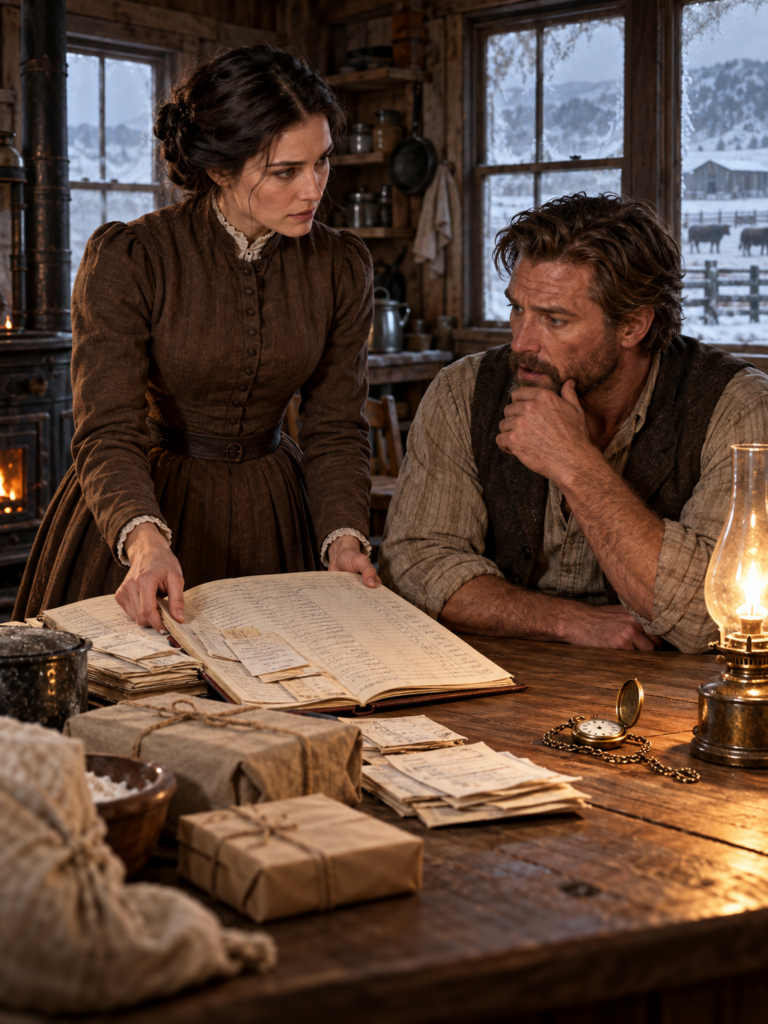
Ethan reached across the table and drew the old notice closer.
The question struck harder than Clara could have known.
For three years, Marcus Holloway had been trying to purchase the northern portion of his ranch.
For three years, Ethan had refused.
And for three years, Holloway had spoken as though the boundaries were less certain than Ethan believed.
“Where’d you find this?” Ethan asked.
“Behind the deed.”
He examined the dated notice.
It concerned an inquiry into competing claims near the northern survey line.
“I knew there was a question raised,” he said. “It was supposed to have been settled.”
“Was it?”
“I never received a proper explanation.”
Clara looked at him carefully.
“Then we should find the explanation before treating the matter as finished.”
Ethan’s jaw tightened.
“You’re here to manage the household, Clara. I don’t expect you to take on every trouble this ranch has.”
She held his gaze.
“I know what you expect. But land papers belong with the accounts if a dispute could affect the business.”
He looked down.
She was right.
Again.
What disturbed him was not her competence.
It was the ease with which she assumed she might have a useful place in matters he had never shared with anyone.
He had spent eleven years deciding everything alone.
Now a woman he barely knew was asking questions he should have asked long ago.
“Keep the papers together,” he said at last. “We’ll look at them properly.”
Clara nodded.
She did not press further.
But she slipped a clean sheet between the notice and the older survey documents, preserving their order.
The following morning brought another kind of trouble.
Billy Marsh returned from Bitter Creek with feed supplies and an unusually awkward expression.
Tom Briggs noticed first.
“What’s eating you?”
Billy glanced toward the house.
“Folks in town are talking about Mrs. Callaway.”
Ethan stopped tightening a saddle cinch.
“What are they saying?”
“That she must’ve been desperate to answer your advertisement.”
Ethan’s hands grew still.
Billy continued reluctantly.
“Some women at the mercantile say she’s plain. That her family had troubles back in Laramie.”
“And what did you say?”
“I told them she’s already put this house in better order than it’s been in years.”
Ethan looked toward the kitchen window.
Clara was inside, working with the ledgers.
“Next time they ask about her,” he said, “tell them her worth isn’t theirs to measure.”
Billy nodded.
But Clara heard similar remarks when she went into town that Saturday.
Two women stood beyond a mercantile shelf, discussing her as though she were a poor bargain Ethan had made.
She bought her coffee and supplies without confronting them.
Outside, she sat in the wagon for a short while, allowing herself to feel the familiar sting.
Then she drove home.
That evening, while Ethan reviewed the corrected accounts, she sat opposite him.
“Why did you advertise for a wife?”
He looked up.
“I needed help running the place.”
“That explains why you wanted a capable person. It doesn’t explain why you chose a stranger.”
Ethan set down his pencil.
For a moment, he considered giving her the easy answer.
But she had shown him too much honesty to deserve anything less.
“I was engaged once.”
Clara waited.
“Dora Fitch. She lived here in Bitter Creek. Left in March of ’79 and married a banker in Denver.”
“I’m sorry.”
“Don’t be. We weren’t suited.”
“Was that all?”
Ethan looked toward the stove.
“She said I was too closed off. Said I couldn’t give a woman what she needed.”
Clara spoke quietly.
“Was she right?”
He looked back at her.
“Some of it.”
The admission seemed to cost him something.
Clara did not soften the question or rush to reassure him.
She simply listened.
“I thought a woman from elsewhere might judge me for the man I was,” Ethan continued, “rather than what the town remembered.”
“And did you imagine she might want the same thing?”
He considered that.
“No,” he admitted. “I don’t believe I thought much about what she was escaping.”
Clara glanced down at her hands.
“My father’s farm was lost when I was twelve. I’ve had people deciding what sort of woman that makes me ever since.”
Ethan’s expression changed.
“Clara—”
“I didn’t come here because nobody else would have me. I came because I wanted work that mattered, and a life in which I could help decide what happened next.”
He nodded slowly.
“Then I owe you a better beginning than I’ve given you.”
She rose.
“A beginning can still be improved.”
She was approaching the hallway when he spoke again.
“Clara.”
She turned.
“I’m glad you came.”
For a moment, neither moved.
Then she gave him a small, genuine smile.
“Good night, Ethan.”
She left him at the table.
He remained there, looking at the accounts she had corrected and the land papers she had begun to organize.
For the first time, he wondered whether he had mistaken loneliness for peace.
Then the back door opened.
Tom Briggs entered carrying a lantern.
His face was serious.
“Boss, you’d better come look north.”
Ethan stood.
“What’s wrong?”
Tom glanced toward the dark window.
“Sky’s turning ugly. If that weather breaks the way I think it will, we’d best have the cattle under shelter before tomorrow night.”
Ethan reached for his coat.
From the hallway, Clara appeared with her own heavy wool garment already over her arm.
“I’ve noticed it too,” she said. “The pressure’s been falling, and the wind has shifted.”
Tom looked at her.
Ethan looked from Clara to the window.
Then he opened the door.
Cold air swept across the kitchen floor.
Beyond the yard, the northern sky had become a solid wall of iron gray.
Clara stepped beside him.
“We should fill the water barrels tonight,” she said, “and bring in more firewood.”
Ethan stared into the approaching darkness.
He knew that sky.
He also knew that the weakest section of fence stood along the eastern pasture.
He turned toward Tom.
“Get Billy. Bring the cattle closer.”
Clara started toward the woodpile.
Ethan caught himself before telling her to remain inside.
Instead, he asked, “What can you manage?”
She tightened her coat.
“More than you think.”
And together they stepped into the growing wind.
The wind struck them hard enough that Clara had to lower her head as she crossed the yard.
Ethan caught up beside her.
“I’ll have Billy stack the wood,” he said. “You can see to the water and stores.”
Clara stopped.
“That suits me. But if you need another hand outside later, ask.”
He studied her.
“You’ve done winter ranch work?”
“Some. My uncle in Minnesota believed everyone in a household ought to know how to be useful when the weather turned.”
Ethan nodded.
“Then I’d better listen.”
By nightfall, the barrels were full, firewood stood under cover, and the cattle had been brought nearer the sheltered pasture.
Tom checked the stable doors.
Billy helped secure the feed.
Clara prepared food that could be warmed quickly if the storm kept everyone occupied.
The first snow arrived just before supper.
It seemed harmless at first.
By midnight, the wind was howling around the buildings.
At two in the morning, Clara entered the kitchen and found Ethan at the window.
An oil lamp stood beside him.
Beyond the glass, snow moved in dense white sheets.
“You should be asleep,” he said.
“So should you.”
She built up the fire and put coffee on the stove.
Ethan did not argue.
He pulled out a chair.
For a while, they listened to the storm.
Then Clara told him about the Minnesota winter she had endured at fifteen, when snow had kept her family indoors for four days.
Her uncle had insisted they keep talking, even about ordinary things, rather than surrender to fear and silence.
“He sounds sensible,” Ethan said.
“He was. He taught me more than anyone.”
“Is he still in Minnesota?”
Clara’s expression softened.
“He died the following spring. Fever.”
Ethan looked down at his cup.
“I’m sorry.”
She nodded.
“He was the one person who made me believe that learning something could change your circumstances.”
“My father thought work could do that.”
“Did he?”
“He started with forty acres and built this ranch a piece at a time. Didn’t speak much. Never told my mother he loved her, though I reckon he did.”
Clara considered.
“Did she know?”
“She said she did.”
“And you?”
Ethan was quiet.
“I always wondered whether she deserved to hear it said.”
Clara looked at him across the lamplight.
“Perhaps she did.”
Before he could answer, pounding erupted at the back door.
Tom entered, covered in snow.
“East fence is down!”
Ethan was already standing.
“How many cattle out?”
“Billy can’t get a proper count. Six at least.”
Ethan reached for his coat.
Clara followed.
“I’m coming.”
He turned.
“The wind’s worse than it looks.”
“I know.”
“Clara—”
“You have Tom, Billy, and yourself. If six head have broken through, you’ll need someone watching the open side while the others turn them.”
Ethan hesitated.
She met his eyes.
“I’ve helped move cattle in bad weather. Don’t send me away because you haven’t seen me do it.”
For one long moment, he weighed the danger.
Then he handed her an extra rope.
“Stay where Tom can see you. If the wind gets worse, we all come back.”
“Agreed.”
The work that followed was cold, exhausting, and frightening.
Snow gathered against the broken fence.
The cattle moved restlessly through the darkness.
Tom and Billy worked to turn the scattered animals toward shelter while Ethan secured a temporary barrier.
Clara held the open flank, keeping enough distance to avoid driving the frightened cattle into a wider scatter.
When a heifer tried to move past her, she shifted position and turned it back without shouting.
Ethan saw it.
He saw, too, how carefully she judged the wind and how she refused to waste strength on movements that accomplished nothing.
For nearly two hours they worked.
By the time the animals were secure, everyone was shaking with fatigue.
They returned to the farmhouse with ice crusting their coats.
Billy dropped into a chair.
Tom stood near the stove warming his hands.
Clara brought out dry cloths and helped prepare hot coffee.
Ethan watched her for a moment.
Then he said, “You knew exactly what you were doing.”
She looked up.
“I told you I’d worked in weather.”
“You did.”
He removed his hat.
“I should’ve asked what you knew before deciding what you could manage.”
Clara’s eyes softened.
“Then ask next time.”
“I will.”
Tom glanced at Billy.
The younger man promptly discovered that he needed to check the stable.
Tom followed him.
The kitchen grew quiet.
Ethan sat across from Clara.
“I ought to tell you something else,” he said.
She waited.
“When I sent for you, I thought I was arranging for a wife who would keep the house in order and leave the rest of my life untouched.”
“That much was plain.”
He almost laughed.
“I told myself it was fair because I wasn’t promising romance.”
“And now?”
“Now I know I should have told you how lonely the place was.”
Clara held his gaze.
“Would you have wanted me to come if you had?”
He thought about it.
“Yes.”
“Then you should have trusted me with the truth.”
“I know.”
The storm went on battering the walls, but something within the kitchen had changed.
Not into love.
Not yet.
Into the beginnings of trust.
When the blizzard finally broke on the fourth morning, the ranch had suffered damaged fencing and exhausting work, but the cattle were safe.
The days that followed were consumed by repairs.
Clara returned to the accounts.
Ethan began sitting at the long kitchen table with the ranch hands instead of eating apart.
Nobody announced the change.
But Tom noticed.
So did Billy.
And Clara, watching Ethan listen to the men over supper, began to understand that a man could be lonely without admitting it even to himself.
One morning, Tom mentioned Marcus Holloway.
Clara looked up from the ledger.
“Who is he?”
Ethan’s expression tightened.
“Rancher east and north of us.”
“He wants to buy this place,” Tom explained.
“Does he?”
“Three offers,” Ethan said. “I’ve turned down every one.”
Clara remembered the old Cheyenne notice.
“Why does he want it so badly?”
Ethan hesitated.
Then he answered.
“The northern edge of my place lies beside a water access point. If Holloway buys this ranch, he’ll be in a position to control how several neighboring properties reach that water.”
Clara set down her pen.
“How many?”
“Six ranches could be affected.”
“And has he been questioning your boundary?”
“For years.”
She opened the leather folder.
“Then those papers matter more than I first understood.”
Ethan sat beside her.
For the first time, he explained the full history of Holloway’s offers and the old disputed survey.
He did not speak as a man issuing instructions to a household employee.
He spoke as someone who wanted her judgment.
Clara listened, made notes, and asked questions.
When she finished, she said, “We need to know precisely what the original filings establish before Holloway can use uncertainty against you.”
Ethan looked at her.
“You said ‘we.'”
She met his eyes.
“I’m living here, aren’t I?”
He nodded.
But the answer meant more to him than she knew.
Eight days after the storm broke, Holloway rode into the yard.
He arrived on an expensive gray horse with two men accompanying him.
Clara saw him from the window and went to find Ethan.
They met the visitors together.
Holloway dismounted with the confidence of a man accustomed to getting his way.
“Callaway. Heard the storm treated you poorly.”
“We’re making repairs,” Ethan replied.
Holloway examined the buildings.
“Hard winter. Hard market. Maybe you ought to reconsider my offer.”
“My answer hasn’t changed.”
Holloway turned toward Clara.
“And this must be the bride.”
“My wife,” Ethan corrected.
Clara inclined her head.
“Mr. Holloway.”
He introduced himself with practiced courtesy.
Then he looked around the yard again.
“A difficult ranch to hold. Especially with new responsibilities.”
Clara understood the suggestion.
She also recognized how carefully he was watching Ethan.
“Mr. Holloway,” she said, “I’ve reviewed enough of our accounts to know the ranch is in a stronger position than certain unfinished entries might suggest.”
His smile thinned.
“Is that so?”
“Yes. We’re correcting those records now.”
Holloway studied her.
“Sounds as though Callaway has found himself a capable bookkeeper.”
Ethan answered before Clara could.
“She’s capable of considerably more.”
Clara glanced at him.
Holloway noticed.
He mounted without renewing his offer.
But before leaving, he looked back at the northern pasture.
“Fences aren’t the only things winter can weaken.”
Then he rode away.
Clara watched him go.
“He’ll look for another advantage,” she said.
“I expect he will.”
“Then we need everything documented.”
Over the next weeks, they worked through the original deed, boundary surveys, and water records.
One afternoon, Clara found a letter dated September 1882 tucked behind the deed.
Its contents concerned the closing of the earlier boundary inquiry.
She read it twice.
Then she carried it to Ethan in the north pasture.
“Do you know who signed this?”
He studied the name.
R. E. Aldridge.
Ethan looked up sharply.
“Richard Aldridge handles Holloway’s legal work in Bitter Creek.”
Clara stood very still.
“The man who handled the old inquiry?”
“The same name.”
She did not immediately declare the document fraudulent.
Instead, she said, “We need to establish whether he held both positions and whether that connection affected the decision.”
Ethan reread the notice.
“If it did?”
“Then the inquiry deserves independent review.”
“And Holloway?”
“He won’t welcome it.”
Ethan folded the paper carefully.
“Neither will Aldridge.”
Clara looked across the pasture.
“I know.”
That evening, they began preparing a formal request to the federal land authorities.
Ethan brought out his father’s original surveys.
Clara organized the records and drafted the complaint.
They worked until after midnight.
She knew how to arrange the evidence.
He knew the land.
Together, they corrected details neither could have completed as confidently alone.
At one point, Ethan returned from the stove carrying two cups of coffee.
He placed hers beside her elbow.
She looked up.
“Thank you.”
He sat down.
For a while, they worked in companionable silence.
Then Ethan asked, “How did you learn so much about land records?”
Clara’s pen stopped.
“My father lost his farm when I was twelve.”
Ethan waited.
“We didn’t understand the papers. We couldn’t afford proper advice. By the time we knew what questions to ask, it was too late.”
She looked down at the complaint.
“I promised myself I would never again be helpless simply because I didn’t understand what someone had put in writing.”
Ethan’s face softened.
“That’s a hard lesson for a child.”
“It was.”
He reached toward the edge of the table, then stopped.
“I’m sorry you had to learn it that way.”
Clara looked at him.
For several seconds, neither spoke.
Then she turned back to the final page.
“We’ll need your signature.”
Ethan took the pen.
He signed.
The complaint went out with the next post.
Within days, Aldridge himself rode to the ranch.
He appeared in an expensive town coat, his manner courteous but strained.
“I hear you’ve sent papers concerning the old boundary matter,” he said.
“That’s correct,” Ethan answered.
Aldridge glanced at Clara.
“A misunderstanding, I’m sure.”
Clara stepped forward.
“Then the records should settle it.”
“These things are often more complicated than they appear, Mrs. Callaway.”
“Which is why we asked for an independent examination.”
Aldridge’s smile faded.
“Marcus Holloway is an influential man.”
Ethan stood beside his wife.
“If you came to ask us to withdraw the complaint, you’ve come for nothing.”
Aldridge put on his hat.
“Think carefully about what you’re beginning.”
Clara answered quietly.
“We have.”
After he left, Ethan found her standing at the kitchen window.
“That frightened you,” he said.
“Yes.”
“You didn’t show it.”
“I was trying to keep my voice steady.”
Ethan stood beside her.
Then, without presuming anything, he offered his hand.
Clara looked at it.
And placed hers in his.
For a moment, neither said a word.
Six weeks later, a federal reply arrived.
The inquiry would be reopened.
An independent agent was coming from Denver.
Ethan read the letter twice.
Clara’s pulse quickened.
“Then they’ll examine the original surveys.”
“And Holloway will know.”
They both understood what that meant.
The next morning, Tom reported that three unfamiliar riders had been studying the northern boundary markers.
One, he had learned, was a surveyor named Curtis Fen.
Holloway had apparently commissioned a competing survey.
Clara spread the original documents across the table.
“If the markers are as your father recorded them, we need a reliable record of their present condition.”
Ethan nodded.
“We’ll ride out.”
They inspected the line with Tom.
The old posts remained standing.
Some markings had weathered, but their locations corresponded with the surviving survey measurements.
Clara compared the papers carefully.
Then she looked toward Ethan.
“Can we have these photographed?”
“There’s a photographer in town.”
“Then send for him.”
Ethan looked toward the neighboring land.
“If Holloway can introduce doubt before the agent arrives, we may spend months fighting it.”
“Then we’d better make certain the evidence is preserved.”
The photographer came.
Glass-plate images were made of the markers and their surroundings.
Copies were arranged for safekeeping.
Clara indexed the records.
Ethan supplied the history of the boundary.
And together, they prepared for the federal examination.
But three days before the agent was due, an unexpected visitor arrived.
A woman stepped from a hired buggy.
She wore a dark coat and looked as though she had spent the journey gathering courage.
Clara met her beside the porch.
“May I help you?”
The woman drew a breath.
“My name is Eleanor Fen.”
Clara went still.
“Curtis Fen is my husband,” the visitor continued. “He’s the surveyor Mr. Holloway hired.”
Clara glanced toward the house.
Then she stepped aside.
“Please come in.”
Eleanor Fen entered the kitchen, took the offered chair, and placed her gloved hands on the table.
“I’ve come because my husband has been asked to write something he does not believe is true.”
Clara felt the whole dispute shift beneath her.
She sat opposite the woman.
“Tell me exactly what happened.”
Eleanor Fen removed her gloves slowly.
For several moments, she stared at them as though they might help her decide where to begin.
Then she looked directly at Clara.
“My husband examined the markers along your northern boundary. He found them consistent with the original survey records.”
Clara remained still.
“All of them?”
“Every one he examined.”
“And what was he asked to report?”
Eleanor swallowed.
“Mr. Holloway’s representative wanted him to describe the worn markings as evidence that the boundary positions were uncertain.”
“Does Curtis believe that?”
“No.”
The answer came immediately.
Eleanor’s composure faltered.
“My husband has spent fifteen years building a reputation as an honest surveyor. He’s never knowingly put his name to a false finding.”
Clara watched her carefully.
“Then why hasn’t he submitted the report?”
“Because Holloway has already paid him. Because refusing may cost him work throughout the territory. Because we have a daughter in Laramie, and Curtis fears what will happen to our family if he angers a man with Holloway’s influence.”
The kitchen door opened.
Ethan entered, carrying the cold air with him.
He took one look at Clara’s face and stopped.
“This is Mrs. Fen,” Clara explained. “Her husband’s survey concerns our northern markers.”
Ethan removed his hat.
“Ma’am.”
Eleanor repeated what she had told Clara.
He listened without interrupting.
When she finished, he pulled out a chair.
“What do you need from us?”
Eleanor looked between them.
“I need to know that an honest report will matter.”
Clara folded her hands on the table.
“The federal agent arrives in three days. We have the original surveys, photographs of the markers, and our complaint on record. If your husband’s findings agree with those records, he can provide independent evidence.”
“But can you protect him?”
Clara did not offer reassurance she could not guarantee.
“No. I can’t promise Holloway won’t retaliate or that your husband won’t lose work.”
Eleanor looked down.
“But the report can be placed before the independent agent,” Clara continued. “And Curtis can explain exactly what he found.”
Ethan added, “He shouldn’t have to falsify a survey to keep his livelihood.”
Eleanor’s eyes filled.
“No. He shouldn’t.”
She stood.
“I came without telling him. I needed to know whether there was a reason to take the risk.”
Clara walked her to the door.
“There is.”
Eleanor clasped her hand.
“Thank you.”
After the buggy departed, Ethan stood beside the kitchen table.
“That took courage.”
Clara looked toward the road.
“More than we may ever know.”
Three days later, Curtis Fen filed his survey report.
It confirmed that the physical markers were consistent with the earlier records.
No unsupported claim of ambiguity appeared in his findings.
When Billy brought the news, Clara sat down so abruptly that Ethan reached toward her.
“Are you all right?”
She laughed once, breathlessly.
“Yes. I just hadn’t allowed myself to expect that.”
Ethan looked toward the window.
“Neither had I.”
The federal agent arrived shortly afterward.
His name was Garrett.
He was a methodical man who asked direct questions and seemed unimpressed by either threats or flattery.
For two days, he examined the documents.
He studied the original surveys, the land-office correspondence, and the photographs.
He spoke with Ethan about the physical boundaries.
He asked Clara to explain the organization of the records.
Then he traveled to inspect the markers himself.
Clara worked beside the kitchen table while the men were gone, preparing the remaining copies.
She knew the evidence was sound.
But evidence still had to be considered by someone willing to read it fairly.
That afternoon, Holloway rode into the yard with several men.
Clara heard the horses before she saw them.
She stepped onto the porch.
Holloway dismounted.
His usual polished manners were gone.
“Where’s Callaway?”
“With the federal agent.”
Holloway’s eyes narrowed.
“I hear you’ve been making accusations about me.”
“We submitted records concerning the boundary inquiry.”
“You’ve been speaking to people who have no business involving themselves in my affairs.”
Clara stood straight.
“Mr. Holloway, we’re asking for an accurate determination of our land boundaries.”
He climbed one step.
“Do you understand how much trouble you’re causing?”
“Yes.”
“Does your husband?”
“He signed the complaint.”
Holloway looked past her toward the house.
“This matter could have been settled with a fair offer.”
“An offer that required us to sell land we do not wish to sell.”
“You may not be able to hold it forever.”
Clara felt fear tighten her throat.
But she remembered her father’s lost farm.
She remembered how adults had spoken over her head while decisions were made that destroyed their livelihood.
And she remembered the years afterward, when she had learned to understand documents precisely because she never wanted to be powerless in such a moment again.
She kept her voice controlled.
“If you believe your claim is sound, you can present it to the agent.”
Holloway stared.
Then he turned away.
His men followed him back to their horses.
Clara remained on the porch until they were gone.
Only then did she grip the railing.
Her hands were shaking.
When Ethan returned, she told him everything.
He listened, his face growing stern.
“Did he touch you?”
“No.”
“Did he threaten you?”
“He tried to frighten me into withdrawing.”
Ethan looked toward the road.
“I should’ve been here.”
Clara stepped closer.
“You couldn’t have known he would come.”
“He shouldn’t have approached you alone.”
“I handled it.”
“I know.”
Ethan turned toward her.
There was something new in his expression.
Not doubt about her ability.
Fear that the person he had begun to care for might suffer because of a conflict he had once considered his alone.
“Clara,” he said quietly, “I don’t want this ranch costing you more than you intended to give.”
She studied him.
“Then don’t decide what I’m willing to give without asking me.”
He lowered his eyes.
After a moment, he nodded.
“You’re right.”
She took his hand.
“We’ll make decisions together.”
And he held on.
The federal inquiry moved forward.
Garrett’s initial examination supported the original survey, but the dispute did not end immediately.
Questions remained about the old closure, Aldridge’s connection to Holloway, and the way the competing claims had been handled.
Additional correspondence went to the federal authorities.
Clara and Ethan continued gathering documents.
Curtis Fen’s report became an important part of the record.
As winter moved toward spring, the ranch settled into a new rhythm.
Ethan no longer kept the serious decisions to himself.
Clara no longer waited for permission to raise a concern.
They argued occasionally.
Sometimes over expenditures.
Sometimes over whether a particular repair ought to be done immediately or postponed until the cattle could be moved.
But those disagreements were different from the cold silences with which their arrangement had begun.
They spoke.
They listened.
And they were learning that partnership did not require identical opinions.
One evening, Clara found Ethan trying to mend a tear in his work coat.
She watched him struggle with the needle.
“Would you like help?”
“I can manage.”
She raised an eyebrow.
“Apparently.”
He laughed.
It surprised them both.
She sat beside him and showed him how to strengthen the seam.
He watched attentively.
“I didn’t know you could make a stitch hold that way.”
“That’s because you never asked.”
“You’re going to remind me of that for years, aren’t you?”
“Quite possibly.”
He smiled.
For the first time, Clara noticed how much younger he looked when he allowed himself to be happy.
Later, they played cribbage at the kitchen table.
Ethan had brought out the old board after discovering that Clara knew the game.
He was competitive.
So was she.
Tom and Billy soon learned that supper could be delayed by an argument over the proper count of a hand.
But nobody minded.
The house had become a place where laughter happened.
And Ethan Callaway, who once ate alone and considered it a sign of independence, began looking forward to the moments when Clara sat opposite him after the day’s work was finished.
The greater dispute continued.
Holloway challenged the findings through the available administrative channels.
Additional statements were requested.
Clara kept careful records of every letter.
Ethan provided further information about the land.
Curtis Fen eventually submitted a detailed statement explaining what he had observed and how Holloway’s representative had attempted to influence the wording of his report.
When Clara read that statement, she sat quietly for a long time.
Then she wrote to Eleanor and Curtis Fen.
She thanked them for their honesty.
Not because their evidence guaranteed the outcome.
But because they had chosen to tell the truth when silence would have been easier.
Weeks passed.
At last, an official ruling arrived from Washington.
Clara was alone in the house when the courier brought it.
She signed for the envelope.
She offered the man coffee and water for his horse.
Then she sat at the kitchen table and opened the letter.
She read the first page.
Then the second.
Her heart began to pound.
The ruling upheld the authoritative original survey.
The appeal against the amended findings was denied.
The earlier closure of the boundary inquiry was invalidated.
The disputed northern line remained as the original records established it.
The water access question was addressed under the applicable territorial survey records.
And the conduct surrounding the old inquiry had been referred for further examination.
Clara read the decision again.
Then she placed both hands flat over the paper.
For several moments, she could not move.
She remembered being twelve years old.
She remembered standing in her father’s empty farmhouse while men discussed papers nobody in her family understood.
She remembered promising herself that she would learn.
She had spent years reading, questioning, and refusing to be dismissed.
Now, in a quiet Wyoming kitchen, she held a ruling that proved the work had mattered.
She rose.
The wind was cold when she crossed the yard toward the north pasture.
Ethan was checking the fencing with Tom.
He saw her coming and straightened.
“Clara?”
She held out the envelope.
His eyes went to the official seal.
He took it carefully.
She watched him read.
His expression barely changed.
But his shoulders slowly lowered.
“The boundary stands,” he said.
“Yes.”
“And the appeal?”
“Denied.”
He read another paragraph.
“The old inquiry?”
“Invalidated.”
Ethan looked at her.
For a long moment, neither spoke.
Then he reached for her.
Clara stepped into his arms.
He held her tightly.
She felt him draw one uneven breath against her hair.
Eleven years of managing the ranch alone.
Months of pressure from Holloway.
The long winter.
The fear of losing land his father had built a life upon.
And now the decision was in their hands.
Ethan finally stepped back.
“We should go see the northern markers.”
Clara smiled.
“Now?”
“Now.”
They saddled their horses and rode toward the boundary.
The winter snow had begun retreating from the lower ground.
The sky stretched pale and enormous above the pastures.
At the northern marker, Ethan dismounted and stood looking at the old iron cap.
Clara remained beside him.
He ran his hand along the weathered post.
“My father helped put this line in order,” he said. “I remember him explaining how carefully a man had to keep records if he wanted his children to know what belonged to the ranch.”
Clara looked toward the neighboring valley.
“He was right.”
Ethan turned.
“Clara, I’ve something to ask you.”
She smiled faintly.
“You sound serious.”
“I am.”
He took off his hat.
“When I sent that telegram, I believed I was asking someone to come manage a household.”
“I remember.”
“I’d convinced myself I didn’t want more than that.”
She waited.
“I’d been alone so long that I stopped considering whether being alone was actually what I wanted.”
Clara’s expression softened.
Ethan looked directly at her.
“I was afraid of being judged. Afraid of disappointing someone again. So I gave you a narrow arrangement and hoped it would protect us both.”
“It didn’t make it easy.”
“No.”
He stepped closer.
“But you came anyway. You looked at this place and saw what needed doing. And instead of standing aside when things got difficult, you stood with me.”
Clara shook her head gently.
“We both worked.”
“I know. That’s what I’m trying to say.”
He took her hand.
“I don’t want you here because you can balance a ledger or hold a fence in a storm.”
Her eyes filled.
“I want you here because I love the woman who does those things. And the woman who tells me when I’m wrong. And the woman who can sit beside me without asking me to pretend I’m somebody else.”
Clara’s fingers tightened around his.
Ethan drew a slow breath.
“We agreed to this marriage before we knew each other. I’m asking you now whether you want to keep building it with me. Not because of the arrangement. Because it’s the life you choose.”
Clara looked at him.
For months, she had guarded her hope.
She had arrived expecting work, dignity, and a chance to make a future for herself.
She had not expected the rancher who barely greeted her at the stagecoach to become the man whose footsteps she listened for at the end of the day.
She had not expected him to learn how to ask.
Or to admit when he was afraid.
Or to give her a voice in decisions that mattered.
And she had not expected love to grow so steadily through ordinary things.
A cup of coffee placed beside her elbow.
A repaired fence.
A shared document.
A quiet word of thanks.
The steady presence of a man who had stopped treating her as an answer to a problem and begun seeing her as a person.
“Yes, Ethan,” she said.
He stared at her.
“Yes?”
“I want to stay. As your wife, not merely your housekeeper or bookkeeper. And I want us to keep making this life together.”
His face changed.
The smile that appeared was not practiced or careful.
It was the smile of a man who had finally allowed himself to believe something good might last.
He lifted her hand and kissed it.
Then Clara stepped closer and kissed him.
The northern marker stood beside them.
Beyond it, the land stretched beneath the Wyoming sky.
It was still hard country.
The winters would remain bitter.
Cattle prices would rise and fall.
Buildings would need repairing.
And there would always be another season of work.
But neither of them would face those things alone.
When they returned to the ranch, news of the federal ruling had already begun spreading through Bitter Creek.
Neighbors came to congratulate them.
James Mallister and his wife Ellen, whose property depended in part upon continued access arrangements in the valley, visited that evening.
Ellen took Clara’s hands.
“We’ve lived here more than twenty years,” she said. “Nobody ever explained those records to us the way you did.”
Clara shook her head.
“Ethan knew the land. Tom knew the old fence lines. Mr. Fen gave an honest report. We needed all of it.”
“Perhaps,” Ellen replied. “But you knew how to bring those things together.”
Clara thanked her.
She had never sought public admiration.
She had wanted a fair chance to defend the ranch.
Still, the gratitude of neighbors whose futures might have been affected made her understand that their struggle had reached beyond the Callaway property.
A few weeks later, Holloway came to the ranch alone.
He arrived on his gray horse, but there were no hired men following him.
Ethan and Clara met him in the yard.
Holloway dismounted.
“The Washington ruling stands,” he said.
“That’s correct,” Ethan answered.
“I’m not pursuing another appeal.”
Clara studied him carefully.
He looked older than he had that winter.
For a moment, Holloway’s gaze rested on her.
“You made certain every document was accounted for.”
“I tried to.”
“Most people wouldn’t have gone to that much trouble.”
“Most people haven’t had a reason to learn what can happen when records aren’t examined.”
Holloway looked away.
Then he spoke quietly.
“My wife died four years ago.”
Neither Ethan nor Clara answered immediately.
“She used to tell me when I was carrying things too far,” he continued. “I didn’t always listen.”
Clara’s expression softened, though she did not excuse what he had done.
“I’m sorry for your loss.”
Holloway nodded.
Then he turned toward Ethan.
“I’d like to discuss a legitimate water easement. Proper terms. Recorded agreement. Something fair to both sides.”
Ethan considered.
“Send the terms through your lawyer.”
“Not Aldridge,” Holloway said. “He’s retired.”
“Then whoever represents you now.”
Holloway nodded.
Clara added, “We’ll review the terms before agreeing to anything.”
The rancher looked at her.
For once, he did not seem surprised that she had spoken.
“Naturally.”
He mounted and rode away.
Ethan watched him go.
“Think he’ll offer fair terms?”
“Perhaps.”
“And if he doesn’t?”
Clara smiled.
“Then we’ll say no.”
Ethan laughed.
He put an arm around her shoulders, and they went inside.
The easement matter was eventually considered on its merits, without the disputed boundary being used as leverage.
The Callaway Ranch remained theirs to operate.
And the neighbors who had watched the struggle learned that powerful men could be questioned with evidence and persistence.
Life returned to its ordinary difficulties.
Cattle needed tending.
Supplies needed purchasing.
Winter repairs had to be completed before spring work began.
But Clara found that ordinary life could hold extraordinary contentment.
She continued managing the accounts, though Ethan became an increasingly willing participant.
He learned to examine invoices before paying them.
He asked questions about expenditures.
And when Clara proposed changes to the purchasing arrangements, he discussed them rather than dismissing them.
The household became more than a place for him to sleep between long working days.
Meals were shared.
Decisions were discussed.
And when the ranch hands gathered at the long kitchen table, Ethan sat among them.
Tom Briggs approved without ever saying so directly.
Billy Marsh, less restrained, occasionally made remarks about how much better the ranch ran now that Mrs. Callaway was there.
Ethan would look at Clara.
Then he would say, “She’s made more difference than you know.”
Clara always pretended to be very interested in her plate.
But she smiled.
The first anniversary of her arrival came on another cold November day.
Ethan returned from town carrying a small parcel.
He placed it on the kitchen table.
“What’s this?” Clara asked.
“Something I should’ve done when you first came.”
She opened it.
Inside lay a carefully made ledger with strong binding and clean pages.
On the first page, Ethan had written a simple note in his own hand.
For the work we do together.
Clara looked up.
“Ethan.”
He rubbed a hand along the back of his neck.
“I know you could’ve bought one yourself.”
“That’s not what matters.”
He looked uncertain.
She closed the ledger gently.
“You remembered.”
“I remember more than you think.”
She stepped around the table and embraced him.
Outside, snow had begun falling in small, quiet flakes.
Inside, the stove warmed the room.
The old pocket watch rested on the mantel.
Ethan had once stood in Bitter Creek counting forty minutes and wishing a woman would never arrive.
Now he sometimes took that watch out and remembered how close he had come to allowing fear to decide the shape of his future.
Years later, Clara would occasionally tease him about their first meeting.
“You barely spoke six words on the road from town.”
“I spoke more than six.”
“Not many more.”
“I was nervous.”
She would smile.
“I know that now.”
And sometimes Ethan would look toward the kitchen table, where the ledgers remained neatly stacked beside correspondence and ranch records.
He would remember the sixty-four dollars and thirty cents that had first forced him to acknowledge her competence.
Such a small amount compared with the value of the land they had defended.
Yet it had been the beginning.
Not of a woman proving herself worthy of his affection.
She had never needed to do that.
It had been the beginning of a man learning to recognize the person standing before him.
Clara had come west seeking an honest arrangement and a life of purpose.
She found both.
But she also found a husband who learned to speak his affection, share his fears, respect her judgment, and stand beside her when difficult decisions had to be made.
Ethan had asked for a wife because he thought his ranch needed managing.
He discovered that a marriage required more than a well-run household.
It required honesty.
Attention.
Trust.
And the courage to let another person matter enough to change the way one lived.
One evening, long after the land dispute had passed, Clara sat beside him at the kitchen table.
The fire burned low.
The winter wind stirred beyond the shutters.
Ethan looked up from his book.
“Clara?”
“Yes?”
“Are you glad the stagecoach was late?”
She laughed.
“What an odd question.”
“Humor me.”
She considered for a moment.
“Yes.”
“Why?”
“Because if it had been on time, you might not have had quite so long to reconsider whether you wanted me.”
Ethan shook his head.
“I spent every one of those forty minutes hoping you wouldn’t come.”
“I suspected as much.”
He reached for her hand.
“I’ve spent every day since being grateful you did.”
Clara leaned toward him.
The man who once struggled to say anything beyond what the day’s work required had learned, at last, to say what mattered.
She kissed his cheek.
Then she returned to her ledger while he returned to his book.
Two cups stood on the table.
Outside, the Wyoming wind crossed the dark pastures.
Inside, there was no longer a silence built to keep the world away.
There was simply the easy quiet of two people who had chosen each other.
Not because they had no other choice.
But because, knowing everything they now knew, they would choose the same life again.
And somewhere in the old stove, beneath years of ash and countless winter fires, the torn telegram had long since disappeared.
Its purpose had been fulfilled anyway.
The woman had come.
The ranch had endured.
And the marriage Ethan had once feared had become the home he never wanted to leave.

