
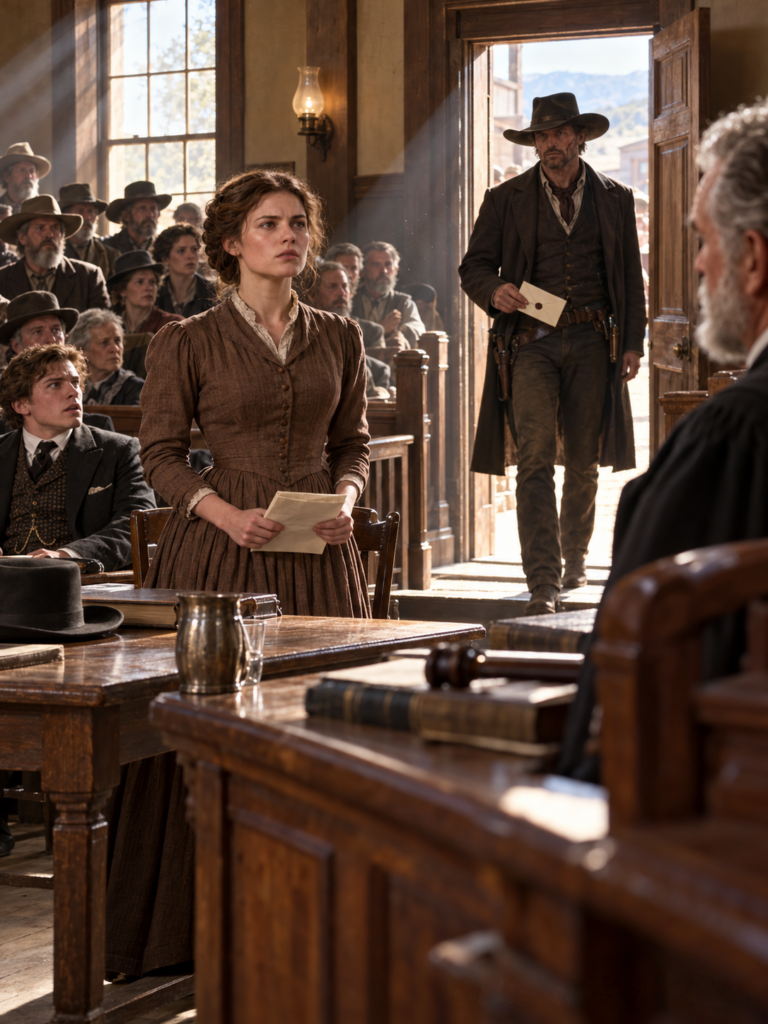
Amelia seized the pen and drew a fresh sheet of paper toward her, her hand steady even as the courtroom began filling again.
Thomas Hail caught her wrist lightly.
“What are you doing?”
“Writing down everything Samuel told me before he died.”
“We should discuss what can safely be presented.”
“Then discuss it while I write.”
He released her immediately.
Across the table, Ethan Walker watched without interfering.
For eleven days, Amelia had allowed other people to describe Samuel’s final weeks. They had taken ordinary acts of nursing and twisted them into evidence of manipulation.
She would not permit that silence to continue.
She wrote that Samuel had grown troubled by discrepancies in his cattle accounts. She remembered him sitting by the window, asking why livestock numbers no longer matched the receipts brought to him.
She remembered his bitterness whenever James visited.
And she remembered something even more important.
Samuel had said he intended to correct his will because certain people had mistaken his age and poor health for weakness.
Hail read over her shoulder.
“Why didn’t you tell me this earlier?”
“Because I had nothing to prove it.”
“You could have trusted me.”
Amelia looked up.
“Thomas, you were appointed to defend me after nearly everyone in town decided I was a murderer. I hardly knew you.”
The young attorney lowered his eyes.
“That’s fair.”
“But I trust you to help me now.”
He nodded.
Ethan moved closer.
“There’s another piece of evidence.”
He placed a small leather notebook on the table.
Samuel’s personal ranch accounts.
The pages contained dates, cattle tallies, and remarks concerning unexplained losses.
Hail turned several leaves.
“These figures don’t agree with the records the estate submitted.”
“They weren’t meant to,” Ethan said. “Someone had been moving cattle without Samuel’s permission.”
Amelia’s stomach tightened.
“Marcus Holt.”
Ethan nodded.
The Whitmore ranch manager had handled Samuel’s herds for eleven years.
He knew every holding pasture and freight route.
“And James?” she asked.
“The records suggest he shared in it.”
Hail shut the notebook.
“That gives us a reason for the false inheritance papers. It doesn’t establish who caused Samuel’s death.”
“No,” Amelia agreed. “And we mustn’t pretend otherwise.”
She remembered Samuel’s tired face.
His weakening heart.
His determination to make amends while time remained.
The thought that someone might have confronted him during those last hours made her throat ache.
“There’s something else,” Ethan said.
“Tell me.”
“Samuel wrote to Daniels before he died. He instructed him to seek me out if trouble followed his death.”
“Why you?”
Ethan’s expression grew troubled.
“Five years ago, I worked around the Whitmore operation. I noticed irregular dealings and convinced myself they weren’t my concern.”
Amelia stared at him.
“Did that have anything to do with why you left Dust Creek?”
“Some of it.”
“Then perhaps you should have said so before disappearing.”
“You’re right.”
His immediate agreement unsettled her more than an excuse would have.
She returned her attention to the notebook.
“You cannot undo five years with one afternoon, Ethan.”
“I know.”
“And whatever Samuel intended to leave me belongs to his wishes, not yours.”
“Agreed.”
“Then I intend to speak for myself when the hearing resumes.”
Ethan stepped aside.
“That’s what Samuel would have wanted.”
The rear door opened.
James Whitmore returned with his lawyer.
He stopped when he saw Amelia holding Samuel’s private notebook.
For a moment, the polished confidence disappeared from his face.
Hail noticed.
So did Ethan.
Judge Puit resumed his seat and announced that the court would consider Walker’s newly produced evidence.
Fitch objected again, insisting the papers had appeared too late to be trusted.
Hail rose.
“Then let us examine their authenticity. The court can verify the notarial record and call the necessary witnesses.”
Amelia stood beside him.
“And I wish to testify.”
The judge turned toward her.
“Miss Carter, your attorney can speak on your behalf.”
“He has done so. Now there are things I must say myself.”
The courtroom grew quiet.
She could feel the eyes of the townspeople upon her.
Eleven days earlier, those eyes had frightened her.
Now they made her angry.
She had worked here for four years, nursing the sick and earning her living honestly.
And a single accusation had been enough to make her a stranger.
Judge Puit studied her.
Then he looked at the notebook.
“The court will hear Mr. Walker concerning these documents. Further testimony will be considered as the evidence is examined.”
Fitch began protesting.
But Amelia was already opening her written notes.
She had made her decision.
She would tell the truth whether the room welcomed it or not.
And as Ethan stepped toward the witness chair, James Whitmore suddenly rose.
His lawyer grabbed his sleeve.
James pulled free and started toward the rear door.
Amelia pointed across the courtroom.
“Your Honor, before he leaves, I believe Mr. Whitmore should explain why he’s frightened of his uncle’s own handwriting.”
James Whitmore stopped halfway down the aisle.
Every face in the courtroom turned toward him.
For an instant, Amelia wondered whether she had gone too far.
Then James looked at the notebook in her hands, and his expression answered more than his words could have.
“I’m not frightened of anything,” he said.
“Then remain and hear the evidence.”
His attorney leaned toward him and whispered urgently.
James returned to his seat.
Amelia watched him sit before turning back to the judge.
Judge Puit had been irritated by her interruption. Yet the entire room had witnessed James’s attempt to leave.
“Miss Carter,” he said, “you will have an opportunity to give your account through the proper proceedings. Mr. Walker may begin.”
Ethan took the witness chair.
He gave his name and described his work in ranch security, tracking, and freight-related assignments across Wyoming and Colorado.
He explained how Samuel’s instructions had reached Porter Daniels in Rawlins.
Daniels had preserved the amendment to the will and the private account book.
The notarial record and Daniels’s statement, Ethan said, could be independently checked.
“Why would Samuel Whitmore entrust these papers to someone outside his family?” Hail asked.
“Because he no longer trusted what happened to important papers inside his own household.”
James shifted.
Ethan continued.
“Samuel believed cattle were being removed from his operation and sold without appearing in his official accounts.”
“By whom?”
“His ranch manager, Marcus Holt, with the involvement of James Whitmore.”
The courtroom erupted.
Fitch rose, demanding proof.
Ethan lifted the notebook.
“This isn’t a complete account of every animal. It’s Samuel’s own record of discrepancies. He marked dates, estimates, and transactions that troubled him.”
Hail requested that the pages be examined alongside the estate’s books.
Judge Puit permitted the preliminary comparison.
As he studied the figures, his expression darkened.
Amelia remembered Samuel sitting beside the window, his fingertips resting on an account sheet.
He had been ill, but he was not confused.
He had understood that something was wrong.
And she had been among the few people who listened.
The judge finally announced that the newly discovered material warranted further examination.
He would not rush to judgment while its authenticity and significance remained unresolved.
The proceedings would continue the next morning.
Until then, Amelia would be released on her own recognizance.
She heard the words and felt the first small loosening of the fear that had held her for eleven days.
Outside the courthouse, the crowd was waiting.
Some stared.
Some turned away.
Agnes Whitfield, whose family Amelia had cared for during a difficult winter, stepped forward.
“I’m glad someone came to help you,” Agnes said.
Amelia studied her.
“You were in town when they arrested me.”
Agnes lowered her gaze.
“Yes.”
“You knew me.”
“Yes.”
“Then you could have spoken before today.”
The older woman’s eyes filled.
“I know.”
Amelia did not offer forgiveness.
Not yet.
She simply moved past her.
Ethan walked beside her toward the hotel, with Thomas Hail carrying the papers.
Amelia appreciated one thing about Ethan’s manner.
He did not place a possessive hand against her back.
He did not steer her through the crowd.
He merely kept pace.
Five years earlier, he had believed leaving was easier than explaining what troubled him.
Today, he seemed determined to make different choices.
But Amelia would not mistake determination for proof.
***
They sat at a rear table in the hotel dining room.
Hail spread the documents across it.
“We have three problems,” he said. “Establishing the amendment’s validity, accounting for the missing cattle, and determining what actually happened before Samuel died.”
“Four,” Amelia said.
Both men looked at her.
“James Whitmore may attempt to leave before tomorrow.”
Ethan nodded.
“I’ve asked Ed Morrow at the freight office to watch for unusual activity near the bank.”
“Without telling me?”
“I arranged it before I came to court.”
Amelia folded her arms.
“Ethan, I am grateful for what you’ve brought. But I will not be the last person informed about decisions affecting my case.”
He accepted the rebuke.
“You’re right.”
“Then tell me what else you’ve done.”
He explained the letter from Samuel, his search for Daniels, the recovered records, and the inquiries he had made about the Whitmore cattle business.
When he finished, Amelia pointed toward the notebook.
“Marcus Holt knows where those missing animals went.”
“Yes.”
“He also knows James better than you do.”
“Perhaps.”
“And I’ve seen him visiting Richard Caldwell’s property north of town whenever business at the Whitmore ranch became difficult.”
Ethan studied her.
“You think he’ll be there?”
“I would begin there.”
Hail looked from one to the other.
“If Holt agrees to testify, he could establish how the cattle operation worked.”
“But he participated in it,” Amelia said. “He will have to admit his own wrongdoing.”
“Which gives him reason to refuse.”
Ethan stood.
“Then I’ll speak with him.”
Amelia looked up sharply.
“Don’t threaten him.”
“I don’t intend to.”
“And don’t promise that the law will spare him.”
“I won’t.”
She considered him for a moment.
“Then go. But be careful.”
Ethan picked up his hat.
Their eyes met.
Five years of disappointment stood between them.
So did an affection neither had entirely extinguished.
“I will,” he said.
He left for the Caldwell property.
***
Marcus Holt was in the barn when Ethan arrived.
He was working with a saddle strap, though he stopped the moment Ethan entered.
“Walker.”
“Marcus.”
Holt’s expression was guarded.
“Word is you caused quite a disturbance in court.”
“Samuel Whitmore’s records caused it.”
Holt looked away.
“I don’t know what you’re talking about.”
Ethan remained near the barn door.
He explained the private ledger.
The cattle losses.
The amendment to the will.
Samuel’s concern about James.
As he spoke, Holt’s hands tightened against the saddle.
“Samuel kept his own figures?”
“He did.”
“For how long?”
“Long enough to recognize what was happening.”
Holt sat heavily on a wooden crate.
For eleven years, he had helped manage the Whitmore ranch.
He had earned Samuel’s trust.
And over the last two years, he had helped James divert cattle through an operation connected to buyers near Casper.
At first, Holt had told himself the arrangement was harmless.
The herd was large.
Samuel was sick.
James would eventually inherit.
But as the sales continued, the excuses became harder to believe.
Ethan let him speak.
When Holt finally stopped, Ethan said, “James won’t carry the blame for you.”
Holt gave a bitter laugh.
“I know that now.”
“Then testify.”
“That means admitting what I did.”
“Yes.”
“I could lose everything.”
“Keeping quiet won’t necessarily save you.”
Holt stared toward the barn doors.
He had spent years doing the work of a ranch manager, watching weather, animals, men, and money.
He knew when an arrangement had become impossible to sustain.
“James intends to leave town,” he said.
Ethan went still.
“When?”
“He was already making arrangements to move money. I heard him discussing it before the afternoon was over.”
“Where will he go?”
“North, most likely.”
Ethan looked toward the yard.
“Will you come back with me and speak to Hail?”
Holt hesitated.
Then he nodded.
“I’ll tell what I know.”
They rode toward Dust Creek as the light began fading.
But when they reached the main street, Ed Morrow was waiting outside his freight office.
“You’re late,” Morrow told Ethan.
“What happened?”
“James went to the bank. Came out carrying a satchel. His lawyer left the hotel earlier.”
“Which road?”
“Someone saw James ride south, then turn back toward the mill.”
Ethan understood.
A false direction.
A man attempting to disappear.
He turned to Holt.
“Go to the hotel. Find Hail and Amelia. Tell them everything.”
Holt nodded.
“What will you do?”
“See whether James can be persuaded to return.”
Ethan turned his horse north.
***
Amelia was still writing when Holt entered the dining room.
He stood before her with his hat in his hands.
“I owe you an apology, Miss Carter.”
She examined him.
“Then make it useful.”
Holt sat and told her about the cattle.
The missing animals.
The buyers near Casper.
The money he had accepted.
James’s involvement.
Then he revealed something that changed the entire case.
James had gone to Samuel’s house on the night before Samuel was found dead.
Amelia gripped the edge of the table.
“How do you know?”
“James told me he intended to confront his uncle. Samuel had written him about the accounts.”
“Was Samuel alive when James arrived?”
“James said he was.”
“What happened?”
Holt looked down.
“He told me later that they argued. Samuel became terribly upset. James claimed his uncle suffered an attack of the heart.”
“Did James summon a doctor?”
“No.”
“Did he tell the sheriff?”
“No.”
Amelia stared at him.
For eleven days, she had been accused because Clara Briggs had seen her visiting the house.
Yet James had apparently been there later.
And nobody had brought that fact before the court.
Hail was writing rapidly.
“You must testify to this tomorrow,” he told Holt.
“I will.”
Amelia looked toward the dining-room entrance.
“Where’s Ethan?”
Hail hesitated.
She understood before he answered.
“He went after James.”
Amelia stood.
“Alone?”
“Yes.”
Anger and fear rose together.
She knew Ethan was capable.
His reputation existed for a reason.
But she also knew what could happen when a man mistook danger for something he had to face without asking for help.
“Find deputies willing to act,” she told Hail. “Have them take the north road.”
Then she turned toward Holt.
“What trail would James use?”
“The narrow passage below the ridge. It leads toward Cottonwood Creek Ford.”
She closed her eyes briefly.
Ethan would know the same route.
That offered some comfort.
Not enough.
“Tell the deputies,” she said.
Then she sat down again, forcing herself to finish the account Samuel had trusted her with.
There was no sense in sacrificing tomorrow’s testimony to fear tonight.
***
Several miles north of town, Ethan found James Whitmore near a narrow bend below the ridge.
Ethan had taken a connecting trail and reached the passage first.
When James rounded the bend, he pulled his horse up sharply.
“Walker.”
“Evening, James.”
“Get out of my way.”
Ethan remained mounted.
“There’s a hearing tomorrow. You ought to be present.”
“I have business elsewhere.”
“So I’ve heard.”
James glanced toward the darkness beyond the trail.
“You have no authority to stop me.”
“That’s true.”
The answer seemed to surprise him.
Ethan continued.
“But Samuel’s papers are real. Marcus Holt is prepared to testify. Leaving tonight won’t change either fact.”
James’s jaw tightened.
“Marcus won’t say anything.”
“He already has.”
The older man’s nephew looked shaken.
For a moment, his hand moved toward his coat.
Ethan shifted his horse slightly, ready but not threatening.
“Don’t make this worse.”
James stopped.
Ethan could have tried to frighten him.
The stories surrounding his name might have made that easy.
Instead, he spoke plainly.
“You’ve spent months trying to avoid answering for what happened at the ranch. Now there’s no road long enough to make those records disappear.”
James looked toward the dark trail ahead.
Then back at Ethan.
“What would you know about running away?”
The words struck harder than James intended.
Ethan thought of Amelia.
Of a younger man who had ridden away five years earlier because affection had frightened him more than danger.
“Enough to know it doesn’t settle anything.”
They remained silent.
Finally, James turned his horse.
Together they rode toward Dust Creek.
No shot was fired.
No blood was spilled.
And when they reached the town, James allowed the deputies to escort him to the county office so he would be available for the morning proceedings.
Ethan cared for his horse at the livery before walking back into the street.
Amelia was waiting across from the stable.
She wore the same brown dress she had worn in court.
The heat of the day had faded, but her face was pale.
When she saw him, she crossed the street.
For one moment, neither spoke.
Then Amelia said, “You rode into the dark after a desperate man without telling me what you intended.”
“I did.”
“That was a poor decision.”
“Perhaps.”
She shook her head.
“No. It was.”
Ethan accepted the correction.
“I should have told you.”
She stared at him.
“Five years ago, you left town without saying goodbye. Tonight you disappeared again, and I had to wonder whether you would come back.”
The words seemed to reach him more deeply than any accusation made in court.
“I’m here now,” he said.
“That isn’t the entire answer.”
He lowered his eyes.
“No.”
She waited.
Finally, he spoke.
“I left Dust Creek five years ago because I was afraid of becoming important to someone. I told myself the work required traveling. That a man with my life had no business asking a woman to wait for him.”
“And you decided that for both of us.”
“Yes.”
“Without asking what I wanted.”
“Yes.”
Amelia looked away.
She had spent years resenting his departure.
But she had also spent years building a life that did not depend on his return.
Now he stood before her, and she had to decide whether the man who had come back was willing to remain.
“I cannot promise you what will happen between us,” she said.
“I know.”
“But tomorrow I intend to clear my name. I need your help with the evidence, not with deciding what I should feel.”
Ethan nodded.
“Then that’s what I’ll give you.”
She looked at him for another long moment.
Then, because it was cold enough now to make the evening air uncomfortable, she gestured toward the hotel.
“Come inside. We have work to do.”
And this time, Ethan followed her through the door.
Ethan followed Amelia into the hotel dining room, where Thomas Hail had covered the corner table with papers.
Marcus Holt sat beside the window.
The ranch manager stood when he saw Ethan.
“James?”
“Back in town,” Ethan answered. “The deputies know where he is.”
Hail let out a breath.
“Good. Then tomorrow we can concentrate on what the evidence actually establishes.”
Amelia sat down and drew Samuel Whitmore’s private notebook toward her.
“Begin with the cattle records.”
They worked late into the night.
Hail organized the amendment to Samuel’s will, the supporting statement from Porter Daniels, and the ledger showing missing cattle.
Holt explained the freight routes and the sales that had been concealed from Samuel.
Amelia reviewed her written account of the old man’s final weeks.
She remembered his declining strength.
His frustration at being unable to oversee the ranch.
His growing suspicion that James had been abusing the trust placed in him.
Some memories were painful.
Others were difficult to explain without sounding as though she was claiming to know more than she did.
Hail reminded her that the difference mattered.
“You can testify to what Samuel told you,” he said. “But we must distinguish what you witnessed from what he believed.”
“I understand.”
“And Holt can testify to what James said, but he wasn’t present throughout their conversation.”
Holt nodded.
“I won’t pretend I was.”
Amelia appreciated that.
For the first time since Samuel’s death, the people around her were making an effort to keep truth separate from convenience.
That was more than the town had offered her eleven days earlier.
At the far end of the table, Ethan checked the list of documents.
Amelia watched him briefly.
He was tired from riding.
His hands showed dust and small marks from handling reins.
Yet he had not asked anyone to praise him for bringing James back.
He had simply returned and joined the work.
She found that more persuasive than anything he had said about changing.
***
The following morning, the courthouse filled before eight.
The spectators arrived expecting a confrontation.
What they received was something far more difficult to dismiss.
Amelia Carter stood before the court and gave her name.
She explained her work as a caretaker.
She described nursing Samuel’s wife during her final illness, then continuing to assist Samuel when his health declined.
She explained how Samuel had begun speaking about past mistakes.
He had been a proud rancher.
A wealthy man.
Someone accustomed to having others carry out his decisions without question.
But sickness had given him time to reconsider the way he had used his influence.
He had begun looking more carefully at his business and at the people who depended upon him.
“Did Mr. Whitmore ever discuss changing his will?” Hail asked.
“Yes.”
“Why?”
“He believed he had failed to provide properly for certain people, and he no longer trusted the people handling his affairs.”
“Did he mention you?”
“He told me he wanted to leave enough that I would not be forced to depend upon the charity of others to survive.”
A murmur moved through the room.
Fitch stood for cross-examination.
“Miss Carter, you were a young unmarried woman employed by a wealthy widower.”
“Yes.”
“And you now claim he intended to leave property to you.”
“I’m telling the court what he said.”
“Wouldn’t you benefit from such an arrangement?”
“If the document is valid, yes.”
“Then you have a financial interest in this matter.”
Amelia met his eyes.
“That is true. It does not make me a murderer.”
Several women in the gallery shifted.
Fitch pressed on.
“You expect this court to believe your visits were entirely innocent?”
“My work was to care for a sick man. I performed that work.”
“You were alone with him repeatedly.”
“Yes.”
“After dark?”
“When his health required it.”
Fitch paused.
Amelia did not.
“Mr. Fitch, people do not become less deserving of care because the sun has gone down.”
The courtroom fell silent.
She continued before he could interrupt.
“I have spent four years in this town caring for families who needed help. Some of those families are sitting here today. If my work is suspicious, I would ask why nobody thought so when their own relatives needed me.”
The prosecutor’s expression hardened.
But he had no useful answer.
Hail later asked about the physician’s findings.
Dr. Emmett Calhoun confirmed that Samuel’s death was consistent with failure of the heart.
There was no reliable medical proof that Amelia had poisoned or physically harmed him.
That did not resolve every question about Samuel’s last night.
But it weakened the accusation against Amelia.
The judge listened more carefully now.
And when Amelia returned to the defense table, Thomas Hail leaned toward her.
“You did well.”
She looked straight ahead.
“I told them what I knew.”
It was enough.
***
Marcus Holt testified next.
He looked uncomfortable in a clean coat that seemed borrowed from a life more respectable than his own.
But when Hail questioned him, he answered directly.
He admitted assisting James Whitmore in diverting cattle from Samuel’s property.
He explained how the animals had been moved through separate holding arrangements and sold to buyers connected with Casper.
He identified discrepancies in Samuel’s notebook that matched the periods when those sales had occurred.
Fitch attacked his credibility.
“You are confessing to participating in theft. Why should anyone believe you?”
Holt looked at him.
“Because the records can be checked, and because I should have told the truth when Samuel was alive.”
“You hope to escape punishment by accusing another man.”
“I know I must answer for what I’ve done.”
The answer was not heroic.
It was frightened and imperfect.
But it mattered.
Then Holt described the final evening of Samuel Whitmore’s life.
James had told him he intended to confront his uncle about a letter Samuel had written.
The old man had discovered enough of the cattle operation to demand answers.
James had gone to the house.
According to what James later told Holt, the discussion became heated.
Samuel, already suffering from poor health, experienced what appeared to be a serious cardiac episode.
James left without summoning help.
The next morning, Samuel was found dead.
Holt could not say that James had intended to kill him.
He had not witnessed the confrontation.
But he could establish that James had been present and had concealed that fact.
“Why did James conceal his visit?” Hail asked.
Holt hesitated.
“I believe he feared what people would conclude if they knew he had argued with Samuel shortly before his death.”
“And what did James say when he contacted you the next morning?”
Holt swallowed.
“He said the matter was finished.”
James lowered his head.
The courtroom was quiet enough to hear the faint creak of the judge’s chair.
Amelia closed her eyes briefly.
Samuel had trusted the wrong people with his ranch.
He had realized it too late to see justice done himself.
But he had not died without leaving a record.
***
Ethan Walker was the final major witness.
He explained his employment around the Whitmore property five years earlier.
He described his knowledge of the ranch operation and how Samuel’s instructions had led him to Porter Daniels.
He explained where the amendment and private notebook had been kept.
Daniels’s supporting statement and the verification of the notarial record helped establish that Samuel had prepared the amendment before his death.
Fitch questioned Ethan’s motives.
“You have a personal relationship with Miss Carter, do you not?”
Ethan glanced at Amelia.
“We knew each other before I left Dust Creek.”
“And now you return with evidence that benefits her?”
“Yes.”
“Why?”
Ethan considered the question.
“Because Samuel Whitmore left instructions that needed to be carried out. And because evidence deserves to be heard regardless of who brings it.”
“Your reputation suggests you aren’t a man particularly concerned with the law.”
“I’ve done dangerous work. That doesn’t change what’s written in those papers.”
Fitch moved closer.
“Did your affection for Miss Carter influence your decision to come here?”
Ethan looked at him steadily.
“My feelings may explain why I regret leaving this town. They don’t explain Samuel’s handwriting, his accounts, or the witness who preserved them.”
Hail made no attempt to hide his approval.
Amelia looked down at her hands.
She had once wanted Ethan to admit that she mattered to him.
Now she was more interested in whether he would tell the truth when doing so was uncomfortable.
He had done exactly that.
***
The judge recessed to examine the testimony and documents.
When he returned, his expression was grave.
He announced that the evidence established a serious dispute over the estate and raised substantial concerns about the conduct of Samuel’s nephew.
The amendment to Samuel’s will, supported by the witness evidence and the notarial record, was accepted as valid for purposes of the estate proceedings.
The earlier administration of the estate would have to be corrected according to Samuel’s final instructions.
The allegations concerning missing cattle and the circumstances surrounding Samuel’s death would be referred to the appropriate territorial authorities for investigation.
James Whitmore would not escape examination merely because he had inherited a powerful name.
Nor would Marcus Holt be excused from answering for his own part in the wrongdoing.
Then Judge Puit turned toward Amelia.
“The accusation against Miss Carter is not supported by the evidence presented. The charges are dismissed.”
For several seconds, Amelia did not understand that it was over.
She remained seated.
Her hands rested against the edge of the table.
She had spent eleven nights imagining a future that ended in disgrace, imprisonment, or death.
Now the judge had spoken words that returned her freedom.
Thomas Hail reached for her hand.
“Amelia.”
She looked at him.
“You’re free.”
Her throat tightened.
Across the courtroom, people began speaking.
Some expressed relief.
Others appeared ashamed.
A few still seemed unable to accept that the woman they had condemned might never have committed any crime at all.
But the court’s decision was clear.
Amelia Carter was no longer a prisoner.
She stood.
This time, when she looked across the room, she did not lower her eyes.
***
Outside, the summer heat lay heavy upon Dust Creek.
Agnes Whitfield approached once more.
“Amelia, I owe you an apology.”
Amelia waited.
“I should have spoken when people began spreading those terrible stories.”
“Yes,” Amelia said.
Agnes wiped her eyes.
“I was afraid of what the town would say.”
“So was I.”
“I hope someday you’ll forgive me.”
Amelia considered the woman who had once welcomed her into her home and then remained silent when she was accused.
“Perhaps someday,” she answered. “But I need time.”
Agnes nodded.
“I understand.”
The apology could not erase eleven days in a cell.
But Amelia had learned that forgiveness need not be immediate to be possible.
She walked down the courthouse steps and found Ethan waiting beside the street.
He had not approached while the townspeople spoke to her.
She appreciated that restraint.
“Well,” he said, “what happens now?”
Amelia looked toward the courthouse.
“Samuel’s estate must be settled properly. Thomas says there will be more hearings and paperwork.”
“And after that?”
“I intend to decide what I want to do with what Samuel left me.”
Ethan nodded.
“That sounds sensible.”
She smiled faintly.
“You always did have a talent for saying very little.”
“I’ve been told.”
They walked together beneath the wooden awnings.
For a while, neither spoke.
Then Amelia stopped.
“Ethan, I need to ask you something.”
“Go ahead.”
“If Samuel hadn’t written that letter, would you ever have returned?”
He looked down the street.
“I don’t know.”
The answer hurt.
But she preferred it to a beautiful lie.
“I thought about returning,” he continued. “More times than I care to count. I never found the courage to face what I’d left unfinished.”
“Me.”
“Yes.”
She studied him.
“Why?”
“I was good at riding into danger. I wasn’t good at believing I could stay somewhere and be wanted.”
“You could have asked.”
“I should have.”
“You made me think I had imagined what was between us.”
“I know.”
Amelia’s eyes filled.
“Five years is a long time to wonder whether someone ever cared.”
Ethan removed his hat.
“I cared, Amelia. More than I knew what to do with.”
She looked away.
“I don’t know whether I can trust you again.”
“Then I won’t ask you to decide today.”
“And I won’t accept being protected as a substitute for being listened to.”
“I understand.”
“You may have helped bring the truth into that courtroom. But the life I build afterward must be mine.”
“It should be.”
She looked at him again.
“And if you want to be part of it, you cannot disappear whenever the future frightens you.”
Ethan’s expression changed.
Not dramatically.
He simply nodded.
“I won’t make another promise I expect you to accept on faith. I’ll have to show you.”
For the first time, she believed they might have something worth rebuilding.
Not because he had arrived at the courthouse like a hero.
Because he understood why that had not been enough.
***
The settlement of Samuel Whitmore’s estate took time.
His instructions had to be carried out.
The ranch accounts required examination.
The fraudulent cattle operation had left questions that could not be answered in a single hearing.
Amelia was not handed an uncomplicated fortune.
What Samuel had provided was a meaningful interest in the property and a chance to establish a secure livelihood.
It was an opportunity, not an escape from responsibility.
She studied the accounts.
She spoke with men who understood grazing land and cattle.
She returned to the Whitmore property and walked its pastures with a new awareness of what ownership required.
Samuel’s ranch was no longer merely the place where she had watched an old man grow weak.
It was land that demanded work, judgment, and honest decisions.
For four years, Amelia had earned her living with her hands.
She understood care.
She understood careful records and limited supplies.
She knew how to recognize when a person was hiding pain.
Managing a cattle operation required different knowledge.
So she learned.
She listened to experienced ranch hands.
She asked questions about water, feed, expenses, herd counts, and fences.
When someone attempted to dismiss her as a woman who had inherited something beyond her understanding, she took out the accounts and asked him to explain the figures.
Often, he discovered she understood more than he expected.
Not everything.
But enough to know when she needed further advice.
That became one of her strengths.
She did not pretend to know what she had yet to learn.
And she would not surrender decisions merely because someone else spoke more confidently.
***
Ethan remained in Dust Creek.
He did not announce that he had become a different man.
He simply stopped leaving.
At first, he took occasional work that allowed him to remain near town.
Then, as Amelia began managing her interest in the Whitmore property, she asked whether he would help examine the neglected fences and security arrangements.
He agreed.
But she insisted on clear terms.
“I’ll pay you for the work.”
“Amelia—”
“Proper wages, Ethan. You have a trade. I have responsibilities. We don’t need to confuse one with the other.”
He considered her words.
“All right.”
“And I make the final decisions about my property.”
“Naturally.”
She raised an eyebrow.
“That sounded suspiciously easy.”
He smiled.
“I’ve learned that arguing with you without good reason is a poor use of daylight.”
It was the sort of ordinary exchange they had been denied for five years.
Their renewed closeness developed slowly.
Sometimes they ate supper together after a day of work.
Sometimes she returned to her own rooms and he went to his lodging without either expecting an explanation.
He learned to tell her when he intended to ride away for an assignment.
She learned that asking him to stay for supper was not the same as surrendering her independence.
They disagreed about fence repairs, pasture routes, and how much money should be reserved before improving neglected structures.
But their disagreements ended in decisions, not disappearances.
One afternoon, Amelia found him replacing a broken rail along the eastern pasture.
The summer sun had turned his shirt dark with sweat.
He was working alone, carefully fitting the rail into place.
She dismounted nearby.
“That fence has been troublesome since Samuel was alive.”
“Looks like it.”
“Can it be finished before the cattle come through tomorrow?”
“If I keep at it.”
Amelia examined the neighboring section.
“What if we shift the temporary barrier and work from the creek side?”
Ethan studied the ground.
Then he nodded.
“That would make better use of the hands we have.”
She smiled.
“Good. Because that’s what I told them to do.”
He laughed.
The sound surprised both of them.
For a moment, they stood together beneath the bright Wyoming sky.
Then Ethan reached for his hammer.
Amelia caught his arm gently.
“There’s something I want to ask.”
He turned.
“Go ahead.”
“Are you happy here?”
He looked across the pasture.
“I think I’m learning how to be.”
“And if I asked you to stay?”
His eyes returned to hers.
“Is that what you’re asking?”
Amelia considered the question.
She had spent years believing she could protect herself by needing nobody.
That belief had helped her survive.
But it had also kept parts of her life closed.
She did not need Ethan to own the ranch.
She did not need him to speak for her.
She did not need him to prove her worth.
Yet she wanted his company.
His judgment.
His quiet humor.
The steadiness he had begun demonstrating through the ordinary demands of each day.
“I’d like you to stay,” she said. “But not because Samuel asked you to look after me.”
Ethan set down the hammer.
“Then why?”
“Because I want to see what we might build if we stop deciding for each other.”
He took a slow breath.
“I’d like that.”
She offered her hand.
He took it.
There was no crowd to watch.
No courtroom waiting for a verdict.
No inheritance to be awarded.
Just two adults standing beside a fence they had agreed to repair.
And a choice that belonged to them alone.
***
In the weeks that followed, Dust Creek began changing around Amelia.
Not entirely.
Some people remained suspicious.
Others tried to behave as though the accusations had never occurred.
She did not allow either response to determine her future.
She continued working.
She reviewed the ranch accounts.
She insisted upon proper records for every transaction.
When former employees approached her with questions about their positions, she considered their work rather than the opinions others held about them.
The lessons of Samuel’s final months remained important.
A ranch could be ruined by bad weather, poor judgment, or dishonest management.
But it could also become a place of fair employment and lasting livelihood.
She intended to make it the latter.
Thomas Hail visited when estate matters required attention.
The young attorney had grown noticeably more confident since the courtroom hearing.
He sometimes admitted that Amelia’s case had taught him as much about courage as any legal book.
She would smile and remind him that preparation had mattered too.
One afternoon, he delivered the final copies of documents confirming her interests under Samuel’s amended will.
Amelia spread them across the kitchen table in the ranch house.
The papers were ordinary in appearance.
Their importance lay in what they represented.
Samuel had wanted to make amends.
She had nearly been destroyed because other people were determined to prevent that intention from being honored.
Now his wishes had been recognized.
And the land before her offered a future she would shape herself.
Hail also brought a personal letter Samuel had left among the papers preserved with his instructions.
Amelia waited until the attorney departed before opening it.
She recognized Samuel’s deliberate handwriting.
He did not flatter her with promises of an easy life.
He acknowledged that he had made mistakes.
He wrote of wanting the property to be managed more honestly than it had been during his final years.
And he expressed his confidence in her practical judgment.
Amelia read the letter twice.
Then she folded it and held it against her chest.
She had cared for Samuel because he needed care.
Not because she expected land.
Not because she hoped to secure an inheritance.
The trust he had placed in her was something she had never demanded.
Now she would honor it through the way she managed what remained.
***
On a clear summer morning, Amelia sat at Samuel’s old kitchen table reviewing the week’s accounts.
Outside, ranch hands were moving cattle toward the eastern pasture.
She could hear their voices drifting across the yard.
Farther away, someone was hammering.
Ethan.
He had started the fence repairs early, before the heat became difficult.
Amelia checked the figures in front of her.
The herd numbers agreed with the working records.
The feed expenses were accounted for.
The pasture repairs were proceeding according to the plan she had approved.
There were problems still to solve.
There would always be problems on land this large.
But they were hers to face.
She placed Samuel’s letter beside the account book.
Through the open window came the scent of dry grass and warm earth.
For a moment, she remembered the courthouse.
The men standing three deep against the wall.
The prosecutor’s accusations.
The laughter.
The eleven days when she had believed that everyone she knew had turned against her.
Then she remembered herself standing to testify.
Not because Ethan had commanded it.
Not because the town finally permitted it.
Because she had chosen to speak.
She rose from the table and walked to the doorway.
Across the pasture, Ethan was examining the fence line.
He saw her and raised one hand.
She returned the gesture.
Then she stepped off the porch and walked toward him.
“How’s the east fence?” she called.
“Better than it was yesterday.”
“Will it hold?”
“It will when we’re finished.”
Amelia stopped beside him and examined the next section.
A rail had come loose where the ground dipped toward the creek.
She pointed to it.
“That one needs another fastening.”
Ethan looked.
“You’re right.”
He handed her the measuring line.
She took it, stepped along the fence, and marked the place where the work should continue.
For a while they said nothing.
There was no discomfort in the silence now.
Ethan broke it first.
“You know, five years ago I thought leaving was the only way to keep from disappointing someone.”
Amelia looked at him.
“And now?”
“Now I reckon the greater disappointment would be failing to show up tomorrow.”
She smiled faintly.
“That’s a better answer.”
He took her hand.
“Do you still want me here?”
Amelia looked toward the ranch house, the working pasture, and the land that had become her responsibility.
Then she looked at the man beside her.
“I do.”
She gave his hand a gentle squeeze.
“But there’s work to finish.”
Ethan smiled.
“Yes, ma’am.”
Together, they turned toward the fence.
The morning stretched ahead beneath the wide Wyoming sky.
Amelia Carter had entered a courthouse believing she might never walk out free.
Now she stood upon land she had fought to claim, with her name restored and her future in her own hands.
And the man who had once ridden away without looking back had finally learned that love did not require him to command, rescue, or possess.
It required him to remain honest.
To listen.
To accept another person’s freedom.
And, when invited, to share the work of building something that could last.
Amelia lifted the measuring line.
Ethan set the next rail.
Beyond them, cattle moved peacefully across the grass.
There was no audience.
No applause.
No judge to declare the moment important.
Only the sound of honest work and the quiet certainty of two people who had chosen, at last, to walk forward together.
And for Amelia, that was the freedom she had wanted all along.

