
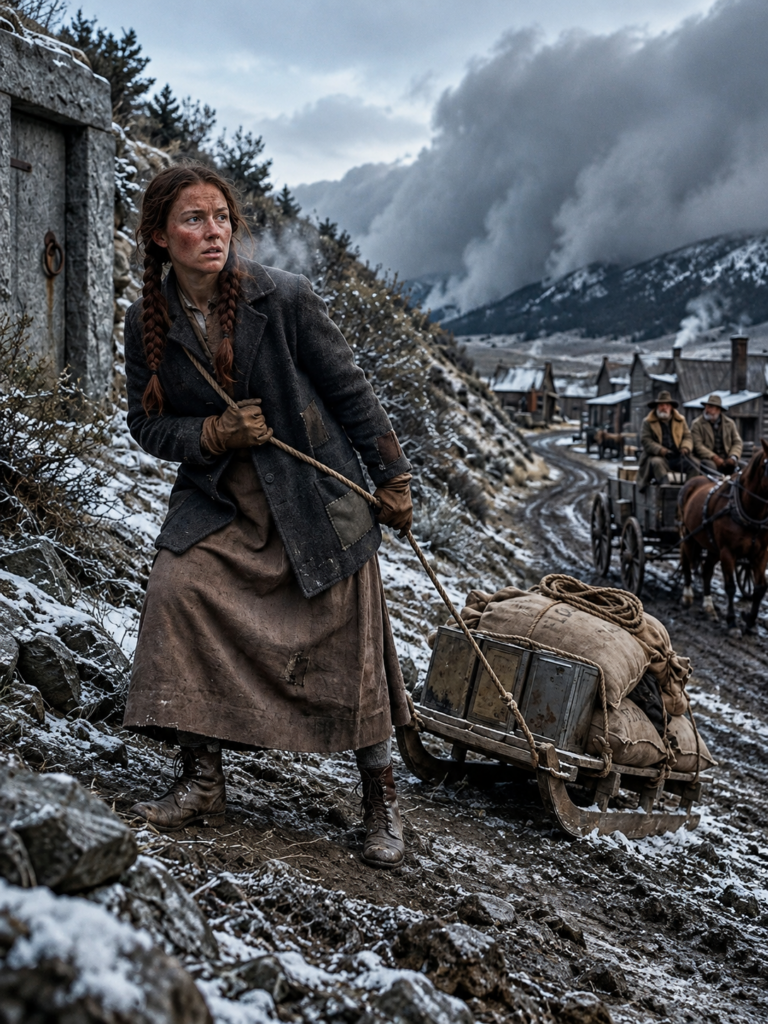
Part 1
The first warning came from a bucket of water.
It was the middle of October, and the afternoon sun was shining through the dusty windows of Bell’s Mercantile in Cinder Gap, Montana. Outside, wagon wheels rattled through muddy streets. Ranchers argued over the price of hay. Two boys chased each other past the blacksmith’s shop, laughing so loudly that even the horses turned their heads.
Nothing about the day suggested a disaster was coming.
But inside the store, eighteen-year-old Norah Vale was staring at a thin sheet of ice floating on a bucket of water.
The bucket stood three feet from a burning stove.
Norah touched the ice with one finger. It cracked beneath her hand, and the cold water stung her skin.
“Something wrong with that bucket?” asked Mr. Bell from behind the counter.
Norah looked toward the window.
“How long has the stove been burning?”
“Since before sunrise.”
She glanced down again.
The ice was already forming another delicate ring around the bucket’s edge.
“My father used to say,” she murmured, “that winter doesn’t always announce itself from the sky.”
Mr. Bell adjusted his spectacles.
“Your father knew a great deal about mountains.”
“Yes, sir.”
“He also knew better than to worry himself sick over a bucket.”
Norah gave him a small, respectful smile, but she did not laugh.
Outside, the Bitterroot Mountains stood beneath a pale, cloudless sky. Their upper slopes should have been white by now. Instead, dark pine forests stretched almost to the peaks, and the high meadows remained strangely bare.
That frightened her more than snow would have.
She had been watching the animals for nearly two weeks.
The deer had begun descending from the mountains in broad daylight. Mice had disappeared from the grain bins behind the mercantile. The geese were flying south so low that their wings nearly touched the cottonwood trees along the river.
And the smoke.
Every morning, chimney smoke crawled northward along the rooftops instead of rising.
Her father, Eli Vale, would have understood.
But her father had been dead for eleven months.
Norah still remembered the morning they brought his body home.
A broken harness chain had sent him beneath a freight wagon on the western road. The men who carried him into the house spoke softly, as though their whispers might somehow make the news less terrible.
His coat smelled of leather, cedar smoke, and the peppermint candies he carried in his pocket.
She had pressed her face into that coat until someone gently pulled it away.
After the funeral, her older half-brother, Wade, had told her she would always have a place beneath his roof.
For a while, he had meant it.
Wade was thirty-two, with their father’s broad shoulders and serious gray eyes. He worked hard, rarely complained, and loved his two young sons.
But that summer, grasshoppers ruined the fields.
The family cow stopped giving milk.
Feed prices doubled.
His wife, Nell, was expecting another baby, and the pantry shelves grew emptier every week.
One September evening, Wade called Norah into the kitchen.
She found him standing beside the open pantry.
Six sacks of grain sat against the wall.
He counted them once.
Then he looked at Nell, at the two boys eating potatoes beside the stove, and finally at Norah.
“I’ve been trying to find another way,” he said.
Norah felt something tighten beneath her ribs.
“Wade?”
He would not meet her eyes.
“We can’t feed another grown person through winter.”
Nell stared down at her hands.
Norah waited for her brother to explain what he meant.
He did not.
Instead, he lifted their father’s old wool coat from a chair and placed it on the bench beside her.
“I can give you two weeks.”
The kitchen became terribly quiet.
From the corner, four-year-old Thomas asked, “Is Aunt Norah going somewhere?”
Nobody answered him.
Norah looked at her brother.
“Papa helped build this house.”
“I know.”
“He worked the western road until his hands bled to pay for the land.”
“I know that too.”
“Then why am I the one leaving?”
Wade shut the pantry door.
“Because I have children to think about.”
The words struck harder than any shouted insult.
Norah wanted to say that she had washed those children’s clothes, soothed their fevers, and spent countless evenings helping Nell mend shirts by lamplight.
She wanted to remind him that their father had raised them both.
Instead, she looked at the family seated around the table and understood that Wade had already made his decision.
The following morning, she packed a blanket, a skillet, a bedroll, and two changes of clothing.
She had eleven dollars sewn inside the cuff of her dress.
At the doorway, Nell offered her half a loaf of bread.
Norah accepted it.
Wade stood near the stove.
“You can come by for supper sometimes,” he said.
Norah looked at him for a long moment.
Then she picked up her father’s coat.
“Thank you.”
She did not say goodbye to the children until she reached the gate.
Thomas ran after her and wrapped his arms around her knees.
“Will you come back before Christmas?”
Norah knelt in the dirt and hugged him.
“I hope so, sweetheart.”
She kissed his forehead.
Then she walked toward town.
For three nights, she slept in the hayloft above an abandoned assay office.
The building smelled of mice, old chemicals, and rotting timber. Wind slipped through gaps in the walls. Every creak of the roof made her wonder whether the whole structure might collapse.
On the fourth morning, the property owner discovered her.
He was not cruel.
He simply stood at the foot of the ladder and said, “Girl, that roof’s liable to come down in the first storm.”
“I’ll be careful.”
“Careful won’t hold rotten beams together.”
He glanced at her little bundle.
“I’m sorry.”
Norah nodded, climbed down, and carried her possessions into the street.
She had nowhere left to go.
Then she remembered the mountain.
When she was nine, her father had taken her along an abandoned survey trail above Cinder Gap.
They had climbed past the cemetery, through a stand of wind-bent fir trees, and up to a granite ridge overlooking the valley.
There, beneath tangled roots, he had shown her a rusted iron ring.
He pulled it.
A stone door opened.
Behind it lay a chamber carved into the mountain by railroad survey crews decades earlier.
The proposed railroad had never been built.
The men abandoned their tools and left the chamber behind.
But Eli Vale had discovered it while mapping the region.
He called it the high room.
Norah remembered how the chamber smelled of damp stone and ancient wood. Timber braces crossed the ceiling. A crude chimney ran upward through a crack in the granite.
Her father had shown her how to check the supports, clear the chimney, and listen for water moving behind the walls.
“People down below watch the calendar,” he told her.
He tapped the rock with his knuckles.
“Up here, you watch what the world is doing.”
Now, nine years later, Norah climbed that forgotten trail alone.
The old iron ring was still there.
She pulled with both hands.
At first, nothing moved.
Then the stone shifted inward with a low grinding sound.
Cold darkness waited beyond it.
Norah stepped inside.
Dust covered the floor. One corner held broken boards. The old stove pipe was badly rusted, and the wooden sleeping platform had collapsed.
Yet the roof remained solid.
The chamber was dry.
And the granite walls offered protection no abandoned barn could match.
Norah set down her belongings.
For the first time since leaving her brother’s house, she felt something close to relief.
“This will do,” she whispered.
That night, she slept on a blanket spread over dry pine needles.
Before closing her eyes, she took her father’s small brass compass from her coat pocket.
Its glass was scratched. The needle trembled whenever she moved.
He had carried it through thirty years of surveying work.
Norah held it against her chest.
“I found it again, Papa.”
The mountain answered with silence.
Over the next several days, she cleaned the chamber, repaired shelves from abandoned mine boards, and gathered fallen timber.
But she kept watching the valley.
Something was changing.
On the morning the geese flew south unusually low, she made her decision.
She would spend nearly everything she had on winter supplies.
Not tomorrow.
Not when the first snow came.
Now.
At Bell’s Mercantile, she bought flour, dried beans, oats, salt, onions, lard, lamp oil, and rope.
She loaded the goods onto a battered hand sled.
Mr. Bell watched her struggle with the canvas straps.
“You feeding a logging camp, Miss Vale?”
“Just myself.”
“For how long?”
Norah tightened the final knot.
“As long as the mountain decides.”
He laughed softly.
But she was not joking.
As she dragged the sled through town, three men outside the blacksmith’s shop stopped working.
Cal Rusk leaned against the doorway, holding a horseshoe.
“Well, look there! Little Norah Vale’s opening herself a store on the mountain!”
Another man grinned.
“Maybe she’s planning to sell snow to the Indians!”
Laughter rose around her.
Norah kept walking.
Cal called after her.
“What are you running from, girl?”
She stopped.
Her hands were red from the ropes.
She turned toward the men.
“I’m not running from anything.”
“Then what’s all this?”
Norah glanced toward the mountains.
“I’m paying a debt before winter comes to collect.”
The men stared.
Then one began laughing so hard he had to brace himself against the wall.
By evening, half the town had heard the story.
Children dragged broken crates through the street, pretending to be Norah Vale.
Women whispered that grief had damaged the poor girl’s judgment.
And Wade, hearing what his sister had done, shook his head over supper.
“She’s going to freeze herself to death up there.”
Nell looked toward the empty chair where Norah once sat.
“Maybe we ought to bring her home.”
Wade studied the small portions on his sons’ plates.
He said nothing.
High above town, Norah continued hauling.
She had no idea that within a few weeks, the very people laughing at her would be fighting for their lives.
Or that the mountain was hiding another person who had been watching her every move.
Part 2
By the third week of October, Norah’s hands were so badly blistered that she could barely close her fingers.
Every morning, she rose before sunrise, wrapped strips of cloth around her palms, and began another journey down the mountain.
Every evening, she returned with something useful.
Coal.
Flour.
Dried meat.
Rope.
Kindling.
A few candles.
Once, she carried a cracked iron kettle someone had thrown behind the blacksmith’s shop.
Another time, she found a discarded wool blanket with a large hole burned through its middle.
She washed it in the stream, cut away the damaged section, and stitched the remaining pieces together.
Nothing could be wasted.
The high room slowly began to resemble a home.
She built shelves along the north wall and arranged food according to how long it would keep.
She raised her sleeping pallet on cedar poles to keep it away from damp stone.
She packed moss and clay into cracks around the entrance.
She tested the chimney with damp grass and watched carefully to make certain the smoke escaped.
Her father had taught her that an underground shelter could become a deathtrap if the chimney failed.
She never forgot that lesson.
One evening, after carrying nearly eighty pounds of supplies uphill, she sank onto her blanket and removed her boots.
Both heels were bleeding.
She stared at the raw skin.
For a moment, she imagined the warm kitchen she had left behind.
The stove.
The smell of Nell’s bread.
Thomas climbing into her lap to hear a story.
Then she remembered Wade’s voice.
I have children to think about.
Norah shut her eyes.
She had loved those children too.
That was the part she could not stop thinking about.
She had never expected Wade to choose her over his sons.
She had only hoped he would try harder to find a place for everyone.
Outside, wind moved through the fir trees.
Norah pulled her father’s coat around her shoulders and opened a little notebook.
She had begun recording every item she carried into the shelter.
Fifty-two pounds of flour.
Twenty-nine pounds of beans.
Dried onions.
Lamp oil.
Coal.
Water.
She calculated how long the food might last.
Enough for one person through a difficult month.
Perhaps longer if she rationed carefully.
But something about the weather warned her that even this might not be sufficient.
The following morning, she noticed that the deer had disappeared from the lower slopes.
Two days earlier, she had seen twelve animals near the creek.
Now there were none.
The forest seemed unnaturally quiet.
Even the squirrels had stopped chattering.
She stood outside the high room and listened.
Far beneath the mountain, the town continued its ordinary business.
The contrast made her uneasy.
That afternoon, she went to the hotel dining room, where ranchers often gathered for lunch.
Sheriff Hollis sat beside the stove with three cattle buyers.
Norah waited until their conversation paused.
“There’s a hard storm coming,” she said.
One man looked up.
“Is that so?”
“Bring your cattle down from the upper pasture. Fill your water barrels. Cut twice the wood you think you’ll need.”
Sheriff Hollis set down his coffee.
“Where’d you hear this?”
“From the mountains.”
The cattle buyers exchanged glances.
Norah continued.
“The deer are leaving. The geese are flying unusually low. Miller’s upper spring stopped running yesterday.”
One young man smiled.
“And I suppose that bucket at Bell’s store told you too?”
A few people chuckled.
Norah ignored them.
“Cold air is settling in the high country. When it moves into the valley, it may happen quickly.”
The sheriff rubbed his chin.
“Miss Vale, we’ve had strange Octobers before.”
“Not like this.”
“You got something more reliable than birds and buckets?”
She thought of her father.
Of the countless nights he had spent studying mountain weather.
Of his insistence that small changes often mattered more than dramatic ones.
“No, sir,” she said. “Only what I’ve seen.”
The sheriff pushed his chair back.
“Then I suggest you don’t go frightening people without a proper reason.”
The conversation ended.
Norah walked outside.
She was halfway down the steps when someone called her name.
“Norah.”
Adah Pike stood near the porch railing.
The old midwife was nearly seventy, with silver hair beneath a black shawl and hands worn by decades of difficult work.
She had delivered half the children in Cinder Gap.
She had also buried more than a few.
Adah looked toward the clear northern sky.
“My mother used to call weather like this the widow’s smile.”
Norah turned.
“Why?”
“Because it looks kind right before it takes your husband.”
A chill traveled down Norah’s spine.
Adah placed a thin hand over hers.
“Keep carrying, child.”
Those four words meant more than any speech the town might have given her.
Norah returned to the mercantile and asked Mr. Bell whether he had more coal.
He frowned.
“You’ve already bought nearly everything I can spare.”
“I can pay for some now. The rest in spring.”
He looked at the coins in her hand.
“Spring’s a long way off.”
“I know.”
For a moment, he appeared ready to refuse.
Then he took out his account book.
He wrote down the debt and went into the storeroom.
When he returned, he carried a sack of coal and another sack tied with twine.
“Cracked corn,” he explained.
Norah shook her head.
“I didn’t ask for that.”
“I know.”
“I can’t pay for it.”
“You can tell me I was foolish come spring.”
She swallowed.
“Thank you, Mr. Bell.”
He gave a dismissive wave.
“Get yourself home before dark.”
That word stayed with her all the way up the trail.
Home.
She had begun thinking of the granite chamber that way.
At the ridge, Norah stopped.
Fresh boot prints marked the thin dirt beside the entrance.
They were large.
Much larger than hers.
The tracks came from the eastern slope, stopped near the hidden stone door, then disappeared back among the rocks.
She examined them carefully.
Someone had been there.
Norah opened the chamber.
Nothing seemed disturbed.
The supplies stood exactly where she had left them.
But beside the stove lay a clean section of metal pipe.
She stared at it.
The existing chimney was rusting through near the upper bend.
The new pipe looked as though someone had measured the opening before bringing it.
Norah turned toward the rear wall.
Several nights earlier, she had heard a faint scraping sound behind an angled timber support.
She had investigated with a lantern and discovered a narrow current of cold air moving through a crack.
Her father had once mentioned a second passage, though she had never found its entrance.
Now she wondered whether someone else knew it.
“Who’s there?” she called.
Her voice echoed faintly.
No answer came.
She stood motionless for almost a minute.
Then she lowered the lantern.
Whoever had entered had not taken anything.
Instead, they had left something she badly needed.
She installed the new pipe before sunset.
That night, while eating beans beside the stove, Norah heard the scraping again.
Slow.
Deliberate.
Leather against stone.
She reached for her short-handled splitting maul.
“Whoever you are,” she said, “I know there’s another passage.”
Silence.
Then a small movement behind the timber.
Norah raised her lantern.
The flame leaned sideways in a draft.
“Show yourself.”
Nothing.
She waited a long time.
Finally, she sat with the maul across her knees.
She did not sleep until dawn.
When morning came, something rested beside the entrance.
A burlap bundle.
Inside were two cleaned snowshoe hares and a small tin of rendered fat.
No message.
No explanation.
Norah looked toward the hidden passage.
“Why are you helping me?”
The mountain remained silent.
She carried the bundle inside.
The meat went into a stew.
The bones became broth.
The fat helped waterproof her damaged boots.
Norah did not know whether the stranger was kind, dangerous, lonely, or merely curious.
But she understood one thing.
Someone else believed the storm was coming.
By late October, the afternoons had become almost warm.
Laundry hung outside overnight without freezing.
Ranchers delayed moving their cattle.
Children played without coats.
The hotel owner called it the finest autumn he could remember.
Norah called it borrowed time.
She kept hauling supplies.
One evening, she passed Wade’s farm on her way toward the mountain.
Thomas spotted her from the fence.
“Aunt Norah!”
He ran toward her, followed by his older brother.
Norah stopped and knelt.
The boys threw themselves into her arms.
For a moment, she forgot the cold, the loneliness, and the terrible ache in her hands.
Thomas touched her torn mitten.
“Why are your fingers all wrapped up?”
“Just working hard.”
“Papa says you live in a cave.”
“A very nice cave.”
“Does it have a stove?”
“It does.”
“Does it have biscuits?”
She smiled.
“Not today.”
Wade appeared in the doorway.
He watched his sons hugging her.
Then he walked toward the fence.
“Norah.”
“Wade.”
His eyes moved toward the sled.
“Still carrying food up there?”
“Yes.”
“People are talking.”
“I know.”
“You’re making a fool of yourself.”
She stood.
“Maybe.”
“Winter supplies belong near town, not halfway up a mountain.”
Norah looked toward the dark ridge.
“Not if the town ends up beneath ten feet of snow.”
Wade gave a short, tired laugh.
“You’re starting to sound like Papa when he got one of his notions.”
“He was right more often than people realized.”
“Norah, you can’t live your whole life chasing his ghosts.”
She flinched.
Wade noticed.
For an instant, regret crossed his face.
But pride kept him from apologizing.
Nell appeared behind him, one hand resting on her swollen belly.
“You look thin, Norah.”
“I’m managing.”
“You ought to come in for supper.”
Wade looked back at the house.
Then at the sled.
Norah understood his hesitation.
She forced a smile.
“Thank you, but I need to get up the trail before dark.”
Thomas clung to her skirt.
“Will we visit your cave?”
Norah brushed the hair from his forehead.
“When the weather clears, sweetheart.”
The boy frowned.
“But it’s clear now.”
She looked toward the mountains.
“That’s what worries me.”
That night, back in the high room, she opened her ledger and counted again.
The shelves were fuller than before.
Flour.
Beans.
Corn.
Meat.
Coal.
Water.
Yet the sight brought little comfort.
The air pressure felt wrong.
The mountain was too still.
Shortly before midnight, Norah stepped outside.
The town below glittered with lamplight.
Music drifted faintly from the hotel.
Then she noticed the northern stars disappearing.
Not behind ordinary clouds.
Behind a low gray wall that seemed to rise from the ground.
A distant roar moved through the valley.
It sounded like a thousand wagons crossing a wooden bridge.
Norah stood frozen.
Her father had described such a sound once.
He had heard it before a blizzard trapped a survey crew in the mountains for six days.
She rushed inside, secured the stone door, and checked the chimney.
Then she looked down at her ledger.
She had prepared for one person.
Something in her chest told her that would not be enough.
At eleven that night, the wind struck.
It did not arrive as a gust.
It hit the mountain like a moving wall.
The stone door slammed against its iron pin.
Dust sifted from the ceiling braces.
Every flame in the chamber bent sideways.
Norah grabbed the edge of the stove.
Then the snow began.
And Cinder Gap disappeared.
Part 3
By dawn, the world outside the high room had ceased to exist.
Norah could hear nothing except the storm.
Wind screamed through cracks in the granite. Snow pressed against the stone entrance with such force that the door shuddered in its frame.
She had never heard weather like it.
Not even during the hardest winters of her childhood.
Around three in the morning, smoke began pouring back through the stove.
Norah woke coughing.
She stumbled from her blankets and opened the stove damper.
Instead of rising, smoke rolled into the room.
The chimney was blocked.
She soaked a cloth in water, tied it around her nose and mouth, and climbed onto the woodpile.
With both hands gripping the maul, she struck the new chimney pipe upward through the vent.
Once.
Twice.
A third time.
Ice broke loose.
For several terrifying seconds, nothing changed.
Then the draft caught.
Smoke rushed upward.
Norah nearly collapsed with relief.
She looked at the clean section of pipe.
Without it, she might already have been dying.
“Whoever you are,” she whispered toward the rear wall, “thank you.”
She kept the fire low through the morning, feeding it only enough fuel to prevent the water from freezing.
By sunrise, the pressure against the entrance had increased.
Norah took her coal shovel and began digging from the inside.
The snow was packed so tightly that it broke away in hard slabs.
It took her nearly an hour to create an opening wide enough to crawl through.
When she finally pushed her head outside, she could scarcely believe what she saw.
The town was gone.
The church steeple rose from a field of white.
The upper windows of the hotel barely showed above the drifts.
Fences had disappeared.
Barns looked like shallow mounds.
The road that had carried freight wagons only yesterday was buried beneath an unbroken blanket of snow.
Norah stared.
Her worst fear had come true.
Then she saw something moving near the cemetery.
A dark shape rose above the snow.
Fell.
Rose again.
At first, she thought it might be a deer.
Then she saw an arm.
Someone was crawling toward the mountain.
Norah rushed back inside.
She took her longest rope and tied one end around a granite brace.
The other she fastened securely around her waist.
Then she pulled on her father’s coat, wrapped a scarf across her face, and stepped into the storm.
The cold struck like a blow.
Within moments, her eyelashes began freezing together.
She could barely see beyond the length of her arm.
She followed the rope downhill, using the shovel handle to test the snow before every step.
Twice, her boots plunged into hidden hollows.
Once, a gust lifted her sideways and slammed her against a buried rock.
Pain shot through her shoulder.
She kept moving.
At last, she reached the dark shape.
A man was crawling on his hands and knees.
Something was tied to his back.
“Help!” he shouted when he saw her.
It was Ben Larkin, the schoolmaster.
Blood had frozen along his cheek.
Strapped behind him was his ten-year-old nephew, Jaime.
The boy’s face was pale and motionless.
“What happened?” Norah shouted.
“The schoolhouse chimney collapsed! We tried the hotel, but the roof’s gone!”
Norah pressed two fingers beneath Jaime’s jaw.
A faint pulse.
She swallowed her fear.
“Give him to me.”
Ben stared at her.
“He’s too heavy!”
“Give him to me!”
She freed the child from his uncle’s back and secured him beneath her own coat as best she could.
Then she placed Ben’s hands around the rope.
“Hold on with both hands!”
“I can walk!”
“You can fall while holding on!”
They began climbing.
The journey lasted less than ten minutes.
To Norah, it felt like an entire night.
Ben sank waist-deep into a hidden drift.
Norah nearly lost her footing while pulling him free.
Jaime did not move.
By the time they reached the stone entrance, Norah’s arms were trembling uncontrollably.
She dragged the boy inside and laid him on blankets near the stove.
His boots were frozen solid.
She removed them carefully, wrapped his feet in dry wool, and began warming him gradually.
Ben collapsed against the wall.
He looked around the chamber.
The neatly stacked wood.
The jars of dried food.
The water containers.
The coal.
The blankets.
Everything Norah had spent weeks carrying uphill.
His mouth opened.
For a moment, no words came.
Then he whispered, “You knew.”
Norah continued working.
“I was afraid.”
“Everyone laughed at you.”
“I remember.”
Ben looked at Jaime.
“God forgive us.”
Norah handed him a cup of warm broth.
“Drink. You’ll be more use to him if you’re conscious.”
Twenty minutes later, Jaime coughed.
Ben fell to his knees beside the boy.
“Jaime?”
The child opened his eyes.
“Uncle Ben?”
Ben covered his face and wept.
Norah turned toward the stove.
She had never felt so exhausted.
Yet before she could sit down, someone knocked against the stone entrance.
Three desperate blows.
She opened the door.
Cal Rusk stood outside with his wife and infant daughter.
They were tied together with strips of harness leather.
Cal’s beard was white with frost.
“My shop’s gone!” he shouted. “Please!”
Norah moved aside.
“Get inside.”
An hour later, Adah Pike arrived guiding two frightened children.
Their mother had been injured when a roof beam collapsed.
Then came Mr. Bell, bleeding from a deep cut across his palm.
Then a widow from the north road.
Then three miners who had abandoned their cabin when snow buried the windows.
Every time the entrance opened, the storm fought to enter.
Every time, Norah made room.
She placed the smallest children nearest the stove.
She hung wet coats along the warmest wall.
She gave Adah her medical supplies.
She asked Cal to inspect the timber braces.
She asked Ben to help measure the drinking water.
No one questioned her instructions.
By nightfall, eleven people crowded into the high room.
The following morning, there were sixteen.
By the third day, twenty-one.
Norah’s refuge had become the only safe place many of them knew.
But she had not prepared for twenty-one people.
The food began disappearing frighteningly fast.
Each morning, she opened her ledger.
She counted.
Measured.
Calculated.
Recalculated.
On the third afternoon, while she was dividing dried beans into smaller portions, someone knocked again.
Norah opened the door.
Wade stood outside.
Snow covered his shoulders.
Nell leaned heavily against him.
Their two boys clung to his coat.
For a moment, brother and sister stared at each other.
Wade looked older than he had three days earlier.
His lips trembled.
“Norah.”
She looked past him toward Nell.
“Where’s the baby?”
“Not yet,” Nell whispered.
Then her expression twisted.
She bent forward with a cry.
Adah hurried to the entrance.
“How long have the pains been coming?”
“Since this morning.”
Adah placed a hand on Nell’s belly.
Then she looked at Norah.
“We need clean blankets and hot water.”
Norah turned immediately.
“Cal, move that woodpile. Ben, take the boys. Mr. Bell, put another kettle on.”
Wade remained frozen near the door.
He seemed unable to move.
Norah looked at him.
“Wade.”
He raised his eyes.
“Your wife needs you.”
The words broke through his shock.
He hurried to Nell’s side.
The high room became a birthing room.
Adah laid clean sheets beside the stove.
Norah boiled water and prepared strips of linen.
The men moved to the far wall while Nell struggled through one painful contraction after another.
Outside, the storm hammered the mountain.
Inside, the little room waited.
Hours passed.
Nell cried out.
Wade held her hand.
Norah sat beside her sister-in-law, pressing a cool cloth against her forehead.
At one point, Nell caught her wrist.
“I’m sorry,” she whispered.
Norah hesitated.
“For what?”
Nell’s eyes filled with tears.
“For letting you leave.”
Norah’s throat tightened.
She looked toward the two boys sleeping beneath a blanket.
“Save your strength.”
“But I should’ve said something.”
Norah squeezed her hand.
“Then say it when we’re all safe.”
Near midnight, after fourteen hours of labor, a baby’s cry rose above the wind.
Everyone in the chamber went still.
Then Adah smiled.
“A girl.”
Wade sank against the wall.
He covered his face.
His shoulders shook.
Adah wrapped the child in one of Eli Vale’s old wool shirts.
Norah recognized the faded blue stitching along the collar.
Her father had worn that shirt on summer surveying trips.
Seeing it around the newborn brought sudden tears to her eyes.
Nell held the baby against her chest.
“What should we call her?”
She looked toward Norah.
Norah shook her head.
“Give her a name that belongs to a warmer future.”
Adah smiled faintly.
“That’s a fine wish.”
For the first time in days, the room filled with something other than fear.
But the moment could not last.
The next morning, Norah opened her ledger again.
Twenty-two people.
The flour would last four days at full portions.
Beans and corn, perhaps five.
Coal, six days if carefully managed.
The storm showed no sign of ending.
Norah stared at the figures.
Then she crossed out the daily ration amounts.
She reduced every portion by one-third.
When she told the others, nobody complained.
Ben helped distribute the food.
Cal repaired a broken shovel.
Mr. Bell cleaned and bandaged his injured hand.
Wade volunteered to carry waste buckets through the lower passage.
Everyone found work.
Yet with each passing day, the shelves grew emptier.
On the fourth morning, Norah noticed something that made her stomach twist.
Jaime’s toes were turning dark at the tips.
Adah examined them quietly.
She did not promise that all would be well.
They continued warming and protecting his feet as best they could.
Another miner developed a fever.
The chimney iced over twice.
And the wind never stopped.
That evening, Norah opened the final flour sack.
Only a little remained at the bottom.
She scraped the dust into a bowl.
Adah watched from the opposite wall.
“How long?”
Norah did not answer immediately.
Then she whispered, “Two days.”
The old woman looked toward the sleeping children.
“The storm could last longer.”
“I know.”
Adah reached beneath her shawl and removed a small cloth pouch.
She opened it.
Dried beans.
Apple slices.
A little sage.
Norah stared.
“Where did you get that?”
“Been carrying it in a pocket of my burial dress.”
Despite everything, Norah nearly laughed.
Adah shrugged.
“Decided I wasn’t ready to wear it just yet.”
She poured the food into Norah’s hands.
That small act began something no one expected.
Ben opened the lining of his coat and removed two hidden packets of oats.
“I kept these for Jaime.”
Cal produced a slab of bacon wrapped in newspaper.
Mr. Bell revealed rice and coffee sewn into his bedroll.
One miner offered dried mushrooms.
Then Wade stood.
He reached beneath his shirt and pulled out three pounds of cornmeal.
His face burned with shame.
“I was keeping it for my boys.”
No one spoke.
Wade looked at Norah.
“I thought… if things got worse, at least they’d have something.”
Norah stared at the cornmeal.
Then she said quietly, “You were trying to protect them from everyone else.”
He nodded.
She looked around the crowded room.
“Now everyone else is protecting them too.”
Wade’s shoulders folded.
He placed the cornmeal on the shelf.
One by one, people stepped forward.
A little food.
A little fuel.
An extra blanket.
A pair of dry socks.
Not enough to make anyone comfortable.
But enough to remind them they were no longer alone.
That night, while the others slept, Norah heard a sound behind the rear wall.
One scrape.
Then three measured knocks.
She lifted her lantern.
The angled timber moved slightly.
And for the first time, Norah heard a human voice coming from the darkness beyond it.
“Miss Vale?”
Her heart began pounding.
The stranger paused.
Then said something that made her grip the lantern with both hands.
“Your father told me about you.”
Part 4
Norah stood motionless beside the rear wall.
The lantern trembled in her hand.
Outside, the storm continued battering the mountain, but she barely heard it.
Her father had been dead for nearly a year.
Yet somewhere beyond that narrow crack, a stranger had spoken his name.
“Who are you?” she demanded.
A pause followed.
Then the voice answered.
“Someone who owes Eli Vale more than I can repay.”
Norah swallowed.
“How do you know my father?”
“Helped him survey the old railroad grade.”
She looked toward the sleeping people behind her.
Most were too exhausted to stir.
Cal Rusk sat awake near the stove, repairing a broken hinge.
He noticed her expression and set down his tool.
“Norah?”
She raised one hand for silence.
The voice came again.
“There’s a second entrance farther up the ridge. I can’t bring what I’ve got through this wall unless you move that brace.”
Norah’s pulse quickened.
“What have you got?”
“Supplies.”
She wanted to believe him.
She wanted it so desperately that she was afraid to.
“How much?”
“Enough to make a difference.”
Cal rose and approached.
“Who’s back there?”
“I don’t know.”
He looked at the timber.
“Could be a trap.”
Norah knew he was right.
The mountain held abandoned shafts, unstable tunnels, and men who sometimes preferred isolation because the law was looking for them.
But the food was running out.
The children were hungry.
And a stranger who knew her father had already helped her survive the blocked chimney.
Norah made her choice.
“Cal, stay here.”
“You’re not going in there alone.”
She handed him the ledger.
“If I don’t come back, keep the fire low and divide the food equally.”
He stared at her.
“Norah—”
“Promise me.”
Cal’s jaw tightened.
Finally, he nodded.
Norah set down the lantern and gripped the angled support.
It moved with difficulty.
Stone dust fell from the wall.
A narrow passage appeared behind it.
Cold air rushed across her face.
She crouched and entered.
The tunnel sloped upward through raw granite.
In places, she had to crawl beneath old beams.
Her lantern illuminated rusted bolts, abandoned drill holes, and strips of rotten timber.
She moved carefully.
Then, around a bend, she saw another light.
An old man stood beside a narrow opening in the ridge.
He wore a heavy buffalo coat, patched trousers, and a fur cap pulled low over his white hair.
Beside him waited a small mountain mule.
A freight sled was tied behind the animal.
It was piled high beneath thick hides.
The man studied Norah.
Then his weathered face softened.
“You have Eli’s eyes.”
Norah stopped a few feet away.
“Who are you?”
“Gideon Shaw.”
She searched her memory.
Her father had mentioned many surveyors, railroad workers, and mountain men.
The name sounded faintly familiar.
Gideon leaned against his walking stick.
“Your father and I worked this ridge when the railroad company still thought it could drive a line through the upper pass.”
“When?”
“Long before you were born.”
He glanced down the tunnel.
“This room was originally meant to store blasting powder. The railroad abandoned it when the engineers decided the grade was too steep.”
Norah stepped closer.
“My father found it later.”
“Yes. And he helped us make it safe.”
Her eyes narrowed.
“Us?”
“Three men stayed here one winter. We reinforced the walls, installed the first stove, and cut the upper passage.”
Norah remembered the old timber braces.
The carefully fitted chimney.
The entrance hidden among the fir roots.
“My father never told me anyone else knew.”
Gideon gave a sad smile.
“Your father knew there are some places worth keeping quiet.”
He removed his gloves.
His fingers were crooked with age.
“After the railroad abandoned this route, I spent years trapping on the eastern slope. Came back here every autumn. Kept a little food stored away.”
Norah looked toward the sled.
“Why didn’t you show yourself before?”
The old man considered her.
Then he spoke carefully.
“Because supplies can change people.”
Norah said nothing.
“I’ve seen hungry men steal from children. I’ve seen neighbors turn on each other over half a sack of flour.”
His gaze moved toward the hidden chamber below.
“When I first saw you hauling food uphill, I wondered whether you’d shut that door on anyone who needed help.”
Norah stiffened.
“So you watched me?”
“I watched what you carried. I watched how you worked. And when the storm came, I watched who you brought inside.”
She thought of Ben crawling through the snow.
Of Jaime’s frozen boots.
Of Wade standing at the entrance with his family.
“I couldn’t leave them out there.”
Gideon nodded.
“Your father wouldn’t have either.”
For several seconds, neither spoke.
Then Norah asked the question she feared most.
“What’s beneath those hides?”
Gideon pulled back the covering.
Sacks of barley.
Dried peas.
Smoked elk meat.
Hardtack.
Candles.
Lamp oil.
Norah stared.
She had not seen so much food since leaving her brother’s farm.
Her knees felt weak.
“Where did you get all this?”
“Stored some. Traded for some. Brought the rest up before the storm shut the eastern pass.”
He lifted a sack.
“I figured the town might need it.”
Norah looked at him.
“Then why did you wait?”
Gideon met her eyes.
“Because food alone doesn’t save people. Someone has to make sure it’s shared.”
He glanced toward the room where twenty-two frightened souls waited.
“You’ve already done the hardest part.”
Norah shook her head.
“No. I haven’t.”
The old man tilted his head.
“What’s that?”
“Keeping them alive until the storm ends.”
Gideon studied her.
Then he smiled for the first time.
“Well, we’d better get to work.”
Together, they began unloading the sled.
Norah carried smaller bundles.
Gideon shouldered the heavy sacks.
They passed through the narrow tunnel again and again.
By the third trip, Norah’s arms burned.
By the fifth, her injured shoulder was throbbing.
But she kept moving.
At last, she entered the high room carrying a sack of barley.
Everyone looked up.
Ben rose slowly.
“Norah?”
She lowered the sack onto the floor.
More footsteps sounded from the passage.
Gideon emerged behind her, carrying smoked meat.
Silence filled the room.
Mr. Bell removed his spectacles.
Cal stood motionless.
Adah Pike pressed one hand against her mouth.
Wade stared at his sister.
No one cheered.
For several seconds, they seemed unable to believe what they were seeing.
Then little Thomas woke and sat upright.
“Aunt Norah?”
She turned.
He pointed at the food.
“Does that mean we can eat tomorrow?”
Norah knelt beside him.
She put her arms around his small shoulders.
“Yes, sweetheart.”
He smiled sleepily.
“Good.”
Then he curled against his blanket and closed his eyes again.
Norah looked away before anyone saw her tears.
Gideon set down his final sack.
He looked around the room.
“I brought the food,” he said.
Then he nodded toward Norah.
“But she’s the reason it matters.”
Still, Norah did not celebrate.
She opened her ledger.
Counted every sack.
Measured every portion.
Worked out how many extra days the food would provide.
Gideon showed Cal how to improve airflow through a second vent, allowing the stove to burn more efficiently.
Ben helped reorganize the shelves.
Mr. Bell divided the new supplies into sealed containers.
Adah checked the children.
For the first time in days, the people in the high room had something more useful than hope.
They had a plan.
But the storm had not finished with them.
On the sixth night, a deep cracking sound traveled through the mountain.
The room shuddered.
Dust fell from the timber braces.
The children screamed.
Cal ran toward the back wall.
“That support’s shifting!”
A heavy beam had begun separating from its stone socket.
Above it, the ceiling creaked.
Norah grabbed the lantern.
Gideon hurried beside her.
They examined the brace.
The old man ran his hands along the timber.
“Pressure from the snow outside.”
Cal looked up.
“Will it hold?”
Gideon did not answer immediately.
Then he said, “Not without help.”
Norah turned toward the men.
“Bring the spare boards.”
The miners rose.
They worked in the dim lantern light, cutting and wedging timbers beneath the weakened support.
Cal used his pocket hammer.
Ben carried wedges.
Wade held a heavy beam upright while the others secured it.
His arms shook from the strain.
“Don’t let go!” Cal warned.
“I won’t!”
The timber groaned.
Norah slid another wedge into place.
“Now!”
Cal struck it with the hammer.
The brace settled.
The cracking stopped.
Everyone waited.
Only the wind could be heard.
Finally, Gideon stepped back.
“That should hold.”
Wade released the beam.
He staggered toward the wall and sank onto the floor.
Norah approached.
“Are you hurt?”
He shook his head.
His eyes filled.
“I almost let go.”
“But you didn’t.”
He looked at her.
For a moment, she saw the older brother who had taught her to saddle a horse and carried her across flooded creeks when she was little.
Then he whispered, “I let go of you.”
Norah stood very still.
Wade lowered his head.
“When I sent you away.”
She swallowed.
Around them, people returned slowly to their blankets.
He continued in a broken voice.
“I told myself I was being practical. That there wasn’t enough food. That I had no choice.”
Norah waited.
“But there was a choice.”
His hands trembled.
“I could’ve shared what we had. I could’ve asked for help. I could’ve done something besides hand you Papa’s coat and send you into the street.”
The words she had waited weeks to hear were finally spoken.
Yet they did not erase the nights she had spent cold and alone.
Norah sat beside him.
“I was frightened, Wade.”
He covered his eyes.
“I know.”
“No. You don’t.”
He looked at her.
She spoke quietly.
“I slept in a barn that nearly collapsed. I went hungry. I walked up here wondering whether I’d survive winter.”
A tear moved down her cheek.
“And every night, I wondered why my own brother hadn’t wanted me.”
Wade’s face crumpled.
“I wanted you.”
“Then you should’ve acted like it.”
He bowed his head.
For a long time, neither spoke.
Finally, Wade whispered, “I’m sorry.”
Norah looked toward Nell and the three children sleeping together.
The newborn’s little hand rested against her mother’s cheek.
“I know you are.”
Wade turned toward her.
“Will you ever forgive me?”
Norah looked into the fire.
“I don’t know yet.”
The answer hurt him.
But she would not lie simply to ease his shame.
She placed one hand over his.
“What matters tonight is keeping everyone alive.”
He nodded.
And when dawn came, Wade rose before anyone else to clear the lower passage.
He did not ask for praise.
He simply worked.
The storm continued for three more days.
Nine days in all.
And when the silence finally came, the people of Cinder Gap discovered just how completely their world had changed.
Part 5
On the ninth morning, Norah woke because something was missing.
For several seconds, she lay still beneath her blanket.
Then she understood.
The wind had stopped.
No screaming through the granite.
No pounding against the stone entrance.
No low, endless roar beyond the walls.
Only the faint crackle of the stove and the gentle breathing of sleeping children.
Norah sat upright.
Gideon Shaw was already awake.
He stood near the rear passage, holding his lantern.
“It’s over,” he said.
Norah stared at him.
“Are you certain?”
He nodded toward the ceiling.
“Listen.”
She did.
For the first time in nine days, the mountain was quiet.
Together, they climbed the upper passage.
Gideon pushed against the hidden hatch.
It resisted.
Then the snow broke loose, and bright sunlight flooded the tunnel.
Norah raised one hand to shield her eyes.
The valley below had become a white ocean.
Trees rose from the drifts like broken black fingers.
Only chimneys and rooftops marked where buildings stood.
Smoke climbed from three places in town.
Just three.
Norah stared at the destruction.
Then she turned toward Gideon.
“We need to get everyone home.”
He shook his head gently.
“First, we make sure there’s something left to go home to.”
The survivors descended in small groups, tied together with rope.
Cal led the first party.
Ben followed with Jaime.
The boy could walk only with assistance, and Adah warned that his injured toes would need proper medical attention as soon as possible.
Wade carried the newborn against his chest beneath his coat.
Nell walked beside him, leaning on Norah.
The descent was slow.
Snow concealed fallen branches, broken fences, and deep hollows.
At the cemetery, they paused.
Norah could barely recognize the place.
The fence was buried.
Only the tops of the headstones showed.
Farther down, the hotel roof had collapsed into the dining room.
The schoolhouse was split along one wall.
Half the livery had been crushed.
At the south fence, several cattle lay frozen where ranchers had waited too long to move them into shelter.
The sight brought tears to the eyes of men who had spent their lives raising livestock.
Mr. Bell stood in front of his damaged store.
Snow had forced its way through the rear windows.
His roof sagged badly.
He removed his hat.
“Twenty-eight years,” he whispered. “Took me twenty-eight years to build this place.”
Norah stood beside him.
“You can build it again.”
He looked toward the mountain.
“Wouldn’t have been here to try if it wasn’t for you.”
She did not know what to say.
By afternoon, word spread through the surviving homes.
Twenty-two people had walked out of the mountain alive.
Among them was a baby born while the town disappeared beneath the storm.
The story traveled from house to house.
People learned about the shelter.
The supplies.
The careful rationing.
The unknown old mountain man.
They learned how close the food had come to running out.
And they remembered the young woman they had laughed at.
A week later, the mayor called a meeting inside the church.
It was the largest building with a sound roof.
The pews filled quickly.
Farmers arrived with bandaged hands.
Women carried infants wrapped in extra shawls.
Ranchers came wearing patched coats and boots stiff with dried mud.
Everyone was tired.
Everyone had lost something.
Yet the room grew quiet when Norah entered.
She wore the same charcoal coat, still patched at both elbows.
Her boots were worn nearly through.
Her auburn hair was braided simply down her back.
She looked like the same young woman who had dragged a sled through town while people laughed.
But no one laughed now.
Cal Rusk stood.
“Norah, there’s a place for you up front.”
She shook her head.
“I’m fine here.”
The mayor rose beside the cold iron stove.
“Miss Vale, please.”
Norah hesitated.
Then she walked down the aisle.
Mayor Tomlin cleared his throat.
“We’ve gathered to discuss what should be done with the shelter in the mountain.”
Cal raised his hand.
“I say we name it after her.”
Several people murmured agreement.
“And the road too,” someone added.
Mr. Bell stood.
“She saved my life. Saved half the folks in this room.”
Ben Larkin rose beside him.
“Without Norah, my nephew would be dead.”
He paused.
“And without her, I would be too.”
Norah stared at the floor.
She had imagined many things during those lonely nights in the shelter.
She had imagined dying.
She had imagined spring arriving.
She had imagined finding work, perhaps at the schoolhouse or the mercantile.
But she had never imagined a room full of people standing to honor her.
The mayor turned toward her.
“What would you like us to do, Miss Vale?”
Norah looked at the faces before her.
The sheriff who had dismissed her warnings.
The ranchers who had laughed.
The neighbors who had ignored the sled.
Her brother.
Her sister-in-law.
The children.
She could have asked for money.
She could have demanded an apology from every person who mocked her.
She could have asked them to build a monument.
Instead, she placed her battered ledger on the pulpit.
“I want every family in Cinder Gap to keep winter supplies.”
The mayor nodded.
“Of course.”
“And I want the high room filled before the first freeze every year.”
“We can arrange that with town funds.”
Norah shook her head.
“Not just town funds.”
The mayor frowned.
“What do you mean?”
“Money can buy flour,” she said. “But it can’t carry it uphill.”
The church grew quiet.
“It can’t cut firewood. It can’t repair the chimney. It can’t check the timber braces or remember which child needs medicine.”
She opened the ledger.
“Every family needs to help.”
A few people nodded.
“Even families who can only spare a candle or a pair of socks.”
Norah looked toward the back pew.
“Especially those families.”
She turned another page.
“Winter keeps accounts.”
The words hung in the air.
“It counted every day we waited. Every roof we didn’t strengthen. Every sack of grain we thought we could buy later.”
She looked toward Sheriff Hollis.
“It counted the warnings we ignored.”
The sheriff lowered his head.
Then she looked toward Wade.
“And it counted what we shared.”
Wade’s eyes filled.
Norah closed the ledger.
“I don’t want the room named after me.”
She glanced toward the mountains through the church window.
“I want it ready for the next person who needs it.”
No one spoke for a long moment.
Then Adah Pike rose.
Her cane struck the wooden floor.
“That’s what Eli Vale would’ve wanted.”
Norah’s breath caught.
Adah smiled at her.
“And he’d be mighty proud of his girl.”
Tears blurred Norah’s vision.
She pressed her lips together, but one tear escaped.
The mayor removed his spectacles.
“Then that’s what we’ll do.”
A quiet murmur of agreement spread through the church.
No one mentioned a monument again.
That spring, Cinder Gap began rebuilding.
Men repaired the schoolhouse and cleared the roads.
The hotel owner replaced the collapsed roof.
Ranchers gathered surviving cattle and repaired fences.
Mr. Bell reopened his store beneath a temporary canvas covering while carpenters worked on the building.
And every week, someone climbed the trail to the high room.
Cal forged a stronger iron door.
The miners reinforced the ceiling.
Ben brought chalk, slates, and books for children who might someday need shelter there.
Adah filled a wooden chest with bandages, clean cloth, herbs, and simple medical supplies.
Mr. Bell donated sealed tins and barrels of flour.
Families carried preserved meat, beans, candles, blankets, and matches.
Some brought only one small thing.
A jar of salt.
A bundle of dry socks.
A single candle.
Norah recorded every contribution.
She kept the ledger just as carefully as before.
But she no longer worked alone.
That summer, Wade came to the mountain almost every Saturday.
He hauled coal.
Repaired shelves.
Cleared fallen branches from the trail.
Sometimes he brought Thomas and his older brother.
The boys loved exploring the shelter while Norah taught them how to stack wood, check the stove, and identify safe places to store food.
One afternoon, after the children had gone outside, Wade found Norah repairing the old sleeping platform.
He stood beside her.
“Nell and I have been talking.”
Norah continued hammering.
“About what?”
“About the house.”
She stopped.
Wade took a breath.
“Papa helped build it. You ought to have a place there whenever you want.”
Norah lowered the hammer.
He continued.
“I know saying that now doesn’t fix what I did.”
“No,” she answered quietly. “It doesn’t.”
“I don’t expect you to move back.”
She looked around the high room.
The shelves.
The stove.
The stone walls that had protected so many lives.
“This is my home now.”
Wade nodded.
“I figured you’d say that.”
He hesitated.
“But I want you to know there’s always a place for you at our table.”
Norah studied his face.
This time, she believed him.
Not because his words were beautiful.
Because for months, he had climbed the mountain and worked without expecting anything in return.
She set down the hammer.
“I’d like to come for supper Sunday.”
Wade’s eyes widened.
Then he smiled.
“Nell will be pleased.”
“And I’d like to hold my niece.”
His smile softened.
“She’ll be pleased too.”
Norah laughed.
It was a small sound.
But it came easily.
That Sunday, she sat at the family table again.
Thomas insisted on occupying the chair beside her.
The baby slept in a cradle near the stove.
Nell served potatoes, bread, and venison stew.
Wade bowed his head and said a simple blessing.
When he thanked God for family, his voice faltered.
Norah reached across the table and placed her hand over his.
Nothing could restore the months they had lost.
But they were building something new.
Not the careless trust of childhood.
Something quieter.
Something tested.
Something that might endure.
Gideon Shaw remained near Cinder Gap through the summer.
He helped repair the upper passage, showed Cal how to identify weakened timber, and taught Norah where mountain runoff could be safely collected.
Often, he and Norah sat outside the high room in the evening, watching the valley turn golden beneath the setting sun.
He told her stories about her father’s surveying days.
How Eli had once crossed a flooded river to recover a lost horse.
How he had refused to abandon an injured worker during a snowstorm.
How he could look at a hillside and recognize where water had flowed a thousand years before.
“He was a good man,” Gideon said one evening.
Norah smiled sadly.
“I know.”
“He worried about you.”
She turned toward him.
“He did?”
Gideon nodded.
“Not because he thought you were weak. Because he knew how much you cared for other people.”
Norah stared across the valley.
Gideon continued.
“He told me once that you had a habit of giving away the last piece of bread.”
She laughed softly.
“Papa used to scold me for that.”
“He wasn’t scolding you.”
Gideon looked at her.
“He was trying to teach you to save enough for yourself.”
Norah sat with those words for a long time.
She had spent so much of her young life believing that love meant giving until nothing remained.
The winter had taught her something different.
A person needed strength, shelter, food, and dignity of her own before she could offer those things to others.
Her father had understood that too.
In early autumn, Gideon arrived at the high room carrying a small cloth bundle.
He placed it beside Norah’s ledger.
Inside lay an old brass survey compass.
Its case was scarred and its glass scratched.
Norah looked up.
“Gideon?”
“Mine,” he said. “Carried it through thirty years of mountain work.”
“I can’t take that.”
He smiled.
“Don’t have much use for it anymore.”
She turned the compass over in her hands.
“Where will you go?”
“East.”
“Will you come back?”
The old man looked toward the ridge.
“Mountains are easier to promise things to than people.”
Norah understood.
She stood and embraced him.
For a moment, he seemed startled.
Then he gently patted her shoulder.
“Take care of that room, Miss Vale.”
“I will.”
“And take care of yourself.”
She nodded.
Gideon stepped onto the eastern trail.
The morning sun caught the silver in his beard.
Norah watched until he disappeared among the fir trees.
She never saw him again.
Years passed.
The railroad finally reached Cinder Gap, although it followed a lower route through the valley.
The hotel was rebuilt in brick.
Electric wires appeared along the main street.
Children who had once slept beside the high-room stove grew old enough to bring their own children up the trail.
Every autumn, the town carried supplies into the mountain.
The tradition became as familiar as planting season.
Families checked the chimney.
Replaced old food.
Counted blankets.
Tested the braces.
The youngest children learned why the room mattered.
Sometimes they asked whether the stories about Norah were true.
Had she really predicted a terrible blizzard from a bucket of ice?
Had she heard winter approaching inside the mountain?
Was Gideon Shaw a ghost who appeared when people were desperate?
Norah never encouraged those stories.
She simply smiled.
The truth, she knew, was less mysterious.
She had paid attention.
She had trusted what she saw.
And she had worked when everyone else was laughing.
One October afternoon, many years later, Norah stood outside the high room watching another group of townspeople carry supplies uphill.
Her hair had turned silver.
Her hands were lined and stiff.
The mountains were as beautiful and unpredictable as ever.
Beside her stood a grown woman carrying a little girl.
It was the baby born during the blizzard.
Wade and Nell’s youngest daughter.
Her name was Grace.
Grace watched her own daughter struggle to carry a small jar of beans.
“Careful, sweetheart,” she called.
The little girl smiled.
“I can do it!”
Norah watched the child climb the final few steps.
The jar looked enormous in her tiny hands.
But she refused to surrender it.
When she reached the entrance, she held it out proudly.
“For the winter room!”
Norah accepted the jar.
“Thank you, darling.”
The little girl looked around.
“Aunt Norah?”
“Yes?”
“Why do we bring food up here every year?”
Norah looked toward the valley.
The church steeple stood above the rooftops.
Smoke rose gently from chimneys.
Cattle grazed in distant fields.
It was a peaceful day.
Much like the afternoon when she first noticed ice forming in a bucket beside a burning stove.
She knelt carefully beside the child.
“Because once, a terrible storm came when nobody expected it.”
The girl nodded solemnly.
“And everybody was scared?”
“Very scared.”
“Even you?”
Norah smiled.
“Especially me.”
The child considered that.
“Then how did you save everybody?”
Norah looked toward the shelves inside the mountain.
They were full again.
Flour.
Beans.
Candles.
Blankets.
Wood.
All carried uphill by people who understood what those supplies meant.
“I didn’t save everybody by myself,” she answered.
The little girl frowned.
“But Mama says you did.”
Norah gently brushed a strand of hair from the child’s face.
“I made sure there was a place where people could help one another.”
The girl thought about that.
Then she looked at her empty hands.
“Can I bring another jar?”
Norah laughed.
“Of course you can.”
The child ran toward her mother.
Norah rose slowly.
She placed the beans on the shelf and opened the old ledger.
Its pages had yellowed.
The handwriting from that first October remained visible.
Small numbers.
Simple lists.
The careful calculations of a frightened eighteen-year-old girl who had been told there was no longer room for her at her brother’s table.
Norah ran one finger across the first page.
Then she looked at the crowded shelves.
That girl had climbed the mountain believing she was alone.
She had no way of knowing that one day an entire town would follow the trail she made.
Outside, children’s voices echoed among the granite walls.
Someone laughed.
A wagon creaked along the path.
Far below, Cinder Gap prepared for another winter.
Norah closed the ledger and placed it beside her father’s compass.
She had lost her home once.
But in saving herself, she had helped build a refuge that would shelter generations.
And every October, long before the first snow fell, the people of Cinder Gap climbed the mountain together.
Not because they believed every winter would bring disaster.
But because they had learned what an abandoned young woman understood before anyone else:
Survival was not a miracle waiting to happen. It was a promise people made to one another—and kept through the work of their own hands.

