
Part 1
The judge’s gavel struck at 10:47 on a cold November morning, and Margaret Hale knew that thirty-eight years of marriage had been reduced to a few signatures on a piece of paper.
She was sixty-two years old.
Her husband had left her for a woman young enough to be their daughter.
The business she had helped build had recently sold for more than twelve million dollars.
And somehow, after months of legal arguments, Margaret was walking out of the courthouse with fourteen dollars in her checking account, a twenty-eight-year-old Volvo, and three suitcases of clothing.
Silas Hale stood near the courtroom doors, adjusting the cuffs of his expensive gray suit.
He looked satisfied.
Not relieved.
Not regretful.
Satisfied.
Margaret had seen that expression before. It was the look he wore after winning a difficult contract, underbidding a competitor, or persuading someone to accept terms they didn’t fully understand.
For almost four decades, she had believed that smile belonged to a hardworking man who wanted a better life for his family.
Now she understood that winning had become more important to him than anything else.
Including her.
Their attorney approached with a final document.
“Mrs. Hale, there are a few remaining formalities concerning the vehicle title.”
Margaret accepted the paperwork.
Her fingers trembled slightly.
She hated that.
She had spent thirty-eight years taking care of other people. She had worked through illness, raised their son, kept the household running, and supported Silas when his first business failed.
She had never been frightened of hard work.
But standing in that courthouse, with strangers discussing the value of her possessions, she felt smaller than she had ever felt in her life.
Silas approached.
“Well, Maggie,” he said, “at least it’s finished.”
Margaret looked at him.
“Finished?”
He sighed.
“Don’t make this harder than it needs to be.”
“Thirty-eight years, Silas.”
“I know how long we were married.”
“Then look at me when you say it.”
For the first time that morning, he met her eyes.
She searched his expression for some trace of the man she had married.
The young mechanic who had once borrowed twenty dollars to buy her flowers.
The nervous father who cried when their son was born.
The husband who promised that if his business ever succeeded, they would never have to worry about money again.
That man was gone.
“You’ll manage,” Silas said.
Margaret swallowed.
“With what?”
“You’ve always been resourceful.”
She almost laughed.
Resourceful.
That was what he called her now.
When the company was struggling, he had called her his partner.
When she worked double shifts at a roadside diner to cover their mortgage, he had called her his angel.
When she sold the little inheritance her mother had left her to help finance his first warehouse lease, he had called her the reason he would succeed.
Now she was merely resourceful.
Silas glanced toward the hallway.
A tall blonde woman stood near the elevators, scrolling through her phone.
Chloe Mercer.
Twenty-six years old.
A marketing assistant at Silas’s company.
Margaret had met her at the company Christmas party the previous year.
Chloe had complimented Margaret’s dress and told her how inspiring it was to see a marriage that had lasted so long.
Margaret remembered thanking her.
The memory made her stomach turn.
Silas followed her gaze.
“There’s no reason to involve Chloe in this.”
Margaret looked back at him.
“She’s already involved.”
His jaw tightened.
“Goodbye, Maggie.”
He walked away without touching her.
Margaret stood alone until a courthouse employee politely asked her to move away from the entrance.
Outside, freezing rain darkened the sidewalk.
She sat in her old Volvo, gripping the steering wheel.
The car smelled faintly of coffee and the lavender hand cream she had used for years.
Silas had wanted her to sell it.
He called it an embarrassment.
But Margaret had refused.
The Volvo had carried their son home from college.
It had taken her mother to hospital appointments.
It had survived blizzards, family vacations, and more than two hundred thousand miles.
Now it was almost the only thing she owned.
She turned the key.
The engine coughed twice before starting.
Margaret drove away from the courthouse without looking back.
For the next three weeks, she lived in a cheap motel outside Akron, Ohio.
The room had thin curtains, a humming refrigerator, and a heater that rattled whenever it switched on.
Every morning, Margaret woke expecting to hear Silas moving around the kitchen.
Then she remembered.
The house was gone.
The marriage was over.
And the man who had promised to grow old beside her was planning a trip to Italy with another woman.
The financial disaster had begun two years earlier.
Margaret had been hospitalized with severe pneumonia. During her recovery, Silas brought several documents to her bedside.
He said they were routine protections for the company.
She remembered how difficult it had been to concentrate.
The medication left her exhausted and confused.
Silas had sat beside her, holding her hand.
“Just a few signatures, sweetheart. I’ll explain everything when you’re feeling better.”
She trusted him.
Later, those documents became the foundation of his legal defense.
The postnuptial agreement appeared to separate major business assets from the marital estate.
Through complex company structures and financial transactions, Silas presented much of his wealth as inaccessible or heavily encumbered.
His attorneys argued that the business had serious liabilities.
Margaret’s lawyer challenged the arrangement, but the court proceedings moved against her.
She could not afford an endless battle.
And the initial judgment left her with almost nothing.
On her seventeenth night at the motel, Margaret opened the bottom drawer of her suitcase.
Inside lay her wedding ring.
A two-carat diamond set in a simple gold band.
Silas had given it to her on their twentieth anniversary.
She remembered him slipping it onto her finger during dinner.
“You deserve the world,” he had said.
Now she held the ring beneath the yellow motel lamp.
It was the last valuable thing she possessed.
She placed it back in its velvet box.
Not yet.
She wasn’t ready to sell the final symbol of the life she’d lost.
Three days later, a thick envelope appeared beneath her motel room door.
It had been forwarded from her former address.
The return address read:
Thomas Gable, Attorney at Law.
Bitterroot Valley, Montana.
Margaret frowned.
She didn’t know anyone in Montana.
She opened the envelope.
Inside was a letter concerning the estate of Arthur Pendleton, her late great-uncle.
Margaret sat down on the bed.
Arthur.
She had met him only twice.
Once when she was a little girl, and again at her mother’s funeral.
He had been a peculiar man with white hair, a weathered face, and a habit of carrying peppermint candies in his coat pockets.
He lived somewhere in the Rocky Mountains.
Family members said he disliked banks, rarely used the telephone, and preferred solitude to company.
According to the letter, Arthur had died six months earlier.
He had no wife.
No children.
And no surviving close relatives other than Margaret.
The attorney requested that she travel to Montana to discuss his estate.
Margaret read the letter again.
An inheritance.
The word seemed almost impossible.
For the first time in weeks, she felt a small movement of hope.
Perhaps Arthur had left her a little money.
Perhaps enough for an apartment.
Enough to hire another attorney.
Enough to stop worrying about how she would pay for groceries.
She called Thomas Gable the following morning.
His voice was deep and tired.
“Mrs. Hale, I’m glad you contacted me. We’ve had difficulty locating you.”
“I’ve recently moved.”
“Yes, ma’am. I understand.”
Margaret hesitated.
“Mr. Gable, is there actually an inheritance?”
“There is property involved.”
“What kind of property?”
“A cabin and some acreage in the mountains.”
Margaret’s heart sank slightly.
“Is it valuable?”
There was a pause.
“That’s something you’ll need to see for yourself.”
Four days later, Margaret drove west in her aging Volvo.
She crossed flat highways, small farming towns, and stretches of open country where the sky seemed enormous.
She slept in inexpensive motels and ate sandwiches from gas stations.
Her car rattled through Nebraska.
It struggled up long grades in Wyoming.
And when the mountains of Montana finally rose ahead of her, dark and magnificent beneath the winter sky, Margaret felt very far from the woman who had walked out of the Ohio courthouse.
She arrived in Pine Ridge on a rainy afternoon.
The town had one main street, a grocery store, a diner, a hardware store, and an old brick courthouse.
Thomas Gable’s office stood between a taxidermy shop and a vacant storefront.
He greeted her with a firm handshake.
“Mrs. Hale. Long drive?”
“Long enough.”
He offered her coffee.
Then he placed a folder on his desk.
“Your great-uncle Arthur was an unusual man.”
“I’ve heard.”
“He owned approximately forty acres on Blackwood Mountain, including a small cabin.”
Margaret leaned forward.
“And he left it to me?”
“Essentially, yes. But he arranged the transfer in an unconventional way.”
Thomas explained that Arthur’s estate documents required a symbolic purchase price of one dollar, subject to the necessary estate approvals and recording requirements.
Margaret stared at him.
“One dollar?”
“Yes.”
She opened her purse.
Inside were a few bills and loose change.
She found a crumpled dollar bill.
It had been folded so many times that the corners were soft.
She smoothed it carefully on the desk.
“This one?”
Thomas smiled faintly.
“That will do.”
She slid it toward him.
He accepted the money and completed the prepared paperwork.
Then he handed Margaret a copy of the property documents.
“Congratulations, Mrs. Hale.”
Margaret looked down at the pages.
For the first time since the divorce, something belonged to her.
Something Silas hadn’t purchased.
Something he hadn’t controlled.
She felt tears rising.
“Thank you.”
Thomas’s smile faded.
“Before you get too excited, there’s something you should know.”
Margaret looked up.
“The cabin hasn’t been properly maintained in years.”
“How bad is it?”
He hesitated.
“Arthur didn’t exactly believe in home improvements.”
Margaret gave a nervous laugh.
“How bad?”
Thomas leaned back.
“Mrs. Hale, I wouldn’t call it a comfortable place to spend a Montana winter.”
Two hours later, she understood why.
Part 2
The road to Blackwood Mountain looked as though it hadn’t been graded in decades.
Margaret drove slowly, steering around deep ruts and loose stones.
The forest thickened as she climbed.
Pine trees crowded the narrow track.
Branches brushed against her windshield.
Twice, the Volvo’s tires slipped on wet leaves.
The final mile took almost half an hour.
When she reached the clearing, she stopped the car.
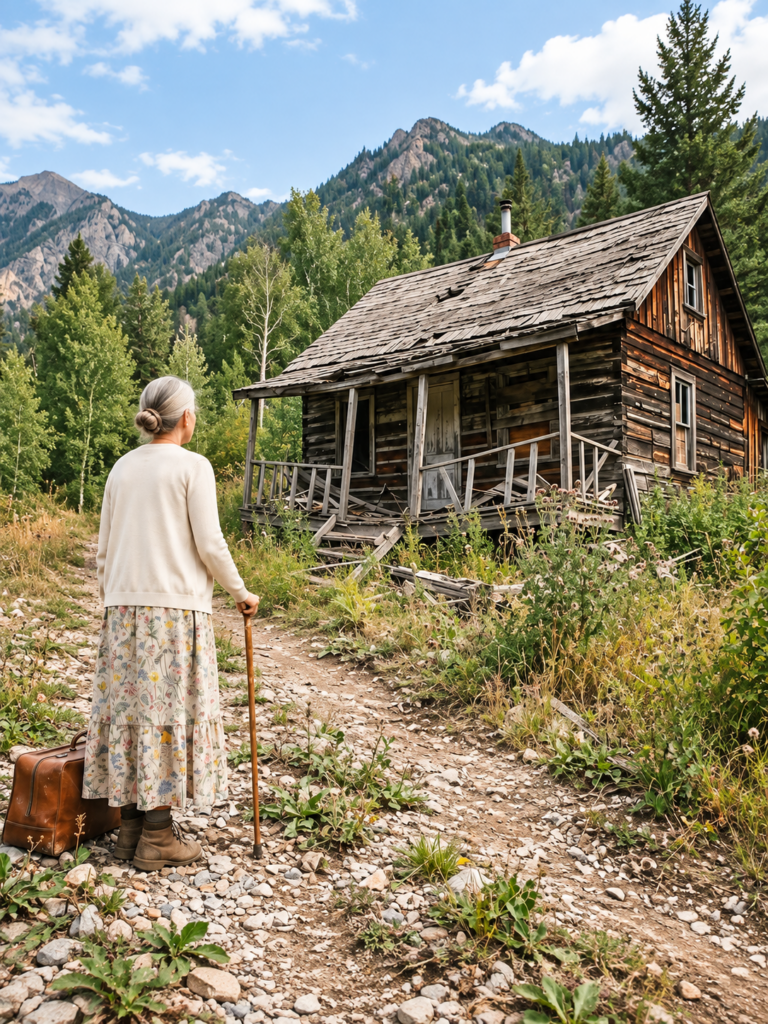
Ahead stood a small wooden cabin.
The roof sagged.
The porch leaned to one side.
Two windows were cracked.
Weeds grew through the steps.
A section of the chimney had collapsed, leaving broken stones scattered across the ground.
Margaret stared.
“This is it?”
She looked at the deed lying on the passenger seat.
Forty acres.
A cabin.
A mountain inheritance.
She had imagined a rustic little home, perhaps with a fireplace and a view of the valley.
Instead, she had inherited what looked like an abandoned storage shed.
She rested her forehead against the steering wheel.
Then she cried.
She cried for the marriage she’d lost.
For the money she’d spent decades helping Silas earn.
For the humiliating courtroom proceedings.
For the home where she had raised their son.
And for the cruel absurdity of traveling nearly two thousand miles to discover that her last hope was a rotting cabin in the wilderness.
The tears eventually stopped.
Outside, the afternoon light was fading.
Margaret wiped her face with a tissue.
“Well,” she whispered, “it’s mine.”
She got out of the car.
Cold mountain air filled her lungs.
The silence was extraordinary.
There were no neighbors.
No traffic.
No distant televisions.
Only wind moving through the pine trees.
Margaret walked toward the cabin.
The porch boards groaned beneath her weight.
She stepped carefully.
The front door was secured by a rusted padlock.
Thomas had given her a key.
After several attempts, the lock opened.
Margaret pushed the door.
A smell of mildew, dust, and old wood smoke rolled out.
Inside was a single large room with a narrow sleeping area behind a curtain.
A cast-iron stove stood near the wall.
There was a wooden table, two mismatched chairs, a sagging cot, and a kitchen counter with a hand pump.
The floorboards were stained.
The ceiling sagged in several places.
A mouse disappeared beneath the stove.
Margaret closed her eyes.
She had once lived in a four-bedroom house with heated floors and a kitchen large enough to host Thanksgiving dinner for twenty people.
Now she was standing in a cabin that might not survive a strong snowfall.
She set down her suitcase.
“Well, Arthur,” she said aloud, “you certainly had unusual taste.”
No one answered.
She opened the shutters.
A shaft of pale light entered the room.
Dust floated through the air.
Margaret began inspecting what she had.
The stove appeared functional, though its chimney needed attention.
There was a hand-operated water pump connected to a holding tank, but the water coming from it was discolored.
The cupboards contained old dishes, a dented kettle, and several jars of food long past their expiration dates.
Near the back wall, she found an ax, a splitting maul, and a stack of firewood.
She looked toward the windows.
The mountains would be beautiful in summer.
But winter was coming.
And beauty wouldn’t keep her alive.
Margaret spent her first night sleeping in the Volvo.
She locked the doors, wrapped herself in two blankets, and woke every hour from the cold.
By morning, frost covered the windshield.
Her knees ached.
Her back felt stiff.
She knew she couldn’t survive the winter this way.
She drove down to Pine Ridge.
At the local hardware store, a gray-haired man stood behind the counter reading a newspaper.
He looked up when she entered.
“Morning.”
“Good morning. I need cleaning supplies, a tarp, some rope, and a few tools.”
“Fixing something?”
“A cabin on Blackwood Mountain.”
The man lowered his newspaper.
“Which cabin?”
“The Pendleton place.”
His eyebrows rose.
“Arthur Pendleton?”
“My great-uncle.”
He folded the paper.
“Well, I’ll be.”
His name was Gregory Shaw.
He had operated the hardware store for almost thirty years.
When Margaret explained her situation, Gregory scratched his chin.
“That old place hasn’t been fit for people in a long time.”
“I noticed.”
“You planning to stay up there?”
“I don’t have many alternatives.”
He studied her for a moment.
Then he began gathering supplies.
A heavy-duty tarp.
Rope.
Cleaning brushes.
Protective gloves.
A good flashlight.
A sleeping bag rated for freezing temperatures.
He also recommended that she have the chimney inspected before using the stove.
Margaret looked at the prices.
She didn’t have enough money.
She opened her purse.
Her wedding ring lay inside its velvet box.
She touched the lid.
Then she looked at Gregory.
“Is there a pawn shop in town?”
An hour later, Margaret walked out of the pawn shop with eight hundred dollars.
It was far less than the ring’s original value.
She had known that would happen.
Still, the transaction hurt.
For thirty-eight years, the diamond had represented a promise.
Now it had become firewood, food, and a chance to survive.
She returned to the hardware store and bought only the most necessary items, leaving the chainsaw Gregory recommended for another day.
Gregory helped load her car.
“You sure you want to do this alone?”
“No,” Margaret admitted. “But I’m going to try.”
He leaned against the tailgate.
“Arthur used to come into this store years ago.”
“What was he like?”
“Quiet. Strange. Always buying things nobody could explain.”
“Such as?”
“Concrete. Ventilation equipment. Electrical parts. Heavy steel pipe.”
Margaret frowned.
“For that little cabin?”
“That’s what we wondered.”
Gregory looked toward the mountains.
“He once told me the mountain had a heartbeat.”
Margaret smiled politely.
“A heartbeat?”
“Said he could hear it through the ground.”
“Perhaps he was getting old.”
“Perhaps.”
Gregory’s expression became serious.
“Just watch your footing up there. Some of those old boards aren’t trustworthy.”
Margaret thanked him.
Then she drove back up the mountain.
For the next six days, she worked from dawn until darkness.
She scrubbed walls.
Removed spoiled food.
Swept out mouse nests.
Covered broken windowpanes with plastic.
She secured a tarp over the most damaged section of roof, working carefully from the ground and low porch roof where she could reach safely.
She cleared brush from the entrance and stacked firewood beneath a dry overhang.
Her hands blistered.
Her muscles ached.
At sixty-two, she discovered that crawling beneath cabinets and carrying water uphill were considerably more painful than they had been at thirty.
But she also discovered something else.
She was capable.
Silas had spent years making her believe she couldn’t manage anything important without him.
He made the financial decisions.
He chose the contractors.
He negotiated every purchase.
When Margaret questioned him, he usually laughed.
“Leave the complicated things to me, Maggie.”
Now there was no Silas.
No one to ask.
No one to blame.
And somehow, one problem at a time, Margaret was making the cabin livable.
On the seventh day, Gregory arranged for a local chimney specialist to inspect the stove.
The man repaired a damaged connection and confirmed that the flue could be used after cleaning.
That evening, Margaret built her first fire.
She sat on the floor beside the stove, watching the flames.
Warmth slowly filled the room.
She made a cup of instant coffee.
Then she opened a can of soup.
It wasn’t much of a supper.
But it was warm.
And it was hers.
The strange sound began that night.
Margaret was lying on her cot when a deep humming rose beneath the floor.
At first, she thought it was wind.
Then she realized the sound was too steady.
Too low.
It seemed to vibrate through the wood.
She sat upright.
The humming continued for several seconds.
Then it stopped.
Margaret listened.
Silence.
She got out of bed and pressed her hand against the floorboards.
Nothing.
She waited another minute.
Then returned to bed.
The next night, it happened again.
A deep vibration.
A faint metallic rattle.
Then silence.
Margaret wondered whether some old mining equipment lay buried beneath the mountain.
She remembered Gregory’s stories about Arthur buying strange supplies.
Perhaps there was an abandoned shaft nearby.
Perhaps the mountain truly was hollow in places.
But she had more immediate concerns.
Food.
Firewood.
The leaking roof.
And the rapidly approaching snow.
On the twelfth day, a severe storm rolled across the mountains.
The weather changed before noon.
Heavy clouds gathered.
The wind strengthened.
By late afternoon, freezing rain struck the cabin roof.
Margaret checked the tarp.
The ropes were holding.
For a while.
At six o’clock, a violent gust tore one corner loose.
Rain began leaking through the ceiling.
Margaret moved a bucket beneath the drip.
Then another.
The wind roared.
Something struck the roof with a heavy crack.
A branch.
Perhaps an entire limb.
The cabin shook.
Margaret reached for her flashlight.
Then she heard a splitting sound beneath the stove.
She froze.
A section of the floor had begun to sag.
The heavy cast-iron stove stood near the damaged boards.
Margaret backed toward the doorway, but another gust shook the building.
Wood cracked beneath her left foot.
She grabbed the edge of the table.
The floor gave way.
Margaret screamed.
For one terrible second, there was nothing beneath her.
Then she struck a hard surface.
Pain exploded through her shoulder and hip.
Above, broken boards fell through the opening.
The stove shifted and crashed onto a reinforced ledge several feet away, sending sparks and splinters into the darkness.
Margaret lay motionless.
Rainwater splashed onto her face.
Her breath came in short, frightened gasps.
She tried moving her fingers.
They worked.
Her legs hurt, but she could move them.
She reached for the flashlight clipped to her belt.
The beam flickered on.
Margaret expected to see dirt.
Instead, the light fell across polished mahogany.
She stopped breathing.
A staircase descended into the darkness.
Its railing was black wrought iron.
The walls were concrete.
And beneath the rotting cabin was a second structure.
A structure nobody had told her existed.
Part 3
Margaret remained on the landing for several minutes, trying to understand what she was seeing.
Above her, rain poured through the broken floor.
Below her, a spiral staircase disappeared into a shaft lined with smooth concrete.
She touched the wall.
It was solid.
Professionally built.
Nothing about it resembled a natural cave.
Her left shoulder throbbed.
She tested her weight on each leg.
Nothing appeared broken, although her hip was badly bruised.
She needed shelter from the storm.
And there was no safe way to climb back through the collapsed floor.
Margaret pointed her flashlight downward.
“Hello?”
Her voice echoed faintly.
No answer.
She gripped the railing.
One step.
Then another.
The staircase descended farther than she expected.
Ten feet.
Twenty.
Nearly thirty.
The air grew warmer as she descended.
A faint mechanical vibration came through the wall.
Margaret stopped.
The humming.
It was the same sound she had heard through the cabin floor.
She continued downward.
At the bottom, her boots touched a thick carpet.
She swept her flashlight across the room.
And stared.
A hallway stretched before her.
The walls were paneled in dark walnut.
Framed paintings hung beneath decorative lamps.
The floor was covered in deep red carpet.
A brass wall sconce gleamed beside an arched doorway.
Margaret whispered, “What in heaven’s name?”
She stepped into the hallway.
To her right stood a library.
To her left, a dining room.
Beyond them, a large living area opened beneath a vaulted ceiling.
She shone her flashlight upward.
Massive steel beams supported the concrete roof.
Ventilation ducts ran along the ceiling, disguised behind decorative woodwork.
Everything looked old.
But carefully maintained.
She walked into the living room.
A grand piano stood near the far wall.
Leather sofas surrounded a stone fireplace.
Shelves held hundreds of books.
There were rugs, lamps, heavy curtains, and polished tables.
It looked like the interior of an expensive mountain lodge.
Except there were no windows.
Margaret approached the piano.
She pressed one key.
A clear note sounded.
She stared at the instrument.
It was tuned.
Someone had cared for this place.
Recently.
She turned toward a doorway.
“Hello?”
Silence.
A small kitchen stood beyond the living room.
There were cupboards, a stove, a sink, and shelves of canned food.
Margaret turned a faucet.
Water flowed immediately.
Clear.
Cold.
She stared at it.
After nearly two weeks of hauling water and wondering whether the cabin’s old supply was safe, she was standing in an underground kitchen with running water.
She found a switch beside the doorway.
Nothing happened.
The electrical system might have been shut down.
Or perhaps it required a generator.
Margaret remembered the sound beneath the floor.
She continued exploring.
A bedroom contained fresh linens.
Another room held a desk and filing cabinets.
A bathroom had a large bathtub, clean towels, and a medicine cabinet stocked with supplies.
The air smelled faintly of wood polish and old paper.
Margaret stood in front of a mirror.
Her hair was tangled.
Dirt covered her cheeks.
A tear had dried beside her nose.
She looked like a woman who had crawled out of a collapsed mine.
And perhaps that wasn’t far from the truth.
She returned to the library.
On a large mahogany desk lay a leather-bound ledger.
Its cover bore a name stamped in gold.
Cornelius Pendleton.
Margaret frowned.
She recognized that name.
Cornelius had been Arthur’s grandfather.
A wealthy financier who had vanished during the late 1920s.
Family stories described him as brilliant, secretive, and dishonest.
Margaret remembered her mother once saying that Cornelius had disappeared with money that didn’t belong to him.
She had dismissed the story as family gossip.
Now she opened the ledger.
The first pages contained dates and financial entries.
Bank accounts.
Bond purchases.
Gold holdings.
Transfers.
Then came descriptions of storage locations.
Underground vault.
Western corridor.
Inventory room.
Margaret turned another page.
The figures grew larger.
Hundreds of thousands of dollars.
Then millions.
She stared at a handwritten total from 1929.
More than forty million dollars.
Her mouth went dry.
She had worked beside Silas for decades.
She understood enough about money to recognize that forty million dollars in 1929 represented an extraordinary fortune.
But where was it?
And how much remained?
She turned another page.
A rough diagram showed the underground complex.
The central living quarters.
Storage chambers.
Mechanical rooms.
A west wing.
At the end of the western corridor was a large room marked:
SECURE VAULT.
Margaret sat down.
Her heart was pounding.
Could the money still be here?
She thought of Arthur.
The eccentric old man who purchased ventilation fans and concrete.
The man who believed the mountain had a heartbeat.
Perhaps he had inherited this secret.
Perhaps he had spent his life protecting it.
Margaret looked around the enormous library.
Every piece of furniture suggested wealth.
Every polished surface suggested care.
She was no longer standing inside a forgotten bunker.
She was standing inside a hidden mansion.
A mansion buried beneath Blackwood Mountain.
Then she noticed the ashtray.
It stood on the desk beside the ledger.
Inside lay a cigar.
Margaret leaned closer.
A thin ribbon of smoke rose from its tip.
She froze.
The cigar was still burning.
Someone was here.
She took a step backward.
Then another.
At that moment, a deep mechanical thud echoed through the building.
An engine started somewhere beyond the walls.
The lights flickered.
Then the chandeliers blazed to life.
Margaret gasped.
She switched off her flashlight.
From the kitchen came the sound of running water.
Then a kettle being placed on a burner.
Someone began whistling.
A slow, old-fashioned tune.
Margaret moved behind the library shelves.
Her breath sounded painfully loud.
Footsteps approached.
Heavy boots.
Unhurried.
A tall man entered the room.
He had broad shoulders, close-cropped silver hair, and a deeply weathered face.
He carried a hunting rifle.
Margaret pressed herself against the shelves.
The man stopped near the center of the living room.
He looked toward the broken staircase landing.
Then he shook his head.
“Well, Arthur,” he muttered, “you were right about that floor.”
He looked toward the library.
“You can come out, Margaret.”
Her heart stopped.
The man waited.
“I know you’re there.”
Margaret remained hidden.
He lowered the rifle.
“I’m not going to hurt you.”
She swallowed.
“Who are you?”
The man turned toward her voice.
“My name’s Jeremiah Cobb.”
“Why do you know my name?”
“Because Arthur told me you’d come.”
Margaret stepped cautiously into the light.
Her clothes were wet.
Her shoulder ached.
But she stood straight.
“This property belongs to me.”
Jeremiah nodded.
“Yes, ma’am. It does.”
“Then explain why you’re inside my house.”
He studied her.
Then he placed the rifle safely aside.
“I worked for your uncle.”
“What kind of work?”
“Engineering. Maintenance. Security. Whatever needed doing.”
Margaret glanced around.
“You’ve been living here?”
“For the last six months.”
“Without telling anyone?”
“Arthur preferred it that way.”
Margaret folded her arms.
“That’s not an answer.”
Jeremiah gave a tired smile.
“No, ma’am. I suppose it isn’t.”
He gestured toward a chair.
“Your shoulder looks painful.”
“I’ll survive.”
“Arthur said you were stubborn.”
Margaret almost smiled.
“Arthur barely knew me.”
“He knew more than you think.”
Jeremiah walked to the desk and removed a sealed envelope from a drawer.
It bore Margaret’s name.
“This was meant for you.”
Margaret stared.
“From Arthur?”
“Yes.”
She opened it carefully.
The letter was brief.
Margaret,
If you’ve found your way into the house below, then you’ve discovered what our family has protected for nearly a century.
Cornelius built this refuge when his financial world collapsed. He brought a fortune with him, along with more trouble than any man should leave to his descendants.
I spent much of my life afraid of what would happen if the wrong people discovered it.
Jeremiah knows the property. Listen to him, but make your own decisions.
You may find that the mountain offers you a new beginning.
Just remember that wealth does not always bring peace.
Arthur.
Margaret lowered the letter.
“Why didn’t he simply tell me?”
Jeremiah sat across from her.
“Because he didn’t know if you’d want the responsibility. And because he was frightened.”
“Of whom?”
Jeremiah looked toward the western hallway.
“People who believed Cornelius took something that belonged to them.”
Margaret’s stomach tightened.
“Is the fortune still here?”
Jeremiah stood.
“Most of it.”
He picked up a ring of old brass keys.
“Come with me.”
They walked down the western corridor.
The walls became plain concrete.
Steel doors lined the passage.
At the far end stood an enormous circular vault door.
Margaret stopped.
It looked like something from an old bank.
Jeremiah inserted a key, entered a combination, and slowly turned the heavy wheel.
The mechanism moved with a deep metallic groan.
The door opened.
Light flooded the room.
Margaret stepped forward.
Then stopped.
Inside were shelves of sealed cases.
Wooden crates.
Rows of old financial documents.
And stacks of gold bars arranged behind heavy steel grilles.
Margaret covered her mouth.
“Oh, my Lord.”
Jeremiah watched her quietly.
“Cornelius was a very wealthy man before he disappeared.”
Margaret walked toward the nearest shelf.
She touched a sealed inventory tag.
“How much is all this worth?”
“Arthur had some of it appraised privately. The estimates were enormous. Hundreds of millions, depending on what’s genuine, what’s collectible, and what anyone can legally claim.”
Margaret looked at him sharply.
“Legally claim?”
Jeremiah nodded.
“There’s a difference between finding gold and having the right to keep it.”
Margaret stared at the shelves.
She thought of the single dollar she had given Thomas Gable.
The freezing nights in the cabin.
The wedding ring she’d pawned for supplies.
And Silas, somewhere in Europe, enjoying the life he had taken from her.
For one extraordinary moment, she felt almost weightless.
She had come to Montana believing she was finished.
Now she stood in front of a fortune beyond anything she had ever imagined.
But Jeremiah wasn’t smiling.
And when Margaret looked back at him, she understood that the discovery had brought a danger she couldn’t yet see.
Part 4
Jeremiah closed the vault door.
The heavy steel settled into place with a sound that made Margaret shiver.
“There’s something else you need to understand,” he said.
Margaret looked at him.
“What?”
“Cornelius didn’t leave this money here because he was sentimental.”
“He was hiding it.”
“Yes.”
“From whom?”
“Banks. Federal investigators. People who claimed he’d stolen from them. And possibly people who were just as dishonest as he was.”
Margaret glanced toward the sealed ledger she still held.
“Then it might not legally belong to me.”
“Some of it may. Some may not. Arthur spent decades trying to establish where it came from.”
Margaret sat down heavily.
The room seemed to tilt around her.
She had spent three weeks believing her life was ruined.
Then another two weeks fighting to survive in a freezing cabin.
Now she had found more money than she could spend in several lifetimes, only to discover that it might carry a century of legal trouble.
Jeremiah poured her a glass of water.
“You need a lawyer.”
“I have one.”
“Thomas Gable?”
“Yes.”
“He’s a good man. But this is bigger than anything he’s handled alone.”
Margaret looked toward the western corridor.
“What did Arthur intend me to do?”
Jeremiah considered the question.
“He never told me to make you rich. He told me to make sure the rightful heir had a choice.”
“A choice?”
“To protect the place, investigate the assets, and decide what kind of life she wanted.”
Margaret was quiet.
Outside, the storm continued.
The underground house was warm and dry.
For the first time in weeks, she could breathe without feeling the cold settle into her chest.
Jeremiah offered to prepare supper.
Margaret refused at first.
Then her stomach growled.
He raised an eyebrow.
“That’s a persuasive argument.”
She laughed unexpectedly.
It felt strange to laugh.
They ate canned stew and warm bread at the enormous dining table.
Jeremiah explained how Arthur had maintained the underground structure.
The original complex had been excavated and constructed decades earlier.
Later generations had reinforced the supports, upgraded the ventilation, and installed generators.
Arthur had continued the work quietly, purchasing materials through small businesses over many years.
“He trusted the mountain more than he trusted people,” Jeremiah said.
Margaret nodded.
“I think I’m beginning to understand why.”
After supper, Jeremiah showed her a small guest room.
The bed had clean sheets.
There was a bathroom nearby.
He offered first-aid supplies and encouraged her to have her injuries examined as soon as the storm passed.
Margaret sat on the edge of the bed.
For the first time since the courthouse, she was sleeping somewhere that felt safe.
But sleep did not come easily.
She kept thinking about the money.
And about Silas.
His company had used accountants who specialized in complicated asset transfers.
He knew how to hide wealth.
He knew how to find it.
During the divorce, his lawyers had asked unusually detailed questions about Margaret’s family history.
At the time, she’d thought they were searching for assets to use against her.
Now she wondered whether they’d discovered something about Arthur’s estate.
The thought troubled her.
At breakfast the following morning, she asked Jeremiah whether anyone else knew about the underground house.
“Arthur. Me. Possibly a few people who worked on it decades ago.”
“And the lawyer?”
“He knows more than most, but not everything.”
Margaret stirred her coffee.
“What if someone has been looking for this place?”
Jeremiah’s expression changed.
“Why do you ask?”
She explained the divorce.
The business sale.
The financial records.
The questions about her relatives.
Jeremiah listened carefully.
When she finished, he set down his cup.
“I think we’d better call Thomas.”
They used the underground communications equipment, which Jeremiah maintained for emergencies.
Thomas answered after several attempts.
When Margaret described the hidden structure, the attorney became very quiet.
Then he said, “Mrs. Hale, do not move or distribute anything until we can properly document what you’ve found.”
“I understand.”
“And there’s another issue.”
Margaret stiffened.
“What issue?”
“Someone contacted my office last week asking about the Pendleton estate.”
“Who?”
“A representative claiming to work for a financial investigation firm.”
Margaret’s mouth went dry.
“Did he give a name?”
“David Mercer.”
She closed her eyes.
David Mercer was one of Silas’s financial advisers.
She remembered him sitting behind her husband during the divorce proceedings.
Always silent.
Always taking notes.
Thomas continued.
“He asked whether the property transfer had been completed.”
“What did you tell him?”
“Nothing beyond publicly available information.”
Margaret looked at Jeremiah.
The man had already risen from his chair.
“Thomas,” she said slowly, “I believe my former husband may know about the property.”
There was a pause.
“Then I strongly recommend we involve the authorities if you receive any threats.”
Margaret agreed.
After ending the call, she sat motionless.
Silas.
Even here.
Even thousands of miles from Ohio.
The thought of him finding her made the underground mansion feel smaller.
Jeremiah checked the security system.
Several cameras monitored the mountain road and the clearing around the cabin.
Most were old but functional.
There were motion sensors near the access points.
He examined the recordings.
“Nothing unusual yet.”
Margaret looked at the screens.
The damaged cabin stood in the clearing.
The storm had torn more shingles from the roof.
Her Volvo sat beside a fallen pine branch.
She remembered the night she’d arrived.
The cold.
The despair.
The promise she had made to herself.
I’m going to survive.
She had never imagined that survival would require facing Silas again.
For two days, she helped Jeremiah inventory the rooms.
They catalogued documents, photographed equipment, and prepared lists for the attorneys.
Margaret insisted that nothing be sold or removed until its ownership had been properly investigated.
Jeremiah seemed surprised.
“Most people would be packing gold into suitcases.”
Margaret looked at him.
“I spent thirty-eight years watching a man convince himself that money gave him the right to do anything.”
She placed another ledger in a storage box.
“I won’t become him.”
Jeremiah nodded.
“Arthur would have liked that.”
On the third evening, the security alarm sounded.
A sharp electronic chime echoed through the library.
Jeremiah stood immediately.
Margaret followed him to the monitors.
A black SUV was climbing the mountain road.
Its tires churned through mud and melting snow.
The vehicle moved slowly but steadily toward the cabin.
Margaret stared at the screen.
She recognized the car.
Silas had purchased it shortly before their divorce.
“That’s him,” she whispered.
Jeremiah looked at her.
“Your husband?”
“My ex-husband.”
The SUV stopped in the clearing.
Two men stepped out.
One was large, wearing dark outdoor clothing.
The other wore an expensive coat.
Silas.
Even on the grainy security image, Margaret recognized his posture.
Confident.
Impatient.
Certain that whatever he wanted would eventually belong to him.
He walked toward the cabin.
The larger man followed.
Jeremiah checked the cameras.
“They’ve found the damaged floor.”
Margaret’s heart pounded.
Silas looked down into the opening.
Then he smiled.
Margaret felt cold.
He knew.
Somehow, he had known.
Jeremiah reached for the telephone.
“We call the sheriff now.”
Margaret nodded.
“Tell them two men have entered private property. One may be armed.”
He made the call.
But the storm had damaged several roads, and the nearest deputies were some distance away.
They couldn’t arrive immediately.
On the monitor, the larger man began lowering a rope through the opening.
Silas was preparing to enter.
Jeremiah turned toward Margaret.
“We can stay behind the security door. It’s reinforced.”
Margaret looked at the monitors.
She thought about Silas standing in the courthouse, telling her she’d manage.
She thought about Chloe waiting beside the elevators.
She thought about the money that had vanished through companies she barely understood.
And she remembered something else.
Silas had always believed he knew exactly how Margaret would behave.
He expected her to cry.
To plead.
To surrender.
He had never considered that she might learn to stand without him.
Margaret looked at Jeremiah.
“We won’t confront them upstairs.”
“Agreed.”
“We keep the authorities informed. We protect the documents. And if he comes down here, we make sure he can’t force us to open the vault.”
Jeremiah nodded slowly.
“There is a security barrier between the main living area and the western corridor.”
“Can it be secured remotely?”
“Yes.”
“Then secure it.”
Jeremiah entered a code.
A heavy steel door slid into place near the western hallway.
Margaret watched the monitor.
Silas disappeared through the broken cabin floor.
She took a slow breath.
Thirty-eight years ago, she had promised to stand beside that man through good times and bad.
Now she was preparing to defend herself against him.
And this time, she would not surrender.
Part 5
Silas Hale descended the spiral staircase with the confidence of a man entering property he already considered his own.
His companion, a broad-shouldered man named Frank Danner, followed several steps behind.
When Silas reached the carpeted hallway, he stopped.
His eyes widened.
“Well,” he said softly, “would you look at that.”
He walked into the underground living room.
His polished shoes sank into the thick carpet.
He stared at the chandeliers, the paintings, the grand piano.
Then he laughed.
“Old Arthur really did it.”
Margaret stood near the library entrance.
Silas turned.
For several seconds, neither spoke.
Then his familiar smile appeared.
“Maggie.”
She kept her hands at her sides.
“Silas.”
He looked her over.
“You’ve had an interesting few weeks.”
“You weren’t invited.”
“Don’t be dramatic.”
He glanced around the room.
“Quite an inheritance you’ve stumbled into.”
Margaret’s chest tightened.
“You knew about Arthur.”
Silas tilted his head.
“Eventually.”
“How long?”
He shrugged.
“Long enough.”
She thought of the divorce.
The documents.
His lawyers.
David Mercer’s questions.
“Did you know before the settlement?”
Silas didn’t answer immediately.
That was answer enough.
Margaret felt something inside her settle into place.
“You knew there might be money here.”
Silas smiled.
“I knew there were rumors. Family trusts. Old banking records. Unclaimed property.”
“So you stripped me of everything and waited to see what I found?”
His smile faded.
“Don’t exaggerate. The marriage was over.”
“You used me.”
“Margaret, I’ve spent my entire life making difficult financial decisions. You wouldn’t understand.”
She stared at him.
There it was.
The same contempt he’d hidden beneath affection for decades.
She had worked nights to support his dreams.
She had raised their child while he traveled.
She had managed the home, paid bills, and cared for aging relatives.
But in his mind, she had never been an equal partner.
Silas glanced toward the western hallway.
“Where’s the vault?”
Margaret said nothing.
Frank shifted his weight.
Silas grew impatient.
“Come on, Maggie. I know there’s a vault. David found references to it in some of the old records.”
“You need to leave.”
He laughed.
“You’re not in a position to give orders.”
“This is my property.”
He stepped closer.
“Property I helped you get.”
Margaret couldn’t believe what she was hearing.
“You took everything I owned.”
“And look how things turned out. You found yourself a mountain estate.”
He gestured around.
“Perhaps you should thank me.”
Margaret felt anger rise so sharply that she nearly lost her breath.
But she remembered Jeremiah’s warning.
Don’t provoke him.
Keep him talking.
The sheriff had been notified.
Help was coming.
She needed to protect herself until it arrived.
“What do you want, Silas?”
He reached inside his coat.
Margaret stiffened.
But he withdrew a folded document.
“A simple agreement.”
She almost laughed.
Of course.
Another agreement.
Another paper he expected her to sign without understanding.
He held it out.
“Transfer the property to a holding company. I’ll manage the assets and make sure everything is handled properly.”
“Your holding company?”
“Naturally.”
“And what would I receive?”
“A generous allowance.”
Margaret stared at him.
“A generous allowance.”
Silas spread his hands.
“You’re sixty-two, Maggie. You don’t want the responsibility of managing something like this.”
She looked around the magnificent hidden room.
The place she had discovered only after surviving nearly two weeks in a freezing cabin.
The place Arthur had entrusted to her.
The place Silas now wanted to steal.
“No,” she said.
Silas blinked.
“What?”
“I won’t sign it.”
His face hardened.
“Don’t be foolish.”
“I said no.”
For a moment, he looked genuinely bewildered.
Then the anger appeared.
“You think you can handle this on your own?”
Margaret met his eyes.
“I’ve been handling things on my own since you left.”
Silas stepped forward.
Frank moved toward the corridor.
Margaret noticed the bulge beneath his jacket.
A weapon.
Her pulse quickened.
Silas lowered his voice.
“Don’t force me to make this unpleasant.”
Margaret glanced toward the western corridor.
The steel security barrier remained closed.
Jeremiah was monitoring the cameras from the control room.
She could hear a faint mechanical hum behind the wall.
Silas followed her gaze.
“The vault’s that way.”
He pushed past her.
Frank followed.
They reached the closed steel door.
Silas pulled the handle.
It didn’t move.
He turned.
“Open it.”
Margaret remained several feet away.
“No.”
His face reddened.
“Margaret!”
She raised her chin.
“I’m not your wife anymore. And I’m not afraid to tell you no.”
Frank reached inside his jacket.
Margaret stepped backward.
“Don’t,” she warned.
He produced a handgun.
Her heart hammered.
Silas looked briefly startled, then recovered.
“Just open the door, Maggie. Nobody needs to get hurt.”
Margaret stared at the weapon.
She was frightened.
Terribly frightened.
But the fear no longer controlled her.
For nearly forty years, she had tried to keep Silas happy.
She had surrendered little things first.
Her preferences.
Her opinions.
Her time.
Then larger things.
Her savings.
Her independence.
Her confidence.
Every surrender had made the next one easier for him to demand.
Now, at sixty-two, standing beneath a mountain in Montana, she understood that there had to be an end.
“No,” she said again.
Silas stared at her.
Frank advanced.
At that moment, Jeremiah’s voice came through a concealed speaker.
“Put the weapon down.”
Frank spun around.
The voice continued.
“This area is under surveillance. Law enforcement has been contacted. The entrance and access corridors are being monitored.”
Silas looked upward.
“Who said that?”
Jeremiah didn’t answer.
A second steel barrier began descending behind the two men, separating the western corridor from the library.
Frank stepped back.
The door stopped short of the floor as its safety sensors detected movement, then remained in a locked protective position.
Margaret retreated toward the library.
Jeremiah opened a side door and guided her into the secure control room.
“Are you hurt?” he asked.
She shook her head.
“Just frightened.”
He checked the monitors.
Silas was shouting.
Frank paced beside the barrier, holding the gun.
Jeremiah kept the protective doors secured while maintaining communication with the sheriff’s office.
Margaret sat beside the control console.
Her hands trembled.
She could hear Silas through the audio system.
“Margaret! Open this door!”
For the first time in her life, she didn’t answer him.
Nearly ninety minutes passed before deputies reached the property.
The mountain road had become muddy and difficult after the storm.
Margaret remained in the secure room while Jeremiah guided the officers to the underground entrance.
The deputies approached cautiously, ordered Frank to put down his weapon, and detained both men without further violence.
When Silas was led through the library in handcuffs, he saw Margaret standing beside Jeremiah.
His expression changed.
First disbelief.
Then fury.
“You did this to me!”
Margaret looked at him.
“No, Silas.”
Her voice was quiet.
“You came here with a gunman and tried to take something that wasn’t yours.”
He opened his mouth.
She continued.
“I won’t spend another day accepting responsibility for your choices.”
He stared at her.
For once, he had no answer.
The deputies escorted him away.
Margaret watched until they disappeared up the staircase.
Then she sat down.
Jeremiah brought her a glass of water.
She held it in both hands.
For a long time, neither spoke.
Finally, Margaret said, “I thought I’d feel happy.”
Jeremiah sat across from her.
“And?”
“I feel tired.”
He nodded.
“Sometimes that’s what surviving feels like.”
The criminal investigation revealed far more than Margaret had expected.
Silas had been under scrutiny for financial misconduct connected to his company.
Investigators examining the business records uncovered questionable transfers, concealed assets, and misleading representations made during the divorce.
David Mercer, his financial adviser, had helped identify the Pendleton estate.
The investigation also established that Silas had concealed information about his company’s sale and financial position.
Margaret’s original divorce settlement was challenged.
After extensive legal proceedings, she recovered a substantial portion of the marital assets that had been wrongfully withheld.
Silas faced criminal charges arising from the armed confrontation in Montana, along with separate financial investigations.
Margaret did not attend every hearing.
She had spent enough of her life sitting in courtrooms listening to men explain why their decisions should cost her everything.
This time, she hired competent attorneys and let them do their work.
The Pendleton fortune required a more complicated process.
Thomas Gable assembled a team of estate lawyers, historians, and forensic accountants to examine the underground records.
The gold and other assets were documented, secured, and appraised.
Some items were subject to potential claims because of their origins.
Certain old bonds had little or no redemption value despite their impressive appearance.
Other holdings proved genuine and valuable.
The attorneys worked with the relevant authorities to establish clear ownership wherever possible.
The process took years rather than weeks.
Margaret learned that finding a fortune was not the same as owning it free of obligations.
Taxes had to be paid.
Claims had to be investigated.
Records had to be verified.
And the history of the Pendleton money could not simply be ignored.
But when the legal proceedings finally concluded, a very substantial estate remained under Margaret’s control.
Enough to make her financially secure for the rest of her life.
Enough to repair the mountain property.
Enough to ensure she would never again have to choose between buying food and keeping warm.
The amount astonished her.
Yet when Thomas Gable explained the final accounting, Margaret discovered something unexpected.
She wasn’t thinking about jewelry.
Or fancy cars.
Or expensive vacations.
She was thinking about the cabin.
The cold nights.
The old Volvo.
The kindness of Gregory Shaw.
And the way Jeremiah had stood beside her when she needed help.
She remembered all the people who had spent their lives working hard, only to discover that age, illness, or a dishonest partner could erase their security.
Margaret wanted to do something useful with her second chance.
She established a charitable foundation to support older women facing housing insecurity after divorce, widowhood, or financial abuse.
The foundation worked with established local organizations to provide emergency housing assistance, legal referrals, and practical financial education.
She also created a small training fund for women over fifty seeking to return to work.
Her attorneys helped structure the programs carefully.
Margaret insisted that the people receiving help be treated with dignity.
“No one should have to tell their worst story over and over just to prove they deserve a warm place to sleep,” she said.
The first woman assisted by the foundation was a sixty-seven-year-old widow named Helen Porter.
Helen had lost her home after her husband’s medical debts overwhelmed the family.
When Margaret met her, she recognized the same exhausted expression she had once seen in her motel bathroom mirror.
Helen tried to thank her.
Margaret took her hands.
“You don’t owe me gratitude.”
“But you’ve given me a chance.”
Margaret smiled.
“Someone gave me one, too.”
She never forgot the dollar bill.
Thomas Gable had kept it in an envelope as part of the estate records.
When the legal matters were finally settled, he returned it to Margaret in a small frame.
She hung it above her desk.
Not because the dollar had purchased an enormous fortune.
But because it reminded her of the moment she had chosen to keep going.
The old cabin was eventually replaced with a beautiful timber-frame lodge.
Margaret insisted that the new house remain modest compared with the enormous underground property.
She wanted windows.
Sunlight.
A kitchen overlooking the forest.
A fireplace where friends could gather.
And a porch strong enough to survive fifty Montana winters.
Jeremiah continued helping maintain the underground complex, now supported by qualified engineers and modern safety systems.
Gregory became a regular visitor.
Thomas sometimes drove up from Pine Ridge for supper.
On clear evenings, Margaret would sit outside watching the sun settle behind the mountains.
She no longer missed the expensive house in Ohio.
She didn’t miss the dinner parties where Silas spent hours boasting about his business.
She didn’t miss the way he corrected her in front of guests.
And she no longer wondered whether Chloe was happier with him than she’d been.
Those questions had belonged to a woman who measured her worth by someone else’s approval.
Margaret had finally learned to measure her life differently.
One autumn evening, several years after her arrival, she stood beside the old cabin’s surviving stone chimney.
She had asked the builders to preserve it as part of the garden.
The original structure had been unsafe, but the chimney remained as a reminder of what had stood there.
Margaret touched the rough stone.
She remembered the freezing rain.
The broken floor.
The terror of falling into darkness.
And the extraordinary sight of the hidden staircase.
For years, she had believed the greatest tragedy of her life was losing Silas.
Now she understood that losing him had forced her to discover how much of herself she had surrendered.
She had been a wife.
A mother.
A waitress.
A bookkeeper.
A business partner.
But somewhere along the way, she’d forgotten she was also Margaret Hale.
A woman with her own judgment.
Her own courage.
Her own future.
Jeremiah approached from the lodge.
“Getting cold out here.”
“A little.”
“Dinner’s ready.”
She smiled.
“I’ll be right in.”
He started toward the house, then paused.
“Margaret?”
“Yes?”
“Arthur would have been proud of what you’ve done with this place.”
She looked toward the mountains.
“I hope so.”
After Jeremiah went inside, Margaret remained by the chimney for another minute.
A light snowfall began drifting through the trees.
She could hear the distant sound of the river below the ridge.
The lodge windows glowed warmly behind her.
She remembered standing in that clearing on the day she’d arrived, staring at the ruined cabin with tears streaming down her face.
She had believed the rest of her life would be a struggle merely to survive.
Instead, she had found a hidden house, a complicated inheritance, and a second chance she never could have imagined.
But the greatest treasure had not been the gold.
It had not been the antique bonds or the rare currency.
It had not even been the mountain itself.
It was the knowledge that she could begin again at sixty-two.
That she could survive betrayal without becoming bitter.
That she could accept help without surrendering her independence.
And that the years ahead of her still belonged to her.
Margaret turned toward the lodge.
Inside, people were waiting for her.
Not because they wanted her money.
Not because she had something they could take.
But because they cared whether she came in from the cold.
She stepped onto the porch and opened the door.
Warmth welcomed her.
For the first time in many years, Margaret Hale felt completely at home.
And this time, nobody could erase her.

