
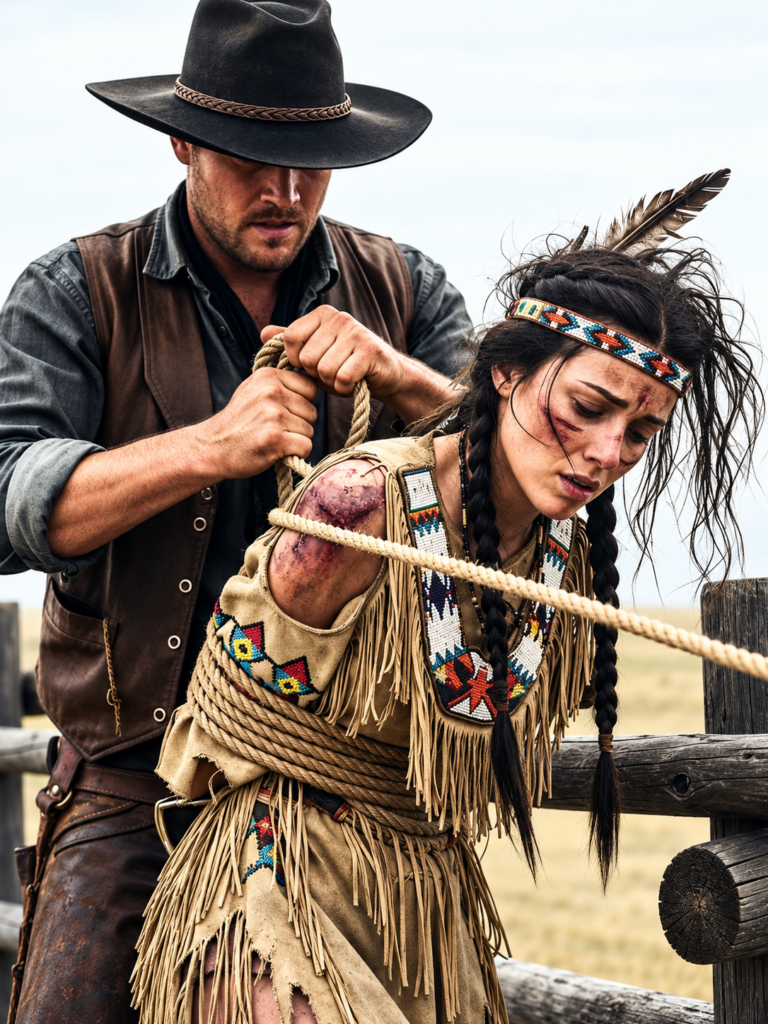
The woman chained to Caleb Roark’s fence had stopped asking for water.
By the time he found her, she was asking for death.
“Please,” she whispered through cracked lips. “Just end it.”
The sun was setting over the West Texas hills, staining the desert sky red. A hot wind moved through the mesquite, carrying dust across the lonely stretch of land Caleb had spent seven years trying to turn into a ranch.
He stood ten feet away, unable to believe what he was seeing.
The woman was young, perhaps twenty-six. Her dark hair hung around a bruised face. Iron shackles bound her wrists to a fence post. A torn blue dress clung to her shoulders, and dried blood marked the places where she had fought against the chains.
Someone had left her there deliberately.
Not hidden in a ravine.
Not abandoned along a trail.
Displayed beside a road where anyone approaching Caleb’s property would see her.
“Who did this?” he asked.
She raised her head.
One eye was swollen nearly shut. The other watched him with an intensity that made him feel as though she was measuring the distance between life and death.
“It doesn’t matter.”
“It matters to me.”
“Then you’re a fool.”
Her voice was barely audible.
“They’ll come back. If you help me, they’ll kill you, too.”
Caleb looked at the iron cuffs.
The shackles were new, the padlock expensive. Whoever had put her here had taken care to make escape impossible.
“What’s your name?”
She closed her eyes.
For a moment, he thought she’d lost consciousness.
Then she whispered, “Mara.”
“I’m Caleb.”
“I didn’t ask.”
Despite everything, he almost smiled.
He set his rifle against the fence and reached for the small ring of tools at his belt.
Mara’s good eye widened.
“What are you doing?”
“Getting you out.”
“No.”
Her voice cracked with panic.
“You don’t understand. If they find me alive—”
“Then they’ll have a difficult conversation with me.”
“You can’t fight them.”
“Whoever they are, they don’t own this fence.”
Caleb knelt beside the padlock.
His hands were scarred and steady. He’d repaired enough harnesses, locks, and broken wagon fittings to understand the mechanism, though this one resisted him.
Mara watched him work.
“You should leave me.”
“No.”
“Please. I’m telling you to save yourself.”
Caleb looked up.
“Would you leave someone chained here?”
She didn’t answer.
The lock finally snapped open.
The moment the chains loosened, Mara collapsed forward.
Caleb caught her before her head struck the ground.
She was frighteningly light.
“Easy,” he murmured. “I’ve got you.”
She tried to push him away.
“Don’t touch me.”
He immediately loosened his hold.
“Can you stand?”
She attempted to straighten.
Her knees buckled.
Caleb waited until she looked at him.
“May I carry you?”
Her eyes filled with tears, though her expression remained fierce.
After a long silence, she nodded.
He lifted her carefully.
She winced, pressing one arm against her ribs.
“I’m sorry,” he said.
“Don’t apologize.”
“Why not?”
“Because you’re the first person in three days who’s touched me without trying to hurt me.”
Caleb said nothing.
He carried her toward the cabin.
Behind them, the empty chains swung against the fence post.
And on the ridge nearly half a mile away, someone watched them through a brass field glass.
It was the autumn of 1883.
Caleb Roark was thirty-nine years old, a former Union cavalryman who had come west after the Civil War and spent much of his adult life trying to forget what he’d seen.
He owned two hundred acres near the edge of the Davis Mountains.
There were cattle, three horses, a stubborn mule, and a modest timber cabin he had built with his own hands.
He made enough to survive.
Most weeks, he spoke to nobody except the animals.
Seven years earlier, he’d believed solitude could quiet his memories.
It hadn’t.
But the land gave him work that made sense.
Fence posts stayed where he put them.
A hungry horse ate when fed.
A broken gate could be repaired.
People were far more difficult.
As he carried Mara inside, he noticed that she kept looking over his shoulder toward the trail.
“Are they behind us?” he asked.
“Not yet.”
“Who are they?”
She shook her head.
He laid her on the bed and lit an oil lamp.
In the yellow glow, her injuries became clearer.
Her wrists were badly abraded. Bruises marked her neck and arms. Her breathing was shallow, and she guarded her left side whenever she moved.
Caleb brought clean water and a cloth.
“I need to wash those cuts. Is that all right?”
She studied him.
“You keep asking permission.”
“Seems like the decent thing to do.”
“Men where I come from don’t.”
“Then they ought to learn.”
She looked away.
Caleb worked carefully, cleaning the injuries he could reach without forcing her to move. He offered water in small amounts and warmed broth on the stove.
Her condition worried him.
She needed a physician, and the nearest town was nearly a day’s ride away.
But a journey over rough ground might worsen her injuries.
He told her both things.
“You decide what we do tomorrow,” he said.
Mara took a cautious sip of broth.
“You talk as though tomorrow belongs to us.”
“Until somebody proves otherwise.”
She looked at him over the rim of the cup.
For the first time, he saw something other than fear in her expression.
Curiosity.
“Who are you, Caleb Roark?”
“Mostly a rancher.”
“Mostly?”
“I used to be a soldier.”
“That explains the rifle.”
“Doesn’t explain much else.”
She lowered the cup.
“My name is Mara Vance.”
Caleb remained still.
He knew the name.
Everyone in that part of Texas did.
Marcus Vance controlled a vast cattle operation north of Fort Davis. His holdings included grazing leases, freight contracts, and water access that smaller ranchers depended upon.
Men who challenged him often found their cattle unable to reach familiar watering places.
Others discovered that merchants suddenly refused them credit.
Nobody could prove Marcus ordered those things.
But nobody called them coincidences.
“Mara Vance,” Caleb repeated.
“His daughter.”
Caleb sat down slowly.
“I see.”
“No,” she said. “You don’t.”
She looked toward the dark window.
“My mother was Mescalero Apache. My father married her when he needed help negotiating passage and supplies through territory he didn’t understand. After she died, he decided the part of me that came from her was something to conceal.”
Caleb listened.
“My mother taught me her family’s stories. Her language. How to read a trail and find water where a stranger would see only rock. My father taught me that everything valuable had a price.”
She looked back at him.
“Then he decided I had one.”
Caleb felt his jaw tighten.
“What happened?”
“John Carver.”
He recognized that name, too.
The Carvers controlled freight wagons, cattle shipments, and several important stretches of road connecting West Texas ranches with rail markets farther east.
Jacob Carver, the family patriarch, had built his influence by making other people dependent on his transport business.
His eldest son, John, had a reputation for cruelty.
Mara continued.
“My father arranged for me to marry John. The marriage would unite their holdings. My father would gain reliable freight access. The Carvers would gain grazing rights and the Vance water leases.”
“And you refused?”
“Yes.”
“Then what?”
“He said I was embarrassing the family.”
Her voice became flatter.
“I told him I wouldn’t marry a man who beats his stable hands and hurts animals when he’s angry. He told me I was too proud to know what was good for me.”
She stared at her bandaged wrists.
“John came to our house three nights later. He grabbed my arm in front of everyone. I struck him.”
Caleb raised an eyebrow.
“With what?”
“A brass candlestick.”
Despite the bruising on her face, Mara looked almost pleased with the memory.
Caleb allowed himself a small smile.
“Did it help?”
“For about five seconds.”
The smile disappeared.
“My father ordered his men to hold me. John said I needed to learn obedience.”
She swallowed.
“They dragged me to a wagon. They beat me. Then they took me out to your fence and chained me there.”
Caleb looked toward the window.
“Why here?”
“Because you’re far from town. Because they thought nobody would come. And because your property sits near a trail smaller ranchers use to reach public roads without crossing Carver-controlled land.”
She took another breath.
“They wanted a warning everybody would understand.”
“A warning about what?”
“That anyone who challenges them can be made to disappear.”
Caleb sat quietly.
For years, he’d heard stories of Vance and Carver men intimidating ranchers, seizing livestock over disputed debts, and threatening families who refused unfavorable contracts.
He’d never been sure which stories were true.
Now he was looking at the evidence.
Mara studied him.
“You’re thinking you should have left me.”
“No.”
“Then you’re thinking you should send me away.”
“I’m thinking we need a doctor.”
She gave a weak, bitter laugh.
“You really don’t understand.”
“Then tell me what I’m missing.”
“My father won’t forgive you. John Carver won’t forgive me. Their men are probably watching this cabin already.”
Caleb looked at the fading light beyond the window.
He believed her.
And it frightened him more than he wanted to admit.
But when he looked back at Mara, he remembered another young woman from years earlier.
A woman outside a burned farmhouse in Missouri.
A woman who had asked his regiment for help.
His commanding officer had ordered the soldiers to move on.
Caleb had obeyed.
He’d spent nineteen years remembering her face.
Not this time.
“Get some rest,” he said.
Mara watched him move toward the door.
“Where are you going?”
“To feed the horses. Then I’m going to make sure nobody comes in here unnoticed.”
She hesitated.
“Caleb?”
He turned.
“Why are you doing this?”
For a moment, he considered telling her about the war.
About the guilt he’d carried west.
About the thousand small ways a man could become accustomed to turning away.
Instead, he said something simpler.
“Because you’re a person, Mara. And someone forgot that.”
Her expression changed.
She turned toward the wall before he could see her cry.
That night, Caleb slept in a chair beside the door.
Mara woke several times.
Once she cried out in her sleep.
Another time, she tried to sit up, convinced she heard horses outside.
He reassured her without touching her.
Near dawn, she asked whether he was frightened.
“Yes,” he answered.
She seemed surprised.
“Then why aren’t you leaving?”
“Being afraid doesn’t decide what I do.”
She stared at him.
Then lay back down.
In the morning, Caleb found fresh hoofprints beyond the northern fence.
At least four horses.
They’d approached during the night and stopped on the ridge.
He studied the tracks.
Then looked toward the cabin.
Whoever had chained Mara to his fence knew she was alive.
And they were waiting to see what he would do.
Just before noon, a rider appeared on the road.
He wore a black coat and carried himself with the confidence of a man accustomed to giving orders.
Caleb met him at the gate.
“You Roark?”
“Yes.”
“My name’s Owen Bell. I work for Jacob Carver.”
“I figured someone would come.”
Bell smiled thinly.
“Mr. Carver wants the woman returned.”
Caleb didn’t move.
“She isn’t a lost horse.”
Bell’s smile disappeared.
“You don’t understand what you’re interfering with.”
“I understand there’s an injured woman inside who doesn’t want to go with you.”
Bell leaned forward in his saddle.
“Her father has agreed to the marriage. The contracts are signed.”
“Her father can sign his own name as often as he likes.”
“Mr. Roark, this doesn’t concern you.”
Caleb looked directly at him.
“You made it my concern when you chained her to my fence.”
Bell studied him.
Then nodded slowly.
“Jacob Carver will be disappointed.”
“I expect he will.”
The rider turned his horse.
Before leaving, he looked back.
“You have until tomorrow morning.”
Caleb watched him disappear.
Then he returned to the cabin.
Mara was sitting up, pale and shaking.
“You heard?”
She nodded.
“They’re coming.”
Caleb looked at the rifle above the fireplace.
Then at the woman who had survived three days chained beneath the Texas sun.
“We’re not staying here waiting for them.”
Her eyes widened.
“You’re taking me back?”
“No.”
He reached for his coat.
“We’re going to find the one person your father fears more than a gun.”
Mara stared at him.
“Who?”
Caleb looked toward the road.
“Someone who knows where he buried the truth.”
And when Mara whispered the name of her father’s estranged sister, Clara Vance, Caleb understood that the fight ahead was going to be far larger than one rancher, one woman, and a lonely cabin.
Part 2
Mara shook her head when Caleb mentioned Clara Vance.
“My aunt hasn’t spoken to my father in eight years.”
“Why?”
“Because she found out what he was doing to the families who rented land from him.”
Caleb waited.
Mara shifted against the pillows, wincing.
“She discovered that some of his men were changing property descriptions on leases. A rancher would sign an agreement for grazing access, then find out later that he’d supposedly surrendered rights to his well or a valuable stretch of creek.”
“And Clara objected?”
“She threatened to expose him. My father said she was betraying her own blood.”
“What happened?”
“She left. Took the part of her inheritance that was legally hers and bought a ranch west of Fort Davis.”
Caleb glanced toward the window.
“Does she have people she trusts?”
“More than my father realizes.”
“Then perhaps she’ll listen.”
Mara’s expression hardened.
“She tried to help me once. My father intercepted her letter. He told me she’d abandoned me.”
“Do you believe that?”
Mara looked down.
“I don’t know what to believe anymore.”
Caleb pulled a chair beside the bed.
“Then we find out.”
He didn’t tell her they would win.
He didn’t promise safety he couldn’t guarantee.
And he certainly didn’t suggest riding directly into Carver territory.
Instead, he asked what Mara knew about the roads, the riders who patrolled them, and the ranches that remained independent.
She surprised him with the detail of her answers.
She knew the creek crossings.
The old freight routes.
The families who would refuse to help out of fear and the ones who might quietly offer shelter.
“My father thought I was learning to ride because it would make me more desirable to a husband,” she said. “He never noticed I was listening when the foremen discussed water and land.”
Caleb looked at her.
“Then we have an advantage.”
“What advantage?”
“They think you’re powerless.”
Mara gave him a tired smile.
“They may be wrong about that.”
That afternoon, Caleb rode to the ranch of an elderly widow named Ruth Morgan, six miles south.
Ruth had once worked as a nurse’s assistant at an army hospital and knew more about tending the sick than anyone within riding distance.
When Caleb told her he’d found a badly injured woman, Ruth didn’t waste time asking whether bringing her into the house was wise.
She packed her medical bag.
Then mounted her mule.
By evening, she was examining Mara’s injuries.
Ruth cleaned and dressed her wrists, checked for fever, and carefully assessed the bruising around her ribs.
She didn’t promise an easy recovery.
“You need proper medical attention as soon as we can arrange safe transport,” she told Mara. “And you need rest.”
Mara looked toward Caleb.
“That’s going to be difficult.”
Ruth followed her gaze.
Then said, “Difficult isn’t the same as impossible.”
Caleb liked her immediately.
Before leaving, Ruth listened to Mara’s account.
She became very quiet.
Then she said, “My nephew works with the sheriff in Fort Davis. I can get a message to him.”
Caleb nodded.
“We need people who will put this on record.”
“And people who won’t tell Marcus Vance where we are before doing it,” Mara added.
Ruth studied her.
“You’re right to be cautious.”
By the following morning, Ruth had arranged for a trusted messenger to carry two letters.
One went to Clara Vance.
The other went to a deputy in Fort Davis, requesting a private meeting with a physician and a county law officer.
Caleb felt better after the rider departed.
Mara did not.
She sat near the cabin window, watching the hills.
“They won’t give us time,” she said.
“Then we use what we have.”
“Caleb, my father can afford twenty men for every one who would stand beside you.”
“Then we make sure this isn’t decided by twenty men.”
She turned toward him.
“How?”
“By getting the truth somewhere men with guns can’t easily bury it.”
For the first time, Mara looked uncertain rather than defiant.
“You really believe a court will protect me?”
Caleb hesitated.
He knew better than to promise that.
The law had often failed people who lacked money or influence. He’d seen enough of it as a soldier and a rancher.
“I believe a record is harder to erase than a rumor,” he said. “And I believe we need witnesses besides the two of us.”
Mara looked toward her bandaged wrists.
“Then we’ll get them.”
That evening, she told him something she’d concealed even from her aunt.
“There are papers in my father’s office,” she said.
Caleb stopped sharpening a piece of harness hardware.
“What kind?”
“Land records. Agreements between my father and the Carvers. Some are legitimate. Others are written to look legitimate.”
“How do you know?”
“I copied the figures.”
Caleb stared at her.
Mara looked almost embarrassed.
“When I was seventeen, my father had me help his bookkeeper sort old correspondence. He thought I was too young to understand the accounts. Later, when I realized what he was doing, I kept copying them.”
“Where are your copies?”
“In a tin box buried beneath the floorboards of my mother’s old sewing room.”
Caleb considered that.
“On the Vance ranch?”
“Yes.”
“Which means getting them is dangerous.”
Mara nodded.
“But they could prove he stole water rights from families who never agreed to sell them.”
“What about the marriage?”
She swallowed.
“The latest contract promises the Carvers access to the spring at Red Mesa after the wedding.”
Caleb knew Red Mesa.
The spring was vital to several smaller ranches during dry seasons.
“If the Carvers control that water, they could make half the valley dependent on them.”
“Exactly.”
Now the scheme made sense.
The marriage wasn’t simply about an alliance between wealthy families.
It was about control of the land and the people living on it.
And Mara’s refusal threatened millions of acres of future influence.
“My father called the marriage a family duty,” she said bitterly.
Caleb looked at her.
“He called it that because he didn’t want you to recognize it as a business transaction.”
Mara said nothing.
But her fingers closed tightly around the blanket.
Two nights later, the attack came.
Caleb was outside checking the horses when he heard the first gunshot.
It struck the cabin door.
He dropped behind the water trough as another shot cracked through the darkness.
From the ridge, a man shouted:
“Roark! Send her out!”
Caleb drew his revolver.
Inside, Mara moved away from the windows.
He’d already told her where the strongest interior wall stood, and she took shelter there.
Another shot shattered the cabin’s only glass window.
Caleb returned fire toward the muzzle flash, forcing the gunman to stop shooting long enough for him to reach the doorway.
There were at least six riders.
Possibly more beyond the ridge.
The horses became frantic.
Caleb pulled the door shut behind him.
Mara was sitting on the floor, her face pale.
“Can you move?”
“Yes.”
“Good. We’re leaving through the back.”
She looked up.
“I thought you said you wouldn’t run.”
“I said I wouldn’t abandon you. That’s different from waiting to be killed.”
For the first time since he’d found her, Mara laughed.
It was a short, startled sound.
Then the cabin wall shook as another bullet struck it.
Caleb guided her toward the rear storage room.
There was a narrow door leading into the yard behind the woodpile.
They slipped outside while the gunmen concentrated on the front of the cabin.
A horse whinnied near the shed.
Caleb helped Mara onto his strongest mare, then climbed behind her.
They rode toward the creek bed.
The uneven ground was punishing.
Mara clenched her teeth against the pain, but she didn’t complain.
Behind them, shots continued.
Then came the smell of smoke.
Caleb looked back.
Flames were spreading along the cabin roof.
For seven years, that house had been the only place he truly belonged.
Now it burned because he’d refused to hand over an injured woman.
Mara turned her face toward him.
“I’m sorry.”
Caleb tightened his hold on the reins.
“Don’t apologize for what they chose to do.”
They rode for more than an hour before reaching the narrow ravine Ruth had identified as a route toward her property.
By dawn, the cabin was behind them.
So was nearly everything Caleb owned.
When Ruth opened her door and saw them, she said only, “Come inside.”
She fed them.
She arranged fresh dressings for Mara.
And when the sun rose, she sent her nephew to inspect the damage and report the shooting to the sheriff.
Caleb slept for two hours on Ruth’s sitting-room floor.
When he woke, a stranger was standing over him.
She was in her late fifties, with gray streaks in her dark hair and a face that looked both stern and deeply tired.
“Caleb Roark?”
He sat up.
“Yes.”
“I’m Clara Vance.”
Mara appeared in the hallway.
For one moment, neither woman moved.
Then Mara whispered:
“Aunt Clara?”
The older woman’s face crumpled.
She crossed the room and gently embraced her niece.
“Oh, child.”
Mara tried to remain composed.
But after three days chained to a fence, two nights of terror, and a desperate ride through the dark, she finally broke.
She cried against her aunt’s shoulder.
Clara held her without asking questions.
Caleb turned away to give them privacy.
Later, when Mara had fallen asleep, Clara sat with him at Ruth’s table.
“I’ve been trying to reach her for months,” she said.
“Her father intercepted your letters.”
“I suspected.”
Clara looked toward the closed bedroom door.
“Marcus always believed obedience was the same as love.”
Caleb said nothing.
“He wasn’t born cruel,” she continued. “But he discovered that cruelty often brought faster results than patience. After enough years, he stopped remembering the difference.”
“Did you know about the marriage?”
“Yes. I tried to persuade him to release her from it.”
“And?”
“He said the future of the family was worth more than one daughter’s objections.”
Caleb felt his anger return.
Clara noticed.
“You’ve done more for my niece than I can properly thank you for.”
“I didn’t do it for thanks.”
“I know.”
She leaned forward.
“Now I’m asking you to help me end what my brother has built.”
Caleb looked at her.
“How?”
“By exposing the records. The false debts, the altered water agreements, the intimidation. I already have complaints from eight families. But I need the documents that connect those acts to Marcus and Jacob Carver.”
“Mara knows where some are.”
Clara’s eyes widened.
“Where?”
Caleb explained.
The older woman listened carefully.
Then she stood.
“Then we can finally do something.”
Mara entered the room before Caleb could answer.
“No.”
Clara turned.
“Mara—”
“You’re not going to decide this without me.”
“I wasn’t—”
“Yes, you were.”
Mara stepped closer.
She was still weak, but her voice was steady.
“For years, my father decided my future. Then John Carver decided what would happen if I refused. Now everybody wants to decide what happens next because I’m injured.”
Clara’s face softened.
Mara looked directly at her.
“I know where the records are. I know what they mean. If we’re going to use them, I belong in that conversation.”
Clara stood quietly for a moment.
Then she nodded.
“Of course you do.”
The three of them spent the afternoon making a plan.
Clara would contact an attorney in San Antonio who had already reviewed disputed Vance land transactions.
The sheriff’s office would be given sworn statements about Mara’s captivity and the shooting at Caleb’s ranch.
And a trusted former household employee would attempt to recover Mara’s copied records from the Vance property, provided he could do so lawfully and safely.
Nobody would ask Mara to return there.
Nobody would force her into another confrontation.
That evening, Clara produced a folded letter.
“There’s something else,” she said.
Mara read the name at the bottom.
John Carver.
Her expression hardened.
“What is this?”
“A message he sent my attorney yesterday.”
Caleb leaned closer.
The letter claimed Mara had suffered an episode of emotional instability, had fled her father’s home, and was being held against her will by a former soldier named Caleb Roark.
It requested that law officers recover her and return her to her family.
Mara’s hands shook.
“He’s turning me into the criminal.”
“Not quite,” Clara said. “He’s trying to make Caleb look like your kidnapper.”
Caleb looked at the letter.
“And if a sheriff believes it, he could try to arrest me.”
Clara nodded.
“That’s why we need your account documented immediately.”
Mara stared at the paper.
Then tore it in half.
For the first time, her fear gave way to unmistakable anger.
“John Carver thinks he can speak for me even now.”
She looked toward her aunt.
“Then I’m going to speak where he can’t interrupt.”
The next day, Mara gave a detailed statement to a deputy and signed it after it was read back to her.
She described the beating.
The shackles.
The days without adequate food or water.
The men who had taken her from her father’s home.
And the business arrangement her marriage was intended to secure.
Caleb gave his own account.
Ruth confirmed Mara’s injuries and condition when she first examined her.
And the damaged cabin, with its bullet-struck walls and burned roof, supplied physical evidence of the attack.
Then, just as the authorities began preparing to question the men responsible, a rider arrived with terrible news.
Marcus Vance had called a gathering of the region’s leading ranchers and freight operators at an old mission outside Fort Davis.
He was accusing Clara of kidnapping his daughter.
He was accusing Caleb of holding her for money.
And he had invited John Carver to testify.
Mara listened without speaking.
Then she asked one question.
“When?”
“Three days.”
She looked toward her bandaged wrists.
Then toward Caleb.
“My father wants everyone to believe I’m too frightened or unstable to speak for myself.”
Caleb shook his head.
“You don’t have to attend.”
“I know.”
She took a slow breath.
“But I want to.”
Clara stepped forward.
“Mara, it’s dangerous.”
“So was saying no to John Carver.”
The room fell silent.
Mara raised her head.
“I spent three days begging to die because I thought my life was already over.”
She looked toward the open window.
“I’m not going to let my father write the ending.”
And when Caleb took her hand, he understood that saving Mara from the chains had been only the beginning.
The harder fight was going to be helping her remain free in a world determined to call her freedom a crime.
Part 3
On the morning of the gathering, Mara Vance stood before a small mirror in Clara’s guest bedroom and stared at the scars around her wrists.
The swelling in her face had begun to fade.
Her ribs still hurt when she breathed too deeply, and Ruth had warned her that traveling might leave her exhausted.
But Mara had made her decision.
She wore a dark blue dress, sturdy boots, and the silver pendant her mother had given her when she was a child.
The pendant was small, its edges worn smooth.
Her mother had told her to remember who she was, especially when other people tried to define her.
Mara touched it.
Then she went downstairs.
Caleb was waiting beside the front door.
He had shaved, washed his shirt, and borrowed a clean coat from one of Clara’s ranch hands.
He looked uncomfortable in it.
Mara almost smiled.
“You look respectable.”
“Don’t spread that around.”
She laughed softly.
Then his expression became serious.
“You can still change your mind.”
“I know.”
“You don’t owe those men a public account of what happened to you.”
“I know that, too.”
Caleb studied her.
“Then why go?”
She looked toward the open door.
“Because every time my father hurt someone, he convinced them silence was the safest choice.”
Her voice steadied.
“I want to know what happens when someone refuses.”
Caleb nodded.
“Then I’ll be beside you.”
Mara touched his hand.
“Not in front of me.”
He understood immediately.
“Beside you.”
They rode toward the old mission with Clara, her attorney, and several witnesses.
A county deputy accompanied them. Other law officers were expected at the gathering because the competing kidnapping and assault allegations had made the event potentially volatile.
Clara had urged the sheriff to prevent armed supporters from turning a public dispute into bloodshed.
She’d also made it clear that the gathering itself was not a court.
No group of ranchers, however influential, could lawfully decide whether Mara belonged to her father.
But their testimony could matter.
Their willingness to speak could matter.
And if Marcus lost the support of people who had long protected him, the legal proceedings might finally have a chance to move forward without intimidation.
The mission stood in a dusty valley between two low ridges.
Its stone walls were weathered by years of heat and wind.
By noon, wagons and horses crowded the surrounding ground.
More than a hundred people had gathered.
Some were cattlemen.
Others were freight operators, merchants, or representatives of families whose livelihoods depended on Vance land and Carver transportation.
Marcus Vance stood near the entrance.
He was tall, silver-haired, and impeccably dressed.
Even at a distance, he looked like a man accustomed to being obeyed.
Beside him stood Jacob Carver and his son John.
John was handsome in a cold, carefully maintained way.
When he saw Mara approaching, his expression changed from surprise to anger.
He whispered something to his father.
Marcus stepped forward.
“Mara!”
He opened his arms as though welcoming a beloved daughter home.
Mara didn’t move toward him.
Marcus’s smile tightened.
“Thank God you’re alive. We’ve been told terrible things.”
She looked directly into his eyes.
“Then I’m sure you’ll want everyone to hear what actually happened.”
A murmur moved through the crowd.
Marcus lowered his voice.
“Daughter, you’re not well. Let me take you home.”
“No.”
His face hardened.
“Mara, don’t embarrass yourself.”
She looked at the people watching them.
Then spoke loudly enough for everyone to hear.
“My father ordered his men to beat me because I refused to marry John Carver.”
The courtyard fell silent.
Marcus stared at her.
“Mara—”
“They chained me to a fence. They left me without proper food or water. And they expected me to die there.”
John stepped forward.
“She’s confused.”
Mara turned toward him.
“You were there.”
John’s expression sharpened.
“Be careful.”
“Why?”
She raised her bandaged wrists.
“Afraid I’ll tell them what you did?”
Someone near the back of the crowd gasped.
Marcus lifted his hands.
“My daughter has suffered a terrible ordeal. She’s not responsible for what she’s saying.”
Clara stepped forward.
“Then let her speak without interrupting.”
Marcus glared at his sister.
“This is your doing.”
“No,” Clara replied. “This is what happens when you mistake family loyalty for permission to commit crimes.”
Jacob Carver stepped forward.
“These accusations are absurd. We came here to settle a domestic misunderstanding, not listen to rehearsed lies.”
Caleb moved closer to Mara.
He said nothing.
He didn’t need to.
Mara stood straighter.
“My name is Mara Vance. My mother was Mescalero Apache. My father raised me to believe the Vance name meant something honorable.”
She looked at Marcus.
“When I refused to marry John Carver, he told me my choice didn’t matter.”
Marcus’s face reddened.
“I was trying to protect your future.”
“You were protecting a freight contract.”
A ripple of whispers moved through the crowd.
Mara continued.
“The marriage agreement promised the Carvers access to Red Mesa Spring and other grazing routes. My father intended to use that control to pressure ranchers who already struggled to move cattle during dry seasons.”
Jacob Carver gave a harsh laugh.
“Business arrangements aren’t crimes.”
“Some aren’t,” Mara answered. “But forged property agreements are.”
Clara’s attorney stepped forward carrying a folder.
Inside were sworn statements from ranchers who disputed land transfers, along with correspondence and other records collected over several months.
Then Clara announced that a former household employee had located Mara’s tin box and turned it over voluntarily to the attorney.
The copied ledgers were inside.
Mara stared.
“You found them?”
Clara nodded.
“Exactly where you said.”
For the first time that morning, Mara’s composure nearly broke.
She remembered hiding those papers beneath the sewing-room floor.
She remembered being seventeen, terrified of what her father might discover.
Now the pages were in the hands of someone prepared to protect them.
Clara’s attorney held up several documents.
“These records contain discrepancies in water-rights descriptions, changes between draft agreements and final documents, and payments whose purposes have not been adequately explained. The proper authorities will determine whether they support criminal charges and civil claims.”
Marcus stepped forward.
“You can’t stand here and accuse me based on copies my daughter stole.”
Mara faced him.
“I didn’t steal your money. I copied records because I saw what you were doing to people who couldn’t afford to fight you.”
Her father stared at her.
“You think you understand business?”
“I understand a family losing its well because someone changed a boundary description after they signed.”
Several ranchers began speaking at once.
A man named Henry Talbot pushed toward the front.
“My father lost access to the south creek after one of those agreements.”
Another rancher shouted:
“Vance’s men told us we’d lose grazing privileges if we complained!”
Marcus raised his voice.
“Enough!”
But for the first time in years, the crowd didn’t fall silent.
An elderly rancher stepped forward carrying a folded letter.
He held it toward Clara’s attorney.
“Vance’s office sent this after I disputed my lease. Said my cattle would be driven off if I didn’t withdraw my complaint.”
Others began offering similar accounts.
Mara watched faces change around her.
Fear didn’t disappear all at once.
It moved from person to person.
A rancher who had spent years remaining silent saw his neighbor speak.
Then another.
Then another.
Marcus turned toward John Carver.
“Tell them what really happened.”
John stepped forward.
His face was pale.
Mara’s stomach tightened.
She remembered the brass candlestick.
The way he’d grabbed her arm.
The satisfaction in his expression when her father’s men restrained her.
John looked toward the sheriff’s deputy standing near the mission wall.
Then toward the growing stack of documents.
For several seconds, he said nothing.
Finally, he spoke.
“Mara refused the marriage.”
Marcus snapped, “We know that.”
John swallowed.
“I demanded an apology. Marcus agreed she needed to be punished.”
The courtyard went still.
Jacob Carver turned sharply.
“John.”
His son ignored him.
“I was there when they took her to the wagon.”
Mara stared at him.
“You watched them beat me.”
John lowered his eyes.
“Yes.”
A terrible silence followed.
Mara felt as though the ground were moving beneath her feet.
She’d imagined him denying everything.
Threatening her.
Calling her a liar.
She hadn’t imagined he’d admit what he’d done.
“Why?” she whispered.
John looked at her.
“Because you humiliated me.”
The answer was so small.
So ugly.
So ordinary.
Mara felt tears burning behind her eyes.
“You nearly killed me because I told you no.”
John didn’t answer.
Jacob grabbed his son’s arm.
“Stop talking.”
A deputy stepped closer.
“Mr. Carver, step away from him.”
Marcus looked around the courtyard.
The men who once rushed to defend him were watching now.
Some were horrified.
Others looked frightened of what their own silence might expose.
He turned toward Mara.
“You’ve destroyed this family.”
She shook her head.
“No, Father. You’ve spent years destroying it. I simply survived long enough to tell people.”
Marcus reached toward his coat.
Caleb instinctively moved, but Mara raised one hand.
“Don’t.”
She kept her eyes on her father.
“You don’t get to frighten everyone into silence again.”
The deputy called out.
“Mr. Vance, keep your hands where I can see them.”
Marcus froze.
For one moment, Mara saw the man her father had once been.
The man who taught her to ride.
The man who lifted her onto her first horse.
The man who told her courage mattered.
Then she remembered him standing inside his study while his men held her down.
She realized that remembering his kindness didn’t excuse his cruelty.
Marcus slowly lowered his arms.
The deputy stepped forward.
The crowd remained tense, but nobody fired.
The confrontation ended not in a grand battle, but in something Marcus feared more.
Witnesses.
Documents.
And people who were finally willing to speak.
The legal process that followed was neither quick nor simple.
Mara gave further statements.
The sheriff’s office investigated her captivity and the attack on Caleb’s property.
The disputed land records were examined by attorneys and public officials.
Several ranchers pursued civil claims over agreements they said had been altered or obtained through fraud.
Marcus’s wealth didn’t vanish overnight.
Jacob Carver didn’t immediately surrender his business.
And not every witness was willing to testify once the public gathering ended.
Some feared losing work.
Others feared retaliation.
But Mara’s testimony, John’s admissions to witnesses, and the evidence collected from the ranches made it impossible to return to the old silence.
Criminal proceedings eventually brought serious consequences for several of the men involved in Mara’s abduction and assault.
Marcus and the Carvers faced legal and financial challenges that weakened their control over the region.
The investigation also exposed agreements that were later challenged or renegotiated, allowing some families to reclaim access to land and water they had been denied.
It wasn’t perfect justice.
But it was real change.
And Mara was alive to see it.
Caleb returned to the remains of his cabin several weeks after the confrontation.
The roof had collapsed.
The door lay charred beside the fireplace.
His bed was ruined.
Nearly all his books had burned.
He stood among the ashes, holding the pocket watch that had belonged to his father.
Mara approached slowly.
Her wrists had begun healing, though narrow scars would remain.
“I’m sorry,” she said.
Caleb looked at her.
“You keep apologizing for things other people did.”
She smiled sadly.
“I know.”
He glanced toward the foundation.
“Seven years.”
Mara stood beside him.
“You built it yourself?”
“Every board.”
“Then you’ll know how to build it again.”
Caleb gave a humorless laugh.
“Getting philosophical now?”
“Learned it from a stubborn rancher.”
He looked at her.
She continued.
“I’ve spent my whole life being told what kind of future I was supposed to have.”
“And now?”
“Now I don’t know.”
Caleb nodded.
“That’s allowed.”
She stared at the burned cabin.
“Would you rebuild here?”
“Probably.”
“Even after everything?”
“This is still my land.”
Mara was quiet.
Then she said:
“I’d like to help.”
Caleb turned toward her.
“You don’t owe me that.”
“I know.”
“Mara—”
She met his eyes.
“For once, I’m not making a decision because somebody expects me to.”
He stopped speaking.
She smiled.
“I want to stay for a while. I want to learn how to rebuild something without someone else deciding what it should become.”
Caleb considered her words.
Then nodded.
“If that’s what you want.”
“It is.”
They began rebuilding before winter.
Clara sent lumber and supplies, but Mara insisted on keeping accounts so Caleb could repay anything that was a loan rather than a gift.
Ruth helped arrange care for Mara’s lingering injuries.
Several local ranchers volunteered labor.
Some had been helped by the exposure of the Vance and Carver agreements.
Others simply respected Caleb for refusing to leave an injured woman to die.
The new cabin was larger than the old one.
It had two bedrooms.
A better stove.
And a proper porch facing the western hills.
Mara helped plan every detail.
She argued with Caleb about window placement.
She wanted more light in the kitchen.
He insisted west-facing windows would make the room too hot in summer.
They compromised.
A small window on the south wall.
Another facing east.
One afternoon, while Caleb was repairing a fence, Mara brought him cold water.
He took the cup.
“Thank you.”
She looked toward the fence post where he’d found her.
The chains were gone.
The wood had been replaced.
But she could still see the place in her memory.
“I thought I was going to die there.”
Caleb stood quietly.
Mara continued.
“When I asked you to end it, I wasn’t asking because I didn’t want to live.”
Her voice broke slightly.
“I was asking because I couldn’t imagine being free again.”
Caleb set down the cup.
She turned toward him.
“You gave me a way to imagine it.”
He shook his head.
“I cut a lock.”
“You did more than that.”
He looked at her scars.
Then said softly:
“You did the hardest part. You kept choosing to live.”
Mara stepped closer.
For a moment, they simply stood together beneath the wide Texas sky.
Then she reached for his hand.
“Caleb?”
“Yes?”
“I’ve been thinking about something.”
“That usually means trouble.”
She laughed.
“Probably.”
He smiled.
“What is it?”
“I don’t want to spend the rest of my life being known as the woman you rescued.”
Caleb’s expression became serious.
“I wouldn’t want that for you.”
“I want to be Mara. A rancher. A woman who can help other people. Someone who can choose where she belongs.”
He squeezed her hand.
“Then that’s who you’ll be.”
She searched his face.
“And if I choose to belong here?”
Caleb was silent for a long moment.
He had spent years avoiding the possibility of loving someone.
It seemed safer.
Simpler.
No one could leave him if he never let them close.
But Mara had taught him something the lonely land never could.
A life protected from every possible loss could become a life without room for joy.
He looked at her.
“Then I’d be glad.”
Her smile was small and genuine.
“And if I choose you?”
His breath caught.
“Then I’d be the luckiest man in Texas.”
Mara laughed.
“That’s a large claim.”
“I’ve never been accused of modesty.”
She leaned forward and kissed him.
Gently.
Without fear.
And for the first time in years, Caleb felt that the future might contain something other than memories he wanted to escape.
They did not marry immediately.
Mara wanted time to recover.
Time to establish herself.
Time to learn what living without her father’s control actually meant.
Caleb respected that.
Over the following year, she worked with Clara to help ranching families review questionable leases and obtain independent legal advice.
She also helped organize a small network of safe lodging and practical assistance for women leaving abusive households.
She insisted that nobody be required to give up one form of dependence merely to enter another.
Caleb continued ranching.
He rebuilt his cattle herd slowly.
He repaired the fences.
And when Mara came home after difficult days, he listened to her without trying to solve every problem on her behalf.
Their relationship grew through ordinary things.
Breakfast beside the stove.
Arguments about whether the horses needed another shelter.
Quiet evenings on the porch.
And mornings when Mara rode beyond the fence line simply because she could.
One spring evening, nearly two years after Caleb had found her, they stood together watching the sun settle behind the Davis Mountains.
Mara wore a simple blue dress.
Her hair moved freely in the breeze.
The scars around her wrists had faded, though they hadn’t disappeared.
Caleb reached into his pocket.
Mara noticed.
“What are you doing?”
“Trying to ask a question.”
She raised an eyebrow.
“That’s unusual. You normally ask them without much preparation.”
He laughed nervously.
Then opened his hand.
A small silver ring rested in his palm.
“I don’t have a great deal to offer,” he said. “A ranch that needs constant work. A cabin we only just finished. More stubbornness than good sense.”
Mara smiled.
“I’m familiar with that last part.”
He took a breath.
“But I love you. And I’d like to build whatever comes next with you.”
Her eyes filled.
Caleb continued.
“Not because you owe me anything. Not because I saved you. And not because anyone expects it.”
He held out the ring.
“Only if it’s what you want.”
Mara looked at him.
Then toward the mountains.
She remembered the girl who had once ridden beyond her father’s fences and felt free for the first time.
She remembered John Carver’s hand closing around her arm.
The chains.
The heat.
The terrible certainty that her choices had ended.
Then she remembered Caleb kneeling beside the padlock.
I’m getting you out.
She looked back at him.
“Yes,” she whispered.
Caleb’s face changed.
“Yes?”
She laughed through her tears.
“Yes, Caleb. I want to marry you.”
He slipped the ring onto her finger.
Then she pulled him close and kissed him.
Their wedding took place that autumn beneath a stand of cottonwoods near the creek.
Clara attended.
So did Ruth, the ranchers who had helped rebuild the cabin, and several friends Mara had made through her work.
There was no powerful family demanding an alliance.
No business agreement hidden inside the ceremony.
No father choosing a husband because of what his daughter could bring him.
Only two people promising to share a life they had freely chosen.
After the ceremony, Mara walked with Caleb toward the far fence.
The late afternoon sun turned the hills gold.
They stopped near the post where he’d found her.
She touched the weathered wood.
For a moment, neither spoke.
Then Mara said:
“Do you remember what I asked you that day?”
Caleb nodded.
“You asked me to let you die.”
She looked toward the open land.
“I thought mercy meant ending my suffering.”
He reached for her hand.
“And now?”
Mara smiled.
“Now I think mercy was someone giving me the chance to decide what happened next.”
Caleb looked at her.
She continued.
“My father thought power meant controlling other people. John Carver thought strength meant making someone afraid.”
She turned toward her husband.
“But the strongest thing anyone ever did for me was open a lock and refuse to tell me what I had to become afterward.”
Caleb squeezed her hand.
“I’d do it again.”
“I know.”
They stood together as the evening wind moved through the grass.
Then Mara stepped away from the fence and walked toward their home.
Not the home her father had chosen.
Not the home John Carver had promised.
The home she’d helped build.
The one with the bright kitchen, the sturdy porch, and a door she could open or close whenever she wished.
Years later, people would still tell the story of the lonely cowboy who found a chained Apache woman on his fence and refused to leave her there.
Some called him a hero.
Others said he had been foolish to challenge men as powerful as Marcus Vance and Jacob Carver.
Caleb never cared much for either description.
Whenever someone asked why he’d risked everything for a stranger, he’d give the same answer.
“Because she needed help.”
But Mara always added something else.
“He opened the chains. Then he let me choose what freedom meant.”
And that was the part of the story that mattered most.
Because real mercy isn’t deciding another person’s future for them. It’s giving them the freedom, dignity, and safety to choose it for themselves.

