
Part 1
“Eighty dollars!”
Royce Henning shouted the number so loudly that people standing beside the livestock trailers turned their heads.
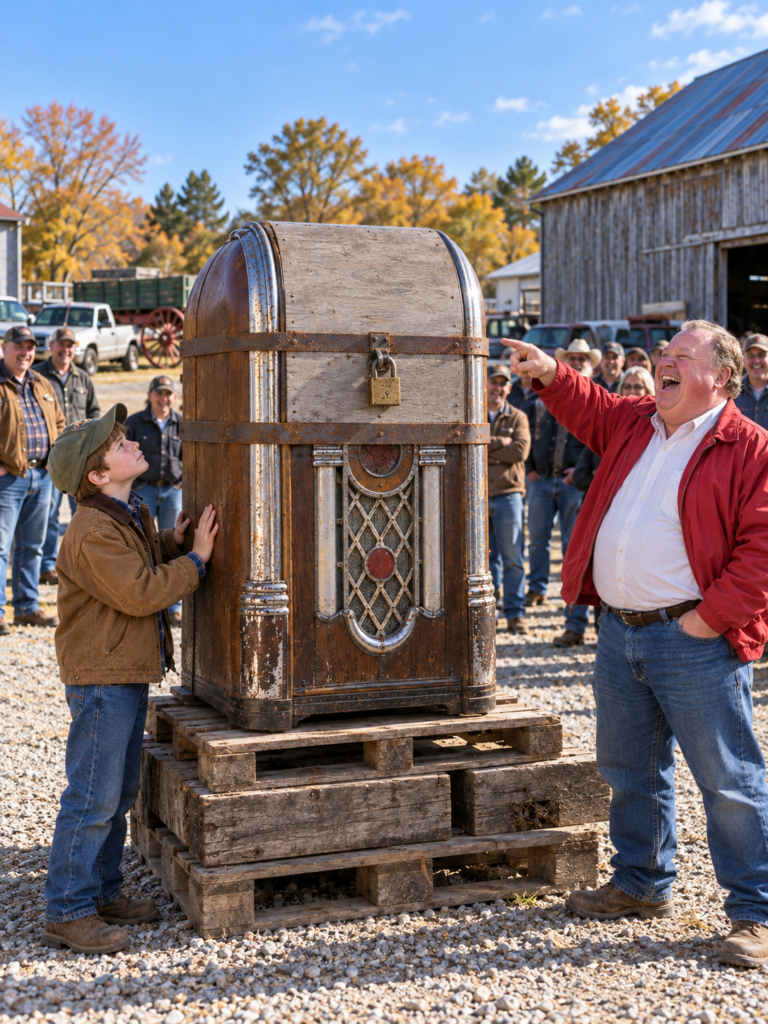
“Folks, remember this day. That boy just paid eighty dollars for a dead jukebox with a padlock on it. I believe we’ve witnessed the most expensive piece of firewood ever sold in Calder Crossing!”
Laughter swept across the gravel yard.
Some people shook their heads. Others slapped their knees. A farmer near the auctioneer’s truck laughed so hard that he nearly spilled his coffee.
And in the middle of it all stood twelve-year-old Wes Tarant, one hand resting against the cold chrome side of a machine taller than he was.
He had eighty-three dollars in his pocket when he arrived that morning.
Now he had three.
The remaining eighty belonged to the auctioneer, and the enormous, dusty jukebox belonged to him.
At least, that was what the auctioneer had said.
Wes was beginning to understand that owning something didn’t always mean people would respect you for it.
The machine looked terrible.
Two rusted steel bands wrapped around its body. Gray plywood covered the curved glass dome. A heavy brass padlock hung from the front, and decades of barn dust had turned what had once been bright chrome into something resembling dirty pewter.
Nobody knew whether anything remained inside.
Nobody even knew whether it had ever worked.
And Royce Henning, the self-proclaimed antique expert who operated a large secondhand business outside town, had already announced that it was worthless.
“Tell you what, son,” Royce called, strolling closer in his bright red jacket. “I’ll give you five dollars for the scrap metal. That’s probably more than you’ll get anywhere else.”
Another round of laughter followed.
Wes didn’t answer.
He wasn’t a big boy. He had narrow shoulders, brown hair that refused to lie flat, and the serious eyes of a child who had learned early that money didn’t come easily.
His jeans were faded at the knees. His boots had been bought secondhand. The jacket he wore had belonged to his older cousin.
Those eighty dollars represented almost an entire summer of work.
He had spent hot afternoons mowing lawns, clearing weeds from fence lines, stacking firewood, and pulling stones from Mrs. Bellamy’s vegetable garden.
Every dollar had gone into an old coffee tin beneath his bed.
He had been saving for a used bicycle.
Instead, he had bought a jukebox that everyone believed was junk.
But there was one thing nobody in that auction yard understood.
Wes hadn’t bid because he wanted the machine.
He had bid because of what happened when his grandmother saw it.
Three hours earlier, Grandma Ida Tarant had arrived at the Mercer estate auction in her old blue sedan, with Wes riding beside her.
Ida was eighty-four years old, small and slightly stooped, with silver-white hair twisted into a bun and held together by two brown pins. She wore a lavender cardigan even on warm days because, as she liked to say, the world had gotten colder since she turned seventy.
She loved auctions.
She loved the smell of old wood, the sound of an auctioneer rattling off prices, and the possibility that something forgotten might still have a purpose.
“People throw away too much these days,” she often told Wes. “They look at something old and think it’s finished. Most of the time, they just don’t know its story.”
That morning, she had brought thirty dollars in her handbag.
She bid on two quilts, a cast-iron skillet, and a rocking chair with a broken spindle.
She lost every bid.
And she laughed about it.
“Saved myself thirty dollars,” she told Wes, settling onto the folding stool he carried for her. “Best kind of shopping there is.”
Then the auctioneer called the final large item.
“Lot sixty-three! One old jukebox. Unknown manufacturer. Locked, boarded, and strapped. Sold as is, where is!”
Two workers pulled a canvas covering from the machine.
The sunlight caught its curved chrome edges.
And Grandma Ida stopped breathing for a moment.
Wes noticed immediately.
Her fingers tightened around his forearm.
“Grandma?”
She didn’t answer.
Her eyes had widened, and the color seemed to drain from her face.
“Grandma, are you all right?”
She leaned forward slowly.
“Oh, Lord,” she whispered.
“What?”
Her hand began to tremble.
“That’s the machine from the Blue Comet.”
Wes had never heard of the Blue Comet.
He looked from his grandmother to the battered machine.
“What machine?”
But Ida shook her head.
“Never mind, sweetheart.”
She tried to smile.
It wasn’t a convincing smile.
“That was a long time ago.”
The auctioneer opened the bidding at ten dollars.
Nobody raised a hand.
Royce Henning stepped forward and knocked his knuckles against the cabinet.
“Not a real factory machine,” he announced. “Wrong dimensions. No visible maker’s badge. Someone probably built it in a garage and stuffed a cheap record player inside.”
He turned toward the crowd.
“I’ll bet the contents were stripped out forty years ago. You open that padlock, you’ll find a mouse nest and an empty beer can.”
The crowd chuckled.
“Ten dollars?” the auctioneer called again.
Silence.
Wes looked at his grandmother.
She was still staring at the machine.
Her eyes glistened.
He had seen those eyes shine only a few times before.
Once when she opened a letter from a childhood friend.
Once when they visited his grandfather’s grave.
And once when an old country song played on the radio and she hurried into the kitchen before anyone noticed she was crying.
Wes raised his hand.
“Ten dollars.”
People turned toward him.
The auctioneer blinked.
“Ten from the young gentleman!”
A farmer standing behind Wes grinned.
“Twenty.”
Wes swallowed.
“Thirty.”
“Forty,” the farmer replied.
The crowd started enjoying itself.
“Fifty.”
“Sixty.”
Wes could feel his grandmother’s hand resting lightly on his shoulder.
“Seventy,” said the farmer.
Wes thought about his bicycle.
He thought about the weeks spent mowing under the July sun.
Then he looked at Grandma Ida.
“Eighty dollars.”
The farmer laughed and raised both hands.
“That’s enough for me!”
The auctioneer’s gavel struck the wooden block.
“Sold! Eighty dollars to the young man!”
And that was how Wes Tarant became the most talked-about boy in Calder Crossing.
Not because he had won something.
Because everyone thought he had made a fool of himself.
Royce was still laughing when Wes approached the auctioneer to pay.
“What are you going to haul it home with?” Royce asked. “Your bicycle?”
More laughter.
Wes stared at the gravel.
He hadn’t thought that far ahead.
The jukebox was enormous, too wide for Grandma Ida’s trunk and too heavy for anything Wes could push.
Then a quiet voice came from near the fence.
“I’ve got a flatbed.”
Hector Villalobos stepped forward.
Hector lived two houses away from the Tarants. He was a retired well driller with weathered hands, a gray mustache, and the habit of speaking only when he had something worth saying.
His old truck was parked beside the county road.
“I can take it over,” he said.
Wes looked up.
“Really?”
Hector nodded.
“Wouldn’t have offered otherwise.”
Royce smirked.
“Careful, Hector. You might scratch that priceless firewood.”
Hector glanced at him.
“Wood doesn’t usually come with chrome.”
He went to fetch his truck.
It took four grown men and a winch to move the jukebox onto the flatbed.
While they worked, Royce kept talking.
“Open it right now, boy. Let’s see what you’ve bought.”
Wes shook his head.
“No, sir.”
“Afraid?”
“No, sir.”
“Then why not?”
Wes looked toward his grandmother.
“Because I don’t know what’s inside, and I don’t want to break it.”
Royce let out another laugh.
But Grandma Ida stepped forward.
“That’s enough, Royce.”
Her voice wasn’t loud.
It didn’t need to be.
Royce turned toward her.
“Now, Ida, we’re only having a little fun.”
“Arlo Mercer sealed that machine himself,” she said. “And he was a better man than most of us will ever have the chance to be.”
For a moment, the laughter stopped.
Then she placed a hand against the dusty chrome.
“He had his reasons.”
Wes saw her wipe one eye before turning away.
They brought the jukebox home that afternoon.
It wouldn’t fit through the front door, so Hector and two neighbors helped lower it into the garage.
There it stood between an aging lawn mower, boxes of sewing supplies, and the workbench where Wes’s father repaired equipment after his shifts at the agricultural cooperative.
When Curtis Tarant came home, he stopped in the garage doorway.
He stared at the machine.
Then at Wes.
“Tell me that thing didn’t cost what Mrs. Bellamy says it cost.”
Wes put his hands in his pockets.
“Eighty dollars.”
Curtis closed his eyes.
“Good grief.”
“It was my lawn money, Dad.”
“I know.”
“I earned it.”
Curtis leaned against the doorframe.
He was a thin, hard-working man with tired eyes and hands that smelled faintly of diesel fuel no matter how often he washed them.
For the past two years, money had been tight.
A bad harvest had hurt the local farmers, which meant fewer feed deliveries and reduced hours at the cooperative.
Wes’s mother, Renee, worked late into the evenings altering wedding dresses, hemming trousers, and repairing coats for people who couldn’t afford new ones.
The family wasn’t starving.
But Wes knew enough to notice when his mother turned a grocery receipt facedown or when his father waited until Friday to buy gasoline.
Curtis studied his son.
“You understand that eighty dollars is gone whether that thing works or not?”
“Yes, sir.”
“And you can’t just change your mind and ask for it back?”
“I know.”
Curtis rubbed his forehead.
Then he looked at the jukebox again.
“Well,” he said slowly, “I suppose if a boy works all summer for something, he ought to be allowed to make his own decisions.”
Wes lifted his head.
“You’re not mad?”
“I’m not thrilled.”
Curtis almost smiled.
“But it’s yours.”
His mother arrived home twenty minutes later.
When Renee saw the jukebox, she stared in disbelief.
Then she started laughing.
But her laughter was different.
She circled the machine, brushing her fingertips over its curved sides.
“Well, I’ll give you this,” she told Wes. “It’s certainly bigger than the bicycle.”
Then she turned to her husband.
“And it’s got prettier lines than your old truck.”
Curtis shook his head.
“Everyone in this house has lost their minds.”
That evening, they gathered around the kitchen table.
There was chicken stew, cornbread, sliced tomatoes from the garden, and a pitcher of sweet tea.
Grandma Ida barely touched her food.
She sat looking toward the dark window over the sink.
Finally, Wes asked the question that had been waiting inside him all afternoon.
“Grandma, what was the Blue Comet?”
Ida lowered her spoon.
For a long time, she said nothing.
Then she folded her hands.
“The Blue Comet,” she began, “was the most beautiful place I ever knew before I married your grandfather.”
Curtis looked up.
“You’ve never told me much about it, Mom.”
“I suppose there was never a reason.”
She smiled sadly.
“It stood along the old state highway, about twelve miles past Miller’s Creek. Arlo Mercer owned it. Saturday nights there was dancing. Sundays he served fried chicken and apple pie. Travelers came through, truck drivers, musicians, farmers coming home from market.”
Her voice softened.
“And on Saturday nights, when the lights came on, it looked like heaven had borrowed a little corner of the earth.”
She described the wooden dance floor, the blue glass lamps, the polished counter, and the smell of coffee mixed with cigarette smoke and fresh pie.
Then she described the jukebox.
“It stood by the dance floor. Bright chrome, curved glass, lights running all around it. Nothing else looked like it. Arlo said it was one of the first machines of its kind.”
Wes listened closely.
“Did you dance there?”
“Oh, I danced.”
She laughed.
“Goodness, I danced until the soles of my shoes nearly fell off.”
Then her expression changed.
“But mostly, I sang.”
Renee smiled.
“You never told us you sang in public.”
“I was seventeen. I thought every song on the radio had been written just for me.”
Ida looked down at her hands.
“Whenever the traveling band took a break, Arlo would let me sing a number or two.”
She paused.
“One summer, there was a young guitar player passing through town. Skinny boy. Barely had enough money for a room. His name was Delbert Reigns.”
Curtis frowned.
“Delbert Reigns?”
“Yes.”
“The country guitarist?”
“I suppose he became one later.”
Ida smiled faintly.
“Back then, he was just Del. He had a borrowed guitar and a pair of boots with holes in the soles.”
Her fingers traced the edge of her napkin.
“One Saturday, we sang together. Arlo had an old recording machine in the back room, and he decided to record us.”
Wes leaned forward.
“Really?”
“Really.”
“Do you still have the record?”
Ida shook her head.
“I never even heard it.”
“Why?”
“Because the Blue Comet closed before Arlo got around to playing it for me. A new interstate opened. Travelers stopped using the old road. Within months, Arlo couldn’t pay the bills.”
She looked toward the garage.
“On the last night, he shut down the jukebox. Wrapped it in steel bands. Screwed a board over the top. Locked the front.”
“Why?”
“He said nobody was going to strip it for scrap while he was alive.”
Wes felt a strange tightness in his chest.
“And then?”
“He put it away in his brother’s barn. I never saw it again.”
Outside, a pickup drove along the county road, its headlights passing across the curtains.
Ida continued staring at the table.
“Until today.”
Wes asked the question quietly.
“Grandma, do you think your record might still be inside?”
Ida slowly raised her eyes.
For one brief moment, he saw something there that looked almost like hope.
Then she shook her head.
“Oh, sweetheart. That was sixty-seven years ago.”
“But maybe—”
“No.”
She reached across the table and took his hand.
“Don’t go spending your childhood chasing an old woman’s memories.”
Wes looked toward the dark garage.
He could almost picture the machine standing inside, silent beneath its layers of rust and dust.
Then he looked back at his grandmother.
She had worked hard all her life.
She had buried her husband.
She had helped raise her grandchildren.
She had cooked meals, mended clothes, tended gardens, and sat beside sickbeds.
And tonight, for the first time Wes could remember, she had spoken about being seventeen.
About having a dream that belonged only to her.
He squeezed her hand.
“Grandma?”
“Yes, honey?”
“Maybe some things are worth remembering.”
Ida pressed her lips together.
Then she turned away, but not before Wes saw a tear roll down her cheek.
That night, long after everyone went to sleep, Wes lay awake thinking about the eighty dollars.
He thought about the bicycle he no longer had money to buy.
He thought about the way Royce Henning had laughed.
But most of all, he thought about his grandmother’s face when she recognized the jukebox.
Finally, he climbed out of bed and walked to the window.
The garage stood dark beneath the October moon.
Inside was a machine nobody wanted.
A machine everyone had laughed at.
And perhaps, hidden somewhere beneath those rusted steel bands, there was a small piece of his grandmother’s life that had been waiting more than half a century for someone to remember it.
Part 2
The next morning, Wes went into the garage before breakfast.
The air smelled of cold concrete, sawdust, and engine oil.
A pale strip of sunlight entered through the dirty window above his father’s workbench.
The jukebox stood exactly where they had left it.
Wes walked around it slowly.
From up close, he could see tiny scratches along the chrome, dark streaks beneath the metal bands, and twelve rusted screws holding the plywood against the curved glass.
The padlock was heavy and green with age.
He touched it.
It was cold enough to make him pull his fingers back.
His father kept a large flathead screwdriver on the workbench.
Wes picked it up.
Twelve screws.
That was all.
Twelve screws, two steel bands, and one padlock stood between him and whatever had been hidden inside the machine for sixty-seven years.
He could probably open it before breakfast.
He imagined finding a pile of rusted parts.
He imagined a dead mouse beneath the record mechanism.
He imagined Royce Henning hearing about it and laughing all over again.
Then he imagined something else.
A record with his grandmother’s name written on it.
A record that had survived all those years.
Wes pressed the screwdriver against the first screw.
The metal slipped slightly.
A rust flake fell onto his sleeve.
He stopped.
What if he damaged something?
What if an old wire broke?
What if the glass dome shattered?
He knew almost nothing about machinery like this.
His father could repair tractors and lawn mowers, but the jukebox was different.
It wasn’t made for hauling hay or turning soil.
It was delicate.
And whatever remained inside it might be more fragile than anything Wes had ever touched.
He put the screwdriver down.
Then he found an old canvas tarp and carefully draped it over the machine.
“Not yet,” he whispered.
At breakfast, his father noticed the rust on Wes’s hands.
“You try opening that thing?”
“No, sir.”
Curtis looked up from his coffee.
“Thought you would.”
“I almost did.”
“What stopped you?”
Wes stirred his oatmeal.
“I don’t want to ruin it.”
Curtis studied him.
Then he nodded.
“That sounds like a fair reason.”
Outside, the family farm was waking up.
The Tarants no longer farmed enough land to support themselves, but they still kept a few acres behind the house.
A vegetable garden stretched beyond the chicken coop. Two old apple trees stood beside the gravel drive. The barn had belonged to Curtis’s father and still held a rusted tractor, fencing supplies, and enough spare lumber to repair half the county.
After breakfast, Wes fed the chickens, carried two buckets of water to the garden, and helped his father replace a broken hinge on the barn door.
He worked quietly.
But his mind remained inside the garage.
By Monday morning, the entire town knew about the auction.
And by Monday afternoon, the story had become a joke.
At the Calder Crossing Café, somebody had written on the chalkboard beneath the lunch special:
EIGHTY-DOLLAR FIREWOOD.
At the feed store, men asked Curtis whether his son planned to heat the house with chrome that winter.
At the barber shop, Royce Henning told anyone who would listen that the machine was probably made from an old refrigerator.
Every time he repeated the story, he made the jukebox sound more ridiculous.
And every time he told it, the crowd laughed a little louder.
The worst part came at school.
Wes was halfway down the seventh-grade hallway when an older boy named Travis Miller stepped in front of him.
“Hey, Jukebox!”
Two other boys laughed.
Wes tried to walk around him.
Travis blocked the way.
“Got any music in that trash can you bought?”
Wes didn’t answer.
“Maybe your grandma can sing inside it.”
That made the other boys laugh harder.
Wes felt heat rise into his face.
He wanted to tell Travis to shut up.
He wanted to shove past him.
Instead, he lowered his eyes and kept walking.
At lunchtime, he sat alone near the cafeteria window.
His friend Daniel slipped onto the bench across from him.
“Don’t listen to Travis,” Daniel said.
“I’m not.”
“Everybody’s talking about it.”
“I know.”
Daniel unwrapped his sandwich.
“Why’d you buy it anyway?”
Wes thought for a moment.
Then he said, “My grandma knew it.”
Daniel looked confused.
“What do you mean?”
“She remembered it from when she was young.”
“So?”
Wes stared at his milk carton.
“So maybe that matters.”
Daniel shrugged.
He wasn’t being cruel.
He simply didn’t understand.
And Wes realized that explaining something didn’t mean another person would feel it the way he did.
That evening, he returned home later than usual.
Grandma Ida was sitting on the back porch beneath a faded quilt, watching the sun settle behind the fields.
A cup of coffee rested beside her.
Wes sat on the steps.
For a while, neither spoke.
Then Ida said, “People giving you trouble?”
Wes looked at her.
“How’d you know?”
“I raised your father. I know what a boy looks like when he’s carrying something heavy and pretending he isn’t.”
Wes picked at a loose thread on his sleeve.
“They think I’m stupid.”
Ida’s expression softened.
“For buying the jukebox?”
He nodded.
“Even the boys at school.”
She stared toward the barn.
“People can be unkind when something doesn’t make sense to them.”
“Royce says I bought junk.”
“Well,” she replied, “Royce has been talking more than he’s been listening since the day he learned how.”
Wes almost smiled.
Then his face grew serious.
“Grandma, what if he’s right?”
Ida turned toward him.
“What if there’s nothing inside?”
He swallowed.
“What if I spent all that money for nothing?”
She looked at his small hands, roughened by summer work.
Then she leaned forward.
“Wes, when your grandfather first bought this place, everybody said he was foolish.”
“Why?”
“Because the roof leaked, half the fences had fallen down, and the barn was leaning so badly that people expected a strong wind to finish it.”
She gestured toward the buildings.
“Your grandfather didn’t have much money. But he had strong hands and more patience than most men I ever met.”
“Did people laugh at him?”
“Some did.”
“What happened?”
“He fixed the roof. He rebuilt the fences. He straightened the barn a little at a time.”
Wes glanced toward the weathered red building.
“It still leans.”
Ida laughed.
“Yes, it does. Your grandfather always said a barn with a little lean has more character.”
Then she rested her hand on his shoulder.
“Sometimes other people see what something costs. They don’t see what it means.”
Wes stared at the garage.
“But what if it really is worthless?”
Ida was quiet for a moment.
Then she said, “You bought that machine because you saw me looking at it.”
He nodded.
She pressed her hand against his cheek.
“Then it was never worthless to me.”
For a moment, Wes couldn’t speak.
The next day, he made a decision.
He would stop worrying about what Royce Henning thought.
He would stop trying to guess what was inside.
He would find out exactly what the machine was.
And he would do it properly.
On Tuesday afternoon, he rode his old bicycle to the Calder Crossing Public Library.
The library occupied a brick building behind the post office that had once been a harness shop.
Its windows were tall and narrow, its wooden floors creaked, and the front door made a little bell ring whenever someone entered.
Bernadette Odum had been the librarian for twenty-seven years.
She wore her reading glasses on a beaded chain and kept pencils tucked into her gray hair.
She had known Wes since he was small enough to stand on tiptoe to reach the checkout desk.
When he walked in, she looked up from her paperwork.
“Well, if it isn’t our famous young auction buyer.”
Wes stopped.
His face fell.
Mrs. Odum immediately noticed.
“Oh, sweetheart,” she said gently. “I wasn’t making fun of you.”
He stepped closer.
“I need to find something.”
“What kind of something?”
“Information about jukeboxes.”
She put down her pen.
Then she smiled.
“Now that’s a question worth asking.”
For the next two hours, they searched old reference books, equipment catalogs, and collector manuals.
Wes learned that jukeboxes weren’t simply decorated record players.
They were complicated machines filled with motors, electrical switches, selectors, amplifiers, and carefully balanced mechanisms.
Some had been produced by the thousands.
Others had disappeared almost as soon as they were built.
Mrs. Odum showed him photographs of machines from the 1940s and 1950s.
Brightly colored cabinets.
Curved glass fronts.
Illuminated panels.
Chrome trim.
Some looked vaguely like the one in his garage.
But none looked exactly right.
“That doesn’t mean yours isn’t real,” Mrs. Odum explained.
“Royce says it wasn’t made by a factory.”
“Royce doesn’t know everything.”
She turned another page.
“Most manufacturers attached a small metal identification plate somewhere on the cabinet. Sometimes on the back. Sometimes near the bottom. It might have the maker’s name, a model number, or a serial number.”
Wes leaned forward.
“So if I find the plate—”
“You may find the answer.”
She raised one finger.
“But listen carefully. Don’t scrape away the dust. Don’t polish the metal. Don’t use sandpaper. Sometimes the identification marks are very faint.”
Wes nodded.
“And one more thing.”
“Yes, ma’am?”
“Don’t plug the jukebox into an electrical outlet.”
“Why not?”
“Because old wiring can be dangerous. A machine that’s been sitting for decades should be inspected before anyone tries to turn it on.”
Wes remembered the brittle power cord coiled behind the cabinet.
He nodded again.
Mrs. Odum studied his face.
“Did you open it yet?”
“No.”
“Good.”
She smiled.
“Sometimes the smartest thing a person can do is leave something alone until he understands it.”
Wes rode home before sunset.
The air had grown cold.
Fields of harvested corn stretched along both sides of the county road, and dry leaves skittered across the pavement.
He pedaled hard enough to make his legs ache.
By the time he reached the house, his father was unloading feed sacks from the pickup.
“Dad!”
Curtis turned.
“What?”
“I need your help.”
“Something broken?”
“Not exactly.”
Wes told him about the identification plate.
Curtis listened carefully.
Then he wiped his hands on a shop rag.
“Well,” he said, “let’s see what we’re dealing with.”
They entered the garage together.
Curtis held a large flashlight while Wes moved behind the jukebox.
There was barely enough room between the machine and the wall.
The air smelled of dust and old wood.
Wes lay flat on an empty feed sack and slid himself into the narrow space.
“Can you see anything?” Curtis asked.
“Mostly cobwebs.”
“Watch your head.”
The back of the cabinet was black with grime.
Wes moved the flashlight beam slowly across it.
Nothing.
Then he remembered Mrs. Odum’s advice.
“Dad, shine the light from the side.”
Curtis lowered the flashlight.
The beam skimmed across the surface.
Near the bottom, something caught the light.
A straight edge.
Then another.
“Wait.”
Wes reached toward it but stopped before touching the dust.
“There’s something here.”
“What?”
“A metal plate.”
Curtis leaned closer.
The plate was about the size of a playing card and held in place by four small rivets.
Most of its surface had darkened with age.
But beneath the dust, raised lettering remained.
Wes shifted his head.
“Marlo,” he whispered.
“What?”
“Marlo Coin Phonograph Company.”
Curtis hurried to the workbench and found a pencil.
“Say it again.”
Wes read the letters carefully.
“Marlo Coin Phonograph Company. Toledo, Ohio.”
Curtis wrote everything on the back of an old delivery receipt.
“Model?” he asked.
Wes narrowed his eyes.
The next line was difficult to read.
“S-T-A-R… L-I-N-E-R.”
“Starliner?”
“Starliner,” Wes repeated.
Then he moved the light lower.
There was a third line.
A serial number.
Wes stared at it.
For several seconds, he thought he was reading it incorrectly.
“Dad?”
“What is it?”
“Come look.”
Curtis knelt beside the cabinet and aimed the light again.
The numbers were unmistakable.
SERIAL NO. 001.
Beneath them were two faint words.
PATENT PENDING.
Curtis stopped writing.
For a long moment, father and son stared at the little metal plate.
Then Curtis whispered, “Number one?”
Wes nodded.
“The very first one?”
“I don’t know.”
Curtis slowly stood.
He looked at the enormous machine, still wrapped in steel bands.
Then he looked at the receipt in his hand.
For the first time since Wes had brought the jukebox home, his father’s expression wasn’t one of disbelief.
It was curiosity.
“Son,” Curtis said, “I think we’d better go back to that library.”
And beneath the dusty canvas covering, the old machine remained silent.
But something had changed.
The boy everyone had laughed at finally had a reason to believe there was more to the story.
And he hadn’t even opened the lock.
Part 3
The following morning, Wes arrived at the library carrying the old delivery receipt as carefully as if it were a hundred-dollar bill.
Mrs. Odum was standing behind the circulation desk, sorting returned books.
When she saw his face, she put the books down.
“You found something.”
Wes nodded.
He unfolded the receipt.
She read the first line.
Then the second.
By the time she reached the serial number, she had stopped smiling.
“Where did you find this?”
“On the back of the jukebox.”
“Are you certain you read it correctly?”
“My dad checked it too.”
Mrs. Odum took off her glasses, cleaned them with the corner of her cardigan, and read the receipt again.
“Marlo Coin Phonograph Company,” she murmured. “Toledo, Ohio.”
She looked toward the shelves.
“I don’t recognize that manufacturer.”
Wes’s shoulders sank.
“Does that mean Royce was right?”
“No.”
She spoke firmly.
“It means we haven’t found the answer yet.”
She led him to a table near the window.
“Sit down, Wes.”
Then she began making telephone calls.
The first call went to a large public library in Toledo.
The second went to a historical society.
The third went to a man who had spent forty years collecting coin-operated machines.
By lunchtime, Wes had filled three pages of a notebook with names, telephone numbers, and questions.
Mrs. Odum ordered copies of two old trade magazines.
Then she found a brief reference in a catalog from 1950.
It was only a few lines long.
But it was enough to make her read it twice.
The Marlo Company had existed.
And it had manufactured jukeboxes.
Wes stared at the printed words.
“So it wasn’t homemade?”
“No, sweetheart.”
Mrs. Odum smiled.
“It wasn’t homemade.”
Wes felt a little of the weight lift from his chest.
But Mrs. Odum wasn’t finished.
She pointed to a sentence in the catalog.
The company’s factory had been destroyed by fire in the spring of 1950.
Production had never resumed.
“That may explain why we can’t find much about it,” she said.
Wes thought about the machine in his garage.
“How many did they make?”
“I don’t know yet.”
“Could ours be the first?”
Mrs. Odum looked at the receipt.
“Possibly.”
“Would that make it valuable?”
She hesitated.
“Maybe. But rarity alone doesn’t tell us everything. Condition matters. History matters. Whether it’s complete matters.”
She folded the paper.
“And right now, we don’t know what’s behind that padlock.”
Wes nodded.
He understood.
For the first time, he began to realize that finding the truth might require more patience than he had ever needed in his twelve years.
The old machine had waited sixty-seven years.
It could wait a few more days.
That evening, he returned home to find his grandmother in the kitchen.
She was sitting beside the window, peeling apples into a large yellow bowl.
The knife moved slowly in her hands.
Wes noticed she had stopped humming.
“Grandma?”
“Yes, honey?”
“Do you remember Arlo Mercer very well?”
She glanced up.
“Of course.”
“What was he like?”
Ida set down the knife.
For a moment, she seemed surprised by the question.
Then she smiled.
“He was a big man. Had a crooked nose from a fight when he was young and always wore suspenders, even when he dressed up.”
She laughed softly.
“He couldn’t carry a tune in a bucket, but he loved music more than almost anyone I ever knew.”
“Why did he buy that jukebox?”
“He said people who worked hard all week deserved something beautiful on Saturday nights.”
Wes pulled out a chair.
“Was it expensive?”
“Oh, terribly. People thought he was foolish.”
“Like they think I’m foolish?”
Ida looked at him.
Then her smile faded.
“Yes,” she said quietly. “A little like that.”
She returned to peeling.
“Arlo used to say that the world was full of men who could tell you the price of something, but very few who bothered to learn its worth.”
Wes repeated the sentence under his breath, trying to remember it.
Then he asked, “Did Grandpa ever go to the Blue Comet?”
Ida’s hands stopped moving.
For a moment, she looked toward the family photograph hanging beside the pantry.
Her husband, Walter Tarant, stood in the picture beside a young Ida, both of them smiling in front of the farmhouse.
“Not until later,” she answered.
“Did he know you sang?”
“He knew.”
“Did he like your singing?”
Her expression softened.
“He liked it more than I deserved.”
She placed the apple in the bowl.
“When Walter first asked me to marry him, I told him I wasn’t sure a farm girl could be happy spending the rest of her life feeding chickens and washing muddy clothes.”
Wes laughed.
“What did he say?”
“He said, ‘Then we’ll buy a radio, and you can sing while you wash them.’”
She smiled at the memory.
“He wasn’t a romantic man in the ordinary way. He didn’t bring flowers very often. But if he knew I loved something, he’d find a way to make room for it.”
Wes watched her hands.
They were thin and spotted with age.
He imagined those same hands when she was seventeen, holding a microphone beneath blue lights.
It was difficult to believe the quiet old woman sitting before him had once stood on a stage with people watching her.
“Grandma, did you ever wish you’d become a singer?”
Ida looked at him for a long moment.
Then she shook her head.
“I wouldn’t trade your grandfather or this family for a thousand songs.”
She paused.
“But I won’t pretend there weren’t nights when I wondered what my voice might have sounded like on a record.”
She turned toward the window.
“Sometimes you can be grateful for the life you lived and still miss the life you didn’t.”
Wes didn’t know what to say.
So he simply sat with her until the apples were peeled.
Two days later, the documents arrived from Toledo.
Mrs. Odum telephoned the Tarant house immediately.
Curtis answered.
“Wes is outside helping with the chickens.”
“Tell him to come straight to the library.”
“Is something wrong?”
“No,” she said.
Then she paused.
“I believe something rather extraordinary may be right.”
Twenty minutes later, Wes rode his bicycle through the library doors.
Mrs. Odum was waiting with several photocopied pages spread across the table.
One showed an advertisement from 1949.
A beautiful jukebox stood beneath the words:
THE MARLO STARLINER — A NEW AGE OF MUSIC.
Wes stopped breathing.
There it was.
The same curved cabinet.
The same sweeping chrome trim.
The same unusual proportions.
Even the metal supports surrounding the glass dome matched.
“That’s it,” he whispered.
Mrs. Odum nodded.
“That’s your jukebox.”
They studied the advertisement.
The Starliner had been designed to hold fifty records, with a mechanism capable of playing both sides.
Its sound system was more powerful than most competing models of the time.
Marlo had hoped to sell hundreds of them.
But the factory fire had ended those plans.
According to the trade publication, fewer than thirty completed machines had left the factory.
And the most remarkable detail was found in a later article.
No surviving example had ever been verified.
Collectors knew the Starliner only from photographs and advertisements.
Mrs. Odum placed her finger on the final paragraph.
“This article was written by an appraiser named Harriet Lindquist.”
Wes leaned closer.
“Who is she?”
“She specializes in antique coin-operated machines. According to the historical society, she’s still working with an auction house in Chicago.”
Wes looked at the photograph.
Then he looked at his notebook.
“Can we contact her?”
Mrs. Odum smiled.
“I was hoping you’d ask.”
That night, with his mother’s permission, Wes used the family computer to write an email.
It took him almost an hour.
He explained that he was twelve years old, that he had purchased a locked jukebox at an estate auction for eighty dollars, and that he had discovered a metal plate reading Marlo Starliner, serial number 001.
He attached photographs of the cabinet, the steel bands, the brass padlock, and the identification plate.
Then he wrote the part that mattered most to him.
“My grandmother remembers this machine from a place called the Blue Comet. She used to sing there when she was seventeen. I don’t know if anything is inside, but I don’t want to hurt it. Could you please tell me what I should do?”
He reread the message.
His mother stood behind him.
“Sounds good to me,” Renee said.
Wes pressed Send.
Then he went to bed.
The following evening, the telephone rang during supper.
Renee answered.
“Yes?”
She listened.
Then she turned toward Wes.
“It’s for you.”
Wes froze.
“Me?”
“A woman from Chicago.”
He nearly knocked over his chair.
Harriet Lindquist had a brisk voice, but there was kindness beneath it.
“Are you Wesley Tarant?”
“Yes, ma’am.”
“I’m calling about the jukebox.”
“Yes, ma’am.”
“I’ve been studying your photographs.”
Wes gripped the telephone.
Harriet asked three questions.
“Have you opened it?”
“No, ma’am.”
“Have you connected it to electricity?”
“No, ma’am.”
“Have you cleaned the identification plate?”
“No, ma’am. We used a flashlight.”
There was a brief silence.
Then Harriet said, “Young man, you’ve already done three things that plenty of grown collectors get wrong.”
Wes didn’t know how to answer.
She continued.
“Those steel bands appear to be original to the way the machine was stored. The padlock may be original too. If that identification plate is authentic, and I have no reason yet to think otherwise, your machine could be extremely important.”
Wes pressed the telephone closer to his ear.
“Important how?”
“I’d rather examine it before saying too much.”
“Can you come?”
“Yes.”
Wes held his breath.
“I can be there three weeks from Saturday.”
He closed his eyes.
Three weeks sounded like forever.
“But until then,” Harriet continued, “I need you to promise me something.”
“Yes, ma’am?”
“Don’t open it. Don’t cut the bands. Don’t polish the cabinet. Don’t oil anything. And above all, don’t let anyone convince you to plug it in.”
“I promise.”
“Good.”
Then she asked, “Is there anyone you’d like present when we examine it?”
Wes looked through the doorway.
His grandmother sat at the kitchen table, holding her cup with both hands.
His father was watching him.
And outside, through the darkening window, the garage stood beneath the apple trees.
Wes thought about the auction yard.
About the laughter.
About the boys at school.
About the man in the red jacket.
“Yes, ma’am,” he answered.
“Who?”
“The man who said it was firewood.”
Harriet gave a short laugh.
“Well, Wesley. I think we’d better invite him.”
By Sunday, the news had spread through Calder Crossing.
An expert from Chicago was coming to inspect the Tarant boy’s eighty-dollar jukebox.
People who had laughed at the auction now began asking questions.
At the café, the chalkboard joke disappeared.
At the feed store, men asked Curtis whether he’d discovered anything valuable.
At school, even Travis Miller seemed curious.
But Royce Henning was unusually quiet.
He owned hundreds of antiques.
He had spent decades telling people he knew more about old machines than anyone in three counties.
And now a woman from Chicago was traveling hundreds of miles to examine something he had dismissed as junk.
On Sunday afternoon, his white pickup turned into the Tarants’ driveway.
Curtis was repairing a fence near the garage when Royce climbed out.
“Well, Curtis,” Royce said pleasantly. “Thought I’d stop by.”
Curtis straightened.
“What can I do for you?”
Royce looked toward the garage.
“I’ve been thinking about that old machine.”
“Have you?”
“Sure have.”
He smiled.
“I might’ve been a little hard on the boy at the auction.”
Curtis said nothing.
“So I figured I’d make things right.”
Royce opened his wallet.
He removed four fifty-dollar bills.
“Two hundred dollars. Cash.”
Curtis looked at the money.
Royce continued.
“More than double what Wes paid. I’ll haul the thing away myself.”
At that moment, Wes stepped out of the garage.
He had heard everything.
Royce turned toward him.
“There he is! Our young collector.”
Wes stopped beside his father.
Royce extended the money.
“What do you say, son? Two hundred dollars, and you can put the whole embarrassing business behind you.”
Wes looked at the bills.
Two hundred dollars.
Enough to buy the bicycle he wanted.
Enough to replace his old boots.
Enough to give some money back to his parents.
For a moment, temptation tugged at him.
Then he remembered his grandmother sitting beneath the porch light, telling him about the Blue Comet.
He remembered her face when she spoke of the song she had never heard.
“No, thank you, Mr. Henning.”
Royce blinked.
“What?”
“I don’t want to sell it.”
Royce’s smile tightened.
“Son, you’re making a mistake.”
“Maybe.”
Wes swallowed.
“But I’d like to find out what it is first.”
Royce glanced toward Curtis.
“You ought to talk some sense into him.”
Curtis folded his arms.
“It’s his jukebox.”
“Curtis, be reasonable.”
“I am.”
Royce stared at them.
Then he forced a laugh.
“Well, when that Chicago lady comes and finds a mouse nest, don’t say I didn’t warn you.”
Wes looked him in the eye.
“You’re welcome to come.”
Royce stopped smiling.
“Come where?”
“To see it opened.”
He hesitated.
Wes continued.
“Saturday. Two o’clock. In our garage.”
For several seconds, Royce said nothing.
Then he tucked the money into his wallet.
“Fine,” he said. “I’ll bring my bolt cutters.”
He climbed into his truck and drove away.
Grandma Ida had watched the entire conversation from the porch.
When Wes turned toward her, she was smiling.
Not because they had refused two hundred dollars.
Not because Royce had been embarrassed.
But because her grandson had learned something that many adults never understood.
He had learned that some decisions could not be measured in money.
And for the first time in many years, Ida allowed herself to hope that an old song might not have disappeared forever.
Part 4
The next three weeks were the longest of Wes Tarant’s young life.
Every morning, he passed the garage on his way to feed the chickens.
Every afternoon, he glanced toward it while carrying firewood or sweeping the porch.
Every night, he imagined what might be hidden beneath the steel bands.
Sometimes he imagined fifty records.
Sometimes he imagined broken gears.
Sometimes he imagined opening the machine and finding nothing at all.
But he never touched the padlock.
He kept his promise.
Autumn deepened across Calder Crossing.
The cornfields turned brown and empty. Cold wind swept over the county roads. The apple trees dropped their last fruit, and the yard filled with dry leaves that crackled beneath Wes’s boots.
One Thursday night, a hard storm came across the valley.
Rain hammered the roof.
Wind rattled the windows.
Just after nine, Curtis heard water dripping in the garage.
He grabbed a flashlight.
“Wes!”
The boy ran downstairs.
A dark stain had spread across the ceiling near the old workbench.
Water was dripping onto the concrete.
The roof had leaked before, but never this close to the jukebox.
Curtis dragged an empty bucket beneath the leak.
“Get the tarp!”
Wes hurried to the shelf.
He and his father pulled the heavy canvas over the machine, making sure the water would run away from the cabinet.
Then Curtis climbed a ladder and checked the rafters with his flashlight.
The rain grew louder.
Outside, branches scraped the walls.
Wes stood beside the jukebox, holding one corner of the tarp.
He thought of the record his grandmother had described.
If it was inside, he couldn’t bear the thought of losing it now.
“Dad, is the water going to reach it?”
“Not if we can help it.”
Curtis climbed down.
Together, they moved boxes away from the leak, swept standing water toward the drain, and placed old towels along the floor.
By midnight, the worst of the storm had passed.
Wes was soaked to the knees.
His father looked exhausted.
But the jukebox remained dry.
Curtis leaned against the wall.
“Funny thing,” he said.
“What?”
“When you brought this home, I thought it was the biggest waste of eighty dollars I’d ever seen.”
Wes looked down.
“I know.”
Curtis shook his head.
“Now here I am, standing in a flooded garage at midnight trying to save it.”
Wes almost laughed.
His father rested a hand on his shoulder.
“Suppose you’ve got me curious too.”
The following morning, Curtis repaired the roof with leftover shingles from the barn.
Wes held the ladder.
Neither complained.
Something about working together made the waiting easier.
Inside the house, Grandma Ida began spending more time with her old photograph albums.
One afternoon, Wes found her sitting beside the living room window with a faded black-and-white picture in her lap.
He recognized the building immediately.
A low roadside restaurant.
A glowing sign.
People standing beside parked automobiles.
THE BLUE COMET.
Ida looked up.
“Found it in Walter’s old things.”
Wes sat beside her.
“Is that you?”
He pointed to a young woman standing near the entrance.
She wore a knee-length dress and had dark curls around her shoulders.
Ida smiled.
“Yes.”
Wes studied the photograph.
“Wow.”
“What?”
“You look different.”
She laughed.
“I should hope so. That picture’s nearly seventy years old.”
He examined the faces.
“Which one’s Arlo?”
She pointed to a broad man standing near the door with his hands on his hips.
“And that’s the bandleader, Sam Haskins. And that’s Ruthie Bell, who married a traveling salesman and moved to Kentucky.”
Her finger moved slowly across the picture.
“Most of those people are gone now.”
Wes looked at her.
“Does that make you sad?”
“Sometimes.”
She studied the photograph.
“But it also makes me grateful I remember them.”
Wes noticed another young man standing partly behind the group.
He wore a light-colored shirt and held a guitar case.
“Is that Del?”
Ida leaned closer.
Her hand trembled slightly.
“Yes.”
She touched the faded image.
“That was Delbert.”
Wes looked at the thin young man.
He didn’t resemble the famous musician whose later photographs Mrs. Odum had shown him.
In those pictures, Delbert Reigns wore expensive suits and held beautiful guitars beneath stage lights.
Here, he looked like an ordinary country boy.
“He looks poor,” Wes said.
“He was.”
“Was he nice?”
Ida smiled.
“He was kind to me.”
She looked out the window.
“That summer, I was so frightened of singing in front of people that my knees shook. Del always told me to look at one friendly face in the audience and sing as if that person was the only one listening.”
“Did it work?”
“Most nights.”
Wes grinned.
“What happened on the other nights?”
“I shut my eyes.”
She laughed softly.
Then her expression grew serious.
“He told me I had a beautiful voice.”
“Did you believe him?”
“No.”
“Why not?”
Ida studied her hands.
“Because I was seventeen, sweetheart. And seventeen-year-old girls can be terribly hard on themselves.”
She placed the photograph back into the album.
“Years later, I heard him on the radio. He’d become famous. I remember turning the volume up and thinking how strange it was that someone I once knew as a hungry boy in worn-out boots could be heard by people all across America.”
She paused.
“And I wondered whether he ever remembered the little girl who sang with him at the Blue Comet.”
Wes looked toward the garage.
“Maybe the record is still there.”
Ida pressed his hand.
“Maybe.”
For once, she didn’t tell him not to hope.
As the day of Harriet’s visit approached, Calder Crossing became increasingly interested.
The local newspaper published a short article about the upcoming inspection.
It described Wes as a young collector.
Wes didn’t like that description.
He didn’t consider himself a collector.
He was simply a boy who had bought something because his grandmother loved it.
But the newspaper attracted more attention.
People began stopping at the Tarants’ house.
Some wanted photographs.
Others asked whether the machine was for sale.
A man from a neighboring county offered five hundred dollars without even looking at it.
Another left a message offering a thousand.
Curtis declined politely.
Then one evening, a man Wes didn’t recognize knocked on the door and said he represented a private collector who might pay considerably more.
Curtis didn’t invite him inside.
“We’re not selling anything,” he said.
The man smiled.
“Everything has a price.”
Curtis looked past him toward the driveway.
“Not today.”
Then he closed the door.
Later that night, Renee sat at the kitchen table examining a stack of bills.
Wes came downstairs for water and saw her rubbing her forehead.
He stopped in the doorway.
“Mom?”
She looked up.
“Shouldn’t you be asleep?”
“Are we in trouble?”
Renee slowly set down the papers.
“What makes you ask that?”
Wes pointed toward the bills.
She sighed.
“Nothing we haven’t handled before.”
He sat beside her.
“Would selling the jukebox help?”
Renee looked surprised.
“Why?”
“Because people keep offering money.”
She watched him for a moment.
Then she took his hand.
“Sweetheart, I won’t pretend an extra thousand dollars wouldn’t be useful.”
Wes lowered his head.
“But your father and I are responsible for keeping this household running. Not you.”
“I could help.”
“You already do.”
She brushed the hair from his forehead.
“You help your father. You look after your grandmother. You worked all summer for your own money.”
She folded the bills.
“And I know why you bought that machine.”
Wes looked up.
“Because of Grandma.”
Renee nodded.
“Then we’re going to see this through.”
The next Saturday, they began preparing the garage.
Hector Villalobos arrived before breakfast with a broom, a toolbox, and a thermos of coffee.
Curtis moved the lawn mower outside.
Renee stacked her sewing boxes in the barn.
Wes swept the concrete until the floor looked cleaner than it had in years.
Hector brought two bright work lights but left them unplugged until Harriet could decide where they should stand.
Mrs. Odum offered to bring folding chairs from the Methodist church.
By noon, twenty-four chairs were arranged in neat rows along the driveway.
Renee made lemonade and set out a plate of oatmeal cookies.
Wes thought it was beginning to look like a wedding.
“Why do we need all these chairs?” he asked.
His father leaned on the broom.
“Because half the town seems determined to see what’s inside that thing.”
Wes looked toward the jukebox.
“What if there’s nothing?”
Curtis was silent for a moment.
Then he said, “Then they’ll see an old machine that a boy had enough sense not to destroy.”
He placed the broom against the wall.
“That’s not nothing.”
Just before lunch, Grandma Ida came into the garage.
She wore a pressed blue dress that had belonged to her for more than twenty years.
Her silver hair was neatly pinned.
She carried a small handbag and wore the pearl earrings Walter had given her on their thirtieth wedding anniversary.
Wes stared.
“Grandma, you look nice.”
She smiled.
“Thought I’d dress properly.”
“For what?”
She looked at the jukebox.
“For an old friend.”
Wes swallowed.
Then he walked over and took her hand.
“Are you nervous?”
“A little.”
“Me too.”
She squeezed his fingers.
“Whatever happens, sweetheart, I want you to know something.”
“What?”
“I’m proud of you.”
Wes looked down.
“For buying it?”
“For being patient.”
She smiled.
“And for remembering that old people were young once too.”
At one forty-five, the first guests arrived.
Lyall Ostrander, the auctioneer, came wearing a brown jacket and a clean white shirt.
The farmer who had bid against Wes brought his wife.
Mrs. Odum arrived carrying a notebook.
Hector sat near the garage entrance, quietly sipping coffee.
Several neighbors from Pruitt Street gathered along the fence.
By ten minutes to two, nearly every chair was occupied.
People spoke in low voices.
Some were excited.
Some were skeptical.
A few still believed the whole thing was a joke.
Then a white pickup rolled slowly along the curb.
Royce Henning climbed out.
He wore the same red jacket he’d worn at the auction.
Across one shoulder rested a pair of long-handled bolt cutters.
He walked up the driveway as if he owned the place.
“Well,” he announced, “looks like we’ve got ourselves a show.”
A few people laughed nervously.
Royce chose a chair near the end of the second row.
He laid the bolt cutters across his knees.
“Figured I’d bring these,” he told Curtis. “Save your expert some time.”
Curtis didn’t answer.
Wes stood beside his grandmother.
The boy’s stomach tightened.
For a moment, he was back in the auction yard, surrounded by laughter.
Then Grandma Ida placed her hand on his shoulder.
“You did the right thing,” she whispered.
At exactly two o’clock, a gray van turned into the driveway.
The lettering on the door identified an appraisal service from Chicago.
A small woman with short silver hair climbed out.
She wore dark trousers, sturdy shoes, and a canvas work apron over her blouse.
Harriet Lindquist.
She looked around at the chairs, the lemonade, the waiting neighbors, and the boy standing beside the garage.
Then she smiled.
“Well,” she said, “I see you’ve gathered a proper audience.”
Wes stepped forward.
“Mrs. Lindquist?”
“Yes.”
He extended his hand.
“I’m Wes.”
She shook it warmly.
“It’s a pleasure to meet you.”
Then she looked past him.
At the machine.
Her smile disappeared.
Not because she was disappointed.
Because the closer she came, the more carefully she began to study it.
She walked around the jukebox once.
Then again.
She crouched beside the metal plate.
She examined the rivets.
She touched the edge of the cabinet with a gloved finger.
Then she pulled a small flashlight from her apron.
For nearly twenty minutes, nobody spoke.
Harriet photographed the steel bands, the screws, the padlock, and every visible section of the cabinet.
She took measurements.
She wrote notes.
She checked the machine’s construction against the documents she had brought from Chicago.
Finally, she knelt beside the identification plate.
Wes stood a few feet away.
He could hear the ticking of the old clock in the garage.
Harriet read the number again.
001.
She remained motionless for several seconds.
Then she slowly stood.
Her expression had changed.
She looked at Wes.
“Whoever stored this machine,” she said, “took unusual care to keep it untouched.”
Wes swallowed.
“Is that good?”
“It could be.”
She glanced at the audience.
Then she opened one of her padded cases.
Inside were carefully arranged tools.
Small shears.
Soft cloths.
A magnifying lens.
Several screwdrivers.
A slim leather case.
Royce shifted in his chair.
“Ma’am,” he called, lifting his bolt cutters, “I’ve got something that’ll take care of that lock in two seconds.”
Harriet didn’t even look at him.
“Mr. Henning, I assume?”
Royce blinked.
“Yes.”
“I’d prefer not to destroy seventy-year-old hardware merely to save two minutes.”
Several people smiled.
Royce slowly lowered the cutters.
Harriet returned her attention to the machine.
She cut the steel bands with a tool designed to control their movement, preventing them from snapping against the cabinet.
The first band dropped onto a folded cloth.
Then the second.
She removed the twelve screws from the plywood, one by one.
Each screw was placed in order.
Nobody laughed now.
The sound of metal turning against old wood seemed unusually loud.
Finally, Harriet lifted the board.
Beneath it, the curved glass dome was intact.
Gray with dust.
But unbroken.
She leaned forward.
For a moment, she looked almost stunned.
Then she examined the padlock.
It took her less than a minute to open it without cutting it apart.
A small metallic click broke the silence.
Harriet placed the brass lock beside the screws.
Then she stepped back.
She looked at Wes.
“You’ve kept this machine closed when nearly everyone around you wanted to force it open.”
Wes nodded.
His hands had begun to shake.
Harriet pointed toward the chrome handle.
“I think you should be the one to open it.”
The boy stared at her.
“Me?”
“Yes.”
Wes turned toward his grandmother.
Ida’s eyes were filled with tears.
She nodded.
“Go ahead, sweetheart.”
Wes stepped forward.
He placed both hands on the handle.
The chrome was cold.
Just as it had been on the day of the auction.
He took a breath.
Then, slowly, he lifted the front panel.
And inside the machine, hidden from the world for sixty-seven years, something caught the afternoon light.
Part 5
The first thing Wes noticed was the shine.
Beneath the dust-covered exterior, the interior of the jukebox looked almost untouched.
The selector arm still gleamed.
The record rack stood in a wide semicircle.
Rows of carefully arranged mechanical parts reflected the light from the garage doorway.
And in the rack were fifty records.
Every slot was occupied.
Every disc appeared to be where someone had left it decades earlier.
Harriet leaned forward.
For several seconds, she said nothing.
Then she whispered, “Good heavens.”
Wes looked at her.
“Is something wrong?”
She shook her head.
“No, Wesley.”
She reached for her flashlight.
“Quite the opposite.”
The crowd leaned forward in their chairs.
Even Royce Henning had stopped fidgeting with his bolt cutters.
Harriet examined the record mechanism without touching it.
She studied the wiring.
She photographed the rack.
Then she began reading the labels.
One after another.
Old country songs.
Big-band recordings.
Popular hits from the 1940s and 1950s.
Most were ordinary commercial records.
Then she reached the first slot.
She stopped.
The record in that position was different.
It didn’t have a printed label.
Instead, a plain white circle had been attached to its center.
Someone had written on it in faded blue ink.
Harriet brought the light closer.
Then she read the words aloud.
“Ida Sue. Saturday night with Del Reigns. The Blue Comet.”
For an instant, no one moved.
Then Grandma Ida made a small sound.
She pressed one hand against her mouth.
Her handbag slipped from her lap.
Wes turned toward her.
“Grandma?”
She stood very slowly.
Her knees trembled.
“What did you say?” she whispered.
Harriet looked up.
“Ida Sue. Saturday night with Del Reigns.”
Ida’s face crumpled.
“Oh, my Lord.”
She took one unsteady step toward the garage.
Wes rushed to her side.
“Grandma, are you okay?”
Ida could barely answer.
“That’s my name.”
Harriet stared at her.
“Your name?”
“Ida Sue.”
The old woman swallowed.
“That’s what Arlo called me.”
Harriet slowly looked back at the record.
Then at Ida.
“Ma’am, do you remember the guitar player who recorded with you?”
Ida nodded.
“Delbert Reigns.”
Harriet went completely still.
“Delbert Reigns?”
“Yes.”
“Are you certain?”
Ida gave a trembling smile.
“I believe I’d remember the boy who played guitar while I sang.”
Harriet lowered the flashlight.
She looked around the driveway.
“Ladies and gentlemen, I think you need to understand what may be sitting inside this machine.”
Everyone became quiet.
“Delbert Reigns went on to become one of the most influential country guitarists of his generation. His recordings inspired musicians across Nashville and beyond.”
She paused.
“But for decades, collectors have believed his earliest surviving professional recording was made in 1961.”
She looked at the handwritten label.
“If this is what it appears to be, we’re looking at a unique recording made before anyone knew who he would become.”
Mrs. Odum covered her mouth.
Curtis stepped closer.
Renee’s eyes widened.
And at the end of the second row, Royce Henning slowly straightened in his chair.
Harriet continued.
“This isn’t an ordinary commercial record. It appears to be a privately cut lacquer disc, likely recorded in the back room of the Blue Comet.”
She turned toward Ida.
“Did Arlo Mercer own recording equipment?”
Ida nodded.
“Yes. He bought a machine from a radio station. Said he wanted to preserve the sounds of his favorite performers.”
Harriet looked at the disc again.
“And did you ever hear the recording?”
Ida shook her head.
“No.”
“Not once?”
“Not once.”
She pressed her hands together.
“Arlo promised he’d play it for me the next Saturday. But business was getting bad. Then the place closed, and I never went back.”
Her voice broke.
“I thought it was gone.”
Harriet was silent.
Then she said softly, “Well, Mrs. Tarant, it appears someone made sure it wasn’t.”
Wes looked between them.
“Can we play it?”
Harriet hesitated.
The whole driveway seemed to lean toward her answer.
“A recording this old is delicate,” she explained. “Playing it without proper equipment could damage it permanently.”
Wes felt his heart sink.
“But Grandma’s waited so long.”
“I know.”
Harriet knelt beside her equipment cases.
“Fortunately, I came prepared to assess a machine that hadn’t been operated in decades.”
For the next hour, she worked with painstaking care.
She tested the wiring.
She examined the amplifier.
She inspected the motor and record changer.
She checked the condition of the stylus assembly and the record’s surface.
She used specialized equipment to control the power supply, ensuring that no sudden electrical surge would damage the old mechanism.
The waiting seemed unbearable.
Wes stood beside his grandmother.
Every few minutes, she glanced toward the machine.
Once, she whispered, “I don’t remember what we sang.”
Wes looked up.
“Really?”
“It was so long ago.”
She gave a sad little smile.
“I remember the room. I remember the lights. I remember being frightened.”
Her eyes filled.
“But the song itself slipped away somewhere along the years.”
Harriet finished inspecting the disc.
Then she turned toward the family.
“The safest approach would be to preserve this recording with professional archival equipment.”
Wes lowered his head.
He understood.
But Harriet wasn’t finished.
“I’ve checked the condition as carefully as I can here. The mechanism is remarkably well preserved, and I’ve brought the equipment necessary for a controlled playback.”
She looked at Ida.
“There’s still some risk, but I believe we can make one carefully supervised play.”
Ida gripped Wes’s hand.
“Please,” she whispered.
Harriet smiled gently.
“All right.”
She made the final adjustments.
Then she turned toward Wes.
“Selection number one.”
The boy stared at the row of buttons.
“Me?”
“It’s your jukebox.”
Wes stepped forward.
His grandmother stood behind him, one hand resting on his shoulder.
His father stood beside the garage door.
His mother clasped her hands beneath her chin.
Hector removed his hat.
Mrs. Odum held a tissue in one hand.
Even the afternoon breeze seemed to quiet.
Wes reached toward the first button.
For a moment, he remembered the day of the auction.
The laughter.
The eighty dollars.
Royce Henning calling the jukebox firewood.
He remembered lying on his back beneath the machine, searching for a metal plate.
He remembered his grandmother’s stories.
Then he pressed the button.
Deep inside the Starliner, a motor began to hum.
The sound was low and uncertain at first.
Then it steadied.
A mechanical arm moved slowly along its track.
It stopped at the first record.
Lifted it.
Carried it toward the turntable.
And lowered it into position.
A soft crackling sound came through the speaker.
Then a faint hiss.
For one terrible second, Wes thought nothing more would happen.
And then—
Music.
A guitar rang out.
Clear.
Bright.
Fast.
The notes moved with a confidence that made Harriet lift her head.
It was an old recording, thin and imperfect, carrying the faint noise of its age.
But the guitar was unmistakably alive.
Someone had played those notes with his own hands, long before Wes was born.
A young man in borrowed boots.
A hungry musician passing through a little roadside restaurant.
Delbert Reigns.
Then a girl’s voice entered.
Soft at first.
A little nervous.
Then stronger.
Sweet and clear, with the warm country sound of someone who had grown up singing in church and at the family kitchen table.
The voice rose with the melody.
And Grandma Ida stopped breathing.
Her hand tightened on Wes’s shoulder.
She stared at the jukebox.
Her lips parted.
For sixty-seven years, the girl in that recording had existed only in her memories.
A seventeen-year-old standing beneath blue lights.
A girl who had been frightened to sing.
A girl who thought she might one day travel beyond Calder Crossing and find a place in the world of music.
Then marriage came.
Children.
Bills.
Harvests.
Illness.
School lunches.
Funerals.
Grandchildren.
The years had passed so quickly that Ida Sue, the singer, had gradually disappeared beneath the responsibilities of being a wife, a mother, and a grandmother.
But now that girl was singing again.
And the old woman listening to her was eighty-four.
Tears rolled down Ida’s cheeks.
“Oh,” she whispered.
The song continued.
Wes looked up at her.
“Grandma?”
She didn’t answer.
Her eyes were fixed on the speaker.
Then, almost without realizing it, she began to move her lips.
The words came back.
One after another.
Like old friends finding their way home.
Her voice trembled as she quietly sang along.
For a few moments, the young girl on the record and the old woman in the garage shared the same song.
Sixty-seven years apart.
And yet, somehow, together.
Curtis turned away, wiping his eyes.
Renee began crying openly.
Mrs. Odum pressed her tissue against her face.
Hector stood with his hat against his chest.
Nobody laughed.
Nobody whispered.
Nobody thought about the eighty dollars.
When the final guitar note faded, the old mechanism lifted the record and returned it carefully to its slot.
Then the motor stopped.
Silence filled the garage.
Grandma Ida stood perfectly still.
Wes turned toward her.
“Grandma?”
She looked down at him.
Her face was wet with tears.
Then she smiled.
A smile unlike any he had ever seen.
“That was me,” she whispered.
Wes nodded.
“Yes, Grandma.”
She covered her mouth.
“That was really me.”
He wrapped his arms around her waist.
Ida held him tightly.
And for the first time since the death of her husband, she cried without trying to hide it.
Not because she was grieving.
Because something she had believed was lost forever had come home.
Harriet waited until the family had a moment together.
Then she gently cleared her throat.
“There’s something else we need to discuss.”
Wes looked up.
Harriet stood beside the jukebox with her notebook.
“I came here to authenticate a machine, and I believe we’ve discovered something quite remarkable.”
She turned toward the audience.
“This is a Marlo Starliner, serial number one. The original prototype from which the surviving production records indicate the other machines were developed.”
A murmur ran through the crowd.
Harriet continued.
“As far as current records show, no other complete Starliner has been verified.”
She gestured toward the machine.
“This example retains its original cabinet, mechanism, identification plate, and record system. Its preservation is exceptional.”
Wes glanced toward his father.
Curtis looked stunned.
Harriet opened her notebook.
“Based on its rarity, condition, and documentation, my preliminary appraisal for insurance purposes is sixty-eight thousand dollars.”
The farmer who had bid against Wes let out a startled noise.
Someone gasped.
Renee grabbed Curtis’s arm.
“Sixty-eight thousand?”
Harriet nodded.
“For the machine itself.”
The driveway fell silent again.
Then Harriet looked toward the first record slot.
“The disc is a separate matter.”
She paused.
“The recording we just heard appears to be the earliest known surviving recording of Delbert Reigns. Its connection to Mrs. Tarant and the Blue Comet gives it extraordinary historical significance.”
She turned a page.
“Subject to final documentation and conservation review, I would assign a preliminary value of one hundred nineteen thousand dollars.”
Wes stared.
He wasn’t sure he had heard correctly.
Harriet looked around the driveway.
“That places the combined preliminary appraised value at approximately one hundred eighty-seven thousand dollars.”
No one spoke.
A bird called somewhere beyond the barn.
The wind moved through the apple trees.
Then Lyall Ostrander, the auctioneer, began laughing.
Not cruelly.
Not mockingly.
He simply couldn’t seem to help himself.
“One hundred eighty-seven thousand dollars!”
He slapped his knee.
“And I sold it for eighty!”
The farmer beside him muttered something that made his wife elbow him sharply.
But Royce Henning didn’t move.
His bolt cutters lay across his knees.
He stared at the jukebox.
His face had lost its color.
Finally, he stood.
“I looked right at it,” he said.
Nobody answered.
“I had my hands on that thing.”
He stared toward Wes.
“I could’ve bought it for ten dollars.”
Grandma Ida turned toward him.
For a moment, she looked at the man who had spent weeks humiliating her grandson.
Then she spoke quietly.
“You looked at the chrome, Royce.”
He swallowed.
She continued.
“You looked at the rust. The dust. The padlock.”
Her voice remained gentle.
“But you never once asked who used to sing beside it.”
Royce lowered his eyes.
For once, there was no clever answer.
He picked up his bolt cutters.
Walked down the driveway.
Climbed into his pickup.
And drove away.
Nobody followed him.
Nobody laughed at him.
There was nothing left to say.
That evening, after the neighbors had gone home, the Tarant family gathered around the kitchen table.
The jukebox stood open in the garage, with Harriet’s instructions carefully written down beside it.
The rare record had been placed in protective archival storage.
Grandma Ida sat in her usual chair.
But something about her had changed.
She looked lighter.
As though a burden she hadn’t known she was carrying had finally been lifted.
Wes sat across from her.
“Grandma?”
“Yes, honey?”
“Are you happy?”
She looked toward the window.
Then she smiled.
“Yes.”
He hesitated.
“Because the jukebox is worth so much?”
Ida shook her head.
“No, sweetheart.”
“Because of the record?”
She reached across the table.
“Because for a little while today, I got to be seventeen again.”
Wes squeezed her hand.
And he understood.
The money was wonderful.
The discovery was extraordinary.
But the greatest gift had been something no appraisal could measure.
His grandmother had heard her own young voice.
She had remembered the girl she used to be.
And everyone in that driveway had finally seen her as more than an old woman with white hair and trembling hands.
They had seen Ida Sue.
The girl who sang at the Blue Comet.
The following Wednesday, Harriet called with more news.
A Nashville record company called Cumberland Row Records had learned of the discovery.
The company owned much of Delbert Reigns’s recording catalog.
Its representatives wanted to acquire the historical recording, restore it, and make it available to the public.
An executive traveled to Calder Crossing the following week.
He arrived in a dark suit and polished shoes.
He sat at the Tarants’ kitchen table while Harriet joined by telephone.
After several hours of discussion, the company offered one hundred forty-six thousand dollars for the disc and the rights associated with its release, subject to the necessary agreements.
Curtis nearly dropped his coffee.
Renee stared at the paperwork.
Wes looked at his grandmother.
Ida sat quietly.
The executive smiled.
“It’s a very generous offer.”
Wes nodded.
Then he said, “I have one condition.”
The man looked surprised.
“What condition?”
Wes pointed toward his grandmother.
“Her name has to be on the record.”
The executive glanced at Ida.
“Of course. We can credit her as a performer.”
“No,” Wes said.
He sat straighter.
“I mean her name has to be just as big as Delbert’s.”
The executive hesitated.
Wes continued.
“Everybody knows who he became. Nobody knows who she was.”
He looked at his grandmother.
“But she sang on it too.”
The room grew quiet.
Ida’s eyes filled.
Then the executive slowly nodded.
“I think we can arrange that.”
Wes smiled.
And a few days later, the agreement was signed with his parents handling the legal details.
The company kept its promise.
The recording would be released under two names.
Delbert Reigns.
And Ida Sue Tarant.
The money changed the family’s circumstances.
Renee paid off the remaining debt on her alteration shop.
Curtis cleared the last mortgage balance on the farmhouse.
They repaired the garage roof properly, replaced the old heating system, and set aside money for unexpected expenses.
The rest was placed in a protected account for Wes, to be used when he was older.
But Wes didn’t rush out to buy expensive things.
He bought a used bicycle.
A good one.
Not because he needed to show anyone what he could afford.
Because he still liked riding along the county roads.
And when a neighbor asked whether he would sell the jukebox, he shook his head.
“No, sir.”
“Even for twenty thousand dollars?”
“No, sir.”
“Why not?”
Wes looked toward the garage.
“Because it belongs here.”
December came.
Snow covered the fields.
The apple trees stood bare against a pale winter sky.
On a cold Saturday morning, Grandma Ida was rolling pie dough in the kitchen.
Flour dusted her sleeves.
The radio beside the window played softly.
Wes sat at the table finishing his homework.
Curtis was outside bringing in firewood.
Renee was folding laundry.
Then the announcer spoke.
“Up next, a newly restored historical recording from country guitar legend Delbert Reigns, featuring a young singer whose voice has been unheard for nearly seven decades.”
Ida stopped rolling the dough.
The announcer continued.
“Recorded at the Blue Comet roadhouse in 1959, here is Delbert Reigns and Ida Sue Tarant.”
The guitar began.
Wes looked up.
His grandmother stood motionless.
Flour covered her hands.
The same voice that had filled the garage now drifted from the little kitchen radio.
But this time, it wasn’t just for the family.
It was traveling across the country.
Into cars.
Farmhouses.
Diners.
Workshops.
And living rooms.
People who had never heard of Calder Crossing were listening to Ida Sue sing.
Grandma Ida lowered herself slowly into a chair.
She listened to the entire song.
When it ended, she began laughing.
Then crying.
Then laughing again.
Wes hurried to her side.
“Grandma?”
She wiped her eyes with the corner of her apron.
“Oh, honey.”
She looked at the radio.
“All those years.”
Then she shook her head in wonder.
“All those years, and somebody finally heard me.”
Wes hugged her.
Outside, his father opened the kitchen door.
“What happened?”
Renee pointed toward the radio.
Curtis understood immediately.
He took off his cap.
Then he walked across the kitchen and kissed his mother’s forehead.
For a long time, the four of them remained together.
There was no great speech.
No celebration.
Just an old farmhouse, a warm kitchen, and the sound of a woman laughing through tears.
The jukebox remained in the Tarants’ garage.
Harriet arranged for a specialist to service and conserve it properly.
The original recording was safely preserved by the company, and the first slot in the record rack was left empty as a reminder of what had once been there.
Harriet sent Wes a framed copy of her appraisal.
He hung it on the garage wall.
Beside it, he placed a photograph of the Blue Comet.
Grandma Ida was seventeen in the picture.
Her dark hair curled around her face.
She stood beneath the old sign, smiling toward the camera.
A young Delbert Reigns held a guitar beside her.
And beneath the photograph, Wes placed a small handwritten card.
“Some things are worth more than they appear.”
By spring, the story had become a favorite memory in Calder Crossing.
Not because the boy had turned eighty dollars into a fortune.
But because of the way he had done it.
He hadn’t broken the lock.
He hadn’t rushed.
He hadn’t listened to the people who laughed.
He had asked questions.
He had learned.
He had waited.
And he had trusted that something old and forgotten might still have a story worth hearing.
Royce Henning came by once more that January.
He didn’t wear his red jacket.
He didn’t bring bolt cutters.
He stood awkwardly near the driveway while Curtis worked beside the barn.
“I’d like to speak to your boy,” Royce said.
Curtis studied him.
Then he called Wes outside.
Royce cleared his throat.
For the first time Wes could remember, the man seemed uncertain of what to say.
“I owe you an apology.”
Wes looked at him.
Royce shifted his weight.
“I made fun of you. Made a fool of myself, truth be told.”
He looked toward the garage.
“I thought I knew everything about those old machines.”
Wes said nothing.
Royce sighed.
“Turns out I didn’t know the most important thing.”
Wes waited.
Royce looked him in the eye.
“I didn’t know enough to listen.”
The boy nodded.
“That’s okay, Mr. Henning.”
Royce gave a small, embarrassed smile.
Then he asked, “You ever think about selling it?”
Wes smiled too.
“No, sir.”
Royce chuckled quietly.
“Didn’t think so.”
He turned toward his truck.
Then stopped.
“Your grandmother has a fine voice.”
Wes glanced toward the house.
“Yes, sir,” he said.
“She does.”
After Royce left, Wes went inside.
Grandma Ida was sitting by the window with her knitting.
“Who was that?” she asked.
“Mr. Henning.”
“What did he want?”
“To apologize.”
Ida nodded slowly.
“Good for him.”
Wes looked surprised.
“You’re not mad at him?”
She considered the question.
“Being wrong doesn’t have to make a man bad forever, sweetheart.”
Then she smiled.
“But it helps if he learns something.”
Wes laughed.
That spring, on certain Saturday evenings, neighbors began gathering at the Tarants’ house.
Hector brought his folding chair.
Mrs. Odum brought cookies.
Curtis opened the garage doors.
And the old Marlo Starliner, carefully maintained and fitted with suitable records, filled the driveway with music.
Sometimes there were only four or five people.
Sometimes there were twenty.
They sat beneath the apple trees as the sky turned orange behind the fields.
They talked about old times.
They remembered neighbors who had passed away.
They told stories about the dances at the Blue Comet.
And when a familiar song began, Grandma Ida sometimes rose from her chair.
She moved slowly now.
Her knees ached.
Her back wasn’t as straight as it used to be.
But she still remembered how to dance.
One evening, Wes stood beside her as an old country tune played.
She held out her hand.
“Care to dance with an old lady?”
Wes grinned.
“Yes, ma’am.”
He took her hand.
They stepped onto the driveway.
Ida guided him through the simple steps.
One, two, three.
One, two, three.
The neighbors watched with quiet smiles.
Wes looked up.
“Grandma?”
“Yes, honey?”
“Do you miss being seventeen?”
She thought for a moment.
Then shook her head.
“Not so much anymore.”
“Why?”
She smiled at him.
“Because I got to hear that girl sing.”
She squeezed his hand.
“And I think she turned out just fine.”
Wes smiled.
Together, they continued dancing beneath the evening sky.
Behind them, the old jukebox glowed softly in the garage.
A machine that had been abandoned in a barn.
Locked away.
Covered in dust.
Forgotten by nearly everyone who had ever seen it.
Until a twelve-year-old boy spent his entire summer savings to bring it home.
The people of Calder Crossing had laughed because they saw eighty dollars wasted on something broken and useless.
But Wes had seen something different.
He had seen his grandmother’s trembling hand.
He had seen the tears in her eyes.
He had recognized that the past mattered to her, even when nobody else seemed interested.
And because he cared enough to listen, a forgotten voice had found its way back into the world.
Years later, people would still talk about the boy who bought an eighty-dollar jukebox that turned out to be worth one hundred eighty-seven thousand dollars.
But whenever Wes told the story, he rarely mentioned the money.
Instead, he remembered an autumn afternoon.
An old woman in a blue dress.
A garage full of neighbors.
The soft crackle of a record beginning to turn.
And his grandmother whispering four words that had meant more to him than any fortune ever could.
“That was really me.”
Because the greatest treasure hidden inside that old jukebox wasn’t the chrome, the rare mechanism, or even the one-of-a-kind recording.
It was the chance for a woman who had spent her whole life taking care of others to hear the girl she had once been.
And to know, at last, that her voice had never truly been forgotten.


