
Part 1
The first time Miriam Wexford heard her husband threaten someone, she was still wearing the wedding dress her stepmother had chosen to make her look ridiculous.
“Say one more word about my wife,” Silvano Orsatti said quietly, “and you will discover why people fear me.”
Two hundred guests stood frozen beneath the crystal chandeliers of Wexford Manor.
The orchestra had stopped playing.
A champagne glass trembled in someone’s hand.
And Miriam, twenty-nine years old, her cheeks burning with humiliation, could hardly believe that the most dangerous man in Chattanooga had just defended her.
Only a few minutes earlier, she had been certain he was going to laugh along with everyone else.
Her stepmother, Dahlia Wexford, had made sure of that.
“Come here, darling,” Dahlia had called, smiling from the raised platform at the front of the ballroom. “Don’t be shy. Everyone wants to admire the bride.”
Miriam had hesitated beside the grand staircase.
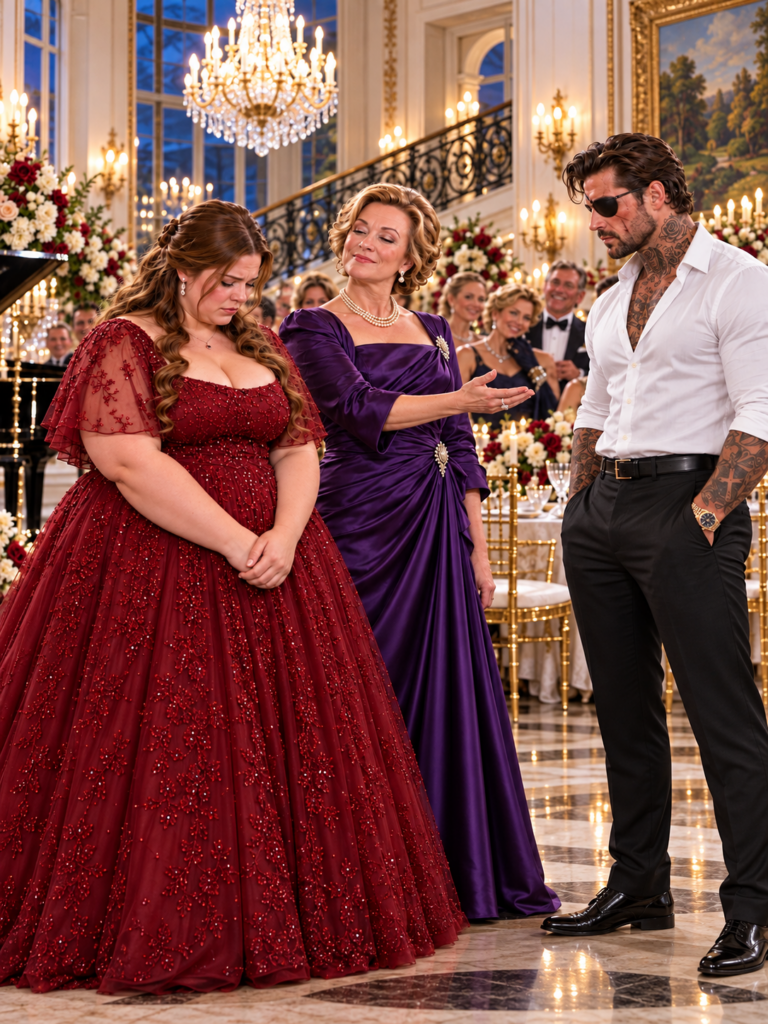
She wore a burgundy gown with long sleeves and a modest neckline. The fabric draped over her full figure, and she had spent the evening nervously smoothing it across her stomach. Her chestnut hair fell to her shoulders in soft waves, framing a round face and gentle green eyes that had once reminded her father of spring leaves after rain.
It was a beautiful dress.
She had almost believed that when she tried it on.
Then Dahlia had looked her up and down and laughed.
“Well, at least burgundy hides a multitude of sins.”
Now, surrounded by Chattanooga’s wealthiest families, Miriam wished she could disappear.
Dahlia caught her wrist before she could retreat.
“Ladies and gentlemen,” her stepmother announced, tapping a spoon against her champagne glass, “I am delighted to present my dear stepdaughter and her new husband.”
Polite applause followed.
Miriam looked toward the man standing beside the fireplace.
Silvano Orsatti.
Thirty-nine years old.
Nearly six feet three inches tall, broad-shouldered, muscular, and dressed in a perfectly tailored black suit.
His thick dark hair was combed back from a severe, handsome face marked by a pale scar running from his left temple toward his cheekbone. A black leather patch covered the eye he had lost in an assassination attempt eighteen months earlier.
His remaining dark eye seemed capable of looking straight through people.
Everyone in Chattanooga knew his name.
Officially, Silvano owned Orsatti Municipal Lighting and Signal Services, a prosperous company responsible for major public lighting and traffic-signal projects throughout Tennessee and northern Georgia.
Unofficially, he controlled one of the most feared criminal organizations in the region.
Men twice his age lowered their voices when he entered a room.
Politicians avoided meeting his gaze.
Even the wealthy businessmen attending the wedding reception seemed careful not to stand too close.
And Miriam had married him that morning.
At a courthouse.
With no flowers.
No music.
No friends.
Only a judge, two witnesses, her stepmother, and a husband who had barely looked at her.
Dahlia pulled Miriam closer.
“I must confess,” she continued brightly, “I never imagined this day would come.”
A few guests smiled.
“Finding a suitable husband for Miriam has always been something of a challenge. You understand, of course. She’s never possessed the delicate figure society expects from a young lady.”
Someone chuckled.
Miriam stared at the polished floor.
“Still,” Dahlia added, turning toward Silvano, “every woman deserves a chance. And when Mr. Orsatti made his generous proposal, I thought perhaps he might be just the man for her.”
A woman near the front whispered something to her companion.
Both laughed.
Miriam heard every word.
“At least he only has one eye. Maybe he won’t notice how big she is.”
The remark struck so painfully that Miriam almost stopped breathing.
Dahlia heard it too.
And smiled wider.
“Perhaps,” she said, “the Lord has a sense of humor. A bride no respectable man wanted and a groom everyone is terrified to approach. What a perfect match.”
The laughter became louder.
Miriam clenched her evening purse until its metal clasp dug into her palm.
She had endured seventeen years of this cruelty.
But she had never imagined Dahlia would turn her wedding into a public spectacle.
Her father would have been devastated.
Graham Wexford had been a kind man, a factory owner who believed people deserved respect regardless of their appearance or bank accounts. He had built Wexford Specialty Ceramics from a small industrial workshop into a respected manufacturer of electrical insulation components.
When Miriam was little, he used to take her onto the factory floor.
She loved the machinery.
She loved watching technicians diagnose problems, dismantle motors, and discover why something had stopped working.
Her father never told her those interests were unsuitable for a girl.
Instead, he bought her a toolbox.
“Machines don’t care what you look like, sweetheart,” he had told her. “They only care whether you understand them.”
Miriam still owned that toolbox.
She used it almost every day at the community kitchen where she repaired commercial dishwashers, warming cabinets, and aging cooking equipment so elderly residents could receive hot meals.
It was not glamorous work.
Dahlia called it embarrassing.
Miriam called it useful.
Her mother had died when Miriam was twelve. Graham remarried a year later, believing Dahlia would bring warmth into their grieving home.
For a while, Dahlia pretended.
Then came the comments about Miriam’s weight.
The family photographs from which she was excluded.
The birthdays nobody remembered.
And the constant reminder that a woman like Miriam should never expect to be loved.
After Graham died, everything grew worse.
Dahlia assumed control of the factory and the Wexford family foundation. She also controlled the charitable funding that helped keep Miriam’s community kitchen operating.
Three weeks before the wedding, Dahlia had entered Miriam’s small workshop carrying an expensive handbag and a marriage proposal.
“You’re going to marry Silvano Orsatti.”
Miriam had nearly dropped her screwdriver.
“Who?”
“You heard me.”
“I don’t even know him.”
“That hardly matters. His company is extremely successful, and he has agreed to marry you.”
“Why would he?”
Dahlia’s expression turned cold.
“Must you question everything? A man wants to marry you. For once in your life, be grateful.”
Miriam had refused.
Then Dahlia revealed what refusing would cost.
Without the Wexford Foundation’s assistance, the community kitchen would lose a significant portion of its operating budget.
Dozens of elderly residents might go without dependable meals.
And the factory, Dahlia claimed, was experiencing financial difficulties that only an alliance with Orsatti could resolve.
“You wouldn’t want sixty-eight innocent employees to lose their jobs because you were selfish, would you?”
Miriam had spent three nights trying to find another solution.
She called charitable organizations.
She spoke with the kitchen director.
She reviewed budgets until her eyes hurt.
Nothing could replace the threatened funding quickly enough.
Finally, with a sickness in her stomach that would not disappear, she agreed.
She told herself marriage was a sacrifice.
She told herself she could survive almost anything if other people were spared.
But now, standing beneath the chandeliers while strangers laughed at her body, she wondered whether she had made the worst mistake of her life.
Dahlia reached into her handbag.
“And because I want my darling stepdaughter to begin her new life properly, I’ve prepared a little farewell gift.”
She produced a cream-colored envelope and held it toward Silvano.
“Her belongings have already been packed. She won’t be returning to Wexford Manor, of course. A married woman belongs with her husband.”
Miriam’s head snapped upward.
“What?”
Dahlia ignored her.
“I thought it best to make a clean break.”
“You packed my things?”
“Don’t make a scene, Miriam.”
“My father’s things are still in my room.”
“Then I’m sure we can arrange delivery.”
Miriam felt as though the marble floor had vanished beneath her feet.
Her father had died in that house.
Her mother had once lived there.
Every childhood memory she possessed was contained within its walls.
And Dahlia had decided she was no longer welcome.
“You promised I could come back for my belongings,” Miriam whispered.
Dahlia leaned closer, still smiling for the guests.
“Lower your voice. You’re embarrassing yourself.”
Something inside Miriam broke.
Not dramatically.
Not loudly.
It was simply the exhaustion of realizing that no amount of obedience would ever make Dahlia love her.
She turned away before anyone could see her tears.
That was when Silvano moved.
He took the envelope from Dahlia’s hand.
Looked at it.
Then looked at Miriam.
“Is this what you agreed to?”
His voice was deep and controlled.
Miriam could barely answer.
“I didn’t know she was sending me away.”
Silvano’s gaze returned to Dahlia.
For several seconds, he said nothing.
Then he placed the envelope on the nearest table with such force that the champagne glasses rattled.
“Have you finished?”
Dahlia blinked.
“Excuse me?”
“Humiliating my wife. Have you finished?”
A nervous silence swept across the ballroom.
Dahlia laughed.
“Oh, Silvano. Surely you understand a little family teasing.”
“Teasing?”
His voice sharpened.
“You dragged her in front of two hundred people, mocked her appearance, and announced that she’d been thrown out of her childhood home.”
Dahlia’s smile faltered.
“I think you’re misunderstanding—”
“No.”
One word.
Quiet enough that only those nearest him heard it.
Yet every conversation stopped.
“You are misunderstanding me.”
He stepped closer.
Miriam instinctively flinched.
Silvano noticed.
Something in his expression changed.
He stopped immediately.
“Mrs. Wexford,” he said, without taking his gaze off Dahlia, “you assured me your stepdaughter wanted this marriage.”
“Of course she did.”
“You assured me she wanted to leave this house.”
“She does.”
“Then why is she crying?”
Dahlia’s lips parted.
No answer came.
Silvano turned toward Miriam.
For the first time since their courthouse wedding, he studied her face without impatience or suspicion.
“Did she threaten you?”
Miriam’s throat tightened.
Dahlia spoke immediately.
“Silvano, please. Miriam has always been emotional.”
He did not even glance at her.
“Miriam.”
His voice softened.
“Look at me.”
She raised her eyes.
“Did you want to marry me?”
The question was unbearable.
Not because she feared the truth.
Because nobody had bothered to ask before.
She swallowed.
“I wanted to protect the people who depend on me.”
Silvano went very still.
“What people?”
“The elderly residents at the kitchen. The factory employees. Dahlia said she would stop funding the meals, and that the factory might close if I refused.”
A muscle moved in Silvano’s jaw.
He turned toward Dahlia.
“You told me she accepted willingly.”
“She did accept!”
“Because you threatened other people’s livelihoods.”
“I did what was necessary for this family.”
Silvano’s remaining eye hardened.
“Do not use that word in front of me.”
Dahlia stepped back.
The guests watched in stunned silence.
Then Silvano looked at Miriam again.
“I’m sorry.”
She stared at him.
Nobody had expected an apology.
Least of all from him.
“I should have spoken to you privately,” he continued. “I was told you wanted this arrangement. I accepted that explanation because it served my purpose.”
“What purpose?” Miriam whispered.
Something shadowed his expression.
“I owe someone a promise. But that doesn’t excuse what happened today.”
He held out his hand.
Palm upward.
Not touching her.
Not ordering her.
“Do you want to leave?”
Miriam glanced toward the staircase.
At the beautiful house where she had been made to feel ugly.
At the guests who had laughed.
At Dahlia, who had spent years teaching her that gratitude meant accepting mistreatment.
Then she looked at Silvano’s outstretched hand.
“What happens if I go with you?”
“You’ll have your own room. Your own key. Your own decisions.”
“Even if I want to leave?”
“Yes.”
“And my job?”
“You keep it.”
She hesitated.
“Why are you being kind to me?”
Silvano’s face tightened slightly.
“Because someone should have been.”
A tear slipped down her cheek.
For the first time that night, she stopped trying to hide it.
She placed her hand in his.
His fingers closed around hers carefully, as though he understood how easily trust could be damaged.
They started toward the ballroom doors.
Dahlia hurried after them.
“Silvano! We still need to discuss the factory arrangements.”
“Have your attorney contact mine.”
“This is family business!”
He stopped.
Slowly turned.
“My wife isn’t collateral for your financial problems.”
Dahlia went pale.
“And one more thing.”
His voice dropped.
“Every person in this room who laughed at her should remember tonight.”
He surveyed the wealthy guests.
“Because the next time Miriam Wexford enters a room, she’ll enter it knowing she owes none of you an apology.”
Nobody laughed.
Nobody moved.
Silvano opened the doors himself.
And Miriam walked out beside him.
Outside, the late October wind swept across Signal Mountain, stirring fallen leaves along the driveway.
A black SUV waited beneath the entrance lights.
Silvano helped her inside, then walked around to the opposite door.
During the drive, Miriam sat with her hands folded tightly in her lap.
The city lights blurred beyond the tinted windows.
She had escaped Dahlia.
But she was sitting beside a man whose reputation frightened judges, businessmen, and hardened criminals alike.
She glanced at his scar.
He noticed.
“You can ask.”
Miriam looked away.
“I wasn’t staring.”
“Yes, you were.”
Her cheeks flushed.
He almost smiled.
“It was an ambush. Eighteen months ago. My left eye is permanently blind.”
“I’m sorry.”
“Don’t be.”
She hesitated.
“Does it hurt?”
“Sometimes.”
“Do you mind if people ask about it?”
“Usually.”
“Then I won’t ask anything else.”
Silvano turned toward her.
For a moment, something resembling surprise crossed his face.
Most people either pretended his injury did not exist or treated him as though it made him dangerous to approach.
Miriam had simply asked what he was comfortable discussing.
The SUV passed through iron gates and approached an enormous stone mansion surrounded by oak trees.
Warm lights glowed from its windows.
Miriam looked at the building with growing unease.
It was even larger than Wexford Manor.
Another beautiful house.
Another powerful person.
Another place where her life might be controlled by somebody else.
Silvano seemed to understand.
“You don’t have to trust me tonight,” he said.
She turned toward him.
“Then what do you expect?”
“Nothing you haven’t chosen to give.”
Before she could respond, his phone vibrated.
A message appeared on the screen.
He read it.
The gentleness vanished from his face.
Miriam watched his jaw tighten.
“Something wrong?”
Silvano put the phone away.
“An old business problem.”
But the message had been from his head of security.
The men who arranged the warehouse ambush have resurfaced. Someone has been asking about Graham Wexford’s daughter.
Silvano looked at the frightened woman beside him.
Seventeen years earlier, her father had saved him from a life of poverty.
Now the daughter of that man had been delivered into a marriage built on deception.
And someone from Silvano’s violent past had discovered her name.
He had intended to honor a promise.
Instead, he had brought danger to her doorstep.
Miriam looked at the mansion again.
“Silvano?”
“Yes?”
“Am I safe here?”
He turned toward her, the black leather patch making his expression difficult to read.
For the first time that evening, he did not answer immediately.
Then he reached for the door.
“You have my word that I will do everything in my power to keep you safe.”
She studied him.
“Is that a promise?”
His remaining eye met hers.
“Yes.”
What Miriam did not know was that Silvano Orsatti rarely made promises.
And when he did, powerful men had died trying to force him to break them.
Part 2
The first thing Silvano gave Miriam inside Orsatti Manor was not jewelry, money, or a wedding present.
It was a silver key.
He placed it in her palm outside a spacious bedroom overlooking the gardens.
“This room belongs to you.”
Miriam stared at the key.
“The door locks?”
“Yes.”
“From the inside?”
“Yes.”
“Even against you?”
Silvano studied her for a moment.
“Especially against me.”
She raised her eyes.
He continued before she could speak.
“I will never enter without permission. I expect nothing from you because of a marriage certificate. If you decide you want an annulment or divorce, I’ll arrange for you to speak with an independent attorney.”
Miriam looked past him into the bedroom.
Fresh white bedding covered a large bed. A vase of pale roses stood beside the window. Several new dresses hung inside an open wardrobe.
Everything was beautiful.
Everything had been chosen by someone else.
“I’d rather wear my own clothes,” she said quietly.
Silvano glanced toward the wardrobe.
“Then wear them.”
“Dahlia packed most of my things.”
“I’ll have them collected.”
She tightened her grip around the key.
“My father’s toolbox is in the garage. And there’s an old suitcase in my bedroom. It has letters from him.”
Silvano’s expression changed almost imperceptibly.
“I’ll make sure you get both.”
Miriam nodded.
“Thank you.”
He hesitated at the doorway.
“You don’t need to thank me for letting you keep what’s yours.”
Then he left.
For the first time in years, Miriam stood inside a bedroom where nobody had the right to enter without her permission.
She closed the door.
Turned the lock.
And cried.
Not because she was unhappy.
Because she didn’t know what else to do with the strange, overwhelming sensation of being allowed to say no.
The following morning, she met the household staff.
Eleanor Bell, the fifty-six-year-old housekeeper, greeted her with a warm smile.
Thomas Hale, the elderly butler, brought her breakfast on a silver tray.
Both were courteous.
Both were unmistakably nervous.
Whenever footsteps sounded in the corridor, Thomas straightened so quickly that Miriam worried he might hurt himself.
Eleanor spoke softly whenever Silvano’s name arose.
And when Silvano entered the dining room, the servants seemed to stop breathing.
Miriam understood why that evening.
She had gone downstairs to find water when she heard something crash in the study.
Thomas had approached Silvano from his blind side while carrying a folder.
Startled, Silvano knocked a coffee cup across the desk.
The hot liquid spilled over several documents.
“Damn it, Thomas!”
The butler recoiled.
“I apologize, sir.”
“How many times have I told you not to approach me from that side?”
“I’m sorry. I thought you heard me.”
“Then you thought wrong.”
Miriam stopped in the doorway.
Thomas bent hurriedly to collect the fallen papers.
Silvano struck the desk with his palm.
“Leave it!”
The elderly man froze.
Miriam saw the fear on his face.
She had seen that expression before.
On her own face.
In Dahlia’s house.
“Thomas was only trying to help,” she said.
Silvano turned sharply.
“This doesn’t concern you.”
“It concerns anyone who thinks people deserve to be treated respectfully.”
His remaining eye narrowed.
“You’ve been in my house for one day.”
“And that makes him less deserving of kindness?”
“Careful, Miriam.”
Her heart began pounding.
For a terrible moment, she was back at Wexford Manor, waiting for punishment because she had spoken out of turn.
But she forced herself to remain standing.
“I know you were frightened,” she said. “I saw what happened when he approached your left side.”
Silvano’s face hardened.
“You don’t know anything about what happened to me.”
“No. I don’t.”
Her voice trembled.
“But I know fear when I see it.”
He stared at her.
She glanced toward Thomas, who still held the ruined folder.
“And I know he didn’t deserve to be frightened too.”
Then she turned and walked away.
Silvano did not follow.
He remained in his study long after the room had been cleaned.
For eighteen months, everyone around him had learned to avoid his temper.
Nobody challenged him.
Nobody reminded him that fear was not the same thing as respect.
Until Miriam.
A woman he had known for less than two days.
A woman who had every reason to be afraid of him.
And who had nevertheless defended an elderly servant.
The memory unsettled him.
It also made him ashamed.
During the following week, Miriam returned to the community kitchen.
She preferred the smell of warm bread and industrial detergent to the expensive perfume and polished marble of wealthy society.
Here, nobody cared about her dress size.
They cared whether the warming cabinets worked.
“Miss Miriam!”
An elderly woman named Mrs. Patterson waved from her wheelchair.
“Is that dishwasher finally fixed?”
“Give me twenty minutes and I’ll have it behaving better than my husband.”
The kitchen volunteers laughed.
Miriam froze.
She hadn’t meant to mention him.
Mrs. Patterson grinned.
“So the rumors are true? You married that terrifying man?”
Miriam crouched beside her.
“He’s complicated.”
“Most men are, dear.”
“Not quite like this.”
“Does he treat you well?”
Miriam thought of the silver key.
Then she remembered Thomas trembling beside the study desk.
“I’m still figuring that out.”
Later that afternoon, Silvano arrived unexpectedly.
He wore a dark jacket rather than his usual formal suit.
Two security men remained near the entrance.
Miriam was kneeling beside a commercial dishwasher, checking a damaged electrical component.
A streak of grease marked her cheek.
Her hair was tied messily behind her head.
“Is something wrong?” she asked.
Silvano looked at the machine.
“No.”
“Then why are you here?”
“I wanted to see where you work.”
She studied him suspiciously.
“Why?”
“Because you spend more time here than anywhere else.”
He glanced toward the elderly residents eating at the nearby tables.
“And because I wanted to understand why.”
Miriam turned back to her work.
“You could have asked.”
“I know.”
The simple answer surprised her.
He crouched beside the open machine.
“Failed heating element?”
“Damaged relay. The previous repair wasn’t secured properly.”
He examined the equipment.
“Who serviced it?”
“Me, six months ago.”
“You make mistakes?”
“Frequently.”
A corner of his mouth moved.
“That’s reassuring.”
She looked at him.
“Are you making fun of me?”
“I’m attempting a joke.”
“You should practice.”
He laughed.
It was a short, rusty sound.
But it transformed his face.
For one startling moment, Miriam caught a glimpse of someone younger beneath the scars and authority.
Someone who might once have smiled easily.
Then Mrs. Patterson called from the dining area.
“Miriam! Is that handsome giant your husband?”
Silvano straightened.
Miriam closed her eyes.
“Oh, please don’t.”
Mrs. Patterson waved at him.
“You’d better be good to her. She’s the reason half of us get a hot dinner.”
Silvano looked at Miriam.
His expression softened.
“I’ll remember that.”
Over the following weeks, he began visiting more often.
Sometimes he arrived with coffee.
Sometimes he helped carry boxes of supplies.
Once, when an elderly resident asked him to open a stubborn jar, he obeyed without complaint.
Miriam found the sight absurdly endearing.
A man who could make dangerous criminals tremble stood patiently opening pickle jars for an eighty-three-year-old woman.
And when Mrs. Patterson patted his cheek and told him he was “a good boy,” Silvano looked so completely bewildered that Miriam burst into laughter.
He stared at her.
“What?”
“Nothing.”
“You’re laughing.”
“I’m allowed.”
He looked at her for another moment.
Then smiled.
For the first time, Miriam noticed that his scar did not make him less handsome.
It made his rare expressions of warmth more striking.
That frightened her more than his temper.
Because attraction was something she had never prepared herself to feel.
Especially toward a man she had been forced to marry.
One rainy November evening, Miriam found Silvano in the library.
He sat near the fireplace, wearing a white shirt with the sleeves rolled to his elbows.
Dark Latin tattoos covered his powerful forearms.
A glass of whiskey rested untouched beside him.
He was reading a maintenance report.
“You actually understand those?” she asked.
He looked up.
“I’m offended.”
“You own a company. That doesn’t mean you understand its equipment.”
“I started as a technician.”
Miriam stopped.
“You did?”
“Before I owned anything.”
He motioned toward the chair across from him.
“Sit.”
She raised an eyebrow.
He corrected himself.
“Would you like to sit?”
She smiled faintly.
“Better.”
She settled into the chair.
For the next hour, they talked about electrical motors, factory equipment, and the strange satisfaction of repairing something everyone else considered broken.
Miriam discovered that Silvano possessed an extraordinary mechanical mind.
He understood machinery intuitively.
He knew the frustration of grease beneath fingernails, late-night repair jobs, and equipment failing at the worst possible moment.
“You don’t talk like a millionaire,” she said.
“How should a millionaire talk?”
“About yachts. Stocks. Expensive watches.”
“I hate boats.”
She laughed.
“Why?”
“Water makes everything unpredictable.”
“And watches?”
“I own three. I only wear one.”
“Stocks?”
“Mostly boring.”
“Then what do you enjoy?”
Silvano hesitated.
He could have told her about his cars.
His private properties.
The exclusive clubs where men competed for his attention.
Instead, he looked at her.
“This.”
Miriam’s heart skipped.
“Reading maintenance reports?”
“No.”
Their eyes met.
The fireplace cracked softly.
Silvano set down the papers.
“Talking to someone who doesn’t care how much money I have.”
She swallowed.
“Most people would be afraid to disagree with you.”
“I’ve noticed.”
“Sometimes I am too.”
His expression became serious.
“I know.”
She expected defensiveness.
Instead, he looked down at his hands.
“I owe you an apology for that night in the study.”
Miriam said nothing.
“And Thomas deserves one as well.”
“You should tell him.”
“I intend to.”
“Then do it.”
Silvano looked at her for a long moment.
Then stood.
He found Thomas in the hallway and apologized directly.
No excuses.
No threats.
No attempt to blame his injury.
The elderly butler looked so astonished that Miriam almost smiled.
Later, when Silvano returned, she said quietly, “That mattered.”
“I should have done it without being told.”
“Yes.”
He sat beside her instead of across from her.
Not touching.
Close enough that she could feel the warmth of his body.
“Miriam.”
She turned.
“I don’t know how to be the kind of man you deserve.”
The words startled her.
“You barely know me.”
“I know enough to recognize when someone is worth respecting.”
She looked toward the fire.
“My stepmother spent years telling me that no one would want me.”
Silvano’s face changed.
“I know.”
“She said men like you could have any woman they wanted. Thin women. Beautiful women. Women who knew how to behave at parties.”
He was silent.
Miriam laughed without humor.
“And now I’m sitting in your library wondering whether I’m embarrassing you.”
Silvano leaned forward.
“Look at me.”
She hesitated.
He waited.
When she finally met his eye, his voice was steady.
“You are not an embarrassment.”
Her throat tightened.
“You don’t have to say that.”
“I’m not saying it because I have to.”
He looked at her grease-marked fingers resting against her burgundy skirt.
“I’ve seen women spend an entire evening talking about jewelry worth more than a person’s annual salary. I’ve seen people waste fortunes trying to impress strangers they despise.”
His gaze returned to hers.
“And I’ve watched you spend six hours repairing a machine so an elderly woman could eat dinner.”
Miriam’s eyes filled.
“That’s not glamorous.”
“No.”
He smiled faintly.
“It’s considerably more impressive.”
For the first time in her life, Miriam wondered what it might feel like to be admired without being changed.
Their closeness grew slowly.
Silvano began asking before visiting her room.
He learned that Miriam disliked expensive restaurants because staff often made her feel uncomfortable.
She discovered he preferred quiet dinners over crowded parties.
He never asked her to change her clothes.
Never criticized what she ate.
Never suggested that she should become smaller to deserve his attention.
And when he noticed her struggling to reach a heavy toolbox on a high shelf, he asked whether she wanted help instead of simply taking over.
It was the smallest gestures that unsettled her most.
Because for years, kindness had always come with conditions.
One evening, they attended a charity gala together.
Miriam wore a dark emerald dress.
She nearly changed three times before leaving.
Silvano waited downstairs, adjusting his cufflinks.
When she entered, he looked up.
And stopped moving.
Miriam immediately tugged at the fabric.
“Is it too much?”
“No.”
“Too tight?”
“No.”
“Silvano—”
“You look beautiful.”
She froze.
He crossed the entrance hall slowly.
“May I?”
She glanced at his offered arm.
Then took it.
At the gala, their arrival silenced several conversations.
Women who had laughed at Miriam’s wedding stared openly.
A wealthy businessman approached Silvano and immediately began speaking over Miriam as though she were invisible.
Silvano listened for thirty seconds.
Then interrupted.
“My wife asked you a question.”
The man blinked.
“Oh. Of course.”
Miriam lifted her chin.
“I asked whether your company still supplies replacement heating components to regional care facilities.”
The businessman looked startled.
Within minutes, Miriam was discussing equipment reliability and maintenance costs with more confidence than anyone expected.
Silvano watched with unmistakable pride.
Then an elegant woman in silver approached.
Vanessa Moretti.
Daughter of a powerful business associate.
Beautiful.
Thin.
And visibly displeased.
“Silvano,” she purred, resting a manicured hand on his sleeve. “I heard the most extraordinary rumor about your wedding.”
He gently removed her hand.
“Then you heard enough.”
Vanessa glanced at Miriam.
“I’m simply surprised. We all assumed you’d eventually marry someone from our circle.”
Miriam felt the familiar sting.
But before Silvano could respond, she smiled.
“I’m surprised too. I assumed wealthy people had better manners.”
A nearby guest choked on his drink.
Vanessa’s face hardened.
Silvano looked at Miriam.
Then laughed.
Not politely.
Genuinely.
He placed a light hand at her waist.
“Vanessa, I believe my wife has answered you.”
Miriam spent the rest of the evening standing beside him without lowering her eyes.
For once, she was not the woman everyone pitied.
She was the woman the most powerful man in the room couldn’t stop watching.
But their growing happiness concealed a secret.
A secret buried inside an old wooden box in Silvano’s study.
Miriam discovered it by accident several weeks later.
She was looking for a book Silvano had recommended when she noticed an old photograph protruding from beneath a stack of letters.
The face in the picture made her breath catch.
Her father.
Graham Wexford.
Younger.
Smiling.
Standing beside a handsome factory worker in blue protective overalls.
The young man’s dark hair fell across his forehead.
Both eyes were visible.
Both perfectly healthy.
Miriam stared.
Then slowly covered her mouth.
“Silvano?”
She didn’t hear him enter.
He stopped in the doorway.
His gaze fell to the photograph.
And his expression changed completely.
“Where did you get that?”
“It was on the shelf.”
He approached slowly.
Miriam held up the picture.
“That’s my father.”
“I know.”
“And that’s you.”
Silvano said nothing.
She stared at him.
“You knew my father?”
He closed his remaining eye.
“Yes.”
“How long?”
“Seventeen years.”
Miriam felt dizzy.
“Why didn’t you tell me?”
“Because I didn’t know how.”
He walked to the desk and opened the old wooden box.
Inside lay a carefully preserved handwritten letter.
He placed it before her.
“Your father gave me my first real opportunity.”
Miriam sat slowly.
Silvano told her about growing up poor.
About repairing machinery for almost nothing.
About arriving at Wexford Specialty Ceramics with no qualifications that wealthy employers respected.
Graham had seen him restore a machine that experienced contractors declared impossible to repair.
Instead of dismissing him, Graham paid for his technical education.
Helped him enroll in evening business courses.
And encouraged him to build a future.
“He believed I could become something better,” Silvano said.
Miriam touched the photograph.
“He believed that about everyone.”
Silvano nodded.
“Even after he learned what I became.”
His voice darkened.
“He never approved of my criminal connections. He told me power wasn’t worth having if innocent people paid for it.”
Miriam looked up.
“Then why did you stay involved?”
Silvano considered the question.
“Because I liked what power could do for me. Because I convinced myself that controlling dangerous men was better than letting someone worse control them.”
“Was it?”
“Not always.”
The honesty unsettled her.
Silvano unfolded the letter.
“When your father became ill, he asked me to protect you if Dahlia ever made your home unsafe.”
Miriam’s eyes filled.
“He knew?”
“He suspected.”
“Then why didn’t he stop her?”
“He was dying, Miriam. He was trying to secure the company’s future, and he believed he had more time.”
Silvano pushed the letter toward her.
“He asked me to make sure you always had somewhere safe to go.”
She recognized her father’s handwriting immediately.
Her hands trembled as she read.
My daughter has more courage than she knows. Please never mistake her kindness for weakness. And if you help her, remember that protecting someone does not mean taking away her right to choose.
Tears blurred the words.
Silvano waited.
When she finally looked up, he said quietly, “I thought marriage would give you protection. Dahlia told me you wanted to leave. I should have asked you myself.”
“You married me because you owed my father?”
“At first.”
The answer hurt more than Miriam expected.
Silvano saw it.
He moved closer, then stopped.
“But that’s no longer the only reason I want you here.”
Her breath caught.
“What other reason?”
He looked at her with an intensity that made the room feel smaller.
“Because when you’re in this house, it feels less like a fortress.”
Miriam stared at him.
“And when you leave for work, I find myself waiting for you to come home.”
Neither moved.
The rain tapped softly against the windows.
Silvano lifted his hand.
Stopped.
“May I touch you?”
Miriam nodded.
His fingers gently brushed a tear from her cheek.
The tenderness of the gesture overwhelmed her.
She stepped closer.
He bent his head.
Their lips almost met.
Then his phone rang.
Silvano looked at the screen.
His expression turned cold.
He answered.
“What?”
A man’s anxious voice spoke rapidly.
Silvano’s remaining eye narrowed.
“Where?”
He listened.
Then said, “Lock down the building. I’ll be there.”
He ended the call.
Miriam stepped back.
“What happened?”
“Someone broke into my company’s records office.”
“Was anything taken?”
“Financial documents.”
“Why would anyone steal financial documents from a lighting company?”
Silvano stared at her.
“That’s what I intend to discover.”
Over the next several days, the atmosphere at Orsatti Manor changed.
Security vehicles appeared near the entrance.
Silvano spent long hours in private meetings.
His head of security, Dominic Rinaldi, visited repeatedly.
Miriam overheard fragments of conversations about a man named Adrian Voss.
A former criminal associate.
A ruthless businessman whose public investments concealed dangerous alliances.
And someone Silvano believed had been involved in the warehouse attack that cost him his eye.
Miriam tried not to listen.
Until one evening, she discovered an unfamiliar black sedan parked near the community kitchen.
The same car appeared again two days later.
And once more outside the hardware store where she purchased electrical supplies.
When she mentioned it to Silvano, his expression hardened.
“Did anyone approach you?”
“No.”
“Did you see the driver?”
“Not clearly.”
“You should have told me immediately.”
His voice rose.
Miriam stiffened.
Silvano stopped.
Closed his eye briefly.
Then tried again.
“I’m sorry. I’m frightened because someone may be watching you.”
She studied him.
“Who?”
“Someone from my past.”
“Why would they care about me?”
Silvano was silent too long.
Her stomach tightened.
“Silvano.”
He looked at her.
“Because they know you’re important to me.”
The admission changed something between them.
That night, Miriam found him standing alone on the balcony.
Cold air moved through the garden.
He had removed his jacket, and moonlight caught the scar along his cheek.
“You should be inside,” he said.
“So should you.”
She stood beside him.
For a while, neither spoke.
Then Miriam asked, “Do you ever wish you could go back?”
“Before the ambush?”
“Before all of it.”
He leaned against the stone railing.
“Sometimes.”
“What would you change?”
“I would listen to Graham when he told me there were better ways to build a life.”
Miriam looked at him.
“You still can.”
He gave a humorless smile.
“It’s not that simple.”
“No,” she said. “It isn’t.”
She touched his hand.
“But changing isn’t supposed to be simple.”
Silvano looked down at their joined fingers.
“I’ve frightened people who didn’t deserve it. I’ve hurt others by refusing to admit when I was afraid.”
She nodded.
“Then keep taking responsibility.”
He turned toward her.
“You make that sound possible.”
“It is possible.”
“Even for me?”
Miriam’s eyes softened.
“Especially if you stop expecting forgiveness to arrive before you’ve earned it.”
Silvano studied her.
Then slowly brought her hand to his lips.
The kiss was gentle.
Reverent.
And infinitely more intimate than anything Miriam had imagined from him.
But the danger surrounding them was growing.
By early January, Wexford Specialty Ceramics was approaching financial collapse.
Dahlia had used company loans to finance expensive jewelry, lavish parties, and reckless investments.
Several major contracts had been canceled.
The bank demanded repayment of nearly $4.8 million.
Sixty-eight employees faced unemployment.
Dahlia approached Silvano for help.
He refused to discuss the matter without independent lawyers and financial specialists.
Miriam insisted on attending the meeting.
“You don’t have to face her again,” he told her.
“Yes, I do.”
“Why?”
“Because those workers deserve someone at the table who cares whether they can feed their families.”
Silvano studied her.
Then nodded.
“Then we’ll go together.”
The meeting took place at Orsatti’s downtown headquarters.
Attorney Margaret Ellis sat beside financial consultant Nathan Brooks.
Dahlia arrived wearing a cream-colored designer suit.
When she saw Miriam, her smile disappeared.
“I didn’t realize this was a family reunion.”
“It isn’t,” Miriam replied.
Dahlia blinked.
Silvano gestured toward the conference table.
“Sit down.”
The meeting began.
Nathan presented financial statements documenting company-funded luxury purchases and unexplained transfers.
Dahlia dismissed the figures as temporary business decisions.
Silvano remained calm.
“I’m willing to consider a legitimate restructuring. But you won’t retain unrestricted control of the company’s funds.”
Dahlia stiffened.
“Graham entrusted that company to me.”
“And you’ve nearly destroyed it.”
She turned toward Miriam.
“You could convince your husband to help me.”
Miriam met her eyes.
“I want to help the employees.”
“Then tell him to give me the money.”
“No.”
Dahlia’s face flushed.
“After everything I’ve done for you?”
Miriam felt the old familiar fear.
Then she remembered the silver key.
The community kitchen.
The way Silvano had waited for her answer instead of deciding for her.
She sat straighter.
“You didn’t raise me to be grateful. You raised me to feel ashamed.”
Dahlia opened her mouth.
Miriam continued.
“You made me believe that my body made me undeserving of respect. That being a larger woman meant I should accept cruelty as kindness.”
Her voice trembled.
“But I don’t believe that anymore.”
Silvano watched silently.
Dahlia sneered.
“A woman your size should be thankful a wealthy man was willing to marry her at all.”
Silvano’s hand closed into a fist.
Then he deliberately opened it.
Miriam placed a hand on his wrist.
“I can answer her.”
He looked at her.
And stepped back.
Miriam rose.
“I don’t need to be thinner to deserve love. I don’t need to be wealthy to deserve dignity. And I certainly don’t need your permission to be happy.”
The room fell silent.
Dahlia’s face turned pale.
Miriam opened her folder.
“There are sixty-eight people at that factory. Sixty-eight employees whose families depend on their wages. I will do everything I can to protect them.”
She looked directly at her stepmother.
“But I will not use my marriage to save you from the consequences of your decisions.”
For the first time in seventeen years, Dahlia had no answer.
Nathan began collecting the financial statements.
Then he stopped.
His eyes narrowed behind his glasses.
“Mrs. Wexford,” he said, “what is Voss Strategic Holdings?”
Dahlia froze.
Silvano slowly turned toward him.
“Repeat that name.”
Nathan pointed toward the final page.
“Voss Strategic Holdings. Several payments were transferred through that company before the factory’s major contracts were canceled.”
Silvano went utterly still.
Adrian Voss.
The man connected to the ambush that had destroyed his left eye.
His former enemy was now connected to Miriam’s father’s company.
Margaret took the document.
“This requires a separate investigation.”
Dahlia abruptly stood.
“I have nothing more to say.”
Silvano looked at her.
“That’s unfortunate.”
His voice was terrifyingly quiet.
“Because I have several questions.”
Dahlia hurried toward the door.
Miriam noticed her trembling fingers.
And for the first time, she understood that her stepmother was afraid of something far worse than bankruptcy.
That evening, Silvano received a message.
Not from his accountant.
Not from his security team.
From an unknown number.
A photograph appeared on his phone.
It showed Miriam standing outside the community kitchen.
Taken that morning.
Beneath it were six words.
Your weakness has her father’s eyes.
Silvano stared at the screen.
Then the phone rang.
A familiar voice spoke.
“Hello, old friend.”
Adrian Voss.
Silvano’s jaw tightened.
“If you go near my wife—”
“You’ve always had such an unfortunate temper.”
A quiet laugh.
“Ask Dahlia what she signed. Then ask your precious bride whether she still wants to be married to a man whose enemies know where she sleeps.”
The call ended.
Silvano stood motionless.
Across the room, Miriam approached.
“Who was that?”
He turned.
For the first time since their wedding, she saw genuine fear in his remaining eye.
And before he could answer, the mansion’s security alarm began screaming.
Part 3
The first alarm came from the rear gardens.
The second from the eastern gate.
Within seconds, Orsatti Manor filled with hurried footsteps.
Dominic Rinaldi entered the library with two security officers.
“Sir, an unauthorized vehicle approached the service entrance. It turned away when our patrol arrived.”
Silvano’s expression hardened.
“Any sign of a breach?”
“Not inside the property. We’re checking the perimeter.”
Miriam stood near the fireplace, her pulse racing.
She looked from Dominic to Silvano.
“Is this about the man who called you?”
Silvano nodded.
“Adrian Voss.”
“Who is he?”
“Someone I trusted once.”
Dominic’s face darkened.
Silvano continued.
“We built parts of our businesses together. He wanted control over everything we touched. When I refused to support some of his dealings, our relationship ended.”
“The ambush?”
Silvano looked away.
“I believe he arranged it.”
Miriam stared at his scar.
For the first time, she understood that the injury had not been a random act of violence.
Someone had deliberately tried to kill him.
“And now he’s threatening me?”
“Yes.”
She swallowed.
“Because I’m your wife?”
“Because he believes hurting you will hurt me.”
Miriam looked toward the windows.
The gardens were dark.
Beyond the glass, security lights illuminated the towering oak trees.
A cold realization settled over her.
Silvano had promised to protect her.
But protection could not erase the danger surrounding his life.
“Did Dahlia know him?” she asked.
“We’re trying to establish that.”
Miriam thought of the financial records.
The canceled factory contracts.
The unexplained transfers.
The strange fear on Dahlia’s face when Nathan mentioned Voss Strategic Holdings.
“Then we need to find out what she signed.”
Silvano’s expression changed.
“No. I need to find out. You need to stay somewhere safe.”
Miriam stiffened.
“Silvano.”
“I’m not risking your life over corporate documents.”
“And I’m not going to sit quietly while someone threatens the factory and the people who work there.”
“This isn’t a broken dishwasher.”
“I know.”
Her voice rose.
“It’s my father’s company. My stepmother’s decisions. My life being used against me again.”
Silvano stepped closer.
“You could be killed.”
The words hung between them.
Miriam flinched.
Then steadied herself.
“Then tell me the truth instead of making my choices for me.”
Silvano closed his remaining eye.
He drew a slow breath.
She watched him struggle with the instinct to command her.
Finally, he nodded.
“You’re right.”
Miriam said nothing.
He looked at her.
“I want you safe. But I don’t have the right to imprison you in the name of protecting you.”
The words mattered.
Especially because they cost him something.
Over the following days, the investigation widened.
Margaret Ellis contacted independent forensic accountants and appropriate legal authorities.
Nathan Brooks examined the company’s records.
Silvano arranged lawful security measures around the factory and community kitchen while cooperating with investigators.
Miriam continued working.
She accepted reasonable precautions, but refused to let fear swallow her life.
And she began studying her father’s old business files.
In a dusty storage cabinet at Wexford Manor, retrieved through her attorney, Miriam found the technical notebooks Graham had kept during the factory’s early years.
They contained equipment diagrams, handwritten maintenance observations, old supplier contracts, and letters from employees.
She spent evenings reading them at the dining table.
Silvano sometimes joined her.
One night, he found her examining a faded document.
“What is it?”
“A manufacturing agreement from seventeen years ago.”
He leaned closer.
Miriam pointed to a signature.
“Do you recognize that name?”
Silvano’s expression tightened.
“Adrian Voss.”
“He wasn’t listed as a shareholder.”
“He wasn’t one.”
“Then why was he involved?”
Silvano studied the page.
“He supplied transportation services to several companies back then.”
Miriam flipped through another folder.
“My father stopped doing business with him.”
Silvano looked up sharply.
“What?”
“There’s a letter terminating the agreement. Dad wrote that he had concerns about financial irregularities and wouldn’t continue the relationship.”
Silvano took the paper carefully.
Graham’s signature appeared at the bottom.
For a long moment, he said nothing.
Then he whispered, “He never told me.”
Miriam watched his face.
“What does that mean?”
“It means Graham may have suspected what Voss was becoming before I did.”
They worked late into the night.
Eventually, Miriam found a second letter.
One addressed to a bank representative.
Graham had refused to pledge the factory’s assets as security for an unrelated investment venture.
The venture’s original sponsor had been Adrian Voss.
Miriam looked at Silvano.
“He tried to get control of the factory years ago.”
Silvano’s jaw tightened.
“And Graham refused.”
“Now Dahlia has been sending money into a company connected to him.”
Their eyes met.
The pattern was becoming clearer.
Adrian Voss had wanted access to Wexford Specialty Ceramics for years.
Dahlia’s vanity and financial desperation had given him an opportunity.
And Silvano’s marriage to Miriam had made the situation personal.
The following morning, Nathan called.
“We found something.”
He sounded exhausted.
Miriam put the phone on speaker.
“The financial records indicate that Dahlia signed agreements giving Voss Strategic Holdings contingent rights connected to portions of the factory’s equipment and receivables.”
Silvano leaned forward.
“Are the agreements enforceable?”
“That remains under legal review. Some signatures and authorizations are disputed.”
Nathan hesitated.
“But there’s more.”
Miriam felt her stomach tighten.
“What?”
“Someone altered internal accounting records after Graham’s death. The transactions appear designed to conceal the true source of several liabilities.”
“Who?”
“We don’t know yet.”
Miriam stared at her father’s photograph on the mantelpiece.
Her father had spent decades building a company that employed families throughout Chattanooga.
Now someone was trying to dismantle it from the inside.
Then Nathan spoke again.
“Miriam, I need you to answer something.”
“Yes?”
“Did your father ever mention an emergency archive?”
She frowned.
“No. Why?”
“There are references to a separate record set maintained before his death. It may contain the original ownership documents and correspondence.”
Miriam thought of the old suitcase.
The one Dahlia had nearly thrown away.
The one containing her father’s final letter.
And then she remembered something.
A small brass key sewn into the lining of the suitcase.
She had found it years earlier.
She had assumed it belonged to an old cabinet.
Suddenly, she wasn’t so certain.
That afternoon, she retrieved the suitcase from her bedroom.
Silvano watched as she carefully opened the lining.
The key was still there.
Tiny.
Brass.
Marked with a number.
“Do you know what it opens?” he asked.
Miriam shook her head.
“But I remember my father once telling me that important things shouldn’t always be kept where important people expect to find them.”
Silvano almost smiled.
“That sounds like Graham.”
They contacted Margaret, who arranged for the key’s possible purpose to be investigated through the appropriate channels.
By the next day, they had an answer.
It belonged to a private document-storage facility Graham had used for years.
Miriam went with Margaret to retrieve its contents.
Inside a secured compartment were sealed envelopes, original corporate records, financial correspondence, and a handwritten statement from Graham.
Miriam recognized his handwriting immediately.
She sat down before opening the final envelope.
The statement documented Graham’s concerns about Adrian Voss’s business dealings and Dahlia’s increasing involvement with questionable investors.
Graham had begun reviewing how to protect the factory and ensure Miriam would not lose her rights after his death.
But his illness had advanced before the process was complete.
The documents did not magically restore everything that had been lost.
They did, however, provide crucial evidence for the investigation.
And among them was a handwritten note addressed to Miriam.
My darling girl,
If you are reading this, then something has gone wrong that I hoped I would have time to prevent.
Please don’t let anyone convince you that kindness means surrendering yourself.
You have a good heart. That is your strength.
But you must learn that saying no can be an act of love too.
Miriam pressed the letter against her chest.
For years, she had believed protecting other people required sacrificing whatever she wanted.
Her father had been trying to teach her something different.
Love did not demand that she disappear.
It asked her to stand with others without abandoning herself.
She wiped her tears.
Then called Silvano.
“I found something.”
His voice came immediately.
“Are you safe?”
“Yes.”
“What did you find?”
She looked at the evidence spread across the table.
“Enough to make Dahlia very uncomfortable.”
For the first time in weeks, Silvano laughed.
“That’s my girl.”
Miriam smiled.
Then her expression softened.
“Silvano?”
“Yes?”
“I want to help finish this.”
A pause.
Then he answered, “Tell me what you need.”
It was the answer she had been waiting to hear.
Not an order.
Not a promise to handle everything for her.
An offer to stand beside her.
The investigation moved quickly after that.
Original documents were compared with altered records.
Independent specialists reviewed the financial transactions.
Dahlia’s personal spending became impossible to conceal.
Several disputed agreements were challenged.
And evidence connecting Adrian Voss to improper financial arrangements was referred to the authorities.
As the case developed, Voss became increasingly desperate.
He attempted to pressure witnesses.
He threatened former business associates.
And one evening, an unidentified vehicle followed Nathan Brooks after he left a meeting.
Nathan escaped unharmed and immediately reported the incident.
Miriam was shaken when she learned what had happened.
“He’s trying to frighten everyone.”
Silvano stood beside the window.
“Yes.”
“What if he doesn’t stop?”
Silvano’s expression became hard.
“There was a time when I would have answered a threat like this with one of my own.”
Miriam looked at him.
“And now?”
He turned toward her.
“Now I’m trying to become the man your father believed I could be.”
She crossed the room.
Touched his arm.
“Then don’t let Voss decide what kind of man you are.”
Silvano lowered his head.
Her hand felt warm against his skin.
He had survived an assassination attempt.
He had built an empire out of determination, ruthlessness, and fear.
Yet the simple trust in Miriam’s eyes affected him more deeply than any threat.
“I love you,” he said.
The words came unexpectedly.
Miriam froze.
Silvano looked almost startled by his own confession.
Then he continued.
“I don’t know when it happened.”
His voice was low.
“Maybe when you stood up for Thomas. Maybe when I watched you fix that machine while everyone else waited for dinner. Maybe when you told Dahlia that you didn’t need to change your body to deserve respect.”
Miriam’s eyes filled.
“I love the way you think,” he whispered. “The way you refuse to walk past someone who needs help. The way you can look at something broken and believe it’s worth repairing.”
She shook her head through tears.
“Silvano—”
“I know I don’t deserve an answer.”
He stepped closer, stopping just before touching her.
“And I know this marriage began in a way neither of us would choose again.”
His remaining eye searched hers.
“But what I feel for you is real.”
Miriam lifted her hand to his scarred cheek.
For a moment, she wanted to kiss him.
Wanted to tell him that she had begun loving him too.
Not because he was powerful.
Not because he had defended her.
But because she had watched him acknowledge his mistakes and struggle to become better.
Yet a small voice inside her reminded her of the truth.
She had never chosen their marriage freely.
She had never lived independently.
Every major decision since Dahlia’s threat had been shaped by someone else’s power.
She loved Silvano.
But she needed to know that love wasn’t simply gratitude disguised as affection.
“I care about you,” she whispered.
Silvano’s expression softened.
“But?”
She took a trembling breath.
“I need time.”
He nodded immediately.
“Take it.”
“I need to understand who I am when I’m not Dahlia’s unwanted daughter or Silvano Orsatti’s protected wife.”
The words hurt him.
She saw that.
But he did not argue.
“Then find out,” he said.
Miriam began crying.
Silvano gently brushed away a tear.
“And when you do,” he added, “I hope you’ll still want me standing beside you.”
The following week, Dahlia finally agreed to cooperate more fully with investigators.
Her extravagant lifestyle had collapsed.
Creditors were demanding repayment.
And she now understood that the financial arrangements she had concealed could expose her to serious legal consequences.
Miriam attended the final restructuring negotiations.
Not as a frightened daughter.
Not as a silent wife.
But as someone determined to preserve her father’s legacy.
The meeting was held in a large conference room overlooking downtown Chattanooga.
Margaret Ellis sat beside Nathan Brooks.
Silvano occupied a chair at the end of the table.
Dahlia arrived without her usual diamond jewelry.
Her face looked tired.
For the first time, Miriam noticed the wrinkles beneath her expensive makeup.
The woman who had seemed invincible throughout Miriam’s childhood now looked ordinary.
Almost small.
Dahlia sat opposite her.
“Miriam,” she began, “I suppose you’re pleased.”
“About what?”
“Watching me lose everything.”
Miriam considered the question.
“No.”
Dahlia looked surprised.
“Then what do you want?”
“I want the factory to survive.”
Margaret presented the restructuring proposal.
Under its terms, the business would continue operating with independent management, lender-approved financial oversight, and a documented financing arrangement involving Orsatti’s legitimate company.
The plan prioritized continued production and the preservation of all sixty-eight jobs.
Dahlia would lose unrestricted control over company funds.
Certain private assets would be sold to meet financial obligations.
And the disputed transactions would remain subject to investigation.
Dahlia read the documents with trembling hands.
“You’re taking my company.”
Miriam shook her head.
“It was never meant to be your personal bank account.”
“I kept that factory running after your father died.”
“You also used its money for things that had nothing to do with keeping it alive.”
Dahlia’s mouth tightened.
“Your father spoiled you.”
Miriam sat very still.
Dahlia continued.
“He made you think you could be anything you wanted. He encouraged that ridiculous interest in machinery. He never taught you how the world actually works.”
Miriam felt a familiar ache.
But this time, she did not lower her gaze.
“My father taught me that people matter more than appearances.”
Dahlia gave a bitter laugh.
“And look where that got him.”
Silvano’s expression changed.
Miriam placed a hand on his arm.
Then looked directly at her stepmother.
“It got him employees who still speak his name with love seventeen years after meeting him.”
Her voice grew stronger.
“It got him a daughter who knows how to work, how to help people, and how to stand up when someone tries to make her feel worthless.”
Dahlia stared.
Miriam continued.
“And it got him the respect you spent years trying to buy.”
Nobody spoke.
Finally, Dahlia looked away.
The negotiations concluded without shouting.
Without threats.
Without Silvano using the power of his criminal reputation to intimidate anyone.
Independent legal processes would determine the remaining liabilities.
The factory would receive a chance to survive.
And Dahlia would no longer be permitted to sacrifice other people’s livelihoods to preserve her lifestyle.
As they left the conference room, Dahlia called after Miriam.
“Do you hate me?”
Miriam stopped.
For years, she had imagined this moment.
She had imagined triumph.
Revenge.
The satisfaction of making Dahlia feel as small as she had made Miriam feel.
But standing there, she discovered that none of those things mattered as much as she once believed.
“I won’t pretend you didn’t hurt me,” she answered.
Dahlia swallowed.
“But I don’t want to spend the rest of my life thinking about you.”
Her stepmother’s eyes filled.
Miriam did not move to comfort her.
Forgiveness, she had learned, did not require giving someone another opportunity to cause harm.
She simply turned and walked away.
Silvano opened the door for her.
Then followed.
Outside, the winter air was cold.
Miriam took a long breath.
“Are you all right?” Silvano asked.
She nodded.
“I think I finally am.”
He looked at her.
Pride softened his scarred face.
“You were extraordinary in there.”
Miriam smiled faintly.
“I was terrified.”
“I know.”
“You didn’t interrupt.”
“You didn’t need me to.”
She laughed.
“No. I didn’t.”
He held her gaze.
And for a moment, neither seemed to know what to do with the tenderness between them.
The investigation into Adrian Voss continued separately.
Financial documents and witness testimony helped expose his efforts to manipulate the factory’s obligations.
Additional evidence connected members of his organization to the earlier attack on Silvano.
Authorities eventually arrested several individuals connected to the conspiracy, including Voss, and the allegations proceeded through the courts.
The process was neither immediate nor simple.
Silvano cooperated through his attorneys and began a serious review of his own business relationships.
Miriam knew that turning away from a criminal life could not happen through one romantic promise.
It would require difficult decisions.
Accountability.
And sacrifices.
But she watched him begin making those decisions.
That mattered more than grand declarations.
By late February, Miriam rented a small apartment near downtown Chattanooga.
The day she told Silvano, he stood beside the fireplace in their private sitting room.
“You want to move out?”
“For a little while.”
He went very still.
“Because of something I’ve done?”
“No.”
She stepped toward him.
“Because I need to learn how to live without waiting for someone else’s permission.”
He looked at her for a long moment.
Then nodded.
“I understand.”
“It doesn’t mean I don’t care about you.”
“I know.”
“I’m frightened you’ll think I’m rejecting you.”
Silvano reached for her hand.
Stopped.
Then asked, “May I?”
Miriam nodded.
He held her fingers gently.
“Your father asked me to protect your freedom,” he said. “I won’t betray that promise again because I’m afraid of losing you.”
Tears gathered in her eyes.
“Would you still want to see me?”
His expression softened.
“More than anything.”
She smiled through her tears.
“Then maybe we can try dating like normal people.”
Silvano raised an eyebrow.
“Normal people?”
“Dinner. Coffee. Walks by the river.”
“I can manage dinner.”
“And no bodyguards sitting at our table.”
“They’re usually across the room.”
“Silvano.”
He sighed.
“Fine. Discreet security when necessary.”
She laughed.
He pulled her gently into an embrace after she gave her consent.
For several moments, she rested against his chest.
Then she stepped away.
And he let her go.
The apartment was small.
The kitchen barely had room for two people.
The windows were narrow.
The furniture was inexpensive.
Miriam loved every inch of it.
She paid her own bills.
Chose her own curtains.
Decided what to eat.
Invited friends whenever she pleased.
And discovered that solitude no longer frightened her.
For years, being alone had meant rejection.
Now it meant independence.
Silvano visited when she invited him.
He brought takeout instead of extravagant gifts.
Sometimes they ate pasta from cardboard containers while sitting on the floor because Miriam had not yet purchased a proper dining table.
Once, he arrived wearing dark jeans and a plain sweater.
Miriam stared at him.
“What?”
“You look normal.”
He frowned.
“Is that an insult?”
“No. It’s adorable.”
Silvano narrowed his eye.
“Nobody has ever called me adorable.”
“Then they’ve missed an opportunity.”
He crossed the room.
“Careful, Mrs. Orsatti.”
She lifted her chin.
“Or what?”
He smiled.
“Or I might kiss you.”
Miriam’s heart raced.
“Then perhaps you should.”
He approached slowly.
One hand settled against her cheek.
The other rested lightly at her waist.
He waited until she moved toward him.
Then his lips touched hers.
The kiss was gentle at first.
A question.
An invitation.
Miriam answered by slipping her arms around his neck.
Silvano drew her closer.
For a man accustomed to command, he kissed her with extraordinary restraint, as though the most important thing in the world was making certain she wanted every moment.
When they finally separated, Miriam rested her forehead against his.
“You know,” she whispered, “you’re not nearly as frightening when you’re holding a carton of noodles.”
He laughed against her hair.
“Don’t tell anyone.”
Their relationship changed.
They began talking about their childhoods.
Their fears.
The things they had lost.
The things they still wanted.
Silvano continued working with Dr. Rebecca Hayes, the trauma specialist helping him manage the responses caused by his injury.
He learned to recognize when unexpected movements triggered panic.
He practiced stopping conversations before anger became cruelty.
He apologized to employees when he failed.
His left eye remained permanently blind.
His scar did not disappear.
And his past did not magically become harmless.
But he stopped treating those realities as reasons to hurt the people around him.
Miriam watched his progress carefully.
She loved the powerful man he had been.
But she loved even more the man who was learning that strength did not require making others afraid.
One afternoon, Silvano visited the community kitchen.
He found Miriam kneeling beside a broken warming cabinet.
Her chestnut hair was tied back.
Her sleeves were rolled up.
A streak of grease marked her cheek.
He watched as she replaced a damaged electrical component.
When the machine finally began heating, several elderly residents applauded.
Miriam laughed.
And Silvano felt something shift inside him.
He had spent years pursuing power.
Wealth.
Influence.
The ability to make other people obey.
But the woman he loved had found happiness in something so much simpler.
Making certain someone received a hot meal.
He knew, suddenly, what kind of future he wanted.
Not one where Miriam existed as an ornament beside his fortune.
One where she could build something meaningful and he could support her without controlling it.
That evening, over dinner, Miriam told him about a dream she had carried since her father died.
“A community center.”
Silvano looked up.
“For meals?”
“For more than meals.”
She leaned forward, suddenly animated.
“A place where elderly people could eat together. Where unemployed adults could learn practical repair skills. Where struggling families could get affordable food without feeling ashamed.”
Silvano listened.
“And you would teach?”
“Yes.”
“What would you teach?”
“Basic maintenance. Kitchen equipment. Electrical safety. Practical skills that help people find work.”
He studied her.
“Have you written a proposal?”
She laughed.
“Not exactly.”
“Then write one.”
“Silvano, I don’t have that kind of money.”
“I didn’t ask whether you had the money.”
She paused.
“I don’t want another person controlling something that matters to me.”
His expression softened.
“Then don’t give anyone that control.”
Over the following weeks, Miriam worked with volunteers to create a realistic operating budget.
She contributed part of her savings.
Several local businesses offered equipment.
Orsatti Municipal Lighting and Signal Services made a documented charitable contribution with clear financial safeguards and no authority over the center’s daily operations.
Miriam named the project The Open Table Center.
She oversaw renovations.
Selected volunteers.
Developed training programs.
And made every major operational decision herself.
When spring arrived, the center opened in a renovated brick building near downtown Chattanooga.
Warm yellow lights glowed above the entrance.
Long tables filled the dining hall.
Former factory workers stood alongside elderly residents, volunteers, and families who had benefited from the community kitchen.
Miriam stood near the entrance wearing a beautiful cream-colored dress.
The fabric complemented her full figure.
A delicate necklace containing a photograph of her mother rested against her chest.
Her green eyes shone.
She had not lost weight.
She had not changed her appearance to satisfy Dahlia’s standards.
She had simply learned to stand straight.
To smile without apology.
To believe she belonged.
Silvano stood near the back of the room.
He wore a white shirt with rolled sleeves and a fitted black vest.
His tattoos were visible.
The familiar black patch covered his left eye.
When Miriam stepped onto the small platform to speak, her hands trembled around the microphone.
She remembered the last time she had stood before a large gathering.
The burgundy gown.
The cruel laughter.
The stepmother who had declared her unwanted.
The terrifying husband who had unexpectedly defended her.
Now, months later, she looked out at a room filled with people who had come because they believed in something she had created.
“For a long time,” Miriam began, “I thought I wasn’t good enough.”
The room became quiet.
“I thought I was too big. Too ordinary. Too different from what people expected a woman to be.”
She paused.
“I believed that being kind meant accepting whatever people did to me.”
Silvano watched from the back of the room.
Miriam continued.
“But my father taught me something I didn’t fully understand until recently.”
Her eyes filled.
“He told me that kindness is important. But kindness without dignity can become another way of losing yourself.”
Several people nodded.
“This center exists because I believe everyone deserves a place at the table. No matter their age, their income, their appearance, or the mistakes they’ve made.”
Her voice strengthened.
“You don’t have to earn your humanity by becoming someone else.”
When she finished, Silvano was the first person to stand.
His applause echoed through the room.
Others rose.
Miriam looked directly at him.
And smiled.
Not because she needed his approval.
But because he understood the woman she had become.
After the celebration, she found him standing in the garden behind the center.
Spring flowers bordered a narrow stone pathway.
The evening air smelled of fresh grass and rain.
Silvano turned when he heard her approach.
“You were magnificent.”
Miriam laughed softly.
“I thought I might faint.”
“You didn’t.”
“No.”
She stepped closer.
For a moment, she simply studied him.
The broad shoulders.
The scar.
The black leather patch.
The intimidating presence that had once terrified her.
He was still the same man who had stood beneath the chandeliers at Wexford Manor.
And yet he was not.
Neither of them was.
“Silvano,” she whispered, “I need to tell you something.”
His expression grew serious.
“Anything.”
She took a breath.
“The first time you held my hand, I was afraid.”
“I know.”
“I thought Dahlia had sold me to someone who would hurt me.”
Pain crossed his face.
Miriam touched his cheek.
“But you gave me a key. You let me work. You listened when I challenged you.”
She smiled through her tears.
“And when I told you I needed to leave, you let me go.”
Silvano swallowed.
“Because I love you.”
“I know.”
She stepped closer.
“And I needed to know that I could survive without you.”
His remaining eye searched hers.
“Can you?”
“Yes.”
The word hung between them.
Then Miriam smiled.
“And now that I know I can, I want to choose you anyway.”
Silvano went utterly still.
“What?”
She took his hand.
“The first time I stood beside you, I didn’t know whether I had a future.”
Her voice trembled.
“But this time, Silvano, I’m choosing you.”
He stared at her.
For one extraordinary moment, the most feared man in Chattanooga seemed incapable of speaking.
Miriam laughed softly through her tears.
“Are you going to say something?”
Silvano slowly lifted her hand to his lips.
Then looked at her.
“I have spent most of my life believing that if I became powerful enough, nobody could take anything important away from me.”
His voice broke slightly.
“But you taught me that love isn’t something I can protect by holding it too tightly.”
A tear slipped down Miriam’s cheek.
Silvano brushed it away.
“I don’t want you because of a promise to your father. I don’t want you because you’re grateful. I don’t want you because a marriage certificate says you belong to me.”
He drew a careful breath.
“I want you because you’re the woman I love. Because you’re brave enough to tell me when I’m wrong. Because you make me want to build something worth leaving behind.”
Miriam’s lips trembled.
“And if I never become the kind of glamorous woman your world expects?”
Silvano smiled.
“Then my world will have to adjust.”
She laughed.
He stepped closer.
“May I kiss my wife?”
Miriam rose onto her toes.
“You may.”
His arms closed gently around her.
Their lips met beneath the spring evening sky.
And for the first time, Miriam kissed him without fear.
Without obligation.
Without gratitude mistaken for love.
She kissed him because she wanted him.
And he held her as though that choice was worth more than every dollar, every property, and every empire he had ever built.
The following autumn, golden leaves covered the garden of The Open Table Center.
A small gathering had assembled beneath strings of warm lights.
There were no extravagant chandeliers.
No wealthy strangers whispering cruel judgments.
No stepmother preparing to turn a wedding into entertainment.
Only friends.
Factory workers.
Community volunteers.
Elderly residents.
And the people who had witnessed Miriam and Silvano become something neither could have imagined when their marriage began.
Miriam wore an ivory wedding gown tailored beautifully to her full figure.
Her chestnut hair fell in soft waves around her round, radiant face.
Silvano stood beside her in a black suit.
The leather patch still covered his blind left eye.
The scar along his cheek remained.
When the time came to exchange vows, he took both her hands.
“Our first marriage began because someone else made a decision that should have belonged to us.”
His voice was steady.
“Today, I’m standing here because you chose me freely.”
Miriam smiled through her tears.
“And because you chose to become someone who understood what that freedom meant.”
Silvano’s expression softened.
“I can’t promise I’ll never make another mistake.”
“You’d better not,” she whispered, making several guests laugh.
He smiled.
“But I promise to keep listening. To keep taking responsibility. To stand beside you rather than in front of you whenever you need your own voice to be heard.”
Miriam squeezed his hands.
“And I promise to love you without asking you to pretend your scars don’t exist.”
His remaining eye filled.
“I promise to see the man you are becoming, while holding you accountable for the man you choose to be.”
Silvano drew her closer.
“You are the love of my life, Miriam.”
She smiled.
“And you’re mine.”
They exchanged rings.
Then kissed beneath the autumn sunlight as their friends rose in applause.
Far from the celebration, Dahlia Wexford lived in a modest house.
Her financial obligations had stripped away much of the extravagant lifestyle she once considered proof of her superiority.
She knew about the ceremony.
She had not been invited.
And Miriam felt no guilt.
She no longer needed Dahlia’s approval.
Or her apology.
Or her presence.
At Orsatti Manor, Thomas no longer trembled when approaching his employer.
Eleanor laughed openly during family dinners.
Silvano continued working to distance his legitimate business from the criminal world that had nearly destroyed him.
His left eye remained blind.
His past remained complicated.
But the house no longer depended on fear to maintain its silence.
And Miriam continued directing The Open Table Center, where people learned practical skills, shared warm meals, and discovered that being overlooked did not make them worthless.
One evening, long after their vow renewal, Silvano found Miriam standing on the balcony overlooking the gardens.
He approached from her right side.
She smiled when she felt his hand gently settle at her waist.
“What are you thinking about?” he asked.
She leaned against him.
“Our wedding.”
“Which one?”
Miriam laughed.
“The first.”
Silvano’s expression grew serious.
“I wish I could erase what happened that night.”
She shook her head.
“No.”
He looked at her.
“Why not?”
“Because I don’t want to forget who I was.”
She turned in his arms.
“The woman who stood in that ballroom was frightened. She believed she was ugly. Unwanted. Worthless.”
Silvano touched her cheek.
“She was none of those things.”
“She didn’t know that.”
Miriam smiled softly.
“But she learned.”
He rested his forehead against hers.
“And so did I.”
Below them, the garden lights shimmered through the autumn darkness.
Miriam looked into his remaining eye.
“Dahlia thought marrying me to you was the cruelest punishment she could imagine.”
Silvano’s mouth curved faintly.
“She underestimated you.”
“And you.”
He kissed her forehead.
Then held her close.
For years, Miriam had believed that love belonged to women who were thinner, richer, prettier, and more socially acceptable than she was.
For years, Silvano had believed that power was the only way to keep the people he cared about from leaving.
Both had been wrong.
Their first marriage had begun with humiliation and fear.
Their second had begun with two people standing freely beside each other.
And as Miriam rested against the man who had once frightened an entire ballroom, she understood something her stepmother never could.
She had not become worthy of love because a powerful man chose her.
She had always been worthy.
What made their love extraordinary was that, after discovering her own strength, she had the freedom to choose him too.


