
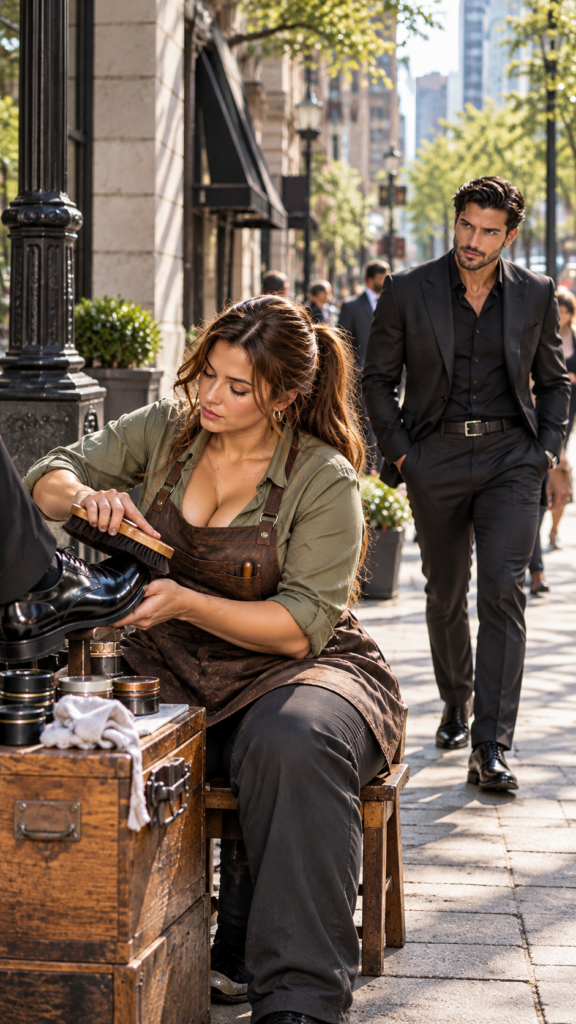
Part 1
“Sir! Wait! You gave me too much!”
The woman’s voice rose above the morning traffic, but the man in the charcoal-gray suit kept walking.
Naomi tightened her grip on the folded bills and hurried through the crowd, her worn shoes striking the pavement as she struggled to catch him.
“Sir, please!”
At last, he stopped.
Daniel Reed turned toward her with the restrained impatience of someone who had forgotten what it felt like to be interrupted without an appointment.
At thirty-eight, he was one of the wealthiest men in the city. His luxury watches were worn by presidents, musicians, and royalty. Business magazines described him as a visionary. Competitors called him merciless. Investors trusted him with fortunes.
Yet the young woman standing in front of him seemed entirely unimpressed.
She was breathing hard, her hair loosened by the run, one hand pressed against her side. In the other, she held four hundred and ninety-five dollars.
“You left this,” she said.
Daniel glanced at the money.
“No. I meant to leave it.”
Naomi frowned.
“You paid me five hundred dollars to clean your shoes.”
“I know.”
“The shine costs five.”
“I know that, too.”
“Then you know this isn’t mine.”
He studied her face.
There was no calculation in her expression, no attempt to charm him into giving her more. She looked genuinely offended by the possibility of accepting money she believed she hadn’t earned.
“Keep it,” he said. “You’ve done excellent work.”
“Excellent work doesn’t turn five dollars into five hundred.”
“Consider it a tip.”
“A tip is a few dollars. This could pay bills.”
“Then let it pay yours.”
Naomi’s expression changed.
Not with gratitude.
With something closer to disappointment.
“Sir, I don’t know what kind of people you’re used to dealing with, but I don’t take money just because somebody can afford to throw it away.”
Daniel went still.
For a moment, the traffic, the impatient horns, and the footsteps surrounding them seemed to recede.
A different voice surfaced in his memory.
A man’s voice, low and tired after a long day of work.
You earn what belongs to you, son. Doesn’t matter whether it’s five dollars or five thousand.
Daniel looked away.
Naomi noticed.
“Did I say something wrong?”
“No.”
“Then please take your change.”
He hesitated before accepting the bills.
“Nobody has ever followed me down the street to return money.”
“Maybe you’ve been surrounded by the wrong people.”
The resemblance to another conversation, from another lifetime, was almost unbearable.
Daniel folded the money and slipped it into his pocket.
“Will you be at that corner tomorrow?”
“Every morning.”
“Same price?”
“Five dollars.”
He gave a slight nod.
“Then I’ll see you tomorrow.”
Naomi watched him leave.
She had polished thousands of shoes, from polished leather belonging to wealthy executives to battered boots worn by men who counted their coins before sitting down.
But she had never encountered anyone quite like him.
And she couldn’t explain why, when he had looked at her, his eyes had held the grief of someone staring at a ghost.
Daniel Reed lived on the highest floor of a glass tower.
From his windows, the city stretched toward the horizon in orderly grids of buildings and lights. His apartment had been decorated by professionals, its furniture selected for beauty rather than comfort, its kitchen maintained by a chef who rarely saw his employer eat.
A dining table designed for twelve dominated the main room.
Most nights, it held one plate.
Daniel owned a watch company worth more than most people could comprehend. His brand had become synonymous with precision, status, and wealth. He was invited to events he never attended and introduced to people who wanted something from him before they knew anything about him.
He knew how to negotiate a contract worth millions.
He knew how to recognize weakness in a business proposal.
He knew how to make difficult decisions without revealing what they cost him.
What he didn’t know was how to sit across from another person at dinner and talk about something that mattered.
He had not always been like that.
Once, he had been a little boy who waited beside a shoeshine stand for his father to finish working.
Daniel was eight when his mother died.
He remembered fragments of her: the warmth of her hand against his forehead, her voice when she called him in for dinner, and the way his father became quieter after the funeral.
Robert Reed never remarried.
He simply worked.
Every morning, Robert carried his brushes and polishing tins to a crowded street corner. He took his place on a heavy wooden stool, set a low customer chair opposite him, and worked until the daylight faded.
His hands were broad, rough, and permanently stained near the fingernails.
Daniel learned to recognize the sound of his father’s footsteps returning home. Some evenings Robert walked slowly, with the exhaustion of a man who had spent his entire day bending over strangers’ shoes.
But he never came through the door without greeting his son.
“How was school?”
Daniel would tell him about tests, teachers, and homework.
Robert listened as if those small events were the most important news in the world.
When Daniel began accompanying him to the corner, he would sit nearby with his books balanced on his knees.
He watched his father transform scratched leather into something people could feel proud to wear.
Robert never hurried a customer simply because another one was waiting.
“People can tell when you’ve taken care with something,” he explained once, guiding Daniel’s hand across a worn leather shoe. “Remember that.”
Daniel remembered.
He remembered the careful movements, the smell of polish, and the tiny grains of dust that settled on his homework.
He also remembered what it felt like when boys at school discovered what his father did for a living.
Their laughter followed him for weeks.
One evening, Daniel announced that he was going to become rich.
Robert looked up from cleaning his brushes.
“Rich, is it?”
“So rich you won’t have to work anymore.”
His father smiled.
“That would be something.”
“I’ll buy you a house. A big one. And a car. You won’t have to sit outside when it rains.”
Robert reached over and ruffled his hair.
“You worry about your education. I’ll worry about the shoes.”
But Daniel had already made his promise.
He carried it through school, through years of study, through sleepless nights spent building a business other people said would never survive.
When his watch company began growing, he worked longer hours.
When it became successful, he worked longer still.
He told himself he was doing it for his father.
Every postponed visit, every missed evening, every conversation cut short because of a meeting was justified by the same thought.
Soon.
Soon there would be enough money.
Soon Robert would retire.
Soon Daniel would have time.
Then Robert died, just as the company reached its first major success.
The money arrived.
The house Daniel had dreamed of buying could finally have been his father’s.
But Robert was gone.
Daniel attended the funeral, returned to work, and began constructing a life in which grief had no room to breathe.
He avoided the old street corner.
At first, because the memory was too painful.
Later, because avoiding it had become a habit.
Ten years passed.
During those ten years, Daniel bought properties, expanded his company, and watched his name appear on buildings and advertisements.
He learned how to measure extraordinary amounts of money.
He never learned how to measure the value of an ordinary afternoon with someone he loved.
And then, on the tenth anniversary of his father’s death, he woke before dawn and found himself thinking about a wooden stool.
Naomi’s world was considerably smaller than Daniel’s.
At twenty-nine, she could fit nearly everything she needed to earn a living inside one battered wooden box.
There were brushes with darkened bristles, soft cloths, tins of polish, shoe dye, a small hammer, and a collection of tools for repairing loose heels and damaged soles.
She carried the box to her street corner each morning at six.
Her working place was nothing impressive.
A worn wooden stool, a low chair for customers, and a narrow space beside the pavement where she could arrange her supplies without blocking the people hurrying past.
But Naomi treated that little corner with the seriousness other people gave to offices with polished floors and expensive furniture.
She cleaned her tools.
She kept her brushes in order.
She greeted every customer respectfully.
And whether someone arrived wearing shoes worth a month’s rent or a pair that barely survived the walk to work, she gave them her full attention.
A standard shine cost five dollars.
Small repairs cost very little.
Sometimes she charged nothing.
The nurse who rushed past each morning on her way to the hospital knew Naomi would never deliberately delay her. A schoolteacher with a cracked sole could count on Naomi to make the repair affordable.
An elderly customer who always apologized while counting out his coins was never made to feel embarrassed.
Naomi understood the value of money.
She understood it better than most people who passed her corner.
Her younger brother, Samuel, was in his final year of school. Tuition, books, transportation, and decent shoes for him all had to be paid for.
She kept careful track of every expense.
There were weeks when she had enough money to put a little aside.
There were other weeks when she opened her cash tin at night and calculated how much food they could afford until the next customers arrived.
Still, Samuel’s shoes were always clean.
She inspected them regularly, touching up scratches before he noticed them.
He teased her about it.
“You know other people don’t examine shoes as closely as you do.”
“Then those people should pay more attention.”
“Nobody is looking at my feet.”
“Somebody might.”
She would say it with such conviction that Samuel always surrendered.
Naomi had learned the trade from an elderly man who once worked on that same corner.
When she was younger, she had watched him work, fascinated by how much care he gave to objects other people barely noticed.
Eventually, he allowed her to help.
First, he taught her to clean the brushes.
Then he showed her how to choose the correct polish, how to handle old leather without damaging it, and how to repair small defects before they became expensive problems.
He was never a man of many words.
But his patience had stayed with her long after his death.
Near the end of his life, when his strength was failing, he gave her the wooden stool.
“Look after it,” he told her.
She promised she would.
“And do the work properly.”
“I will.”
He smiled, apparently satisfied.
Sometimes he had spoken about his son.
A clever boy, he said. A determined boy. One who had grown into a man capable of building something remarkable.
He never spoke with bitterness about the long periods between visits.
Naomi had wondered about that son over the years.
She had never met him.
Eventually, she stopped expecting to.
Her own dream was modest.
She wanted a shop.
Not a large business with employees and expensive equipment.
Just a small place with a front window, a door that closed against the weather, a counter for her tools, and a brass bell to announce customers.
She imagined her name painted on the glass.
Sometimes, when business was slow, she pictured opening that door on a cold morning and turning on the lights.
Then another customer would arrive, and she would return to work.
Dreams were one thing.
School fees and groceries were another.
For six years, Naomi had worked from that old stool, inching toward a future that sometimes felt too far away to reach.
On the morning of his father’s death anniversary, Daniel told his driver that he wanted to walk.
The request was unusual enough to prompt a question.
“Would you like me to meet you somewhere, sir?”
“No. I’ll call if I need the car.”
Daniel left the building before sunrise.
He wore an expensive suit and a watch from his company’s most exclusive collection, but as he walked through the streets, neither made him feel particularly powerful.
The city had changed.
Buildings he remembered from childhood had disappeared. New storefronts occupied familiar addresses. Traffic moved along streets that had once seemed enormous to him.
Then he reached the corner.
And stopped.
The pavement was different.
The shops nearby were different.
But there, beside the flow of pedestrians, stood a wooden stool he knew as well as the furniture in his childhood home.
A young woman sat on it, cleaning a customer’s shoes.
Daniel felt an immediate, irrational urge to turn around.
Instead, he stood watching her work.
She held the brush in a familiar way.
Her movements were unhurried.
She paused to inspect the leather before applying another thin layer of polish.
He had seen those motions thousands of times.
When the customer left, the woman looked toward him.
“Would you like a shine, sir?”
He should have refused.
His shoes were immaculate.
Instead, he crossed the pavement and sat in the low chair.
“Of course,” she said, reaching for a clean cloth. “Just put your foot here.”
Daniel obeyed.
She examined the leather, then began working.
The soft scrape of the brush carried him backward through the years.
For a moment he could almost feel the schoolbooks on his knees and hear his father’s voice telling him to stop worrying about an examination he had already passed.
Daniel looked at the woman’s hands.
They were strong, marked by small cuts and the ordinary wear of manual work.
When she adjusted the angle of the shoe, she did it exactly as Robert once had.
Daniel swallowed.
“How long have you worked here?”
“Six years.”
He looked toward the stool.
“Have you always used that?”
“Yes.”
“Where did you get it?”
“From someone who taught me the business.”
Before he could ask anything more, she finished polishing.
“There you go,” she said. “Five dollars.”
Daniel reached into his pocket.
He removed a folded stack of bills and placed it in her hand without counting.
Then he stood.
“Thank you.”
“You’re welcome, sir.”
He walked away before she could look down.
A moment later, her startled voice followed him through the crowd.
The encounter ended with four hundred and ninety-five dollars returned to his pocket and a promise that he would visit again.
Daniel kept that promise.
The following morning, Naomi found him waiting near her chair.
She glanced at his shoes.
They were spotless.
“Something wrong with yesterday’s shine?”
“They got dirty.”
“Where?”
He examined the pavement as if expecting evidence to appear.
“On my way here.”
Naomi pressed her lips together to hide her smile.
“You walked all this way to have perfectly clean shoes cleaned again?”
“Three blocks.”
“That’s a long way to go for dust.”
“I thought so, too.”
She shook her head and pointed toward the chair.
“Sit.”
This time, when she finished, Daniel handed her exactly five dollars.
He remained for a few moments longer than necessary.
The next day, he returned.
And the day after that.
Sometimes he claimed he had walked through a puddle. Sometimes he mentioned a scuff caused by a revolving door. Once, Naomi was almost certain he had deliberately dragged the edge of his shoe against a rough patch of pavement.
She didn’t accuse him.
She simply took his five dollars and did the work.
At first, Daniel said very little.
But Naomi noticed that he seemed reluctant to leave.
One morning, after she finished, he watched her put away her brush.
“You take your time,” he remarked.
“Leather doesn’t improve because you rush it.”
He gave a small, almost painful smile.
“Someone used to tell me that.”
“Sounds like somebody who knew his trade.”
“He did.”
Daniel looked at the stool for a long moment before leaving.
Naomi watched him go, wondering why such an ordinary conversation had seemed so difficult for him.
A few days later, another customer noticed Daniel sitting in her chair.
The man pointed toward an enormous advertisement displayed above the street.
“Do you know who that is?”
Naomi followed his gaze.
The billboard displayed a luxury watch.
Beside it stood the face of the man whose shoes she was cleaning.
Daniel Reed.
She studied the advertisement, then looked back down at the shoes.
The customer laughed.
“That’s the man who owns the watch company. One of the richest people in the city.”
Naomi looked at Daniel.
He had clearly heard.
For the first time, he seemed uncomfortable about what she might say.
She returned to the shoe she was polishing.
When she finished, she held out her hand.
“Five dollars, please.”
Daniel looked up.
“That’s all?”
“Did the price go up while I wasn’t looking?”
He laughed.
It was a quiet laugh, almost hesitant, but genuine.
And for the first time in years, Daniel Reed felt grateful that someone had treated him exactly like everyone else.
Their conversations grew slowly.
At first, they discussed the weather and the noise of traffic.
Daniel complained about meetings that lasted too long.
Naomi told him about customers who demanded miracles from shoes that were practically falling apart.
He began to ask about Samuel, and she told him how hard her brother was working to finish school.
One morning, Naomi asked Daniel when he had last taken a proper vacation.
He considered the question.
“I don’t remember.”
“Last year?”
“No.”
“The year before?”
“Probably not.”
She stopped polishing and looked at him.
“Are you telling me you haven’t taken time off in years?”
“Nine, more or less.”
“That’s ridiculous.”
“Most people call it dedication.”
“Most people aren’t the ones who have to live in your body.”
He almost smiled.
She continued working.
“Do you at least go home at a reasonable hour?”
“When I can.”
“And when is that?”
“Usually late.”
“What do you do when you get home?”
Daniel hesitated.
“Eat dinner. Read. Work.”
“With your family?”
“No.”
The brush moved gently across his shoe.
He looked away before continuing.
“My dining table has twelve chairs.”
Naomi glanced up.
“Twelve?”
“I bought it years ago. I thought…” He stopped.
“Thought what?”
“That perhaps I’d have a reason to use them someday.”
She waited.
“I usually eat alone.”
For once, Naomi didn’t have a quick response.
She examined the leather beneath her hands.
“That must get lonely.”
Daniel stared at her.
People were always describing his lifestyle as extraordinary.
They admired his privacy, the view from his apartment, the freedom to do whatever he wanted.
Nobody had ever looked at the same life and identified its emptiness so simply.
“It does,” he admitted.
Naomi nodded and went back to work.
She didn’t tell him to be grateful for his money.
She didn’t suggest that a man with his resources had no right to feel lonely.
She simply listened.
And Daniel, who had spent years refusing to expose even the smallest weakness, began to look forward to having someone ask ordinary questions.
One afternoon, Naomi noticed his hand shaking as he checked his phone.
“Have you had anything to eat?”
“I’m fine.”
“That’s not what I asked.”
“I’ve been occupied.”
“So that’s a no.”
He looked vaguely embarrassed.
“I don’t always have lunch.”
She reached into her bag and unfolded a cloth.
Inside was a sandwich.
Without making a ceremony of it, she divided it into two pieces and offered him the larger one.
Daniel stared.
“Naomi, that’s your lunch.”
“Half of it is.”
“I can buy something.”
“I know.”
“Then why—”
“Because there’s food here, and you’re hungry.”
He looked at the sandwich, then at her.
“I can’t take it.”
“Of course you can. It’s a sandwich, not a business contract.”
His mouth twitched.
“Are you always this stubborn?”
“Only when somebody makes eating lunch unnecessarily complicated.”
He accepted it.
For a while, neither spoke.
Daniel sat in a low chair beside a shoeshine stand, eating half a sandwich wrapped in an old cloth, while people carrying briefcases rushed past.
It was the least expensive meal he had shared with another person in years.
And it was the first he could remember wishing would last longer.
The following day, he arrived at one o’clock.
Naomi already had the sandwich divided.
Soon, the arrangement became part of their routine.
Daniel still came for his shoes.
But he also came for the conversation, the teasing, and the unremarkable pleasure of sitting beside someone who expected nothing more from him than his company.
He didn’t recognize what was happening.
Or perhaps he did, and was afraid to give it a name.
Then, one Thursday afternoon, the weather turned.
The clouds darkened before noon, and rain began striking the pavement as Naomi hurried to cover her equipment.
Daniel appeared just as the first heavy drops fell.
“You should be inside,” she told him.
“So should you.”
“I still have customers.”
“Not in this weather.”
Naomi pulled a thin plastic sheet across her wooden box.
The rain intensified.
Within seconds, water ran along the curb.
She grabbed her old black umbrella, one of its metal ribs bent and difficult to straighten.
Daniel expected her to hold it over herself.
Instead, she stepped closer and positioned it above his shoes.
He stared.
“Naomi. What are you doing?”
“Keeping the leather dry.”
“You’re getting soaked.”
“These are expensive shoes.”
“They’re shoes.”
“Someone spent a long time making them.”
Rain streamed down her hair and the sleeves of her jacket.
Daniel reached toward the umbrella.
“Give me that.”
“Hold still. The water will stain the leather.”
He looked down at her, bewildered.
She was standing in the rain to protect something he could replace without noticing the cost.
Her own tools were getting wet.
Her clothing was drenched.
Yet she was concentrating on his shoes as though protecting them were simply part of doing her job properly.
Daniel had employees who managed his schedule, assistants who anticipated his needs, and drivers who prevented him from getting wet.
But none of those arrangements had ever felt like this.
Naomi wasn’t protecting his property because he paid her to.
She was doing it because she cared about the work.
And, Daniel was beginning to suspect, because she cared about him.
For the first time in a decade, he felt the sharp, unfamiliar terror of having something in his life he didn’t want to lose.
Part 2
Daniel could have bought a hundred umbrellas before the rain stopped.
He could have called his driver, gone home, changed his clothes, and forgotten the whole incident.
But long after the storm passed, he kept remembering Naomi’s hands wrapped around that crooked black umbrella.
He remembered the water dripping from her sleeves.
He remembered her expression when he tried to move away, as though he were making her job unnecessarily difficult.
Most of all, he remembered something she had said.
Someone had spent a long time making those shoes.
Daniel had spent his entire adult life working with expensive things. His company sold watches that represented hundreds of hours of skilled labor. He knew the precision required to make something extraordinary.
But somewhere along the way, he had started thinking only about what those objects cost.
Naomi seemed to understand something he had forgotten.
The value of work was not always reflected in the price someone paid for it.
That evening, Daniel sat alone at his enormous dining table, looking at the untouched meal in front of him.
He thought about his father.
Robert had treated every customer with the same care, whether they paid in crisp bills or small coins.
Daniel used to wonder why.
Now, sitting in an apartment filled with things he no longer knew how to enjoy, he was beginning to understand.
Later that week, Daniel arrived at the corner shortly before one.
Naomi was helping a customer when a young man hurried toward them.
He was pale, visibly nervous, and dressed in a carefully ironed shirt.
His shoes, however, looked terrible.
The leather was cracked near the sides. Dust covered the toes, and a small separation had begun forming along one heel.
“Excuse me,” the young man said. “Can you help?”
Naomi looked up.
“What do you need?”
“I have a job interview in twenty minutes. I tried cleaning them myself, but…”
He stared down at his shoes.
“I can’t make them look right.”
“Sit down. Let me see.”
He hesitated, reaching into his pocket.
“I don’t have five dollars.”
He unfolded two crumpled bills.
“I’ve got this much.”
Naomi didn’t examine the money.
“Keep it.”
The young man looked confused.
“But I need—”
“I know what you need. Sit.”
Daniel moved aside to give him room.
Naomi immediately began working.
Her movements were quicker than usual, but not careless. She brushed away the dust, treated the worst of the cracks, and used a little glue to secure the damaged heel.
The young man kept checking the time.
“Am I going to be late?”
“Not if you stop watching the clock and let me work.”
Daniel glanced at his own watch, an extraordinarily expensive piece of machinery designed to measure time with almost absurd precision.
Then he looked at Naomi.
She was using every available second to help a stranger she might never see again.
When she finished, the shoes were transformed.
They were still old, but now they looked cared for. The leather had a clean, even shine, and the heel was secure.
The young man stood.
“That’s amazing.”
“Now go.”
“Wait. How much do I owe you?”
“Nothing.”
He stared at her.
“Why?”
Naomi began putting away her supplies.
“Because somebody once gave me a chance when I needed one.”
His eyes shone.
“Thank you.”
“Thank me by getting that job.”
He rushed away, almost stumbling as he turned the corner.
Naomi watched until he disappeared.
Then she returned to her stool.
Daniel remained beside her.
“You didn’t even take what he had.”
“He needs it more than I do today.”
“You need money, Naomi.”
She raised an eyebrow.
“Of course I need money.”
“Then why turn it down?”
“Because two dollars wouldn’t change my life. But going into that interview with a little confidence might change his.”
Daniel looked toward the street where the young man had vanished.
He thought about the hundreds of millions of dollars that moved through his company.
Contracts, investments, dividends, acquisitions.
He had spent years measuring success through numbers that required several commas.
Naomi had just given away a service worth five dollars.
Yet she appeared more satisfied than Daniel had felt after some of the most profitable deals of his career.
“Do you help people like that often?” he asked.
“When I can.”
“And if they never come back?”
She smiled faintly.
“Then I hope they’re doing well.”
He had no answer.
As Naomi settled onto her stool, Daniel’s gaze drifted toward the dark wood beneath her.
There was something familiar about the angle of one leg, the worn edge near the seat.
He had noticed it before.
He had been noticing it since the first morning.
But now, as she shifted her weight, the stool tilted just enough for him to catch sight of a shallow marking underneath.
Several uneven lines carved into the wood.
His breathing changed.
He leaned forward.
“Naomi.”
“Hmm?”
“Where did you say you got that stool?”
She glanced down.
“From the man who taught me.”
“Did he make it himself?”
“I don’t know. It was already old when I met him.”
Daniel stared at the underside.
There had been a mark there when he was a child.
He remembered watching his father carve something beneath the seat one quiet afternoon.
At the time, Robert had laughed and said that a man needed some way of proving which stool belonged to him.
Daniel had not thought about that afternoon in decades.
Now his heart was beating so hard he could barely concentrate.
“Is something wrong?” Naomi asked.
Daniel straightened.
“No.”
But his voice sounded different.
And throughout the rest of their lunch, he could not stop looking at the stool.
The following afternoon, Daniel arrived without any of his usual excuses about dirty shoes.
Naomi noticed immediately.
“You look serious.”
He sat down.
“Can I ask you something?”
“Of course.”
“That stool. Have you ever looked underneath it?”
She gave him a puzzled smile.
“Not really.”
“Would you?”
Naomi studied him.
“Why?”
“Please.”
There was a quiet urgency in his expression that made her set the brush aside.
She finished the shoe she was polishing, then stood and carefully turned the stool over.
The underside was dark with age.
At first, she saw only scratches and places where the wood had been rubbed smooth.
Then she found the letters.
They had been carved by hand.
Unevenly, as though someone had used a small blade rather than a proper woodworking tool.
She traced the marks with one finger.
ROBERT REED.
Naomi read the name again.
Then she looked up.
Daniel had gone very pale.
“Daniel?”
He stared at the letters.
“That’s my father’s name.”
Naomi didn’t speak.
Daniel leaned forward, elbows resting on his knees.
“His name was Robert Reed.”
She looked down at the stool, then back at him.
“Your father?”
“He worked right here. On this corner.”
The afternoon traffic continued around them.
A bus stopped nearby. People crossed the street, carrying shopping bags and briefcases.
But Naomi could hear almost nothing beyond the uneven sound of Daniel’s breathing.
“He polished shoes here for twenty-two years,” Daniel continued. “When I was a boy, I used to sit beside him while he worked.”
Naomi slowly lowered the stool to the pavement.
“The man who taught me…”
Daniel looked at her.
“He had strong hands,” she said. “He was very quiet. He always told me not to rush.”
Daniel shut his eyes.
“He used to say that to me.”
“He gave me this stool when he was getting too weak to work.”
Daniel pressed one hand against his mouth.
Naomi felt the pieces of the past shifting into place.
The elderly shoeshiner who spoke with such pride about his son.
The wealthy stranger who had returned to the corner again and again.
The look on his face when she had refused the enormous tip.
His fascination with the stool.
The strange sadness that appeared whenever she mentioned the man who taught her.
“Daniel,” she whispered. “You knew him.”
He gave a short, painful laugh.
“He was my whole world.”
She sat down carefully.
For a long moment, neither spoke.
Then Daniel began telling her about his childhood.
About the books he balanced on his knees.
About waiting beside the stool while his father finished the last customer’s shoes.
About the promise he had made to buy Robert a house.
And about the way that promise had gradually consumed the very time they might have spent together.
“I thought I was doing the right thing,” Daniel said. “Every time I missed a visit, I told myself it was temporary.”
Naomi listened.
“I was building the company. I told myself that once it was successful, things would be different.”
His voice thinned.
“Then he died.”
She had never heard him sound so defenseless.
“After the funeral, I couldn’t come back here. I knew this place would look the same, but he wouldn’t be sitting in it.”
Daniel lowered his gaze.
“So I stayed away.”
“For ten years?”
He nodded.
“Until the morning you first polished my shoes.”
Naomi remembered how silently he had sat, staring straight ahead while she worked.
“You came here because of him.”
“It was the anniversary of his death.”
Her eyes filled.
“I didn’t know.”
“I didn’t intend to stay. I only wanted to see the corner again.”
He looked at her hands.
“Then I saw you working the way he used to. Using his stool. Taking your time with every pair of shoes.”
His mouth trembled slightly.
“And I couldn’t leave.”
Naomi remembered the five hundred dollars.
All those mornings when he arrived with shoes that barely needed polishing.
The quiet afternoons.
The shared sandwiches.
“You weren’t really coming for your shoes,” she said.
Daniel looked toward the pavement.
“No.”
He took a difficult breath.
“I think I was trying to find something I’d lost.”
Naomi moved closer.
“Your father never spoke badly about you.”
Daniel looked up so suddenly that she almost stopped.
“What?”
“Not once.”
He stared at her.
“He talked about his son all the time. He said you were clever. That you worked harder than anyone he knew.”
Daniel’s eyes were wet.
“He said you were going to make something wonderful.”
“But I wasn’t there.”
Naomi’s throat tightened.
“He knew you loved him.”
Daniel looked away.
“You don’t know that.”
“Yes,” she said softly. “I do.”
Naomi knelt beside her wooden box.
There was a small compartment at the bottom that she almost never opened.
She moved aside a few supplies and reached into it.
When she stood, she held a little bundle wrapped in faded gray fabric.
“There’s something I should have shown you sooner.”
Daniel watched as she unfolded the cloth.
Inside lay an old shoeshine brush.
Its wooden handle was pale and worn smooth by years of use.
Beside it was a thin polishing cloth, neatly folded, with a single letter stitched into one corner.
R.
Daniel stopped breathing for a moment.
He recognized the brush.
Not because it was valuable.
Not because it was rare.
Because he had watched his father hold it thousands of times.
Robert had used that brush on the busiest mornings and the quietest afternoons.
When Daniel was little, his father sometimes allowed him to hold it.
And when the shop closed for the evening, Daniel would help clean the last pair of shoes.
“Where did you get this?” he whispered.
“He gave it to me with the stool.”
Daniel reached toward the brush, then stopped.
Naomi lifted it and placed it in his hands.
His fingers closed around the handle.
The familiar shape seemed to settle into his palm.
He remembered being a child again.
Robert guiding his hand.
The two of them laughing when Daniel applied too much polish and got it on his sleeve.
His father praising him for concentrating.
Daniel bent his head.
“I used to help him.”
Naomi sat beside him.
“He told me.”
Daniel looked at her.
“He said that?”
“He talked about you doing homework here. And about letting you finish the last pair of shoes when you were little.”
Daniel’s grip tightened around the brush.
“He used to tell me I had good hands.”
Naomi smiled through her tears.
“He told me that, too.”
For several moments, Daniel couldn’t speak.
Then he asked the question he had carried for ten years.
“Did he ever wonder why I didn’t come more often?”
Naomi looked at him.
He was watching her with an expression she had never seen on his face before.
He wasn’t a billionaire asking for an answer.
He was a son afraid of learning that his father had died disappointed in him.
“Daniel…”
“Please. Tell me.”
She took a breath.
“Near the end, he talked about you one evening. He was very tired that day. His hands were hurting, and I stayed with him for a while.”
Daniel lowered his eyes to the brush.
“He said you were working on something important.”
“I was always working.”
“He was proud of you.”
Daniel’s face tightened.
Naomi continued gently.
“He knew you were busy. He believed you were becoming the man he had always known you could be.”
Daniel shook his head.
“I should have been there.”
“Maybe,” Naomi whispered. “But he never said that.”
She rested a hand against the stool.
“He told me to keep this place going. He said his son would find his way back someday.”
Daniel looked at her.
“That’s what he said?”
“He told me to look after the corner until you were ready to return.”
The brush trembled in his hands.
For ten years, Daniel had imagined his father’s final days.
He had imagined loneliness.
Disappointment.
Unanswered questions.
He had punished himself with the belief that Robert must have thought his son had forgotten him.
And now he was sitting beside the woman who had cared for his father’s little corner, holding the brush Robert had left behind.
The thing Daniel had avoided all those years had been waiting for him.
Not an accusation.
Not a demand for an explanation.
A place to come home to.
His shoulders began to shake.
Daniel lowered his head, pressing the old brush against his chest.
Naomi said nothing.
She simply moved closer and stayed beside him.
When his composure finally broke, she didn’t look away.
People continued passing.
Some glanced toward them.
A few slowed their steps.
Daniel didn’t notice.
For once, there was no assistant to protect his privacy, no polished office to retreat into, no meeting that required him to hide what he felt.
He cried openly on the pavement.
For his father.
For the afternoons that would never return.
For a childhood spent beside a wooden stool.
For the terrible discovery that money could buy almost anything except another hour with someone who was gone.
Naomi remained with him until the worst of the grief passed.
Eventually, Daniel straightened.
He looked down at the brush.
“This should stay with you,” he said, his voice rough.
Naomi shook her head.
“He gave it to me to keep safe. I think it’s time you had it.”
Daniel stared at her.
“You’ve done more for me than you know.”
She smiled faintly.
“I think your father did most of the work.”
And Daniel laughed through his tears.
For the next two days, they returned to their familiar routine.
Daniel still arrived at one.
Naomi still divided her sandwich.
But there was a tenderness between them that neither tried to explain.
Daniel found himself noticing things he had previously overlooked.
How Naomi counted her money with careful concentration.
How she always kept her tools clean even when she was exhausted.
How her expression changed whenever she spoke about Samuel’s future.
He also remembered something she had once mentioned.
Her dream of having a little shop.
A place with her name on the window.
To Daniel, making that dream come true seemed simple.
He had spent years using money to solve problems.
This one, surely, he could solve beautifully.
So he found a small building on a quiet street and bought it.
It had a glass front door, a bright window, a narrow counter, and enough room for Naomi to arrange her tools properly.
There was even a brass bell above the entrance.
Daniel arranged everything.
He had her name placed on the glass.
Then, on the third afternoon, he arrived at the corner carrying a folder.
Naomi noticed it immediately.
“Business today?”
“Something like that.”
He sat down beside her.
“I want you to look at something.”
She opened the folder.
The first photograph showed a small storefront.
The second revealed the interior.
Then she saw the entrance.
The brass bell.
The window.
Her own name painted in gold letters.
Her fingers stopped moving.
“Daniel…”
“I bought it yesterday.”
She looked up.
“What?”
“The building. It’s yours.”
For a moment, he saw pure happiness cross her face.
Then something else replaced it.
She carefully closed the folder.
“I can’t accept this.”
Daniel blinked.
“Why not?”
“Because it’s too much.”
“Naomi, you deserve it.”
“That isn’t the point.”
He leaned forward.
“You kept my father’s work alive. You gave me back something I thought I’d lost forever. Please, allow me to do something for you.”
Her eyes glistened.
“I didn’t do those things because I wanted you to repay me.”
“I know.”
“Then why are you trying to?”
Daniel stared at her.
“I’m trying to help you.”
“I know you are.”
“Then let me.”
She placed the folder between them.
“Daniel, I have worked for years because I want to open a shop of my own. Every dollar I’ve saved means something. Every pair of shoes I’ve polished has brought me a little closer.”
He listened without interrupting.
“If I walk into that building because you bought it for me, I won’t feel the same way.”
“You would still be running the business.”
“But I wouldn’t have earned the door.”
He looked hurt.
“I thought you’d be happy.”
“I am happy that you care enough to do this.”
“Then what am I supposed to do?”
Naomi hesitated.
“Understand why I can’t take it.”
His gaze shifted toward the photograph.
“I’ve already bought it. The papers are signed.”
“I know.”
“And your name is on the window.”
She smiled sadly.
“Then I’m sorry you did all that without asking me.”
The words struck him harder than she intended.
He looked at the folder as though it had become something unfamiliar.
“You think I’m trying to buy your gratitude.”
“No.”
“Then what?”
Naomi’s voice trembled.
“I don’t want you to think everything between us can be settled with money.”
Daniel fell silent.
She continued.
“The sandwiches. The conversations. The things your father taught me. None of that was a debt.”
“I never said it was.”
“But this makes it feel like one.”
He stood abruptly.
Naomi rose as well.
“Daniel, please don’t misunderstand me.”
He tucked the folder beneath his arm.
“I understand.”
“No, I don’t think you do.”
His expression closed.
“I thought I was giving you something you wanted.”
“You were. But not in the way I wanted to receive it.”
For a moment, he looked at her as though she had rejected more than a building.
Naomi wished she knew how to explain.
She wanted him in her life.
She wanted their conversations, their lunches, and the quiet warmth that had grown between them.
But she did not want to become someone who owed her future to his fortune.
And she knew the man who had taught her the trade would have understood.
“Your father would have respected that,” she said.
Daniel’s face changed.
The words had touched the one place where his defenses were still weakest.
He looked away.
“Goodbye, Naomi.”
Then he turned and walked down the street.
For the first time since his return to the corner, he left without making any promise to come back.
Part 3
The next afternoon, Daniel’s chair remained empty.
Naomi kept working.
She polished a nurse’s shoes, repaired a damaged heel, and listened patiently while an elderly customer complained about the rising cost of everything.
At one o’clock, she took out her lunch.
Without thinking, she divided the sandwich into two pieces.
Then she looked at the empty chair.
She sat there for several minutes before wrapping the second half again.
He’s busy, she told herself.
Daniel ran an international business. He had responsibilities she could barely imagine.
One missed afternoon meant nothing.
The following day, he didn’t appear.
Naomi found herself looking toward the street every time she heard footsteps approaching.
By the third day, she no longer bothered inventing explanations.
She set the larger half of her sandwich on the empty chair.
An hour later, it was still there.
She looked at it and felt an unexpected ache.
She had spent years believing that if she worked hard enough and remained independent, she could protect herself from disappointment.
But she had never planned for someone like Daniel.
Someone who could make her laugh with an absurd excuse about dirty shoes.
Someone who listened when she spoke about Samuel.
Someone who had trusted her enough to reveal the most painful part of his life.
And someone who had apparently mistaken her refusal of a building for the rejection of his heart.
That evening, Samuel noticed her silence.
They were sitting together after dinner when he put down his schoolbooks.
“What’s wrong?”
“Nothing.”
“Naomi.”
She looked up.
“You’ve barely said a word.”
“I’m tired.”
“You’re always tired. Usually you still manage to tell me what’s wrong with my shoes.”
She tried to smile.
Samuel watched her for another moment.
“Is this about Daniel?”
Her expression betrayed her.
“I knew it.”
“You don’t know anything.”
“Then where’s the man who kept finding mysterious dirt on his expensive shoes?”
Naomi sighed.
“He hasn’t come back.”
Samuel’s expression softened.
“Did something happen?”
She told him about the shop.
About the photographs, the gold lettering on the glass, and Daniel’s hopeful expression as he waited for her response.
She described her refusal.
And the terrible distance that had opened between them afterward.
Samuel listened without interrupting.
When she finished, he leaned back.
“Do you wish you’d taken it?”
“No.”
“Then why are you upset?”
“Because I hurt him.”
“Did he do something wrong?”
Naomi considered the question.
“He tried to make a decision about my future without asking me. But he was trying to be kind.”
Samuel nodded.
“And you told him you wanted to do it yourself.”
“Yes.”
“That doesn’t sound unreasonable.”
“Then why did he look at me like that?”
Her brother was quiet for a moment.
“Maybe because he doesn’t know what else to offer you.”
Naomi looked at him.
“What do you mean?”
“Think about it. He’s rich enough to buy almost anything. If he wants to thank somebody, he can just pay for something they need.”
Samuel glanced toward her workbox.
“But what happens when the person doesn’t want his money?”
Naomi said nothing.
“Maybe nobody’s ever shown him how to give someone something without buying it first.”
The words stayed with her.
She remembered Daniel’s enormous dining table.
The years without a vacation.
The way he had stared at half a sandwich as though she were offering him something priceless.
She thought about his father, whose whole life had been measured in small sacrifices.
Robert had paid for Daniel’s education by working long hours in every kind of weather.
He had given his son his evenings, his patience, and the steady reassurance that someone would always be waiting for him at home.
Daniel had spent years trying to repay those gifts with money.
And now, with Naomi, he had tried to do the same thing.
She looked at Samuel.
“What if he never comes back?”
Her brother smiled faintly.
“Then I guess you’ll have to keep doing what you’ve always done.”
“What’s that?”
“Keep the corner open.”
That night, Naomi returned to the old stool after the street had grown quiet.
She turned it slightly and ran her fingers over Robert Reed’s name.
For years, she had thought the stool was simply a reminder of the man who taught her to work honestly.
Now she understood it carried another meaning.
Robert had trusted her with a place where his son might someday return.
And Daniel had returned.
Not because he needed a shoe shine.
Because he needed someone who remembered the man his father had been.
Naomi thought about the shop she had refused.
She still wanted her own place.
She still intended to earn it.
But when she tried imagining herself unlocking that future door, something had changed.
She could picture the brass bell.
The window.
The counter.
And now, she could also picture Daniel sitting in the first chair, finding some ridiculous reason to have his shoes polished.
She smiled sadly.
She hadn’t wanted his money.
She had wanted him to stay.
On the fourth morning, Naomi arrived earlier than usual.
She set down her box, arranged her brushes, and sat on the stool.
The street gradually filled with commuters.
Ten minutes passed.
Then she heard familiar footsteps.
She looked up.
Daniel stood a short distance away.
He wore a plain jacket instead of his usual expensive suit.
There was no driver behind him.
No polished leather folder beneath his arm.
For a moment, neither moved.
“Good morning,” he said.
Naomi’s throat tightened.
“You’re early.”
“I wasn’t sure you’d want to see me.”
“Daniel…”
“Please. Can I say something first?”
She nodded.
He approached slowly.
“I’ve been thinking about what happened.”
Naomi waited.
“You were right.”
She looked surprised.
“I tried to give you the shop without asking what you wanted. I told myself it was a generous thing to do.”
He glanced at the wooden stool.
“But it wasn’t really about what you needed.”
“What was it about?”
He took a long breath.
“Me.”
Naomi’s expression softened.
“I wanted to show you how grateful I was. And I wanted to do it in a way I understood.”
He looked at her.
“All my life, I’ve believed that if something mattered enough, I had to earn enough money to protect it.”
His voice lowered.
“I thought if I became rich, my father would never have to work again. I thought I could give him everything he deserved.”
Naomi watched his hands.
They were empty.
“Then he died before I could.”
Daniel swallowed.
“And when I met you, I started doing the same thing. I thought if I could buy you the shop, you’d understand what you mean to me.”
Her eyes filled with tears.
“Daniel…”
“But you already understood.”
He looked toward the old stool.
“My father never needed expensive things to show me he loved me. He gave me time. He listened. He made sure I had what I needed even when it cost him more than I knew.”
Daniel looked back at her.
“And I’ve been so busy buying things that I forgot how to do any of that.”
Naomi stepped closer.
“I never wanted to make you feel like your kindness wasn’t enough.”
“You didn’t.”
He gave a small, rueful smile.
“You just reminded me that kindness and money aren’t the same thing.”
For several seconds, they stood facing each other.
Then Daniel reached into his jacket.
He withdrew the old shoeshine brush and the cloth marked with his father’s initial.
Naomi looked down.
“What are you doing?”
“Something I should have done before.”
Daniel knelt on the pavement.
Naomi stared.
“Daniel, get up.”
He smiled slightly.
“Not yet.”
People were beginning to notice.
A wealthy businessman kneeling beside a little shoeshine stand was not an ordinary sight.
Daniel didn’t appear concerned.
He looked at Naomi’s shoes.
They were old.
The leather had cracked near the sides, and the toes had become dull from years of walking across the pavement.
He lifted the brush.
“May I?”
Naomi looked from the brush to his face.
“You want to polish my shoes?”
“Yes.”
“Daniel, you don’t have to do that.”
“I know.”
She fell silent.
He gestured gently toward the footrest.
“Please?”
Naomi sat down.
Slowly, she placed one foot where thousands of customers had placed theirs before.
Daniel examined the leather.
Then he opened a tin of polish.
His first movements were tentative.
It had been decades since he had done this properly.
But as he worked, something familiar returned.
The angle of his wrist.
The careful pressure.
The steady circles across the leather.
He remembered his father correcting him when he tried to hurry.
He remembered Robert’s hand covering his own, demonstrating the proper movement.
And he remembered how proud he had felt when his father allowed him to finish a pair without help.
Naomi watched in silence.
The owner of one of the world’s most successful luxury watch companies was kneeling at her feet, cleaning shoes that had cost less than a single strap from one of his watches.
There was no embarrassment in his face.
No performance.
He was concentrating on making the leather look its best.
Naomi felt tears gathering.
For six years, she had spent her days helping other people walk away with polished shoes.
She had hardly ever taken the time to care for her own.
Now Daniel was giving her the kind of attention she had offered everyone else.
When he finished the first shoe, he moved to the second.
He worked patiently until the dull leather began to shine.
At last, he leaned back.
“There.”
Naomi looked at her feet.
The shoes were still old.
The cracks had not disappeared.
But they had been cared for beautifully.
She looked at Daniel.
“How much do I owe you?”
He paused.
Then a smile spread across his face.
“Five dollars.”
Naomi laughed.
“Five?”
“Not a penny more.”
She began laughing harder, even as tears slipped down her cheeks.
Daniel laughed with her.
Not the restrained sound she had heard during their early conversations, but a genuine, open laugh that surprised him.
For a few precious seconds, he was no longer thinking about contracts, losses, or all the years he couldn’t recover.
He was simply happy.
Then his expression softened.
“Naomi, may I come back tomorrow?”
She reached out her hand.
Daniel took it and stood.
She held on for a moment longer than necessary.
“You don’t need to ask.”
He searched her face.
“Are you sure?”
Naomi smiled through her tears.
“Daniel, sit down. You’re early.”
The following morning, Daniel returned with a wooden sign tucked beneath his arm.
Naomi was preparing her tools when she spotted him.
“What have you brought now?”
“Before you say no, it isn’t a building.”
She laughed.
“That’s reassuring.”
He held up the sign.
The letters were hand-painted.
They weren’t perfectly straight.
A few brushstrokes were noticeably uneven, and the edges suggested that the person responsible had needed several attempts.
Naomi read the words.
ROBERT’S CORNER
Honest Work Since 1989
For a long moment, she said nothing.
Daniel shifted awkwardly.
“I made it last night.”
“You made this?”
“With a borrowed brush. It took three tries.”
She ran her fingers carefully along the painted letters.
“Why?”
He looked at the stool.
“My father never put up a sign. He thought doing the job well was enough.”
Naomi smiled.
“That sounds like him.”
“But people should know who worked here.”
Daniel glanced toward the street.
“He spent twenty-two years at this corner. People walked past him every day. Most probably never learned his name.”
Naomi looked back at the sign.
“And now they will.”
“If you’d like to hang it.”
She nodded.
“I would.”
Together, they fastened the sign to the lamppost above the old stool.
Daniel stepped back to examine it.
The letters were imperfect.
The wood wasn’t expensive.
It was nothing like the advertisements produced for his company.
Yet he couldn’t remember feeling prouder of anything he had made.
Naomi stood beside him.
“He would have loved it.”
Daniel looked at her.
“You think so?”
“I know so.”
The sign changed the corner in ways neither had expected.
At first, people simply noticed it.
A few asked Naomi about Robert.
She told them about the elderly shoeshiner who had taught her the trade, the man who believed honest work deserved pride no matter how little it paid.
The nurse told her sister.
The schoolteacher mentioned the corner to colleagues.
And the young man whose shoes Naomi had repaired before his interview came back with good news.
He had gotten the job.
He told other people about the woman who had helped him when he couldn’t afford to pay.
Gradually, more customers arrived.
Some came because they needed their shoes cleaned.
Others came because they had heard the story of the little corner and wanted to support it.
Naomi didn’t change the way she worked.
She still took her time.
She still charged five dollars for a standard shine.
And she still helped people who needed it.
But the cash tin grew heavier.
For the first time in years, her dream of opening a shop began to feel like something she could actually accomplish.
Daniel noticed.
He never offered to buy her another building.
He didn’t arrive with a new folder or a complicated financial arrangement.
Instead, he continued visiting.
He brought his shoes.
He paid five dollars.
And at one o’clock, he shared lunch with her.
Sometimes they spoke for the entire hour.
Sometimes Naomi was busy, and Daniel simply sat nearby until she finished with a customer.
They talked about Samuel’s schoolwork, the weather, Daniel’s business, and the ordinary complications of living.
There were days when Daniel admitted he was exhausted.
There were days when Naomi confessed that she worried about money.
Neither pretended to have all the answers.
But they were no longer carrying everything alone.
Daniel’s life began to change in small, noticeable ways.
He started leaving his office at noon whenever his schedule allowed.
At first, his staff were surprised.
Then they adjusted.
He hired a second assistant to help manage the workload he had insisted on handling personally for years.
He began taking Sundays off.
He discovered that his company did not collapse because he left a meeting on time.
He also began eating regular meals.
Sometimes he ate with Naomi.
Other times, he returned home and sat at his enormous dining table.
But the apartment no longer felt quite as empty.
One evening, Daniel invited Samuel to dinner.
Naomi had mentioned that her brother was curious about the man who kept visiting her corner.
Samuel arrived with two friends and a deck of cards.
Daniel had not expected the cards.
He had certainly not expected three young people to transform his carefully arranged dining room into a place filled with arguments, laughter, and crumbs.
But as Samuel protested a questionable play and his friends demanded another game, Daniel found himself smiling.
For years, the table had been a monument to everything missing from his life.
That evening, it was simply a table.
There was food on it.
There were people around it.
Someone wanted another serving.
Someone else was laughing too hard to finish a sentence.
Daniel looked toward the empty chairs and, for the first time, did not feel accused by them.
He imagined his father sitting nearby.
Robert would have enjoyed this.
The thought still hurt.
But it no longer hurt in the same way.
Almost a year after their first meeting, Naomi finally reached the goal she had carried quietly for so long.
She found a small shop on a peaceful street.
It wasn’t grand.
The front window needed cleaning, and the counter was narrow. There was just enough room for her supplies, a few chairs, and the equipment she had accumulated over the years.
But it had a door of its own.
Above that door hung a brass bell.
And when Naomi opened it, the sound filled the little space with a bright, cheerful ring.
She had saved for the shop herself.
Every customer, every repaired heel, every careful decision about what she could afford had brought her closer.
She signed the lease with her own name.
Then she stood outside for a long time, looking at the gold lettering on the window.
For a moment, she remembered the photographs Daniel had once shown her.
The shop he had bought.
The gift she had refused.
She knew now that his offer had come from love and gratitude, even if he had not understood what she truly needed.
She was glad they had found another way.
At exactly one o’clock on the shop’s first morning, Daniel appeared.
He wore his plain jacket.
His shoes were clean.
He stood outside the window, smiling.
Naomi opened the door.
The brass bell rang.
“You’re late,” she teased.
He glanced at his watch.
“One o’clock. Exactly.”
“For you, that’s practically late.”
Daniel laughed and stepped inside.
He looked around.
The neatly arranged brushes.
The polished counter.
The sunlight falling across the floor.
The chairs waiting for customers.
And Naomi standing proudly in the middle of it all.
“It’s beautiful,” he said.
She looked toward the window.
“I did it.”
Daniel nodded.
“Yes, you did.”
“I signed the lease myself.”
“I know.”
“I saved for it. Every dollar.”
His expression softened.
“I know, Naomi.”
She looked at him.
There was no need to explain why that mattered.
He understood.
Daniel settled into the first chair.
Naomi reached for her brush.
“Same service?”
“Unless your prices have gone up.”
She examined his shoes.
“They’re already clean.”
“An unfortunate coincidence.”
She laughed.
“You’re impossible.”
“I’ve heard that.”
Naomi began polishing.
Daniel watched her hands move across the leather.
The familiar rhythm filled the room.
For a moment, he remembered another pair of hands, broader and older, working beneath the afternoon sun.
He remembered being a boy and thinking that the most wonderful thing in the world would be to earn enough money to keep those hands from ever having to work again.
Now he understood something he hadn’t understood then.
His father had not spent those years waiting for the day he could stop being a shoeshiner.
Robert had built a life of dignity through the work he knew how to do.
And Daniel’s greatest regret was not that he had failed to make his father rich.
It was that he had forgotten to be present while his father was alive.
Naomi finished the shine.
She looked up at him.
“Five dollars.”
Daniel took out a bill.
“Exactly five.”
She accepted it with a smile.
Behind the counter, on a small wooden shelf, rested Robert’s old brush.
Beside it lay the faded polishing cloth with the embroidered R.
They had decided to keep the two objects there.
Not hidden away.
Not preserved behind glass.
Just placed carefully where they could be seen and remembered.
They were reminders of where Naomi had learned her craft and where Daniel had learned the meaning of honest work.
A few streets away, the original corner remained.
The old wooden stool still stood beneath the hand-painted sign.
Beside it was a newer one, ready for anyone who needed a place to sit.
Robert’s name looked down on the pavement where he had worked for more than two decades.
And in a little shop nearby, the son who had once been too afraid to return was learning how to live again.
Daniel rose from the chair.
He looked at Naomi.
“Same time tomorrow?”
She pretended to consider it.
“That depends.”
“On what?”
“Whether your shoes actually need polishing.”
He glanced down at them.
“I could walk through a puddle.”
“Daniel.”
“Or find a particularly dusty street.”
She shook her head, laughing.
He held out his hand.
Naomi took it.
For a moment, they stood together in the sunlight coming through the glass.
Neither spoke of promises they couldn’t make.
Neither tried to purchase a future for the other.
They had discovered something quieter and more enduring.
Daniel had learned that love was not measured by what he could give someone, but by how faithfully he chose to be there.
Naomi had learned that accepting someone’s presence did not mean surrendering her independence.
And both had come to understand what Robert Reed had known all along.
A life could be made meaningful by ordinary work, small kindnesses, and the time people chose to spend together.
Daniel looked once more at the little shop.
Then at the woman who had refused four hundred and ninety-five dollars, protected his shoes in the rain, and given him back the memory of a father he thought he had lost forever.
“Tomorrow, then?” he asked softly.
Naomi smiled.
“Sit down, Daniel.”
He raised an eyebrow.
“Why?”
“Because you’re early.”
And for the first time in his life, Daniel Reed was in no hurry to be anywhere else.


