Part 1
The first sound Luca Romano heard was a heartbeat.
Not his own.
Not the measured pulse he could feel beneath his fingers when a difficult negotiation demanded more patience than he wanted to give.
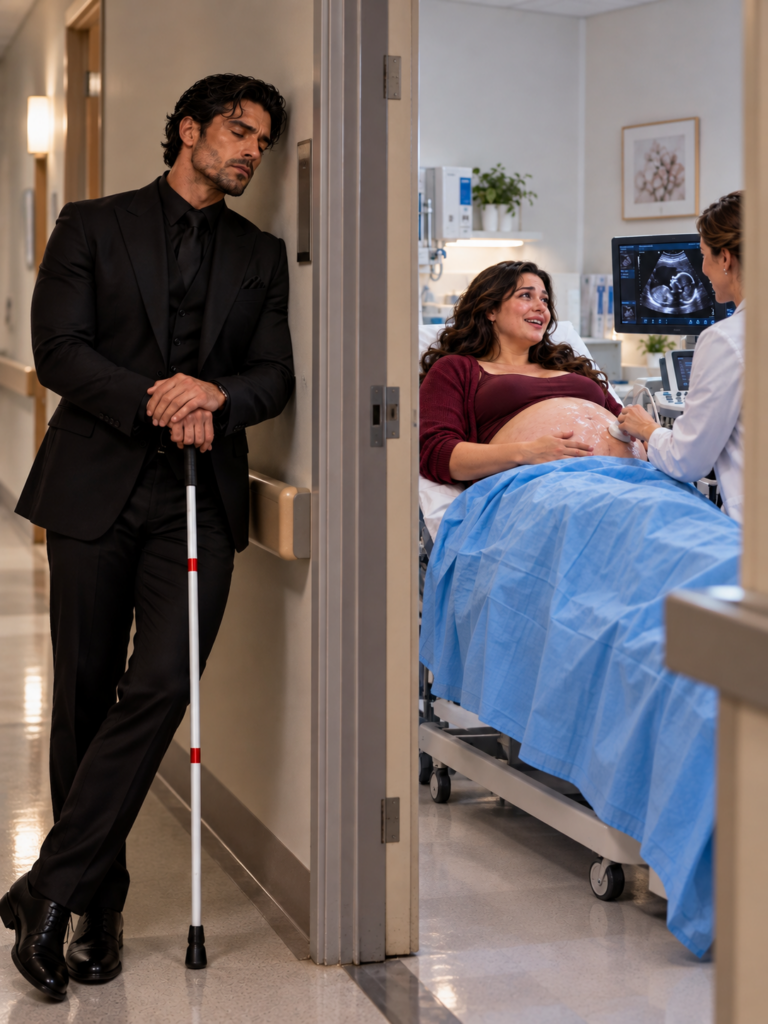
This heartbeat was impossibly fast, a delicate, urgent rhythm spilling through an open doorway into the polished corridor of a private medical clinic.
Luca stopped walking.
His white cane rested against the marble floor. Somewhere ahead, a member of the clinic staff was maneuvering a wheeled cart through a doorway. Luca had been waiting for his driver, his attention divided between the quiet movement of people around him and the familiar sounds of the building.
Ordinarily, he would have ignored the noise coming from another examination room.
Then a woman spoke.
“Are the measurements where they should be?”
The voice struck him harder than any physical blow.
Emma.
For one extraordinary second, Luca forgot the corridor, the clinic, and the people moving around him.
He knew that voice.
He knew the faint hesitation that appeared whenever Emma was worried but determined not to show it. He knew the controlled steadiness she used when asking questions whose answers frightened her.
He had listened to that voice across dinner tables, in dark bedrooms, through arguments neither of them had known how to finish.
And for nine weeks, he had lived without hearing it in person.
His estranged wife was on the other side of the door.
Before Luca could decide whether to announce himself, a doctor answered her question.
“Everything we’re seeing looks appropriate for approximately twelve weeks.”
Twelve weeks.
Luca’s fingers closed around the handle of his cane.
Emma had left their home nine weeks earlier.
He had counted those weeks with a precision he normally reserved for business obligations. Nine weeks without the sound of her footsteps in the house. Nine weeks of meals served to a single person. Nine weeks of resisting the urge to ask someone where she was, what she was doing, and whether she was safe.
Twelve weeks pregnant.
She had already been carrying their child when she walked away.
The realization rearranged everything he thought he understood about their separation.
Luca turned toward the examination room.
The door remained partly open as the staff member finished removing the cart. He took two careful steps forward, following the sound of Emma’s voice.
Then he stopped.
It was not his appointment.
Not his room.
And despite the marriage certificate that still joined their names, Emma had not invited him inside.
He stood just beyond the doorway, hearing the doctor speak quietly, too softly for him to distinguish the words.
Then footsteps approached.
Emma emerged into the corridor.
She stopped so suddenly that Luca heard the change in her breathing.
For a moment, neither moved.
“Emma.”
Her reply was little more than a whisper.
“Luca.”
He had imagined their next meeting many times.
In some versions, she was angry. In others, she was distant. In the one he returned to most often, she told him she was ready to come home.
He had never imagined this.
“Twelve weeks?” he asked.
Emma did not answer.
“I heard the doctor.”
“I know.”
“You left nine weeks ago.”
“I remember when I left, Luca.”
The sharpness of her reply forced him to confront how his words sounded.
He knew she remembered.
What he did not understand was why she had allowed him to remain ignorant of something that changed both their lives.
“Were you planning to tell me?”
Emma drew a slow breath.
“We are not discussing this in a hospital corridor.”
She moved to pass him.
Luca shifted instinctively, his body responding before his judgment caught up.
For years, when a situation threatened to move beyond his control, his first impulse had been to contain it.
He knew exactly how to stop a person from leaving a conversation.
But before he could place himself in Emma’s path, he stepped aside.
She paused.
It was a small movement. He had simply made room for her to walk away.
Yet the silence that followed told him she had noticed.
“I need an answer,” he said.
“You need a great many answers.”
“Then give me one.”
The distant hum of medical equipment filled the space between them.
Luca’s thoughts were crowded with questions.
Was she healthy? Had she been frightened? Who had accompanied her to appointments? Where was she living? Had she been alone when she learned about the pregnancy?
And beneath every question lay another, one he hated himself for needing to ask.
“Emma,” he said carefully, “is the baby mine?”
Her response came slowly.
“That depends on what you mean by yours.”
He frowned.
“What is that supposed to mean?”
“It means I’m not going to let you turn a child into something you own.”
“I haven’t said anything about owning you.”
“You asked whether the baby belonged to you.”
“Because you’re my wife. Because you’re twelve weeks pregnant. Because you’ve been gone for nine weeks.”
“Then ask what you actually want to know.”
Luca opened his mouth.
Closed it.
Emma waited without rescuing him from the discomfort.
Finally, he forced the question into the clearest words he could manage.
“Am I the biological father?”
“Yes.”
No uncertainty.
No hesitation.
One word, and the world he thought he understood altered permanently.
Their child.
A life growing inside the woman he still loved, while the distance between them remained as real as the corridor separating them.
Luca lowered his head briefly.
When he spoke again, his voice was quieter.
“Why didn’t you tell me?”
“I intended to.”
“When?”
“After my attorney finished arranging the boundaries I needed.”
He turned toward her voice.
“You were going to have a lawyer tell me I’m becoming a father?”
“I was going to make certain telling you wouldn’t cost me the independence I fought so hard to recover.”
The words hurt more than he expected.
“Did you believe I would take our child away from you?”
“I believed you would call controlling my life the same thing as protecting our family.”
Luca felt his old defenses rise.
He knew the world Emma had married into.
The Romano name carried wealth, influence, and danger. His position demanded vigilance. He was accustomed to people who concealed their intentions, concealed their movements, and used personal attachments as leverage.
He had spent years building an organization capable of responding to trouble before trouble reached his door.
He could authorize enormous financial decisions with a single conversation. Men who considered themselves powerful waited for his instructions.
But blindness had taught him something else: control was never as complete as other people imagined.
He could command an entire network of loyal people and still be unable to see the expression on the face of the woman standing before him.
He could arrange the safest possible circumstances and still not know whether she was happy.
“I would never hurt you,” he said.
“I know you believe that.”
“Then why are we having this conversation?”
“Because you still think good intentions make every decision acceptable.”
Emma paused.
“Do you remember what you once said about having children?”
He remembered.
If he ever had a child, no one would take that child from him.
At the time, he had considered it a promise of devotion.
Emma had heard something different.
“You said nobody would ever be allowed to take your child away,” she reminded him.
“And I meant it.”
“That’s what frightened me.”
Luca stared into the darkness that was familiar to him, but suddenly offered no comfort.
“Explain.”
“I imagined telling you I was pregnant. Within an hour, there would be security outside my apartment. By evening, someone would have reviewed every route I drove. You’d find a specialist, choose the hospital, arrange transportation, and probably decide my apartment was too far away from the medical facilities you preferred.”
She spoke without anger.
That made it worse.
“You would tell me it was all for my protection,” she continued. “And by the time you finished, there wouldn’t be a single decision left for me.”
Luca responded immediately.
“You should have security. At least until we know—”
Emma exhaled.
He stopped.
“I can arrange someone discreet,” he continued, slower now. “And there’s an excellent private obstetric specialist I know. If the distance from your apartment is inconvenient, another residence could be—”
“Luca.”
One word.
He fell silent.
“Listen to yourself.”
The suggestions remained suspended between them.
Security.
Doctor.
Transportation.
Residence.
He had produced four solutions in less than a minute.
He had not asked Emma whether she wanted any of them.
For the first time, he heard his own words from her side of the conversation.
“I’m trying to keep you safe,” he said.
“I know.”
Her voice softened.
“That’s why leaving you was so difficult.”
He wanted to reach for her hand.
Instead, he kept both hands on his cane.
“You think shutting me out is the answer?”
“No. That’s why I was preparing to tell you.”
She took a step back.
“You deserve to know you’re becoming a father, Luca. But pregnancy doesn’t turn me into a situation you’re entitled to manage.”
He had no immediate answer.
And Emma, who had spent too much of their marriage waiting for him to decide how a conversation would end, made her own decision.
“I’m leaving now.”
This time, he did not move to stop her.
He listened as her footsteps traveled down the corridor.
Only after they faded did he realize he was still holding his cane with enough force to make his hand ache.
For a man accustomed to being obeyed, the hardest part was not that Emma had refused him.
It was realizing how little he had understood about why she needed to.
The following morning, Luca sat across from Emma in a meeting with their attorneys.
There was no dramatic confrontation.
No shouting.
Only documents, carefully worded conditions, and a woman determined to make her position impossible to misunderstand.
Luca listened while Emma’s attorney explained the proposed arrangements.
Emma would retain complete authority over her medical decisions.
Her pregnancy would not justify tracking her telephone, monitoring her home, or assigning security she had not requested.
Neither Luca nor anyone representing him would contact her physicians without permission.
There would be no unannounced visits.
No interference from either family.
No pressure disguised as concern.
Emma would decide which pregnancy updates she wished to share, and Luca would attend medical appointments only when invited.
Luca remained silent through the presentation.
When the attorney finished, he asked, “What happens if I refuse?”
Emma answered before anyone else could.
“Then anything that isn’t an emergency goes through our lawyers.”
“You would limit my involvement with our child because I want to protect you?”
“I would limit your access to me because you refuse to respect me.”
His attorney shifted beside him, preparing to intervene.
Luca raised one hand.
The room quieted.
“What exactly am I allowed to do, Emma?”
She considered him.
“Be a father.”
A pause.
“And stop treating me like someone who needs permission to live.”
“Do you really believe I treated you like a prisoner?”
“No.”
For a moment, he thought she was reconsidering.
Then she continued.
“A prisoner knows her freedom has been taken away. With you, every restriction came wrapped in such a reasonable explanation that objecting made me seem ungrateful.”
Luca sat very still.
“A driver because the route was safer,” she said. “Security because someone might recognize me. Leaving dinner early because one of your men reported a concern. Canceling plans because you believed the situation had changed.”
He remembered each explanation.
He had considered them evidence of responsibility.
“You had people changing my arrangements before anyone thought to ask what I wanted,” Emma continued.
“There were dangers you didn’t know about.”
“Then tell me there is danger.”
“You don’t understand what that could mean.”
“Then help me understand. Let me decide with you.”
The request was painfully simple.
Luca had been so committed to preventing anything from happening to Emma that he had stopped allowing her to participate in decisions affecting her life.
“I was keeping you alive,” he said.
“And I was slowly disappearing inside the life you were keeping safe.”
He had heard accusations before.
From rivals, partners, advisers, and people who resented his authority.
None had left him without an argument.
This one did.
“Was there a particular incident?” he finally asked. “Something that made you leave?”
Emma shook her head, then remembered he could not see the gesture.
“No. I almost wish there had been.”
“Why?”
“Because then I could give you one moment to understand. But it was hundreds of moments, Luca. Small decisions. Small restrictions. Each time, you trusted your judgment more than mine.”
Her voice trembled for the first time.
“Eventually, I didn’t feel protected anymore.”
He heard her swallow.
“I felt controlled.”
Luca lowered his face toward the documents he could not read without assistance.
Every instinct urged him to explain the circumstances behind her examples.
Instead, he turned toward his attorney.
“Make certain everyone working for me understands these restrictions.”
Emma waited.
“Including the surveillance provision?”
“Including that.”
“And nobody contacts my doctor.”
“Nobody.”
“Your mother doesn’t pressure my family.”
Luca took a breath.
“Agreed.”
The meeting ended without reconciliation.
It ended with something less dramatic and more necessary.
An agreement Luca intended to keep.
Emma gathered her belongings.
He heard her approach the door, then hesitate.
“There’s another ultrasound in three weeks.”
Luca lifted his head.
“If you respect everything we’ve discussed until then,” she said, “you can come.”
The door closed behind her.
For the first time in nine weeks, Luca had been offered a place in Emma’s future.
But only if he could learn to stop forcing his way into it.
And no negotiation in his life had ever demanded a more difficult kind of strength.
Part 2
The first test came the following morning.
Luca was reviewing an audio report when his head of security entered his office.
The man had worked for him long enough to know that Luca disliked unnecessary explanations. He was accustomed to anticipating problems and presenting solutions before being asked.
This time, the solution was exactly what Luca did not want to hear.
“We can station someone near Mrs. Romano’s building,” the security chief said. “She wouldn’t know.”
Luca stopped the recording.
“No.”
“Sir, she’s carrying your child.”
“I’m aware.”
“Then you understand how vulnerable she could be if someone discovers she’s living alone.”
Luca turned toward the man’s voice.
“She explicitly refused surveillance.”
“She’d never see the operative.”
“That doesn’t make it permitted.”
The security chief hesitated.
It was unusual for Luca to reject a precaution without demanding alternatives.
“No one follows Emma,” Luca continued. “No one watches her building. If you discover an actual threat, bring the information to me.”
“And then?”
“Then we deal with the threat without pretending Emma’s wishes are irrelevant.”
The man remained near the desk.
Luca could hear that he wanted to argue.
“You don’t use my fear as permission to disobey her,” Luca said.
That ended the conversation.
Two days later, a family contact offered to identify the obstetrician responsible for Emma’s care.
The man insisted it could be done without accessing confidential records.
He seemed to consider this distinction important.
Luca did not.
“Don’t investigate her physician.”
“I thought you’d want to know who was caring for your child.”
“Emma is the patient.”
“Of course, but—”
“She decides what information I receive about her treatment.”
Luca ended the discussion.
His refusal unsettled people who had spent years assuming that no information could be considered private when the Romano family had an interest in obtaining it.
Yet none of those conversations was as difficult as the one with his mother.
She telephoned after learning that Emma remained in her own apartment.
“She needs to come back,” his mother insisted. “Especially now.”
“She has chosen where she wants to live.”
“She’s pregnant with your child.”
“That doesn’t make her my prisoner.”
The line went quiet.
Luca knew the silence.
His mother had spent much of her life defending the family’s interests, and her certainty could be as formidable as his own.
“She should not be alone,” she said.
“Then she can ask for company.”
“Luca—”
“Do not call her. Do not ask her family to intervene. If Emma wants contact, she’ll initiate it.”
His mother sounded genuinely astonished.
A few months earlier, he might have agreed with everything she said.
Now he could hear Emma’s voice beneath his mother’s arguments.
The same language.
The same certainty.
The same belief that protecting someone created the right to decide for them.
He ended the call without changing his instructions.
Then came the difficult part.
Doing nothing.
For Luca Romano, restraint was not a natural state.
He could summon advisers from across the city. He could move funds between companies before most people had finished discussing their plans. His reputation ensured that requests became priorities the moment he made them.
And now his greatest responsibility, as he understood it, was to leave a woman he loved alone.
He sent no flowers.
No expensive gifts appeared at her apartment.
No baby furniture arrived without warning.
There were no drivers waiting near her entrance, no security vehicles keeping a careful distance, no intermediaries bringing messages that Emma had not requested.
He communicated through the approved channel, only when there was something practical to discuss.
At first, even his restraint felt inadequate.
He wondered whether Emma had eaten properly, whether the pregnancy exhausted her, whether she was frightened at night.
Then he remembered that his uncertainty did not entitle him to answers.
Emma noticed the absence of interference.
She had expected the opposite.
After their meeting, she had prepared herself for the possibility of a discreet driver, a concerned message from one of Luca’s associates, or a call from her doctor’s office reporting an unusual inquiry.
During the second week, she checked whether anyone had attempted to obtain information about her appointments.
No one had.
Later, someone connected to both families mentioned that Luca had personally rejected an offer to discover the identity of her obstetrician.
Emma said very little.
She did not telephone Luca to thank him.
She had asked for respect, not a favor.
Still, she found herself thinking about what she had learned.
He was listening.
Not simply agreeing while she watched.
Actually changing what happened when she was not present.
The distinction mattered.
Luca counted the days differently.
The first week taught him how often he wanted to intervene.
The second taught him that refusing to intervene was a decision he would have to make repeatedly.
By the third, he had begun to understand that Emma’s freedom could not survive if it depended on his mood.
Respect had to become reliable.
Otherwise, it was only another condition he controlled.
On the morning exactly three weeks after their meeting, his telephone announced an incoming message.
The screen reader spoke the sender’s name.
“Emma Romano.”
Luca stopped what he was doing.
Then the device read her words.
“Thursday. Nine in the morning. Come alone.”
He listened a second time.
The message was brief.
There was no promise about their marriage and no invitation beyond the appointment itself.
Yet Luca sat with the phone in his hand for several seconds after the screen reader finished.
He had been invited.
That Thursday, Luca entered the examination room with his white cane and no entourage.
Emma was already there.
“You came by yourself,” she said.
“You asked me to.”
He heard her move slightly, making room for him.
For once, he resisted the urge to fill the silence with assurances.
He had arrived.
That was enough.
The doctor greeted him, then explained that she could describe the ultrasound images as the examination progressed.
Before continuing, however, she turned to Emma.
“Would you like me to explain what appears on the screen to him?”
“Yes,” Emma said. “Please do.”
Luca sat beside his wife.
He was close enough to hear the subtle changes in her breathing and the soft movement of her clothing as she settled against the examination table.
He did not reach for her.
The doctor began.
“Growth looks appropriate for this stage. I can identify the baby’s arms and legs.”
Luca leaned forward slightly.
“And there’s movement.”
“Movement?” he repeated.
“Yes. The baby is moving right now.”
The information seemed impossible to contain.
Somewhere beside him, beyond the darkness he had lived with for years, their child was moving.
He could not see the screen.
He could not watch the small figure shift or understand the image through his own eyes.
But he could listen.
And for once, listening felt like receiving something rather than losing something.
Then the heartbeat filled the room.
Luca recognized it immediately.
The rapid rhythm was clearer than the sound that had reached him through the clinic doorway three weeks earlier.
It was strong and steady, a living pulse that demanded nothing from him and changed everything.
He lowered his face.
His hands remained open on his knees.
The doctor allowed the sound to continue for several moments.
When it stopped, Luca looked toward her voice.
“Could I hear that once more?”
The doctor paused.
Emma understood the question beneath the request.
The decision belonged to her.
“Yes,” she said.
The heartbeat began again.
Luca did not speak.
He had imagined fatherhood in terms of responsibility. The Romano family would require protection. His child would inherit a name that attracted admiration, expectations, and dangers.
Yet none of those concerns existed in the sound reaching him.
There was only a little girl or boy growing inside Emma.
A child he had not known about.
A child whose existence he had nearly turned into another argument about control.
His throat tightened.
He kept listening until the sound ended.
Emma watched him.
She had expected the examination to become another opportunity for Luca to ask about doctors, medical records, arrangements, or the next appointment.
Instead, he simply sat there.
When he finally spoke, he surprised her.
“And Emma?”
The doctor waited.
Luca turned toward his wife.
“May I ask how you’re doing?”
Emma studied his face.
The request was so ordinary that it should not have mattered.
But for most of their marriage, Luca’s questions about her well-being had arrived after he had already decided what she needed.
Now he was asking permission even to include her medical condition in the conversation.
“Yes,” she said.
Only then did the doctor explain that the findings were reassuring and Emma was doing well.
Luca thanked her.
He did not ask for copies of medical records.
He did not demand detailed information Emma had not volunteered.
At the end of the appointment, Emma asked if she could record a short segment of the baby’s heartbeat.
The doctor agreed.
Emma saved the audio on her phone.
She offered no explanation for doing so.
Outside the examination room, Luca unfolded his cane.
“Would you like me to accompany you to your car?”
“No, thank you.”
He accepted the answer.
“All right.”
Emma paused.
Part of her expected him to continue.
He might mention that she was pregnant. That the parking area could be busy. That someone should walk beside her.
She had heard every version of those arguments before.
But Luca remained where he was.
There was no second question.
No attempt to change her mind.
She walked away.
That evening, Luca was listening to another report when his phone announced a message from Emma.
It included an audio attachment.
He opened it.
The heartbeat filled his quiet office.
Fast.
Steady.
Alive.
He listened to the entire recording without moving.
When it ended, the screen reader announced the short message beneath it.
“For you.”
He replayed the recording.
Then once more.
The sound was something he could return to, but it had been given freely.
Emma had chosen to share it.
And because she had chosen, it meant more than anything he could have demanded.
Several weeks passed.
The pregnancy was no longer a secret within their immediate families.
Emma had agreed that the people closest to them could know, and news gradually moved through Luca’s inner circle.
With that knowledge came a different kind of pressure.
One afternoon, an adviser approached Luca with what he described as a straightforward solution.
“People will begin asking questions,” the man said.
“About what?”
“About the baby. About why your wife isn’t living with you.”
Luca listened.
“We should control the account before anyone creates an unfavorable interpretation.”
“What account?”
“That the Romano family is expecting a child and that Emma will return home before the birth.”
Luca’s expression changed.
“Has Emma agreed to that?”
The adviser hesitated.
“Not in those exact terms.”
“Then there is nothing to announce.”
“Luca, the circumstances affect the family.”
“People are free to wonder.”
The adviser tried a different approach.
“At the very least, we should arrange protection. Discreetly. If something happened to her, everyone would ask why we didn’t act.”
“Emma refused.”
“She wouldn’t have to know.”
Luca turned his head.
“That you consider secrecy an advantage is precisely the problem.”
The adviser fell quiet.
Luca continued.
“No one follows her. No one stations people near her home. No one pressures her relatives. If a credible threat emerges, you bring the facts to me, and Emma is informed.”
He did not raise his voice.
He did not need to.
“Otherwise, leave her alone.”
Later that week, another adviser approached the separation from a more calculating direction.
The child, he suggested, changed the balance between Luca and Emma.
They would be linked permanently.
Surely Luca understood the advantage that gave him.
Luca let the man finish.
Then he asked, “Are you recommending I use my daughter to force her mother back into my home?”
“I’m saying the situation gives you leverage.”
“My daughter is not leverage.”
“You could delay the separation. Give Emma time to reconsider.”
Luca considered the suggestion.
Months earlier, he might have entertained it.
Not because he wanted to hurt Emma, but because he believed keeping his family together was an outcome worth forcing.
Now he understood that a marriage maintained by pressure was not a marriage repaired.
“Emma knows where I am,” he said.
“And if she doesn’t return?”
The question remained in the air.
Luca had spent countless nights avoiding it.
Then he answered.
“Then she doesn’t return.”
The adviser said nothing.
Luca issued instructions that no one would announce Emma’s supposed homecoming, alter the separation arrangements because of the pregnancy, make promises about where their daughter would live, or pressure Emma into returning.
He did not telephone Emma afterward.
He had done what she asked.
He was not going to turn that into another obligation she had to repay with gratitude.
But Emma learned what had happened.
Her lawyer informed her that Luca’s side had confirmed he would not seek changes to the separation terms merely because she was pregnant.
A mutual family contact later mentioned that Luca had personally stopped discussions about a public statement suggesting her return.
Emma listened.
She had spent so long preparing to defend her autonomy that she barely knew what to do when he defended it without being asked.
The following evening, Luca’s telephone rang.
The screen reader announced her name.
He answered immediately.
“Emma?”
“I need to ask you something.”
“Go ahead.”
“I’m updating my hospital emergency information. They want a primary contact in case I’m unable to communicate.”
Luca became still.
“And you want that person to be me?”
“Yes.”
He could have answered immediately.
He wanted to.
Instead, he asked, “Are you certain?”
“I wouldn’t be calling if I weren’t.”
“Then yes.”
Emma released a breath.
“I need you to understand what this means.”
“I’m listening.”
“It does not give you authority over my medical decisions. I’m handling that paperwork separately. It means you’re the first person they contact if something happens and I can’t speak for myself.”
“I understand.”
“Do you?”
Luca answered carefully.
“You’re trusting me with a responsibility, Emma. You’re not handing me control.”
For a moment, she could not speak.
Then she said, “Exactly.”
The conversation ended without promises.
For Luca, it was one of the most significant calls of his life.
Emma had chosen to place his name where she needed someone dependable.
Not because he was powerful.
Because, for the first time in years, she believed he might respect a limit even when she could not enforce it herself.
That fragile trust was tested again only days later.
Luca’s mother telephoned Emma directly.
The conversation began with concern about the pregnancy.
Then it turned toward the Romano family name, the family’s home, and the supposed dangers of Emma remaining outside Luca’s protection.
Emma interrupted.
“Where I live is not a family decision.”
“You’re carrying Luca’s child.”
“I’m aware.”
“Then you should understand that this child belongs to more than you.”
Emma ended the call.
She stood for a moment, staring at the phone.
A familiar uneasiness rose in her chest.
This was precisely what she had feared: motherhood turning into a justification for everyone around Luca to claim authority over her.
But instead of calling her attorney, she called Luca.
He answered.
“Emma?”
“Your mother contacted me.”
His tone sharpened.
“What did she say?”
Emma told him.
When she finished, she added, “This is what I was afraid would happen.”
For a moment, Luca was quiet.
Then he asked a question she had never expected from him.
“What would you like me to do?”
Emma sat down.
Months earlier, Luca would already have been issuing instructions.
He would have called people, decided upon consequences, and informed her after everything was settled.
Now he waited.
“Make it stop,” she said.
“I will.”
Luca called his mother himself.
“You will not contact Emma again about where she lives, what surname our daughter will have, security arrangements, or where she’s going to be raised.”
His mother objected.
“That child is a Romano.”
“That gives you no authority over Emma.”
“I’m trying to protect my granddaughter.”
“Then begin by respecting her mother.”
His mother’s voice rose.
“You’re allowing Emma to decide everything.”
“Emma decides who has access to Emma.”
There was no answer.
“If she wants advice, she’ll ask. If she wants contact, she can choose it. If you ignore those boundaries again, I will not help you reach her.”
He ended the conversation.
He did not telephone Emma with a description of his firmness.
She had asked him to stop the pressure.
He had done so.
The following day, Emma completed her hospital paperwork.
Before submitting it, she reviewed the emergency contact section one final time.
Primary emergency contact:
Luca Romano.
She looked at the name for several seconds.
It did not mean she was going home.
It did not mean their marriage had healed.
But it meant she could imagine needing him without fearing what he would do with that need.
And that was something she had not believed possible when she left him.
Part 3
At thirty-five weeks pregnant, Emma noticed something that frightened her.
Her daughter was moving less than usual.
At first, Emma tried to remember the pattern of movement from earlier in the day.
The familiar sensations had become part of her daily life, little reminders that the child she was carrying had her own rhythm.
Now that rhythm felt different.
Emma did not wait for Luca to decide what should happen.
She telephoned her maternity care team and explained the change.
They instructed her to come to the hospital for monitoring.
She followed their advice immediately.
Only after she was on her way did she call Luca.
He answered before the second ring.
“Emma?”
“The baby isn’t moving the way she normally does.”
Everything around Luca seemed to recede.
For a single second, the powerful habits he had been trying to change surged back with terrible force.
He wanted to call a hospital director.
He wanted to summon physicians.
He wanted every resource he possessed directed toward Emma and their daughter.
Instead, he made himself listen.
“What did the medical team tell you?”
“They want to monitor her at the hospital.”
“Are you there yet?”
“Almost.”
He tightened his grip on the phone.
“Would you like me to come?”
Emma closed her eyes briefly.
Even now.
Even when he must have been terrified.
He was asking.
“Yes, Luca.”
“I’ll be there.”
By the time he arrived, Emma had already begun receiving care.
A nurse met him outside the examination area.
Luca stood with his white cane in one hand.
He could hear activity beyond the doorway, voices and movement, but could not know what was happening inside.
Every instinct told him to move forward.
Instead, he asked, “Does Emma want me to come in?”
The nurse paused.
“I’ll check.”
She disappeared into the room.
Luca remained in the corridor.
Waiting had always been difficult for him.
Waiting without information was worse.
He had spent much of his adult life building systems that allowed him to act quickly and decisively. He had people who could obtain answers at any hour.
Now he stood outside a hospital room, knowing the two people he loved most were inside, and understanding that fear did not give him permission to cross the threshold.
He thought of the first ultrasound.
The open door.
Emma’s voice.
The terrible instant when he discovered a truth he had not been invited to hear.
He had almost approached that moment as if knowledge created a right to intervene.
This time, he waited.
The nurse returned.
“She wants you with her.”
Luca entered.
He heard the monitor before Emma spoke.
“I’m here,” she said.
He followed her voice toward a chair beside the bed.
“How are you feeling?”
“Scared.”
Her honesty hurt him.
He reached out instinctively, then stopped with his hand suspended between them.
“What do you need from me?”
Emma watched him.
She could see the tension in his shoulders and the careful restraint of his outstretched hand.
He was frightened too.
He was simply refusing to let his fear take command of the room.
“Stay,” she whispered.
Luca sat down.
“I’m staying.”
Emma reached for his hand herself.
The contact nearly undid him.
For months, he had learned to accept distance.
Now she was holding on to him because she wanted him there.
He turned his hand beneath hers, offering his palm without tightening his grip.
The monitoring continued.
Medical staff moved around them, checking the baby’s condition and explaining what they were observing.
Luca listened carefully.
Whenever he wanted to interrupt, he reminded himself that Emma was the patient.
She needed to hear the information first.
She needed the space to ask questions.
After a period of observation, the results became reassuring.
Emma began feeling the baby move again.
The doctor explained that nothing they were seeing at that moment indicated that immediate delivery was necessary.
They would continue observing her, then provide instructions about what changes should prompt another assessment.
Emma asked her questions.
Luca waited.
Only afterward did he ask anything further.
For a man who had once wanted to organize every medical detail, it was a remarkable reversal.
Yet he was discovering that allowing Emma to lead did not make him useless.
He could listen.
He could remember information.
He could stay beside her when she was afraid.
He could be present without taking possession of the situation.
When the doctor left, Emma continued holding his hand.
“You were frightened,” she said.
“Yes.”
“You didn’t call anyone.”
Luca knew exactly what she meant.
There were influential people he could have contacted. People who might have responded immediately simply because of his surname.
But none of them had been in the room assessing their child.
“The people I could have called wouldn’t know more about her condition than the doctors already caring for you.”
Emma looked down at their joined hands.
“You could have tried to take over.”
“I wanted to.”
Her gaze returned to his face.
Luca did not disguise the truth.
“The moment you called, I wanted to arrange everything. I wanted to know every answer before anyone else did. I wanted to make certain nothing could happen.”
He paused.
“But wanting control doesn’t mean I’m entitled to it.”
Emma said nothing.
Her fingers tightened around his.
There had been a time when Luca would have considered such restraint weakness.
Now he understood that it demanded more courage than issuing orders.
He had to acknowledge that something terrible might happen despite his power.
He had to trust the people providing care.
And he had to trust Emma, even when he was afraid.
For Emma, that realization mattered more than any declaration of love.
He had not remained calm because he cared less.
He cared enough to struggle against the very impulse that had driven her away.
Later, the medical team discharged Emma with follow-up instructions.
Luca listened as carefully as she did.
He did not suggest that the frightening experience proved she should move back into his home.
He did not arrange security near her apartment.
He did not attempt to turn a medical scare into an argument about her independence.
When it was time for him to leave, he rose.
Emma watched him unfold his cane.
“Luca?”
He turned toward her.
“Yes?”
She took a moment to speak.
“When labor starts, I want you there.”
For a few seconds, he could not answer.
He had spent so much of his marriage assuming his place beside Emma.
Now she was offering it to him.
He understood the difference.
“I’ll be there,” he said.
And she believed him.
When labor began, Emma called Luca herself.
He came because she asked.
There was no attempt to summon a crowd of family members or turn the birth into a display of Romano influence.
He entered the hospital as a father whose presence had been requested.
Not as a man demanding authority.
Emma told him where she wanted him.
He stayed there.
During the long hours that followed, he listened to her breathing, the instructions from medical staff, and the changes in her voice as exhaustion and discomfort intensified.
Whenever he was uncertain what would help, he asked.
Sometimes she wanted him near.
Sometimes she needed silence.
He followed her lead.
There were moments when he felt helpless.
He could not relieve every pain.
He could not command the process to move more quickly.
He could not guarantee an outcome merely by wanting one badly enough.
But he remained.
And when their daughter was finally born, healthy and crying, Luca forgot everything except the sound of her arrival.
Her first cry filled the room.
He stopped moving.
It was not the same as hearing the ultrasound.
That had been an astonishing sound coming from a life he could not yet touch.
Now his daughter was here.
She had a voice.
She was breathing.
She was alive.
The nurse brought the newborn closer.
Luca heard the soft movement of fabric and the tiny, unfamiliar noises his daughter made between cries.
But he did not reach out immediately.
He turned toward Emma.
“May I?”
Emma looked at him through tears and exhaustion.
She was smiling.
“Yes.”
The nurse carefully placed the baby in his arms.
Luca held her with the attention of a man handling something infinitely more precious than anything he had ever owned.
He supported her head exactly as he had been instructed.
Her body felt astonishingly small against his chest.
He listened to the faint sounds she made, the tiny movements, the quiet breathing.
Then he lowered his face toward her.
He did not speak about the Romano name.
He did not promise her a particular home or a predetermined future.
He did not tell Emma what came next.
For once, Luca had no plan beyond the moment in front of him.
His daughter was resting in his arms.
Her mother was beside him.
And nothing else demanded an answer.
Emma watched his expression.
She had known him as a powerful man whose confidence could make an entire room reorganize itself around his decisions.
Now he held their newborn daughter with a kind of humility she had rarely seen from him before.
There was no possessiveness in the way he cradled her.
Only wonder.
When Emma was ready, he returned the baby to her.
No hesitation.
No argument.
No effort to prolong the moment because it mattered so much to him.
He gave their daughter back into her mother’s arms.
And Emma saw, more clearly than ever, how profoundly he had changed.
The birth transformed both their lives.
But it did not erase the problems that had separated them.
Emma did not return to the Romano house.
Luca did not ask her to.
Their daughter would have two parents who loved her, and for the time being those parents would continue living separately.
Together, Emma and Luca established a schedule.
They discussed practical arrangements.
They learned how to share responsibility without turning every decision into a struggle over authority.
Luca arrived when expected.
He left when it was time.
He did not use their daughter as an excuse to remain overnight.
He did not appear at Emma’s door unannounced.
When arrangements needed to change, they talked about them.
When Luca worried about something, he learned to ask rather than dictate.
Sometimes that was difficult.
Old habits did not disappear simply because he understood them.
There were moments when he knew exactly how he would once have responded to a problem. He could almost hear the instructions he would have issued.
But he no longer confused the first response that came to him with the one he had to follow.
He learned to pause.
To explain his concern.
To accept that Emma might reach a different conclusion.
And to trust that disagreement did not automatically place his family in danger.
Emma changed too.
Not by becoming more obedient.
Not by surrendering the freedom she had fought to recover.
She became less guarded.
At first, she prepared explanations whenever Luca asked about their daughter’s routine.
She expected corrections, suggestions, and instructions.
But as the months passed, those conversations became easier.
Sometimes she called him simply to share something about the baby.
Other times she asked his opinion.
And sometimes they disagreed, discussed the matter, and reached an arrangement neither had imposed upon the other.
It was ordinary parenting.
But for them, ordinary had become precious.
The greatest difference was that Luca expected nothing in return for his efforts.
He did not tell Emma that respecting her boundaries should earn him forgiveness.
He did not remind her how difficult the separation was for him.
He never suggested that being a good father entitled him to reclaim the marriage.
He loved his daughter.
He honored his responsibilities.
And he allowed Emma to remain free.
For the first time, his actions were no longer tied to a demand that she choose him.
He was learning to be the man he should have been whether or not she ever came back.
That was what Emma noticed most.
If Luca had behaved well only when reconciliation seemed possible, she would have recognized it.
If he had treated every kindness as a step toward winning her return, she would have felt the old pressure creeping back.
But he gave her something he had never successfully offered before.
Space.
Not abandonment.
Not indifference.
Space in which she could think, decide, and live without wondering whether every choice would be challenged.
The absence of pressure allowed something unexpected to happen.
Emma began missing him.
Not the enormous house.
Not the security surrounding the Romano name.
Not the ease with which wealth could solve practical problems.
She missed Luca himself.
His dry observations.
The way he remembered sounds other people overlooked.
The careful attention he gave their daughter.
The unexpected gentleness in his voice when he spoke to their little girl.
And the man he was becoming when no one had promised him a reward.
She discovered that she could enjoy seeing him without fearing that he would refuse to leave.
She could invite him into a conversation without being trapped inside it.
She could depend on him without surrendering herself.
Trust returned quietly.
Not in a dramatic confrontation or a grand declaration.
It returned in repeated ordinary moments when Luca did exactly what he said he would do.
One evening, after bringing their daughter back to Emma, Luca prepared to leave.
Their exchange had followed its familiar routine.
He had arrived at the agreed time, shared the necessary information, and made certain Emma had everything she needed.
Nothing about the evening suggested it would be different.
Then Emma spoke.
“Luca, wait.”
He stopped on the front step.
“Is something wrong?”
“No.”
She remained near the open doorway.
“There’s something I want you to hear.”
Luca waited.
Emma took out her phone.
For a moment, there was only the soft movement of her fingers against the screen.
Then a heartbeat began to play.
Fast.
Steady.
Unmistakable.
Luca recognized the recording immediately.
The ultrasound.
The one Emma had invited him to attend after three weeks of respecting her boundaries.
The first recording she had chosen to send him.
He stood motionless while the tiny heartbeat filled the evening air.
It carried him back to that examination room.
To the doctor describing arms and legs he could not see.
To Emma beside him.
To the moment he had asked if he might hear the sound again, rather than assuming he had the right.
The recording ended.
Emma lowered her phone.
“When I first let you listen to her heartbeat with me,” she said, “I was still afraid.”
Luca faced her voice.
“Afraid of what I would do?”
“Afraid of what you would try to control next.”
He accepted the words without defending himself.
Emma moved a little closer.
“I kept waiting for the old Luca to return. The one who would decide what was best before asking me.”
Luca remained quiet.
“But you didn’t.”
The faint sounds of the neighborhood continued around them.
He could hear Emma breathing.
She was standing closer now.
“You kept giving me room,” she said. “Even when you were frightened. Even when other people pushed you. Even when there was nothing in it for you.”
He lowered his head.
“I had no right to make your life smaller because I was afraid of losing you.”
Emma felt her throat tighten.
For so long, she had wanted him to understand that simple truth.
Now he was saying it without being forced.
“You finally learned how to love me without holding on to everything,” she whispered.
Luca listened.
He did not mistake the warmth in her voice for a promise.
“What are you telling me, Emma?”
She reached for his hand.
He let her take it.
“I’m telling you that I want to try again.”
For several seconds, Luca could not speak.
The words reached a part of him that had learned not to hope too openly.
His fingers closed gently around hers.
Then, almost instinctively, his grip relaxed.
He had spent months reminding himself that even a hand offered willingly could be withdrawn.
Emma felt the movement.
She understood.
Luca finally spoke.
“Because of our daughter?”
“No.”
Her answer came without hesitation.
He waited.
“Because you finally understand that I can leave.”
The words were simple.
Months earlier, Luca would have heard them as a threat.
He would have imagined separation, vulnerability, and the destruction of the family he had been determined to keep together.
Now he heard their real meaning.
Emma could leave.
She could refuse.
She could choose a life that did not include him as her husband.
And because she possessed that freedom, choosing him meant something.
It was no longer compliance.
It was love.
Luca swallowed.
“I understand.”
Emma stepped backward toward the open door, still holding his hand.
Then she released it so he could move comfortably with his cane.
Luca approached the threshold.
He knew this entrance.
He had come here many times to collect their daughter or bring her home.
He knew the position of the step, the width of the doorway, and the familiar sounds inside Emma’s apartment.
But this evening was different.
For months, this had been the entrance to a home where he was welcome only for agreed purposes.
Emma had just told him she wanted to try rebuilding their marriage.
And still, Luca stopped.
He did not assume the invitation extended beyond the words she had spoken.
He waited.
Emma watched him standing there.
In the beginning, he had stood outside an ultrasound room and overheard a moment in her life he had not been invited to share.
Back then, he had believed that being her husband entitled him to answers, access, and decisions.
Now he stood outside another doorway.
This time, he knew she loved him.
He knew she wanted to try again.
Yet he waited for her to choose whether he should enter.
Emma reached for his hand once more.
Her voice was soft.
“Come inside, Luca.”
And Luca Romano, a man who had once believed love meant never letting go, crossed the threshold only after the woman he loved invited him in.