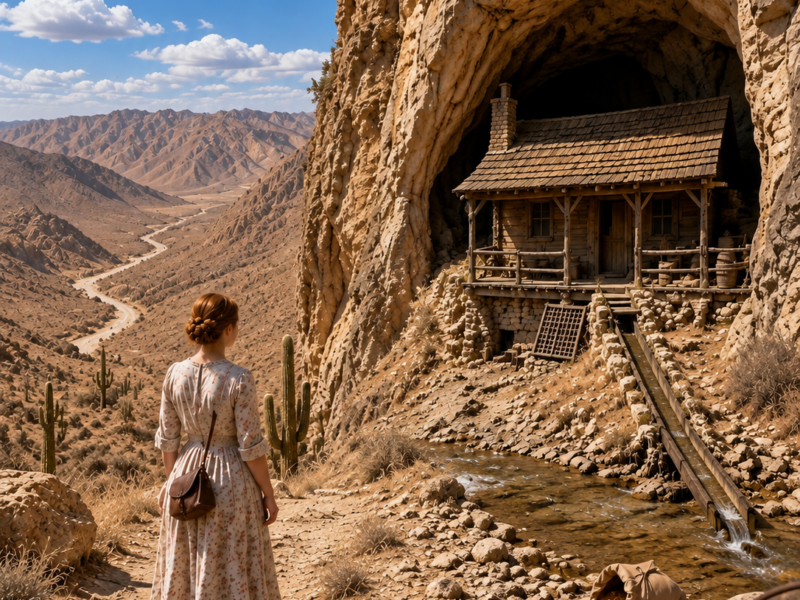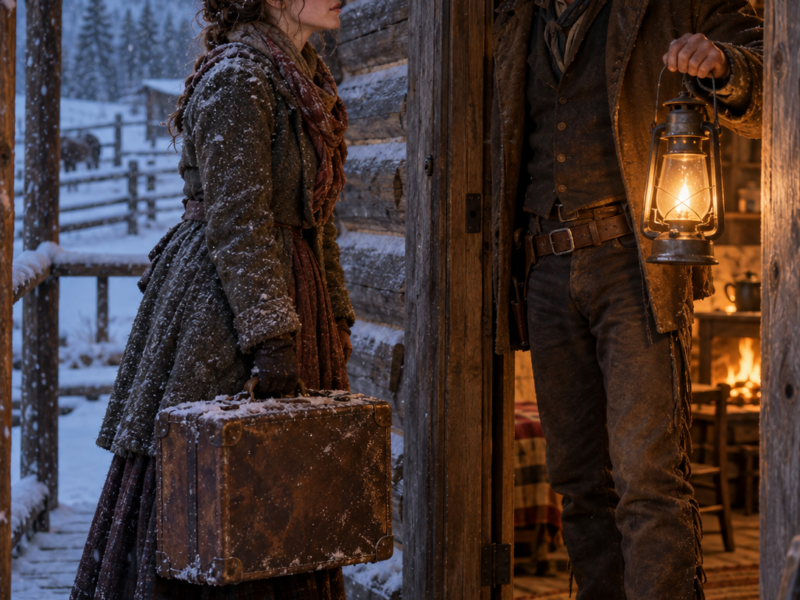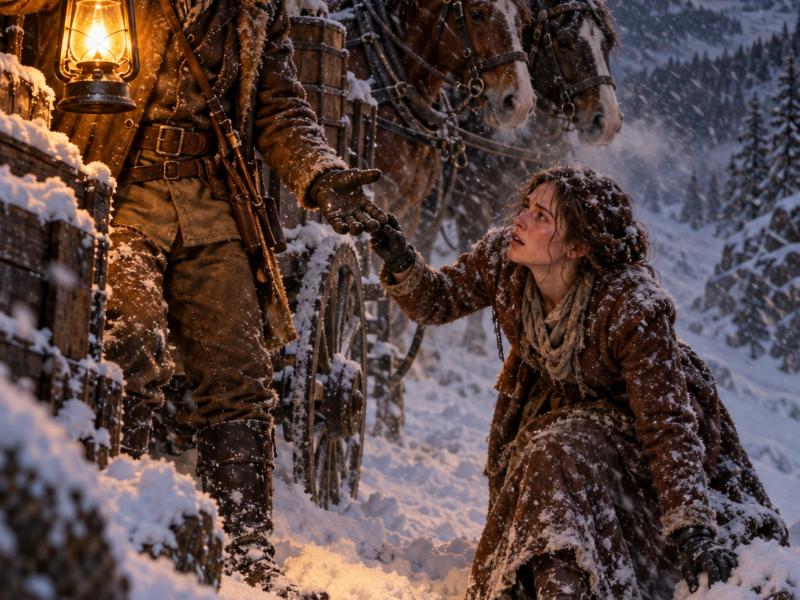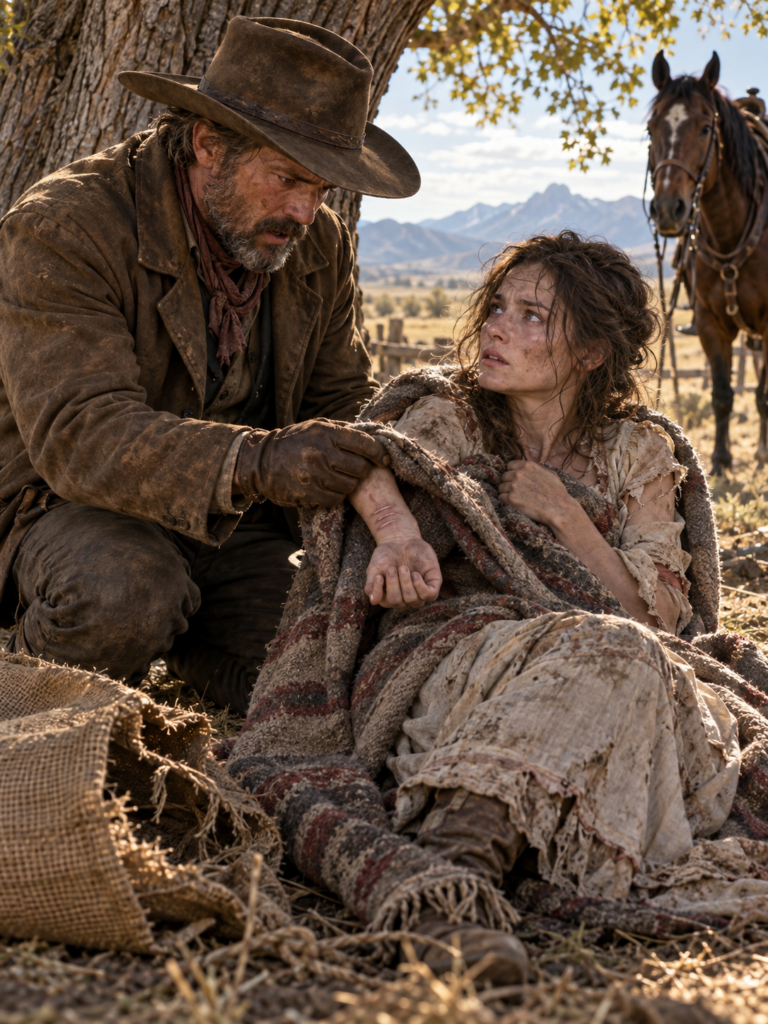
Clara thrust her marked wrist toward Ethan, her shaking fingers catching against his sleeve.
“Tell me,” she whispered. “Have you seen it?”
Ethan looked at the letters.
JKS.
He could have denied recognizing them.
He had spent years becoming skilled at avoiding uncomfortable truths.
But the woman before him had already endured too many lies.
“Yes,” he said.
Her face drained of color.
“Where?”
“In Bisbee. Three years ago.”
She withdrew her hand.
For a moment, he thought she might try to stand.
Instead, she pressed her back against the wall.
“Then you’re one of them.”
“No.”
“How can I know?”
“You can’t. Not yet.”
He moved away from the door, leaving the path clear.
“My rifle’s over there. I’m not going to touch it. You can keep the cutters.”
She looked from the weapon to his face.
“Why didn’t you tell me?”
“Because I was afraid you’d think exactly what you’re thinking now.”
Her lips trembled.
“Men who wear that mark don’t help women.”
“I don’t wear it.”
“But you know it.”
Ethan lowered himself into the chair across the room.
“I once heard a man boasting about it in a saloon. I knew his stories weren’t right. I should’ve told someone. Instead, I walked away.”
The woman stared at him.
“Why?”
He rubbed a hand across his face.
“Because I didn’t want trouble.”
The confession tasted bitter.
He looked directly at her.
“I’ve regretted that choice ever since.”
She turned away.
For a long while, the only sound came from the stove.
Then she picked up the cutters again.
“Hold the wire.”
Ethan approached slowly.
He steadied the rusted loop while she worked the tool into position.
The wire resisted.
Her injured fingers slipped.
“Would you like me to cut it?” he asked.
She hesitated, then handed him the cutters.
“Just the wire.”
“Just the wire.”
He cut through the metal and carefully lifted it away.
She gasped.
Fresh blood seeped from a shallow place where the rusted edge had pressed into her skin.
Ethan brought clean water and cloth.
“May I clean that?”
After a moment, she nodded.
He worked gently, keeping his movements visible.
When he finished, he placed a clean dressing around the wrist.
The three scarred letters remained visible above it.
She studied the bandage.
“You didn’t ask me what happened.”
“I figured you’d tell me when you’re ready.”
Her eyes lifted.
For the first time, he saw something other than terror in them.
Confusion.
Perhaps the beginning of relief.
“I don’t have money,” she said.
“You don’t need any.”
“I can’t work much like this.”
“Then rest.”
“And afterward?”
“We’ll decide what you want to do.”
She swallowed hard.
“Men don’t usually ask.”
Ethan glanced toward the two empty chairs beside the window.
“Then perhaps more of them ought to.”
The words seemed to unsettle her.
She looked down.
“There’s something you should know.”
He waited.
“They don’t leave marks like that unless they expect to find you again.”
A chill passed through him.
“How many men?”
Her jaw tightened.
“I don’t know how many belong to them. Three were close enough for me to recognize their voices.”
Ethan considered the southern fence.
The cottonwood.
The road leading west.
His ranch was isolated, but not hidden.
Anyone who had left her on his land might know exactly where she had been found.
“I can take you somewhere with more people,” he said. “Or you can remain here while we decide what to do.”
She looked toward the door.
“Town isn’t safe just because it has more houses.”
“Then we won’t assume it is.”
She studied his face.
“You’re not going to ask me to trust you?”
“No.”
“Why not?”
“Because trust is yours to give.”
Her expression crumpled.
She covered her face with her uninjured hand.
Ethan remained seated, allowing her to cry without approaching.
Afterward, he warmed more broth.
She drank it slowly.
Then, in a voice scarcely above a breath, she said, “I want to sleep where I can see the door.”
“All right.”
“And I don’t want anyone touching me while I’m asleep.”
“They won’t.”
He arranged her blankets beside the stove and placed fresh water within reach.
Then he returned to the table.
Outside, evening settled over the grassland.
The woman watched him for several minutes.
Finally, she spoke again.
“They called us numbers.”
Ethan looked up.
She touched the bandage.
“Before the letters. Before anything else, they took our names.”
Her voice faltered.
She seemed about to tell him more.
Then a horse whinnied in the yard.
Ethan rose and approached the window.
Three unfamiliar sets of hoofprints crossed the soft earth near the southern fence.
They had not been there that morning.
Someone had ridden close enough to study the house.
He turned back.
The woman was already struggling to stand.
“They found me,” she whispered.
Ethan moved toward the door, then stopped when she caught his sleeve.
“Don’t leave me here without telling me what you’re going to do.”
He looked into her terrified eyes.
“Then come to the window with me. We need to see where those tracks lead.”
She pushed herself upright, braced one hand against the table, and began moving toward the window beside him.
Clara reached the window and steadied herself against its wooden frame.
Ethan stood beside her, careful not to crowd her.
Beyond the glass, late sunlight stretched across the yard.
Three sets of hoofprints curved past the water trough, crossed the bare earth near the fence, and disappeared toward the western ridge.
“They were looking at the house,” she said.
Ethan nodded.
“Seems likely.”
Her hand tightened against the wood.
“They count the ways out.”
He turned toward her.
“How do you know?”
“Because they did it everywhere they kept us.”
The words were quiet.
But they changed everything.
Ethan had suspected that the riders were connected to her injuries.
Now she had confirmed something worse.
These men were accustomed to controlling places and people.
This was not an isolated act of cruelty.
It was a practiced method.
“Can you describe them?” he asked.
She shook her head.
“Not yet.”
“All right.”
He examined the tracks once more.
Then he said, “We should make a plan.”
She looked at him.
“Together?”
“Together.”
***
The next morning, Ethan walked the ranch boundary.
He carried his rifle, but he did not go searching for a fight.
He checked the fence, the creek crossing, and the trail that ran west toward the low ridge.
The tracks were clear enough to follow for a short distance.
Three horses.
One with a distinctive uneven shoe.
The riders had stopped near a shallow depression from which the house could be watched without standing openly on the road.
Ethan crouched and studied the ground.
Someone had remained there long enough to leave cigarette ends and flattened grass.
He straightened.
The ranch no longer felt like a place the world had forgotten.
Someone was watching it.
When he returned, the woman was sitting beside the stove.
She had eaten the breakfast he left.
Her color remained poor, but she was more alert.
“I found where they stopped,” he told her.
She looked toward the door.
“Are they coming back?”
“I don’t know.”
He did not pretend otherwise.
She studied him.
“Most men would say they could handle anything.”
“Most men have never been foolish enough to believe a good fence can stop every kind of trouble.”
Something near a smile touched her mouth.
It vanished quickly.
But Ethan saw it.
And he was glad.
***
Her recovery came slowly.
The injuries on her wrists required careful attention. Her back remained painful, and she tired after standing only a short time.
Ethan urged her to accept a doctor’s care.
At first, the suggestion frightened her.
But after he explained that a doctor could examine her without forcing her to recount everything to the town, she began considering it.
Meanwhile, he gave her a choice of sleeping places.
There was the space beside the stove, where she had spent her first nights.
Or the small room across the hall.
He opened its door and stood aside.
A narrow bed rested beneath the window.
The room smelled faintly of cedar.
A folded quilt lay at its foot.
“Was this your wife’s room?” she asked.
Ethan looked inside.
“She used it for sewing and keeping household things.”
“Where is she now?”
He was silent for a moment.
“Buried behind the barn. Five winters ago.”
The woman looked toward him.
“I’m sorry.”
He nodded.
“Thank you.”
He did not offer more explanation.
She did not demand it.
After examining the room, she said, “I’d like to sleep here. But I want the door to remain open.”
“Then leave it open.”
“And I want to be able to close it when I choose.”
“Of course.”
That evening, Ethan moved her bedding.
She stood beside the doorway, watching him.
When everything was arranged, he left without another word.
Later, as he passed the room, he noticed the door was halfway closed.
He did not touch it.
***
Several mornings afterward, Ethan found her outside.
She stood near the barn with her blanket around her shoulders, watching his old gelding.
The horse lowered his head toward her.
She hesitated.
Then she held out her hand.
The gelding sniffed her fingers.
“He’s gentle,” she said.
“Usually.”
“What’s his name?”
Ethan told her.
She smiled faintly and stroked the horse’s muzzle.
The sight stirred something inside him.
He had begun thinking of her as someone recovering from terrible injuries.
But there was much more to her than what had been done to her.
She noticed how the horse favored one side of his mouth while eating.
She recognized when the water trough needed cleaning.
And when Ethan offered her a soft brush, she carefully began grooming the gelding.
She worked slowly.
Her strength was limited.
But she remained until she had finished.
“Used to care for horses?” Ethan asked.
“No. My grandmother kept a little garden and a stubborn mule.”
He glanced at her.
“That sounds like an education.”
“It was.”
For the first time, she laughed.
The sound was small and unexpectedly warm.
Then she looked embarrassed.
Ethan merely smiled and returned to his work.
***
The change in their daily life was gradual.
The woman began sitting at the table for meals.
She helped sort the household provisions and noticed that several sacks of grain needed moving away from damp boards.
One afternoon, she found Ethan repairing a loose hinge on the barn.
She stood nearby holding a handful of nails.
“Do you need another?”
He looked down.
“Please.”
She handed him the proper size without being told.
He raised an eyebrow.
“Know a little about carpentering?”
“My grandmother could mend nearly anything. I watched.”
“Handy woman.”
“Stubborn woman.”
“That tends to be useful.”
She looked at him.
“Sometimes.”
They worked together until the hinge swung freely.
When Ethan finished, he stepped back.
“Well done.”
She studied the repaired door.
“I didn’t do much.”
“You noticed which nails would hold. That’s something.”
Her face softened.
For a woman who had been reduced to a number, the recognition of an ordinary skill carried unexpected weight.
***
That evening, while they sat beside the fire, she spoke of her grandmother again.
“She grew herbs behind her house,” she said.
Ethan looked up from his harness repair.
“What kind?”
“Mint. Sage. Thyme. Garlic near the fence.”
He considered the bare patch beside his shed.
“There’s ground enough here.”
She followed his glance.
“Could it grow anything?”
“With water and some tending.”
For a moment, she seemed to imagine it.
Then she drew back.
“I shouldn’t start something I might have to leave.”
Ethan set down his work.
“You don’t have to decide forever before you plant a seed.”
She studied him.
He added, “And if you leave, the garden can still be yours while you’re here.”
She looked toward the window.
“Maybe.”
***
The following day, Ethan prepared to ride into Silverton.
He intended to make inquiries about the unfamiliar riders and find out whether the authorities had heard anything about missing women.
When he told her, she became visibly frightened.
“Don’t tell everyone about me.”
“I won’t.”
“And don’t let them bring those men here.”
“I’ll be careful what I say.”
He hesitated.
“Would you like me to ask about a physician?”
She considered.
“Yes. But don’t tell him anything more than he needs to know.”
“All right.”
She followed him to the door.
“Will you come back before dark?”
“I mean to.”
He watched her fingers tighten around the blanket.
“I’ll tell you where I’m going, and if my plans change, I’ll do what I can to get word back.”
He showed her how to secure the door from inside and explained where the emergency firearm was kept.
He did not insist that she use it.
Instead, he asked whether she wanted to learn how to handle it.
She hesitated.
Then nodded.
“Yes.”
He gave her a careful introduction to its safe handling, emphasizing that avoiding danger was better than confronting armed men.
When they finished, she looked at him.
“You left me a way to defend myself.”
“I wanted you to have a choice.”
Her expression softened.
Ethan stepped onto the porch.
He was mounting when she spoke.
“Wait.”
He turned.
She stood in the doorway, both hands gripping the edge of the blanket.
“My name,” she said, “is Clara.”
Ethan removed his hat.
“Clara.”
She nodded.
“That’s what my grandmother called me.”
He looked at her steadily.
“Then Clara it is.”
And he rode toward Silverton carrying the first thing she had freely entrusted to him.
Her name.
***
Silverton was noisy after the stillness of the ranch.
Wagons rattled through the street.
A blacksmith hammered iron beside his forge.
Men gathered at the saloon, trading gossip over whiskey.
Ethan had little patience for drinking and less for idle conversation, but he knew people often said more than they intended when they believed nobody was listening.
He heard rumors of missing young women.
Two had disappeared from settlements farther west.
Another had last been seen traveling near a mining camp.
The accounts were incomplete.
None proved that the same men were responsible.
But the disappearances troubled him.
At the sheriff’s office, he asked about them.
Sheriff Leland listened with growing irritation.
“Rumors,” he said.
“Three women missing isn’t nothing.”
“Do you have witnesses?”
“Not yet.”
“Names?”
“Not all of them.”
Leland leaned back.
“Then what do you expect me to do?”
“Start asking questions.”
The sheriff’s expression hardened.
“I’m not sending men chasing shadows across the territory.”
Ethan looked at him.
“That’s what you call people who disappear?”
Leland did not answer.
Ethan left knowing he had accomplished little.
But he had learned something important.
The town was aware that women were missing.
Its sheriff had simply chosen not to pursue the matter without stronger evidence.
Ethan had once made a similar choice in Bisbee.
The recognition sickened him.
***
He returned to the ranch before sunset.
Clara was waiting beside the stove.
She looked up immediately.
“You came back.”
“I said I meant to.”
He removed his coat.
Then he told her what he had learned.
He did not conceal the sheriff’s indifference.
He did not exaggerate the evidence.
Clara listened until he finished.
“Men like that sheriff are why people disappear,” she said.
Ethan lowered his eyes.
“Sometimes.”
She looked at him.
“You know more than you’re saying.”
He nodded.
Then he told her about Bisbee.
About the drunken man displaying the letters JKS.
About the ugly boasts.
About the frightened voice from the alley.
And about his decision to leave rather than become involved.
Clara said nothing.
The fire popped softly.
At last, she asked, “Did you see who was in the alley?”
“No.”
“Did you know what they were doing?”
“Not clearly enough to prove it. But enough to know I should’ve tried to help.”
She studied him.
“Why didn’t you?”
Ethan took a long breath.
“My wife had died. I was angry with the world. I told myself another man’s troubles weren’t mine.”
He looked toward the window.
“That wasn’t an excuse. It was cowardice.”
Clara sat motionless.
Finally, she said, “You cannot change that night.”
“No.”
“But you can decide what kind of man you are now.”
He met her eyes.
“That’s what I’m trying to do.”
She held his gaze a moment longer.
Then she spoke quietly.
“I was taken with other women.”
Ethan remained still.
“They made us answer to numbers. Mine was twenty-five.”
Her voice trembled.
“When they branded us, they said names weren’t necessary anymore.”
She pulled back the blanket, exposing her scarred wrist.
“I escaped from a shack near the western cliffs. I worked a piece of broken glass against the wire around my hands until I could slip free.”
Ethan listened without interruption.
“I ran,” she continued. “But they caught me again before I reached the road.”
Her breath caught.
“They said they’d make an example of me.”
Ethan’s jaw tightened.
“They left me beneath that tree.”
Clara stared at the flames.
“I don’t know why they didn’t finish killing me.”
Ethan answered quietly.
“Whatever their reason, you survived.”
She looked toward him.
“Others are still there.”
The room seemed to grow colder.
He thought of the missing women.
The three horses near his fence.
The lonely shack Clara had described.
He could no longer pretend that helping one survivor would end the cruelty.
But he also understood that running toward armed men alone would only place more lives in danger.
“We’ll need the sheriff,” he said.
Clara shook her head.
“He won’t listen.”
“Then we’ll find something he cannot ignore.”
She studied him.
“What if those men come here first?”
Ethan looked toward the barred door.
“Then we make certain you’re not facing them alone.”
***
The next days passed under gathering tension.
Ethan found fresh tracks near the creek.
A small fire had recently burned in a sheltered depression west of the ranch.
Someone had left a scrap of blue cloth caught on a fence wire.
The signs did not prove exactly who was responsible.
But they established that unfamiliar riders were using the land close to his home.
He reinforced the door and repaired the weakest section of fence.
Clara insisted on understanding every precaution.
She would not be kept ignorant in the name of protection.
Together they discussed what she should do if strangers approached while Ethan was away.
They agreed on a phrase he would speak three times before she opened the door.
“Red earth,” he suggested.
She repeated it.
“Red earth.”
It was an ordinary phrase.
But between them, it meant that fear would not be allowed to make every decision.
Clara began practicing with the ranch’s firearm under his supervision.
She also continued caring for the gelding and helping with chores she could safely manage.
One afternoon, Ethan found her kneeling beside the shed, pressing garlic cloves into a patch of loosened soil.
He stopped.
“Decided on a garden?”
She looked up.
“Only a little one.”
He glanced at the ground.
“That’s a good beginning.”
She brushed dirt from her hands.
“I want to grow something that belongs to me.”
Ethan nodded.
“Then grow it.”
He did not call it his garden.
He did not claim she was planting for him.
He understood that the little patch represented something more important than vegetables.
It was proof that she could imagine a future.
***
One morning, Ethan prepared to ride west.
Clara watched him check his saddle.
“You’re going to the cliffs.”
He nodded.
“Only to look. I need to know whether the shack is where you remember it.”
Her expression tightened.
“What if they see you?”
“Then I come back.”
He paused.
“I’m not going in alone.”
She studied his face.
“Promise?”
“I promise not to make a fight of it.”
She stepped closer.
“I don’t want you to die trying to prove you’re brave.”
The words startled him.
Then he nodded.
“Neither do I.”
He rode out shortly after dawn.
The trail carried him through dry creek beds and low hills before rising toward the cliffs Clara had described.
He found the shack in the afternoon.
Smoke rose from its patched roof.
Horses stood beneath a rocky overhang.
And when Ethan dismounted behind a stand of scrub, he heard men’s voices.
He approached only close enough to see through a gap in the weathered boards.
Three men were inside.
A fourth figure sat huddled in the corner.
A young woman.
Ethan remained still.
He had found proof that Clara’s account was true.
And another captive was still alive.
He knew he should retreat and bring the sheriff.
But as he watched, one of the men grabbed the young woman by the arm.
She struggled.
The man raised his hand.
Ethan’s decision came in that instant.
He would not stand outside another door while someone suffered.
He moved toward the entrance.
And when the man inside lifted his hand again, Ethan drove his shoulder against the rotten door and burst into the shack.
The door struck the wall with a violent crash.
Three men turned toward Ethan.
The man nearest the captive woman staggered backward.
Ethan stood in the doorway with his rifle raised.
“Step away from her.”
Nobody moved.
Then one man reached toward his belt.
“Don’t,” Ethan said.
His voice was quiet.
That made the warning more frightening.
The man’s hand stopped.
Ethan had spent years avoiding unnecessary confrontation.
He was not proud of the rifle in his hands.
He was not eager to use it.
But he knew that the woman in the corner had no way to escape while those men controlled the room.
“Move to the far wall,” he ordered.
One man cursed.
Another tried to laugh.
Ethan did not answer either.
He kept his attention fixed on their hands.
The captive woman watched him with enormous, frightened eyes.
He could see that she was exhausted and injured.
A blanket lay near her feet.
“Miss,” he said, without turning his head, “there’s a coat hanging from my arm. You can take it if you want.”
She hesitated.
Then she reached for it.
Ethan stepped aside enough to leave a path toward the door.
“Can you walk?”
A faint nod.
“Then come this way.”
She moved slowly.
One of the men protested.
“You’ve no right to take her!”
Ethan looked at him.
“She’s a person. Not something you’ve bought.”
The man spat a curse.
But he stayed where he was.
Ethan helped the young woman outside.
His gelding waited among the scrub.
He assisted her into the saddle and mounted behind her.
Then he guided the horse down the path, keeping enough distance from the shack to avoid another confrontation.
A shout followed them.
Then a gunshot struck the rocks behind them.
Ethan urged the gelding onward.
He did not fire back.
Getting the woman away alive mattered more than settling a score.
***
Her name was Lena.
She told him after they had traveled far enough that the shack could no longer be seen.
Ethan repeated it gently.
“Lena.”
She nodded.
“Are there others?” he asked.
She looked back toward the cliffs.
“Not there today.”
“Do you know where they took them?”
“No.”
He did not question her further.
The sun was dropping toward the western hills.
The ride to Silverton would be long, and the injured woman needed rest.
Ethan considered taking her directly to his ranch.
But he knew Clara was still recovering and that bringing another endangered person to a home already being watched could expose them both.
He turned toward town instead.
When they reached Silverton, the street lamps were being lit.
Ethan rode straight to the sheriff’s office.
Sheriff Leland looked up in irritation as the door opened.
Then he saw Lena.
The irritation disappeared.
Ethan helped her into a chair.
“This is one of the women you’ve been hearing about.”
Leland stared.
Lena pulled Ethan’s coat tightly around her shoulders.
Ethan placed a small piece of damaged clothing he had collected near the shack on the desk.
“There’s a place west of the ridge where armed men are holding women,” he said. “She can tell you what happened if and when she’s able.”
The sheriff looked from the evidence to Lena.
For a moment, his face betrayed the shame he had avoided for months.
He called for his deputy.
Then he sent for a doctor and arranged for Lena to stay with Mrs. Finch, a boardinghouse keeper known for taking in travelers who needed assistance.
Lena looked frightened at the thought of leaving the office.
Ethan crouched beside her.
“Mrs. Finch can give you a bed and food. The doctor can examine your injuries.”
“Will you tell them not to ask everything at once?”
“Yes.”
He spoke to the deputy and made certain Lena understood where she was going.
Then he watched Mrs. Finch lead her toward the boardinghouse.
The young woman glanced back once.
Ethan tipped his hat.
No grand words were needed.
She was no longer trapped in the shack.
That mattered.
***
Back at the sheriff’s office, Leland spread a map across his desk.
Ethan described the shack, the horses, and the three men.
He explained what he had observed and what Lena had told him.
Leland listened carefully this time.
When Ethan finished, the sheriff was silent.
Then he said, “I should’ve acted sooner.”
Ethan looked at him.
“Yes.”
Leland accepted the answer.
He began organizing men to search the area and pursue the suspects.
There would be no easy justice.
The gang knew the country.
Some of its members might have fled already.
Others could be operating from different settlements.
But for the first time, someone with the authority to investigate had begun doing so.
Ethan remained long enough to make certain the arrangements were real.
Then he returned to his horse.
He had someone waiting at home.
***
The moon was high when he reached the ranch.
The house stood dark except for a lantern near the window.
Ethan dismounted.
Then he approached the porch.
“Red earth,” he called.
He waited.
“Red earth.”
A moment passed.
“Red earth.”
The bar moved behind the door.
Then Clara opened it.
She held the pistol low and safely pointed away from him.
Her face changed when she recognized his voice.
“You came back.”
Ethan removed his hat.
“I did.”
She looked at the dried dust on his coat.
“Did you find the shack?”
“Yes.”
Her eyes widened.
“And?”
“There was another woman.”
Clara’s hand tightened.
“Alive?”
“Alive.”
He stepped inside and told her about Lena.
About the confrontation.
About the sheriff finally agreeing to act.
Clara listened without interruption.
When he finished, she closed her eyes.
“Thank God.”
Ethan watched her carefully.
He had expected relief.
But he had not expected the quiet strength with which she received the news.
She sat beside the hearth, hands folded in her lap.
“Was her name Lena?”
He nodded.
Clara looked up sharply.
“I knew her.”
Ethan felt a cold weight settle in his stomach.
“From the shack?”
“From before. When they kept us together.”
Her voice trembled.
“She used to sing when she thought no one was listening.”
Ethan sat beside her.
“She’s safe in Silverton tonight.”
Clara pressed her hands against her face.
This time, her tears were not only grief.
There was relief in them.
And something like hope.
***
At dawn, Sheriff Leland rode toward the western cliffs with a small posse.
Ethan accompanied them to show the location.
The search revealed more evidence of the gang’s activities.
There were signs that women had been held at the shack.
The men responsible had tried to remove much of what might identify them.
But they had not removed everything.
The posse pursued the remaining suspects.
Some were captured.
Others escaped into the surrounding country.
Word spread through Silverton and nearby settlements.
People who had dismissed stories of missing women began speaking openly.
Families came forward.
Witnesses offered information.
The sheriff could no longer pretend that the disappearances were only rumors.
Yet the criminals were not finished.
The remaining gang members knew Ethan had helped expose them.
And they knew where he lived.
***
The first attack came near Silverton.
Riders appeared at the edge of town carrying torches.
They set fire to outbuildings and attempted to frighten residents into abandoning the investigation.
The town erupted in confusion.
Sheriff Leland organized his men, but the attackers moved quickly.
Ethan helped townspeople move toward safer buildings.
He saw smoke rising above the livery.
He heard shouting from the northern street.
Then he noticed several riders breaking away from the main group.
They headed toward the open country.
Toward the ranches.
Toward Clara.
His heart tightened.
He turned his gelding.
“Leland!” he shouted. “Some are heading north!”
The sheriff looked up.
“Go. We’ll hold the square.”
Ethan rode hard toward his land.
The familiar road seemed impossibly long.
He knew Clara understood the danger.
She had practiced securing the door.
She knew where the rifle and pistol were kept.
But knowledge did not make her invulnerable.
Neither did courage.
He urged the gelding onward.
By the time he reached the southern fence, smoke was already rising near the cottonwoods.
***
Clara had heard the warning before she saw the riders.
The tin cans Ethan had hung near the fence began rattling.
She moved to the window.
Three horsemen approached from the west.
One carried a burning torch.
Another had a rifle across his saddle.
Clara felt fear seize her chest.
For an instant, she was back in the shack.
The smell of smoke.
The scrape of boots.
The knowledge that men could decide to take everything from her.
Then she looked toward the small patch of earth beside the shed.
The garlic she had planted was beginning to show green shoots.
She had put those cloves into the ground herself.
She had chosen to remain long enough to see them grow.
She would not surrender that choice without resistance.
Clara secured the door.
Then she moved to the place from which she could watch the yard without exposing herself unnecessarily.
The first rider entered the clearing.
He called out.
“Come on out!”
Clara remained silent.
The horse moved closer.
The rider laughed.
“We know you’re in there.”
She took a slow breath.
She did not answer.
Then the man raised the torch toward the shed.
Clara moved away from the window.
She knew she could not defeat several armed men by herself.
But she could stay behind cover.
She could avoid opening the door.
She could wait for a chance to escape or signal for help.
She heard a gunshot outside.
Then a horse cried out.
Clara looked through the narrow gap beside the shutter.
Ethan had reached the clearing.
His gelding stood near the corral.
One attacker had fallen from his saddle.
The others were turning toward him.
The sight filled her with both relief and terror.
“Ethan,” she whispered.
He had come back.
But the danger was not over.
***
Gunfire broke across the yard.
Ethan sought cover near the cottonwood while the riders scattered.
One fired toward the porch.
A bullet struck the wooden post.
Clara dropped behind the interior wall.
She knew that opening the door now would place her directly in the line of fire.
So she waited.
Outside, Ethan shouted for the attackers to leave.
They answered with curses.
Then one rider dismounted and moved toward the house.
Clara heard his boots on the porch.
The door shook beneath a blow.
She backed away.
Another blow followed.
The heavy bar held.
The man cursed.
Clara gripped the pistol.
Her hands trembled, but she kept her eyes on the entrance.
The attacker tried the latch.
Then he called her name.
“Clara!”
She went cold.
He knew.
He had come specifically for her.
“Open up!”
She said nothing.
The man struck the door again.
Outside, another gunshot sounded.
The attacker turned toward the yard.
Clara heard running footsteps.
Then a struggle.
She moved cautiously toward the window.
Ethan had reached the porch.
He was fighting the man who had tried to break into the house.
Their bodies struck the railing.
The attacker drew a knife.
Clara saw the movement.
She shouted a warning.
“Ethan! His hand!”
Ethan twisted aside as the blade flashed.
The knife caught his sleeve.
He struck the attacker, forcing him backward.
The man stumbled down the steps.
Then another shot cracked across the clearing.
One of the remaining riders fell back toward the fence.
The others began retreating.
But the man at the porch continued fighting.
Ethan struggled with him across the dirt.
The attacker raised his knife again.
Clara moved to the open doorway.
She saw the letters on his forearm.
JKS.
The same mark burned into her own wrist.
For one dreadful instant, her body wanted to retreat.
To become small.
To disappear.
Then she remembered Lena.
The other women.
The days when nobody had answered their cries.
She lifted her voice.
“Leave him!”
The man looked up.
He recognized her.
His expression twisted.
“You should’ve stayed where we put you.”
Ethan forced the knife away.
The struggle ended in another violent burst of gunfire.
When the noise stopped, the attacker lay motionless in the yard.
Ethan remained on one knee, breathing hard.
Clara stood in the doorway.
The pistol was still in her hands.
For several seconds, neither moved.
Then Ethan looked up.
“Clara?”
“I’m here.”
He rose slowly.
Blood darkened the side of his shirt where a bullet had grazed him.
Clara saw it.
She hurried down the steps.
“You’re hurt.”
“Not badly.”
“Let me decide after I look.”
He almost smiled.
She reached him and steadied his arm.
The remaining riders had fled.
Smoke still rose from a small fire near the shed, but the main house remained standing.
Ethan looked toward the garden.
The narrow patch of earth was scorched along one edge.
Several garlic shoots had been crushed beneath a horse’s hoof.
Clara followed his gaze.
For a moment, grief crossed her face.
Then she looked back at him.
“The roots are still there.”
Ethan nodded.
“Yes.”
She took his hand.
“Then we can grow them again.”
***
Morning came with the smell of smoke and damp earth.
The worst of the fighting had ended.
Word reached the ranch that Silverton had survived the attack and that Sheriff Leland was pursuing the remaining riders.
The town had suffered damage.
Several buildings were burned.
But the residents had begun repairing what could be saved.
The violence had left wounds that would not disappear simply because the gunfire stopped.
Ethan knew that.
Clara knew it better.
They had both learned that the aftermath of cruelty could last much longer than the cruelty itself.
Clara cleaned Ethan’s injury and wrapped it with fresh cloth.
He sat on the porch step, allowing her to work.
When she finished, she looked up.
“You frightened me.”
“I frightened myself.”
She paused.
Then she smiled faintly.
“That may be the first sensible thing you’ve said all morning.”
Ethan chuckled.
She tied the dressing securely.
He reached for her hand.
“Thank you.”
“For what?”
“For staying.”
Clara looked toward the damaged garden.
“I stayed because I chose to.”
“I know.”
She held his gaze.
“And I’ll decide what comes next, too.”
Ethan nodded.
“Wouldn’t have it any other way.”
***
The weeks that followed were filled with difficult, ordinary work.
Ethan repaired damaged fencing.
Clara helped restore the garden.
They cleaned the soot from the shed and replaced broken boards.
When supplies became available, Ethan brought home seeds for mint, sage, and other herbs Clara remembered from her grandmother’s garden.
He also found sturdy boots that fit her properly.
She examined them with an expression he could not quite understand.
“What is it?” he asked.
Clara turned one boot in her hands.
“They took my shoes first.”
Ethan waited.
“Before anything else. They wanted me unable to walk far.”
She placed the boots on the floor.
Then she slipped her feet inside.
They fit.
She stood carefully.
Walked across the kitchen.
Then returned to the table.
Her eyes were wet.
“They’re mine?”
“Yours.”
She looked down again.
Ethan understood that the boots meant much more than warmth and protection.
They meant she could leave.
She could walk down the road.
She could choose where her own feet carried her.
And his giving them to her did not make him the owner of that choice.
That evening, Clara wore the boots while tending her garden.
Ethan watched from the porch.
She knelt beside the little patch of earth, breaking clods with her hands and settling seeds into the soil.
A quiet tune escaped her lips.
He had heard it before.
A song from her grandmother.
He did not interrupt.
***
As summer approached, Clara’s strength returned.
Her scars remained.
Some nights were still difficult.
There were sounds that startled her.
Unexpected footsteps.
A door closing too sharply.
The sudden report of a rifle in the distance.
But the fear no longer controlled every moment.
She learned to pause.
To recognize where she was.
To remind herself that the house was not the shack.
That Ethan was not one of the men who had hurt her.
And that she could leave a room or refuse a touch without being punished.
Ethan learned, too.
He stopped assuming that silence meant she was comfortable.
He asked before helping when he was uncertain.
And when she wanted to be alone, he respected it.
There were days when she seemed eager for his company.
Other days when she preferred the garden and the quiet company of the horse.
He accepted both.
He also began speaking more openly about his wife.
Her name had gone unspoken for so long that saying it felt strange at first.
Clara listened without jealousy.
She understood that grief did not vanish simply because a person began to care for someone else.
Ethan told her how his wife had loved the ranch.
How she had wanted flowers beside the porch.
How, after her death, he had allowed the garden bed to dry into hard earth.
Clara looked toward the old patch.
“Would you mind if I planted there?”
Ethan considered.
Then he shook his head.
“No.”
She touched his hand.
“She mattered.”
“She did.”
“And she still does.”
He looked away, blinking.
“Yes.”
Clara squeezed his fingers gently.
“Then perhaps something growing there would be a good way to remember her.”
Ethan nodded.
For the first time in five years, the thought of that place changing did not feel like a betrayal.
It felt like permission to live.
***
One afternoon, while Ethan repaired a corral rail, Clara stood brushing the gelding.
Sunlight lay across the yard.
The horse lowered his head contentedly.
Clara worked the brush along his neck, then looked toward Ethan.
“Can I ask you something?”
He set down his hammer.
“Of course.”
“Why did you stop beneath that cottonwood?”
He frowned slightly.
“Because I heard you breathing.”
“You could’ve ridden on.”
“Yes.”
“You could’ve told yourself you couldn’t help.”
He nodded.
“I could have.”
She looked down at the horse.
“But you didn’t.”
Ethan rested one hand against the rail.
For a moment, the old memory of Bisbee returned.
The saloon.
The frightened voice.
His own footsteps carrying him away.
He could not change that night.
But he had stopped beneath the cottonwood.
He had lowered the sack.
He had listened to a woman who believed death was the only mercy left.
And he had decided not to leave her.
“I knew what it was to have nobody come,” he said quietly.
Clara studied him.
“And I knew what it was to walk away when I should’ve stayed.”
She moved closer.
“Do you think rescuing me made up for that?”
Ethan shook his head.
“No.”
She seemed surprised by the answer.
“I can’t undo what I failed to do before,” he continued. “Helping you wasn’t payment for my conscience. You needed help. That was reason enough.”
Clara’s eyes softened.
He added, “And you never owed me anything for it.”
For a moment, she could not speak.
Then she reached for his hand.
“I know that now.”
He looked at her fingers resting against his.
“Do you?”
She nodded.
“Because you’ve let me choose.”
***
One evening, Clara moved her blanket closer to Ethan’s doorway.
Not because she was frightened.
Not because she could not bear to be alone.
She simply wanted to be near him.
He noticed the change.
“Would you rather have the chair?”
“No.”
“More firewood?”
“No.”
He waited.
Then she smiled.
“You could sit with me.”
So he did.
They talked for a long while.
About the ranch.
About Silverton.
About Lena, who was recovering under Mrs. Finch’s care.
About the women whose names were slowly being restored to the records that had once ignored them.
And about the garden.
Clara hoped the mint would spread.
Ethan hoped it would not overtake the porch.
She assured him it would grow wherever it pleased.
He said that sounded familiar.
She laughed so suddenly that both of them were startled.
It was full, unguarded laughter.
The kind Ethan had not heard in his home for years.
He began laughing, too.
And when their amusement faded, the quiet between them remained warm.
***
Their affection grew without a bargain.
Sometimes Clara sat beside him on the porch, their shoulders touching.
Sometimes she leaned her head briefly against his arm.
Sometimes they walked the fence together, discussing repairs or simply watching the evening light move across the grass.
Ethan began looking forward to her footsteps in the kitchen.
To the soft tune she hummed while tending herbs.
To the sight of two cups beside the stove.
He did not ask her to become his wife.
He did not assume that sharing a home required marriage.
She had spent too long having choices taken from her for him to place another expectation upon her future.
Clara understood his restraint.
And she valued it.
But she also knew that fear of making a demand could become another kind of silence.
One evening, as they sat beneath the darkening sky, she turned toward him.
“Ethan?”
“Yes?”
“Have you ever wondered what it would be like if I stayed?”
He looked at her.
“Every day.”
The answer startled them both.
Clara drew a slow breath.
“And does that frighten you?”
“Some.”
“Why?”
“Because I want you here.”
She waited.
“And I know wanting isn’t the same as having a right.”
Clara looked toward the garden.
Then she smiled.
“No. It isn’t.”
She took his hand.
“But I’m allowed to want things, too.”
He turned toward her.
“What do you want?”
For a moment, she watched the sun disappear behind the distant hills.
Then she answered.
“I want to wake up tomorrow and tend my garden.”
Ethan nodded.
“I’d like that.”
“I want to help with the horses.”
“All right.”
“I want to visit Silverton when I choose, and perhaps one day help other women who need somewhere safe.”
He listened.
“And I want to know that if I stay here, it will be because this is my home, not because I have nowhere else to go.”
Ethan squeezed her hand.
“Then that’s how it shall be.”
She looked into his eyes.
“And I want you beside me, Ethan.”
He was silent for a moment.
Not because he had no answer.
But because the answer mattered too much to rush.
“I’d be glad of that,” he said at last.
Clara leaned closer.
He waited until she rested her head against his shoulder.
Neither needed to say more.
***
By late summer, the garden beside the shed had become a small patchwork of green.
Mint spread along the damp edge.
Sage grew in neat rows.
The garlic stood upright and strong.
Clara tended each plant with careful attention.
The garden had begun as a few cloves pressed into uncertain ground.
Now it supplied herbs for the household and gave her a reason to look forward to every new season.
Ethan watched her sometimes from the porch.
He had once believed his house would never hold warmth again.
Now he could hear Clara singing through the open window.
The sound did not erase his grief.
It did not undo what had happened to her.
But it proved that a life could become more than the worst thing it had endured.
One evening, she emerged from the garden with dirt beneath her fingernails.
Ethan sat on the porch steps holding two cups of coffee.
She accepted one and sat beside him.
The air smelled of sage and warm earth.
Beyond the fence, cattle moved quietly through the tall grass.
For a long time, neither spoke.
Then Clara said, “Do you ever think about that morning?”
Ethan looked toward the southern cottonwood.
“Sometimes.”
“I do, too.”
He waited.
“I remember thinking I would never see another sunset.”
Her voice remained steady.
“And now?”
She looked toward the glowing horizon.
“Now I wonder what tomorrow will bring.”
Ethan smiled faintly.
“That’s a better question.”
She nodded.
Then she looked at him.
“Why did you come back for me, Ethan?”
He considered.
He could have spoken about guilt.
About Bisbee.
About the man he had once been.
But Clara was asking something simpler.
Why had he returned to the ranch when danger followed?
Why had he refused to abandon her after the first rescue?
He looked into her gray eyes.
“Because you mattered.”
Clara’s breath caught.
He continued quietly.
“You mattered before I knew your name. You matter now. That doesn’t depend on whether you stay.”
She looked down at her hands.
The scars were still there.
The letters on her wrist had faded somewhat, but they had not disappeared.
For a long time, those marks had represented what others believed they could take from her.
Now they were simply part of her history.
They could not decide her future.
She set down her cup.
Then she rose and walked into the garden.
Ethan watched as she bent beside the mint and pressed her fingers into the soil.
After a moment, she looked back.
“Come see.”
He joined her.
A new green shoot had emerged beside the oldest plant.
Small.
Unremarkable.
Alive.
Clara smiled.
“It survived.”
Ethan glanced at the shoot.
Then at her.
“Yes,” he said.
“It did.”
She rose, brushing dirt from her hands.
The evening wind moved softly through the cottonwoods.
She reached for his hand.
And together, they walked toward the house.
The porch boards creaked beneath their steps.
Two cups waited on the table.
The door stood open.
Clara paused at the threshold.
Once, she had feared every doorway because she never knew whether it would lead to another place where her choices disappeared.
Now she could walk through this one freely.
She could close it.
Open it.
Or leave.
And tonight, as she stepped inside, she knew she was choosing to remain.
Ethan followed.
He did not ask for a promise.
She did not offer one she could not honestly make.
But the next morning, when the sun rose over the ranch, there were two cups beside the stove again.
And when Clara opened the door, the garden waited for her.
The woman who had once begged for death beneath a cottonwood was no longer asking for an ending.
She was building a beginning.
And the lonely rancher who had once survived by turning away had finally learned to stand beside another person without taking away her freedom.
Their love did not arrive as a grand declaration.
It grew through care, work, patience, and choices freely made.
Like the little garden beside the shed, it took root slowly.
And each day they tended it together.