
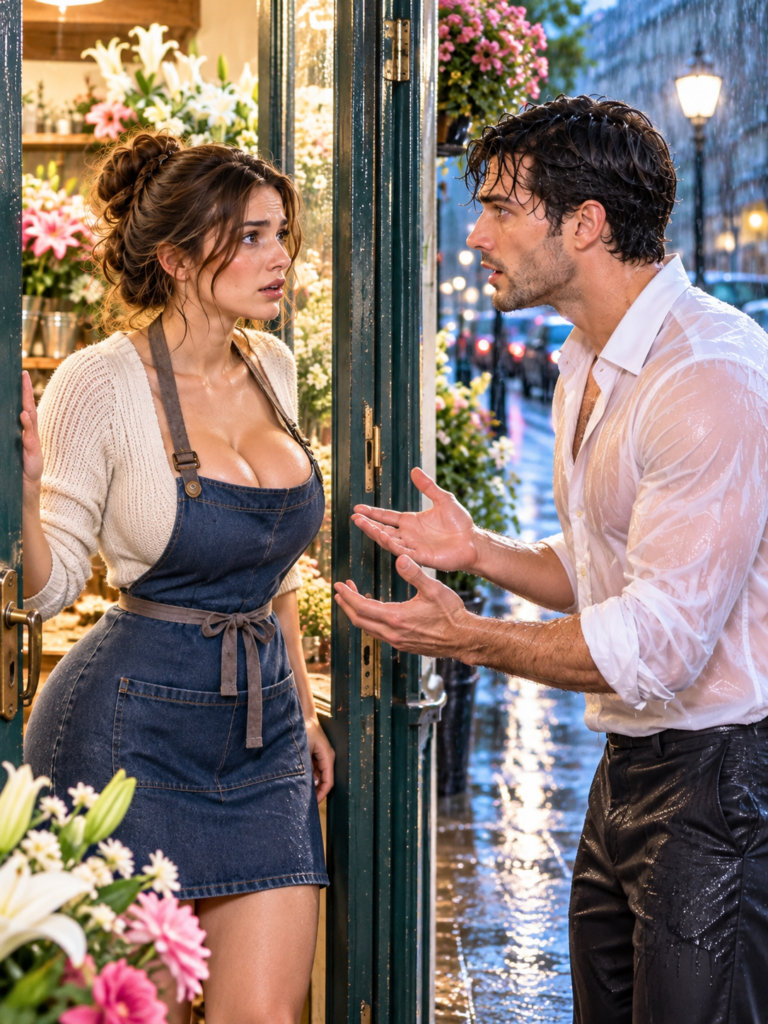
She Gave a Soaked Stranger the White Roses Meant for a Wedding Because He Said They Were for His Mother—Then Eleven Days Later She Saw His Name on the Company Evicting Her Entire Street…
Part 1
By nine forty-seven on Thursday night, Maya Brooks had already turned the sign on Ruth’s Flowers from OPEN to CLOSED.
The rain had been coming down for nearly three hours.
Not gentle rain.
Not the kind that made the city look romantic through restaurant windows.
This was the hard, sideways rain that flooded gutters, turned umbrellas inside out, and drove people from the sidewalks of Willow Street long before the shops normally closed.
Maya stood behind the counter with a calculator in one hand and a pencil between her teeth.
The number on the register tape had not changed simply because she had added it three times.
$417.62.
That was what she had available after tomorrow’s wholesale payment cleared.
Rent was two months behind.
The electricity bill had a red notice folded beneath the register.
And in six weeks Maya was supposed to sit for the state floral-design certification exam she had spent almost a year studying for.
The examination fee was $385.
She had been saving cash in an old tea tin behind the accounting books.
Not much.
But enough.
Almost.
“Maya?”
Her grandmother’s voice drifted from the back room.
“Yeah, Nana?”
“You lock the alley door?”
“Five minutes ago.”
“The cooler?”
“Checked it.”
“The wedding roses?”
Maya looked toward the walk-in refrigerator.
Sixty white roses stood in three tall buckets, their petals perfect and tightly layered.
“Safe.”
“Good. Bride’s mother already called twice.”
“Three times.”
Ruth Brooks emerged from the back carrying a cardigan over her shoulders despite the shop being warm.
At seventy-four, Ruth was small enough that customers regularly underestimated how quickly she could move when someone touched a flower arrangement incorrectly.
Her silver hair was pinned at the back of her head.
She looked at the rain beating against the front windows.
“That storm isn’t playing.”
“No.”
“You taking the bus?”
“Unless you’ve secretly bought me a helicopter.”
“Check the roof.”
Maya smiled.
Then the bell over the door rattled.
Both women looked toward it.
The door was locked.
Someone stood outside.
A man.
He lifted one hand and knocked against the glass.
Maya stared.
He was drenched.
Not damp.
Drenched.
Water ran from his dark hair onto a black coat that looked expensive even while soaked through.
His shirt was plastered against his chest.
One side of his collar had folded inward.
He knocked again.
Ruth frowned.
“We’re closed.”
Maya moved closer to the window.
The man said something through the glass.
She couldn’t hear.
“What?”
He pointed toward the door.
Maya hesitated.
“Maya.”
“I know.”
“Storm makes people foolish.”
“I know.”
She unlocked the door just enough to speak through the opening.
“We’re closed.”
The man stepped closer.
“I’m sorry.”
Rain blew beneath the awning behind him.
“I’m not asking you to sell me anything.”
Maya looked at him.
“What do you need?”
“Just two minutes somewhere dry.”
Ruth called from behind the counter.
“There’s a shelter on Fifth.”
The man glanced toward the street.
“Twelve blocks.”
“You know where it is.”
“I tried two restaurants and a coffee shop. Everyone’s closing.”
Maya looked at his hands.
No bags.
No umbrella.
No visible phone.
He looked less like a homeless man than someone who had lost a fight with the weather.
But that didn’t mean much.
People ended up outside for all kinds of reasons.
The man shivered.
Maya opened the door.
“Two minutes.”
Ruth sighed dramatically.
“Maya.”
“He can stand by the door.”
The stranger stepped inside.
Warm air hit him.
He closed his eyes briefly.
“Thank you.”
Maya locked the door again.
“Don’t thank me yet. Nana is watching you like she’s deciding whether the police need to be involved.”
Ruth folded her arms.
“I know three police officers by first name.”
The man nodded respectfully.
“That seems useful.”
Maya almost smiled.
He stood exactly where she had told him.
Near the door.
Water dripped from his coat onto the mat.
“I’m Daniel.”
“Maya.”
“Ruth,” her grandmother added.
Daniel glanced around the shop.
Even after closing, Ruth’s Flowers smelled alive.
Roses.
Eucalyptus.
Damp stems.
Earth.
The sweet perfume of lilies from the cooler.
Bundles of drying flowers hung upside down from a wire near the back wall.
Hundreds of old stems had been tied there over the years.
Daniel’s eyes lingered on them.
Then he noticed the white roses through the open cooler door.
His expression changed.
Maya saw it.
“Wedding order.”
Daniel looked away.
“Sorry.”
“For what?”
“For staring.”
Something in his voice made her study him.
“Do you like roses?”
He gave a small laugh that carried no humor.
“My mother did.”
Maya’s hand stopped on the register drawer.
Daniel looked back toward the white roses.
“She died a year ago today.”
The rain struck the windows.
Ruth’s expression softened slightly.
Daniel looked embarrassed.
“I shouldn’t have said that.”
“It’s fine.”
“I wasn’t planning to walk around telling strangers my life story.”
Maya leaned against the counter.
“What happened?”
“My car broke down.”
“In this?”
“Apparently it has excellent timing.”
“Phone?”
“Dead.”
“Also excellent timing.”
Daniel nodded.
“I was trying to get to the cemetery before they locked the gate.”
Maya glanced at the clock.
“It’s almost ten.”
“I know.”
“Cemetery’s closed.”
“I know.”
His voice changed on the second answer.
Maya looked at him.
Daniel stared at the white roses again.
“I just wanted flowers for her.”
“What did she love?”
He answered without hesitation.
“White roses.”
Maya didn’t think.
That was the problem.
She opened the cooler.
Ruth immediately straightened.
“Maya.”
Maya selected six stems from the wedding order.
“Not those.”
“I can replace them tomorrow morning.”
“The wedding is at eleven.”
“I’ll call the wholesaler when they open.”
“They open at seven.”
“I know.”
Daniel stepped forward.
“No.”
Maya looked at him.
“I can’t pay you tonight.”
“I didn’t ask.”
“I’ll come back.”
“You said your mother loved white roses.”
“Yes.”
Maya gathered the stems.
She wrapped them in brown paper.
“Then take them.”
Daniel stared at the bouquet.
“I told you, I can’t pay you.”
Maya tied a piece of twine around the paper.
“Flowers for customers cost money.”
She handed him the bouquet.
“Flowers for a mother cost nothing here.”
Daniel did not take them immediately.
His face changed in a way Maya couldn’t name.
Not gratitude exactly.
Something more painful.
Finally, he accepted the roses with both hands.
“Thank you.”
Maya shrugged because sincere gratitude made her uncomfortable.
“You still have the cemetery problem.”
“I can go tomorrow.”
“In soaked clothes?”
“I’ve made several questionable decisions tonight.”
“That’s obvious.”
Maya reached behind the counter and picked up the shop’s large black umbrella.
Ruth stared.
“Maya.”
“He’ll bring it back.”
“You don’t know him.”
Daniel looked at Ruth.
“I’ll bring it back.”
Ruth narrowed her eyes.
“When?”
“Tomorrow.”
“People always say tomorrow when they mean never.”
Daniel almost smiled.
“Then I’ll prove you wrong.”
Maya handed him the umbrella.
When he opened the door, cold rain swept into the shop.
Daniel turned back.
“Thank you, Maya.”
She lifted one shoulder.
“Bring the umbrella back sometime.”
“I will.”
He stepped into the storm.
Maya watched him disappear beneath the black umbrella.
Ruth came to stand beside her.
“You have exactly fifty-four wedding roses now.”
“I can count.”
“And a missing umbrella.”
“He’s bringing it back.”
Ruth made a sound.
“What?”
“That man isn’t poor.”
Maya laughed.
“He couldn’t pay for flowers.”
“That’s not what I said.”
“Nana, he looked like he’d been standing under a waterfall.”
“His coat cost more than your refrigerator.”
“You don’t know that.”
“I raised three children, ran a flower shop for forty years, and dated a jazz musician. I know things.”
Maya turned off the front lights.
“Well, whatever he is, tonight he needed roses.”
Ruth looked toward the door.
“Yes.”
Then quietly:
“He did.”
At 7:03 the next morning, Maya called the wholesaler.
At 7:05, she was told they had no more white roses.
At 7:07, she began panicking.
At 7:12, she called every florist within six miles.
By eight, she had found ivory peonies from a supplier on the west side.
Not white roses.
But close enough to save the bouquet design.
At 8:38, the bride’s mother arrived.
She was twenty-two minutes early.
Maya recognized her immediately.
Mrs. Harmon.
Camel coat.
Pearl earrings.
The kind of expression that suggested the world had repeatedly failed to meet her standards.
“I’m here for the roses.”
Maya forced a smile.
“There was a supply issue last night.”
Mrs. Harmon’s eyes narrowed.
“What kind of issue?”
Maya could have lied.
Truck delay.
Damaged shipment.
Cooler malfunction.
Instead, she said, “I used several stems.”
Mrs. Harmon stared.
“You used my daughter’s wedding flowers?”
“I replaced them with ivory peonies. No additional charge.”
“I did not order peonies.”
“They’re actually softer with the greenery you selected.”
“I didn’t order softer.”
Maya swallowed.
“I understand.”
“The ceremony is at eleven.”
“The arrangements will be ready.”
Mrs. Harmon looked toward the worktable where Maya had already started rebuilding the bouquets.
“I paid four hundred dollars in advance.”
“Yes.”
“I’d like it back.”
Maya went still.
“Mrs. Harmon—”
“Today.”
“I can refund the difference for the roses.”
“The entire amount.”
Maya looked at Ruth.
Her grandmother said nothing.
This was Maya’s decision.
Her mistake.
Her responsibility.
Maya opened the register.
The cash inside was not enough.
She went to the office.
Opened the cabinet.
Removed the tea tin.
Ruth appeared in the doorway.
“No.”
Maya kept counting.
“Maya.”
“It’s my mistake.”
“That is your exam money.”
“I know.”
“You have been saving six weeks.”
“I know.”
“You give that woman four hundred dollars and you start again.”
Maya stopped.
The money in her hands suddenly felt heavier.
Certification meant better supplier rates.
Wedding referrals.
Professional listings.
Possibly enough credibility to expand online.
Maya had delayed the exam twice already because something else always needed money.
The cooler compressor.
Ruth’s medical copay.
Rent.
Now Daniel’s roses.
“You could refuse,” Ruth said.
“She paid for sixty white roses.”
“She got a beautiful replacement.”
“It wasn’t what she ordered.”
Ruth watched her granddaughter.
“You regret giving them away?”
Maya thought of Daniel standing soaked beside the door.
His voice when he said his mother had died.
“No.”
“Then don’t make this about him.”
Maya looked down.
“It’s about me.”
“Yes.”
“I made a promise to a customer.”
“Yes.”
Maya gathered the cash.
“So I fix it.”
Mrs. Harmon left ten minutes later with her refund.
Maya finished the wedding arrangements anyway.
At 10:42, the bride herself arrived.
She looked at the ivory peonies.
“They’re beautiful.”
Maya smiled weakly.
“Your mother asked for the refund.”
The bride closed her eyes.
“Of course she did.”
“I’m sorry.”
“No.”
The bride touched one bouquet.
“These are beautiful.”
She left Maya fifty dollars cash.
Maya tried to refuse it.
The bride insisted.
By noon, forty-two dollars remained in the tea tin.
At 1:15, the landlord called.
Maya stared at the phone.
Ruth looked at her.
“Answer.”
Maya did.
“Hello?”
“Ms. Brooks.”
Mr. Kelman sounded tired rather than angry.
That was worse.
“I’m calling about the rent.”
“I know.”
“Two months, Maya.”
“I know.”
“I’ve carried the balance because Ruth has been here longer than I’ve owned the building.”
“I appreciate that.”
“But I can’t keep doing it.”
Maya closed her eyes.
“I can make a partial payment Friday.”
“How much?”
She looked toward the register.
“Three hundred.”
There was a pause.
“That doesn’t cover one month.”
“I know.”
“Maya…”
“I’m working on it.”
“I need something more concrete.”
“I’ll have it.”
She heard how desperate she sounded.
Mr. Kelman softened.
“I’m not trying to hurt you.”
“I know.”
“But business is business.”
After the call, Maya placed the phone face down.
Ruth was arranging carnations.
Neither spoke for a while.
Finally Maya said, “Maybe Mrs. Harmon was right.”
Ruth snorted.
“About what?”
“Maybe I’m not built for this.”
Ruth stopped working.
Maya continued.
“Grandpa could sell anything.”
“He could not.”
“You always say—”
“Your grandfather opened this shop with eleven dollars and one bucket of daisies.”
“I know.”
“The first winter, we sold almost nothing.”
Maya looked at her.
“He still gave flowers away.”
Ruth smiled faintly.
“Sounds familiar.”
Maya sat on the stool.
“Did it ever get easier?”
Ruth thought about it.
“No.”
Maya laughed bitterly.
“Great.”
“It got worth it.”
Ruth walked over.
She touched Maya’s cheek.
“Kindness always costs something, baby.”
Maya looked at her.
“That’s how you know it’s real.”
Before Maya could answer, the bell over the door rang.
Both women turned.
Daniel stood there.
Dry this time.
The umbrella rested beneath one arm.
White-rose paper was folded carefully in his hand.
“I promised I’d bring it back.”
Maya stared.
“You actually did.”
Ruth muttered, “Miracles happen.”
Daniel set the umbrella beside the door.
Then he held out an envelope.
“For the roses.”
Maya shook her head.
“I told you.”
“Maya.”
“No.”
“I can pay you now.”
“Flowers for a mother cost nothing.”
Daniel looked at her for a moment.
Then he lowered the envelope.
“You look like you’ve had a hard day.”
“Every florist has hard days.”
“I mean it.”
Maya turned away.
Daniel saw the ivory peonies scattered across the worktable.
The opened tea tin.
The receipt beside it.
His expression sharpened.
“Was that because of me?”
“No.”
“Maya.”
“She wanted roses. I gave away roses. That’s a business problem, not your problem.”
Daniel glanced at Ruth.
Ruth said, “It was because of you.”
“Nana.”
“What? You told the truth to the customer. I tell the truth to everybody.”
Daniel looked stricken.
“How much?”
“No.”
“How much did you lose?”
“That is exactly the conversation we are not having.”
Daniel took out his wallet.
Maya’s eyes narrowed.
“If you pull out money, I will throw you back into the rain myself.”
“It’s sunny.”
“I will find water.”
Ruth laughed.
Daniel slowly put his wallet away.
“Then let me work it off.”
Maya stared.
“What?”
“I caused a problem.”
“You did not.”
“I accepted the flowers.”
“Which I gave you.”
“Then let me help.”
“With what?”
Daniel looked around.
“Anything.”
Maya pointed at the floor.
“You know how to sweep?”
Daniel glanced toward a broom.
“How hard can it be?”
Ruth muttered, “Those are famous last words.”
Ten minutes later, Daniel was sweeping badly.
Very badly.
“You’re moving the dirt around,” Maya told him.
“That is what sweeping is.”
“No. Sweeping involves eventually collecting the dirt.”
“I’m creating zones.”
“You’re creating more work.”
Daniel leaned on the broom.
“I manage people for a living.”
Maya looked at his hands.
Clean nails.
No calluses.
Expensive watch.
Ruth had been right.
“These hands have never worked a day.”
Daniel looked offended.
“They are working now.”
Maya laughed.
For the next two hours, Daniel stayed.
He carried buckets.
Stripped leaves from stems.
Moved boxes from storage.
Nearly ruined a bundle of eucalyptus.
Asked why some flowers hung upside down from the wire along the back wall.
“To dry them.”
“Why keep wilted flowers?”
Maya looked up at the ceiling.
“Because somebody gave them for a reason.”
Daniel studied the bundles.
There were anniversary roses.
Funeral carnations.
A tiny dried daisy chain from a child who had once spent her allowance there.
Maya picked up one white rose.
“Your turn.”
“My turn?”
She handed it to him.
“From last night.”
Daniel looked at the rose.
“You kept one?”
“You left one on the counter when you wrapped the bouquet.”
He took it carefully.
“It was for her.”
“Your mother?”
He nodded.
Maya gestured toward the wire.
“Then we dry it.”
Daniel stared.
“It lasts?”
“If we do it right.”
“How long?”
“About two weeks.”
“And then?”
“Then it lasts for years.”
His eyes stayed on the rose.
Maya noticed his fingers tighten slightly around the stem.
“She bought white roses every Sunday,” he said.
Maya looked at him.
“My mother.”
Daniel swallowed.
“She would walk to a little flower shop alone.”
Something in Ruth’s expression changed.
Daniel didn’t notice.
“She used to say every house needs something alive.”
Maya smiled faintly.
“That sounds like a florist.”
Daniel looked down.
“I never went with her.”
“Why not?”
“I was always busy.”
“With what?”
“Work.”
He laughed once.
“Things I thought mattered.”
Maya took the rose.
She removed the lower leaves.
“Tie it tightly.”
Daniel watched.
“Why?”
“The stem shrinks while it dries.”
She handed him twine.
“If it’s loose now, it falls later.”
Daniel tied the knot.
Too loose.
Maya shook her head.
“Tighter.”
“I’m going to break it.”
“White roses bruise easily. That doesn’t mean you handle them so gently they fall apart.”
Ruth, behind them, whispered almost to herself:
“You have somebody’s eyes.”
Daniel glanced over.
“What?”
Ruth shook her head.
“Nothing.”
Daniel returned the next afternoon.
And the afternoon after that.
He always claimed he had “an hour.”
He usually stayed three.
Maya never completely understood what he did for work.
“Corporate strategy,” he said once.
“That sounds invented.”
“It often feels invented.”
“For who?”
“A family company.”
“What kind?”
“Real estate. Investment.”
“Rich people?”
Daniel looked at her.
“Mostly.”
Maya laughed.
“Do you like it?”
Daniel hesitated.
“No one ever asks me that.”
“I just did.”
He looked around Ruth’s Flowers.
“I’m not sure.”
“That’s not an answer.”
“It’s the best one I have.”
The third evening, he helped Maya prepare arrangements for a funeral.
The fourth, he learned to wrap bouquets without crushing them.
The fifth, he brought coffee for Ruth.
“Trying to buy my approval?” she asked.
“Yes.”
“Good answer.”
He brought Maya tea.
She stared at the cup.
“I drink coffee.”
“You complain about coffee.”
“I complain about bad coffee.”
“You also said caffeine makes your eye twitch.”
Maya narrowed her eyes.
“You remember too much.”
Daniel smiled.
“So do you.”
The white rose continued drying above the worktable.
Every evening, Daniel checked it.
Every evening, Maya told him not to touch it.
Something else was changing too.
Maya began checking the clock around four.
Not because of closing.
Because Daniel usually arrived around four fifteen.
She noticed the way he rolled up his sleeves before working.
The way he always asked Ruth whether she needed anything lifted.
The way he never checked his phone because, strangely, he never seemed to have one with him.
Once, a black car stopped across the street.
A man in a suit stepped out.
Daniel immediately walked outside.
They argued quietly.
Maya saw the man hand him a phone.
Daniel refused it.
The car eventually left.
“What was that?” Maya asked when he returned.
“Work.”
“Your office sends cars to collect you?”
“Sometimes.”
Maya stared.
“What exactly do you do?”
Daniel picked up a bucket.
“Apparently, floral logistics.”
She threw a ribbon spool at him.
He caught it.
Ruth watched both of them.
Then looked up at the white rose.
And smiled.
Part 2
The letter arrived at 5:43 on Tuesday evening.
Certified.
Same-day delivery.
Maya signed for it while Daniel was in the back room repairing a crooked storage shelf he insisted had been “structurally insulting.”
The courier handed her the envelope.
Ashford Holdings.
Maya frowned.
She had heard the name.
Everyone in Chicago had.
Hotels.
Office towers.
Luxury developments.
Commercial property.
She opened the envelope.
Read the first line.
Then read it again.
NOTICE TO VACATE.
The property known as 118–140 Willow Street had been sold.
All existing commercial leases would terminate under redevelopment provisions.
Tenants had fourteen days to vacate.
Maya’s fingers went numb.
Ruth came around the counter.
“What is it?”
Maya handed her the letter.
Ruth read silently.
Then sat down.
Daniel stepped from the back.
“Maya?”
Neither woman answered.
He saw the paper.
“What happened?”
Maya looked at him.
“They sold the street.”
“What?”
“The whole block.”
She pointed toward the front window.
“Us. Bellamy Bakery. Mr. Chen’s tailor shop. The shoe repair place. Everything.”
Daniel went still.
“Who?”
Maya looked down.
“Ashford Holdings.”
Daniel’s face emptied.
Ruth noticed.
Maya did not.
She was already looking outside.
Bellamy Bakery had been there thirty-two years.
Chen Tailoring for twenty-seven.
Ruth’s Flowers for forty.
The old bookstore next door had survived three recessions and two owners.
“Fourteen days,” Maya whispered.
Ruth corrected her.
“Thirteen after today.”
Maya laughed once.
The sound broke halfway through.
“Daniel’s rose won’t even be dry.”
He looked toward the wire.
The white rose hung above them.
Not ready.
“Let me see the letter,” Daniel said.
Maya handed it over.
He read it.
His jaw tightened.
“This shouldn’t have happened like this.”
Maya looked at him.
“What does that mean?”
“Nothing.”
Daniel folded the letter.
“I have to go.”
Maya blinked.
“Now?”
“Yes.”
“You just got here.”
“I know.”
“Daniel?”
He looked at her.
Something in his face made her nervous.
“I’ll explain.”
“When?”
“Soon.”
“That’s not an answer.”
He moved toward the door.
“I’m sorry.”
Maya watched him leave.
No umbrella.
No joke.
No promise to return tomorrow.
Across the street, the black sedan appeared almost immediately.
Daniel got inside.
Maya stared through the rain-specked window.
Ruth stepped beside her.
“That car again.”
Maya said nothing.
Inside the sedan, Daniel grabbed the phone waiting on the seat.
“Call my father.”
His assistant, Thomas Reeves, looked at him.
“Sir—”
“Call him.”
Thomas made the call.
Daniel did not wait for a greeting.
“Dad.”
A pause.
“We need to talk about Willow Street.”
His father’s voice came through sharply.
“Where have you been?”
“That isn’t what I asked.”
“The board has been waiting for you all week.”
“You bought Willow Street.”
“Ashford Holdings bought Willow Street.”
“You knew.”
“Of course I knew.”
Daniel looked back through the car window.
Ruth’s Flowers disappeared behind them.
“You didn’t tell me.”
“You weren’t available.”
“What are you building?”
“Mixed-use retail. Residential units above.”
“Luxury?”
“Market rate.”
“That means luxury.”
His father sighed.
“Daniel, it is an aging commercial block producing below-market rent.”
“It is eleven businesses.”
“It is property.”
Daniel’s hand tightened around the phone.
“Mom bought her roses there.”
Silence.
“What?”
“Every Sunday.”
His father said nothing.
Daniel looked toward the city.
“I found the shop.”
His voice changed.
“She went there for twenty years.”
His father finally said, “Come to the office.”
“I want every lease.”
“What?”
“Forty years of them.”
“Daniel—”
“Every tenant. Every renewal. Every rent increase. Every late payment. Every maintenance report. Everything.”
His father’s voice hardened.
“The board votes Friday.”
“Good.”
“On what?”
“The redevelopment.”
Daniel looked at Thomas.
“Then I have three days.”
He ended the call.
Thomas stared.
“What are you planning?”
Daniel watched Willow Street disappear behind them.
“I don’t know yet.”
At Ruth’s Flowers, Maya made six phone calls.
Ashford Holdings answered none.
The number on the notice led to a recorded menu.
Press one for leasing.
Press two for redevelopment.
Press three for tenant services.
Tenant services sent her to voicemail.
She left a message.
Then another.
The next morning she called again.
Nothing.
Daniel did not appear.
By afternoon, Maya was angry.
By evening, she was hurt.
Ruth watched her pack empty vases into cardboard boxes.
“Leave those.”
“We have twelve days.”
“Leave them.”
“Nana.”
“You’re packing too early.”
“We got a legal notice.”
“You got paper.”
“Paper signed by a corporation worth billions.”
Ruth pointed toward the dried flowers on the wall.
“Your grandfather planted this place like a seed.”
Maya closed her eyes.
“Nana.”
“He watered it with everything we had.”
“I know.”
“You do not dig up a seed because somebody tells you winter is coming.”
Maya looked at her.
“It isn’t winter.”
“You know what I mean.”
Maya sank onto a box.
“I called them six times.”
“Call again.”
“They don’t take calls from florists.”
“Then stop calling.”
“What do you want me to do?”
Ruth pointed downtown through the window.
“Their office.”
Maya laughed.
“You want me to walk into Ashford Tower?”
“Yes.”
“They won’t let me past the lobby.”
“Make them say no to your face.”
Maya stared at her.
Ruth looked toward Maya’s apron.
“And keep that on.”
“To a corporate office?”
“Let them see who they’re evicting.”
Maya looked down at the green apron dusted with petals and bits of stem.
Ruth picked up a small bouquet of daisies.
“Never walk in empty-handed.”
“Grandpa’s rule?”
“Mine.”
Maya took the bouquet.
The next morning, she rode the train downtown.
Ashford Tower rose fifty-three floors above the river.
Glass.
Steel.
Cold blue windows reflecting the clouds.
Maya stood across the street wearing her green flower-shop apron beneath her coat.
She nearly turned around.
Then she remembered the notice.
Eleven days.
She entered.
The security desk looked like a hotel reception.
A guard glanced at the flowers.
“Delivery entrance is around back.”
“I’m not delivering.”
“Do you have an appointment?”
“No.”
“Who are you here to see?”
“The person who bought Willow Street.”
The guard blinked.
“Which department?”
“The one evicting everybody.”
A receptionist looked up.
Maya placed the notice on the desk.
“I have eleven days.”
The receptionist’s expression softened.
“Ms. Brooks, I’m sorry. Without an appointment—”
“I’ve called six times.”
“I understand.”
“No one called back.”
“I can send another message.”
“I’m staying.”
The receptionist lowered her voice.
“Security may ask you to leave.”
“Then security can ask.”
Maya sat in a chair beneath a giant abstract painting.
She waited.
Thirty minutes.
Then forty-five.
Executives crossed the lobby carrying leather bags.
Assistants hurried between elevators.
Nobody looked at her for more than a second.
Maya checked her phone.
A message from Ruth:
ANY LUCK?
Maya replied:
Not yet. Still here.
At 9:17, several men stepped through the front doors.
One security guard immediately straightened.
“Good morning, Mr. Ashford.”
Maya looked up.
A man in a charcoal overcoat crossed the lobby.
Thomas Reeves walked beside him.
Behind them were two attorneys.
Maya stood.
“Mr. Ashford?”
The man kept moving.
“Mr. Ashford, please.”
Then another person entered behind the group.
Maya froze.
Daniel.
He wore a navy suit.
Not the rumpled shirt he wore while stripping rose leaves.
Not the borrowed apron Ruth had made him wear when arranging funeral flowers.
A suit tailored perfectly to his body.
An assistant handed him a tablet.
A security officer said:
“Good morning, Mr. Ashford.”
Maya stopped breathing.
Daniel saw her.
He stopped so suddenly Thomas nearly walked into him.
“Maya.”
She stared.
“Ashford.”
The flowers in her hand trembled.
“Like the letter.”
Daniel stepped toward her.
“Let me explain.”
“You let me cry about my shop.”
“Maya—”
“To the man whose company owns it.”
“I didn’t know when I first met you.”
“But you knew later.”
Daniel said nothing.
That was answer enough.
Maya’s eyes burned.
“How long?”
“Since the notice arrived.”
“You disappeared.”
“I was trying to stop it.”
“You could have told me.”
“I wanted something concrete first.”
Maya laughed.
It sounded terrible.
“Of course.”
“Maya.”
“I thought you didn’t have money for roses.”
“My wallet was in the car that night. My phone was dead. The driver couldn’t find me in the storm.”
“So you’re what?”
Daniel looked at her.
“Daniel Ashford.”
The name meant everything now.
The founder’s son.
Board member.
Heir to one of the largest private property companies in the region.
Maya stepped back.
“Nana knew.”
Daniel frowned.
“What?”
“She said your hands had never worked.”
Despite everything, Daniel almost smiled.
Maya did not.
“You let me worry about four hundred dollars.”
“I tried to repay you.”
“You let me tell you about rent.”
“I didn’t know how bad it was at first.”
“You swept my floor.”
“I wanted to.”
“You kept coming back.”
“I wanted to.”
That stopped her.
Daniel lowered his voice.
“That part was real.”
Maya looked away.
“You should have trusted me with the truth.”
“You’re right.”
“I don’t need you agreeing with me.”
“I know.”
“I need eleven businesses not to disappear.”
Daniel looked toward the elevators.
“My father is upstairs.”
“And?”
“The board meeting starts in ten minutes.”
Maya lifted the daisies Ruth had given her.
“Nana told me never to walk in empty-handed.”
Daniel looked at them.
Then back at her.
“Come with me.”
Security stepped forward.
“Mr. Ashford—”
“She’s with me.”
Maya shook her head.
“No.”
Daniel stopped.
“I’m not going upstairs as your guest.”
“What do you want?”
“To be heard as a tenant.”
Daniel nodded.
“Then you will be.”
The boardroom was larger than Ruth’s entire shop.
Maya sat outside while Daniel went in.
She could hear nothing through the doors.
Inside, his father, Charles Ashford, sat at the head of a polished table.
“Flowers, Daniel?”
Daniel set Maya’s daisies beside his files.
“You asked for numbers.”
“I did.”
“You’ll get both.”
The screen behind him lit up.
Willow Street.
Eleven storefronts.
Average tenant tenure: twenty-three years.
Vacancy rate: 0%.
Delinquency rate: low despite below-market rents.
Pedestrian traffic: increasing.
Tourism footfall: rising.
The board members shifted.
Daniel continued.
“The proposed redevelopment produces a projected nine percent annualized return after stabilization.”
His father nodded.
“You’ve finally read the proposal.”
“I read every lease too.”
Charles looked impatient.
“Your point?”
“We’re destroying profitable businesses to build retail space we then have to spend millions trying to fill.”
A board member frowned.
“The rents are below market.”
“Yes.”
Daniel changed slides.
“Because the buildings require capital improvements the company has deferred for eighteen years.”
Charles’s expression changed.
Daniel continued.
“Roofing. Electrical. Accessibility. Plumbing. Facades.”
He looked around the table.
“We created part of the underperformance we’re using to justify demolition.”
Silence.
One board member leaned forward.
“What are you proposing?”
“A preservation redevelopment.”
Charles laughed once.
“Meaning?”
“Renovate the block.”
“Lower return.”
“Lower construction risk.”
Daniel switched slides.
“Keep existing tenants under phased leases. Renovate unused upper floors into moderate-income apartments. Add two new retail units in the vacant warehouse space.”
A board member studied the numbers.
“What does that return?”
“Seven-point-eight percent projected.”
Charles leaned back.
“Below the redevelopment.”
“Yes.”
“Then the discussion is over.”
“No.”
Daniel looked at him.
“Because the nine percent assumes full occupancy within eighteen months.”
Charles said nothing.
Daniel displayed another graph.
“Comparable developments are averaging thirty-two months.”
Several board members began reading.
“With current financing costs, the preservation plan outperforms the redevelopment if stabilization takes longer than twenty-four months.”
His father’s jaw tightened.
“You did all this in two days?”
“Three.”
“Why?”
Daniel looked at the daisies.
Then at the white rose he had brought in a small protective box.
“Because someone gave me flowers when I could not pay.”
Charles stared at him.
Daniel continued.
“And because Mom bought white roses on Willow Street every Sunday for twenty years.”
His father’s expression emptied.
“What?”
“She walked there.”
Daniel’s voice softened.
“You waited in the car.”
Charles looked away.
Daniel remembered childhood Sundays.
His mother returning with white roses wrapped in brown paper.
One separate stem always tucked beneath her arm.
He had never asked why.
“I found her florist.”
Charles said nothing.
Daniel stepped closer.
“You called Willow Street an asset.”
His father looked at him.
“To Mom, it was part of her life.”
Charles rubbed his thumb against the edge of the table.
“You are asking this board to change a forty-million-dollar plan because your mother bought flowers.”
“No.”
Daniel shook his head.
“I am giving the board a financially viable alternative.”
He looked toward the documents.
“The flowers are only why I bothered looking.”
The vote took twenty-six minutes.
Maya spent every one of them sitting outside.
At one point, Thomas brought her coffee.
She didn’t touch it.
Finally, the doors opened.
Board members began leaving.
Nobody spoke to her.
Daniel emerged last.
His father remained inside.
Maya stood.
“Well?”
Daniel looked exhausted.
“The demolition is suspended.”
Maya inhaled.
“And the eviction notices?”
“Withdrawn.”
Her knees nearly gave way.
She caught the back of the chair.
Daniel moved forward.
Maya lifted one hand.
He stopped.
“All of them?”
“All eleven.”
Maya closed her eyes.
Bellamy Bakery.
Mr. Chen.
The bookstore.
Ruth.
She breathed.
“What happens now?”
Daniel looked toward the boardroom.
“The company reviews the preservation plan.”
“So it isn’t over.”
“No.”
Maya opened her eyes.
“Thank you for telling me the truth this time.”
Then she picked up the daisies.
Daniel looked at her.
“Maya.”
She stopped.
“I meant what I said downstairs.”
“Which part?”
“The part about the shop not being why I kept coming back.”
Maya’s eyes filled.
“That almost makes it worse.”
Daniel looked hurt.
“I know.”
“You were the one person I wasn’t thinking about rent around.”
He said nothing.
“I thought you were just Daniel.”
“I am.”
“No.”
She shook her head.
“You’re also the man who knew my whole life could disappear and decided I couldn’t handle knowing who you were.”
Daniel lowered his head.
“You’re right.”
Maya turned toward the elevators.
The white rose would be fully dry tomorrow.
She wondered whether he would ever come back for it.
Part 3
Ruth’s Flowers stayed open.
For the first three days, that was enough.
The bakery put its CLOSED FOREVER sign in the trash.
Mr. Chen unpacked three boxes he had already sealed.
The bookstore owner cried when Maya told her the notice had been withdrawn.
Nobody knew exactly why Ashford Holdings had changed course.
Maya did.
She told no one about Daniel.
Except Ruth.
Ruth listened from behind the worktable.
When Maya finished, her grandmother nodded.
“I knew.”
Maya stared.
“You knew he was Daniel Ashford?”
“No.”
“You just said—”
“I knew he was somebody.”
“That is not the same thing.”
“Close enough.”
Maya folded her arms.
“You recognized his mother?”
Ruth became quiet.
Maya’s anger softened.
“You did.”
Ruth looked toward the dried flowers.
“Eleanor Ashford.”
Daniel’s mother.
“She came every Sunday.”
“For twenty years?”
“Nearly.”
Maya sat.
“Why didn’t you tell him?”
“Not mine to tell.”
“What happened?”
Ruth smiled faintly.
“She would come in around nine-thirty.”
“Before church?”
“After.”
“She bought white roses?”
“Always.”
Ruth walked toward a drawer beneath the counter.
She opened it.
Inside were old order cards.
Handwritten.
Faded.
ELEANOR ASHFORD.
Six white roses.
Every Sunday.
Maya touched the cards.
“Nana.”
“One separately wrapped.”
“Why?”
Ruth looked at her.
“She said, ‘One for the living.’”
Maya frowned.
“For who?”
“I never asked.”
Ruth smiled sadly.
“But I think I know.”
Daniel did not come back for a week.
Maya told herself she preferred it that way.
Then nine days.
Ten.
The white rose remained hanging above the worktable.
Fully dried now.
Straight.
Pale.
Preserved.
Maya considered taking it down.
She didn’t.
On the eleventh day, Mr. Kelman came into the shop.
Maya braced herself.
Instead, he placed an envelope on the counter.
“What is this?”
“New lease.”
She opened it.
The rent had not increased.
More surprising, several overdue maintenance issues were listed for repair at the landlord’s expense.
Roof.
Electrical.
Front window frame.
Accessible entrance.
Maya stared.
“What happened?”
Mr. Kelman laughed.
“Ashford happened.”
“What does that mean?”
“They bought my building as part of the block sale.”
“I thought you sold it already.”
“The transaction was complicated.”
He rubbed his chin.
“Apparently young Ashford restructured the whole thing.”
Maya’s stomach tightened.
“How?”
“Company transferred Willow Street into some preservation subsidiary.”
“Meaning?”
“Meaning I got bought out.”
Maya went still.
“Who owns it now?”
“Ashford Community Holdings, temporarily.”
“Temporarily?”
Mr. Kelman shrugged.
“They’re creating some tenant purchase program. Don’t ask me. Too many attorneys.”
He looked around the shop.
“Whatever you did, it worked.”
“I didn’t do anything.”
He smiled.
“Sure.”
After he left, Maya stared at the lease.
Ruth came over.
“What?”
Maya handed it to her.
Ruth read.
Then smiled.
“He’s fixing something.”
“He’s doing it without speaking to me.”
“Men do that.”
“That is not wisdom.”
“No. Just observation.”
Maya looked at the white rose.
“He lied.”
“He withheld.”
“Nana.”
“Fine. Lied.”
Ruth set down the lease.
“Question is whether he lied to take something from you or because he was afraid of what would happen when you knew.”
“That doesn’t make it okay.”
“I did not say it did.”
Maya sighed.
Ruth touched her arm.
“Forgiving someone and pretending they did nothing wrong are not the same thing.”
The bell over the door rang.
Maya looked up.
Daniel stood there.
No suit.
No car visible.
No assistant.
Just Daniel.
He carried a broom.
Maya stared at it.
“What is that?”
“You said mine was terrible.”
“It was.”
“I bought one with better reviews.”
Ruth began laughing.
Daniel looked nervous.
Maya had never seen him nervous before.
“I came for the rose.”
Maya looked up.
The white rose.
Two weeks exactly.
She climbed the small ladder.
Untied it.
Daniel watched every movement.
Maya brought it down.
“It’s ready.”
He took it carefully.
The petals were ivory now.
Almost weightless.
“It survived.”
“Most things do better when you stop touching them every ten minutes.”
Daniel smiled.
Then it faded.
“Maya.”
“I know.”
“I owe you an apology that doesn’t include the words ‘I was trying to protect you.’”
“That would be a start.”
Daniel nodded.
“I should have told you the moment I knew the company owned the street.”
“Yes.”
“I was ashamed.”
Maya looked surprised.
“Of being rich?”
“No.”
He looked at the rose.
“Of my family.”
He took a breath.
“And then I became afraid that once you knew who I was, everything at the shop would change.”
“You decided for me.”
“Yes.”
“You hated people deciding things for you.”
His expression tightened.
“My father especially.”
“And then you did it to me.”
“Yes.”
Maya leaned against the counter.
Daniel did not defend himself.
That mattered.
“I’m sorry.”
She looked at him for a long time.
“Why did you really come back after the storm?”
He smiled faintly.
“At first?”
“Yes.”
“To return the umbrella.”
“And after?”
Daniel looked toward the worktable.
“The shop was the first place in a year where nobody wanted anything from Daniel Ashford.”
Maya’s expression softened despite herself.
“You had money.”
“You wouldn’t take it.”
“You were terrible with flowers.”
“You laughed at me.”
“You deserved it.”
“Ruth insulted my hands.”
“They were suspicious.”
Daniel smiled.
Then his voice lowered.
“My mother died and everybody around me became careful.”
Maya listened.
“My father stopped mentioning her because he couldn’t.”
“Our employees lowered their voices whenever I walked into a room.”
“Friends asked whether I was okay and then became uncomfortable if I said no.”
Daniel looked at the dried rose.
“You asked what flowers she liked.”
Maya swallowed.
“That was all.”
“It wasn’t.”
He looked at her.
“You made her real for five minutes.”
Silence settled over the shop.
Then Ruth emerged carrying the old order cards.
Daniel stared at them.
“What are those?”
Ruth placed one on the counter.
His mother’s name.
Daniel touched the faded handwriting.
“She really came here.”
“Every Sunday,” Ruth said.
Daniel looked at her.
“You knew.”
“Your mother had your eyes.”
He swallowed.
Ruth opened another drawer.
She removed a small wooden box.
Inside lay dozens of dried white rose petals.
Daniel stared.
“She always bought six,” Ruth said. “But she asked me to wrap one separately.”
“One for the living,” Maya whispered.
Daniel looked at her.
Ruth nodded.
“She said that every Sunday.”
Daniel’s eyes filled.
“For who?”
Ruth smiled sadly.
“For you.”
Daniel stopped breathing.
“She told me you worked too much.”
Maya glanced at him.
Ruth continued.
“She said you never kept flowers because you thought flowers were for people who had time.”
Daniel laughed through the tears in his eyes.
“That sounds like her.”
“She kept leaving one by your bed.”
Daniel looked down.
Memories moved across his face.
A rose on his desk.
A rose beside his coffee.
One tucked into a water glass in his apartment whenever she visited.
“I thought she bought those somewhere near home.”
“She walked here.”
Daniel closed his eyes.
“Why?”
Ruth shrugged.
“People attach themselves to places.”
She looked around the shop.
“Your mother liked places where people knew what she bought without asking.”
Daniel wiped at his face.
Ruth pushed the order cards toward him.
“You can keep those.”
He shook his head.
“They belong here.”
“So did she.”
Daniel looked at Maya.
Then at the dried rose.
A week later, Ashford Holdings formally announced the Willow Street Preservation Project.
No demolition.
No luxury shopping center.
Existing tenants received long-term leases tied to inflation rather than speculative market pricing.
The unused second floors of four buildings would be converted into twenty-six apartments, eight priced below market.
Old storefronts would be repaired instead of replaced.
A grant program would help businesses upgrade electrical systems, accessibility and signage.
Daniel had not bought the street for himself.
He had convinced the company to sell it to a separate preservation entity.
Then he invested his own inheritance from his mother to cover the difference between the redevelopment price and the value of the preservation plan.
That alone would have been enough to shock Maya.
It wasn’t the final surprise.
Ten days after the vote, an attorney arrived at Ruth’s Flowers.
Maya immediately distrusted him because he wore a tie that looked too expensive for Willow Street.
“Ms. Brooks?”
“Yes.”
He handed her a folder.
“What is this?”
“A deed transfer.”
Maya stared.
“To what?”
“This building.”
She laughed.
“No.”
The attorney looked confused.
“Excuse me?”
“No.”
Ruth came from the back.
“What happened?”
Maya handed her the folder.
Ruth read it.
Her mouth opened.
“Nana?”
Ruth sat down.
“Maya…”
Maya took the papers back.
Owner:
Maya Elise Brooks.
No mortgage.
No commercial debt.
The corner building that had housed Ruth’s Flowers for four decades belonged to her.
Maya’s first emotion was not gratitude.
It was fury.
She grabbed her coat.
“Where are you going?”
“To kill a billionaire.”
Ruth nodded approvingly.
“Take an umbrella.”
Daniel was not at Ashford Tower.
Maya found him on Willow Street.
He was helping workers measure the bakery facade.
She marched toward him carrying the folder.
Daniel saw her expression.
“Oh.”
“You gave me a building.”
“Technically—”
“Do not say technically.”
The workers suddenly became very interested in their measuring tape.
Maya held up the deed.
“I told you I don’t take charity.”
“It isn’t charity.”
“It is a building.”
“Yes.”
“You cannot give people buildings because they were nice to you in the rain.”
“I didn’t.”
“Then explain this.”
Daniel gestured toward Ruth’s Flowers.
“My mother left me a separate personal trust.”
Maya crossed her arms.
“So?”
“She spent twenty years buying flowers from your family.”
“That doesn’t make the building mine.”
“No.”
Daniel stepped closer.
“The building was part of my father’s acquisition.”
“Yes.”
“I bought it from the company at the appraised value.”
Maya stared.
“With your inheritance.”
“Part of it.”
“And gave it to me.”
“Yes.”
“Daniel.”
“It has conditions.”
She stopped.
“What conditions?”
“You operate Ruth’s Flowers there for at least ten years.”
Maya blinked.
“That’s your condition?”
“And the upstairs office gets converted into a small classroom.”
“A classroom?”
“For floral-design workshops.”
Maya stared at him.
Daniel continued.
“You told me certification was expensive.”
Her eyes narrowed.
“So now you’re solving that too?”
“No.”
He smiled slightly.
“You teach the classes after you pass.”
Maya opened her mouth.
Closed it.
Daniel’s expression became serious.
“My mother spent thousands of Sundays wanting me to understand that a life does not have to be efficient to matter.”
He looked toward the shop.
“I ignored that lesson.”
Then at Maya.
“You didn’t.”
Her anger weakened.
“I still don’t like it.”
“I know.”
“This is too much.”
“I know.”
“I might refuse.”
“I know.”
She stared.
“Stop saying you know.”
Daniel smiled.
“I’m working on it.”
Ruth appeared in the doorway.
“Maya!”
Maya turned.
Her grandmother held up the broom.
“He missed a spot.”
Daniel looked toward the sidewalk.
“I have missed that spot for months.”
“And I’ll keep pointing it out.”
Maya laughed despite herself.
That was the moment Daniel knew he was forgiven.
Not completely.
Forgiveness, Maya taught him, was not the same as erasing consequences.
He had to earn trust again.
So he did.
Slowly.
He came every Sunday.
Sometimes in a suit after board meetings.
Sometimes in jeans.
Always at closing.
And every Sunday, Ruth handed him a broom.
Daniel learned to sweep properly.
Mostly.
Maya took the certification exam three months later.
She failed the written section by two points.
Daniel found her sitting on the shop floor staring at the score.
He did not tell her everything happened for a reason.
He did not tell her she was brilliant.
He sat beside her.
“That sucks.”
Maya looked at him.
“Yes.”
“Want tea?”
“Yes.”
“Want advice?”
“No.”
“Excellent.”
He got tea.
Six weeks later, Maya took the exam again.
She passed.
Ruth cried harder than Maya.
The second floor of Ruth’s Flowers opened as a workshop space the following spring.
Teenagers learned bouquet design there.
Retired people attended weekend classes.
Young florists preparing for certification practiced wedding arrangements.
Maya charged what she could.
Scholarships covered the rest.
She named the program One for the Living.
Daniel pretended the name did not affect him.
It did.
Willow Street changed too.
Not into something unrecognizable.
That was the point.
Bellamy Bakery stayed.
Mr. Chen stayed.
The bookstore expanded into the neighboring vacant unit.
The upstairs apartments filled slowly.
Families moved in.
An elderly woman who had lived in the neighborhood for forty years rented one of the affordable units.
On warm evenings, people sat outside beneath newly planted trees.
Ashford Holdings still made money.
Just less quickly.
Charles Ashford complained about that for months.
Then one Sunday, he entered Ruth’s Flowers.
Maya was trimming tulips.
She looked up.
The older man stood near the door holding his hat awkwardly.
“I’m told this is where one buys white roses.”
Maya smiled.
“Every Sunday.”
Charles looked around.
His eyes settled on the dried arrangements.
“My wife used to come here.”
Ruth appeared.
“Every Sunday for twenty years.”
Charles recognized her.
“You.”
Ruth smiled.
“You waited in the car.”
Charles looked embarrassed.
“I worked.”
“So did she.”
He lowered his head.
Ruth softened.
“She loved you anyway.”
Maya watched him.
Charles stared toward the worktable.
“Daniel tells me she used to have one wrapped separately.”
“For him.”
Charles nodded.
“She always said I forgot what mattered.”
Ruth selected six white roses.
She wrapped five together.
Then one alone.
Charles stared at the separate stem.
“Keep one back,” Ruth said.
His eyes filled.
He paid.
Before leaving, he looked at Maya.
“You changed my son.”
Maya shook her head.
“No.”
Charles frowned.
“He changed because he finally stopped ignoring himself.”
Charles absorbed that.
Then nodded.
“Sounds like something Eleanor would have said.”
A year passed.
Then another.
Daniel and Maya never became the kind of couple that newspapers expected Daniel Ashford to become part of.
There were no society-page photographs.
No dramatic public announcement.
No charity-gala debut.
Most weekends, Daniel could be found at Ruth’s Flowers wearing an old apron and arguing with Maya about stem lengths.
One Sunday morning, he arrived carrying a single white rose.
Maya looked at it.
“You know we sell those here.”
“I’ve heard rumors.”
“What’s that one for?”
Daniel glanced toward Ruth, who immediately disappeared into the back room while pretending not to listen.
“For the living.”
Maya’s smile faded.
Daniel took her hand.
“I spent most of my life thinking my mother wanted me to become somebody important.”
Maya said nothing.
Daniel continued.
“Then I found out she spent twenty years leaving flowers beside my bed because she was trying to teach me something much simpler.”
“What?”
“That being alive is not the same thing as having a life.”
Maya’s eyes filled.
Daniel handed her the rose.
“You gave me six flowers in a storm and somehow I ended up finding mine.”
“Daniel…”
He reached into his coat.
Maya immediately narrowed her eyes.
“If that is another deed—”
He laughed.
“No buildings.”
“Good.”
He pulled out a small ring box.
Ruth made a noise from the back room.
Maya looked toward the doorway.
“Nana!”
“Didn’t say anything.”
Daniel opened the box.
The ring was simple.
A small diamond held between two tiny leaf-shaped pieces of metal.
An olive branch would have been too much.
A rose would have been obvious.
This looked like something designed for Maya rather than for strangers to admire.
Daniel looked terrified.
That made her love him more.
“Maya Brooks.”
She covered her mouth.
“I had a speech.”
“Oh no.”
“I forgot most of it.”
“Good.”
He laughed nervously.
“So I’ll keep the useful part.”
He looked at her.
“You saw me when I had nothing you wanted.”
Maya shook her head.
“You had terrible sweeping skills.”
“I still do.”
“True.”
“You gave me warmth before you knew my name mattered.”
Daniel’s voice broke slightly.
“You gave me flowers when I couldn’t pay.”
Maya’s eyes filled.
“You made room for my mother in a conversation when everyone else had become afraid to say her name.”
He took a breath.
“And when you discovered everything I had hidden, you made me become someone worthy of the truth.”
Maya looked at the ring.
Daniel continued.
“I don’t want to buy your future.”
She smiled through tears.
“Excellent opening.”
“I want to be invited into it.”
Silence.
Then Ruth yelled from the back:
“Answer him before I die.”
Maya laughed.
“Nana!”
“What? I’m old.”
Daniel was laughing now too.
Maya looked at him.
“Yes.”
He stopped.
“Yes?”
“Yes.”
Daniel stood so quickly he almost knocked over a bucket.
Maya grabbed it.
“Careful!”
“Sorry.”
“Billionaire and still dangerous around flowers.”
He slipped the ring onto her finger.
Ruth emerged crying openly.
“I am not crying.”
“Nana.”
“Pollen.”
“There’s no pollen.”
“Then age.”
They hugged.
The following autumn, Maya and Daniel married in the courtyard behind Ruth’s Flowers.
No hotel ballroom.
No magazine coverage.
No giant floral installation.
Maya designed the arrangements herself.
Daisies.
Greenery.
And white roses.
Six on every table.
One separate rose beside Daniel’s chair.
For the living.
Charles attended.
So did every merchant on Willow Street.
Mr. Chen closed his shop early for the first time in eleven years.
Bellamy Bakery made the cake.
Ruth complained that everyone had tied the ribbon incorrectly.
After the ceremony, Daniel found her sitting alone for a moment near the shop door.
“You all right?”
Ruth looked at him.
“You kept the umbrella.”
Daniel smiled.
“I brought it back.”
“Then you stole my granddaughter.”
“I believe she came voluntarily.”
Ruth considered.
“Fair.”
She looked toward Maya laughing with friends.
“Your mother would have liked this.”
Daniel swallowed.
“I hope so.”
Ruth shook her head.
“No.”
He looked at her.
“She would.”
Years later, people on Willow Street still told the story incorrectly.
Some said a billionaire had wandered into Ruth’s Flowers disguised as a homeless man.
He hadn’t.
Some said Maya had known who Daniel was all along.
She absolutely had not.
Others claimed Daniel bought an entire city street because he fell in love with a florist.
That wasn’t quite true either.
He helped save Willow Street because love made him look carefully at something he had been trained to see only as property.
The street had already possessed value.
Daniel simply learned how to recognize it.
And Maya never believed her six white roses had earned her a building, a preserved neighborhood, or a husband.
Kindness was not a transaction.
That was why it mattered.
She had given the flowers on a night when she expected nothing back.
In fact, the kindness had cost her.
A wedding refund.
Her exam savings.
An argument with her grandmother.
Several sleepless nights.
Years later, Maya still told her students:
“If you only do good things when they are cheap, easy or guaranteed to come back to you, that isn’t generosity. That’s an investment.”
Then she would smile.
“But don’t misunderstand me. You still need to run your business properly.”
Ruth always shouted from downstairs:
“Finally learned that part!”
One stormy Thursday night, almost six years after Daniel first appeared at the shop, Maya was closing when the bell rattled.
She looked up.
An elderly man stood outside.
His jacket was soaked.
Maya opened the door.
“We’re closing.”
“I know.”
He looked embarrassed.
“It’s my wife’s anniversary.”
Maya’s hand stopped on the lock.
“What did she love?”
“Daisies.”
He opened his wallet.
Then his face fell.
“I’m three dollars short.”
Maya looked toward the cooler.
Behind her, Daniel was sweeping.
Badly.
He glanced up.
Their eyes met.
Maya smiled.
She selected a bundle of daisies.
The man shook his head.
“I can’t take charity.”
Maya wrapped the flowers.
“Flowers for customers cost money.”
She placed them gently into his hands.
“Flowers for a wife cost nothing here.”
The man stared at her.
Behind Maya, Daniel went completely still.
For a second he was back in the storm.
Wet coat.
Dead phone.
Empty hands.
A year of grief he had not known how to carry.
The elderly man’s eyes filled.
“I’ll repay you.”
Maya reached beneath the counter.
She pulled out an old black umbrella.
“Bring this back sometime.”
The man laughed.
“I will.”
Daniel walked over.
“I said the same thing once.”
The stranger looked between them.
“And did you?”
Daniel put one arm around Maya.
“Eventually.”
The man stepped into the rain.
Maya left the door open while he crossed the street.
Daniel looked at her.
“We’re going to lose another umbrella.”
“Probably.”
“Bad business.”
“Terrible.”
Ruth’s voice floated down from the apartment upstairs.
“Maya! Lock up, honey! Storm’s coming!”
Maya looked at Daniel.
He smiled.
She looked toward the stranger disappearing into the rain with daisies tucked beneath his arm.
“One more minute, Nana.”
Daniel leaned the broom against the counter.
Above them, dozens of flowers hung upside down from the old wire.
Wedding flowers.
Funeral flowers.
Anniversary roses.
Thank-you bouquets.
Flowers people had kept because someone had given them for a reason.
Among them, protected beneath glass, hung one faded white rose.
Daniel’s first.
The one meant for his mother.
The one that had never reached her grave.
It no longer needed to.
Maya switched off half the lights.
The shop grew warm and quiet.
Daniel reached for her hand.
Outside, Willow Street glowed beneath the rain.
The bakery was still there.
The tailor shop was still there.
Lights shone from apartment windows above stores that had once been scheduled for demolition.
A child ran beneath an umbrella.
Someone opened the bookstore door.
A couple stopped to look through Maya’s window.
Willow Street was alive.
Not because one billionaire had saved it.
Because generations of ordinary people had kept showing up.
Opening doors.
Paying rent when they could.
Helping neighbors.
Repairing old buildings.
Buying bread.
Hemming pants.
Selling books.
Arranging flowers.
Remembering names.
And occasionally giving something away even when kindness cost more than they could comfortably afford.
Daniel squeezed Maya’s hand.
“Ready?”
She looked toward the door.
Then toward the old black umbrella disappearing at the end of the block.
“Not yet.”
He smiled.
Maya left the door unlocked for one more minute.
Just in case somebody else needed to get out of the rain.

