
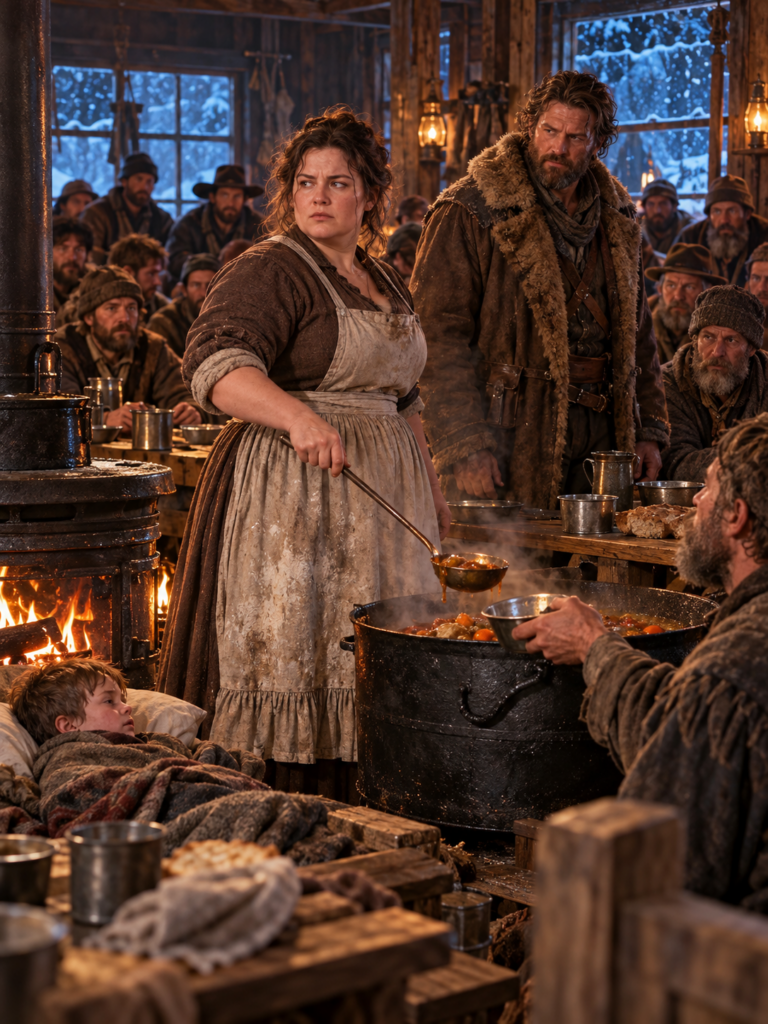
Kora’s finger moved slowly down the column, stopping beside the number she had checked three times.
Alex bent over the ledger.
For several seconds, he said nothing.
Then he looked toward the cookhouse door, beyond which thirty men were shoveling a passage through chest-deep snow.
“How long?”
“Six weeks if they eat the way they’ve been eating. Eight if I cut every portion.”
“And the pass?”
“Won’t open before spring. Not with that much snow.”
Alex drew a breath through his nose.
He had brought thirty workers into the mountains. He had promised wages, shelter, and enough provisions to survive the winter.
Now every one of those promises depended on a kitchen ledger.
“I ordered enough supplies to see us through April,” he said.
“I know what you ordered.”
Kora turned the page.
“And I know what came up the mountain.”
The quantities in the delivered stores did not match the order Alex remembered placing. Whether something had been left behind, counted twice, or never loaded, neither could establish. There was no way to ask the merchant while the pass remained blocked.
“We could slaughter the mules,” Alex said.
“That buys time. It doesn’t buy spring.”
“They’re no use hauling timber until the road opens.”
“And they won’t haul anything afterward if we eat them now.”
Neither spoke for a moment.
A sharp cough came from the adjoining room.
Kora turned immediately.
Toby was sitting upright on his cot, his cheeks flushed from the heat of the stove.
“I’m all right, Ma.”
“I know, sweetheart.”
She brought him water and watched until he had swallowed.
Alex remained at the table.
He had faced difficult winters before, but never with so many lives dependent upon his judgment. He knew the timber trails, the places animals sought shelter, and the cost of a mistake in deep snow.
He did not know how to turn six weeks of provisions into four months of meals.
Kora did not pretend she knew either.
But she could make every remaining measure count.
When she returned, she pulled out a chair and sat opposite him.
“No man gets served before the others. No secret stores. No extra helping for the foreman or the boss.”
Alex nodded.
“And you eat your share.”
Her eyes narrowed.
“My boy comes first.”
“He needs you strong enough to care for him.”
For a moment she looked ready to argue.
Then she reached for the pencil.
“We’ll count everything again, together. I’ll make the portions smaller, but I won’t hide it once the men begin asking.”
“Fair enough.”
“We’ll need help hauling fuel, too. If I’m on the stove all day, I can’t keep the woodpile clear.”
“I’ll arrange it.”
Kora looked at him with a weary, unexpected softness.
“You’re learning to listen, Mr. Wade.”
“That’s Alex.”
She almost smiled.
A gust rattled the shutter.
Then footsteps sounded on the porch.
Hollis entered carrying a shovel, his beard crusted with snow. He saw the open ledger and the expressions on their faces.
“Something wrong?”
Kora closed the book.
“We’ve got less food than we should.”
“How much less?”
“Enough that supper changes tomorrow.”
Hollis looked from her to Alex.
“You saying we’re going hungry?”
“I’m saying we have to make what we’ve got last.”
His expression hardened.
“I didn’t come up here to starve.”
“Neither did I.”
Alex stepped forward.
“We’ll tell the crew together.”
Hollis left without answering.
Through the window, Kora watched him cross the yard toward the bunkhouse. He stopped halfway, called to two other men, and pointed back at the cookhouse.
The news was already spreading.
Alex reached for the ledger.
“I’d better explain.”
Kora kept her hand on its cover.
“No. We explain. They need to know what their food is, and what it isn’t.”
Alex studied her face.
Then he withdrew his hand.
“Together, then.”
She stood, took the ledger, and walked toward the door.
Before opening it, she glanced toward Toby. He was sitting under the buffalo robe, watching her with wide eyes.
She wished she could promise him a full stomach every night.
She could not.
So she promised the only thing she knew she could give.
“I’ll do everything I can, son.”
Then Kora lifted the latch and stepped into the freezing yard, where thirty hungry men were already gathering to hear how they would survive.
The cold struck Kora’s face as she stepped into the yard, clutching the ledger against her chest.
Thirty men stood among the snowbanks, their shovels resting against their boots.
Some looked angry.
Others already looked afraid.
Alex came out behind her, but he did not speak first.
Kora waited until the murmuring stopped.
“There’s something you deserve to know. Our stores are short. We have flour, beans, pork, and oats left, but not enough to feed everyone the way I have been.”
Hollis folded his arms.
“So we starve?”
“No,” she answered. “We count. We ration. We share what’s left fairly, and we work out every other honest chance we have.”
A young hand named Wyatt stepped forward.
“How bad is it, Ma?”
Kora looked into his frightened face.
“Bad enough that I won’t lie to you.”
She opened the ledger and read the quantities aloud.
No one interrupted.
When she finished, Alex explained that the main pass was buried beyond any practical clearing effort. He knew the higher trails, but snow had made travel uncertain. Hunting might help when conditions allowed. For now, no wagon could reach them.
Jeb rubbed his weathered face.
“Then we’ll have to be careful.”
“We will,” Kora replied.
Hollis stared at the snow.
“You still want full shifts from us, Wade?”
“No,” Alex answered. “Timber cutting stops except for what’s needed to keep the buildings sound and the fires going. We preserve strength now.”
That seemed to surprise the men more than anything else.
They had known Alex as a demanding boss who could outwork nearly any man in camp. Now he was telling them to put their axes down.
Kora understood what it cost him.
The timber they failed to cut meant money he would not earn.
But men who were dead or permanently weakened could not work in spring.
The first reduced supper was nearly silent.
Kora stretched beans with their cooking liquid, measured the pork carefully, and divided the remaining bread into portions smaller than any she had served before.
Men stared at their plates.
A few looked toward the stove, hoping there might be another pot.
There wasn’t.
Hollis broke the silence.
“That’s supposed to keep a grown man alive?”
Kora set the empty ladle down.
“It’s what we have.”
“You used to feed us better.”
“And I’ll feed you better again if the supplies allow it.”
He pushed his bowl away.
“This isn’t worth eating.”
Jeb picked up his own bowl.
“Then give it here.”
Hollis stared at him.
Jeb’s voice remained calm.
“I’m hungry enough to appreciate it.”
After a long moment Hollis drew the bowl back and began eating.
The following weeks changed Pine Ridge.
Men who had once shouted across the yard now saved their breath. They worked in pairs whenever they had to go outside, clearing snow from the woodshed and checking the roofs.
Alex had them gather as much fuel as they could safely reach. He inspected the stovepipe, repaired gaps in the cookhouse walls, and shifted unused bedding into the warmest rooms.
Kora reorganized every remaining scrap of food.
She skimmed fat from the cooking pots, saved the bones, and made broth whenever there was anything worth simmering.
She learned which men needed help reaching the table, which ones were growing weak, and which were quietly giving away portions they could not afford to lose.
She stopped the giving.
“You can’t keep your neighbor alive by starving yourself,” she told Wyatt when she caught him sliding half his bread to Jeb.
“Jeb’s worse off.”
“Then we decide together who needs what. You won’t do it in secret.”
Wyatt lowered his eyes.
“Yes, Ma.”
That name continued spreading through the camp.
Soon every man used it.
Even Hollis.
One evening, when Kora brought the final pot of thin soup to the table, he moved his boots out of her path without being told.
“Ma,” he said quietly, “I’ll wash the pans tonight.”
She eyed him suspiciously.
“Properly?”
He sighed.
“Yes, properly.”
“Then I’ll show you where the clean cloths go.”
Kora did not mistake the men’s growing affection for a solution to their hunger.
But their willingness to share the work meant something.
Her hands had begun to shake when she lifted heavy pots. Her knees ached constantly. Some mornings she had to sit for several minutes before standing.
Now Jeb carried water when he was able. Wyatt cut kindling, and Hollis took charge of clearing snow from the kitchen door.
Alex insisted on doing his share, though she could see that his own strength was fading.
Their conversations grew quieter and more personal.
One night, after everyone had gone to bed, he found her sitting beside the stove with her apron folded across her lap.
Toby slept in the back room.
“You ought to be resting,” Alex said.
“So ought you.”
He pulled up a chair.
For several minutes they listened to the fire settle.
Then Kora spoke.
“I haven’t told you much about why I was in Bitter Creek.”
“You don’t have to.”
“I know.”
She looked at her hands.
“I had work before. Enough to keep Toby fed most days. When that work ended, there wasn’t another place for us. His cough kept getting worse. I spent what little money I had trying to keep him warm.”
Alex waited.
“By the time you found us,” she continued, “I had nothing left but the clothes we wore.”
“I’m glad I stopped.”
“I nearly refused you.”
That surprised him.
“Why?”
“You were a stranger with a wagon and a camp full of men I didn’t know.”
He nodded slowly.
“You had good reason to be careful.”
“I still do.”
“Yes.”
Kora studied him.
“You’re the first employer I’ve had who doesn’t mind being corrected.”
Alex gave a tired half smile.
“I mind it. I’ve simply discovered you’re usually right.”
She laughed.
The sound was small, rough from disuse, but it warmed him more than the fire.
He had not realized how much he missed laughter until he heard hers.
A long silence followed.
Then Alex said, “I spent years working these mountains because I understood the work better than people. Trees don’t ask what you’re feeling. Cattle don’t care if you’re poor company.”
“And thirty men?”
“They complain constantly.”
She laughed again.
He leaned back.
“I learned to lead them. Didn’t learn much about making a place worth coming home to.”
Kora watched him carefully.
“This camp was your responsibility before I arrived.”
“I know.”
“It can’t become mine alone just because they call me Ma.”
Alex nodded.
“Then we’ll carry it together.”
It was a small promise.
Neither knew whether they would live long enough to keep it.
By January, the food was nearly gone.
They reluctantly slaughtered the mules after calculating that the animals would not survive long on the remaining feed and that their meat could extend the camp’s provisions.
Alex did the work himself.
No one celebrated.
Those animals had hauled the freight wagon up the mountain and represented the crew’s chance of moving heavy supplies once spring returned.
Kora preserved what meat she could in the bitter cold and used every edible portion.
The meals improved briefly.
Then the supply dwindled again.
By February, the men were sleeping through much of the day to conserve energy. Even carrying firewood across the yard could exhaust them.
Jeb’s gums bled.
Wyatt had developed a troubling cough.
Toby, though still frail, was no longer coughing as constantly as he had in autumn. Kora watched him closely, frightened by every change in his breathing.
Alex noticed her saving part of her supper.
He also noticed that she was giving it to Toby.
One night he placed part of his portion beside her bowl.
She pushed it back.
“Don’t.”
“You need food.”
“So do you.”
“If you fall ill, Toby loses the person he depends on.”
“And these men need their boss.”
Alex stared at the small piece of bread between them.
Then he broke it in half.
“Then we both eat.”
Kora’s expression changed.
She took her half.
After that they stopped pretending either could carry everyone alone.
Alex kept searching for options. He studied the slopes beyond camp, looked for animal tracks near the trees, and measured the snow conditions whenever the weather permitted.
One afternoon he found old tracks leading toward a distant valley.
Elk sometimes wintered there.
He told Kora what he had seen.
She listened without interrupting.
“How far?”
“Far enough that I couldn’t reach it and return before dark.”
“And if the herd’s gone?”
“Then I’d come back empty-handed.”
“You wouldn’t necessarily come back at all.”
Alex did not deny it.
The following evening, Kora was stirring hot water and salt over the stove when her legs suddenly failed.
She caught the edge of the worktable, but the spoon slipped from her hand.
Alex was beside her before it struck the floor.
He eased her onto a stool.
“Sit.”
“The pot—”
“I’ll mind the pot.”
She looked up at him.
For the first time since coming to Pine Ridge, she could not make her body obey simply by willing it.
“We’ve nothing left,” she whispered.
Alex knelt beside her.
His own face had grown thin, his coat hanging loose across his shoulders.
“Not quite.”
She followed his gaze toward the rifle resting beside the door.
“No.”
“There may be elk across the ridge.”
“May be.”
“I’ve hunted that country before.”
“Not when you’re this weak.”
He took her hands.
“I know the danger.”
“Then don’t speak as though being brave makes it smaller.”
Alex looked down.
She was right.
He could not promise success. He could not guarantee his return.
But doing nothing meant watching thirty men and a little boy weaken further.
“I need your judgment,” he said. “Not your permission. Tell me what I’m overlooking.”
Kora swallowed.
She thought of the exposed ridge, the snowfields, the distance, and the narrow chance of finding game.
Then she looked toward Toby’s room.
“If you go, take enough clothing. Mark the route. Don’t waste your strength dragging more than you can manage. And if there are no tracks, turn back.”
Alex nodded.
“I will.”
“You promise me that?”
“Yes.”
She gripped his wrist.
“And Alex?”
He looked at her.
“Don’t make dying out there your way of proving you care about us.”
Something moved across his face.
“I don’t want to die, Kora.”
“Then come back.”
He rose, took his rifle, and began gathering what little equipment he could carry.
Kora watched from the stool as he pulled on his heavy coat and secured his snowshoes.
At the doorway he turned toward her.
“If I find them, I’ll bring back what I can.”
“And if you don’t?”
“I’ll come back and we’ll work out something else.”
Kora held his gaze.
Then Alex opened the door and stepped into the white, frozen silence beyond it.
The door swung shut behind Alex, leaving Kora staring at the place where he had stood.
For a moment she listened to his footsteps fading across the packed snow.
Then she pushed herself upright.
There was still work to do.
She gathered the men who were strong enough to walk and explained that Alex had gone toward the distant valley looking for elk.
Hollis shook his head.
“He’ll never manage it.”
“He knows that country,” Kora replied.
“He’s barely got strength enough to cross the yard.”
“Then we had best make sure he’s got a fire to come back to.”
She assigned the simplest tasks possible. Jeb kept the cookhouse stove supplied. Wyatt helped tend the fire as his cough allowed. Hollis checked that snow did not block the door.
Kora took responsibility for the remaining food.
There was hardly any.
That first night she sat beside the stove, listening to the boards creak as the temperature fell.
Toby woke and came into the kitchen, dragging the buffalo robe behind him.
“Where’s Mr. Wade?”
“Out hunting.”
“In the dark?”
“He started while there was light.”
The boy considered this.
“Will he come back?”
Kora drew him onto her lap.
“He means to.”
She would not promise more.
When Toby fell asleep against her shoulder, she carried him back to his cot and covered him carefully.
Then she returned to the stove.
The second day passed without Alex.
Hollis went to the door repeatedly.
Each time he came back shaking his head.
“No sign.”
Kora continued stirring the thin broth, though there was scarcely enough nourishment in it to justify the firewood.
She was no longer certain what she feared most: losing Alex, or having to tell Toby that the man who had offered them shelter was gone.
By evening, whispers moved through the bunkhouse.
Some men believed Alex was dead.
Hollis, in a fit of frightened bitterness, muttered that perhaps Wade had found a way down the mountain and saved himself.
Kora walked into the bunkhouse carrying the empty soup pot.
“That’s enough.”
Hollis looked up from his blankets.
“You don’t know he’s coming back.”
“No,” she said.
The room fell still.
“But you don’t know he’s abandoned us either. And until we learn different, you’ll not turn fear into an accusation.”
Hollis looked away.
After a moment he whispered, “I’m scared, Ma.”
Kora’s anger softened.
“So am I.”
She set down the pot.
“We can be frightened without being cruel.”
No one argued.
On the morning of the third day, the cookhouse door struck the wall.
Kora turned.
Alex stood in the opening, swaying.
Ice clung to his coat. His face was gray with cold, his lips badly cracked.
Behind him dragged a heavy piece of elk meat, tied to his belt.
He took one step.
Then his knees buckled.
“Alex!”
Kora reached him as he collapsed onto the floor.
The cold of his coat shocked her hands.
She called for Jeb and Hollis, and together they dragged him away from the open doorway and into the shelter of the cookhouse.
Alex was conscious but barely responsive.
Kora closed the door and ordered someone to bring dry blankets.
She helped remove his wet outer clothing while the men moved him to a cot near the stove, taking care not to heat him abruptly.
His hands and feet were painfully cold.
His breathing was shallow.
“Stay with me,” Kora said.
He opened his eyes briefly.
“Found them.”
“I can see that.”
“Couldn’t bring much.”
“You brought yourself.”
His eyes closed.
For a terrible moment she thought he had slipped away.
Then she saw his chest rise again.
Jeb stood at the foot of the cot.
“What do we do, Ma?”
“Keep the room warm. Get dry cloths. And somebody see to that meat before it spoils.”
The men moved at once.
Kora remained with Alex until his breathing steadied and he could respond when she spoke.
Then she turned to the elk.
She had fed thirty hungry men for months, but this was different.
Their bodies had been deprived for so long that suddenly eating large amounts could harm them. She served small portions of cooked meat and broth, repeating the servings cautiously rather than letting anyone gorge.
For the first time in days, the cookhouse smelled of real food.
Some men wept quietly.
Others stared at their bowls as though afraid they might vanish.
Hollis carried a cup of broth to Alex’s bedside.
Kora took it from him.
“Thank you.”
He glanced at the unconscious man.
“He really came back.”
“Yes.”
Hollis rubbed his eyes.
“I said things I shouldn’t have.”
“Then tell him when he’s able to hear you.”
Kora sat beside Alex and supported his head enough for him to take a little warm broth once he was alert and able to swallow.
His eyelids lifted.
He looked at her.
“Did they eat?”
“They did.”
“Toby?”
“He’s sleeping.”
Alex closed his eyes again.
Kora leaned forward.
“You frightened me nearly out of my senses.”
He managed the faintest expression of regret.
“Sorry.”
“You ought to be.”
She brushed a strand of damp hair from his forehead.
After a moment she added, “I’m glad you’re here.”
His hand moved weakly across the blanket.
She took it.
They sat together until he slept.
The elk bought Pine Ridge time, but not enough to end the danger.
Kora knew that.
So did Alex when he recovered enough to sit beside the stove.
They calculated the food again. The meat could sustain them briefly if carefully portioned, but spring remained weeks away.
The crew continued conserving strength.
When weather permitted, a few of the strongest men searched near camp for other small sources of food. They found little, and sometimes nothing.
The remaining hide and bones from the elk were used as far as they safely could be, though none of it was a substitute for a proper diet.
Alex suffered from painful damage to his feet after the journey. Walking remained difficult, and some days he had to remain on the cot.
Kora refused to let him treat the injury lightly.
“You aren’t carrying this camp out on your shoulders,” she told him.
“Seems I didn’t manage much carrying.”
“You brought us food when we had none. Now you’ve got to let us do our part.”
He listened.
It was harder for him than facing the mountain alone.
For years he had believed responsibility meant doing the hardest work himself, bearing every consequence silently, and keeping fear hidden from the men.
Kora taught him that responsibility sometimes meant trusting others.
The change showed in small ways.
He let Jeb organize the wood crews.
He asked Hollis to check the sheds.
He allowed Wyatt, when the young man felt stronger, to assist Kora with measurements and supplies.
And when Kora told him to rest, he usually did.
One evening, as the last light faded behind the snowbanks, Toby climbed onto a stool beside Alex.
“Can I ask you something?”
“Course.”
“Why do the men call my mother Ma?”
Alex looked toward the kitchen.
Kora was scraping the bottom of a pot.
“They’re fond of her.”
“I’m fond of her too.”
“I noticed.”
Toby watched the men eating at the tables.
“Does that mean I have thirty brothers?”
Alex’s mouth twitched.
“Not exactly.”
“Good. They’d eat all my supper.”
Alex laughed.
The sound startled Kora.
She turned, holding the wooden spoon.
“What are you two conspiring about?”
“Nothing,” Toby answered quickly.
“That’s what worries me.”
For a few moments the cookhouse sounded almost like it had before the storm.
Then everyone returned to the hard business of surviving.
March passed slowly.
The sunlight lasted longer, but the cold still reached deep into the cabins. Men waited for spring with the desperate patience of people who had learned that wishing did not melt snow.
Kora kept the stove burning.
Sometimes she had little to put on it.
The camp endured on dwindling provisions and whatever the men could find nearby.
Not everyone recovered quickly.
Jeb remained weak, and Wyatt’s cough lingered.
Toby tired easily.
Alex’s injured feet continued to trouble him.
But they were alive.
Then, late in April, a deep cracking sound rolled through the valley.
The ice on Bitter Creek was breaking.
Alex stood at the window, leaning on a wooden support.
Kora joined him.
Water was beginning to move beneath the snow.
“You hear that?” he asked.
“I do.”
“Spring.”
She watched the dark water cutting a narrow line through the ice.
For months she had been afraid even to imagine it.
Now the mountain was beginning to release them.
The thaw made the trails muddy and treacherous. It was early May before the first freight wagons could make their way up to Pine Ridge.
By then the workers were gaunt, their clothes hanging loose from their shoulders.
When the wagons rattled into the camp, the drivers stared at the men emerging from the bunkhouse.
One merchant removed his hat.
“Good Lord. We thought you might all be dead.”
Hollis stepped forward.
“Not yet.”
The wagon carried sacks of flour, salt meat, beans, and other provisions.
For a moment none of the men moved.
They had dreamed of food for so long that seeing it seemed almost impossible.
Then Hollis turned toward the cookhouse.
“Ma!”
Kora appeared on the porch with Toby beside her.
She looked thinner and older than she had in October, but her eyes were as steady as ever.
“Bring those provisions inside,” she called.
The men obeyed.
“And nobody eats half a sack of bread just because we’ve finally got some.”
Even Alex smiled.
She knew they would need to rebuild their strength carefully after so many months of deprivation.
She planned small meals, increasing them as the men could tolerate more nourishment. The camp would need time and proper care before everyone could work normally again.
But they had reached the thaw.
All thirty workers were alive.
That night the cookhouse was filled with the smell of broth, fresh bread, and coffee.
The men spoke more freely than they had for months.
Some cried as they ate.
Others laughed at jokes that were barely jokes at all.
Jeb raised his cup toward Kora.
“To Ma.”
Thirty cups lifted.
Kora looked around the tables.
Hollis, who had once mocked her when she climbed down from the freight wagon, stood with his head bowed.
Wyatt grinned at her.
Jeb’s eyes shone with tears.
Kora tried to speak.
Nothing came.
Then she cleared her throat.
“Eat your supper before it gets cold.”
The men laughed.
But this time the laughter embraced her.
Later, when the cookhouse had emptied, Alex found her washing the last pot.
He took the cloth from her hand.
“Go sit down. I’ll finish.”
“You’ll leave grease in the corners.”
“Then you can tell me tomorrow.”
She hesitated, then surrendered the cloth.
Outside, evening settled across Pine Ridge.
Kora went onto the porch with two cups of coffee.
Alex joined her a few minutes later, moving carefully because of his feet.
The stars were beginning to show above the timberline.
“Some of the men are leaving,” he said.
“I know.”
“Hollis plans to stay. Jeb and Wyatt too. The others have decisions to make.”
“They’ve earned them.”
Alex nodded.
Then he looked at her.
“And you?”
Kora rested her cup on the railing.
“My contract was for the winter.”
“I remember.”
“You owe me my wages.”
“I do. Every dollar. I’ll settle them before you make any decision.”
She looked toward the dark road leading down the mountain.
“I’ve thought about Denver. Toby ought to have schooling, and a doctor who can examine that cough properly. I don’t want him growing up with no choices but these mountains.”
Alex was quiet.
He had known this conversation would come.
Throughout the winter he had been able to face hunger, cold, and uncertainty because there were tasks that needed doing.
Now there was no task that could make Kora stay.
Only her own wishes could do that.
“I’ll see you get to Denver if that’s what you choose,” he said.
She looked back at him.
“Would you?”
“Yes.”
“Even if you don’t want me to go?”
He took a breath.
“Especially then.”
Kora studied the weathered man standing beside her.
She remembered the alley in Bitter Creek.
The way he had asked whether she could cook instead of asking why she had failed.
The buffalo robe he had placed over Toby.
The space he had given her to decide for herself.
The night he had shared his last bread.
And the morning he had returned from the mountain, nearly frozen, because he could not bear to leave thirty men and one small boy without another chance.
“You never told me what you wanted, Alex.”
He set his cup down.
“I’d like you to stay.”
“As your cook?”
“No.”
He turned toward her.
“I’d like you to stay because I love you.”
Kora’s breath caught.
Alex continued before courage failed him.
“I don’t know the right words for it. I know I look for you when I come in. I know the sound of Toby laughing makes this place feel different. I know I was lonely before you arrived, though I wouldn’t have admitted it.”
She lowered her eyes.
“I don’t want you staying because I helped you,” he said. “Or because the men call you Ma. I want you to have whatever life you and Toby need. I’d only be grateful if there was room for me in it.”
Kora looked toward the cabin lights.
For months she had fought to keep everyone alive.
Now, for the first time, she could consider what she herself wanted.
“I love you too,” she said.
Alex stood very still.
“But loving you doesn’t settle everything.”
“No.”
“Toby needs schooling. We need to know what sort of life you’re offering. And I won’t spend another winter working myself sick because thirty men don’t know how to wash a pot.”
Alex laughed softly.
“Fair enough.”
“The men will help with the kitchen. Properly. And we’ll plan stores with enough margin that one failed delivery doesn’t leave everyone hungry.”
“We will.”
“I want my own say in how the cookhouse is run.”
“You’ve had it since the day you arrived.”
“Then I want it understood.”
He nodded.
“And Toby?”
“We’ll see about schooling and care for his health,” Alex said. “There are ways to make arrangements in town. We’ll work them out together, not leave them to chance.”
Kora looked into his face.
“And you’d help raise him?”
“If he’d have me.”
She smiled.
“He already thinks you’re worth keeping.”
Alex swallowed.
Then, very carefully, he took her hand.
“Kora, would you marry me?”
She did not answer at once.
Not because she doubted his affection.
Because she had spent too many years having decisions forced upon her by poverty and circumstances.
She wanted this decision to be different.
She looked across the yard, where the first patches of dark earth had appeared beneath the melting snow.
She thought of Denver, and schoolrooms, and streets where Toby might grow up without the hardships of an isolated timber camp.
Then she thought of the life she and Alex might make, provided neither asked the other to surrender what mattered.
“I will,” she said at last. “But we’re going to plan it together.”
Alex’s face softened.
“I wouldn’t dare do otherwise.”
“And you’ll keep your muddy boots out of my kitchen.”
“I’ll try.”
“You’ll do better than try.”
“Yes, ma’am.”
She laughed, and he drew closer.
He paused long enough for her to meet him halfway.
Their kiss was gentle.
Neither of them needed an audience.
But when they stepped back inside, thirty men were gathered around the long tables, waiting for another pot of coffee.
Hollis noticed their joined hands.
His face broke into a grin.
“Well, Ma,” he said, “does that mean Wade finally found somebody willing to put up with him?”
Kora raised an eyebrow.
“I haven’t decided how much putting up with him is going to cost.”
The room erupted in laughter.
Alex accepted it with unusual grace.
The months that followed did not turn Pine Ridge into an easy place.
There were timber contracts to fulfill, animals to replace, wages to settle, and buildings to repair.
Several workers left for different employment.
Those who remained took on new duties around the cookhouse. The men washed their own dishes, carried fuel, and learned to help with the food rather than expecting Kora to do everything.
Alex kept his promise about her wages and made sure she had money of her own.
He and Kora made trips to Bitter Creek when travel allowed, looking into Toby’s schooling and medical care.
They spoke openly about winter provisions, the risks of mountain work, and the possibility that life might eventually take them somewhere else.
Their marriage was a choice to build together, not a debt repaid for surviving.
When the next autumn arrived, the cookhouse stood clean and stocked.
The pantry held carefully counted provisions, and Alex had made arrangements for additional supplies and contingency stores.
Kora checked the quantities herself.
Hollis stood beside her with a pencil.
“Think we’ve got enough, Ma?”
She inspected the final column.
“We’ve got a better plan than last year.”
He nodded solemnly.
“That’s good enough for me.”
Outside, Toby was walking beside Alex, asking questions about the trees.
The boy still needed watching, but he had grown stronger through the warmer months.
Alex stopped to adjust the child’s coat before they entered the yard.
Kora saw them through the window.
A year earlier, she had sat behind a livery stable believing the world had no place left for her and her son.
Now she had work she controlled, wages she had earned, a husband who respected her judgment, and a child whose future they were planning together.
And there were men in the next room who had learned to treat her with a tenderness none of them would once have admitted possessing.
That evening, everyone gathered for supper.
Jeb took his familiar place by the stove.
Wyatt brought in the final basket of wood.
Hollis washed his hands without being told.
Alex sat beside Toby, who was explaining something important about the lessons he hoped to study.
Kora carried the bread to the table.
“That’s enough talking,” she announced. “Eat.”
The men reached for their plates.
Then, almost together, thirty rough voices answered.
“Yes, Ma.”
Kora looked around the room and smiled.
They were not all her sons, and she would never pretend she alone had saved them. They had survived because every one of them, frightened and imperfect, had finally learned to care for the others.
She placed the bread in the center of the table, where everyone could reach it.
Alex caught her eye from across the room.
He smiled.
And for the first time in her life, Kora Hayes did not have to wonder whether she had a place to belong.
She had helped build one.
Beyond the windows, the first autumn wind moved through the pines.
Inside, the stove burned steadily, the tables were full, and the door remained open for the last worker coming in from the cold.

