
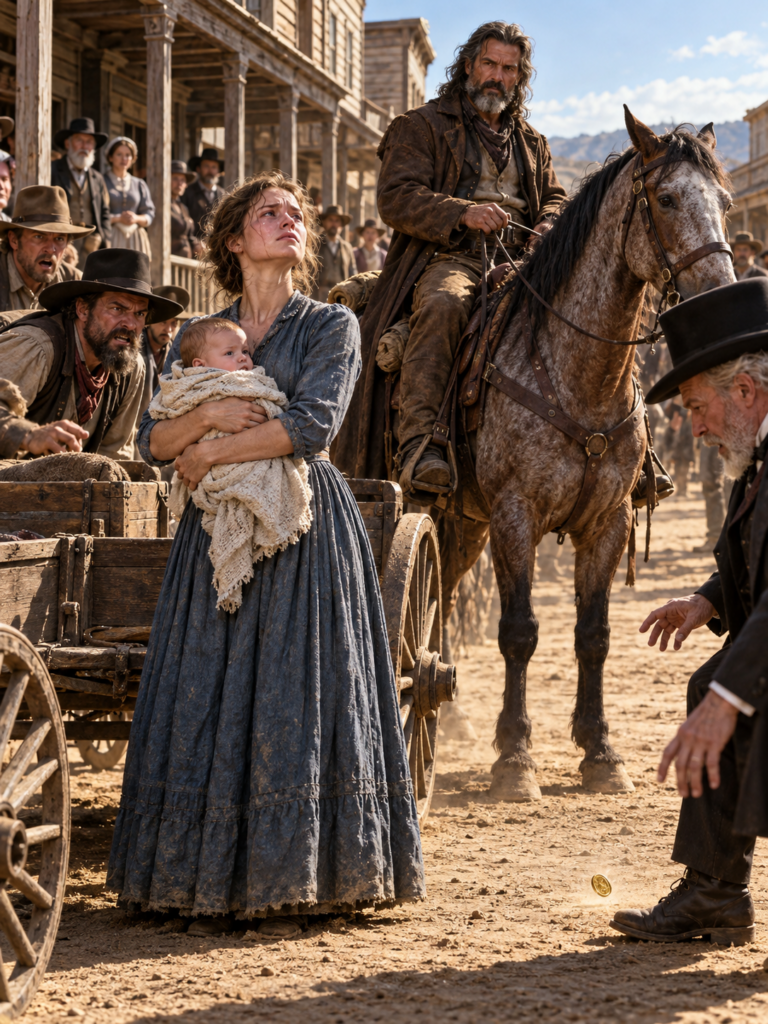
Cora closed her hand around the poker as the door swung inward.
Boone entered carrying firewood and his saddlebags. He stopped when he saw the iron bar pointed toward him.
For a moment, neither spoke.
Then he set the wood down and raised his empty hands.
“Have I given you cause to use that?”
“Not yet.”
His gaze moved from her frightened face to the bed in the corner.
Understanding settled over his expression.
“That’s yours tonight,” he said.
“And where will you sleep?”
“By the fire.”
“Why should I believe you?”
“You shouldn’t have to. Keep the poker until you decide.”
He turned away, leaving her between himself and the door.
Cora watched him kneel beside the hearth and build a fire. He moved without hurry, feeding kindling beneath split logs until orange light reached across the floorboards.
When he stood, she tightened her grip.
Boone noticed.
He removed his gun belt and placed it on a chair away from the bed.
“There’s no lock on that door,” he said. “If you ever want it open, it’ll open.”
“That doesn’t tell me why I’m here.”
“No.”
He filled a pot from the water bucket.
Seth began crying.
Cora tried to quiet him, but the child was hungry and exhausted. Her own stomach twisted painfully. She had eaten almost nothing since the previous morning.
Boone glanced toward the sound.
“Feed him. I’ll make supper.”
Cora hesitated, then laid the poker beside the bed, within reach, and sat down with Seth.
Boone kept his back turned while she nursed the baby.
He heated salt pork and beans, divided the food, and set a plate at the table.
Then he took his own portion and sat near the hearth.
The gesture unsettled her more than an order would have.
He had given her the chair.
He had given her the bed.
He had even left her a weapon.
Yet she remained in an unfamiliar mountain cabin with a stranger whose money had interrupted an auction.
After feeding Seth, she carried him to the table and ate.
Only when her plate was empty did she speak.
“Tell me what you want, Mr. Fletcher.”
Boone set down his fork.
“I come into Oak Haven twice a year for supplies. I’ve seen Webb make trouble for folks who couldn’t pay him. Today I saw what he meant to do to you.”
“You didn’t answer me.”
He nodded, accepting the correction.
“Winter comes early here. The pass closes. I trap and hunt, and there’s work enough for two people to keep this cabin supplied.”
“You want someone to cook and mind your fire.”
“I could use the help.”
“And you chose a widow with an infant?”
“I saw someone who needed a place, and I had one.”
“Then why didn’t you simply offer it?”
Boone looked down at his hands.
“Because I didn’t stop to think how it would sound when I said I’d take you. I should’ve spoken to you first.”
It was the first admission of fault she had heard from any man since Thomas died.
Cora set her fork down.
“I won’t be purchased, Mr. Fletcher. Not for forty dollars. Not for forty thousand.”
“You’re not.”
“And I will not work because you paid my debts.”
“Agreed.”
He explained his proposal. She could remain for the winter with Seth. If she chose to help preserve meat, watch the fire, and manage supplies, he would pay her fifty dollars in spring. If she preferred not to take the work, he would still shelter them until safe travel was possible.
When the trails cleared, he would arrange transportation toward the railhead at Cheyenne, where she could seek a new life.
Cora studied him carefully.
“What happens if I say no?”
“You and your boy still eat.”
“And if I decide to leave before winter?”
“I’ll help you travel while the pass is open.”
She looked toward the door, then at her sleeping son.
For the first time in weeks, she was being asked rather than told.
“My name is Cora,” she said. “The boy is Seth.”
“Boone.”
“I know.”
A faint smile touched his mouth.
He pulled a canvas bedroll from a wooden chest and spread it before the hearth.
Cora watched him remove his boots.
She had one more question.
“Why have you lived alone up here so long?”
Boone’s hands paused.
For the first time that evening, he looked genuinely troubled.
“That’s a longer answer.”
“Then perhaps you’ll give it another day.”
He nodded and lowered himself onto the bedroll.
Cora carried Seth to the bed.
But before climbing beneath the furs, she returned to the table, took a scrap of paper from her sewing bundle, and carefully wrote down their agreement with a stub of pencil.
She placed it beside Boone’s lantern.
“If I’m staying,” she said, “we both put our names to what we’ve promised.”
Boone rose, took the pencil, and reached across the table toward the paper.
Boone’s pencil hovered over the paper.
He read every line Cora had written.
Fifty dollars for agreed work through winter. Food and shelter for herself and Seth regardless. Safe passage to the railhead when spring made travel possible. No claim upon her person or her child.
He looked up.
“You’ve done this before?”
“Kept accounts? Yes.”
“Your husband’s?”
“And the general store’s when their clerk was ill.”
Boone considered the final line.
“There’s something missing.”
Cora stiffened.
“What?”
“Your choice to end the arrangement. We ought to put that down plainly.”
She watched him add the words.
Then he signed his name.
His handwriting was rough, but unmistakable.
Cora signed beneath it.
He pushed the paper back toward her.
“Keep it.”
She folded it carefully and tucked it into her belongings.
It was a small thing, scarcely more than a promise between two strangers.
But on the wagon in Oak Haven, men had spoken of contracts as instruments by which they might own her days and command her body.
This was the first agreement in which anyone had asked what she wanted written down.
She carried Seth to bed while Boone returned to his place beside the hearth.
Neither said another word.
Yet before she slept, she noticed that he had placed a second piece of firewood beside his bedroll so he could tend the flames without disturbing her.
***
The next morning, Cora woke to the sound of an ax.
Sunlight lay across the cabin floor. Seth slept beside her in a shallow wooden cradle Boone had brought from the storage shed before dawn and lined with clean blankets.
Through the open doorway, she could see Boone splitting logs in the yard.
He had already drawn water, fed the horse, and started a pot of coffee.
Cora examined the cabin with a more practical eye than the night before.
Its shelves were crowded but poorly arranged. Flour sacks rested dangerously near the floor, where dampness could spoil them. Cured meat hung above the table. Several jars lacked proper coverings.
The man knew how to survive alone.
That was not quite the same as preparing to feed three people through a mountain winter.
When Boone came inside, she had gathered the food supplies into orderly groups.
He stopped in the doorway.
“Looking for something?”
“Trying to determine whether we’ve enough food to last.”
“There’s meat in the shed.”
“How much?”
“Some.”
“Some isn’t a quantity.”
His eyes narrowed slightly.
Then, unexpectedly, he gave a quiet chuckle.
“No, ma’am. I suppose it isn’t.”
By noon, they were examining every sack and jar.
Cora counted flour, beans, salt, coffee, rendered fat, and dried fruit. Boone estimated the meat he could preserve before winter. Together they checked the smokehouse and root cellar.
The work revealed an uncomfortable truth.
There was food enough for a careful beginning, but three mouths would use the stores faster than one.
“Then we’ll have to put more by,” Cora said.
Boone nodded.
“That’s what I figured.”
“You figured it. I counted it.”
He glanced at her.
“Reckon we’ll need both.”
That was the first time she saw him smile.
It changed his face remarkably.
For a moment, the severe man who had ridden into Oak Haven looked almost young.
Then Seth began crying, and the smile vanished into alarm.
Cora laughed before she could stop herself.
“He’s hungry, Boone. Not wounded.”
“I hadn’t said he was.”
“You were staring as though you expected him to explode.”
Boone looked at the baby, then back at her.
“He’s smaller than anything I’ve ever been responsible for.”
Cora’s laughter softened.
“He’s stronger than he looks.”
“So are you, I reckon.”
She looked away, suddenly unable to decide what to do with the compliment.
***
The weeks established a rhythm.
Boone hunted, checked his traps, repaired the corral, and cut firewood.
Cora helped preserve meat, organized their supplies, kept the stove burning during his absences, and made their provisions stretch without leaving anyone hungry.
She was not afraid of hard work.
She had been doing it since long before marrying Thomas.
Still, Boone refused to let her shoulder every task simply because it happened indoors.
He washed dishes when she was occupied with Seth. He hauled water and scrubbed the floor when heavy mud followed him inside. When she showed him how to cut scraps of cloth into serviceable diapers, he learned without complaint.
She, in turn, learned how to bank the hearth so the embers would last through the night, how to recognize weather in the shape of distant clouds, and where the trail crossed the creek safely.
Once, when Boone found her examining a loose board beneath the kitchen shelf, he fetched a hammer.
She held out her hand.
“I know how to use one.”
He handed it over.
Then he held the shelf steady while she drove the nails.
For some reason, that ordinary afternoon remained in her thoughts long after the work was finished.
At Oak Haven, nearly every man had believed that a widow without money must surrender her judgment along with her labor.
Boone Fletcher seemed content to discover what she could do.
He did not always speak gently. He was impatient with wasted daylight, slow to explain himself, and more comfortable among trees than people.
But when she disagreed, he listened.
And when she was right, he admitted it.
Gradually, their little household became less like an arrangement between strangers.
It began with an extra cup of coffee waiting beside her plate.
Then came a small wooden horse Boone carved for Seth.
Later, Cora noticed him repairing a loose cradle rung without being asked.
He never made speeches over these things.
Neither did she.
But one evening, when he returned wet and chilled from the upper ridge, he discovered his spare shirt warming beside the stove.
He paused, holding the dry cloth.
“Thought you might need it,” she said.
He stood motionless for a moment.
Then he answered quietly.
“I did.”
***
September slipped into October.
The first hard frost silvered the meadow. Snow whitened the highest peaks.
One morning, Boone announced that he meant to hunt an elk on the upper ridge.
Cora looked up from the supplies she was counting.
“The wind has turned.”
“It has.”
“And the ridge was icing yesterday.”
“That’s why I’ll be careful.”
She studied the patched shoulder of his canvas coat.
Two days earlier he had returned with a torn sleeve and a shallow cut from a fall.
“You cannot keep taking chances as though nobody depends on you.”
Boone stopped fastening his belt.
The words seemed to strike him harder than she intended.
For a moment, she regretted their sharpness.
Then he said, “You’re right about that.”
He packed extra food and checked the weather again before leaving.
“I’ll turn back if the clouds close in.”
“See that you do.”
He glanced toward Seth, who was reaching for his wooden horse.
Then his gaze returned to Cora.
“I mean to come home.”
She had grown used to the word, but hearing him say it made her chest ache.
Home.
Not cabin.
Not shelter.
Home.
***
By late afternoon the storm arrived.
Wind struck the valley with such force that the pines bent and groaned. Snow swept across the windows, blotting out the tree line.
Cora moved Seth’s cradle farther from the door and fed the hearth.
She knew enough of mountain weather now to understand the danger.
If Boone had already left the upper ridge, he might reach the cabin.
If he had delayed, the path could disappear beneath drifting snow.
She watched the light fade.
No Boone.
The roan remained in the corral, stamping uneasily against the cold. Boone had gone hunting on foot, taking a pack frame for meat.
Cora warmed water, laid dry clothing near the hearth, and prepared a place where he could sit if he returned injured or exhausted.
Then she wrapped Seth securely in his cradle and checked that the fire was banked well.
She would not abandon her baby to search the mountain.
But she could watch the final stretch of trail from the shelter of the porch.
Pulling on Boone’s spare coat, she stepped outside.
The wind caught her breath.
“Boone!”
Her voice disappeared into the storm.
She stayed close to the doorway.
Minutes passed.
Then something moved beyond the corral.
A bent figure emerged from the whiteness, dragging a heavy canvas sack.
“Boone!”
He lifted his head.
She hurried as far as the corral gate.
He stumbled, caught himself, and struggled forward.
When he reached her, she saw blood darkening his sleeve.
“What happened?”
“Slipped coming off the ridge.”
“You’re hurt.”
“Not so bad.”
“Don’t you dare tell me that.”
He tried to smile, but his face was gray with cold.
Together they dragged the meat sack through the gate. Cora slipped her arm beneath his uninjured side and helped him toward the cabin.
At the doorstep he stopped.
“What in blazes were you doing outside?”
“Looking for you.”
“Seth—”
“Safe and warm inside. I haven’t forgotten I have a son.”
His expression changed.
The fear in his eyes was not for himself.
“I should’ve turned back sooner,” he admitted.
“Yes,” Cora said fiercely. “You should have.”
He bowed his head.
Then he allowed her to guide him inside.
***
The fire had burned bright enough to warm the room.
Cora got Boone out of his frozen coat and seated him near the hearth.
A ragged wound marked his left shoulder where he had struck a sharp rock during the fall.
She cleaned it with boiled and cooled water and clean cloth, watching his face for signs that the injury was worse than he claimed.
He gritted his teeth but did not complain.
Afterward, she covered it with a clean dressing and warned him that any spreading redness, fever, or worsening pain would need attention.
“You know something about tending wounds,” he observed.
“Thomas was ill before the cholera took him. I’ve spent more nights beside a sickbed than I care to remember.”
Boone was silent.
It was the first time she had spoken of her husband without being asked.
“He was a good man,” she added.
“I believe you.”
“He wanted that homestead to work.”
“I’m sorry it didn’t.”
The simplicity of his answer nearly undid her.
He did not tell her that everything happened for a reason.
He did not claim that Thomas’s death had somehow brought her to a better fate.
He simply let the grief remain what it was.
Cora tied the dressing and stepped back.
“Your shoulder will need rest.”
“Then I’ll rest.”
She raised an eyebrow.
“That easily?”
“For tonight, anyhow.”
She laughed softly.
Boone reached for her hand, then stopped.
“Cora?”
She looked at him.
“May I?”
She knew what he was asking.
He had touched her when helping her over difficult ground, when handing her tools, when steadying her on the trail.
But he had never asked to touch her simply because he wanted to.
Cora placed her hand in his.
His fingers closed gently around hers.
For a long while, neither spoke.
The fire settled into glowing coals.
Seth stirred in his cradle and made a sleepy little sound.
Boone glanced toward him.
“That boy’s going to need a bigger cradle before long.”
“He will.”
“I’ve got timber enough.”
Cora studied his face.
There it was again.
That quiet suggestion of a future neither had yet dared name.
She rested her other hand against his cheek.
Boone went still.
“You don’t have to be alone all the time,” she whispered.
He lowered his eyes.
“Been alone so long, I don’t rightly know another way.”
“Perhaps you could learn.”
He looked up.
For the first time, the guarded mountain man seemed uncertain of his own courage.
“I’d like to,” he said.
Cora leaned closer.
Their first kiss was gentle, hesitant, and interrupted when Seth began fussing in his cradle.
She drew back with a startled laugh.
Boone smiled against her forehead.
“Reckon he’s got an opinion.”
“He usually does.”
Boone released her hand so she could tend her son.
And watching Cora lift the baby into her arms, he understood that what he wanted was no longer merely someone to keep a fire burning.
He wanted these two people to remain part of his days.
Yet outside, the mountain was settling into winter.
And the promise he had made to take them away in spring still stood between them.
Boone watched Cora settle Seth against her shoulder.
The baby quieted almost at once, one tiny fist tangled in the faded cloth of her dress.
“He’s a fortunate little fellow,” Boone said.
Cora looked up.
“Why?”
“He’s got you.”
She smiled, but something in her expression turned wistful.
“He’ll never know his father.”
Boone shifted carefully against the chair, mindful of his wounded shoulder.
“You can tell him about Thomas.”
“I will.”
“Then he won’t be forgotten.”
Cora studied him across the warm room.
For a man who spoke so little, Boone sometimes found exactly the words she needed.
“May I ask you something?” she said.
“Certainly.”
“Why have you stayed up here alone for ten years?”
He watched the flames.
For a while she thought he might refuse.
Then he said, “At first, because I preferred it.”
“And afterward?”
“Because I’d forgotten how to be anywhere else.”
His fingers moved over a rough seam in his trousers.
“I worked with other men once. Trapping, hauling, guiding folks through the mountains. I got tired of promises men made when they wanted something. Tired of company that vanished when the work turned hard.”
He looked around the cabin.
“Built this place and found I could manage well enough without anybody. After a while, I stopped wondering whether there ought to be more.”
Cora sat quietly.
“Was there someone you lost?”
“No wife, if that’s what you mean. No family waiting somewhere for me.”
“Then why did you seem so frightened when I said you didn’t have to be alone?”
Boone considered the question.
“Because I’d got used to living in a way where nobody could leave me disappointed.”
He looked toward Seth.
“And now I can’t imagine not hearing that little fellow holler for his breakfast.”
Cora laughed softly.
“He does make himself known.”
“And you,” Boone continued, “have managed to rearrange half my cabin, improve my food stores, and tell me when I’m being a fool.”
“Someone must.”
“I reckon so.”
Their smiles lingered.
Then Boone grew serious.
“I don’t want you thinking that changes our agreement.”
Cora’s smile faded.
“Boone—”
“Spring comes, and you get your fifty dollars. You and Seth will have the chance to go wherever you choose.”
She looked down at the baby.
For all the warmth between them, a door seemed to have closed.
“Even if I wanted something different?”
He did not understand the question she was truly asking.
“I won’t hold you here,” he said.
Cora nodded.
It was a decent answer.
It was also the one that hurt.
***
Winter tightened its hold on the hidden valley.
By January, snow stood high against the cabin walls. Ice glittered along the creek, and the trees cracked in the bitter nighttime cold.
Outside work became harder.
Boone kept a trail open to the woodshed and dug paths between the cabin, smokehouse, and corral. He made fewer long hunting trips, relying increasingly on the provisions they had carefully stored.
His shoulder healed slowly. On some mornings it remained stiff, and Cora would not allow him to pretend otherwise.
Seth grew stronger and noisier.
He learned to pull himself upright against the low table, wobbling on uncertain legs while Cora watched close enough to catch him.
Boone carved a rounded wooden rattle and another small horse.
The first toy horse, made during autumn, was now worn smooth from Seth’s enthusiastic chewing.
One evening, Cora found Boone lying on the floor with the child crawling over his chest.
The mountain man’s beard had become a fascinating object of investigation.
Seth seized a handful.
Boone winced.
“Mercy, boy. That’s attached.”
Cora burst into laughter.
He looked at her with mock reproach.
“Could use a little assistance.”
“You’ve handled elk larger than yourself.”
“Elk don’t generally grab a fellow by the whiskers.”
She knelt beside them and gently loosened Seth’s grip.
The child squealed with pleasure.
Boone watched Cora laugh, and something softened in his face.
She was no longer the frightened woman who had stood on a wagon in Oak Haven.
She was capable, quick-witted, stubborn, and fully herself.
He loved the sound of her laughter.
He loved the way she counted their supplies twice, not because she distrusted him, but because she trusted careful work more than hope.
He loved watching her lift Seth from his cradle and greet the boy as though every new morning were a gift.
But he had not said the word.
Love.
He had offered her shelter.
Then work.
Then friendship.
Then affection.
He knew how to honor a bargain.
He did not know how to ask someone to build a life with him.
And he feared that asking would make the cabin feel like another trap.
***
In February, the wolves came down from the high ridge.
The first warning came from the corral.
The roan began striking the frozen ground and tossing his head against the rails.
Boone was seated near the hearth, working leather grease into a boot.
He stopped.
Cora looked up.
“What is it?”
Boone rose and listened.
The horse cried out again.
“Wolves,” he said.
He took his rifle from its place.
Cora went to the cradle and lifted Seth.
“How many?”
“Don’t know yet.”
Boone peered carefully through the window.
Several gray shapes moved beyond the smokehouse.
The animals were thin and desperate. Their noses were turned toward the scent of meat stored behind the cabin.
“Stay back from the windows,” Boone said.
Cora drew away, keeping Seth close.
“What are you going to do?”
“Try to drive them off before they get to the horse.”
He opened the door and stepped onto the porch.
The cold swept inside.
Cora closed the door behind him, then set Seth securely in his cradle away from the draft.
Through the narrow window, she saw Boone raise his rifle.
A shot cracked across the valley.
One wolf fell.
The others scattered, but only for a moment.
Hunger drew them back.
Boone fired again.
A second animal dropped near the smokehouse.
Then Cora heard an unfamiliar metallic sound.
Boone had lowered the rifle.
He was struggling with its action.
One of the remaining wolves moved around the smokehouse, using a deep drift to approach the porch from the side.
Cora saw it before Boone did.
“Boone!”
He turned.
The wolf sprang toward the porch.
Cora knew the revolver hanging with Boone’s belt had been kept loaded for emergencies. He had shown her how to handle it safely weeks earlier, after she insisted that she ought to understand every weapon in a house where she was helping protect an infant.
Now she took it from its place.
She moved to the doorway, braced both hands around the grip, and fired as the animal lunged.
The noise was deafening.
The wolf collapsed on the porch a short distance from Boone.
For a stunned instant, he did not move.
Then he turned toward her.
“Cora!”
She stood just inside the open door, the revolver pointed downward, her hands shaking from the force of the shot.
“Are you hurt?” she demanded.
“No.”
“Then get inside!”
Boone needed no second invitation.
He stepped over the fallen animal and entered, quickly shutting the door.
For a moment, they simply stared at each other.
Outside, the remaining wolves retreated toward the trees, frightened by the gunfire.
Boone lowered his jammed rifle to the floor.
Cora set the revolver on the table, out of Seth’s reach.
Only then did she begin trembling in earnest.
Boone took one step toward her.
“May I hold you?”
She nodded.
He gathered her carefully into his arms.
Her face pressed against his coat.
“I thought it would get you,” she whispered.
“So did I.”
“You frightened me half to death.”
“I’m sorry.”
He held her until the shaking eased.
Then he stepped back and looked toward the cradle.
Seth had begun crying at the noise.
Cora hurried to lift him.
Boone remained beside them, one hand resting against the cradle rail.
After a while, Cora looked up.
“You don’t have to protect us alone.”
He met her gaze.
“I know that now.”
She brushed her fingertips over his cheek.
“Then remember it.”
Boone nodded.
And this time, he did.
***
They spent the next day securing the smokehouse and checking the corral.
The wolves had damaged part of the outer fencing while circling the stored meat, and the roan needed time to settle after the fright.
Boone repaired the broken rail while Cora helped inspect their provisions.
They discovered that the smokehouse door had been loosened by the animals’ efforts to reach the hanging meat.
Cora pointed out the gap.
“That won’t hold if they return.”
“No,” Boone agreed.
He fetched stronger timber and additional fastenings.
She held the boards steady while he worked.
Later, when he tested the repaired door, she examined it from the outside.
“Better,” she said.
“High praise.”
“Don’t let it turn your head.”
He laughed.
Their life resumed its hard, familiar rhythm.
But something had changed.
Before the wolf attack, Boone had still behaved as though the valley belonged to him and Cora was a guest who happened to be unusually helpful.
Afterward, he began asking her opinion before making plans.
Not only about food.
About the cabin.
About the corral.
About what needed repairing before spring.
One evening, when they were discussing the next season’s supplies, he said, “We might put a garden near the creek.”
Cora looked up.
“We?”
Boone faltered.
“If you think it would work.”
She studied him.
“The ground gets enough light. We’d have to fence it against the animals.”
“I could do that.”
“Then we’d need seed.”
“I could bring some from town.”
The conversation stopped there.
Yet for the first time, Boone had spoken of spring as though she might still be present.
Cora carried that small possibility inside her for weeks.
***
The thaw began in May.
Snow slipped from the branches in glittering sheets. The creek swelled with melting water, and dark earth appeared beneath the retreating drifts.
Birdsong returned to the timber.
The roan rolled happily in the first patches of dry ground.
Seth delighted in everything.
He slapped his hands against the table when Boone returned from checking the trail. He babbled at the wooden horses arranged beside his cradle.
The boy had lived most of his young life in that cabin.
To him, Boone’s footsteps were as familiar as his mother’s voice.
But the opening pass meant the winter bargain was ending.
Boone began preparing for the journey.
He checked the saddle, patched the pack bags, and gathered dried food for the road.
Cora watched him work.
At first she told herself he was merely doing what he had promised.
Then the painful thought took hold.
Perhaps he wanted them gone.
Perhaps the warmth they had shared meant less to him than she believed.
Perhaps he could kiss her beside the fire, laugh with Seth, speak of a garden, and still return without regret to his solitary life.
She tried to ask.
Twice she approached him while he worked in the corral.
Twice he spoke of travel arrangements before she could say what mattered.
At last, she began packing.
Her belongings were few.
A faded blue dress.
A shawl.
The scraps of paper on which she had recorded the household supplies.
Their written winter agreement.
And Seth’s little wooden toys.
She wrapped the toys carefully.
The smallest horse was polished smooth from months of being held in tiny hands.
She was placing it into her bag when Boone entered.
He saw what she was doing.
For an instant, pain crossed his face.
Then he looked away.
“Trail’s clear enough,” he said.
“When?”
“Tomorrow, if the weather holds.”
Cora kept her back straight.
“Very well.”
Boone waited.
There was so much he wanted to say.
He wanted to tell her he had imagined her planting that garden.
That he had already measured the ground.
That he had begun wondering whether a second room could be built before another winter.
He wanted to say Seth had made him feel less like a man hiding from the world and more like one who belonged to somebody.
Most of all, he wanted to tell her he loved her.
But each imagined confession ended with the sight of the auction wagon.
A frightened woman holding her baby.
A stranger offering money.
A choice she had never truly been given until he helped her leave.
So he held to the promise he understood.
“I’ll get you to the railhead,” he said.
Cora nodded.
She did not let him see her cry.
***
They left the cabin the next morning.
Boone saddled the roan for Cora and Seth, then loaded their provisions onto the gray pack mule.
He walked beside them down the steepest parts of the mountain trail, leading the horse where the ground remained slick.
Cora scarcely spoke.
Neither did he.
The journey took them out of the secluded valley, through the timber and foothills, and into the lower country, where the road toward distant Cheyenne could eventually carry them to the railway.
They had traveled many miles before reaching the crossroads where the mountain trail joined the main stage route.
The afternoon sun spread across the dusty ground.
To one side lay the way back toward Oak Haven.
In the other direction, the established road ran toward Cheyenne and the possibility of a new beginning.
Boone stopped the horse.
He reached into his saddlebag and withdrew a leather pouch.
Cora knew immediately what it contained.
“Fifty dollars,” he said.
She stared at his outstretched hand.
The coins made a small, dull sound as he moved the pouch.
“Just as we agreed.”
Cora looked past him at the road.
A year earlier, she would have given almost anything for fifty dollars and the freedom to leave Oak Haven.
Now she was being offered both.
Yet her heart was breaking.
“Is that all you have to say?” she asked.
Boone frowned.
“What do you mean?”
“Seven months, Boone.”
“I know.”
“Seven months of keeping that cabin warm. Of eating supper together. Of listening for your footsteps every evening.”
He swallowed.
“Cora—”
“Seven months of you teaching Seth to laugh at that ridiculous noise you make when he grabs your beard.”
A faint, wounded smile crossed his face.
“He does like that.”
“Yes, he does.”
She shifted Seth more comfortably against her.
“And I suppose you think we can just ride away and forget all of it.”
Boone looked down.
“No.”
“Then why are you sending us away?”
His head lifted.
“I’m not sending you away.”
“You’re taking me to a railway.”
“Because I promised.”
“I know what you promised.”
She looked at the pouch.
Then she remembered the scrap of paper on which they had written their agreement.
The document had been precious because it represented her right to choose.
And now Boone was so determined to honor that right that he had forgotten to ask what she actually wanted.
Cora took a breath.
“Tell me something plainly.”
“Anything.”
“Do you want Seth and me to stay?”
Boone went still.
She waited.
He looked toward the mountains, then back to her.
“More than anything I’ve wanted in my life.”
The words came out rough and unguarded.
Cora’s eyes filled.
“Then why didn’t you tell me?”
“Because I was afraid you’d think I expected it.”
“Expected what?”
“For you to stay because I paid those debts. Because I fed you. Because we spent the winter together.”
His hands tightened around the leather pouch.
“I saw what those men did to you. I never wanted to become another man making your choices.”
Cora looked at him for a long moment.
Then she extended her hand.
“Give me the money.”
Boone placed the pouch in her palm.
She opened it and examined the coins.
Then she tied it shut and tucked it safely into her own bag.
Boone seemed bewildered.
Cora met his gaze.
“This money is mine. I earned it, and I’ll decide what to do with it.”
“Yes, ma’am.”
“And Seth is my son. He will know his father was Thomas Evans, and no one will ask me to forget that.”
“I wouldn’t.”
“And if I come back to your cabin, I will have a say in our future. In the food we store, the money we spend, and whether we plant that garden.”
Boone gave a short, unsteady laugh.
“I’d be a fool to argue about the food stores.”
“Boone.”
His smile faded.
“I’m listening.”
She looked toward the stage road one last time.
There was a world beyond the mountains.
She could take Seth east.
She could find work, rent a little room, and raise him far from the harsh country that had nearly taken both their lives.
She knew that now.
She had the means to choose it.
But she also knew what waited in the valley.
A hearth she had helped keep burning.
A table where three people belonged.
A good man who had learned to listen.
And a life she had helped build with her own hands.
“I don’t want to leave you,” she said.
Boone drew a slow breath.
“Are you certain?”
“Yes.”
“You might be happier closer to a town.”
“Perhaps. But that’s for me to decide.”
He nodded.
“You’re right.”
“And I don’t want to spend the rest of my days wondering whether the man I love was too stubborn to ask me to stay.”
Boone stared at her.
The words seemed to leave him speechless.
Then he stepped closer to the saddle.
“Cora?”
“Yes?”
“I love you.”
She laughed through her tears.
“Well, it’s about time.”
He rested a hand against the saddle, careful not to crowd her.
“I don’t have fine things to offer.”
“I know what you have.”
“It’s a hard place to live.”
“I know that, too.”
“And I’m not always good company.”
“That’s certainly true.”
He smiled helplessly.
Cora reached down and took his hand.
“But you are a good man, Boone Fletcher. You keep your promises. You admit when you’re wrong. You let me be myself. And you love my boy.”
Boone looked toward Seth.
The child reached toward him with both hands.
Boone’s expression crumpled for an instant.
He lifted Seth carefully from Cora’s arms.
The boy seized his beard and laughed.
For a moment Boone could not speak.
Then he pressed his cheek against the child’s hair.
“I do love him,” he whispered.
Cora leaned toward them.
“And we love you.”
Boone raised his eyes.
“Then come home with me.”
She smiled.
“That’s what I’ve been trying to tell you.”
He helped her down from the saddle.
They stood together at the crossroads, Seth laughing between them.
Then Cora turned toward the northern trail.
“There’s a garden to plant,” she said.
“And a fence to build,” Boone answered.
“And a bigger bed for a growing boy.”
“I’ve got timber.”
“And another chair before winter.”
Boone glanced at her.
“We have two already.”
“Seth won’t be small forever.”
His smile broadened.
“No, I reckon he won’t.”
Cora kissed him.
This time there was no storm, no frightening crowd, and no fear that tenderness would be mistaken for an obligation.
There was only a woman who had regained her freedom and a man who had finally learned that love could be offered without taking anything away.
***
They returned to the hidden valley after a careful journey up the mountain trail.
The cabin stood just as they had left it.
The creek ran clear through the meadow.
The pines rustled in the mild spring wind.
But when Cora opened the door, everything felt different.
The cabin no longer represented a refuge she might someday be forced to surrender.
It was a home she had chosen.
She placed Seth on a blanket near the hearth while Boone unpacked their supplies.
Then she went to the table and took out the written agreement they had signed in autumn.
Boone watched her unfold it.
“Keeping that?”
“Of course.”
“The winter’s over.”
“I know.”
She smoothed the paper with her palm.
“It reminds me of the first time a man made a bargain with me and meant every word.”
Boone came to stand beside her.
“I could make another promise.”
“What kind?”
“That I’ll keep asking what you want. Even when I think I know.”
Cora smiled.
“That’s a fine beginning.”
She folded the paper again and placed it safely in the wooden chest.
***
That summer, they planted their garden near the creek.
Boone broke the stubborn ground and built a fence. Cora chose the seeds, arranged the beds, and tended the tender shoots.
Neither possessed every skill the work required.
They learned.
When pests troubled the young plants, they made changes together. When the creek ran low during a dry spell, Boone helped carry water.
Cora continued keeping accounts and planning their supplies.
With her fifty dollars, she purchased things she considered necessary for their household, including cloth for Seth and garden tools.
Boone never questioned her right to use the money.
In time, they built a second sleeping space for the growing boy and repaired the porch.
The cabin became busier, warmer, and considerably less orderly than it had been before Seth arrived.
Boone discovered he did not mind.
He even began making the journey to Oak Haven more often when supplies required it, though he had little interest in its gossip.
The first time Cora returned to town with him, she felt an old fear tighten around her ribs.
She saw the street where the wagon had stood.
The place where strangers had raised their bids.
The buildings from which respectable people had watched without intervening.
She held Seth’s hand firmly as Boone walked beside them.
Mayor Webb was outside the general store.
He recognized her at once.
For a moment his expression changed.
Then his gaze moved to Boone.
“Mrs. Evans,” he said stiffly.
Cora stopped.
“Mayor.”
“Didn’t expect to see you back.”
“I’m buying supplies.”
Webb looked between them.
“Living up in those mountains, are you?”
“Yes.”
He cleared his throat.
“Well. I trust everything turned out satisfactorily.”
Cora met his eyes.
“You should know that what happened on that wagon was wrong.”
Webb’s face reddened.
“The debts—”
“Debts do not make a human being property.”
A few people nearby turned to listen.
Cora felt Boone standing quietly beside her.
He made no threat.
He did not speak for her.
He simply remained.
Webb glanced toward the watching townspeople.
“I consider the matter finished,” he muttered.
“So do I,” Cora replied. “But I won’t pretend it was just.”
She walked into the store with her head high.
Boone followed, carrying Seth.
Nothing about that morning erased what had happened.
The people who had watched her humiliation did not suddenly become brave.
The mayor offered no grand apology.
But Cora had stood in the same street where she had once been treated as a thing to be sold.
And this time, she walked away because she chose to.
***
As the seasons passed, the garden flourished.
Seth learned to walk across the cabin floor, first from the table to Cora’s waiting arms and then toward Boone, who crouched with both hands extended.
The boy stumbled often.
Boone always let him find his balance when he could.
One evening, after Seth had finally fallen asleep, Cora and Boone sat together on the porch.
The mountains were dark against a sky filled with stars.
From the meadow came the gentle sound of the creek.
Boone took her hand.
“Been thinking,” he said.
“That sounds dangerous.”
He smiled.
“I know we never talked much about marrying.”
Cora turned toward him.
He took his time finding the words.
“I don’t want you to think the home we’ve made depends on a ceremony. It doesn’t. And I don’t want you to feel you owe me any answer.”
She waited.
“But I’d be proud to call you my wife, if that’s something you’d want.”
Cora looked out across the valley.
Thomas had been her husband.
She had loved him.
Nothing could alter that.
And nothing about loving Boone required her to erase the man Seth would know through her stories.
She turned back.
“Would you be willing to hear Thomas’s name in this house whenever Seth asks about him?”
“Every time.”
“Would you be willing to let me remain Cora Evans in my own heart, even if the town calls me Mrs. Fletcher?”
Boone squeezed her hand.
“I fell in love with Cora Evans. I don’t mean to lose her.”
She smiled.
“Then yes, Boone. I’d like to marry you.”
They did so on a later trip to town, without extravagance or public spectacle.
What mattered was not the ceremony itself, but what followed.
They returned to the mountain together.
Boone resumed his work.
Cora tended their garden and accounts.
They raised Seth with patience, affection, and stories about both the father who had died and the man who had chosen to care for him.
Life remained difficult.
Winters were long.
Supplies sometimes ran low.
There were disagreements over work, money, travel, and whether Boone was once again taking unnecessary risks on the ridge.
But those disagreements no longer ended in silence.
They talked.
They listened.
They learned how to remain partners even when fear made them stubborn.
***
Years later, on a warm August afternoon, Cora stood on the porch watching Seth help Boone repair the garden fence.
The boy had grown tall enough to carry tools and old enough to ask questions about the world beyond their valley.
Beside the doorway stood the same worn saddlebag Boone had carried into Oak Haven.
The little wooden horse he had carved during their first winter rested on a shelf inside.
Its edges were smooth from years of use.
Cora picked it up and turned it in her hands.
Once, she had stood on a wagon with an infant in her arms while strangers argued over her worth.
Then a mountain man had ridden into town and laid gold at the mayor’s feet.
She had believed he was another man prepared to take possession of her life.
But he had given her a bed, a meal, a written promise, and eventually the freedom to choose what came next.
From the garden, Seth called out.
“Ma! Come see what we fixed!”
She stepped onto the porch.
Boone stood beside their son, his beard grayer now, his smile just as rare and wonderful as it had been at that dusty crossroads.
He held out his hand.
Cora crossed the yard and took it.
The garden gate swung freely on its repaired hinges.
The creek moved steadily through the valley.
Behind them, the cabin door stood open.
Boone glanced at her.
“Still glad you came up this mountain?”
Cora looked at their son, at the garden they had planted, and at the strong little home that had grown around their shared labor.
Then she smiled.
“I didn’t stay because you paid forty dollars for my debts, Boone Fletcher.”
“I know.”
“I stayed because, when you finally gave me the chance to leave, I discovered I was free to come home.”
He kissed her forehead.
And together, they walked through the garden gate.
The mountain that had once sheltered two lonely strangers had become the place where a family learned to belong.
Not because anyone had been bought.
Not because anyone was owed.
But because, when the road finally opened, they had chosen one another.

