
Part 1
At fifty-nine, Margaret Hale watched her husband of thirty-four years carry her piano out of the house while their grown son held the other end.
The piano struck the front doorframe. A low, wounded note sounded somewhere inside its wooden body.
“Careful,” Margaret said.
Her husband, Richard, didn’t even turn around.
“It’s a piano, Maggie. Not a newborn baby.”
Their son, Daniel, adjusted his grip and kept walking.
It was a cold April morning in Scranton, Pennsylvania. Margaret sat in the back of a taxi outside the two-story brick house where she’d spent nearly all her married life. On her lap rested a wicker basket containing an old tea kettle, two packets of flower seeds, and a folded dish towel.
She had eleven hundred dollars in her checking account, a divorce decree barely a week old, and nowhere permanent to live.
Richard set the piano down beside the driveway and wiped his forehead.
Then he noticed Margaret watching through the taxi window.
He came over and knocked on the glass.
She lowered it halfway.
“So where are you taking all this stuff?” he asked.
“To Ellen’s.”
“Your music teacher friend?”
Margaret nodded.
Richard glanced at the boxes stacked on the sidewalk, the flowerpots beside the piano, and the old suitcase near the porch.
“Eleven hundred dollars, huh?” he said. “Well, I guess that’s enough to buy yourself a shack somewhere.”
He laughed loudly enough for the neighbors across the street to hear.
Two older women stood beside their mailboxes, pretending they hadn’t been watching.
Neither laughed.
Daniel stood near the piano holding Margaret’s red geranium, his eyes fixed on the driveway.
Margaret raised the window.
The taxi driver, an older man with a baseball cap and a quiet voice, looked at her in the rearview mirror.
“Where to, ma’am?”
She gave him Ellen Brooks’s address.
Then she looked straight ahead until the house disappeared behind them.
Only three months earlier, she’d still been making Richard’s coffee every morning.
She’d still been folding his laundry, reminding him about his blood-pressure medication, and setting an extra plate whenever Daniel stopped by after work.
Thirty-four years of marriage hadn’t ended with a shouting match or a dramatic discovery.
They’d ended with a sheet of paper taped to the refrigerator.
Richard had divided their possessions into two columns.
HIS.
HERS.
Under hers, he’d written: books, piano, sewing machine, clothes, plants, miscellaneous kitchen items.
He’d written the list in the same block letters he used on invoices at the auto repair shop where he spent most of his time.
Margaret remembered looking at the paper and realizing that almost everything she’d done during their marriage had been impossible to put into either column.
The groceries she’d bought.
The appointments she’d made.
The years she’d spent caring for Richard’s mother.
The birthday parties, meals, school concerts, Christmas mornings, and countless ordinary evenings she’d organized without anyone noticing.
None of those things had a resale value.
And none had earned her a line on the refrigerator.
The house had belonged to Richard before they married. His parents had left it to him years earlier, and the divorce settlement had left him with the house. Much of the remaining money had gone through accounts he controlled, and Margaret had neither the savings nor the energy for a prolonged legal fight.
She’d spent years working as a piano instructor at a community music school. Her pay had covered food, household expenses, and all the little things that kept a family running.
She’d never imagined that, at fifty-nine, she’d be calculating whether she could afford a rented room.
Her father had bought the piano for her tenth birthday.
It was a black Wurlitzer upright, heavy and scarred at the corners, with one ivory-colored key that had developed a faint yellow stain decades earlier.
Her father had driven nearly eighty miles to buy it secondhand.
He’d brought it home in the back of a borrowed truck and spent an entire Saturday helping two neighbors carry it into the house.
Margaret had learned scales on it.
Later, she’d played Chopin while her mother prepared supper, and Christmas carols while relatives crowded around the living room.
When Daniel was little, she’d drawn paper keyboards for him because he liked pretending to play before his fingers were big enough.
Now that piano stood beside a driveway, waiting for the moving truck Ellen had hired.
Ellen Brooks had taught violin at the same music school for nearly twenty years.
A widow with a small house, an empty garage, and an opinion about almost everything, Ellen had refused to let Margaret pay for the movers.
“You can argue with me when you’re standing on your own two feet again,” she’d said.
Margaret had promised to repay her.
She wasn’t sure when.
For the first few nights, she slept on a folding bed in Ellen’s spare room.
The room smelled faintly of apples and the cat food Ellen kept in the closet.
Ellen made oatmeal in the mornings, soup in the evenings, and never asked questions Margaret wasn’t ready to answer.
But Margaret barely slept.
She lay awake calculating expenses.
A furnished room in Scranton would cost at least a thousand dollars a month. Transportation, food, medication, utilities, and insurance would consume most of what remained of her teaching income.
And retirement was getting closer.
She could barely afford to live alone now.
What would happen when she stopped working?
On the third afternoon, Ellen came into the kitchen carrying her phone.
“You’re going to think I’ve lost my mind,” she said.
Margaret looked up from her tea.
“That’s never stopped you before.”
Ellen put the phone on the table.
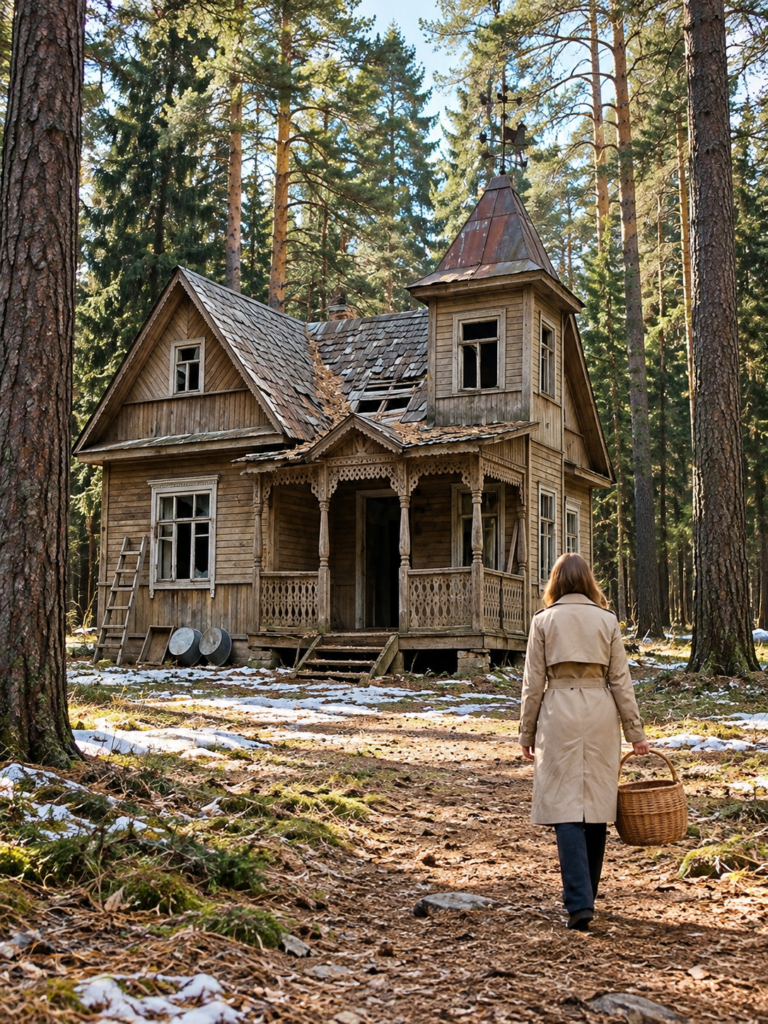
An online listing showed an old wooden cottage standing among tall pine trees. The photograph had been taken from the road, but Margaret could make out a steep roof, a crooked little tower above the front entrance, and a long porch disappearing into overgrown weeds.
Part of the roof had collapsed.
The windows looked like empty black squares.
The listing was brief.
OLD COTTAGE. AS-IS. PINE HOLLOW COMMUNITY, NORTHERN PENNSYLVANIA. STRUCTURALLY UNSAFE. OWNER WILL TRANSFER FOR $1 TO SOMEONE WILLING TO TAKE RESPONSIBILITY FOR THE PROPERTY.
Margaret read the words twice.
Then she zoomed in on the porch.
Beneath the peeling paint were decorative wooden posts and delicate, old-fashioned trim.
She remembered her grandmother’s summer cottage and how everyone used to gather on its porch after supper.
“There’s no roof,” Ellen said.
“I can see that.”
“You can’t live in a place without a roof.”
Margaret kept looking at the photograph.
“I don’t have one either.”
Ellen stared at her.
“Maggie.”
“I’m going to call.”
The owner was a thirty-year-old man named Kevin Whitaker.
He lived several hours away and had inherited the property from his grandmother, Eleanor, who’d died six years earlier.
He told Margaret the cottage had been deteriorating ever since.
The community association had repeatedly warned him about the falling tower and the dangerous roof.
A demolition contractor had quoted more than Kevin wanted to spend.
He’d kept the property taxes current, but he was tired of paying for a place he didn’t visit.
“I’ll cover the transfer paperwork and recording fees,” he told her. “You’d be taking it as-is. I want someone who understands that.”
Margaret asked him what had happened to the roof.
“It gave way after a bad winter. Once water got in, everything went downhill.”
“And the tower?”
“Leaning. Pretty badly.”
“Is there electricity?”
“Disconnected at the moment.”
“Water?”
“There’s a community well.”
Margaret looked at Ellen, who was shaking her head.
“I’d like to see it,” she said.
The next morning, Margaret took a regional bus toward the Pocono foothills.
The ride lasted nearly an hour and a half. The last stretch passed through pinewoods, small lakeside neighborhoods, and scattered vacation cabins.
Patches of dirty snow still lingered beneath the trees.
Pine Hollow was an aging cottage community near a wooded lake, with narrow roads, modest homes, and a few larger houses built by people who had money to spend.
Kevin waited outside the last property on a gravel road that ended near the forest.
He wore a clean jacket and looked as though he had an appointment somewhere else.
“You’re Margaret?”
“That’s right.”
He glanced at her wicker basket.
“You came all the way out here by bus?”
“Didn’t have much choice.”
Kevin opened the gate with his shoulder.
It sagged so badly that it scraped the ground.
Margaret walked inside.
The cottage was worse than the photographs.
Thick pine logs formed the exterior walls. Someone had once painted them dark green, but most of the paint had peeled away.
Half the roof had collapsed into the main room.
A small eight-sided tower leaned forward above the porch, its pointed roof crooked and rusted.
There were no glass panes in most of the windows.
Dead weeds grew through gaps between the porch steps.
The decorative trim, once painted white, hung in broken sections beneath the porch roof.
But the house had something the photograph hadn’t captured.
Presence.
It stood among the pines as though it had been waiting for someone to remember it.
Kevin followed her toward the porch.
“I wouldn’t go inside if I were you.”
Margaret stepped carefully onto the first stair.
“Why?”
“The ceiling’s coming down.”
“I’ll watch my head.”
The front door opened with a long wooden groan.
Inside, the main room was a wreck.
Broken rafters, wet boards, torn roofing material, leaves, and shattered glass covered the floor.
Rainwater had collected in shallow puddles.
The air smelled of damp wood and decay.
An old wall hanging depicting deer in a forest remained above a water-stained section of wall.
Margaret moved toward a doorway on the right.
The kitchen was smaller.
Its ceiling was intact.
The floor was dry.
Against one wall stood an old brick-lined wood cookstove with a black iron top and a stovepipe that disappeared into a chimney.
On the windowsill sat an empty glass pitcher.
Margaret ran her fingers across the dry wood beneath it.
Then she went outside.
Kevin was waiting by the gate.
“Well?” he asked.
Margaret looked up at the crooked tower.
“I’ll take it.”
Kevin blinked.
“Seriously?”
“Seriously.”
“You know the roof could cost more than this entire place is worth.”
“I know you listed it for a dollar.”
“That wasn’t exactly the point.”
“Then why did you list it?”
Kevin glanced toward the house.
For a moment, he looked embarrassed.
“My grandmother loved this place. My great-grandfather built it in 1952. He was a doctor, and apparently he liked building things with his hands. She spent every summer here.”
Margaret listened.
Kevin continued.
“I thought somebody might save it. But I figured everyone would just want the land.”
“I don’t want to tear it down.”
“Even looking at that roof?”
“Especially looking at that roof.”
Kevin studied her for several seconds.
Then he smiled, not because he thought she was foolish, but because he’d run out of arguments.
The property transfer took more than a handshake. Kevin arranged for the deed to be prepared, notarized, and recorded with the county. He explained the association obligations, the property taxes, and the warnings already attached to the cottage’s condition.
Margaret accepted the responsibility.
The price was one dollar.
When Kevin handed her the keys after the paperwork was completed, he showed her three on a rusty ring.
“Front door. Shed. And this little one—I have no idea.”
He held up a small brass key.
“My grandmother carried it for years. I found it with the others.”
Margaret slipped the ring into her coat pocket.
A woman in a quilted vest approached along the gravel road.
She had short gray hair, rubber boots, and a thick folder tucked beneath her arm.
“I’m Carol Briggs,” she announced. “President of the Pine Hollow Community Association.”
Her eyes moved from Margaret to the damaged roof.
“You’re the new owner?”
“That’s me.”
Carol opened the folder.
“I need to be very clear about something. This building is a hazard. Children have been climbing through the windows. That tower could fall onto somebody. We’ve given the previous owner repeated warnings.”
Margaret nodded.
“I’m going to repair it.”
Carol looked at the collapsed roof.
Then at Margaret’s basket.
“Repair it?”
“That’s the plan.”
“You have until fall to address the dangerous conditions. After that, the association will have to take further action under our rules.”
Margaret stood a little straighter.
“I understand.”
Carol closed the folder.
“Well. Good luck to you.”
She walked away.
Margaret watched her go.
By evening, the last bus had departed.
Margaret had planned to return to Ellen’s house, but she’d spent too long examining the kitchen and making a list of what could be saved.
Now she stood alone beneath the pines with a flashlight, a bag of clothes, some crackers, and her wicker basket.
She went into the kitchen.
Broken boards from an old bench lay across the floor. Empty cans and mouse nests filled one corner.
For two hours, she carried debris outside.
She swept with a worn broom found in the shed.
She covered the broken kitchen window with an old rug and moved an intact wooden bench against the wall.
She didn’t dare light the stove before someone checked the chimney.
Finally, she set her tea kettle on the windowsill beside the empty glass pitcher.
She lay down on the bench, using her bag as a pillow.
The air was bitterly cold.
Branches scraped against the damaged roof.
Somewhere beneath the floor, a mouse moved through the darkness.
Margaret pulled her coat around her shoulders.
She thought about Richard sitting in his comfortable living room.
About Daniel, who hadn’t called.
About her piano wrapped in blankets inside Ellen’s garage.
She wondered whether she’d made the worst decision of her life.
Then exhaustion caught up with her.
She slept.
Morning arrived with birdsong.
Margaret woke stiff and cold, but sunlight entered through the covered window.
She went outside and walked around the cottage.
The logs were enormous, some nearly as thick as her waist.
The foundation rested on large, well-set stones.
Where rain had poured through the collapsed roof, one section of wood was soft and damaged.
But elsewhere, the walls seemed solid.
Margaret knocked gently against a log.
A sharp, clear sound answered.
She knocked again.
Then moved to another log.
The sound was different near the damaged corner, duller and softer.
But the logs along most of the back wall answered with the same dry, clean knock.
She knew that sound.
For years, she’d listened to the wooden body of her piano, learning to distinguish healthy resonance from a loose panel or cracked sounding board.
She tested one of the carved porch posts.
Another clear knock.
Margaret stepped back.
The building wasn’t simply rotting away.
Most of its structure had survived. Water entering through the broken roof was destroying it a little more with every storm.
If that could be stopped, perhaps the rest could be saved.
She took an old pencil from a kitchen shelf and wrote on the back of her bus ticket.
Roof.
Tower.
Windows.
Stove.
Porch.
She underlined the last word twice.
A voice came from the road.
“Hey there! You the lady who bought Eleanor’s place?”
An elderly man stood outside the gate carrying a bucket.
He wore a faded work jacket and had broad hands stained from years of labor.
Margaret walked toward him.
“I’m Margaret.”
“Walter Bennett. Live across the road. Folks call me Walt.”
He glanced toward the chimney.
“You didn’t try firing up that old stove, did you?”
“No. Didn’t know if it was safe.”
“Good. Chimney’s probably full of nests.”
He let himself through the gate and examined the porch tower.
“I worked on that thing back in ’86,” he said.
Margaret turned.
“You did?”
“Replaced the shingles and some trim. Eleanor hired me when I was still working at the furniture factory.”
He studied the leaning corner.
“Rot’s in the support post. That’s why she’s tipping.”
“Can it be fixed?”
Walter looked at her.
“Depends.”
“On what?”
“Whether you’re serious about staying.”
Margaret glanced down at her hands.
Her fingers were scratched from yesterday’s cleanup, and dirt filled the lines of her palms.
“I’m staying.”
Walter nodded once.
“Then I’ll bring a jack tomorrow morning. Seven sharp. Get yourself some work gloves.”
He started toward the gate.
Margaret called after him.
“Mr. Bennett?”
He turned.
“I can’t afford to pay you much.”
Walter looked back at the house.
“Buy some decent coffee,” he said. “We’ll figure out the rest.”
The next morning, he appeared precisely at seven with a hydraulic jack, tools, a chainsaw, and two lengths of timber on a small cart.
He crawled beneath the porch, examined the rotten support, and explained his plan.
They would brace the tower, lift the sagging beam just enough to relieve the pressure, and replace the damaged post with sound lumber.
Walter had a piece of treated timber in his shed that he’d never used.
He insisted they could put it to better use here.
Margaret spent the day handing him tools, pulling ropes, and carrying boards.
The jack creaked.
The beam rose.
The crooked tower slowly straightened.
By late afternoon, Walter had cut away the decayed post and fitted the replacement.
He lowered the beam carefully into place.
Then he struck the new wood with the back of a hammer.
A clean, solid note rang out.
“That’s what you want to hear,” he said.
Margaret smiled.
“I know. That’s how I checked the walls yesterday.”
Walter looked at her with fresh interest.
“You did what?”
“Knocked on them.”
He laughed.
“Well, I’ll be. Maybe you aren’t as helpless as you look.”
She laughed too.
It was the first time she’d laughed since the divorce.
Together, they began clearing the collapsed main room.
The work was filthy.
The debris reached almost to Margaret’s knees in places. Rotten rafters, wet leaves, broken roof boards, and shards of glass came out one bag at a time.
Beneath the ruined section, the floorboards were badly damaged.
Elsewhere, they remained strong.
When Walter lifted the old deer wall hanging, he stopped.
“Look here.”
Someone had written directly on the logs in pencil.
JUNE 1952. LOWER COURSE: LARCH. UPPER WALLS: PINE.
Below it, in uneven childish letters, were the words:
ELLIE, AGE 8.
Walter touched the writing with one finger.
“Eleanor,” he said quietly. “Her daddy built this house, and she followed him around every day. She told me she’d written her name on the wall.”
Margaret traced the small letters without touching them.
For a moment, she imagined a little girl standing there seventy years earlier, proud to have contributed something to the construction.
Margaret left the writing uncovered.
She washed the wall hanging outside and later found a place for it in the kitchen.
They couldn’t afford to finish the roof.
Instead, Walter brought over a patched blue tarp and helped Margaret secure it over the opening as a temporary barrier.
When the next rainstorm came, Margaret stood in the main room and listened.
Water struck the tarp.
It ran down the outside of the house.
For the first time in years, it didn’t pour onto the floor.
Margaret stood there for several minutes, just listening.
She had never thought the sound of rain staying outside could be so beautiful.
By May, she had developed a routine.
She woke before sunrise, walked to the bus stop, and traveled to Scranton to teach.
In the evenings, she returned to Pine Hollow and worked until darkness made it impossible.
She cleaned floors, cleared weeds, scraped paint, and carried rubbish.
On weekends, Walter came by to help with anything requiring heavy tools or another pair of hands.
Most of Margaret’s paycheck went toward supplies.
She bought groceries, bus passes, her medication, and the cheapest household necessities she could manage.
The rest went into the cottage.
She repaid Ellen for the moving truck as soon as she could.
Ellen visited in late May.
At the gate, she stared at the blue tarp, the tower, and the piles of broken wood.
“Maggie, you have absolutely lost your mind.”
Then she stepped into the clean kitchen.
The old cookstove had been checked and made safe to use. The worn floor had been scrubbed, the little blue decorative tiles above the stove cleaned, and the tea kettle polished.
Ellen sat down on the bench.
“All right,” she said. “Maybe not completely.”
They drank coffee on the porch.
Ellen told Margaret that the piano was still safe in her garage, wrapped in blankets and protected from dampness.
Margaret reached across the table and squeezed her hand.
“I’ll bring it home when the roof’s finished.”
Ellen glanced upward at the tarp.
“Then we’d better get you a roof.”
When June arrived, the music school’s summer schedule gave Margaret more days at the cottage.
She began restoring the porch.
Beneath waist-high weeds lay five wide steps, decorative wooden railings, and intricate trim carved into little diamonds, flowers, and sunbursts.
She spent three days washing and brushing the wood.
Walter reproduced two missing pieces from the original patterns.
They smelled of fresh pine when he brought them over.
“How much do I owe you?” Margaret asked.
“About a thousand cups of coffee.”
“Walt.”
“Don’t argue with an old cabinetmaker. We enjoy being difficult.”
Margaret painted the porch white.
While she worked, she hummed pieces she had taught for years.
One morning, she noticed a little girl standing outside the gate.
The child wore a sunhat and carried a small plastic bucket.
“What song is that?” the girl asked.
“Tchaikovsky.”
“Sounds sad.”
“It is. It’s called ‘The Sick Doll.'”
The girl considered that.
“Does the doll get better?”
“There’s another piece about getting a new doll.”
“Is that one happy?”
“Very.”
The girl smiled.
Her name was Emma Caldwell.
She was nine and spent her summers with her grandmother, Ruth, two houses down.
Emma came back the next day.
And the next.
She asked about the tower, the broken roof, the deer hanging in the kitchen, and whether the cottage was haunted.
“The only ghost I’ve seen is a mouse beneath the floor,” Margaret told her.
A few days later, Emma discovered Margaret taught piano.
“Where’s yours?”
“Staying with a friend until I finish the roof.”
“How do you teach without a piano?”
Margaret considered that question.
Then she found a cardboard box, cut it flat, and drew two octaves of piano keys across its surface.
She placed it on the porch table.
“Sit down.”
Emma stared at the cardboard.
“It doesn’t make any noise.”
“That’s why I have to sing.”
Margaret showed her how to curve her fingers and where to place her thumbs.
When Emma pressed a drawn key, Margaret sang the note.
The girl laughed so hard that she kept losing her place.
Within a week, she could play a C-major scale on the cardboard while Margaret sang along.
Ruth came to thank her.
She brought homemade pickles, potatoes, and a tray of blueberry muffins.
Then she asked whether Margaret might teach two other children in the neighborhood.
Margaret agreed.
By July, a mother from farther down the road had asked for regular lessons for her seven-year-old son.
She insisted on paying.
Margaret hesitated before accepting fifteen dollars a lesson.
The money wasn’t much.
But fifteen dollars could buy a few boards, a box of screws, or another small part of a window.
She also began selling tomato and flower seedlings beside the gate.
Ellen had brought Margaret’s old pots from Scranton, including the red geranium Daniel had carried out of the house.
Margaret replanted it in fresh soil and placed it at the end of the porch railing.
By midsummer, the leaves had thickened and new red blossoms had appeared.
The first Sunday gathering happened by accident.
Ruth arrived with Emma.
A neighboring woman brought her grandchildren.
Walter crossed the road with a bowl of raspberries.
Someone else appeared carrying a pie.
Margaret brought out coffee, tea, a plate of cookies, and every mug she could find.
They sat on the newly painted steps and talked.
Someone complained about the price of groceries.
Someone else mentioned the recent rain.
The children chased one another between the pine trees.
Ruth looked along the porch railing and suddenly smiled.
“Eleanor used to do this.”
Margaret turned.
“Do what?”
“Have everybody over. Sunday afternoons, mostly. She’d put out tea, lemonade, cookies, whatever she had. We’d all come wandering up the road.”
Ruth looked toward the tower.
“She made this whole place feel like it belonged to the neighborhood.”
Margaret said nothing.
She looked at the children sitting on the steps, at Walter eating raspberries, at Ellen laughing with Ruth near the kitchen door.
The roof was still covered with a tarp.
The paint was unfinished.
And the floors inside needed work.
But for the first time since the divorce, Margaret wasn’t thinking about all the things she’d lost.
She was thinking about the people who had come through her gate.
The following Sunday, eleven adults arrived.
The Sunday after that, more came.
They carried cookies, lemonade, paper napkins, coffee, and their own mugs.
Word spread along Pine Hollow Road.
Margaret had never invited the whole neighborhood.
Somehow, it had begun showing up anyway.
And on the third Sunday in July, Carol Briggs, the community association president, walked through the gate carrying her familiar folder.
She stopped beneath the tower and surveyed the crowded porch.
“Margaret,” she announced, “do you understand what kind of liability you’re creating by having people gather beneath a structure that hasn’t been fully cleared?”
Walter rose from his chair.
“Carol.”
She turned.
He pointed toward the repaired tower support.
“The bad post’s been replaced. We’ve got it braced and we’re working through the rest. You can come have a look at the repair.”
Carol inspected it from a safe distance while Walter explained what they’d done.
She listened with her arms folded.
Then she looked toward Margaret.
“And that roof?”
“Working on it.”
Carol sighed.
“Well, you had better finish before the snow comes.”
Margaret nodded.
“I intend to.”
Carol looked at the table.
Then at the empty chair beside Ruth.
“Is that blueberry pie?”
Ruth smiled.
“There’s a slice left.”
Carol hesitated.
Then she closed her folder and sat down.
She stayed for almost an hour.
When she left, she stopped beside Margaret at the gate.
“I’m not trying to make your life miserable,” she said. “I’ve lived here forty years. I know what our winters can do.”
“I know.”
“That tarp won’t last.”
Margaret looked up.
Three new tears had already appeared along its edges.
Carol followed her gaze.
“Get the roof done, Margaret.”
Then she walked home.
That evening, after everyone had gone, Margaret sat alone on the porch.
She added up her receipts.
The new rafters would take nearly everything she’d saved.
She still needed roof sheathing, metal panels, and the remaining supplies.
Autumn was coming.
The old cottage had begun to feel like home.
Now Margaret had to find a way to keep it standing.
Part 2
By the end of July, the cottage had become the first thing Margaret thought about when she woke and the last thing she thought about before falling asleep.
She knew which porch board creaked beneath her left foot. She knew which kitchen window let in the strongest morning light. She knew the exact hour the sun reached the small patch of garden where she’d planted marigolds and sweet peas.
And she knew how much every improvement had cost.
She kept the receipts in an old cookie tin above the stove.
Each one represented something she’d gone without.
A restaurant meal.
A new winter coat.
A trip to visit her sister.
Sometimes just the comfort of knowing she had money left in the bank.
Walter never asked her to spend more than necessary.
He called a friend who worked at a local sawmill and arranged discounted lumber for the roof framing. He reused sound boards whenever possible and taught Margaret how to identify damaged wood rather than throw everything away.
They installed the new rafters during the hottest days of July.
Walter climbed the ladder slowly while Margaret held it steady from below. She passed lumber up using a rope and watched the fresh timber gradually form a clean, regular pattern against the sky.
After four days, ten new rafters stood where the broken roof had collapsed.
Margaret stepped into the yard and looked up.
The house reminded her of an overturned wooden boat being repaired before it returned to the water.
“Looking better, isn’t she?” Walter asked.
“She looks like she might actually survive.”
Walter took off his cap and wiped his forehead.
“Just don’t start celebrating until she’s watertight.”
In August, Margaret made a costly mistake.
Walter’s friend at the sawmill was away, and she didn’t want to lose two weeks waiting for his return.
A man at a building-supply yard offered her a load of roof boards at a substantial discount.
They looked straight.
They smelled of fresh pine.
And the price was nearly two hundred dollars less than she’d expected.
She bought them.
When Walter inspected the delivery, he lifted one board and frowned.
“These are green.”
“Green?”
“Fresh-cut. Haven’t dried properly.”
Margaret felt her stomach tighten.
“Can we still use them?”
Walter examined the stack.
“We can try. But wood moves when it dries.”
She decided to take the chance.
For a week they worked, attaching the boards across the rafters.
Then the rain came.
Warm August storms soaked the roof, followed by days of bright sunshine.
The lumber began drying unevenly.
One morning, Margaret stepped outside and discovered that several boards had twisted upward while others had bowed toward the rafters.
A few fasteners had started pulling loose.
Walter climbed up, examined the damage, and came down without speaking.
Margaret watched his face.
“Tell me.”
“We can’t lay metal roofing over that. It’ll never sit right. Water will find its way underneath.”
She sat on the porch steps.
For several minutes, she couldn’t say anything.
They’d spent money she couldn’t replace and days of work she couldn’t get back.
“I’m sorry,” she whispered.
Walter settled beside her.
“Don’t waste energy apologizing to lumber.”
She looked at him.
“What can we save?”
“About half. Maybe more, if we’re lucky. We’ll pull it down, stack it properly, and see what straightens.”
“And the rest?”
“Firewood.”
Margaret closed her eyes.
Then she stood.
“Where do we start?”
For two more weeks, they removed boards, dried them under cover, and replaced the worst pieces.
Walter’s sawmill friend returned with seasoned lumber.
By the end of August, the roof decking was finally ready.
But Margaret’s roofing fund had almost disappeared.
She had enough for only a small portion of the green metal panels she needed.
September brought the school term and her regular teaching schedule.
Margaret returned to Scranton each weekday.
The summer children went home, leaving only Emma and one little boy who continued Saturday lessons.
The roadside seedlings were finished for the season.
At the end of the month, Margaret had purchased enough metal to cover roughly a third of the roof.
The rest remained beneath worn tarps and temporary sheeting.
The tower’s pointed roof was still unfinished.
Every evening, she studied the weather forecast.
Every morning, she checked the sky.
One Wednesday night, her phone rang.
It was Richard.
She stared at his number before answering.
“Hello?”
“Maggie. It’s me.”
“I know.”
“Daniel told me you bought some old cabin up in the Poconos for a dollar. Is that true?”
“Yes.”
Richard gave a short laugh.
“Unbelievable.”
Margaret said nothing.
“Listen, I’ve got a friend who buys properties around there. Lakefront, wooded lots, that kind of thing. He might be interested in yours.”
“It’s not for sale.”
“Don’t be stubborn. The land might be worth something, even with that wreck sitting on it. He’d tear the place down and give you enough to rent a decent apartment.”
Margaret looked toward the kitchen wall.
The old deer hanging had been cleaned and carefully mounted. Beneath it, the words written in pencil in 1952 remained visible.
“I’m not selling.”
“Maggie, you’re fifty-nine years old. You’re not going to survive a Pennsylvania winter in a broken-down cabin.”
“I’ll manage.”
“That’s what you always say. I’m trying to help.”
Margaret thought about the morning he’d laughed at her through the taxi window.
“You told me I had enough money for a shack, Rick.”
“So?”
“Well, you were right. I found one.”
Richard sighed sharply.
“Fine. Freeze out there if you want. Just don’t call me when the roof falls in.”
He hung up.
Margaret stood holding the phone.
Her hands were trembling.
She set it down, added another log to the stove, and walked onto the porch.
The tarp snapped in the wind.
She looked at the exposed rafters and tried not to imagine snow piling on top of them.
By early October, nighttime temperatures had fallen below freezing.
Frost covered the grass.
One morning, a strong wind tore loose a corner of the protective sheeting.
Margaret went outside in her coat and boots, staring up at the damaged section flapping above the main room.
The roof was only one-third finished.
She needed more metal panels.
She had almost no money until her next paycheck.
And Walter had been confined to bed for several days after a serious spike in his blood pressure.
Margaret stood on the porch looking at the bare tower framing.
For the first time since purchasing the cottage, she wondered whether everyone had been right.
Ellen.
Carol.
Richard.
Perhaps she was simply a stubborn older woman who couldn’t admit she’d made a terrible mistake.
She went inside, prepared coffee, and sat beside the stove.
The following Saturday, Margaret awoke to hammering.
At first, she thought another section of roofing had blown loose.
Then she heard voices.
She pulled her coat over her nightgown, put on her boots, and hurried outside.
People were standing by the gate.
Nine at first glance.
Then more came along the road.
Two men pushed a cart carrying a stack of dark-green metal roofing panels.
Behind them came neighbors carrying tools, extension cords, ladders, and food.
At the front stood Carol Briggs.
Her folder was tucked beneath one arm.
“Morning, Margaret,” she said.
Margaret stared.
“What’s going on?”
Carol opened the folder and removed a piece of paper.
“The association held a meeting Wednesday.”
Margaret’s heart sank.
Carol continued.
“Earlier this summer, we replaced the roof on the community storage building. There were eleven unused metal panels left over. They’ve been sitting under the maintenance shed roof ever since.”
She held up the paper.
“The members voted to donate them toward eliminating the dangerous conditions at your property.”
Margaret stared at the panels.
“You’re giving them to me?”
Carol cleared her throat.
“Technically, we’re using surplus association material for a community safety project.”
A man behind her chuckled.
Carol ignored him.
“Almost everyone who voted has been to your Sunday gatherings. Only one person voted against it.”
Ruth stepped forward with Emma beside her.
“We brought sandwiches.”
Another neighbor carried a slow cooker.
A woman named Olivia introduced her husband, Mike, who worked professionally as a roofer.
He’d brought his tools and a few coworkers willing to donate their weekend.
Two younger men visiting family for the weekend offered to carry materials.
And near the side of the gate stood Walter Bennett, pale and wrapped in a thick jacket.
Margaret hurried toward him.
“What are you doing out of bed?”
Walter held up a hand.
“I’m not climbing anything. I’m supervising.”
“You should be resting.”
“Then find me a chair.”
They brought out the kitchen chair and placed it in the yard where he could see the roof.
Walter sat with a blanket around his legs and began giving instructions.
Mike and his crew inspected the framing and checked the work that had already been completed. The repaired supports and newly installed decking had to pass his judgment before they proceeded.
He made a few adjustments, checked the flashing, and organized the volunteers.
Then the work began.
Metal panels rose on ropes.
Cordless drivers buzzed.
Ladders shifted.
People called measurements back and forth.
In the kitchen, Ruth and Carol heated soup and prepared sandwiches.
Emma moved between the workers carrying a box of screws, asking each person how many they needed.
Margaret tried to help everywhere at once.
By Saturday evening, the large damaged section was covered.
By Sunday evening, the second slope was complete.
Mike stood near the ridge and waved down at the yard.
Margaret looked up.
The roof was green.
Straight.
Solid.
No gaping hole.
No blue tarp flapping in the wind.
For several seconds, she couldn’t speak.
Walter watched her from his chair.
“Not bad for a shack.”
Margaret laughed, then put a hand over her mouth.
Her eyes were burning.
She turned toward him.
“Did you organize all this?”
“I called Carol.”
“And?”
“That’s it. Turns out she knows how to get things done.”
Carol, standing nearby with a coffee mug, pretended not to hear.
The tower roof remained.
There weren’t enough full sheets to cover its eight-sided pointed cap, so Mike proposed cutting and shaping leftover pieces to fit.
He needed another dry weekend.
It came the following Sunday.
Mike worked on the tower from morning until late afternoon, cutting, bending, and fastening eight dark-green sections around the pointed frame.
At the top, he reinstalled an old metal rooster weathervane Margaret had found in the weeds.
It was rusty and missing part of its tail.
Margaret had insisted on keeping it.
“Looks like he’s survived a few things,” she told Mike.
“So has the house,” he answered.
The first snow arrived that October, not long after the tower was finished.
Margaret woke to an unusual stillness.
She opened the kitchen door.
The pines were white.
The porch steps were white.
The cottage roof was covered in an even layer of snow.
Nothing dripped through.
Nothing flapped.
No water ran down the interior walls.
The house was quiet.
Margaret went back inside, lit the stove, and sat on the wooden bench while the kettle warmed.
Then she began to cry.
Not the desperate tears she’d expected when she left Richard.
These came quietly.
She’d kept telling herself to hold on until the next paycheck, the next weekend, the next repair.
Now the roof was finished.
She allowed herself a few minutes to feel what that meant.
Then she dried her face, drank her coffee, and caught the bus to work.
Winter was difficult, but manageable.
Margaret closed off the large room to conserve heat and lived mostly in the kitchen.
She purchased firewood with her November paycheck, and Walter helped stack it under the shed roof.
She graded music assignments beside the stove, made simple dinners, and played checkers with Walter when he came over.
Ellen visited whenever the roads were clear.
Carol sometimes stopped by with groceries or a newspaper.
On New Year’s Eve, the three neighbors shared a modest supper.
Carol brought potato salad and sparkling cider.
Walter brought an evergreen branch and set it in the glass pitcher that had belonged to Eleanor.
The little kitchen smelled of wood smoke, coffee, and pine.
No one made a speech.
At midnight, they wished one another a happy new year.
Margaret could not remember a quieter celebration.
Or one she’d enjoyed more.
In January, she finally discovered what the smallest key was for.
She’d climbed the narrow staircase into the tower to check for leaks after several days of snow.
The little eight-sided room was cold but dry.
An old cupboard stood against one wall.
When Margaret moved it slightly to inspect the timber behind it, she discovered a narrow wooden door she’d never noticed before.
It was scarcely waist-high.
A small brass lock sat beneath the handle.
Margaret stood staring at it.
Then she remembered Kevin’s key ring.
She went downstairs, retrieved it, and returned.
The smallest key slid into the lock.
It turned.
Behind the door was a shallow storage closet.
Inside stood an old copper hot-water urn, the kind once used for serving tea to a crowd. Its surface had turned green with age, and one wooden handle was broken.
Beside it lay a box of tarnished teaspoons.
Under the spoons was a stack of yellowed recipe cards.
Margaret carried them toward the little window.
The handwriting was neat and rounded.
Blueberry pie.
Molasses spice cookies.
Honey biscuits.
Preserved berries.
On the final card, Eleanor had written a short instruction.
SUNDAY TEA. FIVE O’CLOCK. EVERYONE WELCOME.
Margaret sat on the wooden floor.
For months, she’d believed the Sunday gatherings were something she’d begun herself.
Now she understood.
The porch had been gathering people long before she arrived.
Eleanor had built a small tradition out of tea, homemade food, and an unlocked gate.
And without knowing it, Margaret had brought that tradition back.
She remained in the tower until the cold drove her downstairs.
Throughout the rest of winter, she cleaned the old urn with care.
She polished the copper, cleaned the spout, and asked Walter to make a replacement handle.
By February, it gleamed in the firelight.
Margaret set it on a kitchen shelf beside Eleanor’s old glass pitcher.
She put the recipe cards safely in her wicker basket.
One evening, while she sat listening to the fire, she thought about the old woman’s handwriting.
Everyone welcome.
Not everyone who could afford to pay.
Not everyone who belonged to a particular family.
Not everyone who had helped repair the house.
Everyone.
Margaret looked through the kitchen doorway toward the closed-off room where her piano would eventually stand.
For the first time, she understood what she’d been rebuilding.
It wasn’t only a roof and four walls.
It was a place where people could come without being asked to prove what they were worth.
Part 3
Spring arrived late in Pine Hollow.
Snow clung to the shaded side of the cottage until the end of March. When the thaw finally came, heavy sheets slid from the green metal roof and landed beside the house with dull thuds.
Every time Margaret heard one, she went outside to inspect the gutters and eaves.
Nothing had shifted.
Nothing had leaked.
The new roof had survived its first winter.
Walter joined her one sunny afternoon as she walked around the cottage, inspecting the logs.
They checked the damaged corner where water had once poured down the wall.
The wood had dried considerably, though one section still needed eventual replacement.
Walter marked the area in his notebook.
“We’ll keep an eye on it,” he said. “No need to pretend it’s perfect. But there’s no reason to tear the whole house down.”
Margaret looked up at the tower.
The little rooster turned slowly above its green roof.
“A year ago, I didn’t think we’d get this far.”
Walter made a sound in his throat.
“A year ago, you didn’t know which end of a hammer to hold.”
“I still don’t, half the time.”
“Yeah, but now you know enough to ask before using it.”
She smiled.
In March and April, Margaret spent nearly every extra dollar on the cottage.
A local glass repairman came to measure the remaining windows.
Walter built two replacement wooden frames, copying the six-pane design from the originals.
When the last glass was installed, Margaret walked slowly through every room.
Sunlight fell across the newly repaired floor.
The large room, once filled with rotten boards and standing water, had become dry and bright.
She opened a window.
Fresh pine air moved through the house.
She remembered her first night sleeping beside the cold stove while the broken roof groaned in the wind.
Now she could stand in the main room and hear birds outside.
She decided to repaint the cottage in its original color.
At the hardware store, she handed the clerk a small chip of green paint she’d carefully removed from one of the logs.
“Can you match this?”
The clerk examined it.
“Pretty old color.”
“Pretty old house.”
He matched the shade as closely as he could.
The following weekend, Margaret set out brushes and paint cans beside the porch.
Neighbors began arriving.
Ruth came first.
Then Carol.
Walter brought his smaller brushes and immediately began complaining that everyone else was painting too fast.
Emma helped with the lower sections she could safely reach.
By the second weekend, the dark-green walls had been renewed and the porch trim shone white against them.
The tower stood straight.
The old metal rooster turned above the roof.
Flowerpots lined the railing.
Fresh green shoots appeared where Margaret had planted seeds near the steps.
The cottage looked cared for.
It looked occupied.
It looked loved.
On the last Friday in April, Ellen arrived in the same moving truck she’d hired a year earlier.
Margaret was working near the gate when she heard the engine.
The truck stopped.
Ellen climbed from the passenger side and waved.
“Got a delivery for you!”
The driver opened the back.
Inside stood Margaret’s black Wurlitzer piano, wrapped in blankets and secured with heavy straps.
Margaret didn’t move.
For a moment, she was back on the street outside Richard’s house, watching her husband and son carry that piano toward the curb.
She could almost hear the sound it had made when it struck the doorframe.
Walter came around the corner carrying a paintbrush.
“Well, don’t just stand there,” he called. “Let’s get that thing inside.”
Mike and several neighbors helped unload it.
They carried it along the path, up the five white porch steps, and through the front door.
Slowly.
Carefully.
Not once did it touch the doorframe.
They placed it against the wall where Eleanor had written her name in 1952.
Margaret ran a hand across its worn black surface.
“Welcome home,” she whispered.
A piano technician from her music school arrived the next day.
He opened the instrument, inspected the action and strings, and began the long process of bringing it back into tune.
Ellen’s care had helped protect it, though a year in storage had not been kind to the instrument.
Margaret stayed in the kitchen while he worked.
She found the tightening strings and uneven notes almost painful to hear.
In the late afternoon, he called her.
“All right, Maggie. Give it a try.”
She entered the room.
The piano stood beneath the open window.
Margaret sat on the bench and placed her hands on the keys.
She began with a C-major scale.
One note.
Then another.
The instrument answered.
She played slowly at first, listening to the familiar sound settle into the room.
Then she began Tchaikovsky’s “Sweet Dream,” one of the pieces she’d taught for years.
The melody drifted through the windows and onto the porch.
It moved between the pine trees and out toward the road.
When she finished, Margaret turned around.
People were standing outside her gate.
Ruth was there.
Carol stood beside her.
Walter leaned against the fence.
Emma stood in front of everyone with her hands wrapped around the wooden pickets.
Nobody had been invited.
They had simply heard the music.
Margaret went onto the porch.
“Sunday,” she announced. “Five o’clock. We’re having tea. Bring a mug.”
Emma grinned.
Then she ran home.
By evening, she’d painted a sign on a piece of plywood.
SUNDAY PORCH TEA — 5:00 PM
EVERYONE WELCOME. BRING A MUG!
Walter nailed it beside the gate.
The first warm Sunday of the season arrived with clear skies and gentle sunshine.
Nearly forty people gathered at Margaret’s cottage.
Children sat on the steps.
Neighbors filled the porch chairs.
Extra benches had been brought from nearby houses.
The newly painted railings were decorated with flowerpots, and young nasturtiums had begun climbing around the posts.
In the center of the table stood Eleanor’s polished copper tea urn.
Margaret had filled it with hot water from the kitchen.
Beside it were teapots, coffee, homemade blueberry pie, and a large plate of molasses cookies.
She’d made the cookies using Eleanor’s recipe.
Ruth tasted one and stopped chewing.
Margaret noticed.
“What’s wrong?”
Ruth looked at the cookie.
“Nothing.”
“Are they too sweet?”
Ruth shook her head.
“I haven’t tasted these in forty years.”
She looked toward the tower.
“Eleanor made them exactly like this.”
Margaret put a hand on her shoulder.
“Then I guess the recipe still works.”
The two women smiled.
From inside the house came the hesitant notes of a C-major scale.
Emma was sitting at the real piano.
For almost a year, she’d practiced finger positions on a cardboard keyboard.
Now she could hear every key she pressed.
The scale was uneven.
She slowed down halfway through, stumbled over a note, and started again.
When she reached the end, the people on the porch applauded.
Emma’s laughter floated through the open window.
Margaret was pouring another cup of tea when she heard a car slowing outside.
She looked up.
A silver sedan stopped beside the gate.
She recognized the dent above the rear wheel.
Richard had never bothered having it repaired.
He stepped out first.
Daniel followed.
The two men stood on the gravel road, staring at the cottage.
Neither spoke.
Richard looked at the dark-green roof.
Then at the straight tower, with its pointed cap and little rooster.
Then at the white porch crowded with people.
He looked around as though he’d turned onto the wrong road.
A woman carrying a pie walked past him.
“Excuse me,” Richard said. “We’re looking for an old place with a tower. Broken roof. I was told it was around here.”
The woman looked at him strangely.
“You’re standing in front of it.”
Richard turned back toward the cottage.
Margaret watched him from the top step.
She wore a light blue dress and a knitted cardigan.
Her hair was pinned back, and she held a kettle in one hand.
For a long moment, Richard simply stared.
Daniel looked from the porch to the house, then toward the garden.
He seemed equally unable to reconcile what he was seeing with what he’d expected.
Margaret set the kettle on the table.
Then she descended the five white steps and walked to the gate.
“Hello, Rick.”
Richard cleared his throat.
“Well, I’ll be damned.”
She looked at Daniel.
“Hello, sweetheart.”
“Hi, Mom.”
He sounded uncertain.
Richard glanced up at the roof again.
“My friend told me you’d fixed the place up. He drove past here last week. Said I wouldn’t believe it.”
Margaret waited.
Richard gestured toward the cottage.
“You did all this?”
“Not by myself.”
She turned and indicated the people on the porch.
“They helped.”
Several neighbors watched from their chairs.
Walter set down his mug.
Carol folded her hands in her lap.
Richard nodded slowly.
“Well, it’s impressive. I’ll give you that.”
Margaret said nothing.
He shifted his weight.
Then his voice changed.
It became softer and more familiar.
The voice he’d once used when he wanted Margaret to agree to something she hadn’t chosen.
“Listen, Maggie. We were married a long time. Thirty-four years. There’s no reason for us to act like strangers.”
Margaret looked at him.
“All right.”
“And this is a pretty big place for one person.”
“It’s just right for me.”
Richard gave a brief laugh.
“Sure, sure. But I’m thinking, Daniel could use a place to get away from the city now and then. Summer weekends, maybe. He’s working hard at the dealership.”
Daniel glanced toward his father.
Richard continued.
“You’ve got that tower room upstairs. He could stay there. And I could come up and help with things. I’ve got plenty of tools in the garage.”
Margaret watched him.
She had learned something during the past year.
When a person wanted something from her, she no longer had to answer immediately.
She could listen.
She could think.
And she could decide.
Richard went on.
“Actually, there’s something else we ought to consider. You know, for the future.”
He lowered his voice slightly, though not enough to keep the people on the porch from hearing.
“Why not put the property in Daniel’s name? Save everyone a headache when it comes to inheritance later. It would still be your home, obviously.”
Daniel looked startled.
“Dad—”
Richard raised a hand.
“I’m just talking about being practical.”
Margaret looked from her former husband to her son.
She remembered standing in Richard’s kitchen, looking at the sheet of paper dividing their belongings.
She remembered the chipped blue cup she’d been told to leave behind.
She remembered the piano on the curb.
And she remembered Richard’s laughter through the taxi window.
Strangely, she wasn’t angry.
The anger she’d carried during those first weeks seemed to have been worn down by work, cold mornings, and the steady company of people who’d never asked what she could give them in return.
“Rick,” she said.
He stopped talking.
“This cottage is not for sale.”
He frowned.
“I didn’t say sell it.”
“And I’m not transferring it to anybody.”
“Maggie, I’m thinking about Daniel.”
“So am I.”
She looked at her son.
“Daniel is welcome to visit me. But that doesn’t mean he owns my house.”
Richard’s face reddened.
“You’re making it sound like I’m trying to take something from you.”
Margaret kept her voice calm.
“I’m saying what I want.”
Behind her, the porch remained quiet.
She continued.
“I paid one dollar for this place. You laughed when you said I could afford a shack.”
Richard looked away.
“That was a joke.”
“It didn’t feel like one.”
He opened his mouth, but Margaret wasn’t finished.
“This house was falling apart when I got here. Walt helped me repair the tower. My neighbors helped replace the roof. People brought food, lent tools, taught me things, and worked beside me when they didn’t have to.”
She glanced toward the porch.
“They helped make it a home.”
Then she looked at Richard again.
“Sunday tea is open to everybody. You’re welcome to come sit down and have a cup.”
She paused.
“But that’s all I’m offering.”
Richard stared at her.
For a moment, he seemed unable to find an answer.
Then he glanced toward the porch, where forty people had heard every word.
“Fine,” he muttered.
He turned toward the car.
“Stay here with your little country club.”
He reached the driver’s door and called over his shoulder.
“Daniel. Come on.”
But Daniel didn’t move.
He was looking past Margaret toward the porch railing.
She followed his gaze.
At the far end, beside the climbing flowers, stood a red geranium.
Its leaves were thick and glossy.
A dozen bright flower heads rose above the pot.
Daniel stared at it.
Margaret knew what he was remembering.
A year earlier, he’d carried that same plant out of the house while his father told her to leave.
He’d held it near the piano and looked at the ground while Richard laughed.
Now it stood in full bloom.
“Mom,” Daniel said quietly.
“Yes?”
He swallowed.
“Could I have some tea?”
Margaret looked at him for a moment.
Then she opened the gate.
“Of course.”
Richard honked the horn.
Daniel flinched but didn’t turn.
Margaret led him along the garden path.
Behind them, Richard sat in the car for another minute.
Then the engine started.
The silver sedan drove away, raising dust along the gravel road.
No one followed it with their eyes.
Margaret guided Daniel up the five white steps.
Walter shifted along the bench to make room.
She poured tea into a blue mug and placed one of Eleanor’s molasses cookies beside it.
Daniel held the mug with both hands.
For a while, he didn’t drink.
Inside the house, Emma began another hesitant scale.
Daniel raised his head.
“Who’s playing?”
“One of my students. Emma. She’s nine.”
“She’s pretty good.”
“She’s learning.”
Margaret smiled.
“Last year, she practiced on a keyboard I drew on cardboard.”
Daniel looked at her.
Then a small smile crossed his face.
“You used to do that for me.”
“I remember.”
“I couldn’t wait until I got big enough to play the real piano.”
“You used to bang on the bottom keys and scare the cat.”
Daniel laughed.
It was the first time Margaret had heard him laugh in months.
He stayed all afternoon.
He helped carry chairs, wash mugs, and bring the leftover food into the kitchen.
He listened when Walter told him how they’d straightened the tower.
He examined the photographs Ellen had taken during the repairs.
And when he stood in the main room beside the old Wurlitzer, he ran his hand over its black wooden top.
“I thought Dad was going to get rid of it,” he said.
“He probably would have.”
Daniel looked down.
“I should’ve helped you.”
Margaret continued arranging cups on a tray.
“You did what you thought you needed to do.”
He shook his head.
“No. I didn’t think.”
She put down the tray.
Daniel looked toward the window.
“Dad told me you were fine. That you’d taken money from the divorce and had somewhere to live. He said you were just making things difficult.”
Margaret listened.
“I never asked you,” he said. “I should have asked.”
“Yes,” she answered.
Daniel nodded.
He didn’t try to defend himself.
He didn’t ask her to forget what had happened.
And Margaret was grateful for that.
Near evening, he prepared to leave.
At the gate, he turned toward her.
“Mom?”
“Yes?”
“Could I come next Sunday?”
Margaret smiled.
“Five o’clock.”
Daniel looked relieved.
“Should I bring anything?”
“Bring your own mug.”
He laughed softly.
Then he hugged her.
It was awkward at first, the embrace of two people who had allowed a long silence to grow between them.
But he held on a moment longer than she’d expected.
Margaret watched him walk toward the bus stop.
She didn’t know what their relationship would become.
One visit couldn’t repair a year of hurt.
But the gate had been opened.
For now, that was enough.
That evening, after the neighbors had gone home, Margaret washed the cups in the kitchen.
There were mugs of every size and color.
Some belonged to her.
Some had been left by visitors.
She arranged them in neat rows so everyone could collect them the following Sunday.
Eleanor’s old tea urn stood on the porch table, cooling.
The kitchen windows reflected the last orange light among the pine trees.
On the windowsill sat Margaret’s wicker basket.
The same basket she’d held in the taxi a year earlier.
Inside were Eleanor’s recipes and several packets of flower seeds for the coming summer.
Beside it stood her sister’s old tea kettle.
Near the kettle lay a small abandoned bird’s nest she’d removed from the stove chimney during that first spring.
It was woven from dried grass and pine needles.
Margaret had never been able to throw it away.
She stepped onto the porch.
The evening was still.
For a moment, she thought about how little she owned when she first arrived.
A basket.
A tea kettle.
Some clothes.
An old piano waiting in somebody else’s garage.
And a house nobody wanted.
She didn’t have a fortune now.
Her income was still modest.
There would always be repairs to make, expenses to manage, and practical problems to solve.
But when she looked at the white porch steps, she remembered the forty people who’d gathered there that afternoon.
The cottage was no longer unwanted.
Neither was she.
A week later, an email arrived from Kevin Whitaker.
He’d seen photographs of the restored house that Ruth had shared with him.
He wrote that he’d stared at them for a long time.
He had barely recognized his grandmother’s cottage.
Attached was a black-and-white photograph he’d discovered in an old family album.
It showed the same porch.
The same carved railing.
The same tower.
A crowd of people sat around a long table.
Women wore light summer dresses.
Children crowded the steps.
An old copper tea urn stood in the center.
And near the table sat a little girl of about eight with braided hair.
Kevin’s note was short.
That’s my grandmother, Eleanor. Summer of 1952. The first year the cottage was finished.
Thank you for saving it.
Margaret printed the photograph at a shop in Scranton.
She framed it and hung it in the kitchen, close to the exposed pencil writing on the logs.
Eleanor’s childhood handwriting remained faint but legible.
ELLIE, AGE 8.
Margaret often stopped to look at the photograph while waiting for the kettle to boil.
She wondered whether Eleanor had understood what her father was giving her when he built that house.
Not money.
Not a grand estate.
Just a place where people could gather and feel welcome.
By midsummer, the Sunday teas had become a regular part of life in Pine Hollow.
Margaret no longer had to organize them.
Neighbors brought food.
Children helped arrange the chairs.
Emma learned to make Eleanor’s molasses cookies.
Walter kept the porch steps in good repair.
Carol made sure the association’s community calendar included the gathering.
One Sunday afternoon, Margaret asked Carol to stay after the guests had left.
She handed her a spare house key.
Carol looked surprised.
“What’s this for?”
“If I ever get sick, or go visit my sister, I don’t want everyone arriving to find a locked door.”
Carol turned the key over in her hand.
Margaret glanced toward the copper urn.
“Sunday tea should still happen. Five o’clock. Walter knows how to set everything up, and Emma can already bake the cookies.”
Carol was quiet for a moment.
Then she opened her familiar folder and slipped the key into a small pocket inside.
“I’ll take care of it,” she said.
Margaret smiled.
“I know you will.”
Later that evening, Emma came over for her piano lesson.
The little girl sat beside Margaret on the old bench, studying the sheet music.
They had been working on another piece from Tchaikovsky’s Album for the Young.
“Ready to try ‘The New Doll’?” Margaret asked.
Emma nodded.
“Remember your hands.”
Emma curved her fingers, keeping them relaxed as Margaret had taught her.
Margaret moved aside.
She watched Emma place her small hands on the keys.
Then Margaret stood and walked through the open doorway onto the porch.
The sun was sinking behind the pines.
Sweet peas climbed the white railings.
The wooden steps were warm beneath her feet.
She sat on the top one, where she’d sat that first cold morning with a cup of weak tea and no idea what the future held.
Inside, Emma began to play.
The music was hesitant.
A few notes came too quickly.
Others needed more time.
Halfway through, Emma made a mistake and stopped.
Margaret listened.
After a moment, the girl started again.
This time, the melody continued.
It floated through the open windows and across the quiet yard.
Beyond the gate, Pine Hollow Road stretched between the trees.
And high above the dark-green roof, the little metal rooster turned slowly in the evening breeze.
Margaret closed her eyes and listened to the music.
She had come to this place with almost nothing.
She had found damaged timber, broken windows, and a roof open to the sky.
She’d spent a year learning how to repair what could be repaired and how to live with what couldn’t.
She had never found a hidden fortune.
She had never become wealthy.
But she’d discovered something Richard’s list on the refrigerator could never have measured.
A home wasn’t simply the property a person possessed.
It was the place where they could finally choose how to live.
And that little cottage, bought for one dollar, belonged to her.
Not because nobody else had wanted it.
But because she’d stayed long enough to make it her own.

