
Part 1
The sound woke me before I understood what it was.
Not a knock.
A slow creak.
The kind a door makes when it hasn’t been latched all the way and the weight of the hallway air nudges it inward.
I opened my eyes on the couch, staring through the dark toward the entryway. The television had shut itself off sometime earlier. The apartment was quiet except for the refrigerator humming in the kitchen and that soft scrape of hinges.
For half a second, I thought I’d imagined it.
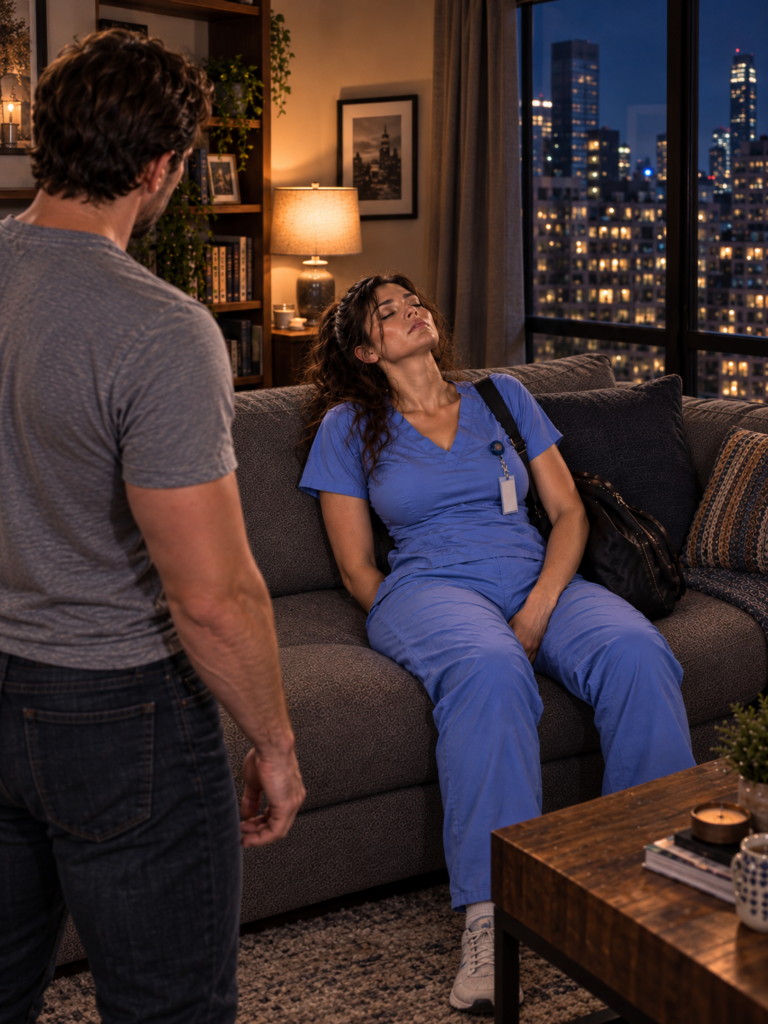
Then a woman stepped inside.
She had one shoe halfway off, a heavy bag hanging from her shoulder, and the exhausted concentration of someone performing a complicated task when all she was actually doing was trying to remove footwear.
“Okay,” she muttered to herself. “Almost there.”
I sat up.
She still didn’t notice me.
I’d gotten home from the garage a few hours earlier, brought in groceries, eaten something standing at the kitchen counter, and apparently failed at the very basic adult responsibility of making sure my front door had clicked shut.
That part was on me.
What came after belonged to both of us.
The woman finally looked up.
I watched confusion move across her face in stages.
First, a pause.
Then a slight frown.
Then wide eyes as she took in the couch, the jacket thrown over the back of my chair, the groceries I hadn’t completely put away, and finally me.
Her gaze snapped back toward the hallway.
“This isn’t my apartment.”
It wasn’t really a question.
“No,” I said. “It’s not.”
She grabbed her bag so quickly she nearly knocked over the lamp beside the door.
“Oh my God.”
“It’s okay.”
“No, it’s not. I just—” She pushed a hand through her hair, looking behind herself like the correct apartment might somehow materialize in the hall. “I moved in three weeks ago, and every floor in this building looks exactly the same. I swear I counted. I always count.”
Then she closed her eyes.
“I broke into a stranger’s apartment.”
“Technically, the door was open.”
Her eyes opened.
“So less breaking in,” I said, “more wandering in.”
She covered her face with both hands.
“That does not make me feel better.”
I should have been more alarmed than I was.
A stranger had walked into my apartment after midnight. There were a dozen reasonable reactions available to me, and offering hospitality probably wasn’t high on the recommended list.
But then I noticed the hospital badge clipped to her scrubs.
Kestrel Memorial.
I also noticed how pale she looked under the hallway light. Not sick exactly. Just emptied out. Her eyelids seemed too heavy to stay open, and one hand had settled around the doorframe like she needed it for balance.
“You work at Kestrel?”
She looked down at her badge as if she’d forgotten she was wearing it.
“Yeah.”
“Long shift?”
A laugh escaped her, but there wasn’t much humor in it.
“Double.”
That explained the wrong floor.
The missing shoe.
Possibly the entire situation.
“Have you eaten?”
She blinked.
“What?”
“Tonight. Have you eaten anything?”
Her expression suggested I’d asked her to solve an equation.
“There was a granola bar.”
“When?”
“Two?”
She frowned.
“Maybe one.”
I glanced toward the kitchen.
I’d made too much pasta, which was something I did regularly because apparently measuring dry noodles was beyond me.
“Sit down for five minutes.”
She stared at me.
“I already entered your apartment without permission.”
“And now you’re being invited.”
“Which somehow feels more dangerous.”
“Probably smart.”
That got the smallest hint of a smile.
I nodded toward the stool at the counter.
“Pasta. Then you can go find your actual apartment.”
She stood there debating it.
I could almost see exhaustion arguing against common sense.
Exhaustion won.
She sat.
I reheated the pasta while she rested her elbow on the counter and propped her head in one hand. Her eyes closed once. She caught herself immediately and straightened.
“I promise I’m not normally like this.”
“Like what?”
“Unable to locate my own home.”
“You did locate a home.”
She looked at me.
“Just the wrong one,” I added.
That earned me a tired laugh.
It was small and rough around the edges, but it changed something about the room.
I set the bowl in front of her.
“Thank you.”
She meant it seriously this time.
“You’re welcome.”
She took one bite and then another, and after that she stopped pretending she wasn’t hungry.
We ended up talking for almost an hour.
Not about anything particularly important.
Maybe that was why it was easy.
She told me about a patient’s kid who had drawn her a picture of a dog he didn’t actually own. The kid had apparently given the imaginary dog a name, a birthday, and digestive problems.
I told her about a sedan that had come into the garage smelling strongly enough of pancakes that three mechanics spent twenty minutes trying to locate the source.
“Did you?”
“No.”
“So somebody’s driving around right now with a haunted breakfast car?”
“That’s the working theory.”
She laughed again.
This one lasted longer.
I liked that sound more than I expected to.
There was no performance in the conversation. No trying to make ourselves sound more interesting than we were.
She was too tired to impress me.
I hadn’t expected company.
Somehow that made it easier to be honest in all the small ways people usually aren’t when they first meet.
When she finally stood, she adjusted the bag on her shoulder and put both shoes on properly.
“I really am sorry.”
“You’ve said that twice.”
“I know.”
She reached the doorway.
“This is the third time for emphasis.”
I leaned against the counter.
“I’ll note it in the official report.”
She smiled.
For the first time since she’d walked in, the exhaustion seemed to loosen its grip on her face.
Then she glanced around the apartment one more time.
“Honestly, though?”
“What?”
“This is the best mistake ever.”
And then she left.
I stood there after the door closed, staring at the spot where she’d been.
People didn’t normally return after accidentally entering strangers’ apartments.
That seemed obvious.
I locked my door properly and went back to the couch.
But I didn’t sleep much.
The next evening, somebody knocked.
A real knock.
Three deliberate taps.
I opened the door.
She was standing there.
Wide awake this time.
Her hair was pulled back, there were no scrubs, and she was holding a small paper bag from the bakery down the street.
“I wanted to apologize properly,” she said.
“You apologized three times.”
“Four.”
“I only counted three.”
“There was one while you were reheating the pasta.”
“I must’ve missed it.”
She lifted the bakery bag.
“This is the formal fifth apology. It comes with baked goods.”
I looked at the bag.
“That changes things.”
She smiled.
Then she shifted her weight.
“Also, I wanted to make sure I actually knew which floor was mine now.”
“Important research.”
“Exactly.”
I stepped aside.
She came in.
This time, neither of us was confused about where she was.
She returned to the same stool at the counter, but now she sat upright instead of looking as if gravity had personally declared war on her.
“I’m Hannah,” she said. “In case last night didn’t qualify as a normal introduction.”
“It didn’t.”
“No?”
“You spent part of it looking at my couch like it had betrayed you.”
She laughed.
“I’ve lived here three months.”
“Three months?”
“The apartment itself, yes. I moved to this floor three weeks ago.”
“That somehow makes getting lost worse.”
“I know.”
She pulled a pastry from the bag and pointed it at me.
“You are legally prohibited from judging me after feeding an unidentified woman pasta after midnight.”
“Fair.”
That night, the conversation went deeper.
Not dramatically.
Just enough.
She told me about nursing at Kestrel Memorial.
Twelve-hour shifts that became fourteen. People asking her questions she didn’t have answers to. Families who wanted certainty when there wasn’t any. Patients she could help and patients she couldn’t.
She didn’t tell those stories looking for admiration.
If anything, she seemed uncomfortable when I gave it.
“The hard part isn’t always the big stuff,” she said. “Sometimes it’s finishing one room, walking into the next, and having to reset your face because that person deserves someone who’s actually present.”
I understood that more than I expected.
Cars weren’t people, obviously.
But I knew what it was like to reach the end of a long day, think you were finished, then see another vehicle being pushed into the garage because somebody needed it to get to work the next morning.
I told Hannah about the shop.
Not the one where I worked.
The one I wanted.
I’d been saving for over a year. Quietly. No dramatic business plan taped to my wall, no countdown.
Just a separate account and the stubborn idea that someday I’d stop fixing cars for somebody else’s business and build something that belonged to me.
“What kind of place?” she asked.
“Small.”
“That wasn’t what I meant.”
I looked at her.
She waited.
It was such a nurse thing to do, I would realize later.
Ask the real question and then leave enough silence that you eventually answered it.
“A place where people don’t feel stupid because they don’t understand cars,” I said. “No selling somebody work they don’t need. No pretending every repair is an emergency just because fear makes people spend money faster.”
Hannah smiled slightly.
“That sounds like you.”
We’d known each other less than two days.
The fact that she said it anyway stayed with me.
When she got up to leave, she stopped at the door.
Again.
Apparently my doorway was becoming a place where things happened.
“Do you want to get coffee sometime?”
She said it quickly, then added, “Not as an apology.”
“Okay.”
“Okay?”
“Yeah.”
I’d answered before she’d completely finished.
Her smile widened.
“Four days from now? I’m off at seven.”
“There’s a place two blocks over.”
“I know it.”
“Seven-thirty?”
“Seven-thirty.”
Coffee happened exactly four days later.
Dinner happened the following week.
Somewhere between those two things, we began finding reasons to encounter each other.
She showed up once with leftover soup after a shift.
I left my umbrella outside her door when the weather report called for rain and I knew she’d walked to work.
She sent me a picture of something ridiculous one of her coworkers had taped to the nurses’ station.
I started buying better coffee.
I told myself that wasn’t because she preferred it.
Then I bought a second bag when the first got low.
None of the gestures seemed important enough to name.
Together, they became something harder to ignore.
But there was a problem neither of us mentioned.
Hannah’s schedule changed constantly.
My mornings at the garage started before six.
We were getting good at finding scraps of time.
Twenty minutes before my shift.
Forty after hers.
Dinner eaten standing at a kitchen counter because sitting down somehow made the evening feel too official, too likely to remind us that one of us had to leave soon.
At first, those fragments felt exciting.
Maybe because anything new can feel abundant when you haven’t yet learned how much of it you want.
Three weeks after Hannah first opened the wrong door, I walked her back to her apartment.
The correct apartment.
We stopped outside it.
“This is nice,” she said.
I smiled.
“High praise.”
She didn’t laugh.
“All of it.”
That changed my expression.
She looked down the hallway.
“I just wish we had more than the leftover pieces of our days.”
There are sentences you understand the moment they’re spoken.
Then there are sentences you understand more fully several hours later.
I didn’t have an answer for her.
Not then.
I told her good night.
She went inside.
I walked down the same hallway she’d gotten lost in three weeks earlier, passed my own door, stopped, and came back.
For once, I was the one who wasn’t entirely sure where I wanted to end up.
Part 2
The leftover pieces stopped feeling like enough faster than either of us expected.
It didn’t happen because of one fight.
There wasn’t some obvious disaster we could point to later and say, That. That was where we nearly ruined this.
It was smaller than that.
Hannah canceled coffee because a shift ran over.
I moved dinner because a car came into the garage ten minutes before closing and I couldn’t leave it half-finished.
She apologized.
I said I understood.
Then I canceled something.
She understood.
Understanding became our specialty.
That was almost the problem.
Neither of us complained because the reasons were real.
Her patients mattered.
My work mattered.
She was trying to build a life she respected.
So was I.
How do you argue with that?
You don’t.
You tell yourself you’ll see each other tomorrow.
Then tomorrow gets moved too.
One night Hannah appeared at my door still wearing scrubs.
The dark circles under her eyes reminded me of the first night we’d met, except this time she hadn’t entered by accident.
She had chosen my door.
That mattered.
“I almost canceled three times tonight,” she said.
She dropped onto my couch and leaned her head back.
I sat beside her.
“You could’ve.”
“I know.”
“I would’ve understood.”
Her eyes opened.
“That’s the problem.”
I waited.
She rubbed one wrist across her eyes.
“You’d understand. I’d let you understand. Then you’d cancel something and I’d understand that. And eventually we’d just…”
She made a helpless motion with one hand.
“Understand each other into nothing.”
The words landed harder than I expected.
She stared toward the dark television.
“I keep giving you whatever’s left of me at the end of the day.”
“Hannah—”
“That’s not fair.”
“You’ve been working.”
“I know.”
She turned toward me.
“That’s why it’s hard. There’s always a good reason.”
I didn’t say anything.
“Not fair to you,” she continued. “And honestly? Not fair to me either.”
That part caught me.
I had been thinking of myself as the patient one.
The supportive one.
The guy who didn’t complain when a nurse came off fourteen hours at a hospital and couldn’t make dinner.
But Hannah wasn’t asking me to become less understanding.
She was asking both of us to stop treating each other like the first thing to be sacrificed whenever the rest of life became inconvenient.
“I’ve been doing the same thing,” I said.
She watched me.
“I keep fitting you into whatever gap my schedule leaves.”
“Yes.”
“Like you’re an errand instead of—”
I stopped.
Her voice softened.
“Instead of what?”
I looked at her.
“Someone I actually want to see.”
The exhaustion in her face didn’t disappear.
But something else came forward.
Relief, maybe.
Not because I’d said anything especially romantic.
Because I’d finally admitted that this mattered enough to create a problem.
“So,” she said. “What do we do?”
We worked it out right there.
No speeches.
No dramatic promises about always putting love first.
We weren’t even officially calling it love.
We picked one evening.
Friday.
We would protect it.
Not absolutely. Hannah worked in a hospital. Emergencies existed. People got sick whether our calendar approved or not.
Cars broke down too.
But we agreed that our time would stop being automatically expendable.
If something threatened Friday, we’d say it immediately.
No silent cancellations.
No pretending disappointment wasn’t disappointment.
No making the other person guess whether the relationship mattered.
It sounded simple.
Two days later, my manager called me into his office.
“We got a fleet job.”
He named a local company.
I knew them.
A dozen vehicles. Maintenance and repairs. They wanted everything finished over a weekend to avoid taking trucks off the road during business hours.
“We need everybody,” he said.
Then he told me what overtime would pay.
I thought I’d misheard.
It was more money than I usually brought home in two weeks.
Maybe not enough to open my shop immediately, but enough to move the timeline forward in a serious way.
Money I’d been chasing for more than a year.
“What weekend?”
He told me.
Friday evening through Sunday.
Of course.
I leaned back in the chair.
“You in?”
The old answer would have been immediate.
Yes.
I would have texted Hannah afterward.
Something came up.
She would have understood.
That’s what we did.
My manager mistook my silence for hesitation about the work.
“I know it’s ugly hours.”
“It’s not that.”
“What?”
I pictured Hannah on my couch saying, We’ll understand each other into nothing.
Then I pictured the separate savings account.
The shop.
The building I wanted but hadn’t found yet.
My name over a garage door.
For a moment, I resented the choice.
That surprised me.
Not Hannah.
The existence of a choice at all.
I wanted both things.
I wanted my future business and Friday night with a nurse I’d met because she couldn’t count apartment floors after a double shift.
Wanting one did not make the other less real.
That was probably the first thing Hannah taught me without trying.
A life could contain more than one thing worth protecting.
“I can’t do Friday.”
My manager frowned.
“We need the whole crew.”
“I can come in Saturday morning.”
“We’re starting Friday.”
“I already made a commitment.”
He stared at me.
“You’ve been asking for overtime for months.”
“I know.”
“You’ve been saving for that shop over a year.”
“I know.”
“This gets you most of the way to your next target in one weekend.”
I looked at him.
“I know.”
“Then what are you doing?”
Keeping my word, I thought.
Out loud, I said, “I already made a plan. I’m not breaking it.”
I didn’t tell Hannah.
Not because I wanted to hide things from her.
Because I knew her.
If she found out before Friday, she would offer to cancel.
She would insist the money mattered.
She would tell me one night didn’t compare to the shop.
And maybe financially she’d be right.
But we’d just agreed this wasn’t about comparing every hour against the most productive alternative.
The choice was mine.
I didn’t want to convert it into a debt she felt obligated to repay.
Friday came.
She knocked properly.
“Look at you,” I said when I opened the door. “Correct floor.”
“I checked twice.”
“Personal growth.”
“Don’t get used to it.”
We spent the evening doing almost nothing.
That was what made it different.
Dinner lasted longer than twenty minutes.
Nobody stood at the counter eating while checking a clock.
We talked.
She complained about somebody at work who kept stealing pens and then vehemently denying it while using everyone else’s pens.
I told her one of the guys at the garage had spent half an afternoon searching for a wrench that turned out to be in his back pocket.
“Competence everywhere,” she said.
“America runs on us.”
When she left, nothing dramatic had happened.
I remember feeling strangely proud of that.
We’d kept a Friday.
That was all.
It felt like proof.
A few days later, I learned she’d made her own choice.
One of my coworkers mentioned his sister worked at Kestrel.
“Hannah, right?” he said.
I looked up from beneath the hood of a pickup.
“What about her?”
“My sister said she traded a Sunday because she needed Friday off.”
I straightened.
“What?”
He shrugged.
“Apparently one of the nurses wanted Sunday free, so your girl switched with her.”
Your girl.
I ignored that part.
“She traded for Friday?”
“That’s what I heard.”
I thought about the evening she’d sat in my apartment making fun of stolen pens.
She’d never mentioned it.
When I asked her later, she barely reacted.
“Yeah.”
“Why didn’t you tell me?”
She looked confused.
“Tell you what?”
“That you moved a shift.”
“I didn’t move it. I traded.”
“For our night.”
“For a night I wanted.”
“That’s the same thing.”
“No, it isn’t.”
She set down the mug she was holding.
“She wanted my Sunday. I wanted her Friday. We both got something.”
“Hannah.”
“What?”
“You could’ve told me.”
“And then what?”
I didn’t answer quickly enough.
“You would’ve felt guilty,” she said.
“Maybe.”
“You would’ve offered to move our plans.”
Maybe again.
Her expression softened.
“I’m not telling you that story as some grand sacrifice.”
“I know.”
“I didn’t lose anything. I made a trade.”
I looked at her.
She smiled.
“I wanted Friday protected.”
Something inside me went quiet.
I’d spent years thinking commitment was measured mostly in large costs.
How much money you were willing to put down.
How many hours you were willing to work.
How tired you were willing to become for the thing you said you wanted.
Hannah had a different kind of discipline.
She made room.
Not endlessly.
Not self-destructively.
She looked at her life and decided some space belonged to us.
Over the next weeks, both of us changed in ways that probably would have looked insignificant from outside.
Hannah stopped volunteering for every open shift.
Not all of them.
She still picked up extra work when she wanted the hours or when someone needed help.
But she stopped acting as though saying no made her less committed to nursing.
I stopped treating overtime like a moral virtue.
I’d been measuring my seriousness about the shop by exhaustion.
If somebody offered more hours, I took them.
If my body complained, that was evidence I was working hard enough.
But I had already saved for more than a year.
Missing one shift didn’t erase that.
Choosing dinner with Hannah didn’t make me lazy.
We started planning before our schedules filled instead of afterward.
Some weeks worked better than others.
But the difference was noticeable.
One protected evening, Hannah came over after a brutal shift.
She knocked.
Properly, as always now.
She kicked off her shoes near the door.
“You know,” she said, “I actually know whose apartment I’m walking into this time.”
“Progress.”
“Remarkable, isn’t it?”
I cooked.
Hannah claimed she was helping.
Her version of helping consisted of handing me ingredients when asked, stealing pieces of whatever I chopped, and leaning against the counter telling me about her day.
It had been a bad one.
One of those shifts where everything had seemed to go wrong in small ways until all the small ways became one enormous weight.
Earlier in our relationship—whatever we were calling it then—I might have tried to fix her mood.
Offer solutions.
Tell her what she should do.
Instead, I listened.
She didn’t need a mechanic.
She needed somewhere she didn’t have to be useful for an hour.
When dinner was ready, we sat at the table.
Actually sat.
I realized I couldn’t remember the last time I’d checked the clock.
There was no place either of us needed to be.
No next obligation hovering ten minutes away.
And looking at her across from me, I understood that the problem had never really been scheduling.
Scheduling was only where it showed itself.
The problem was that we’d been afraid to treat whatever existed between us as something real enough to demand space.
Maybe because naming something gave it the power to hurt you.
Maybe because both of us were people who found it easier to serve responsibilities than admit we wanted something for ourselves.
I put my fork down.
Hannah noticed.
“What?”
“I’ve been thinking.”
“That’s dangerous.”
“I don’t want this to keep being something we squeeze into whatever’s left.”
Her expression changed.
Not alarm.
Attention.
“I don’t want to see you only because neither of us happens to be working,” I said. “Or because you accidentally walked through my door one night.”
A small smile appeared.
“That was a pretty good system.”
“It had flaws.”
“One major flaw. Wrong apartment.”
“Hannah.”
The smile faded into something quieter.
I suddenly felt more nervous than I had turning down the overtime.
“I want to actually date you.”
She held my gaze.
“On purpose,” I added.
Silence.
Long enough for me to regret every word.
Then her mouth curved slowly.
“Yes.”
“Yeah?”
“Yes.”
No hesitation.
Just that.
Yes.
I sat back.
Something settled in me.
No fireworks.
No dramatic rush.
Just a click.
As if every bowl of soup, every borrowed umbrella, every cup of decent coffee, every protected hour had been pieces of something we’d finally agreed to call by its name.
We stayed at the table after the dishes were empty.
Neither of us rushed to clear them.
When Hannah eventually stood to leave, she paused at the door.
Of course she did.
She looked around the apartment.
The counter.
The stool.
The spot where she’d once dropped her bag.
Then she shook her head.
“Best mistake ever.”
I smiled.
“Still holds up.”
She looked at me.
“Maybe more now.”
And for the first time since she’d walked into my apartment exhausted and mortified, neither of us seemed confused about where this was going.
Part 3
Dating Hannah on purpose didn’t magically make either of us less busy.
Her schedule still changed.
Some weeks she worked mostly days.
Other weeks she flipped to nights so fast I lost track of whether coffee at seven meant seven in the morning or seven at night.
My hours stretched too, especially once the shop stopped being something I talked about in the future and became something I was actively working toward.
There were bad weeks.
We missed dinners.
We passed in the hallway with no more than tired smiles.
Sometimes one of us fell asleep halfway through a conversation.
But we got better at one thing.
We stopped disappearing behind good reasons.
If Hannah’s shift ran long, she told me.
If my overtime threatened our plans, I told her early.
We moved things instead of quietly abandoning them.
Dinner became breakfast when necessary.
Sometimes I cooked eggs before she came off a night shift.
Sometimes we ate breakfast food at nine at night because her internal clock had surrendered completely.
“You understand none of this is normal,” I told her once as she poured hot sauce onto eggs after sunset.
“Time is a social construct.”
“That’s not what nurses mean when they say twelve-hour shift.”
She pointed her fork at me.
“I haven’t slept. Don’t challenge my science.”
Little by little, our belongings began migrating.
Hannah left spare scrubs at my apartment.
Not intentionally at first.
Then intentionally.
A toothbrush appeared beside mine.
I kept better coffee stocked because she said the hospital breakroom coffee “tasted like regret.”
She repeated that phrase so often it stopped being funny.
Then somehow became funny again.
I learned the difference between the silence that meant she was tired and the silence that meant something at work was bothering her.
She learned when I’d had a bad day by the way I cleaned my tools.
“You’re organizing sockets aggressively,” she said once.
“I’m organizing.”
“Aggressively.”
“There’s no such thing.”
“You’re doing it right now.”
Some evenings we barely spoke.
That surprised me at first.
I’d assumed closeness needed conversation.
But after enough long days, there was comfort in sitting beside someone who didn’t demand anything from you.
One night we were on my couch with the TV playing low.
Hannah was tucked against my side, half watching something neither of us would remember afterward.
She glanced toward the entryway.
“I still can’t believe how bad I was at counting floors.”
I followed her gaze.
“You were exhausted.”
“I was catastrophically bad at it.”
“True.”
She nudged me.
“I thought you were defending me.”
“I changed my mind.”
She looked around the apartment.
“I’m glad I was bad at it.”
I smiled.
“Worst sense of direction I’ve ever been grateful for.”
She threw a couch cushion at me.
I caught it.
She laughed.
And for maybe five whole minutes, there were no patients, no engines, no future plans.
Just us.
Around then, the shop finally became real.
I found a small space not far from the garage where I worked.
It wasn’t impressive.
The floor needed work.
The office was barely an office.
One wall looked as if somebody had made repeated bad decisions involving shelving.
But the rent was possible.
The location was good.
And when I stood inside it, I could see what it might become.
I put down a deposit.
Then I started spending my days off there.
Cleaning.
Fixing.
Painting.
Making lists.
Crossing things off.
Adding three more.
Hannah came by with takeout one afternoon while I was trying to figure out why an outlet refused to work.
She sat on an overturned bucket and watched me.
“You know,” she said, “I was promised lunch.”
“There is lunch.”
“You’ve been staring at that wall for seven minutes.”
“It’s winning.”
She looked at the outlet.
“Have you considered asking it about its childhood?”
“Have you considered going back to the hospital?”
“No.”
She stayed three hours.
She couldn’t help much with the electrical work.
That wasn’t the point.
I didn’t need her to build the shop for me.
She didn’t need me to carry her through nursing.
We were building separate things.
That became important.
I’d seen relationships where one person’s dream slowly swallowed the other person’s life.
Hannah had seen versions of the same thing.
Neither of us wanted that.
She was not an accessory to my shop.
I was not a refuge designed solely to repair whatever the hospital did to her.
We had our own work.
Our own ambitions.
Our own exhaustion.
What changed was that neither of us felt alone inside those things anymore.
A year after Hannah walked into my apartment by mistake, I planned something deliberately.
For once, I left nothing to chance.
I asked her to come over after work.
That wasn’t unusual.
She arrived still wearing scrubs, hair a little messy, hospital badge clipped near her shoulder.
She knocked.
I opened the door.
“Rough one?”
“They’re all a little rough lately.”
She stepped inside and kicked off her shoes in the same spot she always did.
“What’s for dinner?”
“Come see.”
She stopped after three steps.
I’d arranged the apartment to look as close as possible to the night we’d met.
Not theatrically.
I didn’t recreate every grocery bag and misplaced jacket.
But the lights were low.
Music played softly.
Pasta sat on the counter.
The same simple kind I’d reheated for her when she was too tired to realize she was in a stranger’s home.
Hannah looked from the kitchen to me.
Then back again.
“Wait.”
I said nothing.
Her eyes narrowed.
“Is this supposed to be that first night?”
“As close as I could remember.”
She laughed.
Then the laughter softened.
I saw the instant she began putting things together.
The question in her face.
The hope she didn’t want to assume.
Then she noticed the box.
Small.
Sitting on the counter almost exactly where her bag had landed that first night.
Her hand went to her mouth.
I picked up the box.
“You didn’t get lost this time.”
“Holy—”
“I wanted you to walk into the right place on purpose.”
Her eyes were already shining.
“Hannah.”
She shook her head once as though I was making it impossible for her to process anything.
I went down on one knee.
The apartment suddenly seemed very quiet.
I remembered her standing inside that same door a year earlier.
One shoe off.
Eyes barely open.
Mortified.
I remembered asking whether she’d eaten.
I remembered the pastry she brought back the following night.
Her stool at my counter.
Coffee four days later.
Soup.
My umbrella outside her door.
Standing in the hallway when she said she wanted more than leftover pieces.
The couch where we’d decided to stop understanding each other into nothing.
Friday.
The overtime I turned down.
The shift she’d traded without asking for credit.
Her sitting at my kitchen table when I finally asked to date her on purpose.
An overturned bucket in the shop.
Scrubs in my closet.
Good coffee.
Eggs at impossible hours.
Nothing about us had happened quickly.
Except the first mistake.
Everything important after that had required repetition.
Attention.
Choices.
That was what I wanted to tell her.
Not that fate had dropped her into my apartment and made the rest inevitable.
It hadn’t.
She could have left after the pasta.
She could have never knocked the next night.
We could have let schedules wear us down.
I could have chosen every extra hour.
She could have volunteered for every extra shift.
We could have been one of those almost-stories people remember fondly years later.
Instead, we’d kept choosing.
“The best thing that ever happened to me walked through my unlocked door by accident,” I said.
Hannah laughed through the tears gathering in her eyes.
“I don’t want to spend the rest of my life wondering what would’ve happened if I’d just pointed you toward the elevator that night instead of asking if you’d eaten.”
Her hand covered her mouth.
I opened the box.
“Hannah, will you marry me?”
For one second she simply stared at me.
Then she started laughing and crying at the same time.
Both hands went over her face, almost exactly the way they had the first night when she’d realized she’d entered the wrong apartment.
The memory hit both of us.
I could tell.
“Yes,” she said.
Her voice broke.
She lowered her hands.
“Yes.”
I smiled.
“Yeah?”
“Of course yes.”
She laughed again.
“Yes.”
The answer sounded exactly like the one she’d given when I asked her to date me.
No hesitation.
I slid the ring onto her finger.
Then I stood.
For a while, neither of us said much.
We didn’t need to.
Hannah kept looking down at the ring and then back at me as though checking both were still there.
Eventually she glanced around the apartment.
“I can’t believe this started because you forgot to lock your door.”
“You got the floor wrong.”
“You left the door open.”
“You invaded a private residence.”
“I was medically exhausted.”
“You ate my pasta.”
“You offered it.”
“Under suspicious circumstances.”
She laughed and wiped beneath one eye.
Then she looked at me differently.
Softer.
“You know what the strange part is?”
“What?”
“I used to think the important part was the mistake.”
I waited.
She looked toward the door.
“But it wasn’t, was it?”
I knew what she meant.
The accident had introduced us.
That was all.
Accidents couldn’t build anything.
They couldn’t keep a Friday free.
They couldn’t tell the truth when work interfered.
They couldn’t make breakfast after a night shift, save for a shop, trade a Sunday, listen after a brutal day, or sit quietly beside someone when neither had enough energy left to be interesting.
The mistake opened a door.
Everything after that had been choice.
“No,” I said. “I guess it wasn’t.”
She leaned against me.
I wrapped an arm around her.
“Still the best mistake ever, though,” she said.
“Still holds up.”
A year earlier, Hannah had stood in that same apartment convinced she’d ended up in the wrong place.
Now there was a ring on her hand.
Pasta on the counter.
Her shoes beside mine.
And suddenly I understood something about that first night I hadn’t understood while it was happening.
I had thought she was the lost one.
Maybe both of us had been, in different ways.
Hannah had known exactly what mattered to her at work, but not yet how to keep any part of herself from being consumed by it.
I had known exactly what I wanted professionally, but I’d treated every hour not spent chasing it like an hour wasted.
We had both been measuring our lives by what was left after responsibility finished with us.
Then we met.
Badly.
Awkwardly.
Completely by accident.
And over time, we learned that caring about another person wasn’t something you did with the leftovers.
You made room before everything else claimed it.
Not every time.
Not perfectly.
But deliberately.
The hospital would still need Hannah.
The shop would still demand more hours than I wanted to give it sometimes.
There would be canceled plans and bad weeks.
Maybe mornings when we’d barely see one another.
That wasn’t going to disappear because of a ring.
But I wasn’t afraid of that anymore.
We had already learned the harder part.
How to say, This matters.
How to act like it did.
How to choose without turning every choice into a sacrifice story.
Hannah looked at her ring again.
“You’re definitely locking the door tonight, right?”
I laughed.
“Absolutely.”
“Good.”
She glanced toward it one last time.
“Wouldn’t want some exhausted stranger wandering in and ruining the moment.”
“I’ve reached my lifetime limit.”
“One?”
“One was enough.”
She smiled.
And standing there with her, I knew we weren’t going back to counting floors or measuring our relationship in leftover hours.
From then on, every door she walked through would be one she was choosing.
So would every day after it.
What began as the best mistake either of us had ever made had become, slowly and deliberately, the best decision we’d ever made.

