
Part 1
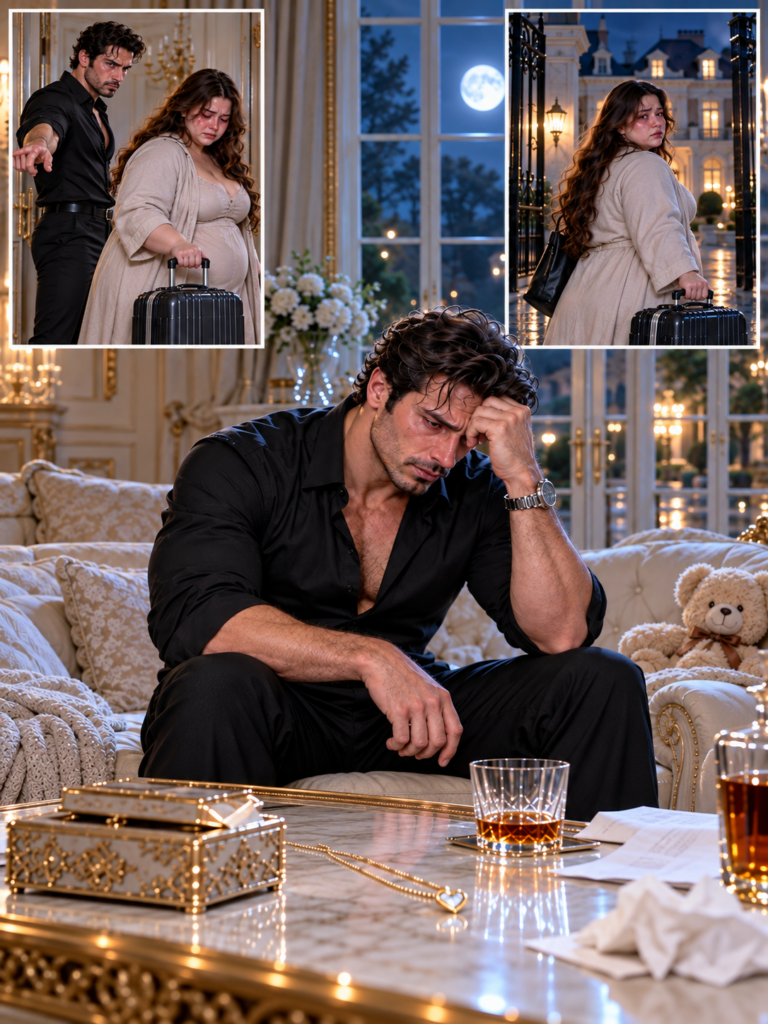
The silver necklace struck the polished dresser with a sound so small Dominic Castellano almost missed it.
Four years of marriage, countless promises, and a lifetime of carefully guarded emotions had somehow come down to that single, delicate piece of jewelry lying between him and his wife.
Claire stood beside the dresser in a sapphire-blue dress that had once made Dominic forget how to speak. Tonight, he could barely look at her without hearing his father’s contemptuous voice.
“You’ve gained too much weight, Claire.”
She stared at him. For several seconds, the only movement in the enormous bedroom came from the trembling of her fingers against the furniture.
“Dominic, please. I’ve been trying to explain that something is wrong with my health.”
“Every time I bring this up, you have another explanation.”
“Because I’ve been sick!”
“Then perhaps you should stop making excuses and start taking responsibility.”
Her expression changed. The hurt remained, but something quieter settled behind it.
“Is that really what you think of me?”
Dominic looked at the dress again. He remembered Salvatore Castellano’s expression earlier that evening, the way his father had spoken about Claire as though she were an unfortunate business investment.
For years, Dominic had commanded men who feared disappointing him. He had made decisions that affected fortunes, businesses, and powerful families. Yet one dismissive remark from his father had been enough to make him turn his own humiliation against the woman who loved him.
“If you can’t understand what’s expected of my wife,” he said, “perhaps you shouldn’t be living in this house.”
Claire’s breathing became shallow.
“Are you telling me to leave?”
Dominic could still have stopped.
He could have admitted that he was angry, that he had allowed his father’s words to poison his judgment, that watching her struggle had frightened him in ways he refused to understand.
Instead, he said, “Yes. Leave.”
Claire reached behind her neck and unclasped the silver chain he had given her on their wedding day.
She laid it carefully on the dresser.
“Then I’m leaving.”
Dominic watched her cross to the wardrobe, take down a small suitcase, and place it on their bed.
He had expected crying. Perhaps pleading. Certainly an argument that would end with Claire apologizing and promising to try harder.
He had not expected her to begin folding clothes.
“What exactly do you think you’re doing?”
She didn’t look at him.
“Packing.”
“You’re going to throw away our marriage because of one disagreement?”
Claire stopped with a sweater in her hands.
“One disagreement?”
Her voice was almost unbearably quiet.
“Dominic, I’ve spent months telling you that I wake up exhausted. That I can’t get warm even when everyone else is comfortable. That I feel different inside my own body, and I don’t understand why.”
He folded his arms.
“You know how important appearances are in this family.”
“I know.”
“Then why—”
“Because I can’t make myself healthy just to keep your father from criticizing you.”
That silenced him.
Claire returned to the suitcase. She folded her clothes with unusual care, stopping twice when dizziness forced her to hold the edge of the mattress.
Dominic noticed both times.
Neither time did he move.
The man who could arrange protection for an entire city block could not bring himself to offer his wife a hand.
Claire placed her charger, toiletries, and a few personal belongings into the suitcase. Then she picked up her phone and called Maya Brooks.
Maya had been her closest friend long before the Castellano mansion, long before the expensive dresses and carefully managed family appearances.
“Claire?” Maya answered immediately. “Everything okay?”
Claire glanced at Dominic.
“Could I stay with you for a little while?”
Maya heard what Claire was struggling to conceal.
“Of course. You don’t even need to ask. What’s happened?”
“I’ll tell you when I get there.”
After ending the call, Claire closed her suitcase.
Dominic remained by the bedroom door.
He was a man accustomed to seeing people hesitate when he stood in their path. Claire approached without asking him to move.
“You’re really going through with this?” he asked.
She looked up at him.
“You told me to get out of your house.”
“You’re being dramatic.”
“No.” Her fingers tightened around the suitcase handle. “I’ve been begging you to listen to me for months. Tonight, you made it clear that my pain matters less to you than what people think when they see me standing beside you.”
He wanted to tell her she had misunderstood.
But he could not point to a single thing he had done that evening to prove it.
Claire stepped around him.
Downstairs, a young housekeeper saw the suitcase and immediately offered assistance. Claire thanked her but declined.
At the enormous front door, she stopped.
For a heartbeat, Dominic, watching from the staircase, thought she might reconsider.
Instead, she removed the mansion key from her key ring.
She set it on the entry table.
Then she walked outside without looking back.
The door closed softly.
Dominic stood motionless.
He told himself that her departure was temporary. Claire had always been the gentler one, the person who tried to resolve disagreements rather than prolong them.
She would calm down.
She would miss the house.
She would eventually remember the comfortable life he had provided.
And when she returned, he would decide whether he was ready to forgive her for making such a scene.
Upstairs, however, the necklace remained exactly where she had left it.
Its silver pendant caught the bedroom light.
Dominic remembered fastening it around her neck on their wedding day. Claire had turned to him with a smile so open and trusting that he had felt, briefly, like a better man simply because she loved him.
He looked away.
He had no interest in remembering that version of himself tonight.
The next morning, Dominic walked into the dining room expecting to find Claire waiting.
The table had been set.
His coffee was hot. His schedule had been placed beside his plate. The household staff moved efficiently through the mansion, fulfilling every instruction with practiced precision.
Only Claire was missing.
He took his usual seat.
For the first few minutes, he considered the silence pleasant.
Nobody asked if he had slept well. Nobody reminded him that three cups of coffee were not breakfast. Nobody talked about fabrics, renovations, or the interior design projects Claire had loved long before she married him.
His routine continued without interruption.
He should have been satisfied.
By the second evening, the silence had begun to feel different.
Dinner arrived precisely at seven.
Dominic sat at one end of the enormous dining table, staring at the empty chair opposite him.
Claire used to sit there and tell him about her day.
Sometimes she spoke excitedly about a design concept or asked his opinion about a color combination. Sometimes she shared something funny that had happened with the household staff.
He usually answered while reviewing messages on his phone.
Now there was no conversation to interrupt.
He checked the time twice before finishing his meal.
When a young housekeeper entered to clear his plate, he noticed how stiffly she held her shoulders.
“Is there a problem?”
She stopped.
“No, Mr. Castellano.”
“Then why does everyone seem so uncomfortable?”
“We’re only trying to make sure everything is done correctly, sir.”
She collected the dishes and hurried away.
Dominic watched her retreat.
He remembered hearing that same young woman laughing in the kitchen with Claire. He remembered how the laughter had stopped when he entered.
For the first time, he wondered whether the staff had been comfortable around Claire because she was kind—or uncomfortable around him because he wasn’t.
Across the city, Claire was lying beneath a blanket in Maya’s guest room.
She had slept for much of the afternoon, but the exhaustion remained. Even after a warm meal and a hot shower, her body felt heavy and cold.
Maya appeared in the doorway carrying a tray.
“You need anything else?”
Claire shook her head.
“You’ve already done enough.”
“You’re my best friend. I’m allowed to feed you.”
Claire managed a small smile.
Maya set the tray down and sat beside her.
She did not demand an explanation of the marriage. She had heard enough the previous night to understand that Claire needed somewhere safe to rest before she could decide what came next.
After a while, Maya mentioned a small project at her interior design studio.
“Nothing complicated,” she said. “Some fabric selections and layout planning. I could use someone with your eye.”
Claire looked toward the window.
Before her marriage became a continuous exercise in satisfying Castellano family expectations, she had loved working on design projects. She remembered the pleasure of solving a practical problem, of making a room comfortable for the people who would actually live in it.
“Maybe when I’m feeling stronger,” she answered.
“Whenever that is.”
Maya squeezed her hand.
For the first time since leaving the mansion, Claire felt that her future might still belong to her.
On the third morning, Dominic sent a message.
We need to talk about when you’re returning.
He read it once before sending.
It seemed reasonable. Direct. Efficient.
Claire received it while sitting at Maya’s kitchen table.
She stared at the screen.
There was no apology.
No acknowledgment of what he had said.
He had not even asked whether she was feeling better.
The message assumed the only unresolved matter was the date on which she would resume her place in his house.
Claire placed the phone facedown.
“Maya?”
Her friend looked up.
“Can you help me arrange to collect the rest of my things? I’d rather do it when Dominic isn’t home.”
Maya studied her expression.
“Are you sure?”
Claire nodded.
“For once, I am.”
That evening, Dominic arrived home after midnight.
The downstairs hallway was dark.
For years, Claire had left a lamp burning whenever he was expected home late. She knew he disliked entering a completely unlit house, although he had never admitted that preference to anyone else.
Tonight, there was no warm light waiting beside the staircase.
He switched on the lamp himself.
It was a small inconvenience.
It should not have mattered.
Yet he remained in the entrance hall long after the light came on.
Later, he lay awake on the enormous bed, trying to concentrate on the business decisions awaiting him the following morning.
Shortly after three, he woke with his heart pounding.
His hand reached automatically toward Claire’s side of the mattress.
Cold sheets.
No familiar breathing.
No soft movement as she turned toward him in her sleep.
And suddenly, without warning, he remembered another bedroom, another absence, and a grief he had spent thirty years trying to bury.
He was nine years old again.
His mother had been ill for weeks.
He remembered sitting beside her while she stroked his hair. She had tried to smile whenever he asked whether she was going to recover.
Sometimes, in the mornings, she had sung softly while preparing breakfast.
He remembered the sound more clearly than he remembered the words.
Then, one morning, she was gone.
After the funeral, Dominic had hidden in her bedroom, clutching one of her sweaters.
The fabric still smelled faintly of her perfume.
He pressed his face into it and cried until breathing hurt.
Salvatore found him on the floor.
“What are you doing?”
Dominic looked up through his tears.
“I want Mama.”
His father took the sweater from him.
“She’s gone, Dominic. Crying won’t change that.”
“But I miss her.”
Salvatore stood over his son, expression severe.
“You’re a Castellano. You don’t collapse every time life takes something from you. Get up.”
Dominic remembered struggling to stop crying because his father’s disappointment frightened him almost as much as his mother’s absence.
After that day, grief became something he concealed.
Fear became something he denied.
Affection became a liability to manage.
Every mistake invited another lecture about discipline. Every display of vulnerability earned a reminder that weakness was dangerous.
By adulthood, Dominic could stare down powerful adversaries without trembling.
But he had never learned how to tell someone he was hurting.
Claire had been the first person who made that possibility seem safe.
During their early months together, she noticed that any mention of his mother made him withdraw.
One evening, instead of pressing him for answers, Claire sat beside him and held his hand.
“You don’t have to tell me anything,” she said gently. “But if you ever want to, I’ll listen.”
He had insisted there was nothing worth saying.
She stayed anyway.
Eventually, he told her about his mother’s singing.
He described how the kitchen used to feel in the mornings, how she had made ordinary things seem joyful.
Claire listened.
She did not tell him to be strong.
She did not treat his memories as embarrassing.
For the first time in years, Dominic had spoken of his mother without feeling ashamed.
Now, sitting alone in the darkness, he realized how rarely he had offered Claire the same gentleness.
On the fifth day after Claire left, Salvatore arrived at the mansion.
He entered with the confidence of a man who had spent decades treating his son’s house as an extension of his own authority.
“Has your wife decided to return?”
“Not yet.”
Salvatore gave a satisfied nod.
“Perhaps some distance will teach her that you have standards.”
Dominic’s eyes shifted toward the empty chair.
“She told me she wasn’t feeling well.”
“That woman has been making excuses for months.”
“She was trying to tell me something.”
“And you allowed yourself to become distracted by it. A man in your position cannot afford to be ruled by sympathy.”
A week earlier, Dominic might have agreed.
Now he could hear Claire’s exhausted voice asking when he had stopped believing her.
He remembered her gripping the furniture to steady herself.
He had seen her struggle.
He had chosen not to care.
Salvatore continued speaking, but Dominic barely heard him.
His father’s approval, once the foundation of his ambition, suddenly felt strangely empty.
That evening, Dominic returned to the bedroom.
The wardrobe still contained several of Claire’s things. Her books remained near the bed, and her slippers sat beneath her favorite chair.
He opened the wardrobe without knowing exactly what he hoped to find.
At the back of a shelf, beneath a folded blanket, lay a small brown teddy bear.
A crooked ribbon circled its neck.
Dominic lifted it carefully.
Three years earlier, Claire had suffered through several days of fever.
At the time, he had been unnerved by his inability to make her feel better.
He could organize security, command employees, and resolve difficult business disputes. None of those abilities could take away her discomfort.
One evening, on his way home, he had entered a small shop.
He bought the teddy bear almost impulsively.
When he placed it beside her pillow, Claire had stared at him.
“Did Dominic Castellano really go shopping for a teddy bear?”
He had frowned, embarrassed by her delight.
“Don’t make a production of it.”
Claire had hugged the bear against her chest.
“He’s wonderful. I love him.”
Dominic had muttered that it was only a toy.
Claire’s smile softened.
“I wasn’t talking about the toy.”
He remembered sitting beside her afterward, holding her hand until she fell asleep.
His phone had rung several times.
For once, he had ignored it.
There had been a time when taking care of Claire made him feel capable rather than weak.
When had that changed?
Dominic carried the bear to the bed.
Then he noticed the silver necklace again.
He picked it up and allowed the chain to fall across his palm.
On their wedding day, he had told Claire the necklace would always remind her of the place she held in his life.
He had believed the sentiment generous.
Now he wondered whether, somewhere along the way, he had mistaken providing a home for owning the right to decide who deserved to live inside it.
His phone vibrated.
A message from the housekeeper informed him that Maya Brooks had contacted the household about arranging the collection of Claire’s remaining belongings.
Dominic read the message twice.
Claire wasn’t waiting for him to call her home.
She was preparing to stay away.
He looked toward the wardrobe.
Soon, the clothes would disappear.
The books, the slippers, the familiar traces of her presence.
Perhaps even the small bear in his hands would be taken away.
He pressed it against his chest and remembered how Claire had looked at him when she still believed his love could protect her.
Then he remembered the night he had told her to leave.
His breathing faltered.
He lowered his face and began to cry.
There was no audience. No father standing over him, demanding that he compose himself.
For several minutes, Dominic Castellano made no effort to stop the tears.
He cried for the frightened boy who had lost his mother.
For the husband he had once hoped to become.
And most of all, for the woman he had wounded because he had been too cowardly to challenge his father’s contempt.
When the worst of it passed, he stared at Claire’s empty side of the bed.
He could order employees to carry out his instructions.
He could settle disputes with a telephone call.
He could purchase almost anything money could provide.
But he could not order Claire to love him again.
And for the first time, that truth terrified him.
Fourteen days after Claire left, Dominic sat alone at the dining table.
Her belongings had been collected earlier that week while he was away. The wardrobe now held empty spaces where her clothes had hung. Her favorite books were gone. Her slippers no longer waited beneath the chair.
The mansion functioned perfectly.
His businesses remained profitable. His employees followed instructions. The men under his authority still treated his decisions as final.
Yet everything he had once considered proof of success now seemed incapable of satisfying him.
That afternoon, he had resolved a difficult business disagreement.
His first impulse had been to call Claire.
He even reached for his phone before remembering that she no longer lived with him.
Now he stared at a plate of food he could not finish.
When the young housekeeper entered, he looked up.
“Thank you for dinner.”
She blinked in surprise.
“You’re welcome, sir.”
The shock on her face troubled him.
Had basic courtesy become so unusual that a simple expression of gratitude startled the people working in his home?
He was still considering that question when a familiar voice came from the doorway.
“Well, at least the house looks respectable again.”
Salvatore Castellano stood beneath the dining room archway.
Dominic did not rise.
“What do you want, Father?”
Salvatore glanced at Claire’s empty chair.
“I came to see whether you’ve finally recovered your senses. Two weeks without your wife, and you’re still managing perfectly well.”
Dominic set down his glass.
“Don’t.”
“Don’t what? Congratulate you? Claire was becoming an embarrassment. Removing her was the sensible decision.”
Something inside Dominic settled into a cold, unfamiliar certainty.
“Her name is Claire.”
Salvatore frowned.
“I know perfectly well what she’s called.”
“Then speak about her with respect.”
His father gave a short, contemptuous laugh.
“You’re beginning to sound like your mother. She was always allowing emotion to interfere with sound judgment.”
For thirty years, those words had been enough to silence him.
Tonight, Dominic stood.
“You taught me to believe that caring about someone meant surrendering power.”
“I taught you how to survive.”
“You taught me to be ashamed of loving people.”
Salvatore’s expression hardened.
“Be careful, Dominic.”
But Dominic continued.
“I spent my entire marriage trying to prove that I was strong enough to lead this family. And every time Claire needed something from me, I treated her as though she were demanding something unreasonable.”
His eyes moved toward the empty chair.
“She wanted a husband who would listen to her. I made her feel like she had to earn the right to be treated decently.”
“Are you seriously holding me responsible for your wife’s behavior?”
“No.”
Dominic met his father’s stare.
“I’m responsible for mine. You taught me cruelty, but I was the one who chose to use it.”
Salvatore stepped closer.
“Sentiment will destroy your authority. The men around you will begin to wonder whether you’ve lost your nerve.”
“Let them wonder.”
“You’ll regret defying me.”
Dominic looked at the table where Claire had sat for four years.
“I already regret something far worse.”
Salvatore left without another word.
Dominic remained standing until the front door closed.
He had spent most of his life fearing the loss of his father’s approval.
Now he was beginning to understand that becoming exactly like Salvatore was a far more frightening possibility.
Part 2
That night, Dominic returned to the bedroom and found the teddy bear resting beside his pillow.
He sat on the edge of the bed and picked up his phone.
His head of security answered immediately.
“Mr. Castellano?”
“I need to speak with Claire.”
“We can establish where she’s staying and arrange for her to meet you, sir. Just authorize it.”
Dominic closed his eyes.
The suggestion was familiar.
Whenever he needed information, someone gathered it. Whenever he wanted a meeting, someone arranged it. His influence was so extensive that he rarely had to consider whether another person actually wanted to cooperate.
He almost gave the order.
Then he remembered Claire placing her key on the entry table.
She had walked away because he had made their marriage a place where her voice no longer mattered.
If he sent his men after her, he would simply be proving that nothing had changed.
“No,” he said.
“Sir?”
“Nobody follows her. Nobody checks her phone or tries to find out where she is staying. And nobody approaches her on my behalf unless she gives permission.”
There was a pause.
“Then how should we arrange contact?”
“We won’t arrange anything.”
Dominic looked at the teddy bear.
“I already know how to reach my wife. What I don’t know is whether she’ll ever want to hear from me again.”
He ended the call.
For several minutes, he stared at Claire’s number on his phone.
He could have called.
He could have sent a dozen messages promising that things would be different.
But every promise he imagined sounded too much like another attempt to make her do what he wanted.
The following morning, he found the public contact information for Maya’s design studio.
He wrote a brief message asking whether she would be willing to pass an apology to Claire. He acknowledged that Claire might not want to read it, much less respond.
Then he sent it.
Maya called that afternoon.
“Mr. Castellano.”
“Thank you for calling.”
“I want something understood before this goes any further.”
Dominic waited.
“Claire isn’t going back because you’ve discovered that you miss having her around.”
“I know.”
“Do you? Because I’ve watched her struggle for months. She kept trying to explain that she wasn’t well, and you made her feel like she was failing at being your wife.”
Dominic stared at the edge of his desk.
“You’re right.”
Maya had prepared herself for an argument.
She seemed momentarily uncertain what to do without one.
“I treated her terribly,” Dominic continued. “I humiliated her, and I forced her out of a home that should have been hers as much as mine.”
“What do you want from her?”
He considered the question.
The answer he wanted to give was that he wanted his wife home.
Instead, he said, “I want her to know I’m sorry. She doesn’t have to answer.”
Maya was quiet for a moment.
“I’ll ask whether she’s willing to read what you’ve written. That’s all.”
“Thank you.”
When the call ended, Dominic resisted asking where Claire was living.
It was the first of many impulses he would have to learn not to obey.
Later, Dominic entered a counselor’s office.
He had chosen someone experienced in grief, anger, and controlling behavior. Making the appointment had been uncomfortable. Actually attending it was worse.
He sat stiffly in the chair, dressed like a man arriving to negotiate a contract.
The counselor allowed him to explain why he had come.
“I’ve damaged my marriage,” Dominic said. “I need to find a way to repair it.”
“What if your wife doesn’t want the marriage repaired?”
Dominic stared at him.
“That’s why I’m here. To change what happened.”
“You can change your behavior. You cannot change what already happened, and you cannot determine your wife’s decision.”
Dominic felt anger rise.
He was used to problems having solutions. Strategies. Decisions that could be implemented if he found the right person and paid the necessary price.
This man was suggesting that Claire might remain beyond his reach regardless of how much effort he made.
“Then what am I supposed to do?”
“Perhaps we should begin by examining why you believe her decision must eventually agree with yours.”
Dominic nearly stood up.
For an instant, he heard his father’s voice insisting that no Castellano should tolerate being questioned.
He looked toward the door.
Then he remained in his chair.
It was not a victory.
But it was a beginning.
Across the city, Maya handed Claire her phone.
“Dominic sent this. You don’t have to read it.”
Claire hesitated before taking it.
The message was shorter than she expected.
Dominic acknowledged that his words about her body had been cruel. He admitted that forcing her out of their home had been wrong. He wrote that he had ignored her suffering and had no justification for doing so.
There was no demand that she return.
No explanation about his father.
No suggestion that she had contributed to the argument.
Only an apology.
Claire read it twice.
Maya watched her face.
“How do you feel?”
Claire considered the question.
She felt relieved that he had finally recognized what he had done.
She felt angry that it had taken her departure to make him listen.
And beneath both emotions lay the dangerous tenderness of remembering the man who had once bought her a teddy bear because he could not bear to see her sick.
“I don’t know,” she admitted.
“You don’t owe him anything.”
“I know.”
Claire placed the phone on the table.
“I’m not ready to respond.”
Maya nodded.
“Then don’t.”
For years, Claire had treated Dominic’s displeasure as a problem she was responsible for solving.
This time, his feelings were his own responsibility.
The following morning, Claire returned to Maya’s studio.
The assignment was modest, but it required skills she had almost forgotten how much she enjoyed using.
She studied fabric samples, considered the proportions of a client’s living room, and discussed how small changes might make the space more inviting.
Maya let her set the pace.
When fatigue began to overtake her, Claire rested.
When she felt capable, she returned to the work.
There was no one telling her that needing a break made her lazy.
No one studying her body as though it were a public embarrassment.
Over several days, she completed the assignment.
The satisfaction was different from the approval she had once sought from the Castellano family.
She had created something useful because she understood her craft.
That accomplishment belonged to her.
Meanwhile, Dominic attended another counseling session.
He began noticing how frequently he interrupted people.
A manager would start explaining an issue, and Dominic would already be preparing an order before the explanation was finished.
The habit was so deeply ingrained that recognizing it felt almost humiliating.
He caught himself doing it in meetings, over the phone, and during ordinary conversations with household employees.
Sometimes he stopped in the middle of a sentence and asked the other person to continue.
At first, people seemed suspicious.
Dominic understood why.
He had taught them that disagreement was dangerous.
Changing their expectations would require more than a few courteous conversations.
It would require time.
And he had no right to demand that anyone trust him immediately.
On the twentieth day after Claire left, Maya forwarded a message.
Claire is willing to meet you. She wants you to understand that this doesn’t mean she’s moving back.
Dominic read it several times.
His pulse quickened.
He wanted to ask whether Claire missed him.
Whether she had kept the apology.
Whether she still loved him.
Instead, he replied that he understood and that Claire could choose the time and place.
The next afternoon, he arrived at a quiet café.
Through the window, he saw his wife sitting alone at a small table.
She wore a simple blue blouse, and her brown hair rested loosely against her shoulders.
For a moment, he saw the familiar woman he had loved for years.
Then she looked toward the entrance.
Her expression made him hesitate.
Claire was not waiting for him with the anxious anticipation he remembered from the early days of their marriage.
She appeared composed.
Guarded.
As though she understood that he no longer possessed the authority to decide what happened between them.
Dominic opened the door.
When he reached the table, Claire gestured toward the chair opposite her.
“Please sit.”
He did.
For several seconds, neither spoke.
Then Dominic folded his hands together.
“Thank you for agreeing to see me.”
Claire gave a small nod.
“I wanted to hear what you had to say.”
He took a breath.
“I was cruel to you. I made your body something to criticize when you were telling me you were struggling. And I threw you out of our home because I cared more about my pride than your well-being.”
Claire watched him closely.
“You’ve apologized before, Dominic.”
“I know.”
“Usually, the apology comes with a reason why I made you angry.”
He lowered his gaze.
“You didn’t make me treat you that way. I decided to do it.”
Her fingers tightened slightly around her coffee cup.
“Do you understand what hurt the most?”
Dominic looked up.
“It wasn’t only what you said about my weight.”
Her voice grew unsteady.
“It was realizing that my husband could look at me and feel ashamed of me. I kept thinking that if I explained myself better, you might finally understand.”
Dominic felt the memory of the sapphire dress return with painful clarity.
Claire had been standing in front of him, exhausted and frightened.
He had seen only an inconvenience.
“I’m sorry,” he said.
Claire looked down.
“There’s something else you need to know.”
He waited.
“I finally have an answer from my doctor.”
Dominic became still.
“I have Hashimoto’s disease. It’s affecting my thyroid. That’s part of why I’ve been so tired, why I’m cold all the time, and why I’ve been gaining weight.”
The words seemed to rearrange every memory of the past several months.
Her exhaustion.
Her difficulty getting through ordinary days.
The weight changes he had judged instead of trying to understand.
He remembered Claire sitting quietly during meals, too tired to finish conversations. He remembered telling her that she needed more discipline.
“Claire, I didn’t know.”
She looked directly at him.
“You didn’t know because you wouldn’t listen.”
He felt the truth of it immediately.
She had repeatedly told him something was wrong.
He had treated her concern as an excuse.
“I called you lazy,” she continued. “I made you feel like your illness was a failure of character.”
Dominic did not defend himself.
“Yes,” he said. “I did.”
Claire’s eyes filled with tears.
She had expected him to argue, or to explain that he had been under pressure.
Instead, he sat in front of her, accepting responsibility for what he had done.
“I’m receiving treatment,” she said. “My doctor says improvement may take time.”
“I’m glad you’re getting help.”
He paused.
“And I need you to understand something. You shouldn’t have needed a medical diagnosis to convince me you deserved compassion.”
Claire pressed her lips together.
For a moment, she could barely speak.
“I loved you when you were distant,” she whispered. “I loved you when your father made you angry and you came home refusing to talk to anyone. I never expected you to become a different person before I could care about you.”
Dominic’s eyes burned.
“And I acted as though you had to meet a standard before I’d give you the same love.”
She wiped a tear from her cheek.
Then she asked the question he had been afraid to hear.
“What happens if I decide never to come back?”
Everything in Dominic wanted to protest.
He wanted to remind her of their wedding, their history, the years they had spent together.
He wanted to promise that he could make her happy.
But he had finally begun to understand the difference between offering love and demanding forgiveness.
He kept his voice steady.
“Then I’ll have to accept that I caused damage I can’t undo. I won’t punish you for choosing what’s best for you.”
Claire studied him.
She was not ready to believe that one conversation could change four years of habits.
Dominic reached into his jacket and took out a small box.
He placed it on the table between them.
“Your necklace.”
Claire stared at the box.
“I kept it safe. It belongs to you.”
She did not reach for it.
“Not today.”
He nodded.
“All right.”
“I need more time, Dominic.”
“I understand.”
“And I need to know that you won’t use your influence to pressure me.”
“I won’t.”
Claire stood.
Dominic remained seated.
He watched her walk toward the door, fighting the instinct to follow.
Only after she disappeared outside did he look down at the unopened box.
For the first time, he had spoken to Claire without trying to control her answer.
It had not brought her home.
But it had allowed her to leave without fear of what he would do next.
His phone vibrated.
A message from Salvatore appeared.
The elder Castellano expected him at a family meeting the following morning.
Claire’s continued absence, the message declared, was becoming a problem for the family’s reputation.
Dominic stared at the screen.
His father had found another way to turn Claire into something to be managed.
Only this time, Dominic knew exactly what obedience would cost.
The following morning, Dominic entered the meeting room where Salvatore waited with three senior family members.
His father wasted no time.
“Your wife has embarrassed this family long enough.”
Dominic took his seat.
“Claire hasn’t embarrassed anyone.”
Salvatore leaned forward.
“Then bring her back. She can appear beside you at the next family event, and these ridiculous rumors will stop.”
“That’s not going to happen unless she chooses to return.”
“Then announce that your marriage is over.”
Dominic stared at him.
“That is between Claire and me.”
“Your personal decisions affect this family’s standing. You’ve allowed a private disagreement to become a public concern.”
Dominic looked around the table.
The other men remained quiet.
He recognized the expectation in their faces.
They were waiting for the familiar Dominic Castellano, the one who would solve the inconvenience by demanding obedience from his wife.
“Claire is not a reputation problem,” Dominic said. “She is a person who has the right to make decisions about her own life.”
Salvatore’s expression turned severe.
“If you refuse to handle this properly, I’ll ask the trustees to remove you from your position at the family charitable foundation.”
Dominic understood the threat immediately.
His place in the foundation had connected him with prominent donors, established business leaders, and respected figures whose relationships with the Castellano family had been cultivated for decades.
Losing that position would weaken his influence beyond the foundation itself.
Salvatore was offering him a choice between his wife’s dignity and the approval of the family whose power he had spent his life protecting.
“You would take my position away because I refuse to force Claire into appearing beside me?”
“I’m giving you an opportunity to remember your responsibilities.”
Dominic rose from his chair.
For an instant, he remembered being nine years old, standing before his father and trying desperately not to cry.
He had spent decades working to become a man Salvatore would respect.
Now he looked at his father without lowering his eyes.
“Then we have very different ideas about what my responsibilities are.”
He walked out.
He knew the threat was real.
For the first time, he did not intend to make Claire pay the price of avoiding it.
Part 3
The following week, Dominic stood before the foundation’s board while his father called for a vote.
He had attended countless meetings in that room. For years, the position had been one of the clearest signs of his standing within the Castellano family.
Through the foundation, he had worked with influential donors and business leaders. The relationships had strengthened his professional reputation and expanded the network his father had spent decades building.
Salvatore knew precisely what he was taking away.
When the votes were counted, three trustees supported Dominic’s removal.
The secretary announced the decision.
His position was terminated.
Dominic sat still while the remaining formalities were completed.
He felt the loss more sharply than he had expected.
Some doors that had always opened for him would now close. Certain associates would distance themselves. His father would ensure that others understood the consequences of refusing Castellano family authority.
When the meeting ended, Dominic gathered his belongings.
Salvatore remained behind.
“This doesn’t have to be permanent.”
Dominic looked at him.
“What are you proposing?”
“One telephone call to your wife. Have her accompany you to the next family event. Let everyone see that your household is back in order, and I’ll speak to the trustees about reconsidering.”
Dominic glanced at the table.
The space where his nameplate had rested was empty.
For one fleeting moment, the old instinct returned.
He imagined calling Claire, explaining what was at stake, and persuading her to make a single appearance.
Perhaps he could frame it as a favor.
Perhaps he could remind her that they were still married.
Perhaps she would agree out of guilt.
The possibility made him sick.
He finally understood how easily his authority could become another instrument of cruelty.
“No.”
Salvatore’s expression darkened.
“Think carefully.”
“I have.”
“You’re throwing away years of influence over a woman who won’t even live under your roof.”
Dominic placed the last document into his case.
“I’m not going to humiliate Claire to recover a title.”
“You’ll regret this decision.”
“Perhaps.”
He looked directly at his father.
“But I won’t regret refusing to hurt her again.”
Salvatore turned away.
Dominic left the building without asking for another chance.
He did not call Claire afterward.
He did not tell her about the position he had lost.
He understood how easily the story could be turned into a demand for gratitude.
He had made his decision because it was right, not because he expected it to bring his wife home.
The months that followed were neither simple nor comfortable.
Dominic continued attending counseling.
Some sessions left him exhausted in ways that long business meetings never had.
He spoke about his mother, about the years of trying to impress Salvatore, and about the fear that had always lived beneath his need for control.
He began to recognize how often he had mistaken intimidation for respect.
It was easier to command someone than to listen to criticism.
Easier to punish a mistake than to understand how it happened.
Easier to blame Claire for changing than to admit he had abandoned the gentleness that once made her trust him.
Understanding those habits did not immediately erase them.
One afternoon, an employee questioned a decision that Dominic had already approved.
Dominic felt irritation rise.
His first instinct was to remind the man who held authority.
Instead, he stopped.
“Explain what I’m overlooking.”
The employee hesitated, then described how the decision would delay his team’s work.
Dominic listened.
He reviewed the problem and changed the plan.
The solution was better than his original instruction.
As the employee left, Dominic considered how many useful ideas he had silenced simply because he could not tolerate being challenged.
Another afternoon, the young housekeeper who had always seemed afraid of him accidentally knocked over an expensive vase.
It shattered across the floor.
Dominic heard the crash from the adjoining room.
When he entered, the young woman was already apologizing.
“I’m terribly sorry, Mr. Castellano. I didn’t mean to—”
She stopped speaking when he looked at the broken pieces.
He recognized the expression on her face.
Fear.
The same kind of fear he had seen in Claire’s eyes during arguments.
“Are you hurt?” he asked.
The housekeeper blinked.
“No, sir.”
“That’s what matters. Please be careful with the glass.”
She stared at him for another second before gathering the cleaning supplies.
Dominic walked away knowing that one calm response could not erase years of intimidation.
But over time, the atmosphere inside the mansion began to change.
Employees grew more comfortable asking questions.
Small mistakes no longer caused immediate panic.
And Dominic discovered that authority did not disappear when he treated people with dignity.
Across the city, Claire was learning an equally important lesson.
She did not have to measure her worth by how much she could endure.
She continued receiving treatment and following her doctor’s recommendations. Some mornings were easier than others. On difficult days, she rested without treating the need as a personal failure.
Her progress was not perfectly steady.
There were afternoons when exhaustion interrupted work she was eager to finish.
There were mornings when she wished her body would cooperate with the plans she had made.
But she was no longer living under constant criticism.
She could acknowledge that she felt unwell without fearing the consequences.
At Maya’s studio, she accepted more responsibility as her strength allowed.
She helped complete a community design project, bringing the same careful attention to practical details that had once made her so enthusiastic about her profession.
When the completed work earned recognition, Maya found her studying the final results.
“You should be proud of yourself.”
Claire smiled.
“I’d forgotten how much I loved doing this.”
“You were always good at it.”
“I know.”
The answer surprised them both.
Claire had spent so long doubting herself that speaking with confidence felt unfamiliar.
But she had made decisions, solved problems, and contributed something valuable.
For once, she could appreciate an achievement without wondering whether Dominic or his father would approve.
Several months after their meeting at the café, Claire agreed to see Dominic again.
Their conversations were careful at first.
Sometimes they discussed her work.
Sometimes Dominic spoke about the changes he was making.
He did not try to turn every meeting into an argument for reconciliation.
He asked questions and allowed Claire to finish answering.
When she disagreed with him, he listened instead of immediately defending himself.
At times, she saw traces of the old impatience in his expression. She had known him too long to believe change could happen without effort.
But she also saw him recognize those impulses and choose not to act on them.
Gradually, the meetings became less uncomfortable.
Claire began to realize that she could speak freely without preparing herself for criticism.
During one of their conversations, she learned what had happened at the foundation.
She stared at Dominic.
“Your father had you removed?”
He nodded.
“He followed through with the threat.”
“Because you wouldn’t make me appear at a family event?”
“Yes.”
Claire lowered her gaze.
“You lost your position.”
“I did.”
“Why didn’t you tell me?”
Dominic considered his answer.
“Because I didn’t want you to think you owed me something for it.”
She looked up again.
“Did you do it because you hoped it would convince me to come back?”
“No.”
He paused.
“I did it because my father was wrong to treat you that way. And because I was wrong when I did the same.”
Claire said nothing for a while.
She had heard many promises from Dominic during their marriage.
Promises to spend more time with her.
Promises not to let his father’s opinions affect their relationship.
Promises that the next disagreement would be different.
But this decision had cost him something real.
And he had made it without using the sacrifice to pressure her.
She could not pretend that it erased the past.
Still, she began to believe that his efforts were about more than his desire to have her back.
Their conversations continued, always by mutual agreement.
Neither of them tried to hurry the process.
By the eighth month, Dominic had stopped interpreting every meeting as an opportunity to persuade Claire to return.
He had begun to understand that rebuilding trust was not the same as negotiating a favorable outcome.
Sometimes Claire wanted to talk.
Sometimes she needed distance.
He learned to respect both.
One evening, his phone lit up with a message from her.
There’s somewhere I’d like to walk tomorrow. Would you be free?
Dominic read it twice.
He smiled before he could stop himself.
Then he answered.
I’d be glad to.
The following afternoon, Dominic arrived at the garden ten minutes early.
He remembered walking those paths with Claire during the early years of their marriage.
Back then, he had often moved ahead without noticing whether she was keeping pace.
He had expected her to follow because she always had.
Now he waited near the entrance.
When Claire appeared, he felt the familiar ache of seeing her.
She wore a soft blue dress, and her brown hair rested naturally against her shoulders.
She was still the woman he loved.
But there was a confidence in the way she approached him that had once been missing.
She did not seem to be searching his expression for approval.
She looked comfortable being herself.
“Hello, Dominic.”
“Claire.”
She smiled gently.
“Thank you for coming.”
“You invited me. I was happy to.”
They began walking.
The afternoon was quiet, and the familiar paths gave them something comfortable to share while they found their words.
Claire spoke about her latest design project.
Maya’s studio had offered her another opportunity, one that would allow her to take on more responsibility.
She was excited.
Dominic listened as she explained what interested her about the work.
He asked questions, not because he was trying to please her, but because he genuinely wanted to understand.
After a while, he looked at her.
“You seem happier.”
Claire thought about the observation.
“I think I’m becoming happier.”
She glanced toward the path ahead.
“My health still needs attention. There are difficult days. But I’m doing work I care about, and I’ve built a life that feels like mine.”
Dominic nodded.
“I’m glad.”
Claire looked at him with a faint, knowing smile.
“You wouldn’t have liked hearing me say that nine months ago.”
He understood.
Nine months earlier, the idea of Claire finding happiness outside their marriage would have felt like a rejection he needed to reverse.
He might have interpreted her independence as a threat.
Now he could see how selfish that had been.
“Nine months ago,” he admitted, “I thought loving you gave me the right to decide what your life should look like.”
Claire slowed as they approached a bench overlooking part of the garden.
Dominic stopped beside her.
“I used to believe that losing control was the worst thing that could happen to me,” he said.
She turned toward him.
“What do you believe now?”
He looked at her for a moment.
“That I was so afraid of losing control, I destroyed the trust of the person I loved most.”
Claire’s expression softened.
“I can’t pretend those years didn’t happen.”
“I know.”
“And I can’t forget what you said to me that night.”
“You shouldn’t have to.”
She looked away briefly.
“I need you to understand that I’m still not ready to move back into the mansion.”
Dominic felt the familiar disappointment.
Part of him had imagined that this walk might end differently.
But he also knew how much courage it had taken Claire to rebuild her life after leaving him.
He would not turn her honesty into another reason for fear.
“I understand,” he said.
Claire studied his face.
She seemed to be waiting for the argument that once would have followed.
It never came.
Dominic glanced toward the winding path.
“Would you like to keep walking?”
She nodded.
“I would.”
They continued together.
A few minutes later, Claire stopped.
“Dominic?”
“Yes?”
“Do you still have my necklace?”
He reached inside his jacket.
He had brought the small box with him, although he had not intended to mention it unless she did.
“Yes.”
He placed it in her hand.
Claire opened the box.
The silver necklace rested against the lining, its delicate chain arranged carefully around the pendant.
She remembered standing before Dominic on their wedding day.
He had fastened the clasp and told her the necklace would always remind her where she belonged.
At the time, the words had sounded like a promise that she would always have a place beside him.
Later, they had come to feel like an expectation she could never escape.
“You told me this was supposed to remind me where I belonged,” Claire said.
Dominic looked at the necklace.
“I remember.”
She waited.
He lifted his eyes to hers.
“I was wrong to think I had the right to decide that for you.”
Claire closed the box.
For a moment, Dominic wondered whether she would put the necklace on.
She did not.
Instead, she slipped the box into her handbag.
He said nothing.
The necklace belonged to Claire.
What she chose to do with it belonged to her as well.
They began walking again.
After several quiet steps, Claire glanced toward him.
“I’d like to see you next Sunday.”
Dominic stopped.
She almost laughed at his surprised expression.
“Perhaps we could have coffee.”
He searched her face.
“I’d like that very much.”
Her smile was gentle but serious.
“I’m not promising anything beyond coffee.”
“I understand.”
“I mean it, Dominic. I still need time.”
“Then we’ll take whatever time you need.”
Claire looked at the path ahead.
She could remember the night she had left the mansion as clearly as though it had happened yesterday.
The humiliation.
The exhaustion.
The silver necklace lying on the dresser.
For months afterward, she had wondered whether she would ever look at her husband without remembering the expression on his face when he told her to leave.
That memory had not disappeared.
But it no longer defined every moment they spent together.
She had learned how to trust her own judgment again.
She had learned to seek medical care when her body told her something was wrong.
She had rediscovered her profession, her confidence, and the simple relief of living without constant criticism.
She knew she could continue building that life whether Dominic was beside her or not.
And that knowledge changed everything.
She no longer needed him to give her permission to be happy.
She no longer needed to earn her place in his world.
Whatever happened between them next would have to be a choice they made freely, not a return to the expectations that had nearly destroyed their marriage.
Dominic watched her take another step.
Then he moved beside her.
Not ahead.
Not expecting her to follow.
Beside her.
After a moment, Claire reached for his hand.
Dominic looked down, startled by the small gesture.
He took her hand gently.
He did not draw her closer or interpret the touch as a promise of reconciliation.
He simply held it, allowing her to decide how long she wished to remain connected to him.
They walked through the garden at the same pace.
There was no dramatic declaration.
No promise that the past had been erased.
No sudden decision to return to the mansion.
Only two people who had once loved each other, standing together with a fragile possibility neither wanted to force.
Dominic understood that he might never recover the marriage exactly as it had been.
Perhaps he should not want to.
The old marriage had been built, in part, around Claire’s willingness to make herself smaller so that his pride would remain intact.
If they were ever to build something lasting again, it would require a different foundation.
Respect.
Patience.
Honesty.
And the willingness to accept an answer he did not want to hear.
He thought of his father, of the frightened boy holding his mother’s sweater, and of the man he had become while trying to prove he needed no one.
For most of his life, Dominic Castellano had confused power with security.
He had believed that a man who controlled everything could never truly lose anything.
Then he had ordered his wife to leave and discovered that all his influence could not make her return.
It had taken losing her trust to understand what she had tried to teach him throughout their marriage.
Love was not the authority to decide where someone belonged.
It was the willingness to become someone they could safely choose.
And as Claire continued walking beside him, her hand resting lightly in his, Dominic finally understood the difference.
For the first time in their marriage, he did not know exactly where the path would lead.
He no longer needed to.
Claire was walking beside him because she wanted to.
For that afternoon, it was enough.

