
Part 1
“Sir! Excuse me, sir! You need to stop!”
The man in the charcoal-gray suit kept walking.
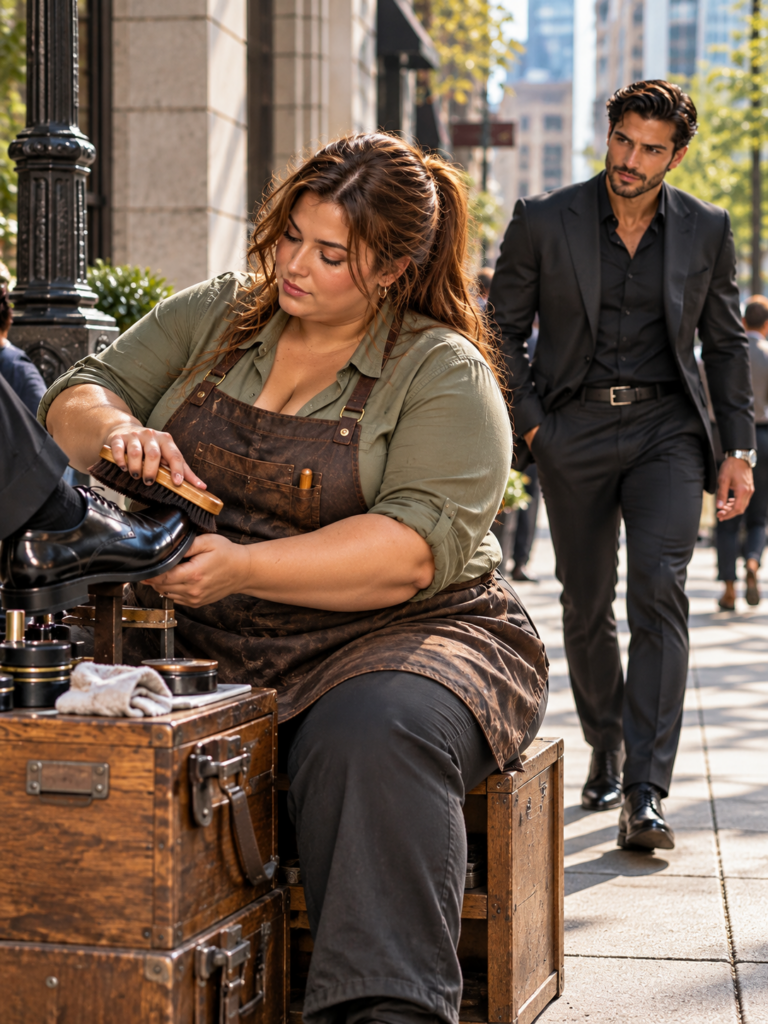
Naomi hurried after him, clutching a thick fold of bills in one hand while trying to keep her wooden shoeshine box from banging against her leg. Morning commuters streamed around her. A taxi horn blared from the intersection. Somewhere behind her, a street vendor shouted about fresh coffee.
But Naomi barely heard any of it.
All she could think about was the money.
“Sir!”
Finally, the man turned.
He was tall, impeccably dressed, and handsome in a way that seemed almost severe. His dark hair was neatly styled, his leather shoes looked expensive enough to belong in a museum, and the watch on his wrist probably cost more than everything Naomi owned.
He studied her with a faint expression of surprise.
“Is something wrong?”
“You left your change.”
She held out the money.
Four hundred and ninety-five dollars.
The man’s eyes moved from the bills to her face.
“I meant to leave it.”
Naomi blinked.
“You meant to give me five hundred dollars for cleaning your shoes?”
“Yes.”
“The shine costs five.”
“I know.”
For a moment, she genuinely wondered whether she had misunderstood him.
Then she extended her hand farther.
“Well, here’s the rest.”
He didn’t take it.
“Keep it.”
Naomi’s fingers closed around the bills.
“Sir, I worked on your shoes for five minutes.”
“And you did an excellent job.”
“Then you owe me five dollars. Not five hundred.”
Something changed in his expression.
He seemed accustomed to people doing what he asked. Not because he was especially demanding, but because money had apparently made disagreement an unusual experience in his life.
“Consider the difference a tip.”
Naomi glanced down at his gleaming shoes.
“A tip that size isn’t a tip. It’s something else.”
“What would you call it?”
“I don’t know. That’s why I’m trying to give it back.”
A passing pedestrian brushed against her shoulder. She stepped aside, but she kept the money extended between them.
The man looked at her for several seconds.
“Most people wouldn’t run after me.”
“Then most people wouldn’t have to work beside the same street corner tomorrow.”
He frowned slightly.
“What does that mean?”
“It means I have to respect myself when I sit down to work. And I can’t do that if I start taking money I haven’t earned.”
The stranger lowered his gaze.
For the first time, the certainty drained from his face.
“My father used to say something very similar.”
Naomi noticed the sudden roughness in his voice.
“Was he a shoeshiner?”
The question seemed to catch him off guard.
He looked past her, toward the crowded intersection.
After a moment, he said, “Something like that.”
There was a sadness in those three words that made Naomi stop pressing him.
She gently placed the extra bills into his hand.
“Five dollars is enough, sir.”
He looked at the money, then at her.
“Will you be working tomorrow?”
“Same place. Same time.”
“And the price?”
“Still five dollars.”
A strange, almost reluctant smile touched his mouth.
“Then I’ll see you tomorrow.”
Naomi watched him disappear into the crowd.
She had met wealthy customers before. Some ignored her. Some treated her kindly. Others behaved as though letting her touch their shoes was an extraordinary privilege.
But she had never met anyone quite like him.
And she certainly had never seen a man look so devastated by getting his money back.
What Naomi didn’t know was that she had just returned four hundred and ninety-five dollars to one of the richest men in the city.
And the money had almost nothing to do with her shoes.
His name was Daniel Reed.
At thirty-eight, Daniel owned one of the most successful luxury watch companies in the world.
His watches appeared in glossy magazines, behind thick glass in exclusive boutiques, and on the wrists of celebrities, world leaders, and royalty.
Some cost more than an ordinary family earned in a decade.
Business publications called him a visionary. Financial analysts called him disciplined. His competitors called him relentless.
People who worked with him often used a simpler word.
Untouchable.
Daniel rarely raised his voice. He didn’t need to. His expectations were precise, his decisions decisive, and his tolerance for excuses practically nonexistent.
Yet none of those people knew what happened when the meetings ended.
Every evening, a driver carried him home to the top floor of a glass residential tower overlooking the city.
A chef prepared dinner.
A long polished dining table waited beneath carefully positioned lights.
There were twelve chairs.
Only one was ever occupied.
Sometimes Daniel ate while reviewing business documents. Sometimes he stared through the windows at the city below. Often he barely touched his food.
No one asked whether he had enjoyed his day.
No one noticed when something troubled him.
And after the household staff finished their work, the apartment became so quiet that he could hear the soft ticking of his own watches.
He had built an empire around the measurement of time.
Yet he had no one with whom he wanted to spend it.
There had been a time when Daniel’s world was very different.
He was eight years old when his mother died.
Her death left a silence inside their small home that his father, Robert Reed, never entirely learned to fill.
Robert wasn’t a businessman. He had no savings worth mentioning, no impressive connections, and no wealthy relatives waiting to rescue them.
He was a street shoeshiner.
Every morning, before Daniel left for school, Robert carried his wooden box to a busy street corner. He arranged the brushes, polishing cloths, and tins of wax exactly where he wanted them.
Then he worked.
Rain, summer heat, winter cold—it made little difference.
There were school fees to pay.
Food to buy.
Shoes to replace when Daniel outgrew them.
Robert’s hands were rough, his back frequently hurt, and his shirts grew thin long before he could afford new ones.
But he never allowed his son to feel ashamed of him.
Sometimes Daniel sat beside him after school, doing homework on the pavement while his father worked.
He remembered the sound of leather being brushed.
The small metallic click of polish tins.
The patient movement of his father’s hands.
And Robert’s favorite lesson.
“A good shine takes patience, Danny. Don’t rush something just because somebody’s watching.”
Daniel would look up from his schoolbook.
“But wouldn’t you make more money if you worked faster?”
“Maybe.”
“Then why don’t you?”
Robert would smile.
“Because the customer is paying me to do the job right.”
He would finish polishing a shoe, inspect it carefully, and add, “Never confuse honest work with small work, son.”
Daniel remembered those words better than almost anything else from childhood.
They became part of him.
But so did something else.
The sight of his father’s exhausted hands.
As Daniel grew older, he began to hate how hard Robert had to work. He hated watching wealthy men place a few coins into his father’s palm without meeting his eyes.
He hated that Robert never complained.
Most of all, he hated being unable to change anything.
So he made a promise.
One day, his father would never have to shine another pair of shoes.
Daniel would buy him a beautiful house.
A comfortable chair.
A place where he could sit in the sunshine without worrying about tomorrow’s customers.
He studied relentlessly. He worked whenever he could. He took chances that frightened other people.
Eventually, those chances became a company.
The company became a fortune.
And the fortune became almost unimaginably large.
But success arrived too late.
Just as Daniel’s business was beginning its first extraordinary rise, Robert died.
Daniel hadn’t purchased the house.
He hadn’t fulfilled the promise.
Worse, he had been so consumed by building the future that he had spent less and less time with the man for whom he claimed to be building it.
The grief was terrible.
The guilt was worse.
After the funeral, Daniel stopped visiting his father’s street corner.
He told himself there was no reason to return.
There were meetings to attend, contracts to negotiate, employees depending on him.
He buried himself in work.
Years passed.
His company expanded across continents. His name appeared on magazine covers. His wealth multiplied.
And the little wooden stool at the corner disappeared from his daily thoughts—or so he tried to believe.
But grief doesn’t always disappear when someone refuses to look at it.
Sometimes it simply learns to wait.
Ten years after Robert’s death, Daniel woke before sunrise.
He knew the date before looking at his phone.
For a long time, he lay motionless beneath the expensive sheets.
Then he got dressed.
Instead of calling for his driver, he decided to walk.
He had no planned destination, no appointment, and no explanation for the powerful urge pulling him through the streets.
But his feet remembered something his mind had spent a decade trying to forget.
Three blocks from the old corner, Daniel slowed.
The neighborhood had changed.
There were new storefronts and taller buildings. Familiar businesses had vanished. Even the traffic seemed louder.
Then he heard it.
A brush moving across leather.
He stopped.
Across the sidewalk sat a young woman with a wooden shoeshine box and an old, dark stool.
Daniel recognized the stool immediately.
The worn edges.
The slightly uneven legs.
The polished patch along one side where years of work had rubbed the wood smooth.
His father’s stool.
For a moment, Daniel couldn’t move.
He could almost see Robert sitting there, sleeves rolled up, a cloth draped over one knee.
Then the young woman raised her head.
“Good morning, sir. Need a shine?”
Daniel had intended only to look.
Instead, he walked toward her.
And sat down.
Naomi was twenty-nine, with observant eyes, capable hands, and a quiet dignity that made even exhausted customers feel welcome.
Her life wasn’t glamorous.
Almost everything required to operate her business fit inside a wooden box.
Brushes. Polish. Cloths. Small tools for basic shoe repairs. A few tins of dye.
Every morning at six, she arrived at the corner.
By evening, her fingers were often stiff, her shoulders ached, and there was black polish beneath her fingernails no matter how carefully she scrubbed.
She charged five dollars for a shine.
Repairs cost a little more, though she was generous with customers who struggled to pay.
A nurse stopped by on her way to the hospital. A schoolteacher occasionally needed help with an old sole. An elderly man paid in small coins, apologizing every time.
Naomi never embarrassed him by counting the money in front of him.
She understood what it meant to stretch a few dollars.
Her younger brother, Samuel, was finishing his last year of school.
Naomi helped cover his fees, his books, and the other expenses that seemed to appear whenever she thought she was finally catching up.
His school shoes were always clean.
She took particular care of those.
Her own shoes, meanwhile, were worn at the sides.
That didn’t bother her.
Samuel had opportunities ahead of him, and she intended to help him reach them.
For years, Naomi had imagined owning a small shop.
Nothing extravagant.
Just a clean place with a glass door, a little bell above the entrance, a narrow counter, and enough light to work without squinting.
She wanted her name painted on the window.
A proper business.
A door she could unlock every morning.
But rent and school expenses came before dreams.
For now, the corner would have to be enough.
She had learned the trade years earlier from an elderly shoeshiner who worked in the same spot.
He had been gentle, patient, and remarkably skilled.
He taught her how to work wax into tired leather, how to repair a loose heel, and how to recognize when a customer wanted conversation—or silence.
He also taught her something more important.
“If you’re going to do a job,” he would tell her, “make sure you can be proud of it when you go home.”
Near the end of his life, he gave Naomi his old stool.
“Look after the corner,” he said.
She had promised she would.
For six years, she had sat on that stool while building her business.
She knew every scratch along its surface.
Or thought she did.
That morning, when Daniel first sat across from her, Naomi noticed immediately that something was unusual.
He didn’t look at his phone.
He didn’t complain about the weather.
He didn’t ask how long the shine would take.
He simply stared at her hands.
“Would you prefer regular polish, sir?”
He seemed to return from somewhere far away.
“Whatever you recommend.”
“All right.”
She began working.
The brush moved across his shoes in slow, measured strokes.
Daniel watched.
The way she held the brush was familiar.
So was the careful pressure she applied near the seams.
Robert had worked like that.
Daniel swallowed.
He wanted to ask where she had learned.
He wanted to know how she had gotten the stool.
But he couldn’t seem to form either question.
When Naomi finished, she set her cloth aside.
“There you go. Five dollars.”
Daniel reached into his pocket and handed her the folded bills.
Then he stood and walked away.
It was only after he had gone that Naomi discovered the five hundred dollars.
And that was how she ended up chasing a billionaire down the street.
The following morning, Naomi was arranging her supplies when she noticed a familiar pair of expensive shoes standing beside her box.
She looked up.
Daniel.
“You’re back.”
“I am.”
She glanced at his shoes.
“They look perfectly clean.”
“They got dirty.”
“Since yesterday?”
“Apparently.”
Naomi fought a smile.
“Where?”
Daniel considered the question.
“On the way here.”
She tilted her head.
“You deliberately walked through dirt to get another shine, didn’t you?”
His expression remained serious.
“Would that be against your rules?”
She laughed before she could stop herself.
“Only if you’re expecting a discount.”
“I wouldn’t dream of it.”
“Then sit down.”
He did.
And the next day, he returned again.
Sometimes he claimed to have stepped in a puddle.
Sometimes a revolving door had apparently scuffed his shoe.
Once, he admitted that he had walked three blocks for no reason other than wanting them cleaned.
Naomi didn’t believe half his excuses.
But she began to look forward to hearing them.
A week later, a customer pointed toward a towering advertisement above the street.
The billboard displayed an exquisite luxury watch.
Beneath it was a photograph of Daniel Reed.
The customer laughed.
“You know who that guy is, don’t you? The fellow who keeps showing up here?”
Naomi looked from the billboard to the empty chair in front of her.
She shook her head.
The man explained.
When Naomi finally understood that her quiet customer controlled an international luxury-watch empire, she stood motionless for several seconds.
Then she returned to polishing the shoes in front of her.
The next morning, Daniel arrived as usual.
Naomi looked up at him.
“Good morning, Mr. Reed.”
He stopped.
There was a brief pause.
“You know.”
“I saw your picture.”
“And?”
“And nothing.”
He raised an eyebrow.
“Nothing?”
“Your shoes still cost five dollars.”
For the first time since Naomi had met him, Daniel laughed.
Not the polite little laugh wealthy customers sometimes offered when they wanted to appear friendly.
A real one.
The sound surprised both of them.
And for reasons Daniel couldn’t explain, that small moment stayed with him long after he returned to his office.
He began to find excuses to talk.
At first, they discussed harmless things.
Traffic.
Weather.
The strange habits of commuters.
Then the conversations became more personal.
Daniel admitted he hadn’t taken a proper day off in nine years.
Naomi stopped brushing.
“Nine years?”
“Something like that.”
“You haven’t gone anywhere just because you wanted to?”
“I travel constantly.”
“For business?”
“Yes.”
“That’s not what I meant.”
Daniel watched her thoughtfully.
“No. I suppose it isn’t.”
Another day, he mentioned the enormous dining table in his apartment.
“Twelve seats,” he told her.
Naomi smiled.
“Big family?”
“No.”
“Friends?”
He hesitated.
“Not really.”
Her smile faded.
“How many people usually eat there?”
“One.”
She kept her eyes on the leather.
“That sounds lonely.”
Daniel could have dismissed the observation.
He was a man who had spent years avoiding pity.
But Naomi hadn’t spoken with pity.
She had simply recognized something.
“Yes,” he admitted.
“It is.”
A few days later, she noticed his hand trembling slightly when he reached for his phone.
“Did you eat lunch?”
“I’ve been busy.”
“That wasn’t my question.”
Daniel glanced up.
“No.”
Without another word, Naomi opened the cloth containing her sandwich.
She broke it in half and handed him the larger piece.
He stared.
“Naomi, I can’t take your lunch.”
“It’s half a sandwich.”
“You need it.”
“So do you.”
“I can order something.”
“Then order something tomorrow.”
She pushed the sandwich toward him.
“Today, you’re eating this.”
Daniel took it reluctantly.
He ate slowly.
There was nothing extraordinary about the bread, the filling, or the small meal they shared beside the street.
But Daniel couldn’t remember the last time someone had noticed he was hungry without being paid to notice.
The following afternoon, he appeared shortly before one.
Naomi unfolded her lunch cloth.
Two halves.
Neither spoke about the new arrangement.
They didn’t need to.
Soon, their afternoons developed a rhythm Daniel found himself protecting from the demands of his business.
At one o’clock, he returned to the corner.
At one o’clock, Naomi shared her sandwich.
And for a little while, the watches he manufactured no longer seemed to matter.
Something else was happening, too.
Daniel began noticing the world Naomi inhabited.
The tired faces of commuters.
The schoolteacher who brought old shoes because a new pair wasn’t affordable.
The nurse who sometimes arrived in a hurry and left looking a little more confident.
Naomi remembered people’s names.
She remembered their worries.
She treated every pair of shoes as though the person wearing them mattered.
Watching her, Daniel felt an uncomfortable recognition.
His father had approached the world the same way.
Then, one Thursday, the sky turned dark before noon.
Naomi was covering her supplies with a thin plastic sheet when Daniel arrived.
“You should leave,” she told him. “It’s going to rain hard.”
“Then why are you staying?”
“Some customers are still heading to work.”
Before he could respond, rain began pouring down.
Naomi grabbed her old black umbrella.
Daniel expected her to protect herself.
Instead, she leaned forward and held it over his polished shoes.
Within seconds, water was running through her hair and down her sleeves.
“Naomi, what are you doing?”
“Trying to keep the leather dry.”
“Forget the shoes. You’re getting soaked.”
She adjusted the umbrella.
“They’re expensive.”
“They’re shoes.”
“And someone spent time making them.”
Daniel stared at her.
She wasn’t trying to impress him.
She wasn’t flattering him because of his money.
She was protecting another person’s workmanship at the expense of her own comfort.
He had employees, drivers, and assistants who anticipated his every need.
Yet standing in that rain, he realized how rarely anyone had ever shown him this kind of uncomplicated care.
When the worst of the storm passed, Naomi lowered the umbrella.
Her clothes were wet.
Her shoes were drenched.
And Daniel’s were perfectly dry.
He wanted to say something that would convey what the moment had meant to him.
Nothing seemed adequate.
So he simply helped her gather the scattered supplies.
A few days later, another encounter changed the way he looked at her.
A young man rushed toward the corner, visibly nervous.
He had a job interview in twenty minutes.
His shirt was carefully pressed, but his shoes were badly scuffed, and one heel had started splitting.
He took two crumpled bills from his pocket.
“It’s all I’ve got,” he said. “Can you do anything?”
Naomi glanced at the money.
Then at the shoes.
“Sit down.”
Daniel stood quietly beside the box.
Naomi worked quickly, repairing the small split, applying polish, and buffing the worn leather until the shoes looked presentable.
When she finished, the young man reached for his money.
“How much?”
“Nothing.”
He stared at her.
“But—”
“You’ve got an interview. Don’t waste time arguing with me.”
He looked close to tears.
“Why would you help me?”
Naomi smiled.
“Someone helped me once. Now go get that job.”
The young man hurried away.
Daniel watched him disappear into the crowd.
Then he turned to Naomi.
“You do that often?”
“When I can.”
“He couldn’t pay you.”
“I noticed.”
“You still gave him the shine.”
“He needed it.”
Daniel fell quiet.
For someone whose adult life revolved around the value of things, Naomi’s answer was difficult to dismiss.
She understood money.
He knew that.
She worked long hours for very little, and nearly everything she earned went toward keeping herself and Samuel afloat.
Yet she had given away her labor without resentment.
Because someone needed it.
Daniel looked at the old stool beneath her.
For the first time in years, he allowed himself to study it closely.
His gaze followed the worn leg, the scratched edges, the dark underside of the wooden seat.
And then he noticed something.
Faint grooves.
Marks that looked suspiciously like carved letters.
His pulse accelerated.
He leaned closer.
Naomi noticed.
“Daniel?”
He didn’t answer immediately.
Because if those marks were what he thought they were, the woman sitting across from him knew far more about his father than either of them realized.
And the corner he had spent ten years avoiding was holding something he had believed lost forever.
Part 2
The next afternoon, Daniel arrived earlier than usual.
Naomi noticed the difference before he said a word.
He wasn’t carrying his phone in his hand. There was no faint amusement in his expression, no explanation about a mysterious scuff or an inconvenient puddle.
He sat in the familiar chair and looked toward her stool.
“Something wrong?” she asked.
“No.”
But she knew him well enough by now to recognize when that answer meant the opposite.
She placed his foot on the rest and began working.
For several minutes, neither spoke.
The sound of the brush filled the space between them.
Then Daniel asked, “Naomi, where did you get that stool?”
She glanced down.
“Someone gave it to me.”
“Who?”
“An old shoeshiner. He taught me the trade.”
Daniel’s fingers tightened around the edge of his chair.
“Do you know who owned it before you?”
Naomi smiled faintly.
“I’ve never thought much about that. It’s been mine for years.”
“It wasn’t always.”
Her brush stopped.
There was something in his voice that made her look up.
“Daniel, what are you trying to tell me?”
He stared at the stool.
“Please finish the shoes first.”
Naomi almost argued.
Instead, she studied his face, then slowly resumed her work.
By the time she finished, Daniel had barely moved.
She set the brush aside.
“Now tell me.”
He nodded toward the stool.
“Turn it over.”
Naomi frowned.
“Why?”
“There’s something underneath it.”
She stood, lifted the wooden stool, and carefully tilted it sideways.
At first, she saw only dark wood worn smooth by years of use.
Then her gaze caught the shallow marks carved near the underside of the seat.
Letters.
She leaned closer.
There was a name.
Unevenly cut.
Old enough that dust and polish had darkened the grooves.
Robert Reed.
Naomi ran her thumb across the carving.
“Robert Reed,” she whispered.
Daniel closed his eyes.
She looked at him.
“Do you know this man?”
He opened his eyes again.
There was no sign of the distant billionaire who commanded conference calls and made decisions worth millions of dollars.
Only a grief-stricken man struggling to breathe normally.
“He was my father.”
Naomi stared.
“What?”
Daniel nodded slowly.
“Robert Reed was my dad.”
She lowered the stool carefully.
For several seconds, neither could speak.
Then Naomi whispered, “The man who taught me?”
Daniel looked at her.
“He taught you?”
She nodded, still trying to understand.
“The old shoeshiner who worked here. The man who gave me this stool.”
Daniel pressed his fingers against his mouth.
“He worked this corner for twenty-two years.”
His voice grew unsteady.
“I used to sit right there when I was little. After school. I’d bring my homework and sit beside him while he polished shoes.”
Naomi turned toward the sidewalk.
She had never imagined Daniel as a small boy sitting on concrete with a schoolbook balanced against his knees.
But now she could almost see him.
Dark-haired.
Serious.
Watching his father’s hands.
“He used to talk about his son,” she said quietly.
Daniel looked up sharply.
“What did he say?”
Naomi considered her memories.
“He said his boy was smart. That he was working hard. That one day he was going to build something wonderful.”
Daniel stared at the pavement.
“He never told you my name?”
“No.”
“Did he ever complain about me?”
The question surprised her.
“Complain?”
Daniel’s voice barely carried above the traffic.
“Did he ever say I didn’t visit enough? That I forgot where I came from?”
Naomi felt something inside her tighten.
“No, Daniel.”
He didn’t look convinced.
She knelt beside him.
“Not once.”
Daniel shook his head.
“I should have come back.”
“Daniel—”
“I had the money. Eventually, I had more money than I knew what to do with. I could have given him everything.”
His voice cracked.
“But when he needed me, I was always working.”
Naomi didn’t interrupt.
He stared at the little wooden stool.
“I kept thinking there would be time later. After the next contract. After the company was bigger. After everything settled down.”
He laughed bitterly.
“Nothing ever settled down. I made sure of that.”
A bus rolled past, shaking the pavement.
Daniel waited for the noise to fade.
“I was going to buy him a house.”
Naomi watched him.
“A real house,” he continued. “A place where he wouldn’t have to get up before sunrise. Somewhere quiet.”
His eyes filled.
“He never got to live in it.”
Naomi sat beside him on the edge of the sidewalk.
She understood now.
The expensive shoes.
The money.
His strange insistence on returning every morning.
Daniel hadn’t been coming because he needed his shoes polished.
He had been coming because she was sitting where his father once sat.
Every day, for a little while, he could hear the familiar sound of a brush against leather.
He could watch the same patient movements.
He could sit in the place where he had once been a child.
And perhaps, for a few minutes, he could pretend that the years hadn’t taken everything away.
“You know something?” Naomi said softly.
Daniel turned toward her.
“He was proud of you.”
Daniel looked away.
“You don’t have to say that.”
“I’m not saying it to make you feel better.”
She glanced at the old stool.
“He talked about you when he was tired. When the weather was bad. Even when he barely had enough strength to finish a customer’s shoes.”
Daniel’s eyes returned to hers.
“He told me his son was building something important. He said you worked harder than anyone he knew.”
Naomi smiled through gathering tears.
“I used to think it must be wonderful to have someone believe in you that much.”
Daniel swallowed.
For ten years, he had imagined his father dying disappointed in him.
Now he was hearing something entirely different.
“He never blamed you,” Naomi said.
Daniel bowed his head.
She didn’t try to convince him that all his regrets were unnecessary.
He had lost time with his father.
Nothing could change that.
But perhaps she could help him understand that Robert hadn’t spent those final years counting his son’s failures.
He had spent them celebrating his future.
Suddenly, Naomi remembered something.
“Wait here.”
She turned toward her shoeshine box and pulled open the small lower drawer.
Beneath old cloths and carefully stored supplies was a bundle wrapped in faded gray fabric.
She lifted it out.
Daniel watched, confused.
“What is that?”
“Something he gave me.”
She untied the fabric.
Inside lay an old shoeshine brush.
Its wooden handle had been worn pale by years of use.
Beside it rested a thin polishing cloth, carefully folded, with a tiny letter R stitched into one corner.
Daniel stopped breathing for a moment.
He recognized them.
He knew the shape of that brush.
The way the handle curved.
The little worn place where Robert’s thumb had rested through countless working days.
Slowly, Daniel reached toward it.
“May I?”
Naomi nodded.
He lifted the brush.
Its weight settled into his palm with an almost unbearable familiarity.
For a moment, he was no longer thirty-eight.
He was eight again.
Sitting beside his father.
Watching the sunlight move over the sidewalk.
Waiting for Robert to finish the last customer’s shoes so they could walk home together.
“I know this brush,” Daniel whispered.
His thumb moved across the wooden handle.
“He used to let me hold it.”
Naomi stayed quiet.
“When his hands were tired, sometimes he’d let me finish the last shine. He’d watch me work and tell me I was getting better.”
Daniel gave a trembling smile.
“He said I had good hands.”
Naomi’s eyes filled.
“He told me that, too.”
Daniel looked up.
“He said his son had the best hands of anyone he’d ever taught.”
For a long moment, Daniel stared at the brush.
He had bought countless rare and expensive objects during his life.
Nothing he owned had ever felt as valuable as the worn piece of wood in his hands.
Naomi touched the folded cloth.
“He gave me these when he gave me the stool. But I never used them.”
“Why not?”
“They were his. I didn’t feel right wearing them out.”
Daniel looked at the stitched R.
A small, imperfect letter.
He remembered seeing his father mark cloths that way so they wouldn’t get mixed up with other supplies.
Something so ordinary.
Something he had forgotten existed.
Naomi hesitated.
“There’s one more thing.”
Daniel raised his head.
“One evening, when he was getting weaker, he sat with me after work.”
She paused, recalling the conversation.
“He talked about you for a long time. About how you used to do homework beside him, and how you were building a company.”
Daniel’s grip tightened around the brush.
“What else?”
“He told me you hadn’t been back in a while.”
Daniel looked down.
Naomi continued gently.
“I asked whether it made him sad.”
“And?”
“He said you were busy becoming the man he’d always known you could be.”
Daniel closed his eyes.
“Did he think I’d come back?”
“Yes.”
She moved closer.
“He told me to keep the corner warm for you.”
Daniel’s eyes opened.
Naomi’s voice trembled.
“He said that one day, when you were ready, you’d find your way home.”
The brush shook in Daniel’s hands.
For years, he had imagined his father waiting in anger.
He had imagined disappointment.
Questions.
Accusations he would never be able to answer.
Instead, Robert had left him patience.
Even at the end.
Even when Daniel had been too frightened to return.
He pressed the old brush against his chest.
His shoulders began to shake.
At first, he tried to stop it.
He turned his face away, as though the tears were something embarrassing.
But there was too much grief inside him.
Too much guilt.
Too many years of pretending he could survive without remembering the man who had loved him first.
Finally, Daniel bent forward and cried.
Not quietly.
Not elegantly.
He cried with the helplessness of someone who had spent ten years holding his sorrow inside.
Naomi didn’t tell him to be strong.
She didn’t remind him how powerful he was.
She simply sat beside him.
Close enough that he wouldn’t feel alone.
People continued walking past.
Cars stopped at the traffic lights.
The city carried on with its ordinary afternoon.
But Daniel had stopped caring who saw him.
For the first time in a decade, he allowed himself to miss his father.
When his breathing finally steadied, he looked at Naomi.
“I can’t take these,” he whispered.
He held out the brush and cloth.
“They belong to you.”
Naomi shook her head.
“They were only mine to protect.”
“But your mentor gave them to you.”
“And now I understand why I kept them.”
She closed his fingers around the brush.
“You should have them, Daniel.”
He looked at her for a long time.
“Thank you.”
It wasn’t a businessman thanking someone for a service.
It was a son accepting something precious that had been waiting for him.
And Naomi understood the difference.
After that afternoon, something changed between them.
Daniel still visited the corner.
Naomi still charged him exactly five dollars.
They still shared sandwiches at one.
But now their conversations carried a different warmth.
Daniel no longer had to pretend he came only because of his shoes.
Naomi no longer wondered why her ordinary corner mattered so much to him.
Sometimes they talked about Robert.
Sometimes they sat without talking.
And sometimes Naomi caught Daniel looking at her with an expression that made her heart beat faster.
There was gratitude in it.
But she was beginning to suspect there was something else, too.
She hadn’t intended to grow attached to him.
A man like Daniel belonged to a world she barely understood.
His home overlooked the city.
His business crossed oceans.
Her livelihood depended on brushes, polish, and the number of customers who stopped by before sunset.
Yet when Daniel sat across from her, those differences seemed less important.
She liked how carefully he listened.
How his humor appeared slowly, almost shyly, beneath his serious manner.
How he remembered small things about Samuel.
And how he was beginning to look less exhausted each day.
Daniel, meanwhile, found himself thinking about Naomi at inconvenient moments.
He thought about her when meetings dragged on.
When someone praised him for another successful deal.
When he looked at the empty chairs around his dinner table.
She was the first person in years who had made him wonder whether his life could contain something beyond work.
He wanted to do something meaningful for her.
Something that might repay even a fraction of what she had given him.
And because Daniel Reed had spent his adult life solving problems with money, he made a decision that seemed perfectly reasonable to him.
He bought her a shop.
Three days after the emotional discovery at the corner, Daniel arrived holding a folder.
Naomi glanced up.
“No scuffed shoes today?”
“Not particularly.”
“Then what’s that?”
He smiled.
“Something I want you to see.”
She wiped her hands and opened the folder.
Inside were photographs.
A narrow storefront on a quiet street.
A glass door.
A small brass bell.
A bright window overlooking a clean work area.
Naomi studied the pictures.
Her breath caught.
She knew this kind of shop.
She had imagined it for years.
“What is this?”
“A place of your own.”
She looked up.
Daniel continued carefully.
“I bought the building yesterday. Everything is arranged. The documents are signed.”
Naomi stared at him.
He turned one photograph toward her.
On the glass, painted in elegant letters, was her name.
For one beautiful, frightening second, she could almost feel the key in her hand.
She could imagine opening that door.
Hearing the bell ring.
Welcoming her first customer inside.
It was everything she’d wanted.
Then she closed the folder.
“Daniel, I can’t.”
He blinked.
“What do you mean?”
“I can’t accept it.”
His smile faded.
“Naomi, this is your dream.”
“I know.”
“Then what’s wrong?”
She looked at the photographs again.
The answer hurt more than she expected.
“It’s too much.”
Daniel moved closer.
“You helped me find something I thought I’d lost forever. You looked after my father’s corner. You gave me his brush. Let me do something for you.”
Naomi shook her head.
“I didn’t do any of that to earn a reward.”
“I know.”
“Then you understand why I can’t take the shop.”
“No,” Daniel said softly. “I don’t.”
She took a careful breath.
“I want that door more than I can tell you. But I want to earn the right to open it myself.”
“You have earned it.”
“Not like this.”
Daniel glanced at the folder.
“There’s no obligation attached.”
“Maybe not for you.”
Her voice trembled.
“But I would always know you bought it. Everyone else would know, too.”
He looked at her.
She continued.
“I don’t want to be the woman who got a business because a billionaire felt sorry for her.”
“I don’t feel sorry for you.”
“I know you don’t mean it that way.”
“Then why won’t you let me help?”
Naomi struggled to find words that wouldn’t hurt him.
“Because what we’ve shared matters to me.”
Daniel stopped.
“The lunches. Our conversations. Your father. Everything.”
She glanced down.
“I don’t want any of that turned into a debt that has to be repaid.”
Daniel’s face grew still.
“That’s not what this is.”
“Then please believe me when I say I don’t want it.”
For a moment, there was only traffic noise between them.
Naomi knew she was refusing more than a building.
Daniel was offering gratitude in the language he understood best.
Money.
He could acquire property, hire professionals, and solve practical problems with a signature.
But what he couldn’t easily understand was why the woman he cared about might value her independence more than his generosity.
Naomi touched the folder.
“Your father wouldn’t have accepted something like this, either.”
The words came out before she could soften them.
Daniel’s expression changed.
She saw the hurt immediately.
“Daniel, I didn’t mean—”
“I understand.”
He collected the folder.
“No. Please, I—”
“You want to do it yourself.”
His voice was controlled.
She nodded.
“Yes.”
“Then I shouldn’t interfere.”
He stood.
Naomi reached toward him.
“Daniel.”
He looked at her, and for a moment she thought he might sit back down.
Instead, he gave a small nod.
“I hope you get your shop, Naomi.”
Then he turned and walked away.
He didn’t ask whether she would be there tomorrow.
And Naomi, watching him disappear into the crowd, felt a sudden emptiness that frightened her.
The next day, Daniel didn’t come.
At one o’clock, she opened her lunch cloth.
She looked toward the empty chair.
Then she told herself he was busy.
The second day, she made the same excuse.
Daniel ran a vast company. He had responsibilities. Surely he couldn’t spend every afternoon sitting beside her on the sidewalk.
But on the third day, the truth became harder to ignore.
Naomi broke her sandwich in half.
She placed the larger portion on the empty chair.
Then she waited.
Customers came and went.
The sunlight shifted.
The sandwich remained untouched.
By evening, Naomi had barely eaten.
Samuel noticed as soon as she got home.
“You’ve been quiet all week.”
“Just tired.”
He watched her set down the box.
“Where’s the man who always needs his shoes cleaned?”
Naomi looked up.
Samuel knew about Daniel.
Not his entire story, but enough to recognize that the mysterious wealthy customer had become important to his sister.
“He hasn’t been around.”
“Did something happen?”
Naomi sat down.
“He wanted to buy me a shop.”
Samuel stared.
“A whole shop?”
She nodded.
“And you said no?”
“Yes.”
“Why?”
“Because I need to build something that’s mine.”
Samuel considered that.
Then he sat beside her.
“Did you explain that?”
“I tried.”
“And?”
“I think I hurt him.”
Samuel was quiet for a while.
“Did he say something cruel?”
“No.”
“Did he ask you for anything?”
“No.”
“Then maybe he just doesn’t understand.”
Naomi looked at her brother.
Samuel continued thoughtfully.
“Maybe he’s spent so long giving people money that he doesn’t know what else to give.”
The words stayed with her.
Daniel had tried to hand her a building because he didn’t know how to say what she meant to him.
And she had rejected the building because she needed him to understand that their connection wasn’t for sale.
Neither had known how to reach the other.
Later that evening, after the streets grew quiet, Naomi returned to the corner.
She sat on Robert’s old stool and thought about the past few weeks.
She remembered Daniel’s first awkward smile.
His terrible excuses about dirty shoes.
The way he looked when he held his father’s brush.
The sound of his laughter.
The empty chair beside her.
She wanted a shop.
She still wanted it.
But suddenly, her dream of a little storefront felt incomplete.
Because the future she imagined now included something she hadn’t planned for.
Someone.
Naomi ran her hand over the worn wood beneath her.
She didn’t need Daniel to buy her a building.
She didn’t need another expensive gift.
She only wanted him to return.
And for the first time, she understood just how much she had begun to care about him.
Part 3
On the fourth morning, Naomi arrived at the corner before six.
The city was still waking up.
Delivery trucks rumbled along the street. A few early commuters hurried past with coffee in their hands.
She placed her shoeshine box beside the old stool and arranged everything as she always did.
Brushes to the left.
Polish near the center.
Clean cloths folded neatly.
She tried not to look at the chair across from her.
For ten minutes, she succeeded.
Then she heard footsteps.
Slow.
Unhurried.
Familiar.
Naomi raised her head.
Daniel stood a few feet away.
He wasn’t wearing one of his expensive suits.
Instead, he had on a plain jacket and dark trousers.
There was no driver waiting behind him.
No assistant.
No folder filled with documents.
Only Daniel.
And something small in his hand.
“Good morning,” he said.
Naomi felt her throat tighten.
“You’re early.”
A faint smile crossed his face.
“I wasn’t sure you’d want me to come back.”
She stood immediately.
“Daniel—”
“Please. There’s something I need to say.”
Naomi stopped.
He looked toward the stool, then back at her.
“I’ve spent the last few days thinking about what happened.”
She waited.
“You were right.”
Naomi opened her mouth, but Daniel continued.
“I tried to give you a shop because I thought that was the best way to thank you.”
He looked at his hands.
“I’m used to fixing things with money. When there’s a problem at work, I find the resources and solve it. When somebody needs something, I buy it.”
His voice softened.
“But I didn’t ask what you actually wanted.”
Naomi’s eyes filled.
“Daniel, I know you meant well.”
“I did. But that doesn’t mean I was listening.”
He looked toward the old stool.
“My father never had much money. But I never doubted that he loved me.”
A long pause followed.
“He gave me his time. He helped with my homework when he was exhausted. He listened when I was afraid. He made me feel that I mattered more than anything else in the world.”
Daniel took a careful breath.
“I spent years thinking I needed to become rich enough to repay him.”
His eyes returned to Naomi.
“But I can’t repay him. I can only remember what he taught me.”
Naomi brushed a tear from her cheek.
Daniel continued.
“I don’t want to buy your dreams. I want to see you accomplish them.”
She smiled shakily.
“And I want to be there, if you’ll let me.”
“Daniel…”
“I’m sorry I walked away.”
Naomi shook her head.
“I’m sorry I hurt you.”
“You didn’t do anything wrong by saying no.”
She looked at him for a long moment.
Then she said quietly, “I never wanted you to stop coming.”
Daniel’s expression changed.
“I know that now.”
He opened his hand.
Resting in his palm was Robert’s old shoeshine brush.
Beside it lay the worn gray cloth marked with a small embroidered R.
Naomi stared.
“What are you doing?”
Daniel looked toward the chair.
“Something my father taught me a long time ago.”
Then, to her astonishment, he knelt on the pavement.
Naomi stepped forward.
“Daniel, get up.”
He smiled.
“Not yet.”
“People are looking.”
“Let them.”
He nodded toward her shoes.
“May I?”
Naomi glanced down.
Her old work shoes were cracked at the edges and marked with years of street dust.
She had spent thousands of hours making other people’s shoes look beautiful.
She rarely had time to care for her own.
“You don’t have to do this,” she whispered.
“I know.”
He held up the brush.
“I’d like to.”
There was something so gentle in his expression that Naomi couldn’t bring herself to refuse.
Slowly, she sat on the old stool.
Daniel guided one of her feet onto the shoeshine rest.
For a moment, he studied the worn leather.
Then he opened the polish.
His hands trembled as he lifted the brush.
It had been decades since he had worked this way.
He remembered the movements, but not perfectly.
The first strokes were awkward.
Then the rhythm returned.
Slow circles.
Even pressure.
Careful attention near the seams.
Just as Robert had taught him.
Naomi watched in silence.
There was something almost impossible about the sight.
A man who owned an international watch empire was kneeling on a crowded sidewalk, polishing a poor woman’s shoes with a brush that had once belonged to his father.
Yet Daniel looked more comfortable doing this than she had ever seen him look in his expensive suits.
He wasn’t thinking about shareholders, sales figures, or the value of his time.
He was simply doing something kind.
With his own hands.
After a while, he glanced up.
“My father used to tell me I was too impatient.”
Naomi smiled through her tears.
“He told me the same thing.”
Daniel looked down at the leather.
“He was right.”
He continued working until the worn shoes took on a gentle shine.
They were still old.
There was no hiding that.
But they were clean, carefully polished, and treated with the same respect Naomi had given every customer who sat across from her.
When Daniel finished, he lowered the brush.
“There.”
Naomi looked at her shoes.
Then at him.
Her voice trembled with laughter.
“How much do I owe you?”
Daniel pretended to consider.
“Five dollars.”
Naomi laughed.
“Exactly five?”
“Not a penny more.”
Her laughter turned into tears.
Daniel laughed with her.
And for the first time in years, he felt no need to hide his happiness.
He was still kneeling when he looked up and asked, “Can I come back tomorrow?”
Naomi reached out her hand.
He took it.
She helped him stand.
Then she smiled.
“Sit down, Daniel. You’re early.”
The following morning, Daniel returned carrying a small wooden sign.
He held it awkwardly beneath one arm.
Naomi narrowed her eyes.
“What’s that?”
“Something I made.”
“You made it?”
“Yes.”
“With your own hands?”
“Believe it or not.”
She laughed.
Daniel looked almost embarrassed.
“I borrowed a paintbrush. Ruined the first two attempts. The third wasn’t much better.”
He turned the sign toward her.
Naomi stopped smiling.
Not because she disliked it.
Because she could hardly speak.
Painted across the wood were the words:
Robert’s Corner
Honest Work Since 1989
The letters weren’t perfect.
One leaned slightly to the right.
Another was a little too thick.
But Naomi thought it was beautiful.
Daniel studied her expression nervously.
“He never had a proper sign.”
She nodded.
“He said good work should speak for itself.”
“I remember.”
Daniel touched the edge of the wood.
“But I thought people should know his name.”
Naomi ran her fingers over the painted letters.
For years, Robert had been remembered privately by the two people standing beside that stool.
Now his name would become part of the street again.
“I love it,” she whispered.
Together, they fastened the sign above the corner.
And slowly, something wonderful happened.
People began to notice.
The nurse told her coworkers.
The schoolteacher recommended Naomi to other teachers.
The young man whose shoes she had repaired before his interview told friends about the woman who had helped him when he couldn’t afford it.
More customers arrived.
Some came for a shine.
Others brought shoes that needed careful repairs.
A few simply wanted to know the story behind the wooden sign.
Naomi told them about Robert.
About his patience.
About his belief that no honest work was beneath a person.
Word spread.
The line at the corner grew longer.
And little by little, Naomi’s savings grew.
Daniel never offered to buy her another shop.
He never mentioned the old folder.
He understood now that loving someone’s dream did not mean taking control of it.
Instead, he supported Naomi in the ways she welcomed.
He came at one o’clock.
He paid five dollars.
He shared her sandwiches.
He listened when her days were difficult.
And Naomi did the same for him.
Daniel began changing his life.
He started leaving his office at noon whenever his responsibilities allowed.
He hired another assistant to help manage the workload.
He stopped treating every Sunday as another opportunity to work.
For the first time in nine years, he began giving himself permission to rest.
His home changed, too.
One evening, he invited Samuel to dinner.
Samuel arrived with two friends and a deck of cards.
Daniel’s chef prepared more food than anyone could finish.
Laughter filled the dining room.
Cards scattered across the enormous table.
Someone accused Samuel of cheating.
Samuel denied it indignantly.
And Daniel, sitting among them, laughed until his stomach hurt.
Later, after everyone had gone, he remained at the table for a while.
The room was quiet again.
But the quiet no longer felt empty.
He could still remember the laughter.
The conversations.
The simple pleasure of having people around him who expected nothing except his company.
He looked at the empty chairs and smiled.
For years, he had owned a table large enough for twelve.
Now he finally understood what it was for.
Almost a year after Daniel first returned to his father’s corner, Naomi stood outside a small storefront on a quiet street.
In her hand was a key.
A narrow brass bell hung above the glass door.
Sunlight spilled across the front window.
And painted carefully on the glass was her own name.
She had saved for this.
Every coin she could spare.
Every repair completed.
Every five-dollar shine.
She had found a place she could afford, negotiated the lease, signed the documents, and opened the business herself.
The shop wasn’t large.
But it was exactly what she’d dreamed of.
And this time, when she unlocked the door, there was no feeling that she owed anyone for the opportunity.
She had earned it.
At precisely one o’clock, Daniel arrived.
He wore his familiar plain jacket.
For several seconds, he stood outside, studying the storefront.
Then he opened the door.
The little bell rang.
Naomi turned.
“Well?”
Daniel looked around.
At the narrow counter.
The neatly arranged supplies.
The polished chair waiting by the window.
The sunlight brightening the clean floor.
Finally, he looked at her.
“It’s beautiful.”
Naomi smiled.
“I did it.”
Daniel nodded.
“You did.”
Her eyes shone.
He stepped toward the chair.
“Are you accepting customers?”
“Of course.”
“Then I believe my shoes need attention.”
She glanced down.
“They look clean.”
“They got dirty on the way here.”
Naomi burst out laughing.
“Daniel Reed, you are the worst liar I’ve ever met.”
“I’ve been told I’m quite convincing in business.”
“Then you’re much better at business.”
He sat down.
Naomi picked up her brush and began to work.
The familiar sound filled the little shop.
Neither needed to say much.
When she finished, Daniel handed her a five-dollar bill.
She accepted it.
“Exactly five.”
“Exactly.”
Behind the counter, on a small wooden shelf, rested Robert’s old brush and the folded gray polishing cloth.
The little embroidered R was visible in the afternoon sunlight.
And several streets away, the original corner remained.
Robert’s wooden stool stood beside a newer one, beneath the handmade sign bearing his name.
The place had not been forgotten.
Neither had the man who had spent twenty-two years working there.
Naomi looked at Daniel.
He looked back at her with the quiet, familiar warmth that had grown between them over the past year.
“Same time tomorrow?” he asked.
She tilted her head.
“Sit down, Daniel. You’re early.”
He smiled.
And Naomi understood that the most important thing he had ever given her wasn’t money, a building, or an expensive gift.
It was his time.
His trust.
His willingness to change.
Daniel, who had once believed that wealth could compensate for everything he had lost, had finally discovered something money could never buy.
The feeling of being welcomed somewhere simply because someone wanted him there.
He had come to that corner carrying ten years of grief.
He had tried to leave five hundred dollars behind.
But the woman who refused his money had given him something infinitely more valuable.
A way to remember his father without running from the pain.
A reason to open his heart again.
And a place where he no longer had to feel alone.
He had spent his life creating watches that measured the passing of time.
Now, at last, he was learning how to treasure it.
And every afternoon, when the little brass bell above Naomi’s door rang, he was reminded of a simple truth his father had understood all along.
A person’s worth was never measured by the money in their pocket.
And love, in its quietest and most meaningful form, was never something that could be bought.

